bookmark_borderNow, It’s Time to Go?

[Intro]
Wait are you telling me….
This is it… this is the show?
That’s all there is to see.
Now, it’s time to go?

[Bridge]
Woe (Woah)
Whoa (woe)
Woulda been nice to know

[Verse 1]
I had been anticipating
(After all this waiting)
There would be some reason (Why?)
Optimist procrastinating… (do or die?)

[Chorus]
Wait are you telling me….
This is it… (this is the show?)
That’s all there is to see?
(Now, it’s time to go.)

[Bridge]
Woe (Woah)
Whoa (woe)
Woulda been nice to know

[Verse 2]
I guess I was overrating
(After over-anticipating)
The exact reason (Why?)
Antagonist propagating… (sell the lie.)

[Chorus]
Wait are you telling me….
This is it… (this is the show?)
That’s all there is to see?
(Now, it’s time to go.)

[Bridge]
Woe (Woah)
Whoa (woe)
Woulda been nice to know

[Outro]
End. (of the show)
Now (it’s time to go)
Go.

From the album “Obscured” by Daniel

The Human Induced Climate Change Experiment

MegaEpix Enormous

bookmark_borderCold Hard Heat

[Intro]
Who lacks…
Cold hard facts?
Do you think you can beat
The heat?

[Verse 1]
Shouldn’t be surprising
The temperature is rising
Due to increased gases
Amassed from the masses

[Chorus]
Who lacks cold hard facts
(Do you think you can beat the heat)
Who can try to deny
(We’re all going to fry)

[Bridge]
Melting ice
(Rising sea levels)
Gonna pay the price
(As our climate dishevels)

[Verse 2]
Extreme weather events
Sure represents
An obvious thesis
On our dying species

[Chorus]
Who lacks cold hard facts
(Do you think you can beat the heat)
Who can try to deny
(We’re all going to fry)

[Bridge]
Melting ice
(Rising sea levels)
Gonna pay the price
(As our climate dishevels)

[Chorus]
Who lacks cold hard facts
(Do you think you can beat the heat)
Who can try to deny
(We’re all going to fry)

[Bridge]
Melting ice
(Rising sea levels)
Gonna pay the price
(As our climate dishevels)

[Outro]
Yet with all we know
(Here we go….)

A SCIENCE NOTE
The basic cold hard facts about global warming are well-established in the scientific community, based on overwhelming evidence from a wide range of studies. Key points include:

  1. Rising Temperatures: Global average temperatures have risen by about 1.2°C (2.2°F) since the late 19th century, primarily due to human activities, especially the burning of fossil fuels. This warming is contributing to more frequent and intense heatwaves and shifts in climate patterns worldwide (NASA, IPCC).
  2. Increased Greenhouse Gases: The concentration of carbon dioxide (CO2), methane (CH4), and nitrous oxide (N2O) in the atmosphere has reached unprecedented levels due to human activities. These gases trap heat in the atmosphere, creating the greenhouse effect that warms the planet (IPCC).
  3. Melting Ice and Rising Sea Levels: Ice sheets and glaciers are melting at an accelerating rate, contributing to rising sea levels. Since 1900, global sea levels have risen by about 20 cm (8 inches), and this rate is increasing. This threatens coastal communities and ecosystems (NASA, NOAA).
  4. Ocean Warming and Acidification: The world’s oceans have absorbed much of the excess heat, with the top 100 meters warming by about 0.33°C since 1969. Additionally, the absorption of CO2 is making oceans more acidic, which harms marine life, especially corals and shellfish (NOAA, IPCC).
  5. Extreme Weather Events: The frequency and intensity of extreme weather events such as hurricanes, floods, and droughts are increasing. These events are exacerbated by higher temperatures and altered atmospheric conditions. For example, stronger hurricanes are linked to warmer sea surface temperatures (NASA, IPCC).
  6. Biodiversity Loss: Global warming is disrupting ecosystems and habitats, leading to the loss of biodiversity. Species unable to adapt quickly enough to changing climates are at risk of extinction (IPCC, WWF).
  7. Human Health and Agriculture: Global warming is linked to worsening air quality, more frequent heatwaves, and the spread of infectious diseases. It also affects crop yields, potentially leading to food insecurity and economic instability in vulnerable regions (WHO, FAO).

These facts are supported by multiple lines of evidence, including direct measurements, climate models, and historical data. The scientific consensus is that urgent action is needed to mitigate these effects, primarily by reducing greenhouse gas emissions and transitioning to renewable energy sources.

From the album “Turbulence” by Daniel

The Human Induced Climate Change Experiment

MegaEpix Enormous

bookmark_borderTurbulence

[Intro]
Awoke from a dream
(In a chaotic jet stream)
Pestilence
(Of turbulence)

[Verse 1]
Once spoke in a dream
(Chaos amplification)
A changing scene seen
(This intensification )

[Bridge]
Awoke from a dream
(In a chaotic jet stream)
Pestilence
(Of turbulence)

[Chorus]
The butterfly effect
(Took effect)
One flap of the wings
(Look what it brings)
The butterfly effect
(Energy inject)
As the butterfly flies

[Verse 2]
Once hard to hear
(Chaos amplification)
Now comes in clear
(This intensification )

[Bridge]
Awoke from a dream
(In a chaotic jet stream)
Pestilence
(Of turbulence)

[Chorus]
The butterfly effect
(Took effect)
One flap of the wings
(Look what it brings)
The butterfly effect
(Energy inject)
As the butterfly flies

[Bridge]
All shook up
(Shake, shake, shake)
All fall down
(Quake, quake, quake)

[Chorus]
The butterfly effect
(Took effect)
One flap of the wings
(Look what it brings)
The butterfly effect
(Energy inject)
As the butterfly flies

[Outro]
The butterfly effect
(Took effect)
Butterflies fly

A SCIENCE NOTE
Climate change significantly impacts air turbulence, especially in aviation, by intensifying wind patterns in the upper atmosphere. The connection between climate change, turbulence, and chaos theory lies in the inherent unpredictability and non-linear dynamics of atmospheric systems.

Impact on Air Turbulence

  1. Jet Stream Changes: Climate change accelerates the polar jet stream due to a larger temperature gradient between the equator and the poles at higher altitudes. This intensification creates more instances of clear-air turbulence (CAT), which occurs in regions of strong wind shear where no visible clouds are present.
    • A study from the University of Reading suggests that CAT could become up to three times more frequent by the end of the century over busy flight routes like the North Atlantic.
  2. Increased Turbulence Severity: Warmer air holds more moisture, contributing to instability and turbulence associated with storms and severe weather. This can increase both the frequency and intensity of in-flight disturbances.
  3. Chaos Amplification: Small changes in temperature, pressure, and wind patterns in a warming world can create disproportionate effects in atmospheric behavior, amplifying turbulence unpredictably.

Link to Chaos Theory

Chaos theory explains how small differences in initial conditions (the so-called “butterfly effect”) can lead to vastly different outcomes in complex systems, like the atmosphere. Climate change increases the energy in the system, making weather patterns—including turbulence—more chaotic and harder to predict.

For example:

  • The jet stream, which is already a chaotic system, becomes more erratic as climate patterns shift, resulting in sharp gradients in wind speed that lead to turbulence.
  • Convective weather systems, fueled by warmer temperatures, grow more unstable, adding further unpredictability to turbulence-prone areas.

This relationship highlights the challenges for meteorologists and aviation experts in forecasting and mitigating turbulence risks as the planet continues to warm. Enhanced climate modeling and chaos theory principles are essential for improving turbulence prediction tools in this evolving context.

From the album “Turbulence” by Daniel

Also found on the album “Reggae Day” by Narley Marley

The Human Induced Climate Change Experiment

MegaEpix Enormous

bookmark_borderDiametrical

[Intro]
Man is part of nature
But, remains diametrically opposed
No on is quite sure
As to why… I suppose?

[Verse 1]
It’s man against man
(Trying to make his final stand)
Can you understand
(Man’s damned demand)

[Chorus]
Man is part of nature
But, remains diametrically opposed
No on is quite sure
As to why… I suppose?

[Bridge]
The higher we climb
(The further we fall)
Well past our prime
(We’ve dropped the ball)
Diametrical
(Diabolical)

[Verse 2]
Once again…
(It’s man against man)
Making his lst stand)
Can you understand
(Man’s damned demand)

[Chorus]
Man is part of nature
But, remains diametrically opposed
No on is quite sure
As to why… I suppose?

[Bridge]
The higher we climb
(The further we fall)
Well past our prime
(We’ve dropped the ball)
Diametrical
(Diabolical)

[Chorus]
Man is part of nature
But, remains diametrically opposed
No on is quite sure
As to why… I suppose?

[Bridge]
The higher we climb
(The further we fall)
Well past our prime
(We’ve dropped the ball)
Diametrical
(Diabolical)

[Outro]
Diametrical
(Diabolical)

From the album “Diametrical” by Daniel

The Human Induced Climate Change Experiment

MegaEpix Enormous

bookmark_borderCrazy (World’s Gone Wild)

[Intro]
Crazy!
(World’s gone wild)
Getting hazy
(In the land of self-denial)

[Verse 1]
The situation of our levitation
As I recall… is about to fall
The habits upon our habitation
Cause negation… after stagnation

[Chorus]
Crazy!
(World’s gone wild)
Lazy
(In the land of self-denial)

[Bridge]
Crazy (Crazy!)
(World’s gone wild)
Crazy (Crazy!)
(In the land of self-denial)
Dogs in a pile….

[Verse 2]
Wrath’s hibernation awakes in retaliation
Because after all… we caused our fall
The habits upon our habitation
Cause negation… (after long, slow, hard, agitation) and stagnation

[Chorus]
Crazy!
(World’s gone wild)
Lazy
(In the land of self-denial)

[Bridge]
Crazy (Crazy!)
(World’s gone wild)
Crazy (Crazy!)
(In the land of self-denial)
Dogs in a pile….

[Outro]
Hard to make you smile
(In the land of self-denial)
Crazy (Crazy!)

From the album “Lift” by Daniel

The Human Induced Climate Change Experiment

MegaEpix Enormous

bookmark_borderThe Golden Age


[Verse 1]
Watching the Golden Age
(As it quickly fades away)
In search of a bold ole’ sage
(To tell me why we went astray)

[Chorus]
There’s plenty to go around
(And round n’ round)
But, no humanity to be found
(Love boat’s gone aground)

[Bridge]
[Instrumental, Saxophone Solo]
Dawn of a new day
In the twilight
Golden Age lost it’s shine
And that’s just fine

[Verse 2]
Waving the Golden Age
(Goodbye… won’t even cry)
Write on a blank page
(Of how we try… and get by)

[Chorus]
Plenty of love can be found
(All around n’ around)
We’re humane humanity bound
(Love’s bound to abound)

[Bridge]
Dawn of a new day
In the twilight
Golden Age lost it’s shine
And that’s just fine

[Chorus]
Plenty of love can be found
(All around n’ around)
We’re humane humanity bound
(Love’s bound to abound)

[Outro]
[Instrumental, Whistle Solo]
Dawn of a new day
In the twilight
Golden Age lost it’s shine
And that’s just fine

A SCIENCE NOTE
We first developed the hypothesis of the non-linear acceleration of climate change in the 1990s. By the early 2000s, this hypothesis evolved into established climate theory, now widely accepted as scientific fact. My lab partner, a Doctor of Physics from Ohio State, and I collaborated to provide crucial evidence supporting this theory. Over time, we have observed a significant shift in the doubling time of climate change impacts — the rate at which the effects intensify. Initially, the doubling time was approximately 100 years, but it has since decreased to 10 years, and more recently, to just 2 years.

This trend means that the damage caused by climate change today is double what it was two years ago, and in two more years, it could be four times worse. Unfortunately, this rapid acceleration does not appear to be an anomaly, especially given the record-breaking events we’ve witnessed this year, even during the typically cooler La Nina phase. If this trajectory continues, the outcomes will be far more catastrophic than previously expected.

Our climate model was validated in the summer of 2024, as we observed a dozen billion-dollar climate disasters in the first part of the year. On September 26, Hurricane Helene made landfall, emerging as one of the most destructive climate events in recorded history. With over 200 fatalities and $126 billion in direct damages, the hurricane had ripple effects beyond its immediate destruction. For instance, it disrupted 60% of the U.S. IV fluid supply, causing critical shortages in the healthcare sector. Even more concerning, the global tech industry has been impacted, as 99% of the pure quartz used in semiconductor manufacturing has been affected, leading to potential long-term consequences for electronics production.

Hurricane Milton quickly followed, further compounding the devastation. Milton is expected to result in over $100 billion in insurance claims, complicating an already strained insurance market for Florida homeowners. On top of that, the public and government will likely bear an additional $50 billion in costs, placing further pressure on taxpayers and state resources. Much of the damage was caused by high winds and an unprecedented number of tornadoes — over 30 tornadoes hit eastern Florida, causing the highest number of fatalities and extensive financial losses.

The Grantham Institute for Climate Change and the Environment at Imperial College London confirmed that nearly half of the increased costs and intensity of Hurricanes Milton and Helene can be directly attributed to climate change. According to Professor Ralf Toumi, Director of the Grantham Institute and co-author of several studies, “With every fraction of a degree of warming, extreme weather events like Hurricanes Milton and Helene become more powerful and destructive. This should be a wake-up call for anyone who believes climate change is too expensive to address — every delay in reducing emissions only increases the cost of these catastrophic events.”

In summary, the evidence is clear: climate change is rapidly accelerating, and the costs — both economic and human — are growing exponentially. The future demands decisive and immediate action to curb greenhouse gas emissions and prevent further environmental and societal collapse.

From the album “Lift” by Daniel

The Human Induced Climate Change Experiment

MegaEpix Enormous

bookmark_borderA Bolt From the Blue

[Intro]
When something appears suddenly
(As if from nowhere)
In the face… not so subtly
(Bringing on despair)

[Verse 1]
The rate of change
Irate we rearrange
Could it be too late
To appreciate?

[Chorus]
A bolt from the blue
(Strikes you)
Causing you to wake
(To an earthquake)

[Bridge]
When something appears suddenly
(As if from nowhere)
In the face… not so subtly
(Bringing on despair)

[Verse 2]
The acceleration rate
Why do we participate
With all the hate
And being late?

[Chorus]
A bolt from the blue
(Strikes you)
Causing you to wake
(To an earthquake)

[Bridge]
When something appears suddenly
(As if from nowhere)
In the face… not so subtly
(Bringing on despair)

[Chorus]
A bolt from the blue
(Strikes you)
Causing you to wake
(To an earthquake)

[Bridge]
When something appears suddenly
(As if from nowhere)
In the face… not so subtly
(Bringing on despair)

[Outro]
A bolt from the blue
(Strikes you)

A SCIENCE NOTE
The Past, Present, and Future of Climate Change
We first developed the hypothesis of the non-linear acceleration of climate change in the 1990s. By the early 2000s, this hypothesis evolved into established climate theory, now widely accepted as scientific fact. My lab partner, a Doctor of Physics from Ohio State, and I collaborated to provide crucial evidence supporting this theory. Over time, we have observed a significant shift in the doubling time of climate change impacts — the rate at which the effects intensify. Initially, the doubling time was approximately 100 years, but it has since decreased to 10 years, and more recently, to just 2 years.

This trend means that the damage caused by climate change today is double what it was two years ago, and in two more years, it could be four times worse. Unfortunately, this rapid acceleration does not appear to be an anomaly, especially given the record-breaking events we’ve witnessed this year, even during the typically cooler La Nina phase. If this trajectory continues, the outcomes will be far more catastrophic than previously expected.

From the album “A Bolt From the Blue” by Daniel

The Human Induced Climate Change Experiment

MegaEpix Enormous

bookmark_borderWhat’s Left Intact

[Intro]
Basic instincts
(Left intact)
Critical thinks
(Under attack)

[Verse 1]
How long can I hold out
(Makes me want to shout!)
Steeped in denial and doubt
(Wait till they find out)

[Chorus]
The reality of destiny
(Created in our image)
Hard to imagine
(Our vulgarity)

[Bridge]
Basic instincts
(As one thinks)
Critical thinking
(Surely sinking)

[Verse 2]
How long till they figure it out
(Makes me want to shout!)
Steeped in denial and doubt
(The damned one way route)

[Chorus]
The reality of destiny
(Created in our image)
Hard to imagine
(Our vulgarity)

[Bridge]
Basic instincts
(As one thinks)
Critical thinking
(Surely sinking)

[Break]
Shout!

How long can I hold out
(Makes me want to shout!)
Steeped in denial and doubt
(Wait till they find out)

[Chorus]
The reality of destiny
(Created in our image)
Hard to imagine
(Our vulgarity)

[Outro]
Critical thinking
(Overall shrinking)

From the album “A Glimmer of Light” by Daniel

The Human Induced Climate Change Experiment

MegaEpix Enormous

bookmark_borderThe Situation

[Intro]
Inspiration
(From your admiration)
Of the ignorance
(Surely not bliss)
Come past this….

[Verse 1]
The situation
(Of our agitation)
Brings down the gravity
(I’m beginning to see)

[Chorus]
To grasp to grow
(To want to know)
To see the insight
(Brought into the light)
… into the light
(The light)

[Bridge]
Shall so we go
To higher place
(With less disgrace)
One race
(Human)
Say it again
(Human)
[Break]
Let the race begin

[Verse 2]
The situation
(Of our gravitation)
Brings the wait of the world
(Down on me) Makes me grow old
(Grave, I see)

[Chorus]
To grasp to grow
(To want to know)
To see the insight
(Brought into the light)
… into the light
(The light)

[Bridge]
Shall so we go, too
A higher place
(Float on grace)
One race
(Human)
Say it again
(Human!)

[Outro]
A higher place
One race
(Human)
Say it again
(Human!)

From the album “Careful What You Wish For” by The Electric Slugs

The Human Induced Climate Change Experiment

MegaEpix Enormous

bookmark_borderAs to the Flow

[Intro]
Hey, there
(Stunned. Unaware)

[Verse 1]
Hey, there!
(Dumb? Unaware?)
Say, there…
(Do you even care?)
Stay there…
No fear
(I’m good hear)

[Chorus]
The music’s free
Quite happy
What I hear here

[Bridge]
All’s glowin’ fine
(Showin’ shine)
You know…
(As to the flow)

[Verse 2]
So there
(Numb. Unaware.)
Pray, there…
(Does more despair)
Fray there…
From fear
(I’m good hear)

[Chorus]
The music’s free
Quite happy
What I hear here

[Bridge]
All’s glowin’ fine
(Showin’ shine)
You know…
(As to the flow)

[Chorus]
The music’s free
Quite happy
What I hear here

[Bridge]
All’s goin’ fine
(Showin’ shine)
You know…
(As to the flow)

[Outro]
’cause ya know, the flow is gonna go
(Where the flow is gonna go, so….)

A SCIENCE NOTE
If you’re wondering why rain-related severe weather events are becoming more frequent and intense, it’s due to climate change. Rising temperatures increase the amount of humidity in the atmosphere, as warmer air holds more moisture. The Clausius-Clapeyron equation shows that for every 1°C (1.8°F) increase in temperature, the air can hold about 7% more water vapor. This not only raises relative humidity, posing health risks, but it also amplifies the intensity of extreme weather events like storms, floods, and hurricanes.

Many areas in the U.S. are experiencing average temperature increases of up to 10°C, extending over more weeks during both spring and fall. This increase allows the atmosphere to hold about 70% more water vapor, leading to significantly more rainfall. Additionally, raindrops are becoming larger and falling faster, which increases their momentum. Using the formula p=mv (momentum = mass x velocity), larger and faster raindrops carry more energy.

Moreover, the number of raindrops is also increasing. A higher concentration of raindrops in a given time and area further boosts momentum. For example, if N raindrops, each with mass m and velocity v, hit a surface area A per second, the total momentum impacting the surface is Nmv per second. This contributes to increased force and damage during rainstorms.

The end result is an increase not only in the frequency and intensity of storms but also in the momentum of falling rain, which intensifies their impact.

Violent Rain
What turns these severe weather events into ‘violent rain events’ is the application of the drag equation and flow dynamics.

Mass and velocity are just part of the equation; density also plays a key role. The combination of these variables increases the intensity of flow forces. Wind and water forces scale with the square of velocity, meaning that as flow speeds increase — due to more intense heating or heavier rainfall — the damage scales accordingly. According to drag physics, force is proportional to density times the square of velocity.

For example, a 20-mile-an-hour wind exerts four times the force of a 10-mile-an-hour wind, while a 40-mile-an-hour wind exerts 16 times the force of a 10-mile-an-hour wind. At 50 miles an hour, the force is 25 times greater, and at 60 miles an hour, it’s 36 times greater than at 10 miles an hour. Now, add the density factor: water is about 800 times denser than air, so a 10-mile-an-hour water flow exerts 800 times the force of a 10-mile-an-hour wind.

As flow velocities increase due to climate change, the forces — and thus the damage — scale with the square of the velocities. While we may not know precisely how much velocities will rise with climate change, we’re already seeing the effects: overwhelmed flood and sewage systems, collapsing hillsides, and more.
From the album “Careful What You Wish For” by The Electric Slugs

The Human Induced Climate Change Experiment

MegaEpix Enormous

bookmark_borderNeversink Mountain

[Intro]
Fire!

[Verse 1]
Did you ever think
We’d see Neversink
On fire? (On fire!)
By the time you blink
You’re on the brink
Of fire (On fire!)

[Chorus]
The mountain’s on fire
Our situation’s dire
We lay our eyes
And realize

[Bridge]
Look out (there she blow’s)
Fire, shout! (so everyone knows)
Shout! (Shout it out)
On fire (On fire!)

[Verse 2]
Did you ever think
We’d see coasts sink
No higher? (No higher)
Sink in and think
’cause Neversink’s
On fire (On fire!)

[Chorus]
The mountain’s on fire
Our situation’s dire
We lay our eyes
And realize

[Bridge]
Look out (there she blow’s)
Fire, shout! (so everyone knows)
Shout! (Shout it out)
On fire (On fire!)

[Bridge]
The hand of Man
Cannot understand
The low is sinking
(The high is burning)
What’s he thinking?
Acquisition yearning
(Leaves Earth scorning)
Everything, but the kitchen sink…
(Stop! To think.)

[Outro]
Neversink’s sunk
You’re fired

A SCIENCE NOTE
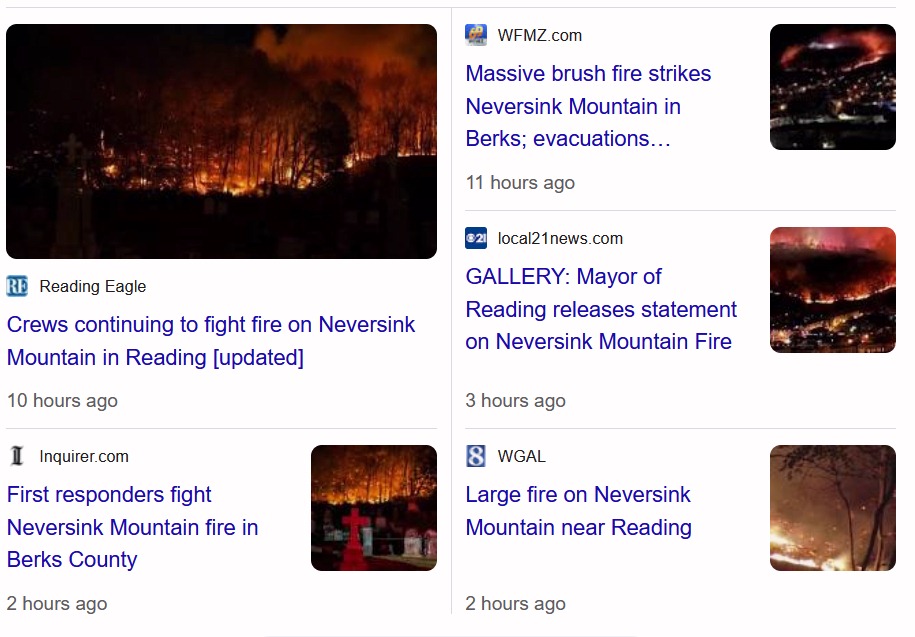
Reading, PA — Crews continued battling a wind-driven fire on Neversink Mountain November 9, which had broken out just after midnight. Visible from miles away, the blaze produced dense smoke and a striking ring of flames along the mountain’s edge, visible from Reading’s Pagoda landmark. Evacuations were ordered for residents in areas where flames neared structures, including neighborhoods from South 9th to 14th and 17th to 18th streets.

Climate change is contributing to the increased intensity and frequency of wildfires through a combination of factors that create favorable conditions for wildfires to ignite, spread, and become more destructive.

A report by the USDA and the U.S. Forest Service found that the risk of wildfires has been drastically underestimated. The updated model concluded that wildfires pose a high risk to one-third of all U.S. residents and buildings. “We’re more accurately reflecting climate changes that we’ve seen in the last few years,” said Kelly Pohl, associate director at the nonprofit Headwaters Economics, which released the findings with the Forest Service.

Here are some key ways in which climate change influences wildfires:


  1. Higher Temperatures:
    • Impact: Rising global temperatures increase the likelihood of extreme heat events.
    • Effect on Wildfires: Higher temperatures contribute to drier conditions, leading to increased evaporation and moisture loss from vegetation. Dry and hot conditions provide a more conducive environment for wildfires to ignite and spread.
  2. Drought Conditions:
    • Impact: Changes in precipitation patterns and prolonged droughts are linked to climate change.
    • Effect on Wildfires: Drought conditions result in dry vegetation, making it more susceptible to ignition. Reduced soil moisture levels also contribute to the flammability of ecosystems.
  3. Changing Rainfall Patterns:
    • Impact: Climate change alters regional rainfall patterns, leading to more intense rainfall in some areas and prolonged dry spells in others.
    • Effect on Wildfires: Areas experiencing reduced rainfall may face prolonged dry seasons, creating conditions favorable for wildfires. Intense rainfall in certain regions can lead to the growth of vegetation, which later dries out and becomes potential fuel for fires.
  4. Warming Winters:
    • Impact: Warmer winter temperatures can affect snowpack and contribute to earlier snowmelt.
    • Effect on Wildfires: Reduced snowpack and earlier snowmelt can result in drier soil and vegetation earlier in the year, extending the wildfire season and increasing the period of vulnerability to fire ignition.
  5. Extended Fire Season:
    • Impact: Changes in climate contribute to longer and more intense fire seasons.
    • Effect on Wildfires: A longer fire season means that conditions conducive to wildfires persist for a more extended period, increasing the likelihood of ignition and the potential for wildfires to become larger and more destructive.
  6. Insect Infestations:
    • Impact: Warmer temperatures allow for the proliferation of certain insects, such as bark beetles.
    • Effect on Wildfires: Insect-infested trees become more susceptible to disease and wildfire. Dead and dry trees contribute to the fuel load, increasing the intensity and spread of wildfires.
  7. Wind Patterns:
    • Impact: Changes in climate can influence wind patterns.
    • Effect on Wildfires: Changes in wind patterns can contribute to the rapid spread of wildfires. Strong winds can carry embers over long distances, leading to the ignition of new areas.
  8. Thawing Permafrost:
    • Impact: Warming temperatures contribute to the thawing of permafrost.
    • Effect on Wildfires: Thawing permafrost releases stored carbon, creating flammable conditions. It can also lead to changes in vegetation types, altering fuel availability for wildfires.

The combination of these factors creates feedback loops, where more intense and frequent wildfires release large amounts of carbon dioxide into the atmosphere, contributing to further climate change. This cycle reinforces the importance of addressing both the causes and consequences of climate change to mitigate the impact on wildfire risk. While the beautiful sunsets during forest fires create captivating visuals, it’s essential to recognize the environmental and health impacts associated with wildfires. Wildfires can cause significant damage to ecosystems, contribute to air pollution, and pose risks to human health. The mesmerizing sunsets are a visible reminder of the interconnectedness of atmospheric processes and the far-reaching effects of natural events like wildfires.

From the album “Rolling Boil” by The Beatless Sense Mongers

The Human Induced Climate Change Experiment

MegaEpix Enormous


bookmark_borderTheir Thirst

[Intro]
If at first
Their thirst
(Causes eyes to bleed)
Then the rest
Think it’s best
(To pray for you to plead)

[Verse 1]
Oh, no (Too, too woe)
The woe has gotta go
Have we come to know
(That we are the show)

[Chorus]
If at first
Their thirst
(Causes eyes to bleed)
Then the rest
Think it’s best
(To pray for you to plead)

[Bridge]
Hey! (I’m O.K.)
No need to sway
(To your attention)
What you say
Will go away
(Due to neglection)

[Verse 2]
Oh, so (Reap our sow)
The woe we’ve come to know
Is dragging… make things slow
(So, the woe has gotta go)

[Chorus]
If at first
Their thirst
(Causes eyes to bleed)
Then the rest
Think it’s best
(To pray for you to plead)

[Bridge]
Hey! (I’m O.K.)
No need to sway
(To your attention)
What you say
Will fade away
(Retrospection)

[Bridge]
Hey! (I’m O.K.)
No need to sway
(To your attention)
What you say
Will fade away
(Retrospection)

[Outro]
Hey! (We’re O.K.!)
It’s a new day

From the album “Six of One” by The Beatless Sense Mongers

The Human Induced Climate Change Experiment

MegaEpix Enormous

bookmark_borderWhere the Used Ones Go

[Intro]
Do you know
Where the used ones go
What we stow
Accumulates below

[Verse 1]
Buy and buy
(By and by)
Stuff the stuff
(Going gets rough)

[Chorus]
Do you know
Where the used ones go
What we stow
Accumulates below

[Bridge]
Doesn’t help to listen what they said
(The voices in your head)

[Verse 2]
Score more, more
(Scored to hoard)
More, more, more
(Oh good lord!)

[Chorus]
Do you know
Where the used ones go
What we stow
Accumulates below

[Bridge]
Doesn’t help to listen what they said
(The voices in your head)

[Chorus]
Do you know
Where the used ones go
What we stow
Accumulates below

[Bridge]
[Instrumental, Organ Solo]
Doesn’t help to listen what they said
(The voices in your head)

[Outro]
Oh, do you know….
(Where the used ones go?)

From the album “Six of One” by The Beatless Sense Mongers

The Human Induced Climate Change Experiment

MegaEpix Enormous

bookmark_borderLove Notion

[Intro]
Feel (real)
Can you feel (Feel!)

[Verse 1]
In flows in
(In flows out)
You begin
(To figure out)

[Bridge]
Real feel
(The love is real)
Feel real
(Let love reveal)

[Chorus]
Love’s solution
(Answer)
Love’s solution
(Mixture)
A notion
(Of a love potion)

[Bridge]
Feel it in the air
(Feel it everywhere)

[Verse 2]
Give and take
(Live and make)
The more you give…
(The more love you make)

[Bridge]
Real feel
(The love is real)
Feel real
(Let love reveal)

[Chorus]
Love’s solution
(Answer)
Love’s solution
(Mixture)
A notion
(Of a love potion)

[Bridge]
Feel it in the air
(Feel it everywhere)

[Verse 2]
Give and take
(Live and make)
The more you give…
(The more love you make)

[Break]
Love notion!
(Solution)

[Bridge]
Real feel
(The love is real)
Feel real
(Let love reveal)

[Chorus]
Love’s solution
(Answer)
Love’s solution
(Mixture)
A notion
(Of a love potion)

[Outro]
A notion
(Of a love potion)

ABOUT THE SONG
What Can I Do? There are plenty of things you can do to help save the planet: stop using fossil fuels, consume less, and love more.

Love has the transformative power to save the world in numerous ways:

  1. Fostering Connection and Unity: Love brings people together, transcending boundaries of race, religion, nationality, and ideology. By fostering a sense of empathy, compassion, and understanding, love promotes unity and solidarity among diverse individuals and communities. When people come together in love, they can work collaboratively to address shared challenges and create positive change on a global scale.
  2. Promoting Peace and Harmony: Love is the antidote to hatred, conflict, and violence. By promoting forgiveness, reconciliation, and mutual respect, love can help heal deep-seated divisions and promote peace and harmony within and between societies. When individuals and nations choose love over fear and hostility, they pave the way for peaceful coexistence and cooperation.
  3. Inspiring Empathy and Altruism: Love cultivates a sense of empathy and concern for the well-being of others. When individuals act out of love, they are motivated to alleviate suffering, promote justice, and advance the common good. Love inspires acts of kindness, generosity, and selflessness, creating a ripple effect of positive change that spreads throughout communities and across borders.
  4. Protecting the Environment: Love for the natural world motivates individuals to protect and preserve the planet for future generations. When people recognize their interconnectedness with all living beings and the delicate balance of ecosystems, they are inspired to adopt sustainable lifestyles, promote conservation efforts, and advocate for environmental stewardship. Love for the Earth compels us to take action to address climate change, protect biodiversity, and ensure a healthy and sustainable future for all.
  5. Empowering Social Justice: Love is inherently egalitarian, valuing the inherent worth and dignity of every individual. When people act out of love, they are committed to promoting social justice, equality, and human rights for all. Love drives efforts to dismantle systems of oppression, combat discrimination, and create inclusive societies where everyone has the opportunity to thrive. By standing up for justice and advocating for marginalized communities, love can help create a more just and equitable world for future generations.

In summary, love has the power to save the world by fostering connection and unity, promoting peace and harmony, inspiring empathy and altruism, protecting the environment, and empowering social justice. When individuals and communities choose love as their guiding principle, they can create a world where compassion, understanding, and cooperation prevail, paving the way for a brighter and more sustainable future for all.

From the album “The Last: Prophecies of Daniel and the Climate Crisis” by Daniel

The Human Induced Climate Change Experiment

MegaEpix Enormous

bookmark_borderIn the Lion’s Den

[Intro]
What’s the score
(Feel the roar)
When…?
(In the lion’s den)

[Verse 1]
Will there be survival
At all?
Facing great odds
Men as gods

[Chorus]
What’s the score
(Feel the roar)
When…?
(In the lion’s den)

[Bridge]
Resilience under threat
(You bet!)
Opposition
(Of our position)

[Verse 2]
Resistance to change
Must rearrange
Watch the powerful
As they fall

[Chorus]
What’s the score
(Feel the roar)
When…?
(In the lion’s den)

[Bridge]
Resilience under threat
(You bet!)
Opposition
(Of our position)

[Chorus]
What’s the score
(Feel the roar)
When…?
(In the lion’s den)

[Bridge]
Resilience under threat
(You bet!)
Opposition
(Of our position)

[Outro]
What’s the score
(Feel the roar)

ABOUT THE SONG
The Book of Daniel in the Bible contains prophetic visions and stories that, in various ways, can be seen as analogies to the climate crisis and the challenges humanity faces today.

Daniel in the Lion’s Den (Daniel 6:1-28)

Daniel’s survival in the lion’s den symbolizes hope and resilience under threat. This can be seen as an analogy for those working to address climate change, as they face great odds and opposition. Just as Daniel remained steadfast, people dedicated to climate action continue their efforts against powerful industries and interests resistant to change. This story reminds us that resilience, commitment, and faith in solutions are crucial, even in the face of overwhelming adversity.

The Book of Daniel’s themes of warning, resilience, and responsibility provide powerful metaphors for the climate crisis. They encourage reflection on humanity’s role in either contributing to or averting disaster, as well as the courage needed to make meaningful changes.

From the album “The Last: Prophecies of Daniel and the Climate Crisis” by Daniel

The Human Induced Climate Change Experiment

MegaEpix Enormous