[Silence]
[Arrangement: Rock with thunderous percussion, pulsing bass, electric guitar tremolo, storm ambience, and escalating choral backing vocals]
[Intro]
Horizon’s boiling
(Sky on red)
Pressure rising
(Overhead)
Something’s shifting
(In the air)
You can feel it
(Everywhere)
[Verse 1]
Jet stream bending
(Out of shape)
Heat dome forming
(No escape)
Dry land cracking
(Sun-scorched ground)
No relief
(To be found)
Moisture rising
(From the sea)
Fueling storms
(Continuously)
Boundaries breaking
(Line by line)
Nature’s rhythm
(Out of time)
[Pre-chorus]
Better take cover
(A storm’s a brewin’)
Grab your lover
(If ya ever want lovin’)
Clouds are stacking
(On the rim)
Sky is singing
(Low and grim)
[Chorus]
Dancin’ in…
(A ring-of-fire)
The reign of rain
(Heat Miser’s pain)
Thunder calling
(Louder still)
Nature bending
(Against its will)
[Refrain]
Lightning strikes twice
(Or maybe thrice)
Everyone sing:
(In a ring!)
A ring-of-fire
(Feedback…)
Higher and higher
No, no more slack
(Feedback…)
[Verse 2]
Storms keep training
(On the track)
Same direction
(Coming back)
Flash flood rivers
(Cut the land)
No one thought
(It’d be this grand)
Omega locking
(Sky in place)
Time is frozen
(Weather race)
Heat won’t leave
(The dome won’t break)
Storms just circle
(The edge it makes)
[Bridge]
Fire meets water
(Sky meets ground)
Chaos turning
(Round and round)
What was balance
(Now unglued)
System shifting
(All we knew)
[Instrumental]
[Thunder percussion breakdown]
[Electric guitar storm solo]
[Wind and rain crescendo]
[Final Chorus]
Dancin’ in…
(A ring-of-fire)
No way out
(No higher)
Lightning singing
Through the wire
Burning brighter
And higher
[Final Refrain]
Lightning strikes twice
(Or maybe thrice)
Everyone sing:
(In a ring!)
A ring-of-fire
(Feedback…)
Higher and higher
No, no more slack
(Feedback…)
[Outro]
Ring of fire…
(Higher! Higher!)
Round we go
(Will it stop… I don’t know)
Ring of fire…
(When will it tire)
I don’t know
About the Song
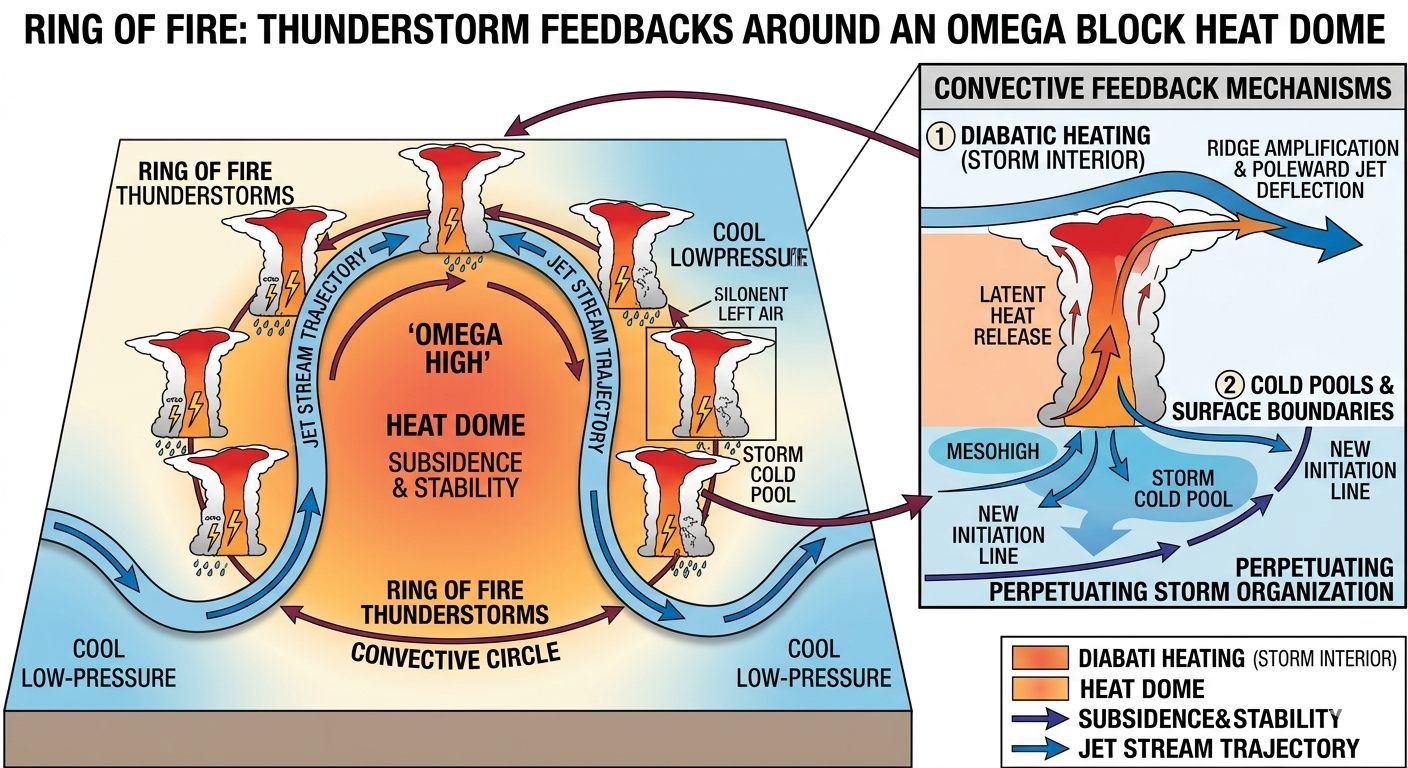
In meteorology, a Ring of Fire describes a recurring pattern in which clusters of powerful thunderstorms repeatedly develop and travel around the outer edge of a large, stationary high-pressure system. These storms form where extremely hot, dry air beneath the heat dome collides with cooler, moisture-rich air circulating around its perimeter.
The pattern becomes especially dangerous when the high-pressure system takes the form of an Omega block, named because the jet stream bends into a shape resembling the Greek letter Ω. In this configuration, the jet stream stalls, leaving a massive dome of sinking air trapped beneath the center of the ridge. The descending air continuously compresses and warms, suppressing cloud formation and preventing thunderstorms from developing over the core of the heat dome.
Unable to penetrate this atmospheric “cap,” storms are instead forced to travel around the edge of the dome, following the path of the jet stream. The result is a nearly continuous corridor of severe thunderstorms that circles the stagnant high-pressure system like a racetrack.
The Ring: A Corridor of Explosive Storms
Along the outer edge of the heat dome, the hot, dry air meets cooler, more humid, and unstable air associated with surrounding low-pressure troughs. The sharp temperature and moisture contrasts create an ideal environment for rapid thunderstorm development. Abundant atmospheric moisture—enhanced by warmer oceans and increased evaporation—provides enormous latent heat that fuels severe convection. The result is repeated outbreaks of supercell thunderstorms, mesoscale convective systems (MCSs), derechos, torrential rainfall, large hail, and frequent lightning.
The “Train Track” Effect
Because Omega blocks often remain stationary for days or even weeks, the jet stream changes very little. New thunderstorms repeatedly form along the same atmospheric boundary and follow nearly identical paths. Meteorologists refer to this as training, because successive storms move over the same locations like railroad cars on a track. This dramatically increases the risk of catastrophic flash flooding, even when individual storms are moving rapidly.
The Ring of Fire is an example of how Earth’s climate system is increasingly governed by interacting positive feedback loops rather than isolated events. Rising temperatures increase atmospheric moisture and instability, producing more lightning, larger wildfires, and greater emissions of greenhouse gases and light-absorbing aerosols. These processes reinforce one another, accelerating climate change.
Ring of Fire Thunderstorm Feedbacks
From the album “What’s in a Name?“