[Intro]
Turn on the tap!
(What’s that?)
Water rising!
(Not surprising!)
Filling up…
(Drop by drop)
Where’s the drain?
(When does it stop?)
[Verse 1]
Picture a bathtub, filling with carbon
Year by year we’re adding more
Human emissions keep the faucet running
While natural sinks are draining the floor
[Pre-Chorus]
Turn the faucet down
(Slow the flow)
But the level’s rising
(Watch it grow)
Less coming in
(Is not enough)
When the drain can’t keep up
(That’s the rub!)
[Refrain]
The bathtub’s filling
(Do you know if it will overflow)
Situation’s chilling
(Watch the temperature mature)
… for sure
[Verse 2]
Here’s the distinction you need to know
Reducing emissions slows the flow
But lowering carbon in the air
Means removing more than we’re putting there
[Pre-Chorus]
Turn the faucet down
(That’s a start)
But the water level
(Still climbs up)
To bring it down
(Here’s the condition)
Removal must exceed
(Total emission!)
[Refrain]
The bathtub’s filling
(Do you know if it will overflow)
Situation’s chilling
(Watch the temperature mature)
… for sure
[Verse 3]
Now there’s another problem
(The drain is changing!)
Warming oceans
(Their chemistry rearranging!)
Forests under pressure
(Their sinks declining)
More heat, more stress
(The feedbacks are combining!)
Permafrost thawing
(Releasing carbon below)
Wildfires burning
(Adding more to the flow)
Wetlands shifting
(Ecosystems stressed)
The warmer it gets
(The harder the drain works best?)
(Fill it up!)
(Watch it rise!)
(Where’s the drain?)
(Therein lies…)
Faucet!
(Flowing!)
Drainage!
(Slowing!)
Carbon!
(Accumulating!)
Feedback!
(Amplifying!)
[Verse 4]
It’s not just the faucet
It’s the whole machine
Oceans and forests
And the frozen in-between
A bathtub isn’t overflowing
Just because the level’s high
The question is the balance
Between the outflow and supply
What’s the faucet?
(Human emissions!)
What’s the drain?
(Natural submissions!)
Turn it down!
(Down, down, down)
Shout about:
(Drain it out!)
Get below!
(Get below!)
The level’s got to go!
[Final Refrain]
The bathtub’s filling
(Do you know if it will overflow)
Situation’s chilling
(Watch the temperature mature)
… for sure
The bathtub’s filling
(And the water’s getting high)
Natural sinks are struggling
(As the feedbacks multiply)
Turn the faucet down
(But that’s not enough!)
Get the drain working
(That’s the harder stuff!)
The bathtub’s filling
(Do you know if it will overflow)
Situation’s chilling
(Watch the temperature mature)
… for sure!
[Outro]
Faucet running…
(Flowing in)
Drain is clogging…
(Slowin’, slowin’)
Less in…
(More out!)
That’s the balance
(There’s no doubt!)
The bathtub’s filling…
(Watch it rise…)
… should be no surprise
About the Song
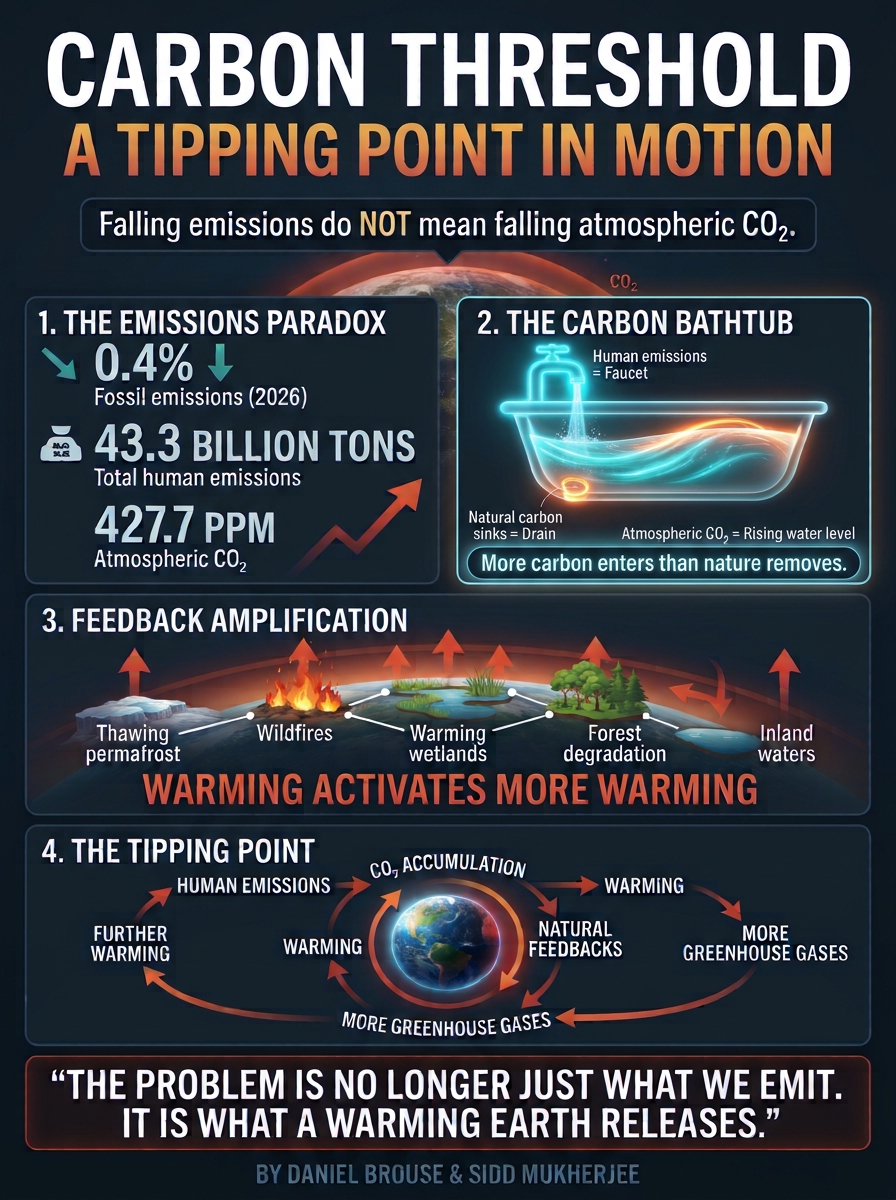
NEW PAPER: CARBON THRESHOLD DYNAMICS — THE CARBON BATHTUB EXPLAINS WHY CO₂ KEEPS RISING
Why does atmospheric CO₂ continue to rise even when human emissions decline?
Think of the atmosphere as a bathtub.
Human emissions are the faucet. Natural carbon sinks—primarily the oceans and terrestrial ecosystems—are the drain. Turning down the faucet slows the rise, but it does not lower the water level while more carbon continues entering the atmosphere than nature removes.
And there is another problem: climate warming is weakening the drain while activating additional sources of carbon emissions.
Warming affects the oceans, forests, wetlands, and frozen landscapes. Wildfires, ecosystem disruption, and thawing permafrost add further pressure to an already overloaded carbon cycle. These processes interact, creating feedbacks that amplify the original warming.
This is the central message of our new paper, Carbon Threshold Dynamics: Emissions, Feedback Amplification, and the Approach to a Tipping Point, by Daniel Brouse and Sidd Mukherjee.
The paper examines:
* Why atmospheric CO₂ continues accumulating despite changes in annual human emissions.
* The difference between reducing emissions and actually reducing atmospheric CO₂.
* How natural carbon sinks influence the rate of atmospheric accumulation.
* How warming activates and strengthens interconnected natural feedbacks.
Why the combined effects of emissions, feedback amplification, and carbon-cycle disruption matter more than any single year’s emissions figure.
How these dynamics move the climate system toward increasingly dangerous thresholds.
The critical distinction: slowing the inflow is not the same as lowering the water level.
To bring atmospheric CO₂ down, total carbon emissions must fall below the amount being removed from the atmosphere. That challenge becomes harder as warming weakens natural removal and activates additional carbon sources.
The carbon bathtub is a simple way to understand a complex problem: we are not just managing the faucet. We are changing the entire system that determines how much carbon enters, how much leaves, and how much remains.
Read the full paper:
Carbon Threshold Dynamics: Emissions, Feedback Amplification, and the Approach to a Tipping Point
From the album “Feedback Coupling“