[Intro]
[Instrumental Intro: Aggressive Electric Guitar Riff, Driving Bass, Punchy Drums, Hammond Organ Stabs and Pulsing Synth]
[Spoken Vocal]
Give it a thrust!
A lil’ shove…
(Into the love)
[Verse 1]
When the road gets rough
And the pressure starts to build
When the old way isn’t working
And the future won’t stand still
Don’t freeze up
Don’t rust
Don’t wait around
For someone you trust
Put your shoulder
To the wheel
Find the force
That makes it real
[Pre-Chorus]
Push!
(Push!)
Drive!
(Drive!)
Move!
(Move!)
Alive!
[Refrain]
Give a robust…
(Thrust!)
Quench your thirst
(Burst!)
Bust
(Thrust!)
[Chorus]
Thrust!
(Thrust!)
Push through the wall
Thrust!
(Thrust!)
Don’t wait to fall
Bust!
(Bust!)
Break out of the crust
Give a robust
Thrust!
[Verse 2]
A seed beneath the surface
Doesn’t know the sky
But something in its nature
Tells it it should try
Push through the darkness
Push through the dirt
Find a little sunlight
Even when it hurts
[Instrumental]
[Electric Guitar Solo: High-Energy Blues-Rock Lead With Wah-Wah, Hammond Organ, Bass and Driving Drums]
[Bridge]
… finding motion
When you’re stuck in place
(Getting the notion)
… get back in the race
[Rap Vocal Break]
Thrust!
(Bust!)
Push!
(Rush!)
Move!
(Improve!)
Don’t confuse
The motion with the noise
Make a choice
(Make a choice)
Change the flow
(Into the know)
Give the future
Room to grow
Robust!
(Thrust!)
Strong enough
To bend a little
Quench the thirst
(Burst)
Burst the bubble
(Through the rubble)
[Breakdown]
[Music Drops to Bass, Sparse Drums and Distorted Guitar Feedback]
Give a robust…
[Pause]
Thrust!
Quench your thirst…
[Pause]
Burst!
[Whispered]
Bust…
Thrust.
[Final Refrain]
Give a robust…
(Thrust!)
Quench your thirst
(Burst!)
Bust
(Thrust!)
[Final Chorus]
Thrust!
(Thrust!)
Push into life
Thrust!
(Thrust!)
Cut through the strife
Bust!
(Bust!)
Break through the “must”
Quench your thirst
And give a robust…
Thrust!
[Outro]
[Instrumental Outro: Full Band Groove With Repeating Guitar Riff, Hammond Organ and Synth; Final Cymbal Crash]
Thrust!
[Intro]
[Instrumental Intro: Driving Electric Guitar, Punchy Bass, Big Drums, Hammond Organ, Hand Claps and Bright Analog Synth]
[Spoken Vocal]
Feeling strong?
Well… don’t go wrong.
(Sing along!)
[Verse 1]
Knowing when enough is enough
(Done hanging tough)
Knowing when to reach out
(And shout: Shout!)
[Pre-Chorus]
Stand!
(Stand!)
Rise!
(Rise!)
Take a breath
And open your eyes!
(Surprise!)
[Refrain]
Feeling strong?
(Sing along:)
Strong!
(Shout it out:)
Strong!
(Come on, come on)
Sing along!
(Strong!)
[Verse 2]
A tree that never bends
May break beneath the storm
A river finds a pathway
By changing its own form
Roots beneath the surface
Branches reaching high
Strength isn’t just the trunk
It’s knowing when to try
[Instrumental]
[Electric Guitar Solo: Uplifting Blues-Rock Lead With Hammond Organ, Hand Claps, Bass and Driving Drums]
[Bridge]
Come on!
(Come on!)
Come on!
(Come on!)
You don’t have to prove
That you belong
Just keep moving
(… improving)
Find the place
Where you are strong
[Rap Vocal Break]
Strong in the body
(Strong!)
Strong in the mind
(Strong!)
Strong enough
To leave the old behind
Strong in the heart
(Strong!)
Strong in the soul
(Strong!)
Strong enough
To make yourself whole
(Soul, soul, soul)
Feeling strong?
(Sing along:)
Strong!
(Shout it out:)
Strong!
(Come on, come on)
Sing along!
(Strong!)
Feeling strong?
(Sing along:)
Strong!
(Shout it out:)
Strong!
(Come on, come on)
Sing along!
(Strong!)
Not control
(Not control!)
Strength is knowing
What is worth the goal
Feeling strong?
(Sing along:)
Strong!
(Shout it out:)
Strong!
(Come on, come on)
Sing along!
(Strong!)
[Breakdown]
[Music Drops to Bass, Hand Claps and Sparse Guitar]
Feeling strong?
[Instrumental Intro: Bright Acoustic Guitar, Bouncy Bass, Snappy Drums, Hammond Organ and Playful Synth Bells]
[Spoken Vocal]
The spring has sprung…
So what are you waiting for?
Get up!
[Verse 1]
Winter held its breath
The ground was cold and still
Now something’s moving underneath
A little life, a little will
Green comes through the cracks
The branches start to sway
The world has found its rhythm
And we’re coming out to play
[Pre-Chorus]
Wake up!
(Wake up!)
Come alive!
(Come alive!)
Feel the change
As we arrive!
[Refrain]
The spring
(Has sprung)
Now sing:
(Bell’s been rung)
[Chorus]
Spring has sprung!
(Spring has sprung!)
Ring that bell!
Spring has sprung!
(Spring has sprung!)
Can’t you tell?
Out of the dark
Into the light
Shake off the night
Feel the delight
[Verse 2]
The snow may linger
On the mountain side
But down below
The rivers rise
The buds are opening
One by one
Leaves are reaching
For the sun
Birds return
(Wings unfurled)
New beginnings
(Into the world)
[Instrumental]
[Electric Guitar Solo: Upbeat Roots-Rock Lead With Hammond Organ, Bell-Like Synth, Bass and Driving Drums]
[Bridge]
Spring …
(Here’s the thing)
[Rap Vocal Break]
Spring!
(Sprung!)
Ring!
(Rung!)
Move!
(Improve!)
Shake off
The frozen groove
Roots down
(Rise up)
Fill the cup
(Drink up)
Life is moving
Don’t get stuck
(Noo… don’t wait on luck)
[Breakdown]
[Music Drops to Acoustic Guitar, Hand Claps and Soft Bell Tones]
The spring…
[Whispered]
Has sprung.
Now sing…
(Come undone)
Sing to sung!
[Soft Response]
Bell’s been rung.
[Final Refrain]
The spring
(Has sprung)
Now sing:
(Bell’s been rung)
[Final Chorus]
Spring has sprung!
(Spring has sprung!)
Ring that bell!
Spring has sprung!
(Spring has sprung!)
Can’t you tell?
Surprise!
(Arise!)
[Outro]
[Instrumental Outro: Full Band With Bright Guitar, Hammond Organ, Bells, Bass and Drums; Gradually Building Into a Celebratory Final Chord]
The spring…
[Intro]
[Instrumental Intro: Bright Acoustic Guitar Picking, Warm Bass, Light Drums, Hammond Organ and Gentle Analog Synth]
[Spoken Vocal]
Put a seed in the ground…
Give it a little time to be found
You might surprise…
(As it starts to rise)
[Verse 1]
Buried in the darkness
Waiting for the rain
Small enough to overlook
Strong enough to remain
[Refrain]
If it was in doubt
(That it would sprout)
The essence
(Of resilience)
… is in our presence
[Chorus]
Sprout!
(Out!)
Reach for the light
Sprout!
(About!)
Push through the night
(Into the light)
Find a way
To survive
Sprout!
(Sprout!)
Root and rise
[Verse 2]
A forest isn’t planted
All at once and all alike
Some arrive by wind
Some arrive by wildlife
[Instrumental]
[Electric Guitar Solo: Melodic Roots-Rock Lead With Acoustic Guitar, Hammond Organ, Warm Bass and Rolling Drums]
[Bridge]
Resilience isn’t silence
(It’s persistence)
It isn’t never bending
(It’s resistance)
It isn’t being certain
(It’s adapting)
It’s finding one more way
When the first way isn’t happening
[Rap Vocal Break]
Sprout
(Reach out)
Root
(Grow)
Push through
(What you know)
Darkness isn’t proof
That nothing’s there
(As it struggles…)
Reaching for the air
Just enough life
(To begin again)
[Breakdown]
[Music Drops to Acoustic Guitar, Bass and Soft Piano]
If it was in doubt…
[Whispered]
That it would sprout…
The essence…
Of resilience…
(You’re about to find out)
[Soft Response]
It’s in our presence.
[Final Refrain]
If it was in doubt
(That it would sprout)
The essence
(Of resilience)
… is in our presence
[Outro]
[Instrumental Outro: Acoustic Guitar and Hammond Organ Over Warm Bass; Soft Synth and Gentle Percussion Gradually Fade]
If it was in doubt
(That it would sprout)
The essence
(Of resilience)
… is in our presence
[Intro]
[Instrumental Intro: Dreamy Electric Guitar, Warm Bass, Soft Drums, Hammond Organ and Shimmering Analog Synth]
[Spoken Vocal]
What’s gotten into me?
Could it be…
Reality?
Maybe I’ve finally
(foregone destiny)
[Verse 1]
I used to chase the answer
Like it owed me something back
Looking down the road ahead
While standing on the track
I wanted certainty
I wanted something sure
But life kept moving underneath me
And the future wasn’t pure
Then somewhere in the silence
I began to understand
The things I thought were permanent
Were slipping through my hands
[Pre-Chorus]
Wake up!
(Wake up!)
Look around!
(Look around!)
Hear the world
(Hear the sound)
[Refrain]
What’s gotten into me
(Could it be…)
Reality…
(I’ve come to see?)
The inevitability:
(Put love above)
To survive…
(To be alive)
Put love above
(Love, love, love)
The love of…
(Love, love, love)
[Chorus]
Put love above
Put love above
Not fear
Not greed
Not what we think we need
Put love above
Put love above
The life we share
The air we breathe
The future’s waiting there
Love of life
(Love of life)
Love of Earth
(Love of Earth)
Love of those
Who haven’t even
Had their birth
[Verse 2]
Reality can hurt you
When you finally look it in the eye
But hiding from the truth
Won’t make the truth comply
The mountains aren’t forever
The rivers aren’t immune
The forests have their limits
In the atmosphere of doom
Room for change
(Room for change)
Room for hope
(Room for hope)
… hope without action
(No solution)
… it’s the end of the rope
[Instrumental]
[Electric Guitar Solo: Emotional Blues-Rock Lead With Sustained Notes, Hammond Organ Swells, Warm Bass and Slow-Building Drums]
[Bridge]
What’s gotten into me?
Love?
(Of love)
In and about…
(Shout!)
Love, love, love
[Music builds]
When survival
Is the question
Love becomes
The direction
Not just love
For me
But love
For we
[Rap Vocal Break]
Love the soil
(Love the rain)
Love the river
(Love the plain)
Love the forest
(Love the sea)
Love the life
That isn’t me
Love the child
We haven’t met
Love the future
Not here yet
Put love above
The appetite
Put love above
The endless fight
Put love above
The need to win
Maybe that’s
Where we begin
(To start a heart)
[Breakdown]
[Music Drops to Piano, Acoustic Guitar and Soft Vocal]
The inevitability…
[Whispered]
Put love above…
To survive…
To be alive.
(To thrive!)
[Soft Response]
Love…
Love…
Love…
[Final Refrain]
What’s gotten into me
(Could it be…)
Reality…
(I’ve come to see?)
The inevitability:
(Put love above)
To survive…
(To be alive)
Put love above
(Love, love, love)
The love of…
(Love, love, love)
[Final Chorus]
Put love above!
(Love above!)
The fear and the greed
Put love above!
(Love above!)
The things we don’t need
Love of life!
(Love of life!)
Love of Earth!
(Love of Earth!)
Love the future
Before its birth
Put love above!
(Put love above!)
To survive…
To be alive.
[Outro]
[Instrumental Outro: Full Band Gradually Reduces to Acoustic Guitar and Hammond Organ; Shimmering Synth Holds the Final Chord]
What’s gotten into me?
[Silence]
[Instrumental, Electric Guitar, Acoustic Guitar, Bass, Drums, Piano, Organ, Synth]
[Intro]
[Instrumental Intro: Dry Acoustic Guitar, Bouncy Bass, Tight Drums, Hammond Organ Stabs and Bright Analog Synth]
[Spoken Vocal]
Black locust…
(Lush lust)
Sure…?
(You’ll endure.)
[Verse 1]
Out along the fence line
Growing where it can
Roots down in the rocky soil
Standing where it stands
Didn’t need permission
Didn’t need a plan
Wind blew from the direction
Of where man made a stand
[Refrain]
The locust
(Is robust)
A thorn
(Thrust)
A torn born
[Chorus]
Black locust!
(… into me you thrust!)
Thorn upon the stem
Tough enough to weather
What is thrown at them
The locust
(Is robust)
A thorn
(Thrust)
A torn born
[Verse 2]
Maple in the garden
Oak beside the way
Sycamore and walnut
Growing day by day
Tulip poplar reaching
Toward the open sky
Evergreen beside it
Take a breath… sigh (Sigh)
[Instrumental]
[Electric Guitar Solo: Twangy Roots-Rock Lead With Hammond Organ, Banjo-Like Acoustic Picking, Bass and Driving Drums]
[Bridge]
One may struggle
One may thrive
Together
We can keep ourselves alive
[Rap Vocal Break]
The locust
(Is robust)
A thorn
(Thrust)
A torn born
Poplar!
(Is popular)
Watch it grow
(Watch it go, go, go)
All ya need to know
(Watch it grow)
Watch it go, go, go
(go, go, go)
[Breakdown]
[Music Drops to Acoustic Guitar, Bass and Light Percussion]
The locust
(Is robust)
A thorn
(Thrust)
A torn born
The locust…
… robust.
[Whispered]
A thorn…
Thrust…
A torn born.
[Final Refrain]
The locust
(Is robust)
A thorn
(Thrust)
A torn born
[Outro]
[Instrumental Outro: Acoustic Guitar Picking, Warm Hammond Organ, Bass and Light Drums; Birdsong-Like Synth Motif Fades Into Wind]
The locust…
for life lust…
A thorn…
Thrust…
[Spoken, fading]
Lush… (with the locust)
About the Song: Selecting Trees
A diverse mixture of trees provides the greatest resilience.
Both deciduous and evergreen (conifer) species should be included whenever practical.
Whenever possible, native species should be prioritized because they support local wildlife, require less maintenance, and are naturally adapted to regional conditions.
Nature often contributes to the experiment as well. Birds, squirrels, and the wind frequently plant volunteer seedlings that can be transplanted into containers.
During the Pennsylvania experiment, naturally occurring species included:
Black locust
Red and Japanese maples
Oak
Sycamore
Black walnut
Tulip poplar
The Black Locust
One of the most promising candidates for future forests is the black locust. Reaching heights of up to 100 feet and lifespans of 75-90 years, black locusts combine durability, rapid growth, and climate resilience. Their wood is exceptionally strong — with a Janka hardness of approximately 1,700 lbf, rivaling or exceeding that of white oak and golden teak. Their natural resistance to rot, ability to recover from damage, and tolerance of heat and drought make them remarkably suited for 21st-century conditions. Black locust sprouts vigorously from stumps and roots after cutting or damage. As hardwoods that also fix nitrogen, locusts help rebuild soils damaged by erosion and extreme rainfall.
[Intro]
[Instrumental Intro: Atmospheric Electric Guitar, Deep Bass Drone, Slow Heavy Drums, Distant Hammond Organ and Dark Synth; Gradually Building Tension]
[Spoken Vocal]
They look permanent…
They aren’t.
Stone remembers.
Ice forgets.
Tumbling… (our regrets)
[Verse 1]
High above the water
Where the frozen mountains stand
Ice has held the pieces
… a giant steady hand
Rock begins to wander
Snow begins to slide
Gravity is waiting
On the mountain’s other side
[Refrain]
Can you see…
(When mountains crumble to the sea)
A giant tsunami
(Can come to be)
[Chorus]
Mountains crumble
Mountains fall
Gravity can move it all
Mountains crumble
To the sea
What was solid
Moves suddenly
Energy!
(Energy!)
Hitting you
(Hitting me)
[Verse 2]
Rock and ice came crashing
From the mountain to the bay
Water rose six hundred feet
And violently gave way
Nine days of oscillation
Nine days of water’s sway
A mountain’s fall became a signal
That the whole Earth could display
[Instrumental]
[Heavy Progressive-Rock Instrumental: Tremolo Electric Guitar, Deep Bass, Massive Drums, Hammond Organ Swells and Low Synth; Building From Slow Pulse Into Sudden Rhythmic Surges]
[Bridge]
One thing moves
Then another
Ice!
(Ice!)
Rock!
(Rock!)
Water!
(Water!)
Wave!
(Wave!)
Gravity!
(Gravity!)
Energy!
(Energy!)
[Spoken Vocal]
Can you see…
(When mountains crumble to the sea)
A giant tsunami
(Can come to be)
Seiche.
[Rap Vocal Break]
That’s the cascade
That’s the chain
Freeze the mountain
Melt the frame
Water enters
Fractures grow
Gravity says
“Let it go”
Stored energy
Waiting there
Twenty-five million cubic meters
In the air
Then the mountain
Isn’t there
And the sea
Comes back at me
Wave goes up
Wave comes down
Fjord becomes
A shaking ground
Nine days
Nine nights
Global instruments
See the lights
Not a myth
Not a tale
A mountain fell
And left a trail
[Breakdown]
[Music Drops to Deep Bass Drone, Sparse Piano and Distant Guitar Harmonics]
Can you see?
[Whispered]
When mountains crumble…
To the sea?
[Soft Response]
A giant tsunami…
Can come to be.
[Final Refrain]
Can you see…
(When mountains crumble to the sea)
A giant tsunami
(Can come to be)
[Final Chorus]
Mountains crumble
Mountains fall
Gravity can move it all
Mountains crumble
To the sea
What looks permanent
Can suddenly flee
Can you see?
(Can you see?)
[Final Bridge]
Cryosphere!
(Hydrosphere!)
Lithosphere!
(All together!)
Ice to water
Water to wave
Mountain to ocean
Grave to grave
A giant…
[Pause]
…wave.
[Final Refrain]
Can you see…
(When mountains crumble to the sea)
A giant tsunami
(Can come to be)
[Outro]
[Instrumental Outro: Massive Guitar Chords, Rolling Tom Drums, Deep Bass and Hammond Organ; Rhythm gradually slows as distant synth and guitar feedback remain]
Mountains crumble…
To the sea…
Gravity waits…
Patiently.
[Spoken, fading]
The mountain doesn’t have to prove…
(It only has to move.)
About the Song
Mountains may look permanent. They are not.
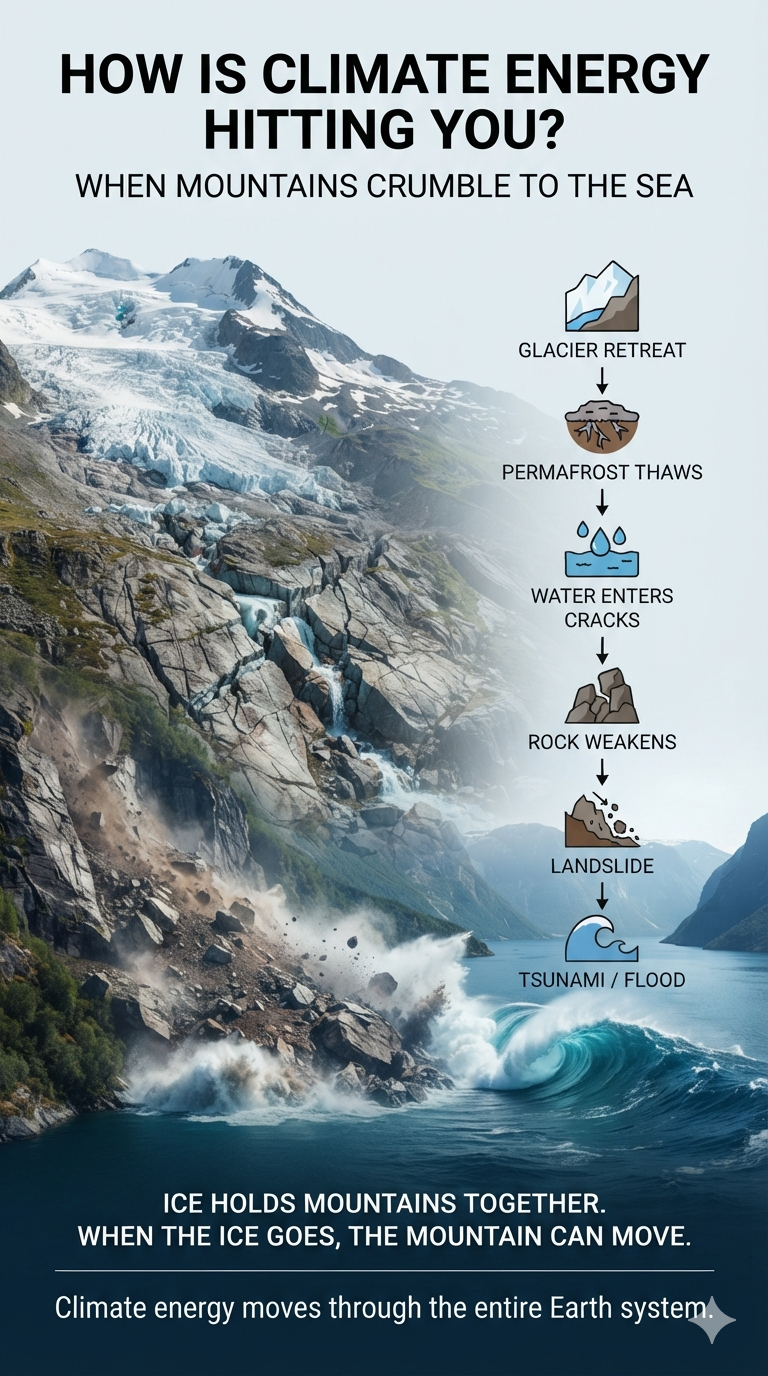
Across Alaska, Greenland, Norway, Chile, New Zealand, and the European Alps, glaciers are retreating, permafrost is thawing, and mountain slopes that were stabilized by ice for centuries or millennia are becoming increasingly unstable.
The result is a dangerous transformation of the high mountains: rockfalls, landslides, glacier collapses, debris flows, and landslide-generated tsunamis.
These are not simply isolated geological curiosities. They are examples of a larger climate-driven interaction among the cryosphere—the frozen part of the Earth system—the hydrosphere, and the lithosphere. As ice disappears, water enters places where it previously could not. As frozen ground thaws, fractures that were once reinforced by ice can weaken. As glaciers retreat, steep slopes can lose part of the support and confinement that helped stabilize them.
The mountains can begin to crumble.
And when they do, enormous amounts of stored gravitational energy can suddenly become kinetic energy.
A Mountain Can Become a Climate Hazard
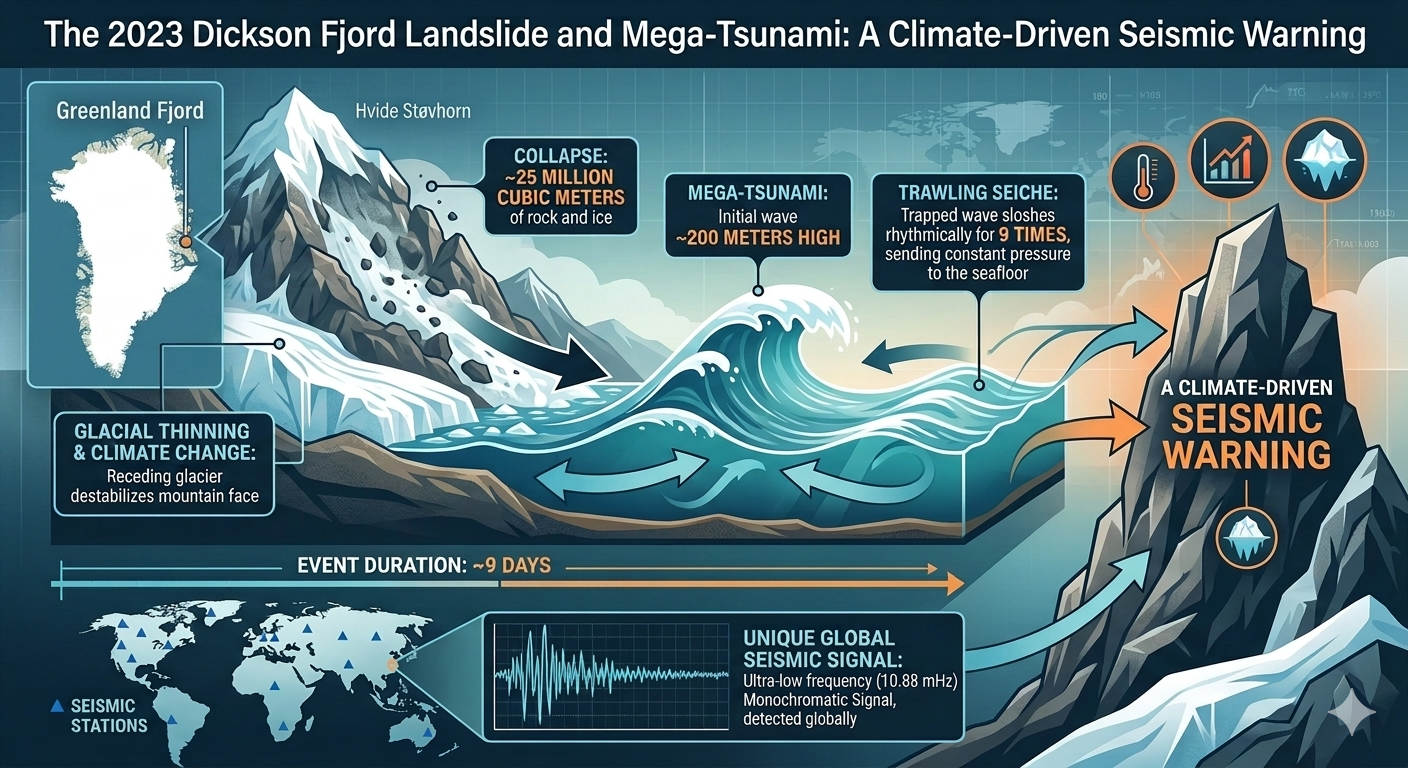
One of the clearest examples occurred in East Greenland in September 2023.
A massive rock-and-ice avalanche, involving approximately 25 million cubic meters of material, plunged into Dickson Fjord. The impact generated an initial tsunami with a runup of approximately 200 meters—about 650 feet. The confined fjord then acted like a gigantic bathtub, allowing the water to oscillate back and forth as a seiche.
That oscillation continued for nine days.
The movement was powerful enough to generate seismic waves detectable around the world. Scientists eventually determined that the mysterious nine-day signal recorded by seismometers globally was produced by the fjord’s oscillating water.
In other words, a climate-related change in a glacierized mountain landscape produced a chain reaction:
Glacial thinning → slope destabilization → rock-and-ice avalanche → tsunami → seiche → global seismic signal
[Intro]
[Instrumental Intro: Winding Electric Guitar Riff, Rolling Bass, Loose Garage Drums, Hammond Organ and Circular Analog Synth Pattern]
[Spoken Vocal]
Round and round…
We go.
But I swear…
(… are we getting anywhere?)
[Verse 1]
Take the long way
Take the short
Make a turn
Change of course
(Of course…)
Left at the corner
Right at the light
Going around
Blind in the night
[Pre-Chorus]
Turn!
(Turn!)
Back!
(Back!)
Left!
(Left!)
Right!
Where does the road
Lead tonight?
[Refrain]
In a roundabout way
(Or come on… head on?)
What would you say
(Is in the way?)
[Chorus]
Roundabout way!
(Round and round!)
Are we lost
Or are we found?
Roundabout way!
(Leave or stay?)
… or maybe another day
Going around
(’round n’ ’round)
[Verse 2]
We chase the shortcut
We chase the prize
Run in circles
And wonder why
[Refrain]
In a roundabout way
(Or come on… head on?)
What would you say
(Is in the way?)
[Instrumental]
[Electric Guitar Solo: Circular Blues-Rock Lead, Wah-Wah, Hammond Organ, Synth Arpeggios and Rolling Bass]
[Bridge]
Head on!
(Head on!)
Or turn away?
(Roundabout!)
What would you say
(or are you still in doubt?)
[Rap Vocal Break]
Roundabout
(Roundabout)
Turn it around
(Without a doubt)
Look at the problem
From the other side now
(Roundabout)
Left lane
(Right lane)
Slow down
(Change lane)
Is the smartest move
(What you cannot prove)
Don’t confuse
Going fast
With getting there
Don’t confuse
More pressure
With better care
In a roundabout way
(Come on… head on?)
What would you say
(Come on! Come on!)
Then change direction
Change the flow
Give the future
Room to grow
[Breakdown]
[Music Drops to Acoustic Guitar, Bass and Sparse Piano]
In a roundabout way…
In a roundabout way
(Come on… head on!)
Hear what we say
(Come on! Come on!)
[Whispered]
What would you say…
Is in the way?
[Final Refrain]
In a roundabout way
(Or come on… head on?)
What would you say
(Is in the way?)
[Outro]
[Instrumental Outro: Guitar Riff Circles Back to the Opening Theme, Bass and Hammond Organ Following; Synth Slowly Pans and Fades]
Round…
About…
Way…
[Spoken, fading]
In a roundabout way
(Been there and back today)
Wouldn’t you say
(Come on! Come on!)
Sing along…
(Come on! Come on!)
[Intro]
[Instrumental Intro: Funky Electric Guitar, Bouncy Bass, Tight Drums, Hammond Organ, Hand Claps and Bright Analog Synth]
[Spoken Vocal]
Been sitting around?
Missing the sound?
Well…
Blow it off!
[Verse 1]
Cobwebs on the ceiling
Dust upon the floor
Been waiting for a reason
To open up the door
Stretch your arms
Move your feet
Find yourself
A different beat
[Pre-Chorus]
Up!
(Up!)
Get out!
(Get out!)
Move!
(Move!)
About!
[Refrain]
Blow off the dust
(Shake off the rust)
Get up and move about
(Shout!)
Dance at the chance
[Chorus]
Blow off the dust!
(Blow it off!)
Shake off the rust!
(Shake it off!)
Get your body moving
Get your spirit grooving
Dance!
(Dance!)
At the chance!
Life is waiting
Don’t sit still
Find your rhythm
Find your will
[Verse 2]
Maybe you’ve been waiting
For the world to change
Maybe you’ve been thinking
Life should rearrange
Walk outside
Feel the air
Turn around
There’s life out there
[Instrumental]
[Electric Guitar Solo: Funk-Rock Lead With Wah-Wah, Hammond Organ, Hand Claps, Synth Bass and Driving Drums]
[Bridge]
Rust isn’t destiny
(Dust isn’t home)
Stillness isn’t energy
(Get up and roam)
You don’t have to run
(You don’t have to race)
Just put a little motion
Back into the place
[Rap Vocal Break]
Shake it
(Don’t break it)
Move it
(Improve it)
Stand up
(Speak up)
Turn the volume
Way up!
More movement
More light
A lot more laughter
Feels alright
Don’t wait
For motivation
Motion can create
The inspiration
Blow off the dust
(Shake off the rust)
Get up and move about
(Shout!)
Dance at the chance
[Breakdown]
[Music Drops to Bass, Hand Claps and Sparse Electric Guitar]
Blow off…
The dust.
Shake off…
The rust.
[Whispered]
Get up…
Move about…
OK (play)
… and shout!
(Shout)
[Final Refrain]
Blow off the dust
(Shake off the rust)
Get up and move about
(Shout!)
Dance at the chance
[Final Chorus]
Blow off the dust!
(Blow it off!)
Shake off the rust!
(Shake it off!)
Get up!
(Get up!)
Move about!
(Move about!)
Shout!
(Shout!)
Dance!
(Dance!)
Dance at the chance!
[Outro]
[Instrumental Outro: Full Funk-Rock Groove With Electric Guitar, Bass, Drums, Hammond Organ, Hand Claps and Synth; Crowd-Like Shouts Fade Into Laughter]
Blow it off!
[Intro]
[Instrumental Intro: Warm Electric Guitar, Rolling Bass, Loose Drums, Hammond Organ and Bright Analog Synth]
[Spoken Vocal]
Do you wish we could?
Feel good…
You know we should.
(… if we would…)
[Verse 1]
Wake up in the morning
Open up the door
Feel the air around you
Like you never did before
Sunlight on the window
Feet upon the floor
Singin’ “ray, me, doe”
Doesn’t have to cost any more
[Pre-Chorus]
Breathe!
(Breathe!)
Move!
(Move!)
Smile!
(Smile!)
Stay awhile!
[Refrain]
Do you wish we could
(Feel good)
You know we should
(Feel good)
Feelin’ good
(Feelin’ good)
Feelin’ good
… like ya know we could
[Verse 2]
Less stuff in the closet
Less clutter in the mind
Less running after something
You were never gonna find
[Instrumental]
[Electric Guitar Solo: Melodic Blues-Rock Lead With Clean Tone, Hammond Organ, Warm Bass, Piano and Driving Drums]
[Bridge]
Do you need it?
(Need it?)
Or wanna feed it?
(Why not concede it?)
[Rap Vocal Break]
… finding balance
Every chance
Sing our song
… do the dance
Not just money
(Not just cash)
But the things
That truly last
And, before you depart…
Start!
From the heart!
Do you wish we could
(Feel good)
You know we should
(Feel good)
Feelin’ good
(Feelin’ good)
Feelin’ good
… like ya know we could
[Breakdown]
[Music Drops to Acoustic Guitar, Bass and Soft Piano]
Do you wish we could…
Feel good?
[Whispered]
You know we should…
Feel good.
[Final Refrain]
Do you wish we could
(Feel good)
You know we should
(Feel good)
Feelin’ good
(Feelin’ good)
Feelin’ good
… like ya know we could
[Outro]
[Instrumental Outro: Warm Guitar, Hammond Organ, Bass, Drums and Analog Synth; Gradual Fade]
Feeling good…
[Intro]
[Instrumental Intro: Fast Garage-Rock Guitar, Slap Bass, Driving Drums, Hammond Organ Stabs and Pulsing Analog Synth]
[Spoken Vocal]
You got vigor?
I got vigor.
You got vigor?
Let us… (get vigorous!)
[Verse 1]
Wake it up
Shake it loose
Find the spark
Find the juice
Heart beats
Feet move
Find a rhythm
Find your groove
Don’t wait
For the perfect time
Don’t wait
For the perfect sign
Life is moving
Can’t you see?
Get up
And come with me!
[Pre-Chorus]
Kick!
(Kick!)
Move!
(Move!)
Push!
(Push!)
Prove!
Feel!
(Feel!)
The groove!
[Refrain]
Kick the vigor
(In all of us)
Get vigorous
(Are you serious?)
Get vigorous
(Simultaneous)
Seriously
(Simultaneously)
… the vigorous in all of us
[Verse 2]
Strong isn’t
Just muscle and bone
It’s the will
To make it known
[Instrumental]
[Electric Guitar Solo: High-Energy Blues-Rock Lead With Wah-Wah, Hammond Organ, Slap Bass, Synth Arpeggios and Driving Drums]
[Bridge]
Seriously!
(Seriously!)
Simultaneously!
(Simultaneously!)
Not just one
(Won’t be won)
But all of us
(All of us)
(Vigor… us)
[Rap Vocal Break]
Kick the vigor
Kick it harder
Turn the spark
Into a starter
Don’t confuse
The word “vigorous”
With pretending
Nothing’s dangerous
Vigor means
You’re ready
Ready to adapt
Ready to move
Ready to act
Health
(Strength)
Life
(Length)
Kick the vigor
(In all of us)
Get vigorous
(Are you serious?)
Get vigorous
(Simultaneous)
Seriously
(Simultaneously)
… the vigorous in all of us
[Breakdown]
[Music Drops to Bass, Hand Claps, Synth Pulse and Sparse Guitar]
Get vigorous…
Are you serious?
Seriously…
Simultaneously…
[Whispered]
The vigorous…
In all of us.
[Final Refrain]
Kick the vigor
(In all of us)
Get vigorous
(Are you serious?)
Get vigorous
(Simultaneous)
Seriously
(Simultaneously)
… the vigorous in all of us
Heart!
(Heart!)
Mind!
(Mind!)
Body!
(Body!)
All aligned!
Get vigorous!
(Get vigorous!)
Seriously!
Simultaneously!
(Simultaneously!)
The vigorous
(In all of us)
[Outro]
[Instrumental Outro: Full Band Accelerates Into a Frenetic Guitar, Bass, Drums, Hammond and Synth Groove; Sudden Stop]
Vigor!
Vigorous!
Seriously…
[Spoken, fading]
(Unaware?)
It’s in there.
(We can choose)
… to kick it loose.
[Intro]
[Instrumental Intro: Driving Garage-Rock Guitar, Deep Bass, Punchy Drums, Hammond Organ and Pulsing Analog Synth]
[Spoken Vocal]
It’s a must…
(Find a way)
Not someday.
(Justice or bust)
[Verse 1]
We bent the frame
We pushed too far
Forgot how fragile
Systems are
Took what worked
And took some more
Till the warning
Reached the door
[Refrain]
It’s a must
(Find our way back to robust)
It’s a must
(Making justice just)
[Chorus]
It’s a must!
(Kick of the dust)
Find our way back
To robust
It’s a must!
(Forego lust!)
Make the future
More just
(… for sure)
[Verse 2]
Justice isn’t
Taking more
Justice isn’t
Blood and gore
[Instrumental]
[Electric Guitar Solo: Melodic Blues-Rock Lead With Wah-Wah, Hammond Organ, Synth Arpeggios and Driving Bass]
[Bridge]
Robust!
(Essence of resilience)
Justice!
(Forget vengeance)
[Rap Vocal Break]
It’s a must
Not a threat
It’s a must
Not a regret
Change the signal
Send it out to all
Put the power
In your hand
(… to understand)
Break the cycle
Break the spell
(Make ill well)
[Breakdown]
[Music Drops to Bass, Acoustic Guitar and Sparse Piano]
It’s a must…
(Pick up the slack)
Find our way back…
To robust.
[Whispered]
Making…
Justice…
Just.
[Final Refrain]
It’s a must
(Find our way back to robust)
It’s a must
(Making justice just)
[Final Chorus]
It’s a must!
(It’s a must!)
Just…
(Justice!)
It’s a must!
(It’s a must!)
Find our way
Back to robust
[Outro]
[Instrumental Outro: Full Band Crescendo, Electric Guitar and Hammond Organ Over Driving Bass and Drums; Synth Pulse Continues Underneath]
Robust…
[Intro]
[Instrumental Intro: Bright Garage-Rock Guitar, Driving Bass, Punchy Drums, Hammond Organ Stabs and Rising Analog Synth]
[Spoken Vocal]
Raise it…
(Why?)
Raise the bar.
(But how high…)
Can we go?
(Do you know?)
[Verse 1]
One more step
One more climb
Move the marker
One more time
Set the standard
Set the pace
Push the limit
Change the race
Yesterday
Was yesterday
Tomorrow
Moves away
What we thought
Was far enough
Suddenly
Is gettin’ tough
[Refrain]
Raising the bar
(Sound bizarre)
Gonna see how far
(We push, push, push)
Gotta raise the bar
(To accommodate the state)
… the state we’re in…
(Begin!)
[Verse 2]
Heat goes up
Water climbs
Storms arrive
At different times
Old assumptions
Lose their grip
When the system
Starts to shift
What was rare
Becomes routine
What was distant
Now is seen
Adaptation
Isn’t fear
It’s responding
To what’s already here
[Instrumental]
[Electric Guitar Solo: Energetic Blues-Rock Lead With Wah-Wah, Hammond Organ, Synth Arpeggios and Driving Drums]
[Bridge]
The bar was built
For yesterday
Yesterday
Is gone
If the baseline
Moves beneath us
Then the baseline
Must move on
[Rap Vocal Break]
Raise the standard
Raise the floor
Measure more
Of what’s in store
Don’t pretend
The old scale
Still explains
Your fairytale
New data
(New day)
New limits
(New way)
New conditions
Need knew vision
Don’t wait
Until the water
Reaches the door
(No, we can’t wait any more!)
[Breakdown]
[Music Drops to Bass, Sparse Piano and Percussion]
Raising the bar…
Sound bizarre…
How far?
[Whispered]
The state we’re in…
Begin.
[Final Refrain]
Raising the bar
(Sound bizarre)
Gonna see just how far
(We can push, push, push)
… push the lush
Gotta raise the bar
(To accommodate the state)
… the state we’re in…
(Begin!)
[Outro]
[Instrumental Outro: Full Band Crescendo With Electric Guitar, Bass, Hammond Organ, Synth and Heavy Drums; Sudden Stop]
Raise…