bookmark_borderRio Negro

[Verse 1]
Beneath the canopy, where the Rio Negro flows,
Its water dark as night, its secrets no one knows,
Carbon-rich and acidic, like Coca-Cola’s hue,
But in 2023, it recorded lows we never knew.

]Chorus]
Oh, Rio Negro, what tales do you tell?
Of carbon sinks and climate’s swell,
With every drop, a story untold,
In your depths, the truth unfolds.

[Verse 2]
A scientist’s home, where the river bends,
Watching as the drought, its harshness extends,
More carbon discharged, to the ocean it will sink,
But with less rain, it’s a chain that leads to the brink.

[Bridge]
In South American rivers, a study finds,
DOC release, rapid, as rain unwinds,
Small catchments and peatlands, the most sensitive they see,
With every rain event, DOC sets free.

[Chorus]
Oh, Rio Negro, what tales do you tell?
Of carbon sinks and climate’s swell,
With every drop, a story untold,
In your depths, the truth unfolds.

[Verse 3]
Under natural light, in the Rio’s deep embrace,
Rates of photo-oxidation, an exponential race,
The deeper the water, the more carbon’s laid to rest,
In the ocean’s depths, where it may find its final test.

[Interlude]

[Verse 4]
But beyond the Rio, in the Amazon’s expanse,
A record low, and an unusual dance,
Droughts more frequent, the rainforest weeps,
Decarbonization at an exponential creep.

[Bridge]
The AMOC slows, the Amazon falls,
In a tangled dance, their destiny calls,
Carbon cycles disrupted, in nature’s grand scheme,
The collapse hastened, like a recurring dream.

[Chorus]
Oh, Rio Negro, what tales do you tell?
Of carbon sinks and climate’s swell,
With every drop, a story untold,
In your depths, the truth unfolds.

[Outro]
From the heat of Rio to the river’s might,
From drought to deluge, in the day and the night,
The Rio Negro speaks, if only we would hear,
In its ebb and its flow, the message is clear.

ABOUT THE SONG
Rio Negro Climate Change Case Study
What do you know about the Rio Negro as it relates to climate change and carbon sinks? The Rio Negro gets its name from its color. The black water is caused by highly acidic and carbon rich water. One scientist that lives on the river called it similar to Coca-cola. In 2023, the Rio Negro recorded record low levels.

Most of the carbon discharged into the water helps the carbon to eventually sink in the ocean as a literal carbon sink. The lack of rain and drought conditions result in more vegetation dying and contribute to a feedback loop — more plants die from less rain… and there is less rain to wash the excess carbon to the bottom of the ocean… resulting in more global warming… resulting in more dead vegetation.

A study of Dissolved Organic Carbon (DOC) in South American rivers found, “Small and steep catchments hosting organic rich forest soils and peatlands were the most sensitive and showed the highest and fastest DOC release if evaluated on a per unit area basis. Here, rain events caused a rapid exponential increase in DOC release….”

The study Effects of natural light and depth on rates of photo-oxidation of dissolved organic carbon in a major black-water river, the Rio Negro, Brazil found under natural sunlight during the dry seasons rates of complete photo-oxidation and changes in absorbance indices decayed exponentially. The deeper the water the less CO2 emissions created and the more carbon is sequestered at the bottom of the ocean.

The Amazon river was also at record lows during 2023. The drought conditions in the Amazon rain forest are unusual. We are watching the Rio Negro and Amazon Rivers as a case study for the slowing and/or collapse of the AMOC, the die-back of the Amazon, and the carbon cycle.

The carbon sequestration from dissolved organic carbon is only one of the many carbon sinks in the Amazon. It is likely Amazon droughts will become more frequent and intense resulting in decarbonization at an exponential rate. The collapse of the AMOC will hasten the collapse of the Amazon. The collapse of the Amazon will hasten the collapse of the AMOC.
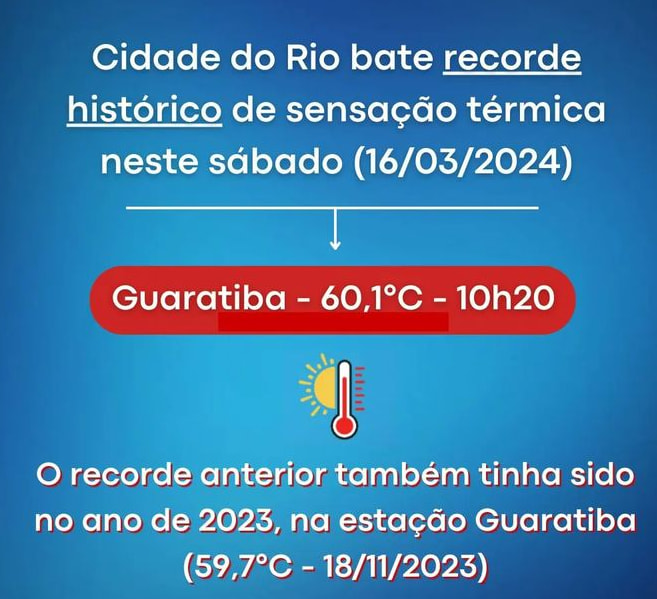
Rio de Janeiro with a wet-bulb temperature reaching 62.3 degrees Celsius (144.1 degrees Fahrenheit)

From March 16 through 18, 2024, Brazil experienced a severe heatwave, setting new records in Rio de Janeiro with a wet-bulb temperature reaching 62.3 degrees Celsius (144.1 degrees Fahrenheit). The wet-bulb temperature reflects the body’s cooling mechanism through sweat evaporation. Higher heat and humidity levels, indicated by the heat index, impede sweat evaporation. A wet-bulb temperature of 35℃ (95℉) at 100% humidity, or 115℉ at 50% humidity, represents the upper limit of safety, beyond which the human body cannot effectively regulate its core temperature through sweat evaporation.

On March 23, an atmospheric river event brought heavy rains to Brazil’s Rio de Janeiro state, resulting in at least nine fatalities, primarily in Petropolis, which bore the brunt of the impact. An astonishing 270 mm (11 inches) of rain fell within a 24-hour period, significantly affecting the region and leading to numerous incidents, including landslides and house collapses.
The Beatless Sense Mongers: We’re Here… er, a… Were Here

4D Music: Songs About Science

A song about The Human Induced Climate Change Experiment

bookmark_borderCan You Stop the Rain?

[Intro]
[Instrumental]
[Verse 1]
Can we stop the rain?
Isn’t it insane?
Drip, drip, destroy
Come back to enjoy

[Chorus]
Please explain
What are we waiting for?
[Choir refrain]
Choir refrain: What are we waiting for?
(What are we waiting for?)

[Bridge]
Well?
Hell!
Well, well, well
La, de, da, la, de, dee
Help us see

[Break]

[Verse 2]
Can we stop the rain?
Hate to complain
Can’t get a grip
Drip, drip, destroy
Please come back to enjoy

[Chorus]
Please explain
What are we waiting for?
[Choir refrain]
Choir refrain: What are we waiting for?
(What are we waiting for?)

[Bridge]
Well?
Hell!
Well, well, well
La, de, da, la, de, dee
Help us see

[Solo]

[Break]

[Bridge]
It’s going to rain
It’s going to pour
Can’t bear the pain
Oh going poor
er, a, ah, ahh, ah, la, la
La, la, la, lo, da, de, da

[Verse 1]
Can we stop the rain?
Isn’t it insane?
Drip, drip, destroy
Come back to enjoy

[Outro]
Please explain
What are we waiting for?
[Choir refrain]
Choir refrain: What are we waiting for?
(What are we waiting for?)

[Ending]

[Silence]

THE SCIENCE LESSON

Most climate change models forecast rising sea levels as the predominant threat of a warming climate to flood risks. Though sea level rise is of great concern, so should be extreme rainfall (violent rain). One type of violent rain is an atmospheric river. Atmospheric rivers are narrow bands of moisture that travel across the lower troposphere. The Journal EOS in the article Atmospheric Rivers Spur High-Tide Floods on U.S. West Coast explains, “Atmospheric rivers, at their peak, can carry as much water through the sky as the Amazon River does on land. They unleash intense winds and heavy rain as they surge across the Pacific Ocean, eventually making landfall on the U.S. West Coast, contributing to many high-tide flooding events.”

Both the sea and air temperatures are rising. Warm air can hold more moisture than cool air. Warmer sea temperatures result in more evaporation. Warmer air can hold more moisture. The increased moisture in the air moves over land causing inland deluges.

The Beatless Sense Mongers: We’re Here… er, a… Were Here

4D Music: Songs About Science

A song about The Human Induced Climate Change Experiment

bookmark_borderIons on the Air

[Intro]
[Harmonica]
Can you feel?
Feel real
Feeeeeeeel
So real
Ideal
I-deal

[Verse 1]
Can you feel
Ions on the air
Negative ions
Positive signs
Charge!

[Bridge]
Ch, ch, ch, charge
Large, large, charge
Ion
Eye on
Ion
Eye on ion
I… on… and, on and on, and on

[Break]

[Verse 2]
Intersection of teleconnection
Clear ear ear
Through the atmosphere, ear, ear
Hear here

[Bridge]
Ch, ch, ch, charge
Large, large, charge
Ion
Eye on
Ion
Eye on ion
I… on… and, on and on, and on

[Verse 3]
Ions on the air
I’m already there
On the air
There

[Solo]

[Break]

[Outro]
Can you feel?
Feel real
Feeeeeeeel
So real
Ideal
I-deal

[Ending]

[Silence]

ABOUT THE SCIENCE
How does rain affect ions?
As raindrops collide, the water molecules break apart into fragments that gain an electrical charge. The heavier and harder the rain, the more negative ions are produced.

Negative ions are tasteless, odourless and invisible molecules that we inhale when we are in environments that contain moving water, like rain. Once the negative ions reach our bloodstream, they are believed to produce biochemical reactions that help to relieve stress, alleviate depression and even boost our energy.

Global warming is caused by an increase in thermal energy in the climate system. The Earth is a climate system. Many subsystems make up our climate. Chaos theory emphasizes the complexity and nonlinearity of dynamic system.

Teleconnections:
Chaos theory recognizes the concept of teleconnections, where seemingly unrelated events in one part of the Earth system influence conditions in another. For instance, changes in sea surface temperatures (linked to ocean dynamics) can affect atmospheric circulation patterns, leading to variations in precipitation and temperature on land.

The Beatless Sense Mongers: We’re Here… er, a… Were Here

4D Music: Songs About Science

A song about The Human Induced Climate Change Experiment

bookmark_borderThe Hottest Year on Earth (Cosmic Fever)

A space groove rock song about the hottest year on Earth.

[Verse]
Lost in the cosmic void
The Earth’s temperature soars
Every year gets hotter
The heat wave roars
Melting ice caps
Rising tides
A planet in distress
The hottest year on Earth
It’s a cosmic mess

[Verse 2]
Parched lands and scorched skies
The sun’s relentless wrath
No escape from this heat
It’s a dangerous path
The Earth’s in a fever
Burning up from within
Humanity’s choices
A cosmic sin

[Chorus]
Cosmic fever
Burning up the atmosphere
Can’t escape the heat
It’s getting crystal clear
From galaxies far
They watch us wonder
The hottest year on Earth
Our cosmic blunder

ABOUT THE SONG
In the 20th century, the Earth’s surface temperature averaged 13.9℃. However, in the first weeks of July 2023, the global average temperature surged to 17℃, marking a concerning shift. The question arises: Can humans endure temperatures greater than 3℃? The answer is a grim “probably not long,” as such extremes have never been experienced by humanity before.

September 6, 2023, marked a dire warning from United Nations Secretary-General Antonio Guterres, following the World Meteorological Organization’s report on the hottest Northern Hemisphere summer in human history. Guterres stated, “The dog days of summer are not just barking, they are biting,” emphasizing the severity of the situation.

Climate breakdown, the most alarming development, occurs when feedback loops are triggered, and tipping points are crossed. This leads to the extinction of plants, the disappearance of carbon sinks, and an exponential acceleration of Earth’s temperature. The consequences are dire, with the potential disappearance of vital resources like food, fresh water, and breathable air, likely followed by catastrophic impacts on human survival.

In October 2023, the European Space Agency’s Copernicus Climate Change Service reported that the average temperature for September hit 16.38 degrees Celsius, surpassing the previous record set in September 2020 by 0.5 degrees Celsius. Copernicus Director Carlo Buontempo described it as “mind-blowing” and emphasized the devastating impacts on people and ecosystems, citing destruction of assets, infrastructure, and harvests. “What we are observing, are not only new extremes but the persistence of these record-breaking conditions, and the impacts these have on both people and planet, are a clear consequence of the warming of the climate system,” Director Buontempo said.

By January 2024, the Earth had experienced an alarming annual average temperature increase of over 1.5 degrees Celsius. This temperature rise continued in February 2024, with a monthly average reaching 1.77 degrees above pre-industrial levels, occurring centuries earlier than previously predicted. The urgency to address and combat climate change has never been more critical.

The Beatless Sense Mongers: We’re Here… Were Here

4D Music: Songs About Science

A song about The Human Induced Climate Change Experiment

bookmark_borderOut the Window

[Refrain]
What comes above love?
Above love
Love

[Verse 1]
Did someone just jump out the window
I wonder who’s next to follow?
Find it hard to swallow
(Swallow, swallow)

[Chorus]
The more we make
The more we take
Forgot forgive
And how to live
Push comes to shove
What about love?

[Refrain]
What comes above love?
Above love
Love

[Verse 2]
Did you hear someone yelp for help?
I wonder who’s next to follow?
Find it hard to swallow
(Swallow, swallow)

[Chorus]
The more we make
The more we take
Forgot forgive
And how to live
Push comes to shove
What about love?

[Bridge]
What about love, love, love
When push comes to shove
What about love?
Love, love, love

[Refrain]
What comes above love?
Above love
Love

[Verse 3]
Do you hear fear coming near?
I wonder who’s next to follow?
Find it hard to swallow
(Swallow, swallow)

[Chorus]
The more we make
The more we take
Forgot forgive
And how to live
Push comes to shove
What about love?

[Bridge]
What about love, love, love
When push comes to shove
What about love?
Love, love, love

[Refrain]
What comes above love?
Above love
Love

[Outro]
Did someone just jump out the window
I wonder who’s next to follow?
Find it hard to swallow
(Swallow, swallow)
What comes above love?
Above love
Love

ABOUT THE SONG
Global warming has inflicted irreversible damage on our environment, a consensus echoed by nearly all scientists. Indeed, climate change poses a profound challenge. Our planet is witnessing conditions that increasingly jeopardize human habitation. The critical question now is whether we can adapt swiftly enough. (Year: 1999)

Human-induced climate change is a dynamic component of an intricate and unordered system, as per chaos theory. This implies that global warming is accelerating exponentially in a complex manner. Over the period from 1992 to 2023, we have presented compelling evidence, proposed remedies to mitigate climate change, and amassed valuable information through the engagement of millions with this climate model. Your participation has been invaluable. The incontrovertible data underscores that human-induced climate change is rapidly deteriorating our habitat.

This climate model / experiment employs chaos theory to comprehensively consider human impacts and projects a potential global average temperature increase of 9℃ above pre-industrial levels. Global warming is a consequence of elevated thermal energy in the climate system, which comprises various subsystems. Chaos theory underscores the intricate and nonlinear nature of dynamic systems. Human well-being is compromised above a 1.5-degree temperature rise, rendering much of the Earth uninhabitable. A 9-degree Celsius increase would bring the Earth close to a wet-bulb temperature incapable of sustaining human life.

The Beatless Sense Mongers: We’re Here… Were Here

4D Music: Songs About Science

A song about The Human Induced Climate Change Experiment

bookmark_borderInsane Train

[Verse 1]
Are you driving your crazy train
Draaaaaain trill none remain
Are you driving your crazy train
Draaaaaain trill none remain
Are you driving your crazy train
Draaaaaain trill none remain

[Chorus]
All those years of knocking the know-all
In vain
Mocking meek
And talking small
… insane

[Verse 2]
Are you driving your crazy train
Draaaaaain trill none remain
Are you craving to cause a strain
Brain, does one remain?
Are you craving to cause a strain
Brain? Does not remain.

[Chorus]
All those years of knocking the know-all
In vain
Mocking meek
And talking small
… insane

[Bridge]
Toss the tears
Embrace us all
Remain
Sing the refrain
Seeking meek
Head held tall
Embrace us all

[Verse 3]
Are you driving your crazy train
Draaaaaain trill none remain
Are you craving to cause a strain
Brain sings the refrain
Spread the loving while we remain
Nothing to lose and all to gain

[Chorus]
All those years of knocking the know-all
In vain
Mocking meek
And talking small
… insane

[Bridge]
Toss the tears
Embrace us all
Remain
Sing the refrain
Seeking meek
Head held tall
Embrace us all

[Outro]
Spread the loving while we remain
Nothing to lose and all to gain
Remain

ABOUT THE SONG

Atmospheric circulation together with ocean circulation is how thermal energy is redistributed throughout the world. Chaos theory offers insights into the complex, nonlinear dynamics of climate systems role in the redistribution of thermal energy. The Earth’s climate is a highly complex and dynamic system, influenced by various factors such as ocean currents, atmospheric circulation, and feedback loops.

General Circulation Models for the earth climate are nonlinear and teleconnected. That means a small change in temperature or pressure or humidity in one small area on the globe can cause _large_ changes in conditions _anywhere_ on the globe. This is sometimes called the Butterfly effect. The complexity of these models can lead to chaotic behaviour. Climate science must grapple with these models and extract results in spite of the mathematical difficulties, and there have been remarkable successes in some cases and sad failures in others. Nevertheless we must proceed.

The Butterfly Effect illustrates that a small change in one area can lead to significant alterations in conditions anywhere on the globe. Hence, the frequently heard statement that a fluttering butterfly in China can cause a hurricane in the Atlantic. Be a butterfly and affect the world.

The Beatless Sense Mongers: We’re Here… Were Here

4D Music: Songs About Science

A song about The Human Induced Climate Change Experiment

bookmark_borderA Dead Ringer

[Verse 1]
A ring around the sun
A ring around the trunk
A ring around the sun
A ring around the trunk

[Chorus]
Another year gone by
Is this the one we’ll try?
Another day passed by
Another well run dry

[Bridge]
Hissy fits
Over leftover bits
Yet, not yet
Can’t forget regret

[Verse 2]
A ring around the sun
A ring around the trunk
An orbit of the Earth
Adding to the tree’s girth

[Chorus]
Another year gone by
Is this the one we’ll try?
Another day passed by
Another well run dry

[Bridge]
Hissy fits
Over leftover bits
Yet, not yet
Can’t forget regret

[Verse 3]
A ring around the sun
A ring around the trunk
An orbit of the Earth
Adding to the tree’s girth
One more ring till we’re done?
Here’s the thing: should have thunk!

[Chorus]
Another year gone by
Is this the one we’ll try?
Another day passed by
Another well run dry

[Bridge]
Hissy fits
Over leftover bits
Yet, not yet
Can’t forget regret

[Outro]
Sing!
Here’s the thing
Should have thunk!
Sing!

ABOUT THE SONG
Trees are highly vulnerable to climate change due to their lack of mobility, as they are rooted in place and unable to relocate in response to changing environmental conditions. This vulnerability is multifaceted:

  1. Temperature Extremes: Trees have evolved to thrive within specific temperature ranges. As temperatures rise due to climate change, trees may struggle to adapt, leading to increased stress, decreased growth rates, and heightened susceptibility to pests and diseases. Unlike mobile organisms that can seek out more suitable habitats, trees are confined to their current location, making them particularly vulnerable to temperature extremes.
  2. Changing Precipitation Patterns: Climate change alters precipitation patterns, leading to more frequent droughts or intense rainfall events in certain regions. Drought-stressed trees are more susceptible to disease, insect infestations, and mortality. Conversely, excessive rainfall can lead to waterlogged soils, root suffocation, and increased risk of landslides or uprooting. Trees cannot relocate to areas with more favorable moisture conditions, exacerbating their vulnerability to shifting precipitation patterns.
  3. Habitat Loss and Fragmentation: Climate change can alter ecosystems and disrupt habitats, leading to habitat loss and fragmentation for tree species. As temperatures warm, suitable habitat zones for certain tree species may shift poleward or to higher elevations. However, habitat fragmentation and human development may impede natural migration pathways, trapping tree populations in isolated patches of habitat. This fragmentation reduces genetic diversity and limits the ability of tree populations to adapt to changing conditions.
  4. Interactions with Other Species: Trees form complex ecological relationships with other organisms, including symbiotic fungi, pollinators, and herbivores. Climate change can disrupt these interactions, leading to mismatches in timing (e.g., flowering and pollinator emergence) or altering species distributions. Trees may face increased pressure from invasive species or novel pests and pathogens that thrive under warmer conditions. Limited mobility prevents trees from escaping areas of high predation or disease pressure.

The metaphor of trees as climate refugees underscores the parallels between the vulnerability of stationary organisms like trees and the plight of human populations displaced by climate change. Much like trees, climate refugees are often unable to escape the impacts of environmental degradation and face challenges in finding suitable habitats and resources. Both trees and climate refugees highlight the urgent need for proactive adaptation strategies, conservation efforts, and international cooperation to address the complex and interconnected challenges of climate change.

The Beatless Sense Mongers: We’re Here… Were Here

4D Music: Songs About Science

A song about The Human Induced Climate Change Experiment

bookmark_borderIf You Do the Math


[Verse 1]
Come right this way
If you have a problem
I know how to solve them
When it comes to math, I’m of the persuasion
To solve the equation

[Chorus]
Figure it out
Without doubt
Resolve to solve
In evolution
To find solution
Know to know

[Bridge]
If synapse collapse
Comes your way
Change your day
Put it in play
It’ll be O.K.

[Verse 2]
Fracture by the fraction
In our subdivision
More multiplication
In their skepticism

[Chorus]
Figure it out
Without doubt
Resolve to solve
In evolution
To find solution
Know to know

[Bridge]
If synapse collapse
Comes your way
Change your day
Put it in play
It’ll be O.K.

[Verse 3]
Status time symbol
Feeling less than nimble
Lacking Gucci?
Dole parts of the whole
Theirs takes a toll
Wait! You’ll see

[Chorus]
Figure it out
Without doubt
Resolve to solve
In evolution
To find solution
Know to know

[Bridge]
If synapse collapse
Comes your way
Change your day
Put it in play
It’ll be O.K.

[Outro]
Divisor advisor
Integer instigator
Divisor advisor
All the wiser
[Silence]

ABOUT THE SONG

I’ve been thinking about the giant global warming formula that has been formulating in my head for the last few decades.

Human induced climate change is an exponential component of an unordered system (chaos theory). Our climate model uses chaos theory in an attempt to adequately account for humans and forecasts a global average temperature increase of 9 degrees Celsius above pre-industrial levels.

Unfortunately, even scientists are failing to see (let alone forecast) the rapid acceleration in climate change. Due to their complexity, the impacts of the Domino Effect are being underestimated. Tipping points are Critical Milestones that directly impact the rate of acceleration in climate change by multiplying the number and intensity of feedback loops. The Domino Effect is also known as “tipping cascades” in climate science. Cascading impacts in relation to tipping points include cascading impacts across biogeophysical and social systems. Until recently, scientist have been drastically underestimating the social-ecological systems. The University of Exeter reports, “There is a notable lack of topic clusters dedicated to how humans will be impacted by climate-related tipping cascades.”

Previous climate models have inadequately incorporated “social-ecological systems” as human involvement was not a significant factor in past climate changes. Regrettably, the United States ranks among the least prepared countries globally, with the highest percentage of climate deniers. The Republican party dismisses it as a manufactured crisis and plans to increase fossil fuel production, exacerbating the situation. Political extremists asserting that the climate crisis is manufactured employ an ironic term, considering that human manufacturing activities are the primary driver of climate change. Both political parties have concurred to allocate unlimited emergency funding for climate disasters instead of proactively preventing them. Last year, the US witnessed a record number of over a billion-dollar climate disasters, totaling 28 separate weather and climate-related events. It is due to this arrogance and ignorance that “worst-case scenarios” are now “best-case scenarios” for the acceleration of climate change. These factors have altered our climate model, shifting the projected maximum temperature rise from 4 degrees Celsius over the next millennium to a probable increase of 9 degrees Celsius this century.

The Beatless Sense Mongers: We’re Here… Were Here

4D Music: Songs About Science

A song about The Human Induced Climate Change Experiment

bookmark_borderThese Roots Ain’t Made for Walking

[Verse 1]
Woe to be a plant
And put down roots
No walking boots
Bound by roots
Have to take the chance
On Man’s cahoots
Overshoots
Rapes and loots

[Chorus]
That’s what he did
Enslaved by id
Used and then rid
That’s what he did

[Verse 2]
Ohhhh to be a tree
Not really free….
No walking boots
Bound by roots
Have to take the chance
On Man’s cahoots
Overshoots
Rapes and loots

[Chorus]
That’s what he did
Enslaved by id
Used and then rid
That’s what he did

[Verse 3]
Noooo, to be a flower…
Hour after hour…
No walking boots
Bound by roots
Have to take the chance
On Man’s cahoots
Overshoots
Rapes and loots

[Chorus]
That’s what he did
Enslaved by id
Used and then rid
That’s what he did

[Outro]
By what id did
Watch him go
Stroke ego
Go, cat, go
No, don’t know
Ego, go, go
Don’t know no

ABOUT THE SONG
Plants are in a precarious position.  At the hands of Man, vegetation can not escape.  There is no way to run.  There is no way to hide. After Man conquers, they die. Global warming is caused by an increase in thermal energy in the climate system. The Earth is a climate system. Many subsystems make up our climate. Chaos theory emphasizes the complexity and nonlinearity of dynamic systems, and this complexity is inherent in the interactions between soil, atmosphere, and oceans in the Earth’s climate system.

The Beatless Sense Mongers: We’re Here… Were Here

4D Music: Songs About Science

A song about The Human Induced Climate Change Experiment

bookmark_borderSeconds (Back for More, More, More)

[Verse 1]
Coming back for a second helping
Never too late for another plate
Extra stuffing
Must concede
Not a need

[Verse 2]
Going back out to the store
Just to store more, more, more….
Extra fluffing
Yes, indeed
Not a need

{Guitar Solo]
[Bridge]
Say, what’s in the fridge?
Water under the bridge
What’s in the closet?
[Knocking]
Skeletons? You bet.

[Verse 3]
Hope you don’t mind if I form a new line
First of it’s kind, “I’m doing fine!”
Enough enoughing
Beg and plead
I concede
[Outro]
Yes, indeed
Doing fine
Stopped the bleed
Feeling fine
… for the rest of my time….

ABOUT THE SONG
Anthropogenic climate change is an exponential component of an unordered system (chaos theory). Climate change is primarily driven by the escalation of thermal energy affecting biogeophysical and socio-economic systems. While biogeophysical factors can be studied using math, physics, and historical records, socio-economic systems pose greater challenges due to the unpredictable consequences of human behavior and inexplicable consumer choices, exacerbating tipping points and feedback loops.

The Beatless Sense Mongers: We’re Here… Were Here

4D Music: Songs About Science

A song about The Human Induced Climate Change Experiment

bookmark_borderCosmic Countdown

A psychedelic hard rock space song about running out of time.

[Verse]
Lost in the cosmos, I’m searching for a sign
Space and time are melding, it’s a race against time
Gravity pulls me closer, my heart’s about to burst
In this psychedelic universe, I’m fighting for what’s worth

[Verse 2]
Staring at the stars, my mind begins to spin
Losing track of days, the countdown’s wearing thin
The clock’s ticking faster, reality’s slipping away
In this cosmic chaos, I’ve got no time to delay

[Chorus]
Running out of time, on this interstellar ride
My mind’s on overload, as the universe unfolds
(Oh-oh-oh, oh-oh, oh-oh)
Running out of time, in this cosmic countdown
Gotta find my way back home, before I’m lost and never found

Cosmic Countdown Part II
[Verse 1]
In the first week of July, the world turned ablaze,
The hottest days ever, a scorching craze,
But how long is “ever” in our human gaze,
As we stumble through history’s intricate maze?

[Chorus]
Running out of time, on this interstellar ride
My mind’s on overload, as the universe unfolds
(Oh-oh-oh, oh-oh, oh-oh)
Running out of time, in this cosmic countdown
Gotta find my way back home, before I’m lost and never found

(Verse 2)
Humans, mere blips in Earth’s ancient story,
Yet we wield power, seeking our glory,
From the Seven Sisters to our fossil fuel inventory,
We’ve altered the climate, rewriting allegory.

(Chorus)
We’ve breached the threshold, beyond pre-industrial,
Heating the planet, the impact substantial,
Can we adapt to a world so unforgivable,
Where extremes reign supreme, and life seems unlivable?

(Bridge)
Feedback loops and tipping points, a dire concern,
As ice melts, forests burn, the consequences churn,
The domino effect, each tipping point we spurn,
Will we awaken, or watch as the world yearns?

(Verse 3)
Climate scientists warned of this impending fate,
Yet we ignored, sealed our tragic state,
Now the Earth’s wrath, it’s far too late,
As we stand at the precipice, sealing our own crate.

(Chorus)
It’s not a distant future, it’s today’s call,
To halt the burning, to prevent the fall,
For if we continue, humanity’s downfall,
Will be swift and merciless, our epitaph scrawl.

(Outro)
So let’s halt the combustion, the exploitation spree,
For a world worth saving, for you and me,
Stop burning fossil fuels, let our actions decree,
A future of hope, where all can be free.

Cosmic Countdown Part III
[Verse]
Lost in the cosmos, I’m searching for a sign
Space and time are melding, it’s a race against time
Gravity pulls me closer, my heart’s about to burst
In this psychedelic universe, I’m fighting for what’s worth

[Verse 2]
Staring at the stars, my mind begins to spin
Losing track of days, the countdown’s wearing thin
The clock’s ticking faster, reality’s slipping away
In this cosmic chaos, I’ve got no time to delay

[Chorus]
Running out of time, on this interstellar ride
My mind’s on overload, as the universe unfolds
(Oh-oh-oh, oh-oh, oh-oh)
Running out of time, in this cosmic countdown
Gotta find my way back home, before I’m lost and never found

ABOUT THE SONG
How long is “ever”… as in “the hottest it’s ever been in recorded history”?

During the first week of July 2023, the Earth had the hottest days ever.

Humans are about 200,000 years old with our closest variety being dated to about 140,000 years ago. The earliest “recording of history” is approximately 100,000 years old. It is the story of The Seven Sisters of The Pleiades. The Seven Sister are a cluster of stars in the Taurus constellation. There are six stars visible to the naked eye. The story is about seven stars. The seventh star has not been visible to the naked eye for over 100,000 years.

The 20th-century surface temperature average for Earth was 13.9℃.
In the first weeks of July of 2023, the average temperature was 17℃.

Q: Is it possible for humans to push the temperature 3℃ above pre-industrial levels?
A: Yes. Humans have pushed global temperatures up more than 3℃.

Q: Is it possible for humans to survive at temperatures greater than 3℃?
A: Probably not long. Humans have never done it before.

Extreme weather will become more frequent and intense. Sea levels will rapidly rise as the coasts disappear. However, the most concerning development will be feedback loops and tipping points. Plants will become extinct and many carbon sinks will vanish. The Earth’s temperature will continue to accelerate at an exponential rate no matter what humans do. Food, fresh water, and breathable air will cease to exist. Humans will likely follow in short order.

These “tipping points” were preventable; however, now they are becoming inevitable. Climate scientists had thought we would not cross tipping points for centuries at the earliest. Tipping points are part of feedback loop systems. A tipping point occurs when a human influenced global warming activity becomes self-sustaining without the human activity. For instance, the mountain glacier loss tipping point has triggered a feedback loop. The ice-albedo feedback loop is an expression of the ability of surfaces to reflect sunlight (heat from the sun). Any loss of ice over a darker surface means the surface will absorb more heat and reflect less heat. This process makes the Earth warmer causing more loss of ice… which in turn causes more warming of the Earth. When a tipping point causes another tipping point to be toppled it is called the The Domino Effect. Mountain glacier loss, the collapse of AMOC, and the dieback of the Amazon rainforest is an example of The Domino Effect.

“The increasing heating of our planet caused by fossil fuel use is not unexpected, it was predicted already in the 19th century after all,” said climate scientist Stefan Rahmstorf at the Potsdam Institute for Climate Research in Germany. “But it is dangerous for us humans and for the ecosystems we depend on. We need to stop it fast.”

This is our current situation. Not “years away”. Not tomorrow. Today.

Stop burning fossil fuels today, stop exploiting hydrocarbons today, or else….

— from Climate Change: How Long Is “Ever”? Brouse (2023)

The Beatless Sense Mongers: We’re Here… er, a… Were Here

4D Music: Songs About Science

A song about The Human Induced Climate Change Experiment

bookmark_borderStanding Tall (After All)

After all,
… standing tall
You know…
The wind may blow
The will to bend
But will not break
How much can we take?
We tapped our resources
Again and again
Run out or recourse
Consumption sin

After all, standing tall
You know…
The wind may blow
The will to bend
But will not break
How much can we take?
We crashed our economy
Again and again
And trashed from sea to see
Consumption sin

After all, standing tall
You know…
The wind may blow
The will to bend
But will not break
How much can we take?
Let’s put more hope back into scope
Yes! Let’s begin
Come shining love from above
Yes! Let’s begin
Again and again

Unplugged Version Chords: F#/7 Bm7 F# / A B D F
Instrumentation: Vocals (TC-Helicon VOICELIVE and MiniNova Vocorder), Ibanez Acoustic Guitar (AW54CE)

ABOUT THE SONG

Human-induced climate change is a dynamic component of an intricate and unordered system, as per chaos theory. This implies that global warming is accelerating exponentially in a complex manner. Over the period from 1992 to 2023, we have presented compelling evidence, proposed remedies to mitigate climate change, and amassed valuable information through the engagement of millions with this climate model. Your participation has been invaluable. The incontrovertible data underscores that human-induced climate change is rapidly deteriorating our habitat.

This climate model / experiment employs chaos theory to comprehensively consider human impacts and projects a potential global average temperature increase of 9℃ above pre-industrial levels. Global warming is a consequence of elevated thermal energy in the climate system, which comprises various subsystems. Chaos theory underscores the intricate and nonlinear nature of dynamic systems. Human well-being is compromised above a 1.5-degree temperature rise, rendering much of the Earth uninhabitable. A 9-degree Celsius increase would bring the Earth close to a wet-bulb temperature incapable of sustaining human life.

What Can I Do? There are numerous actions you can take to contribute to saving the planet. Each person bears the responsibility to minimize pollution, discontinue the use of fossil fuels, reduce consumption, and foster a culture of love and care. The Butterfly Effect illustrates that a small change in one area can lead to significant alterations in conditions anywhere on the globe. Hence, the frequently heard statement that a fluttering butterfly in China can cause a hurricane in the Atlantic. Be a butterfly and affect the world.

The Beatless Sense Mongers: We’re Here… Were Here

4D Music: Songs About Science

A song about The Human Induced Climate Change Experiment

bookmark_borderFrom on High

From on high
Look around
What goes up
Must come down
Started, now can’t stop
Crumbling mountaintop

Can’t deny
Look around
What goes up
Must come down
Started, in motion
Ice into ocean

My, Oh, my
Look around
What goes up
Soon falls down
Started, domino
You know… there they go….

Unplugged Version Chords: E F F# F# F E / D C E
Instrumentation: Vocals (TC-Helicon VOICELIVE and MiniNova Vocorder), Ibanez Acoustic Guitar (AW54CE)

ABOUT THE SONG
Climate breakdown, the most alarming development, occurs when feedback loops are triggered, and tipping points are crossed. This leads to the extinction of plants, the disappearance of carbon sinks, and an exponential acceleration of Earth’s temperature. The consequences are dire, with the potential disappearance of vital resources like food, fresh water, and breathable air, likely followed by catastrophic impacts on human survival. Identifying and understanding these tipping points is crucial for climate science and policymaking. Crossing multiple tipping points could lead to a domino effect, resulting in a much more rapid and severe climate change than currently projected.

The Beatless Sense Mongers: We’re Here… Were Here

4D Music: Songs About Science

A song about The Human Induced Climate Change Experiment

bookmark_borderEquation of Change

LYRICS
Hard rock song about the equation to solve the climate change formula .

Climate Change: The Equation Brouse and Mukherjee (2023)

[Verse]
The world is turning, spinning round and round
Temperature rising, the ice is meltin’ down (down)
We gotta find a solution, before it’s too late
The equation of change, we must calculate (calculate)

[Verse 2]
Carbon emissions, polluting the air
We gotta find a way, to show we care (care)
The clock is ticking, time is running out
We gotta solve this problem, there’s no room for doubt (doubt)

[Chorus]
(x^2 – 4xy + 3y^2) – (2x^2 – 6xy + 4y^2)
Equals the power of change, to save our Earth
We’ll take action and fight, for a better tomorrow
Together we’ll make a difference, and heal the sorrow

bookmark_borderBiblical Baggage

LYRICS
[Verse 1]
Today is the day
While the banks are breached
The earth was at fault
A new record reached

(Chorus)
The damn is breaking
The flood is flowing
The Earth is shaking
No one is knowing

[Verse 2]
Today we all sway
To, fro, friend and foe
Some will wash away
Will you stay or go?
(chorus)
[Bridge]
Water and land roll
Nature’s exact toll
Will Man yearn to learn
Or crash and burn?

[Verse 3]
Today they do say
Quasi-biblical
Our rate of decay
Is historical
(chorus)

[Outro]
Soon… the sun is eclipsed by the moon
Flood, mud, earthquake, shake and bake
Soon… the sun is eclipsed by the

Chords: F Bb Ab F / F Bb Db F / Db F Db C7 F / F Ab Bb F; Part II @ 104 Beats Per Minute
Instrumentation: Vocals (TC-Helicon VOICELIVE and MiniNova Vocorder), Ibanez Acoustic Guitar (AW54CE), Ibanez Electric RG-270 (Vox ToneLab and Boss Digital Delay), Fender Jazz Bass (Boss Digital Delay), Keyboards (Korg PS60, Casio WK-3500, Yamaha PSR-740, MiniNova, MicroKorg)

ABOUT THE SONG
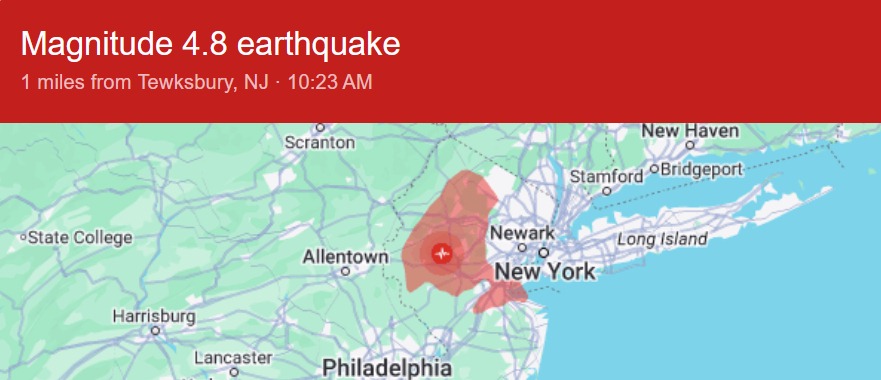
Between April 1 and 4, 2024, Southeastern Pennsylvania experienced another severe weather event attributed to atmospheric rivers and strong winds. Rainfall accumulation exceeded 3 inches, accompanied by wind gusts ranging from 35 to 45 mph. Tragically, two individuals lost their lives in unrelated incidents, one in Montgomery County and the other in Delaware County, when trees collapsed onto their vehicles. Today (Friday April 5) Pennsylvania, New Jersey, and New York experienced a 4.8 magnitude earthquake. Monday is a total eclipse.

This song, “Biblical Baggage,” delves into the tumultuous and uncertain nature of our times, drawing parallels to events of biblical proportions.

[Verse 1] sets the scene with a sense of urgency, describing a day when natural forces wreak havoc, breaking banks and setting new records.

The [Chorus] captures the chaos and devastation unfolding, likening it to a dam breaking, floods flowing, and the Earth shaking, all while humanity remains oblivious to the impending catastrophe.

[Verse 2] portrays the collective uncertainty and vulnerability in the face of such calamities. The imagery of swaying suggests a lack of stability and the looming threat of being swept away by the relentless tide.

The [Bridge] reflects on the toll exacted by nature’s fury, questioning whether humanity will heed the lessons it presents or face dire consequences.

[Verse 3] paints a picture of the magnitude of the events, labeling them quasi-biblical and highlighting the historical significance of our current state of decay.

The [Outro] brings a sense of foreboding, as the sun is eclipsed by the moon, symbolizing an impending darkness amidst the ongoing turmoil of floods, mudslides, earthquakes, and more.

Overall, “Biblical Baggage” serves as a reflection on the precariousness of our existence in the face of natural disasters and the urgent need for awareness and action in the midst of escalating environmental crises.

ABOUT THE SCIENCE
Human-induced climate change is a complex element within a dynamic and interconnected chaotic system. When coupled with other natural phenomena such as earthquakes or solar eclipses, the convergence of factors can create overwhelming compounding effects. Climate change is primarily driven by the escalation of thermal energy affecting biogeophysical and socio-economic systems. While biogeophysical factors can be studied using math, physics, and historical records, socio-economic systems pose greater challenges due to the unpredictable consequences of human behavior and inexplicable consumer choices, exacerbating tipping points and feedback loops.

The Age of Loss and Damage is a new way of thinking about economics by combining economics, climate science, statistics, and physics. Until now, economic models have been unfit to capture the full extent of climate damage. Traditionally, “integrated assessment models” (IAMs) were used to forecast “shock” events. IAMs use “quadratic function” to calculate GDP losses by squaring the temperature change, yet ignore other methods (such as the exponential function) that are better suited for rapid change. “Climate change is fundamentally different to other shocks because once it has hit, it doesn’t go away,” said Thierry Philipponnat, author of a report by Finance Watch, a Brussels-based public interest NGO on financial issues. “And if the fundamental assumption is flawed, all the rest makes little sense — if any.”

Industrial Noize Pollution = The Equation

4D Music: Songs About Science

A song about The Human Induced Climate Change Experiment