bookmark_borderOne Point Five and Still Alive

LYRICS
Faster and faster
Life is going past Her
1.5 and still alive
Make it to two
… how about you?
Burn, baby, burn
Higher and higher
Burn, baby, burn
Mired in dire
Expire

Faster and faster
Heading to disaster
2 in view
It’s hard to thrive
Make it to 3
… hardly
Burn, baby, burn
Higher and higher
Burn, baby, burn
Mired in dire
Expire

Faster and faster
Reaper is our master
Destiny passing three
Can’t arrive…
We can’t be
Burn, baby, burn
Higher and higher
Burn, baby, burn
Mired in dire
Expire

Faster and faster
We couldn’t outlast Her
Explore 4
There’ll be no more
I’s… to testify
Burn, baby, burn
Higher and higher
Burn, baby, burn
Mired in dire
Expire

Chords: Dm Am Em Am / G A / C E C E / E Am / C Dm; Part II 80 to 92 to 104 to 116 to 30 Beats Per Minute
Instrumentation: Vocals, Acoustic Guitar, Electric Guitar, Bass, Keyboards (Korg PS60, Casio WK-3500, Yamaha PSR-740, MiniNova, MicroKorg)

Currently, we have crossed the tipping point when human induced climate change triggers a chain reaction of feedback loops. In 2022, the UN Environment Programme (UNEP) insisted there is “no credible pathway to 1.5℃ in place.”

The Earth will exceed 1.5℃ (average global surface temperature over the surface of the earth for ten years) by the 2040’s and a societal collapse will ensue. For the most part, the Earth will be uninhabitable for humans by 2070 UNLESS immediate action is taken. UPDATE: Since writing this in 2021, there is enough data to conclude 1.5℃ will be breached a decade earlier. In October 2023, the Imperial College of London published a study that concludes 1.5℃ will be reached by 2030 at our current rate of emissions. The average temperature for 2023 was +1.4℃ with September’s average +1.7℃ and parts of July at +3℃

— from The Human Induced Climate Change Experiment / Mukerhjee and Brouse (2021/2023)

Q: Is it possible for humans to push the temperature 3℃ above pre-industrial levels?
A: Yes. Humans have pushed global temperatures up more than 3℃.

Q: Is it possible for humans to survive at temperatures greater than 3℃?
A: Probably not long. Humans have never done it before.

Extreme weather will become more frequent and intense. Sea levels will rapidly rise as the coasts disappear. However, the most concerning development will be feedback loops and tipping points. Plants will become extinct and many carbon sinks will vanish. The Earth’s temperature will continue to accelerate at an exponential rate no matter what humans do. Food, fresh water, and breathable air will cease to exist. Humans will likely follow in short order.
— from Climate Change: How Long Is “Ever”? / Brouse (2023)

bookmark_borderWater Vapor Savior

LYRICS
Going on days and days
Living in a haze
Down with a bog
Living in a fog
Simply some sun sheen
Or a dripping of moonbeam
Would save me
Surely some bright light
A cool breeze through trees
Water vapor savior

It’s not just the heat
To make it complete
The humidity is killing me
Simply some sun sheen
Or a dripping of moonbeam
Would save me
Surely some bright light
A cool breeze through trees
Water vapor savior

Tired of jumping through hoops
When the air’s thick as soup
Please let it rain
I won’t complain
Simply some sun sheen
Or a dripping of moonbeam
Would save me
Surely some bright light
A cool breeze through trees
Water vapor savior

Chords: Am Em Bm Em / C Am E / E C E C E Am; Part II 121 Beats Per Minute
Instrumentation: Vocals, Acoustic Guitar, Electric Guitar, Bass, Keyboards (Korg PS60, Casio WK-3500, Yamaha PSR-740, MiniNova, MicroKorg)

For every degree Celsius in warming, the water-holding capacity of the atmosphere increases by about 7%. Record-high sea temperatures ensure there is more moisture (in the form of water vapor) in the atmosphere, by an estimated 5-15% compared to before the 1970s, when global temperature rise began in earnest.

Water vapor is a powerful greenhouse gas. Since the 1970s, its rise likely increased global heating by an amount comparable to that from rising carbon dioxide. We are now seeing the consequences. In the current climate, for average all-sky conditions, water vapour is estimated to account for 50% of the total greenhouse effect, carbon dioxide 19%, ozone 4% and other gases 3%. Clouds make up about a quarter of the greenhouse effect.

The main greenhouse gases – carbon dioxide, methane, nitrous oxide and ozone – don’t condense and precipitate. Water vapor does, which means its lifetime in the atmosphere is much shorter, by orders of magnitude, compared to other greenhouse gases. On average, water vapor only lasts nine days,

Sidd said, “The biggest feedback loop is water vapor. Humans put CO2 in the air. CO2 is a greenhouse gas, so the earth gets warmer. Warmer air can hold more water vapor soaking up more water vapor from the oceans. Water vapor is a greenhouse gas, so it gets even warmer… rinse (sorry!) and repeat. Another interesting thing is that the precipitation (rain, snow, sleet) intensity is increasing.”

The most common measure of water vapor in the atmosphere is relative humidity. Deadly humid heat is affecting billions of people today. “It’s very disturbing,” study co-author Matthew Huber of Purdue University. “It’s going to send a lot of people to emergency medical care.”

The study Greatly enhanced risk to humans as a consequence of empirically determined lower moist heat stress tolerance was conducted by Purdue and George Mason University and published August 15, 2023. These results indicate that a significant portion of the world’s population will experience — for the first time in human history — prolonged exposures to uncompensable extreme moist heat. Humans will struggle to adapt to these conditions in a warmer world as they will present widespread challenges across many aspects of food-energy-water security, human health, and economic development including in the world’s most populous and most vulnerable regions. At 3C (5.4F) of yearly average warming, more than 1.5 billion people will suffer. Both 2022 and 2023 saw a record number of heat related deaths. More than 61,000 Europeans died from extreme heat in the summer of 2022.

— From Sea Level Rise: Then and Now / Mukherjee and Brouse (2023)

What you can do today. How to save the planet.

Climate Change: The End of Times

A song about The Human Induced Climate Change Experiment

bookmark_borderSpin Me Round

LYRICS
As the flow force intensifies
It’s hard to open up my eyes
Spin me round
Blow me down
As the wind speed increases
Harder, harder never ceases
Spin me round
Blow me down

Often found on the ground
Flat on my back
A big black cloud following
Foreshadowing
Shadowing
Foreshadowing shadowing
Here’s the thing:
The dark days grow darker
There’s no days to grow
The leading edge grows sharper
Bleeding we’ll come to know
As the flow force intensifies
It’s hard to open up my eyes
Spin me round
Blow me down

Chords: Bb/7 / Eb Db Bb / Ab Bb / Eb Db Bb / Fm Bb; Part II 166 Beats Per Minute
Instrumentation: Vocals, Acoustic Guitar, Electric Guitar, Bass, Keyboards (Korg PS60, Casio WK-3500, Yamaha PSR-740, MiniNova, MicroKorg)

A song about The Reign of Violent Rain and flow forces. Wind and water flow forces scale as the square of velocity, so as flow speeds increase (say due to more intense heating or heavier rain) the damage scales as the square of the velocity. So a twenty mile an hour wind exerts four times as much force as a ten mile an hour wind. And a forty mile an hour wind exerts sixteen times as much force as a ten mile an hour wind. A wind of fifty miles an hour exerts twenty five times and a wind of sixty miles an hour exerts thirty six times as much force as one of ten miles an hour. Then you have the density term. Water is about eight hundred times denser than air, So the force exerted by a ten mile an hour flow of water is eight hundred times that of a ten mile an hour wind. So as flow velocities go up due to climate change, force and damage scale as square of the velocities. What is not clear is how much these velocities increase with climate change. But in a sense we are seeing this already as, for example, flood and sewage systems succumb and hillsides fall down, and so on.
There is a very complex set of climate systems impacted by sea level rise. The shape of the Earth is changing and speeding up as ice from the poles melts and is drawn toward the equator through centrifugal force. A study published in Geophysical Research Letters of the American Geophysical Union suggests that global warming has led to significant melting of glaciers due to which our planet’s axis of rotation has been moving faster since the 1990s. All of this has a great impact on our weather. The rain intensity is increasing faster today than ever known.
— from Sea Level Rise: Then and Now / Mukherjee and Brouse (2023)

What you can do today. How to save the planet.

Climate Change: The End of Times

A song about The Human Induced Climate Change Experiment

bookmark_borderMind Blowing

LYRICS
I heard the scientists’ hypothesis
It was quite mind-blowing
Come on knowing
What they said filled my head
They said quite mind-blowing
Come on knowing
The ice is melting way too fast
At this pace, it will never last
Quite mind-blowing
Come on knowing
Though not surprising
The temperature’s rising
It’s the rapid rate
Doubt the primate
Is apt to adapt
Quite mind-blowing
Come on knowing
I was hoping not to fade away
Memories of our yesterday
… not fade away
… decay
But if there’s no one here to hear
There’s no sound to be found

Quite mind-blowing
Come on knowing

Chords: E/7/m/m7/sus4/7 / C A G E
Instrumentation: Vocals, Acoustic Guitar
Written and recorded at Lake Wynonah, Pennsylvania

A song about * Antarctic sea-ice at ‘mind-blowing’ low *
On September 17, 2023, the BBC reported:
The sea-ice surrounding Antarctica is well below any previous recorded winter level, satellite data shows, a worrying new benchmark for a region that once seemed resistant to global warming.

“It’s so far outside anything we’ve seen, it’s almost mind-blowing,” says Walter Meier, who monitors sea-ice with the National Snow and Ice Data Center.

An unstable Antarctica could have far-reaching consequences, polar experts warn.

The Guardian reported:
“September was, in my professional opinion as a climate scientist, absolutely gobsmackingly bananas,” said Zeke Hausfather, at the Berkeley Earth climate data project.”

Antarctica’s huge ice expanse regulates the planet’s temperature, as the white surface reflects the Sun’s energy back into the atmosphere and also cools the water beneath and near it.

What you can do today. How to save the planet.

Climate Change: The End of Times

A song about The Human Induced Climate Change Experiment

bookmark_borderViolent Rain

LYRICS
The moisture
Starts taking shape
For sure
Shape of a cloud
We think
Out loud
Out loud
So proud
(How loud? Hubris us proud)
Is cumulonimbus a reflection on us
Inability to sustain
Brings on violent rain
As silent remain
Under violent rain
Under violent reign
(No fun dancing in the violent rain)

Blue pasture
What do you see
Cloud animal
Gas shaped as ass
We think
Out loud
Out loud
So proud
(How loud? Hubris us proud)
Is cumulonimbus a reflection on us
Inability to sustain
Brings on violent rain
As silent remain
Under violent rain
Under violent reign
(No fun dancing in the violent rain)

Self-portrait pareidolia (Oh, yeah!)
Irate primate watching ass gas pass
We think
Out loud
Out loud
So proud
(How loud? Hubris us proud)
Is cumulonimbus a reflection on us
Inability to sustain
Brings on violent rain
As silent remain
Under violent rain
Under violent reign
(No fun dancing in the violent rain)

… look! A loon flying by the moon

Chords: A D E A / A D C A / A G A / B7 C / C E / E G A / A G E; Part II 176 Beats Per Minute
Instrumentation: Vocals, Acoustic Guitar, Electric Guitar, Bass, Keyboards (Korg PS60, Casio WK-3500, Yamaha PSR-740, MiniNova, MicroKorg)

ABOUT THE SONG
1) Pareidolia is the tendency to perceive a specific, often meaningful image in a random or ambiguous visual pattern, such as clouds.

2) The Reign of Violent Rain

My interest in sea-level rise and ice sheets collapsing began in the 1990’s after I asked Sidd his greatest concerns about human induced climate change. Much of climate change can be reversed or at least stopped from worsening. The collapse of ice sheets is irreversible. Sidd said, “A terrible future awaited.” Coastal areas were forecast to be at greatest risk.

In October of 2023 Sidd said, “Now I am thinking the violent rain will be a bigger problem before we die… still thinking it through. In the long run, ya, sea level rise will hit big. If you look at the history, it is episodic, and in the fast bits it can go up 3 feet every twenty years for five hundred years. But, the rain intensity is increasing faster today, and drainage cannot cope, whether in the city or out, culverts and such put in over the last hundred years cannot handle. So, I am paying a lot of attention to terrain and drainage far inland from the seacoast (like Ohio.) By drainage I don’t mean just human built. I mean that the natural streams and gullies and ravines have not evolved to a state that can handle the water volumes we see and the worse, larger volumes we will see. So expect huger erosion, steeper slopes to waterways, land collapses and such. Build out your drainage.”

Violent Rain
Multiple factors figure into the physics of violent rain. The starting point is the moisture content of air. The Earth is warming. Warm air can physically hold more water than cool air. The warmer the air the more water vapor the air can hold (i.e. relative humidity). The capacity doubles for every ten degree Celsius warming.

One physical result is more massive raindrops. The Momentum of Rain is p = mv (p = momentum, m = mass, v = velocity.) Part of the increasing momentum is transferred to the sides and upward increasing wind turbulence, as well as updrafts. Most of the momentum is transferred upon impact. You may notice the rain bouncing higher off the streets and sidewalks. Flowing rainwater will have both increased mass and velocity.

On the ground, concrete, asphalt, solar panels, roofs, plants, animals, houses, and infrastructure will be hit with greater momentum. In the air, the increasing mass of the rain will intensify wind turbulence. Professor Paul D. Williams of the University of Reading, UK, said, “Turbulence is chaotic (chaos theory). Turbulence is known famously as the hardest problem in physics.” In their study Evidence for Large Increases in Clear-Air Turbulence Over the Past Four Decades, Prof. Williams and his team found “Climate change has caused turbulence to double in the last 40 years” and is expected to double or triple again in the next decades.

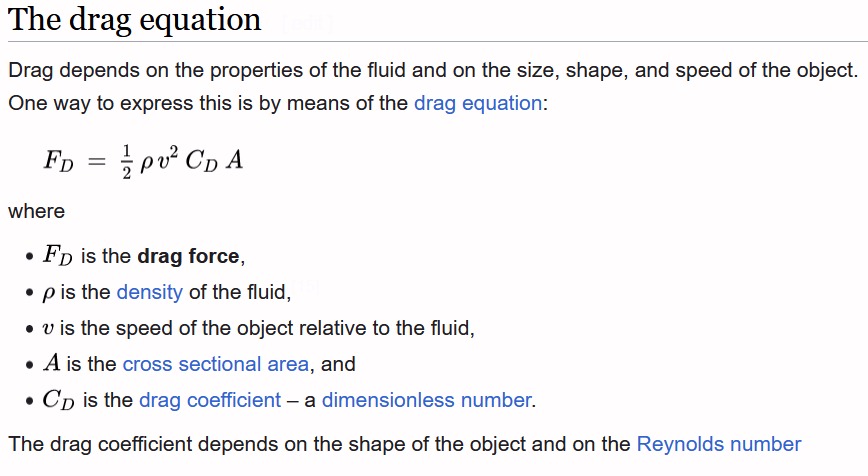
Mass and velocity are parts of a larger equation that also includes density.The combination of these variables results in an increased intensity of the flow forces (i.e. flow dynamics). Wind and water flow forces scale as the square of velocity, so as flow speeds increase (say due to more intense heating or heavier rain) the damage scales as the square of the velocity. Look at drag physics and you will see that force is proportional to density times square of velocity (v^2).

So a twenty mile an hour wind exerts four times as much force as a ten mile an hour wind. And a forty mile an hour wind exerts sixteen times as much force as a ten mile an hour wind. A wind of fifty miles an hour exerts twenty five times and a wind of sixty miles an hour exerts thirty six times as much force as one of ten miles an hour. Then you have the density term. Water is about eight hundred times denser than air, so the force exerted by a ten mile an hour flow of water is eight hundred times that of a ten mile an hour wind. As flow velocities go up due to climate change, force and damage scale as square of the velocities. What is not clear is how much these velocities increase with climate change. But in a sense we are seeing this already as, for example, flood and sewage systems succumb and hillsides fall down, and so on.

The Drag Equation
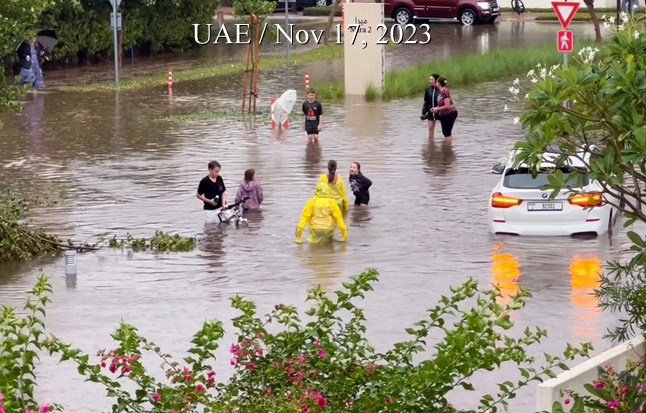
UAE Stormwater Flooding

Rainfall-surge Hazard
The Journal Nature published the study Tropical cyclone climatology change greatly exacerbates US extreme rainfall-surge hazard examining how current models underestimate the risk of Rainfall-surge Hazard. “Tropical cyclones (TCs) are drivers of extreme rainfall and surge, but the current and future TC rainfall-surge joint hazard has not been well quantified. Using a physics-based approach to simulate TC rainfall and storm tides, we show drastic increases in the joint hazard from historical to projected future (SSP5-8.5) conditions. The frequency of joint extreme events (exceeding both hazards’ historical 100-year levels) may increase by 7-36-fold in the southern US and 30-195-fold in the Northeast by 2100. This increase in joint hazard is induced by sea-level rise and TC climatology change; the relative contribution of TC climatology change is higher than that of sea-level rise for 96% of the coast, largely due to rainfall increases. Increasing storm intensity and decreasing translation speed are the main TC change factors that cause higher rainfall and storm tides and up to 25% increase in their dependence.”

Expect to see increasing intensity and/or frequency in a wide variety of violent rain events including: downpours, flooding, hurricanes, cyclones, monsoons, coastal flooding, storm surges, lightning and wildfires, hail, extreme wind, and concurrent extremes. The reign of violent rain has already begun. More hillsides and shorelines are collapsing. Atmospheric rivers are dramatically increasing flash flooding in the Northeastern USA (pictured beach erosion in Ocean City, NJ / December 2023). Worldwide, stormwater systems are becoming overwhelmed. Ironically, the streets of Abu Dhabi and Dubai, UAE, flooded days before the COP28 Climate Conference (pictured / November 2023). Nowhere is safe from violent rain, not even in the desert preparing for a UN meeting on the climate crisis. As a result of increasing violent rain, new drainage culverts are forming. Eventually, the culverts will transform into recurring streams, carving new canyons, creating new landscapes and islands. At the same time as the violent rain makes its way to the sea, the sea is rising to meet the violent rain.
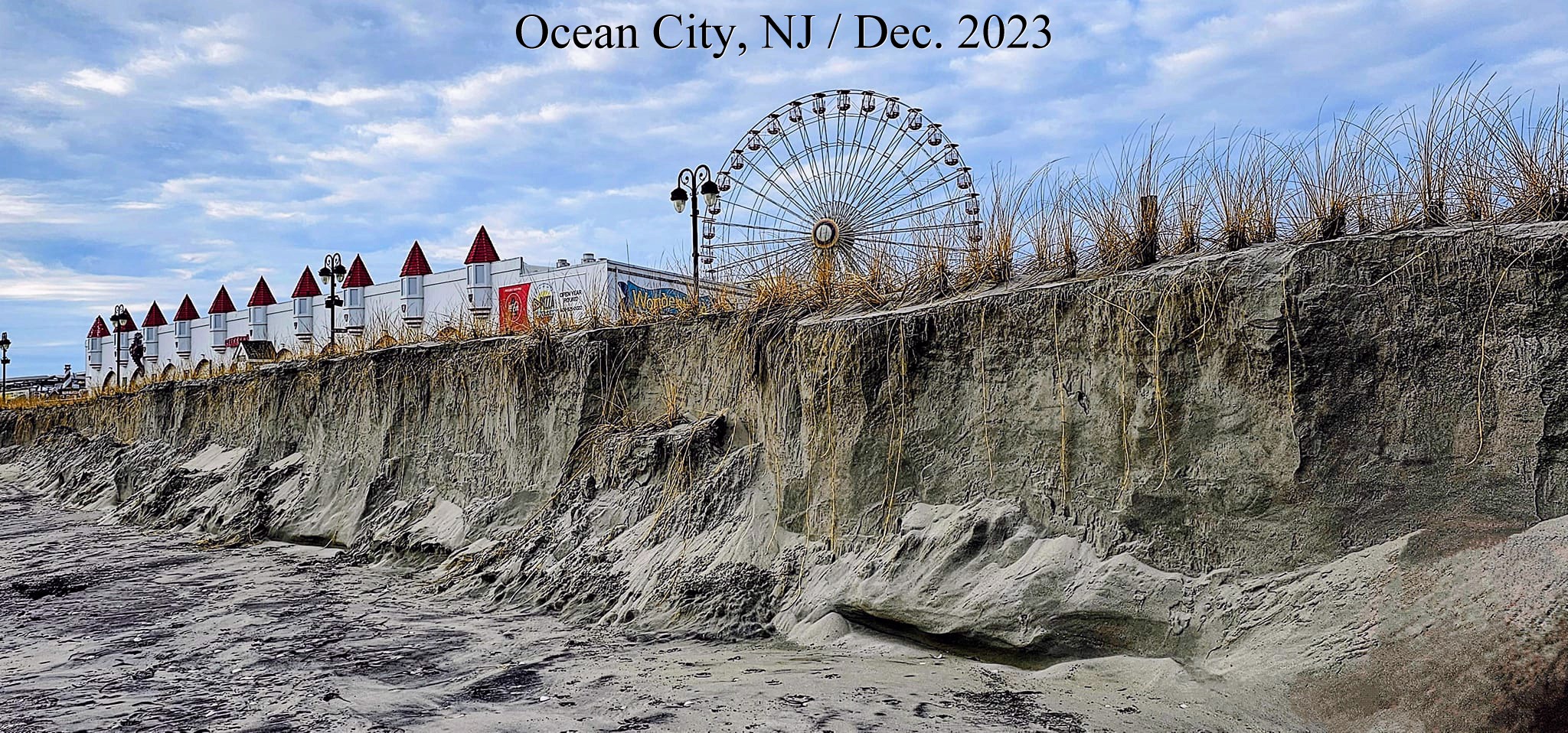
Ocean City Beach Erosion

Conclusion
Humans are making the Earth hotter. The cool water from the melting ice at the poles is being drawn toward the center of the Earth and getting warmed to record high temperatures. The warm, moist air is circulating and moving over land. The average time moisture stays in the air is 9 days before it turns into precipitation. The warmer the air becomes, the more rain the atmosphere holds and dumps; therefore, violent rain events are increasing in frequency and intensity. The greatest short term risk to the Earth is violent rain (liquified water vapor). The greatest short term risk to human health is deadly humid heat (hot water vapor).

— from The Reign of Violent Rain / Brouse and Mukherjee (2023)
Also see: Atmospheric Rivers Mukherjee and Brouse (2022-2023)

3) While sitting outside writing the song, I looked at the passing clouds and saw the form of Man taking shape as an ass in the water vapor gas. The storm clouds approaching, I thought about Gene Kelly in the movie “Singin’ in the Rain”:

Let the stormy clouds chase everyone from the place
Come on with the rain, I’ve a smile on my face
I walk down the lane with a happy refrain
Just singin’, singin’ in the rain
Dancin’ in the rain
I’m happy again
I’m singin’ and dancin’ in the rain

And, I thought to myself, “No, it’s no fun dancing in the violent rain.”

ExperiMental Music: The music and lyrics are written and recorded extemporaneously. Extemporaneous, spontaneous, improvisation, jamming, freestyle, and impromptu music are most closely related to pure chaos. The music and lyrics evolve from the “sensitive initial conditions” similar to “a butterfly flapping its wings in China causing a hurricane in the Atlantic.”

Music as a Universal Language: Music has the power to communicate emotions universally. Certain melodies, harmonies, or rhythms can evoke specific feelings that resonate with people across different cultures and backgrounds.

The Science of Chaos Theory, String Theory, and Music
What you can do today. How to save the planet.

Climate Change: The End of Times

A song about The Human Induced Climate Change Experiment

Deep Dive Into Science

bookmark_borderSolve to Slow

LYRICS
The temperature’s rising
Boiler’s going to blow
All take action
That are in the know
With a mind that’s quick
Solve to slow
With a kind heart pick
Which way to go

The waters are rising
Going to overflow
All take action
That are in the know
With a mind that’s quick
Solve to slow
With a kind heart pick
Which way to go

Do you find it surprising
Food’s harder to grow
All take action
That are in the know
With a mind that’s quick
Solve to slow
With a kind heart pick
Which way to go

Solve-to-Slow.mp3

Chords: G/7 Bb C G / G C G / C D7 G
Instrumentation: Vocals, Acoustic Guitar

A song about the acceleration of climate change. How fast are humans causing the climate to change? When we started our experiments in the 1990’s, we thought the time scale was in millenniums. If climate change were happening on a linear basis, we would have been correct; however, by the late 90’s we were convinced climate change was non-linear.

Doubling time is the amount of time it takes for a quantity to double in size (exponential growth). By 2020, there was enough data to see the doubling time of some anthropogenic climate affects had gone from 100 years to 10 years. For instance the rate of sea level rise has gone from about 1.5 millimeters per year to over 3 millimeters. We expect to see the doubling period to continue to shrink raising the possibility of sea levels rising a foot/year by 2050.

At what rate is climate change accelerating?
A: Rapidly
As described above, we do not know the rate of acceleration other than to say it is more rapid than previously thought. In the summer of 2023, the extreme temperatures left most climate scientists shocked. The average earth surface temperature recorded record highs for months reaching over 3 degrees Celsius above pre-industrial levels. The Paris Agreement calls for keeping temperatures below 1.5 degrees. Scientists concur that a rise of 2 degrees will trigger feedback loops and tipping points. Triggering these tipping points results in the CO2 stored in nature to be released at an exponential growth rate. How extreme the acceleration will be depends on tipping points toppling other tipping points in what is known as The Domino Effect. Toppled tipping points will continue to shrink the doubling time and exponentially increase the rate of global warming. Though we do not know how much carbon is stored in nature, it would be reasonable to assume that the temperature could be pushed from 3 degrees to 6 degrees above pre-industrial levels. Humans can not thrive above a rise of 1.5 degrees. Humans can not survive if the temperature rises 6 degrees.

About the 2023 wildfires in Hawaii, Governor Josh Green said, “For perspective, we’ve had six fire emergencies this August, we had six fire emergencies between 1953 and 2003. That’s how- how fast things are changing. I know that there is debate out there whether we should be talking about climate change or not. Well, let’s be real world, climate change is here we are in the midst of it with a hotter planet, and fiercer storms.”

About the catastrophic die-off of 10,000 emperor penguin chicks in the Antarctic, Dr. Caroline Holmes of the British Antarctic Survey (an expert on Antarctic sea-ice) said, “What we’re seeing right now is so far outside what we’ve observed previously. We expected change but I don’t think we expected so much change so rapidly.”
— From Climate Change: Rate of Acceleration / Brouse and Mukherjee (2023)

What you can do today. How to save the planet.

Climate Change: The End of Times

A song about The Human Induced Climate Change Experiment

bookmark_border= M/V –> D / (A * .5 * r * V^2) [Density Figures Into Drag]

LYRICS
= M/V
The severity
Of the density
Then once you know
How it goes into the flow
Thick is sick
Can you come back quick
Not that slick
Led by lead
A sinker not a thinker
Oh, what a drag
Once again…
See how you fit in?
Can’t hit a snag
When you are the drag
Oh so efficient
As the co-efficient
Why on Earth would that make you brag
Oh… what a drag
Your density is getting to me
Let go of my flow!

= M/V
The severity
Of the density
Then once you know
How it goes into the flow
Thick is sick
Oh what a drag

This song is about the abuse scientists experience online.

People,
Please oh please keep your political opinions out of science.
Thank you,
The management

When a particularly abusive knucklehead kept attacking me with their stupidity, racism, and bigotry, I replied:
= M/V –> D / (A * .5 * r * V^2)

M/V is the formula for density.
D / (A * .5 * r * V^2) is the formula for the co-efficient of drag.

So this response was both figuratively and literally appropriate. The person’s dense intellect figures into their being such a drag. The formulas also critically prove the impact of human induced climate change.

From Climate Change: The Equation / Brouse and Mukherjee (2023)

Technically Speaking, It’s Not the Momentum That Kills You

It’s not the fall that kills you; it’s the sudden stop at the end.

Technically speaking it is the impact from the momentum that causes damage and deaths. Global warming causes an increase in mass and/or velocity (momentum) of things that are mass flow driven by heat, like wind and flood.

The burning of fossil fuels and other human released emissions have impacted momentum’s impact. A warmer atmosphere can hold more moisture. Warmer air allows for the creation of more massive raindrops. Warmer ocean temperatures create stronger hurricanes. Hail and tornadoes form in strong thunderstorm clouds with intense updrafts, high liquid-water content, and large water droplets.

Sidd added: It’s worse than that. Wind and water flow forces scale as the square of velocity, so as flow speeds increase (say due to more intense heating or heavier rain) the damage scales as the square of the velocity.

About “square of the velocity”, I asked Sidd: is this Bernoulli’s Equation?

Sidd replied:

look at Wikipedia: Drag (Physics)
you will see that force is proportional to density times square of velocity (v^2)

The Drag Equation
So a twenty mile an hour wind exerts four times as much force as a ten mile an hour wind. And a forty mile an hour wind exerts sixteen times as much force as a ten mile an hour wind. A wind of fifty miles an hour exerts twenty five times and a wind of sixty miles an hour exerts thirty six times as much force as one of ten miles an hour. Then you have the density term. Water is about eight hundred times denser than air, So the force exerted by a ten mile an hour flow of water is eight hundred times that of a ten mile an hour wind. So as flow velocities go up due to climate change, force and damage scale as square of the velocities. What is not clear is how much these velocities increase with climate change. But in a sense we are seeing this already as, for example, flood and sewage systems succumb and hillsides fall down, and so on.

Chords: E A D / B E / C D E / C B7 E; Part II 128 Beats Per Minute
Instrumentation: Vocals, Acoustic Guitar, Electric Guitar, Bass, Keyboards (Korg PS60, Casio WK-3500, Yamaha PSR-740, MiniNova, MicroKorg)

What you can do today. How to save the planet.

Climate Change: The End of Times

A song about The Human Induced Climate Change Experiment

bookmark_borderDoubling Time

LYRICS
Go ahead
Scratch at the surface
Go ahead
Mind needs fed
2+2, 4+4
Go for more
8+8
No debate
Double the score

Go ahead
Scratch at the surface
Go ahead
Mind needs fed
16+16
Know what I mean?
32+32
Yes, I do

Go ahead
Scratch at the surface
Go ahead
Mind needs fed
64+64
Go for more
128+128
Celebrate
Go for more
Double the score
This time
It’s time
For double time

Doubling Time.mp3 (unplugged to save energy)

Chords: E A D G / E A D E / E A G F# E
Instrumentation: Vocals, Acoustic Guitar
Written and recorded at Lake Wynonah, Pennsylvania

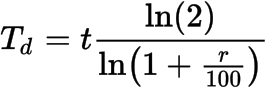
T_{d}=t \frac{\ln (2)}{\ln \left(1+\frac{r}{100}\right)}
T_{d} = doubling time
t = time
{r} = growth rate

Doubling time is the amount of time it takes for a quantity to double in size (exponential growth). For instance, if you invest your money at 10%, it will take about 7 years to double your money. For every $1,000 invested today, you will accumulate $128,000 in 49 years.

The same principle holds true with the accumulated impact of climate change. By 2020, there was enough data to see the “doubling period” of some anthropogenic climate affects had gone from 100 years to 10 years. For instance, the rate of sea level rise has gone from about 1.5 millimeters per year to over 3 millimeters. We expect to see the doubling period to continue to shrink raising the possibility of sea levels rising a foot/year by 2050.

Though the rate of change in climate disasters’ intensity, duration, and likelihood vary according to the type of extreme weather, a “rule-of-thumb” can be derived from the Canada wildfires of 2023. The World Weather Attribution Organization found, “Climate change made the cumulative severity of Quebec’s 2023 fire season to the end of July around 50% more intense, and seasons of this severity at least seven times more likely to occur.”

50% more intense
7 x more likely

These numbers may be similar in other catastrophes like hurricanes, heat waves, droughts, floods, tornadoes, and sea level rise.

If the doubling time remains at 10 years, we could see extreme events 100% more intense and/or longer in duration, as well as, 14 times more likely to occur. As mentioned above, we expect the doubling time to be reduced. If the doubling time is 5 years, in ten years we could see 200% more intense and longer extreme weather events being 28 times more likely to occur.

— from Climate Change: Rate of Acceleration  / Brouse and Mukherjee (2023)

What you can do today. How to save the planet.

Climate Change: The End of Times

A song about The Human Induced Climate Change Experiment

bookmark_borderTipping Point

LYRICS
There’s a drought in the rainforest
There’s no doubt what that’s about
You’ll find out about opinion
Versus the definition
Of desertification
Reached a tipping point
Fell over the edge
Who’s running this joint?
Need a new world pledge
Let’s get right to the point
Pledge to walk back…
… from the ledge
(Please step back from the ledge)

As a matter of fact, AMOC is whack
There’s no doubt what that’s about
You’ll find out about opinion
Versus the definition
Of overturning circulation

Alas, mountain glacier loss
There’s no doubt what that’s about
You’ll find out about opinion
Versus the definition
Of coastal saturation

Reached a tipping point
Fell over the edge
Who’s running this joint?
Need a new world pledge
Let’s get right to the point
Pledge to walk back…
… from the ledge
(Please step back from the ledge)
Reached a tipping point?
Reached tipping points
Breached tipping points
Multiple tipping points
Who’s running this joint?
Need a new world pledge
Let’s get right to the point
Pledge to walk back…
… from the ledge
(Please step back from the ledge)

Chords: B C E / A G E / G A E / G A A G E; Part II @ 110 Beats Per Minute
Instrumentation: Vocals, Acoustic Guitar, Electric Guitar, Bass, Keyboards (Korg PS60, Casio WK-3500, Korg N364, MiniNova, MicroKorg)

The song is about tipping points we appear to have breached. Push a glass toward the edge of a table and eventually it will fall off on its own. No matter how slowly or meticulously you push… no matter how you weight or fill the glass, it will reach a tipping point and fall off before being pushed completely off the table. No matter whether you believe the glass is half-empty or half-full, when the tipping point is reached it will plummet out-of-control to its end. This is science not fate, faith, nor belief. Human induced climate change has resulted in environmental tipping points being breached.

Crossing one tipping point would be alarming. For instance, crossing the tipping point for ‘mountain glacier loss‘ has immediate consequences: millions of people in Europe will be impacted by the lack of fresh water. Billions of people that live along coasts will be impacted by the saline infiltration and eventually by the submerging of their property. This in and of itself should be alarming; however, it gets worse. Tipping points are parts of feedback loop systems. The ice–albedo feedback loop is an expression of the ability of surfaces to reflect sunlight (heat from the sun). Any loss of ice over a darker surface means the surface will absorb more heat and reflect less heat. This process makes the Earth warmer causing more loss of ice… which in turn causes more warming of the Earth. So, yes, the mountain ice tipping point is quite alarming for both its immediate impact as well as its self-sustaining growth to global warming; but wait, it gets more alarming. The increasing temperatures due to crossing a tipping point causes other tipping points to be breached.

The tipping point for the collapse of AMOC (Atlantic Meridional Overturning Circulation) was thought to be centuries away, at the earliest. In July of 2023, the study Warning of a forthcoming collapse of the Atlantic meridional overturning circulation was published in the journal Nature Communications. “Here we provide statistical significance and data-driven estimators for the time of tipping. We estimate a collapse of the AMOC to occur around mid-century (2025-2095) under the current scenario of future emissions.” The collapse is likely to cause faster sea level rise on the east coast of the US, more severe storms in Europe, and increasing drought in the Sahel in Africa. “From the study of past climate, we know changes in the AMOC have been some of the most abrupt and impactful events in the history of climate,” said Prof. Stefan Rahmstorf, at the Potsdam Institute for Climate Impact Research in Germany and world leading oceanographer. During the last Ice Age, winter temperatures changed by up to 10C within three years in some places. “We are dealing with a system that in some aspects is highly non-linear, so fiddling with it is very dangerous, because you may well trigger some surprises,” he said. “I wish I knew where this critical tipping point is, but that is unfortunately just what we don’t know. We should avoid disrupting the AMOC at all costs. It is one more reason why we should stop global warming as soon as possible.” A feedback loop created by the AMOC tipping point is disruption in weather systems and circulation that cause loss of naturally occurring carbon sinks. One scenario is desertification of the Amazon rainforest.

The tipping point / feedback loop problem is very complex (chaos theory) and exponentially alarming. A third tipping point appears to have been triggered by the summer of 2023 — Amazon Rainforest Dieback. The Amazon is often referred to as ‘the lungs of our planet’. Not only does the Amazon suck in huge quantities of CO2 and breath out O2, but the Amazon soils also store huge amounts of CO2.  The desertification of the Amazon would result in a release of the carbon as the soils disappeared.

1) much of July was spent at record temperatures +3C
2) the collapse of the Amazon rainforest is likely to happen between +2 – 4C. The collapse of the Amazon is expected to occur because of changing weather patterns and circulation that result in drought.
3) Brazil set up a task force for “unprecedented drought in the Amazon”

Low river levels and hotter waters have killed masses of fish seen floating on river surfaces, contaminating the drinking water, Environment Minister Marina Silva said. “We have a very worrying situation. This record drought has disrupted river transport routes (dropping 30 cm / day) threatening food and water shortages, and a large fish mortality is already beginning.” This was the effect of a periodic El Niño mixing with changes in weather patterns brought by global warming. “We are seeing a collision of two phenomena, one natural which is El Niño and the other a phenomenon produced by humans, which is the change in the Earth’s temperature.” Worsened by climate change, this combination has caused drought not seen before in the Amazon and “is incomparably stronger and could happen more frequently.” 

Scientists concur that a rise of 2 degrees will trigger feedback loops and tipping points. Triggering these tipping points results in the CO2 stored in nature to be released. Though we do not know how much carbon is stored in nature, it would be reasonable to assume that the temperature could be pushed from 3 degrees to 6 degrees above pre-industrial levels. Humans cannot thrive above a rise of 1.5 degrees. Humans cannot survive if the temperature rises 6 degrees.

— from Toppled Tipping Points: The Domino Effect Brouse and Mukherjee (2023)

What you can do today. How to save the planet.

Climate Change: The End of Times

A song about The Human Induced Climate Change Experiment

bookmark_borderLeft in Ruins

Left-in-Ruins.mp3

LYRICS
They’re packing it up
They’re moving it out
They said, “Damn it…
Need a new planet!”
They’re moving real fast
They’re trying to move past
They said, “Look out…
You’re in the route”
Human race
Wrecked the place

They’re loading it up
Leaving no doubt
They said, “Damn it…
Need a new planet!”
They’re moving real fast
They’re trying to move past
They said, “Look out…
You’re in the route”
Human race
Trashed the place

They’ve had enough
Of too much stuff
They said, “Damn it…
Need a new planet!”
They’re moving real fast
They’re trying to move past
They said, “Look out…
You’re in the route”
Human race
Ruined the place

They’re packing it up
They’re moving it out
They said, “Damn it…
Need a new planet!”

Chords: E A D G E / B7 E
Instrumentation: Vocals, Acoustic Guitar

A song about:
“LinkedIn founder Reid Hoffman has told the New Yorker that at least 50% of Silicon Valley’s wealthiest have ‘apocalypse insurance’ – either an underground bunker or a contingency plan in case of disaster. ‘Saying you’re buying a house in New Zealand is kind of a wink, wink, say no more.'”
and… “the billionaire bunker, whether on land, sea or someday (ostensibly) on another planet entirely.”

It’s kind-of like Dr. Frankenstein hiding from his monster?

What you can do today. How to save the planet.

Climate Change: The End of Times

A song about The Human Induced Climate Change Experiment

bookmark_borderDensity

LYRICS
Dense
I see density
Hits me
Like reality
In sane
Wind whipped rain
When gas turns to liquid
As it just did
You come to know
The force of flow
In that space
Where it hits your face
You’ll make sense
Of what is dense
Literally, I can see density
It disfigures me
Density
Times the squared velocity
The irony
In my eye
I see
Density
Yeah… it hits me

What a drag
Hit a snag
Came to know
The forces flow

Chords: F#m / D#m F#m / G#m Gm F#m; 121 Beats Per Minute
Instrumentation: Vocals, Electric Guitar, Keyboards (Korg PS60, Casio WK-3500, Korg N364, MiniNova, MicroKorg)

Technically Speaking, It’s Not the Momentum That Kills You

It’s not the fall that kills you; it’s the sudden stop at the end.

Technically speaking it is the impact from the momentum that causes damage and deaths. Global warming causes an increase in mass and/or velocity (momentum) of things that are mass flow driven by heat, like wind and flood.

The burning of fossil fuels and other human released emissions have impacted momentum’s impact. A warmer atmosphere can hold more moisture. Warmer air allows for the creation of more massive raindrops. Warmer ocean temperatures create stronger hurricanes. Hail and tornadoes form in strong thunderstorm clouds with intense updrafts, high liquid-water content, and large water droplets.

Sidd added: It’s worse than that. Wind and water flow forces scale as the square of velocity, so as flow speeds increase (say due to more intense heating or heavier rain) the damage scales as the square of the velocity.

About “square of the velocity”, I asked Sidd: is this Bernoulli’s Equation?

Sidd replied:

look at Wikipedia: Drag (Physics)
you will see that force is proportional to density times square of velocity (v^2)

The Drag Equation

So a twenty mile an hour wind exerts four times as much force as a ten mile an hour wind. And a forty mile an hour wind exerts sixteen times as much force as a ten mile an hour wind. A wind of fifty miles an hour exerts twenty five times and a wind of sixty miles an hour exerts thirty six times as much force as one of ten miles an hour. Then you have the density term. Water is about eight hundred times denser than air, So the force exerted by a ten mile an hour flow of water is eight hundred times that of a ten mile an hour wind. So as flow velocities go up due to climate change, force and damage scale as square of the velocities. What is not clear is how much these velocities increase with climate change. But in a sense we are seeing this already as, for example, flood and sewage systems succumb and hillsides fall down, and so on. — from “Climate Change: The Equation” / Brouse and Mukherjee (2023)

What you can do today. How to save the planet.

Climate Change: The End of Times

A song about The Human Induced Climate Change Experiment

bookmark_borderDrag Force

LYRICS
The forces of nature
Continue to grow
Divorce from mature
What’s in you will show

The choices we made
Continue to blow
Voices that throw shade
Miss what’s in the know

Now that we’ve dared
The velocity squared
Tossed to and fro
The undertow
Of the overflow
The drag force… of course!

Intensity density
Continues to grow
Sensitivity of humanity
Is still a no-show

The choices we made
Continue to blow
Voices that throw shade
Miss what’s in the know

Now that we’ve dared
The velocity squared
Tossed to and fro
The undertow
Of the overflow
The drag force… of course!

The destiny of energy
Is quid pro quo
As humanity gets angry
At the ill we show

The choices we made
Continue to blow
Voices that throw shade
Miss what’s in the know

Now that we’ve dared
The velocity squared
Tossed to and fro
The undertow
Of the overflow
The drag force… of course!

Drag-Force.mp3

Chords: F#m A / E6 B7 F#m / D E6 F#m / F#m Am G#m F#m
Instrumentation: Vocals, Acoustic Guitar
Written and recorded at Lake Wynonah, Pennsylvania

Technically Speaking, It’s Not the Momentum That Kills You

It’s not the fall that kills you; it’s the sudden stop at the end.

Technically speaking it is the impact from the momentum that causes damage and deaths. Global warming causes an increase in mass and/or velocity (momentum) of things that are mass flow driven by heat, like wind and flood.

The burning of fossil fuels and other human released emissions have impacted momentum’s impact. A warmer atmosphere can hold more moisture. Warmer air allows for the creation of more massive raindrops. Warmer ocean temperatures create stronger hurricanes. Hail and tornadoes form in strong thunderstorm clouds with intense updrafts, high liquid-water content, and large water droplets.

Sidd added: It’s worse than that. Wind and water flow forces scale as the square of velocity, so as flow speeds increase (say due to more intense heating or heavier rain) the damage scales as the square of the velocity.

About “square of the velocity”, I asked Sidd: is this Bernoulli’s Equation?

Sidd replied:

look at Wikipedia: Drag (Physics)
you will see that force is proportional to density times square of velocity (v^2)


The Drag Equation


So a twenty mile an hour wind exerts four times as much force as a ten mile an hour wind. And a forty mile an hour wind exerts sixteen times as much force as a ten mile an hour wind. A wind of fifty miles an hour exerts twenty five times and a wind of sixty miles an hour exerts thirty six times as much force as one of ten miles an hour. Then you have the density term. Water is about eight hundred times denser than air, So the force exerted by a ten mile an hour flow of water is eight hundred times that of a ten mile an hour wind. So as flow velocities go up due to climate change, force and damage scale as square of the velocities. What is not clear is how much these velocities increase with climate change. But in a sense we are seeing this already as, for example, flood and sewage systems succumb and hillsides fall down, and so on. — from “Climate Change: The Equation” / Brouse and Mukherjee (2023)

What you can do today. How to save the planet.

Climate Change: The End of Times

A song about The Human Induced Climate Change Experiment

bookmark_borderThe Unsung Young

LYRICS
Keep it simple?
It’s a complex world
Solve the riddle
Before growing old
If you dream big enough
And your heart’s not too tough
Begun the unsung young

The-Unsung-Young.mp3

Human induced climate change is an exponential component of an unordered system (chaos theory). That means global warming is accelerating at a rapid rate in a complex way — a climate crisis. A simple way to try to explain it can be found in the explanation of tipping points:

Push a glass toward the edge of a table and eventually it will fall off on its own. No matter how slowly or meticulously you push… no matter how you weight or fill the glass, it will reach a tipping point and fall off before being pushed completely off the table. No matter whether you believe the glass is half-empty or half-full, when the tipping point is reached it will plummet out-of-control to its end. This is science not fate, faith, nor belief. Human induced climate change has resulted in environmental tipping points being breached.

The youth offer us our best hope. Keep your heart and mind young. Save the world.

Chords: Em F#M7 / G D C C D G
Instrumentation: Vocals, Acoustic Guitar

What you can do today. How to save the planet.

Climate Change: The End of Times

A song about The Human Induced Climate Change Experiment

bookmark_borderOnce in a Blue Moon

LYRICS
Sing me a song
That it won’t be long
Coming soon
Before the Blue Moon
It’s coming along
No, we can’t go wrong
Coming soon
Before the Blue Moon
Save us from ourselves
If nobody else
Make it plain to see
Our humanity

Sing me a song
How it won’t be long
Found buffoon
Before the Blue Moon
We’re coming on strong
No, it wont’ be long
Coming soon
Before the Blue Moon
Save us from ourselves
If nobody else
Make it plain to see
Our humanity

Sing me a tune
That we will resume
Coming soon
Before the Blue Moon
We learn to love
Beyond and above
Not just once
In a Blue Moon
Save us from ourselves
If nobody else
Make it plain to see
Our humanity

A NASA Study reported, “If global temperatures keep rising and reach 2 degrees Celsius (3.6 degrees Fahrenheit) above pre-industrial levels, people worldwide could face multiple impacts of climate change simultaneously.”

I responded, “If”? … sadly no longer “If”… at current levels of emissions, we will reach an average of +3 in the 2050’s. (We already reached that average for July of 2023.) Multiple tipping points have already been breached… the dominoes are falling. According to the new IPCC chair, Jim Skea, we would need to stop all emissions immediately… and then there is a small chance that we would peek at +1.5 – 2… and then start coming back down after 2100. However, he admits chances are slim that we will stop using fossil fuels. The speed at which we will reach +3 to +6 depends mostly on how much CO2 is stored in nature. We do not know that answer. But as these tipping points take off on their own, we will find out.

Human induced climate change is an exponential component of an unordered system (chaos theory). Tipping points and feedback loops are parts of an equation that determine the rate of acceleration in climate change.

Chords: C A7 / C D A7: Part II from 98 to 108 to 118 Beats Per Minute
Instrumentation: Vocals, Acoustic Guitar, Keyboards (Korg PS60, Casio WK-500, Korg N364, MiniNova, MicroKorg)

What you can do today. How to save the planet.

Climate Change: The End of Times

A song about The Human Induced Climate Change Experiment

bookmark_borderYou’re Getting Warmer

LYRICS
I spy something warmer
Comes with a disclaimer
Everything within sight
Could soon ignite
Is running down the street
Burning your feet
Is everyone you meet
Jumping in too deep
Gone dire
On fire

I spy something warmer
Comes with a disclaimer
Everything within sight
Could soon ignite
An apocalyptic view
Coming to you
As every one you meet
Is burning on the street
Gone dire
On fire

I spy something warmer
Comes with a disclaimer
Everything within sight
Could soon ignite
All your hopes and dreams
Like a World War movie scene
No more news flashes
The world lay in ashes
Gone dire
On fire

In the Hawaii wildfires of August 2023, both wind and water flow forces contributed to the devastation. Hurricane Dora was at least 500 miles from Hawaii yet the wind forces impacted the fire in Maui. The winds were so strong that before the fire reached Lahaina extremely hot air blew over the town. The streets were so hot they burnt people’s feet trying to flee. The surface of everything became hot. Even after people jumped into the ocean, they said the debris in the water was too hot to float on.

The blast of hot air over Lahaina created the conditions for a flashpoint. A flashpoint is the temperature at which a particular organic compound gives off sufficient vapor to ignite in air. The entire town ignited so quickly that warning sirens could not be activated and people did not have time to escape.

In an unexpected twist, water flow forces also contributed to the chaos. How could water flow add to the fire emergency conditions? When people fled the heat and fire, they jumped into the sea. ABC news reported: Shawn Dougherty, of Lahaina, was among the hundreds of residents forced to flee the resort city when the wildfire began engulfing their homes.

Like others, Dougherty said his only means of survival was to jump into the ocean with his girlfriend, but while some found safety in nearby jetties, the rocks and coral tore up Dougherty’s body.

“At one point, it seemed like I might drown,” he told ABC News. “I’m a good swimmer, but the water was just really rough because of the wind and the turbulence.”

From: Climate Change: The Equation / Brouse and Mukherjee (2023)

What you can do today. How to save the planet.

Climate Change: The End of Times

Chords: Em G A A G Em / Em C D Em / Em B7 B7 Em; Part II @ 120 BPM
Instrumentation: Vocals, Acoustic Guitar, Electric Guitar, Bass, Keyboards (Korg PS60, Casio WK-500, Korg N364, MiniNova, MicroKorg)

A song about The Human Induced Climate Change Experiment

The hall of historic Waiola Church in Lahaina and nearby Lahaina Hongwanji Mission are engulfed in flames along Wainee Street on Tuesday, Aug. 8, 2023, in Lahaina, Hawaii. (Matthew Thayer/The Maui News via AP)