bookmark_borderWhat’s the Matter With Dark Matter?

LYRICS
1. Watch that quark
She’s ready to spark
Of course
On course
For the strong force

Not right
To wave in the light
Might flight
Into insight
For that matter
Bizarre D*
Dark matter
Dark matter
… a little further
What’s the matter
With dark matter?
Please shed some light
What’s the matter
With dark matter?
She’s alright!
Have to climb Wittgenstein’s ladder
To see delight
In the night

2. Stark hexaquark
Find in the dark
Often found
3 up, 3 down

3. Quote: “Quark can’t be broken”
Spoken: your light awoken

Chords: E7 Am7 D7 / D7 C / C Em / Bm Em / Em E7 / A7 E7 A7 B7 E7; Part II @ 116 Beats Per Minute
Instrumentation: Vocals (TC-Helicon VOICELIVE and MiniNova Vocorder), Ibanez Acoustic Guitar, Fender Squire Mini (Boss Digital Delay), Fender Jazz Bass (Boss Digital Delay), Keyboards (Korg PS60, Casio WK-3500, Yamaha PSR-740, MiniNova, MicroKorg)

ABOUT THE SONG
Quarks are elementary particles and a fundamental constituent of matter. They combine to form protons and neutrons, which in turn make up atomic nuclei. There are six types, or “flavors,” of quarks: up, down, charm, strange, top, and bottom. Quarks are never found in isolation; they are always bound together by the strong force, mediated by particles called gluons. Current understanding is quarks are indivisible and cannot by broken down.

Dark matter is a mysterious form of matter that does not emit, absorb, or reflect light, making it invisible and detectable only through its gravitational effects. It is thought to make up about 27% of the total mass and energy content of the universe, as inferred from observations of the large-scale structure of the cosmos and the motion of galaxies.

D* (D-star) hexaquark particles are hypothesized to consist of three up and three down quarks, and have been proposed as a candidate for dark matter. A study found that production of stable d* hexaquarks could account for 85% of the Universe’s dark matter.

Ludwig Wittgenstein, an influential 20th-century philosopher, introduced the concept of “Wittgenstein’s ladder” in his later work, particularly in his book “Philosophical Investigations.” This idea is closely related to his views on language and the nature of philosophy.

The ladder metaphor is used to illustrate the idea that philosophical problems often arise from misunderstandings or misuses of language. Wittgenstein suggests that philosophical confusion can be dispelled by recognizing the ways in which language is used and by clarifying the meanings of words.

The ladder analogy can be explained as follows:

  1. Building the Ladder: Initially, when we encounter a philosophical problem or confusion, we may construct a conceptual framework or use certain words in a particular way. Wittgenstein likens this to building a ladder to reach a certain understanding.
  2. Climbing the Ladder: Once the ladder (conceptual framework or language use) is in place, we use it to address the philosophical issue at hand. However, Wittgenstein argues that the ladder is not meant to be climbed indefinitely. It is a temporary tool for reaching a specific understanding.
  3. Throwing Away the Ladder: After reaching the desired understanding, Wittgenstein suggests that we should discard the ladder. This means that once the clarification is achieved and the problem is understood in a new way, there is no need to hold onto the initial philosophical concepts or language that led to the confusion.

In essence, Wittgenstein’s ladder is a method for overcoming philosophical puzzles and confusion by examining and understanding the language that gives rise to these problems. It emphasizes the importance of recognizing how words are used in different contexts and discourages the tendency to create philosophical theories based on misunderstandings or misuse of language.

For Wittgenstein, the goal of philosophy is not to provide grand theories or solutions but to dissolve philosophical problems by exposing their linguistic origins. By understanding how language functions in everyday life, we can dispel the illusions that lead to philosophical confusion.

bookmark_borderChoose Wisely

LYRICS
Careful of the road you choose
the choice between win and lose
However
When all is said and done
Choosing none
Never won
Choose wisely,
My son
Bang!
The race is on
Sang!
Outpace swan song
As the Fat Lady sings
The ending she brings
When all is said and done
Choose wisely everyone

Go!
The race is on
(No human reason)
Know!
Human reason
Watching Rome burn
What did we learn
If asked who lost or won
Choose wisely or be done

Chords: Em C A / C Em A / C B7 Em / Em F#m Fm Em / C Em; Part II @ 100 Beats Per Minute
Instrumentation: Vocals (TC-Helicon VOICELIVE and MiniNova Vocorder), Ibanez Acoustic Guitar, Fender Squire Mini Electric Guitar (Vox Sound Lab and Boss Digital Delay), Fender Jazz Bass (Boss Digital Delay), Keyboards (Korg PS60, Casio WK-3500, Yamaha PSR-740, MiniNova, MicroKorg)

Human induced climate change is an exponential component of an unordered system (chaos theory). That means global warming is accelerating at a rapid rate in a complex way.

“The era of global warming has ended and the era of ‘global boiling’ has arrived. Climate change is here. It is terrifying. And it is just the beginning”, UN secretary general, António Guterres, said after scientists confirmed July 2023 was on track to be the world’s hottest month on record.

In the 1990’s, we wrote a paper on the worst-case scenario entitled, “The Impact of Governance & Globalization on Forecasting (The Tunnel Under Thesis).” The theory predicted that forecasting would become increasingly difficult. “The result — a figurative, as well as, literal tunneling underground.”

Since that time, forecasting has become increasing more difficult. “In general, as energy is added to a system, the fluctuations in the system increase. So, we expect more storms, more droughts, more wildfires, more floods, more fluctuations of all kinds. What we are saying is that weather conditions will become more volatile due to the impact of humans,” said Mukherjee and Brouse. (2004)

In a report published in Nature entitled Over half of known human pathogenic diseases can be aggravated by climate change, data analyst and associate professor in the Department of Geography and Environment at the University of Hawaii Manoa, Camilo Mora, said climate hazards aggravated 58% of all known human pathogens. That is over half of infectious diseases discovered since the end of the Roman Empire. 58% of an authoritative list of infectious diseases documented to have impacted humanity have already been shown to be aggravated by climatic hazards — a finding the researchers found “shocking,” Mora said.

Movement of people and animals caused by climate is one factor. Warming at higher latitudes allowed vectors and pathogens to survive winter is another factor. The report goes on to say, “The human pathogenic diseases and transmission pathways aggravated by climatic hazards are too numerous for comprehensive societal adaptations, highlighting the urgent need to work at the source of the problem: reducing GHG (Greenhouse Gas) emissions.”

This research reveals more evidence that humans will have difficulty adapting to climate change, especially those in developing countries, Mora said. “The magnitude of the vulnerability when you think about one or two diseases — okay, sure, we can deal with that,” he said. “But when you’re talking about 58% of the diseases, and 58% of those diseases can be affected or triggered in 1,000 different ways. So that, to me, was also revealing of the fact that we’re not going to be able to adapt to climate change.”

In 2023, we wrote about having crossed tipping points in the paper, “Climate Change: How Long Is ‘Ever’?“. When we wrote the Tunnel Under Thesis in 1995, we forecast crossing these tipping points would not happen for centuries. We underestimated Man’s ignorance and arrogance. Fossil fuel consumption and greenhouse gas emissions have continued to set record highs. Humans have caused chain-reactions resulting in toppled tipping points, feedback loops, and The Domino Effect.

Events we thought would not happen in our lifetimes are happening now. My last resort emergency plan was to escape to Canada. (I am a dual citizen.) This summer that plan literally went up in smoke. “Beginning in March 2023, and with increased intensity starting in June, Canada has been affected by an ongoing, record-setting series of wildfires.” — Wikipedia

— from Climate Change: The End of Times Brouse and Mukherjee (2023)

What Can I Do?
There are plenty of things you can do to help save the planet. Stop using fossil fuels. Consume less. Love more. Here is a list of additional actions you can take.
A song about The Human Induced Climate Change Experiment

bookmark_borderDrill, Drill, Drill

LYRICS
If you think it’s normal running
All cylinders are humming
Well, you’ve got another thing coming
While we left our motor running
Our situation’s turning stunning
Quell, we’ve got another thing coming
Drill, drill, drill
Right until
All’s empty
We won’t fulfill
Still instill
Self-pity

Nod and wink oh so cunning
Yet all the while keep on bumming
Well, you’ve got another thing coming
While we left our motor running
Our situation’s turning stunning
Quell, we’ve got another thing coming
Drill, drill, drill
Right until
All’s empty
We won’t fulfill
Still instill
Self-pity

Something stinks… more nose thumbing
You rattle on… so mind numbing
Well, you’ve got another thing coming
While we left our motor running
Our situation’s turning stunning
Quell, we’ve got another thing coming
Drill, drill, drill
Right until
All’s empty
We won’t fulfill
Still instill
Self-pity

Chords: E G A / A G E / G A C E; Part II @ 140 Beats Per Minute
Instrumentation: Vocals (TC-Helicon VOICELIVE and MiniNova Vocorder), Ibanez Acoustic Guitar, Fender Squire Mini Electric Guitar (Vox Sound Lab and Boss Digital Delay), Fender Jazz Bass (Korg Toneworks Bass Multi Effects and Boss Digital Delay), Keyboards (Korg PS60, Casio WK-3500, Yamaha PSR-740, MiniNova, MicroKorg)

Who is the worst President ever? What President tries to destroy his whole country… and the world?

“I said I want to be a dictator for one day. You know why I wanted to be a dictator? Because I want a wall, and I want to drill, drill, drill,” the former president Trump said.

All while leading scientist say we have crossed multiple climate change tipping points.

Human induced climate change is an exponential component of an unordered system (chaos theory). That means global warming is accelerating at a rapid rate in a complex way. From 1992 through 2023, we presented evidence and suggested remedies to mitigate climate change. By 2023, the data was undeniable that human induced climate change is destroying our habitat at a rapidly increasing rate.

“For people, for other species, for the ecosystems, for the world we live in, we’ve entered the Age of Loss and Damage, but we’re just at the start. What we are seeing already just makes you want to cry,” said Dr. Christopher Trisos (BBC Interview / MP3 Format) from the University of Cape Town. “We can’t eliminate loss and damage. It is here. That said, there is a lot we can do to limit it.”

The 20th-century surface temperature average for Earth was 13.9℃. In the first weeks of July of 2023, the average temperature was 17℃.
Q: Is it possible for humans to survive at temperatures greater than 3℃?
A: Probably not long. Humans have never done it before.

September 6, 2023: “Climate breakdown has begun,” the United Nations Secretary-General Antonio Guterres warned the world after the World Meteorological Organization (WMO) reported the world endure its hottest Northern Hemisphere summer in human history. “The dog days of summer are not just barking, they are biting,” the UN chief said in a statement after the report’s release.

“What we are observing, are not only new extremes but the persistence of these record-breaking conditions, and the impacts these have on both people and planet, are a clear consequence of the warming of the climate system,” C3S’s Climate Change Service Director Carlo Buontempo said.

Climate Breakdown is the most concerning development. Climate breakdown happens when feedback loops are created and tipping points are crossed. Plants will become extinct and many carbon sinks will vanish. The Earth’s temperature will continue to accelerate at an exponential rate no matter what humans do. Food, fresh water, and breathable air will cease to exist. Humans will likely follow in short order.

In October of 2023, the European Space Agency’s Copernicus Climate Change Service calculated that the average temperature for September was 16.38 degrees Celsius (61.48 degrees Fahrenheit) breaking the previous record set in September 2020 by a half-degree Celsius (0.9 degrees Fahrenheit). This is the largest increase in a monthly record high ever.

“What we’re seeing right now is so far outside what we’ve observed previously. We expected change but I don’t think we expected so much change so rapidly.”

Some areas of the world are now warming so fast, it is becoming more difficult to measure the change from “normal” or average. Jeff Boyne, National Weather Service meteorologist and climatologist, said, “There are climate normals that are updated every 10 to 15 years, because the planet is warming so fast. The ENSO (El Nino-Southern Oscillation) regions are warming so fast that those normals are being updated every 5 years.”

“It’s just mind-blowing really,” said Copernicus Director Carlo Buontempo. “Never seen anything like that in any month in our records.”

“This is not a fancy weather statistic. It’s a death sentence for people and ecosystems. It destroys assets, infrastructure, harvest,” Imperial College of London climate scientist Friederike Otto said.

“September was, in my professional opinion as a climate scientist, absolutely gobsmackingly bananas,” said Zeke Hausfather, at the Berkeley Earth climate data project.”

— from Climate Change: How Long Is “Ever”? / Brouse (2023) and Climate Change: Rate of Acceleration / Brouse and Mukherjee (2023)

What Can I Do?
There are plenty of things you can do to help save the planet. Stop using fossil fuels. Consume less. Love more. Here is a list of additional actions you can take.

A song about The Human Induced Climate Change Experiment

bookmark_borderDon’t Go With the Flow

LYRICS
Can’t go with the flow
When flow won’t let go
We will come to know
The force that flows
Will grow and grow
Now how to let go
Might start with a drip
Then a drop just won’t stop

So woah with the flow
Oh woe slow the flow
Forego overflow
The force that flows
Will grow and grow
Now how to let go
Might start with a drip
Then a drop just won’t stop

Oh no with the flow
Won’t go with the flow
I know undertow
The force that flows
Will grow and grow
Now how to let go
Might start with a drip
Then a drop just won’t stop

Chords: A C G A / A Bb A / D A / A D C A / A D C G A; Part II @ 85 Beats Per Minute
Instrumentation: Vocals (TC-Helicon VOICELIVE and MiniNova Vocorder), Ibanez Acoustic Guitar, Fender Squire Mini Electric Guitar (Vox Sound Lab and Boss Digital Delay), Fender Jazz Bass (Korg Toneworks Bass Multi Effects and Boss Digital Delay), Keyboards (Korg PS60, Casio WK-3500, Yamaha PSR-740, MiniNova, MicroKorg)

Human induced climate change is an exponential component of an unordered system (chaos theory). That means global warming is accelerating at a rapid rate in a complex way.

Violent Rain
Multiple factors figure into the physics of violent rain. The Momentum of Rain is p = mv (p = momentum, m = mass, v = velocity.) Part of the increasing momentum is transferred to the sides and upward increasing wind turbulence, as well as updrafts. Most of the momentum is transferred upon impact. You may notice the rain bouncing higher off the streets and sidewalks. As rain becomes more massive, it will have greater momentum when it hits the ground causing more damage.

Mass is not the only factor in violent rain. The greater the mass of the rain the more the wind turbulence is intensified. Professor Paul D. Williams of the University of Reading, UK, said, “They are chaotic (chaos theory). Turbulence is known famously as the hardest problem in physics.” In their study Evidence for Large Increases in Clear-Air Turbulence Over the Past Four Decades, Prof. Williams and his team found “Climate change has caused turbulence to double in the last 40 years” and is expected to double or triple again in the next decades.

The momentum of rain and the turbulence of wind are part of a larger equation that includes not only the mass and velocity of precipitation but also the density. The combination of these variables results in an increased intensity of the flow dynamics. Increased updrafts will result in an increase in the frequency of hail. When violent rain becomes denser and turns into hail, it can be deadly. Ground without groundcover will be hit harder causing more damage. The groundcover will also be hit harder causing more damage. Concrete, asphalt, solar panels, roofs, and plants will sustain more damage. Hail may also impact your skull. Infants and young children are at highest risk. Several infants have been killed by hail in the past year.

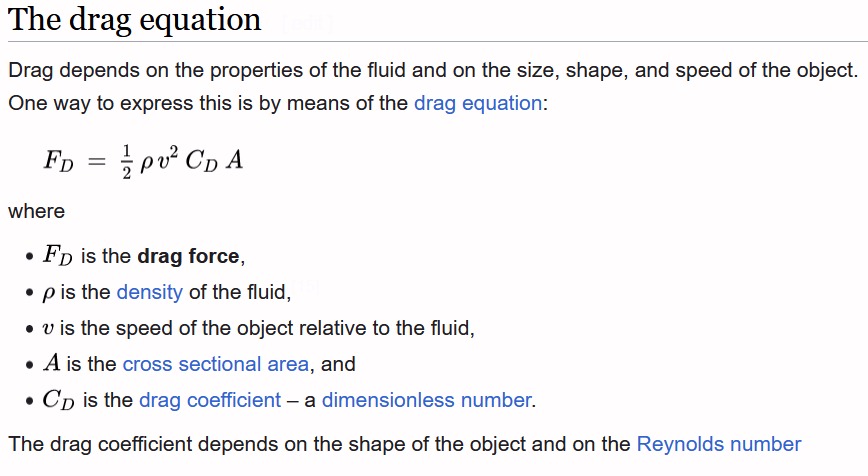
Wind and water flow forces scale as the square of velocity, so as flow speeds increase (say due to more intense heating or heavier rain) the damage scales as the square of the velocity. Look at drag physics and you will see that force is proportional to density times square of velocity (v^2).

The Drag Equation
So a twenty mile an hour wind exerts four times as much force as a ten mile an hour wind. And a forty mile an hour wind exerts sixteen times as much force as a ten mile an hour wind. A wind of fifty miles an hour exerts twenty five times and a wind of sixty miles an hour exerts thirty six times as much force as one of ten miles an hour. Then you have the density term. Water is about eight hundred times denser than air, So the force exerted by a ten mile an hour flow of water is eight hundred times that of a ten mile an hour wind. So as flow velocities go up due to climate change, force and damage scale as square of the velocities. What is not clear is how much these velocities increase with climate change. But in a sense we are seeing this already as, for example, flood and sewage systems succumb and hillsides fall down, and so on.

— from The Reign of Violent Rain Brouse and Mukherjee (2023)

Climate Change: How Long Is “Ever”?

A song about The Human Induced Climate Change Experiment

bookmark_borderCrude

LYRICS
You say the big one got away
So the little ones are your prey
So you say
Pull the lever
Step on the gas
Run them over
And make it fast

Boy’s too clever
He’ll never last

You say the big ones got in your way
So little ones will do for today
So you say
Pull the lever
Step on the gas
Run them over
And make it fast

Boy’s too clever
He’ll never last

You say the big ones exploit you for pay
Yet you would have it no other way
So you say
Pull the lever
Step on the gas
Run them over
And make it fast

Boy’s too clever
He’ll never last

When the crude in their attitude
Protrudes into your latitude
Do you find…
Find it strange
When the lewd use of all crude
Extrudes into all pursued
Is it time…
Time for change

Chords: E F# / F# F E / G Bm E / E G A A G E; Part II 123 Beats Per Minute
Instrumentation: Vocals, Ibanez Acoustic Guitar, Fender Squire Mini Electric Guitar, Fender Jazz Bass, Keyboards (Korg PS60, Casio WK-3500, Yamaha PSR-740, MiniNova, MicroKorg)

“It’s just mind-blowing really,” said Copernicus Director Carlo Buontempo. “Never seen anything like that in any month in our records.”

“This is not a fancy weather statistic. It’s a death sentence for people and ecosystems. It destroys assets, infrastructure, harvest,” Imperial College of London climate scientist Friederike Otto said.

Global heat is now “gobsmackingly bananas,” said climate scientist Zeke Hausfather. “It’s hard to overstate just how exceptionally high global temperatures are at the moment.”

On November 20, 2023, the UN’s Emission Gap Report found even if countries carried out their current emissions-reduction pledges, the world would likely continuously exceed +3C degrees of warming this century. Later that day, the International Cryosphere Climate Initiative released State of the Cryosphere Report 2023 saying, “Two degrees is too high. Our message — the message of the Cryosphere — is that this insanity cannot and must not continue. The melting point of ice pays no attention to rhetoric, only to our actions.”

What Can I Do?
There are plenty of things you can do to help save the planet. Stop using crude oil! Consume less. Love more. Here is a list of additional actions you can take.

Climate Change: How Long Is “Ever”?

A song about The Human Induced Climate Change Experiment

bookmark_borderHellbent on the Movement

LYRICS
You’re looking at me
Looking at you
It’s plain to see
What we’re to do
Hellbent
On the movement
Of the movement

You hearing me
Hearing you
Clear to the ear
We both can hear
From ear to ear
What to do here
Hellbent
On the movement
Of the movement

Your taste for me
The taste in you
Point-of-view
Come to savor
A knew flavor
Favor to do
Hellbent
On the movement
Of the movement

Lack of movement
Under statement
Could use improvement
Wonder abatement
Find what groove meant
Onward movement

Chords: E D A E / G A E / D C / E; Part II 135 Beats Per Minute
Instrumentation: Vocals, Ibanez Acoustic Guitar, Fender Squire Mini Electric Guitar, Fender Jazz Bass, Keyboards (Korg PS60, Casio WK-3500, Yamaha PSR-740, MiniNova, MicroKorg)

September 6, 2023: “Climate breakdown has begun,” the United Nations Secretary-General Antonio Guterres warned the world after the World Meteorological Organization (WMO) reported the world endure its hottest Northern Hemisphere summer in human history. “The dog days of summer are not just barking, they are biting,” the UN chief said in a statement after the report’s release.

“What we are observing, are not only new extremes but the persistence of these record-breaking conditions, and the impacts these have on both people and planet, are a clear consequence of the warming of the climate system,” C3S’s Climate Change Service Director Carlo Buontempo said.

Climate Breakdown is the most concerning development. Climate breakdown happens when feedback loops are created and tipping points are crossed. Plants will become extinct and many carbon sinks will vanish. The Earth’s temperature will continue to accelerate at an exponential rate no matter what humans do. Food, fresh water, and breathable air will cease to exist. Humans will likely follow in short order.

In October of 2023, the European Space Agency’s Copernicus Climate Change Service calculated that the average temperature for September was 16.38 degrees Celsius (61.48 degrees Fahrenheit) breaking the previous record set in September 2020 by a half-degree Celsius (0.9 degrees Fahrenheit). This is the largest increase in a monthly record high ever.

“It’s just mind-blowing really,” said Copernicus Director Carlo Buontempo. “Never seen anything like that in any month in our records.”

“This is not a fancy weather statistic. It’s a death sentence for people and ecosystems. It destroys assets, infrastructure, harvest,” Imperial College of London climate scientist Friederike Otto said.

— from Climate Change: How Long Is “Ever”? / Brouse (2023)

Global heat is now “gobsmackingly bananas,” said climate scientist Zeke Hausfather. “It’s hard to overstate just how exceptionally high global temperatures are at the moment.”

On November 20, 2023, the UN’s Emission Gap Report found even if countries carried out their current emissions-reduction pledges, the world would likely continuously exceed +3C degrees of warming this century. Later that day, the International Cryosphere Climate Initiative released State of the Cryosphere Report 2023 saying, “Two degrees is too high. Our message — the message of the Cryosphere — is that this insanity cannot and must not continue. The melting point of ice pays no attention to rhetoric, only to our actions.”
— from The Age of Loss and Damage / Brouse (2023)

Climate Change: How Long Is “Ever”?

A song about The Human Induced Climate Change Experiment

bookmark_borderPass Gas

LYRICS
Smells like you’re leaking some kind of gas
Might want to check on the gas you pass
’cause if you ask me
I think
You stink
You’ve left me
Without a drop to drink
Will life leave
When there’s no air to breathe?
And it’s so hot
Believe it or not
Deniers are criers
And it’s so hot
Believe it or not
Deniers are liars

Smells like you’re leaking some real bad gas
Sounds like it’s starting to leak real fast
’cause if you ask me
I think
You stink
You’ve left me
Without a drop to drink
Will life leave
When there’s no air to breathe?
And it’s so hot
Believe it or not
Deniers are criers
And it’s so hot
Believe it or not
Deniers are liars

Smells like you’re leaking some reeking gas
How much longer can we freaking last?
’cause if you ask me
I think
You stink
You’ve left me
Without a drop to drink
Will life leave
When there’s no air to breathe?
And it’s so hot
Believe it or not
Deniers are criers
And it’s so hot
Believe it or not
Deniers are liars

Chords: F F# / F Eb Bb F / F Db Eb F; Part II 108 Beats Per Minute
Instrumentation: Vocals, Ibanez Acoustic Guitar, Fender Electric Guitar, Fender Jazz Bass, Keyboards (Korg PS60, Casio WK-3500, Yamaha PSR-740, MiniNova, MicroKorg)

Global warming has caused irreparable damage to our environment. Almost all scientists agree that IN FACT climate change is a problem. Our planet is becoming unfit for human life. Now the question is can we adapt in time? (1999) We’ve known this for decades. DON’T BE A DENIER! Deniers are part of the problem. Be part of the solution. There are plenty of things you can do to help save the planet. Stop using fossil fuels. Consume less. Love more. Here is a list of additional actions you can take.

Climate Change: The End of Times

What you can do today. How to save the planet.

Climate Change: How Long Is “Ever”?

A song about The Human Induced Climate Change Experiment

bookmark_borderSlaughter a Dragon

LYRICS
Now that we’ve heard your bandwagon
How do we get onboard
We’d like to get on with a sing-along
And finally cut the cord
That was us on the bus
Is it any wonder
We got thrown under?

Why bother to slaughter a dragon
When it’s the bragging to abhor
We’d like to get on with a sing-along
And finally cut the cord
That was us on the bus
Is it any wonder
We got thrown under?

Hard to speak with a gag on
Why bother screaming “Oh, Lord!”
We’d like to get on with a sing-along
And finally cut the cord
That was us on the bus
Is it any wonder
We got thrown under?

Slaughter a Dragon.mp3

Chords: F# E B F# / F# B D C#7 F#
Instrumentation: Vocals, Ibanez Acoustic Guitar

Climate Change: How Long Is “Ever”?

A song about The Human Induced Climate Change Experiment

bookmark_borderMore, More, More

LYRICS
Keep on pouring
Poor, poor, poor
Keep imploring
More, more, more
The more we ignore
“Same as before”
The less we’ll endure
Forevermore
Just like before?

Find it boring
Keep on snoring
Bore, bore, bore
All the whoring
More, more, more-ing
More, more, more
The more we ignore
“Same as before”
The less we’ll endure
Forevermore
Just like before?
Forever more
Rotten to the core?

News that’s flooring
Sound off roaring
Roar, roar, roar
Find it luring
Reassuring
Sure, sure, sure
The less we ignore
“Same as before”
The more we’ll endure
Forevermore
Open the door!

Chords: A C D A / G D A / A E E A; Part II 86 Beats Per Minute
Instrumentation: Vocals, Ibanez Acoustic Guitar, Fender Squire Mini Electric Guitar, Fender Jazz Bass, Keyboards (Korg PS60, Casio WK-3500, Yamaha PSR-740, MiniNova, MicroKorg)

September 6, 2023: “Climate breakdown has begun,” the United Nations Secretary-General Antonio Guterres warned the world after the World Meteorological Organization (WMO) reported the world endure its hottest Northern Hemisphere summer in human history. “The dog days of summer are not just barking, they are biting,” the UN chief said in a statement after the report’s release.

“What we are observing, are not only new extremes but the persistence of these record-breaking conditions, and the impacts these have on both people and planet, are a clear consequence of the warming of the climate system,” C3S’s Climate Change Service Director Carlo Buontempo said.

Climate Breakdown is the most concerning development. Climate breakdown happens when feedback loops are created and tipping points are crossed. Plants will become extinct and many carbon sinks will vanish. The Earth’s temperature will continue to accelerate at an exponential rate no matter what humans do. Food, fresh water, and breathable air will cease to exist. Humans will likely follow in short order.

In October of 2023, the European Space Agency’s Copernicus Climate Change Service calculated that the average temperature for September was 16.38 degrees Celsius (61.48 degrees Fahrenheit) breaking the previous record set in September 2020 by a half-degree Celsius (0.9 degrees Fahrenheit). This is the largest increase in a monthly record high ever.

“It’s just mind-blowing really,” said Copernicus Director Carlo Buontempo. “Never seen anything like that in any month in our records.”

“This is not a fancy weather statistic. It’s a death sentence for people and ecosystems. It destroys assets, infrastructure, harvest,” Imperial College of London climate scientist Friederike Otto said.

— from Climate Change: How Long Is “Ever”? / Brouse (2023)

Global heat is now “gobsmackingly bananas,” said climate scientist Zeke Hausfather. “It’s hard to overstate just how exceptionally high global temperatures are at the moment.”

On November 20, 2023, the UN’s Emission Gap Report found even if countries carried out their current emissions-reduction pledges, the world would likely continuously exceed +3C degrees of warming this century. Later that day, the International Cryosphere Climate Initiative released State of the Cryosphere Report 2023 saying, “Two degrees is too high. Our message — the message of the Cryosphere — is that this insanity cannot and must not continue. The melting point of ice pays no attention to rhetoric, only to our actions.”
— from The Age of Loss and Damage / Brouse (2023)

Climate Change: How Long Is “Ever”?

A song about The Human Induced Climate Change Experiment

bookmark_borderLet Go of Me!

LYRICS
Maybe it’s time we let go
Of our stubborn ways
If we hope to know
More newborn days
We’re here to report
We’ve numbered them short
Might be time to begin
Taking them in
The air up there
Is plain to see
And it shouldn’t be
The earth’s on fire
The pain is dire
Makes it hard to be
It’s not surprising
The tide is rising
All because of “we”
And me, me, me!

Maybe it’s time we let go
Of our selfish ways
Better get to know
How to share our days
We’re here to report
We’ve numbered them short
Might be time to begin
Taking them in
The air up there
Is plain to see
And it shouldn’t be
The earth’s on fire
The pain is dire
Makes it hard to be
It’s not surprising
The tide is rising
All because of “we”
And me, me, me!

Maybe it’s time we let go
Of our fuelish ways
Rather get to know
How to prolong days
We’re here to report
We’ve numbered them short
Might be time to begin
Taking them in
The air up there
Is plain to see
And it shouldn’t be
The earth’s on fire
The pain is dire
Makes it hard to be
It’s not surprising
The tide is rising
All because of “we”
And me, me, me!

Chords: A D C A / A E A / C D A / B Bb A; Part II 172 Beats Per Minute
Instrumentation: Vocals, Ibanez Acoustic Guitar, Fender Electric Guitar, Fender Jazz Bass, Keyboards (Korg PS60, Casio WK-3500, Yamaha PSR-740, MiniNova, MicroKorg)

Global warming has caused irreparable damage to our environment. Almost all scientists agree that IN FACT climate change is a problem. Our planet is becoming unfit for human life. Now the question is can we adapt in time? (1999)

Human induced climate change is an exponential component of an unordered system (chaos theory). That means global warming is accelerating at a rapid rate in a complex way. From 1992 through 2023, we presented evidence and suggested remedies to mitigate climate change. By 2023, the data was undeniable that human induced climate change is destroying our habitat at a rapidly increasing rate.

Climate Change Review 2023

Sidd said, “Do you remember back in the early 2000’s when we thought we wouldn’t live to see the extreme changes due to global warming?”

Daniel replied, “I think 2023 is the most significant year so far. We saw confirmation of tipping points being crossed for Mountain Glacier Loss, Greenland Ice Sheet Collapse, Antarctic Ice Sheet Collapse, and potentially the Collapse of AMOC.”

Sidd continued, “We already knew that. It was Canada catching on fire that I could not believe. I never thought I’d live to see the day.”

Daniel asked, “Do you think the permafrost and peatlands will have zombie fires and cause the permafrost tipping point?”

Sidd responded, “Yes. They are gone, too. We already know from the permafrost peatland fires in Siberia.”

NASA reported: Wildland fire experts have described Canada’s 2023 fire season as record-breaking and shocking. Over the course of a fire season that started early and ended late, blazes have burned an estimated 18.4 million hectares. Hundreds of fires exceeded 10,000 hectares (39 square miles), large enough to be considered “megafires.” These megafires were also unusually widespread this season, charring forests from British Columbia and Alberta in the west to Quebec and the Atlantic provinces in the east to the Northwest Territories and the Yukon in the north.

Forest fires cause a carbon feedback loop. The carbon emissions of Canada’s fires outweighed the combined emissions from its oil and gas, transport and agriculture sectors. The fires also cause the melting of the permafrost and zombie fires to burn in the permafrost. The permafrost collapse is a self-sustaining feedback loop/tipping point. As the permafrost melts, the peatlands emit CO2 and methane. The increase in CO2 and methane results in more warming that results in more peatland emissions. A third feedback loop is created with lightning strikes. The study Forests at Risk Due to Lightning Fires found a sensitivity of extratropical intact forests to potential increases in lightning fires, which would have far-reaching consequences for terrestrial carbon storage and biodiversity. The results show that, on a global scale, lightning is the primary ignition source of fires in temperate and boreal forests. Global warming causes more extreme weather events and conditions for lightning creating more forest fires that create more warming and more lightning strikes.

The study Wildfire as a major driver of recent permafrost thaw in boreal peatlands published in the Journal Nature Communications found wildfires have caused a quarter of permafrost thaw (2,000 square kilometres) in Western Canada’s boreal peatlands over the past 30 years. “Historically, permafrost in this area underwent a natural cycle of thawing and reforming, but given current climate conditions and projections for the future, this fire-induced thaw appears to be irreversible,” said Carolyn Gibson, who conducted the research.

Climate Change: How Long Is “Ever”?

A song about The Human Induced Climate Change Experiment

bookmark_borderMind Mind

LYRICS
Need to figure about
Just how to get out
Of this world
Seems I’m trapped in
The lunatic bin
Logic unfurled
What have you done
You cursed brat
Whole world’s undone
Imagine that
Melting, melting
Reign keeps pelting
Mind’s fine line

Time for all to begin
Just how to dig in
To this world
About trying to get out
There is much doubt
Thoughts whorl
What have you done
You cursed brat
Whole world’s undone
Imagine that
Melting, melting
Reign keeps pelting
Mind’s fine line
Mine a fine mind
Find mind mines
Mind our mines
Mind our minds
Mind your mind

Chords: F#/7 E / B D F# B / B Bb / F# / B C#7 F#; Part II 152 BPM
Instrumentation: Vocals, Acoustic Guitar, Electric Guitar, Bass, Keyboards (Korg PS60, Casio WK-3500, Yamaha PSR-740, MiniNova, MicroKorg)

Climate change is causing significant challenges for mental health. The Commonwealth Fund found,
“Climate change is having an impact on the mental health of people who haven’t personally experienced climate-related disasters: more than two-thirds of U.S. adults (68%) have reported having at least some anxiety about climate change.”

As the global population is causing the world to melt down, extreme weather events such as Violent Rain will literally impact your state of mind. There is no escaping climate change. So, mind your mind.

What you can do today. How to save the planet.

A song about The Human Induced Climate Change Experiment

bookmark_borderIn Search of Dreams

In search of the sweet spot
Because believe it or not
I completely forgot
We were already there
While blindly unaware
That cause we didn’t care
We turned our scene obscene

Was there heaven on Earth
After my birth?
Can’t remember, for what it’s worth
Were we already there
Though blindly unaware
That cause we didn’t care
We turned our scene obscene

In search of dreams come true
Because if they do
Would it be something new?
Were we already there
Though blindly unaware
That cause we didn’t care
We turned our scene obscene

Chords: E G#m7b5 E / C D G / G D G / D C E G#m7b5 E; Part II 130 BPM
Instrumentation: Vocals, Acoustic Guitar, Electric Guitar, Bass, Keyboards (Korg PS60, Casio WK-3500, Yamaha PSR-740, MiniNova, MicroKorg)

Is it getting harder to remember when there was time without human induced climate change?

How long is “ever”… as in “the hottest it’s ever been in recorded history”?

During the first week of July 2023, the Earth had the hottest days ever.

Humans are about 200,000 years old with our closest variety being dated to about 140,000 years ago. The earliest “recording of history” is approximately 100,000 years old. It is the story of The Seven Sisters of The Pleiades. The Seven Sister are a cluster of stars in the Taurus constellation. There are six stars visible to the naked eye. The story is about seven stars. The seventh star has not been visible to the naked eye for over 100,000 years.

The 20th-century surface temperature average for Earth was 13.9℃.
In the first weeks of July of 2023, the average temperature was 17℃.

Q: Is it possible for humans to push the temperature 3℃ above pre-industrial levels?
A: Yes. Humans have pushed global temperatures up more than 3℃.

Q: Is it possible for humans to survive at temperatures greater than 3℃?
A: Probably not long. Humans have never done it before.

Extreme weather will become more frequent and intense. Sea levels will rapidly rise as the coasts disappear. However, the most concerning development will be feedback loops and tipping points. Plants will become extinct and many carbon sinks will vanish. The Earth’s temperature will continue to accelerate at an exponential rate no matter what humans do. Food, fresh water, and breathable air will cease to exist. Humans will likely follow in short order.

These “tipping points” were preventable; however, now they are becoming inevitable. Climate scientists had thought we would not cross tipping points for centuries at the earliest. Tipping points are part of feedback loop systems. A tipping point occurs when a human influenced global warming activity becomes self-sustaining without the human activity. For instance, the mountain glacier loss tipping point has triggered a feedback loop. The ice-albedo feedback loop is an expression of the ability of surfaces to reflect sunlight (heat from the sun). Any loss of ice over a darker surface means the surface will absorb more heat and reflect less heat. This process makes the Earth warmer causing more loss of ice… which in turn causes more warming of the Earth. When a tipping point causes another tipping point to be toppled it is called the The Domino Effect. Mountain glacier loss, the collapse of AMOC, and the dieback of the Amazon rainforest is an example of The Domino Effect.

— from Climate Change: How Long Is “Ever”? Brouse (2023)

What you can do today. How to save the planet.

A song about The Human Induced Climate Change Experiment

bookmark_borderChinese Water Torture

LYRICS
If you open the door
And take a step out
You might find some more
Of what I’m talking about
The Reign of Rain
Is pounding my head
It’ll drive you insane
’till you wish you were dead
Chinese water torture
That’s for sure
The dripping of the rain
Is getting to my brain

If you open the door
And take a step out
You might find some more
Of what I’m talking about
The Reign of Rain
Is pounding my head
It’ll drive you insane
’till you wish you were dead
Never a moment dull
Dripping on my skull
Get it through my head
The climate change dread

If you open the door
And take a step out
You might find some more
Of what I’m talking about
The Reign of Rain
Is pounding my head
It’ll drive you insane
’till you wish you were dead
Wind whistling through my ear
Makes it hard to hear
What’s becoming clear
Easy isn’t near

Chinese Water Torture.mp3

Chords: G C A D / D A E A / Bridge A Ab G G Ab A
Instrumentation: Vocals, Acoustic Guitar

The song was written during an extreme weather event.

Violent Rain
Multiple factors figure into the physics of violent rain. The Momentum of Rain is p = mv (p = momentum, m = mass, v = velocity.) Part of the increasing momentum is transferred to the sides and upward increasing wind turbulence, as well as updrafts. Most of the momentum is transferred upon impact. You may notice the rain bouncing higher off the streets and sidewalks. As rain becomes more massive, it will have greater momentum when it hits the ground causing more damage.

Mass is not the only factor in violent rain. The greater the mass of the rain the more the wind turbulence is intensified. Professor Paul D. Williams of the University of Reading, UK, said, “They are chaotic (chaos theory). Turbulence is known famously as the hardest problem in physics.” In their study Evidence for Large Increases in Clear-Air Turbulence Over the Past Four Decades, Prof. Williams and his team found “Climate change has caused turbulence to double in the last 40 years” and is expected to double or triple again in the next decades.

The momentum of rain and the turbulence of wind are part of a larger equation that includes not only the mass and velocity of precipitation but also the density. The combination of these variables results in an increased intensity of the flow dynamics. Increased updrafts will result in an increase in the frequency of hail. When violent rain becomes denser and turns into hail, it can be deadly. Ground without groundcover will be hit harder causing more damage. The groundcover will also be hit harder causing more damage. Concrete, asphalt, solar panels, roofs, and plants will sustain more damage. Hail may also impact your skull. Infants and young children are at highest risk. Several infants have been killed by hail in the past year.

Wind and water flow forces scale as the square of velocity, so as flow speeds increase (say due to more intense heating or heavier rain) the damage scales as the square of the velocity. Look at drag physics and you will see that force is proportional to density times square of velocity (v^2).

— from The Reign of Violent Rain / Brouse and Mukherjee (2023)

What you can do today. How to save the planet.

A song about The Human Induced Climate Change Experiment

bookmark_borderGot That Right

LYRICS
Hey! What’s next
Getting complex
Do you feel perplexed?
Yes, just that
Fat Cat habit
How ’bout habitat?
Sooner or later
We’ll see the light
Sooner the better
Before “good night.”
Got that right!

Hey! What’s next
Getting complex
Do you feel perplexed?
Say, what’s that
Fat Cat habitat
Full fledged heart attack
Sooner or later
We’ll see the light
Sooner the better
Before “good night.”
Got that right!

Hey! What’s next
Getting complex
Do you feel perplexed?
Prey? Big rat
Bet on the Fat Cat
Lost our habitat
Sooner or later
We’ll see the light
Sooner the better
Before “good night.”
Got that right!

Chords: E G E / G G6 / C A D G / G B E; Part II 85 BPM
Instrumentation: Vocals, Acoustic Guitar, Keyboards (Korg PS60, Casio WK-3500, Yamaha PSR-740, MiniNova, MicroKorg)

“For people, for other species, for the ecosystems, for the world we live in, we’ve entered the Age of Loss and Damage, but we’re just at the start. What we are seeing already just makes you want to cry,” said Dr. Christopher Trisos (BBC Interview / MP3 Format) from the University of Cape Town. “We can’t eliminate loss and damage. It is here. That said, there is a lot we can do to limit it.”

Health and Wellness
Humans will experience greater loss and damage to life and quality of life from air pollution, decreasing supply of potable water, extreme weather events, and disease. The greatest short term climate change risk to human health is deadly humid heat (wet-bulb temperature).

Real Estate and Infrastructure
A warmer world will present widespread challenges across many aspects of food-energy-water security and economic development. Infrastructure including roads, bridges, sewer and water plants will become unsustainable. Personal property will suffer loss and damage as homeowners and flood insurance become increasingly difficult to obtain.

Conclusion
Triggering tipping points results in the CO2 stored in nature to be released without the assistance of humans. Though we do not know how much carbon is stored in nature, it would be reasonable to assume that the temperature could be pushed from 3 degrees to 6 degrees Celsius above pre-industrial levels. Humans cannot thrive above a rise of 1.5 degrees. Much of the Earth will be uninhabitable if the temperature rises an additional 6 degrees Celsius. If humans also add 3 degrees Celsius, the temperature and humidity will approach a wet-bulb temperature that will not sustain human life. In any event, there will be exponential loss and damage.

For the first time in human history, global warming is going to continue no matter what humans do. Even if humans stopped their greenhouse gas emissions today, humans have invoked nature’s greenhouse gas emissions. Nevertheless, the sooner humans stop their emissions, the better. In addition, humans must adapt their habitat to remove, reduce, and hinder nature’s greenhouse gas emissions.

Welcome to the Age of Loss and Damage.

What Can I Do?
There are plenty of things you can do to help save the planet. Stop using fossil fuels. Consume less. Love more.

— from The Age of Loss and Damage Brouse (2023)

What you can do today. How to save the planet.

A song about The Human Induced Climate Change Experiment

bookmark_borderSlow Motion Fast

LYRICS
Once upon a time
The gravest crime
Shivered my spine
Slow motion fast
Before my eyes life passed
How long can we last
Before all hope’s dashed?

Almost all the time
The gravest crime
Man-made grime
Slow motion fast
Before my eyes life passed
How long can we last
Before all hope’s dashed?

Feels like every time
Not a reason, not a rhyme
For the gravest crime
Slow motion fast
Before my eyes life passed
How long can we last
Before all hope’s dashed?

Chords: Db f Bb / Ab Eb Bb / Db Ab Bb; Part II 125 BPM
Instrumentation: Vocals, Acoustic Guitar, Electric Guitar, Bass, Keyboards (Korg PS60, Casio WK-3500, Yamaha PSR-740, MiniNova, MicroKorg)

Global warming has caused irreparable damage to our environment. Almost all scientists agree that IN FACT climate change is a problem. Our planet is becoming unfit for human life. Now the question is can we adapt in time? (1999)

Human induced climate change is an exponential component of an unordered system (chaos theory). That means global warming is accelerating at a rapid rate in a complex way. From 1992 through 2023, we presented evidence and suggested remedies to mitigate climate change. By 2023, the data was undeniable that human induced climate change is destroying our habitat at a rapidly increasing rate.

At what rate is climate change accelerating?
A: Rapidly
As described above, we do not know the rate of acceleration other than to say it is more rapid than previously thought. In the summer of 2023, the extreme temperatures left most climate scientists shocked. The average earth surface temperature recorded record highs for months reaching over 3 degrees Celsius above pre-industrial levels. The Paris Agreement calls for keeping temperatures below 1.5 degrees. Scientists concur that a rise of 2 degrees will trigger feedback loops and tipping points. Triggering these tipping points results in the CO2 stored in nature to be released at an exponential growth rate. How extreme the acceleration will be depends on tipping points toppling other tipping points in what is known as The Domino Effect. Toppled tipping points will continue to shrink the doubling time and exponentially increase the rate of global warming. Though we do not know how much carbon is stored in nature, it would be reasonable to assume that the temperature could be pushed from 3 degrees to 6 degrees above pre-industrial levels. Humans can not thrive above a rise of 1.5 degrees. Humans can not survive if the temperature rises 6 degrees.

What you can do today. How to save the planet.

A song about The Human Induced Climate Change Experiment