LYRICS
Once again
In search of a bargain
How long’s it been
Since a perch on the in
Out on a limb
Start to begin
Be to been
Head toward the light
It’ll be alright
Head toward the light
(k)new insight
(k)new in sight
Here again
In search of lovin’
How long’s it been
Since a perch on the in
Out on a limb
Start to begin
Be to been
Head toward the light
It’ll be alright
Head toward the light
(k)new insight
(k)new in sight
[increase tempo]
Start again
In a lurch for livin’
How long’s it been
Since a perch on the in
Out on a limb
Start to begin
Be to been
Head toward the light
It’ll be alright
Head toward the light
(k)new insight
(k)new in sight
LYRICS
Go ahead
Scratch at the surface
Go ahead
Mind needs fed
2+2, 4+4
Go for more
8+8
No debate
Double the score
Go ahead
Scratch at the surface
Go ahead
Mind needs fed
16+16
Know what I mean?
32+32
Yes, I do
Go ahead
Scratch at the surface
Go ahead
Mind needs fed
64+64
Go for more
128+128
Celebrate
Go for more
Double the score
This time
It’s time
For double time
Chords: E A D G / E A D E / E A G F# E
Instrumentation: Vocals, Acoustic Guitar
Written and recorded at Lake Wynonah, Pennsylvania
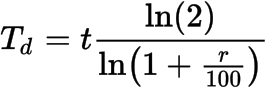
=
doubling time
=
time
=
growth rate
Doubling time is the amount of time it takes for a quantity to double in size (exponential growth). For instance, if you invest your money at 10%, it will take about 7 years to double your money. For every $1,000 invested today, you will accumulate $128,000 in 49 years.
The same principle holds true with the accumulated impact of climate change. By 2020, there was enough data to see the “doubling period” of some anthropogenic climate affects had gone from 100 years to 10 years. For instance, the rate of sea level rise has gone from about 1.5 millimeters per year to over 3 millimeters. We expect to see the doubling period to continue to shrink raising the possibility of sea levels rising a foot/year by 2050.
Though the rate of change in climate disasters’ intensity, duration, and likelihood vary according to the type of extreme weather, a “rule-of-thumb” can be derived from the Canada wildfires of 2023. The World Weather Attribution Organization found, “Climate change made the cumulative severity of Quebec’s 2023 fire season to the end of July around 50% more intense, and seasons of this severity at least seven times more likely to occur.”
50% more intense
7 x more likely
These numbers may be similar in other catastrophes like hurricanes, heat waves, droughts, floods, tornadoes, and sea level rise.
If the doubling time remains at 10 years, we could see extreme events 100% more intense and/or longer in duration, as well as, 14 times more likely to occur. As mentioned above, we expect the doubling time to be reduced. If the doubling time is 5 years, in ten years we could see 200% more intense and longer extreme weather events being 28 times more likely to occur.
LYRICS
Question
Can we get home tonight
Caution
Will we be alright
Or come to find the end of the line
Once we unload, explore
The end of the road
We’ll come to explode
Mortality mode
Or come to find no such kind
Do you really think we can get out alive?!?!
Arrive
At the next station
The final destination
Cross the River Styx
Eyes fix
(I’s affix)
What does the sign say?
Is it your lucky day?
Well…
Is this heaven
Or is this hell?
Question
Can we get home tonight
Caution
Will we be alright
Or come to find the end of our time?
Chords: D F# / D E F# / F# B F#; Part II at 106 Beats Per Minute
Instrumentation: Vocals, Acoustic Guitar, Electric Guitar, Bass, Keyboards (Korg PS60, Casio WK-3500, Korg N364, MiniNova, MicroKorg)
A song about the kind of world you choose to live in… are you going to wait to die to find out? What if after crossing the River Styx you are right back where you started? Do you already live in heaven or hell?
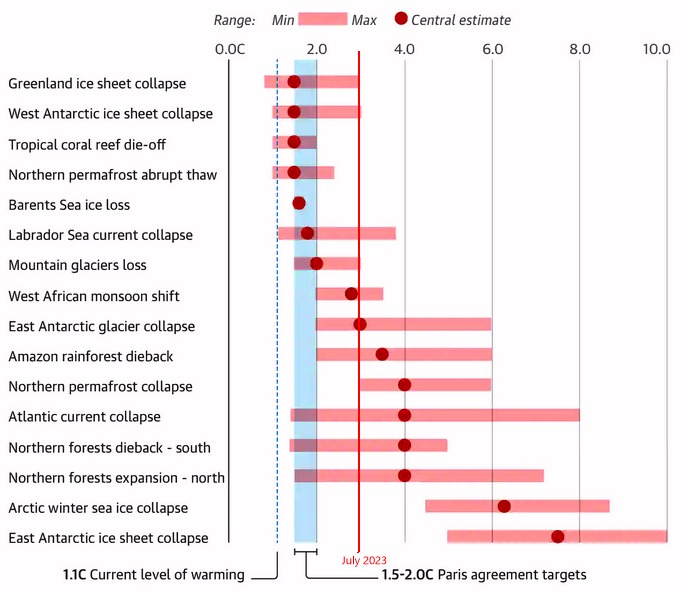
LYRICS There’s a drought in the rainforest There’s no doubt what that’s about You’ll find out about opinion Versus the definition Of desertification Reached a tipping point Fell over the edge Who’s running this joint? Need a new world pledge Let’s get right to the point Pledge to walk back… … from the ledge (Please step back from the ledge)
As a matter of fact, AMOC is whack There’s no doubt what that’s about You’ll find out about opinion Versus the definition Of overturning circulation
Alas, mountain glacier loss There’s no doubt what that’s about You’ll find out about opinion Versus the definition Of coastal saturation
Reached a tipping point Fell over the edge Who’s running this joint? Need a new world pledge Let’s get right to the point Pledge to walk back… … from the ledge (Please step back from the ledge) Reached a tipping point? Reached tipping points Breached tipping points Multiple tipping points Who’s running this joint? Need a new world pledge Let’s get right to the point Pledge to walk back… … from the ledge (Please step back from the ledge)
Chords: B C E / A G E / G A E / G A A G E; Part II @ 110 Beats Per Minute Instrumentation: Vocals, Acoustic Guitar, Electric Guitar, Bass, Keyboards (Korg PS60, Casio WK-3500, Korg N364, MiniNova, MicroKorg)
The song is about tipping points we appear to have breached. Push a glass toward the edge of a table and eventually it will fall off on its own. No matter how slowly or meticulously you push… no matter how you weight or fill the glass, it will reach a tipping point and fall off before being pushed completely off the table. No matter whether you believe the glass is half-empty or half-full, when the tipping point is reached it will plummet out-of-control to its end. This is science not fate, faith, nor belief. Human induced climate change has resulted in environmental tipping points being breached.
Crossing one tipping point would be alarming. For instance, crossing the tipping point for ‘mountain glacier loss‘ has immediate consequences: millions of people in Europe will be impacted by the lack of fresh water. Billions of people that live along coasts will be impacted by the saline infiltration and eventually by the submerging of their property. This in and of itself should be alarming; however, it gets worse. Tipping points are parts of feedback loop systems. The ice–albedo feedback loop is an expression of the ability of surfaces to reflect sunlight (heat from the sun). Any loss of ice over a darker surface means the surface will absorb more heat and reflect less heat. This process makes the Earth warmer causing more loss of ice… which in turn causes more warming of the Earth. So, yes, the mountain ice tipping point is quite alarming for both its immediate impact as well as its self-sustaining growth to global warming; but wait, it gets more alarming. The increasing temperatures due to crossing a tipping point causes other tipping points to be breached.
The tipping point for the collapse of AMOC (Atlantic Meridional Overturning Circulation) was thought to be centuries away, at the earliest. In July of 2023, the study Warning of a forthcoming collapse of the Atlantic meridional overturning circulation was published in the journal Nature Communications. “Here we provide statistical significance and data-driven estimators for the time of tipping. We estimate a collapse of the AMOC to occur around mid-century (2025-2095) under the current scenario of future emissions.” The collapse is likely to cause faster sea level rise on the east coast of the US, more severe storms in Europe, and increasing drought in the Sahel in Africa. “From the study of past climate, we know changes in the AMOC have been some of the most abrupt and impactful events in the history of climate,” said Prof. Stefan Rahmstorf, at the Potsdam Institute for Climate Impact Research in Germany and world leading oceanographer. During the last Ice Age, winter temperatures changed by up to 10C within three years in some places. “We are dealing with a system that in some aspects is highly non-linear, so fiddling with it is very dangerous, because you may well trigger some surprises,” he said. “I wish I knew where this critical tipping point is, but that is unfortunately just what we don’t know. We should avoid disrupting the AMOC at all costs. It is one more reason why we should stop global warming as soon as possible.” A feedback loop created by the AMOC tipping point is disruption in weather systems and circulation that cause loss of naturally occurring carbon sinks. One scenario is desertification of the Amazon rainforest.
The tipping point / feedback loop problem is very complex (chaos theory) and exponentially alarming. A third tipping point appears to have been triggered by the summer of 2023 — Amazon Rainforest Dieback. The Amazon is often referred to as ‘the lungs of our planet’. Not only does the Amazon suck in huge quantities of CO2 and breath out O2, but the Amazon soils also store huge amounts of CO2. The desertification of the Amazon would result in a release of the carbon as the soils disappeared.
1) much of July was spent at record temperatures +3C 2) the collapse of the Amazon rainforest is likely to happen between +2 – 4C. The collapse of the Amazon is expected to occur because of changing weather patterns and circulation that result in drought. 3) Brazil set up a task force for “unprecedented drought in the Amazon”
Low river levels and hotter waters have killed masses of fish seen floating on river surfaces, contaminating the drinking water, Environment Minister Marina Silva said. “We have a very worrying situation. This record drought has disrupted river transport routes (dropping 30 cm / day) threatening food and water shortages, and a large fish mortality is already beginning.” This was the effect of a periodic El Niño mixing with changes in weather patterns brought by global warming. “We are seeing a collision of two phenomena, one natural which is El Niño and the other a phenomenon produced by humans, which is the change in the Earth’s temperature.” Worsened by climate change, this combination has caused drought not seen before in the Amazon and “is incomparably stronger and could happen more frequently.”
Scientists concur that a rise of 2 degrees will trigger feedback loops and tipping points. Triggering these tipping points results in the CO2 stored in nature to be released. Though we do not know how much carbon is stored in nature, it would be reasonable to assume that the temperature could be pushed from 3 degrees to 6 degrees above pre-industrial levels. Humans cannot thrive above a rise of 1.5 degrees. Humans cannot survive if the temperature rises 6 degrees.
LYRICS
Tune in
The frequency
Turn up
The volume
The magic is in the science
It’s music to our ears
Raise the chance your atoms
Dance
Until the smoke clears
Tune in
The frequency
Tune in
Frequently
Turn up
The volume
Turn up
And than some
The way the waves behave
Is music to our ears
Raise the chance our atoms
Dance
When everyone hears
Tune in
The frequency
Tune in
Frequently
Turn up
The volume
Turn up
And than some
The ear drums vibrate
At a certain rate
They stimulate
And move
Until we dance and groove
A song about the science of sound and the magic of music. The line “The magic is in the science” was inspired by Merlin from King Arthur. Many think his acts of magic where actually science experiments. The line “Dance until the smoke clears” is about science protecting scientists in dark times (such as Galileo and the Inquisition or modern scientists and climate change deniers.) Most of the song is about the magic of music being heard.
Johns Hopkins says: The ear collects sound waves and channels them into the ear canal, where the sound is amplified. The sound waves then travel toward a flexible, oval membrane at the end of the ear canal called the eardrum, or tympanic membrane. Sound waves cause the eardrum to vibrate. The cochlea is filled with a fluid that (when stimulated) moves in response to the vibrations from the oval window. As the fluid moves, 25,000 nerve endings are set into motion. These nerve endings transform the vibrations into electrical impulses that then travel along the eighth cranial nerve (auditory nerve) to the brain.
Chords: G A C D A / D A / G A C D A G A C E A; Part II @ 112 Beats Per Minute
Instrumentation: Vocals, Acoustic Guitar, Electric Guitar, Bass, Keyboards (Korg PS60, Casio WK-3500, Korg N364, MiniNova, MicroKorg)
LYRICS
They’re packing it up
They’re moving it out
They said, “Damn it…
Need a new planet!”
They’re moving real fast
They’re trying to move past
They said, “Look out…
You’re in the route”
Human race
Wrecked the place
They’re loading it up
Leaving no doubt
They said, “Damn it…
Need a new planet!”
They’re moving real fast
They’re trying to move past
They said, “Look out…
You’re in the route”
Human race
Trashed the place
They’ve had enough
Of too much stuff
They said, “Damn it…
Need a new planet!”
They’re moving real fast
They’re trying to move past
They said, “Look out…
You’re in the route”
Human race
Ruined the place
They’re packing it up
They’re moving it out
They said, “Damn it…
Need a new planet!”
Chords: E A D G E / B7 E
Instrumentation: Vocals, Acoustic Guitar
A song about:
“LinkedIn founder Reid Hoffman has told the New Yorker that at least 50% of Silicon Valley’s wealthiest have ‘apocalypse insurance’ – either an underground bunker or a contingency plan in case of disaster. ‘Saying you’re buying a house in New Zealand is kind of a wink, wink, say no more.'”
and… “the billionaire bunker, whether on land, sea or someday (ostensibly) on another planet entirely.”
It’s kind-of like Dr. Frankenstein hiding from his monster?
Density.MID Casio WK-3500 with Digital Signal Processing (DSP)
LYRICS
Dense
I see density
Hits me
Like reality
In sane
Wind whipped rain
When gas turns to liquid
As it just did
You come to know
The force of flow
In that space
Where it hits your face
You’ll make sense
Of what is dense
Literally, I can see density
It disfigures me
Density
Times the squared velocity
The irony
In my eye
I see
Density
Yeah… it hits me
What a drag
Hit a snag
Came to know
The forces flow
Technically Speaking, It’s Not the Momentum That Kills You
It’s not the fall that kills you; it’s the sudden stop at the end.
Technically speaking it is the impact from the momentum that causes damage and deaths. Global warming causes an increase in mass and/or velocity (momentum) of things that are mass flow driven by heat, like wind and flood.
The burning of fossil fuels and other human released emissions have impacted momentum’s impact. A warmer atmosphere can hold more moisture. Warmer air allows for the creation of more massive raindrops. Warmer ocean temperatures create stronger hurricanes. Hail and tornadoes form in strong thunderstorm clouds with intense updrafts, high liquid-water content, and large water droplets.
Sidd added: It’s worse than that. Wind and water flow forces scale as the square of velocity, so as flow speeds increase (say due to more intense heating or heavier rain) the damage scales as the square of the velocity.
About “square of the velocity”, I asked Sidd: is this Bernoulli’s Equation?
Sidd replied:
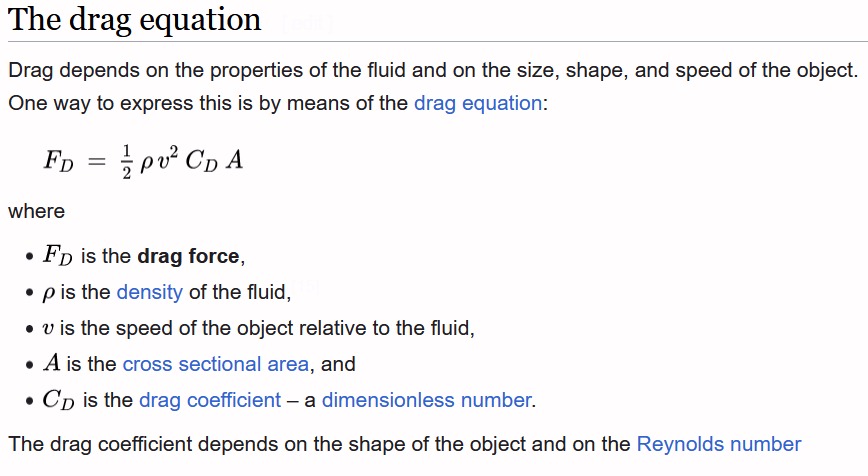
look at Wikipedia: Drag (Physics)
you will see that force is proportional to density times square of velocity (v^2)
So a twenty mile an hour wind exerts four times as much force as a ten mile an hour wind. And a forty mile an hour wind exerts sixteen times as much force as a ten mile an hour wind. A wind of fifty miles an hour exerts twenty five times and a wind of sixty miles an hour exerts thirty six times as much force as one of ten miles an hour. Then you have the density term. Water is about eight hundred times denser than air, So the force exerted by a ten mile an hour flow of water is eight hundred times that of a ten mile an hour wind. So as flow velocities go up due to climate change, force and damage scale as square of the velocities. What is not clear is how much these velocities increase with climate change. But in a sense we are seeing this already as, for example, flood and sewage systems succumb and hillsides fall down, and so on. — from “Climate Change: The Equation” / Brouse and Mukherjee (2023)
LYRICS
Can we go this fast
And take our foot off the gas
’cause matter of fact
This can not last
No more free pass
They’re coming home
Can’t roost alone
We’re prone for trouble
And the risk will double
Tell her a
Stellar
Storm cellar
She’s going down
Helter skelter
She’s going down
Please take shelter
Look at our past
This can’t last
All things shall pass
Should get a grasp
Coil and cast
Reduce our mass
They’re coming home
Can’t roost alone
We’re prone for trouble
And the risk we’ll double
Tell her a
Stellar
Storm cellar
She’s going down
Helter skelter
She’s going down
Please take shelter
Chords: F C / F C G7 C / Cm C; 98 Beats Per Minute
Instrumentation: Vocals, Electric Guitar, Keyboards (Korg PS60, Casio WK-3500, Korg N364, MiniNova, MicroKorg)
LYRICS
Rendezvous
With the things you do
Karma’s view
Coming ’round to you
If only we could put it back
That ability we lack
We better find a quick cure
If we want to endure
Rendezvous
With the things you do
Karma’s due
Coming ’round to you
It only wastes time looking back
Best get on the attack
Time’s the essence of the presence
Better start making sense
Rendezvous
With the things you do
Karma’s cue
Coming ’round to you
No more wasting time looking back
Lets get on the right track
Number one forever more
Will be to find our cure
Chords: A C E / E C A / D A C A; Part II 100 Beats Per Minute
Instrumentation: Vocals, Acoustic Guitar, Electric Guitar, Keyboards (Korg PS60, Casio WK-3500, Korg N364, MiniNova, MicroKorg)
LYRICS
Since everyday
May be my last day
I’d say, hey!
Do you dream, too
That lovin’ will do
Peace comes into view
Understanding de-Man-ding
In a big picture future
Chords: Em/7 / G F# E / C D E; Part II 104 Beats Per Minute
Instrumentation: Vocals, Keyboards (Korg PS60, Casio WK-3500, Korg N364, MiniNova, MicroKorg)
LYRICS
Ophelia
I’ll feel ya
Coming at the coast
Ophelia
I’ll feel ya
Live up to the boast
Wind strengthens its blow
Limb lengthens its bow
How much bend to take
Before the break?
Ophelia
I’ll feel ya
Coming at the coast
Ophelia
I’ll feel ya
Live up to the boast
Rain strengthens its flow
Flows begin to grow
How much force to make
Before damns break?
Ophelia
I’ll feel ya
Coming at the coast
Ophelia
I’ll feel ya
Live up to the boast
Too soon covered in gloom
Sky so dark might be night
How to make a lake
Before daybreak
Ophelia
I’ll feel ya
Coming at the coast
Ophelia
I’ll feel ya
Live up to the boast
Your fingers linger
Your remnants a testament to what you meant
Chords: F Bb Bb F / Db Eb F / Db G F / E/F; Part II 118 Beats Per Minute
Instrumentation: Vocals, Acoustic Guitar, Electric Guitar, Keyboards (Korg PS60, Casio WK-3500, Korg N364, MiniNova, MicroKorg)
The Weather Channel reported:
Ophelia became the 16th storm of the 2023 Atlantic hurricane season early on September 23. Ophelia developed from an area of energy and spin in the mid-levels of the atmosphere that began over the Deep South and swung southeastward across Florida and into the western Atlantic.
The system developed strong winds and increasing surf while sitting over the warm Gulf Stream current on Sept. 21, and attained winds of 40+ mph by late evening. It took on subtropical, then tropical characteristics as it neared the North Carolina coast.
Ophelia may have been a hurricane for a very short time either late on Sept. 22 or early on Sept. 23. Surface winds measured by the Hurricane Hunters temporarily briefly fluttered around 75 mph and an eye feature was briefly seen on radar and satellite data.
The storm lingered over Pennsylvania from Friday night through Monday.
LYRICS
Want a particular flavor
When you ask a favor
Same as before
Demanding more
More and more
Nature’s whore / horror
Horrid id did
Squid
Game
Insane
In game
What a peculiar behavior
Blame it on your savior
Same as before
Demanding more
More and more
Nature’s whore / horror
Horrid id did
Squid
Game
Insane
In game
Took more than we gave Her
A little too late to savor
Same as before
Demanding more
More and more
Nature’s whore / horror
Nevermore
Chords: F#m A / E6 B7 F#m / D E6 F#m / F#m Am G#m F#m Instrumentation: Vocals, Acoustic Guitar Written and recorded at Lake Wynonah, Pennsylvania
Technically Speaking, It’s Not the Momentum That Kills You
It’s not the fall that kills you; it’s the sudden stop at the end.
Technically speaking it is the impact from the momentum that causes damage and deaths. Global warming causes an increase in mass and/or velocity (momentum) of things that are mass flow driven by heat, like wind and flood.
The burning of fossil fuels and other human released emissions have impacted momentum’s impact. A warmer atmosphere can hold more moisture. Warmer air allows for the creation of more massive raindrops. Warmer ocean temperatures create stronger hurricanes. Hail and tornadoes form in strong thunderstorm clouds with intense updrafts, high liquid-water content, and large water droplets.
Sidd added: It’s worse than that. Wind and water flow forces scale as the square of velocity, so as flow speeds increase (say due to more intense heating or heavier rain) the damage scales as the square of the velocity.
About “square of the velocity”, I asked Sidd: is this Bernoulli’s Equation?
Sidd replied:
look at Wikipedia: Drag (Physics) you will see that force is proportional to density times square of velocity (v^2)
So a twenty mile an hour wind exerts four times as much force as a ten mile an hour wind. And a forty mile an hour wind exerts sixteen times as much force as a ten mile an hour wind. A wind of fifty miles an hour exerts twenty five times and a wind of sixty miles an hour exerts thirty six times as much force as one of ten miles an hour. Then you have the density term. Water is about eight hundred times denser than air, So the force exerted by a ten mile an hour flow of water is eight hundred times that of a ten mile an hour wind. So as flow velocities go up due to climate change, force and damage scale as square of the velocities. What is not clear is how much these velocities increase with climate change. But in a sense we are seeing this already as, for example, flood and sewage systems succumb and hillsides fall down, and so on. — from “Climate Change: The Equation” / Brouse and Mukherjee (2023)