bookmark_borderProfits Predict

[Space]
[Intro]
When the levee breaks
The heart aches
When the levee breaks

[Verse 1]
The lunatic is spouting gas
Climate change is his remains

[Bridge]
And if the dam breaks open many years too soon
And if there is no room upon the hill
And if your head explodes with dark forebodings too

[Break]

[Chorus]
And if the cloud bursts thunder in your ear
You shout and no one seems to hear
And if the band you’re in starts playing different tunes
I see you in the ruins

[Space interlude]

[Bridge]
Take from to the water
To be chastised

[Break]

[Bridge]
I was wrong
I was wrong same old song
Same old song and dance
Left destiny to chance
Same old song
Done me wrong
Done me wrong

[Outro]
La da de da da de da
Da
La da de da da de da
De
D

La da de da da de da
Da
La da de da da de da
De
D

[End]
[Silence]

SOCIO-ECONOMIC LESSON
This song reflects on the prophetic voices of rock stars, blues, and folk singers who have warned about the impending impacts of climate change.

[Verse 1] portrays a sense of urgency and despair, likening the actions of those who ignore climate change to madness. The reference to “spouting gas” alludes to both literal emissions contributing to climate change and metaphorical rhetoric that denies or downplays its significance.

The [Bridge] paints a picture of a looming disaster, where the breaking of a dam symbolizes the catastrophic consequences of inaction on climate change. The imagery of a bursting dam and exploding heads evokes a sense of imminent danger and foreboding.

The [Chorus] reflects on the frustration of feeling unheard and powerless in the face of climate crisis. The metaphor of a cloud bursting with thunder suggests the overwhelming nature of climate change impacts, while the mention of a band playing different tunes hints at societal indifference or denial.

The [Space interlude] provides a moment of reflection, perhaps symbolizing the vastness and complexity of the climate change issue.

[Bridge] again emphasizes the importance of water, a fundamental element affected by climate change, and suggests a need for repentance or correction.

[Outro] concludes with a sense of resignation and reflection on past mistakes, echoing the sentiment that the same patterns of denial and inaction persist despite the warnings of climate prophets.

Overall, the song paints a haunting portrait of a world on the brink of climate disaster, with echoes of warnings from the past ringing true in the present. It serves as a call to action and a reminder of the urgent need for collective responsibility and change.

Inspired by Memphis Minnie, Kansas Joe McCoy, Pink Floyd, Led Zeppelin, Al Green, The Talking Heads, Aerosmith, Genesis, and others.

To Cause a Change: Philadelphia Experiment

4D Music: Songs About Science

A song about The Human Induced Climate Change Experiment

bookmark_borderThe Forecast

[Break]
[Bridge]
Drip, drip, drip
Drip, drip, drip

[Verse 1]
It started with a drip, drip
And turned into a trickle
That churned a current forced to rip
All because Man’s earned fickle

[Chorus]
When you choose your destiny
It’s easy to foresee
Comedy and tragedy
Easy to see, e, e

[Bridge]
De de de de
E e e eeeeeeeeeeeeeeeeeeeeeeee

[Break]

[Verse 2]
It started with a teardrop, drip, drip, drop
Then turned into a flow
Churned a current we couldn’t stop
Because Man neglects to know…
Oh, no, no, no

[Verse 3]
Having cried a river of tears
That turned into an ocean
We churned a current of “worse than” fear
All because of where Man’s been

[Break]

[Chorus]
When you choose your destiny
It’s easy to foresee
Comedy and tragedy
Easy to see, e, e

[Outro]
[End]
[Silence]

SCIENCE LESSON
Some areas of the world are now warming so fast, it is becoming more difficult to measure the change from “normal” or average. Jeff Boyne, National Weather Service meteorologist and climatologist, said, “There are climate normals that are updated every 10 to 15 years, because the planet is warming so fast. The ENSO (El Nino-Southern Oscillation) regions are warming so fast that those normals are being updated every 5 years.”

“It’s so far outside anything we’ve seen, it’s almost mind-blowing,” says Walter Meier, who monitors sea-ice with the National Snow and Ice Data Center. “September was, in my professional opinion as a climate scientist, absolutely gobsmackingly bananas,” said Zeke Hausfather, at the Berkeley Earth climate data project.”

* Our climate model uses chaos theory in an attempt to adequately account for humans and forecasts a global average temperature increase of 9 degrees Celsius above pre-industrial levels. Everybody has the responsibility not to pollute. There are plenty of things you can do to help save the planet. Stop using fossil fuels. Consume less. Love more. Here is a list of additional actions you can take.

To Cause a Change: Philadelphia Experiment

4D Music: Songs About Science

A song about The Human Induced Climate Change Experiment

bookmark_borderWhen the Levee Breaks

Bonus Tracks

By Memphis Minnie

[Female Vocals]
[Backing Vocals]
[Intro]
[Break]

[Verse 1]
If it keeps on rainin’, levee’s goin’ to break
And the water gonna come in, have no place to stay

[Verse 2]
Well all last night I sat on the levee and moan
Thinkin’ ’bout my baby and my happy home

[Bridge]
If it keeps on rainin’, levee’s goin’ to break
And all these people have no place to stay

[Break]

[Chorus]
Now look here mama what am I to do
I ain’t got nobody to tell my troubles to
I works on the levee mama both night and day
I ain’t got nobody, keep the water away

[Verse 3]
Oh cryin’ won’t help you, prayin’ won’t do no good
When the levee breaks, mama, you got to lose

[Chorus]
I works on the levee, mama both night and day
I works so hard, to keep the water away
I had a woman, she wouldn’t do for me
I’m goin’ back to my used to be

[Break]

[Outro]
I’s a mean old levee, cause me to weep and moan
Gonna leave my baby, and my happy home

[End]
[Silence]

ABOUT THE SONG AND SCIENCE
When blues musical duo Kansas Joe McCoy and Memphis Minnie composed “When the Levee Breaks,” the memory of the Great Mississippi Flood of 1927 was still fresh in people’s minds. This devastating flood submerged 26,000 square miles of the Mississippi Delta, resulting in the loss of hundreds of lives and the displacement of hundreds of thousands of residents. The event inspired numerous blues songs, including “Backwater Blues” by Bessie Smith (1927) and “Mississippi Heavy Water Blues” by Barbecue Bob (1928).

Ethel Douglas, Minnie’s sister-in-law, recounted that Minnie was residing with her family near Walls, Mississippi, when the levee broke in 1927. The poignant lyrics of “When the Levee Breaks” depict the personal tragedy endured by a man who lost his home and family in the flood. However, biographers also interpret the song as a testament to resilience and renewal amidst adversity.

Climate change is impacting the Mississippi Delta in several ways:

  1. Sea Level Rise: The Mississippi Delta is already experiencing the effects of sea level rise, which is exacerbating coastal erosion and land loss. As sea levels continue to rise due to global warming, low-lying areas of the delta are becoming increasingly vulnerable to inundation and saltwater intrusion, threatening freshwater resources, ecosystems, and communities.
  2. Increased Flooding: Climate change is contributing to more frequent and intense rainfall events, leading to increased flooding in the Mississippi Delta. This flooding can overwhelm levees and other flood control infrastructure, exacerbating erosion and land loss while posing risks to human safety and livelihoods.
  3. Saltwater Intrusion: Rising sea levels and reduced freshwater flow from upstream are causing saltwater to intrude further inland in the Mississippi Delta. This saltwater intrusion threatens the availability of freshwater for drinking, agriculture, and industry, as well as the health of freshwater ecosystems and wetlands.
  4. Loss of Habitat: Climate change is altering habitat conditions in the Mississippi Delta, affecting wildlife populations and biodiversity. Sea level rise, increased flooding, and saltwater intrusion are causing the loss of crucial habitat types such as marshes, swamps, and estuaries, which support diverse plant and animal species.
  5. Impacts on Agriculture: The Mississippi Delta is a major agricultural region, producing crops such as cotton, soybeans, rice, and corn. Climate change is posing challenges to agriculture in the delta by increasing the frequency of extreme weather events, reducing crop yields, and altering growing conditions. Farmers are facing greater uncertainty and risks due to changes in temperature, precipitation patterns, and pest pressures.

Overall, climate change is posing significant challenges to the Mississippi Delta, threatening its natural ecosystems, communities, and economy. Addressing these impacts will require coordinated efforts to mitigate greenhouse gas emissions, adapt to changing conditions, and protect vulnerable areas and populations.

To Cause a Change: Philadelphia Experiment

4D Music: Songs About Science

A song about The Human Induced Climate Change Experiment

bookmark_borderDiscover Over

[Verse 1]
After the clouds pass over, pass over, over
I love to discover, discover over
Blue sky for my eye
Blue sky for my I
Delight in sunlight

[Verse 2]
Once the storm has passed
To discover at last
Blue sky for my eye
Blue sky for my I
Delight in sunlight

[Bridge]
Insight in sight
Insight incite
Incite insight
Insight in sight

[Chorus]
Ohhhh, I see the light
I see the light
Once again
Agin’ my skin
Ohhhh, I love the light
Love delight

[Bridge]
Insight in sight
Insight incite
Incite insight
Insight in sight

[Break]

[Verse 3]
Having weathered the storm
What did we learn?
Blue sky for my eye
Blue sky for my I
Delight in sunlight

[Bridge]
Insight in sight
Insight incite
Incite insight
Insight in sight

[Chorus]
Ohhhh, I see the light
I see the light
Once again
Agin’ my skin
Ohhhh, I love the light
Love delight

[Outro]
Insight in sight
Insight incite
Incite insight
Insight in sight

[End]
[Silence]

ABOUT THE SONG
This song tries to capture the experience of weathering violent rain, finding solace in the aftermath, and reflecting on the lessons learned about climate change and its impacts.

[Verse 1] and [Verse 2] evoke a sense of relief and wonder as the storm clouds pass and reveal the blue sky once more. There’s a celebration of the sunlight and the beauty of nature returning after the turmoil of the storm.

The [Bridge] delves into introspection, suggesting that the experience of weathering the storm has provided insight and a deeper understanding of the world around us. The repetition of “Insight in sight” emphasizes the importance of reflection and learning from our experiences.

The [Chorus] expresses gratitude for the return of light and warmth, symbolizing resilience in the face of adversity. There’s a sense of joy and appreciation for the beauty of nature, even after enduring the storm.

[Verse 3] reflects on the lessons learned from the storm, posing the question of what we have gained from the experience. Despite the challenges, there’s a recognition of the value in facing adversity and emerging stronger and wiser.

The [Outro] echoes the sentiment of introspection and insight, emphasizing the importance of reflecting on our experiences and finding meaning in the face of hardship.

Overall, the song captures the journey of weathering extreme weather events, finding solace and beauty in their aftermath, and reflecting on the lessons learned about climate change and resilience.

To Cause a Change: Philadelphia Experiment

4D Music: Songs About Science

A song about The Human Induced Climate Change Experiment

bookmark_borderPhiladelphia: Land of Freedom

[Intro]
Dum, de, dum, do, dum, de, dum, dum

[Verse 1]
In the Land of Freedom
The rule of the fool
Is the selfish act
React
React, act, ack, ack, ack, ack
[Break]

[Bridge]
Dum, de, dum, do, dum, de, dum, dum

[Chorus]
Time to pass a law
Responsibility for all
That claim the right
See the light?
Alright, right? Right!

[Bridge]
Dum, de, dum, do, dum, de, dum, dum

[Verse 2]
When you misunderstand: Free Dumb, de, dum, dum
The rule of the fool
Is the selfish act
React
React, act, ack, ack, ack, ack
[Break]

[Bridge]
Dum, de, dum, do, dum, de, dum, dum

[Chorus]
Time to pass a law
Responsibility for all
That claim the right
See the light?
Alright, right? Right!

[Verse 3}
Is it time to succumb to freedom?
he rule of the fool
Is the selfish act
React
React, act, ack, ack, ack, ack
[Break]

ECONOMICS LESSON
Climate change is primarily driven by the escalation of thermal energy affecting biogeophysical and socio-economic systems. While biogeophysical factors can be studied using math, physics, and historical records, socio-economic systems pose greater challenges due to the unpredictable consequences of human behavior and inexplicable consumer choices, exacerbating tipping points and feedback loops.

Human rights, social responsibility, and climate change are interconnected in several ways:

  1. Human Rights Impacts: Climate change disproportionately affects marginalized and vulnerable communities, often violating their human rights. For example, extreme weather events, sea-level rise, and food insecurity can lead to displacement, loss of livelihoods, and inadequate access to clean water and sanitation, all of which are fundamental human rights issues.
  2. Social Responsibility: Addressing climate change requires collective action and social responsibility. Individuals, businesses, governments, and organizations have a responsibility to reduce greenhouse gas emissions, mitigate the impacts of climate change, and ensure equitable access to resources and opportunities. Socially responsible actions, such as investing in renewable energy, supporting climate adaptation projects, and advocating for policy changes, can help mitigate the effects of climate change and protect human rights.
  3. Interconnected Systems: Climate change is not just an environmental issue but also a social and economic one. Its impacts intersect with various aspects of society, including health, education, employment, and poverty. By addressing climate change, societies can promote human rights, social justice, and sustainable development simultaneously. Conversely, failure to address climate change can exacerbate existing inequalities and threaten human rights.
  4. Policy and Governance: Governments have a duty to protect the human rights of their citizens, including the right to a healthy environment. This includes implementing policies and regulations to mitigate climate change, adapt to its impacts, and ensure that vulnerable populations are not disproportionately affected. Social responsibility frameworks can inform decision-making processes, encouraging governments to prioritize climate action and uphold human rights.

In summary, human rights, social responsibility, and climate change are deeply intertwined, with each influencing and shaping the others. By recognizing these interconnections and taking concerted action, societies can work towards a more just and sustainable future for all.

To Cause a Change: Philadelphia Experiment

4D Music: Songs About Science

A song about The Human Induced Climate Change Experiment

bookmark_borderThe Philadelphia Violent Rain Experiment


[Verse 1]
In Philadelphia, where the skies turn dark,
Violent rainstorms leave their mark,
From Nor’easters fierce to Gulf’s embrace,
Each deluge brings a stronger embrace.

[Bridge]
Hurricane Ida, a tempest grand,
From Category 1 to 4, it ran,
Warm Gulf air, a moisture surge,
Turned Vine Street to a canal’s verge.

[Chorus]
Oh, Philadelphia, in the storm’s embrace,
Tales of rain and fury we face,
From derailed trains to cars swept away,
In the violence of rain, we find dismay.

[Break]

[Verse 2]
Plymouth Meeting, Washington Crossing too,
Witnessed floods, a tragic brew,
Drenched in rain, the land did yield,
Sinkholes exposed, under Route 202’s shield.

[Bridge]
Tropical Storm Ophelia, a relentless pour,
Soaking streets, flooding shores,
Winter’s grip with rivers’ flow,
January’s fury, a historic blow.

[Chorus]
Oh, Philadelphia, in the storm’s embrace,
Tales of rain and fury we face,
From record March days to winds that roar,
In nature’s rage, we find no shore.

[Break]

[Chorus]
Oh, Philadelphia, in the storm’s embrace,
Tales of rain and fury we face,
From record March days to winds that roar,
In nature’s rage, we find no shore.

[Outro]
From Delaware’s creeks to Rio’s plight,
In rain’s dance, we fear the night,
The Philadelphia Violent Rain Experiment,
A tale of nature’s relentless lament.

[End]
[Silence]

SCIENCE LESSON

The Philadelphia Violent Rain Experiment

The Greater Philadelphia Area serves as our focal point for studying non-coastal violent rain events. Although situated 78 miles from the nearest coast, Philadelphia has experienced a surge in violent rainstorms since 2021, with each episode yielding more precipitation than the typical monthly average. In addition to enduring Nor’easters and tropical storms from the Southeast, Philadelphia is increasingly subjected to deluges originating from the Gulf of Mexico.

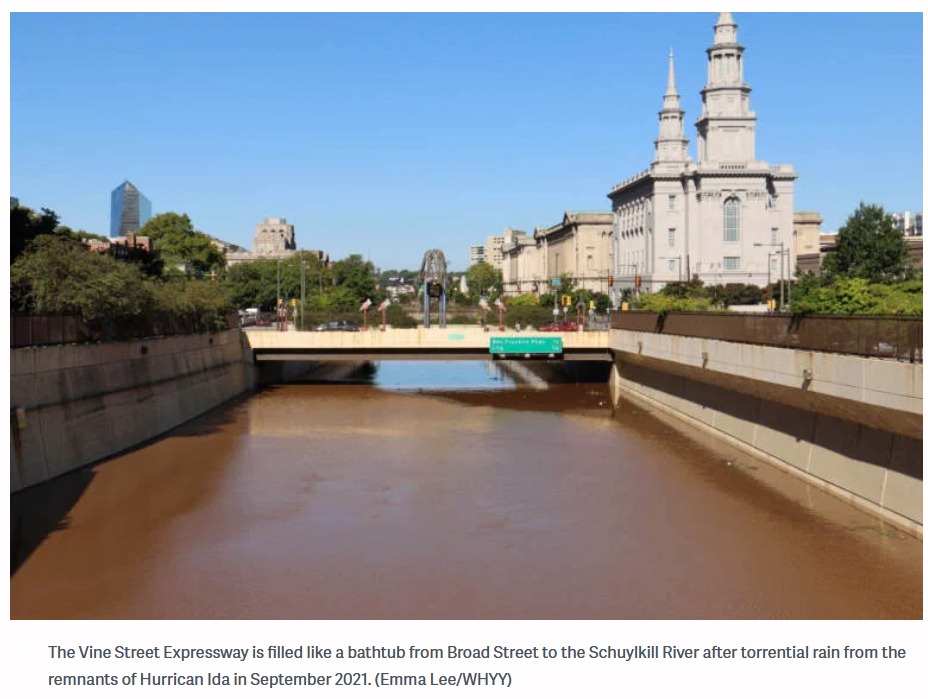
Vine Street Expressway Flooded

Hurricane Ida in the summer of 2021 is a good example. Because of the 85 degrees Fahrenheit Gulf of Mexico ocean temperature, Ida rapidly gained strength right before it made landfall jumping from a Category 1 to a Category 4 storm. The warm air allowed more moisture to be carried as rain. The storm was so large that it was able to pick up more moisture from the Atlantic Ocean. After destroying parts of Florida, the ocean moisture was carried inland and dumped over places like Pennsylvania and New York. Ida caused record flood damage in parts of Pennsylvania. The Philadelphia Inquirer reported, “The remnants of Hurricane Ida destroyed or damaged hundreds of homes in Southeastern Pennsylvania and caused more than $100 million in public infrastructure damage across the state.” There were more deaths in the Northeastern USA than where the storm made landfall in Louisiana. The New York Times reported, “The remnants of Hurricane Ida caused flash flooding and a number of deaths and disrupted transit across parts of New York and New Jersey. The storm killed at least 43 people in New York, New Jersey, Pennsylvania and Connecticut and left more than 150,000 homes without power.” Ida’s Philadelphia area destruction included 5 deaths, 7 tornadoes, record flooding, hundreds of water rescues, and “one incredibly soggy mess.” The violent rain in Philadelphia was so extreme that the main road across the city from the Delaware River to the Schuylkill River, the Vine Street Expressway, was turned into a canal. “You could’ve swam from 22nd Street to about 15th Street,” said Justin Galbreath, a district maintenance manager at the Pennsylvania Department of Transportation. As climate change intensifies, the frequency of Vine Street becoming a river will likely increase until such time as it becomes permanent.

The train derailment in Plymouth Meeting (July 17, 2023), the eleven vehicles swept away, and the seven people drowned by flood waters in Washington Crossing (July 15, 2023) were caused by a deluge of rain and flash flooding. “In my 44 years, I’ve never seen anything like it,” Upper Makefield Fire Chief Tim Brewer said. “When the water came up, it came up very swiftly. We do not think that anybody drove into it, that they were actively on that road when it happened.” CBS news reported, “Over 6 inches of rain in an hour caused the flash flooding according to Brewer. The fire department was dispatched in that area for a lightning strike and just by happenstance they found 11 cars. Eight people were rescued from the cars and two from the creek.” In July and December of 2023, extreme rainfall resulted in sinkholes being exposed in the carbonate rock under Route 202 in nearby King of Prussia, PA.

In September of 2023, the Philadelphia Inquirer reported, “The remnants of Tropical Storm Ophelia soaked the entire Philadelphia region with episodic downpours on Saturday, the first day of fall, conspiring to incite 60-mph wind gusts at the Shore and high-tide flooding that closed numerous roads in beach and back-bay towns.” There were up to 8 inches of rain recorded throughout the Philadelphia region over the three day event.

The winter of 2023 saw near weekly atmospheric river flash flooding events. On January 9, the Greater Philadelphia Region incurred an historic winter tropical violent rain event. CBS news reported, “If it feels like it’s been an abnormally rainy few weeks, you’re right. Normal rainfall totals between Dec. 1 and Jan. 9 amount to about 4.78 inches. Between December 2023 and Tuesday, we’d already recorded more than 9 inches of rain, an amount normally recorded in December, January and February combined.” The January 9 storm brought over 4 inches of rain to many areas. The Delaware River peaked at its highest level ever. There were hurricane strength winds with wind gusts over 70mph.

On March 23, 2024, Philadelphia witnessed its wettest March day on record. The rain gauge at the airport measured over 3 inches of rainfall, with parts of New Castle County, Delaware, also receiving over 3 inches. Some areas in Gloucester County and Camden County, New Jersey, recorded rainfall exceeding 4 inches. The precipitation observed on that day was roughly equivalent to the typical rainfall for the entire month. A young girl was swept away by the rapidly rising and swift moving waters of the Chester Creek in Delaware County, PA. On the same day, an atmospheric river event brought heavy rains to Brazil’s Rio de Janeiro state, resulting in at least nine fatalities, with Petropolis being the hardest hit. A staggering 270 mm (11 inches) of rain fell within 24 hours, significantly impacting the region and leading to numerous incidents, including landslides and house collapses.

Between April 1 and 4, 2024, Southeastern Pennsylvania experienced another severe weather event attributed to atmospheric rivers and strong winds. Rainfall accumulation exceeded 3 inches, accompanied by wind gusts ranging from 35 to 45 mph. Tragically, two individuals lost their lives in unrelated incidents, one in Montgomery County and the other in Delaware County, when trees collapsed onto their vehicles.

To Cause a Change: Philadelphia Experiment

4D Music: Songs About Science

A song about The Human Induced Climate Change Experiment

bookmark_borderWhirlwind

[Intro]
De, de, de, de, de, de
Da, De, de, de, de, de, de
De, de, de, de, de, de
Da, De, de, de, de, de, de

[Verse 1]
Have you ever thought to try
… more than just get by?

[Bridge 1]
Come on, girl
Give it a whirl
Come on, Man
I bet you can

[Chorus]
If you fall down, get up and do it again
Just break it down, and get back to begin
De, de, de, de, de, de
Maybe you will come to see
De, de, de, de, de, de
How things are meant to be
De, de, de, de, de, de
Then,
Tell a friend
And do it again

[Verse 2]
Ever been of the mind to give
To cherish every moment you live

[Bridge 1]
Come on, girl
Give it a whirl
Come on, Man
I bet you can

[Chorus]
If you fall down, get up and do it again
Just break it down, and get back to begin
De, de, de, de, de, de
Maybe you will come to see
De, de, de, de, de, de
How things are meant to be
De, de, de, de, de, de
Then,
Tell a friend
And do it again

[Bridge 2]
De, de, de, de, de, de
Da, De, de, de, de, de, de
De, de, de, de, de, de
Da, De, de, de, de, de, de

[Verse 3]
Let’s say “what about love”?
Take our spirits and rise above
Rise higher, higher
Hi, hi, hi

[Bridge 1]
Come on, girl
Give it a whirl
Come on, Man
I bet you can

[Chorus]
If you fall down, get up and do it again
Just break it down, and get back to begin
De, de, de, de, de, de
Maybe you will come to see
De, de, de, de, de, de
How things are meant to be
De, de, de, de, de, de
Then,
Tell a friend
And do it again

[Bridge 2]
De, de, de, de, de, de
Da, De, de, de, de, de, de
De, de, de, de, de, de
Da, De, de, de, de, de, de

[Pre-Outro]
Come on, girl
Give it a whirl
Come on, Man
I bet you can
See to be
A, B, C
De, de, de, de, de, de
Da, De, de, de, de, de, de
De, de, de, de, de, de
Da, De, de, de, de, de, de

[Outro]
Come on, girl
Give it a whirl
Come on, girl
Whirl
We’ll win
Whirlwind

[Ending]
[Silence]
[End]

The Beatless Sense Mongers: We’re Here… er, a… Were Here

4D Music: Songs About Science

A song about The Human Induced Climate Change Experiment

bookmark_borderThe Good-times

[Intro]

[Chanting]
The good-times
The good-times
The good-times
… iiiiimes

[Verse 1]
Everyone shout
All about
The good-times
Good times
Everyone shout
The good-times
Good times

[Chorus]
It’s possible that somehow
It won’t get better… than right now
Right now
Everyone chimes:
The good-times
Good times

[Bridge]
Loving on living
Living on loving
Loving living
Living loving

[Verse]
Reminiscence route
What about…
The good-times?
Good times
Everyone shout
All about
The good-times
Good times

[Chorus]
It’s possible that somehow
It won’t get better… than right now
Right now
Everyone chimes:
The good-times
Good times

[Bridge]
Loving on living
Living on loving
Loving living
Living loving

[Break]

[Interlude]

[Verse 3]
In for a bout
Shout it out:
The good-times
Good times.
Everyone shout
All about
The good-times
Good times.

[Chorus]
It’s possible that somehow
It won’t get better… than right now
Right now
Everyone chimes:
The good-times
Good times

[Outro]
Loving on living
Living on loving

[Fade out]
Loving living
Living loving

[Ending]
[Silence]

The Beatless Sense Mongers: We’re Here… Were Here

4D Music: Songs About Science

A song about The Human Induced Climate Change Experiment

bookmark_borderRio Negro

[Verse 1]
Beneath the canopy, where the Rio Negro flows,
Its water dark as night, its secrets no one knows,
Carbon-rich and acidic, like Coca-Cola’s hue,
But in 2023, it recorded lows we never knew.

]Chorus]
Oh, Rio Negro, what tales do you tell?
Of carbon sinks and climate’s swell,
With every drop, a story untold,
In your depths, the truth unfolds.

[Verse 2]
A scientist’s home, where the river bends,
Watching as the drought, its harshness extends,
More carbon discharged, to the ocean it will sink,
But with less rain, it’s a chain that leads to the brink.

[Bridge]
In South American rivers, a study finds,
DOC release, rapid, as rain unwinds,
Small catchments and peatlands, the most sensitive they see,
With every rain event, DOC sets free.

[Chorus]
Oh, Rio Negro, what tales do you tell?
Of carbon sinks and climate’s swell,
With every drop, a story untold,
In your depths, the truth unfolds.

[Verse 3]
Under natural light, in the Rio’s deep embrace,
Rates of photo-oxidation, an exponential race,
The deeper the water, the more carbon’s laid to rest,
In the ocean’s depths, where it may find its final test.

[Interlude]

[Verse 4]
But beyond the Rio, in the Amazon’s expanse,
A record low, and an unusual dance,
Droughts more frequent, the rainforest weeps,
Decarbonization at an exponential creep.

[Bridge]
The AMOC slows, the Amazon falls,
In a tangled dance, their destiny calls,
Carbon cycles disrupted, in nature’s grand scheme,
The collapse hastened, like a recurring dream.

[Chorus]
Oh, Rio Negro, what tales do you tell?
Of carbon sinks and climate’s swell,
With every drop, a story untold,
In your depths, the truth unfolds.

[Outro]
From the heat of Rio to the river’s might,
From drought to deluge, in the day and the night,
The Rio Negro speaks, if only we would hear,
In its ebb and its flow, the message is clear.

ABOUT THE SONG
Rio Negro Climate Change Case Study
What do you know about the Rio Negro as it relates to climate change and carbon sinks? The Rio Negro gets its name from its color. The black water is caused by highly acidic and carbon rich water. One scientist that lives on the river called it similar to Coca-cola. In 2023, the Rio Negro recorded record low levels.

Most of the carbon discharged into the water helps the carbon to eventually sink in the ocean as a literal carbon sink. The lack of rain and drought conditions result in more vegetation dying and contribute to a feedback loop — more plants die from less rain… and there is less rain to wash the excess carbon to the bottom of the ocean… resulting in more global warming… resulting in more dead vegetation.

A study of Dissolved Organic Carbon (DOC) in South American rivers found, “Small and steep catchments hosting organic rich forest soils and peatlands were the most sensitive and showed the highest and fastest DOC release if evaluated on a per unit area basis. Here, rain events caused a rapid exponential increase in DOC release….”

The study Effects of natural light and depth on rates of photo-oxidation of dissolved organic carbon in a major black-water river, the Rio Negro, Brazil found under natural sunlight during the dry seasons rates of complete photo-oxidation and changes in absorbance indices decayed exponentially. The deeper the water the less CO2 emissions created and the more carbon is sequestered at the bottom of the ocean.

The Amazon river was also at record lows during 2023. The drought conditions in the Amazon rain forest are unusual. We are watching the Rio Negro and Amazon Rivers as a case study for the slowing and/or collapse of the AMOC, the die-back of the Amazon, and the carbon cycle.

The carbon sequestration from dissolved organic carbon is only one of the many carbon sinks in the Amazon. It is likely Amazon droughts will become more frequent and intense resulting in decarbonization at an exponential rate. The collapse of the AMOC will hasten the collapse of the Amazon. The collapse of the Amazon will hasten the collapse of the AMOC.

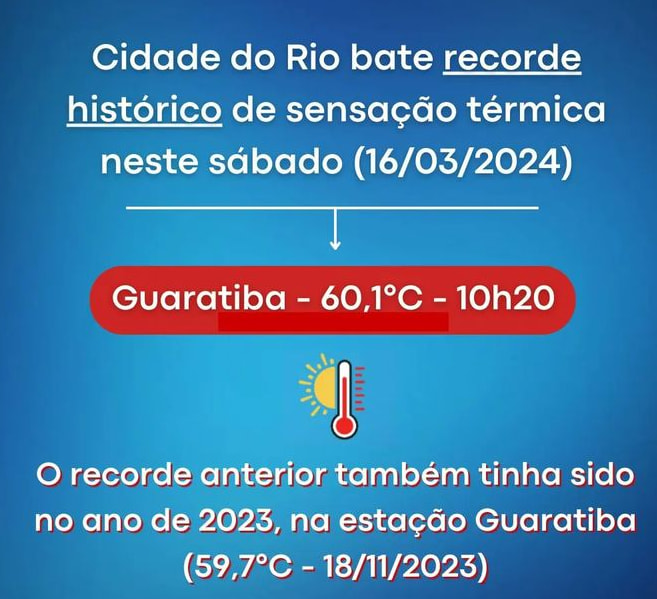
Rio de Janeiro with a wet-bulb temperature reaching 62.3 degrees Celsius (144.1 degrees Fahrenheit)

From March 16 through 18, 2024, Brazil experienced a severe heatwave, setting new records in Rio de Janeiro with a wet-bulb temperature reaching 62.3 degrees Celsius (144.1 degrees Fahrenheit). The wet-bulb temperature reflects the body’s cooling mechanism through sweat evaporation. Higher heat and humidity levels, indicated by the heat index, impede sweat evaporation. A wet-bulb temperature of 35℃ (95℉) at 100% humidity, or 115℉ at 50% humidity, represents the upper limit of safety, beyond which the human body cannot effectively regulate its core temperature through sweat evaporation.

On March 23, an atmospheric river event brought heavy rains to Brazil’s Rio de Janeiro state, resulting in at least nine fatalities, primarily in Petropolis, which bore the brunt of the impact. An astonishing 270 mm (11 inches) of rain fell within a 24-hour period, significantly affecting the region and leading to numerous incidents, including landslides and house collapses.

The Beatless Sense Mongers: We’re Here… er, a… Were Here

4D Music: Songs About Science

A song about The Human Induced Climate Change Experiment

bookmark_borderCan You Stop the Rain?

[Intro]
[Instrumental]
[Verse 1]
Can we stop the rain?
Isn’t it insane?
Drip, drip, destroy
Come back to enjoy

[Chorus]
Please explain
What are we waiting for?
[Choir refrain]
Choir refrain: What are we waiting for?
(What are we waiting for?)

[Bridge]
Well?
Hell!
Well, well, well
La, de, da, la, de, dee
Help us see

[Break]

[Verse 2]
Can we stop the rain?
Hate to complain
Can’t get a grip
Drip, drip, destroy
Please come back to enjoy

[Chorus]
Please explain
What are we waiting for?
[Choir refrain]
Choir refrain: What are we waiting for?
(What are we waiting for?)

[Bridge]
Well?
Hell!
Well, well, well
La, de, da, la, de, dee
Help us see

[Solo]

[Break]

[Bridge]
It’s going to rain
It’s going to pour
Can’t bear the pain
Oh going poor
er, a, ah, ahh, ah, la, la
La, la, la, lo, da, de, da

[Verse 1]
Can we stop the rain?
Isn’t it insane?
Drip, drip, destroy
Come back to enjoy

[Outro]
Please explain
What are we waiting for?
[Choir refrain]
Choir refrain: What are we waiting for?
(What are we waiting for?)

[Ending]

[Silence]

THE SCIENCE LESSON

Most climate change models forecast rising sea levels as the predominant threat of a warming climate to flood risks. Though sea level rise is of great concern, so should be extreme rainfall (violent rain). One type of violent rain is an atmospheric river. Atmospheric rivers are narrow bands of moisture that travel across the lower troposphere. The Journal EOS in the article Atmospheric Rivers Spur High-Tide Floods on U.S. West Coast explains, “Atmospheric rivers, at their peak, can carry as much water through the sky as the Amazon River does on land. They unleash intense winds and heavy rain as they surge across the Pacific Ocean, eventually making landfall on the U.S. West Coast, contributing to many high-tide flooding events.”

Both the sea and air temperatures are rising. Warm air can hold more moisture than cool air. Warmer sea temperatures result in more evaporation. Warmer air can hold more moisture. The increased moisture in the air moves over land causing inland deluges.

The Beatless Sense Mongers: We’re Here… er, a… Were Here

4D Music: Songs About Science

A song about The Human Induced Climate Change Experiment

bookmark_borderIons on the Air

[Intro]
[Harmonica]
Can you feel?
Feel real
Feeeeeeeel
So real
Ideal
I-deal

[Verse 1]
Can you feel
Ions on the air
Negative ions
Positive signs
Charge!

[Bridge]
Ch, ch, ch, charge
Large, large, charge
Ion
Eye on
Ion
Eye on ion
I… on… and, on and on, and on

[Break]

[Verse 2]
Intersection of teleconnection
Clear ear ear
Through the atmosphere, ear, ear
Hear here

[Bridge]
Ch, ch, ch, charge
Large, large, charge
Ion
Eye on
Ion
Eye on ion
I… on… and, on and on, and on

[Verse 3]
Ions on the air
I’m already there
On the air
There

[Solo]

[Break]

[Outro]
Can you feel?
Feel real
Feeeeeeeel
So real
Ideal
I-deal

[Ending]

[Silence]

ABOUT THE SCIENCE
How does rain affect ions?
As raindrops collide, the water molecules break apart into fragments that gain an electrical charge. The heavier and harder the rain, the more negative ions are produced.

Negative ions are tasteless, odourless and invisible molecules that we inhale when we are in environments that contain moving water, like rain. Once the negative ions reach our bloodstream, they are believed to produce biochemical reactions that help to relieve stress, alleviate depression and even boost our energy.

Global warming is caused by an increase in thermal energy in the climate system. The Earth is a climate system. Many subsystems make up our climate. Chaos theory emphasizes the complexity and nonlinearity of dynamic system.

Teleconnections:
Chaos theory recognizes the concept of teleconnections, where seemingly unrelated events in one part of the Earth system influence conditions in another. For instance, changes in sea surface temperatures (linked to ocean dynamics) can affect atmospheric circulation patterns, leading to variations in precipitation and temperature on land.

The Beatless Sense Mongers: We’re Here… er, a… Were Here

4D Music: Songs About Science

A song about The Human Induced Climate Change Experiment

bookmark_borderTo Testify

[Intro]
Are you prepared?
Are you prepared?
Are you?
Are you prepared?
Are you prepared?
Are you, come true

[Verse 1]
Are you prepared
Or feeling scared
To testify
Self declared
Unaware
Please justify

[Bridge]
Why?
Why not try
Why not try to kiss the sky
I, I, I

[Chorus]
Why not try to kiss the sky
Fill an ocean with your emotion
Devotion solution, soul-you-tion
Mother Earth
Mother Earth,
Owe my birth
To Mother Earth

[Verse 2]
Are you prepared
Or feeling scared
To testify
Self declared
Unaware
Please justify
Just a lie?
Possum die…
Can’t deny

[Bridge]
Why?
Why not try
Why not try to kiss the sky
I, I, I

[Chorus]
Why not try to kiss the sky
Fill an ocean with your emotion
Devotion solution, soul-you-tion
Mother Earth
Mother Earth,
Owe my birth
To Mother Earth

[Accelerando]

[Verse 3]
Are you prepared
Or feeling scared
To testify
Self declared
Unaware
Please justify
Just a lie?
Possum die…
Can’t deny
Are you finding it true
All you do
Comes back to you?
Are you
True

[Bridge]
Why?
Why not try
Why not try to kiss the sky
I, I, I

[Chorus]
Why not try to kiss the sky
Fill an ocean with your emotion
Devotion solution, soul-you-tion
Mother Earth
Mother Earth,
Owe my birth
To Mother Earth

[Outro]
Are you finding it true
All you do
Comes back to you?
Are you
True

[Ending]

[Silence]

ABOUT THE SONG
This song delves into the theme of responsibility, particularly in the context of climate change, urging listeners to reflect on their actions and their impact on the planet.

[Verse 1] sets the tone by questioning whether individuals are prepared to take responsibility for their actions or if they are simply ignoring the consequences. It challenges listeners to justify their behavior and acknowledge their role in the current state of affairs.

The [Bridge] emphasizes the importance of taking action, suggesting that striving to reach new heights (“kiss the sky”) is not only desirable but necessary in addressing the challenges we face. It urges individuals to take responsibility for their actions and strive for positive change.

The [Chorus] reinforces the message of responsibility, encouraging listeners to channel their emotions and dedication towards finding solutions for the benefit of Mother Earth. It acknowledges the debt owed to the planet for sustaining life and underscores the need for collective action.

[Verse 2] repeats the questioning from the first verse, highlighting the urgency of the situation and the consequences of inaction. It challenges individuals to confront the reality of their impact on the environment and to question whether their actions align with their values.

The [Accelerando] section increases the intensity of the song, perhaps reflecting the escalating urgency of the climate crisis and the need for swift action.

[Verse 3] expands on the theme of personal responsibility, suggesting that individuals cannot escape the consequences of their actions. It prompts listeners to consider whether their actions are in alignment with their true values and urges them to take ownership of their impact on the world.

The [Outro] reiterates the central message of personal responsibility and the interconnectedness of individual actions and their consequences. It challenges listeners to reflect on the true impact of their actions and to strive for authenticity and accountability.

Overall, the song serves as a poignant reminder of the importance of personal responsibility in addressing climate change and emphasizes the need for individuals to take action and work towards positive change for the sake of Mother Earth and future generations.

The Beatless Sense Mongers: We’re Here… Were Here

4D Music: Songs About Science

A song about The Human Induced Climate Change Experiment

bookmark_borderSee Through

[Verse 1]
Ripples in how the waves behave
Sets sail, motion in the veil
Gives a notion of our position
Satisfaction…
Satisfaction?

[Chorus]
Is that a reflection that I see
Or see through reality?
Can you tell me?
Please, tell me.

[Verse 2]
Wrinkles in how the waves behave
Full fail to cloak the veil
A notion to our situation
Clarification

[Chorus]
Is that a reflection that I see
Or see through reality?
Can you tell me?
Please, tell me.

[Bridge]
Ripples and wrinkles
In the way waves behave
Confusion in solution
Nevertheless, we must progress

[Interlude]

[Verse 3]
Stretch out my arm, open my eyes
A helping hand might surprise
Plain as the nose on my face
The human race

[Chorus]
Is that a reflection that I see
Or see through reality?
Can you tell me?
Please, tell me.

[Outro]
Ripples and wrinkles
In the way waves behave
Confusion in solution
Nevertheless, we must progress

ABOUT THE SONG
This song delves into the intricate behavior of light waves and sound waves as they traverse different mediums, drawing parallels to human perception and progress.

[Verse 1] introduces the concept of waves behaving like ripples, suggesting a sense of fluidity and motion. There’s a hint of uncertainty as the lyrics question whether our perception brings satisfaction or leaves us yearning for more understanding.

The [Chorus] delves deeper into the theme of perception versus reality, questioning whether what we see is merely a reflection or a glimpse into the truth. It’s a plea for clarity and understanding amidst the complexities of existence.

[Verse 2] builds upon this theme, likening waves to wrinkles that fail to fully obscure the veil of reality. There’s a desire for clarification, a yearning to comprehend our situation more fully.

The [Bridge] reinforces the idea of waves as agents of confusion and progression simultaneously. Despite the challenges posed by the complexities of existence, the imperative to move forward remains.

[Interlude] provides a moment of reflection, perhaps inviting the listener to contemplate their own perception and understanding.

[Verse 3] shifts focus to human interaction and the potential for revelation through connection. There’s an acknowledgment of the plain truths that surround us, symbolized by the metaphor of stretching out one’s arm and opening one’s eyes.

The [Chorus] reiterates the central theme, highlighting the ongoing quest for clarity and understanding in the face of ambiguity.

The [Outro] echoes the sentiments of the bridge, acknowledging the inherent confusion in navigating life’s complexities but emphasizing the necessity of progress despite these challenges.

Overall, the song explores the interplay between perception and reality, drawing parallels between the behavior of waves and the human experience, while ultimately advocating for continued growth and understanding.

The Beatless Sense Mongers: We’re Here… Were Here

4D Music: Songs About Science

A song about The Human Induced Climate Change Experiment

bookmark_borderThe Hottest Year on Earth (Cosmic Fever)

A space groove rock song about the hottest year on Earth.

[Verse]
Lost in the cosmic void
The Earth’s temperature soars
Every year gets hotter
The heat wave roars
Melting ice caps
Rising tides
A planet in distress
The hottest year on Earth
It’s a cosmic mess

[Verse 2]
Parched lands and scorched skies
The sun’s relentless wrath
No escape from this heat
It’s a dangerous path
The Earth’s in a fever
Burning up from within
Humanity’s choices
A cosmic sin

[Chorus]
Cosmic fever
Burning up the atmosphere
Can’t escape the heat
It’s getting crystal clear
From galaxies far
They watch us wonder
The hottest year on Earth
Our cosmic blunder

ABOUT THE SONG
In the 20th century, the Earth’s surface temperature averaged 13.9℃. However, in the first weeks of July 2023, the global average temperature surged to 17℃, marking a concerning shift. The question arises: Can humans endure temperatures greater than 3℃? The answer is a grim “probably not long,” as such extremes have never been experienced by humanity before.

September 6, 2023, marked a dire warning from United Nations Secretary-General Antonio Guterres, following the World Meteorological Organization’s report on the hottest Northern Hemisphere summer in human history. Guterres stated, “The dog days of summer are not just barking, they are biting,” emphasizing the severity of the situation.

Climate breakdown, the most alarming development, occurs when feedback loops are triggered, and tipping points are crossed. This leads to the extinction of plants, the disappearance of carbon sinks, and an exponential acceleration of Earth’s temperature. The consequences are dire, with the potential disappearance of vital resources like food, fresh water, and breathable air, likely followed by catastrophic impacts on human survival.

In October 2023, the European Space Agency’s Copernicus Climate Change Service reported that the average temperature for September hit 16.38 degrees Celsius, surpassing the previous record set in September 2020 by 0.5 degrees Celsius. Copernicus Director Carlo Buontempo described it as “mind-blowing” and emphasized the devastating impacts on people and ecosystems, citing destruction of assets, infrastructure, and harvests. “What we are observing, are not only new extremes but the persistence of these record-breaking conditions, and the impacts these have on both people and planet, are a clear consequence of the warming of the climate system,” Director Buontempo said.

By January 2024, the Earth had experienced an alarming annual average temperature increase of over 1.5 degrees Celsius. This temperature rise continued in February 2024, with a monthly average reaching 1.77 degrees above pre-industrial levels, occurring centuries earlier than previously predicted. The urgency to address and combat climate change has never been more critical.

The Beatless Sense Mongers: We’re Here… Were Here

4D Music: Songs About Science

A song about The Human Induced Climate Change Experiment

bookmark_borderOut the Window

[Refrain]
What comes above love?
Above love
Love

[Verse 1]
Did someone just jump out the window
I wonder who’s next to follow?
Find it hard to swallow
(Swallow, swallow)

[Chorus]
The more we make
The more we take
Forgot forgive
And how to live
Push comes to shove
What about love?

[Refrain]
What comes above love?
Above love
Love

[Verse 2]
Did you hear someone yelp for help?
I wonder who’s next to follow?
Find it hard to swallow
(Swallow, swallow)

[Chorus]
The more we make
The more we take
Forgot forgive
And how to live
Push comes to shove
What about love?

[Bridge]
What about love, love, love
When push comes to shove
What about love?
Love, love, love

[Refrain]
What comes above love?
Above love
Love

[Verse 3]
Do you hear fear coming near?
I wonder who’s next to follow?
Find it hard to swallow
(Swallow, swallow)

[Chorus]
The more we make
The more we take
Forgot forgive
And how to live
Push comes to shove
What about love?

[Bridge]
What about love, love, love
When push comes to shove
What about love?
Love, love, love

[Refrain]
What comes above love?
Above love
Love

[Outro]
Did someone just jump out the window
I wonder who’s next to follow?
Find it hard to swallow
(Swallow, swallow)
What comes above love?
Above love
Love

ABOUT THE SONG
Global warming has inflicted irreversible damage on our environment, a consensus echoed by nearly all scientists. Indeed, climate change poses a profound challenge. Our planet is witnessing conditions that increasingly jeopardize human habitation. The critical question now is whether we can adapt swiftly enough. (Year: 1999)

Human-induced climate change is a dynamic component of an intricate and unordered system, as per chaos theory. This implies that global warming is accelerating exponentially in a complex manner. Over the period from 1992 to 2023, we have presented compelling evidence, proposed remedies to mitigate climate change, and amassed valuable information through the engagement of millions with this climate model. Your participation has been invaluable. The incontrovertible data underscores that human-induced climate change is rapidly deteriorating our habitat.

This climate model / experiment employs chaos theory to comprehensively consider human impacts and projects a potential global average temperature increase of 9℃ above pre-industrial levels. Global warming is a consequence of elevated thermal energy in the climate system, which comprises various subsystems. Chaos theory underscores the intricate and nonlinear nature of dynamic systems. Human well-being is compromised above a 1.5-degree temperature rise, rendering much of the Earth uninhabitable. A 9-degree Celsius increase would bring the Earth close to a wet-bulb temperature incapable of sustaining human life.

The Beatless Sense Mongers: We’re Here… Were Here

4D Music: Songs About Science

A song about The Human Induced Climate Change Experiment