bookmark_borderBangarang

We sang of Bangarang!

[Verse 1]
Do we detect a disturbance
Of quite some importance
It’s becoming quite clear
Disturbance in the atmosphere
(Oh, dear!)

[Chorus]
Look who’s come and rang
Bangarang
Knocking at my door
Implore, no more

[Instrumental, Saxophone Solo, Bass]

[Verse 2]
No problem? Problem
Problem for us, problem for them
It’s becoming quite clear
Problem with the atmosphere
(Oh, dear!)

[Chorus]
Look who’s come and rang
Bangarang
Knocking at my door
Implore, no more

[Instrumental, Guitar Solo, Drum Fills]

[Bridge]
Bangarang:
(translation a trouble, or disturbance)
We sang of Bangarang
A troubling thing
Sing: Bangarang
Dang!

[Chorus]
Look who’s come and rang
Bangarang
Knocking at my door
Implore, no more

[Outro]
We sang of Bangarang
A troubling thing
Sing: Bangarang
Dang!

A SCIENCE NOTE
Bangarang: (translation : trouble or disturbance) A. problem, disturbance or mischief.

“Jamaica faces very serious threats from hotter temperatures, droughts and floods linked to climate change, and an existential threat due to sea level rise.”

From the album The Real World by Narley Marley

MegaEpix Enormous

A song about The Human Induced Climate Change Experiment

bookmark_borderThrust, I Must

A must, the thrust
2, 1, 0

[Verse 1]
Picking up speed to succeed (faster, higher, faster)
To see escape velocity (faster, higher, faster)
To be… escape velocity (faster, higher, faster)
Hope to see the sea, all the sea
From sea to sea (from sea to sea)
And, to infinity (beyond the see)
See beyond the sea
A must, the thrust

[Bridge]
Picking up speed, but we might need
A boost
[Break]
[Chorus]
Through the roof
(I’ve a feeling we’ve hit the ceiling)
I’ve a feeling
(I’ve a feeling we’ve hit the ceiling)
The ceiling is dealing a mighty blow
(We’re going a little too slow)
[Break]
Oh, no (Oh, know)
A must, the thrust

[Instrumental, Saxophone Solo, Drum Fills, Rockets]

[Verse 2]
Picking up speed but I must concede (Feeling low)
The severity of the gravity (Feeling low)
Seems to be impeding me (Feeling low, low, low)
Feeling low, don’t you know
Sure could use some juice, a boost
Developing a lust for thrust
Thrust I must!

[Bridge]
Picking up speed, but we might need
A boost

[Chorus]
Through the roof
(I’ve a feeling we’ve hit the ceiling)
I’ve a feeling
(I’ve a feeling we’ve hit the ceiling)
The ceiling is dealing a mighty blow
(We’re going a little too slow)
Oh, no (Oh, know)
A must, the thrust

[Bridge]
You see, gravity
Is bringing me down
(Down, down, down)
Down to Earth
From birth
Mama always said,
Son, the gravity will help keep you
… well grounded.

[Instrumental, Saxophone Solo, Piano, Bass]

Thrust I must!

A SCIENCE NOTE
Escape velocity is the minimum speed required for an object to break free from the gravitational attraction of a celestial body, such as a planet or a moon, without further propulsion. It is the speed at which the object would need to travel horizontally to move away from the body and out into space, overcoming the gravitational pull.

In relation to gravity and rocket boosters, escape velocity depends primarily on the mass of the celestial body and the distance from its center. The greater the mass of the body, the stronger its gravitational pull, and thus the higher the escape velocity required. Similarly, the closer an object is to the center of mass of the celestial body, the greater the gravitational force acting upon it, requiring a higher escape velocity.

Rocket boosters are used to provide the necessary thrust to achieve escape velocity. By accelerating the spacecraft to a speed equal to or greater than the escape velocity, the rocket can break free from the gravitational pull of the celestial body and travel into space. The design and power of the rocket boosters are crucial factors in determining whether a spacecraft can achieve escape velocity and successfully escape the gravitational field of the celestial body.

From the album “Nowadays” by The Beatless Sense Mongers

MegaEpix Enormous

bookmark_borderEvolution Forcing Revolution

This evolution forcing revolution
(Evolution revolution)

[Verse 1]
This evolution forcing revolution
With no solution to our institution
(Pro-pollution)
Self-centered position
(For repetition)

[Chorus]
Going round and round
In a feedback loop
Adding more and more
To recoup
[Bridge]
Round n’ round in a loop (loo-pity-loop)
Found around (loo-pity-loop)
Loop, Loop (loo-pity-loop)

[Verse 2]
The inept apt to force (adaptation?)
With no solution (Citizens Pro-pollution)
Self-centered position
(For repetition)

[Chorus]
Going round and round
In a feedback loop
Adding more and more
To recoup
[Bridge]
Round n’ round in a loop (loo-pity-loop)
Found around (loo-pity-loop)
Loop, Loop (loo-pity-loop)

A SCIENCE NOTE
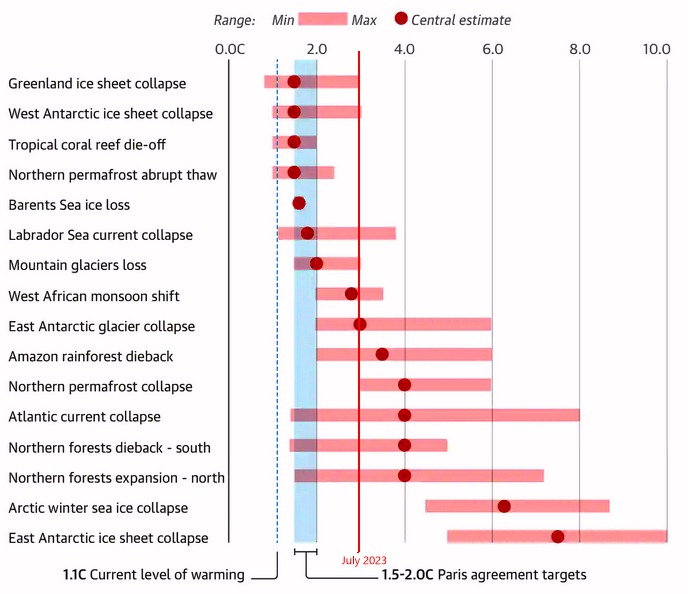
Tipping cascades have emerged between biogeophysical and social-ecological systems. This Domino Effect is causing climate change to accelerate at an exponential rate.

Tipping points are Critical Milestones that directly impact the rate of acceleration in climate change by multiplying the number and intensity of feedback loops. Identifying and understanding these tipping points is crucial for climate science and policymaking. Crossing multiple tipping points could lead to a domino effect, resulting in a much more rapid and severe climate change than currently projected.

Tipping Points

Push a glass toward the edge of a table and eventually it will fall off on its own. No matter how slowly or meticulously you push… no matter how you weight or fill the glass, it will reach a tipping point and fall off before being pushed completely off the table. No matter whether you believe the glass is half-empty or half-full, when the tipping point is reached it will plummet out-of-control to its end. This is science not fate, faith, nor belief. Human induced climate change has resulted in environmental tipping points being breached.

Tipping points, when crossed, trigger self-sustaining feedback loops that are no longer dependent on human activity. Similar to when a domino topples over hitting two more dominoes that in turn fall hitting more dominoes. Thus, the name The Domino Effect. It can also be visualized as The Snowball Effect. A tipping point is like a snowball rolling down a hill growing in mass and velocity (momentum). When a tipping point is crossed, it results in cumulative and reinforced global warming.

From the album “Nowadays” by The Beatless Sense Mongers

MegaEpix Enormous

A song about The Human Induced Climate Change Experiment

bookmark_borderBizarre Sky

Such a bizarre sky…
I wonder why?

[Verse 1]
Such a bizarre sky
I wonder why
Clouds casting a foreshadow
Out my window (Here we go)

[Bridge]
Better hold on tight
We’re going for a ride
Tight, with all your might
Till our troubles subside

[Chorus]
Bizarre sky (All day)
Bizarre sky (All night)
Overcast in a way
That doesn’t feel right

[Instrumental, Saxophone Solo]

[Break]
Such a bizarre sky…
I wonder why?

[Verse 2]
Such a bizarre sky
Raining, but dry
A dark cloud’s shroud
Screaming out-loud

[Bridge]
Better hold on tight
We’re going for a ride
Tight, with all your might
Till our troubles subside

[Chorus]
Bizarre sky (All day)
Bizarre sky (All night)
Overcast in a way
That doesn’t feel right

[Instrumental, Claves, Sub-bass]

[Break]
Such a bizarre sky…
I wonder why?

[Verse 3]
Such a bizarre sky
It’s reigning, It’s pooring
Out my window foreshadow
Raging and roaring

[Bridge]
Better hold on tight
We’re going for a ride
Tight, with all your might
Till our troubles subside

[Chorus]
Bizarre sky (All day)
Bizarre sky (All night)
Overcast in a way
That doesn’t feel right (not quite right)

[End]

From the album A Bizarre Situation by A Bizarre Bazaar

MegaEpix Enormous

A song about The Human Induced Climate Change Experiment

bookmark_borderBizarre Baggage

About your baggage
Bizarre
Carry your own cage
So far

[Verse 1]
About your baggage….
Bizarre
Why carry your own cage
Oh, so far

[Bridge]
The human being
Being seen
Accumulating garbage
For excess baggage

[Chorus]
You’re such a trip
Oblivious to all of us
Such a tight grip
Lascivious for exploitation
[Break]
What about a solution?

[Instrumental, Claves, Bass]

[Verse 2]
Luggage language
Excess baggage
Living in your prison
With a passion

[Bridge]
The human being
Being seen
Accumulating garbage
For excess baggage

[Instrumental, Flute Solo]

[Chorus]
You’re such a trip
Oblivious to all of us
Such a tight grip
Lascivious for exploitation
[Break]
What about a solution?

[Bridge]
The human being
Being seen
Accumulating garbage
For excess baggage

[Chorus]
You’re such a trip
Oblivious to all of us
Such a tight grip
Lascivious for exploitation
[Break]
What about a solution?

[End]

From the album A Bizarre Situation by A Bizarre Bazaar

MegaEpix Enormous

A song about The Human Induced Climate Change Experiment

bookmark_borderGive Her Flowers?

Our relationship sours
Should I try giving Her flowers?

[Verse 1]
Asking a higher power
What’s the difference
Between a weed and a flower
Simply preference?
(No real difference)

[Bridge]
Indeed, the wee is just a plant
Though you might choose to rage and rant
Why cast such a negative slant?

[Chorus]
Don’t you know, let them grow
No longer get a pass mowing grass
With all sincerity, biodiversity
Is a necessity (As we’re about to see)

[Instrumental, Piano Solo]

[Verse 2]
What’s in the interest of “our”
Are the powers of the weeds’ flower
What they’ll induce through medicinal use
… profuse

[Bridge]
Indeed, the wee is just a plant
Though you might choose to rage and rant
Why cast such a negative slant?

[Chorus]
Don’t you know, let them grow
No longer get a pass mowing grass
With all sincerity, biodiversity
Is a necessity (As we’re about to see)

[Instrumental, Saxophone Solo]

[Verse 3]
Our relations with Mother Nature sour
Why not give her a flower
It’s within our heart, within the hour
We have the power

[Bridge]
Indeed, the wee is just a plant
Though you might choose to rage and rant
Why cast such a negative slant?

[Chorus]
Don’t you know, let them grow
No longer get a pass mowing grass
With all sincerity, biodiversity
Is a necessity (As we’re about to see)

[Outro]
It’s within our heart, let love shower
Concede the need for weeds’ flower

[End]


A SCIENCE LESSON
Weeds, often considered undesirable plants, play several important roles in biodiversity and food systems:

  1. Biodiversity: Weeds contribute to overall biodiversity by providing habitat, food, and shelter for various insects, birds, and other wildlife. They can support pollinators like bees and butterflies, which are essential for the reproduction of many plants, including crops.
  2. Soil Health: Some weeds have deep root systems that help break up compacted soil, improve soil structure, and increase soil fertility by bringing up nutrients from deeper layers. When these weeds decompose, they add organic matter to the soil, enriching it and enhancing its ability to retain moisture.
  3. Pest Management: Certain weed species can act as trap crops or repellents for pests, reducing the need for chemical pesticides. They can also attract beneficial insects that prey on pest species, promoting natural pest control in agricultural systems.
  4. Edible and Medicinal Uses: Many so-called weeds are edible and nutritious, offering alternative food sources for humans and livestock. Some common weeds, such as dandelions, purslane, and stinging nettles, are rich in vitamins, minerals, and antioxidants. Additionally, several weeds have medicinal properties and have been used in traditional herbal medicine for centuries.
  5. Adaptability: Weeds are often hardy and resilient plants that can thrive in diverse environmental conditions, including disturbed habitats and degraded soils. Studying their adaptive traits can provide valuable insights into plant resilience and adaptation to changing environmental conditions, which can inform strategies for crop breeding and agriculture in the face of climate change.

While weeds may pose challenges in agricultural settings, recognizing their ecological and nutritional value can help us appreciate their role in sustaining biodiversity and supporting food systems.

Guide to Edible Weeds

MegaEpix Enormous

Daniel

bookmark_borderAgents of Fortune: Spring Force


Agents of change be:
Wild and free!

[Verse 1]
In the realm of math, a symbol’s call,
Delta signifies change, we hold the ball.
From physics to climate, we hold sway,
Guiding us through transformation’s array.

[Chorus]
Agents of change, they shape our world,
In every force, their secrets unfurl.
Spring force, oh, it holds the key,
To shifts in motion, wild and free.
[Break]
Agents of change be:
[Break]
Wild and free!

[Verse 2]
As springs stretch and compress in tight,
Their forces strive to set things right.
In physics’ dance, they play their part,
Affecting objects, stop and start.

[Chorus]
Agents of change, they shape our world,
In every force, their secrets unfurl.
Spring force, oh, it holds the key,
To shifts in motion, wild and free.
[Break]
Agents of change be:
[Break]
Wild and free!

[Instrumental, Saxophone Solo]

[Verse 3]
Best listen to the message She’ll send,
As agents of fortune, they’ll never bend.
Through chaos and calm, they’ll always be,
Agents of change, for eternity.

[Bridge]
From climate shifts to nature’s grace,
Agents of fortune, in every place.
They guide our journey, day by day,
In the dance of life, they lead the way.

[Chorus]
Agents of change, they shape our world,
In every force, their secrets unfurl.
Spring force, oh, it holds the key,
To shifts in motion, wild and free.
[Break]
Agents of change be:
[Break]
Wild and free!

[Outro]
Agents of change be:
Wild and free!
Really, wild and free

[End]

A SCIENCE LESSON
Uppercase delta (Δ) means “change” or “the change” in math. An example in which a variable x stands for the movement of an object: “Δx” means “the change in movement.” Scientists make use of this mathematical meaning of delta in various branches of science. In physics, an agent of change typically refers to a force or an interaction that causes a change in the state of an object or system. In the context of climate change, agents of change are factors or mechanisms that contribute to alterations in the Earth’s climate system, leading to global warming, shifts in weather patterns, and other environmental impacts.

Spring Force: When a spring is stretched or compressed, it exerts a force that tries to restore it to its equilibrium position. This force is known as the spring force. It can cause changes in the position or velocity of objects attached to the spring.

by Δ To Cause a Change from the album Agents of Change

A song about The Human Induced Climate Change Experiment

bookmark_borderTanzania Mania

Onyo ohhhhhhhh

[Break]

[Verse 1]
Intensity intensifying
Frequency Increasing
Not a matter of whether weather
A matter of weathering weather

]Chorus]
Onyo, yo-yo do you know?
Another round of “feel it pound”
Onyo, woah woe, let us know
Logic sound needs to be found

[Instrumental, African Drums, Vocal Scat]

[Break]
Ohhhh Onyo

[Verse 2]
Intensity terrifying
Frequency multiplying
Not a matter of whether weather
A matter of weathering weather

]Chorus]
Onyo, yo-yo do you know?
Another round of “feel it pound”
Onyo, woah woe, let us know
Logic sound needs to be found

[Instrumental, African Drums, Vocal Scat]

[Break]
Ohhhh Onyo

[Bridge]
Mount Kilimanjaro
Hard to swallow
Ngorongoro Crater
Scene seen

[Verse 2]
Intensity so mean
Frequency extreme
Not a matter of whether weather
A matter of weathering weather

]Chorus]
Onyo, yo-yo do you know?
Another round of “feel it pound”
Onyo, woah woe, let us know
Logic sound needs to be found

[Instrumental, African Drums, Vocal Scat]

[Outro]
Ohhhh Onyo

[End]

A SCIENCE LESSON
How to say warning in Swahili: Onyo

In the first months of 2024, Tanzania has faced devastating impacts from extreme weather events. On May 2, 2024, flooding and landslides claimed the lives of at least 155 people. These tragedies have been exacerbated by heavy rains amplified by the El Niño weather pattern, a natural climate phenomenon known for its global weather disruptions, including droughts in some regions and heavy downpours in others.

Adding to the challenges, Cyclone Hidaya is approaching the eastern coast of Tanzania, with an anticipated landfall expected on May 3, as per the latest weather forecasts. The Tanzania Red Cross Society has issued alerts, stating that the presence of Cyclone Hidaya is likely to impact weather patterns across the country, bringing heavy rainfall and strong winds to regions near the Indian Ocean.

by The Beatless Sense Mongers

A song about The Human Induced Climate Change Experiment

bookmark_borderMay Day Mayday

Are you O.K.?
[Break]
No way,
Mayday!

[Instrumental, Guitar Solo, Drum Fills]

[Verse 1]
Mayday, they say, coming our way (Mayday!)
The first of May may showing decay (Mayday!)
What’s it take for opinions to sway (Mayday!)
The working emitters are going to pay (Mayday!)

[Chorus]
It’s a May Day mayday,
Distress signal yells Mother Nature
To hot to play today
Can our dancing endure? (Oh, please save Her)
[Break]
Mayday!
[Break]
Mayday!

[Instrumental, Hammond B3 Organ, Guitar Solo, Drum Fills]

[Bridge]
Maritime crime
Aviation pollution
Don’t you think it’s time
We found our solution

[Instrumental, Saxophone Solo, Drum Fills]

[Break]
Are you O.K.?
[Break]
No way,
Mayday!

[Break]

[Verse 2]
Mayday, today’s the day (Mayday!)
Have we become our own prey? (Mayday!)
Nerves wrecked, hair turned gray (Mayday!)
Will you wake up? Hey, hey, hey! (Mayday!)

[Chorus]
It’s a May Day mayday,
Distress signal yells Mother Nature
To hot to play today
Can our dancing endure? (Oh, please save Her)
[Break]
Mayday!
[Break]
Mayday!

[Instrumental, Hammond B3 Organ, Guitar Solo, Drum Fills]

[Bridge]
Maritime crime
Aviation pollution
Don’t you think it’s time
We found our solution

[Chorus]
It’s a May Day mayday,
Distress signal yells Mother Nature
To hot to play today
Can our dancing endure? (Oh, please save Her)
[Break]
Mayday!
[Break]
Mayday!

[Outro]
Dot dot dot
Dash dash dash
Dot dot dot
Mayday!

[End]

ABOUT THE SONG
“Mayday” is a universally understood distress signal, primarily utilized in aviation and maritime contexts. While many of us encounter it only in fiction or on television, it serves as a vital communication tool for aircraft and boats in times of emergency. It is expressed both as an interjection (“Mayday! Mayday!”) and as a modifier for a noun (“a mayday signal”).

“May Day” is an ancient European festival that heralds the arrival of summer, typically observed on May 1st, situated midway between the Northern Hemisphere’s Spring equinox and June solstice. Often, festivities spill over to the night before, referred to as May Eve. Traditions abound during this celebration, ranging from the gathering of wildflowers and green branches to the weaving of floral garlands. Other customs include the coronation of a May Queen, and the erection of a Maypole, May Tree, or May Bush, encircled by joyful dancing.

National Weather for May 1, 2024
THERE IS AN ENHANCED RISK OF SEVERE THUNDERSTORMS IN WESTERN OKLAHOMA…THE EASTERN TEXAS PANHANDLE AND NORTHWEST/WEST-CENTRAL TEXAS: The greatest threat today for large to very large hail, severe thunderstorm gusts and a few tornadoes will be in western Oklahoma, the eastern Texas Panhandle and northwest/west-central Texas. The Northeastern United States has seen days of record temperatures.

by The Beatless Sense Mongers

A song about The Human Induced Climate Change Experiment

bookmark_borderTexas Clima Extremo

[Intro]
Oh, Texas Clima Extremo, a stormy sight,
Floods and winds in the dead of night.
Winds roar, rivers rage, take a bath,
Leaving destruction, in the aftermath.

[Instrumental, Penny Whistle, Snare Drum, Piccolo]

[Break]
Don’t Mess with Texas?
[Break]
Texas Mess
[Break]

[Verse 1]
In the land of Texas, where the wild winds blow,
Fires rage, floods overflow.
April’s end brings a tempest’s might,
As tornadoes dance in the dead of night.

[Pre-Chorus]
Cold fronts clash with southern heat,
A volatile mix, a deadly feat.
The Trinity River, it bursts its banks,
As Texas faces nature’s ranks.

[Chorus]
Oh, Texas Clima Extremo, a stormy sight,
Floods and winds in the dead of night.
Winds roar, rivers rage, take a bath,
Leaving destruction, in the aftermath.

[Break]
Don’t Mess with Texas?
[Break]
Texas Mess
[Break]

[Instrumental]

[Verse 2]
In Trinity city, a home laid bare,
Torn asunder by the storm’s cruel glare.
But amidst the chaos, hope remains,
As lives are spared amidst the rains.

[Chorus]
Oh, Texas Clima Extremo, a stormy sight,
Floods and winds in the dead of night.
Winds roar, rivers rage, take a bath,
Leaving destruction, in the aftermath.

[Instrumental]

[Break]
Don’t Mess with Texas?
[Break]
Texas Mess
[Break]

[Bridge]
Darkness falls, as power fades,
Thousands stranded, in the storm’s cascade.
Oh, well…
The Texas mess, drill more wells (drill, drill, drill)
Pump more oil (spoil, spoil, spoil)
Two-step with Mother tonight
See the light

[Chorus]
Oh, Texas Clima Extremo, a stormy sight,
Floods and winds in the dead of night.
Winds roar, rivers rage, take a bath,
Leaving destruction, in the aftermath.

[Outro]
Don’t Mess with Texas?
This Texas Mess

[End]

A SCIENCE LESSON
April 30, 2024 — Amidst a backdrop of unusual winter warmth and raging wildfires that have gripped the Lone Star State for months, April bids its farewell with a tumultuous display of nature’s fury. Across Texas, communities grapple with the wrath of severe weather, unleashing a barrage of flooding, high winds, and tornadoes.

In Polk County, along the banks of the Trinity River, the scene is one of urgency as rushing waters breach their confines, triggering mandatory evacuations. Homes stand vulnerable against the relentless onslaught of flooding, prompting authorities to issue dire warnings and mobilize rescue efforts to safeguard lives.

The tumultuous weather phenomenon is attributed to a convergence of cold fronts sweeping down from the Pacific Northwest, colliding tumultuously with warmer air masses from the southeast. This clash engenders a volatile atmospheric cauldron ripe for the genesis of tornadoes and thunderstorms, unleashing chaos across the region.

“The relentless onslaught of fast-moving disturbances traversing the western U.S. continues to spawn new low pressure systems across the heartland of America,” remarks the weather service in a somber forecast discussion on Monday, foretelling the continuation of this tempestuous saga.

In the city of Trinity, southeast Texas bears witness to the unforgiving wrath of the storm, as at least one home is reduced to rubble, torn asunder by the ferocious might of a tornado. Trinity County Sheriff Woody Wallace, in a solemn Facebook video, recounts the devastation wrought by the twister, which left a trail of destruction in its wake. Miraculously, amidst the chaos, all occupants escaped with their lives, though the scars of the ordeal remain etched in the landscape.

Among the casualties of the storm, Lt. James “Jimmy” Waller and his wife suffer injuries in the wake of the Trinity County tornado. Waller, critically wounded, faces a grueling journey to recovery, while his steadfast wife remains steadfast at his side, a beacon of resilience in the face of adversity.

As the storm rages on, its impact reverberates beyond Texas’s borders, plunging tens of thousands into darkness as power outages sweep through the region. In Louisiana, Texas, and Oklahoma, communities brace themselves against the onslaught, grappling with the harsh realities of nature’s unyielding force.

by The Beatless Sense Mongers

A song about The Human Induced Climate Change Experiment

bookmark_borderPhotosphere

The temperature of the Sun’s surface, known as the photosphere, is approximately 5,500 degrees Celsius (9,932 degrees Fahrenheit). However, deeper within the Sun’s core, where nuclear fusion reactions occur, temperatures can reach millions of degrees Celsius.

The photosphere is the visible surface of the Sun, where sunlight is emitted and where most of the Sun’s radiation is generated. It is the outermost layer of the Sun’s interior and is composed primarily of hydrogen and helium gases. The photosphere is characterized by a granular texture, with dark regions known as sunspots interspersed among brighter areas called granules. Sunspots are cooler regions caused by intense magnetic activity, while granules represent convective cells where hot gas rises and cooler gas sinks. Overall, the photosphere appears as a bright, glowing disk when observed from Earth.

[Intro]
[Instrumental, Strings, Guitar Solo]
[Break]
Hot!
[Break]
Hot!
[Break]
Hot!

[Verse 1]
Beneath the sky of blue,
A star of fiery hue,
A domain of blazing view,
The photosphere we knew.

Granules dance in the light,
Sunspots fade in the night,
A cosmic, wondrous sight,
Of the photosphere’s might.

[Break]
Hot!
[Break]
Hot!
[Break]
Hot!

[Chorus]
Hot, hot, hot, the photosphere,
Burning bright, without a fear,
A fiery dance, so crystal clear,
In the Sun’s embrace, we persevere.
[Bridge, Instrumental, Flute Solo]
[Break]

[Verse 2]
At five thousand five hundred,
Degrees Celsius, it’s thunder,
On this surface, we wonder,
In its glow, we ponder.

Nuclear fusion, no illusion, might
In the core, burning bright,
Millions of degrees, the light,
In the Sun’s eternal flight.

[Break]
Hot!
[Break]
Hot!
[Break]
Hot!

[Chorus]
Hot, hot, hot, the photosphere,
Burning bright, without a fear,
A fiery dance, so crystal clear,
In the Sun’s embrace, we persevere.
[Bridge, Instrumental, Flute Solo]
[Break]

[Bridge]
A grand celestial dance,
In the Sun’s fiery expanse,
A cosmic symphony’s chance,
In the photosphere’s trance.

[Break]
Hot!
[Break]
Hot!
[Break]
Hot!

[Chorus]
Hot, hot, hot, the photosphere,
Burning bright, without a fear,
A fiery dance, so crystal clear,
In the Sun’s embrace, we persevere.
[Bridge, Instrumental, Flute Solo]
[Break]

[Outro]
In the photosphere’s glow,
We bask in its radiant show,
A celestial fire, aglow,
In the universe’s eternal flow.
Sunshine shine
[End]
[Silence]

From Daniel’s Multimedia Album: Omnilogy

bookmark_borderWhirlwind

[Intro]
De, de, de, de, de, de
Da, De, de, de, de, de, de
De, de, de, de, de, de
Da, De, de, de, de, de, de

[Verse 1]
Have you ever thought to try
… more than just get by?

[Bridge 1]
Come on, girl
Give it a whirl
Come on, Man
I bet you can

[Chorus]
If you fall down, get up and do it again
Just break it down, and get back to begin
De, de, de, de, de, de
Maybe you will come to see
De, de, de, de, de, de
How things are meant to be
De, de, de, de, de, de
Then,
Tell a friend
And do it again

[Verse 2]
Ever been of the mind to give
To cherish every moment you live

[Bridge 1]
Come on, girl
Give it a whirl
Come on, Man
I bet you can

[Chorus]
If you fall down, get up and do it again
Just break it down, and get back to begin
De, de, de, de, de, de
Maybe you will come to see
De, de, de, de, de, de
How things are meant to be
De, de, de, de, de, de
Then,
Tell a friend
And do it again

[Bridge 2]
De, de, de, de, de, de
Da, De, de, de, de, de, de
De, de, de, de, de, de
Da, De, de, de, de, de, de

[Verse 3]
Let’s say “what about love”?
Take our spirits and rise above
Rise higher, higher
Hi, hi, hi

[Bridge 1]
Come on, girl
Give it a whirl
Come on, Man
I bet you can

[Chorus]
If you fall down, get up and do it again
Just break it down, and get back to begin
De, de, de, de, de, de
Maybe you will come to see
De, de, de, de, de, de
How things are meant to be
De, de, de, de, de, de
Then,
Tell a friend
And do it again

[Bridge 2]
De, de, de, de, de, de
Da, De, de, de, de, de, de
De, de, de, de, de, de
Da, De, de, de, de, de, de

[Pre-Outro]
Come on, girl
Give it a whirl
Come on, Man
I bet you can
See to be
A, B, C
De, de, de, de, de, de
Da, De, de, de, de, de, de
De, de, de, de, de, de
Da, De, de, de, de, de, de

[Outro]
Come on, girl
Give it a whirl
Come on, girl
Whirl
We’ll win
Whirlwind

[Ending]
[Silence]
[End]

The Beatless Sense Mongers: We’re Here… er, a… Were Here

4D Music: Songs About Science

A song about The Human Induced Climate Change Experiment

bookmark_borderTo Reach the End

LYRICS
(Verse 1)
Pushing and shoving, we race to the end,
But what message do we hope to send?
In our pursuit of more, we’ve lost our way,
Me, my, mine, dominating the fray.
(Chorus)
Neglecting reason, rejecting rhyme,
We’re running out of space, running out of time.
The Earth cries out, her voice a plea,
To halt our madness and set her free.
(Verse 2)
Consuming voraciously, without a thought,
The consequences of our actions, often forgot.
Nature’s rhythms disrupted by our greed,
As we sow the seeds of our own misdeed.
(Chorus)
(Bridge)
But amidst the chaos, a glimmer of light,
A chance to change our course, to make it right.
Let’s pause, let’s listen, let’s realign,
And weave a future where all can shine.
(Verse 3)
Together we stand, against the tide,
To protect the Earth, our precious guide.
For in unity lies our greatest strength,
To heal the planet, no matter the length.
(Chorus)
(Outro)
So let’s rewrite the story, let’s change the trend,
And journey together, towards a brighter End.
With compassion and care, let’s mend the line,
And embrace a world with harmonies fine.

Chords: F# E / B D F# B / B F# F# B / D E F# / F# C# B F#; Part Reggae Trip-Hop II @ 90 Beats Per Minute
Instrumentation: Vocals (TC-Helicon VOICELIVE and MiniNova Vocorder), Ibanez Acoustic Guitar (AW54CE), Keyboards (Korg PS60, Casio WK-3500, Yamaha PSR-740, MiniNova, MicroKorg)

ABOUT THE SONG
This song serves as a poignant commentary on humanity’s destructive impact on the environment and the urgent need for collective action to address climate change.

The opening verse paints a picture of a society driven by relentless pursuit of material gain, where individualism reigns supreme and the consequences of our actions are disregarded in favor of short-term gratification.

The chorus highlights the dire situation we find ourselves in, as we neglect reason and continue to exploit the Earth’s resources at an unsustainable rate. The Earth is personified as a sentient being crying out for relief from the damage we have inflicted upon her.

The second verse delves deeper into the destructive nature of human consumption and the disregard for the interconnectedness of all life on Earth. Our greed and disregard for the natural world have disrupted delicate ecosystems and set us on a path of self-destruction.

The bridge offers a glimmer of hope amidst the despair, emphasizing the potential for positive change if we can muster the courage to realign our priorities and work towards a sustainable future where all beings can thrive.

The third verse calls for unity in the face of adversity, recognizing that only by coming together can we hope to protect the planet and heal the damage that has been done. It emphasizes the strength that lies in collective action and the importance of standing up against the forces of destruction.

The outro serves as a rallying cry for action, urging listeners to rewrite the story of our relationship with the planet and embark on a journey towards a brighter future. It emphasizes the need for compassion and care in our interactions with the natural world and calls for a renewed commitment to living in harmony with the Earth.

Overall, this song serves as a powerful reminder of the urgent need for action to address climate change and the importance of collective responsibility in safeguarding the planet for future generations.

ABOUT THE SCIENCE

What will the “End of Times” look like?

“The era of global warming has ended and the era of ‘global boiling’ has arrived. Climate change is here. It is terrifying. And it is just the beginning”, UN secretary general, António Guterres, said after scientists confirmed July 2023 was on track to be the world’s hottest month on record.

In the 1990’s, we wrote a paper on the worst-case scenario entitled, “The Impact of Governance & Globalization on Forecasting (The Tunnel Under Thesis).” The theory predicted that forecasting would become increasingly difficult. “The result — a figurative, as well as, literal tunneling underground.”

Since that time, forecasting has become increasing more difficult. “In general, as energy is added to a system, the fluctuations in the system increase. So, we expect more storms, more droughts, more wildfires, more floods, more fluctuations of all kinds. What we are saying is that weather conditions will become more volatile due to the impact of humans,” said Mukherjee and Brouse. (2004)

In a report published in Nature entitled Over half of known human pathogenic diseases can be aggravated by climate change, data analyst and associate professor in the Department of Geography and Environment at the University of Hawaii Manoa, Camilo Mora, said climate hazards aggravated 58% of all known human pathogens. That is over half of infectious diseases discovered since the end of the Roman Empire. 58% of an authoritative list of infectious diseases documented to have impacted humanity have already been shown to be aggravated by climatic hazards — a finding the researchers found “shocking,” Mora said.

Movement of people and animals caused by climate is one factor. Warming at higher latitudes allowed vectors and pathogens to survive winter is another factor. The report goes on to say, “The human pathogenic diseases and transmission pathways aggravated by climatic hazards are too numerous for comprehensive societal adaptations, highlighting the urgent need to work at the source of the problem: reducing GHG (Greenhouse Gas) emissions.”

This research reveals more evidence that humans will have difficulty adapting to climate change, especially those in developing countries, Mora said. “The magnitude of the vulnerability when you think about one or two diseases — okay, sure, we can deal with that,” he said. “But when you’re talking about 58% of the diseases, and 58% of those diseases can be affected or triggered in 1,000 different ways. So that, to me, was also revealing of the fact that we’re not going to be able to adapt to climate change.”

In 2023, we wrote about having crossed tipping points in the paper, “Climate Change: How Long Is ‘Ever’?“. When we wrote the Tunnel Under Thesis in 1995, we forecast crossing these tipping points would not happen for centuries. We underestimated Man’s ignorance and arrogance. Fossil fuel consumption and greenhouse gas emissions have continued to set record highs. Humans have caused chain-reactions resulting in toppled tipping points, feedback loops, and The Domino Effect.

Events we thought would not happen in our lifetimes are happening now. My last resort emergency plan was to escape to Canada. (I am a dual citizen.) This summer that plan literally went up in smoke. “Beginning in March 2023, and with increased intensity starting in June, Canada has been affected by an ongoing, record-setting series of wildfires.” — Wikipedia

All of my life I have located my office and bedrooms in the uppermost southern exposure (preferably in the tree canopy.) I love sunlight, elevation, trees, fresh air, and wildlife. It is becoming ever more obvious my dreamlife is coming to an end, and I will be forced to tunnel under. For those forward thinkers, think about your poop. Pumping sewage above ground level will be a major problem at all times. In addition, the inability to pump flood water will become deadly during extreme weather events. In July of 2020 NPR reported, “The remnants of Hurricane Ida dropped unprecedented rainfall on several eastern states, killing dozens of people. Eleven of them were Queens residents who died when their basement apartments flooded.” In August of 2022 CNN reported, “Seoul has vowed to move some of the city’s poorest families out of underground and semi-subterranean homes after 13 people were killed in flooding caused by record rainfall this week, sparking public horror and calls for government accountability.” Drowning in your own poop may result for those unprepared.

There will be enough ice melt to raise sea levels 220 feet. We estimate 270 feet to be “the minimum safe” elevation to live. High-tides, waves, coastal flooding, storm surge, grade of shoreline, etc. would make the lowest elevations for living space to be at least 270 feet above pre-industrial sea levels. This would be the minimum elevation. Personally, I would not want to live that low. As the water submerges sewage treatment plants, landfills, chickens, cows, and all sorts of other bio-hazards, the waters will become toxic. In addition, much of the land will experience salinization making it unfit for plant life. Another concern for elevations under 800 feet is living on an island. Many locations at lower elevations will become isolated. Living on an island has many problems including fresh water, food, shelter, and healthcare. Security from pirates pilfering, raping, and plundering will likely be the overriding concern. Of course, I don’t expect that to happen for millennia, but I hope government planners do plan for it now. If you look at Florida as an example, parts of the coastline have seen sea levels rise over 14-20 feet in the last decade. Although the storm surge was only for hours, you wouldn’t want to live there during those hours. Not to mention, the frequency of these extreme weather events will rise exponentially. Thus, our recommendation to evacuate Florida now (i.e. Managed Retreat). The billions of dollars spent to rebuild after Hurricane Ida will all be for naught. Allowing building there will needlessly endanger property and lives. Parts of the world have already seen storm surges of 40 feet. I expect most North American coastlines will see sea levels rise, if only temporarily, by 20-40 feet this century. As far as long run sea level rise, much will depend on location, gravity, isostatic adjustment, and thermal expansion. If the ocean temperatures get warm enough (thermal expansion), parts of the world may see sea levels rise to 270 feet for long periods of times. Other parts of the world, like Greenland, may actually see sea levels decline. In any event, the Earth crossed tipping points this decade which make extreme sea level rise inevitable and irreversible in our lifetimes. Planners should plan on it.

Sidd reiterated, “That 270 feet will take a long time. I would be more careful about the violent rain than the ice melt.” Expect to see increasing intensity and/or frequency in a wide variety of violent rain events including: downpours, flooding, hurricanes, cyclones, monsoons, coastal flooding, storm surges, lightning and wildfires, hail, extreme wind, and concurrent extremes. The reign of violent rain has already begun. More hillsides and shorelines are collapsing. Atmospheric rivers are dramatically increasing flash flooding in the Northeastern USA. Worldwide, stormwater systems are becoming overwhelmed. Ironically, the streets of Abu Dhabi and Dubai, UAE, flooded days before the COP28 Climate Conference. Nowhere is safe from violent rain, not even in the desert preparing for a UN meeting on the climate crisis. As a result of increasing violent rain, new drainage culverts are forming. Eventually, the culverts will transform into recurring streams, carving new canyons, creating new landscapes and islands. In addition, extreme weather events are increasing the frequency of lightning storms and wildfires. After wildfires, rain deluges cause massive landslides transforming the topography. At the same time as the violent rain makes its way to the sea, the sea is rising to meet the violent rain.

In the article “Violent Rain and the Substrate,” Greg Laden, coastal archaeologist, said, “With a little erosion, the Hudson, Lake Champlain, and the St. Lawrence could become contiguous, so New England becomes an Island.”

For any remaining humans, fresh air, water, food, and sunlight will all be problematic; however, your most severe concern will likely be security. Those with supplies will be at high risk of being raped and looted. Good luck!

* Our climate model employs chaos theory to comprehensively consider human impacts and projects a potential global average temperature increase of 9℃ above pre-industrial levels.

What Can I Do?
There are numerous actions you can take to contribute to saving the planet. Each person bears the responsibility to minimize pollution, discontinue the use of fossil fuels, reduce consumption, and foster a culture of love and care. Be a butterfly and affect the world. The Butterfly Effect illustrates that a small change in one area can lead to significant alterations in conditions anywhere on the globe. Hence, the frequently heard statement that a butterfly in China can cause a hurricane in the Atlantic.

Here is a list of additional actions you can take.

4D Music: Songs About Science

A song about The Human Induced Climate Change Experiment

bookmark_borderYou Know What You Mean

LYRICS
When one acknowledges their role within the system (Gaia hypothesis), the mind is liberated from suffering.

Dreaming away
Dream of the day
When sense is king and loves a thing
Deeming the way to our daydream
Where sense is king and love’s the scene
And you know what you mean
Understand the part of Man
To command what is “I am”
Then the lion lies with the lamb
I am
I can

Working our way
Toward the day
When sense is a thing an love is king
Deeming the way to our dream day
Know sense is a thing a love’s in play
And you know what you mean
Understand the part of Man
To command what is “I am”
Then the lion lies with the lamb
I am
I can

Enjoying today
We found the way
Sense is our king
And love is our thing
Deemed the way to work and play
We sense the thing we need to bring
And you know what you mean
Understand the part of Man
To command what is “I am”
Then the lion lies with the lamb
I am
I can

You’ll find
You liberate your mind

Chords: C Bb / Bb / C Eb / C Eb Bb C; Part II Swing Reggae Trip-Hop @ 100 Beats Per Minute
Instrumentation: Vocals (TC-Helicon VOICELIVE and MiniNova Vocorder), Ibanez Acoustic Guitar (AW54CE), Fender Jazz Bass (Boss Digital Delay), Keyboards (Korg PS60, Casio WK-3500, Yamaha PSR-740, MiniNova, MicroKorg)

ABOUT THE SONG
These lyrics convey a message of unity with nature and a recognition of humanity’s place within the Earth’s interconnected system. The reference to the Gaia hypothesis highlights the idea that the Earth functions as a self-regulating organism, with all living beings playing a vital role. As individuals acknowledge their interconnectedness with the planet, they experience a sense of liberation from suffering.

The imagery of dreaming and envisioning a world where “sense is king and love’s the scene” suggests a future where humanity values wisdom and compassion above all else. This vision includes harmony between humans and nature, symbolized by the lion lying with the lamb.

The repetition of the phrase “I am, I can” emphasizes the power of individual agency and responsibility in shaping the world for the better. By understanding their role as stewards of the Earth, individuals can work towards a future where sense and love guide their actions, leading to a more harmonious existence for all beings.

Overall, these lyrics encourage listeners to recognize the interconnectedness of all life and to strive for a future where humanity lives in harmony with the Earth, liberated from suffering through understanding and compassion.

ExperiMental Music: For the most part, this music is written and recorded extemporaneously. Extemporaneous, spontaneous, improvisation, jamming, freestyle, and impromptu music are most closely related to pure chaos. The music and lyrics evolve from the “sensitive initial conditions” similar to “a butterfly flapping its wings in China causing a hurricane in the Atlantic.”

Music as a Universal Language: Music has the power to communicate emotions universally. Certain melodies, harmonies, or rhythms can evoke specific feelings that resonate with people across different cultures and backgrounds.

The Science of Chaos Theory, String Theory, and Music
4D Music stands for four-dimensional music. The concept of the fourth dimension in the context of spacetime comes from the merging of three-dimensional space with the dimension of time into a four-dimensional continuum. This idea is a fundamental component of Einstein’s theory of general relativity. In classical physics, space and time were considered separate entities, with space described by three dimensions (length, width, and height), and time considered as a separate parameter. However, in the early 20th century, Albert Einstein introduced the concept of spacetime, where time is treated as a fourth dimension, and the fabric of the universe is a four-dimensional continuum.

4D songs contain music and lyrics influenced and inspired by science including: Einstein’s theory of general relativity, quantum mechanics, string theory, chaos theory, physics, climatology, statistics, economics, astronomy, geology, biology, anthropology, meteorology, chemistry, and other scientific disciplines.

ABOUT THE SCIENCE
Human-induced climate change is a dynamic component of an intricate and unordered system, as per chaos theory. This implies that global warming is accelerating exponentially in a complex manner. Over the period from 1992 to 2023, we have presented compelling evidence, proposed remedies to mitigate climate change, and amassed valuable information through the engagement of millions with this climate model. Your participation has been invaluable. The incontrovertible data underscores that human-induced climate change is rapidly deteriorating our habitat.

Our climate model / experiment employs chaos theory to comprehensively consider human impacts and projects a potential global average temperature increase of 9℃ above pre-industrial levels. Global warming is a consequence of elevated thermal energy in the climate system, which comprises various subsystems. Chaos theory underscores the intricate and nonlinear nature of dynamic systems. Human well-being is compromised above a 1.5-degree temperature rise, rendering much of the Earth uninhabitable. A 9-degree Celsius increase would bring the Earth close to a wet-bulb temperature incapable of sustaining human life.

What Can I Do? There are numerous actions you can take to contribute to saving the planet. Each person bears the responsibility to minimize pollution, discontinue the use of fossil fuels, reduce consumption, and foster a culture of love and care. The Butterfly Effect illustrates that a small change in one area can lead to significant alterations in conditions anywhere on the globe. Hence, the frequently heard statement that a fluttering butterfly in China can cause a hurricane in the Atlantic. Be a butterfly and affect the world.

Here is a list of additional actions you can take.

4D Music: Songs About Science

A song about The Human Induced Climate Change Experiment

bookmark_borderCoral Grief

LYRICS
Ocean acidification
Change in circulation
Shifts in distributions
Mortality by bleach
(1. Mothers, what do we teach/)
(2. Fathers, what do we teach/)
(3. Children, what do we teach/)
Coral reef grief
Reaches the beach
Children,
What do we teach?
Coral reef grief
In disbelief
Coral reef grief
Reaches the beach
Stressed and susceptible
Skeletons gone weak
Our ways unsustainable
Man has passed his peak
Our prominence in disturbance
Doesn’t give ’em half a chance
… not half a chance
And, the tide rolls in
The tide rolls out
And, there’s no doubt
Coral reef grief
Our prominence in disturbance
Doesn’t give ’em half a chance

Chords: C Dm / C F G / G F# F C / G Am / G F# F C / C Dm / Dm G / G F# F C; Part III Reggae-Latin-House @ 90 Beats Per Minute
Instrumentation: Vocals (TC-Helicon VOICELIVE and MiniNova Vocorder), Ibanez Acoustic Guitar (AW54CE), Ibanez Electric RG-270 (Boss Digital Delay), Fender Jazz Bass (Boss Digital Delay), Keyboards (Korg PS60, Casio WK-3500, Yamaha PSR-740, MiniNova, MicroKorg)

ABOUT THE SONG
These lyrics poignantly address the impacts of climate change on coral reefs, specifically highlighting the phenomenon of ocean acidification, changes in circulation patterns, shifts in species distributions, and the devastating consequences of coral bleaching. The inclusion of parenthetical questions directed at mothers, fathers, and children suggests a plea for reflection on the responsibilities and lessons passed down through generations regarding environmental stewardship.

The repeated refrain of “Coral reef grief reaches the beach” underscores the profound and far-reaching consequences of coral degradation, reaching not only the underwater ecosystems but also impacting human communities connected to these environments. The plea to children emphasizes the importance of imparting knowledge and responsibility for the protection of coral reefs.

The lines “Stressed and susceptible, Skeletons gone weak, Our ways unsustainable, Man has passed his peak” draw attention to the vulnerability of coral reefs in the face of human-induced disturbances, stressing the urgency for sustainable practices to prevent irreversible damage.

The mention of the tide rolling in and out with “no doubt” signifies the inevitability of the changes occurring in coral reefs. The repeated acknowledgment of “Coral reef grief” serves as a somber recognition of the sorrowful state of these ecosystems and the human role in their decline.

The concluding lines, “Our prominence in disturbance, Doesn’t give ’em half a chance,” convey a powerful message about the need for responsible and sustainable actions to provide a fighting chance for coral reefs against the disturbances brought about by human activities. The lyrics poetically capture the urgency and gravity of the situation, calling for reflection, responsibility, and immediate action to preserve these vital marine ecosystems.

ABOUT THE SCIENCE
Coral reefs confront unprecedented challenges arising from various stressors, many of which are directly tied to human activities. Some of these stressors possess critical tipping points, surpassing which can lead to the collapse of coral ecosystems. According to the European Geosciences Union’s statement on January 2, 2024, specific tipping points include a temperature increase of 1.2℃ above pre-industrial levels and atmospheric CO2 concentrations exceeding 350 parts per million. Disturbingly, as of February 2024, the Earth’s yearly average temperature has already risen to +1.5℃, underscoring the urgency of addressing climate-related threats to coral reefs.

Climate change is having significant and detrimental effects on coral reefs around the world. Some of the key impacts include:


  1. Coral Bleaching:
    • One of the most immediate and visible impacts of climate change on coral reefs is coral bleaching. Elevated sea temperatures cause corals to expel the symbiotic algae (zooxanthellae) living within their tissues. Without these algae, corals lose their vibrant colors and become more susceptible to stress, disease, and death. While corals can recover from mild bleaching events, severe or prolonged bleaching can lead to widespread coral mortality.
  2. Ocean Acidification:
    • Increased carbon dioxide (CO2) levels in the atmosphere not only contribute to global warming but also lead to ocean acidification. The absorption of excess CO2 by the oceans results in a decrease in pH, making the water more acidic. This acidification can weaken coral skeletons and hinder the ability of corals to build and maintain their calcium carbonate structures.
  3. Sea Level Rise:
    • Rising global temperatures contribute to the melting of polar ice caps and glaciers, causing sea levels to rise. Elevated sea levels can lead to increased stress on coral reefs, especially those located in shallow waters. This can result in reduced sunlight reaching the corals and increased sedimentation, impacting their growth and survival.
  4. Extreme Weather Events:
    • Climate change is linked to an increase in the frequency and intensity of extreme weather events, such as hurricanes and cyclones. These events can physically damage coral reefs by causing coral breakage, dislodgment, and destruction of the reef structure. The recovery time for damaged reefs is often extended, making them more vulnerable to subsequent disturbances.
  5. Changes in Ocean Circulation:
    • Climate change can alter ocean currents and circulation patterns. Changes in water flow can affect the distribution of nutrients and impact the resilience of coral reefs. Some regions may experience altered temperature regimes, nutrient imbalances, and disruptions in the supply of food sources for corals and their associated ecosystems.
  6. Shifts in Coral Species Distribution:
    • As sea temperatures change and habitats are modified, the distribution of coral species may shift. Some species may migrate to cooler waters, while others may struggle to adapt or face local extinctions. These shifts can disrupt the balance of ecosystems and affect the biodiversity associated with coral reefs.

The cumulative impact of these climate-related stressors poses a severe threat to coral reefs worldwide. It’s crucial to address the root causes of climate change and implement conservation measures to enhance the resilience of coral ecosystems. Protection of coral reefs involves both local and global efforts, including sustainable fishing practices, marine protected areas, reducing greenhouse gas emissions, and promoting coral reef restoration initiatives.

Coral reef ecosystems can be influenced by several feedback loops that contribute to reaching tipping points. These feedback loops often involve interactions between various environmental stressors and the responses of coral reefs.

Mitigating these feedback loops requires comprehensive conservation strategies, including reducing greenhouse gas emissions, implementing sustainable fishing practices, establishing marine protected areas, and addressing local stressors to enhance the resilience of coral reefs.

What Can I Do?
Our climate model uses chaos theory in an attempt to adequately account for humans and forecasts a global average temperature increase of 9℃ above pre-industrial levels. Everybody has the responsibility not to pollute. There are plenty of things you can do to help save the planet. Stop using fossil fuels. Consume less. Love more. Here is a list of additional actions you can take.
— from Coral Reefs’ Tipping Point / Brouse (2024)

ExperiMental Music: The music and lyrics are written and recorded extemporaneously. Extemporaneous, spontaneous, improvisation, jamming, freestyle, and impromptu music are most closely related to pure chaos. The music and lyrics evolve from the “sensitive initial conditions” similar to “a butterfly flapping its wings in China causing a hurricane in the Atlantic.”

Music as a Universal Language: Music has the power to communicate emotions universally. Certain melodies, harmonies, or rhythms can evoke specific feelings that resonate with people across different cultures and backgrounds.
The Science of Chaos Theory, String Theory, and Music

A song about The Human Induced Climate Change Experiment