bookmark_borderWill Our Dreams Succeed?

[Intro]
I’ve got this feeling
(I’ve got this feeling)
Feeling, oh so…
So… you know?

[Verse]
I’ve got this feeling
Can’t keep concealing
Kneeling, I concede

[Breakdown]
[Instrumental, Guitar, Percussion, Bass]

[Bridge]
I’ve got this feeling (feeling)
Feeling (feel for real for real)

[Chorus]
I’ve got this feeling
Time for revealing
Will our dreams succeed?
(Will dreams to succeed!)
[Bridge]
[Instrumental, Saxophone Solo]
Dream the scene (dream)
The scene’s a dream (dream)
Dream
[Instrumental]
I’ve got this feeling (feeling)
Feeling (feel for real for real)
[Breakdown]
[Instrumental, Guitar, Percussion, Bass]
I’ve got this feeling (feeling)
Feeling (feel for real for real)

[Bridge]
[Instrumental, Guitar Solo]
I’ve got this feeling (feeling)
Feeling (feel for real for real)
Dream the scene (dream)
The scene’s a dream (dream)
Dream
[Instrumental]

[Breakdown]
[Instrumental, Guitar]
I’ve got this feeling (feeling)
Feeling (feel for real for real)
Dream the scene (dream)
The scene’s a dream (dream)
Dream

[Instrumental, Guitar]

[Outro]
I’ve got this feeling (feeling)
Feeling (feel for real for real)
Dream the scene (dream)
The scene’s a dream (dream)
Dream

From the album “Hold the Onions” by The Beatless Sense Mongers

MegaEpix Enormous

bookmark_borderFossil Fuel’s Fools

[Intro]
Keep your eyes on the hands
They never leave the wrists
Misunderstands
With added twists

[Verse 1]
Wood you save the trees
Please (Oh, please)
As my soul grieves
Please (Oh, please)

[Bridge]
Keep your eyes on the hands
They never leave the wrists
Misunderstands
With added twists

[Chorus]
Fossil fuel’s fools
Corporate tools
Can’t see the trees
(Through the forest’s unrest)
As though there brains seize
[Bridge]
Irate climate primate
Can’t see clearly
At any rate,
Merely
Fossil fuel’s fools

[Verse 2]
Wood you save the trees
Please (Oh, please)
Who possibly disbelieves?
Please (Oh, please)

[Bridge]
Keep your eyes on the hands
They never leave the wrists
Misunderstands
With added twists

[Chorus]
Fossil fuel’s fools
Corporate tools
Can’t see the trees
(Through the forest’s unrest)
As though there brains seize
[Bridge]
Irate climate primate
Can’t see clearly
At any rate,
Merely
Fossil fuel’s fools

[Outro]
Wood you save the trees
Please (Oh, please)
As my soul grieves
Please (Oh, please)

A SCIENCE NOTE
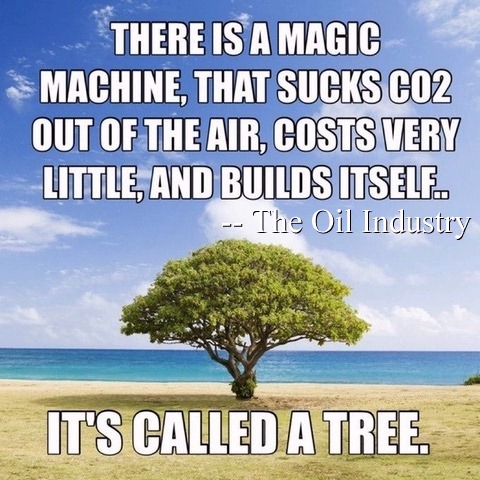
Giving carbon offsets for planting trees and allowing for the continued use of fossil fuels is greenwashing and accelerates the pace of climate change. This meme is an example. Unfortunately, the meme was created by the oil industry to spread misinformation. Trees are not machines; they are inefficient ‘carbon capture facilities’ and cannot substitute for reducing fossil fuel consumption.


Oil Industry Meme

Trees do not permanently sequester carbon. Much of the carbon stored in a tree is in the leaves, which usually last under a year. In one case study, the average life of a tree planted for carbon credit sequestration was 7 years. Additionally, ‘Tree Extinction Due to Human-Induced Environmental Stress‘ is already lowering the life expectancy of all trees. It is extremely rare for a tree to sequester carbon for the approximate 100-year lifespan of carbon in the atmosphere. You cannot burn carbon that has been sequestered for millions of years and expect trees to help in the long run. The important role of trees in climate change is their role as guardians of the soil. In general, climate scientists are against the use of tree sequestration for carbon credits. Giving carbon offsets for planting trees while allowing for the continued use of fossil fuels is greenwashing and accelerates the pace of climate change

THE OIL INDUSTRY STRATEGY
The fossil fuel industry uses carbon offsets as a strategy to maintain and even expand the use of fossil fuels while attempting to address concerns about climate change. Here’s how this works:

  1. Promoting Carbon Offsets: The fossil fuel industry invests in or purchases carbon offsets, which are credits representing reductions in greenhouse gas emissions achieved by others. These offsets can come from various projects such as reforestation, renewable energy, or methane capture.
  2. Continuing Emissions: By purchasing carbon offsets, fossil fuel companies claim to neutralize their own emissions. This allows them to argue that they can continue extracting, refining, and burning fossil fuels without increasing their net carbon footprint.
  3. Public Relations: The industry uses carbon offsets as part of their public relations strategy to portray themselves as environmentally responsible. This helps to counter criticism and regulatory pressure related to their contributions to climate change.
  4. Regulatory Compliance: In some regions, carbon offsets are part of cap-and-trade systems or carbon pricing mechanisms. By using offsets, fossil fuel companies can meet regulatory requirements without reducing their actual fossil fuel production and consumption.
  5. Delaying Transition: By relying on carbon offsets, the fossil fuel industry can delay transitioning to renewable energy sources. Offsets can be cheaper and less disruptive to their current business models compared to investing heavily in clean energy technologies.
  6. Economic Benefits: Investing in carbon offset projects can also bring economic benefits to fossil fuel companies. For instance, they might invest in projects that align with their other business interests or use offsets to enter new markets.

The fossil fuel industry uses carbon offsets to give the appearance of reducing their environmental impact while continuing to produce and use fossil fuels. This approach helps them meet regulatory requirements, maintain public support, and delay the transition to a low-carbon economy.

THE REAL PROBLEM
The exact amount of O2 contributed and CO2 absorbed is a complicated equation on a daily or yearly basis. Trees both absorb and emit CO2. However, this calculation is relatively meaningless because CO2 has an average lifespan in the atmosphere of 100 years. In contrast, 99% of a tree’s carbon has an average cycle of 7 years. Essentially, 0% of the CO2 causing climate change is stored in a tree. The importance of trees and forests lies in their role within the soil ecosystem. Trees act as caretakers for the CO2 stored in the soil.

CANADIAN WILDFIRE CASE STUDY
For a frightening example, look at the forest fires in Canada. These fires are more intense and frequent due to human CO2 emissions. Last year, Canada’s largest contributor to CO2 emissions was wildfires. While this may not be a significant factor in the long term, as that CO2 would have returned to the atmosphere within 50 years anyway, it creates a feedback loop that accelerates climate change.

But it gets worse. The real feedback loop problem is the permafrost. Forest fires and a warming climate have ignited the permafrost, causing ‘zombie fires’ that burned all winter under the snow and continue to burn this year. Millions of years of CO2 are stored in the permafrost. While we do not know exactly how much carbon is stored in nature, it is reasonable to assume that temperatures could be pushed from 3 degrees to 6 degrees above pre-industrial levels. Humans cannot thrive above a rise of 1.5 degrees. Much of the Earth will be uninhabitable if the temperature rises an additional 6 degrees Celsius. If humans also add 3 degrees Celsius, the temperature and humidity will approach a wet-bulb temperature that will not sustain human life.

From the album “Wood You Save the Trees?” by The Beatless Sense Mongers

MegaEpix Enormous

A song about The Human Induced Climate Change Experiment

bookmark_borderWhat a Blast!

[Instrumental, Xylophone]
[Intro]
Boom!
Ba, ba, boom!
(BOOM!)
What a blast
Past the past

[Verse]
Haven’t had this much fun
Since things started coming undone
Now that we’re on a run
Taking it ’round the sun

[Bridge]
[Instrumental, Xylophone]
Hold the phone
Am I alone?
Come on ride along
(Our song)

[Chorus]
The ease with which it’ll please
Is hard to believe
As for the moment: seize
Imagine, conceive

[Instrumental]

[Break]
Boom!
Ba, ba, boom!
(BOOM!)
What a blast
Past the past

[Instrumental, Xylophone]

[Verse]
Haven’t had this much fun
Since things started coming undone
Now that we’re on a run
Taking it ’round the sun

[Bridge]
[Instrumental, Xylophone]
Hold the phone
Am I alone?
Come on ride along
(Our song)

[Chorus]
The ease with which it’ll please
Is hard to believe
As for the moment: seize
Imagine, conceive

[Outro]
Boom!
Ba, ba, boom!
(BOOM!)
What a blast
Past the past

Xylophone

From the album “Hold the Onions” by The Beatless Sense Mongers

MegaEpix Enormous

bookmark_borderCould Use a Drink

[Intro]
Can’t even think
Can’t even blink
Could use a drink
[Break]
[Instrumental]
It’s so hot
(hot)

[Instrumental, Guitar Solo, Drum Fills]

[Verse 1]
What do you think
Too hot to blink
My eye’s so dry
Can’t even cry

[Chorus]
At this rate
Cast our fate
Can’t ask why (why?)
Tryin’ to die (sigh)

[Bridge]
[Instrumental, Saxophone Solo, Bass]
Hang my head
Oh, to cry
Half-way dead
Collective sigh
(Sigh)

[Instrumental, Guitar Solo, Drum Fills]

[Break]
[Instrumental]
It’s so hot
(hot, so hot)
Too, too hot
(hot, so hot)

[Instrumental, Guitar Solo, Drum Fills]

[Verse 2]
Could use a drink (too hot)
Too hot to think (too hot)
My mouth’s so dry (oh, so dry)
Can’t ask ’em why (too, too dry)

[Chorus]
At this rate
Cast our fate
Don’t ask why (why?)
Tryin’ to die (sigh)

[Bridge]
[Instrumental, Saxophone Solo, Bass]
Hang my head
Oh, to cry
Half-way dead
Collective sigh
(Sigh)

[Instrumental, Guitar Solo, Drum Fills]

[Chorus]
At this rate
Cast our fate
Don’t ask why (why?)
Tryin’ to die (sigh)

[Outro]
Can’t even think
Can’t even blink
Could use a drink

A MUSICAL NOTE
Ibanez electric/acoustic used for guitar effects, harmonics, and percussion.

Also of note, I’m fascinated by how the AI model utilizes my sound library, seamlessly integrating my previously recorded sounds into ‘intelligent’ spots. In this song, for example, not only is it ‘real’ guitar from this session, but I’m also playing trumpet and keys, and who knows what else from previous sessions. What a blast!

A SCIENCE NOTE
The greatest health risk from climate change to those alive today is the increased moisture content in the air (relative humidity) combined with the increased temperatures. Climate change and rising temperatures significantly increase the humidity in the atmosphere due to the relationship between temperature and the air’s capacity to hold moisture. The Clausius-Clapeyron equation describes this relationship, indicating that for every 1C (1.8F) increase in temperature, the air can hold about 7% more water vapor.

Right now, where I live, the air contains about 28% more moisture than ever before. We also have record high temperatures and an air quality alert due to pollution.

From the album “Hold the Onions” by The Beatless Sense Mongers

MegaEpix Enormous

A song about The Human Induced Climate Change Experiment

bookmark_borderA Mountain to Climb

[Intro]
I’ve got a mountain to climb
And, I am

[Verse 1]
Had to start at the bottom
Climbed up to the top
Came to a stop
[Rest]
Took a look
[Bridge]
And, said…

[Instrumental, Guitar Solo, Drum Fills]

[Chorus]
What are they doing down there?
Is anyone aware
Or, don’t they even care?
Another mountain to climb
(And, I am)

[Instrumental, Saxophone Solo, Bass]

[Verse 2]
Now, I’ll climb on down
And, take a look around
She what love is found
[Rest]
Took a look
[Bridge]
And, said…

[Instrumental, Guitar Solo, Drum Fills]

[Chorus]
What are they doing down there?
Is anyone aware
Or, don’t they even care?

[Instrumental, Saxophone Solo, Bass]

I’ve got a mountain to climb
(And, I am)

From the album “Free Democracy” by The Beatless Sense Mongers

MegaEpix Enormous

A song about The Human Induced Climate Change Experiment

bookmark_borderSOS (Send Less Mess)

[Intro]
S.O.S.
Under stress
S.O.S.
Under duress
Please…
Send less mess

[Verse]
Unfortunately,
Can you rescue me
(You rescue)
(Me unfortunately)

[Bridge]
[Instrumental, Guitar Solo, Drum Fills]
Can’t believe
Hard to breathe
(Can’t believe)
(Hard to breathe)
S.O.S.
(Under stress)
S.O.S.
(Under duress)
Please…
Send less mess
Less mess!

[Chorus]
Thieves!
Took my breath away
Thieves!
Ruined our way

[Break]
[Instrumental, Saxophone Solo, Bass]
Save the day!
Took my breath away
Save the day!

Going down now, (going down)
Going d-d-d-d-down
Woo, woo

[Instrumental, Harmonica Solo, Guitar]

S.O.S.
(Under stress)
S.O.S.
(Under duress)
Please…
Send less mess
Less mess!

A SCIENCE NOTE

Earth’s Current Climate Status

“We’ve entered the Age of Loss and Damage, but we’re just at the start. What we are seeing already just makes you want to cry,” expressed Dr. Christopher Trisos from the University of Cape Town in a recent BBC interview (MP3 Format). He highlighted the inevitability of loss and damage but emphasized that there are significant measures we can take to mitigate it.

In the 20th century, the Earth’s surface temperature averaged 13.9℃. However, in the first weeks of July 2023, the global average temperature surged to 17℃, marking a concerning shift. The question arises: Can humans endure temperatures greater than 3℃? The answer is a grim “probably not long,” as such extremes have never been experienced by humanity before.

September 6, 2023, marked a dire warning from United Nations Secretary-General Antonio Guterres, following the World Meteorological Organization’s report on the hottest Northern Hemisphere summer in human history. Guterres stated, “The dog days of summer are not just barking, they are biting,” emphasizing the severity of the situation.

Climate breakdown, the most alarming development, occurs when feedback loops are triggered, and tipping points are crossed. This leads to the extinction of plants, the disappearance of carbon sinks, and an exponential acceleration of Earth’s temperature. The consequences are dire, with the potential disappearance of vital resources like food, fresh water, and breathable air, likely followed by catastrophic impacts on human survival.

In October 2023, the European Space Agency’s Copernicus Climate Change Service reported that the average temperature for September hit 16.38 degrees Celsius, surpassing the previous record set in September 2020 by 0.5 degrees Celsius. Copernicus Director Carlo Buontempo described it as “mind-blowing” and emphasized the devastating impacts on people and ecosystems, citing destruction of assets, infrastructure, and harvests. “What we are observing, are not only new extremes but the persistence of these record-breaking conditions, and the impacts these have on both people and planet, are a clear consequence of the warming of the climate system,” Director Buontempo said.

By January 2024, the Earth had experienced an alarming annual average temperature increase of over 1.5 degrees Celsius. This temperature rise continued in February 2024, with a monthly average reaching 1.77 degrees above pre-industrial levels, occurring centuries earlier than previously predicted. The urgency to address and combat climate change has never been more critical.

In a significant update from May 2024, scientists determined through tree ring analysis that the average temperature increase in 2023 reached 2.07 degrees Celsius, further underscoring the escalating pace of climate change and its profound impact on global ecosystems.

June 6, 2024 — Carbon dioxide is accumulating in the atmosphere faster than ever — accelerating on a steep rise to levels far above any experienced during human existence, scientists from NOAA and the Scripps Institution of Oceanography at the University of California San Diego announced today. “Over the past year, we’ve experienced the hottest year on record, the hottest ocean temperatures on record and a seemingly endless string of heat waves, droughts, floods, wildfires and storms,” said NOAA Administrator Rick Spinrad, Ph.D. “Now we are finding that atmospheric CO2 levels are increasing faster than ever. We must recognize that these are clear signals of the damage carbon dioxide pollution is doing to the climate system, and take rapid action to cut fossil fuel use as quickly as we can.”

From the album “Free Democracy” by The Beatless Sense Mongers

MegaEpix Enormous

A song about The Human Induced Climate Change Experiment

bookmark_borderIt Ain’t the Heat

[Intro]
Have you heard the news?
Hey, Philadelphia,
Have you heard the knews?

[Verse]
Have you heard the news
The summer time blues
Started way too soon
(Too, too, too soon)
In the month of June

[Instrumental, Guitar Solo]

[Bridge]
The temperature (the temperature)
And the moisture (the moisture)
Put me under pressure
(Under pressure)
That’s for sure
(Under pressure)
(Too, too, too soon)

[Chorus]
It ain’t the heat (heartbeat)
It’s the humidity (clearly)
Wet-bulb sob
The humidity
Killing me

[Instrumental, Guitar, Harmonica]

[Bridge]
I regret
It’s not even summer yet!
Boo, hoo
Summertime blues, and…
It’s not even summer yet!

[Breakdown]
[Bridge]
The temperature (the temperature)
And the moisture (the moisture)
Put me under pressure
(Under pressure)
That’s for sure
(Under pressure)
(Too, too, too soon)

A SCIENCE NOTE
The greatest short term climate change risk to human health is deadly humid heat (wet-bulb temperature).

A Wet-bulb measures the temperature read by a thermometer covered in a wet cloth. As water evaporates from the cloth, evaporation cools the thermometer. This mirrors how the human body cools itself with sweat. The higher the heat and humidity (heat index), the harder it is for sweat to evaporate. The study Adaptability Limit to Climate Change Due to Heat Stress found that a wet-bulb temperature of 35C (95F) at 100% humidity, or 115F at 50% humidity, would be the upper limit of safety, beyond which the human body can no longer cool itself by evaporating sweat from the surface of the body to maintain a stable body core temperature.

When the “wet bulb” temperature reaches a temperature too hot for humans to sweat, it is referred to as the “wet-bulb temperature threshold” or simply the “wet-bulb limit.” This limit represents the maximum temperature at which evaporation from a wet surface, such as the skin, can effectively cool the human body through sweating. Beyond this threshold, the body’s ability to regulate its internal temperature becomes severely compromised, posing a significant risk to human health and well-being.

When the temperature exceeds the wet-bulb temperature threshold, the human body faces significant risks of heat-related illnesses and potentially fatal heatstroke. Under such conditions, the body’s ability to cool itself through perspiration is severely compromised, leading to a rapid rise in core body temperature. As a result, individuals may experience symptoms such as dizziness, fatigue, rapid heartbeat, nausea, and confusion. Without intervention, heat exhaustion can progress to heatstroke, a life-threatening condition characterized by a core body temperature above 40°C (104℉), accompanied by neurological symptoms such as seizures, delirium, and loss of consciousness. Heatstroke requires immediate medical attention and can be fatal if left untreated.

Exposure to temperatures exceeding the wet-bulb threshold poses a grave risk to human health and highlights the urgent need for effective measures to mitigate and adapt to the impacts of climate change, which can exacerbate extreme heat events and increase the frequency of conditions exceeding this critical threshold.

From the album “Free Democracy” by The Beatless Sense Mongers

MegaEpix Enormous

A song about The Human Induced Climate Change Experiment

bookmark_borderTo the Touch

[Intro]
No more more
No more
Say no more
We’ve turned it up
Way too much
Now, it’s hot to the touch!

[Verse 1]
Drill, drill, drill
Bring on the ill
How long to endure
Till there is no more?

[Break]
No more more
No more
Say no more
We’ve turned it up
Way too much
Now, it’s hot to the touch!

[Bridge]
[Instrumental, Guitar Solo, Drum Fills]

[Verse 2]
Spill, spill, spill
Bring on the ill
How long to endure
Till there is no more?

[Bridge]
No more more
No more
Say no more
We’ve turned it up
Way too much
Now, it’s hot to the touch!

[Instrumental, Saxophone Solo, Bass]

[Outro]
We’ve turned it up
Way too much
Now, it’s hot to the touch!


A SCIENCE NOTE
Our climate model / experiment employs chaos theory to comprehensively consider human impacts and projects a potential global average temperature increase of 9℃ above pre-industrial levels. Global warming is a consequence of elevated thermal energy in the climate system, which comprises various subsystems. Chaos theory underscores the intricate and nonlinear nature of dynamic systems. Previous climate models have inadequately incorporated “social-ecological systems” as human involvement was not a significant factor in past climate changes. Regrettably, the United States ranks among the least prepared countries globally, with the highest percentage of climate deniers. Politicians hinder the fight against climate change exacerbating the problem. The Republican party dismisses it as a manufactured crisis and plans to increase fossil fuel production. Political extremists asserting that the climate crisis is manufactured employ an ironic term, considering that human manufacturing activities are the primary driver of climate change. Under President Biden, the United States has continued to be the world’s largest producer of oil, including crude oil, natural gas liquids, and other petroleum products. Both political parties have concurred to allocate unlimited emergency funding for climate disasters instead of proactively preventing them. Last year, the US witnessed a record number of over a billion-dollar climate disasters, totaling 28 separate weather and climate-related events. It is due to this arrogance and ignorance that “worst-case scenarios” are now “best-case scenarios” for the acceleration of climate change. These factors have altered our climate model, shifting the projected maximum temperature rise from 4 degrees Celsius over the next millennium to a probable increase of 9 degrees Celsius this century. A 9-degree Celsius increase would bring the Earth close to a wet-bulb temperature incapable of sustaining human life.
From the album “Free Democracy” by The Beatless Sense Mongers

MegaEpix Enormous

A song about The Human Induced Climate Change Experiment

bookmark_borderIndefensible

[Intro]
No.
No more more

[Verse 1]
Indefensible
Just say war no more
Reprehensible
What we did to that kid

[Bridge]
[Instrumental]
And, that one (And, that one)

[Chorus]
No more war
(War no more)
No more war
(War no more)

[Instrumental, Guitar Solo, Drum Fills]

[Verse 2]
Insensible
Just say war no more
Not dispensable
What we did to that kid

[Bridge]
[Instrumental]
And, that one (And, that one)

[Chorus]
No more war
(War no more)
No more war
(War no more)

[Instrumental, Guitar Solo, Drum Fills]

[Bridge]
And, that one (And, that one)

[Chorus]
No more war
(War no more)
No more war
(War no more)

[Instrumental, Piano]

[Bridge]
And, that one (And, that one)

From the album “Free Democracy” by The Beatless Sense Mongers

MegaEpix Enormous

bookmark_borderInto the Groove

[Intro]
Hummmmmm
Hummmmmm

[Verse 1]
I’m in the mood
(I’m in the mood)
To get in the groove
(Get in the groove)

[Bridge]
Into the groove
{Instrumental]

[Chorus]
Be the needle
In vibration
Listenable
Cause a sensation

[Instrumental, Guitar Solo, Drum Fills]

[Verse 2]
In the groove
Making the move
Time to improve
What we behoove

[Bridge]
Making the move
{Instrumental]

[Chorus]
Be the needle
In vibration
Listenable
Cause a sensation

[Bridge]
[Instrumental, Saxophone Solo, Bass]
Into the forward rotation
Don’t repeat the same rotation
Then, do it again
(Do it again!)

[Instrumental, Guitar Solo, Drum Fills]

[Bridge]
Into the forward rotation
Don’t repeat the same rotation
Then, do it again
(Do it again!)

[Chorus]
Be the needle
In vibration
Listenable
Cause a sensation

[Instrumental, Piano]

[Outro]
Into the groove
Making the move

From the album “Free Democracy” by The Beatless Sense Mongers

MegaEpix Enormous

bookmark_borderPart of the Stew

{Count In]
[Intro]
ding-a-ling a ling
Come and get it!
Just for you,
Stew

[Verse]
One side is shaked
Half-baked
The other side is raw
Yet to thaw

[Bridge]
ding-a-ling a ling
Come and get it!
Just for you,
The you stew

[Chorus]
Part of the stew
Is eating you
Tooth and claw
Maybe all

[Bridge]
Eat your own tail
Devolve to a snail
(And the children wail!)

[Instrumental, Guitar Solo, Drum Fills]

[Chorus]
Part of the stew
Is eating you
Tooth and claw
Maybe all

[Instrumental, Piano, Organ]

[Outro]
Eat your own tail
Devolve to a snail
(And the children wail!)

From the album “Free Democracy” by The Beatless Sense Mongers

MegaEpix Enormous

bookmark_borderDeficit

[Intro]
One trillion
Two trillion
Zillion trillion

[Verse 1]
Understanding deficit
Of a fiscal deficit
Bringing on regret
We won’t forget

[Chorus]
And, tax and spend
Do it again
Going to upend
When will it end?

[Bridge]
Zillion trillion
Borrow sorrow

[Instrumental, Guitar Solo, Drum Fills]

[Verse 2]
Underestimate the deficit
When you neglect the climate
Bringing on debt and regret
We hope to live to forget

[Chorus]
And, tax and spend
Do it again
Going to upend
When will it end?

[Bridge]
Zillion trillion
Borrow sorrow

[Instrumental, Saxophone Solo, Bass]

[Chorus]
And, tax and spend
Do it again
Going to upend
When will it end?

[Bridge]
Zillion trillion
Borrow sorrow

[Outro]
And, tax and spend
Do it again
Going to upend
When will it end?

A POLITICAL SCIENCE NOTE

The federal budget deficit and national debt can negatively impact freedom, liberty, and future generations in several ways:

1. Economic Constraints

Debt Servicing Costs:

  • As the national debt grows, so do the costs associated with servicing that debt, primarily through interest payments. This means a larger portion of the federal budget is allocated to paying interest rather than funding essential services such as education, healthcare, and infrastructure. The Congressional Budget Office (CBO) projects that interest costs could become the largest federal expenditure, outpacing even defense spending .

Reduced Fiscal Flexibility:

  • High levels of debt reduce the government’s ability to respond effectively to economic crises or other emergencies. For instance, during recessions or natural disasters, a heavily indebted government may find it challenging to implement necessary fiscal stimulus measures without exacerbating the debt situation .

2. Higher Taxes and Reduced Public Services

Tax Burden on Future Generations:

  • To manage the debt, the government might increase taxes. Higher taxes can reduce disposable income for individuals and businesses, potentially slowing economic growth. Future generations could bear the brunt of these increased tax burdens, limiting their financial freedom and opportunities .

Cuts to Public Services:

  • To control the deficit, the government might also cut public services and social programs. This can affect the quality of education, healthcare, and social security, undermining the social safety net that many depend on .

3. Economic Growth and Opportunities

Crowding Out Effect:

  • When the government borrows extensively, it can lead to higher interest rates as it competes with the private sector for capital. Higher interest rates can deter private investment, which is crucial for economic growth and job creation. This “crowding out” effect can limit economic opportunities for individuals and businesses .

Inflationary Pressures:

  • Financing debt by printing more money can lead to inflation. While moderate inflation is normal, high inflation erodes purchasing power, disproportionately affecting those on fixed incomes and savings, thus reducing their economic liberty .

4. National Security and Sovereignty

Dependency on Foreign Creditors:

  • A significant portion of the U.S. debt is held by foreign investors. This dependency can potentially give foreign governments leverage over U.S. policy decisions, compromising national sovereignty and security .

Strategic Vulnerabilities:

  • High debt levels can limit defense spending and investment in national security infrastructure, making the country more vulnerable to external threats .

5. Moral and Ethical Considerations

Intergenerational Equity:

  • Accumulating substantial debt shifts the financial burden to future generations. This raises ethical concerns about the fairness of making future citizens pay for current consumption and policy decisions. This intergenerational transfer of debt can be seen as a reduction in the liberty and opportunities available to future generations .

Conclusion

While managing a certain level of debt is normal and can be beneficial for economic growth, excessive debt and persistent deficits pose significant risks to economic freedom, national security, and the well-being of future generations. Policymakers need to balance current needs with long-term fiscal sustainability to ensure that freedom and opportunities are preserved for future generations.

References

  1. Congressional Budget Office – The Budget and Economic Outlook
  2. Committee for a Responsible Federal Budget – Interest Costs Will Be the Largest Category of Federal Spending
  3. Brookings Institution – The National Debt Dilemma
  4. Center on Budget and Policy Priorities – Debunking Myths About Federal Spending
  5. Heritage Foundation – The Unsustainable Fiscal Outlook
  6. Federal Reserve Bank of St. Louis – The Crowding Out Effect
  7. International Monetary Fund – Inflation and Debt
  8. Council on Foreign Relations – Foreign Holdings of U.S. Debt
  9. RAND Corporation – National Security Implications of U.S. Debt
  10. Urban Institute – Intergenerational Equity and the Federal Budget

From the album “Free Democracy” by The Beatless Sense Mongers

MegaEpix Enormous

bookmark_borderExtreme Extreme

[Intro]
Mean extreme
I mean
Extreme extreme

[Verse 1]
Heavier rainfall
Brings on the floods
Well, after all
Governed by duds

[Bridge]
Mean extreme
I mean
Extreme extreme

[Chorus]
Watch the primate
Gyrate
Can’t win
Putting a spin
On the climate

[Instrumental, Guitar Solo, Drum Fills]

[Verse 2]
Drier droughts
No doubt
Can’t you see
The rising sea
A bout
Of severity

[Bridge]
Mean extreme
I mean
Extreme extreme

[Chorus]
Watch the primate
Gyrate
Can’t win
Putting a spin
On the climate

[Instrumental, Saxophone Solo, Bass]

[Bridge]
Higher highs
Lower lows
Whichever way the wind blows
Drier drys
No one knows
Whichever way the wind blows

[Instrumental, Guitar Solo, Drum Fills]

[Outro]
Higher highs
Lower lows
Whichever way the wind blows
Drier drys
No one knows
Whichever way the wind blows

A SCIENCE NOTE

How Climate Change Intensifies Weather Extremes

1. Increased Atmospheric Water Vapor

Mechanism: Warmer air holds more moisture. For every degree Celsius of warming, the atmosphere can hold about 7% more water vapor . This additional moisture can lead to more intense precipitation events when conditions are right.

Impact: This results in heavier rainfall, leading to increased flood risks during storms.

Example: Record-breaking rainfall and flooding events, such as those seen in Europe in 2021 and the U.S. in 2022, are becoming more frequent and severe .

2. Enhanced Heatwaves

Mechanism: Higher global temperatures increase the frequency, duration, and intensity of heatwaves. Climate change shifts the distribution of temperature extremes, making hot days hotter and more common.

Impact: Increased risk of heat-related illnesses, wildfires, and strain on energy resources due to higher demand for air conditioning.

Example: The heatwave in the Pacific Northwest in 2021 set all-time high temperature records and led to hundreds of deaths .

3. Intensified Storms and Hurricanes

Mechanism: Warmer sea surface temperatures provide more energy to storms and hurricanes, increasing their intensity. Additionally, higher temperatures can lead to more rapid intensification of these systems.

Impact: Stronger winds, heavier rainfall, and higher storm surges cause more damage to coastal areas.

Example: Hurricanes like Harvey (2017), which dropped unprecedented rainfall in Texas, and Dorian (2019), which devastated the Bahamas, exemplify this trend .

4. Prolonged Droughts

Mechanism: Changes in precipitation patterns and increased evaporation rates due to higher temperatures contribute to longer and more severe droughts.

Impact: Reduced water supply, agricultural losses, and increased wildfire risk.

Example: The prolonged droughts in California over the past decade have led to significant water shortages and increased wildfire activity .

5. More Severe Winter Storms

Mechanism: Disruptions in the jet stream, partially driven by Arctic warming, can lead to unusual patterns that result in severe winter storms in certain regions.

Impact: Increased snowfall, ice storms, and prolonged cold spells can disrupt infrastructure, travel, and power supplies.

Example: The February 2021 winter storm in Texas caused widespread power outages and significant damage due to unprecedented cold temperatures .

6. Rising Sea Levels

Mechanism: Melting polar ice and thermal expansion of seawater due to warming contribute to rising sea levels.

Impact: Increased coastal flooding, erosion, and higher storm surges during extreme weather events.

Example: Coastal areas around the world, such as Miami and the Maldives, are experiencing more frequent and severe flooding events .

Summary

Climate change is a key driver in the increasing frequency and intensity of various weather extremes. The complex interactions between higher temperatures, altered precipitation patterns, and changing oceanic conditions create a more volatile and unpredictable climate system. This underscores the urgency for robust climate mitigation and adaptation strategies globally.

Our climate model / experiment employs chaos theory to comprehensively consider human impacts and projects a potential global average temperature increase of 9℃ above pre-industrial levels. Global warming is a consequence of elevated thermal energy in the climate system, which comprises various subsystems. Chaos theory underscores the intricate and nonlinear nature of dynamic systems. Previous climate models have inadequately incorporated “social-ecological systems” as human involvement was not a significant factor in past climate changes. Regrettably, the United States ranks among the least prepared countries globally, with the highest percentage of climate deniers. Politicians hinder the fight against climate change exacerbating the problem. The Republican party dismisses it as a manufactured crisis and plans to increase fossil fuel production. Political extremists asserting that the climate crisis is manufactured employ an ironic term, considering that human manufacturing activities are the primary driver of climate change. Both political parties have concurred to allocate unlimited emergency funding for climate disasters instead of proactively preventing them. Last year, the US witnessed a record number of over a billion-dollar climate disasters, totaling 28 separate weather and climate-related events. It is due to this arrogance and ignorance that “worst-case scenarios” are now “best-case scenarios” for the acceleration of climate change. These factors have altered our climate model, shifting the projected maximum temperature rise from 4 degrees Celsius over the next millennium to a probable increase of 9 degrees Celsius this century. A 9-degree Celsius increase would bring the Earth close to a wet-bulb temperature incapable of sustaining human life.

From the album “Free Democracy” by The Beatless Sense Mongers

MegaEpix Enormous

A song about The Human Induced Climate Change Experiment

bookmark_borderScary Clowns

[Intro]
If you surround yourself with clowns,
Don’t be surprised if your life becomes a circus
For all of us

[Verse 1]
Two sad clowns
Trying to get down
Such a sad situation
When it comes to votin’

[Chorus 1]
The one on the left
Laughed, “a bit daft”
The one on the right
Causing fright

[Instrumental, Guitar Solo, Drum Fills]

[Verse 2]
Two scary clowns
Trying to get down
Bringing fear near
When it comes to votin’

[Chorus 2]
The one on the left
Minimal
The one on the right
Criminal

[Instrumental, Saxophone Solo, Bass]

[Bridge]
Surround yourself with clowns
Send out the frowns (clowns)
Bringing your circus (down)
Down upon us

[Instrumental, Piano]

[Outro]
Surround yourself with clowns
Send out the frowns (clowns)
Bringing your circus (down)
Down upon us

From the album “Free Democracy” by The Beatless Sense Mongers

MegaEpix Enormous

bookmark_borderThe Emperor’s Glass House

[Verse 1]
You say you’re all for freedom
Then how come
You won’t free me?

[Verse 2]
You pray for liberty
Yet can’t see
Democracy

[Chorus]
Self-imposed cage
Rat in a maze
The world is a stage
Tar in a rage

[Bridge]
[Instrumental, Synthesizers, Bass]
I suppose…
Wearing the emperor’s new clothes
Who knows…
Causing quite a rouse
Living in a glass house

[Chorus]
Self-imposed cage
Rat in a maze
The world is a stage
Tar in a rage

[Instrumental, Piano]

[Outro]
I suppose…
Wearing the emperor’s new clothes
Who knows…

From the album “Free Democracy” by The Beatless Sense Mongers

MegaEpix Enormous