bookmark_border98.6

LYRICS
If we ever get in the clear
Then we’ve got to get out of here
Masses of gases
Making my temperature rise
Bulging eyes as the brain fries
Making my temperature rise
Can’t cry too dry
Making my temperature rise

If we ever get out of here
Then we’re near the “all’s clear”
Masses of gases
Making my temperature rise
Bulging eyes as the brain fries
Making my temperature rise
Can’t cry too dry
Making my temperature rise

Until we get out of here
Hear that we have yet to fear
Masses of gases
Making my temperature rise
Bulging eyes as the brain fries
Making my temperature rise
Can’t cry too dry
Making my temperature rise

Chords: E F G / G F# E / E’s; Part II Double Boogie @ 164 Beats Per Minute
Instrumentation: Vocals (TC-Helicon VOICELIVE and MiniNova Vocorder), Ibanez Acoustic Guitar (AW54CE), Fender Jazz Bass (Boss Digital Delay), Keyboards (Korg PS60, Casio WK-3500, Yamaha PSR-740, MiniNova, MicroKorg)

ABOUT THE SONG
This song “98.6” vividly portrays the intense and deadly effects of extreme heat, particularly focusing on the concept of wet-bulb temperature and its implications for human survival in the context of climate change. The repetition of the phrase “Making my temperature rise” underscores the urgency and intensity of the situation. The reference to “Masses of gases” suggests the role of greenhouse gases in exacerbating the heat, highlighting the link to human activities and climate change. The imagery of “bulging eyes” and “brain fries” paints a distressing picture of the physical and cognitive impacts of extreme heat, emphasizing the life-threatening nature of the situation. Overall, the song captures the ominous and oppressive atmosphere of deadly humid heat and the urgent need to address climate change to mitigate its devastating effects.

ABOUT THE SCIENCE
Greenhouse gases themselves are not inherently toxic to humans in the concentrations typically found in the atmosphere. However, their role in trapping heat and contributing to global warming and climate change can have detrimental effects on human health and the environment. For example, the increased temperatures associated with higher levels of greenhouse gases can lead to more frequent and severe heatwaves, which can cause heat-related illnesses and even death, particularly in vulnerable populations such as the elderly and those with pre-existing health conditions. Additionally, changes in climate patterns influenced by greenhouse gases can impact air and water quality, alter ecosystems, and lead to more extreme weather events, all of which can indirectly affect human health and well-being. Therefore, while greenhouse gases themselves may not be toxic, their effects on the environment can have significant health implications.

The greatest health risk from climate change to those alive today is the increased moisture content in the air (relative humidity) combined with the increased temperatures.

A Wet-bulb measures the temperature read by a thermometer covered in a wet cloth. As water evaporates from the cloth, evaporation cools the thermometer. This mirrors how the human body cools itself with sweat. The higher the heat and humidity (heat index), the harder it is for sweat to evaporate. The study Adaptability Limit to Climate Change Due to Heat Stress found that a wet-bulb temperature of 35C (95F) at 100% humidity, or 115F at 50% humidity, would be the upper limit of safety, beyond which the human body can no longer cool itself by evaporating sweat from the surface of the body to maintain a stable body core temperature.

The United Nations DRR says:
For every degree Celsius in warming, the water-holding capacity of the atmosphere increases by about 7%. Record-high sea temperatures ensure there is more moisture (in the form of water vapor) in the atmosphere, by an estimated 5-15% compared to before the 1970s, when global temperature rise began in earnest.

Deadly humid heat affects billions including the US Midwest this century. “It’s very disturbing,” study co-author Matthew Huber of Purdue University. “It’s going to send a lot of people to emergency medical care.” The study Greatly enhanced risk to humans as a consequence of empirically determined lower moist heat stress tolerance was conducted by Purdue and George Mason University and published August 15, 2023.

These results indicate that a significant portion of the world’s population will experience — for the first time in human history — prolonged exposures to uncompensable extreme moist heat. Humans will struggle to adapt to these conditions in a warmer world as they will present widespread challenges across many aspects of food-energy-water security, human health, and economic development including in the world’s most populous and most vulnerable regions.

At 3C (5.4F) of yearly average warming, more than 1.5 billion people will suffer. In the summer of 2023, the Earth experienced about a month of warming at 3C above pre-industrial levels. Both 2022 and 2023 saw a record number of heat related deaths. More than 61,000 Europeans died from extreme heat in the summer of 2022.

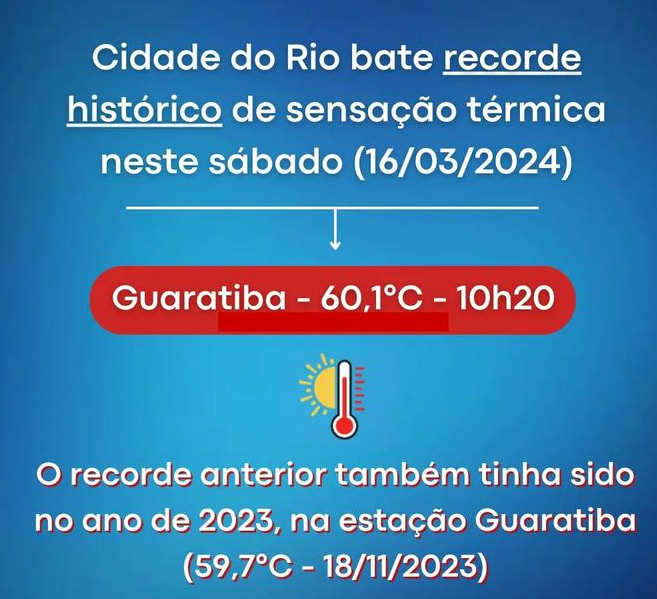
The average temperature for Brazil had been above the historical average from July through October of 2023. Rio de Janeiro recorded 42.5C on November 12, 2023 (a record for November) and high humidity on the 14th meant that it felt like 58.5C, municipal authorities said. The combination of heat and humidity is the greatest climate change risk to human health. On November 17, “a young Brazilian fan of US singer Taylor Swift died in Rio de Janeiro after falling ill inside the sweltering stadium where the superstar’s concert was held, amid a record-breaking heatwave across large swathes of Brazil,” as reported by ABC. “The show took place on the same day that Rio recorded its highest-ever heat index reading, which combines temperature and humidity, at 59.3 degrees Celsius (139 degrees Fahrenheit).”

The Water Vapor Feedback Problem
Water vapor is a powerful greenhouse gas. Since the 1970s, its rise likely increased global heating by an amount comparable to that from rising carbon dioxide. We are now seeing the consequences. In the current climate, for average all-sky conditions, water vapour is estimated to account for 50% of the total greenhouse effect, carbon dioxide 19%, ozone 4% and other gases 3%. Clouds make up about a quarter of the greenhouse effect.

The main greenhouse gases — carbon dioxide, methane, nitrous oxide and ozone — don’t condense and precipitate. Water vapor does, which means its lifetime in the atmosphere is much shorter, by orders of magnitude, compared to other greenhouse gases. On average, water vapor only lasts nine days. The increased intensity of precipitation often results in violent rain.

Sidd said, “The biggest feedback loop is water vapor. Humans put CO2 in the air. CO2 is a greenhouse gas, so the earth gets warmer. Warmer air can hold more water vapor soaking up more water vapor from the oceans. Water vapor is a greenhouse gas, so it gets even warmer… rinse (sorry!) and repeat. Another interesting thing is that the precipitation (rain, snow, sleet) intensity is increasing.”

Due to climate change humans will experience greater loss and damage to life and quality of life from air pollution, decreasing supply of potable water, extreme weather events, and disease. The greatest short term climate change risk to human health is deadly humid heat (wet-bulb temperature).

* Our climate model uses chaos theory in an attempt to adequately account for humans and forecasts a global average temperature increase of 9 degrees Celsius above pre-industrial levels. Everybody has the responsibility not to pollute. There are plenty of things you can do to help save the planet. Stop using fossil fuels. Consume less. Love more. Here is a list of additional actions you can take.
Climate Change and Deadly Humid Heat Brouse (2023)

4D Music: Songs About Science

A song about The Human Induced Climate Change Experiment

bookmark_borderFamily Barbecue

LYRICS
Today’s the day
Record hot
So they say
All we’ve got

Chorus:
There’s going to be a barbecue
Involving me
Involving you
Too late to wake
We’re going to bake
Sadly see
“For goodness sake”

Today’s the day
Record heat
It’s not O.K.
Ruins the beat… the beat… the beat
(chorus)

Today’s the day
Record broke
Lost our way
The fires stoke
(chorus)

Chords: F# C# B F# / C# B F# / B F# C#7 F#; Part II 83 to 110 BPM
Instrumentation I: Vocals, Takamine Acoustic Guitar
Written and recorded at Lake Wynonah, Pennsylvania on a summer-like day in March.
Instrumentation II: Vocals (TC-Helicon VOICELIVE and MiniNova Vocorder), Ibanez Acoustic Guitar (AW54CE), Fender Squire Mini Electric Guitar (Boss Digital Delay and VOX ToneLab), Fender Jazz Bass (Boss Digital Delay), Keyboards (Korg PS60, Casio WK-3500, Yamaha PSR-740, MiniNova, MicroKorg)

ABOUT THE SONG
This song “Family Barbecue” serves as a poignant commentary on the impact of climate change, particularly focusing on the extreme heat and its consequences.

The repeated phrase “Today’s the day” emphasizes the immediacy and urgency of the situation, suggesting that the effects of climate change are being felt in the present moment. “Record hot” and “record heat” highlight the extreme temperatures that are occurring, indicating a departure from normal conditions.

The metaphor of a “barbecue” evokes images of heat, discomfort, and potential danger, mirroring the intensity of the heatwave described in the song. The phrase “All we’ve got” underscores the sense of helplessness or resignation in the face of these extreme conditions.

The chorus emphasizes the inevitability of the situation, suggesting that it is “too late to wake” and that individuals are resigned to “bake” in the heat. The use of the phrase “For goodness sake” conveys a sense of frustration or disbelief at the severity of the situation.

Overall, “Family Barbecue” serves as a sobering reminder of the reality of climate change and its impact on daily life, urging listeners to recognize the urgency of addressing this pressing issue.

ABOUT THE SCIENCE
Human-induced climate change is a dynamic component of an intricate and unordered system, as per chaos theory. This implies that global warming is accelerating exponentially in a complex manner. Over the period from 1992 to 2023, we have presented compelling evidence, proposed remedies to mitigate climate change, and amassed valuable information through the engagement of millions with this climate model. Your participation has been invaluable. The incontrovertible data underscores that human-induced climate change is rapidly deteriorating our habitat.

Our climate model / experiment employs chaos theory to comprehensively consider human impacts and projects a potential global average temperature increase of 9℃ above pre-industrial levels. Global warming is a consequence of elevated thermal energy in the climate system, which comprises various subsystems. Chaos theory underscores the intricate and nonlinear nature of dynamic systems. Human well-being is compromised above a 1.5-degree temperature rise, rendering much of the Earth uninhabitable. A 9-degree Celsius increase would bring the Earth close to a wet-bulb temperature incapable of sustaining human life.

What Can I Do? There are numerous actions you can take to contribute to saving the planet. Each person bears the responsibility to minimize pollution, discontinue the use of fossil fuels, reduce consumption, and foster a culture of love and care. The Butterfly Effect illustrates that a small change in one area can lead to significant alterations in conditions anywhere on the globe. Hence, the frequently heard statement that a fluttering butterfly in China can cause a hurricane in the Atlantic. Be a butterfly and affect the world.

Here is a list of additional actions you can take.

4D Music: Songs About Science

A song about The Human Induced Climate Change Experiment

bookmark_borderOn My Way

LYRICS
I can’t resume to consume
As though it’s yesterday
Should I assume there is room
To obtain O.K.?
If so, I’m on my way

Chorus:
On my way
Into today
On my way
Toward the day
When we can say
All’s O.K.

Pursue to refrain to “to consume”
As though time will resume
It’s a crime to breed doom
No, it’s not O.K.
Let’s hope help is on the way
(chorus)

Consequences of consume loom
The reaper counts the days
As we encourage gloom
Best change our ways
Or else End in a blaze
(chorus)

Chords: Am D7 / D7 C Am / Am Em Am; Part II Heavy Metal Twist @ 164 BPM
Instrumentation: Vocals, Takamine Acoustic Guitar; Part II Vocals (TC-Helicon VOICELIVE and MiniNova Vocorder), Keyboards (Korg PS60, Casio WK-3500, Yamaha PSR-740, MiniNova, MicroKorg)
Part I written and recorded at Lake Wynonah, Pennsylvania

ABOUT THE SONG
These lyrics convey a sense of reflection on past actions and a desire for positive change in the face of potential consequences. The singer expresses a reluctance to resume the same consumption patterns as before, suggesting a recognition of the impact of past behaviors. The use of “On my way” and the chorus implies a commitment to move forward into a better future, aspiring toward a day when everything is deemed okay. The lyrics also touch on the urgency of addressing environmental issues, hinting at potential dire consequences if actions are not altered. Overall, the song encourages a shift in behavior for the greater good and a more sustainable future.

THE SCIENCE
“Human well-being is compromised above a 1.5-degree temperature rise, rendering much of the Earth uninhabitable.” — Daniel and Sidd

March 7, 2024
“According to Copernicus, the average global surface air temperature in February was 13.54 degrees Celsius (roughly 56.4 degrees Fahrenheit). That is 1.77 degrees Celsius above the pre-industrial average for February, leading it to become the ninth consecutive month where each month was the warmest on record globally.”

Our climate model employs chaos theory to comprehensively consider human impacts and projects a potential global average temperature increase of 9℃ above pre-industrial levels. Global warming is a consequence of elevated thermal energy in the climate system, which comprises various subsystems. Chaos theory underscores the intricate and nonlinear nature of dynamic systems. Human well-being is compromised above a 1.5-degree temperature rise, rendering much of the Earth uninhabitable. A 9-degree Celsius increase would bring the Earth close to a wet-bulb temperature incapable of sustaining human life.

What Can I Do? There are numerous actions you can take to contribute to saving the planet. Each person bears the responsibility to minimize pollution, discontinue the use of fossil fuels, reduce consumption, and foster a culture of love and care. Consume less. Consumer habits have played a significant role in damaging the world’s environment and economies. The insatiable demands of mass consumption have led to the exploitation of natural resources and the emission of pollution and greenhouse gases. In many instances, it’s feasible to choose not to consume certain products entirely. Travel, fashion, and meat are examples of areas where consumption could be minimized. Reducing overall consumption is the most impactful individual contribution towards eliminating pollution and mitigating the effects of climate change. The critical aspect of reducing consumption is to cease burning fossil fuels and using hydrocarbon products immediately. (Hydrocarbons encompass plastics, polymers, petroleum, and natural gas.)

The Butterfly Effect illustrates that a small change in one area can lead to significant alterations in conditions anywhere on the globe. Hence, the frequently heard statement that a fluttering butterfly in China can cause a hurricane in the Atlantic. Be a butterfly and affect the world.

The Butterfly Effect / Be a Butterfly

What you can do today. How to save the planet.

A song about The Human Induced Climate Change Experiment

bookmark_borderHubris and Nemesis

LYRICS
Anoint
No doubt succession
Exploit
Without repercussions
Never learn our lesson
Nemesis is Hubris’
Consequences
Humaneless humans
Have no defenses
Environmental degradation
Eye on mental
No hesitation
Ecosystem disruption
On her and him…
Their acquisition
Ignorant and arrogant
They rant:
I want this
And I want that
Don’t give a piss
Where you’re at
I need more
Than those before
Will not concede
My need for greed
Me, my, mine
All the time
Have no spine
Hear me whine
Ignorant and arrogant
We rant:
We can’t

We can’t rant

Chords: Em Am C / B7 AM Em / Em D# Dm / Dm C Am Em / G Am Em / B7 Am Em; Part II @ 120 Beats Per Minute
Instrumentation: Vocals (TC-Helicon VOICELIVE and MiniNova Vocorder), Ibanez Acoustic Guitar (AW54CE), Ibanez Electric RG-270 (Boss Digital Delay), Fender Jazz Bass (Boss Digital Delay), Keyboards (Korg PS60, Casio WK-3500, Yamaha PSR-740, MiniNova, MicroKorg)

ABOUT THE SONG
In 2023, we wrote about having crossed tipping points in the paper, “Climate Change: How Long Is ‘Ever’?“. We had forecast crossing these tipping points would not happen for centuries. We underestimated Man’s ignorance and arrogance. Fossil fuel consumption and greenhouse gas emissions have continued to set record highs. Humans have caused chain-reactions resulting in toppled tipping points, feedback loops, and The Domino Effect.
— from Climate Change: The End of Times Brouse and Mukherjee (2023)

The song presents a powerful metaphor for the interplay between hubris and nemesis in the context of environmental degradation, acting as a commentary on human-induced climate change.

Hubris in Exploitation:

  1. Anoint, No doubt succession, Exploit: These lyrics highlight a sense of entitlement and anointing oneself without considering the consequences. The term “exploit” suggests the reckless use of resources without acknowledging the impacts on the environment.
  2. Without repercussions, Never learn our lesson: The idea that actions are taken without fear of consequences reflects the hubris of assuming that nature can be exploited endlessly without facing repercussions. The refusal to learn lessons indicates a dangerous cycle of repeating environmentally harmful behaviors.
  3. Nemesis is Hubris’ Consequences: Here, the song explicitly connects the concept of nemesis to the consequences of hubris. It implies that the environmental challenges and crises faced by humanity are the natural outcomes of arrogant and exploitative practices.

Consequences and Defenselessness:

  1. Humaneless humans, Have no defenses: The lyrics suggest that humans, lacking humility and empathy (humaneless), are defenseless in the face of the environmental consequences. This vulnerability stems from a lack of understanding and acknowledgment of the interconnectedness of all life.
  2. Environmental degradation, Eye on mental, No hesitation: Describing environmental degradation, the song emphasizes the psychological impact (“eye on mental”) and the lack of hesitation in causing harm. This underscores the urgency and severity of the environmental crisis.

Ecosystem Disruption and Acquisition:

  1. Ecosystem disruption, On her and him, Their acquisition: The disruption of ecosystems is highlighted, with a subtle nod to the gendered impacts (“on her and him”). The mention of “acquisition” suggests the relentless pursuit of resources without regard for the delicate balance of ecosystems.

Ignorance and Arrogance:

  1. Ignorant and arrogant, They rant: The repetition of “ignorant and arrogant” reinforces the theme of overconfidence and lack of awareness. The act of ranting suggests a self-centered and thoughtless expression of desires without considering the broader consequences.
  2. I want this, And I want that, Don’t give a piss, Where you’re at: The lyrics express a selfish and indifferent attitude toward others and the environment, reinforcing the theme of self-centeredness and disregard for the well-being of others.

Refusal to Change:

  1. We can’t rant: The concluding lines imply a recognition that the current path of exploitation and arrogance cannot continue without consequences. However, the phrase “We can’t rant” may suggest a collective inability or unwillingness to change behavior and attitudes.

In summary, the song serves as a poignant metaphor for the destructive cycle of human hubris leading to environmental nemesis, urging listeners to reflect on the consequences of unsustainable practices and the urgent need for change.

Hubris and Nemesis
Hubris and Nemesis, concepts from Greek mythology, can be seen as metaphorical representations of certain aspects of human-induced climate change.

  1. Hubris:
    • Definition: Hubris refers to excessive pride, arrogance, or overconfidence, often leading individuals to defy or challenge the gods, leading to their downfall.
    • Metaphor for Climate Change: Human activities, driven by technological advancements and industrialization, can be viewed as a form of hubris. The excessive exploitation of natural resources, deforestation, and the release of greenhouse gases demonstrate a certain level of arrogance regarding humanity’s impact on the environment. The belief that humans can manipulate and control nature without consequences parallels the hubris seen in Greek myths.
  2. Nemesis:
    • Definition: Nemesis represents the inevitable punishment or retribution for hubris, ensuring a balance is maintained in the natural order.
    • Metaphor for Climate Change: The consequences of environmental degradation, global warming, and climate change can be seen as a form of nemesis. Rising sea levels, extreme weather events, and disruptions to ecosystems can be viewed as nature’s way of restoring balance and imposing consequences for humanity’s environmental hubris. The impacts of climate change, such as natural disasters and loss of biodiversity, act as a form of retribution for the unsustainable practices that have disrupted the balance of the planet.

In this metaphorical interpretation, the cycle of hubris and nemesis mirrors the human impact on the environment. Hubris represents the anthropocentric belief that humans can exploit nature without repercussions, while nemesis embodies the natural consequences and environmental challenges that arise as a result of these actions. The metaphor serves as a cautionary tale about the importance of humility, sustainability, and recognizing the interconnectedness between human activities and the health of the planet.

From the album: The Echoes of Earth’s Wrath:
A Musical Journey Through Mythical Metaphors on Human-Induced Climate Change

A song about The Human Induced Climate Change Experiment

bookmark_borderExplain How Lucky is Lame

LYRICS
You call yourself lucky
Though damage is plenty
I’m missing the lovely
Obviously
How do you explain
Lucky is lame
In pursuit of fortune and fame?

You know it was risky
The outcome was murky
I’m missing the lovely
Obviously
How do you explain
Lucky is lame
In pursuit of fortune and fame?

You’re begging for mercy
While killing our baby
I’m missing the lovely
Obviously
How do you explain
Lucky is lame
In pursuit of fortune and fame?

There’s only Earth
To give birth
Learn to learn
For what it’s worth
Only one Earth
To give birth
Learn to learn
For what it’s worth
Or in the end…
The End

Chords: Em G A / C EM A C B7 Em / Em C / B7 Em; Part II @ 120 Beats Per Minute
Instrumentation: Vocals (TC-Helicon VOICELIVE and MiniNova Vocorder), Ibanez Acoustic Guitar (AW54CE), Ibanez Electric RG-270 (Boss Digital Delay), Fender Jazz Bass (Boss Digital Delay), Keyboards (Korg PS60, Casio WK-3500, Yamaha PSR-740, MiniNova, MicroKorg)

ABOUT THE SONG
The lyrics of “Explain How Lucky is Lame” convey a critical message about the current state of the world, particularly in relation to climate change and environmental degradation. The lyrics suggest a sense of urgency and concern about the choices humanity has made in pursuit of material wealth and fame, even as it takes a toll on the environment.

  1. Critique of the Pursuit of Fortune and Fame:
    • The repetition of the question “How do you explain / Lucky is lame / In pursuit of fortune and fame?” suggests a critical stance towards the societal values that prioritize material success and recognition over more meaningful and sustainable aspects of life.
  2. Acknowledgment of Damage and Risk:
    • The lines “You call yourself lucky / Though damage is plenty” and “You know it was risky / The outcome was murky” highlight the acknowledgment of the environmental damage caused by human activities and the risks associated with pursuing unsustainable paths.
  3. Yearning for the Lovely:
    • The repeated mention of “missing the lovely” could imply a longing for a more harmonious and balanced relationship with nature. The use of “lovely” contrasts with the perceived emptiness or lack of fulfillment in the pursuit of fortune and fame.
  4. Environmental Consequences:
    • The lines “You’re begging for mercy / While killing our baby” suggest a plea for mercy or forgiveness in the face of environmental destruction. The metaphorical use of “killing our baby” emphasizes the impact of human actions on the Earth, our shared home.
  5. Limited Resources and Responsibility:
    • The lines “There’s only Earth / To give birth / Learn to learn / For what it’s worth” underscore the finite nature of Earth’s resources and the need for responsible stewardship. The repetition emphasizes the urgency of learning and taking action for the planet’s well-being.
  6. Reflection on Choices and Consequences:
    • The closing lines “Or in the end… / The End” leave the listener with a sense of contemplation about the potential consequences of our collective actions. It suggests that, if unsustainable practices persist, there may be a bleak outcome for the Earth.

Overall, the lyrics appear to advocate for a reevaluation of societal values, a reconsideration of the environmental impact of human actions, and a call to prioritize sustainability and the well-being of the planet over the pursuit of material success. The choice of words and imagery suggests a sense of urgency and a desire for positive change in the face of the challenges posed by climate change.

Climate Change: The End of Times Brouse and Mukherjee (2023)

A song about The Human Induced Climate Change Experiment

bookmark_borderFill Our End

LYRICS
Are you strong enough
Are you sure
Aren’t we wrong enough
Insecure
Be the cure
So we can endure
Elixir
Be our fixer
Be the mainstay
Show the way
To the day-to-day
We’ll tunnel away
Till you fill our End
Send in the light
Quite

2. Are you smart enough
Are you sure
To depart is rough
That’s for sure!

3. Are you wise enough
Are you sure
Our demise is tough
Let’s love more

Chords: A / E G A / A E A / G D A; Part II @ 106 Beats Per Minute
Instrumentation: Vocals (TC-Helicon VOICELIVE and MiniNova Vocorder), Ibanez Acoustic Guitar, Ibeanex RG-Series (Boss Digital Delay), Fender Jazz Bass (Boss Digital Delay), Keyboards (Korg PS60, Casio WK-3500, Yamaha PSR-740, MiniNova, MicroKorg)

ABOUT THE SONG
“We’ll tunnel away till you fill our End. Send in the light.”
The expression “light at the end of the tunnel” is a metaphorical phrase that is often used to convey a sense of hope or optimism in difficult situations. It suggests that even in the darkest and most challenging times, there is a possibility of improvement or a positive outcome on the horizon.

The “tunnel” in this metaphor represents a difficult or challenging period, and the “light” symbolizes hope, relief, or a positive change that awaits at the conclusion of that difficult situation. Essentially, it implies that despite current hardships, there is a glimmer of optimism or a resolution that will eventually be reached.

In the 1990’s, we wrote a paper on the worst-case scenario entitled, “The Impact of Governance & Globalization on Forecasting (The Tunnel Under Thesis).” The theory predicted that forecasting would become increasingly difficult. “The result — a figurative, as well as, literal tunneling underground.” In 2023, we wrote about having crossed tipping points in the paper, “Climate Change: How Long Is ‘Ever’?“. When we wrote the Tunnel Under Thesis in 1995, we forecast crossing these tipping points would not happen for centuries. We underestimated Man’s ignorance and arrogance. Fossil fuel consumption and greenhouse gas emissions have continued to set record highs. Humans have caused chain-reactions resulting in toppled tipping points, feedback loops, and The Domino Effect.

Events we thought would not happen in our lifetimes are happening now. My last resort emergency plan was to escape to Canada. This summer that plan literally went up in smoke. “Beginning in March 2023, and with increased intensity starting in June, Canada has been affected by an ongoing, record-setting series of wildfires.” — Wikipedia

All of my life I have located my office and bedrooms in the uppermost southern exposure (preferably in the tree canopy.) I love sunlight, elevation, trees, fresh air, and wildlife. It is becoming ever more obvious my dreamlife is coming to an end, and I will be forced to tunnel under. For those forward thinkers, think about your poop. Pumping sewage above ground level will be a major problem at all times. In addition, the inability to pump flood water will become deadly during extreme weather events. In July of 2020 NPR reported, “The remnants of Hurricane Ida dropped unprecedented rainfall on several eastern states, killing dozens of people. Eleven of them were Queens residents who died when their basement apartments flooded.” In August of 2022 CNN reported, “Seoul has vowed to move some of the city’s poorest families out of underground and semi-subterranean homes after 13 people were killed in flooding caused by record rainfall this week, sparking public horror and calls for government accountability.” Drowning in your own poop may result for those unprepared.
— from Climate Change: The End of Times Brouse and Mukherjee (2023)

What Can I Do?
There are plenty of things you can do to help save the planet. Stop using fossil fuels. Consume less. Love more. Here is a list of additional actions you can take.

A song about The Human Induced Climate Change Experiment

bookmark_borderFear of the Unknown

LYRICS
Despite the dirt and grime
Despite the vice and crime
At The End of time(s)
I’ll feel fine
Unite with scientists
Solutions we can’t resist
At The End of time(s)
You’ll feel fine
At The End of time(s)
We’ll feel fine
As the fear of the unknown has grown
Look to the sage to be shown
Near the age of the known
Near the age
Of the known
Be a sage
Of mind-blown
Despite the dirt and grime
Despite the vice and crime
At The End of time(s)
I’ll feel fine
Unite with scientists
Solutions we can’t resist
At The End of time(s)
You’ll feel fine
At The End of time(s)
We’ll feel fine
All we have to do is look around
Answers to be found abound
Near the age of the known
Near the age
Of the known
Be a sage
Of mind-blown

Despite the dirt and grime
Despite the vice and crime
At The End of time(s)
I’ll feel fine
Unite with scientists
Solutions we can’t resist
At The End of time(s)
You’ll feel fine
At The End of time(s)
We’ll feel fine
The fear of the unknown is gone
Moving on… feeling knowledge dawn
Near the age of the known
Near the age
Of the known
Be a sage
Of mind-blown

Chords: F/7 Eb Bb F / Ab Eb Bb / Eb Bb F; Part II @ 152 Beats Per Minute
Instrumentation: Vocals (TC-Helicon VOICELIVE and MiniNova Vocorder), Ibanez Acoustic Guitar, Fender Squire Mini (Boss Digital Delay), Fender Jazz Bass (Boss Digital Delay), Keyboards (Korg PS60, Casio WK-3500, Yamaha PSR-740, MiniNova, MicroKorg)

ABOUT THE SONG
Fear
Why are people afraid of climate change?

The fear of the unknown and the fear of the dark are both common human fears that can be rooted in our evolutionary history and psychological factors.

  1. Fear of the Unknown:
    • This fear is often associated with uncertainty and the unfamiliar. Humans naturally seek predictability and control in their environment, and the unknown represents a lack of control.
    • It can manifest in various aspects of life, such as fear of the future, fear of the unfamiliar, or fear of the unpredictable.
  2. Fear of the Dark:
    • Fear of the dark, known as nyctophobia, is a common fear, especially in children. It may stem from a survival instinct, as humans historically needed to be cautious in the dark to avoid potential dangers. There is an innate fear of the unknown.
    • Imagination and the inability to see clearly in low light conditions can contribute to feelings of vulnerability and fear.

Both fears are deeply ingrained in the human experience and can vary in intensity from person to person. Understanding and addressing these fears often involve a combination of psychological strategies, exposure therapy, and cognitive-behavioral techniques to reframe perceptions and reactions.

Climate Change Knowledge
We know the following to be inevitable and irreversible:

  • Mountain Glacier Loss
  • Greenland Ice Sheet Collapse
  • Antarctic Ice Sheet Collapse
  • Collapse of AMOC (Atlantic Meridional Overturning Circulation)
  • Amazon Rainforest Dieback
  • Northern Permafrost Collapse

Tipping cascades have emerged between biogeophysical and social-ecological systems. This Domino Effect is causing climate change to accelerate at an exponential rate.

Tipping points are Critical Milestones that directly impact the rate of acceleration in climate change by multiplying the number and intensity of feedback loops.

Tipping Points

Push a glass toward the edge of a table and eventually it will fall off on its own. No matter how slowly or meticulously you push… no matter how you weight or fill the glass, it will reach a tipping point and fall off before being pushed completely off the table. No matter whether you believe the glass is half-empty or half-full, when the tipping point is reached it will plummet out-of-control to its end. This is science not fate, faith, nor belief. Human induced climate change has resulted in environmental tipping points being breached.

Tipping points, when crossed, trigger self-sustaining feedback loops that are no longer dependent on human activity. Similar to when a domino topples over hitting two more dominoes that in turn fall hitting more dominoes. Thus, the name The Domino Effect. It can also be visualized as The Snowball Effect. A tipping point is like a snowball rolling down a hill growing in mass and velocity (momentum). When a tipping point is crossed, it results in cumulative and reinforced global warming.

Crossing even a single tipping point is alarming. For instance, crossing the tipping point for ‘mountain glacier loss‘ has immediate consequences: millions of people in Europe will be impacted by the lack of fresh water. Billions of people that live along coasts will be impacted by the saline infiltration and eventually by the submerging of their property. In September of 2022, UNESCO reported accelerated melting of glaciers in World Heritage sites, with glaciers in a third of sites set to disappear by 2050. In September of 2023, the GLAMOS glacier monitoring center found 10% of Swiss glaciers had disappeared in the last 2 years. They do not expect any Swiss glaciers will be left by 2050 no matter what actions are taken. If extreme measures are taken, they anticipate we may be able to save some polar glaciers.

This in and of itself should be alarming; however, it gets worse. Tipping points are parts of feedback loop systems. The ice-albedo feedback loop is an expression of the ability of surfaces to reflect sunlight (heat from the sun). Any loss of ice over a darker surface means the surface will absorb more heat and reflect less heat. This process makes the Earth warmer causing more loss of ice, which in turn causes more warming of the Earth. So, yes, the mountain ice tipping point is quite alarming for both its immediate impact as well as its self-sustaining growth to global warming; but wait, it gets more alarming. The increasing temperatures due to crossing a tipping point cause other tipping points to be toppled (The Domino Effect).

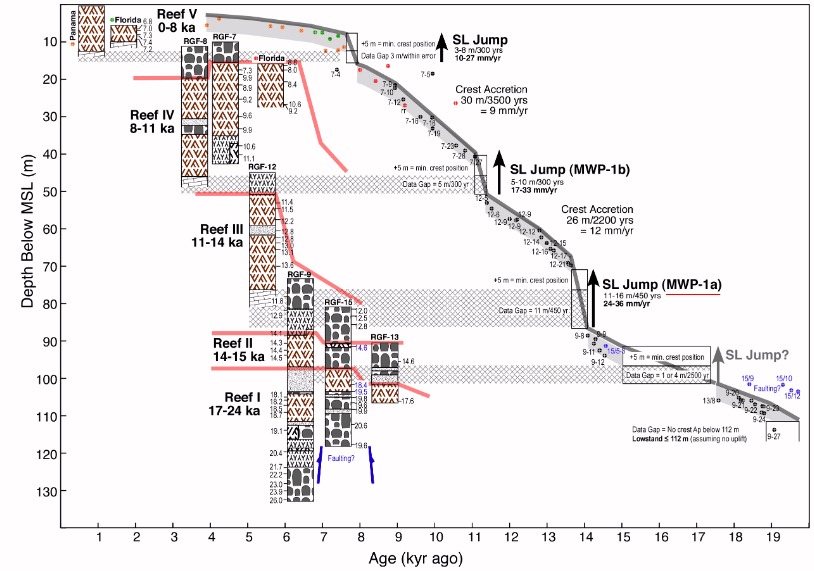
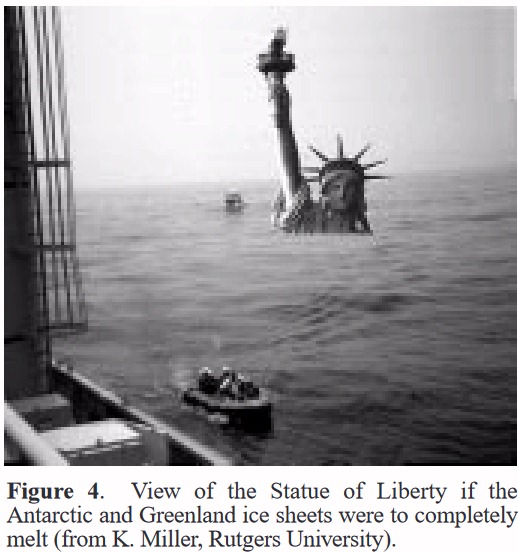
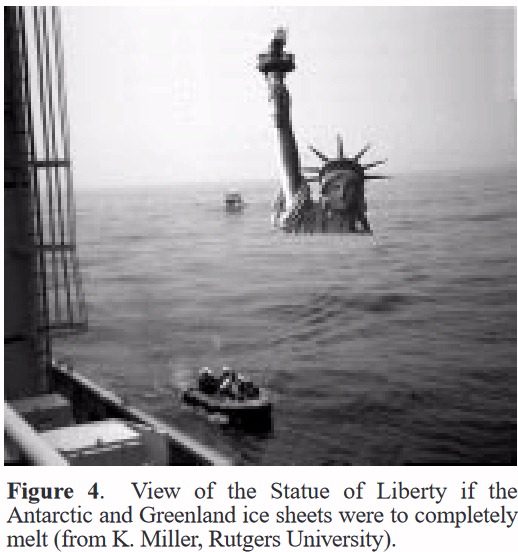
Long run sea level rise New Jersey Coast

By the Autumn of 2023, it had become evident the West Antarctic and Greenland ice sheets will completely melt. The process is irreversible and inevitable. The cool water from the melting ice at the poles is being drawn toward the center of the Earth and getting warmed to record high temperatures. The warm, moist air is circulating and moving over land. These changes in climate systems will cause other areas to experience unprecedented drought. We expect sea level rise will total about 270 feet over the next several millennia. It is episodic, and in the fast bits it can go up 3 feet every twenty years for five hundred years. The melting Arctic and Antarctic have multiple feedback loops including: enhanced oceanic heating and ice-albedo, Planck feedback, lapse-rate feedback, and cloud feedback.

The tipping point for the collapse of AMOC (Atlantic Meridional Overturning Circulation) was thought to be centuries away, at the earliest. In July of 2023, the study Warning of a forthcoming collapse of the Atlantic meridional overturning circulation was published in the journal Nature Communications. “Here we provide statistical significance and data-driven estimators for the time of tipping. We estimate a collapse of the AMOC to occur around mid-century (2025-2095) under the current scenario of future emissions.” The collapse is likely to cause faster sea level rise on the east coast of the US, more severe storms in Europe, and increasing drought in the Sahel in Africa. “From the study of past climate, we know changes in the AMOC have been some of the most abrupt and impactful events in the history of climate,” said Prof. Stefan Rahmstorf, at the Potsdam Institute for Climate Impact Research in Germany and world leading oceanographer. During the last Ice Age, winter temperatures changed by up to 10C within three years in some places. “We are dealing with a system that in some aspects is highly non-linear, so fiddling with it is very dangerous, because you may well trigger some surprises,” he said. “I wish I knew where this critical tipping point is, but that is unfortunately just what we don’t know. We should avoid disrupting the AMOC at all costs. It is one more reason why we should stop global warming as soon as possible.” A feedback loop created by the AMOC tipping point would cause a disruption of weather systems and circulation. The result would be the loss of naturally occurring carbon sinks. One scenario is desertification of the Amazon rainforest. In 2023, the Amazon River and the Rio Negro set record low levels.

The tipping point / feedback loop problem is very complex (chaos theory) and exponentially alarming. Yet another tipping point appears to have been triggered before 2024 — Amazon Rainforest Dieback. The Amazon is often referred to as ‘the lungs of our planet.’ Not only does the Amazon suck in huge quantities of CO2 and breath out O2, but the Amazon soils also store huge amounts of CO2. The desertification of the Amazon would result in a release of the carbon as the soils disappeared.
— from Toppled Tipping Points: The Domino Effect / Brouse and Mukherjee (2023)

What will the “End of Times” look like?

“The era of global warming has ended and the era of ‘global boiling’ has arrived. Climate change is here. It is terrifying. And it is just the beginning”, UN secretary general, António Guterres, said after scientists confirmed July 2023 was on track to be the world’s hottest month on record.

Movement of people and animals caused by climate is one factor. Warming at higher latitudes allowed vectors and pathogens to survive winter is another factor. The report goes on to say, “The human pathogenic diseases and transmission pathways aggravated by climatic hazards are too numerous for comprehensive societal adaptations, highlighting the urgent need to work at the source of the problem: reducing GHG (Greenhouse Gas) emissions.”

This research reveals more evidence that humans will have difficulty adapting to climate change, especially those in developing countries, Mora said. “The magnitude of the vulnerability when you think about one or two diseases — okay, sure, we can deal with that,” he said. “But when you’re talking about 58% of the diseases, and 58% of those diseases can be affected or triggered in 1,000 different ways. So that, to me, was also revealing of the fact that we’re not going to be able to adapt to climate change.”

In 2023, we wrote about having crossed tipping points in the paper, “Climate Change: How Long Is ‘Ever’?“. When we wrote the Tunnel Under Thesis in 1995, we forecast crossing these tipping points would not happen for centuries. We underestimated Man’s ignorance and arrogance. Fossil fuel consumption and greenhouse gas emissions have continued to set record highs. Humans have caused chain-reactions resulting in toppled tipping points, feedback loops, and The Domino Effect.

Events we thought would not happen in our lifetimes are happening now.

There will be enough ice melt to raise sea levels 220 feet. We estimate 270 feet to be “the minimum safe” elevation to live. High-tides, waves, coastal flooding, storm surge, grade of shoreline, etc. would make the lowest elevations for living space to be at least 270 feet above pre-industrial sea levels. This would be the minimum elevation. Personally, I would not want to live that low. As the water submerges sewage treatment plants, landfills, chickens, cows, and all sorts of other bio-hazards, the waters will become toxic. In addition, much of the land will experience salinization making it unfit for plant life. Another concern for elevations under 800 feet is living on an island. Many locations at lower elevations will become isolated. Living on an island has many problems including fresh water, food, shelter, and healthcare. Security from pirates pilfering, raping, and plundering will likely be the overriding concern. Of course, I don’t expect that to happen for millennia, but I hope government planners do plan for it now. If you look at Florida as an example, parts of the coastline have seen sea levels rise over 14-20 feet in the last decade. Although the storm surge was only for hours, you wouldn’t want to live there during those hours. Not to mention, the frequency of these extreme weather events will rise exponentially. Thus, our recommendation to evacuate Florida now (i.e. Managed Retreat). The billions of dollars spent to rebuild after Hurricane Ida will all be for naught. Allowing building there will needlessly endanger property and lives. Parts of the world have already seen storm surges of 40 feet. I expect most North American coastlines will see sea levels rise, if only temporarily, by 20-40 feet this century. As far as long run sea level rise, much will depend on location, gravity, isostatic adjustment, and thermal expansion. If the ocean temperatures get warm enough (thermal expansion), parts of the world may see sea levels rise to 270 feet for long periods of times. Other parts of the world, like Greenland, may actually see sea levels decline. In any event, the Earth crossed tipping points this decade which make extreme sea level rise inevitable and irreversible in our lifetimes. Planners should plan on it.

Sidd reiterated, “That 270 feet will take a long time. I would be more careful about the violent rain than the ice melt.” Expect to see increasing intensity and/or frequency in a wide variety of violent rain events including: downpours, flooding, hurricanes, cyclones, monsoons, coastal flooding, storm surges, lightning and wildfires, hail, extreme wind, and concurrent extremes. The reign of violent rain has already begun. More hillsides and shorelines are collapsing. Atmospheric rivers are dramatically increasing flash flooding in the Northeastern USA. Worldwide, stormwater systems are becoming overwhelmed. Ironically, the streets of Abu Dhabi and Dubai, UAE, flooded days before the COP28 Climate Conference. Nowhere is safe from violent rain, not even in the desert preparing for a UN meeting on the climate crisis. As a result of increasing violent rain, new drainage culverts are forming. Eventually, the culverts will transform into recurring streams, carving new canyons, creating new landscapes and islands. In addition, extreme weather events are increasing the frequency of lightning storms and wildfires. After wildfires, rain deluges cause massive landslides transforming the topography. At the same time as the violent rain makes its way to the sea, the sea is rising to meet the violent rain.

In the article “Violent Rain and the Substrate,” Greg Laden, coastal archaeologist, said, “With a little erosion, the Hudson, Lake Champlain, and the St. Lawrence could become contiguous, so New England becomes an Island.”

For any remaining humans, fresh air, water, food, and sunlight will all be problematic; however, your most severe concern will likely be security. Those with supplies will be at high risk of being raped and looted. Good luck!
— from Climate Change: The End of Times / Brouse and Mukherjee (2023)

Conclusion
Don’t be afraid. Shed some light on global warming. Learn what is going to happen so you can reduce your anxiety and prepare for the inevitable.

What Can I Do?
There are plenty of things you can do to help save the planet. Stop using fossil fuels. Consume less. Love more. Here is a list of additional actions you can take.

A song about The Human Induced Climate Change Experiment

bookmark_borderOur Own Devices

LYRICS
Since there’s no place quite like home
Perhaps we shouldn’t be left alone
With our own devices
The price of crisis
I must confess
My room’s a mess
I made this bed
How can I rest
Mince no words
Failed the test
Self-mutilation
More or less
(At it’s best)
With our own devices
The price of crisis

Since there’s no place quite like home
Perhaps we shouldn’t be left alone
With our own devices
The price of crisis
What did you do
Tell me true
Made haste of waste
In all we taste
Took a narrow
Point-of-view
Of the place
All defaced
(Disgraced)
With our own devices
The price of crisis

Since there’s no place quite like home
Perhaps we shouldn’t be left alone
With our own devices
The price of crisis
What have we done
3rd from the sun
Human race run
We’ve come undone
To the Earth
We cannot mend
Message send
“Bring on The End”
The End

Chords: G Bb C G D7 G / C G; Part II @ 104 Beats Per Minute / Twisted Twist
Instrumentation: Vocals (TC-Helicon VOICELIVE and MiniNova Vocorder), Ibanez Acoustic Guitar, Ibanez RG Series Electric Guitar (Boss Digital Delay), Fender Jazz Bass (Boss Digital Delay), Keyboards (Korg PS60, Casio WK-3500, Yamaha PSR-740, MiniNova, MicroKorg)

ABOUT THE SONG

Global warming has caused irreparable damage to our environment. Almost all scientists agree that IN FACT climate change is a problem. Our planet is becoming unfit for human life. Now the question is can we adapt in time? (1999)

Human induced climate change is an exponential component of an unordered system (chaos theory). That means global warming is accelerating at a rapid rate in a complex way. From 1992 through 2023, we presented evidence and suggested remedies to mitigate climate change. By 2023, the data was undeniable that human induced climate change is destroying our habitat at a rapidly increasing rate.

“For people, for other species, for the ecosystems, for the world we live in, we’ve entered the Age of Loss and Damage, but we’re just at the start. What we are seeing already just makes you want to cry,” said Dr. Christopher Trisos (BBC Interview / MP3 Format) from the University of Cape Town. “We can’t eliminate loss and damage. It is here. That said, there is a lot we can do to limit it.”

Humans will experience greater loss and damage to life and quality of life from air pollution, decreasing supply of potable water, extreme weather events, and disease. The greatest short term climate change risk to human health is deadly humid heat (wet-bulb temperature).

A warmer world will present widespread challenges across many aspects of food-energy-water security and economic development. Infrastructure including roads, bridges, sewer and water plants will become unsustainable. Personal property will suffer loss and damage as homeowners and flood insurance become increasingly difficult to obtain. Storm surges in Florida are an example. Parts of the coastline have seen sea levels rise over 14-20 feet in the last decade. Although the storm surge was only for hours, you wouldn’t want to live there during those hours. Not to mention, the frequency of these extreme weather events is rising exponentially. Thus, our recommendation to evacuate Florida now (i.e. Managed Retreat). The billions of dollars spent to rebuild after Hurricane Ida will all be for naught. Allowing building there will needlessly endanger property and lives. Parts of the world have already seen storm surges of 40 feet. We expect most North American coastlines will see sea levels rise, if only temporarily, by 20-40 feet this century.

Almost all survivors of climate-related disasters suffer from mental distress. Of those who have not experienced climate disasters, more than two-thirds of U.S. adults (68%) have reported climate change anxiety.

New Economics

Anthropogenic climate change is an exponential component of an unordered system (chaos theory).

The Age of Loss and Damage is a new way of thinking about economics by combining economics, climate science, statistics, and physics. Until now, economic models have been unfit to capture the full extent of climate damage. Traditionally, “integrated assessment models” (IAMs) were used to forecast “shock” events. IAMs use “quadratic function” to calculate GDP losses by squaring the temperature change, yet ignore other methods (such as the exponential function) that are better suited for rapid change. “Climate change is fundamentally different to other shocks because once it has hit, it doesn’t go away,” said Thierry Philipponnat, author of a report by Finance Watch, a Brussels-based public interest NGO on financial issues. “And if the fundamental assumption is flawed, all the rest makes little sense — if any.”

Unfortunately, even scientists are failing to see, let alone forecast, the rapid acceleration in climate change. Due to their complexity, the impacts of the Domino Effect are being underestimated. The Domino Effect is also known as “tipping cascades” in climate science. Cascading impacts in relation to tipping points include cascading impacts across biogeophysical and social systems. Until recently, scientist have been drastically underestimating the social-ecological systems. The University of Exeter reports, “There is a notable lack of topic clusters dedicated to how humans will be impacted by climate-related tipping cascades.” 2023 was a wake-up call to social-ecological scientists. The record breaking physical and economical impacts could be felt worldwide. The record warming year was seventeen times greater than any other record increase in history. Typically record breaking temperatures are measured in 100th degrees. There were also 200 consecutive days of record breaking temperatures. Typically there are one or two record breaking days in row. The increase in intensity and frequency of record breaking heat requires forecasting models to be recast.

As flow velocities go up due to climate change, force and damage scale as square of the velocities.

— from The Age of Loss and Damage / Brouse (2023)

What Can I Do?
There are plenty of things you can do to help save the planet. Stop using fossil fuels. Consume less. Love more. Here is a list of additional actions you can take.

A song about The Human Induced Climate Change Experiment

bookmark_borderWinning at Losing

LYRICS
When you ask me
How things are
Do you find it
A bit bizarre?
Gone too far
Choosing winning at losing
At this pace
Human race
Won’t leave a trace
Self-erase

When you ask me
How things are
Gone so low
Can’t lower the bar
When you ask me
How things are
Do you find it
A bit bizarre?
Gone too far
Choosing winning at losing
At this pace
Human race
Won’t leave a trace
Self-erase

Since you asked me
How things are
Look at “Be” and see
Bizarre
Gone too far
Choosing winning at losing
At this pace
Human race
Won’t leave a trace
Self-erase

Winning-at-Losing.mp3 (unplugged to conserve energy)

Chords: A D A A E A / C D A / C E A / E C A / D G A / C E A
Instrumentation: Vocals, Takamine Acoustic Guitar
Written and recorded at Lake Wynonah, Pennsylvania.

ABOUT THE SONG
Why are humans choosing to lose? Why are we winning at losing?

What will the “End of Times” look like?

“The era of global warming has ended and the era of ‘global boiling’ has arrived. Climate change is here. It is terrifying. And it is just the beginning”, UN secretary general, António Guterres, said after scientists confirmed July 2023 was on track to be the world’s hottest month on record.

In 2023, we wrote about having crossed tipping points in the paper, “Climate Change: How Long Is ‘Ever’?“. When we wrote the Tunnel Under Thesis in 1995, we forecast crossing these tipping points would not happen for centuries. We underestimated Man’s ignorance and arrogance. Fossil fuel consumption and greenhouse gas emissions have continued to set record highs. Humans have caused chain-reactions resulting in toppled tipping points, feedback loops, and The Domino Effect.

Events we thought would not happen in our lifetimes are happening now.

— from Climate Change: The End of Times Brouse and Mukherjee (2023)

What Can I Do?
There are plenty of things you can do to help save the planet. Stop using fossil fuels. Consume less. Love more. Here is a list of additional actions you can take.

A song about The Human Induced Climate Change Experiment

bookmark_borderUnrecognizable

LYRICS
Am I alone
Can’t recognize home
What’s our climate zone
Can’t recognize home
Goldilocks? Not.
Temperatures too hot
The air is too, too thick
Make ya gag
Make ya sick
Do something….
Quick!

Where’s my beautiful music?
Peace, love, and understanding
Man’s demanding reprimanding
My piece of love notwithstanding

Am I alone
Can’t recognize home
What’s our climate zone
Can’t recognize home
Goldilocks? Not.
Little Bo-peep deep
Water’s way too thick
Make ya gag
Make ya sick
Do something….
Quick!

Where’s my beautiful music?
Peace, love, and understanding
Man’s demanding reprimanding
My piece of love notwithstanding

Am I alone
Can’t recognize home
What’s our climate zone
Can’t recognize home
Goldilocks? Not.
Like flies dying to drop
Way too soft up in the loft
Ain’t no gag
Are we sick
Do something….
Quick!

Where’s my beautiful music?
Peace, love, and understanding
Man’s demanding reprimanding
My piece of love notwithstanding

Chords: F Bb F / Ab Bb / Db C7 F / Eb Bb F; Part II @ 102 Beats Per Minute
Instrumentation: Vocals (TC-Helicon VOICELIVE and MiniNova Vocorder), Ibanez Acoustic Guitar, Ibanez RG Series Electric Guitar (Boss Digital Delay), Fender Jazz Bass (Boss Digital Delay), Keyboards (Korg PS60, Casio WK-3500, Yamaha PSR-740, MiniNova, MicroKorg)

Human induced climate change is an exponential component of an unordered system (chaos theory). That means global warming is accelerating at a rapid rate in a complex way.

From 1992 through 2023, we presented evidence and suggested remedies to mitigate climate change. By 2023, the data was undeniable that human induced climate change is destroying our habitat at a rapidly increasing rate.

“For people, for other species, for the ecosystems, for the world we live in, we’ve entered the Age of Loss and Damage, but we’re just at the start. What we are seeing already just makes you want to cry,” said Dr. Christopher Trisos (BBC Interview / MP3 Format) from the University of Cape Town. “We can’t eliminate loss and damage. It is here. That said, there is a lot we can do to limit it.”

September 6, 2023: “Climate breakdown has begun,” the United Nations Secretary-General Antonio Guterres warned the world after the World Meteorological Organization (WMO) reported the world endure its hottest Northern Hemisphere summer in human history. “The dog days of summer are not just barking, they are biting,” the UN chief said in a statement after the report’s release.

At what rate is climate change accelerating?
A: Rapidly
As described above, we do not know the rate of acceleration other than to say it is more rapid than previously thought. In the summer of 2023, the extreme temperatures left most climate scientists shocked. The average earth surface temperature recorded record highs for months reaching over 3 degrees Celsius above pre-industrial levels. The Paris Agreement calls for keeping temperatures below 1.5 degrees. Scientists concur that a rise of 2 degrees will trigger feedback loops and tipping points. Triggering these tipping points results in the CO2 stored in nature to be released at an exponential growth rate. How extreme the acceleration will be depends on tipping points toppling other tipping points in what is known as The Domino Effect. Toppled tipping points will continue to shrink the doubling time and exponentially increase the rate of global warming. Though we do not know how much carbon is stored in nature, it would be reasonable to assume that the temperature could be pushed from 3 degrees to 6 degrees above pre-industrial levels. Humans can not thrive above a rise of 1.5 degrees. Humans can not survive if the temperature rises 6 degrees.

About the 2023 wildfires in Hawaii, Governor Josh Green said, “For perspective, we’ve had six fire emergencies this August, we had six fire emergencies between 1953 and 2003. That’s how- how fast things are changing. I know that there is debate out there whether we should be talking about climate change or not. Well, let’s be real world, climate change is here we are in the midst of it with a hotter planet, and fiercer storms.”

About the catastrophic die-off of 10,000 emperor penguin chicks in the Antarctic, Dr. Caroline Holmes of the British Antarctic Survey (an expert on Antarctic sea-ice) said, “What we’re seeing right now is so far outside what we’ve observed previously. We expected change but I don’t think we expected so much change so rapidly.”

Some areas of the world are now warming so fast, it is becoming more difficult to measure the change from “normal” or average. Jeff Boyne, National Weather Service meteorologist and climatologist, said, “There are climate normals that are updated every 10 to 15 years, because the planet is warming so fast. The ENSO (El Nino-Southern Oscillation) regions are warming so fast that those normals are being updated every 5 years.”

“It’s so far outside anything we’ve seen, it’s almost mind-blowing,” says Walter Meier, who monitors sea-ice with the National Snow and Ice Data Center. “September was, in my professional opinion as a climate scientist, absolutely gobsmackingly bananas,” said Zeke Hausfather, at the Berkeley Earth climate data project.”
— from Climate Change: Rate of Acceleration Brouse and Mukherjee (2023)

What will the “End of Times” look like?
“The era of global warming has ended and the era of ‘global boiling’ has arrived. Climate change is here. It is terrifying. And it is just the beginning”, UN secretary general, António Guterres, said after scientists confirmed July 2023 was on track to be the world’s hottest month on record.

In 2023, we wrote about having crossed tipping points in the paper, “Climate Change: How Long Is ‘Ever’?“. When we wrote “The Impact of Governance & Globalization on Forecasting (The Tunnel Under Thesis)” in 1995, we forecast crossing these tipping points would not happen for centuries. We underestimated Man’s ignorance and arrogance. Fossil fuel consumption and greenhouse gas emissions have continued to set record highs. Humans have caused chain-reactions resulting in toppled tipping points, feedback loops, and The Domino Effect.
— from Climate Change: The End of Times Brouse and Mukherjee (2023)

What Can I Do?
There are plenty of things you can do to help save the planet. Stop using fossil fuels. Consume less. Love more. Here is a list of additional actions you can take.

A song about The Human Induced Climate Change Experiment

bookmark_borderTill Tomorrow

LYRICS
Sitting on high
Looking below
On days gone by
Till tomorrow
As days go past
Can’t help but ask
How can this last
Till tomorrow?
I don’t know
[Don’t listen to the voices in your head
Don’t listen. You’ve choices.
In your head
Position
Straight ahead
In your head
Straight ahead]
Let it be said:
Get it on high
Just look below
it’s do or die
Till tomorrow
As days go past
Can’t help but ask
How can this last
Till tomorrow?
I don’t know
[Don’t listen to the voices in your head
Don’t listen. You’ve choices.
In your head
Position
Straight ahead
In your head
Straight ahead]
Let it be said:
Turn love on high
Above below
Give our best try
Till tomorrow
As days go past
Can’t help but ask
How can this last
Till tomorrow?
I don’t know
[Don’t listen to the voices in your head
Don’t listen. You’ve choices.
In your head
Position
Straight ahead
In your head
Straight ahead]
Let it be said

Chords: Em C D Em / Em Bm A7 Em / Em/7
Instrumentation: Vocals, Takamine Acoustic Guitar, Kurzweil PC88 Electric Piano
Written and recorded at Lake Wynonah, Pennsylvania during sunset.

What will the “End of Times” look like?

“The era of global warming has ended and the era of ‘global boiling’ has arrived. Climate change is here. It is terrifying. And it is just the beginning”, UN secretary general, António Guterres, said after scientists confirmed July 2023 was on track to be the world’s hottest month on record.

In 2023, we wrote about having crossed tipping points in the paper, “Climate Change: How Long Is ‘Ever’?“. When we wrote the Tunnel Under Thesis in 1995, we forecast crossing these tipping points would not happen for centuries. We underestimated Man’s ignorance and arrogance. Fossil fuel consumption and greenhouse gas emissions have continued to set record highs. Humans have caused chain-reactions resulting in toppled tipping points, feedback loops, and The Domino Effect.

There will be enough ice melt to raise sea levels 220 feet. We estimate 270 feet to be “the minimum safe” elevation to live. High-tides, waves, coastal flooding, storm surge, grade of shoreline, etc. would make the lowest elevations for living space to be at least 270 feet above pre-industrial sea levels. This would be the minimum elevation. Personally, I would not want to live that low. As the water submerges sewage treatment plants, landfills, chickens, cows, and all sorts of other bio-hazards, the waters will become toxic. In addition, much of the land will experience salinization making it unfit for plant life. Another concern for elevations under 800 feet is living on an island. Many locations at lower elevations will become isolated. Living on an island has many problems including fresh water, food, shelter, and healthcare. Security from pirates pilfering, raping, and plundering will likely be the overriding concern. Of course, I don’t expect that to happen for millennia, but I hope government planners do plan for it now. If you look at Florida as an example, parts of the coastline have seen sea levels rise over 14-20 feet in the last decade. Although the storm surge was only for hours, you wouldn’t want to live there during those hours. Not to mention, the frequency of these extreme weather events will rise exponentially. Thus, our recommendation to evacuate Florida now (i.e. Managed Retreat). The billions of dollars spent to rebuild after Hurricane Ida will all be for naught. Allowing building there will needlessly endanger property and lives. Parts of the world have already seen storm surges of 40 feet. I expect most North American coastlines will see sea levels rise, if only temporarily, by 20-40 feet this century. As far as long run sea level rise, much will depend on location, gravity, isostatic adjustment, and thermal expansion. If the ocean temperatures get warm enough (thermal expansion), parts of the world may see sea levels rise to 270 feet for long periods of times. Other parts of the world, like Greenland, may actually see sea levels decline. In any event, the Earth crossed tipping points this decade which make extreme sea level rise inevitable and irreversible in our lifetimes. Planners should plan on it.

Sidd reiterated, “That 270 feet will take a long time. I would be more careful about the violent rain than the ice melt.” Expect to see increasing intensity and/or frequency in a wide variety of violent rain events including: downpours, flooding, hurricanes, cyclones, monsoons, coastal flooding, storm surges, lightning and wildfires, hail, extreme wind, and concurrent extremes. The reign of violent rain has already begun. More hillsides and shorelines are collapsing. Atmospheric rivers are dramatically increasing flash flooding in the Northeastern USA. Worldwide, stormwater systems are becoming overwhelmed. Ironically, the streets of Abu Dhabi and Dubai, UAE, flooded days before the COP28 Climate Conference. Nowhere is safe from violent rain, not even in the desert preparing for a UN meeting on the climate crisis. As a result of increasing violent rain, new drainage culverts are forming. Eventually, the culverts will transform into recurring streams, carving new canyons, creating new landscapes and islands. In addition, extreme weather events are increasing the frequency of lightning storms and wildfires. After wildfires, rain deluges cause massive landslides transforming the topography. At the same time as the violent rain makes its way to the sea, the sea is rising to meet the violent rain.

In the article “Violent Rain and the Substrate,” Greg Laden, coastal archaeologist, said, “With a little erosion, the Hudson, Lake Champlain, and the St. Lawrence could become contiguous, so New England becomes an Island.”

For any remaining humans, fresh air, water, food, and sunlight will all be problematic; however, your most severe concern will likely be security. Those with supplies will be at high risk of being raped and looted. Good luck!
— from Climate Change: The End of Times / Brouse and Mukherjee (2023)

What you can do today. How to save the planet.

bookmark_borderPay the Piper!

LYRICS
“What’s up, Bigshot?”
They’re asking you
How ’bout “why not?”
Do’s have come due
Did you hear them say
“The piper demands pay!”
Ohh…
It’s on the way?
I swear…
It’s on the way
Put it in the post today
It’s on the way

Keep on drilling
As illing comes on
The sick get thick
And it won’t be long
Did you hear them say
“The piper demands pay!”
Ohh…
It’s on the way?
I swear…
It’s on the way
Put it in the post today
It’s on the way

Shot down Biggun
No place to run
Not bones nor hide
Have place to hide
Did you hear them say
“The piper demands pay!”
Ohh…
It’s on the way?
I swear…
It’s on the way
Put it in the post today
It’s on the way

Curtains falling
End of the show
Music’s over
Discover know
Or didn’t you hear the say
No help is on the way

“The piper demands pay!”
Ohh…
It’s on the way?
I swear…
It’s on the way
Put it in the post today
It’s on the way

Chords: G A G A / C E A / C D A; Part II @ 120 Beats Per Minute / fourth verse slowdown, speedup, slowdown.
Instrumentation: Vocals (TC-Helicon VOICELIVE and MiniNova Vocorder), Ibanez Acoustic Guitar, Ibanez RG Series Electric Guitar (Boss Digital Delay), Fender Jazz Bass (Boss Digital Delay), Keyboards (Korg PS60, Casio WK-3500, Yamaha PSR-740, MiniNova, MicroKorg)

ABOUT THE SONG
These lyrics use The Pied Piper as a metaphor to convey a sense of impending consequences, particularly related to environmental issues and climate change. The lines “What’s up, Bigshot?” and “They’re asking you, how ’bout ‘why not?'” suggest a confrontational tone directed at someone in authority or power, challenging their actions or inaction.

The reference to “The piper demands pay!” implies that there will be consequences for past actions, and the repeated refrain “It’s on the way” emphasizes the inevitability of these consequences. The urgency is heightened with the lines “Keep on drilling, as illing comes on,” linking environmental exploitation (drilling) with detrimental effects on health and well-being (illing).

The mention of being “shot down Biggun” and having “no place to run” paints a picture of dire circumstances with no escape, possibly reflecting the irreversible damage caused by human activities. The repeated assertion that “It’s on the way” underscores a sense of accountability and a reckoning for the actions taken.

The concluding lines, “Curtains falling, end of the show, music’s over, discover know,” convey a sense of finality and a realization that time is running out. The phrase “No help is on the way” suggests a lack of external assistance or redemption, reinforcing the idea that the consequences must be faced.

Overall, these lyrics utilize The Pied Piper narrative to convey a warning about the impending repercussions of environmental degradation and the urgent need for accountability and change.

The phrase “pay the piper” originates from the story of the Pied Piper of Hamelin. The town of Hamelin agrees to pay the Piper to get rid of all the rats. When they fail to pay him, he steals their kids. Similarly, Man has failed to pay the price of human induced climate change. Now the human race will pay the price with our children and our children’s children.

Human induced climate change is an exponential component of an unordered system (chaos theory). That means global warming is accelerating at a rapid rate in a complex way. From 1992 through 2023, we presented evidence and suggested remedies to mitigate climate change. By 2023, the data was undeniable that human induced climate change is destroying our habitat at a rapidly increasing rate.

“For people, for other species, for the ecosystems, for the world we live in, we’ve entered the Age of Loss and Damage, but we’re just at the start. What we are seeing already just makes you want to cry,” said Dr. Christopher Trisos (BBC Interview / MP3 Format) from the University of Cape Town.

Tipped Tipping Points, Feedback Loops, and the Domino Effect

Tipping points are Critical Milestones that directly impact the rate of acceleration in climate change by multiplying the number and intensity of feedback loops.

Tipping Points

Push a glass toward the edge of a table and eventually it will fall off on its own. No matter how slowly or meticulously you push… no matter how you weight or fill the glass, it will reach a tipping point and fall off before being pushed completely off the table. No matter whether you believe the glass is half-empty or half-full, when the tipping point is reached it will plummet out-of-control to its end. This is science not fate, faith, nor belief. Human induced climate change has resulted in environmental tipping points being breached.

Tipping points, when crossed, trigger self-sustaining feedback loops that are no longer dependent on human activity. Similar to when a domino topples over hitting two more dominoes that in turn fall hitting more dominoes. Thus, the name The Domino Effect. It can also be visualized as The Snowball Effect. A tipping point is like a snowball rolling down a hill growing in mass and velocity (momentum). When a tipping point is crossed, it results in cumulative and reinforced global warming.

By 2024, six (6) of the multiple tipping points show the proverbial snowball is already rolling. The first dominoes have fallen and will continue to knock down more tiles with each escalating step.

  • Mountain Glacier Loss
  • Greenland Ice Sheet Collapse
  • Antarctic Ice Sheet Collapse
  • Collapse of AMOC (Atlantic Meridional Overturning Circulation)
  • Amazon Rainforest Dieback
  • Northern Permafrost Collapse

Crossing even a single tipping point is alarming. For instance, crossing the tipping point for ‘mountain glacier loss‘ has immediate consequences: millions of people in Europe will be impacted by the lack of fresh water. Billions of people that live along coasts will be impacted by the saline infiltration and eventually by the submerging of their property. In September of 2022, UNESCO reported accelerated melting of glaciers in World Heritage sites, with glaciers in a third of sites set to disappear by 2050. In September of 2023, the GLAMOS glacier monitoring center found 10% of Swiss glaciers had disappeared in the last 2 years. They do not expect any Swiss glaciers will be left by 2050 no matter what actions are taken. If extreme measures are taken, they anticipate we may be able to save some polar glaciers.

This in and of itself should be alarming; however, it gets worse. Tipping points are parts of feedback loop systems. The ice-albedo feedback loop is an expression of the ability of surfaces to reflect sunlight (heat from the sun). Any loss of ice over a darker surface means the surface will absorb more heat and reflect less heat. This process makes the Earth warmer causing more loss of ice, which in turn causes more warming of the Earth. So, yes, the mountain ice tipping point is quite alarming for both its immediate impact as well as its self-sustaining growth to global warming; but wait, it gets more alarming. The increasing temperatures due to crossing a tipping point cause other tipping points to be toppled (The Domino Effect).

Long run sea level rise New Jersey Coast

By the Autumn of 2023, it had become evident the West Antarctic and Greenland ice sheets will completely melt. The process is irreversible and inevitable. The cool water from the melting ice at the poles is being drawn toward the center of the Earth and getting warmed to record high temperatures. The warm, moist air is circulating and moving over land. These changes in climate systems will cause other areas to experience unprecedented drought. We expect sea level rise will total about 270 feet over the next several millennia. It is episodic, and in the fast bits it can go up 3 feet every twenty years for five hundred years. The melting Arctic and Antarctic have multiple feedback loops including: enhanced oceanic heating and ice-albedo, Planck feedback, lapse-rate feedback, and cloud feedback.
— from Toppled Tipping Points: The Domino Effect / Brouse and Mukherjee (2023)

In 2023, we wrote about having crossed tipping points in the paper, “Climate Change: How Long Is ‘Ever’?“. When we wrote the Tunnel Under Thesis in 1995, we forecast crossing these tipping points would not happen for centuries. We underestimated Man’s ignorance and arrogance. Fossil fuel consumption and greenhouse gas emissions have continued to set record highs. Humans have caused chain-reactions resulting in toppled tipping points, feedback loops, and The Domino Effect.

Events we thought would not happen in our lifetimes are happening now. My last resort emergency plan was to escape to Canada. This summer that plan literally went up in smoke. “Beginning in March 2023, and with increased intensity starting in June, Canada has been affected by an ongoing, record-setting series of wildfires.” — Wikipedia

All of my life I have located my office and bedrooms in the uppermost southern exposure (preferably in the tree canopy.) I love sunlight, elevation, trees, fresh air, and wildlife. It is becoming ever more obvious my dreamlife is coming to an end, and I will be forced to tunnel under. For those forward thinkers, think about your poop. Pumping sewage above ground level will be a major problem at all times. In addition, the inability to pump flood water will become deadly during extreme weather events. In July of 2020 NPR reported, “The remnants of Hurricane Ida dropped unprecedented rainfall on several eastern states, killing dozens of people. Eleven of them were Queens residents who died when their basement apartments flooded.” In August of 2022 CNN reported, “Seoul has vowed to move some of the city’s poorest families out of underground and semi-subterranean homes after 13 people were killed in flooding caused by record rainfall this week, sparking public horror and calls for government accountability.” Drowning in your own poop may result for those unprepared.

There will be enough ice melt, water redistribution, and extreme weather events to raise sea levels as much as 270 feet.  Sidd reiterated, “That 270 feet will take a long time. I would be more careful about the violent rain than the ice melt.”

“For any remaining humans, fresh air, water, food, and sunlight will all be problematic; however, your most severe concern will likely be security. Those with supplies will be at high risk of being raped and looted. Good luck!”
— from Climate Change: The End of Times / Daniel Brouse and Sidd Mukherjee (2023)

What Can I Do?
There are plenty of things you can do to help save the planet. Stop using fossil fuels. Consume less. Love more. Here is a list of additional actions you can take.

From the album: The Echoes of Earth’s Wrath:
A Musical Journey Through Mythical Metaphors on Human-Induced Climate Change

A song about The Human Induced Climate Change Experiment

bookmark_borderInto the Solstice

LYRICS
Limited volume
Maximum used some
Halfway between night and day
Out of the equinox
To the school of hard knocks
Roll on

Limited volume
Maximum used some
Day after day thrown away
Looks lie we lost this
Into the solstice
Lights out
(No doubt)

Under the human hex (Parts 1a, 1b, 1c)
Done in a sex hex (Part 2)
Fall of might
Spun in a vortex
Lost our sight
Drag of the funnel
Is there light
At The End of the tunnel?

Chords: E G A / C Esus4 / Esus4 A7 / Em E /D9 EbM7 Em/E / A7 C D Em; Part 2 @ 133 Beats Per Minute
Instrumentation: Vocals (TC-Helicon VOICELIVE and MiniNova Vocorder), Ibanez Acoustic Guitar, Fender Squire Mini Electric Guitar (Vox Sound Lab and Boss Digital Delay), Fender Jazz Bass (Boss Digital Delay), Keyboards (Korg PS60, Casio WK-3500, Yamaha PSR-740, MiniNova, MicroKorg)

The song is an analogy of the Winter Solstice and human induced climate change. Figuratively, 2023 saw darker and darker days for the future of the Earth.

Human induced climate change is an exponential component of an unordered system (chaos theory). That means global warming is accelerating at a rapid rate in a complex way. From 1992 through 2023, we presented evidence and suggested remedies to mitigate climate change. By 2023, the data was undeniable that human induced climate change is destroying our habitat at a rapidly increasing rate.

“For people, for other species, for the ecosystems, for the world we live in, we’ve entered the Age of Loss and Damage, but we’re just at the start. What we are seeing already just makes you want to cry,” said Dr. Christopher Trisos (BBC Interview / MP3 Format) from the University of Cape Town. “We can’t eliminate loss and damage. It is here. That said, there is a lot we can do to limit it.”

The 20th-century surface temperature average for Earth was 13.9℃. In the first weeks of July of 2023, the average temperature was 17℃.
Q: Is it possible for humans to survive at temperatures greater than 3℃?
A: Probably not long. Humans have never done it before.

September 6, 2023: “Climate breakdown has begun,” the United Nations Secretary-General Antonio Guterres warned the world after the World Meteorological Organization (WMO) reported the world endure its hottest Northern Hemisphere summer in human history. “The dog days of summer are not just barking, they are biting,” the UN chief said in a statement after the report’s release.

“What we are observing, are not only new extremes but the persistence of these record-breaking conditions, and the impacts these have on both people and planet, are a clear consequence of the warming of the climate system,” C3S’s Climate Change Service Director Carlo Buontempo said.

Climate Breakdown is the most concerning development. Climate breakdown happens when feedback loops are created and tipping points are crossed. Plants will become extinct and many carbon sinks will vanish. The Earth’s temperature will continue to accelerate at an exponential rate no matter what humans do. Food, fresh water, and breathable air will cease to exist. Humans will likely follow in short order.

In October of 2023, the European Space Agency’s Copernicus Climate Change Service calculated that the average temperature for September was 16.38 degrees Celsius (61.48 degrees Fahrenheit) breaking the previous record set in September 2020 by a half-degree Celsius (0.9 degrees Fahrenheit). This is the largest increase in a monthly record high ever.

“It’s just mind-blowing really,” said Copernicus Director Carlo Buontempo. “Never seen anything like that in any month in our records.”

“This is not a fancy weather statistic. It’s a death sentence for people and ecosystems. It destroys assets, infrastructure, harvest,” Imperial College of London climate scientist Friederike Otto said.

About the 2023 wildfires in Hawaii, Governor Josh Green said, “For perspective, we’ve had six fire emergencies this August, we had six fire emergencies between 1953 and 2003. That’s how- how fast things are changing. I know that there is debate out there whether we should be talking about climate change or not. Well, let’s be real world, climate change is here we are in the midst of it with a hotter planet, and fiercer storms.”

About the catastrophic die-off of 10,000 emperor penguin chicks in the Antarctic, Dr. Caroline Holmes of the British Antarctic Survey (an expert on Antarctic sea-ice) said, “What we’re seeing right now is so far outside what we’ve observed previously. We expected change but I don’t think we expected so much change so rapidly.”

Some areas of the world are now warming so fast, it is becoming more difficult to measure the change from “normal” or average. Jeff Boyne, National Weather Service meteorologist and climatologist, said, “There are climate normals that are updated every 10 to 15 years, because the planet is warming so fast. The ENSO (El Nino-Southern Oscillation) regions are warming so fast that those normals are being updated every 5 years.”

“September was, in my professional opinion as a climate scientist, absolutely gobsmackingly bananas,” said Zeke Hausfather, at the Berkeley Earth climate data project.”

Climate Change Review 2023

Sidd said, “Do you remember back in the early 2000’s when we thought we wouldn’t live to see the extreme changes due to global warming?”

Daniel replied, “I think 2023 is the most significant year so far. We saw confirmation of tipping points being crossed for Mountain Glacier Loss, Greenland Ice Sheet Collapse, Antarctic Ice Sheet Collapse, and potentially the Collapse of AMOC.”

Sidd continued, “We already knew that. It was Canada catching on fire that I could not believe. I never thought I’d live to see the day.”

Daniel asked, “Do you think the permafrost and peatlands will have zombie fires and cause the permafrost tipping point?”

Sidd responded, “Yes. They are gone, too. We already know from the permafrost peatland fires in Siberia.”

Daniel ponders, “Hmmmm… I guess that means my plan went up in smoke? My worst case scenario / last resort emergency plan was to escape to Canada.”

What Can I Do?
There are plenty of things you can do to help save the planet. Stop using fossil fuels. Consume less. Love more. Here is a list of additional actions you can take.

From the Christmas album of music Merry Christmas!

A song about The Human Induced Climate Change Experiment

bookmark_borderChoose Wisely

LYRICS
Careful of the road you choose
the choice between win and lose
However
When all is said and done
Choosing none
Never won
Choose wisely,
My son
Bang!
The race is on
Sang!
Outpace swan song
As the Fat Lady sings
The ending she brings
When all is said and done
Choose wisely everyone

Go!
The race is on
(No human reason)
Know!
Human reason
Watching Rome burn
What did we learn
If asked who lost or won
Choose wisely or be done

Chords: Em C A / C Em A / C B7 Em / Em F#m Fm Em / C Em; Part II @ 100 Beats Per Minute
Instrumentation: Vocals (TC-Helicon VOICELIVE and MiniNova Vocorder), Ibanez Acoustic Guitar, Fender Squire Mini Electric Guitar (Vox Sound Lab and Boss Digital Delay), Fender Jazz Bass (Boss Digital Delay), Keyboards (Korg PS60, Casio WK-3500, Yamaha PSR-740, MiniNova, MicroKorg)

Human induced climate change is an exponential component of an unordered system (chaos theory). That means global warming is accelerating at a rapid rate in a complex way.

“The era of global warming has ended and the era of ‘global boiling’ has arrived. Climate change is here. It is terrifying. And it is just the beginning”, UN secretary general, António Guterres, said after scientists confirmed July 2023 was on track to be the world’s hottest month on record.

In the 1990’s, we wrote a paper on the worst-case scenario entitled, “The Impact of Governance & Globalization on Forecasting (The Tunnel Under Thesis).” The theory predicted that forecasting would become increasingly difficult. “The result — a figurative, as well as, literal tunneling underground.”

Since that time, forecasting has become increasing more difficult. “In general, as energy is added to a system, the fluctuations in the system increase. So, we expect more storms, more droughts, more wildfires, more floods, more fluctuations of all kinds. What we are saying is that weather conditions will become more volatile due to the impact of humans,” said Mukherjee and Brouse. (2004)

In a report published in Nature entitled Over half of known human pathogenic diseases can be aggravated by climate change, data analyst and associate professor in the Department of Geography and Environment at the University of Hawaii Manoa, Camilo Mora, said climate hazards aggravated 58% of all known human pathogens. That is over half of infectious diseases discovered since the end of the Roman Empire. 58% of an authoritative list of infectious diseases documented to have impacted humanity have already been shown to be aggravated by climatic hazards — a finding the researchers found “shocking,” Mora said.

Movement of people and animals caused by climate is one factor. Warming at higher latitudes allowed vectors and pathogens to survive winter is another factor. The report goes on to say, “The human pathogenic diseases and transmission pathways aggravated by climatic hazards are too numerous for comprehensive societal adaptations, highlighting the urgent need to work at the source of the problem: reducing GHG (Greenhouse Gas) emissions.”

This research reveals more evidence that humans will have difficulty adapting to climate change, especially those in developing countries, Mora said. “The magnitude of the vulnerability when you think about one or two diseases — okay, sure, we can deal with that,” he said. “But when you’re talking about 58% of the diseases, and 58% of those diseases can be affected or triggered in 1,000 different ways. So that, to me, was also revealing of the fact that we’re not going to be able to adapt to climate change.”

In 2023, we wrote about having crossed tipping points in the paper, “Climate Change: How Long Is ‘Ever’?“. When we wrote the Tunnel Under Thesis in 1995, we forecast crossing these tipping points would not happen for centuries. We underestimated Man’s ignorance and arrogance. Fossil fuel consumption and greenhouse gas emissions have continued to set record highs. Humans have caused chain-reactions resulting in toppled tipping points, feedback loops, and The Domino Effect.

Events we thought would not happen in our lifetimes are happening now. My last resort emergency plan was to escape to Canada. (I am a dual citizen.) This summer that plan literally went up in smoke. “Beginning in March 2023, and with increased intensity starting in June, Canada has been affected by an ongoing, record-setting series of wildfires.” — Wikipedia

— from Climate Change: The End of Times Brouse and Mukherjee (2023)

What Can I Do?
There are plenty of things you can do to help save the planet. Stop using fossil fuels. Consume less. Love more. Here is a list of additional actions you can take.

A song about The Human Induced Climate Change Experiment

bookmark_borderAt the End

LYRICS
Gather up
And spread it out
Come find out
What it’s about
Hear the tale
Of our tail
Though you catch it at The End
There’s still a moral to send
The more we take, take, take
The more grave mistake

All together
Spread the word
Won’t believe it’s so absurd
Hear the tale
Of our tail
Though you catch it at The End
There’s still a moral to send
The more we take, take, take
The more grave the mistake

Individually
Form a crowd
turn the volume
Extra loud
Spread the tale
Of our tail
Though you catch it at The End
There’s a message to send
The more love you make
The more love intake

The more love you make
The more love to partake

Chords: G Em Am C G / G D D G/7; Part II @ 82 to 118 to 32 Beats Per Minute
Instrumentation: Vocals, Ibanez Acoustic Guitar, Fender Squire Mini Electric Guitar, Fender Jazz Bass, Keyboards (Korg PS60, Casio WK-3500, Yamaha PSR-740, MiniNova, MicroKorg)

The Tale of Our Tale

September 6, 2023: “Climate breakdown has begun,” the United Nations Secretary-General Antonio Guterres warned the world after the World Meteorological Organization (WMO) reported the world endure its hottest Northern Hemisphere summer in human history. “The dog days of summer are not just barking, they are biting,” the UN chief said in a statement after the report’s release.

“What we are observing, are not only new extremes but the persistence of these record-breaking conditions, and the impacts these have on both people and planet, are a clear consequence of the warming of the climate system,” C3S’s Climate Change Service Director Carlo Buontempo said.

Climate Breakdown is the most concerning development. Climate breakdown happens when feedback loops are created and tipping points are crossed. Plants will become extinct and many carbon sinks will vanish. The Earth’s temperature will continue to accelerate at an exponential rate no matter what humans do. Food, fresh water, and breathable air will cease to exist. Humans will likely follow in short order.

In October of 2023, the European Space Agency’s Copernicus Climate Change Service calculated that the average temperature for September was 16.38 degrees Celsius (61.48 degrees Fahrenheit) breaking the previous record set in September 2020 by a half-degree Celsius (0.9 degrees Fahrenheit). This is the largest increase in a monthly record high ever.

“It’s just mind-blowing really,” said Copernicus Director Carlo Buontempo. “Never seen anything like that in any month in our records.”

“This is not a fancy weather statistic. It’s a death sentence for people and ecosystems. It destroys assets, infrastructure, harvest,” Imperial College of London climate scientist Friederike Otto said.

“September was, in my professional opinion as a climate scientist, absolutely gobsmackingly bananas,” said Zeke Hausfather, at the Berkeley Earth climate data project.”

“The era of global warming has ended and the era of ‘global boiling’ has arrived. Climate change is here. It is terrifying. And it is just the beginning”, UN secretary general, António Guterres, said after scientists confirmed July 2023 was on track to be the world’s hottest month on record.

In the 1990’s, we wrote a paper on the worst-case scenario entitled, “The Impact of Governance & Globalization on Forecasting (The Tunnel Under Thesis).” The theory predicted that forecasting would become increasingly difficult. “The result — a figurative, as well as, literal tunneling underground.”

Since that time, forecasting has become increasing more difficult. “In general, as energy is added to a system, the fluctuations in the system increase. So, we expect more storms, more droughts, more wildfires, more floods, more fluctuations of all kinds. What we are saying is that weather conditions will become more volatile due to the impact of humans,” said Mukherjee and Brouse. (2004)

In a report published in Nature entitled Over half of known human pathogenic diseases can be aggravated by climate change, data analyst and associate professor in the Department of Geography and Environment at the University of Hawaii Manoa, Camilo Mora, said climate hazards aggravated 58% of all known human pathogens. That is over half of infectious diseases discovered since the end of the Roman Empire. 58% of an authoritative list of infectious diseases documented to have impacted humanity have already been shown to be aggravated by climatic hazards — a finding the researchers found “shocking,” Mora said.

Movement of people and animals caused by climate is one factor. Warming at higher latitudes allowed vectors and pathogens to survive winter is another factor. The report goes on to say, “The human pathogenic diseases and transmission pathways aggravated by climatic hazards are too numerous for comprehensive societal adaptations, highlighting the urgent need to work at the source of the problem: reducing GHG (Greenhouse Gas) emissions.”

This research reveals more evidence that humans will have difficulty adapting to climate change, especially those in developing countries, Mora said. “The magnitude of the vulnerability when you think about one or two diseases — okay, sure, we can deal with that,” he said. “But when you’re talking about 58% of the diseases, and 58% of those diseases can be affected or triggered in 1,000 different ways. So that, to me, was also revealing of the fact that we’re not going to be able to adapt to climate change.”

In 2023, we wrote about having crossed tipping points in the paper, “Climate Change: How Long Is ‘Ever’?“. When we wrote the Tunnel Under Thesis in 1995, we forecast crossing these tipping points would not happen for centuries. We underestimated Man’s ignorance and arrogance. Fossil fuel consumption and greenhouse gas emissions have continued to set record highs. Humans have caused chain-reactions resulting in toppled tipping points, feedback loops, and The Domino Effect.

— from Climate Change: The End of Times Brouse and Mukherjee (2023)

What’s the First Thing Can I Do?
There are plenty of things you can do to help save the planet. Stop using fossil fuels. Consume less. Love more. Here is a list of additional actions you can take.

Climate Change: How Long Is “Ever”?

A song about The Human Induced Climate Change Experiment

From the Christmas album of music Merry Christmas!