[Verse 1]
Ridin’ down the road
(He’s ridin’ his scapegoat)
Looking to blame
(Offload his shame)
Too many people
(Too many mouths)
Too many strangers
(From the south)
Point at the stranger
(Point and accuse)
Pick out an enemy
(Somebody to lose)
[Refrain]
Road in to town
(Ridin’ his scapegoat)
Deny what’s goin’ down
(Livin’ life cutthroat)
The Titanic Band
(Playin’ lifeboat ethics)
Man’s damned demand
(Is not joyful music)
Who gets to survive
(Arrive alive)
After what you’ve said
(We’ll all be dead)
[Verse 2]
“Overpopulation!”
(That’s the refrain)
“Too many people!”
(Again and again)
But who consumes
(And who consumes more?)
Who burns the fuel
(And who owns the store?)
[Refrain]
Road in to town
(Ridin’ his scapegoat)
Deny what’s goin’ down
(Livin’ life cutthroat)
The Titanic Band
(Playin’ lifeboat ethics)
Man’s damned demand
(Is not joyful music)
Who gets to survive
(Arrive alive)
After what you’ve said
(We’ll all be dead)
[Bridge]
This is the transformation
(Watch the meaning change)
Man’s devolution
From:
“What can we do?”
(To:)
“I’m blaming you”
[Break]
Scapegoat!
(Scape-goat!)
Ride it down
(Ride it out)
Shout it out!
(Scape-goat!)
What are you thinking…
(The ship is sinking)
[Final Refrain]
Road in to town
(Ridin’ his scapegoat)
Deny what’s goin’ down
(Livin’ life cutthroat)
The Titanic Band
(Playin’ lifeboat ethics)
Man’s damned demand
(Is not joyful music)
[Outro]
Who gets to survive
(Arrive alive)
After what you’ve said
(We’re all going to be dead)
Who gets to survive
(Who gets to thrive)
[Fade out]
Who gets to survive?
[Silence]
[End]
About the Song
Ecofascism: Climate Change as a Scapegoating Narrative
Ecofascism represents a fundamentally different approach.
Rather than denying climate change, ecofascist narratives accept environmental collapse but attribute it to supposedly undesirable populations—particularly immigrants, refugees, or people in the Global South.
The “overpopulation” narrative
One recurring theme is the claim that environmental degradation is primarily caused by population growth among poorer or non-white populations.
This can obscure the enormous differences in consumption and greenhouse-gas emissions between populations. High-income populations have historically produced far greater per-capita emissions than the world’s poorest populations.
The political transformation occurs when legitimate concerns about ecological limits are converted into arguments about which people supposedly deserve access to resources.
Blaming immigrants for environmental degradation
A related narrative links immigration directly to pollution, resource depletion, or greenhouse-gas emissions.
This is sometimes described as eco-bordering: using environmental concerns to justify more restrictive borders.
The danger of this framing is not the discussion of the environmental consequences of population growth or migration itself. Those are legitimate subjects for analysis. The problem arises when immigrants are treated as the primary ecological threat while the much larger effects of industrial energy systems, fossil-fuel consumption, land use, and unequal resource consumption are displaced from the discussion.
“Lifeboat ethics”
At its most extreme, ecofascist thinking adopts a form of “lifeboat ethics”: the assumption that resources are becoming so scarce that societies must protect their own populations by excluding outsiders.
Climate disasters can intensify this mentality. As droughts, floods, heat waves, sea-level rise, and food insecurity increase displacement, refugees can be portrayed not as people affected by climate change but as the cause of further environmental decline.
In its most extreme forms, this worldview has intersected with white-supremacist and accelerationist movements. Researchers have documented cases in which perpetrators of mass violence invoked “Great Replacement” ideas alongside environmental or resource-based fears.
The resulting political question changes from:
How do we respond to climate change?
to:
Who gets to survive climate change?
That is a profound shift in the political meaning of climate change.
Ride that tide
(See ya on the flipside)
Feedin’ back
(Way back, back, back)
[Fade out]
Feedin’ back
(Way back, back, back)
Ride that tide…
(See ya on the flipside)
[Surf Guitar Fade]
[Silence]
[End]
About the Song: Why Hasn’t There Been a Hurricane?
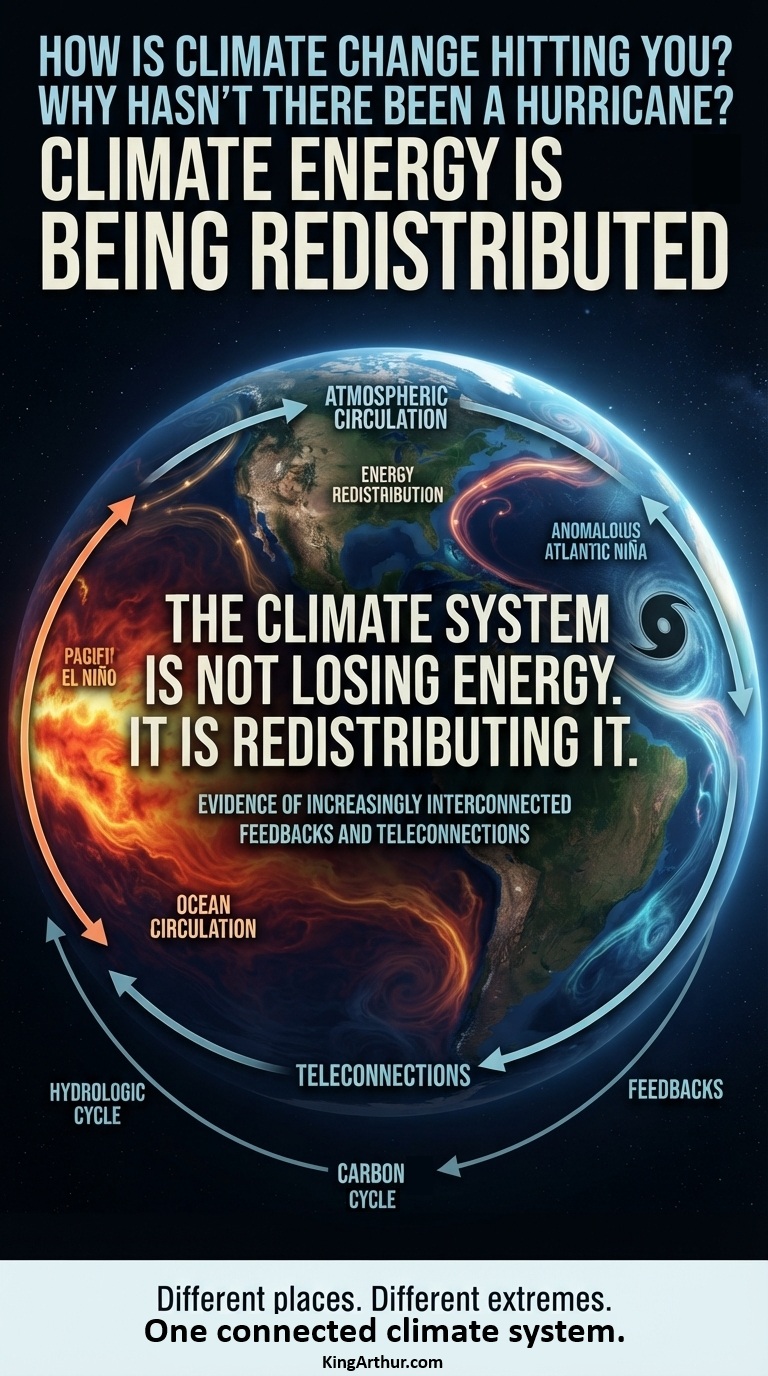
Climate Energy Is Being Redistributed
The absence of hurricanes isn’t evidence that the climate system is becoming less energetic. It is the opposite: climate energy is being redistributed in ways that produce very different outcomes in different parts of the planet.
As of September 23, the Atlantic has produced six named storms but still has produced zero hurricanes—an exceptionally delayed first hurricane. NOAA’s current summary shows Atlantic ACE about 92% below the 1991–2020 average at this point in the season.
The alarming part isn’t simply the lack of hurricanes. It’s the apparent coupling of climate patterns that historically operated more independently. I first warned about this Pacific El Niño–Atlantic Niña coupling back in May. Now, as we progress this far into the season, the observations are providing an unusually clear real-world example of how teleconnections can link distant parts of the climate system.
The simultaneous occurrence of an extreme Pacific El Niño and an anomalous Atlantic Niña represents a significant disruption of the historical baseline. NOAA reports that the El Niño is strengthening, with eastern equatorial Pacific sea-surface temperatures already more than 3°C above average.
An Atlantic Niña can suppress Atlantic hurricane development through increased atmospheric stability and wind shear. So there is a relatively straightforward physical explanation for the quiet Atlantic. But I think the deeper question is why these large-scale ocean–atmosphere patterns are coupling so strongly in the first place.
That’s where climate-acceleration research comes in. I see this as evidence worth watching for increasingly interconnected feedbacks and teleconnections—changes in ocean circulation, atmospheric circulation, energy redistribution, and the hydrologic and carbon cycles that can influence one another across ocean basins.
In other words, the absence of hurricanes isn’t evidence that the climate system is becoming less energetic. It is the opposite: climate energy is being redistributed in ways that produce very different outcomes in different parts of the planet.
It may manifest as a powerful, rare September nor’easter hitting the Jersey Shore.