About the Song
The 1.5°C threshold identified in the Paris Agreement—and the roughly 2°C level generally regarded as an even more dangerous boundary—is not important because the difference between 1.4°C and 1.5°C is somehow magical. These numbers matter because increasing global temperatures raise the probability of triggering major climate tipping points.
And once tipping points begin to activate, the question of whether warming ultimately reaches 2°C, 3°C, or even 4–7°C becomes much less relevant for two fundamental reasons:
First, tipping points can initiate self-reinforcing feedbacks that continue driving change even after the original forcing changes.
Second, the impacts do not necessarily increase gradually with temperature. They can accelerate, compound, and cascade as interconnected systems begin to destabilize.
In other words, 1.5°C is not a destination. It is not merely a warning sign or an alarm. It is a tripwire.
[Intro]
Feedback loop and tipping-point network: it starts at the top of the world… and works its way down to Middle Earth, where our girth is actually slowing the planet’s rotation. Welcome to the present.
Starting at the top…
(Top of the world)
Place is changing…
(Things are rearranging)
Down from the poles…
(Into the whole)
A little change
(Becomes something strange)
[Verse 1]
Up where the cold wind blows
(Where the white world glows)
Ice is losing ground
(And the heat comes round)
Pole to pole
(Losing control)
The gradient weakens
(The system awakens)
Difference gets smaller
(The feedback gets taller)
[Pre-Chorus]
Move the mass
(Change the spin)
One more coupling
(Let it begin)
[Refrain]
Starting on top of the world
(Coming unfurled)
Working down to the middle
(Creating an existential riddle)
Are you slowing down
(Spinning round)
Down, down, down
(Hey! Hey! Hey!)
Changing the time of day
[Verse 2]
The equator
(The pole)
Used to have a different role
(For sure)
Hot and cold
(High and low)
Set the gradient
(Watch it go)
That old difference
(Doesn’t last)
Energy moves
(Into different grooves)
And down below
(Feel the water flow)
[Refrain]
Starting on top of the world
(Coming unfurled)
Working down to the middle
(Creating an existential riddle)
Are you slowing down
(Spinning round)
Down, down, down
(Hey! Hey! Hey!)
Changing the time of day
[Verse 3]
Welcome to Middle Earth
(What’s that really worth?)
Our girth
(Has some worth)
Shift the distribution
(Change the rotation)
Tiny little change
The system’s sure strange)
Begin!
(Spin!)
Mass!
(Fast!)
Move!
(Prove!)
Time!
(And time again!)
Top of the world!
(Down to the middle!)
Top of the world!
(Down to the middle!)
[Verse 4]
Atomic clocks
(Watch the rocks)
Earth rotation
(Observation)
A tiny variation
(In the rotation)
Becomes information
(About the whole system)
[Bridge]
One system…
(Many parts)
One pulse…
(Many hearts)
Mass…
(Spin…)
Time…
(Begin!)
A change up there
(Travels down here)
A change over there
(Alter what’s near)
[Refrain]
Starting on top of the world
(Coming unfurled)
Working down to the middle
(Creating an existential riddle)
Are you slowing down
(Spinning round)
Down, down, down
(Hey! Hey! Hey!)
Changing the time of day
Starting on top of the world
(Coming unfurled)
Working down to the middle
(Find a piece of the riddle)
Are you slowing down
(Spinning round)
Down, down, down
(Hey! Hey! Hey!)
Changing the time of day
[Final Refrain]
Starting on top of the world
(Coming unfurled)
Working down to the middle
(Creating an existential riddle)
[Outro]
Are you slowing down
(Spinning round)
Down, down, down
(Hey! Hey! Hey!)
Changing the time of day
Starting at the top…
(Down to the middle)
Feedback coupling…
(It’s all connected)
Round and round…
(The network’s turning)
Day by day…
(Time keeps changing)
Round and round…
(Down, down, down…)
Hey! Hey! Hey!
(The time of day)
About the Song
Feedback loop and tipping-point network: it starts at the top of the world… and works its way down to Middle Earth, where our girth is actually slowing the planet’s rotation. Welcome to the present.
Polar amplification → weakened equator-to-pole temperature gradients → planetary mass redistribution → altered moment of inertia → rotational dynamics → slight rotational slowing → changes in length of day.
Today’s new release, “Feedback Network,” is also tonight’s homework assignment: create a theme-song sound for the next eco-rock album, “Feedback Coupling.”
The song is about a remarkably strange consequence of climate change: humanity is, in a very literal sense, changing the length of the day.
As polar ice melts and mass is redistributed through the Earth system, the planet’s rotation can change slightly. The effect is tiny—but measurable, and large enough to create challenges for keeping highly precise time in scientific and technical applications.
It’s a little like the Y2K problem of 1999. Y2K involved a seemingly tiny detail in computer code—the way years were represented—that became important because modern systems depended on precise timekeeping.
This is different, of course. Here, the problem isn’t a coding convention. It’s the Earth itself changing how it rotates.
And that matters for systems that depend on extremely precise timing and positioning—particularly GPS and other satellite-based technologies.
The irony is pretty remarkable:
We changed the climate.
The climate changed the planet.
And now we’re having to account for the change in the clock.
This song is my attempt to translate that feedback network into sound.
It’s experimental audio science.
The track begins with a clean acoustic/electric guitar signal, running through a digital delay and distortion pedal. The guitar starts relatively clean and acoustic. Then the distortion enters, followed by increasing digital-delay feedback.
Next, a live synthesizer joins the network.
Again, the signal begins clean.
Then it becomes distorted.
Then delayed.
Then the delay feeds back into itself.
And the guitar and synth begin interacting as a coupled system.
The musical system starts behaving a little like the climate system I’m trying to describe: one change feeds into another, which feeds back into the first, creating something larger and increasingly complex.
By the end, we’ve arrived at some serious feedback coupling.
[Verse 1]
Spring came early
(What did you say?)
Trees woke up
(Before the day)
Buds unfolding
(Birds take flight)
Roots are moving
(Into the light)
[Refrain]
A man-made
(Cascade)
… of ecological disruptions
(Biological interruptions)
Messin’ with the lifecycle
(Holding mankind liable)
… a phenology tragedy
[Verse 2]
Phenology
(What’s that?)
The study of timing
(That’s that!)
When leaves unfold
(When flowers bloom)
When insects emerge
(When birds resume)
When trees put out
(Their tender leaves)
When caterpillars hatch
(Before the freeze)
When pollinators arrive
(When food is there)
When everybody’s ready
(But nobody’s prepared)
[Refrain]
A man-made
(Cascade)
… of ecological disruptions
(Biological interruptions)
Messin’ with the lifecycle
(Holding mankind liable)
… a phenology tragedy
[Bridge]
It’s not just hot…
(That we’ve got.)
Things aren’t rhyming
(It’s the timing.)
Tick-tock…
(Tick-tock…)
Bud break!
(Break!)
Leaves
(Leaving)
Flower!
(Power!)
Tick-tock…
(Tick-tock…)
Who’s keeping time?
[Refrain]
A man-made
(Cascade)
… of ecological disruptions
(Biological interruptions)
Messin’ with the lifecycle
(Holding mankind liable)
… a phenology tragedy
[Breakdown]
Phenology…
(Phenology…)
Messin’ with biology
[Final Refrain]
A man-made
(Cascade)
… of ecological disruptions
(Biological interruptions)
Messin’ with the lifecycle
(Holding mankind liable)
… a phenology tragedy
[Outro]
A man-made
(Cascade)
Changing the forest’s functions
Messin’ with the lifecycle
(Changing who’s viable)
… a phenology tragedy
Autumn came late…
(We changed the date.)
About the Song
Phenology: The Study of Biological Lifecycle Events
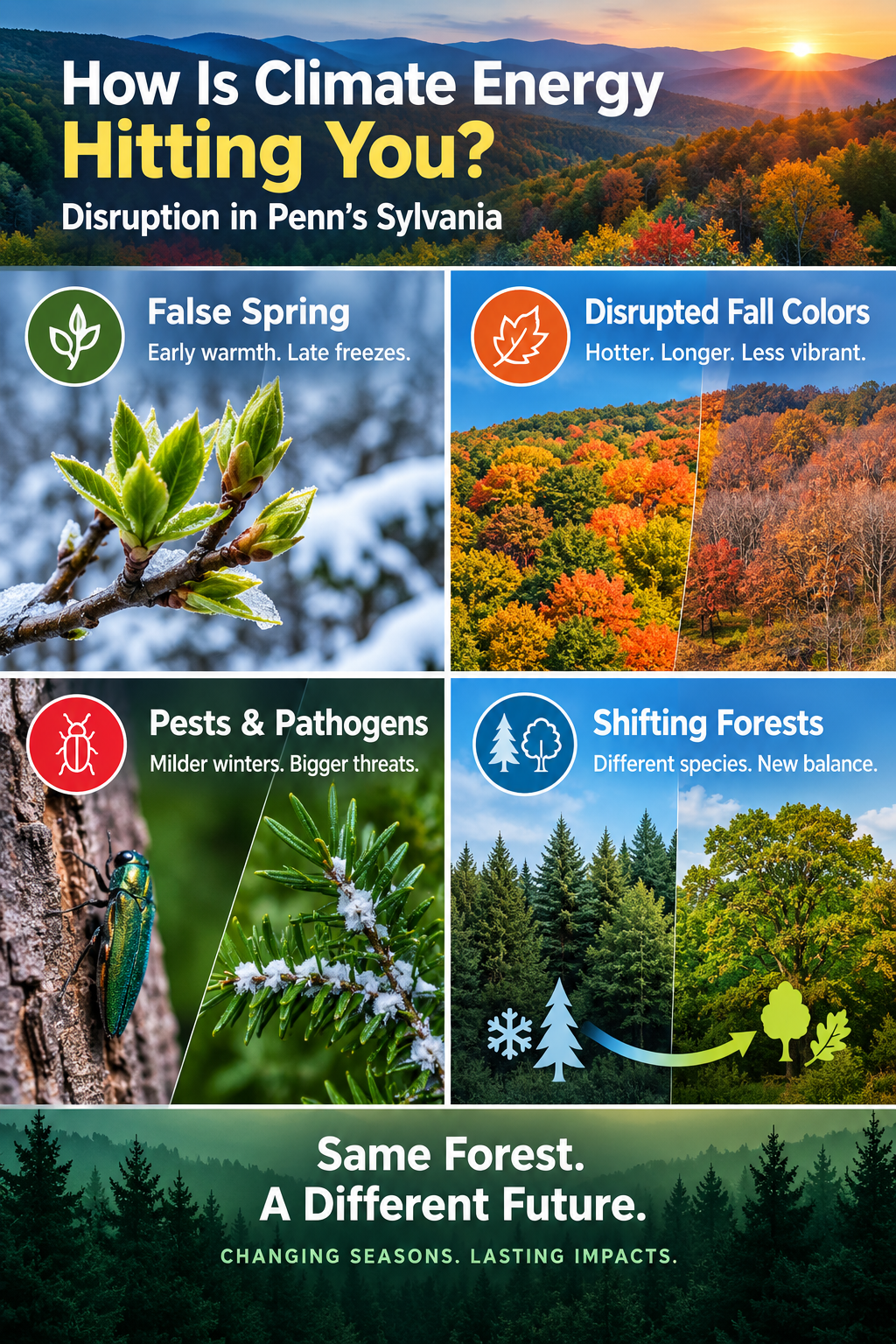
Disruption in Pennsylvania’s Sylvania
Pennsylvania’s forests are being disrupted by accelerating seasonal expansion—the lengthening of warm-season conditions into spring and autumn. The change is doing more than making individual days warmer. It is altering the timing of tree life cycles, increasing ecological vulnerabilities, and shifting which species can successfully survive and reproduce.
As summer-like conditions expand into early spring and late autumn, biological events known as phenology are increasingly occurring outside the historical weather conditions to which Pennsylvania’s forests evolved.
The result is a cascade of ecological disruptions.
[Refrain]
Accelerating
(Seasonal Expansion)
Exasperating
(Reason in suspension)
Forever summer…
(… a real bummer)
[Bridge]
[Beat Drops / Psychedelic Organ / Echoed Vocals]
Forever…
(Summer…)
Forever…
(Bummer…)
Is it a vacation?
(No!)
Is it relaxation?
(No!)
It’s duration
(Know expansion!)
It’s intensity
(Reality!)
[Instrumental]
[Surf Guitar Solo / Wah-Wah / Drum Fills]
June…
July…
August…
September…
October?
(Wait…)
November?
(Seriously?)
… really!
[Refrain]
Accelerating
(Seasonal Expansion)
Exasperating
(Reason in suspension)
Forever summer…
(… a real bummer)
[Breakdown]
[Spoken / Half-Time Groove]
“Hey… what month is it?”
(October.)
“What’s the temperature?”
(Summer.)
“…Oh.”
[Final Refrain]
Accelerating
(Seasonal Expansion)
Exasperating
(Reason in suspension)
Forever summer…
(… a real bummer)
[Outro]
Accelerating
(Coming on strong)
Summer keeps expanding
(… and hanging on)
Forever summer…
(How long can it last?)
Forever summer…
(It’s growing fast…)
About the Song: Accelerating Seasonal Expansion
The seasons are not simply getting warmer. They are changing duration, timing, and intensity.
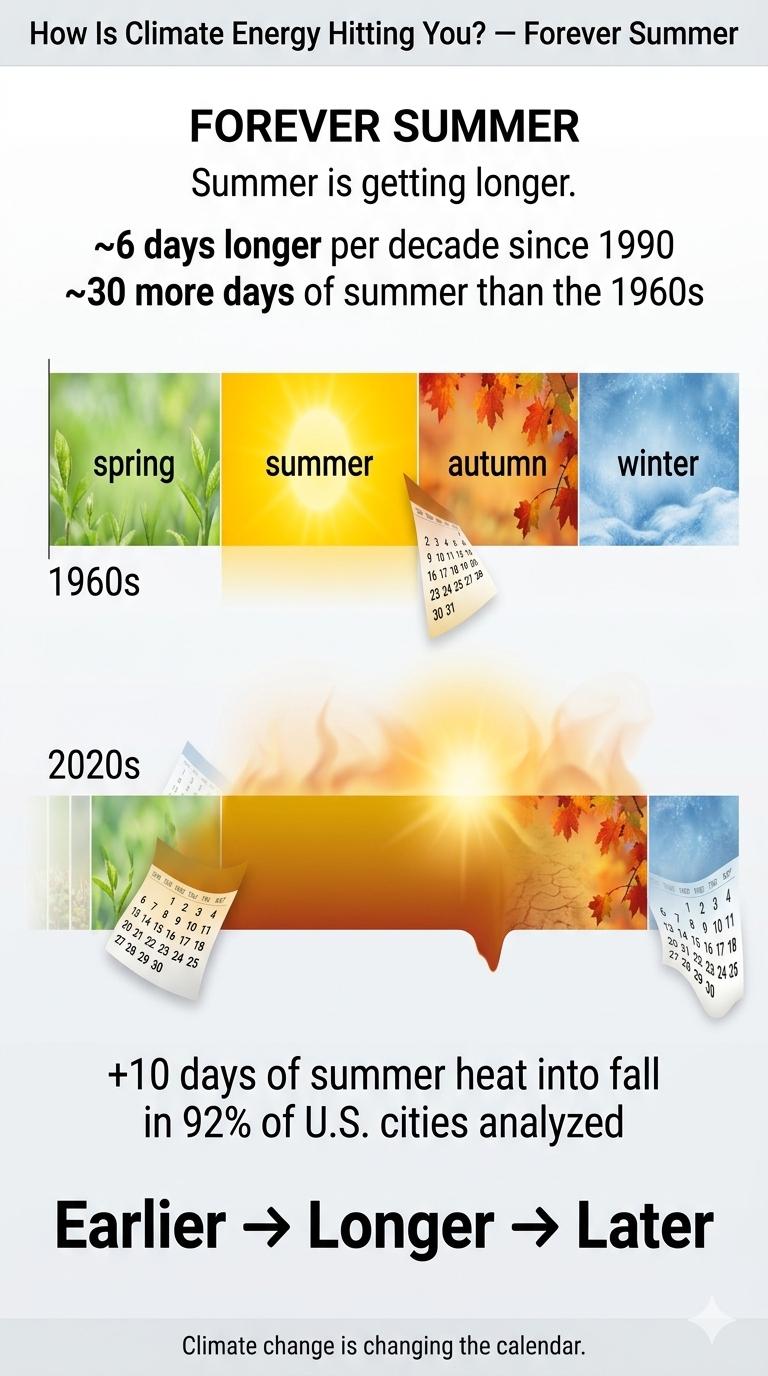
Summers Now Last 30 Days Longer
Summer is getting longer.
A study by researchers at the University of British Columbia found that, between 1990 and 2023, summer-like conditions across the regions between the tropics and the polar circles expanded by roughly six days per decade. That rate is substantially faster than earlier estimates.
The researchers did not define summer by the calendar. Instead, they identified summer as the period when temperatures rise above a location’s historically typical threshold for the warmest part of the year. Using this temperature-based definition, they found that summers across the midlatitudes now last roughly 30 days longer than they did in the 1960s.
The change is occurring at both ends of summer: warm conditions are arriving earlier in the year and lingering later into autumn. The result is not simply a longer calendar season, but a longer period of accumulated heat.
A Longer Summer
• Accelerating seasonal expansion — The UBC study, published in Environmental Research Letters, found that summer length increased by roughly six days per decade from 1990 to 2023. Across the midlatitudes, summer is now about 20 days longer than it was in 1990 and roughly 30 days longer than in the 1960s.
• Summer heat lingering into fall — Climate Central analyzed temperature records from 246 major U.S. cities and found that summer-like temperatures now extend an average of 10 days later into autumn in 227 cities—92% of those analyzed—compared with the early 1970s.
[Pre-Chorus]
And that’s where intuition
(Can lead you astray)
Because complicated systems
(Don’t always behave that way)
[Refrain]
Not simply ignorance
(Often it’s more)
Lacking any tolerance
(Preferring blood and gore)
Cognitive ability
(Lacking sensibility)
Christian nationalism
(Lacking humane vision)
[Breakdown]
[Half-Time / Spoken Vocal]
Cognition…
What can you process?
(More or less)
Recognition…
(Of what you possess)
Cognitive ability
(Showin’ off its fragility)
[Final Bridge]
[Band Builds / Crowd Vocals]
Think beyond the tribe!
(Think to what you proscribe!)
Think beyond the certainty
(… till you find clarity)
[Final Refrain]
Not simply ignorance
(Often it’s more)
Lacking any tolerance
(Preferring blood and gore)
Cognitive ability
(Lacking sensibility)
Christian nationalism
(Lacking humane vision)
[Outro]
Not simply ignorance
(If it’s on purpose)
Not simply intelligence
(If you choose to lose)
Cognitive ability
(Needs humility)
Reasoning without reflection
(Can become a weapon)
[Organ / Guitar Feedback / Fading Drum Beat]
Cognitive ability
(Showin’ off its fragility)
[Final Whisper]
Cognitive ability…
(Needs humane vision.)
Face-to-face reality
(Moral of the lesson)
About the Song
Cognitive Ability, Christian Nationalism & Climate Change Denial
A 2026 study by sociologist S. L. Perry finds a significant negative association between verbal cognitive ability and Christian nationalist beliefs in the United States.
That finding raises an important question:
What does cognition have to do with climate change denial?
Climate science is extraordinarily complex. Understanding it requires processing interconnected systems, probabilities, feedbacks, long-term trends, and evidence that cannot simply be evaluated through everyday experience.
This creates several pathways toward climate skepticism:
🧠 Intuitive thinking can favor simple narratives over complex scientific evidence.
✝️ Christian nationalist ideology can reinforce distrust of secular scientific and academic institutions.
🛡️ Motivated reasoning can allow people with substantial cognitive ability to construct sophisticated defenses of beliefs that are deeply connected to their political, religious, or cultural identity.
The result is a paradox: Less cognitive capacity can make complex science harder to process. Greater cognitive capacity can make existing beliefs harder to dislodge.
The problem is therefore not simply ignorance.
It is the interaction of cognition, ideology, identity, institutional trust, and reasoning.