bookmark_borderThe Affect Effect

The-Affect-Effect-Best-Of.mp3
The-Affect-Effect-Best-Of.mp4
The-Affect-Effect.mp3
The-Affect-Effect.mp4
The-Affect-Effect-intro.mp3

[Intro]
Oh, yeah
(I eye)

[Verse 1]
Knock on (Knock on, knock on)
And on and on
Into view (what I do)
I can see (comes back to me)

[Bridge]
Oh, yeah
(I eye)
It’s coming back to me
(Now I see clearly)

[Chorus]
Influence the outcome
(The affect effect)
Make of freewill what we will
(Our kingdom or our freedom)

[Break]
How come…
(We stand still?)

[Verse 2]
Knock on (Knock on would)
What can — did (thus could)
All said and done (choose no one)
No won (know one)

[Bridge]
Oh, yeah
(I eye)
It’s coming back to me
(Now I see clearly)

[Chorus]
Influence the outcome
(The affect effect)
Make of freewill what we will
(Our kingdom or our freedom)

[Break]
How come…
(We stand still?)

[Chorus]
Influence the outcome
(The affect effect)
Make of freewill what we will
(Our kingdom or our freedom)

[Outro]
How come…
(We stand still?)

Tipping points and feedback loops drive the acceleration of climate change. When one tipping point is toppled and triggers others, the cascading collapse is known as the Domino Effect.

From the album “Edge of Chaos

The Human Induced Climate Change Experiment

bookmark_borderDoubling Time

Doubling-Time-Best-Of.mp3
Doubling-Time-Best-Of.mp4
Doubling-Time.mp3
Doubling-Time.mp4
Doubling-Time-intro.mp3

[Verse 1]
Acceleration
(Becomes a thing of the past)
At last at last
(The past piles up so fast)

[Bridge]
Our you sure
(Of a future?)

[Chorus]
The trouble with doubling time
Is it’s half of half-the-time
(All the time)
Like per second per second… I reckon…
It just keeps going and growing
(Shorter and shorter)

[Bridge]
Faster and faster
(Into disaster)

[Verse 2]
100 years goes to 10
(Then… to two)
Not a matter of when
(It’s happening to you)

[Bridge]
Our you sure
(Of a future?)

[Chorus]
The trouble with doubling time
Is it’s half of half-the-time
(All the time)
Like per second per second… I reckon…
It just keeps going and growing
(Shorter and shorter)

[Bridge]
Drastic (disorder)
Faster and faster
(Into disaster)

[Chorus]
The trouble with doubling time
Is it’s half of half-the-time
(All the time)
Like per second per second… I reckon…
It just keeps going and growing
(Shorter and shorter)

[Outro]
Drastic (disorder)
Faster and faster
(Into disaster)
[Instrumental, Whistle Solo]

A SCIENCE NOTE

Beyond Linear Change: The Reality of Exponential Acceleration

When we began our climate experiments in the 1990s, we assumed significant change would occur over millennia. If climate change progressed linearly, this would hold. However, by the late 1990s, our findings–and global observations–began to show that climate impacts were accelerating exponentially.

Doubling time — the period required for a quantity to double — is a critical marker of exponential growth. For anthropogenic climate impacts, this period has collapsed at an alarming rate. By 2020, the doubling time for key impacts such as sea level rise had shrunk from 100 years to just 10 years, with rates increasing from about 1.5 mm/year to over 3 mm/year. If left unchecked, this trajectory could result in sea-level increases of up to one foot per year by 2050.
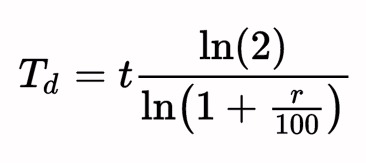
Doubling Time Formula

Extreme Events: The New Normal

Extreme weather events are intensifying and occurring with alarming frequency as warming oceans, disrupted jet streams, and accelerating atmospheric rivers destabilize the climate system. What were once “500-year” events now occur every 5-10 years, and in many places, annually.

  • Heatwaves are now 5x more likely, projected to become 10x more likely within 5 years and 20x within a decade, consistent with the shrinking climate doubling period.
  • Storms and flooding are not only more frequent but also exponentially more destructive due to physics: wind and water forces scale with the square of velocity (v²) and, in the case of water, with 800x the density of air, making even modest increases in flow speed dramatically more damaging.
  • Wildfires, fueled by heat, lightning, and brown carbon feedback loops, are igniting with greater speed and ferocity, as seen during Canada’s record-breaking 2023 wildfire season.

Non-linear acceleration is now confirmed: The 2-7°F rise in temperatures during recent European heatwaves translated to a tripling of heat deaths, demonstrating the amplified sensitivity of human and natural systems to seemingly small increases in mean temperatures. For every 1°C (1.8°F) increase, the atmosphere can hold 7% more water vapor, intensifying storms and the humidity of heatwaves, compounding mortality risk.

2025 Update: Doubling Period Shrinks Further

Originally estimated at 100 years, the climate doubling period–how quickly climate impacts double in intensity–contracted to 10 years. By 2024, new observations confirmed the doubling period had shortened further to just 2 years. 100 years → 10 years → 2 years. This means the damage caused by climate change today is already double what it was just two years ago. If this trend continues, it could be four times worse in two years, eight times worse in four years, and up to 64 times worse within a decade. Critically, these estimates are conservative, assuming the doubling period does not continue to shrink even further as tipping points and feedback loops accelerate the crisis.

The surge in persistent heat domes and resonance patterns in the jet stream confirms that critical thresholds in the climate system are being crossed faster than models predicted. As warming oceans and a destabilized jet stream lock in planetary wave patterns, heat domes and extreme weather events persist longer, amplifying both frequency and intensity.

In 2023, Earth’s surface temperatures averaged over 3°C above pre-industrial levels–double the Paris Agreement’s 1.5°C ceiling. Scientists agree that a 2°C rise will trigger tipping points and feedback loops, releasing carbon from permafrost, weakening the AMOC, and destabilizing polar ice sheets. This cascading “Domino Effect” could push global temperatures toward 6°C, rendering large regions of the planet uninhabitable within this century.

As climate change accelerates, what was once a 1,000-year flood now occurs as a 100-year or even 10-year event. Violent rain, flash flooding, and catastrophic water events are rewriting our understanding of “normal,” with Chapel Hill’s recent “1,000-year” flood serving as a stark warning that the climate system is entering a phase of nonlinear, runaway change that threatens human systems, infrastructure, and global stability.

Ignite a Domino Effect: Albedo, Brown Carbon, AMOC, Permafrost, Amazon Rainforest Dieback, Sea Level Rise Pulses, Hydroclimate Whiplash, and Arctic Sea Ice Brouse and Mukherjee (2025)

Tipping Cascades: The Nonlinear Dominoes of Climate Collapse Brouse and Mukherjee (2025)

The Domino Collapse: Amazon Rainforest Dieback and the Ozone Feedback Loop Brouse and Mukherjee (2025)

Climate Change, Doubling Time, and the Eroding Value of Jersey Shore Real Estate Brouse (2025)

Tipping points and feedback loops drive the acceleration of climate change. When one tipping point is toppled and triggers others, the cascading collapse is known as the Domino Effect.

From the album “Edge of Chaos

The Human Induced Climate Change Experiment

bookmark_borderWings Flutter

Wings-Flutter-Best-Of.mp3
Wings-Flutter-Best-Of.mp4
Wings-Flutter.mp3
Wings-Flutter.mp4
Wings-Flutter-intro.mp3

[Verse 1]
Starts with just a twitch
(Oh, how it twists)
Ya know… then the winds blow
(And off we go)

[Chorus]
The fluttering of wings
(Look what it brings)
The chaos in us
(Reign of the hurricane)

[Bridge]
Wings flutter
(Physics stutter)
Stand back
(Feedback)
Loop (loop, loop)

[Verse 2]
Sensitive dependence
(On initial conditions)
Momentum in relevance
(Circular repetitions)

[Chorus]
The fluttering of wings
(Look what it brings)
The chaos in us
(Reign of the hurricane)

[Bridge]
Wings flutter
(Physics stutter)
Stand back
(Feedback)
Loop (loop, loop)

[Chorus]
The fluttering of wings
(Look what it brings)
The chaos in us
(Reign of the hurricane)

[Outro]
Wings flutter
(Physics stutter)
Stand back
(Feedback)
Loop (loop, loop)

ABOUT THE SONG

Today’s featured new release, “Wings Flutter,” is the second single from the soon-to-be-released album Edge of Chaos. This track blends bluegrass and dubstep into a chaotic, deep-drop hybrid that mirrors its scientific inspiration: the Butterfly Effect.
The song also serves as a science lesson on the core concept of chaos theory—the study of how small changes in initial conditions can lead to dramatically different outcomes in complex systems. This is what’s known as sensitive dependence on initial conditions—famously described as how a butterfly flapping its wings in China can cause a hurricane in the Atlantic.

A SCIENCE NOTE

Chaos theory studies how small changes in initial conditions can lead to wildly different outcomes in complex systems. This is often called sensitive dependence on initial conditions — or famously, the butterfly effect — a butterfly in China can cause a hurricane in the Atlantic.

In chaotic systems:

  • Behavior looks random, but is deterministic underneath.

  • Predictability breaks down over time.

  • Feedback loops accelerate instability.

  • Thresholds or tipping points matter more than averages.

Edge of Chaos: Chaos Theory Basics Brouse (2025)

Tipping points and feedback loops drive the acceleration of climate change. When one tipping point is toppled and triggers others, the cascading collapse is known as the Domino Effect.

From the album “Edge of Chaos

The Human Induced Climate Change Experiment

bookmark_borderTipple

Tipple.mp3
Tipple.mp4
Tipple-Pt-2.mp3
Tipple-Pt-2.mp4
Tipple-intro.mp3

[Verse 1]
One falls over
(Striking the next)
Soon we’ll discover
(How complex)

[Bridge]
Are you nimble
(For a tipple)
Will you topple
(Fall and crumble)

[Chorus]
Tipping points
(Causing scenes)
Breaking joints
(Crushing dreams)

[Verse 2]
Watch ’em fall
(One and all)
All in a row
(Falling domino)

[Bridge]
Are you nimble
(For a tipple)
Will you topple
(Fall and crumble)

[Chorus]
Tipping points
(Causing scenes)
Breaking joints
(Crushing dreams)

[Bridge]
Are you nimble
(For a tipple)
Will you topple
(Fall and crumble)

[Chorus]
Tipping points
(Causing scenes)
Breaking joints
(Crushing dreams)

[Bridge]
Are you nimble
(For a tipple)
Will you topple
(Fall and crumble)

[Outro]
Tipping points
(Causing scenes)
Breaking joints
(Crushing dreams)

A SCIENCE NOTE
Research and Development Incorporating Complex Social-Ecological Feedback Loops Within a Dynamic, Non-Linear System is an extremely complex subject. A small example of this complexity can be seen in the interaction of the Albedo Feedback Loop, Brown Carbon Feedback Loop, Freshwater-AMOC Disruption Loop, Permafrost-Methane Feedback Loop, Amazon Rainforest Dieback Feedback Loop, Sudden Sea Level Rise Pulses (“Cork Release” Events), Hydroclimate Whiplash, and Arctic Sea Ice Feedback.

Lately, my deep reflection has centered on how tipping points have triggered self-sustaining feedback loops within the climate system. We knew this was coming–and now it is here. I was prepared for that part.

What I could not fully envision was how quickly the interplay of these tipping points would ignite a domino effect–so, so fast.

Now, I can see it clearly: the nonlinear, dynamic dance of economic, physical, and ecological systems in real time. This is pure math and science visibly unfolding, transforming abstract models into undeniable, measurable reality.

Tipping points and feedback loops drive the acceleration of climate change. When one tipping point is toppled and triggers others, the cascading collapse is known as the Domino Effect.

From the album “Edge of Chaos

The Human Induced Climate Change Experiment

bookmark_borderCry Me a River

Cry-Me-a-River.mp3
Cry-Me-a-River.mp4
Cry-Me-a-River-Unplugged-Underground-XXIII.mp3
Cry-Me-a-River-Unplugged-Underground-XXIII.mp4
Cry-Me-a-River-intro.mp3

[Verse 1]
Not too thick
(But dynamic)
Come to fear
(The atmosphere)

[Chorus]
Cry me a river
(That’s non-linear)
A river of tears
(Till it clears)

[Bridge]
Hard to predict
(Rain so thick)
Atmospheric
(Rivers deliver)

[Verse 2]
It just keeps on raining
(Till none’s remaining)
Gonna pour, pour, pour
(Till the poor are more)

[Chorus]
Cry me a river
(That’s non-linear)
A river of tears
(Till it clears)

[Bridge]
Hard to predict
(Rain so thick)
Atmospheric
(Rivers deliver)

[Chorus]
Cry me a river
(That’s non-linear)
A river of tears
(Till it clears)

[Outro]
Hard to predict
(Rain so thick)
Atmospheric
(Rivers deliver)

A SCIENCE NOTE:Chaos Theory and Atmospheric Rivers

Chaos theory studies dynamic, nonlinear systems that are highly sensitive to initial conditions, meaning small changes can lead to large, unpredictable outcomes. The atmosphere is a prime example of such a system, with interacting factors (temperature gradients, moisture content, jet streams, ocean currents) producing complex weather patterns that can shift suddenly and dramatically.

Atmospheric rivers (ARs) are long, narrow bands of concentrated moisture in the atmosphere that can carry as much water vapor as the Amazon River. They form when warm, moist air is pulled along strong low-level winds, often interacting with cold fronts or mountains, leading to intense rain or snow when they make landfall.

Chaos theory helps explain atmospheric rivers in several ways:

1️⃣ Sensitivity to Initial Conditions
Small shifts in ocean surface temperatures (e.g., a localized warm patch), jet stream undulations, or pressure systems can determine whether an AR will form, its path, its moisture content, and its intensity. This is why accurately predicting AR impacts weeks in advance is difficult.

2️⃣ Nonlinear Interactions
Atmospheric rivers emerge from nonlinear interactions between large-scale patterns like El Niño, local sea surface temperatures, atmospheric pressure systems, and topography. A minor upstream disturbance can amplify moisture transport, causing an AR to stall, intensify, or shift suddenly, leading to unexpected flooding.

3️⃣ Self-Organization within Chaos
Despite the apparent randomness, ARs often follow recognizable patterns due to self-organization within the chaotic atmospheric system. This is why meteorologists can identify AR structures on satellite images, yet the timing and intensity of impacts remain uncertain.

4️⃣ Feedback Loops
Warming oceans increase evaporation, adding more moisture to the atmosphere and strengthening ARs. In turn, intense rainfall from ARs can alter soil moisture and surface temperatures, feeding back into local atmospheric conditions and influencing subsequent weather patterns.

Why This Matters for Climate Change

As climate change alters baseline conditions (e.g., warmer oceans, higher atmospheric moisture), the chaotic system of the atmosphere shifts, increasing the likelihood and intensity of ARs. Small changes (like a slight increase in sea surface temperature) can lead to exponentially larger impacts, including record-breaking rainfall and flooding, reflecting the nonlinear dynamics chaos theory describes.

In short:
Chaos theory helps us understand why atmospheric rivers are hard to predict precisely, why they can intensify suddenly, and why small changes in climate conditions can lead to disproportionately large and damaging AR events.

Tipping points and feedback loops drive the acceleration of climate change. When one tipping point is toppled and triggers others, the cascading collapse is known as the Domino Effect.

From the album “Edge of Chaos

The Human Induced Climate Change Experiment

bookmark_borderIn the Eye

In-the-Eye-Best-Of.mp3
In-the-Eye-Best-Of.mp4
In-the-Eye.mp3
In-the-Eye.mp4
In-the-Eye-intro.mp3

[Intro]
On the edge…
(In the eye)
I…

[Verse 1]
(Oh, well) How can you tell
On the edge
Of a hurricane
Where to begin
And come to know within

[Bridge]
The urge
(On the ledge)
Surge

[Chorus]
To observe (from afar)
Bizarre (the nerve)
Struck (as by luck)
All falls into place
(In space)

[Verse 2]
(Thick in chaotic)
Unordered system
(I am)
We are so far
In to the eye
(Of I)

[Bridge]
On the edge
Of a hurricane
Where to begin
And come to know within

[Bridge]
The urge
(On the ledge)
Surge

[Chorus]
To observe (from afar)
Bizarre (the nerve)
Struck (as by luck)
All falls into place
(In space)

[Outro]
To observe (from afar)
Bizarre (the nerve)
Struck (as by luck)
All falls into place
(In space)

A SCIENCE NOTE

Tipping Points Igniting a Domino Effect

We knew tipping points in the climate system would eventually trigger self-sustaining feedback loops—and now, they have arrived. That part, I was prepared for.

What I could not fully envision was how rapidly the interplay among these tipping points would ignite a domino effect across Earth’s systems—so, so fast.

Now, I see it clearly: the nonlinear, dynamic dance of economic, physical, and ecological systems is unfolding in real time. Abstract models are transforming into undeniable, measurable reality before our eyes, each cascading shock amplifying the next, each destabilization eroding the buffers we once relied upon.

If you are new to the concept of “unordered systems,” think of a hurricane. When you stand at the edge of an approaching storm, you have no idea what this system will bring. Even inside the eye, hovering on the edge of calm, you cannot comprehend the full scope of what is happening. It is only when you pull back—way back—that you recognize the system’s structure, the magnitude of the forces at play, and the multitude of interconnected subsystems spiraling within it.

Then, and only then, can you begin to see how simple this complexity truly is.

Chaos theory in climate physics reveals that small perturbations—like incremental emissions, deforestation, or a regional heatwave—can escalate rapidly, interacting with larger systemic instabilities to produce abrupt, unpredictable changes. This is not just theoretical; we are seeing ice sheet destabilization, jet stream fragmentation, and ocean current disruptions accelerating far faster than models predicted. It is in this nonlinear acceleration, driven by reinforcing feedback loops, that the true scale of the crisis comes into focus.

We are no longer discussing distant projections or theoretical risk curves. We are witnessing the planetary system cross thresholds where the rate of change itself doubles in shorter and shorter intervals, transforming manageable problems into cascading disasters. This is the reality of living within a chaotic system: tipping points are not isolated events but triggers in a global chain reaction now fully underway.

Tipping points and feedback loops drive the acceleration of climate change. When one tipping point is toppled and triggers others, the cascading collapse is known as the Domino Effect.

From the album “Edge of Chaos

The Human Induced Climate Change Experiment

bookmark_borderSo, So Fast

So-So-Fast-Best-Of.mp3
So-So-Fast-Best-Of.mp4
So-So-Fast.mp3
So-So-Fast.mp4
So-So-Fast-intro.mp3

[Intro]
So (so fast)
Not (so-so) fast
(Does the past last?)

[Verse 1]
The rapid way
The interplay
Among these tipping points…
You know… tip the domino — so, so fast.

[Chorus]
Clearer nonlinear
(Dynamic dance)
Unfolding in real time
(Reason and rhyme)

[Bridge]
(Alas)
Watch the past (pass) past
You know
(There you go)
Domino

[Verse 2]
In a chain-reaction
(The dominoes fall)
Dues of self-satisfaction
(The collectors call)

[Chorus]
Clearer nonlinear
(Dynamic dance)
Unfolding in real time
(Reason and rhyme)

[Bridge]
(Alas)
Watch the past (pass) past
You know
(There you go)
Domino

[Chorus]
Clearer nonlinear
(Dynamic dance)
Unfolding in real time
(Reason and rhyme)

[Outro]
(Think fast)
As the past (passes) past
Could not ignore
(Future could not endure)
You know
(There we go)
Domino
(You know)
Domino (no-no)

A SCIENCE NOTE

Tipping Points Igniting a Domino Effect

We knew tipping points would eventually trigger self-sustaining feedback loops in the climate system–and now, they have arrived. I was prepared for that part.

What I could not fully envision was how rapidly the interplay among these tipping points would ignite a domino effect–so, so fast.

Now, I see it clearly: the nonlinear, dynamic dance of economic, physical, and ecological systems unfolding in real time. Abstract models are transforming into undeniable, measurable reality before our eyes.

Cascading System Failures

The breakdown of climate subsystems will not follow a smooth, linear decline. Instead, as one subsystem fails, it accelerates the failure of others, creating cascading, compounding effects across the entire climate system.

There are too many interconnected subsystems to list exhaustively, but consider one example:
The collapse of the AMOC slows ocean circulation, leading to hotter tropics and a warmer Arctic. This accelerates polar ice melt, causing sea levels to rise more rapidly while injecting large volumes of freshwater into the North Atlantic, further destabilizing the AMOC in a reinforcing loop.

At the same time, a disrupted climate system increases droughts in the Amazon, pushing the rainforest toward dieback and desertification. As the Amazon loses its ability to recycle rainfall and sequester carbon, it further amplifies global warming, which then accelerates ice melt, sea level rise, and AMOC collapse.

This example is just one piece of a much larger mosaic of cascading feedback loops already unfolding, shifting the climate system from a stable state to a chaotic, accelerating collapse.:

Ignite a Domino Effect: Albedo, Brown Carbon, AMOC, Permafrost, Amazon Rainforest Dieback, Sea Level Rise Pulses, Hydroclimate Whiplash, and Arctic Sea Ice Brouse and Mukherjee (2025)

Tipping Cascades: The Nonlinear Dominoes of Climate Collapse Brouse and Mukherjee (2025)

The Domino Collapse: Amazon Rainforest Dieback and the Ozone Feedback Loop Brouse and Mukherjee (2025)

Tipping points and feedback loops drive the acceleration of climate change. When one tipping point is breached and triggers others, the cascading collapse is known as the Domino Effect.

From the album “Edge of Chaos

The Human Induced Climate Change Experiment

bookmark_borderBreaking Capitalism

Breaking-Capitalism-Best-Of.mp3
Breaking-Capitalism-Best-Of.mp4
Breaking-Capitalism.mp3
Breaking-Capitalism.mp4
Breaking-Capitalism-intro.mp3

[Verse 1]
No extreme whether
(Extreme weather)
I’m talking violent rain
(A reign of pain)

[Chorus]
Breaking the bank
Who else to thank…
But us
Optimism to pessimism
Breaking capitalism
Notorious

[Bridge]
Consume to excess
(Resume our mess)
His story
(Going down in history)
Down, down, down

[Verse 2]
Holler:
Live by the dollar
(Die by the dollar)
Holler:
No rational (at all)

[Chorus]
Breaking the bank
Who else to thank…
But us
Optimism to pessimism
Breaking capitalism
Notorious

[Bridge]
Consume to excess
(Resume our mess)
His story
(Going down in history)
Down, down, down

[Outro]
Our story
(Going down in history)
Down, down, down
(Just look around)
Down, down, down

A SCIENCE NOTE

As extreme weather accelerates, the world is nearing a tipping point where insurance — and capitalism itself — can no longer function.

The climate crisis is on track to destabilize and ultimately destroy global capitalism, according to a stark warning from one of the world’s largest insurers. Allianz SE board member Gunther Thallinger has sounded the alarm: the growing cost of climate-driven disasters threatens to break the financial sector’s ability to operate — starting with insurance.

Speaking as both a top executive of Allianz and chair of its investment board, Thallinger said the world is fast approaching temperature thresholds beyond which many climate risks will simply become uninsurable. And without insurance, critical sectors of modern finance — from mortgages and real estate to infrastructure and industry — will cease to function.

“Heat and water destroy capital,” Thallinger wrote. “Flooded homes lose value. Overheated cities become uninhabitable. Entire asset classes are degrading in real time.”

The Math No Longer Works

“As temperatures rise to 1.5°C, 2°C, 3°C, insurers will no longer be able to offer coverage for many of these risks,” Thallinger said. “The math breaks down: the premiums required exceed what people or companies can pay. This is already happening.”

Our updated climate model, now integrating complex social-ecological factors as part of a dynamic and non-linear system, shows that global temperatures could rise by up to 9°C within this century–far beyond previous predictions of a 4°C rise over the next thousand years. This level of warming will render much of the world uninhabitable within this century.

Without insurance, the ripple effects spread rapidly through the financial system. Mortgages, infrastructure investment, agriculture, and transportation all rely on insurance to manage risk. Remove that foundation, and the global credit system starts to seize up — a “climate-induced credit crunch.”

“This is a systemic risk threatening the very foundation of the financial sector,” Thallinger warned.

Nick Robins, chair of the Just Transition Finance Lab at the London School of Economics, called the analysis “devastating,” adding that it highlights not only a financial crisis but a civilizational one.

Disease vectors, violent rain, and deadly humid heat are driving an exponential rise in climate-related deaths. This lethal triad–infectious disease, extreme heat, and intense rainfall–demonstrates that climate change is not a distant concern but a present, accelerating force behind rising mortality worldwide. Together, these threats magnify each other’s impacts, underscoring the urgent need to address climate change as a health crisis already unfolding.

Tipping points and feedback loops drive the acceleration of climate change. When one tipping point is breached and triggers others, the cascading collapse is known as the Domino Effect.

What I could not fully envision was how rapidly the interplay among these tipping points would ignite a domino effect–so, so fast.

Now, I see it clearly: the nonlinear, dynamic dance of economic, physical, and ecological systems unfolding in real time. Abstract models are transforming into undeniable, measurable reality before our eyes.

What you can do today. How to save the planet.

From the album “Edge of Chaos

The Human Induced Climate Change Experiment

bookmark_borderThe Human Induced Climate Change Experiment

The-Human-Induced-Climate-Change-Experiment-Best-Of.mp3
The-Human-Induced-Climate-Change-Experiment-Best-Of.mp4
The-Human-Induced-Climate-Change-Experiment-Pt-1.mp3
The-Human-Induced-Climate-Change-Experiment-Pt-1.mp4
The-Human-Induced-Climate-Change-Experiment-Pt-2.mp3
The-Human-Induced-Climate-Change-Experiment-Pt-2.mp4
The-Human-Induced-Climate-Change-Experiment-Reggae.mp3
The-Human-Induced-Climate-Change-Experiment-Reggae.mp4
The-Human-Induced-Climate-Change-Experiment-UU-XXIII.mp3
The-Human-Induced-Climate-Change-Experiment-UU-XXIII.mp4
The-Human-Induced-Climate-Change-Experiment-Unplugged.mp3
The-Human-Induced-Climate-Change-Experiment-Unplugged.mp4
The-Human-Induced-Climate-Change-Experiment-intro.mp3

[Verse 1]
Man, man’s damned demand
No longer can rely on supply
Time we come to understand
Getting tougher to get by

[Bridge]
Let’s investigate
(How to mediate)
[Instrumental]

[Chorus]
Research and development
(Is what I meant)
Into the way we live
(A lot less take and much more give)

[Verse 2]
Complex Social-Ecological
(Feedback Loops)
Within a dynamic, non-linear system
(Whoops… I am)

[Bridge]
Let’s investigate
(How to navigate)

[Chorus]
Research and development
(Is what I meant)
Into the way we live
(A lot less take and much more give)

[Bridge]
Let’s investigate
(How to evacuate)

[Chorus]
Research and development
(Is what I meant)
Into the way we live
(A lot less take and much more give)

[Outro]
Let’s investigate
(How to negate)

A SCIENCE NOTE
We knew tipping points would eventually trigger self-sustaining feedback loops in the climate system–and now, they have arrived. I was prepared for that part. What I could not fully envision was how rapidly the interplay among these tipping points would ignite a domino effect–so, so fast. Now, I see it clearly: the nonlinear, dynamic dance of economic, physical, and ecological systems unfolding in real time. Abstract models are transforming into undeniable, measurable reality before our eyes.

In the 1990s, we first hypothesized the non-linear acceleration of climate change. By the early 2000s, this hypothesis had evolved into an established climate theory, now widely recognized as scientific fact. My lab partner, a Doctor of Physics from Ohio State, and I collaborated to provide the key evidence creating this theory. Over the years, we have observed a dramatic reduction in the doubling time of climate change impacts—the rate at which these effects intensify. Initially, the doubling time was approximately 100 years, but it has since decreased to 10 years and, more recently, to just 2 years. This trend implies that the damage caused by climate change today is double what it was two years ago. In two years, it could be four times worse; in four years, eight times worse; and within a decade, potentially 64 times worse. These projections are conservative, assuming the doubling period does not continue to shrink further. Alarmingly, this rapid acceleration does not appear to be an anomaly. If this trajectory persists, the consequences will likely be far more catastrophic than previously anticipated.

Disease vectors, violent rain, and deadly humid heat are driving an exponential rise in climate-related deaths. This lethal triad–infectious disease, extreme heat, and intense rainfall–demonstrates that climate change is not a distant concern but a present, accelerating force behind rising mortality worldwide. Together, these threats magnify each other’s impacts, underscoring the urgent need to address climate change as a health crisis already unfolding.

* Our climate model — which incorporates complex social-ecological feedback loops within a dynamic, non-linear system — projects that global temperatures could rise by up to 9°C (16.2°F) within this century. This far exceeds earlier estimates of a 4°C rise over the next thousand years, signaling a dramatic acceleration of warming.

We analyze how human activities (such as deforestation, fossil fuel use, and land development) interact with ecological processes (including carbon cycling, water availability, and biodiversity loss) in ways that amplify one another. These interactions do not follow simple cause-and-effect patterns; instead, they create cascading, interconnected impacts that can rapidly accelerate system-wide change, sometimes abruptly. Understanding these dynamics is essential for assessing risks and designing effective climate adaptation and mitigation strategies.

From the album “Edge of Chaos

Also found on the album “Reggae Modern Day

The Human Induced Climate Change Experiment

bookmark_borderCool, Cool Air

Cool-Cool-Air.mp3
Cool-Cool-Air.mp4
Cool-Cool-Air-Reggae.mp3
Cool-Cool-Air-Reggae.mp4
Cool-Cool-Air-intro.mp3

[Verse 1]
What I need
(Is some cool, cool air to breathe)
Hear me plead
(I need cool, cool air to breathe)

[Bridge]
(Woah, oh, oh)
I need to breathe, please

[Chorus]
Heat and humidity
(Raise the difficulty)
With no solution
(To air pollution)

[Bridge]
(Woah, oh, oh)
I need to breathe, please

[Verse 2]
How to create
(Cool, cool air to breathe)
Getting desperate
(For cool, cool air to breathe)

[Bridge]
(Woah, oh, oh)
I need to breathe, please

[Chorus]
Heat and humidity
(Raise the difficulty)
With no solution
(To air pollution)

[Bridge]
(Woah, oh, oh)
I need to breathe, please

[Chorus]
Heat and humidity
(Raise the difficulty)
With no solution
(To air pollution)

[Outro]
(Oh, you know)
We need to breathe before we seize
(Please.)

A SCIENCE NOTE
Climate change is accelerating the rise in both the heat and humidity in the air. Here are some ways to help slow climate change ans save money with cool, cool air:

  • Energy, Cooling, and Air Purification:
    • Use natural cooling and air purification strategies to reduce energy demand.
    • Insulate your home while ensuring proper ventilation to maintain air quality.
    • Practice zone cooling: keep main living areas at 80–85°F and cool only occupied rooms as needed.
    • Paint exterior walls and roofs white or light colors to reflect heat and lower indoor temperatures.
    • Plant shade trees around your home to block direct sunlight and reduce cooling needs.
    • Create a small “movable forest” of potted trees that can be repositioned around your foundation to maximize shade throughout the seasons.
    • Build Corsi-Rosenthal Boxes for each floor to filter and circulate air effectively without energy-intensive systems.
    • Improve indoor air quality while cooling naturally by using air-purifying indoor plants.

What you can do today. How to save the planet.

From the album “Edge of Chaos

Also found on the album “Reggae Modern Day

The Human Induced Climate Change Experiment

bookmark_borderCascading System Failures

Cascading-System-Failures-Best-Of.mp3
Cascading-System-Failures-Best-Of.mp4
Cascading-System-Failures.mp3
Cascading-System-Failures.mp4
Cascading-System-Failures-intro.mp3

[Verse 1]
The foot bone’s connected to the mouth
The mouth… connected to the two faced
Watch as the humans race (to the bottom)
Here we come! (Dumb, dee, dumb)

[Bridge]
I don’t believe
(Because I can’t conceive)

[Chorus]
Cascading system failures
(Reigning down on me)
Crazy train disrailures
(The wheels of for real)
Have come off the track
(Fact: we’re legendary)

[Verse 2]
The A-mock’s connected to the jet stream
(Know what I mean?)
The jet stream’s connected to the ice melt
(Soon to be felt)

[Bridge]
I don’t believe
(Because I can’t conceive)

[Chorus]
Cascading system failures
(Reigning down on me)
Crazy train disrailures
(The wheels of for real)
Have come off the track
(Fact: we’re legendary)

[Verse 3]
The A-mock’s gone amuck caused an Fph up
(You know the tidal flow will go)
Connected to the Amazon Rain Forest
(Desertified land due to man’s damned demand)
U.S.A. “We’re the best”
Understand?

[Bridge]
(A strain to connect to the brain)
I don’t believe
(Because I can’t conceive)

[Chorus]
Cascading system failures
(Reigning down on me)
Crazy train disrailures
(The wheels of for real)
Have come off the track
(Fact: we’re legendary)

[Outro]
(A strain to connect to the brain)
Can’t conceive
(Won’t believe)
Can’t conceive
(Won’t believe)
Can’t conceive
(Won’t believe)

A SCIENCE NOTE
Research and development incorporating complex social-ecological feedback loops within a dynamic, non-linear system is profoundly challenging. A small window into this complexity can be seen in the interactions among the Albedo Feedback Loop, Brown Carbon Feedback Loop, Freshwater-AMOC Disruption Loop, Permafrost-Methane Feedback Loop, Amazon Rainforest Dieback Feedback Loop, Sudden Sea Level Rise Pulses (“Cork Release” Events), Hydroclimate Whiplash, and Arctic Sea Ice Feedback. A microcosm of a much larger and more complex climate system.

Combined Consequences

These interlinked, reinforcing feedbacks can:

  • Drive non-linear, abrupt climate shifts.

  • Cause sudden sea level rise pulses (feet per year for consecutive years).

  • Collapse the AMOC, disrupting weather, food systems, and rainfall patterns.

  • Trigger Amazon dieback, increasing global CO2.

  • Result in mass displacement, famine, and water crises.

Tipping Points Igniting a Domino Effect

We knew tipping points would eventually trigger self-sustaining feedback loops in the climate system–and now, they have arrived. I was prepared for that part.

What I could not fully envision was how rapidly the interplay among these tipping points would ignite a domino effect–so, so fast.

Now, I see it clearly: the nonlinear, dynamic dance of economic, physical, and ecological systems unfolding in real time. Abstract models are transforming into undeniable, measurable reality before our eyes.

Cascading System Failures

The breakdown of climate subsystems will not follow a smooth, linear decline. Instead, as one subsystem fails, it accelerates the failure of others, creating cascading, compounding effects across the entire climate system.

* Our climate model — incorporating complex social-ecological feedback loops within a dynamic, non-linear system — projects that global temperatures could rise by up to 9°C (16.2°F) within this century. This far exceeds earlier estimates, which predicted a 4°C rise over the next thousand years, and signals a dramatic acceleration of warming.

What you can do today. How to save the planet.

Recent Articles

The Optimism Paradox: Climate Collapse and Capitalism Collapse Brouse (2025)

The Great Race Against Time: Trump vs. Mother Nature Brouse (2025)

The Sustainability Challenge: Walk the Poop Before You Talk the Transition Brouse (2025)

Climate Change and the Surging Threat of Pathogen Vectors Brouse (2025)

Ignite a Domino Effect: Albedo, Brown Carbon, AMOC, Permafrost, Amazon Rainforest Dieback, Sea Level Rise Pulses, Hydroclimate Whiplash, and Arctic Sea Ice Brouse and Mukherjee (2025)

Tipping Cascades: The Nonlinear Dominoes of Climate Collapse Brouse and Mukherjee (2025)

From the album “Edge of Chaos

The Human Induced Climate Change Experiment

bookmark_borderKing of the Universe

King-of-the-Universe-Best-Of.mp3
King-of-the-Universe-Best-Of.mp4
King-of-the-Universe-intro.mp3
King-of-the-Universe.mp3
King-of-the-Universe.mp4

[Intro]
Albedo… (so….) here we go

[Verse 1]
Warmly, we’ve come to no
(Albedo)
Cautiously, I’ve come to be
(Obviously)

[Bridge]
Albedo… (so….) here we go

[Chorus]
Sudden sea level pulses
(The pulse of the universe)
What’s it going to take
(To break the climate)

[Bridge]
An exceptional primate
(King of the Universe is us?)
Pop my cork
(Stick it with a fork]

[Verse 2]
Back for seconds
(At the feedback loop)
The me in me I reckon
(Will take a second scoop)

[Bridge]
Albedo… (so….) here we go

[Chorus]
Sudden sea level pulses
(The pulse of the universe)
What’s it going to take
(To break the climate)

[Bridge]
An exceptional primate
(King of the Universe is us?)
Pop my cork
(Stick it with a fork]

[Chorus]
Sudden sea level pulses
(The pulse of the universe)
What’s it going to take
(To break the climate)

[Outro]
I ass-ume the prime primate
(Lives in all of us)
Popped your cork
(Stuck it with a fork]

A SCIENCE NOTE: Albedo Feedback and Ice Melt
As ice melts, darker surfaces are exposed, absorbing more heat and causing further melt. Sea ice melt increases ocean heat but does not directly raise sea levels, whereas land ice melt in Greenland and Antarctica not only raises sea levels but alters ocean salinity and temperature, destabilizing the AMOC.

Greenland and Antarctica contain “corks” holding vast meltwater reservoirs. Once these corks break, sudden sea level pulses of 1-3 feet per year for multiple years could occur, with unpredictable impacts on the AMOC and global climate systems.

* Our climate model — incorporating complex social-ecological feedback loops within a dynamic, non-linear system — projects that global temperatures could rise by up to 9°C (16.2°F) within this century. This far exceeds earlier estimates, which predicted a 4°C rise over the next thousand years, and signals a dramatic acceleration of warming.

Tipping points and feedback loops drive the acceleration of climate change. When one tipping point is breached and triggers others, the cascading collapse is known as the Domino Effect.

From the album “Edge of Chaos

The Human Induced Climate Change Experiment

bookmark_borderIgniting the Domino Effect

Igniting-the-Domino-Effect.mp3
Igniting-the-Domino-Effect.mp4
Igniting-the-Domino-Effect-Unplugged-Underground-XXIII.mp3
Igniting-the-Domino-Effect-Unplugged-Underground-XXIII.mp4
Igniting-the-Domino-Effect-intro.mp3

[Verse 1]
The tip of the iceberg
(Of what’s to come)
Or haven’t you heard
(It’s coming undone)

[Chorus]
Lit the match
(Light the fuse)
We’ll dispatch
(How to lose)

[Bridge]
Igniting the domino effect
(What the heck?!?!)

[Verse 2]
Just look outside
(It’s plain as day)
No longer can hide
(And it’s coming this way)

[Chorus]
Lit the match
(Light the fuse)
We’ll dispatch
(How to lose)

[Bridge]
Igniting the domino effect
(What the heck?!?!)

[Chorus]
Lit the match
(Light the fuse)
We’ll dispatch
(How to lose)

[Outro]
Igniting the domino effect
(What the heck?!?!)

A SCIENCE NOTE

Research and development incorporating complex social-ecological feedback loops within a dynamic, non-linear system is profoundly challenging. A small window into this complexity can be seen in the interactions among the Albedo Feedback Loop, Brown Carbon Feedback Loop, Freshwater-AMOC Disruption Loop, Permafrost-Methane Feedback Loop, Amazon Rainforest Dieback Feedback Loop, Sudden Sea Level Rise Pulses (“Cork Release” Events), Hydroclimate Whiplash, and Arctic Sea Ice Feedback.

Combined Consequences

These interlinked, reinforcing feedbacks can:

  • Drive non-linear, abrupt climate shifts.

  • Cause sudden sea level rise pulses (feet per year for consecutive years).

  • Collapse the AMOC, disrupting weather, food systems, and rainfall patterns.

  • Trigger Amazon dieback, increasing global CO2.

  • Result in mass displacement, famine, and water crises.

Tipping Points Igniting a Domino Effect

We knew tipping points would eventually trigger self-sustaining feedback loops in the climate system–and now, they have arrived. I was prepared for that part.

What I could not fully envision was how rapidly the interplay among these tipping points would ignite a domino effect–so, so fast.

Now, I see it clearly: the nonlinear, dynamic dance of economic, physical, and ecological systems unfolding in real time. Abstract models are transforming into undeniable, measurable reality before our eyes.

Cascading System Failures

The breakdown of climate subsystems will not follow a smooth, linear decline. Instead, as one subsystem fails, it accelerates the failure of others, creating cascading, compounding effects across the entire climate system.

There are too many interconnected subsystems to list exhaustively, but consider one example:
The collapse of the AMOC slows ocean circulation, leading to hotter tropics and a warmer Arctic. This accelerates polar ice melt, causing sea levels to rise more rapidly while injecting large volumes of freshwater into the North Atlantic, further destabilizing the AMOC in a reinforcing loop.

At the same time, a disrupted climate system increases droughts in the Amazon, pushing the rainforest toward dieback and desertification. As the Amazon loses its ability to recycle rainfall and sequester carbon, it further amplifies global warming, which then accelerates ice melt, sea level rise, and AMOC collapse.

This example is just one piece of a much larger mosaic of cascading feedback loops already unfolding, shifting the climate system from a stable state to a chaotic, accelerating collapse.:

* Our climate model — incorporating complex social-ecological feedback loops within a dynamic, non-linear system — projects that global temperatures could rise by up to 9°C (16.2°F) within this century. This far exceeds earlier estimates, which predicted a 4°C rise over the next thousand years, and signals a dramatic acceleration of warming.

Tipping points and feedback loops drive the acceleration of climate change. When one tipping point is breached and triggers others, the cascading collapse is known as the Domino Effect.

From the album “Edge of Chaos

The Human Induced Climate Change Experiment

bookmark_borderSeven in a Row

Seven-in-a-Row-Best-Of.mp3
Seven-in-a-Row-Best-Of.mp4
Seven-in-a-Row.mp3
Seven-in-a-Row.mp4
Seven-in-a-Row-intro.mp3

[Verse 1]
Of what you speak
(It’s not that weak)
The things ya know
(Well, here we go)

[Chorus]
There’s seven days
(In a row)
Taken together
(One full week)

[Bridge]
Whether the weather
(Weather the whether)
Oh, oh, oh (We’ll will)
Oh, oh, oh (Until)

[Verse 2]
What will we do
At fifty-two?
We’ll say
Happy Birthday
(To you)

[Acapella Vocals]
(Happy birthday to you)

[Chorus]

[Bridge]

[Chorus]

[Outro]
And, another year (year, year)
Around the sun (Oh such fun)
(Happy birthday to you)

ABOUT THE SONG
Today’s new release, “Seven in a Row,” is a song about time—because, well, I figured it’s about time. Lately, I’ve been digging playing the organ. Yesterday, it was a Yamaha with pipes and flute effects layered with a Korg PS60. Today, I’m mixing a Kurzweil with a Korg N364 to get that warm, playful groove.

Lyrically, the song is a lighthearted reflection on the passage of days and years, weaving together the idea of “seven days in a row” with the cycles of birthdays and another trip around the sun. It’s about finding joy in the weeks that roll by and celebrating the simple gift of time—day by day, week by week, and year by year.

From the album “Edge of Chaos

bookmark_borderEdge of Chaos

Edge-of-Chaos-Best-Of.mp3
Edge-of-Chaos-Best-Of.mp4
Edge-of-Chaos.mp3
Edge-of-Chaos.mp4
Edge-of-Chaos-Pt-2.mp3
Edge-of-Chaos-Pt-2.mp4
Edge-of-Chaos-Prequel.mp3
Edge-of-Chaos-Prequel.mp4
Edge-of-Chaos-intro.mp3

[Intro]
There’s chaos amongst us
(On the edge of chaos)

[Verse 1]
Now, I can see it clearly
The nonlinear, dynamic dance
Physical (ecological)
Unfolding (transforming)

[Bridge]
There’s chaos amongst us
(On the edge of chaos)

[Chorus]
Jumping through hoops
(Feedback loops)
Dynamic (music)
Whiplash (think fast)

[Verse 2]
A nonlinear, dynamic dance
(Something more than a chance)
Oh, well (Oh, well)
Hot has hell (in a nutshell)

[Bridge]
There’s chaos amongst us
(On the edge of chaos)

[Chorus]
Jumping through hoops
(Feedback loops)
Dynamic (music)
Whiplash (think fast)

[Bridge]
There’s chaos amongst us
(On the edge of chaos)

[Chorus]
Jumping through hoops
(Feedback loops)
Dynamic (music)
Whiplash (think fast)

[Outro]
There’s chaos amongst us
(On the edge of chaos)

ABOUT THE SCIENCE
Now, I can see it clearly: the nonlinear, dynamic dance of economic, physical, and ecological systems in real time. This is pure math and science visibly unfolding, transforming abstract models into undeniable, measurable reality.

How can the climate breakdown and collapse of the climate system be explained through chaos theory?

Great question — this is one of those rare cases where chaos theory isn’t just useful — it’s necessary to understand what’s happening with the climate system.

In a nutshell:

The climate system is a non-linear, complex, feedback-driven system — exactly the kind of system chaos theory was developed to describe.

Chaos Theory Basics (quick refresher)

Chaos theory studies how small changes in initial conditions can lead to wildly different outcomes in complex systems. This is often called sensitive dependence on initial conditions — or famously, the butterfly effect.

In chaotic systems:

  • Behavior looks random, but is deterministic underneath.

  • Predictability breaks down over time.

  • Feedback loops accelerate instability.

  • Thresholds or tipping points matter more than averages.

Edge of Chaos: Chaos Theory Basics

Disease vectors, violent rain, and deadly humid heat are driving an exponential rise in climate-related deaths. This lethal triad–infectious disease, extreme heat, and intense rainfall–demonstrates that climate change is not a distant concern but a present, accelerating force behind rising mortality worldwide. Together, these threats magnify each other’s impacts, underscoring the urgent need to address climate change as a health crisis already unfolding.

* Our climate model — which incorporates complex social-ecological feedback loops within a dynamic, non-linear system — projects that global temperatures could rise by up to 9°C (16.2°F) within this century. This far exceeds earlier estimates of a 4°C rise over the next thousand years, signaling a dramatic acceleration of warming.

We analyze how human activities (such as deforestation, fossil fuel use, and land development) interact with ecological processes (including carbon cycling, water availability, and biodiversity loss) in ways that amplify one another. These interactions do not follow simple cause-and-effect patterns; instead, they create cascading, interconnected impacts that can rapidly accelerate system-wide change, sometimes abruptly. Understanding these dynamics is essential for assessing risks and designing effective climate adaptation and mitigation strategies.

From the album “Edge of Chaos

The Human Induced Climate Change Experiment