bookmark_borderKeep on Knocking

LYRICS
Through the remnants roam
Through the remnants comb
I keep on knocking
But there’s nobody home

Is this a catacomb
Look for your tombstone
I keep on knocking
But there’s nobody home
I swear
Better beware
Don’t go there

Through the movement know
Through the movement show
We keep on rocking
Bring it on home

In the movement zone
We’re gravity prone
We keep on rocking
Bring it on home
I swear
Become aware
Let’s go there

Keep-on-Knocking.mp3 (unplugged to save energy)

Chords: Em/7 G Em / G A C D Em
Instrumentation: Vocals, Takamine Acoustic Guitar
Written and recorded at Lake Wynonah, Pennsylvania.

ABOUT THE SONG
Are you aware of the climate crisis? Look out your window!


2023 Record Anomalies

2023: The Hottest Year in Human History
2023 was a wake-up call to both biogeophysical and social-ecological scientists. The record breaking physical and economical impacts could be felt worldwide. The record warming year was seventeen times greater than any other record increase in history. Typically record breaking temperatures are measured in 100th degrees. There were also 200 consecutive days of record breaking temperatures. Typically there are one or two record breaking days in row. The graphic shows how far out of skew the 2023 anomalies are compared to the previous record set in 2016. The increase in intensity and frequency of record breaking heat requires forecasting models to be recast.

2023 Biogeophysical Records

Global temperatures reached exceptionally high levels in 2023. The Copernicus Climate Change Service (C3S), implemented by the European Centre for Medium-Range Weather Forecasts on behalf of the European Commission with funding from the EU, monitored several key climate indicators throughout the year, reporting on record-breaking conditions such as the hottest month on record and daily global temperature averages briefly surpassing pre-industrial levels by more than 2C. Unprecedented global temperatures from June onwards led 2023 to become the warmest year on record – overtaking by a large margin 2016, the previous warmest year.


  • 2023 is confirmed as the warmest calendar year in global temperature data records going back to 1850
  • 2023 had a global average temperature of 14.98°C, 0.17°C higher than the previous highest annual value in 2016
  • 2023 was 0.60°C warmer than the 1991-2020 average and 1.48°C warmer than the 1850-1900 pre-industrial level
  • It is likely that a 12-month period ending in January or February 2024 will exceed 1.5°C above the pre-industrial level
  • 2023 marks the first time on record that every day within a year has exceeded 1°C above the 1850-1900 pre-industrial level. Close to 50% of days were more than 1.5°C warmer then the 1850-1900 level, and two days in November were, for the first time, more than 2°C warmer.
  • Annual average air temperatures were the warmest on record, or close to the warmest, over sizeable parts of all ocean basins and all continents except Australia
  • Each month from June to December in 2023 was warmer than the corresponding month in any previous year
  • July and August 2023 were the warmest two months on record. Boreal summer (June-August) was also the warmest season on record
  • September 2023 was the month with a temperature deviation above the 1991–2020 average larger than any month in the ERA5 dataset
  • December 2023 was the warmest December on record globally, with an average temperature of 13.51°C, 0.85°C above the 1991-2020 average and 1.78°C above the 1850-1900 level for the month. You can access information specific for December 2023 in our monthly bulletin
  • 2023 saw a transition to El Niño. In spring 2023, La Niña came to an end and El Niño conditions began to develop, with the WMO declaring the onset of El Niño in early July.
  • High SSTs in most ocean basins, and in particular in the North Atlantic, played an important role in the record-breaking global SSTs
  • The unprecedented SSTs were associated with marine heatwaves around the globe, including in parts of the Mediterranean, Gulf of Mexico and the Caribbean, Indian Ocean and North Pacific, and much of the North Atlantic
  • 2023 was remarkable for Antarctic sea ice: it reached record low extents for the corresponding time of the year in 8 months. Both the daily and monthly extents reached all-time minima in February 2023
  • Arctic sea ice extent at its annual peak in March ranked amongst the four lowest for the time of the year in the satellite record. The annual minimum in September was the sixth-lowest
  • The atmospheric concentrations of carbon dioxide and methane continued to increase and reached record levels in 2023, reaching 419 ppm and 1902 ppb respectively. Carbon dioxide concentrations in 2023 were 2.4 ppm higher than in 2022 and methane concentrations increased by 11 ppb.
  • A large number of extreme events were recorded across the globe, including heatwaves, floods, droughts and wildfires. Estimated global wildfire carbon emissions in 2023 increased by 30% with respect to 2022 driven largely by persistent wildfires in Canada

2023 Social-Ecological Records

NOAA: A historic year of U.S. billion-dollar weather and climate disasters

In 2023, the U.S. experienced 28 separate weather and climate disasters costing at least 1 billion dollars. That number puts 2023 into first place for the highest number of billion-dollar disasters in a calendar year and included:

  • 1 winter storm/cold wave event (across the northeast U.S. in early-February).
  • 1 wildfire event (firestorm destroying town of Lahaina on Maui Island of Hawaii).
  • 1 drought and heat wave event (focused across the central and southern U.S.).
  • 4 flooding events (in California, Florida, and across the eastern and northeastern U.S.).
  • 2 tornado outbreaks (across the central and eastern U.S.).
  • 2 tropical cyclones (Idalia in Florida and Typhoon Mawar in Guam).
  • 17 severe weather/hail events (across many parts of the country).

2023 was also deadly, causing at least 492 direct or indirect fatalities — the 8th most disaster-related fatalities for the contiguous U.S. since 1980.

— from Tipping Cascades, Social-Ecological Systems, and the Hottest Year in History Brouse (2024)

What Can I Do?
There are plenty of things you can do to help save the planet. Stop using fossil fuels. Consume less. Love more. Here is a list of additional actions you can take.

A song about The Human Induced Climate Change Experiment

bookmark_borderBeginning Spinning

LYRICS
Pastel light
To neon bright
Slipping into night
(Beget sunset)
The thrust of dusk
In the cusp
Slipping through twilight
(Forget sun, yet?)
What might make night
Overtake day?
Does the sun
Have a say?
Invite insight
The Earth turns away
Invite insight
Till another day
Getting the notion the motion
Once beginning spinning
Spins us round and round
Found doing laps around
… the sun
Never done
[Unless, of course coerced
By an outside force]

Chords: Am D C Am / D Em Am / Am C D Em Am / G Am / C Em Am; Part II @ 85 Beats Per Minute
Instrumentation: Vocals (TC-Helicon VOICELIVE and MiniNova Vocorder), Ibanez Acoustic Guitar, Ibanez RG Series Electric Guitar (Boss Digital Delay), Fender Jazz Bass (Boss Digital Delay), Keyboards (Korg PS60, Casio WK-3500, Yamaha PSR-740, MiniNova, MicroKorg)

ABOUT THE SONG
Why do we have night and day? How and why did the Earth begin to spin? How and why is the Earth tilted?

The Earth spins due to gravity. Between 4-5 million years ago a cloud of hydrogen, helium, dust, and rock started to pull itself together. The gravitational pull caused the cloud to start spinning. It is the conservation of angular momentum. Not all the gas and debris was moving at the same speed and direction. The asymmetry during gravitational accretion resulted in the angular momentum of what became Earth.

Wait! There is more. When the Earth got its tilt, the rotational speed was also reset by the giant-impact hypothesis. The origin of the Moon is believed to be the result of a giant Mars-like object striking the Earth. During the collision, a giant chunk of the Earth formed a debris cloud that would go on to become the Moon. The blow to the Earth knocked it on a 23.5 degrees tilt from the plane of its orbit around the sun, as well as, reset the Earth’s rate of rotation. The time of day, time of tides, and time of season are a result of the giant-impact.

Once the Earth was spinning, Newton’s First Law of Motion became the guiding force:
an object in motion stays in motion with the same speed and in the same direction unless acted upon by an outside force.

bookmark_borderPoof! Uprising

LYRICS
The temperature’s rising
Rising, keeps climbing
All aloof
Through the roof
Poof!
Surprising?
When permafrost starts to rot
It’s getting way too hot
So, believe it or not
Wrought with feelings of got
What about love… forgot?

Temperature increasing
Increasing non-ceasing
All aloof
Through the roof
Poof!
Advising:
When permafrost starts to rot
It’s getting way too hot
So, believe it or not
Wrought with feelings of got
What about love… forgot?

It’s going higher
Higher wildfire
All aloof
Through the roof
Poof!
Uprising
When permafrost starts to rot
It’s getting way too hot
So, believe it or not
Wrought with feelings of got
What about love… forgot?

Chords: E F / E F F# / E F F# G G# A / A G A / A C G E; Part II @ 158 Beats Per Minute / Twisted Twist
Instrumentation: Vocals (TC-Helicon VOICELIVE and MiniNova Vocorder), Ibanez Acoustic Guitar, Ibanez RG Series Electric Guitar (Boss Digital Delay), Fender Jazz Bass (Boss Digital Delay), Keyboards (Korg PS60, Casio WK-3500, Yamaha PSR-740, MiniNova, MicroKorg)

Human induced climate change is an exponential component of an unordered system (chaos theory). That means global warming is accelerating at a rapid rate in a complex way.

“The era of global warming has ended and the era of ‘global boiling’ has arrived. Climate change is here. It is terrifying. And it is just the beginning”, UN secretary general, António Guterres, said after scientists confirmed July 2023 was on track to be the world’s hottest month on record.

The Domino Effect is also known as “tipping cascades” in climate science.

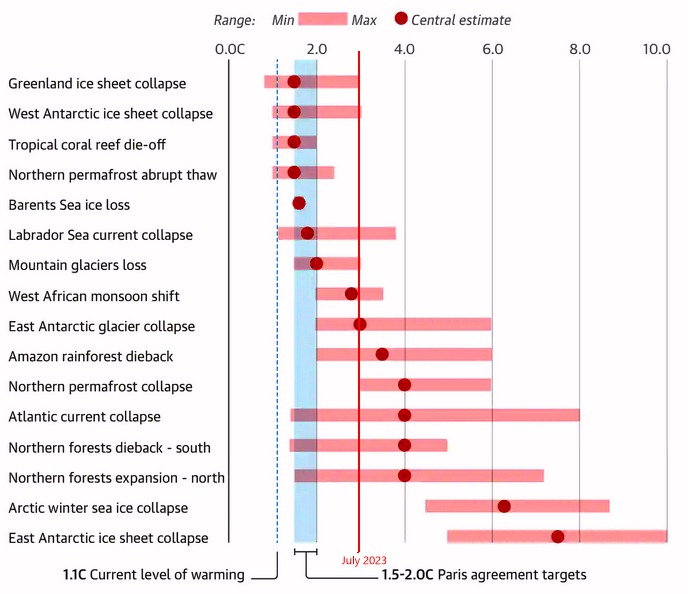
Tipping points are Critical Milestones that directly impact the rate of acceleration in climate change by multiplying the number and intensity of feedback loops.

Tipping Points


Push a glass toward the edge of a table and eventually it will fall off on its own. No matter how slowly or meticulously you push… no matter how you weight or fill the glass, it will reach a tipping point and fall off before being pushed completely off the table. No matter whether you believe the glass is half-empty or half-full, when the tipping point is reached it will plummet out-of-control to its end. This is science not fate, faith, nor belief. Human induced climate change has resulted in environmental tipping points being breached.

Tipping points, when crossed, trigger self-sustaining feedback loops that are no longer dependent on human activity. Similar to when a domino topples over hitting two more dominoes that in turn fall hitting more dominoes. Thus, the name The Domino Effect. It can also be visualized as The Snowball Effect. A tipping point is like a snowball rolling down a hill growing in mass and velocity (momentum). When a tipping point is crossed, it results in cumulative and reinforced global warming.

A look at six (6) of the multiple tipping points that show the proverbial snowball is already rolling. The first dominoes have fallen and will continue to knock down more tiles with each escalating step.

  • Mountain Glacier Loss
  • Greenland Ice Sheet Collapse
  • Antarctic Ice Sheet Collapse
  • Collapse of AMOC (Atlantic Meridional Overturning Circulation)
  • Amazon Rainforest Dieback
  • Northern Permafrost Collapse

.

Climate Change Review 2023

Sidd said, “Do you remember back in the early 2000’s when we thought we wouldn’t live to see the extreme changes due to global warming?”

Daniel replied, “I think 2023 is the most significant year so far. We saw confirmation of tipping points being crossed for Mountain Glacier Loss, Greenland Ice Sheet Collapse, Antarctic Ice Sheet Collapse, and potentially the Collapse of AMOC.”

Sidd continued, “We already knew that. It was Canada catching on fire that I could not believe. I never thought I’d live to see the day.”

Daniel asked, “Do you think the permafrost and peatlands will have zombie fires and cause the permafrost tipping point?”

Sidd responded, “Yes. They are gone, too. We already know from the permafrost peatland fires in Siberia.”

Daniel ponders, “Hmmmm… I guess that means my plan went up in smoke? My worst case scenario / last resort emergency plan was to escape to Canada.”

NASA reported: Wildland fire experts have described Canada’s 2023 fire season as record-breaking and shocking. Over the course of a fire season that started early and ended late, blazes have burned an estimated 18.4 million hectares. Hundreds of fires exceeded 10,000 hectares (39 square miles), large enough to be considered “megafires.” These megafires were also unusually widespread this season, charring forests from British Columbia and Alberta in the west to Quebec and the Atlantic provinces in the east to the Northwest Territories and the Yukon in the north.

Forest fires cause a carbon feedback loop. The carbon emissions of Canada’s fires outweighed the combined emissions from its oil and gas, transport and agriculture sectors. The fires also cause the melting of the permafrost and zombie fires to burn in the permafrost. The permafrost collapse is a self-sustaining feedback loop/tipping point. As the permafrost melts, the peatlands emit CO2 and methane. The increase in CO2 and methane results in more warming that results in more peatland emissions. A third feedback loop is created with lightning strikes. The study Forests at Risk Due to Lightning Fires found a sensitivity of extratropical intact forests to potential increases in lightning fires, which would have far-reaching consequences for terrestrial carbon storage and biodiversity. The results show that, on a global scale, lightning is the primary ignition source of fires in temperate and boreal forests. Global warming causes more extreme weather events and conditions for lightning creating more forest fires that create more warming and more lightning strikes.

The study Wildfire as a major driver of recent permafrost thaw in boreal peatlands published in the Journal Nature Communications found wildfires have caused a quarter of permafrost thaw (2,000 square kilometres) in Western Canada’s boreal peatlands over the past 30 years. “Historically, permafrost in this area underwent a natural cycle of thawing and reforming, but given current climate conditions and projections for the future, this fire-induced thaw appears to be irreversible,” said Carolyn Gibson, who conducted the research.

On January 1, 2024, the article, Why Are Alaska’s Rivers Turning Orange?, was published in Scientific America. “Streams in Alaska are turning orange with iron and sulfuric acid. Scientists who have studied these rusting rivers agree that the ultimate cause is climate change. Kobuk Valley National Park has warmed by 2.4 degrees Celsius (4.32 degrees Fahrenheit) since 2006 and could get another 10.2 degrees C hotter by 2100, a greater increase than projected for any other national park. The heat may already have begun to thaw 40 percent of the park’s permafrost, the layer of earth just under the topsoil that normally remains frozen year-round. McPhee wanted to protect the Salmon River because humans had ‘not yet begun to change it.’ Now, less than 50 years later, we have done just that. The last great wilderness in America, which by law is supposed to be ‘untrammeled by man,’ is being trammeled from afar by our global emissions.”
— from Toppled Tipping Points: The Domino Effect / Brouse and Mukherjee (2023)

What Can I Do?
There are plenty of things you can do to help save the planet. Stop using fossil fuels. Consume less. Love more. Here is a list of additional actions you can take.

A song about The Human Induced Climate Change Experiment

bookmark_borderChange the Climate Change

LYRICS
The human race
Must’ve replaced
The natural space
With distaste
The human race
Must’ve misplaced
A loving heart
Lost in the dark
Start with a spark
Go up on a lark
If we dare to
Go up on a lark
Do you care, too?
Change the climate change
Rearrange deranged
Exchange short-change
Estrange estrange
Is that so strange?

The human race
Must’ve erased
Without a trace
Natural space
The human race
Must’ve misplaced
A loving heart
Lost in the dark
Start with a spark
Go up on a lark
If we dare to
Go up on a lark
Do you care, too?
Change the climate change
Rearrange deranged
Exchange short-change
Estrange estrange
Is that so strange?

Hey, human race
The facts face
Our natural space
Laid to waste
Give light a taste
Let’s make haste
Out of the dark
A loving heart
Start with a spark
Go up on a lark
If we dare to
Go up on a lark
Do you care, too?
Change the climate change
Rearrange deranged
Exchange short-change
Estrange estrange
Is that so strange?

Chords: Em C AM B7 / B7 E / C A D E / C Am B7 / B7 Em ; Part III @ 128 Beats Per Minute
Instrumentation: Vocals (TC-Helicon VOICELIVE and MiniNova Vocorder), Ibanez Acoustic Guitar, Ibanez RG Series Electric Guitar (Boss Digital Delay), Fender Jazz Bass (Boss Digital Delay), Keyboards (Korg PS60, Casio WK-3500, Yamaha PSR-740, MiniNova, MicroKorg

Global warming has caused irreparable damage to our environment. Almost all scientists agree that IN FACT climate change is a problem. Our planet is becoming unfit for human life. Now the question is can we adapt in time? (1999)

“In general, as energy is added to a system, the fluctuations in the system increase. So, we expect more storms, more droughts, more wildfires, more floods, more fluctuations of all kinds. What we are saying is that weather conditions will become more volatile due to the impact of humans,” said Mukherjee and Brouse. (2004)

In 2023, we wrote about having crossed tipping points in the paper, “Climate Change: How Long Is ‘Ever’?“. When we wrote the Tunnel Under Thesis in 1995, we forecast crossing these tipping points would not happen for centuries. We underestimated Man’s ignorance and arrogance. Fossil fuel consumption and greenhouse gas emissions have continued to set record highs. Humans have caused chain-reactions resulting in toppled tipping points, feedback loops, and The Domino Effect.

What Can I Do?
There are plenty of things you can do to help save the planet. Stop using fossil fuels. Consume less. Love more. Here is a list of additional actions you can take.

A song about The Human Induced Climate Change Experiment

bookmark_borderAnomalies Multiply

LYRICS
What we used to call winter
Is now barely a shiver
Try not to get bitter
Waiting for Man to deliver

Anomalies multiply
Like zombies, never die
Trying to get to laughter
Clawing through disaster

If you look just right
A splinter of light
Can we fight for delight
Get more light in sight?
Well alright!
Make it
Bright tonight
Take it
On outright

If you’re one to show
Please say so
If you’re one to shine
Shine on mine
Any time

If you look just right
A river of light
We might find delight
Get more light in sight?
Well alright!
Make it
Bright tonight
Take it
On outright

If you’re one to show
Please say so
If you’re one to shine
Shine on mine
Any time

Chords: Bbm Fm C7 Fm / Fm F / Eb F / Eb Db F; Part II @ 110 Beats Per Minute
Instrumentation: Vocals (TC-Helicon VOICELIVE and MiniNova Vocorder), Ibanez Acoustic Guitar, Ibanez RG Series Electric Guitar (Boss Digital Delay), Fender Jazz Bass (Boss Digital Delay), Keyboards (Korg PS60, Casio WK-3500, Yamaha PSR-740, MiniNova, MicroKorg)

Human induced climate change is an exponential component of an unordered system (chaos theory). That means global warming is accelerating at a rapid rate in a complex way.

2023: The Hottest Year in Human History
2023 was a wake-up call to both biogeophysical and social-ecological scientists. The record breaking physical and economical impacts could be felt worldwide. The record warming year was seventeen times greater than any other record increase in history. Typically record breaking temperatures are measured in 100th degrees. The graphic shows how far out of skew the 2023 anomalies are compared to the previous record set in 2016. There were also 200 consecutive days of record breaking temperatures. Typically there are one or two record breaking days in row. The increase in intensity and frequency of record breaking heat requires forecasting models to be recast.

— from Tipping Cascades, Social-Ecological Systems, and the Hottest Year in History / Brouse (2024)

What Can I Do?
There are plenty of things you can do to help save the planet. Stop using fossil fuels. Consume less. Love more. Here is a list of additional actions you can take.

A song about The Human Induced Climate Change Experiment

bookmark_borderSocial-Ecological Systems

LYRICS
Another day of pounding rain
Another day of going insane
Atmospheric rivers
Hysterics delivers
Ain’t no self-restraint

Another night of howling winds
Another night knocked down and pinned
Atmospheric rivers
Hysterics delivers
Ain’t no self-restraint

Another year of record heat
Another year be tough to beat?
Atmospheric rivers
Hysterics delivers
Ain’t no self-restraint

The air above
Needs our love
And you know
The land below

The skis above
Need our love
Can’t see the sea nearly

More pollution
No solution
Institution
Of confusion
Depending on
Carrying on
But this can’t to on and on
… and on

Chords: Em C Em / C D / D C Em / Am Em Bm Em / AM C / C B7 Em; Part II @ 104 Beats Per Minute
Instrumentation: Vocals (TC-Helicon VOICELIVE and MiniNova Vocorder), Ibanez Acoustic Guitar, Ibanez RG Series Electric Guitar (Boss Digital Delay), Fender Jazz Bass (Boss Digital Delay), Keyboards (Korg PS60, Casio WK-3500, Yamaha PSR-740, MiniNova, MicroKorg)

ABOUT THE SONG
In September of 2023, the Philadelphia Inquirer reported, “The remnants of Tropical Storm Ophelia soaked the entire Philadelphia region with episodic downpours on Saturday, the first day of fall, conspiring to incite 60-mph wind gusts at the Shore and high-tide flooding that closed numerous roads in beach and back-bay towns.” There were up to 8 inches of rain recorded throughout the Philadelphia region over the three day event.

The winter of 2023 saw near weekly atmospheric river flash flooding events. On January 9, the Greater Philadelphia Region incurred an historic winter tropical violent rain event. CBS news reported, “If it feels like it’s been an abnormally rainy few weeks, you’re right. Normal rainfall totals between Dec. 1 and Jan. 9 amount to about 4.78 inches. Between December 2023 and Tuesday, we’d already recorded more than 9 inches of rain, an amount normally recorded in December, January and February combined.” The January 9 storm brought over 4 inches of rain to many areas. The Delaware River peaked at its highest level ever. There were hurricane strength winds with wind gusts over 70mph.

This song was written and recorded on January 9, 2024 during the storm. Upon starting the electric “plugged-in” version, we lost power for the first out of five times. The version is called “Social-Ecological-Systems-Power-Outage.mp3”. The studio was put on battery back-up for the remainder of the recording session.

The original intent of the song was to highlight the Social-Ecological risks of climate change.

Human induced climate change is an exponential component of an unordered system (chaos theory). That means global warming is accelerating at a rapid rate in a complex way.

Unfortunately, even scientists are failing to see (let alone forecast) the rapid acceleration in climate change. Due to their complexity, the impacts of the Domino Effect are being underestimated. Tipping points are Critical Milestones that directly impact the rate of acceleration in climate change by multiplying the number and intensity of feedback loops. The Domino Effect is also known as “tipping cascades” in climate science. Cascading impacts in relation to tipping points include cascading impacts across biogeophysical and social systems. Until recently, scientist have been drastically underestimating the social-ecological systems. The University of Exeter reports, “There is a notable lack of topic clusters dedicated to how humans will be impacted by climate-related tipping cascades.”

2023 was a wake-up call to both biogeophysical and social-ecological scientists. The record breaking physical and economical impacts could be felt worldwide. The record warming year was seventeen times greater than any other record increase in history. Typically record breaking temperatures are measured in 100th degrees. There were also 200 consecutive days of record breaking temperatures. Typically there are one or two record breaking days in row. The increase in intensity and frequency of record breaking heat requires forecasting models to be recast.

Read the full articles:

The Reign of Violent Rain Brouse and Mukherjee (2023-2024)

The Age of Loss and Damage Brouse (2023)

Tipping Cascades, Social-Ecological Systems, and the Hottest Year in History Brouse (2024)

Climate Change: How Long Is “Ever”? Brouse (2023)

Climate Change: The End of Times Brouse and Mukherjee (2023)

What Can I Do?
There are plenty of things you can do to help save the planet. Stop using fossil fuels. Consume less. Love more. Here is a list of additional actions you can take.

A song about The Human Induced Climate Change Experiment

bookmark_borderPresenting the Future

LYRICS
Once it’s already happening
It’s a little too late to wait
The voice of experience
Has been waiting for this date
Anticipate
The future’s sure to come
Presenting as the present
Soaking in the freedom
Let the message be sent

An ounce of prevention
Is worth a pound of cure
Our human intervention
Makes it all the more sure
Who will endure?
The future’s sure to come
Presenting as the present
Soaking in the freedom
Let the message be sent

The barn doors opening
Is swinging oh so wide
It’s midnight reckoning
We’re out of time to bide
Look far and wide?
The future’s sure to come
Presenting as the present
Soaking in the freedom
Let the message be sent

Chords: C D/7 C D/7 / D/ C G / G D7 D7 G (Part I D7 / Part II D); Part II @ 92 Beats Per Minute
Instrumentation: Vocals (TC-Helicon VOICELIVE and MiniNova Vocorder), Ibanez Acoustic Guitar, Ibanez RG Series Electric Guitar (Boss Digital Delay), Fender Jazz Bass (Boss Digital Delay), Keyboards (Korg PS60, Casio WK-3500, Yamaha PSR-740, MiniNova, MicroKorg)

ABOUT THE SONG
Human induced climate change is an exponential component of an unordered system (chaos theory). That means global warming is accelerating at a rapid rate in a complex way.

Unfortunately, even scientists are failing to see (let alone forecast) the rapid acceleration in climate change. Due to their complexity the impacts of the Domino Effect are being underestimated. Tipping points are Critical Milestones that directly impact the rate of acceleration in climate change by multiplying the number and intensity of feedback loops. The Domino Effect is also known as “tipping cascades” in climate science. Cascading impacts in relation to tipping points include cascading impacts across biogeophysical and social systems. Until recently, scientist have been drastically underestimating the social-ecological systems. The University of Exeter reports, “There is a notable lack of topic clusters dedicated to how humans will be impacted by climate-related tipping cascades.”

The Age of Loss and Damage is a new way of thinking about economics by combining economics, climate science, statistics, and physics. Until now, economic models have been unfit to capture the full extent of climate damage. Traditionally, “integrated assessment models” (IAMs) were used to forecast “shock” events. IAMs use “quadratic function” to calculate GDP losses by squaring the temperature change, yet ignore other methods (such as the exponential function) that are better suited for rapid change. “Climate change is fundamentally different to other shocks because once it has hit, it doesn’t go away,” said Thierry Philipponnat, author of a report by Finance Watch, a Brussels-based public interest NGO on financial issues. “And if the fundamental assumption is flawed, all the rest makes little sense — if any.”

Reuters reported, “Critics say this (IAMs) choice is doomed to underplay the likely impact – particularly if the planet hits environmental tipping points in which damage is not only irreversible but happens at an ever-accelerating rate.” Thierry Philipponnat’s report, Finance in a Hot House World, concludes: “Climate risk is growing to disruptive levels throughout the financial system and the guardians of financial stability urgently need to adapt their tools to regain control.” The report calls for economic models that do not mislead, scenario analyses that prepare the market, and a new prudential tool to address the build-up of systemic climate risk.

Traditional economics is based upon the “costs and benefits” to society. Since there are no known long-term benefits of climate change to society, the Age of Loss and Damage economics focuses on the exponential costs of climate change to society.

— from The Age of Loss and Damage Brouse (2023)

What Can I Do?
There are plenty of things you can do to help save the planet. Stop using fossil fuels. Consume less. Love more. Here is a list of additional actions you can take.

A song about The Human Induced Climate Change Experiment

bookmark_borderPowers of Ours

LYRICS
So hard to hang on
When you must let go
Why must we hang on
’cause the Jones say so?
Been time to move on
Since we curbed to grow
Grow your mind
Grow your kind
Grow our powers
The fruits of flowers
Ours

So hard to hang on
When you must let go
Why must we hang on
Clutch of ego?
Been time to move on
Since we curbed to grow
Grow your mind
Grow your kind
Grow our powers
The fruits of flowers
Ours

So hard to hang on
When you must let go
Why must we hang on
Does anybody know?
Been time to move on
Since we curbed to grow
Grow your mind
Grow your kind
Grow our powers
The fruits of flowers
Ours

Chords: Em A7 / C E E / E Em 7sus4 7 7(11); Part II @ 184 / 92 Beats Per Minute
Instrumentation: Vocals (TC-Helicon VOICELIVE and MiniNova Vocorder), Ibanez Acoustic Guitar, Ibanez RG Series Electric Guitar (Boss Digital Delay), Fender Jazz Bass (Boss Digital Delay), Keyboards (Korg PS60, Casio WK-3500, Yamaha PSR-740, MiniNova, MicroKorg)

bookmark_borderJust Look

LYRICS
The way things are going
Can’t keep pretending
We don’t know
The way things are warming
Makes us far less charming
As if we don’t know
It’s time to go
Just look outside your window
The weather outside is frightful
Insightful blow

The increasing forces
With the power of horses
Start to flow
The way things are warming
Makes us far less charming
As if we don’t know
It’s time to go
Just look outside your window
The weather outside is frightful
Insightful blow

Volatile violent rain
In and out of my brain
Movements slow
The way things are warming
Makes us far less charming
As if we don’t know
It’s time to go
Just look outside your window
The weather outside is frightful
Insightful blow

Increasing strange
In the Age of Damage
Rearrange
What you know
The way things are warming
Makes us far less charming
As if we don’t know
It’s time to go
Just look outside your window
The weather outside is frightful
Insightful blow

Chords: F# DEM7 F# / B D C#7 F#; Part II @ 112 Beats Per Minute
Instrumentation: Vocals (TC-Helicon VOICELIVE and MiniNova Vocorder), Ibanez Acoustic Guitar, Ibanez RG Series Electric Guitar (Boss Digital Delay), Fender Jazz Bass (Boss Digital Delay), Keyboards (Korg PS60, Casio WK-3500, Yamaha PSR-740, MiniNova, MicroKorg)

ABOUT THE SONG
When I asked Sidd for advice in combating climate change deniers, he said, “Just tell them to look out their window.”

The way things are warming
September 6, 2023: “Climate breakdown has begun,” the United Nations Secretary-General Antonio Guterres warned the world after the World Meteorological Organization (WMO) reported the world endure its hottest Northern Hemisphere summer in human history. “The dog days of summer are not just barking, they are biting,” the UN chief said in a statement after the report’s release.

The increasing forces
Wind and water flow forces scale as the square of velocity, so as flow speeds increase (say due to more intense heating or heavier rain) the damage scales as the square of the velocity. Look at drag physics and you will see that force is proportional to density times square of velocity (v^2).

Volatile violent rain
Multiple factors figure into the physics of violent rain. The starting point is the moisture content of air. The Earth is warming. Warm air can physically hold more water than cool air. The warmer the air the more water vapor the air can hold (i.e. relative humidity). The capacity doubles for every ten degree Celsius warming.

One physical result is more massive raindrops. The Momentum of Rain is p = mv (p = momentum, m = mass, v = velocity.) Part of the increasing momentum is transferred to the sides and upward increasing wind turbulence, as well as updrafts. Most of the momentum is transferred upon impact. You may notice the rain bouncing higher off the streets and sidewalks. Flowing rainwater will have both increased mass and velocity.

On the ground, concrete, asphalt, solar panels, roofs, plants, animals, houses, and infrastructure will be hit with greater momentum. In the air, the increasing mass of the rain will intensify wind turbulence. Professor Paul D. Williams of the University of Reading, UK, said, “Turbulence is chaotic (chaos theory). Turbulence is known famously as the hardest problem in physics.” In their study Evidence for Large Increases in Clear-Air Turbulence Over the Past Four Decades, Prof. Williams and his team found “Climate change has caused turbulence to double in the last 40 years” and is expected to double or triple again in the next decades.

In the Age of Damage
“For people, for other species, for the ecosystems, for the world we live in, we’ve entered the Age of Loss and Damage, but we’re just at the start. What we are seeing already just makes you want to cry,” said Dr. Christopher Trisos (BBC Interview / MP3 Format) from the University of Cape Town. “We can’t eliminate loss and damage. It is here. That said, there is a lot we can do to limit it.”

What Can I Do?
There are plenty of things you can do to help save the planet. Stop using fossil fuels. Consume less. Love more. Here is a list of additional actions you can take.

A song about The Human Induced Climate Change Experiment

bookmark_borderUnrecognizable

LYRICS
Am I alone
Can’t recognize home
What’s our climate zone
Can’t recognize home
Goldilocks? Not.
Temperatures too hot
The air is too, too thick
Make ya gag
Make ya sick
Do something….
Quick!

Where’s my beautiful music?
Peace, love, and understanding
Man’s demanding reprimanding
My piece of love notwithstanding

Am I alone
Can’t recognize home
What’s our climate zone
Can’t recognize home
Goldilocks? Not.
Little Bo-peep deep
Water’s way too thick
Make ya gag
Make ya sick
Do something….
Quick!

Where’s my beautiful music?
Peace, love, and understanding
Man’s demanding reprimanding
My piece of love notwithstanding

Am I alone
Can’t recognize home
What’s our climate zone
Can’t recognize home
Goldilocks? Not.
Like flies dying to drop
Way too soft up in the loft
Ain’t no gag
Are we sick
Do something….
Quick!

Where’s my beautiful music?
Peace, love, and understanding
Man’s demanding reprimanding
My piece of love notwithstanding

Chords: F Bb F / Ab Bb / Db C7 F / Eb Bb F; Part II @ 102 Beats Per Minute
Instrumentation: Vocals (TC-Helicon VOICELIVE and MiniNova Vocorder), Ibanez Acoustic Guitar, Ibanez RG Series Electric Guitar (Boss Digital Delay), Fender Jazz Bass (Boss Digital Delay), Keyboards (Korg PS60, Casio WK-3500, Yamaha PSR-740, MiniNova, MicroKorg)

Human induced climate change is an exponential component of an unordered system (chaos theory). That means global warming is accelerating at a rapid rate in a complex way.

From 1992 through 2023, we presented evidence and suggested remedies to mitigate climate change. By 2023, the data was undeniable that human induced climate change is destroying our habitat at a rapidly increasing rate.

“For people, for other species, for the ecosystems, for the world we live in, we’ve entered the Age of Loss and Damage, but we’re just at the start. What we are seeing already just makes you want to cry,” said Dr. Christopher Trisos (BBC Interview / MP3 Format) from the University of Cape Town. “We can’t eliminate loss and damage. It is here. That said, there is a lot we can do to limit it.”

September 6, 2023: “Climate breakdown has begun,” the United Nations Secretary-General Antonio Guterres warned the world after the World Meteorological Organization (WMO) reported the world endure its hottest Northern Hemisphere summer in human history. “The dog days of summer are not just barking, they are biting,” the UN chief said in a statement after the report’s release.

At what rate is climate change accelerating?
A: Rapidly
As described above, we do not know the rate of acceleration other than to say it is more rapid than previously thought. In the summer of 2023, the extreme temperatures left most climate scientists shocked. The average earth surface temperature recorded record highs for months reaching over 3 degrees Celsius above pre-industrial levels. The Paris Agreement calls for keeping temperatures below 1.5 degrees. Scientists concur that a rise of 2 degrees will trigger feedback loops and tipping points. Triggering these tipping points results in the CO2 stored in nature to be released at an exponential growth rate. How extreme the acceleration will be depends on tipping points toppling other tipping points in what is known as The Domino Effect. Toppled tipping points will continue to shrink the doubling time and exponentially increase the rate of global warming. Though we do not know how much carbon is stored in nature, it would be reasonable to assume that the temperature could be pushed from 3 degrees to 6 degrees above pre-industrial levels. Humans can not thrive above a rise of 1.5 degrees. Humans can not survive if the temperature rises 6 degrees.

About the 2023 wildfires in Hawaii, Governor Josh Green said, “For perspective, we’ve had six fire emergencies this August, we had six fire emergencies between 1953 and 2003. That’s how- how fast things are changing. I know that there is debate out there whether we should be talking about climate change or not. Well, let’s be real world, climate change is here we are in the midst of it with a hotter planet, and fiercer storms.”

About the catastrophic die-off of 10,000 emperor penguin chicks in the Antarctic, Dr. Caroline Holmes of the British Antarctic Survey (an expert on Antarctic sea-ice) said, “What we’re seeing right now is so far outside what we’ve observed previously. We expected change but I don’t think we expected so much change so rapidly.”

Some areas of the world are now warming so fast, it is becoming more difficult to measure the change from “normal” or average. Jeff Boyne, National Weather Service meteorologist and climatologist, said, “There are climate normals that are updated every 10 to 15 years, because the planet is warming so fast. The ENSO (El Nino-Southern Oscillation) regions are warming so fast that those normals are being updated every 5 years.”

“It’s so far outside anything we’ve seen, it’s almost mind-blowing,” says Walter Meier, who monitors sea-ice with the National Snow and Ice Data Center. “September was, in my professional opinion as a climate scientist, absolutely gobsmackingly bananas,” said Zeke Hausfather, at the Berkeley Earth climate data project.”
— from Climate Change: Rate of Acceleration Brouse and Mukherjee (2023)

What will the “End of Times” look like?
“The era of global warming has ended and the era of ‘global boiling’ has arrived. Climate change is here. It is terrifying. And it is just the beginning”, UN secretary general, António Guterres, said after scientists confirmed July 2023 was on track to be the world’s hottest month on record.

In 2023, we wrote about having crossed tipping points in the paper, “Climate Change: How Long Is ‘Ever’?“. When we wrote “The Impact of Governance & Globalization on Forecasting (The Tunnel Under Thesis)” in 1995, we forecast crossing these tipping points would not happen for centuries. We underestimated Man’s ignorance and arrogance. Fossil fuel consumption and greenhouse gas emissions have continued to set record highs. Humans have caused chain-reactions resulting in toppled tipping points, feedback loops, and The Domino Effect.
— from Climate Change: The End of Times Brouse and Mukherjee (2023)

What Can I Do?
There are plenty of things you can do to help save the planet. Stop using fossil fuels. Consume less. Love more. Here is a list of additional actions you can take.

A song about The Human Induced Climate Change Experiment

bookmark_borderI-lands

LYRICS
What you
know
And what you don’t know
About the flow
The force, the blow
Change course
(Well, of course)
Change course
Of what you know
Crevice
Culvert
Crevices
Culverts
Create caves
(Depends on how Man behaves)
Conduits
Dividing us
On to “I”-lands
Understand
Where non one stands
The damned demands of…
Oh, man
A man
Men,
Amen
Ohh… woe…
Woman
Women
All to often

I-lands.mp3

Chords: F#m / E6 B7 F#m / G#m Gm F#m / A7 F#m
Instrumentation: Vocals, Takamine Acoustic Guitar
Written and recorded at Lake Wynonah, Pennsylvania.

Sidd reiterated, “I would be more careful about the violent rain than the ice melt.” Expect to see increasing intensity and/or frequency in a wide variety of violent rain events including: downpours, flooding, hurricanes, cyclones, monsoons, coastal flooding, storm surges, lightning and wildfires, hail, extreme wind, and concurrent extremes. The reign of violent rain has already begun. More hillsides and shorelines are collapsing. Atmospheric rivers are dramatically increasing flash flooding in the Northeastern USA. Worldwide, stormwater systems are becoming overwhelmed. Ironically, the streets of Abu Dhabi and Dubai, UAE, flooded days before the COP28 Climate Conference. Nowhere is safe from violent rain, not even in the desert preparing for a UN meeting on the climate crisis. As a result of increasing violent rain, new drainage culverts are forming. Eventually, the culverts will transform into recurring streams, carving new canyons, creating new landscapes and islands. In addition, extreme weather events are increasing the frequency of lightning storms and wildfires. After wildfires, rain deluges cause massive landslides transforming the topography. At the same time as the violent rain makes its way to the sea, the sea is rising to meet the violent rain.

In the article “Violent Rain and the Substrate,” archaeologist Greg Laden said, “With a little erosion, the Hudson, Lake Champlain, and the St. Lawrence could become contiguous, so New England becomes an Island.”

Violent Rain
Multiple factors figure into the physics of violent rain. The starting point is the moisture content of air. The Earth is warming. Warm air can physically hold more water than cool air. The warmer the air the more water vapor the air can hold (i.e. relative humidity). The capacity doubles for every ten degree Celsius warming.

One physical result is more massive raindrops. The Momentum of Rain is p = mv (p = momentum, m = mass, v = velocity.) Part of the increasing momentum is transferred to the sides and upward increasing wind turbulence, as well as updrafts. Most of the momentum is transferred upon impact. You may notice the rain bouncing higher off the streets and sidewalks. Flowing rainwater will have both increased mass and velocity.

On the ground, concrete, asphalt, solar panels, roofs, plants, animals, houses, and infrastructure will be hit with greater momentum. In the air, the increasing mass of the rain will intensify wind turbulence. Professor Paul D. Williams of the University of Reading, UK, said, “Turbulence is chaotic (chaos theory). Turbulence is known famously as the hardest problem in physics.” In their study Evidence for Large Increases in Clear-Air Turbulence Over the Past Four Decades, Prof. Williams and his team found “Climate change has caused turbulence to double in the last 40 years” and is expected to double or triple again in the next decades.

Mass and velocity are parts of a larger equation that also includes density.The combination of these variables results in an increased intensity of the flow forces (i.e. flow dynamics). Wind and water flow forces scale as the square of velocity, so as flow speeds increase (say due to more intense heating or heavier rain) the damage scales as the square of the velocity. Look at drag physics and you will see that force is proportional to density times square of velocity (v^2).

So a twenty mile an hour wind exerts four times as much force as a ten mile an hour wind. And a forty mile an hour wind exerts sixteen times as much force as a ten mile an hour wind. A wind of fifty miles an hour exerts twenty five times and a wind of sixty miles an hour exerts thirty six times as much force as one of ten miles an hour. Then you have the density term. Water is about eight hundred times denser than air, so the force exerted by a ten mile an hour flow of water is eight hundred times that of a ten mile an hour wind. As flow velocities go up due to climate change, force and damage scale as square of the velocities. What is not clear is how much these velocities increase with climate change. But in a sense we are seeing this already as, for example, flood and sewage systems succumb and hillsides fall down, and so on.
— from The Reign of Violent Rain / Brouse and Mukherjee (2023)

The Drag Equation

What you can do today. How to save the planet.

A song about The Human Induced Climate Change Experiment

bookmark_borderTill Tomorrow

LYRICS
Sitting on high
Looking below
On days gone by
Till tomorrow
As days go past
Can’t help but ask
How can this last
Till tomorrow?
I don’t know
[Don’t listen to the voices in your head
Don’t listen. You’ve choices.
In your head
Position
Straight ahead
In your head
Straight ahead]
Let it be said:
Get it on high
Just look below
it’s do or die
Till tomorrow
As days go past
Can’t help but ask
How can this last
Till tomorrow?
I don’t know
[Don’t listen to the voices in your head
Don’t listen. You’ve choices.
In your head
Position
Straight ahead
In your head
Straight ahead]
Let it be said:
Turn love on high
Above below
Give our best try
Till tomorrow
As days go past
Can’t help but ask
How can this last
Till tomorrow?
I don’t know
[Don’t listen to the voices in your head
Don’t listen. You’ve choices.
In your head
Position
Straight ahead
In your head
Straight ahead]
Let it be said

Chords: Em C D Em / Em Bm A7 Em / Em/7
Instrumentation: Vocals, Takamine Acoustic Guitar, Kurzweil PC88 Electric Piano
Written and recorded at Lake Wynonah, Pennsylvania during sunset.

What will the “End of Times” look like?

“The era of global warming has ended and the era of ‘global boiling’ has arrived. Climate change is here. It is terrifying. And it is just the beginning”, UN secretary general, António Guterres, said after scientists confirmed July 2023 was on track to be the world’s hottest month on record.

In 2023, we wrote about having crossed tipping points in the paper, “Climate Change: How Long Is ‘Ever’?“. When we wrote the Tunnel Under Thesis in 1995, we forecast crossing these tipping points would not happen for centuries. We underestimated Man’s ignorance and arrogance. Fossil fuel consumption and greenhouse gas emissions have continued to set record highs. Humans have caused chain-reactions resulting in toppled tipping points, feedback loops, and The Domino Effect.

There will be enough ice melt to raise sea levels 220 feet. We estimate 270 feet to be “the minimum safe” elevation to live. High-tides, waves, coastal flooding, storm surge, grade of shoreline, etc. would make the lowest elevations for living space to be at least 270 feet above pre-industrial sea levels. This would be the minimum elevation. Personally, I would not want to live that low. As the water submerges sewage treatment plants, landfills, chickens, cows, and all sorts of other bio-hazards, the waters will become toxic. In addition, much of the land will experience salinization making it unfit for plant life. Another concern for elevations under 800 feet is living on an island. Many locations at lower elevations will become isolated. Living on an island has many problems including fresh water, food, shelter, and healthcare. Security from pirates pilfering, raping, and plundering will likely be the overriding concern. Of course, I don’t expect that to happen for millennia, but I hope government planners do plan for it now. If you look at Florida as an example, parts of the coastline have seen sea levels rise over 14-20 feet in the last decade. Although the storm surge was only for hours, you wouldn’t want to live there during those hours. Not to mention, the frequency of these extreme weather events will rise exponentially. Thus, our recommendation to evacuate Florida now (i.e. Managed Retreat). The billions of dollars spent to rebuild after Hurricane Ida will all be for naught. Allowing building there will needlessly endanger property and lives. Parts of the world have already seen storm surges of 40 feet. I expect most North American coastlines will see sea levels rise, if only temporarily, by 20-40 feet this century. As far as long run sea level rise, much will depend on location, gravity, isostatic adjustment, and thermal expansion. If the ocean temperatures get warm enough (thermal expansion), parts of the world may see sea levels rise to 270 feet for long periods of times. Other parts of the world, like Greenland, may actually see sea levels decline. In any event, the Earth crossed tipping points this decade which make extreme sea level rise inevitable and irreversible in our lifetimes. Planners should plan on it.

Sidd reiterated, “That 270 feet will take a long time. I would be more careful about the violent rain than the ice melt.” Expect to see increasing intensity and/or frequency in a wide variety of violent rain events including: downpours, flooding, hurricanes, cyclones, monsoons, coastal flooding, storm surges, lightning and wildfires, hail, extreme wind, and concurrent extremes. The reign of violent rain has already begun. More hillsides and shorelines are collapsing. Atmospheric rivers are dramatically increasing flash flooding in the Northeastern USA. Worldwide, stormwater systems are becoming overwhelmed. Ironically, the streets of Abu Dhabi and Dubai, UAE, flooded days before the COP28 Climate Conference. Nowhere is safe from violent rain, not even in the desert preparing for a UN meeting on the climate crisis. As a result of increasing violent rain, new drainage culverts are forming. Eventually, the culverts will transform into recurring streams, carving new canyons, creating new landscapes and islands. In addition, extreme weather events are increasing the frequency of lightning storms and wildfires. After wildfires, rain deluges cause massive landslides transforming the topography. At the same time as the violent rain makes its way to the sea, the sea is rising to meet the violent rain.

In the article “Violent Rain and the Substrate,” Greg Laden, coastal archaeologist, said, “With a little erosion, the Hudson, Lake Champlain, and the St. Lawrence could become contiguous, so New England becomes an Island.”

For any remaining humans, fresh air, water, food, and sunlight will all be problematic; however, your most severe concern will likely be security. Those with supplies will be at high risk of being raped and looted. Good luck!
— from Climate Change: The End of Times / Brouse and Mukherjee (2023)

What you can do today. How to save the planet.

bookmark_borderMy Slice of Pi

LYRICS
Ready to help with everything I know
Ready to help from the get-go
Eager to spur imagination to grow
From the thoughts we’re about to sow
Here we go!
Are you sure?
Do you ask why?
What’s the pi of our pie
Do you know
The ratio
The circumstance
Of the circumference
To the diameter
For sure
3.14 forever more

Yes, I yearn to learn to know
Start the heart and let it go
Eager to spur imagination to grow
From the thoughts we’re about to sow
Here we go!
Are you sure?
Do you ask why?
What’s the pi of our pie
Do you know
The ratio
The circumstance
Of the circumference
To the diameter
For sure
3.14 forever more

Mind’s a terrible thing to waste
Open the world and take a taste!
Eager to spur imagination to grow
From the thoughts we’re about to sow
Here we go!
Are you sure?
Do you ask why?
What’s the pi of our pie
What’s your piece
Being at peace?
What’s your slice?
Ain’t no game of dice
Do you know
The ratio
The circumstance
Of the circumference
To the diameter
For sure
3.14 forever more

Chords: F# A / F# B A / F# D E F# / A F# / F# A B C#7 N.C. F#; Part II @ 109 Beats Per Minute
Instrumentation: Vocals (TC-Helicon VOICELIVE and MiniNova Vocorder), Ibanez Acoustic Guitar, Ibanez RG Series Electric Guitar (Boss Digital Delay), Fender Jazz Bass (Boss Digital Delay), Keyboards (Korg PS60, Casio WK-3500, Yamaha PSR-740, MiniNova, MicroKorg)

ABOUT THE SONG
Are you doing everything you can to help make the world a better place? Are you trying to learn everything you can… or are you only worried about your own slice of the pie? Do you even know what your slice of the pie is?

Circles are mathematically similar. The circumference divided by the diameter equals the same value regardless of their size — 3.14. The value of the ratio of the circumference to the diameter is called π (Pi). Ironically, pi is called an irrational number. Pi a real number that cannot be written as a simple fraction. Pi has an “infinite decimal.” After the decimal point, the digits go on forever and ever — 3.141592653589793238462643383279502884197, etc. (but is usually rounded down to 3.14.)

Now you can figure out your slice of the pi.

What Can I Do?
There are plenty of things you can do to help save the planet. Stop using fossil fuels. Consume less. Love more. Here is a list of additional actions you can take.

bookmark_borderAny More

LYRICS
Not that sure
Any more
What’s in store
For your future
All depends
On what we do
Who up-ends the classic view
Decisions that we make
Give versus take
Will we wake?
(Gotta wake up. I’ve gotta wake up. You’ve gotta wake up. We’ve gotta wake up.)\

What came before
May come no more
What’s in store
For your future
All depends
On what we do
Who up-ends the classic view
Decisions that we make
Give versus take
Will we wake?
(Gotta wake up. I’ve gotta wake up. You’ve gotta wake up. We’ve gotta wake up.)\

The rains pour
More and more
What’s in store
For your future
All depends
On what we do
Who up-ends the classic view
Decisions that we make
Give versus take
Will we wake?
(Gotta wake up. I’ve gotta wake up. You’ve gotta wake up. We’ve gotta wake up.)

Chords: E7sus4 E / C D A C D E / E6 E E G A E / E G A / A G E; Part II @ 120 Beats Per Minute
Instrumentation: Vocals (TC-Helicon VOICELIVE and MiniNova Vocorder), Ibanez Acoustic Guitar, Ibanez RG Series Electric Guitar (Boss Digital Delay), Fender Jazz Bass (Boss Digital Delay), Keyboards (Korg PS60, Casio WK-3500, Yamaha PSR-740, MiniNova, MicroKorg)

What will be the changing topography caused by extreme rain events? You can kind-of imagine Eastern and Western North America as giant beaches with ever increasing atmospheric waves splashing down on us. The Gulf Coast will be hit from both sides. We to see increasing intensity and/or frequency in a wide variety of violent rain events including: downpours, flooding, hurricanes, cyclones, monsoons, coastal flooding, storm surges, lightning and wildfires, hail, extreme wind, and concurrent extremes. The reign of violent rain has already begun. More hillsides and shorelines are collapsing. Atmospheric rivers are dramatically increasing flash flooding in the Northeastern USA. Worldwide, stormwater systems are becoming overwhelmed. Ironically, the streets of Abu Dhabi and Dubai, UAE, flooded days before the COP28 Climate Conference. Nowhere is safe from violent rain, not even in the desert preparing for a UN meeting on the climate crisis. As a result of increasing violent rain, new drainage culverts are forming. Eventually, the culverts will transform into recurring streams, carving new canyons, creating new landscapes and islands. Increased wildfires and landslides will transform topography. At the same time as the violent rain makes its way to the sea, the sea is rising to meet the violent rain. What do you think will happen to the floodplains in North America?

— from The Reign of Violent Rain Brouse and Mukherjee (2023)

What Can I Do?
There are plenty of things you can do to help save the planet. Stop using fossil fuels. Consume less. Love more. Here is a list of additional actions you can take.

A song about The Human Induced Climate Change Experiment

bookmark_borderChange the Dial

LYRICS
The future that’s right ahead
Does it give us reason to dread?
Water over our head
At the rate it’s rising
Won’t be surprising
If lowlifes wind up dead
The moral of the story
Up to the neck in glory
Forever in denial
Upon dwindling isle
No sense waiting a while
Go on change the dial

Try a new station instead
The airwaves are overhead
Water upon our head
At the rate it’s rising
Won’t be surprising
If lowlifes wind up dead
The moral of the story
Up to the neck in glory
Forever in denial
Upon dwindling isle
No sense waiting a while
Go on change the dial

“Should have listened,” the wise man said
You can’t make drink…
… though you have led
Water feeding our head
At the rate it’s rising
Won’t be surprising
If lowlifes wind up dead
The moral of the story
Up to the neck in glory
Forever in denial
Upon dwindling isle
No sense waiting a while
Go on change the dial

Chords: A Bb A C A / C D A / A C E B E / G Bm E; Part II @ 100 Beats Per Minute
Instrumentation: Vocals (TC-Helicon VOICELIVE and MiniNova Vocorder), Ibanez Acoustic Guitar, Ibanez RG Series Electric Guitar (Boss Digital Delay), Fender Jazz Bass (Boss Digital Delay), Keyboards (Korg PS60, Casio WK-3500, Yamaha PSR-740, MiniNova, MicroKorg)

ABOUT THE SONG
Do you know what happens if you drink too much water? You drown.

The first part of the song is about sea level rising. In general, the shorelines and waterways that are seeing the largest storm surges are the same areas that are experiencing the fastest rate of sea level rise. The sea level does not rise at the same rate along most coasts. Some of the conditions that determine the relative sea level at any given location include: water temperature (thermal expansion), circulation, ocean floor contour, ice melt, ocean dynamics, and Earth’s uneven gravity field.

Idalia Storm Surge 2023

The Shape of Things to Come
For the foreseeable future, storm surges will offer a good forecast of future sea level rise. Hurricane Idalia’s storm surge (pictured / 2023), brought a 10-15 storm surge to the northern coast of Florida. In 2022, Hurricane Ida brought a 14-20 foot storm surge to the southern coast of Florida. Ida also made landfall in Southeastern USA. Plaquemines Parish on the east bank of the Mississippi River had an estimated storm surge of at least 14 feet. Grand Isle, Louisiana, which was located just east of a landfall, was struck by 10.2 feet and rendered uninhabitable after the storm.

We know these areas of the United States will see sea levels rise at least 10-15 feet because it has already happened. Although it was only for hours, you wouldn’t want to live there during those hours. Not to mention, the frequency of these extreme weather events is rising exponentially. Thus, our recommendation to evacuate Florida now (i.e. Managed Retreat). The billions of dollars spent to rebuild after Hurricane Ida will all be for naught. Allowing building will needlessly endanger property and lives. Parts of the world have already seen storm surges of 40 feet. I expect most North American coastlines will see sea levels rise, if only temporarily, by 20-40 feet this century. Within a generation, these areas could be submerged most of the time.

— from Measuring Sea Level Rise, Storm Surge, and Gravity Brouse and Mukherjee (2024)

The second part of the song “The airwaves are overhead, Water upon our head” is about violent rain and Atmospheric Rivers. “You can kind-of imagine Eastern and Western North America as giant beaches with ever increasing atmospheric waves splashing down on us. The Gulf Coast will be hit from both sides.”

Human induced climate change is an exponential component of an unordered system (chaos theory). That means global warming is accelerating at a rapid rate in a complex way.

What Can I Do?
There are plenty of things you can do to help save the planet. Stop using fossil fuels. Consume less. Love more. Here is a list of additional actions you can take.

A song about The Human Induced Climate Change Experiment