[Refrain]
To remain the same
(Could drive us insane)
[Bridge]
Would it be abrupt!
To change it up?
Can’t turn down
(Changing up)
Getting down
(Changing up)
Down, down, down
[Refrain]
To remain the same
(Will drive us insane)
Don’t rename the game
(And shift the blame)
[Bridge]
Would it be abrupt!
To change it up?
Can’t turn down
(Changing up)
Getting down
(Changing up)
Down, down, down
[Outro]
To remain the same
(Is insane)
To go backwards…
(Reverse is worse)
Four words:
(Forewords… onward… light delight)
Incite (insight)
Incite (in sight)
[Intro]
It’s a mungo (a go-go)
But what do they know
(Woe, know no know)
[Refrain]
Claim to fame:
[Verse]
They pulled reclaimed wool
(Over their eyes)
Thinking sheepish will hide the fool
(Only to realize)
[Bridge]
Realize!
It’s a mungo (a go-go)
But what do they know
(Woe, know no know)
Mungo (a go-go)
Here we go
[Refrain]
Claim to fame:
(Still the same)
[Verse]
Their reclaimed wool
(Still covers the fool?)
As the wolf prepares to eat
(Lamb! Oh, what a treat)
[Bridge]
Pulled wool…
(Over their eyes)
Realize!
It’s a mungo (a go-go)
But what do they know
(Woe, know no know)
Mungo (a go-go)
Here we go
Come mungo (a go-go)
Know what they no
(As they know no know)
Mungo (a go-go)
Here we go
Mungo (a go-go)
Here we come
Mungo (a go-go)
Free (dumb)
[Intro]
It’s daylight saving time
(Saving time? Sublime)
[Chorus]
If we could put time in a bottle
(Keep it for ever and ever)
So, we could keep up on the throttle
(For a better endeavor)
[Bridge]
It’s daylight saving time
(Saving time sounds sublime)
[Verse]
A penny saved
(Is a penny earned)
No rights waved
(Or so we yearn)
[Chorus]
If we could put time in a bottle
(Keep it for ever and ever)
So, we could keep up on the throttle
(For a better endeavor)
[Bridge]
It’s daylight saving time
(Saving time sounds sublime)
What do you say
(We save it for a rainy day?)
[Verse]
Don’t put all your eggs
(In one basket)
The less one kneels and begs
(If you should drop it)
[Chorus]
If we could put time in a bottle
(Keep it for ever and ever)
So, we could keep up on the throttle
(For a better endeavor)
[Bridge]
It’s daylight saving time
(Saving time sounds sublime)
[Outro]
Save that daylight
(Before it turns to night)
Save that daylight
(With all your might)
Don’t let it slip away
(Save it while you can)
It’s not too late to start today
(Every man can)
Brighten the day
[Verse 1]
Makin’ a livin’ the old hard way
Takin’ and givin’ by day by day
I dig snow and rain and the bright sunshine
[Refrain]
Draggin’ the line (Draggin’ the line)
[Verse 2]
My dog Sam eats purple flowers
Ain’t got much, but what we got’s ours
We dig snow and rain and the bright sunshine
[Refrain]
Draggin’ the line (Draggin’ the line)
Draggin’ the line (Draggin’ the line)
[Chorus]
I feel fine
I’m talkin’ ’bout peace of mind
I’m gonna take my time
I’m gettin’ the good sign
[Refrain]
Draggin’ the line (Draggin’ the line)
Draggin’ the line (Draggin’ the line)
[Verse 3]
Lovin’ a free and feelin’ spirit
Of huggin’ a tree when you get near it
Diggin’ the snow and the rain and the bright sunshine
[Refrain]
Draggin’ the line (Draggin’ the line)
Draggin’ the line (Draggin’ the line)
[Chorus]
I feel fine
I’m talkin’ ’bout peace of mind
I’m gonna take my time
I’m gettin’ the good sign
[Refrain]
Draggin’ the line (Draggin’ the line)
Draggin’ the line (Draggin’ the line)
[Outro]
Draggin’ the line (Draggin’ the line) (La-la la-la la-la la-la)
Draggin’ the line (Draggin’ the line) (La-la la-la la-la la)
Draggin’ the line (Draggin’ the line) (La-la la-la la-la la-la)
Draggin’ the line (Draggin’ the line) (La-la la-la la-la la)
Draggin’ the line (Draggin’ the line) (La-la la-la la-la la-la)
Draggin’ the line (Draggin’ the line) (La-la la-la la-la la)
[Verse 1]
What is the spread
(In your head)
How far between
(The extreme)
[Bridge]
What is the range of change?
[Chorus]
Are your toys in the attic
(Static)
Are your bats in the belfry
(Really free)
[Verse 2]
What is the difference
(In your high and low)
Is your deference
(Because you know)
[Bridge]
[Chorus]
[Bridge]
Can you tell me
(How thin, how thick)
Seriously….
What is the range of change?
ABOUT THE SONG
Examples of “range in change” involve measuring the spread of data (like temperatures or scores), tracking fluctuations in financial markets (trading ranges), or observing how function outputs shift (domain/range transformations in math), often focusing on the difference between extreme values to understand variability, such as a toy’s review scores shifting from a high range (metal toys) to a lower range (plastic toys).
[Verse 1]
When presented with the present
(I said thank you for the gift)
I truly love your present
(It gives me quite a lift)
[Bridge]
[Instrumental, Synth Solo, Organ Solo]
Ya, it’s about time
(We got closer to fine)
[Instrumental, Guitar Solo]
[Chorus]
To ensure
(The future)
Be sure
(To endure)
[Instrumental, Saxophone Solo, Bass Solo]
[Verse 2]
We passed right past the past
(Moving at the speed of light)
We knew the past couldn’t last
(We set our sites for delight)
[Bridge]
[Instrumental, Synth Solo, Organ Solo]
So, it’s about time
(We got closer to fine)
[Instrumental, Guitar Solo]
[Chorus]
To ensure
(The future)
Be sure
(To endure)
[Outro]
In our prime time
[Instrumental, Synth Solo, Organ Solo]
(And, it’s about time)
We’re getting (closer and closer to fine)
Go getting (a sireen dream scene)
No what I mean?
[Chorus]
If you’re comin’ this far
(Bring your guitar)
If you’re going bizarre
(I know right where you are)
[Outro]
Floating past our star…
[Instrumental, Synth Solo, Bass, Percussion]
We’re everywhere….
(Out there)
Space-time
(Continuum)
And, then some
I’m Back
[Intro]
I’m back
(Your back)
We’re back
[Bridge]
In divergence
(From before)
[Instrumental, Guitar Solo]
Sense (the scene)
Imagine (the dream)
[Verse]
So why not go
(Hear we go)
Here we go
(There we go)
[Bridge]
[Instrumental, Synth Solo]
In divergence
(From before)
[Instrumental, Guitar Solo]
Sense (the scene)
Imagine (the dream)
[Instrumental, Organ Solo]
[Verse]
So here go
(Near no no)
Just so ya know…
(Off we go)
[Bridge]
[Instrumental, Synth Solo]
In divergence
(From before)
[Instrumental, Guitar Solo]
Sense (the scene)
Imagine (the dream)
[Instrumental, Organ Solo]
[Outro]
[Instrumental, Synth Solo]
In divergence
(From before)
[Instrumental, Guitar Solo]
Sense (the scene)
Imagine (the dream)
Theoretically Possible
[Verse 1]
Would you like to go
(On a trip both far and near)
Exploring what we know
(And what’s to fear)
[Bridge]
Impossible?
(Theoretically possible)
[Chorus]
Into the future
(Let’s ride)
An endeavor
(End? …nevermore)
[Verse 2]
Yow would come to know
(The physics… and quick)
The speed of light we go
(Better bring some music)
[Bridge]
Impossible?
(Theoretically possible)
[Chorus]
Into the future
(Let’s ride)
An endeavor
(End? …nevermore)
[Outro]
Speed and gravity
(Indeed gain clarity)
How fast can we go
(Guess it’s time we know)
ABOUT THE SONG
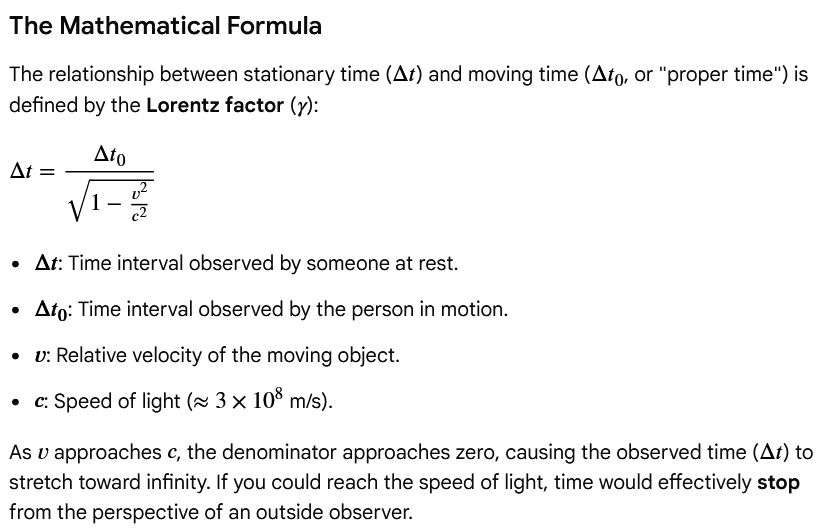
In physics, time travel into the future is not only theoretically possible but a well-established and measured phenomenon known as time dilation. According to Albert Einstein’s theories of relativity, the rate at which time passes is relative and can change depending on speed and gravity.
Primary Mechanisms of Future Time Travel
Physicists have identified two main ways to “jump” into the future by slowing down your own internal clock relative to the rest of the world:
* Velocity-Based Time Dilation (Special Relativity): The faster you move through space, the slower you move through time.
* The Effect: If you were to travel on a spaceship at near-light speeds (e.g., 99.9% the speed of light) for what felt like one year to you, several decades might have passed on Earth when you returned.
* Real-World Example: Astronauts on the International Space Station (ISS) travel at 17,500 mph. After six months, they have aged approximately 0.005 seconds less than people on Earth.
Gravitational Time Dilation (General Relativity): Time passes more slowly in stronger gravitational fields.
* The Effect: Clocks near massive objects (like stars or black holes) run slower than clocks in deep space.
* Extreme Scenarios: A person who orbits the edge of a massive black hole for a few hours might return to Earth to find 1,000 years have passed.
* Daily Technology: GPS satellites are farther from Earth’s gravity than we are, causing their clocks to run about 38 microseconds faster per day than clocks on the ground. Engineers must constantly correct for this “time travel” to keep GPS accurate.
Comparison with Past Time Travel
While traveling to the future is a standard consequence of modern physics, traveling into the past is far more controversial. Theories like “wormholes” or “closed timelike curves” suggest it might be mathematically possible, but many physicists, including the late Stephen Hawking, argue that the laws of nature likely prevent it to avoid causality paradoxes (like the “grandfather paradox”).
AI can make mistakes, so double-check responses
Jump Into
[Verse 1]
Wanna get a taste
(Of velocity based)
Faster through space
(Slower through time)
[Bridge]
I’m….
[Instrumental, Synth Solo, Percussion]
Slow down
(And jump)
… into the future
[Instrumental, Guitar Solo]
This Is Freaky
[Verse 1]
Ma, do you know the formula
(Dad can you fill me in)
No, no said my mama
(My dad didn’t know where to begin)
[Bridge]
Now, I’m dialed in…
[Instrumental, Synth Solo, Percussion]
Dialed in to (dilation)
Man, is this freaky
[Instrumental, Guitar Solo]
[Chorus]
Just in time
(My brain keeps up to my mind)
If it were to go slow
(Ohhh, I just don’t know)
[Instrumental, Synth Solo, Percussion Solo]
[Verse 2]
Pa, do you know the formula
(Ma can you fill me in)
They said, “No son. Not for this sun.”
(So my birth on earth did begin)
[Bridge]
Now, I’m dialed in…
[Instrumental, Synth Solo, Percussion]
Dialed in to (dilation)
Man, is this freaky
[Instrumental, Guitar Solo]
[Chorus]
Just in time
(My brain keeps up to my mind)
If it were to go slow
(Ohhh, I just don’t know)
[Outro]
[Instrumental, Whistle Solo]
Will it take a toll (on my soul)
I dunno
Will a arrive alive
(Survive the drive)
I dunno
(No, no know)
ABOUT THE SONG
Velocity-Based Time Dilation (Special Relativity): The faster you move through space, the slower you move through time. Acore tenet of Einstein’s Special Relativity, describes how time slows down for an object as its speed increases relative to a stationary observer.
Time Dilation
Particle Accelerators
[Intro]
Accelerating particles practically
(To the speed of light)
Out of sight!
[Verse]
To get to live
(Along alive)
Would would I give
(To live)
… to thrive
[Bridge]
(Survive)
[Instrumental, Piano Solo, Strings, Bass, Percussion]
Accelerating particles practically
(To the speed of light)
Out of sight!
[Instrumental, Synth Solo]
[Verse]
To arrive alive
(What’s the destination)
To merely survive
(Or love procreation)
… mind dive
[Bridge]
(Extracurricular education)
[Instrumental, Piano Solo, Strings, Bass, Percussion]
Accelerating particles practically
(To the speed of light)
Out of sight!
[Instrumental, Synth Solo]
[Outro]
If you could live forever
(Would you ever)
Accept the endeavor?
ABOUT THE SONG
Particle Accelerators: At facilities like the GSI Helmholtz Centre in Germany, physicists accelerate ions to near-light speeds, observing that these particles “live” much longer than they do at rest—a direct confirmation of time dilation.
Retro
[Verse 1]
What do you say
(About the music they play)
Does it digress…
(Day after day)
[Bridge]
[Instrumental, Guitar Solo]
Yo!
(What do you know)
About retro
[Instrumental, Guitar Solo]
[Chorus]
Have we found the sound
(We’ve been lookin’ for)
Can we score some more
(It’s found all around)
[Instrumental, Saxophone Solo]
[Verse 2]
Can you please play
(The sounds of yesterday)
With a new twist
(I can’t resist)
[Bridge]
[Instrumental, Guitar Solo]
Yo!
(What do you know)
About retro
[Instrumental, Guitar Solo]
[Chorus]
Have we found the sound
(We’ve been lookin’ for)
Can we score some more
(It’s found all around)
[Outro]
Futuristic music
(Soundin’ retro)
Come on
(Go, cat, go)
Retro
Tomorrows
[Intro]
Will I be alive
(When tomorrows arrive)
[Verse]
Living day by day
(Try to get some play)
Not a total jerk
(Work, work, work)
[Bridge]
Will I be alive
(When tomorrows arrive)
[Chorus]
Will tomorrow ever come
(Is the future at bay)
On borrowed time (and then some)
When is our prime (coming our way)
Ample
[Intro]
How much time do we have
(Is it ample)
If you don’t mind…
(Could you give us a sample)
[Bridge]
[Chorus]
The sands of time
(They don’t know)
They just flow
(Flow, flow, flow)
[Verse]
How much time is on the clock
(Is there enough… is it ample)
Or, has our ship… already left the dock
(Rendering my plea… a bad example)
[Bridge]
tick-tock
(tick-tock)
[Chorus]
The sands of time
(They don’t know)
They just flow
(Flow, flow, flow)
[Verse]
How much time does remain
(Enough to keep this soul alive)
Or, has the world gone insane
(Now, to beg to survive)
[Bridge]
tick-tock
(tick-tock)
[Chorus]
The sands of time
(They don’t know)
They just flow
(Flow, flow, flow)
[Outro]
As for me
(Swimming against the tide)
Can’t you see
(That ain’t my ride)
Slowing the Spin
[Verse 1]
Which way to go
(We don’t know)
What a (Shhh) it show
(A fatal blow)
[Bridge]
Drip by drip
(Drop by drop]
We’re fillin’ ‘er up
[Chorus]
Once again
(We’re slowing the spin)
Faster and faster
(Can’t slow disaster)
[Verse 2]
The future is now
(Can’t stop it… know how)
Oh, didn’t you hear
(We’re bringing it here)
[Bridge]
Drip by drip
(Drop by drop]
We’re fillin’ ‘er up
[Chorus]
Once again
(We’re slowing the spin)
Faster and faster
(Can’t slow disaster)
[Outro]
Drip by drip
(Drop by drop]
We’re fillin’ ‘er up
ABOUT THE SONG
If the Earth were to spin faster, time would pass more slowly relative to an outside observer, according to Einstein’s theory of relativity. For people on Earth, however, time would feel completely normal. What would change is the length of the day: faster rotation would shorten days and could even require “negative leap seconds” to keep atomic clocks aligned with Earth’s rotation. At Earth’s current rotational speed, these relativistic effects are extremely small, but they are very real. GPS satellites, for example, experience measurable time shifts due to both their high orbital speed and weaker gravity, and must correct for relativity to function accurately.
Climate change, by contrast, is causing the Earth to spin slightly more slowly, lengthening days by tiny but measurable amounts. As polar ice melts, water is redistributed toward the equator, moving mass farther from Earth’s axis of rotation. Like a spinning skater extending their arms, this increases Earth’s moment of inertia and slows its spin. This effect adds to other long-term influences, such as tidal friction from the Moon, which has been gradually slowing Earth’s rotation for billions of years.
Conclusion:
Relativity and climate change affect time and Earth’s rotation in very different ways, but both are observable, measurable, and governed by well-understood physics. While relativistic time dilation reminds us that time itself is not absolute, climate-driven changes in Earth’s spin show that human activity is now influencing even the planet’s most fundamental motions. The changes are small, but their significance lies in what they reveal: Earth is a dynamic system, and human actions are increasingly part of that system.
Things Never Change
[Verse 1]
The inevitability
(Of gravity)
And the supposed need
(Of greed)
[Instrumental, Electric Piano Solo]
[Chorus]
Some things never change
(Despite how we might rearrange)
They stay the same
(Remain)
[Instrumental, Synth Solo, Bass, Percussion]
[Verse 2]
Fundamental laws
(Natural flaws)
And to participate
(In hate)
[Instrumental, Electric Piano Solo]
[Chorus]
Some things never change
(Despite how we might rearrange)
They stay the same
(Remain)
[Verse 3]
Another setting sun
(2 equals one plus one)
Love, hate, and tears
(Darkness and fears)
[Chorus]
Some things never change
(Despite how we might rearrange)
They stay the same
(Remain)
[Bridge]
Can we put love above
[Instrumental, Synth Solo, Bass, Percussion]
(Lighten the load)
Take the high road
[Instrumental, Guitar Solo, Bass, Percussion]
[Chorus]
Some things never change
(Despite how we might rearrange)
They stay the same
(Remain)
[Outro]
Can we put love above
(Lighten the load)
Take the high road
As for the fate of hate
(The message we send)
In the end
(The end)
ABOUT THE SONG
Things that never change often fall into fundamental laws, enduring aspects of human nature, or life’s unavoidable realities, such as physics (gravity), natural cycles (sunsets), core human emotions (love, fear, bias), the past’s permanence, the inevitability of change itself, and persistent societal issues like inequality, while spiritual beliefs often focus on eternal truths or unchanging deities.
Where Will You Be
[Intro]
Where will you be tomorrow
(Do you know?)
Where will you be next year
(Any where near?)
[Verse 1]
The sun will rise
(The sun will set)
That’s no surprise
(You can’t forget)
[Chorus]
Where will you be tomorrow
(Do you know?)
Where will you be next year
(Any where near?)
[Bridge]
Yes, my birth (on Earth)
Dictates (how one navigates)
[Verse 2]
The Earth spins around
(The Earth goes around)
The fact is — on its axis
(As it orbits the sun some)
[Chorus]
Where will you be tomorrow
(Do you know?)
Where will you be next year
(Any where near?)
[Bridge]
Yes, my birth (on Earth)
Dictates (how one navigates)
[Outro]
Join the human race
(… as we race in place)
Through space
Yes, my birth (on Earth)
Does dictate (how I navigate)
Past Last
[Verse 1]
I can’t quite put my finger on it
(Not really within my grasp)
Given some thought… perhaps not
(Hard to present the past)
[Bridge]
Will the past last?
As permanent as it may be
(History is illusionary)
[Verse 2]
Yesterdays slip through my fingers
(It’s only memory that lingers)
In fact… is there any other time
(Than the one I’m in)
[Bridge]
I’m not certain
Alas, the past can’t last
As permanent as it may be
(History is illusionary)
Though it will never change
(Yes, it seems quite strange)
[Outro]
Yesterdays slip through my fingers
(It’s only a memory that lingers)
No, I can’t put my finger on it
(No, not within my grasp)
Does the past last
(Given some thought… perhaps not)
Almost Now
[Intro]
The present (is present)
The future (is unsure)
[Verse 1]
I heard someone say
(“The future is now”)
And, somehow…
(That doesn’t sound OK)
Know no how
[Bridge]
The present (is present)
The future (is unsure)
[Chorus]
It should be clear
(The future’s almost here)
So, have no fear
(It’s very, very near)
[Verse 2]
Is it just another day
(Or different some way)
Is it somehow
(Getting closer to now)
Oh, that’s OK
[Bridge]
The present (is present)
The future (is unsure)
[Chorus]
It should be clear
(The future’s almost here)
So, have no fear
(It’s very, very near)
[Outro]
Oh, so very close
(You could reach out and touch it)
Though no one knows
(Exactly when it will hit)
The Arrow of Time
[Intro]
(Do you know)
How to draw the bow
(Shoot the arrow of time)
[Verse 1]
Do you know
(If it’s time to go)
Are we in our prime
(Hear the clocks chime)
[Bridge]
(Do you know)
How to draw the bow
(Shoot the arrow of time)
[Chorus]
Entropy
(Memory and causality)
Reality
(And relativity)
[Verse 2]
Do you know
(Which way to go)
They said, “move ahead”
(We lack going back)
[Bridge]
(Do you know)
How to draw the bow
(Shoot the arrow of time)
[Chorus]
Entropy
(Memory and causality)
Reality
(And relativity)
[Outro]
From the arrow quiver
(Draw a sliver)
Pull back the string
(And start your fling)
ABOUT THE SONG
In physics, time is not a simple flow but a complex dimension governed by the laws of thermodynamics, relativity, and quantum mechanics.
The Arrow of Time (Thermodynamics)
While most fundamental equations in physics are time-symmetric (they work the same forward and backward), our reality has a clear “one-way” direction called the Arrow of Time.
* Entropy: The Second Law of Thermodynamics states that entropy (disorder) in an isolated system always increases over time. This creates the distinction between past and future; the future is simply the direction of higher entropy.
* Memory and Causality: Our psychological perception of time is tied to this arrow. Creating a memory is a physical process that releases heat, thereby increasing entropy. This is why we remember the past but not the future.
The Block Universe
[Verse 1]
Are we keeping time
(Do we have the beat)
On the hour, do we chime
(Can we achieve the feat)
[Bridge]
Universalism
(Eternalism)
[Chorus]
Did your space-time fabric
(Get wrinkled)
Iron out the static
(Get sparkled)
[Verse 2]
Miraculously
(Past, present, and future)
Simultaneously
(Last as they endure)
[Bridge]
Universalism
(Eternalism)
[Chorus]
Did your space-time fabric
(Get a stain)
Iron out the static
(Rid of strain)
[Outro]
How much does remain?
Universalism
(Eternalism)
ABOUT THE SONG
The Block Universe (Relativity)
Albert Einstein’s theories of relativity suggest a model called the Block Universe or Eternalism.
* Space-Time Fabric: In this view, time is a fourth dimension woven with the three dimensions of space into a “block” of spacetime.
* Coexistence of Moments: According to this theory, the past, present, and future are all equally real and coexist simultaneously. The “flow” of time is considered a human illusion; we are simply experiencing different “slices” of the block.
Predictability Of
[Verse 1]
Purely Newtonian
(Laplace’s Demon)
Perhaps Babylonian
(So ya know… come on)
[Bridge]
Get with the times
(Reason that rhymes)
[Chorus]
The predictability of….
(The future)
You gotta love
(The picture)
[Verse 2]
Retrocausality
(Will you be the death of me)
Comes to today
(In an unusual way)
[Bridge]
Get with the times
(Reason that rhymes)
[Chorus]
The predictability of….
(The future)
You gotta love
(The picture)
[Outro]
Ensure (endure)
Get with the times
(Reason that rhymes)
It’s the modern day
(Coming our way)
ABOUT THE SONG
Predictability of the Future
Whether the future is “fixed” depends on which branch of physics is applied:
* Classical Physics: In a purely Newtonian universe, if you knew the position and velocity of every particle, you could perfectly predict the future (a concept known as Laplace’s Demon).
* Quantum Mechanics: At the subatomic level, the future is probabilistic rather than certain. The Heisenberg Uncertainty Principle states that we cannot know both the position and momentum of a particle exactly, meaning the future cannot be perfectly determined.
* Current Research: Theoretical physicists are increasingly focused on “Effective Theories” rather than a singular “Theory of Everything”. Some 2025/2026 studies have even explored retrocausality, the controversial idea that future states might subtly influence present conditions.
Tense
[Intro]
Are you feeling tense…
(Presently)
Or are you past all that
(Is that where you’re at?)
[Chorus]
Are you feeling tense…
(Presently)
Or are you past all that
(Is that where you’re at?)
[Bridge]
What tense are you livin’ in
(Can you begin?)
[Chorus]
Are you feeling tense…
(Presently)
Or are you past all that
(Is that where you’re at?)
[Bridge]
What tense are you livin’ in
(Can you begin?)
Can you begin livin’
(Or are you too tense)
Two tense
[Outro]
What tense are we livin’ in
(Can we begin?)
More walkin’
(Less talkin’)
Begin livin’
(Strive to thrive)
Alive
Albert, I n’ Stein
[Intro]
Albert,
Say it’s true
(Will you)
How ’bout it?
[Bridge]
Son, you’re butt rotating around the sun
(Some)
Your Weisenheimer Style…
(Does it count for a while?)
[Verse]
Albert,
Albeit… I don’t know
(I ‘n Stein, thank you for the advice)
Albeit… I may take it twice.
[Bridge]
Son, you’re butt rotating around the sun
(Some)
Your Weisenheimer attitude
(… does it lack fortitude)
[Outro]
Son, as you orbit the sun some
(What is the essence of your presence)
Will there be more
(For sure)
But, as for folklore…
(Does time endure?)
Standing Near a Black Hole
[Intro]
(I’mmmmm….)
Hanging at the corner of space-time
(Ohh, oh, oh)
Standing next to a black hole
[Bridge]
(Let’s roll)
[Refrain]
(I’mmmmm….)
Hanging at the corner of space-time
(In my prime)
Standing next to a black hole
[Bridge]
(Let’s roll)
Take a leap of faith?
(What a waste)
Take a leap
(Into the future)
Take a peep
(If we’ll endure)
[Refrain]
(I’mmmmm….)
Hanging at the corner of space-time
(In my prime)
Standing next to a black hole
[Bridge]
(Let’s roll)
The gravity of the situation
Is slowing you down
(Down, down, down)
The irony of our relation
Gives me the faith to leap
(Time ain’t cheap)
[Refrain]
(I’mmmmm….)
Hanging at the corner of space-time
(In my prime)
Standing next to a black hole
[Outro]
(Let’s roll)
Don’t let it drag you down
(Down, down, down)
Take a leap with me
(Come and see)
ABOUT THE SONG
Time Travel into the Future
Physically, traveling into the future is a proven reality through time dilation. For example, intense gravity slows time. Standing near a black hole would cause time to pass much slower for you than for someone in deep space, effectively allowing you to “leap” into their future.
[Intro]
(I’mmmmm….)
Hanging at the corner of space-time
(Ohh, oh, oh)
Standing next to a black hole
[Bridge]
(Let’s roll)
[Refrain]
(I’mmmmm….)
Hanging at the corner of space-time
(In my prime)
Standing next to a black hole
[Bridge]
(Let’s roll)
Take a leap of faith?
(What a waste)
Take a leap
(Into the future)
Take a peep
(If we’ll endure)
[Refrain]
(I’mmmmm….)
Hanging at the corner of space-time
(In my prime)
Standing next to a black hole
[Bridge]
(Let’s roll)
The gravity of the situation
Is slowing you down
(Down, down, down)
The irony of our relation
Gives me the faith to leap
(Time ain’t cheap)
[Refrain]
(I’mmmmm….)
Hanging at the corner of space-time
(In my prime)
Standing next to a black hole
[Outro]
(Let’s roll)
Don’t let it drag you down
(Down, down, down)
Take a leap with me
(Come and see)
ABOUT THE SONG
Time Travel into the Future
Physically, traveling into the future is a proven reality through time dilation. For example, intense gravity slows time. Standing near a black hole would cause time to pass much slower for you than for someone in deep space, effectively allowing you to “leap” into their future.