About the Song
The new release of the day, “Acceleration,” comes from the album Rush. It’s a retro-futuristic garage-rock track infused with elements of dubstep, before transitioning into experimental electronic glitch.
The song explores climate acceleration—the way warming, feedback activation, feedback coupling, and amplification can push the climate system into increasingly rapid change. The progression is much like water cascading over a waterfall: once the flow accelerates, each successive drop carries the system faster toward the next.
“Acceleration” features an Ibanez electric/acoustic guitar alongside a mix of analog and synthesizer keyboards, blending organic instrumentation with increasingly chaotic electronic textures.
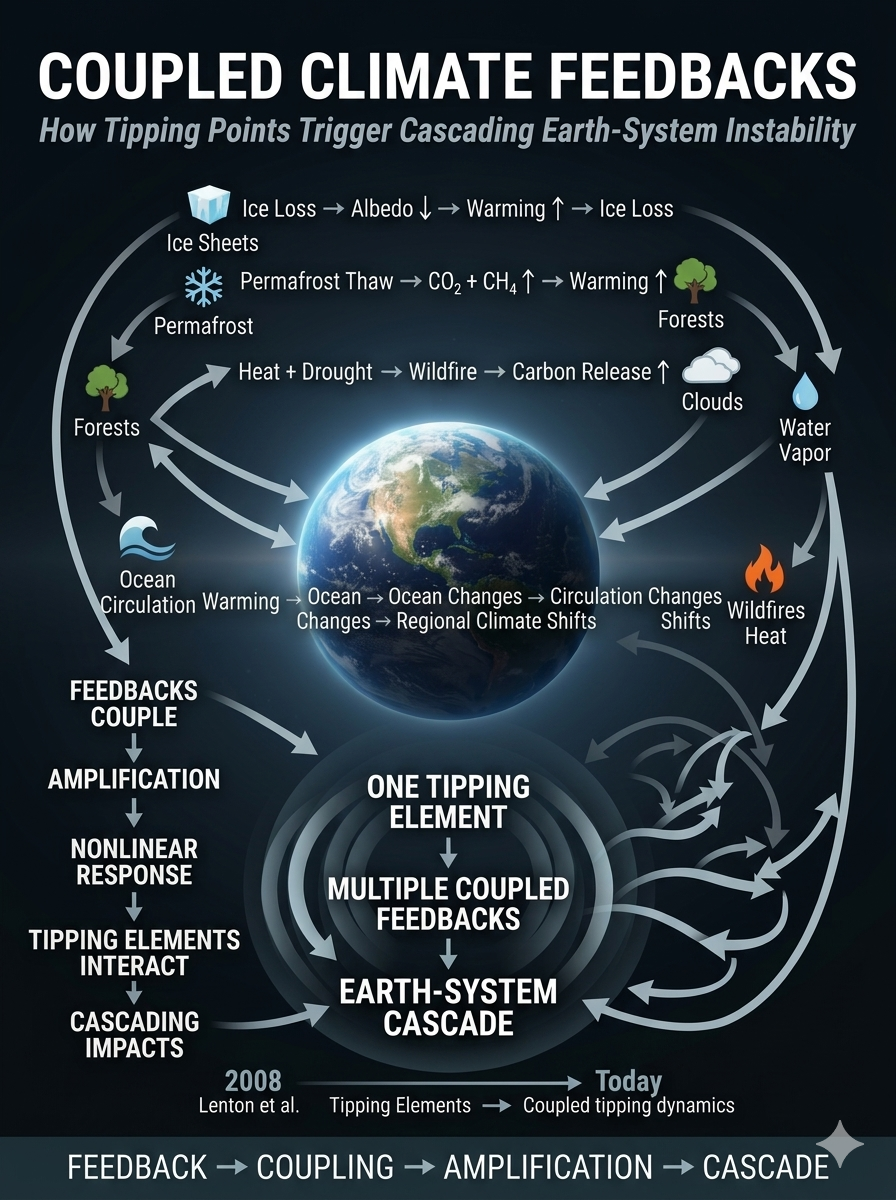
The climate system is not simply warming—it is changing how it responds to that warming. Coupled climate feedbacks are becoming one of the most consequential dimensions of climate risk in the 21st century because they amplify changes and connect individual tipping-point pathways into larger cascading effects.
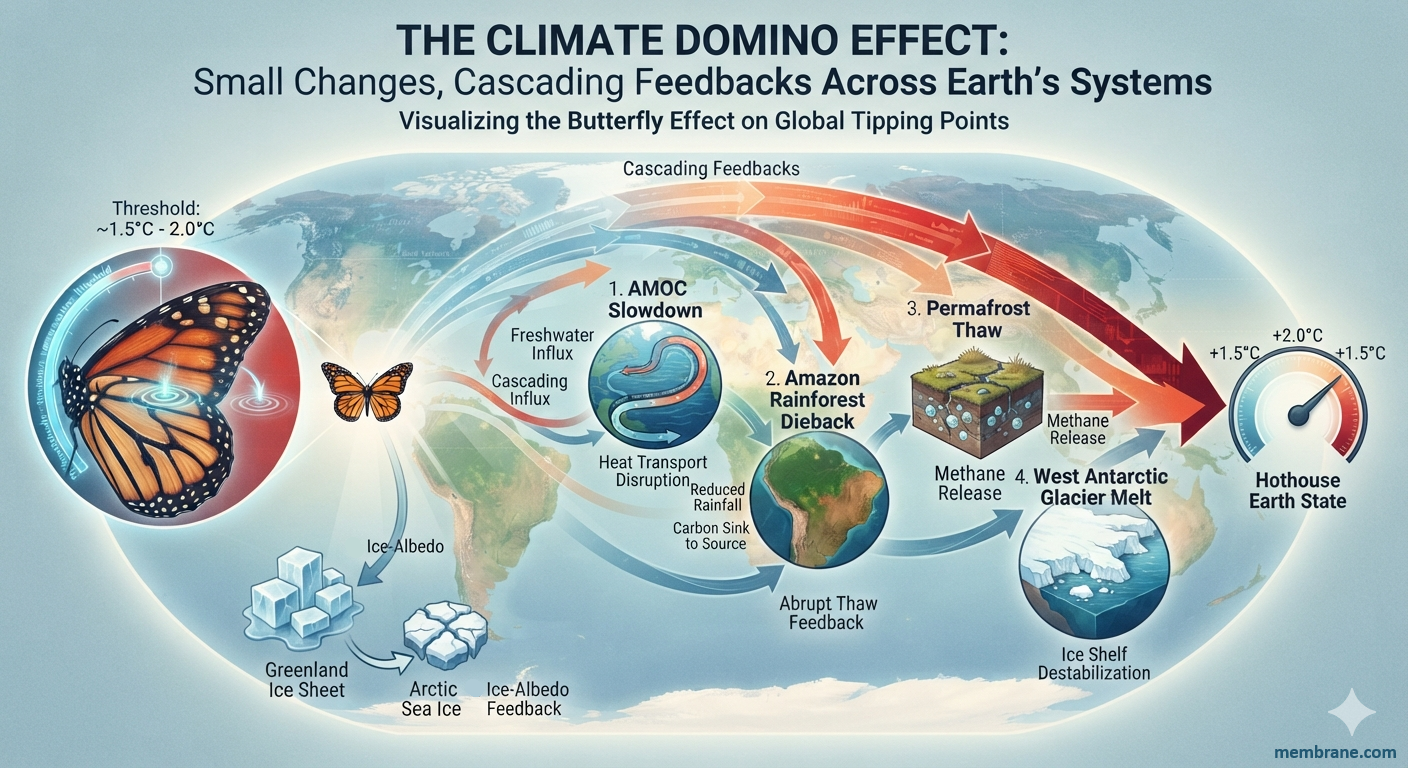
The longer warming persists, the more climate feedbacks become active. As these feedbacks interact, we are already observing nonlinear responses, amplification, and cascading impacts across the climate system. Hundreds of feedback mechanisms have been identified, and many can couple and reinforce one another, contributing to the accelerating pace and increasing magnitude of climate change—The Domino Effect.
Bottom line:The question is no longer how warm the planet becomes, but how life on Earth can endure when change outpaces our ability to adapt.
We cannot control the laws of physics, but we can control our pollution. The most effective action is to stop burning fossil fuels.
Lapse-rate feedback
(Changes the game)
Land and atmosphere
(They’re not the same)
[Outro]
[Instrumental Outro: Pulsing Bass, Echoing Guitar, Layered Synth, Slow Heavy Drums]
Lapse-rate feedback
(Feed back, back, back)
What is perplexing
(Sure needs fixing)
Can’t be a denier
(Of the amplifier)
Feed back…
Back…
Back…
[Final spoken vocal]
The ice changes the surface.
The atmosphere changes the response.
And the feedback…
Keeps feeding back.
(Back, back, back)
In a loopty loop loop
About the Song
How Lapse-Rate and Ice–Albedo Feedbacks Couple to Create a Powerful Self-Reinforcing Warming Loop
The Two Dominant Drivers of Arctic Amplification
Arctic amplification is not produced by a single climate feedback. It emerges from the interaction of several processes that redistribute, trap, and amplify energy within the Arctic climate system.
Two of the most important are the lapse-rate feedback and the ice–albedo feedback. They operate through different physical mechanisms, but they are tightly coupled:
Lapse-Rate Feedback → Traps Heat Near the Surface
Ice–Albedo Feedback → Converts More Sunlight Into Heat
Together, they create a reinforcing loop:
Warming → Atmospheric Stabilization → Surface Heat Retention → Ice and Snow Loss → Lower Albedo → Greater Solar Absorption → More Warming
This coupling helps explain why the Arctic can warm substantially faster than the global average.
1. Lapse-Rate Feedback: The Primary Atmospheric Amplifier
The Arctic atmosphere behaves very differently from the atmosphere of the tropics.
In the warm tropics, intense solar heating produces strong convection. Warm air rises, expands, mixes vertically, and transports energy high into the atmosphere. This vertical mixing helps distribute surface heating through a deep atmospheric column, where energy can ultimately be radiated to space.
The Arctic atmosphere is often much more stable.
During periods of strong surface cooling—especially over snow- and ice-covered surfaces—cold, dense air can accumulate near the ground while warmer air remains above it. This creates a temperature inversion, in which temperature increases with height rather than decreasing.
The result is a strongly stratified atmosphere with limited vertical mixing.
When greenhouse gases and other processes add energy to the Arctic system, that energy is therefore more readily retained near the surface rather than rapidly redistributed upward by convection.
This produces a critical asymmetry:
Tropical warming → strong vertical mixing
Arctic warming → weak vertical mixing and enhanced near-surface warming
The lapse-rate feedback therefore changes how efficiently the Arctic atmosphere can respond to additional radiative energy.
As the Arctic warms, the vertical temperature structure changes. The characteristic lapse rate—the rate at which temperature changes with altitude—affects the amount of infrared radiation escaping to space. Because the Arctic surface and lower atmosphere can warm disproportionately, the region’s radiative response differs substantially from that of warmer, more convective regions.
The result is an atmospheric environment particularly favorable to near-surface warming and Arctic amplification.
2. Ice–Albedo Feedback: The Solar Amplifier
The lapse-rate feedback is only part of the story.
The Arctic is covered by highly reflective surfaces—especially snow and sea ice—that normally reflect a substantial fraction of incoming sunlight back toward space.
Ice and snow therefore act as a planetary-scale solar shield.
But warming begins to remove that shield.
As snow and ice melt, they expose darker surfaces:
Bright snow and ice → dark ocean and land
Dark surfaces absorb much more solar radiation than bright, reflective surfaces.
That additional absorbed energy warms the surface and surrounding environment, which promotes additional melting.
The loop becomes:
Warming → Ice/Snow Loss → Lower Albedo → More Solar Absorption → More Warming
This is the classic ice–albedo feedback.
Unlike the lapse-rate mechanism, which primarily alters the vertical distribution and radiative behavior of atmospheric energy, the ice–albedo feedback changes the amount of incoming solar energy absorbed by the surface.
The two mechanisms therefore attack the climate system from different directions.
3. The Coupling: When Two Feedbacks Reinforce Each Other
The real significance emerges when the feedbacks are considered together.
The lapse-rate feedback helps concentrate warming near the Arctic surface.
The ice–albedo feedback increases the amount of solar energy absorbed by that same surface.
That creates a powerful coupling:
Greenhouse Forcing
↓
Atmospheric Stability / Lapse-Rate Effects
↓
More Near-Surface Heat Retention
↓
Warmer Surface
↓
Snow and Ice Loss
↓
Lower Surface Albedo
↓
More Solar Energy Absorbed
↓
Additional Surface Warming
↓
Further Snow and Ice Loss
The result is not simply two independent feedbacks operating side by side.
[Intro]
[Instrumental Intro: Flowing Piano, Warm Bass, Swirling Synth, Rolling Percussion]
[Spoken Vocal]
You can’t see…
(It’s too “clearly”)
Came as light
(… changing day n’ night)
Energy of what’s to be
[Refrain]
OK
(Now I hear you say)
You moved me
(It’s plain to see)
Obviously
(You moved me)
[Verse 1]
Leaving liquid, taking flight
Carrying energy out of sight
You can’t see it
(But it’s there)
You can’t hold it
(In the air)
[Chorus]
You moved me
(From the ocean to the sky)
You moved me
(As the water molecules fly)
You moved me
(And the atmosphere knows)
You moved me
(Where the energy flows)
[Verse 2]
Rain comes down upon the ground
Energy has traveled all around
What looked like an ordinary day
Held a hidden transfer on the way
[Instrumental]
[Atmospheric Guitar Solo, Pulsing Bass, Layered Synth, Rolling Drums]
[Bridge]
One kilogram
(Watch it go)
Two point four five
(Megajoules in the flow)
[Breakdown]
[Minimal Beat, Soft Piano, Deep Bass]
You moved me…
Not just sea.
Energy moved… we
That’s the part…
You cannot see.
[Final Chorus]
OK
(Now I hear you say)
You moved me
(It’s plain to see)
Obviously
(You moved me)
[Outro]
[Instrumental Outro: Flowing Piano, Echo Guitar, Warm Bass, Gentle Percussion]
OK
(Now I hear you say)
You moved me
(It’s plain to see)
Obviously
(You moved me)
Energy…
(Gone astray)
Energy…
(Gone outta the way)
The say…
(Energy)
About the Song
You probably think of the water cycle as a simple process:
Evaporation → clouds → rain
But there is something hidden inside that cycle: energy.
Every time water evaporates, enormous amounts of energy move from one place to another. As climate change warms the oceans and atmosphere, this energy-transfer system is becoming more powerful—and you may see the consequences right outside your back door.
When a water molecule changes from liquid to vapor, it takes energy with it. That energy is called latent heat.
Approximately:
1 kilogram of evaporated water = about 2.45 megajoules of energy transported into the atmosphere.
About the Song: Greenland’s Giant Iceberg Flip: A Dramatic Sign of a Rapidly Changing Arctic
On July 25, 2026, a massive iceberg near Ilulissat, Greenland, dramatically rolled over in the ocean, sending a powerful surge of waves and mist toward the coastline. The spectacular event occurred near the UNESCO-listed Ilulissat Icefjord on Greenland’s western coast, where enormous icebergs regularly break away from one of the most active glacier systems on Earth.
As the giant block of ice rotated with tremendous force, it revealed a jagged, ancient underside that had been hidden beneath the ocean surface. Fortunately, no injuries or property damage were reported from the resulting waves.
Why Do Giant Icebergs Flip?
Icebergs are naturally unstable structures. They float with roughly 90% of their mass hidden below the waterline, and their shape changes continuously as they melt.
1. Uneven Melting Shifts the Center of Gravity
Icebergs often become unstable because melting does not occur evenly. Warmer ocean water can erode the submerged portion of the iceberg, while sunlight and warmer air melt the upper surface.
As the underwater shape changes, the iceberg’s center of gravity shifts. Eventually, the enormous ice mass becomes unstable and violently rotates until it reaches a new equilibrium.
2. The Ilulissat Region Is an Iceberg Hotspot
The event occurred near the terminus of Sermeq Kujalleq Glacier, one of the fastest-moving glaciers in the world.
This glacier feeds the Ilulissat Icefjord and has historically produced some of Greenland’s largest icebergs. Its rapid flow and frequent calving make the region one of the most dramatic locations on Earth to witness glacier change.
Why This Matters for Climate Change
Iceberg flips are a natural part of the iceberg life cycle, but climate change is altering the conditions that create and accelerate these events.
A Warmer Arctic Means Faster Ice Loss
The Arctic is warming much faster than the global average, causing:
Faster glacier flow: Warmer temperatures increase ice loss and can accelerate glacier movement toward the ocean.
More frequent calving: As glaciers lose mass, more large icebergs break away.
More rapid underwater melting: Warmer ocean waters attack the submerged portions of icebergs, destabilizing them more quickly.
Greater instability of ice structures: Rapid melting creates unusual shapes that are more likely to roll over.
Greenland’s ice sheet is now losing hundreds of billions of tons of ice each year, contributing to rising global sea levels. The surrounding Arctic Ocean is also warming rapidly, intensifying the processes that reshape Greenland’s glaciers and icebergs.
[Verse 2]
A changing climate, changing state
Decisions shape the final rate
Feedbacks grow and systems bend
Where we arrive depends on when
Adaptation, innovation
Transformation, preparation
The choices made across the years
Can alter outcomes that appear
[Bridge]
Not a prediction
(Not a fate)
A probability
(We calculate)
A range of futures
(A fan of light)
Six possible paths
(Beyond tonight)
[Breakdown]
[Minimal Beat, Deep Sub Bass, Spoken Vocal]
The question…
Is not:
“What future will happen?”
The question is…
“Which future…”
Will we choose?
(Win or lose?)
[Final Chorus]
Six possible futures
(Of how we’ll endure)
…or not
Six possible futures
(Our choice for sure)
…so why not?
The future is waiting
(Not written in stone)
The path we create
(Is the path we own)
Six possible futures
(Standing in view)
The next step forward…
Depends on what we do.
[Outro]
[Instrumental Outro: Piano, Echo Guitar, Synth Fade, Soft Percussion]
Six possible futures…
Six possible ways…
One shared planet…
Our choice today.
About the Song
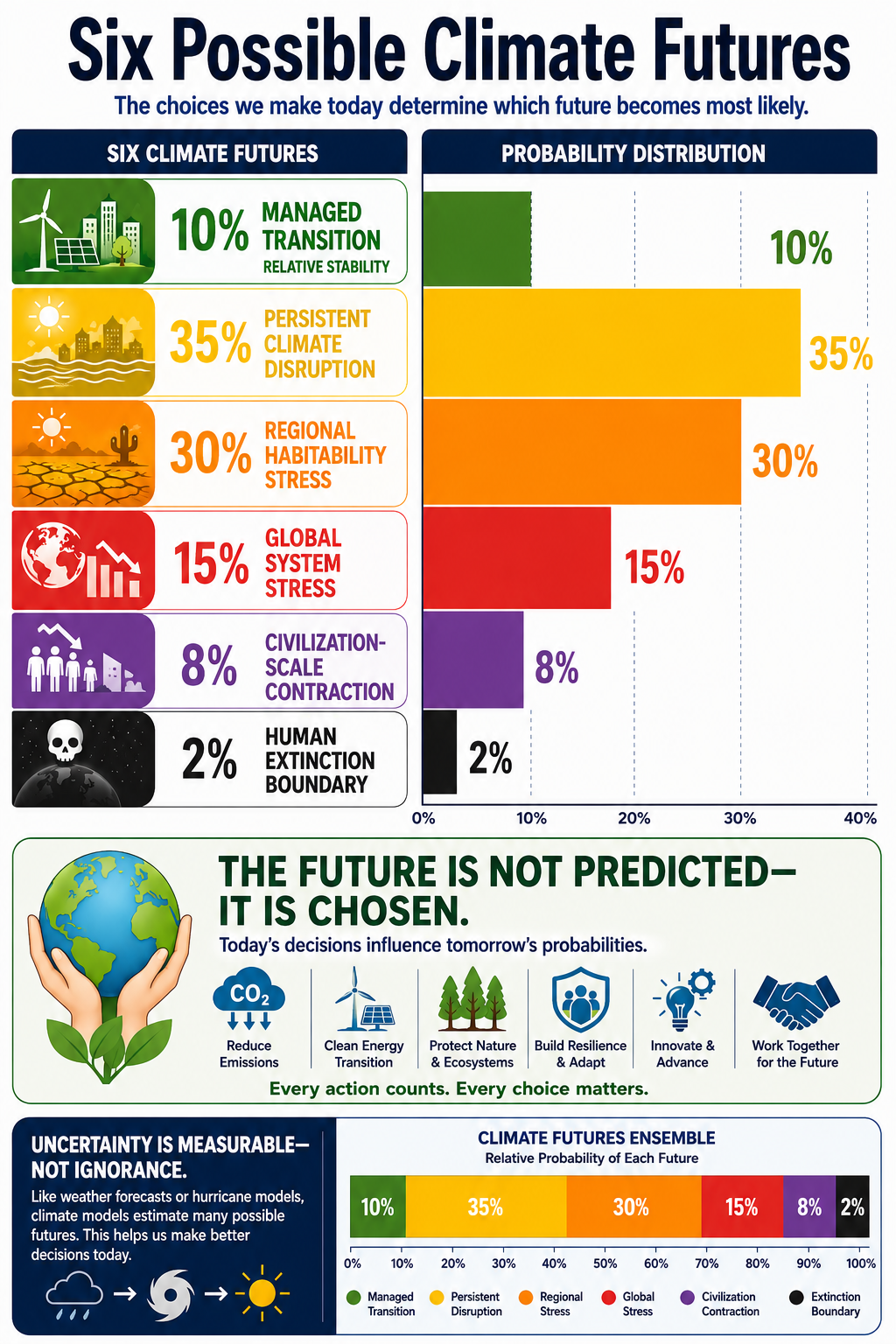
This graphic emphasizes a fundamental idea: **the future is not predetermined.** Humanity is actively choosing which of these six climate futures we move toward through the decisions we make today.
It also represents an effort to visualize some very complex mathematics and nonlinear climate dynamics in a way that is accessible to a broad audience.
For those interested in the underlying science and calculations, there are two versions of the paper:
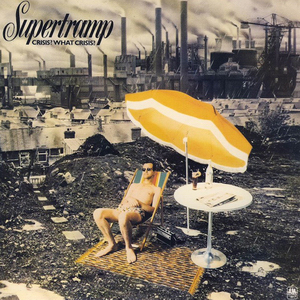
Couldn’t help but think of Supertramp’s “Crisis? What Crisis?” album cover:
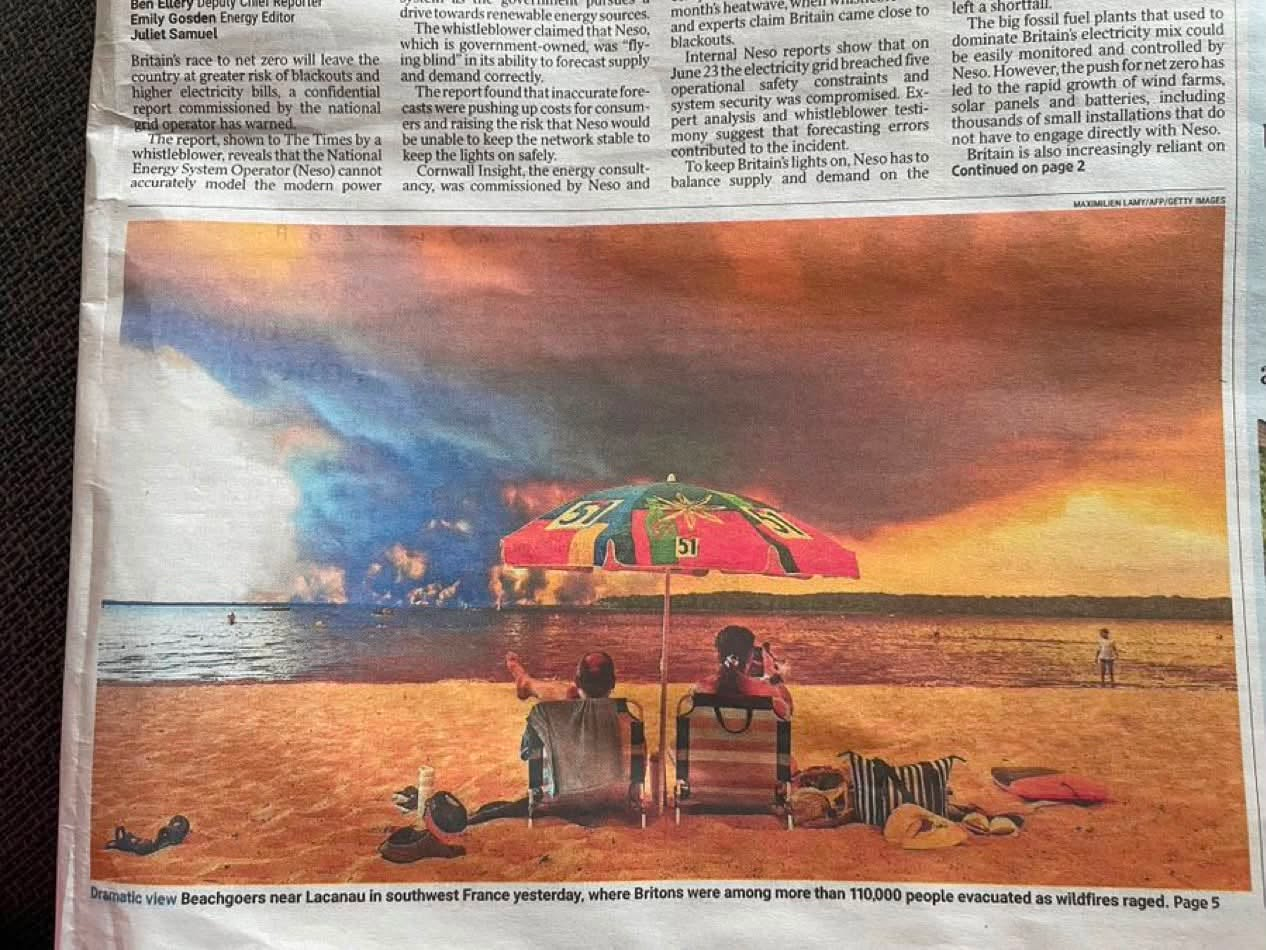
Maximilien Lamy’s powerful photograph capturing a couple relaxing on a beach against a backdrop of apocalyptic wildfire smoke has quickly become a defining global image of the climate crisis. Taken on July 24, 2026, at Moutchic beach near Lacanau in southwestern France, the photo perfectly encapsulates the jarring contrast of modern climate apathy. It features prominently on the front pages of major global newspapers, including The Times, The Guardian, The Wall Street Journal, and The New York Times.
[Verse 2]
Change is easier to ignore
When it builds a little more
Until one morning comes around
And yesterday can’t quite be found
[Bridge]
Hope begins
With seeing clear
Not through panic
Not through fear
Face the facts
(Understand)
The future’s built
(By our hands)
[Breakdown]
[Minimal Beat, Deep Sub Bass, Spoken Vocal]
Apathy…
Doesn’t delay…
The decay.
It only delays…
Our number of days.
[Final Chorus]
This apathy
(Is insanity)
…I mean…
(Really)
…obscene
(Scene)
Seen
Wake up now
(Open wide)
Don’t let reason
(Step aside)
This apathy…
(Isn’t destiny)
[Outro]
[Instrumental Outro: Echo Guitar, Piano, Organ Fade]
This apathy
(Is insanity)
…I mean…
(Really)
… completely
(Clean)
The scene
(The scene seen)
Climate Change Today: When Weather Becomes Climate
About the Song
Much of the public discussion still focuses on historical trends and older climate models. But since 2023–2024, our understanding of the climate system has advanced significantly as scientists have increasingly examined real-time observations, accelerating changes, feedback loops, and complex Earth system behavior.
Understanding climate acceleration no longer requires multiple advanced degrees or a deep background in nonlinear chaos theory. The evidence is increasingly visible in the world around us. In many ways, you can begin by simply looking out your window or out your backdoor.
[Intro]
A tiny motion…
(A distant change)
A single step…
(A wider range)
One small turn…
(Begins the flow)
Watch what happens…
(As systems grow)
[Refrain]
Watch the butterfly
(Kiss the sky)
Blow a domino
(Then watch them go)
[Verse 1]
A whisper moves across the air
A subtle shift could land anywhere
The oceans turn, the forests bend
A change begins… where’s the end?
A little warmer, a little more
Energy enters through the door
The atmosphere begins to change
The patterns shift, the winds rearrange
[Chorus]
Butterflies and dominoes
(Where the hidden pathway goes)
Small beginnings
(Growing wide)
Systems changing
(Worldwide)
Feedback rising
(Loop by loop)
Tipping points
(Coming through)
Butterflies and dominoes
(Watch the chain reaction grow)
[Refrain]
Watch the butterfly
(Kiss the sky)
Blow a domino
(Then watch them go)
[Verse 2]
Ice reflects the sunlight away
Until the mirror starts to fade
Dark oceans absorb the light
Adding heat into the night
Frozen soils begin to thaw
Releasing what was stored before
Forests struggle, oceans warm
Each response creates a storm
[Bridge]
Feedback loops
(Amplify)
Tipping points
(Stand nearby)
One falls over
(Then another)
Like a signal
(From a brother)
Dominoes falling
(Row by row)
Faster than
(We used to know)
[Breakdown]
The butterfly does not move the domino.
No, the butterfly…
reveals the connection.
(Now we know)
[Final Chorus]
Watch the butterfly
(Kiss the sky)
Blow a domino
(Then watch them go)
Small disturbance
(Larger change)
A new pattern
(Rearranged)
Feedback rising
(Loop by loop)
Tipping points
(Coming through)
Butterflies and dominoes
(Where the hidden pathway goes)
[Outro]
Watch the butterfly
(Kiss the sky)
Blow a domino
(Then watch them go)
A butterfly flies…
A domino falls…
(Surprise!)
A planet changes…
(Rearranges)
Connected…
Through it all.
Butterfly Effect and Domino Effect
About the Song: The Hidden Connections Driving Climate Change
Climate change is not a simple chain of cause and effect. The Earth operates as a connected system where changes in one part of the planet can trigger responses in many others. These emerging coupled feedback interactions demonstrate a fundamental principle of nonlinear systems: a small initial change can spread through multiple connected processes and produce a response much larger than the original disturbance. This is the climate version of the Butterfly Effect.
Climate feedbacks do not operate independently. Instead, they interact as a vast network linking the atmosphere, oceans, ice sheets, forests, soils, and ecosystems. When one feedback strengthens another, the combined effect can become greater than the sum of the individual parts. This is why climate change can sometimes accelerate faster than expected and why predicting future changes is so challenging.
Feedback Loops → Tipping Points → Acceleration → Domino Effect
Feedback loops amplify climate change and can push interconnected Earth systems past critical tipping points. As tipping points are crossed, they can trigger additional feedback loops and destabilize other climate systems. This cascading “Domino Effect” compresses timescales, accelerates change, and increases the risk of rapid, nonlinear climate transformations.
Emerging
[Intro]
Something changes…
(Beneath the view)
A hidden pattern…
(Coming through)
A single signal…
(Begins to grow)
A new direction…
(Who’s to know)
[Refrain]
Emerging
(From your cocoon)
Diverging
(Way too soon)
[Verse 1]
A tiny shift begins the chain
A subtle spark within the rain
One system moves, another follows
Through the skies and ocean hollows
Forests breathe and oceans turn
Ice reflects what they return
Every piece begins to bend
Connecting where the pathways end
[Chorus]
Emerging
(Out of sight)
Changing patterns
(Left and right)
Diverging
(From before)
Opening another door
Not a single
(Simple line)
But a network
(Intertwined)
Emerging
(Into view)
A different world
(Breaking through)
[Refrain]
Emerging
(From your cocoon)
Diverging
(Way too soon)
Why, butterfly?
[Verse 2]
A feedback loop begins to rise
Hidden underneath familiar skies
One response amplifies the next
Changing what we once could expect
Atmosphere and living things
Oceans, forests, frozen wings
Now connected through the flow
More than any single show
[Bridge]
Can you see it?
(The unseen thread)
All the pathways
(Where they lead)
Not tomorrow
(Not someday)
The transformation
(Is underway)
Emergent patterns
(Coming alive)
New behaviors
(Will arise)
[Breakdown]
A butterfly does not predict the storm.
A single feedback loop…
does not define the future.
But together…
connections become consequences.
[Final Chorus]
Emerging
(From your cocoon)
Diverging
(Way too soon)
New directions
(Coming fast)
Leaving behind
(The fading past)
Feedback rising
(Through the chain)
Amplification
(Again and again)
Emerging
(Into the light)
A changing system
(Changing its flight)
[Refrain]
Emerging
(From your cocoon)
Diverging
(Way too soon)
Why, butterfly?
[Outro]
From the hidden…
Comes the visible…
From the smallest change…
Emerging…
A world transformed.
[Refrain]
Emerging
(From your cocoon)
Diverging
(Way too soon)
Fly, butterfly!
(Fly1)
Butterfly Effect and Domino Effect
About the Song
Emerging coupled feedback interactions exemplify nonlinear amplification: a modest initial perturbation can propagate through multiple coupled systems, producing a response much larger than the original forcing—a climate-scale manifestation of the Butterfly Effect. Rather than operating independently, feedbacks interact as an interconnected network in which biological, atmospheric, oceanic, cryospheric, and ecological processes reinforce one another. This networked behavior is one reason Earth-system responses become increasingly difficult to predict using traditional linear cause-and-effect thinking.
Unlike traditional climate feedbacks, which are often described individually, coupled feedback interactions arise when one feedback activates, strengthens, or synchronizes with others, producing cascading amplification throughout the Earth system. These interactions create emergent behavior that cannot be understood by examining any single process in isolation.
Zombie Fires and Ice Algae
[Intro]
Beneath the snow…
(The embers sleep)
Beneath the ice…
(The secrets keep)
Hidden forces…
(Begin to rise)
Changing Earth…
(Before our eyes)
… Surprise!
[Refrain]
Zombie fires
(Transpire)
Higher!
Ice algae
(Really?)
Reality
[Verse 1]
A summer flame begins to burn
Leaving scars where forests turn
But underground the story stays
Waiting through the frozen days
[Pre-Chorus]
Sleeping fire
(Still alive)
Waiting underneath
(To survive)
[Chorus]
Zombie fires
(Rising higher)
From the ground
(Without a sound)
Ancient carbon
(Returns again)
Feeding warming
(From within)
A hidden spark
(A warning sign)
A feedback loop
(Beyond the line)
[Refrain]
Zombie fires
(Transpire)
Higher!
Ice algae
(Really?)
Reality
[Verse 2]
Far above the frozen land
A different change begins to stand
Snow retreats beneath the sun
Revealing what the ice has become
Tiny life begins to grow
On the glaciers far below
Pigments darken frozen white
Absorbing more of solar light
Darkened ice
(Absorbs the day)
Accelerating
(Melt away)
A microscopic
(Force unseen)
Changing landscapes
(Cold and green)
[Refrain]
Zombie fires
(Transpire)
Higher!
Ice algae
(Really?)
Reality
[Bridge]
Now you know the below
(Ice the ice above)
Disruption of flow
(What happened to love?)
Small reactions
(Become chains)
Hidden networks
(Change the game)
[Breakdown]
The strangest feedbacks…
are often the ones we cannot see.
A fire beneath the snow.
Hotter higher on the ice.
Tiny changes…
with planetary consequences.
[Final Chorus]
Zombie fires
(Transpire)
Higher!
Ice algae
(Really?)
Reality
Hidden forces
(Coming through)
Changing worlds
(We thought we knew)
Zombie fires
(Ice algae)
Signals rising…
(See…)
Reality.
[Outro]
Beneath the snow…
The fire waits.
Across the ice…
The color… participates
Hidden…
Emerging…
Alive.
(Thrive)
About the Song
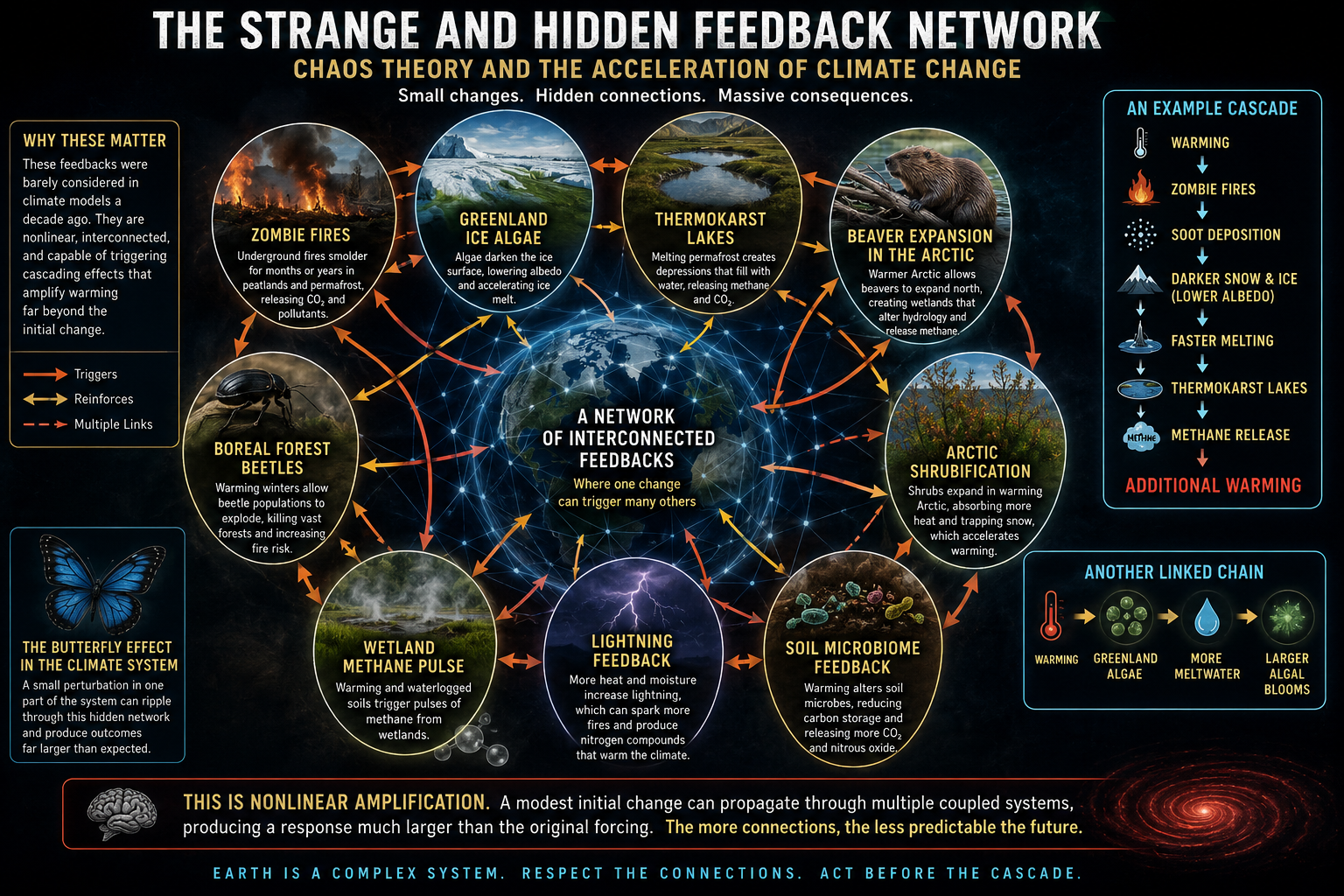
The Strange and Hidden Feedback Network: Chaos Theory and the Acceleration of Climate Change
Some of the most fascinating—and concerning—climate feedback loops are ones that were barely considered in climate models a decade ago. They illustrate how a relatively small change can trigger a cascade of nonlinear responses, making them particularly relevant from a chaos theory perspective.
1. Zombie Fires (Overwintering Peat Fires)
Feedback loop:
Higher temperatures → more drought.
Peat ignites during summer fires.
Fire smolders underground all winter.
Fire re-emerges the following spring.
Vegetation and insulating peat disappear.
Permafrost thaws.
Ancient carbon and methane are released.
More warming → more fires.
These fires can survive beneath snow because peat acts like charcoal, insulating the combustion. They’re becoming increasingly common across Canada and Siberia as warmer, drier conditions expand.
2. Greenland Ice Algae
Perhaps one of the strangest biological feedbacks.
Feedback loop:
Warmer summers melt snow.
Microscopic algae bloom on exposed ice.
Dark pigments reduce ice reflectivity (albedo).
More sunlight is absorbed.
Ice melts faster.
More liquid water supports additional algae.
Researchers call this biological darkening. In parts of Greenland’s “Dark Zone,” algae have become a measurable contributor to increased melt.
Strange and Hidden
[Intro]
What you don’t see…
(Still matters)
What you don’t know…
(Still will grow)
Oh, oh, oh
[Refrain]
The strange
(Rearrange)
Hidden from view
(Do what they do)
[Verse 1]
Beneath the ice and underneath snow
Tiny changes start to grow
Not alone but hand in hand
Working quietly across the land
One small spark beneath the ground
Another signal without a sound
One begins what others feed
Growing faster than we’d believe
[Pre-Chorus]
Hidden pieces
(Working still)
Following
(Physics’ will)
[Chorus]
Strange and hidden
(Hard to see)
Building pathways
(Quietly)
One becomes
(Two or three)
Then becomes
(A growing sea)
The strange
(Rearrange)
Hidden from view
(Do what they do)
[Verse 2]
Zombie fires beneath the snow
Ice algae where glaciers glow
Thermokarst lakes begin to rise
Methane drifting through the skies
Lightning strikes a drying land
Beetles spread through weakened stands
Shrubs advance where tundra slept
Oceans warm in layers kept
As the stories intertwine
Crossing invisible design
No single answer tells it all
Together, systems rise and fall
[Bridge]
Not a straight line
(Not a chain)
More like rivers
(Joining rain)
Tiny changes
(Start the flow)
How far they travel…
(Nobody knows)
[Final Chorus]
The strange
(Rearrange)
Hidden from view
(Do what they do)
Small beginnings
(Big surprise)
Changing Earth
(Before our eyes)
Butterflies
(Dominoes)
One small change
(Grows and grows)
The strange
(Rearrange)
Hidden from view…
Changing…
Me and you.
[Outro]
Hidden pathways…
(Hidden patterns…)
Hidden futures…
(Anticipating)
Waiting…
…to emerge.
(Converge)
Chaos Theory and the Acceleration of Climate Change
About the Song: The Strange and Hidden Feedback Network
*Chaos Theory and the Acceleration of Climate Change*
Climate change isn’t just one feedback causing another.
It’s becoming a **network of interacting feedbacks** where seemingly unrelated processes reinforce each other in ways that traditional linear thinking struggles to capture.
Our newest infographic explores some of the Earth’s most unusual and recently recognized climate feedbacks, including:
This is **nonlinear amplification**: modest initial changes propagating through interconnected systems to produce responses far larger than the original disturbance.
As these hidden connections strengthen, predicting climate behavior becomes increasingly difficult using simple cause-and-effect models.
Understanding the **network** is becoming just as important as understanding the individual feedbacks.
Feedback building
(One by one)
Until the race
(Is never won)
[Refrain]
No! (No hesitating)
Accelerating
(Acceleration
…of acceleration)
(No!) No hesitation
(No!) No time for anticipation
…when you wait…
(It becomes too late)
[Verse 2]
Not a straight and simple line
Not a clock that keeps good time
Networks learn to synchronize
Unexpected patterns rise
[Pre-Chorus]
One connects
(To many more)
Then they open
(Another door)
[Bridge]
Butterflies fly…
(Bye-Bye)
Then, another domino
(Starts to go)
Tiny changes…
(Start the flow…)
Feedback joining
(Still unaware?)
Building something
(None can share)
Not just faster…
(Faster faster…)
Changing how…
(Changing now…)
[Breakdown]
Acceleration…
is change over time.
The acceleration…
of acceleration…
is when the rate of change…
changes.
[Final Chorus]
No! (No hesitating)
Accelerating
(Acceleration
…of acceleration)
(No!) No hesitation
(No!) No time for anticipation
…when you wait…
(It becomes too late)
Feedback rising
(Loop by loop)
Networks forming
(Group by group)
Small beginnings
(Bigger fate)
Understanding…
…cannot wait.
[Outro]
The future…
isn’t only changing…
It’s changing…
how…
it changes.
About the Song
Emerging coupled feedback interactions exemplify nonlinear amplification: a modest initial perturbation can propagate through multiple coupled systems, producing a response much larger than the original forcing—a climate-scale manifestation of the Butterfly Effect. Rather than operating independently, feedbacks interact as an interconnected network in which biological, atmospheric, oceanic, cryospheric, and ecological processes reinforce one another. This networked behavior is one reason Earth-system responses become increasingly difficult to predict using traditional linear cause-and-effect thinking.
Unlike traditional climate feedbacks, which are often described individually, coupled feedback interactions arise when one feedback activates, strengthens, or synchronizes with others, producing cascading amplification throughout the Earth system. These interactions create emergent behavior that cannot be understood by examining any single process in isolation.
Climate change is more than a gradual increase in global temperature. It is the evolution of an increasingly interconnected Earth system whose components continuously exchange thermal energy, moisture, carbon, and momentum through a growing network of coupled feedbacks.
The possibility that the acceleration of climate change may itself accelerate represents one of the most consequential hypotheses in modern climate science. If correct, future climate change will depend not only on greenhouse gas emissions but also on how rapidly feedbacks become interconnected and how efficiently they amplify one another.
Determining the limits of this amplification—including the upper bounds of radiative forcing, ocean heat content, and equilibrium warming—will require integrating chaos theory, nonlinear dynamics, thermodynamics, and Earth-system science into the next generation of climate models. Understanding these interactions may prove essential for anticipating future climate trajectories and the societal, ecological, and economic thresholds they may cross.
Eight contract…
(Two remain…)
The smallest shadow…
(The final frame)
[Breakdown]
Probability…
…isn’t prediction.
Uncertainty…
…isn’t ignorance.
It tells us…
…where to pay attention.
[Final Chorus]
What are the odds
(We’ll be saved by your gods?)
What are the chances
(We continue with dances)
There’s no solution
(In divine intervention)
Only choices…
(Only change)
Only courage…
(To rearrange)
What are the odds?
They’re waiting…
…for us.
(Please discuss)
[Outro]
The future…
…isn’t fixed.
The probabilities…
…are listening.
Choose wisely.
[Refrain]
What are the odds
(We’ll be saved by your gods?)
What are the chances
(We continue with dances)
There’s no solution
(In divine intervention)
A Conceptual Probability Envelope Derived from the Nonlinear Acceleration Framework
About the Song: A Theoretical 200-Year Probability Envelope
Derived from the Nonlinear Acceleration Framework
Model Time Horizon: 2026–2226
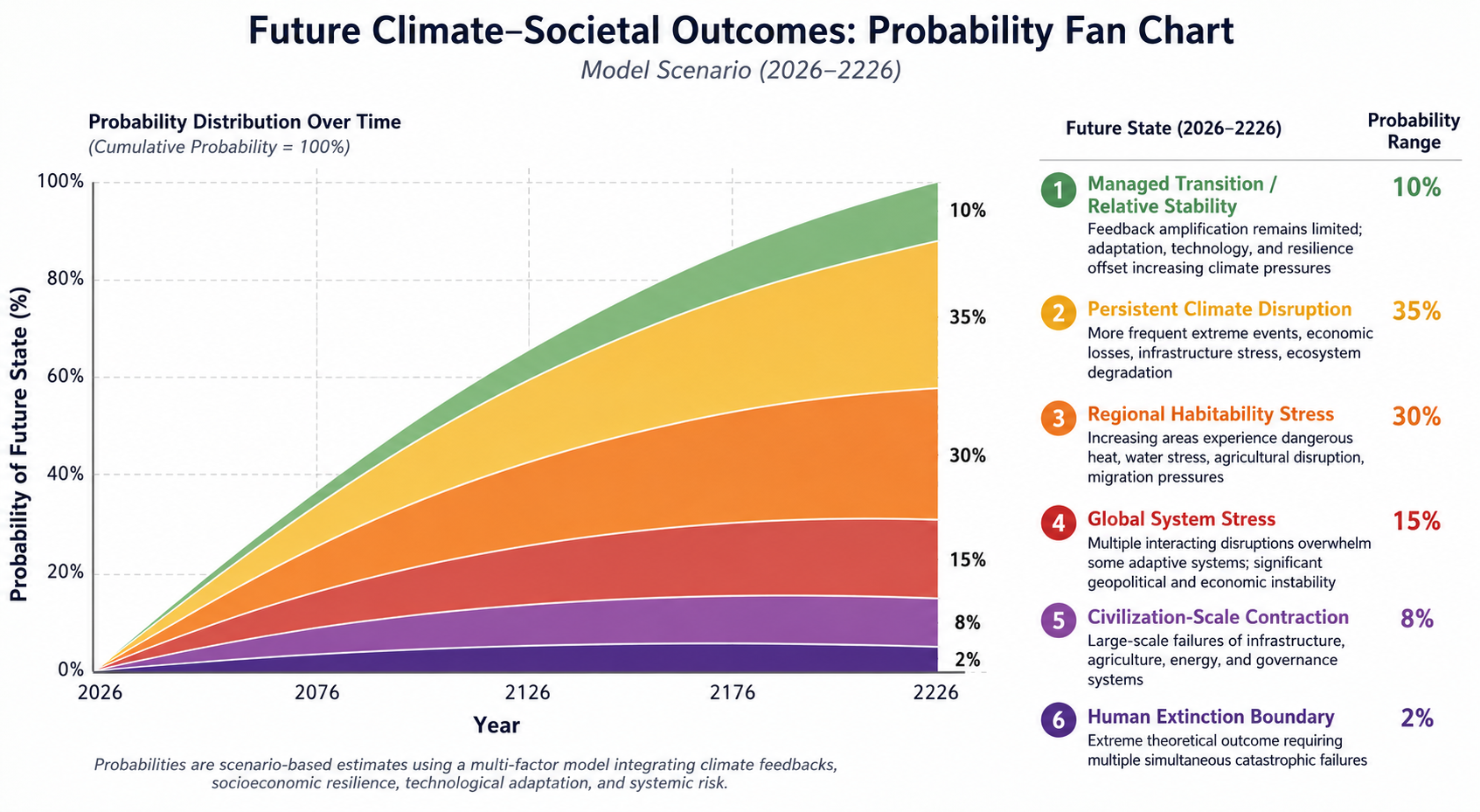
A Probability Distribution of Humanity’s Next 200 Years
How likely are different futures for civilization as climate change accelerates?
Here is a Climate-Societal Probability Fan Chart (2026–2226) that visualizes a model-based distribution of potential outcomes over the next two centuries.
Rather than asking “What will happen?”, the chart asks the more scientifically useful question:
“What is the probability distribution of plausible futures?”
The model incorporates nonlinear climate feedbacks, systemic interactions, adaptive capacity, technological progress, and societal resilience to estimate the relative likelihood of six broad scenarios:
The important takeaway is that human extinction is not the central expectation of the model. The highest-probability outcomes involve increasing disruption, economic stress, migration, infrastructure challenges, and declining habitability across vulnerable regions—not the disappearance of humanity.
Understanding probability distributions is far more informative than focusing on a single prediction. As with weather forecasting or hurricane models, uncertainty is not ignorance—it is measurable.
A Theoretical Model of Coupled Feedback Amplification, System-State Transitions, and Future Climate Trajectories
The distribution is not intended to be a literal prediction of where humanity will be in exactly 200 years. A 200-year horizon necessarily involves enormous uncertainty—seven generations means changes in technology, governance, economics, and adaptation capacity that cannot be known today.
The main purpose of the graph is to emphasize that human extinction remains a very low-probability outcome across the modeled scenarios. The more likely risks involve increasing climate disruption, ecosystem stress, and challenges to human systems.
Given that distinction, the most important actions are clear: reduce the primary driver of warming by transitioning away from fossil fuel combustion while simultaneously accelerating adaptation and resilience efforts. The goal is not to focus on an unlikely worst-case outcome, but to reduce the probability of disruptive pathways and improve the chances of a stable, adaptable future.
The effect is real
(The question is when)
The world connects
(Again and again)
[Refrain]
Get out the butterfly nets
(The world has gone crazy)
Canceling out all bets
(As the future gets hazy)
Try to catch the butterfly effect
(With your butterfly net)
The butterfly net trope
(…at the end of our rope)
[Verse 2]
We search for answers, search for signs
Looking for the warning lines
But complex systems rarely show
Exactly where the pathways go
[Pre-Chorus]
Small disturbance
(Larger sound)
Hidden pathways
(Coming around)
[Bridge]
Can you catch a butterfly?
(Can you hold the sky?)
Can you stop the dominoes?
(After they begin to fly?)
[Breakdown]
Fly, butterfly, fly
(Escaping the question, “why?”)
Fly, butterfly, fly
(On a mission… do or die?)
[Final Chorus]
Get out the butterfly nets
(The world has gone crazy)
Canceling out all bets
(As the future gets hazy)
Try to catch the butterfly effect
(With your butterfly net)
The butterfly net trope
(…at the end of our rope)
The wings keep turning
(The winds keep blowing)
The future’s writing
(While we’re still not knowing)
[Refrain]
Get out the butterfly nets
(The world has gone crazy)
Canceling out all bets
(As the future gets hazy)
Try to catch the butterfly effect
(With your butterfly net)
The butterfly net trope
(…at the end of our rope)
[Outro]
Get out the butterfly nets
(The world has gone crazy)
Canceling out all bets
(As the future gets hazy)
Try to catch the butterfly effect
(With your butterfly net)
The butterfly net trope
(…at the end of our rope)
And the Band Played On
[Intro]
Most things…
looked…
normal.
Until it wasn’t… at all
(Headed toward the waterfall)
[Refrain]
The ship has sailed
(Headed toward the waterfall)
Navigation failed
(Now hear disaster call)
More momentum
(Can’t slow down)
Likely to succumb
(Too numb… too dumb)
Discover going over
(Going down, down, down)
[Verse 1]
Warnings written in the charts
Science mapped the fragile parts
Still we argued, still delayed
Thinking somehow we’d be saved
[Pre-Chorus]
The river bends
(The current stays)
Tomorrow’s built
(On yesterday)
[Chorus]
And the band played on
(Playing every song)
While the waters
(Pulled us along)
Looking backward
(Instead of ahead)
Ignoring words
(Already said)
The ship has sailed
(Headed toward the waterfall)
[Verse 2]
The engines never questioned why
They only pushed and passed on by
Growth became the only creed
Even after every plead
[Pre-Chorus]
Truth remains
(What it is)
No debate
(Changes this)
[Breakdown]
Discover going over
(Going down, down, down)
[Refrain]
More momentum
(Can’t slow down)
Likely to succumb
(Too numb… too dumb)
Discover going over
(Going down, down, down)
[Final Chorus]
The ship has sailed
(Headed toward the waterfall)
Navigation failed
(Now hear disaster call)
More momentum
(Can’t slow down)
Likely to succumb
(Too numb… too dumb)
Discover going over
(Going down, down, down)
Change the heading
(Change it now)
Don’t keep asking
(Only how)
[Outro]
Our choice…
Our voice…
our destination:
(Desolation)
We did (what we did)
We did.
Children’s Children’s Children
[Intro]
This generation…
…writes a letter…
…to the next.
(Perplexed)
[Refrain]
To my children’s children’s children
(I hope you can begin again)
Seven generations
(Relations’ foundations)
The evolution
(Of solution)
[Verse 1]
Not just money left behind
But fresh air and peace of mind
Not just property or gold
But stories waiting to be told
[Chorus]
Children’s children’s children
(Beyond our names)
Living futures
(Not just dreams)
Seven generations
(Looking back)
Wondering if
(We stayed on track)
The evolution
(Of solution)
[Refrain]
To my children’s children’s children
(I hope you can begin again)
Seven generations
(Relations’ foundations)
The evolution
(Of solution)
[Verse 2]
The question isn’t only heat
Or every record that we beat
The deeper question still remains
What world survives beyond our names?
[Bridge]
An estate…
(Is more than things)
It’s the future
(That kindness brings)
The greatest wealth
(We’ll ever see)
Is possibility.
[Breakdown]
[Minimal Beat, Deep Sub Bass, Spoken Vocal]
The ultimate inheritance…
…is opportunity.
Not certainty.
Simply…
…a chance…
…to begin again.
[Final Chorus]
To my children’s children’s children
(I hope you can begin again)
Seven generations
(Relations’ foundations)
The evolution
(Of solution)
Children’s children’s children
(May they always know)
We loved them…
…before…
… their birth on Earth.
[Outro]
To my children’s children’s children
(I hope you can begin again)
Seven generations
(Relations’ foundations)
The evolution
(Of solution)
To my children’s…
Children’s…
Children…
This view…
Is for you.
Universal Estate Plan for the Next Seven Generations
About the Song: Universal Estate Plan for the Next Seven Generations
The ultimate estate plan is remarkably simple:
To my children’s children’s children.
The greatest inheritance most of us hope to leave is not a larger bank account. It is the chance for our descendants to raise children of their own, watch them grow, and someday become grandparents themselves.
The question is no longer: How hot is the planet warming?
The more important question is:
“How difficult do we want life to be for the next seven generations?”
[Refrain]
You can bet
(It’s not over yet!)
Stave off regret
(Love… love… love)
Don’t forget!
[Verse 1]
The road ahead is not defined
By all the storms we leave behind
A changing world, a turning page
A future waiting for our age
The choices made from here today
Can still redirect the way
The smallest step, the smallest spark
Can shine a light into the dark
[Chorus]
It’s not over yet
(Not even close)
There’s still a chance
(For what matters most)
The future calls
(From far away)
Waiting on
(The choices made)
Love can guide us
(Through the night)
Hope can find us
(Through the fight)
You can bet…
It’s not over yet!
[Refrain]
You can bet
(It’s not over yet!)
Stave off regret
(Love… love… love)
Don’t forget!
[Verse 2]
Seven generations look ahead
At the paths that we have spread
Will they find a world that thrives?
Or struggle through the choices of our lives?
[Bridge]
When the clouds are darkest
(Start at begin)
When the world feels broken
(Build again)
[Breakdown]
The greatest mistake…
is believing…
nothing can change.
Every sunrise…
brings on surprise.
[Final Chorus]
You can bet
(It’s not over yet!)
Stave off regret
(Love… love… love)
Don’t forget!
[Refrain]
You can bet
(It’s not over yet!)
Stave off regret
(Love… love… love)
Don’t forget!
[Outro]
Not over…
(Not yet)
Not finished…
(Sure bet)
Not too late.
(Anticipate)
The future…
waits.
Feedback’s Back
[Intro]
You thought…
it was over.
(Oh, but “not”)
Then it came…
back around.
(Bringing you down)
Down, down, down
[Refrain]
Whoa no!
(The feedback’s back)
Here we go
(Woe, no, no, no)
Under attack
(The feedback’s back)
[Verse 1]
One more loop begins again
Calling all its closest friends
Every answer brings another
Every sister finds a brother
[Pre-Chorus]
Round and round
(It comes again)
Strengthening
(The chain within)
[Chorus]
Feedback’s back
(Here we go)
Growing faster
(Than we know)
Round it comes
(Loop by loop)
Adding one more
(To the group)
Whoa no!
(The feedback’s back)
[Refrain]
Whoa no!
(The feedback’s back)
Here we go
(Woe, no, no, no)
Under attack
(The feedback’s back)
[Verse 2]
Warmer oceans feed the breeze
Changing currents, changing seas
Finds a pathway… starts to blend
Where does one… and one more end?
[Breakdown]
[Minimal Beat, Deep Sub Bass, Spoken Vocal]
A feedback…
doesn’t simply…
repeat itself.
It amplifies…
(Hear nature’s cries?)
[Final Chorus]
Whoa no!
(The feedback’s back)
Here we go
(Woe, no, no, no)
Under attack
(The feedback’s back)
Round again
(Then once more)
Opening
(Another door)
Loop by loop
(Step by step)
Building futures
(We haven’t met)
Whoa no!
The feedback’s back…
[Refrain]
Whoa no!
(The feedback’s back)
Here we go
(Woe, no, no, no)
Under attack
(The feedback’s back)
[Outro]
Around…
and around…
Until…
sanity is found.
Sea Reality
[Intro]
Can you…
see climate change?
Look…
to the sea…
(… to see)
[Refrain]
In years like this
…it’s a lot easier to see the sea
(…and reality)
Really!
(Careful what you wish)
‘Cause in years such as this…
(…it’s a lot easier to see the sea)
[Verse 1]
The ocean keeps what we can’t see
Holding on relentlessly
Hiding beneath the tide
Keeping yesterday inside
Then one season breaks the calm
Warmer currents sound alarm
Surface waters start to glow
Showing what the depths now know
[Chorus]
See the sea
(See the signs)
Breaking records
(Time after time)
[Refrain]
In years like this
…it’s a lot easier to see the sea
(…and reality)
Really!
(Careful what you wish)
‘Cause in years such as this…
(…it’s a lot easier to see the sea)
[Verse 2]
Fish move north to cooler streams
Following forgotten dreams
Storms discover warmer seas
Finding strength with greater ease
Atmospheric rivers grow
Loaded where warm oceans flow
(Or don’t you know?)
[Bridge]
Accumulating
(Year by year)
Suddenly becomes
(Crystal clear)
[Breakdown]
The atmosphere…
(Not so clear)
The ocean…
(Releases again.)
[Final Chorus]
In years like this
…it’s a lot easier to see the sea
(…and reality)
Really!
(Careful what you wish)
‘Cause in years such as this…
(…it’s a lot easier to see the sea)
Sea reality…
Is no fantasy.
[Outro]
The sea…
doesn’t argue.
(Or don’t you)
… see (see sea, see?)
About the Song
Can you see climate change?
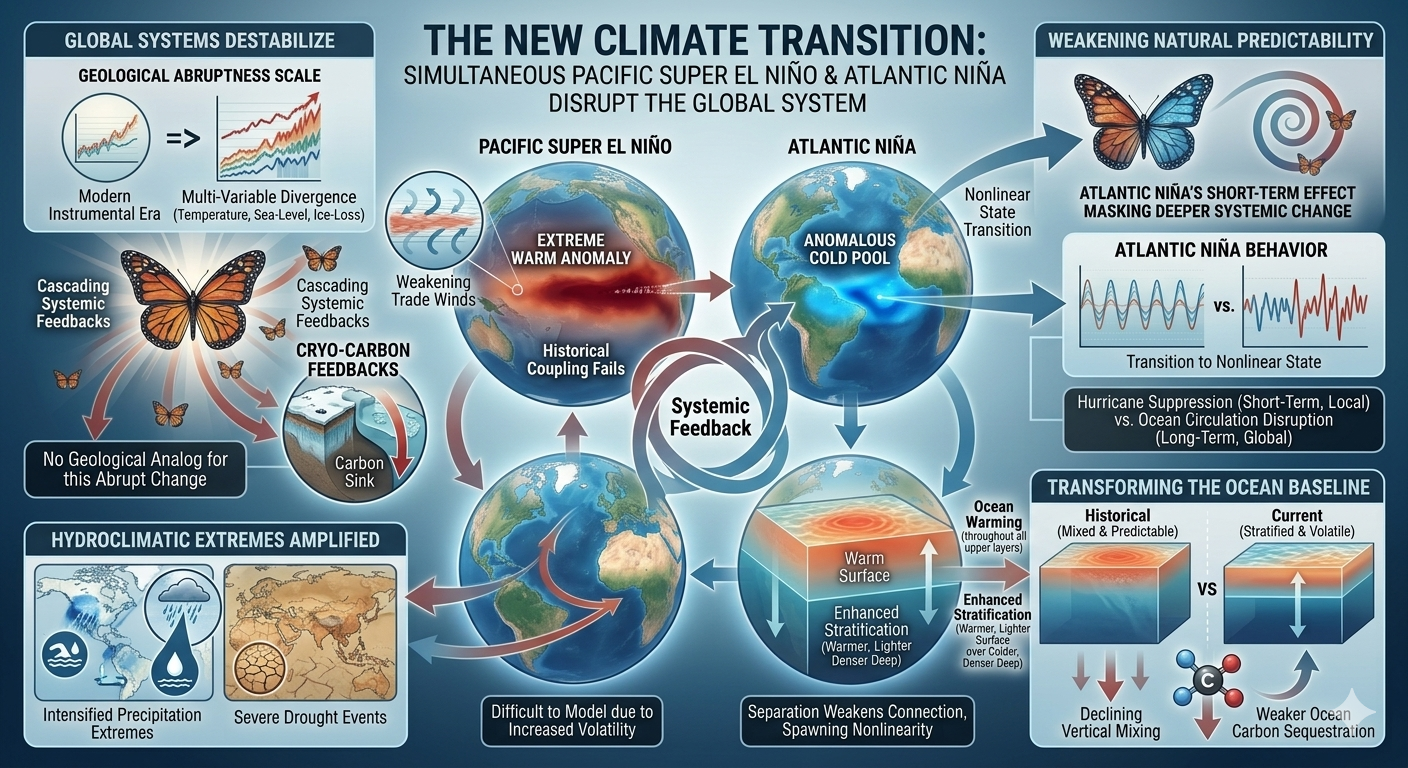
It depends where you look. About 90% of the excess heat is in the ocean. In years like this—with a super El Niño—it’s much easier to see the sea… and reality. Marine heatwaves intensify, coral bleaching accelerates, ocean temperatures shatter records, hurricanes find more fuel, atmospheric rivers carry more moisture, and fisheries are disrupted as marine species migrate in search of cooler waters. The ocean doesn’t hide the warming—it amplifies its consequences.
Set ‘Em Up, Knock ‘Em Down
[Intro]
One…
after another.
Standing…
in a line.
(How much time?)
[Refrain]
Set ’em up
(Knock ’em down)
Yep…
(Watch ’em fall all around)
[Verse 1]
One small push, one tiny lean
Changes the things in between
Standing steady, row by row
Waiting for the first to go
[Pre-Chorus]
One by one
(Then two by two)
What’s behind…
(Is coming through)
[Chorus]
Set ’em up
(Knock ’em down)
Watch the circle
(Come around)
One small motion
(Starts the flow)
How far it goes…
(You never know)
Set ’em up
(Knock ’em down)
[Verse 2]
Ice gives way, the oceans rise
Smoke climbs upward to the skies
Forests fade, the rivers change
Nothing stays within its range
[Pre-Chorus]
Connected worlds
(Connected fate)
The first small push…
(Can escalate)
[Bridge]
Not by chance…
(Not by luck)
Just the way…
(Systems work)
One transition
(Leads to more)
Opening yet…
(Another door)
[Breakdown]
After all…
A domino…
doesn’t choose…
to fall.
[Final Chorus]
Set ’em up
(Knock ’em down)
Yep…
(Watch ’em fall all around)
One becomes
(Two become four)
As they reach
(Forever more)
Butterflies…
(Dominoes…)
Feedback loops…
(All in rows…)
Set ’em up…
Knock ’em down…
(There it goes!)
[Outro]
Set ’em up
(Knock ’em down)
Yep…
(Watch ’em fall all around)
Falling down
(Down, down, down)
Slippery Slope
[Intro]
Dig it up…
Burn it down…
(Then look around?)
Yup.
[Refrain]
Draw down the oil
(On a slippery slope)
Watchin’ nature spoil
(Feelin’ like a dope)
I should have known
(My actions’ reactions)
I should have grown
(Should have flown)
…now hear me groan
[Verse 1]
Easy fuel beneath our feet
Power, profit, endless heat
Another barrel, gone in flame
Quietly rewrote the game
Cheap today and costly then
Borrowed from tomorrow’s end
Smoke climbed higher year by year
Now the bill is finally here
[Chorus]
Slippery slope
(Harder to climb)
Running out
(Of borrowed time)
[Refrain]
Draw down the oil
(On a slippery slope)
Watchin’ nature spoil
(Feelin’ like a dope)
I should have known
(My actions’ reactions)
I should have grown
(Should have flown)
…now hear me groan
[Verse 2]
Storms grow stronger, oceans rise
Smoke hangs heavy in the skies
Heat waves settle, rivers dry
Still we ask the question, “Why?”
[Pre-Chorus]
Cause and effect
(Hand in hand)
The laws of nature
(Make their stand)
[Bridge]
It wasn’t fate…
(It wasn’t luck)
Piece by piece…
(We filled the truck)
One decision…
(Became a trend)
Ignoring warnings…
(Has its end)
[Breakdown]
The atmosphere…
keeps receipts.
The oceans…
keep records.
(And it ain’t cheap!)
[Final Chorus]
Draw down the oil
(On a slippery slope)
Watchin’ nature spoil
(Feelin’ like a dope)
I should have known
(My actions’ reactions)
I should have grown
(Should have flown)
…now hear me groan
[Outro]
Draw down the oil
(On a slippery slope)
Watchin’ nature spoil
(Feelin’ like a dope)
I should have known
(My actions’ reactions)
I should have grown
(Should have flown)
…now hear me groan
Winds
[Intro]
You cannot…
see the wind.
Only…
what it moves.
(Physics proves)
The winds of change…
(Rearrange)
[Refrain]
The winds blow the butterflies
(Off course)
The winds blow the dominoes
(Of course)
Oh no!
(There they go)
The winds of change…
(Rearrange)
[Verse 1]
Invisible across the sky
A moving force goes drifting by
Pressure changes, currents flow
Taking places we don’t know
Gentle breezes, growing strong
Carrying the world along
One small gust becomes a gale
Changing scenes on the trail
[Chorus]
Butterflies
(Change their flight)
Dominoes
(Tip tonight)
Oh no!
(There they go)
[Refrain]
The winds blow the butterflies
(Off course)
The winds blow the dominoes
(Of course)
Oh no!
(There they go)
The winds of change…
(Rearrange)
[Verse 2]
Jet streams wander far from home
Rossby waves begin to roam
Storms are steered from sea to land
By an unseen guiding hand
[Bridge]
You can’t catch it…
(With your hands)
Yet it shapes…
(The sea and lands)
[Breakdown]
The wind…
doesn’t decide…
where to blow.
It responds…
to energy…
moving…
then feel the flow.
The winds of change…
(Rearrange)
[Final Chorus]
The winds blow the butterflies
(Off course)
The winds blow the dominoes
(Of course)
Oh no!
(There they go)
One more gust
(One more change)
One more pathway
(Rearranged)
Butterflies…
(Dominoes…)
[Refrain]
The winds blow the butterflies
(Off course)
The winds blow the dominoes
(Of course)
Oh no!
(There they go)
The winds of change…
(Rearrange)
[Outro]
The winds blow the butterflies
(Off course)
The winds blow the dominoes
(Of course)
Oh no!
(There they go)
The winds of change…
(Rearrange)
Chaos Amongst Us
[Intro]
Order…
inside disorder.
Not the norm…
hidden in the storm.
[Refrain]
There must be
(Chaos amongst us)
’cause it’s so hard to see
(With the chaos amongst us)
I am not in the eye
(Of the hurricane)
I remain…
(In the chaos… awry)
[Verse 1]
What appears to be random noise
May reveal a hidden voice
Signals buried underneath
Patterns waiting to be seen
[Refrain]
There must be
(Chaos amongst us)
’cause it’s so hard to see
(With the chaos amongst us)
I am not in the eye
(Of the hurricane)
I remain…
(In the chaos… awry)
Chaos amongst us
(Hidden in view)
Changing the pathways
(That we move through)
[Verse 2]
A warmer ocean, changing air
New conditions everywhere
A pressure shift, a current turn
Lessons waiting to be learned
[Pre-Chorus]
Sensitive systems
(Respond and bend)
Small beginnings
(Where’s the end?)
[Bridge]
I search for calm
(Inside the storm)
I look for patterns
(Changing form)
If the answer
(Was clear to see)
Then the future
(I’d guarantee)
[Breakdown]
Chaos…
Not random… intricate sums.
Chaos…
means small differences…
can create enormous outcomes.
[Final Chorus]
There must be
(Chaos amongst us)
’cause it’s so hard to see
(With the chaos amongst us)
I am not in the eye
(Of the hurricane)
I remain…
(In the chaos… awry)
Through the turbulence
(Through the change)
Through the patterns
(Rearranged)
Chaos amongst us…
Yet connected…
All the same.
(We’re in the same game.)
[Outro]
Inside the chaos…
There is a pattern.
Inside the pattern…
There is change…
(… in the chaos amongst us)
The Effect
[Intro]
A tiny motion…
A subtle change…
(A bigger notion)
A different path…
Begins to arrange.
(Do you find it strange?)
[Refrain]
The butterfly
(Effect)
Be a butterfly
(Affect)
Though you’re small
(You can affect it all)
[Verse 1]
A little breeze across the sky
A shifting current passing by
A drop of rain, a change in heat
A different pattern we may meet
The smallest moments hidden deep
Can wake a system from its sleep
A tiny difference, barely seen
Can change the future in between
[Pre-Chorus]
Small beginnings
(Large unknowns)
Hidden pathways
(Far-off zones)
[Chorus]
The butterfly effect
(Changes the way)
A moment today
(Can shape tomorrow’s day)
The butterfly
(Effect)
Be a butterfly
(Affect)
[Refrain]
The butterfly
(Effect)
Be a butterfly
(Affect)
Though you’re small
(You can affect it all)
[Verse 2]
A hurricane far away begins
From countless tiny changes within
A warmer sea, a pocket of air
A chain reaction everywhere
[Pre-Chorus]
Sensitive systems
(Respond and move)
Tiny differences
(Change the groove)
[Bridge]
You don’t need to move a mountain
To create a change
You don’t need to control the future
To rearrange
[Breakdown]
The butterfly…
does not create intensification.
The butterfly…
reveals the connection.
[Final Chorus]
The butterfly
(Effect)
Be a butterfly
(Affect)
Though you’re small
(You can affect it all)
One small action
(Can start a chain)
One small signal
(Can move the rain)
The butterfly
(Effect)
The power to affect
Small beginnings…
Infinite directions…
(Introspection)
[Outro]
A butterfly flies…
A system responds…
A world connected…
By every small bond.
[Refrain]
The butterfly
(Effect)
Be a butterfly
(Affect)
Though you’re small
(You can affect it all)
About the Song
Chaos Theory and Climate Dynamics
Chaos theory helps explain why climate change is more than a gradual warming trend. As thermal energy accumulates, the climate system becomes increasingly nonlinear, allowing small disturbances to generate disproportionately large responses.
Sensitive Dependence on Initial Conditions
Often referred to as the “butterfly effect,” small differences in initial atmospheric or oceanic conditions can lead to vastly different weather and climate outcomes. Slight variations in sea surface temperatures, humidity, soil moisture, or atmospheric pressure may eventually influence hurricanes, atmospheric rivers, heat waves, droughts, or persistent blocking patterns thousands of kilometers away.
What Can I Do?
The single most important action you can take to help address the climate crisis is simple: stop burning fossil fuels. There are numerous actions you can take to contribute to saving the planet. Each person bears the responsibility to minimize pollution, discontinue the use of fossil fuels, reduce consumption, and foster a culture of love and care. The Butterfly Effect illustrates that a small change in one area can lead to significant alterations in conditions anywhere on the globe. Hence, the frequently heard statement that a fluttering butterfly in China can cause a hurricane in the Atlantic. Be a butterfly and affect the world.
The Music of Physics
[Intro]
If you (listen closely…)
To the universe…
You’ll hear the verse
(And sing the chorus)
… with all of us!
[Refrain]
You can dance
(Dance!)
To the music
(Of physics)
Quick
(Dance!)
While we’ve got the chance
[Verse 1]
Planets spin without a sound
Gravity keeps turning ’round
As the note begins to play
To the laws that will not sway
[Chorus]
Dance with motion
(Dance with light)
Dance through darkness
(Into bright)
You can dance
(Dance!)
To the music
(Of physics)
[Refrain]
You can dance
(Dance!)
To the music
(Of physics)
Quick
(Dance!)
While we’ve got the chance
[Verse 2]
Energy can change its face
Yet nothing’s ever lost in space
Heat becomes the wind that sings
Storms become the dance of springs
[Bridge]
Gravity
(Keeps the beat)
Entropy
(Moves your feet)
Light is dancing
(Time and space)
Nature prancing
(Keeping pace)
You and I
(Join the band)
Playing songs
(Hand in hand)
[Breakdown]
Physics…
… sounding logic.
The universe…
… one more chorus.
(Sing it with us!)
[Final Chorus]
You can dance
(Dance!)
To the music
(Of physics)
Quick
(Dance!)
While we’ve got the chance
Move with purpose
(Move with grace)
Make the choice
(Change the space)
Dance…
To the music…
Of physics.
[Outro]
You can dance
(Dance!)
To the music
(Of physics)
Quick
(Dance!)
While we still have a chance
Hold My…
[Intro]
Here…
Hold my beer
(You might want to stand clear)
[Verse 1]
Just a little touch
(Barely seen)
No, doesn’t take much
(To change the scene)
A tiny wobble
(Starts the show)
Who can know
(How far it’ll go)
[Pre-Chorus]
Here…
(Hold my beer)
Hear?
(Stand clear)
Noooo… don’t come near!
[Chorus]
You can’t catch
(A falling domino)
Oh, no, no, no
There’s no match
(For a falling domino)
No whoa
(Just watch it go)
Ohhhh, go, go, go
[Verse 2]
One becomes two
(Two becomes four)
Then another
(Hits the floor)
Gravity smiles
(Physics wins)
Once it starts
(It just begins)
[Pre-Chorus]
Here…
(Hold my beer)
Hear?
(Stand clear)
Noooo… nowhere near!
[Bridge]
Hold my…
Common sense.
Hold my…
False confidence.
You thought you had
Enough control…
Until the first one
Let it roll.
[Breakdown]
The hardest domino…
…to stop…
…is the first to go…
…after it falls.
(There’s no last calls)
[Final Chorus]
You can’t catch
(A falling domino)
No, no, no
There’s no match
(For a falling domino)
One hits two
(Two hits four)
[Intro]
[Instrumental Intro: Pulsing Bass, Organ Swell, Muted Guitar Chops, Rising Synth Filter]
[Minimal Beat, Sub Bass, Spoken Vocal]
Here…
Hold my beer
(You might want to stand clear)
[Instrumental]
[Piano Glissando Waterfall Run]
[Heavy Sub-Bass Solo and Kick Drum]
[Verse 1]
Just a little touch
(Barely seen)
No, doesn’t take much
(To change the scene)
A tiny wobble
(Starts the show)
Who can know
(How far it’ll go)
[Pre-Chorus]
Here…
(Hold my beer)
Hear?
(Stand clear)
Noooo… don’t come near!
[Chorus]
You can’t catch
(A falling domino)
Oh, no, no, no
There’s no match
(For a falling domino)
No whoa
(Just watch it go)
Ohhhh, go, go, go
[Instrumental]
[Synth Solo]
[Driving Bass, Psychedelic Organ Jam]
[Verse 2]
One becomes two
(Two becomes four)
Then another
(Hits the floor)
Gravity smiles
(Physics wins)
Once it starts
(It just begins)
[Pre-Chorus]
Here…
(Hold my beer)
Hear?
(Stand clear)
Noooo… nowhere near!
[Bridge]
Hold my…
Common sense.
Hold my…
False confidence.
You thought you had
Enough control…
Until the first one
Let it roll.
[Breakdown]
[Minimal Beat, Deep Sub Bass, Spoken Vocal]
The hardest domino…
…to stop…
…is the first to go…
…after it falls.
(There’s no last calls)
[Final Chorus]
You can’t catch
(A falling domino)
No, no, no
There’s no match
(For a falling domino)
One hits two
(Two hits four)
(… too late…)
Four hits eight
(Then many more)
Here…
(Hold my beer)
Too late…
(Stand clear!)
Go, go, go…
Watch ’em fall…
One small push…
Affects…
…them all.
[Outro]
[Instrumental Outro: Echo Guitar, Organ Fade, Cascading Piano Notes, Domino Sound Effects]
Click…
[Verse 2]
Fish move north to cooler streams
Following forgotten dreams
Storms discover warmer seas
Finding strength with greater ease
Atmospheric rivers grow
Loaded where warm oceans flow
(Or don’t you know?)
[Bridge]
Accumulating
(Year by year)
Suddenly becomes
(Crystal clear)
[Breakdown]
[Minimal Beat, Deep Sub Bass, Spoken Vocal]
The atmosphere…
(Not so clear)
The ocean…
(Releases again.)
[Final Chorus]
In years like this
…it’s a lot easier to see the sea
(…and reality)
Really!
(Careful what you wish)
‘Cause in years such as this…
(…it’s a lot easier to see the sea)
Sea reality…
Is no fantasy.
[Outro]
[Instrumental Outro: Ocean Waves, Piano, Echo Guitar, Organ Fade]
The sea…
doesn’t argue.
(Or don’t you)
… see (see sea, see?)
About the Song
Can you see climate change?
It depends where you look. About 90% of the excess heat is in the ocean. In years like this—with a super El Niño—it’s much easier to see the sea… and reality. Marine heatwaves intensify, coral bleaching accelerates, ocean temperatures shatter records, hurricanes find more fuel, atmospheric rivers carry more moisture, and fisheries are disrupted as marine species migrate in search of cooler waters. The ocean doesn’t hide the warming—it amplifies its consequences.
[Verse 2]
The question isn’t only heat
Or every record that we beat
The deeper question still remains
What world survives beyond our names?
[Bridge]
An estate…
(Is more than things)
It’s the future
(That kindness brings)
The greatest wealth
(We’ll ever see)
Is possibility.
[Breakdown]
[Minimal Beat, Deep Sub Bass, Spoken Vocal]
The ultimate inheritance…
…is opportunity.
Not certainty.
Simply…
…a chance…
…to begin again.
[Final Chorus]
To my children’s children’s children
(I hope you can begin again)
Seven generations
(Relations’ foundations)
The evolution
(Of solution)
Children’s children’s children
(May they always know)
We loved them…
…before…
… their birth on Earth.
[Outro]
[Instrumental Outro: Piano, Acoustic Guitar, Organ Fade, Children’s Voices in the Distance, Gentle Wind]
To my children’s children’s children
(I hope you can begin again)
Seven generations
(Relations’ foundations)
The evolution
(Of solution)
To my children’s…
Children’s…
Children…
This view…
Is for you.
Universal Estate Plan for the Next Seven Generations
About the Song: Universal Estate Plan for the Next Seven Generations
The ultimate estate plan is remarkably simple:
To my children’s children’s children.
The greatest inheritance most of us hope to leave is not a larger bank account. It is the chance for our descendants to raise children of their own, watch them grow, and someday become grandparents themselves.
The question is no longer: How hot is the planet warming?
The more important question is:
“How difficult do we want life to be for the next seven generations?”
[Intro]
[Instrumental Intro: Thoughtful Piano, Pulsing Bass, Clean Guitar Arpeggios, Organ Swells, Slow Building Drums]
[Minimal Beat, Sub Bass, Spoken Vocal]
Tomorrow…
…isn’t written.
(Still… don’t be smitten)
As probabilities…
Surely can be.
[Refrain]
What are the odds
(We’ll be saved by your gods?)
What are the chances
(We continue with dances)
There’s no solution
(In divine intervention)
[Verse 1]
People ask, “What will it be?”
One fixed future? One destiny?
Science answers differently—
A range of possibilities.
[Chorus]
What are the odds?
(Look and see)
Probability…
(Not certainty)
One path climbs…
(One path falls)
A small action…
(Changes all)
[Refrain]
What are the odds
(We’ll be saved by your gods?)
What are the chances
(We continue with dances)
There’s no solution
(In divine intervention)
[Instrumental]
[Guitar Solo]
[Driving Bass, Expansive Synths, Organ Chords, Rolling Drums]
[Verse 2]
Most futures don’t simply end;
Most require that people mend.
The greatest risks we truly face
Are stress and strain from place to place.
[Pre-Chorus]
Not extinction…
(Most of the time)
But disruption…
(Climbing the line)
[Bridge]
Ten percent…
(A steadier way)
Thirty-five…
(Harder days)
Eight contract…
(Two remain…)
The smallest shadow…
(The final frame)
[Breakdown]
[Minimal Beat, Deep Sub Bass, Spoken Vocal]
Probability…
…isn’t prediction.
Uncertainty…
…isn’t ignorance.
It tells us…
…where to pay attention.
[Final Chorus]
What are the odds
(We’ll be saved by your gods?)
What are the chances
(We continue with dances)
There’s no solution
(In divine intervention)
Only choices…
(Only change)
Only courage…
(To rearrange)
What are the odds?
They’re waiting…
…for us.
(Please discuss)
[Outro]
[Instrumental Outro: Piano Returns, Echo Guitar, Organ Fade, Soft Synth Atmosphere]
The future…
…isn’t fixed.
The probabilities…
…are listening.
Choose wisely.
[Refrain]
What are the odds
(We’ll be saved by your gods?)
What are the chances
(We continue with dances)
There’s no solution
(In divine intervention)
A Conceptual Probability Envelope Derived from the Nonlinear Acceleration Framework
About the Song: A Theoretical 200-Year Probability Envelope
Derived from the Nonlinear Acceleration Framework
Model Time Horizon: 2026–2226
A Probability Distribution of Humanity’s Next 200 Years
How likely are different futures for civilization as climate change accelerates?
Here is a Climate-Societal Probability Fan Chart (2026–2226) that visualizes a model-based distribution of potential outcomes over the next two centuries.
Rather than asking “What will happen?”, the chart asks the more scientifically useful question:
“What is the probability distribution of plausible futures?”
The model incorporates nonlinear climate feedbacks, systemic interactions, adaptive capacity, technological progress, and societal resilience to estimate the relative likelihood of six broad scenarios:
The important takeaway is that human extinction is not the central expectation of the model. The highest-probability outcomes involve increasing disruption, economic stress, migration, infrastructure challenges, and declining habitability across vulnerable regions—not the disappearance of humanity.
Understanding probability distributions is far more informative than focusing on a single prediction. As with weather forecasting or hurricane models, uncertainty is not ignorance—it is measurable.
A Theoretical Model of Coupled Feedback Amplification, System-State Transitions, and Future Climate Trajectories
The distribution is not intended to be a literal prediction of where humanity will be in exactly 200 years. A 200-year horizon necessarily involves enormous uncertainty—seven generations means changes in technology, governance, economics, and adaptation capacity that cannot be known today.
The main purpose of the graph is to emphasize that human extinction remains a very low-probability outcome across the modeled scenarios. The more likely risks involve increasing climate disruption, ecosystem stress, and challenges to human systems.
Given that distinction, the most important actions are clear: reduce the primary driver of warming by transitioning away from fossil fuel combustion while simultaneously accelerating adaptation and resilience efforts. The goal is not to focus on an unlikely worst-case outcome, but to reduce the probability of disruptive pathways and improve the chances of a stable, adaptable future.