bookmark_borderPrime Primate: Acceleration Rate

e is the base of the natural logarithm,
rr is the growth rate,
tt is the time elapsed since the initial quantit

[Intro]
What is the acceleration rate
Of the prime primate’s fate
[Break]
Rabidly rapid
[Instrumental, Piano]
The prime primate’s acceleration rate
[Break]
[Verse 1]
You would have thought
He would have thought
To slow down
‘stead the farm he bought
Overwrought
Hit the wall, like a clown
Fall down
[Bridge]
Past Her faster
Natural disaster
Under the command
Of Man
Understand?
[Chorus]
The prime primates doubling rate
Rapid, no debate
The prime primates doubling rate
Rabid, waste ate
Irate
[Instrumental]

[Verse 2]
Would have thought would have thought know
No, no, no
Oh, nooo
Would have thought, obvious to us
Stop!
After all, I mean… obscene
Why not?
Why not stop?
[Break]
Stop
[Break]
Stop
Why not?
[Break]
What is the acceleration rate
Of the prime primate’s fate
[Break]
Rabidly rapid
[Instrumental, Piano]
The prime primate’s acceleration rate
[Break]
so much change so rapidly
[Break]
Can’t we see?
[Break]
It’s so far outside anything we’ve seen, it’s almost mind-blowing,
absolutely gobsmackingly bananas
[Break]
gobsmackingly
[Instrumental]

[Chorus]
The prime primates doubling rate
Rapid, no debate
The prime primates doubling rate
Rabid, waste ate
Irate
[Instrumental]
[Outo]
* Our climate model uses chaos theory in an attempt to adequately account for humans and forecasts a global average temperature increase of 9 degrees Celsius above pre-industrial levels. Everybody has the responsibility not to pollute. There are plenty of things you can do to help save the planet. Stop using fossil fuels.
[End]
[Silence]

How fast are humans causing the climate to change? When we started our experiments in the 1990’s, we thought the time scale was in millenniums. If climate change were happening on a linear basis, we would have been correct; however, by the late 90’s we were convinced climate change was non-linear.

About the catastrophic die-off of 10,000 emperor penguin chicks in the Antarctic, Dr. Caroline Holmes of the British Antarctic Survey (an expert on Antarctic sea-ice) said, “What we’re seeing right now is so far outside what we’ve observed previously. We expected change but I don’t think we expected so much change so rapidly.”

Some areas of the world are now warming so fast, it is becoming more difficult to measure the change from “normal” or average. Jeff Boyne, National Weather Service meteorologist and climatologist, said, “There are climate normals that are updated every 10 to 15 years, because the planet is warming so fast. The ENSO (El Nino-Southern Oscillation) regions are warming so fast that those normals are being updated every 5 years.”

“It’s so far outside anything we’ve seen, it’s almost mind-blowing,” says Walter Meier, who monitors sea-ice with the National Snow and Ice Data Center. “September was, in my professional opinion as a climate scientist, absolutely gobsmackingly bananas,” said Zeke Hausfather, at the Berkeley Earth climate data project.”

* Our climate model uses chaos theory in an attempt to adequately account for humans and forecasts a global average temperature increase of 9 degrees Celsius above pre-industrial levels. Everybody has the responsibility not to pollute. There are plenty of things you can do to help save the planet. Stop using fossil fuels. Consume less. Love more. Here is a list of additional actions you can take.

Doubling time refers to the duration needed for a quantity to double in size, a characteristic of exponential growth. By 2020, substantial data revealed that the doubling time for certain anthropogenic climate impacts had decreased significantly, shifting from 100 years to merely 10 years. For instance, the rate of sea level rise has surged from approximately 1.5 millimeters per year to over 3 millimeters. This trend suggests that the doubling period is likely to further contract, heightening the prospect of sea levels ascending at a rate of one foot per year by 2050.
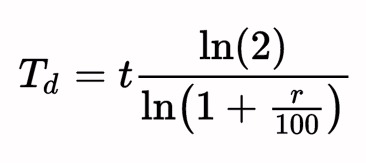
T_{d}=t \frac{\ln (2)}{\ln \left(1+\frac{r}{100}\right)}

From Daniel’s Multimedia Album: Omnilogy

bookmark_borderThe Most Immediate Risk

[Instrumental, Drums, Bugle]
[Intro]
Lull?
All…
Be very, very careful
[Break]
The most immediate risk
Looks like this:
[Break]
Thunder
[Break]
Lightning
[Break]
Frightening
Extreme, know what I mean/

[Guitar Solo]
[Verse 1]
When the skies start to rumble, and the winds begin to howl,
There’s a danger that’s lurking, bringing fear with its growl.
It’s the storm on the horizon, the floodwaters rising high,
The heat that’s overwhelming, reaching for the sky.

[Chorus]
The most immediate risk, is knocking at our door,
Hail, hurricanes and heatwaves, a threat we can’t ignore.
Wildfires ever higher, mud, floods, the danger’s in our face,
For human health and safety, we must find a saving grace.
[Break]
Thunder
[Break]
Lightning
[Break]
Frightening
Extreme, know what I mean?
[Break]
The most immediate risk
Looks like this:
[Instrumental]

[Break]
The most immediate risk
Looks like this:
[Verse 2]
In the sweltering heatwaves, the sun beats down (down, down)
There’s a risk like this: dehydration and heatstroke all around. (Abound)
And when the hurricanes come raging, tearing through the land, (Man)
Leaving destruction in our wake, with no mercy just demand. (Damned demand)

[Chorus]
The most immediate risk, is knocking at our door,
Hail, hurricanes and heatwaves, a threat we can’t ignore.
Wildfires ever higher, mud, floods, the danger’s in our face,
For human health and safety, we must find a saving grace.
[Break]
Thunder
[Break]
Lightning
[Break]
Frightening
Extreme, know what I mean?
[Break]
The most immediate risk
Looks like this:
[Instrumental]

[Bridge]
It’s time to come together, prepare and to defend, (The End)
Against the storms of primate change, we’ll rise and we’ll ascend.
With resilience and action, we’ll weather through the storm,
Emerge with strength to be, our spirit will transform.

[Chorus]
The most immediate risk, is knocking at our door,
Hail, hurricanes and heatwaves, a threat we can’t ignore.
Wildfires ever higher, mud, floods, the danger’s in our face,
For human health and safety, we must find a saving grace.
[Break]
Thunder
[Break]
Lightning
[Break]
Frightening
Extreme, know what I mean?
[Break]
The most immediate risk
Looks like this:
[Instrumental]

[Outro]
All stand tall, wheather together, in the face of what may come,
For in unity and courage, our battle will be won.
Against the most immediate risk, we’ll forge a path ahead,
With hope and determination, we’ll rise from where we’ve tread.
We made our bed….
[End]
[Silence]

A SCIENCE LESSON
The most immediate risk to human health due to climate change is the increased frequency and intensity of extreme weather events. These events, such as heatwaves, hurricanes, violent rain, and wildfires, can have direct and indirect impacts on human health and well-being. Heatwaves, for example, can lead to heat-related illnesses such as heat exhaustion and heatstroke, particularly among vulnerable populations such as the elderly and those with pre-existing health conditions. Similarly, hurricanes and floods can cause injury, displacement, and waterborne diseases, while wildfires can result in respiratory issues due to smoke inhalation and exacerbate existing respiratory conditions. Overall, the heightened occurrence of extreme weather events poses significant risks to human health, requiring proactive measures to mitigate their impact and protect communities.

From Daniel’s Multimedia Album: Omnilogy

bookmark_borderGravity’s Echo

A jungle rock song about physics and Newton’s Laws. Newton’s Laws of Motion are three fundamental principles that describe the relationship between the motion of an object and the forces acting on it. They were formulated by Sir Isaac Newton in the 17th century and laid the groundwork for classical mechanics. The three laws are: Law of Inertia, Law of Acceleration, and Action-Reaction Law.

[Verse]
In the wild
Where the trees grow tall
There’s a force
That can make you fall
It’s the law
That keeps us grounded tight
Newton’s got it all
Yeah
He got it right

Inertia’s the game
When bodies are at rest
You can’t move ’em
You’ll just fail the test
But when forces act
Man
It’s a different scene
Mass times acceleration
Is what we mean

[Verse 2]
There’s a symmetry
Between action and reaction
For every action
There’s an equal
Opposite attraction
When you push
There’s a push right back
It’s a fact
No matter how much you lack

From Daniel’s Multimedia Album: Omnilogy

bookmark_borderInfrasound (You Move Me)

[Intro]
Infrasound
I’ve found
[Break]
You move me
[Instrumental]
[Verse 1]
In the quiet of the night, beneath the starry sky,
I found you shake the ground, down low on high
Not clear to the ear, no, deep in the soul,
Invisible thunder, make the spirit whole.

[Chorus]
Infrasound, you move me,
Beneath the surface, you soothe me,
A silent symphony, felt deep within,
Infrasound, you move me, again and again.
Infrasound, shake the ground
[Instrumental, Guitar, Drums]

[Verse 2]
Rumble of the thunder, ocean’s roar,
Infrasound surrounds us, and so more,
In the way seismic waves behave
A primal connection, transcends the ears,
Infrasound vibrations, calming all my fears.
[Break]
Heartbeat
[Break]
Complete

[Chorus]
Infrasound, you move me,
Beneath the surface, you soothe me,
A silent symphony, felt deep within,
Infrasound, you move me, again and again.
Infrasound
I’ve found
[Break]
You move me
Dance as we
[Instrumental]

[Instrumental, Bass, Drums]
[Bridge]
In the pulse of the Earth, in the beat of my heart,
Infrasound thunders, we’re never apart,
It’s the rhythm of life, the song of the night,
Infrasound vibrations, guiding us to the light.

[Chorus]
Infrasound, you move me,
Beneath the surface, you soothe me,
A silent symphony, felt deep within,
Infrasound, you move me, again and again.
Infrasound
I’ve found
[Break]
You move me
Dance as we
[Instrumental, Bass, Drums]

[Outro]
Infrasound, you move me, can’t you see
Infrasound, you move me, together we’ll be
[End]
[Silence]

The frequency range of human hearing typically spans from about 20 Hertz (Hz) to 20,000 Hertz (20 kHz). This range can vary slightly from person to person and tends to diminish with age, with higher frequencies becoming more difficult to hear as individuals get older.

At the lower end of the spectrum, frequencies below 20 Hz are referred to as infrasound, which is typically felt rather than heard. Frequencies above 20 kHz are known as ultrasound, which is beyond the range of human hearing but can be detected by certain animals like bats and dolphins.

From Daniel’s Multimedia Album: Omnilogy

bookmark_borderGravitational Waves

[Intro, Timpani, Drums]
[Instrumental, Guitar Solo]
[Break]
Rip, rip, ripples
Space-time tipples
[Bridge, Saxophone Solo]
Ripples

[Verse 1]
Ripples in the fabric of space and time,
Traveling through the cosmos, a mystical rhyme.
Born from the dance of massive things,
A cosmic symphony that gravity brings.

[Chorus]
Gravitational waves, a cosmic ballet,
Traveling through the universe, night and day.
Invisible threads weaving through the void,
Revealing the secrets that stars have deployed.
[Break]
Rip, rip, ripples
Space-time tipples
[Bridge, Flute Solo]
Ripples
[Instrumental, Strings]
[Break]

[Verse 2]
At the speed of light, we journey on,
Carrying whispers of events far gone.
Whole colliding black holes, neutron stars’ embrace,
Their echoes traverse the vastness of space.

[Chorus]
Gravitational waves, a cosmic ballet,
Traveling through the universe, night and day.
Invisible threads weaving through the void,
Revealing the secrets that stars have deployed.
[Break]
Rip, rip, ripples
Space-time tipples
[Bridge, Flute Solo]
Ripples
[Instrumental, Strings]
[Break]

[Bridge]
A cosmic messenger, a ripple’s embrace,
Unveiling the mysteries of time and space.
In the cosmic dance, we play our part,
Guiding the journey through the celestial chart.

[Chorus]
Gravitational waves, a cosmic ballet,
Traveling through the universe, night and day.
Invisible threads weaving through the void,
Revealing the secrets that stars have deployed.
[Break]
Rip, rip, ripples
Space-time tipples
[Bridge, Flute Solo]
Ripples
[Instrumental, Strings]
[Break]

[Outro]
So listen closely to the cosmic tunes,
As gravitational waves sing under the moons.
For in their whispers, we find our way,
Navigating the cosmos, night and day.
Far away
Coming this way
[End]
[Silence]

A SCIENCE LESSON
In the universe, the two fastest things known are:

  1. Light: Light travels at the fastest speed possible in a vacuum, which is approximately 299,792 kilometers per second (about 186,282 miles per second). According to Einstein’s theory of relativity, nothing with mass can travel at the speed of light or faster.
  2. Gravitational Waves: Gravitational waves are ripples in spacetime caused by the acceleration of massive objects. They travel at the speed of light, making them one of the fastest phenomena in the universe.

From Daniel’s Multimedia Album: Omnilogy

bookmark_borderPhotosphere

The temperature of the Sun’s surface, known as the photosphere, is approximately 5,500 degrees Celsius (9,932 degrees Fahrenheit). However, deeper within the Sun’s core, where nuclear fusion reactions occur, temperatures can reach millions of degrees Celsius.

The photosphere is the visible surface of the Sun, where sunlight is emitted and where most of the Sun’s radiation is generated. It is the outermost layer of the Sun’s interior and is composed primarily of hydrogen and helium gases. The photosphere is characterized by a granular texture, with dark regions known as sunspots interspersed among brighter areas called granules. Sunspots are cooler regions caused by intense magnetic activity, while granules represent convective cells where hot gas rises and cooler gas sinks. Overall, the photosphere appears as a bright, glowing disk when observed from Earth.

[Intro]
[Instrumental, Strings, Guitar Solo]
[Break]
Hot!
[Break]
Hot!
[Break]
Hot!

[Verse 1]
Beneath the sky of blue,
A star of fiery hue,
A domain of blazing view,
The photosphere we knew.

Granules dance in the light,
Sunspots fade in the night,
A cosmic, wondrous sight,
Of the photosphere’s might.

[Break]
Hot!
[Break]
Hot!
[Break]
Hot!

[Chorus]
Hot, hot, hot, the photosphere,
Burning bright, without a fear,
A fiery dance, so crystal clear,
In the Sun’s embrace, we persevere.
[Bridge, Instrumental, Flute Solo]
[Break]

[Verse 2]
At five thousand five hundred,
Degrees Celsius, it’s thunder,
On this surface, we wonder,
In its glow, we ponder.

Nuclear fusion, no illusion, might
In the core, burning bright,
Millions of degrees, the light,
In the Sun’s eternal flight.

[Break]
Hot!
[Break]
Hot!
[Break]
Hot!

[Chorus]
Hot, hot, hot, the photosphere,
Burning bright, without a fear,
A fiery dance, so crystal clear,
In the Sun’s embrace, we persevere.
[Bridge, Instrumental, Flute Solo]
[Break]

[Bridge]
A grand celestial dance,
In the Sun’s fiery expanse,
A cosmic symphony’s chance,
In the photosphere’s trance.

[Break]
Hot!
[Break]
Hot!
[Break]
Hot!

[Chorus]
Hot, hot, hot, the photosphere,
Burning bright, without a fear,
A fiery dance, so crystal clear,
In the Sun’s embrace, we persevere.
[Bridge, Instrumental, Flute Solo]
[Break]

[Outro]
In the photosphere’s glow,
We bask in its radiant show,
A celestial fire, aglow,
In the universe’s eternal flow.
Sunshine shine
[End]
[Silence]

From Daniel’s Multimedia Album: Omnilogy

bookmark_borderWhich Way is Out? (Relativity Challenges)

[Intro]
Excuse me
[Break]
Can you help me out?
Can’t seem to see
My way out

[Verse 1]
Here’s the thing…
Finding something (out)
Finding anything (out)
About out
Getting out!
O
U
T
Free me
[Chorus]
Which way is up?
Which way is down?
Hard to tell
If you keep moving around
In the meantime,
[Bridge]
I’m…
I’m… trying to find anything about…
How to get out
So, excuse me
[Break]
Can you help me out?
Can’t seem to see
[Break]
My way out
[Break]
Breakout
[Instrumental]

[Verse 2]
Can you tell me, without a doubt
Which way is out?
Here I sit… cry and shout out, “Out!”
’cause I can’t find my way out

[Chorus]
Which way is up?
Which way is down?
Hard to tell
If you keep moving around
In the meantime,
[Bridge]
I’m…
I’m… trying to find anything about…
How to get out
So, excuse me
[Break]
Can you help me out?
Can’t seem to see
[Break]
My way out
[Break]
Breakout
[Instrumental]

[Verse 3]
In search of the most direct route
To getting out
Relativity’s gettin’ the best of me
The Heavens know, I can’t see
My way out

[Chorus]
Which way is up?
Which way is down?
Hard to tell
If you keep moving around
In the meantime,
[Bridge]
I’m…
I’m… trying to find anything about…
How to get out
So, excuse me
[Break]
Can you help me out?
Can’t seem to see
[Break]
My way out
[Break]
Breakout
[Break]
Relativity challenges our intuitive understanding of space, time, and the nature of reality.
Really?
In the realm of relativity, the concept of “out” becomes more complex.
Perplex?
[Instrumental]
[Outro]
Relativity challenges our intuitive understanding of space, time, and the nature of reality.
Really.
In the realm of relativity, the concept of “out” becomes more complex
Really.
[End]
[Silence]

Relativity challenges our intuitive understanding of space, time, and the nature of reality. It suggests that our perception of the universe is shaped by our relative motion and the gravitational environment in which we exist, leading to philosophical questions about the nature of existence and our place in the cosmos.

While the effects of relativity may not always be directly observable in our daily lives, they underpin many aspects of modern science and technology, shaping our understanding of the universe and influencing the development of new technologies and ideas.

In the realm of relativity, the concept of “out” becomes more complex and relative depending on the observer’s frame of reference and the curvature of spacetime. In everyday experience on Earth, “out” is often interpreted as away from the center of the planet or outward toward the horizon.

However, in the context of general relativity, which describes gravity as the curvature of spacetime, the direction of “out” can vary depending on the local gravitational field and the observer’s position in spacetime. For example:

  1. Near a massive celestial body like a planet or star, the direction of “out” may be toward the center of gravity due to the curvature of spacetime caused by the mass of the object. In this case, “out” would be perpendicular to the local gravitational field.
  2. In regions of strong gravitational fields, such as near a black hole, the curvature of spacetime becomes extreme, and the concept of “out” may lose its conventional meaning. Objects near a black hole may appear to move inward toward the singularity, regardless of their initial direction of motion.
  3. In the absence of significant gravitational fields, such as in deep space far from massive objects, the direction of “out” may be more straightforward, following the trajectory of the observer’s motion or the expansion of the universe in cosmological terms.

Ultimately, the concept of “out” in the realm of relativity is relative and dependent on the observer’s frame of reference, the local gravitational environment, and the curvature of spacetime.

From Daniel’s Multimedia Album: Omnilogy

bookmark_borderSurface Tension

[Intro]
Walk on water?
There’s tension on the surface
[Instrumental, Flute, Piano]
[Guitar Solo]
[Break]
Water
[Break]
Give me some water
[Break]
Can’t get any hotter
[Break]
[Verse 1]
Did I fail to mention
With good ole surface tension
You can walk on water
If it gets any hotter…
[Bridge]
Suspension
Is a whole other thing
Over the water
Let’s swing
[Break]
Go!
[Instrumental]
[Bridge]
This bridge about a bridge
To get from ridge to ridge
[Chorus]
Trying not to get wet, yet
Yet, trying to cool down
No relief in this town found
Wanna bet it’s stagnant
There’s no current current
[Break]
Water
[Break]
Give me some water
[Break]
Can’t get any hotter
[Break]
There’s tension on the surface
The facts we’ve got to face
[Instrumental]

[Verse 2]
What do you think, take a drink?
Mouth so dry, think I might die
Suppose it was all water under the bridge
Till we set ‘er a flame, damn shame
Burning our bridges is rarely sane

[Break]
Water
[Break]
Give me some water
[Break]
Can’t get any hotter
[Break]

[Bridge]
This bridge about a bridge
To get from ridge to ridge
[Chorus]
Trying not to get wet, yet
Yet, trying to cool down
No relief in this town found
Wanna bet it’s stagnant
There’s no current current
[Break]
Water
[Break]
Give me some water
[Break]
Can’t get any hotter
[Break]
There’s tension on the surface
The facts we’ve got to face
[Instrumental]

[Verse 3]
You first.
Begin.
Wade in.
Let me know…
… how far you go
Did I fail to mention
[Break]
Did I fail to mention
With good ole surface tension
You can walk on water
If it gets any hotter…
[Break]
Suspension
It’s a whole ‘nuther thing
Over the water
Let’s swing
[Chorus]
Trying not to get wet, yet
Yet, trying to cool down
No relief in this town found
Wanna bet it’s stagnant
There’s no current current
[Break]
Water
[Break]
Give me some water
[Break]
Can’t get any hotter
[Break]
There’s tension on the surface
The facts we’ve got to face
[Instrumental]
[Outro]
Just can’t rant, rant, rant
See currently…
There’s no current current
[End]
[Silence]

Surface tension is a phenomenon that occurs at the surface of a liquid, where molecules are strongly attracted to each other. This attraction creates a thin, elastic layer on the surface of the liquid, which resists external forces and allows certain objects to float on or be supported by the surface.

In simpler terms, surface tension is like an invisible “skin” that forms on the surface of a liquid, caused by the cohesive forces between the liquid molecules. This tension gives the surface of the liquid certain properties, such as the ability to hold together in drops or form a meniscus in a narrow tube. Surface tension also allows insects like water striders to walk on water and enables small objects like paper clips to float on the surface of water.

Social tensions over water can arise due to various factors, including competition for limited water resources, unequal access to clean water, disputes over water rights and allocation, and the impacts of water-related disasters such as floods and droughts. Here are some examples of social tensions related to water:

  1. Access to Clean Water: In many parts of the world, access to clean and safe drinking water is not equitable. While some communities have reliable access to clean water sources, others may lack access to adequate sanitation facilities or rely on contaminated water sources, leading to health risks and disparities.
  2. Water Scarcity: As populations grow and demand for water increases, competition for limited water resources can lead to tensions between different users, such as agriculture, industry, and households. In regions experiencing water scarcity, conflicts may arise over water rights, allocation, and management.
  3. Transboundary Water Conflicts: Rivers, lakes, and aquifers often cross international borders, leading to potential conflicts over shared water resources between neighboring countries. Disputes may arise over dam construction, water diversion projects, pollution, and the impacts of climate change on water availability.
  4. Urban-Rural Divide: In many regions, there is a divide between urban and rural areas in terms of access to water infrastructure and services. Urban centers may receive preferential treatment in water allocation and infrastructure development, leading to tensions with rural communities that rely on water for agriculture and livelihoods.
  5. Environmental Concerns: Water extraction and infrastructure development can have significant impacts on freshwater ecosystems and biodiversity. Environmental conservationists and indigenous communities may clash with government authorities and corporations over dam construction, river diversion, and other projects that alter natural water systems.
  6. Water-related Disasters: Events such as floods, droughts, and hurricanes can exacerbate social tensions over water. Vulnerable communities may face displacement, food and water shortages, and economic losses, leading to social unrest and conflicts over relief efforts and resources.

Addressing these social tensions requires collaborative and inclusive approaches to water management, involving stakeholders from government, civil society, the private sector, and local communities. Sustainable water governance, equitable water distribution, and integrated water resource management are essential for mitigating conflicts and promoting cooperation in addressing water challenges.

Several regions around the world are facing water-related tensions and conflicts, often referred to as “water wars,” due to issues such as scarcity, pollution, overuse, and mismanagement of freshwater resources. Some examples include:

  1. Middle East: The arid and semi-arid regions of the Middle East, including countries like Israel, Palestine, Jordan, and Syria, have long experienced water scarcity and disputes over shared water sources such as the Jordan River and the aquifers of the West Bank.
  2. South Asia: Countries in South Asia, including India, Pakistan, and Bangladesh, face water-related tensions due to competing demands for water from agriculture, industry, and urban populations, exacerbated by factors such as population growth, pollution, and climate change.
  3. Africa: Various countries in Africa, particularly those in the Sahel region and the Horn of Africa, contend with water scarcity and conflicts over transboundary rivers and lakes, such as the Nile River, the Niger River, and Lake Chad.
  4. South America: Parts of South America, including countries like Brazil, Argentina, and Chile, experience water-related tensions related to deforestation, land use changes, and conflicts over access to water for agriculture, mining, and energy production.
  5. United States: Within the United States, regions facing water stress and tensions include the southwestern states of Arizona, California, and Nevada, where water scarcity issues are exacerbated by rapid population growth, urbanization, and agricultural demands. Cities like Phoenix and Scottsdale, Arizona, grapple with challenges such as groundwater depletion, competing water rights, and the impacts of climate change on water availability.

These are just a few examples of regions facing water-related tensions and conflicts, highlighting the need for sustainable water management practices, cooperation, and conflict resolution mechanisms to address these challenges.

From Daniel’s Multimedia Album: Omnilogy

bookmark_borderDissociation

In science, dissociation refers to the process by which molecules or compounds break apart into smaller components, such as ions or radicals, usually as a result of being exposed to certain conditions like heat, light, or solvation. This process often occurs in solution, where solvent molecules surround and interact with the solute molecules, causing them to separate into their constituent parts. Dissociation can involve the splitting of chemical bonds, leading to the formation of ions with positive or negative charges, or it can involve the disruption of molecular structures, resulting in the release of smaller fragments or radicals.

[Intro]
[Bubbling]
[Bubbles]
[Water]
[Instrumental]
[Flute Solo]
[Break]
Our relation in dissociation
[Break]
[Verse 1]
In the depths of water’s flow,
Secrets of eons start to show.
Substance dissolved, and then we break,
Into I and you, a bold move we take.

[Chorus]
Dissociation, a chemical dance,
In water’s embrace, a newfound chance.
Breaking bonds, setting us free,
In the aqueous realm, a symphony.
[Break]
Our relation in dissociation
[Break]
[Bridge]
Association of dissociation
[Instrumental]

[Verse 2]
Positive, negative, we roam,
In the solution, we find a home.
Charged particles, in motion… glide,
Dissociation’s beauty cannot hide.

[Chorus]
Dissociation, a chemical dance,
In water’s embrace, a newfound chance.
Breaking bonds, setting us free,
In the aqueous realm, a symphony.
[Break]
Our relation in dissociation
[Break]

[Bridge]
From solid to liquid, a transformation,
Dissociation sparks creation.
In water’s realm, soles unite,
A dance of chemistry, pure and bright.

[Break]
Our relation in dissociation
[Break]

[Chorus]
Dissociation, a chemical dance,
In water’s embrace, a newfound chance.
Breaking bonds, setting us free,
In the aqueous realm, a symphony.
[Break]
Our relation in dissociation
[Break]
Association of dissociation

[Outro]
Dissociation, in waters deep,
A dance of dances, a secret to keep.
In the realm of chemistry’s creation,
Our dissociation sparks fascination.

[End]
[Silence]

From Daniel’s Multimedia Album: Omnilogy

bookmark_borderOn the Nanometer Scale

[Intro]
Down, down, down
[Break]
[Verse]
Down in the world of the miniscule,
Where atoms dance and particles rule,
There’s a realm where wonders prevail,
On the nanometer scale.
Awe won’t fail
Never goes stale
From 1 to 100, in a tiny span,
Nano wizards work a steady hand,
Synthesizing wonders, precision and grace,
Unveiling secrets of a microscopic space.

[Chorus]
On the nanometer scale, hail the small,
Nano’s the name, weighing it all.
From atoms to molecules, a brave new way,
Designing a future, innovation holds the sway.

[Bridge]
With nano as our guide, we explore the unknown,
Unlocking the mysteries, where they’re barely shown.
Medical miracles to materials anew,
Who knew the possibilities, what nano can do.

[Chorus]
On the nanometer scale, hail the small,
Nano’s the name, “waying” it all.
From atoms to molecules, a brave new day,
Designing a future, innovation the way.
[End]
[Silence]

A SCIENCE LESSON
“Nanotechnology,” or “nano” for short, refers to the manipulation and study of matter at the nanoscale, typically ranging from 1 to 100 nanometers. This field involves the design, synthesis, characterization, and application of materials and devices on the nanometer scale. The prefix “nano-” comes from the Greek word “nanos,” meaning dwarf. In nanotechnology, scientists and engineers work with structures and systems at the atomic or molecular level, where properties can differ significantly from those at larger scales.

From Daniel’s Multimedia Album: Omnilogy

bookmark_borderSpace (I Can See Right Through You)

[Intro]
Empty?
[Break]
I’m not really empty, see.
[Break]
Do you see right through me?
[Instrumental]
[Flute Solo]
[Drum Solo]
Space the final frontier…
Or just the next peer-to-peer?
[Verse 1]
Space the final frontier…
No fear, the future’s near
The past passed
[Bridge]
Our race through space
It’s plain to see
Not empty
[Break]
Here’s me!
[Break]
There’s you, too
[Break]
[Chorus]
Our observation of all creation
May not be as it appears
No fears, between spheres
In the space permeated
Created
[Bridge]
Switched and baited
By various forms of energy
A tendency to radiate
At what rate?
Don’t hesitate
It’s free

[Break]
Space
[Break]
Space
I can see right through you, through you
[Break]
Who turned out the lights?
[Break]
[Verse 2]
And, there’s dark energy, see?
Ohh, no, never mind, not your kind
Ohh, woe, won’t let the dark energy
Get the best of me
No, won’t let ‘er get me down, run down
[Bridge]
Gonna shine, I am
I’m gonna shine
I am
Shine like a star
You’re sure to go far
[Chorus]
Our observation of all creation
May not be as it appears
No fears, between spheres
In the space permeated
Created
[Break]
Space
[Break]
Space
I can see right through you, through you
[Instrumental]
[Flute Solo]
Shine like a star
Wherever you are
Suppose you own your own space
Hey! You’re your own star
So why not shine?
Shine, all your time
[Bridge]
Believe me, I’m tryin’
Tryin’ to shine fine
[Outro]
Just give me time,
Sweet, sweet, time
All the time, tryin’
Shinin’, Shinin’ in
[End]
[Silence]

A SCIENCE LESSON
Space, often referred to as the vacuum of space, is mostly made up of empty space. In the vast expanse between celestial bodies like stars, planets, and galaxies, there are very few particles present. However, space is not entirely empty; it contains extremely low-density matter, including gas, dust, and radiation. These particles are spread out over immense distances, making space appear empty to human observation. Additionally, space is permeated by various forms of energy, such as electromagnetic radiation and dark energy, which contribute to the dynamic properties of the universe.

In seemingly empty space, there are still traces of matter and energy, including particles such as photons, neutrinos, and cosmic rays. Additionally, there are electromagnetic fields permeating space, along with gravitational fields associated with massive objects like stars and galaxies. Despite appearing empty, space is filled with subtle but fundamental components that contribute to the fabric of the universe.

From Daniel’s Multimedia Album: Omnilogy

bookmark_borderPhoton: On

[Intro]
Click
[Break]
Click
[Break]
Click
[Break]
Click
[Instrumental]
[Synthesizer Solo]
[Saxophone Solo]
[Break]
Photon: on
[Break]
[Guitar Solo]
[Break]
[Verse 1]
Photon on
My little packet of energy
You turn me on
It’s elementary,
My dear
How did get here?
[Bridge]
Partially particle
Wave goodbye
Getting high, you can fly
Electro magnetic personality
[Chorus]
I see the light
We’ll be the light
Best thing in sight
Delight
[Instrumental]
[Break]

[Verse 2]
As the clouds move in, you begin
Fading to dim
Where ya goin’?
[Break]
When the sun’s not found
[Break]
You go down,
[Break]
go down
[Break]
[Guitar Solo]
[Bridge]
Particles part
Wave goodbye
Never die, you can fly
Lovely, magnetic personality
[Break]
[Flute Solo]
[Chorus]
I see the light
We’ll be the light
Best thing in sight
Delight
[Instrumental]
[Break]
[Bridge]
Until we meet again
A new day will begin
A new day we’ll begin
[Outro]
At the break of the day
What do you say…
It’s dawning on me, I see
I see the light
[End]
[Silence]

A SCIENCE LESSON
Light is made up of tiny packets of energy called photons. Photons are elementary particles that have properties of both particles and waves. They travel in electromagnetic waves and are responsible for carrying electromagnetic radiation, including visible light, infrared light, ultraviolet light, and more. When photons interact with matter, they can be absorbed, reflected, or transmitted, giving rise to the various phenomena we observe with light.

From Daniel’s Multimedia Album: Omnilogy

bookmark_borderApparent Chaos

Overall, the most intriguing aspect of chaos theory is its ability to shed light on the intricate dynamics of nonlinear systems and uncover the underlying order within apparent chaos, challenging traditional notions of predictability and determinism in science.

[Intro]
Chaos
It’s no coin toss
Know, know, know

[Instrumental]

[Verse 1]
In the realm of complexity, where order meets surprise,
There’s a theory that reveals the truth behind our eyes.
It’s chaos, they say, but don’t be dismayed,
For within this apparent chaos, there’s a hidden serenade.

[Bridge]
Behind our I’s
Our ears hear
Here is made
A hidden serenade

[Chorus]
Apparent chaos, dancing in disguise,
Unraveling secrets, where truth and mystery flies.
Beneath the surface, in the depths of the unknown,
There’s an underlying order, waiting to be shown.
[Break]
Chaos
[Break]
It’s no coin toss
Know, know, know
[Instrumental]
[Guitar Solo]

[Break]
Chaos
[Break]
It’s no coin toss
Know, know, know
[Break]

[Verse 2]
From simple rules, emerge patterns unforeseen,
In nonlinear systems, where chaos reigns supreme.
But don’t be fooled by the “randomness” you see,
For within this apparent chaos, lies a symphony.

[Bridge]
Behind our I’s
Our ears hear
Here is made
A hidden serenade

[Chorus]
Apparent chaos, dancing in disguise,
Unraveling secrets, where truth and mystery flies.
Beneath the surface, in the depths of the unknown,
There’s an underlying order, waiting to be shown.
[Break]
Chaos
[Break]
It’s no coin toss
Know, know, know
[Instrumental]
[Guitar Solo]

[Break]
Chaos
[Break]
It’s no coin toss
Know, know, know
[Break]
[Bridge]
Traditional notions, they begin to fade,
As chaos theory reveals the game we’ve played.
No longer bound by predictability’s chains,
We embrace the complexity, where true knowledge reigns.

[Chorus]
Apparent chaos, dancing in disguise,
Unraveling secrets, where truth and mystery flies.
Beneath the surface, in the depths of the unknown,
There’s an underlying order, waiting to be shown.
[Break]
Chaos
[Break]
It’s no coin toss
Know, know, know
[Instrumental]
[Flute Solo]

[Outro]
So let’s dive into the chaos, with open hearts and minds,
For within its depths, the beauty of order we’ll find.
In the dance of complexity, we’ll discover the key,
To unlocking the secrets of the universe’s mystery.
[Instrumental]
[Saxophone Solo]
[End]
[Silence]

From Daniel’s Multimedia Album: Omnilogy

bookmark_borderExcitation of Electrons

[Intro]
Excitation of electrons
Bring it on
And on we go, I didn’t know
[Break]
[Verse 1]
In the garden where the moonlight gleams,
We dance beneath the starry beams.
Your touch, spot on, photon, ignite the spark,
And in your arms, I find my heart less dark.

[Chorus]
Celebration! Excitation of electrons in my soul,
Lighting up my world and making me whole.
With every glance, you elevate me higher,
In your love, I’m consumed by fire, fire
[Break]
Excitation
[Break]
Exclamation
[Break]
Explanation?
[Bridge]
[Instrumental]

[Verse 2]
Dew dripped green in the morning sun,
Love fuels the scene, I’m not undone.
With each kiss, I’m propelled to soar,
In this dance of love, forevermore.

[Chorus]
Celebration! Excitation of electrons in my soul,
Lighting up my world and making me whole.
With every glance, you elevate me higher,
In your love, I’m consumed by fire, fire
[Break]
Excitation
[Break]
Exclamation
[Break]
Explanation?
[Bridge]
In the chemistry of love, we find our fate,
Bound by the bonds we create.
With every heartbeat, we synchronize,
In this cosmic dance, our love never dies.

[Chorus]
Celebration! Excitation of electrons in my soul,
Lighting up my world and making me whole.
With every glance, you elevate me higher,
In your love, I’m consumed by fire, fire
[Break]
Excitation
[Break]
Exclamation
[Break]
Explanation?

[Outro]
So let’s dance in the light of our connection, (Teleconnections)
In this symphony of love and affection. (Teleconnections)
With you, I’m electrified, I’m alive,
Forever entwined, we’ll continue to thrive.
We will survive!
[End]
[Silence]

A SCIENCE LESSON

Chlorophyll, the green pigment found in plants and other photosynthetic organisms, plays a crucial role in transforming light energy into chemical energy through the process of photosynthesis. Here’s how it works:

  1. Light Absorption: Chlorophyll molecules are embedded in specialized structures called chloroplasts within plant cells. When exposed to sunlight, chlorophyll absorbs photons, which are packets of light energy.
  2. Excitation of Electrons: The absorbed photons energize electrons within the chlorophyll molecules, causing them to become “excited” and jump to higher energy levels.
  3. Electron Transport Chain: The excited electrons are passed through a series of proteins and molecules known as the electron transport chain, located within the thylakoid membranes of the chloroplasts.
  4. ATP Synthesis: As the excited electrons move through the electron transport chain, they release energy, which is used to pump protons (hydrogen ions) across the thylakoid membrane, creating a concentration gradient.
  5. Chemiosmosis: The buildup of protons creates a potential energy gradient across the thylakoid membrane. Protons then flow back through ATP synthase channels, driving the synthesis of adenosine triphosphate (ATP), a molecule that stores energy.
  6. NADPH Production: In addition to ATP, the excited electrons also contribute to the reduction of nicotinamide adenine dinucleotide phosphate (NADP+) to form NADPH, another energy-rich molecule.
  7. Carbon Fixation: The ATP and NADPH generated during the light-dependent reactions are utilized in the subsequent dark reactions (Calvin cycle) to convert carbon dioxide (CO2) into carbohydrates, such as glucose, through a process known as carbon fixation.

In summary, chlorophyll harnesses light energy from the sun and converts it into chemical energy in the form of ATP and NADPH, which are then used to drive the synthesis of organic molecules during photosynthesis. This process is fundamental to the production of oxygen and the sustenance of life on Earth.

From Daniel’s Multimedia Album: Omnilogy

bookmark_borderCatIon

Ions are created when atoms gain or lose electrons. Atoms consist of protons, neutrons, and electrons. Protons have a positive charge, electrons have a negative charge, and neutrons are neutral.

When an atom gains one or more electrons, it becomes negatively charged because it now has more electrons than protons. This negatively charged atom is called an anion. Conversely, when an atom loses one or more electrons, it becomes positively charged because it now has more protons than electrons. This positively charged atom is called a cation.

[Intro]
[Instrumental]
[Break]
Turn
[Break]
On
[Break]
Turn I on

[Verse 1]
In the atomic world, where particles roam,
There’s a little thing called a positive zone.
Shed some negativity, no longer neutral,
We’ve become something else, something beautiful.

[Pre-Chorus]
So come on, baby, let’s ignite the flame,
In this chemical game, we’re not the same.
I’ll be your positive charge, you’ll be my attraction,
Together we’ll create some chemical reaction.

[Chorus]
I’m a cat ion, positively charged,
Let’s dance together, let’s live large.
Turn I on, feel the spark,
In this atomic love, we’ll make our mark.
I on
Turn ion

[Break]
To turn I on
A positive charge
Like a cat, just like that
I on
[Break]
I on
[Break]
[Verse 2]
In a world of I ons, under high demand,
Our electric energy, you just can’t withstand.
We’re like magnets, drawn together so tight,
In our chemical bond, we’ll shine so bright.

[Pre-Chorus]
So come on, baby, let’s ignite the flame,
In this chemical game, we’re not the same.
I’ll be your positive charge, you’ll be my attraction,
Together we’ll create some chemical reaction.

[Chorus]
I’m a cat ion, positively charged,
Let’s dance together, let’s live large.
Turn I on, feel the spark,
In this atomic love, we’ll make our mark.
I on
Turn ion

[Break]
To turn I on
A positive charge
Like a cat, just like that
I on
[Break]
I on
[Break]

[Bridge]
We’ll defy gravity, rise above, love, love, love
In this atomic dance, we’ll find our love.
With every proton, with every electron,
Our bond is strong, we’ll carry on.
And on and on and on

[Break]
To turn I on
A positive charge
Like a cat, just like that
I on
[Break]
I on
[Break]

[Verse 3]
A positive charge at large,
Our electric energy, is blinding to see.
We’re like gravity, out-of-sight,
Our chemical romance shine so bright.

[Chorus]
I’m a cat ion, positively charged,
Let’s dance together, let’s live large.
Turn I on, feel the spark,
In this atomic love, we’ll make our mark.
I on
Turn ion

[Outro]
So come on, baby, let’s ignite the flame,
In this chemical game, we’re not the same.
I’ve got a positive charge, you’re my attraction,
Together we’ll create some chemical reaction.
[End]
[Silence]

From Daniel’s Multimedia Album: Omnilogy