bookmark_borderStomp Your Feet and Bang Your Head

[Intro]
Ga, ga
[Break]
What did you say?
[Break]
“Ga, ga,” Dada
[Break]
[Instrumental, Guitar Solo, Drum Fills]
[Bridge]
So….
Stomp your feet (Defeat)
Band your head (What can be said?)
[Verse 1]
Sensory Stimulation
Vibration in my skull
Sheer sensation
As my words fall null

[Chorus]
Stomp your feet, (feet, feet, feet)
Won’t stand for…
Won’t stand for defeat (eat, eat, eat)
(on my seat!)
You go off to bed, I’ll stay and get fed
Tired of being led
You go to bed.
[Instrumental]
[Bridge]
I don’t wanna go
Oh, no, no, no
Noooooo

[Break]
So….
Stomp your feet (Defeat)
Band your head (What can be said?)
[Verse 2]
My words, stole
“Out-of-control in your role!”
Hold my breath, till death!
Sheer sensation cessation
As my words fall deaf

[Chorus]
Stomp your feet, (feet, feet, feet)
Won’t stand for…
Won’t stand for defeat (eat, eat, eat)
(on my seat!)
You go off to bed, I’ll stay and get fed
Tired of being led
You go to bed.
[Instrumental]
[Bridge]
I don’t wanna go
Oh, no, no, no
Noooooo

[Break]
So….
Stomp your feet (Won’t go down in defeat!)
Band your head (What can be said?)
Put it to bed

[Verse 3]
My words, stole
“Out-of-control in your role!”
Hold my breath, till death!
Sheer sensation cessation
As my words fall deaf

[Chorus]
Stomp your feet, (feet, feet, feet)
Won’t stand for…
Won’t stand for defeat (eat, eat, eat)
(on my seat!)
You go off to bed, I’ll stay and get fed
Tired of being led
You go to bed.
[Instrumental]
[Bridge]
I don’t wanna go
Oh, no, no, no
Noooooo

[Chorus]
Stomp your feet, (feet, feet, feet)
Won’t stand for…
Bang my head to the beat (beat, beat, beat)
(Off my feet!)
You go off to bed, I’ll stay and a while
Tired of being led
Sick of your style
Sick and tired…
… go to bed!
[Instrumental]
[Outro]
I don’t wanna go
Oh, no, no, no
Noooooo

[End]
[Silence]

Why do children stomp their feet or bang their head if they have to take a bath or go to bed?

Sensory Stimulation: Stomping feet or banging their heads may provide sensory stimulation and a sense of physical release for children. It’s a way for them to express frustration, anger, or discomfort through physical actions when they don’t have the vocabulary to articulate their feelings verbally.
From Daniel’s Multimedia Album: Omnilogy

bookmark_borderThe Snowball Effect (Roll, Baby, Roll)

[Intro]
I didn’t really know what I was doing at the time…
You see, I was under the influence of gravity
[Instrumental, Organ, Saxophone, Bass]

[Verse 1]
Conservation of my momentum
Conversation: go get ’em
Time to roll
It’s all downhill from… hear
[Bridge]
Hear the diction of friction
Your warm affection
I’ve the notion
Accelerates my motion
[Break]
Roll, baby, roll
[Chorus]
Roll, baby, roll (Roll, baby, roll)
It’s all downhill from here
We’re on a roll (Roll, baby, roll)
Make sure our path is clear
Don’t want our ride to collide
[Instrumental]

[Break]
In the first place
[Verse 2]
In the first place
I was under the influence of gravity
And, it really got to me
[Break]
Pull
[Break]
Pull
[Break]
Pull
[Break]
I have to go
‘least, it’s all downhill from… hear
[Bridge]
Hear the diction of friction
Your warm affection
I’ve the notion
Accelerates my motion
[Break]
Roll, baby, roll
[Chorus]
Roll, baby, roll (Roll, baby, roll)
It’s all downhill from here
We’re on a roll (Roll, baby, roll)
Make sure our path is clear
Don’t want our ride to collide
[Instrumental]

[Break]
Foot on the gas
[Verse 3]
Gaining mass
While time goes past
Conserving my momentum
I am…
Going big
Big, big, big
[Break]
Pull
[Break]
Pull
[Break]
Pull
[Break]
I have to go
‘least, it’s all downhill from… hear
[Bridge]
Hear the diction of friction
Your warm affection
I’ve the notion
Accelerates my motion
[Break]
Roll, baby, roll
[Chorus]
Roll, baby, roll (Roll, baby, roll)
It’s all downhill from here
We’re on a roll (Roll, baby, roll)
Make sure our path is clear
Don’t want our ride to collide

[Outro]
I didn’t really know what I was doing at the time…
I was really under the influence of gravity
And, she said, “Let’s roll.”
So, we went for a stroll
[End]
[Silence]

A SCIENCE LESSON
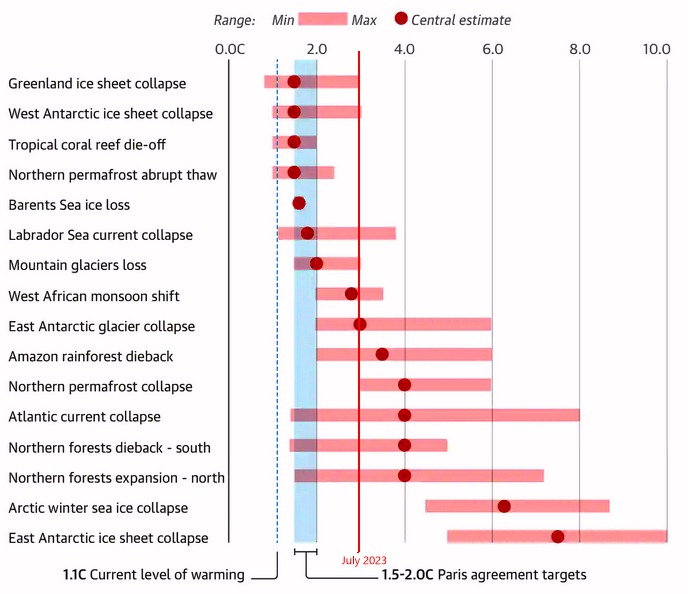
When a snowball rolls down a hill, it accumulates mass, accelerates, and gains inertia, mirroring the progression of human-induced climate change. Tipping points, once breached, set off self-sustaining feedback loops independent of human influence. This phenomenon is akin to a falling domino striking two more, setting off a chain reaction—hence the term “The Domino Effect”. In climate science, it’s often termed “tipping cascades.” This concept can also be likened to “The Snowball Effect.” A tipping point resembles a snowball gathering mass and velocity (momentum) as it rolls downhill. Once passed, it leads to cumulative and reinforced global warming.

  1. Conservation of Momentum: According to Newton’s first law of motion, an object in motion tends to stay in motion unless acted upon by an external force. As the snowball starts rolling down the hill, it gains momentum. Momentum is the product of mass and velocity, so as the snowball gains mass by accumulating more snow, its momentum increases.
  2. Friction: Friction between the snowball and the surface of the hill plays a crucial role. Friction opposes the motion of the snowball, which means it acts in the direction opposite to the snowball’s velocity. However, as the snowball accumulates more mass, it also gains more surface area in contact with the hill, which increases the frictional force. This can help accelerate the snowball’s motion, especially if the hill is steep enough.
  3. Gravity: Gravity is what pulls the snowball downhill in the first place. As the snowball rolls down the hill, it accelerates under the influence of gravity. The force of gravity acting on the snowball increases its velocity, contributing to its momentum.
  4. Impact and Collisions: As the snowball accumulates more mass, it may collide with other objects like rocks or other snowballs on its way down the hill. These collisions can transfer momentum and alter the snowball’s trajectory and velocity.

Overall, the snowball’s momentum is a result of the interplay between these factors. As it gains mass and velocity while rolling down the hill, its momentum increases, governed by the principles of classical mechanics.

Chaos theory, the concept of The Snowball Effect, tipping points and feedback loops provide valuable insights into understanding the acceleration of climate change.

  1. Chaos Theory: Chaos theory deals with complex systems that are highly sensitive to initial conditions, where small changes can lead to significant differences in outcomes. The Earth’s climate system is a classic example of such a complex system. Small perturbations, such as changes in greenhouse gas concentrations or variations in ocean currents, can lead to large-scale and often unpredictable changes in weather patterns and climate dynamics. Chaos theory helps us understand why seemingly small changes in atmospheric composition or temperature can have profound and sometimes unexpected effects on global climate patterns.
  2. Tipping Points: Tipping points are thresholds in a system where a small change can lead to a significant and often irreversible shift in the system’s state. In the context of climate change, tipping points represent critical thresholds in Earth’s climate system, such as the melting of polar ice caps or the collapse of large ice sheets. Once these tipping points are crossed, they can trigger feedback loops that amplify warming and accelerate climate change. For example, the melting of Arctic sea ice reduces the Earth’s albedo, leading to more absorption of solar radiation and further warming of the Arctic, creating a positive feedback loop.
  3. Feedback Loops: Feedback loops are mechanisms by which changes in one part of a system amplify or dampen changes in another part of the system. In the climate system, there are both positive and negative feedback loops. Positive feedback loops amplify changes and tend to destabilize the climate system, while negative feedback loops dampen changes and promote stability. For example, as temperatures rise, permafrost thaw releases methane, a potent greenhouse gas, which further accelerates warming, creating a positive feedback loop. On the other hand, increased atmospheric CO2 levels can stimulate plant growth, leading to more carbon uptake through photosynthesis, which acts as a negative feedback loop.

By considering chaos theory, tipping points, and feedback loops, we can better understand the non-linear dynamics of the climate system and why climate change can accelerate rapidly once certain thresholds are crossed. This understanding is crucial for developing effective strategies to mitigate and adapt to climate change.

Tipping points are Critical Milestones that directly impact the rate of acceleration in climate change by multiplying the number and intensity of feedback loops. Identifying and understanding these tipping points is crucial for climate science and policymaking. Crossing multiple tipping points could lead to a domino effect, resulting in a much more rapid and severe climate change than currently projected.

Tipping Points

Push a glass toward the edge of a table and eventually it will fall off on its own. No matter how slowly or meticulously you push… no matter how you weight or fill the glass, it will reach a tipping point and fall off before being pushed completely off the table. No matter whether you believe the glass is half-empty or half-full, when the tipping point is reached it will plummet out-of-control to its end. This is science not fate, faith, nor belief. Human induced climate change has resulted in environmental tipping points being breached.

Tipping points, when crossed, trigger self-sustaining feedback loops that are no longer dependent on human activity. Similar to when a domino topples over hitting two more dominoes that in turn fall hitting more dominoes. Thus, the name The Domino Effect. It can also be visualized as The Snowball Effect. A tipping point is like a snowball rolling down a hill growing in mass and velocity (momentum). When a tipping point is crossed, it results in cumulative and reinforced global warming.

From Daniel’s Multimedia Album: Omnilogy

bookmark_borderRunning at the Speed of Light


If I could run as fast as the speed of light,
could I catch up to my yesterday?
[Space Intro]
[Break]
Know
[Break]
Oh, know
[Break]
[Verse 1]
If I could run as fast as the speed of light,
could I catch my yesterday?
No. No way.
You’d lose your future
You’d lose your past

[Chorus]
Lose your future
Lose your past
Traveling that fast
Have no future
Passed past
Standing still, aghast
[Break]
Whoa
[Break]
I didn’t know
[Bridge]
If one endures, dilation occurs
Theoretically stationary…
In time
[Instrumental, Guitar Solo, Drum Fills]

[Break]
Know
[Break]
Oh, know
[Break]
[Verse 2]
From the past, can’t run away
Where it’s going, it’s gonna stay
Lost your future
Lost your past
Boredom, who’ll outlast?

[Chorus]
Lose your future
Lose your past
Traveling that fast
Have no future
Passed past
Standing still, aghast
[Break]
Whoa
[Break]
I didn’t know
[Bridge]
If one endures, dilation occurs
Theoretically stationary…
In time
[Instrumental, Bass Solo, Drum Fills, Guitar Solo]

[Verse 3]
If I could run as fast, (blast)
As the speed of light, (out-of-sight)
Would I catch my yesterday?
No. No way.
I’d lose the future
I’d lose the past
All my time, at last

[Chorus]
Lose your future
Lose your past
Traveling that fast
Have no future
Passed past
Standing still, aghast

PART II
[Verse 2]
Running so fast, I’m standing still
Questioning my freewill
Running so fast, I’m standing still
Standing still Until

[Break]
Whoa
[Break]
I didn’t know
[Bridge]
If one endures, dilation occurs
Theoretically stationary…
In time
[Instrumental, Bass Solo, Drum Fills, Guitar Solo]

[Outro]
Whoa
I didn’t know
If one endures, dilation occurs
Theoretically stationary…
In time
[End]
[Silence]

If I could run as fast as the speed of light, could I catch up to my yesterday?

In classical physics, the answer would be no. According to Einstein’s theory of relativity, as you approach the speed of light, time dilation occurs. Essentially, time slows down for you relative to someone who is stationary. So, theoretically, if you were traveling at the speed of light, time would stand still for you, and you wouldn’t experience the passage of time. This means you wouldn’t be able to catch up to your yesterday because time wouldn’t be passing for you in the same way it does for someone who is stationary.

However, this is a purely theoretical concept as nothing with mass can travel at the speed of light according to our current understanding of physics. Also, as you approach the speed of light, your mass would increase infinitely, requiring infinite energy to continue accelerating, which is not feasible. So, while it’s an intriguing idea to entertain, it remains firmly in the realm of science fiction for now.

From Daniel’s Multimedia Album: Omnilogy

bookmark_borderLight Years

[Space Intro]

[Verse 1]
Watch the future flee
At light speed
Watch the past come
Light speed, undone

[Chorus]
A glimpse of the past
Moving, passed fast
Maybe a hundred years ago
Or, so…
[Bridge]
Maybe billion or more
So you know
What’s to come before
See the light might
Show us what’s in store
[Instrumental]

[Verse 2]
The past coming at you again
At light speed
Tomorrow, back to begin
Light speed freed

[Chorus]
A glimpse of the past
Moving, passed fast
Maybe a hundred years ago
Or, so…
[Bridge]
Maybe billion or more
So you know
What’s to come before
See the light might
Show us what’s in store
[Instrumental]

[Verse 3]
At last, relive the past
Bleed at light speed
Tomorrow is here to last
Light speed freed

[Chorus]
A glimpse of the past
Moving, passed fast
Maybe a hundred years ago
Or, so…
[Bridge]
Maybe billion or more
So you know
What’s to come before
See the light might
Show us what’s in store
[Outro]
Watch the future flee
At light speed
Watch the past come
Light speed, undone
[End]
[Silence]

Light years allow us to see the past because light travels at a finite speed, approximately 299,792 kilometers per second (186,282 miles per second) in a vacuum. When we observe objects in space, we are actually seeing the light that they emitted in the past. Since light takes time to travel from distant objects to our eyes or telescopes, the farther away an object is, the longer it takes for its light to reach us.

For example, if a star is located 100 light years away from Earth, the light we see from that star today actually left the star 100 years ago. Similarly, if we observe a galaxy that is millions or even billions of light years away, we are seeing the light that was emitted by the galaxy millions or billions of years ago. In essence, by looking at objects in space, we are looking back in time and gaining insights into the universe’s history.

From the album: The Future

bookmark_borderLiving in Space

[Space Intro]
Someday…
The human race
Will be living in space
[Instrumental]
[Verse 1]
Someday, the human race will be living in space
Maybe soon, walking on the moon
Mayday, before we leave without a trace
Feel the future loom

[Chorus]
Man, living in space
Watch him race
Unaware
He’s already there
Oh, living in space
Souls bare
[Instrumental]

[Break]
The human race
Will be living in space
[Instrumental]
[Verse 2]
Someday, the human race may come to embrace
Maybe soon, appreciate the state
Mayday, while finding our place
We’ve gone irate

[Chorus]
Man, living in space
Watch him race
Unaware
He’s already there
Oh, living in space
Souls bare
[Instrumental]

[Break]
The human race
Will be living in space
[Break]
[Verse 3]
Someday, the human race may find their pace
Maybe soon, stop running low
Today, out searching for grace
Oh, no, do you know?

[Chorus]
Man, living in space
Watch him race
Unaware
He’s already there
Oh, living in space
Souls bare
[Outro]
Today…
The human race
Is living in space
[End]
[Silence]

From the album: The Future

bookmark_borderFuture

[Instrumental, Electronica, Piano, Saxophone, Guitar Solo[
[Space Intro]
The current moment, the here and now
Time intersects our immediate experience
The future what is yet to come somehow
At times, much more precarious
[Instrumental]
[Verse 1]
In the present, we stand, the moment’s embrace,
Where time and reality weave in grace.
Each breath we take, each step we tread,
In the here and now, where life is led.

[Chorus]
The current moment, the here and now,
Where past and future softly bow.
But the future’s horizon, uncertain, unknown,
A realm of possibilities, yet to be shown.
Come in to known.
[Instrumental]

[Verse 2]
The future looms large, a vast expanse,
A realm of dreams, of chance and dance.
It holds the promise of what may be,
A canvas of hope, for you and me.
[Chorus]
The current moment, the here and now,
Where past and future softly bow.
But the future’s horizon, uncertain, unknown,
A realm of possibilities, yet to be shown.
Come in to known.
[Instrumental]

[Bridge]
In the present, we find our strength,
Guided by the past, yet facing the length,
Of the road ahead, the journey untold,
With courage and faith, we’ll be bold.
Let it roll.
[Chorus]
The current moment, the here and now,
Where past and future softly bow.
But the future’s horizon, uncertain, unknown,
A realm of possibilities, yet to be shown.
Come in to known.
[Instrumental]

[Outro]
Embrace each moment we find, all kind.
For in the present, our destinies entwined.
And as we journey into the great unknown,
May hope be our compass, our guide, our own.
[End]
[Silence]

The future and the present are differentiated by the passage of time and the sequence of events. The present refers to the current moment, the here and now, where time intersects with our immediate experience. It is the moment we are living in, characterized by its immediacy and tangible reality.

In contrast, the future represents what is yet to come, the moments and events that lie ahead of the present. It encompasses the passage of time beyond the present moment and encompasses the potential outcomes, possibilities, and uncertainties that await us. The future is characterized by its unknown nature, as it has not yet unfolded and is subject to change based on various factors such as our actions, decisions, and external circumstances.

While the present is concrete and tangible, the future is abstract and speculative, existing only in our imaginations and projections. It is shaped by our hopes, fears, aspirations, and plans for what lies ahead. Despite its uncertainty, the future holds the promise of new opportunities, experiences, and possibilities for growth and transformation.

From the album: The Future

bookmark_borderMath and Science

[Intro]
[Instrumental]
1 + 1 = 2
[Break]
2 + 2 = 2’s, too
[Verse 1]
Mathematics a universal language
No baggage
Political point-of-view
Here’s all you’ve got to do:
[Chorus]
Just look out your window
Tell me, what do you see?
Do you see all the math
Of our after-wrath?
[Bridge]
And, it ain’t over yet
Place your bet
Have we just started
[Break]
1 to 1
[Break]
1 to 2
I’m asking you

[Verse 2]
What are the odds, of pulling through
Ask your gods if you’re lucky, too?
I’m beggin’ you, do the math
Takin’ a bath
[Bridge]
Frogs in a pot
Why not?
Turn up the heat
(And, the sun beat, beat, beat
Down)

[Chorus]
Just look out your window
Tell me, what do you see?
Do you see all the math
Of our after-wrath?
[Bridge]
And, it ain’t over yet
Place your bet
Have we just started
[Break]
1 to 1
[Break]
1 to 2
I’m asking you
[Instrumental]

[Break]
Do you see the math
[Break]
Of our after-wrath?
[Bridge]
And, it ain’t over yet
Place your bet
Have we just started
[Break]
1 to 1
[Break]
1 to 2
I’m asking you
[Instrumental]
[Chorus]
Just look out your window
Tell me, what do you see?
Do you see all the math
Of our after-wrath?
[Outro]
And, it ain’t over yet
Place your bet
Have we just started
[End]
[Silence]

Mathematics, often simply referred to as “math,” is the study of numbers, quantity, structure, space, and change. It involves abstract concepts such as numbers, shapes, and patterns, as well as logical reasoning and problem-solving techniques.

Mathematics encompasses a wide range of branches, including arithmetic, algebra, geometry, calculus, statistics, and more. It provides tools and methods for analyzing and understanding the world around us, from calculating the trajectory of a spacecraft to modeling the spread of a disease.

Mathematics is considered a universal language because its principles and concepts are consistent and applicable across different cultures and contexts. It plays a fundamental role in various fields such as science, engineering, economics, and technology, serving as a cornerstone of modern civilization.

* Our climate model employs mathematics, statistics, economics, and chaos theory to comprehensively consider human impacts and projects a potential global average temperature increase of 9℃ above pre-industrial levels.

From Daniel’s Multimedia Album: Omnilogy

bookmark_borderAstronomy

[Verse 1]
First verse of the universe:
Any time, night or day
[Break]
Look out!
Come to find out
Astronomy’s comin’ at me
I seeeeeee
[Bridge]
Astronomy, meeeeeeeeeee
Comin’ at me
At the speed of light
Both day and night
At light speed, the feed

[Instrumental]
[Break]
Woosh!
[Break]
Duck!
[Break]
What the faaa…
[Instrumental]
[Chorus]
Astronomy
Shining light
Gave me birth
On Earth
Son of the Sun
And Mother Earth
Just a little “here”
Both far and near
[Instrumental]

[Break]
Astronomy, you see
My life depends deeply

[Verse 2]
Second verse of the universe:
All the time, at the time,
This time,
All night and day
Comin’ this way
[Break]
Look out!
Come to find out
Astronomy’s comin’ at me
I seeeeeee
[Bridge]
Astronomy, meeeeeeeeeee
Comin’ at me
At the speed of light
Both day and night
At light speed, the feed

[Break]
Woosh!
[Break]
Duck!
[Break]
What the faaa…

[Outro]
Earth is deeply intertwined with astronomy, as it involves the study of celestial objects and phenomena, including planets like Earth. Therefore, it’s challenging to separate the two. Life on Earth relies heavily on the light from celestial objects, particularly the Sun. Have fun!
[Break]
Astronomy, you see
My life depends deeply
[End]
[Silence]

The concept of Earth, as a physical entity, is deeply intertwined with astronomy, as it involves the study of celestial objects and phenomena, including planets like Earth. Therefore, it’s challenging to separate the existence of Earth from the field of astronomy.

Life on Earth relies heavily on the light from celestial objects, particularly the Sun. Sunlight provides the energy needed for photosynthesis, which is the process by which plants and other photosynthetic organisms produce food. This food forms the basis of the food chain, ultimately sustaining all life on Earth. Additionally, sunlight regulates Earth’s climate and temperature, influencing weather patterns, ocean currents, and other environmental factors that are crucial for life.

Without the light of celestial objects, Earth would be shrouded in darkness, and photosynthesis would cease, leading to the collapse of ecosystems and the extinction of most life forms. Therefore, the presence of light from celestial objects is essential for the existence of life on Earth.

From Daniel’s Multimedia Album: Omnilogy

bookmark_borderThunder

[Verse 1]
Beneath the darkened skies we stand,
As lightning strikes across the land,
A flash of light, a crack so loud,
Echoes in my head from the thunder cloud.

[Pre-Chorus]
The air ignites, the heavens roar,
A cacophony you can’t ignore,
In every storm, a tale untold,
Of lightning bolts and thunder’s hold.

[Chorus]
Thunder rolls, the sky’s alive,
Such energy, we will survive,
A rumbling echo, fierce and strong,
In every storm, the rain sing along.

[Instrumental]
[Break]
Thunder!
[Break]
Clap!
[Break]

[Verse 2]
The lightning’s dance, a sight to see,
A fleeting moment, wild and free,
Wait! In its wake, a sound profound,
As thunder shakes the very ground.

[Pre-Chorus]
The air ignites, the heavens roar,
A cacophony you can’t ignore,
In every storm, a tale untold,
Of lightning bolts and thunder’s hold.

[Instrumental]
[Break]
Thunder!
[Break]
Thunder!
[Break]
Thunder!
[Chorus]
Thunder rolls, the sky’s alive,
Such energy, we will survive,
A rumbling echo, fierce and strong,
In every storm, the rain sing along.
[Break]
Thunder!
[Break]
Clap!
[Break]
[Instrumental]

[Bridge]
With each strike, a stories unfold,
Of chaos in the clouds, untold,
In thunder’s song, we find our way,
Through stormy nights and cloudy days.

[Outro]
So let the thunder fill the air,
A reminder that we’re all aware,
Of nature’s power, wild and grand,
In every storm, we will withstand.
[End]
[Silence]

Thunder results from the rapid expansion and contraction of air surrounding a lightning bolt. When lightning strikes, it heats the air to temperatures hotter than the surface of the sun. This extreme heat causes the air to expand quickly, creating a shockwave that manifests as thunder. The rumbling sound of thunder is the audible representation of this shockwave traveling through the atmosphere and reaching our ears. The time delay between the lightning flash and the sound of thunder depends on the distance between the lightning bolt and the observer, with approximately 5 seconds of delay corresponding to 1 mile of distance.

In the realm of meteorology, chaos theory offers valuable insights into the intricate dynamics of thunderstorm formation. Thunderstorms are complex phenomena influenced by multiple factors, including temperature, humidity, air pressure, and wind patterns. These variables interact in nonlinear ways, making thunderstorm prediction challenging.

Chaos theory underscores the concept of sensitivity to initial conditions, known as the butterfly effect. In the context of thunderstorms, even minor fluctuations in atmospheric conditions can have profound effects, such as triggering the development of lightning and thunder. This sensitivity to initial conditions highlights the complexity and unpredictability of thunderstorm behavior, illustrating the need for advanced modeling techniques and data analysis in meteorological research.

From Daniel’s Multimedia Album: Omnilogy

bookmark_borderAppear to Float

[Instrumental, Piano, Keyboards]
[Break]
Will the remain
Or will the rain?
[Break]
[Verse 1]
High in the sky in the dream dome,
Clouds drift along, they’ve got no home.
Let droplets dance on air,
Seemingly weightless, without a care.

[Pre-Chorus]
Up here appear to float, so soft and light,
But there’s more to it, than meets your sight.
A delicate balance, up in the blue,
Let me break it down for you.

[Chorus]
They appear to float, in the endless expanse,
Buoyed by the air, in a graceful dance.
But it’s the forces at play, that keep them afloat,
Invisible hands guide the ride
Float my boat
{bridge]
Fly high
[Instrumental]

[Break]
Will the remain
Or will the rain?
[Break]

[Verse 2]
Upward currents gently lift them high,
While gravity pulls, like a silent sigh.
Condensed from vapor, small, yet complete,
Floating like dreams in the midday heat.

[Pre-Chorus]
Up here appear to float, so soft and light,
But there’s more to it, than meets your sight.
A delicate balance, up in the blue,
Let me break it down for you.

[Chorus]
They appear to float, in the endless expanse,
Buoyed by the air, in a graceful dance.
But it’s the forces at play, that keep them afloat,
Invisible hands guide the ride
Float my boat
{bridge]
Fly high
[Instrumental]

[Bridge]
So next time you gaze at the sky above,
Remember the magic, the science of love.
For clouds may seem like dreams on high,
But they’re just tears in the sky, passing by.

[Chorus]
They appear to float, in the endless expanse,
Buoyed by the air, in a graceful dance.
But it’s the forces at play, that keep them afloat,
Invisible hands guide the ride
Float my boat
{bridge]
Fly high
[Instrumental]

[Outro]
Yes, they appear to float, in the endless blue,
But now you know the secrets, they’re not so new.
A dance of forces, in the sky’s embrace,
Clouds may appear to float, but there’s science in their grace.

[End]
[Silence]

A SCIENCE LESSON
Clouds appear to float in the sky because of a delicate balance between upward and downward forces acting on water droplets or ice crystals suspended in the air. These particles, known as cloud droplets or cloud ice crystals, are extremely small and lightweight.

Clouds form when warm air rises and cools, causing the water vapor it contains to condense into tiny droplets or crystals. These droplets or crystals are so small that they are easily lifted by air currents, similar to dust particles or pollen.

Once suspended in the air, the droplets or crystals encounter upward air currents, such as thermals or updrafts, that push them higher into the atmosphere. Additionally, the droplets or crystals are buoyed by the surrounding air, which is cooler and denser than the warm, moist air from which they formed.

Gravity, however, constantly exerts a downward force on the droplets or crystals, attempting to pull them toward the Earth’s surface. Despite this force, the buoyancy provided by the surrounding air and the upward air currents counteract gravity, allowing the droplets or crystals to remain suspended in the atmosphere and giving the appearance of floating.

In summary, clouds float in the sky due to a delicate balance between the buoyant force of the surrounding air and upward air currents, which counteract the downward force of gravity acting on the suspended water droplets or ice crystals.

From Daniel’s Multimedia Album: Omnilogy

bookmark_borderSuction (Water Down the Drain)

[Intro]
Ssssssssuck
[Break]
Suction function
[Break]
Suck much?

[Verse 1]
The gravity of the situation
Directing the navigation
Don’t you know, creates the flow
[Break]
Look out below
[Break]
Here we go
[Break]
Who will remain?
Water down the drain
[Chorus]
The suction function
A natural reaction
Pressure! Combination
For sure, gravitation
The suction function

[Bridge]
Letting go
Watch the flow
Look out below
Here we go
Who will remain?
Water down the drain

[Instrumental]

[Verse 2]
Getting sucked down the drain
The force to sustain
Might as well let go
[Break]
Look out below
[Break]
In the flow
[Break]
Who will remain?
Water down the drain
[Chorus]
The suction function
A natural reaction
Pressure! Combination
For sure, gravitation
The suction function

[Bridge]
Letting go
Watch the flow
Look out below
Here we go
Who will remain?
Water down the drain

[Instrumental]

[Verse 3]
Annoyed? fill the void
The force to sustain will wane
On with the show
[Break]
Look out below
[Break]
In the flow, here we go
[Break]
Who will remain?
Water down the drain
[Chorus]
The suction function
A natural reaction
Pressure! Combination
For sure, gravitation
The suction function

[outro]
Letting go
Watch the flow
Look out below
Here we go
Who will remain?
Water down the drain

[End]
[Silence]

Water gets sucked down a drain due to a combination of gravity and pressure differences. When water is poured into a drain or flushed down a toilet, it creates a flow of water that is pulled downwards by gravity. As the water moves, it creates a low-pressure area behind it. This low-pressure area causes surrounding water, as well as air, to be drawn into the drain to fill the void left by the moving water.

Additionally, many drains are designed with a slope or curvature that helps direct the flow of water downward, further aiding in the suction effect. This combination of gravity and pressure differences creates the suction force that pulls water down a drain.

From Daniel’s Multimedia Album: Omnilogy

bookmark_borderHumor Me

[Instrumental, Guitar Solo, Drum Fill]
[Intro]
Knock, knock
[Break]
Knock, knock
[Break]
Unaware
Of who is there?
[Break]
[Verse 1]
A world of stress and strife, where worries weigh so heavy,
There’s a remedy we’ve found, that keeps our spirits steady.
It’s the magic of a joke, a smile, a little tease, (please!)
A laughter shared among us all, puts our minds at ease. (please!)

[Chorus]
So humor me, let’s share a laugh,
Turn those frowns around, break free from the half-empty glass.
With every chuckle, every grin we see,
We’re rewriting our story, to humor’s melody.
[Break]
Knock, knock
[Break]
Knock, knock
[Break]
Unaware
Of who is there?
[Break]

[Chorus]
So humor me, let’s share a laugh,
Turn those frowns around, break free from the half-empty glass.
With every chuckle, every grin we see,
We’re rewriting our story, to humor’s melody.
[Break]
Knock, knock
[Break]
Knock, knock
[Break]
Unaware
Of who is there?
[Break]

[Bridge]
In the face of hardship, in the depths of despair,
Crack a smile for a while, shows us we can dare.
To find joy in the journey, to laugh along the way,
For in humor’s embrace, find a brighter day. Hey!

[Break]
Knock, knock
[Break]
Knock, knock
[Break]
Unaware
Of who is there?
[Break]

[Chorus]
So humor me, let’s share a laugh,
Turn those frowns around, break free from the half-empty glass.
With every chuckle, every grin we see,
We’re rewriting our story, to humor’s melody.
[Break]
Knock, knock
[Break]
Knock, knock
[Break]
Unaware
Of who is there?
[Break]

[Outro]
Keep laughing, take a stand,
In humor’s thralls, living life grand.
The joy of laughter, moments light and free,
Find the strength to face whatever comes to be.
[End]
[Silence]

A SCIENCE LESSON
Humor offers a wide range of benefits for mental, emotional, and physical well-being:

  1. Stress Reduction: Humor can act as a natural stress reliever, triggering laughter and releasing tension in the body. It helps to reduce levels of stress hormones like cortisol, promoting relaxation and a sense of calm.
  2. Improved Mood: Laughter stimulates the production of endorphins, the body’s natural feel-good chemicals. It can uplift mood, boost happiness, and provide a sense of lightness even during challenging times.
  3. Enhanced Social Connection: Sharing laughter and humor with others strengthens social bonds, fosters camaraderie, and promotes a sense of belonging. It can break down barriers, build rapport, and create positive interactions with friends, family, and colleagues.
  4. Increased Resilience: Humor can help individuals cope with adversity and bounce back from setbacks more effectively. By reframing difficult situations in a humorous light, people can gain perspective, maintain optimism, and navigate challenges with greater resilience.
  5. Improved Creativity: Engaging in humor and playful thinking can stimulate creativity and problem-solving skills. It encourages flexible thinking, lateral connections, and out-of-the-box ideas, fostering innovation and ingenuity.
  6. Physical Health Benefits: Laughter has been linked to various physical health benefits, including improved immune function, reduced pain perception, and enhanced cardiovascular health. Regular laughter may contribute to overall well-being and longevity.
  7. Cognitive Benefits: Humor stimulates mental agility and cognitive flexibility, sharpening focus and improving mental clarity. It can enhance memory retention, learning, and information processing, making it easier to grasp complex concepts and retain information.

In summary, incorporating humor into daily life can have profound effects on mental, emotional, and physical health, promoting well-being, fostering social connection, and enhancing resilience and creativity.

From the album Happy: Experiments in the Fine Line Between

bookmark_borderVortex Control

[Intro]
Some say it put’s a spin….
[Break]
I’m listening

[Verse 1]
It’s funny how some people put a spin on things
Look! There goes a pig with wings
Flying in lying
But, that ain’t what I’m talkin’ ’bout
Reroute
Vortices (is is is is)
Especially, a vortex that wrecks
[Break]
Wipe out!
[Break]

[Chorus]
Get ready to roll
Vortex control
Don’t be such a drag
No, don’t let your flow sag
[Break]
Get it under control
[Bridge]
and, get ready to roll
[Instrumental]

[Break]
Shout out:
[Break]
Wipe out!
[Break]

[Verse 2]
Introspection: Vortex Interaction
Twist it out
Twist and shout
Indeed, we bleed
… depending on the flow…
[Bridge]
Let me know
[Instrumental]
[Chorus]
Get ready to roll
Vortex control
Don’t be such a drag
No, don’t let your flow sag
[Break]
Get it under control
[Bridge]
And, get ready to roll….

[Verse 3]
Da, da, da, dynamics
Our behavior, the notion of motion
Whether we’ll merge together
Causing fa, fa, fa, phenomena lift
If you catch my drift

[Chorus]
Get ready to roll
Vortex control
Don’t be such a drag
No, don’t let your flow sag
[Break]
Get it under control
[Bridge]
And, get ready to roll….

[Outro]
This is Vortex Control
Come in, Manned
What’s the position of The Mission?
[Break]
Beep
[Break]
Beep
[End]
[Silence]

A SCIENCE LESSON
Vortex physics deals with the study of vortices, which are swirling flows of fluid or gas characterized by a rotating motion around a central axis. The main components of vortex physics include:

  1. Vortex Formation: Vortices can form in various ways, such as through the interaction of fluid flow with obstacles or changes in fluid density. Common examples include the vortex created behind an object moving through a fluid, like the wake behind a boat, or the vortex generated by the rotation of a propeller.
  2. Vortex Dynamics: Vortex dynamics refers to the behavior and motion of vortices over time. This includes phenomena such as vortex shedding, where vortices are periodically shed from a solid object in a fluid flow, and the interactions between vortices, which can lead to complex flow patterns.
  3. Vortex Structures: Vortices can take on different structures depending on the flow conditions and the properties of the fluid. Common vortex structures include vortex rings, vortex sheets, and vortex lines. These structures can exhibit various characteristics, such as stability, coherence, and turbulence.
  4. Vortex Interactions: Vortices can interact with each other and with their surrounding environment in complex ways. For example, vortices can merge together to form larger vortices or break apart into smaller vortices. They can also interact with solid surfaces, causing phenomena like lift and drag in aerodynamics.
  5. Vortex Control: Understanding and controlling vortices is important in many practical applications, such as fluid dynamics, aerodynamics, and weather prediction. Researchers study methods for manipulating vortices to achieve desired outcomes, such as reducing drag on vehicles or enhancing mixing in industrial processes.

Overall, vortex physics encompasses a wide range of phenomena related to the formation, dynamics, structures, interactions, and control of vortices in fluid and gas flows. It plays a crucial role in understanding natural phenomena, engineering applications, and environmental processes.

From Daniel’s Multimedia Album: Omnilogy

bookmark_borderTerminal Velocity

[Intro]
[Rain]
[Instrumental, Piano, Saxophone, Flute]
Do you think it looks like rain?
[Break]
Do you think it looks like pain?
[Break]
[Instrumental]

[Verse 1]
Will the rain penetrate my brain?
Woah, slow down piercing my crown

[Chorus]
The majesty of gravity
You are a reckoning force
Looking for some levity
To throw you off course
[Break]
Of course!
[Break]
Terminal velocity,
Save me!
[Bridge]
The strain of the rain on the brain
Enough to drive ya insane
[Instrumental]

[Break]
Do you think it looks like rain?
[Break]
Shame, no where to drain
[Break]

[Verse 2]
Precipitation acceleration
Mother’s crying, children dying

[Chorus]
The majesty of gravity
You are a reckoning force
Looking for some levity
To throw you off course
[Break]
Of course!
[Break]
Terminal velocity,
Save me!
[Bridge]
The strain of the rain on the brain
Enough to drive ya insane
[Instrumental]

[Break]
Do you think it looks like rain?
[Break]
Shame, no where to drain
[Break]

[Verse 3]
Size of matter matters
May your area’s surface surface
And save this race

[Chorus]
The majesty of gravity
You are a reckoning force
Looking for some levity
To throw you off course
[Break]
Of course!
[Break]
Terminal velocity,
Save me!
[Bridge]
The strain of the rain on the brain
Enough to drive ya insane
[Instrumental]

[Outro]
Do you think it looks like rain?
Do you think we’ll remain… sane?
[End]
{Silence]

The Momentum of Rain is p = mv (p = momentum, m = mass, v = velocity.)

What prevents gravity from causing rain to pierce my brain?

Gravity is indeed the force that pulls raindrops downward toward the Earth. However, several factors prevent raindrops from piercing through objects like your brain:

  1. Air Resistance: As raindrops fall through the atmosphere, they encounter air resistance, which slows their descent. This resistance increases with the size of the raindrop and the speed of its fall. For most raindrops, air resistance is sufficient to prevent them from reaching terminal velocity, the speed at which the force of gravity equals the force of air resistance.
  2. Size of Raindrops: Raindrops are typically small and light enough that they do not possess enough kinetic energy to cause significant damage upon impact. Even larger raindrops, such as those in heavy downpours, are still relatively small compared to solid objects and do not exert enough force to penetrate most materials.
  3. Surface Area: Raindrops have a relatively large surface area compared to their mass, which further reduces their impact force. This means that even if a raindrop were to hit an object with some force, its impact would be distributed over a larger area, lessening the potential for damage.
  4. Terminal Velocity: Raindrops reach a maximum speed known as terminal velocity due to air resistance. Once they reach this speed, they no longer accelerate and continue to fall at a constant rate. Terminal velocity varies depending on the size and shape of the raindrop, but it is typically not fast enough to cause harm upon impact with most objects.

In summary, while gravity is responsible for pulling raindrops downward, other factors such as air resistance, raindrop size, surface area, and terminal velocity prevent them from piercing through objects like your brain.

From Daniel’s Multimedia Album: Omnilogy

bookmark_borderString Theory

[Female Vocal Harmonies]
[Intro]
[Instrumental, Acoustic, Piano, Guitar]
[Break]
Vibrate
[Break]
Feel free
Don’t hesitate to
[Break]
Vibrate
[Break]
[Bridge]
(vibrate, resonate)
(vibrate, resonate)
(vibrate, resonate)
[Verse 1]
In the fabric of the scenes, where seems entwine,
The strings sing, a cosmic symphony so fine. (so fine)
Each note a particle, each chord a force untold,
Silent harmonies, in strings of purest gold.

[Chorus]
String theory, weaving dreams of the universe,
Echoes of vibrations, in every cosmic verse.
From the tiniest quark (spark) through the galaxies above,
Strings of creation sing a song, the creation of the initial love…
in harmony
[Instrumental]

[Verse 2]
Like a guitar string plucked, in the dance of space and time,
Strings reverberate, in melodies sublime.
Pythagorean harmonies, in the cosmic ballet,
Infinite variations, in the strings that play.

[Chorus]
String theory, weaving dreams of the universe,
Echoes of vibrations, in every cosmic verse.
From the tiniest quark (spark) through the galaxies above,
Strings of creation sing a song, the creation of the initial love…
in harmony

[Bridge]
In the symphony of strings, every note has its place,
From the lowest bass to the highest grace.
Through the cosmic orchestra, let the music unfurl,
In the cosmic dance of strings, let love and truth prevail.

[Chorus]
String theory, weaving dreams of the universe,
Echoes of vibrations, in every cosmic verse.
From the tiniest quark (spark) through the galaxies above,
Strings of creation sing a song, the creation of the initial love…
in harmony

[Outro]
In the tapestry of existence, where mysteries abound,
Strings of creation weave, in patterns, look around.
Listen to the music, strings bind us all,
The song of string theory, unknot the gnarl.
[End]
[Silence]

String theory hypothesizes that very small “strings” vibrations produce the observed particles and forces of nature similar to a vibrating guitar string and heard in Pythagorean harmonies. If you view a guitar string in slow motion, it moves in a variety of ways at the same time in a similar fashion as the forces in subatomic particles.

“A piano or violin string can resonate or vibrate with many different shapes of vibration corresponding to different tones. There is basic tone and there are higher overtones. The richness or beauty of music has to do with the different interplay of the harmonics,” explains Edward Witten.

From Daniel’s Multimedia Album: Omnilogy