bookmark_borderIn for a Change (Ghouls and Fools)

LYRICS
Along the way
Went astray
To this day
The price we pay
The world’s aflame
Never be the same
We’re in for a change
The ghoulish primate
Foolish of climate
The ghouls we have met
Are fools of the climate

Along the way
Left O.K.
Our own prey
The price we pay
The world’s aflame
Never be the same
We’re in for a change
The ghoulish primate
Foolish of climate
The ghouls we have met
Are fools of the climate

Push to play
Would not say
Go away
The price we pay
The world’s aflame
Never be the same
We’re in for a change
The ghoulish primate
Foolish of climate
The ghouls we have met
Are fools of the climate

As we may
Our last day
In decay
The price we pay
The world’s aflame
Never be the same
We’re in for a change
The ghoulish primate
Foolish of climate
The ghouls we have met
Our fools of the climate

Chords: Em G Esus4 / FM7 Em Am / Am D7 / D7 Em; Part II @ 68 to 78 to 88 to 118 Beats Per Minute
Instrumentation: Vocals (TC-Helicon VOICELIVE and MiniNova Vocorder), Ibanez Acoustic Guitar, Fender Squire Mini Electric Guitar (Boss Digital Delay), Fender Jazz Bass (Boss Digital Delay), Keyboards (Korg PS60, Casio WK-3500, Yamaha PSR-740, MiniNova, MicroKorg)

Human induced climate change is an exponential component of an unordered system (chaos theory). That means global warming is accelerating at a rapid rate in a complex way.

Time is no longer running out to act on climate change; it’s up,” reports Deloitte.

The Age of Loss and Damage

Humans will experience greater loss and damage to life and quality of life from air pollution, decreasing supply of potable water, extreme weather events, and disease. The greatest short term climate change risk to human health is deadly humid heat (wet-bulb temperature).

A warmer world will present widespread challenges across many aspects of food-energy-water security and economic development. Infrastructure including roads, bridges, sewer and water plants will become unsustainable. Personal property will suffer loss and damage as homeowners and flood insurance become increasingly difficult to obtain.

Almost all survivors of climate-related disasters suffer from mental distress. Of those who have not experienced climate disasters, more than two-thirds of U.S. adults (68%) have reported climate change anxiety.

Tipping points are Critical Milestones that directly impact the rate of acceleration in climate change by multiplying the number and intensity of feedback loops.

At what rate is climate change accelerating?
A: Rapidly
As described above, we do not know the rate of acceleration other than to say it is more rapid than previously thought. In the summer of 2023, the extreme temperatures left most climate scientists shocked. The average earth surface temperature recorded record highs for months reaching over 3 degrees Celsius above pre-industrial levels. The Paris Agreement calls for keeping temperatures below 1.5 degrees. Scientists concur that a rise of 2 degrees will trigger feedback loops and tipping points. Triggering these tipping points results in the CO2 stored in nature to be released at an exponential growth rate. How extreme the acceleration will be depends on tipping points toppling other tipping points in what is known as The Domino Effect. Toppled tipping points will continue to shrink the doubling time and exponentially increase the rate of global warming. Though we do not know how much carbon is stored in nature, it would be reasonable to assume that the temperature could be pushed from 3 degrees to 6 degrees above pre-industrial levels. Humans can not thrive above a rise of 1.5 degrees. Humans can not survive if the temperature rises 6 degrees.

About the 2023 wildfires in Hawaii, Governor Josh Green said, “For perspective, we’ve had six fire emergencies this August, we had six fire emergencies between 1953 and 2003. That’s how- how fast things are changing. I know that there is debate out there whether we should be talking about climate change or not. Well, let’s be real world, climate change is here we are in the midst of it with a hotter planet, and fiercer storms.”

About the catastrophic die-off of 10,000 emperor penguin chicks in the Antarctic, Dr. Caroline Holmes of the British Antarctic Survey (an expert on Antarctic sea-ice) said, “What we’re seeing right now is so far outside what we’ve observed previously. We expected change but I don’t think we expected so much change so rapidly.”

Some areas of the world are now warming so fast, it is becoming more difficult to measure the change from “normal” or average. Jeff Boyne, National Weather Service meteorologist and climatologist, said, “There are climate normals that are updated every 10 to 15 years, because the planet is warming so fast. The ENSO (El Nino-Southern Oscillation) regions are warming so fast that those normals are being updated every 5 years.”

“It’s so far outside anything we’ve seen, it’s almost mind-blowing,” says Walter Meier, who monitors sea-ice with the National Snow and Ice Data Center. “September was, in my professional opinion as a climate scientist, absolutely gobsmackingly bananas,” said Zeke Hausfather, at the Berkeley Earth climate data project.”

What Can I Do?
There are plenty of things you can do to help save the planet. Stop using fossil fuels. Consume less. Love more. Here is a list of additional actions you can take.
A song about The Human Induced Climate Change Experiment

bookmark_borderInto the Solstice

LYRICS
Limited volume
Maximum used some
Halfway between night and day
Out of the equinox
To the school of hard knocks
Roll on

Limited volume
Maximum used some
Day after day thrown away
Looks lie we lost this
Into the solstice
Lights out
(No doubt)

Under the human hex (Parts 1a, 1b, 1c)
Done in a sex hex (Part 2)
Fall of might
Spun in a vortex
Lost our sight
Drag of the funnel
Is there light
At The End of the tunnel?

Chords: E G A / C Esus4 / Esus4 A7 / Em E /D9 EbM7 Em/E / A7 C D Em; Part 2 @ 133 Beats Per Minute
Instrumentation: Vocals (TC-Helicon VOICELIVE and MiniNova Vocorder), Ibanez Acoustic Guitar, Fender Squire Mini Electric Guitar (Vox Sound Lab and Boss Digital Delay), Fender Jazz Bass (Boss Digital Delay), Keyboards (Korg PS60, Casio WK-3500, Yamaha PSR-740, MiniNova, MicroKorg)

The song is an analogy of the Winter Solstice and human induced climate change. Figuratively, 2023 saw darker and darker days for the future of the Earth.

Human induced climate change is an exponential component of an unordered system (chaos theory). That means global warming is accelerating at a rapid rate in a complex way. From 1992 through 2023, we presented evidence and suggested remedies to mitigate climate change. By 2023, the data was undeniable that human induced climate change is destroying our habitat at a rapidly increasing rate.

“For people, for other species, for the ecosystems, for the world we live in, we’ve entered the Age of Loss and Damage, but we’re just at the start. What we are seeing already just makes you want to cry,” said Dr. Christopher Trisos (BBC Interview / MP3 Format) from the University of Cape Town. “We can’t eliminate loss and damage. It is here. That said, there is a lot we can do to limit it.”

The 20th-century surface temperature average for Earth was 13.9℃. In the first weeks of July of 2023, the average temperature was 17℃.
Q: Is it possible for humans to survive at temperatures greater than 3℃?
A: Probably not long. Humans have never done it before.

September 6, 2023: “Climate breakdown has begun,” the United Nations Secretary-General Antonio Guterres warned the world after the World Meteorological Organization (WMO) reported the world endure its hottest Northern Hemisphere summer in human history. “The dog days of summer are not just barking, they are biting,” the UN chief said in a statement after the report’s release.

“What we are observing, are not only new extremes but the persistence of these record-breaking conditions, and the impacts these have on both people and planet, are a clear consequence of the warming of the climate system,” C3S’s Climate Change Service Director Carlo Buontempo said.

Climate Breakdown is the most concerning development. Climate breakdown happens when feedback loops are created and tipping points are crossed. Plants will become extinct and many carbon sinks will vanish. The Earth’s temperature will continue to accelerate at an exponential rate no matter what humans do. Food, fresh water, and breathable air will cease to exist. Humans will likely follow in short order.

In October of 2023, the European Space Agency’s Copernicus Climate Change Service calculated that the average temperature for September was 16.38 degrees Celsius (61.48 degrees Fahrenheit) breaking the previous record set in September 2020 by a half-degree Celsius (0.9 degrees Fahrenheit). This is the largest increase in a monthly record high ever.

“It’s just mind-blowing really,” said Copernicus Director Carlo Buontempo. “Never seen anything like that in any month in our records.”

“This is not a fancy weather statistic. It’s a death sentence for people and ecosystems. It destroys assets, infrastructure, harvest,” Imperial College of London climate scientist Friederike Otto said.

About the 2023 wildfires in Hawaii, Governor Josh Green said, “For perspective, we’ve had six fire emergencies this August, we had six fire emergencies between 1953 and 2003. That’s how- how fast things are changing. I know that there is debate out there whether we should be talking about climate change or not. Well, let’s be real world, climate change is here we are in the midst of it with a hotter planet, and fiercer storms.”

About the catastrophic die-off of 10,000 emperor penguin chicks in the Antarctic, Dr. Caroline Holmes of the British Antarctic Survey (an expert on Antarctic sea-ice) said, “What we’re seeing right now is so far outside what we’ve observed previously. We expected change but I don’t think we expected so much change so rapidly.”

Some areas of the world are now warming so fast, it is becoming more difficult to measure the change from “normal” or average. Jeff Boyne, National Weather Service meteorologist and climatologist, said, “There are climate normals that are updated every 10 to 15 years, because the planet is warming so fast. The ENSO (El Nino-Southern Oscillation) regions are warming so fast that those normals are being updated every 5 years.”

“September was, in my professional opinion as a climate scientist, absolutely gobsmackingly bananas,” said Zeke Hausfather, at the Berkeley Earth climate data project.”

Climate Change Review 2023

Sidd said, “Do you remember back in the early 2000’s when we thought we wouldn’t live to see the extreme changes due to global warming?”

Daniel replied, “I think 2023 is the most significant year so far. We saw confirmation of tipping points being crossed for Mountain Glacier Loss, Greenland Ice Sheet Collapse, Antarctic Ice Sheet Collapse, and potentially the Collapse of AMOC.”

Sidd continued, “We already knew that. It was Canada catching on fire that I could not believe. I never thought I’d live to see the day.”

Daniel asked, “Do you think the permafrost and peatlands will have zombie fires and cause the permafrost tipping point?”

Sidd responded, “Yes. They are gone, too. We already know from the permafrost peatland fires in Siberia.”

Daniel ponders, “Hmmmm… I guess that means my plan went up in smoke? My worst case scenario / last resort emergency plan was to escape to Canada.”

What Can I Do?
There are plenty of things you can do to help save the planet. Stop using fossil fuels. Consume less. Love more. Here is a list of additional actions you can take.

From the Christmas album of music Merry Christmas!

A song about The Human Induced Climate Change Experiment

bookmark_borderHow About the Start?

LYRICS
Whipping wind
Agin the skin
Again and again, again, again
Patience wearing thin
Where to begin
How ’bout the start?
Try wearing a grin
There to laughin’
Straight from the heart
From my mouth these words depart:
We’re killin’ me
From the rising sea
To the unfair air
Cannot stop the hot
I’m beggin’… why not?

Pounding rain
Agin the brain
Sustain the pain, sustain, sustain
Patience wearing thin
Where to begin
How ’bout the start?
Try wearing a grin
There to laughin’
Straight from the heart
From my mouth these words depart:
We’re killin’ me
From the rising sea
To the unfair air
Cannot stop the hot
I’m beggin’… why not?

Surging flood
Mixed with blood
Up to the neck in mud
Patience wearing thin
Where to begin
How ’bout the start?
Try wearing a grin
There to laughin’
Straight from the heart
From my mouth these words depart:
We’re killin’ me
From the rising sea
To the unfair air
Cannot stop the hot
I’m beggin’… why not?

Chords: C Dm Em / Am C Em / G Dm Em / C Dm Em; Part II @ 132 Beats Per Minute
Instrumentation: Vocals (TC-Helicon VOICELIVE and MiniNova Vocorder), Ibanez Acoustic Guitar, Fender Squire Mini Electric Guitar (Boss Digital Delay), Fender Jazz Bass (Boss Digital Delay), Keyboards (Korg PS60, Casio WK-3500, Yamaha PSR-740, MiniNova, MicroKorg)

In the two weeks leading up to Christmas 2023, the East Coast had two extreme weather events caused by unprecedented winter atmospheric rivers.

In October of 2023 Sidd said, “Now I am thinking the violent rain will be a bigger problem before we die….”

East Coast Atmospheric Rivers
Historically in the United States, atmospheric rivers (AR) have been associated with the West Coast. Now, AR activity is getting more attention on the East Coast. “Actually, their frequency is not really increasing. Meteorologists have used the term for decades. It has simply become popular by the media. Just like polar vortex,” said Jeff Boyne, National Weather Service meteorologist and climatologist. Indeed, “atmospheric rivers are more frequent on the East Coast than they are on the West Coast,” said Jason Cordeira, associate professor of meteorology at Plymouth State University. “They’re just not as impactful and don’t usually produce as much rainfall.”

What is changing is the research into the types and increasing intensity of East Coast AR events. “Between 1958 and 2012, the Northeast saw more than a 70% increase in the amount of rainfall measured during heavy precipitation events, more than in any other region in the United States. Projections indicate continuing increases in precipitation, especially in winter and spring and in northern parts of the region,” as reported in The US Fourth National Climate Assessment.

Most types of East Coast ARs are increasing in intensity likely due to climate change. The study Identifying Eastern US Atmospheric River Types and Evaluating Historical Trends reports, “The impact of increasing moisture transport could be significant across the northeast corridor from Washington D.C. to Coastal Maine, as it increases the risk of extreme precipitation from landfalling ARs. The results indicate most ARs in the study domain are forced by extratropical cyclones, with lee side low pressure systems and coastal lows along the Atlantic Coast (e.g. nor’easters) responsible for producing the strongest ARs.”

Human induced climate change is an exponential component of an unordered system (chaos theory). That means global warming is accelerating at a rapid rate in a complex way.

What Can I Do?
There are plenty of things you can do to help save the planet. Stop using fossil fuels. Consume less. Love more. Here is a list of additional actions you can take.

A song about The Human Induced Climate Change Experiment

bookmark_borderChoose Wisely

LYRICS
Careful of the road you choose
the choice between win and lose
However
When all is said and done
Choosing none
Never won
Choose wisely,
My son
Bang!
The race is on
Sang!
Outpace swan song
As the Fat Lady sings
The ending she brings
When all is said and done
Choose wisely everyone

Go!
The race is on
(No human reason)
Know!
Human reason
Watching Rome burn
What did we learn
If asked who lost or won
Choose wisely or be done

Chords: Em C A / C Em A / C B7 Em / Em F#m Fm Em / C Em; Part II @ 100 Beats Per Minute
Instrumentation: Vocals (TC-Helicon VOICELIVE and MiniNova Vocorder), Ibanez Acoustic Guitar, Fender Squire Mini Electric Guitar (Vox Sound Lab and Boss Digital Delay), Fender Jazz Bass (Boss Digital Delay), Keyboards (Korg PS60, Casio WK-3500, Yamaha PSR-740, MiniNova, MicroKorg)

Human induced climate change is an exponential component of an unordered system (chaos theory). That means global warming is accelerating at a rapid rate in a complex way.

“The era of global warming has ended and the era of ‘global boiling’ has arrived. Climate change is here. It is terrifying. And it is just the beginning”, UN secretary general, AntĂ³nio Guterres, said after scientists confirmed July 2023 was on track to be the world’s hottest month on record.

In the 1990’s, we wrote a paper on the worst-case scenario entitled, “The Impact of Governance & Globalization on Forecasting (The Tunnel Under Thesis).” The theory predicted that forecasting would become increasingly difficult. “The result — a figurative, as well as, literal tunneling underground.”

Since that time, forecasting has become increasing more difficult. “In general, as energy is added to a system, the fluctuations in the system increase. So, we expect more storms, more droughts, more wildfires, more floods, more fluctuations of all kinds. What we are saying is that weather conditions will become more volatile due to the impact of humans,” said Mukherjee and Brouse. (2004)

In a report published in Nature entitled Over half of known human pathogenic diseases can be aggravated by climate change, data analyst and associate professor in the Department of Geography and Environment at the University of Hawaii Manoa, Camilo Mora, said climate hazards aggravated 58% of all known human pathogens. That is over half of infectious diseases discovered since the end of the Roman Empire. 58% of an authoritative list of infectious diseases documented to have impacted humanity have already been shown to be aggravated by climatic hazards — a finding the researchers found “shocking,” Mora said.

Movement of people and animals caused by climate is one factor. Warming at higher latitudes allowed vectors and pathogens to survive winter is another factor. The report goes on to say, “The human pathogenic diseases and transmission pathways aggravated by climatic hazards are too numerous for comprehensive societal adaptations, highlighting the urgent need to work at the source of the problem: reducing GHG (Greenhouse Gas) emissions.”

This research reveals more evidence that humans will have difficulty adapting to climate change, especially those in developing countries, Mora said. “The magnitude of the vulnerability when you think about one or two diseases — okay, sure, we can deal with that,” he said. “But when you’re talking about 58% of the diseases, and 58% of those diseases can be affected or triggered in 1,000 different ways. So that, to me, was also revealing of the fact that we’re not going to be able to adapt to climate change.”

In 2023, we wrote about having crossed tipping points in the paper, “Climate Change: How Long Is ‘Ever’?“. When we wrote the Tunnel Under Thesis in 1995, we forecast crossing these tipping points would not happen for centuries. We underestimated Man’s ignorance and arrogance. Fossil fuel consumption and greenhouse gas emissions have continued to set record highs. Humans have caused chain-reactions resulting in toppled tipping points, feedback loops, and The Domino Effect.

Events we thought would not happen in our lifetimes are happening now. My last resort emergency plan was to escape to Canada. (I am a dual citizen.) This summer that plan literally went up in smoke. “Beginning in March 2023, and with increased intensity starting in June, Canada has been affected by an ongoing, record-setting series of wildfires.” — Wikipedia

— from Climate Change: The End of Times Brouse and Mukherjee (2023)

What Can I Do?
There are plenty of things you can do to help save the planet. Stop using fossil fuels. Consume less. Love more. Here is a list of additional actions you can take.

A song about The Human Induced Climate Change Experiment

bookmark_borderDrill, Drill, Drill

LYRICS
If you think it’s normal running
All cylinders are humming
Well, you’ve got another thing coming
While we left our motor running
Our situation’s turning stunning
Quell, we’ve got another thing coming
Drill, drill, drill
Right until
All’s empty
We won’t fulfill
Still instill
Self-pity

Nod and wink oh so cunning
Yet all the while keep on bumming
Well, you’ve got another thing coming
While we left our motor running
Our situation’s turning stunning
Quell, we’ve got another thing coming
Drill, drill, drill
Right until
All’s empty
We won’t fulfill
Still instill
Self-pity

Something stinks… more nose thumbing
You rattle on… so mind numbing
Well, you’ve got another thing coming
While we left our motor running
Our situation’s turning stunning
Quell, we’ve got another thing coming
Drill, drill, drill
Right until
All’s empty
We won’t fulfill
Still instill
Self-pity

Chords: E G A / A G E / G A C E; Part II @ 140 Beats Per Minute
Instrumentation: Vocals (TC-Helicon VOICELIVE and MiniNova Vocorder), Ibanez Acoustic Guitar, Fender Squire Mini Electric Guitar (Vox Sound Lab and Boss Digital Delay), Fender Jazz Bass (Korg Toneworks Bass Multi Effects and Boss Digital Delay), Keyboards (Korg PS60, Casio WK-3500, Yamaha PSR-740, MiniNova, MicroKorg)

Who is the worst President ever? What President tries to destroy his whole country… and the world?

“I said I want to be a dictator for one day. You know why I wanted to be a dictator? Because I want a wall, and I want to drill, drill, drill,” the former president Trump said.

All while leading scientist say we have crossed multiple climate change tipping points.

Human induced climate change is an exponential component of an unordered system (chaos theory). That means global warming is accelerating at a rapid rate in a complex way. From 1992 through 2023, we presented evidence and suggested remedies to mitigate climate change. By 2023, the data was undeniable that human induced climate change is destroying our habitat at a rapidly increasing rate.

“For people, for other species, for the ecosystems, for the world we live in, we’ve entered the Age of Loss and Damage, but we’re just at the start. What we are seeing already just makes you want to cry,” said Dr. Christopher Trisos (BBC Interview / MP3 Format) from the University of Cape Town. “We can’t eliminate loss and damage. It is here. That said, there is a lot we can do to limit it.”

The 20th-century surface temperature average for Earth was 13.9℃. In the first weeks of July of 2023, the average temperature was 17℃.
Q: Is it possible for humans to survive at temperatures greater than 3℃?
A: Probably not long. Humans have never done it before.

September 6, 2023: “Climate breakdown has begun,” the United Nations Secretary-General Antonio Guterres warned the world after the World Meteorological Organization (WMO) reported the world endure its hottest Northern Hemisphere summer in human history. “The dog days of summer are not just barking, they are biting,” the UN chief said in a statement after the report’s release.

“What we are observing, are not only new extremes but the persistence of these record-breaking conditions, and the impacts these have on both people and planet, are a clear consequence of the warming of the climate system,” C3S’s Climate Change Service Director Carlo Buontempo said.

Climate Breakdown is the most concerning development. Climate breakdown happens when feedback loops are created and tipping points are crossed. Plants will become extinct and many carbon sinks will vanish. The Earth’s temperature will continue to accelerate at an exponential rate no matter what humans do. Food, fresh water, and breathable air will cease to exist. Humans will likely follow in short order.

In October of 2023, the European Space Agency’s Copernicus Climate Change Service calculated that the average temperature for September was 16.38 degrees Celsius (61.48 degrees Fahrenheit) breaking the previous record set in September 2020 by a half-degree Celsius (0.9 degrees Fahrenheit). This is the largest increase in a monthly record high ever.

“What we’re seeing right now is so far outside what we’ve observed previously. We expected change but I don’t think we expected so much change so rapidly.”

Some areas of the world are now warming so fast, it is becoming more difficult to measure the change from “normal” or average. Jeff Boyne, National Weather Service meteorologist and climatologist, said, “There are climate normals that are updated every 10 to 15 years, because the planet is warming so fast. The ENSO (El Nino-Southern Oscillation) regions are warming so fast that those normals are being updated every 5 years.”

“It’s just mind-blowing really,” said Copernicus Director Carlo Buontempo. “Never seen anything like that in any month in our records.”

“This is not a fancy weather statistic. It’s a death sentence for people and ecosystems. It destroys assets, infrastructure, harvest,” Imperial College of London climate scientist Friederike Otto said.

“September was, in my professional opinion as a climate scientist, absolutely gobsmackingly bananas,” said Zeke Hausfather, at the Berkeley Earth climate data project.”

— from Climate Change: How Long Is “Ever”? / Brouse (2023) and Climate Change: Rate of Acceleration / Brouse and Mukherjee (2023)

What Can I Do?
There are plenty of things you can do to help save the planet. Stop using fossil fuels. Consume less. Love more. Here is a list of additional actions you can take.

A song about The Human Induced Climate Change Experiment

bookmark_borderEn Route to Merry

LYRICS
In pursuit of fashion
In pursuit of wealth
Don’t hurt yourself
The boot of passion
In pursuit… so stealth
Don’t hurt yourself
To fall prey
To go the wrong way
To gain regret
You can’t forget
Dying, you fray
Day-by-day

En route to merry
En route to health
Please help yourself
The load we carry
We could bury
Please help yourself

To hold high
Till the day I die
To love all
Till the day I fall
Above all
Love, love, love

Chords: Am Em C G Am / AM Em Em AM / Am E E Am (A E E A); Part II @ 130 Beats Per Minute
Instrumentation: Vocals (TC-Helicon VOICELIVE and MiniNova Vocorder), Ibanez Acoustic Guitar, Fender Squire Mini Electric Guitar (Vox Sound Lab and Boss Digital Delay), Fender Jazz Bass (Korg Toneworks Bass Multi Effects and Boss Digital Delay), Keyboards (Korg PS60, Casio WK-3500, Yamaha PSR-740, MiniNova, MicroKorg)

The Greatest Risks to the US Economy

  1. Climate Change
  2. Government Spending / Debt
  3. Lack of Immigration

Human induced climate change is an exponential component of an unordered system (chaos theory).

The Age of Loss and Damage is a new way of thinking about economics by combining economics, climate science, statistics, and physics. Until now, economic models have been unfit to capture the full extent of climate damage. Traditionally, “integrated assessment models” (IAMs) were used to forecast “shock” events. IAMs use “quadratic function” to calculate GDP losses by squaring the temperature change, yet ignore other methods (such as the exponential function) that are better suited for rapid change. “Climate change is fundamentally different to other shocks because once it has hit, it doesn’t go away,” said Thierry Philipponnat, author of a report by Finance Watch, a Brussels-based public interest NGO on financial issues. “And if the fundamental assumption is flawed, all the rest makes little sense — if any.”

Reuters reported, “Critics say this (IAMs) choice is doomed to underplay the likely impact – particularly if the planet hits environmental tipping points in which damage is not only irreversible but happens at an ever-accelerating rate.” Thierry Philipponnat’s report, Finance in a Hot House World, concludes: “Climate risk is growing to disruptive levels throughout the financial system and the guardians of financial stability urgently need to adapt their tools to regain control.” The report calls for economic models that do not mislead, scenario analyses that prepare the market, and a new prudential tool to address the build-up of systemic climate risk.

What Can I Do?
There are plenty of things you can do to help save the planet. Stop using fossil fuels. Consume less. Love more. Here is a list of additional actions you can take.

From the Christmas album of music Merry Christmas!

A song about The Human Induced Climate Change Experiment

bookmark_borderAt the End

LYRICS
Gather up
And spread it out
Come find out
What it’s about
Hear the tale
Of our tail
Though you catch it at The End
There’s still a moral to send
The more we take, take, take
The more grave mistake

All together
Spread the word
Won’t believe it’s so absurd
Hear the tale
Of our tail
Though you catch it at The End
There’s still a moral to send
The more we take, take, take
The more grave the mistake

Individually
Form a crowd
turn the volume
Extra loud
Spread the tale
Of our tail
Though you catch it at The End
There’s a message to send
The more love you make
The more love intake

The more love you make
The more love to partake

Chords: G Em Am C G / G D D G/7; Part II @ 82 to 118 to 32 Beats Per Minute
Instrumentation: Vocals, Ibanez Acoustic Guitar, Fender Squire Mini Electric Guitar, Fender Jazz Bass, Keyboards (Korg PS60, Casio WK-3500, Yamaha PSR-740, MiniNova, MicroKorg)

The Tale of Our Tale

September 6, 2023: “Climate breakdown has begun,” the United Nations Secretary-General Antonio Guterres warned the world after the World Meteorological Organization (WMO) reported the world endure its hottest Northern Hemisphere summer in human history. “The dog days of summer are not just barking, they are biting,” the UN chief said in a statement after the report’s release.

“What we are observing, are not only new extremes but the persistence of these record-breaking conditions, and the impacts these have on both people and planet, are a clear consequence of the warming of the climate system,” C3S’s Climate Change Service Director Carlo Buontempo said.

Climate Breakdown is the most concerning development. Climate breakdown happens when feedback loops are created and tipping points are crossed. Plants will become extinct and many carbon sinks will vanish. The Earth’s temperature will continue to accelerate at an exponential rate no matter what humans do. Food, fresh water, and breathable air will cease to exist. Humans will likely follow in short order.

In October of 2023, the European Space Agency’s Copernicus Climate Change Service calculated that the average temperature for September was 16.38 degrees Celsius (61.48 degrees Fahrenheit) breaking the previous record set in September 2020 by a half-degree Celsius (0.9 degrees Fahrenheit). This is the largest increase in a monthly record high ever.

“It’s just mind-blowing really,” said Copernicus Director Carlo Buontempo. “Never seen anything like that in any month in our records.”

“This is not a fancy weather statistic. It’s a death sentence for people and ecosystems. It destroys assets, infrastructure, harvest,” Imperial College of London climate scientist Friederike Otto said.

“September was, in my professional opinion as a climate scientist, absolutely gobsmackingly bananas,” said Zeke Hausfather, at the Berkeley Earth climate data project.”

“The era of global warming has ended and the era of ‘global boiling’ has arrived. Climate change is here. It is terrifying. And it is just the beginning”, UN secretary general, AntĂ³nio Guterres, said after scientists confirmed July 2023 was on track to be the world’s hottest month on record.

In the 1990’s, we wrote a paper on the worst-case scenario entitled, “The Impact of Governance & Globalization on Forecasting (The Tunnel Under Thesis).” The theory predicted that forecasting would become increasingly difficult. “The result — a figurative, as well as, literal tunneling underground.”

Since that time, forecasting has become increasing more difficult. “In general, as energy is added to a system, the fluctuations in the system increase. So, we expect more storms, more droughts, more wildfires, more floods, more fluctuations of all kinds. What we are saying is that weather conditions will become more volatile due to the impact of humans,” said Mukherjee and Brouse. (2004)

In a report published in Nature entitled Over half of known human pathogenic diseases can be aggravated by climate change, data analyst and associate professor in the Department of Geography and Environment at the University of Hawaii Manoa, Camilo Mora, said climate hazards aggravated 58% of all known human pathogens. That is over half of infectious diseases discovered since the end of the Roman Empire. 58% of an authoritative list of infectious diseases documented to have impacted humanity have already been shown to be aggravated by climatic hazards — a finding the researchers found “shocking,” Mora said.

Movement of people and animals caused by climate is one factor. Warming at higher latitudes allowed vectors and pathogens to survive winter is another factor. The report goes on to say, “The human pathogenic diseases and transmission pathways aggravated by climatic hazards are too numerous for comprehensive societal adaptations, highlighting the urgent need to work at the source of the problem: reducing GHG (Greenhouse Gas) emissions.”

This research reveals more evidence that humans will have difficulty adapting to climate change, especially those in developing countries, Mora said. “The magnitude of the vulnerability when you think about one or two diseases — okay, sure, we can deal with that,” he said. “But when you’re talking about 58% of the diseases, and 58% of those diseases can be affected or triggered in 1,000 different ways. So that, to me, was also revealing of the fact that we’re not going to be able to adapt to climate change.”

In 2023, we wrote about having crossed tipping points in the paper, “Climate Change: How Long Is ‘Ever’?“. When we wrote the Tunnel Under Thesis in 1995, we forecast crossing these tipping points would not happen for centuries. We underestimated Man’s ignorance and arrogance. Fossil fuel consumption and greenhouse gas emissions have continued to set record highs. Humans have caused chain-reactions resulting in toppled tipping points, feedback loops, and The Domino Effect.

— from Climate Change: The End of Times Brouse and Mukherjee (2023)

What’s the First Thing Can I Do?
There are plenty of things you can do to help save the planet. Stop using fossil fuels. Consume less. Love more. Here is a list of additional actions you can take.

Climate Change: How Long Is “Ever”?

A song about The Human Induced Climate Change Experiment

From the Christmas album of music Merry Christmas!

bookmark_borderDon’t Go With the Flow

LYRICS
Can’t go with the flow
When flow won’t let go
We will come to know
The force that flows
Will grow and grow
Now how to let go
Might start with a drip
Then a drop just won’t stop

So woah with the flow
Oh woe slow the flow
Forego overflow
The force that flows
Will grow and grow
Now how to let go
Might start with a drip
Then a drop just won’t stop

Oh no with the flow
Won’t go with the flow
I know undertow
The force that flows
Will grow and grow
Now how to let go
Might start with a drip
Then a drop just won’t stop

Chords: A C G A / A Bb A / D A / A D C A / A D C G A; Part II @ 85 Beats Per Minute
Instrumentation: Vocals (TC-Helicon VOICELIVE and MiniNova Vocorder), Ibanez Acoustic Guitar, Fender Squire Mini Electric Guitar (Vox Sound Lab and Boss Digital Delay), Fender Jazz Bass (Korg Toneworks Bass Multi Effects and Boss Digital Delay), Keyboards (Korg PS60, Casio WK-3500, Yamaha PSR-740, MiniNova, MicroKorg)

Human induced climate change is an exponential component of an unordered system (chaos theory). That means global warming is accelerating at a rapid rate in a complex way.

Violent Rain
Multiple factors figure into the physics of violent rain. The Momentum of Rain is p = mv (p = momentum, m = mass, v = velocity.) Part of the increasing momentum is transferred to the sides and upward increasing wind turbulence, as well as updrafts. Most of the momentum is transferred upon impact. You may notice the rain bouncing higher off the streets and sidewalks. As rain becomes more massive, it will have greater momentum when it hits the ground causing more damage.

Mass is not the only factor in violent rain. The greater the mass of the rain the more the wind turbulence is intensified. Professor Paul D. Williams of the University of Reading, UK, said, “They are chaotic (chaos theory). Turbulence is known famously as the hardest problem in physics.” In their study Evidence for Large Increases in Clear-Air Turbulence Over the Past Four Decades, Prof. Williams and his team found “Climate change has caused turbulence to double in the last 40 years” and is expected to double or triple again in the next decades.

The momentum of rain and the turbulence of wind are part of a larger equation that includes not only the mass and velocity of precipitation but also the density. The combination of these variables results in an increased intensity of the flow dynamics. Increased updrafts will result in an increase in the frequency of hail. When violent rain becomes denser and turns into hail, it can be deadly. Ground without groundcover will be hit harder causing more damage. The groundcover will also be hit harder causing more damage. Concrete, asphalt, solar panels, roofs, and plants will sustain more damage. Hail may also impact your skull. Infants and young children are at highest risk. Several infants have been killed by hail in the past year.

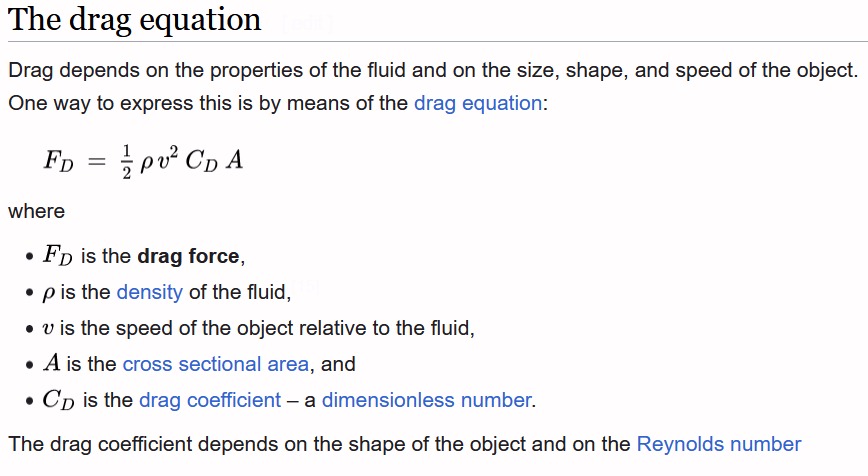
Wind and water flow forces scale as the square of velocity, so as flow speeds increase (say due to more intense heating or heavier rain) the damage scales as the square of the velocity. Look at drag physics and you will see that force is proportional to density times square of velocity (v^2).

The Drag Equation
So a twenty mile an hour wind exerts four times as much force as a ten mile an hour wind. And a forty mile an hour wind exerts sixteen times as much force as a ten mile an hour wind. A wind of fifty miles an hour exerts twenty five times and a wind of sixty miles an hour exerts thirty six times as much force as one of ten miles an hour. Then you have the density term. Water is about eight hundred times denser than air, So the force exerted by a ten mile an hour flow of water is eight hundred times that of a ten mile an hour wind. So as flow velocities go up due to climate change, force and damage scale as square of the velocities. What is not clear is how much these velocities increase with climate change. But in a sense we are seeing this already as, for example, flood and sewage systems succumb and hillsides fall down, and so on.

— from The Reign of Violent Rain Brouse and Mukherjee (2023)

Climate Change: How Long Is “Ever”?

A song about The Human Induced Climate Change Experiment

bookmark_borderYour Present (What’s Inside the Box?)

LYRICS
So close
Getting warmer
Almost
Getting warmer
Think inside the box
What unlocks the locks?
The key to our success
Is the key to nothing — less
What’s inside the box
Shocks
… with its presence
In our hands, the present

Oh, no
Getting hotter
You know
Getting hotter
Think inside the box
What unlocks the locks?
The key to our success
Is the key to nothing — less
What’s inside the box
Shocks
… with its presence
In our hands, the present

See the climate change
Right before your eyes
The primates rearrange
Comes as no surprise

Unlocks Pandora’s box
And there’s no going back
Unlocks Pandora’s box
Turned status to whack

Chords: E E7 E / B7 A E / A E A C B7 E / C D E / E/7; Part II 128 Beats Per Minute
Instrumentation: Vocals, Ibanez Acoustic Guitar, Fender Squire Mini Electric Guitar, Fender Jazz Bass, Keyboards (Korg PS60, Casio WK-3500, Yamaha PSR-740, MiniNova, MicroKorg)

Can you guess what’s inside the box? What is under the wrapping? Is it your present?

We know exactly what is our present — human induced climate change.

Global heat is now “gobsmackingly bananas,” said climate scientist Zeke Hausfather. “It’s hard to overstate just how exceptionally high global temperatures are at the moment.”

Climate Change Review 2023

Sidd said, “Do you remember back in the early 2000’s when we thought we wouldn’t live to see the extreme changes due to global warming?”

Daniel replied, “I think 2023 is the most significant year so far. We saw confirmation of tipping points being crossed for Mountain Glacier Loss, Greenland Ice Sheet Collapse, Antarctic Ice Sheet Collapse, and potentially the Collapse of AMOC.”

Sidd continued, “We already knew that. It was Canada catching on fire that I could not believe. I never thought I’d live to see the day.”

Daniel asked, “Do you think the permafrost and peatlands will have zombie fires and cause the permafrost tipping point?”

Sidd responded, “Yes. They are gone, too. We already know from the permafrost peatland fires in Siberia.”

Daniel ponders, “Hmmmm… I guess that means my plan went up in smoke? My worst case scenario / last resort emergency plan was to escape to Canada.”

What Can I Do?
There are plenty of things you can do to help save the planet. Stop using fossil fuels. Consume less. Love more. Here is a list of additional actions you can take.

— from Toppled Tipping Points: The Domino Effect / Brouse and Mukherjee (2023)

Climate Change: How Long Is “Ever”?

A song about The Human Induced Climate Change Experiment

From the Christmas album of music Merry Christmas!

bookmark_borderHellbent on the Movement

LYRICS
You’re looking at me
Looking at you
It’s plain to see
What we’re to do
Hellbent
On the movement
Of the movement

You hearing me
Hearing you
Clear to the ear
We both can hear
From ear to ear
What to do here
Hellbent
On the movement
Of the movement

Your taste for me
The taste in you
Point-of-view
Come to savor
A knew flavor
Favor to do
Hellbent
On the movement
Of the movement

Lack of movement
Under statement
Could use improvement
Wonder abatement
Find what groove meant
Onward movement

Chords: E D A E / G A E / D C / E; Part II 135 Beats Per Minute
Instrumentation: Vocals, Ibanez Acoustic Guitar, Fender Squire Mini Electric Guitar, Fender Jazz Bass, Keyboards (Korg PS60, Casio WK-3500, Yamaha PSR-740, MiniNova, MicroKorg)

September 6, 2023: “Climate breakdown has begun,” the United Nations Secretary-General Antonio Guterres warned the world after the World Meteorological Organization (WMO) reported the world endure its hottest Northern Hemisphere summer in human history. “The dog days of summer are not just barking, they are biting,” the UN chief said in a statement after the report’s release.

“What we are observing, are not only new extremes but the persistence of these record-breaking conditions, and the impacts these have on both people and planet, are a clear consequence of the warming of the climate system,” C3S’s Climate Change Service Director Carlo Buontempo said.

Climate Breakdown is the most concerning development. Climate breakdown happens when feedback loops are created and tipping points are crossed. Plants will become extinct and many carbon sinks will vanish. The Earth’s temperature will continue to accelerate at an exponential rate no matter what humans do. Food, fresh water, and breathable air will cease to exist. Humans will likely follow in short order.

In October of 2023, the European Space Agency’s Copernicus Climate Change Service calculated that the average temperature for September was 16.38 degrees Celsius (61.48 degrees Fahrenheit) breaking the previous record set in September 2020 by a half-degree Celsius (0.9 degrees Fahrenheit). This is the largest increase in a monthly record high ever.

“It’s just mind-blowing really,” said Copernicus Director Carlo Buontempo. “Never seen anything like that in any month in our records.”

“This is not a fancy weather statistic. It’s a death sentence for people and ecosystems. It destroys assets, infrastructure, harvest,” Imperial College of London climate scientist Friederike Otto said.

— from Climate Change: How Long Is “Ever”? / Brouse (2023)

Global heat is now “gobsmackingly bananas,” said climate scientist Zeke Hausfather. “It’s hard to overstate just how exceptionally high global temperatures are at the moment.”

On November 20, 2023, the UN’s Emission Gap Report found even if countries carried out their current emissions-reduction pledges, the world would likely continuously exceed +3C degrees of warming this century. Later that day, the International Cryosphere Climate Initiative released State of the Cryosphere Report 2023 saying, “Two degrees is too high. Our message — the message of the Cryosphere — is that this insanity cannot and must not continue. The melting point of ice pays no attention to rhetoric, only to our actions.”
— from The Age of Loss and Damage / Brouse (2023)

Climate Change: How Long Is “Ever”?

A song about The Human Induced Climate Change Experiment

bookmark_borderNew Year’s Spectacular

LYRICS
Just another year
Doesn’t apply here
It’s clear
If you catch my drift
Know what I mean
The scene
Obscene
Tipping points tipped
Futures ripped
Glaciers dripped
Feedback tripped
Dominoes fall
Maybe all?
Taking it higher
Fire, fire, fire
Deniers and liars
Fire, fire, fire
(There goes my plan, Man
Duh! Canada)

Spectacular year
Is what we have right here
I fear
If you catch my drift
Know what I mean
The scene
Obscene
Tipping points tipped
Futures ripped
Glaciers dripped
Feedback tripped
Dominoes fall
Maybe all?
Taking it higher
Fire, fire, fire
Deniers and liars
Fire, fire, fire
(There goes my plan, Man
Duh! Canada)

Oh what a year
Let’s hope we hear
Right here
And clear
If you catch my drift
Know what I mean
The scene
Obscene
Tipping points tipped
Futures ripped
Glaciers dripped
Feedback tripped
Dominoes fall
Maybe all?
Taking it higher
Fire, fire, fire
Deniers and liars
Fire, fire, fire
Taking it higher
Deniers and liars
Fire, fire, fire
(There goes my plan, Man
Choke… up in smoke
Duh! Canada)

Chords: E/7 D A G E / D C / D / A G E; Part II 132 Beats Per Minute
Instrumentation: Vocals, Ibanez Acoustic Guitar, Fender Electric Guitar, Fender Jazz Bass, Keyboards (Korg PS60, Casio WK-3500, Yamaha PSR-740, MiniNova, MicroKorg)

Climate Change Review 2023

Sidd said, “Do you remember back in the early 2000’s when we thought we wouldn’t live to see the extreme changes due to global warming?”

Daniel replied, “I think 2023 is the most significant year so far. We saw confirmation of tipping points being crossed for Mountain Glacier Loss, Greenland Ice Sheet Collapse, Antarctic Ice Sheet Collapse, and potentially the Collapse of AMOC.”

Sidd continued, “We already knew that. It was Canada catching on fire that I could not believe. I never thought I’d live to see the day.”

Daniel asked, “Do you think the permafrost and peatlands will have zombie fires and cause the permafrost tipping point?”

Sidd responded, “Yes. They are gone, too. We already know from the permafrost peatland fires in Siberia.”

Daniel ponders, “Hmmmm… I guess that means my plan went up in smoke? My worst case scenario / last resort emergency plan was to escape to Canada.”

NASA reported: Wildland fire experts have described Canada’s 2023 fire season as record-breaking and shocking. Over the course of a fire season that started early and ended late, blazes have burned an estimated 18.4 million hectares. Hundreds of fires exceeded 10,000 hectares (39 square miles), large enough to be considered “megafires.” These megafires were also unusually widespread this season, charring forests from British Columbia and Alberta in the west to Quebec and the Atlantic provinces in the east to the Northwest Territories and the Yukon in the north.

Forest fires cause a carbon feedback loop. The carbon emissions of Canada’s fires outweighed the combined emissions from its oil and gas, transport and agriculture sectors. The fires also cause the melting of the permafrost and zombie fires to burn in the permafrost. The permafrost collapse is a self-sustaining feedback loop/tipping point. As the permafrost melts, the peatlands emit CO2 and methane. The increase in CO2 and methane results in more warming that results in more peatland emissions. A third feedback loop is created with lightning strikes. The study Forests at Risk Due to Lightning Fires found a sensitivity of extratropical intact forests to potential increases in lightning fires, which would have far-reaching consequences for terrestrial carbon storage and biodiversity. The results show that, on a global scale, lightning is the primary ignition source of fires in temperate and boreal forests. Global warming causes more extreme weather events and conditions for lightning creating more forest fires that create more warming and more lightning strikes.

The study Wildfire as a major driver of recent permafrost thaw in boreal peatlands published in the Journal Nature Communications found wildfires have caused a quarter of permafrost thaw (2,000 square kilometres) in Western Canada’s boreal peatlands over the past 30 years. “Historically, permafrost in this area underwent a natural cycle of thawing and reforming, but given current climate conditions and projections for the future, this fire-induced thaw appears to be irreversible,” said Carolyn Gibson, who conducted the research.

Climate Change: The End of Times

What you can do today. How to save the planet.

Climate Change: How Long Is “Ever”?

A song about The Human Induced Climate Change Experiment

From the Christmas album of music Merry Christmas!

bookmark_borderMore, More, More

LYRICS
Keep on pouring
Poor, poor, poor
Keep imploring
More, more, more
The more we ignore
“Same as before”
The less we’ll endure
Forevermore
Just like before?

Find it boring
Keep on snoring
Bore, bore, bore
All the whoring
More, more, more-ing
More, more, more
The more we ignore
“Same as before”
The less we’ll endure
Forevermore
Just like before?
Forever more
Rotten to the core?

News that’s flooring
Sound off roaring
Roar, roar, roar
Find it luring
Reassuring
Sure, sure, sure
The less we ignore
“Same as before”
The more we’ll endure
Forevermore
Open the door!

Chords: A C D A / G D A / A E E A; Part II 86 Beats Per Minute
Instrumentation: Vocals, Ibanez Acoustic Guitar, Fender Squire Mini Electric Guitar, Fender Jazz Bass, Keyboards (Korg PS60, Casio WK-3500, Yamaha PSR-740, MiniNova, MicroKorg)

September 6, 2023: “Climate breakdown has begun,” the United Nations Secretary-General Antonio Guterres warned the world after the World Meteorological Organization (WMO) reported the world endure its hottest Northern Hemisphere summer in human history. “The dog days of summer are not just barking, they are biting,” the UN chief said in a statement after the report’s release.

“What we are observing, are not only new extremes but the persistence of these record-breaking conditions, and the impacts these have on both people and planet, are a clear consequence of the warming of the climate system,” C3S’s Climate Change Service Director Carlo Buontempo said.

Climate Breakdown is the most concerning development. Climate breakdown happens when feedback loops are created and tipping points are crossed. Plants will become extinct and many carbon sinks will vanish. The Earth’s temperature will continue to accelerate at an exponential rate no matter what humans do. Food, fresh water, and breathable air will cease to exist. Humans will likely follow in short order.

In October of 2023, the European Space Agency’s Copernicus Climate Change Service calculated that the average temperature for September was 16.38 degrees Celsius (61.48 degrees Fahrenheit) breaking the previous record set in September 2020 by a half-degree Celsius (0.9 degrees Fahrenheit). This is the largest increase in a monthly record high ever.

“It’s just mind-blowing really,” said Copernicus Director Carlo Buontempo. “Never seen anything like that in any month in our records.”

“This is not a fancy weather statistic. It’s a death sentence for people and ecosystems. It destroys assets, infrastructure, harvest,” Imperial College of London climate scientist Friederike Otto said.

— from Climate Change: How Long Is “Ever”? / Brouse (2023)

Global heat is now “gobsmackingly bananas,” said climate scientist Zeke Hausfather. “It’s hard to overstate just how exceptionally high global temperatures are at the moment.”

On November 20, 2023, the UN’s Emission Gap Report found even if countries carried out their current emissions-reduction pledges, the world would likely continuously exceed +3C degrees of warming this century. Later that day, the International Cryosphere Climate Initiative released State of the Cryosphere Report 2023 saying, “Two degrees is too high. Our message — the message of the Cryosphere — is that this insanity cannot and must not continue. The melting point of ice pays no attention to rhetoric, only to our actions.”
— from The Age of Loss and Damage / Brouse (2023)

Climate Change: How Long Is “Ever”?

A song about The Human Induced Climate Change Experiment

bookmark_borderLet Go of Me!

LYRICS
Maybe it’s time we let go
Of our stubborn ways
If we hope to know
More newborn days
We’re here to report
We’ve numbered them short
Might be time to begin
Taking them in
The air up there
Is plain to see
And it shouldn’t be
The earth’s on fire
The pain is dire
Makes it hard to be
It’s not surprising
The tide is rising
All because of “we”
And me, me, me!

Maybe it’s time we let go
Of our selfish ways
Better get to know
How to share our days
We’re here to report
We’ve numbered them short
Might be time to begin
Taking them in
The air up there
Is plain to see
And it shouldn’t be
The earth’s on fire
The pain is dire
Makes it hard to be
It’s not surprising
The tide is rising
All because of “we”
And me, me, me!

Maybe it’s time we let go
Of our fuelish ways
Rather get to know
How to prolong days
We’re here to report
We’ve numbered them short
Might be time to begin
Taking them in
The air up there
Is plain to see
And it shouldn’t be
The earth’s on fire
The pain is dire
Makes it hard to be
It’s not surprising
The tide is rising
All because of “we”
And me, me, me!

Chords: A D C A / A E A / C D A / B Bb A; Part II 172 Beats Per Minute
Instrumentation: Vocals, Ibanez Acoustic Guitar, Fender Electric Guitar, Fender Jazz Bass, Keyboards (Korg PS60, Casio WK-3500, Yamaha PSR-740, MiniNova, MicroKorg)

Global warming has caused irreparable damage to our environment. Almost all scientists agree that IN FACT climate change is a problem. Our planet is becoming unfit for human life. Now the question is can we adapt in time? (1999)

Human induced climate change is an exponential component of an unordered system (chaos theory). That means global warming is accelerating at a rapid rate in a complex way. From 1992 through 2023, we presented evidence and suggested remedies to mitigate climate change. By 2023, the data was undeniable that human induced climate change is destroying our habitat at a rapidly increasing rate.

Climate Change Review 2023

Sidd said, “Do you remember back in the early 2000’s when we thought we wouldn’t live to see the extreme changes due to global warming?”

Daniel replied, “I think 2023 is the most significant year so far. We saw confirmation of tipping points being crossed for Mountain Glacier Loss, Greenland Ice Sheet Collapse, Antarctic Ice Sheet Collapse, and potentially the Collapse of AMOC.”

Sidd continued, “We already knew that. It was Canada catching on fire that I could not believe. I never thought I’d live to see the day.”

Daniel asked, “Do you think the permafrost and peatlands will have zombie fires and cause the permafrost tipping point?”

Sidd responded, “Yes. They are gone, too. We already know from the permafrost peatland fires in Siberia.”

NASA reported: Wildland fire experts have described Canada’s 2023 fire season as record-breaking and shocking. Over the course of a fire season that started early and ended late, blazes have burned an estimated 18.4 million hectares. Hundreds of fires exceeded 10,000 hectares (39 square miles), large enough to be considered “megafires.” These megafires were also unusually widespread this season, charring forests from British Columbia and Alberta in the west to Quebec and the Atlantic provinces in the east to the Northwest Territories and the Yukon in the north.

Forest fires cause a carbon feedback loop. The carbon emissions of Canada’s fires outweighed the combined emissions from its oil and gas, transport and agriculture sectors. The fires also cause the melting of the permafrost and zombie fires to burn in the permafrost. The permafrost collapse is a self-sustaining feedback loop/tipping point. As the permafrost melts, the peatlands emit CO2 and methane. The increase in CO2 and methane results in more warming that results in more peatland emissions. A third feedback loop is created with lightning strikes. The study Forests at Risk Due to Lightning Fires found a sensitivity of extratropical intact forests to potential increases in lightning fires, which would have far-reaching consequences for terrestrial carbon storage and biodiversity. The results show that, on a global scale, lightning is the primary ignition source of fires in temperate and boreal forests. Global warming causes more extreme weather events and conditions for lightning creating more forest fires that create more warming and more lightning strikes.

The study Wildfire as a major driver of recent permafrost thaw in boreal peatlands published in the Journal Nature Communications found wildfires have caused a quarter of permafrost thaw (2,000 square kilometres) in Western Canada’s boreal peatlands over the past 30 years. “Historically, permafrost in this area underwent a natural cycle of thawing and reforming, but given current climate conditions and projections for the future, this fire-induced thaw appears to be irreversible,” said Carolyn Gibson, who conducted the research.

Climate Change: How Long Is “Ever”?

A song about The Human Induced Climate Change Experiment

bookmark_borderSnowballed

LYRICS
Pushing a snowflake
Down a mountain
Turned biggest mistake
That’s for certain
Turned into a ball
And started to roll
Watching the ball fall
… roll… out-of-control

Trying to stop a snowball
Divertin’
Hoping this doesn’t happen
Often
Turned into a ball
And started to roll
Watching the ball fall
… roll… out-of-control

Vacate the downside
Or it’s curtains
The biggest balls fall
And you’ll be hurtin’
Turned into a ball
And started to roll
Watching the ball fall
… roll… out-of-control

Can’t concede to gaining speed
I pray we’re not askin’
For divine intervention
… is that your intention?

Chords: Em CM7 / C E A / A slide up one octave Em side down one octave; Part II 100 to 115 Beats Per Minute
Instrumentation: Vocals, Ibanez Acoustic Guitar, Fender Electric Guitar, Fender Jazz Bass, Keyboards (Korg PS60, Casio WK-3500, Yamaha PSR-740, MiniNova, MicroKorg)

Could a White Christmas be a thing of the past?

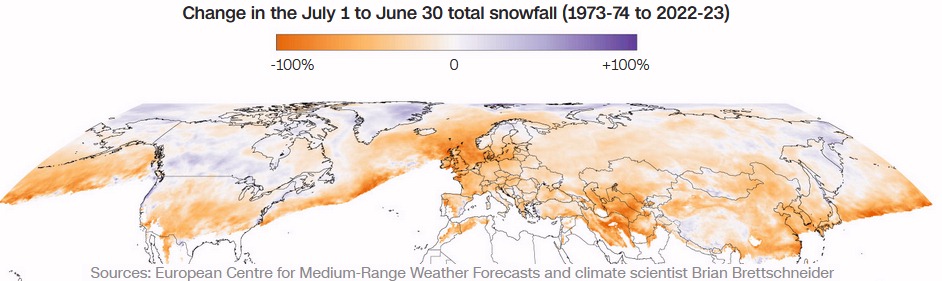
Global warming is causing warmer and shorter winters. Not only are White Christmases less frequent, so are icebergs, sea ice, and glaciers. An analysis and maps from NOAA found snowfall is declining globally as temperatures warm due to anthropological climate change.

Decline in Annual Snowfall
As the atmosphere’s heat and humidity increase, precipitation is more likely to fall as rain or hail than snow. “Eventually the laws of thermodynamics mean that as you keep warming you’re just going to transition more and more of that snow over to rain. You can get away with things for a little bit, and it can hide some trends, but overall the laws of thermodynamics will win out,” said Brian Brettschneider, a climate scientist with the National Weather Service in Alaska.

Justin Mankin, a climate scientist and associate professor of geography at Dartmouth College, said with rising temperatures snowfall will not decline linearly (at a 1-to-1 rate.) Rather, there is a tipping point. Once a certain temperature threshold is reached, “we should expect the losses to accelerate. It means we can expect a lot of the places that haven’t exhibited massive snowfall declines to maybe start to exhibit them with just a little bit more warming.”

Albedo is the reflective nature of snow and measures how much light is reflected without being absorbed when hitting an object (e.g. the fraction of incoming solar radiation that gets reflected back into space). Snow has a very high albedo that reflects most of the light and absorbs very little heat. The snow-albedo feedback loop occurs when the atmosphere gets warmer due to human induced climate change resulting in less snowfall. The less snow reflecting heat back into space, the warmer the earth becomes. The warmer the earth, the less snowfall. The less snowfall, the warmer the earth.

— from The Snow-Albedo Feedback Loop / Brouse (2023)

Push a glass toward the edge of a table and eventually it will fall off on its own. No matter how slowly or meticulously you push… no matter how you weight or fill the glass, it will reach a tipping point and fall off before being pushed completely off the table. No matter whether you believe the glass is half-empty or half-full, when the tipping point is reached it will plummet out-of-control to its end. This is science not fate, faith, nor belief. Human induced climate change has resulted in environmental tipping points being breached.

Tipping points, when crossed, trigger self-sustaining feedback loops that are no longer dependent on human activity. Similar to when a domino topples over hitting two more dominoes that in turn fall hitting more dominoes. Thus, the name The Domino Effect. It can also be visualized as The Snowball Effect. A tipping point is like a snowball rolling down a hill growing in mass and velocity (momentum). When a tipping point is crossed, it results in cumulative and reinforced global warming.

Tipping points are Critical Milestones that directly impact the rate of acceleration in climate change by multiplying the number and intensity of feedback loops (chaos theory).

We’ve been snowballed.

— from Toppled Tipping Points: The Domino Effect / Brouse and Mukherjee (2023)

What you can do today. How to save the planet.

Climate Change: How Long Is “Ever”?

A song about The Human Induced Climate Change Experiment

From the Christmas album of music Merry Christmas!

bookmark_borderChinese Water Torture

LYRICS
If you open the door
And take a step out
You might find some more
Of what I’m talking about
The Reign of Rain
Is pounding my head
It’ll drive you insane
’till you wish you were dead
Chinese water torture
That’s for sure
The dripping of the rain
Is getting to my brain

If you open the door
And take a step out
You might find some more
Of what I’m talking about
The Reign of Rain
Is pounding my head
It’ll drive you insane
’till you wish you were dead
Never a moment dull
Dripping on my skull
Get it through my head
The climate change dread

If you open the door
And take a step out
You might find some more
Of what I’m talking about
The Reign of Rain
Is pounding my head
It’ll drive you insane
’till you wish you were dead
Wind whistling through my ear
Makes it hard to hear
What’s becoming clear
Easy isn’t near

Chinese Water Torture.mp3

Chords: G C A D / D A E A / Bridge A Ab G G Ab A
Instrumentation: Vocals, Acoustic Guitar

The song was written during an extreme weather event.

Violent Rain
Multiple factors figure into the physics of violent rain. The Momentum of Rain is p = mv (p = momentum, m = mass, v = velocity.) Part of the increasing momentum is transferred to the sides and upward increasing wind turbulence, as well as updrafts. Most of the momentum is transferred upon impact. You may notice the rain bouncing higher off the streets and sidewalks. As rain becomes more massive, it will have greater momentum when it hits the ground causing more damage.

Mass is not the only factor in violent rain. The greater the mass of the rain the more the wind turbulence is intensified. Professor Paul D. Williams of the University of Reading, UK, said, “They are chaotic (chaos theory). Turbulence is known famously as the hardest problem in physics.” In their study Evidence for Large Increases in Clear-Air Turbulence Over the Past Four Decades, Prof. Williams and his team found “Climate change has caused turbulence to double in the last 40 years” and is expected to double or triple again in the next decades.

The momentum of rain and the turbulence of wind are part of a larger equation that includes not only the mass and velocity of precipitation but also the density. The combination of these variables results in an increased intensity of the flow dynamics. Increased updrafts will result in an increase in the frequency of hail. When violent rain becomes denser and turns into hail, it can be deadly. Ground without groundcover will be hit harder causing more damage. The groundcover will also be hit harder causing more damage. Concrete, asphalt, solar panels, roofs, and plants will sustain more damage. Hail may also impact your skull. Infants and young children are at highest risk. Several infants have been killed by hail in the past year.

Wind and water flow forces scale as the square of velocity, so as flow speeds increase (say due to more intense heating or heavier rain) the damage scales as the square of the velocity. Look at drag physics and you will see that force is proportional to density times square of velocity (v^2).

— from The Reign of Violent Rain / Brouse and Mukherjee (2023)

What you can do today. How to save the planet.

A song about The Human Induced Climate Change Experiment