bookmark_borderDrizzle

[Verse 1]
Under strain
From lack of rain
In a bout
With a drought

[Bridge]
The storm (already fizzled)
Left (with just a drizzle)

[Chorus]
Dazzled
By the weather
Frazzled
Under whether

[Verse 2]
Not enough rain
To reach the drain
There’s no doubt
About drought

[Bridge]
The storm (already fizzled)
Left (with just a drizzle)

[Chorus]
Dazzled
By the weather
Frazzled
Under the whether
(Watching the drizzle frizzle)

[Bridge]
The storm (already fizzled)
Left (with just a drizzle)

[Chorus]
Dazzled
By the weather
Frazzled
Under the whether
(Watching the drizzle frizzle)

[Outro]
The storm (already fizzled)
Left (with just a drizzle)

A song about The Human Induced Climate Change Experiment

Mish-Mash” by The Beatless Sense Mongers

MegaEpix Enormous

bookmark_borderMother’s Calling

[Intro]
Henry! (come to me)
Henry (it’s come to be)

[Verse 1]
Ashes are falling from the sky
After becoming too dry
Then wouldn’t you know
The water starts to flow

[Chorus]
The tide is rising (uprising)
The reign is falling (down falling)
Can’t hide, surprising? (surprising.)
Mother’s calling (calling… calling)

[Bridge]
After not
It won’t stop
While time transpires
Until the next fire

[Verse 2]
Ashes are falling, you know why
Enough to make you cry
Followed by a flow
With nowhere to go

[Chorus]
The tide is rising (uprising)
The reign is falling (down falling)
Can’t hide, surprising? (surprising.)
Mother’s calling (calling… calling)

[Bridge]
After not
It won’t stop
While time transpires
Until the next fire

[Chorus]
The tide is rising (uprising)
The reign is falling (down falling)
Can’t hide, surprising? (surprising.)
Mother’s calling (calling… calling)

[Bridge]
After not
It won’t stop
While time transpires
Until the next fire

[Outro]
Henry! (come to me)
Henry (it’s come to be)

A SCIENCE NOTE
I asked Sidd, “Are you starting to think wildfires are the most significant threat, or is violent rain still reigning at #1?” Sidd replied, “Well, I never thought I’d see Canada burn. The smoke in the eastern U.S. is currently coming from the Amazon, and Ohio is in severe drought. We were considering buying land in the wooded areas of southeast Ohio, but now we’re reconsidering.”

A song about The Human Induced Climate Change Experiment

From the The EndOf the Line” and the album “A Negril Chill” by Narley Marley

MegaEpix Enormous

bookmark_borderShe’s Gonna Give!

[Intro]
You know…
She’s gonna…
She’s gonna blow!

[Verse 1]
You know She’s gonna give
And, I don’t mean in
She’ll give you the will to live
Earth is heaven

[Chorus]
You know She’s gonna blow (let’s go)
Blow up the love (love love)
Bring it in from above (love love)
She’ll give the love to live
[Break]
Let’s go
[Bridge]
Love’s a two-way street
Where give and take meet
Determinative
She’s gonna give!

[Verse 2]
You wanna know how to live (give)
Give giving a try (before you die)
Be like Her and give (live)
And, feel the high (kiss the sky)

[Chorus]
You know She’s gonna blow (let’s go)
Blow up the love (love love)
Bring it in from above (love love)
She’ll give the love to live
[Break]
Let’s go
[Bridge]
Love’s a two-way street
Where give and take meet
Determinative
She’s gonna give!

[Chorus]
You know She’s gonna blow (let’s go)
Blow up the love (love love)
Bring it in from above (love love)
She’ll give the love to live

[Outro]
Let’s go
Where give and take meet
Become complete

From the album “She’s Gonna Give!” by Daniel

MegaEpix Enormous

bookmark_borderÀ LA Carte

[Intro]
À la carte
With a carrot
Care to share it?

[Verse 1]
À la carte
With a lung
With a heart
À la carte
Swan song sung
Where to start
[Bridge]
How ’bout with a tart?
Come on, do your part!
(An eye for an eye)
How about a breast with the rest?
(An I for an I)

[Chorus]
Whatever dish
That you wish
Your desire
Is their dire

[Verse 2]
À la carte
Pick a brain
Tear apart
À la carte
The only strain
Where to start
[Bridge]
How ’bout with a tart?
Come on, do your part!
(An eye for an eye)
How about a breast with the rest?
(An I for an I)

[Chorus]
Whatever dish
That you wish
Your desire
Is their dire

[Outro]
Where to start
Give from your heart?
Come on, do your part!

A SCIENCE NOTE
Humans will experience greater loss and damage to life and quality of life from air pollution, decreasing supply of potable water, extreme weather events, disease, and other adverse health outcomes. The greatest short term climate change risk to human health is deadly humid heat (wet-bulb temperature).

The greatest health risk from climate change to those alive today is the increased moisture content in the air (relative humidity) combined with the increased temperatures. Climate change and rising temperatures significantly increase the humidity in the atmosphere due to the relationship between temperature and the air’s capacity to hold moisture. The Clausius-Clapeyron equation describes this relationship, indicating that for every 1C (1.8F) increase in temperature, the air can hold about 7% more water vapor.

When the “wet bulb” temperature reaches a temperature too hot for humans to sweat, it is referred to as the “wet-bulb temperature threshold” or simply the “wet-bulb limit.” This limit represents the maximum temperature at which evaporation from a wet surface, such as the skin, can effectively cool the human body through sweating. Beyond this threshold, the body’s ability to regulate its internal temperature becomes severely compromised, posing a significant risk to human health and well-being.

When the temperature exceeds the wet-bulb temperature threshold, the human body faces significant risks of heat-related illnesses and potentially fatal heatstroke. Under such conditions, the body’s ability to cool itself through perspiration is severely compromised, leading to a rapid rise in core body temperature. As a result, individuals may experience symptoms such as dizziness, fatigue, rapid heartbeat, nausea, and confusion. Without intervention, heat exhaustion can progress to heatstroke, a life-threatening condition characterized by a core body temperature above 40°C (104℉), accompanied by neurological symptoms such as seizures, delirium, and loss of consciousness. Heatstroke requires immediate medical attention and can be fatal if left untreated.

Exposure to temperatures exceeding the wet-bulb threshold poses a grave risk to human health and highlights the urgent need for effective measures to mitigate and adapt to the impacts of climate change, which can exacerbate extreme heat events and increase the frequency of conditions exceeding this critical threshold.
* Our climate model uses chaos theory in an attempt to adequately account for humans and forecasts a global average temperature increase of 9 degrees Celsius above pre-industrial levels. Everybody has the responsibility not to pollute. There are plenty of things you can do to help save the planet. Stop using fossil fuels. Consume less. Love more.

From the album “How to Serve Man” by The Beatless Sense Mongers

MegaEpix Enormous

A song about The Human Induced Climate Change Experiment

bookmark_borderObsolete (Train Song)

[Verse 1]
Want to write a song
About a train
But, for how much longer
Will they remain?

[Chorus]
Will I live to see
My melody
Dated
Fated as outdated

[Bridge]
Buggy whips, beepers, fax machines
Know what it means
When you obsolete
It’s beat
Ya, I hear that train coming
Only it was going

[Instrumental, Guitar Solo, Drum Fills, Harmonica]

[Verse 2]
About the train
Coming round the bend
Will I remain
For its end?

[Chorus]
Will I live to see
My melody
Dated
Fated as outdated

[Bridge]
Buggy whips, beepers, fax machines
Know what it means
When you obsolete
It’s beat
Ya, I hear that train coming
Only it was going

[Instrumental, Piano, Upright Bass]

[Bridge]
Newspaper, rotary phone
No, I’m not alone
When you’re obsolete
It’s beat
Ya, I hear that train coming
Only it was going

[Instrumental, Guitar, Whistling, Trap Drums, Harmonica]

Outro]
Will I live to see
My melody
Dated
Fated as outdated

From the album “Tempered Response” by The Beatless Sense Mongers

MegaEpix Enormous

bookmark_borderThe Philadelphia Zoo

[Intro]
[Animal]
[Jungle]
Did you
Did you
Did you
Go to the zoo?
Hominidae
Day-ah
Hominidae
Day-ya

[Verse 1]
That’s a whole different animal, Man
Man, oh, man
A different animal, criminal
Ban on Man?

[Verse 2]
That’s a whole different animal, Man
Man, oh, man
A different animal, Subliminal
Sometimes sublime
I’m, I’m, I’m

[Pre-Chorus]
Hominidae
Day-ah
Hominidae
Day-ya
That’s why I ask you, did you
Go to the zoo, did you?

[Break]

[Chorus]
At any rate the prime primate
The carrier behind the barrier
Carrier of All’s fate
The prime primate
Coming to think, going extinct
Overate
Prime primate

[Bridge]
I don’t exaggerate
Ate, ate, ate…
Have you been to the zoo?
Have you?

[Verse 3]
That’s a whole different animal, Man
Man, oh, man
A different animal, Animal
Animal born of man
I am, I am, I am

[Pre-Chorus]
Hominidae
Day-ah
Hominidae
Day-ya
That’s why I ask you, did you
Go to the zoo, did you?

[Break]

[Chorus]
At any rate the prime primate
The carrier behind the barrier
Carrier of All’s fate
The prime primate
Coming to think, going extinct
Overate
Prime primate

[Outro]
Hominidae
Day-ah
Hominidae
Day-ya
Day-O
Day-O
Daylight come and me gotta go home

[End]
[Silence]

A SCIENCE LESSON
Yes, humans are classified as primates. Primates are a group of mammals that include lemurs, monkeys, apes, and humans. Humans belong to the family Hominidae, which also includes great apes such as chimpanzees, gorillas, and orangutans. Within the family Hominidae, humans are classified as the species Homo sapiens.

Humans are often considered the most dangerous animal on the planet due to their unique capacity for causing widespread harm and destruction to the environment, other species, and even to themselves. Here are several reasons why:

  1. Environmental Impact: Humans have a significant impact on the environment through activities such as deforestation, pollution, habitat destruction, and overexploitation of natural resources. These actions contribute to climate change, loss of biodiversity, and degradation of ecosystems, threatening the stability of the planet’s life-support systems.
  2. Technology and Weapons: Humans have developed advanced technology and weapons capable of causing massive destruction and loss of life. Nuclear weapons, chemical warfare agents, and other weapons of mass destruction pose existential threats to humanity and the planet as a whole.
  3. Conflict and Violence: Human history is marked by wars, conflicts, and acts of violence that have resulted in millions of deaths and widespread suffering. The propensity for aggression and conflict is a dark aspect of human nature that has led to countless atrocities throughout history.
  4. Disease and Pandemics: Humans are susceptible to infectious diseases, and our interconnected global society facilitates the rapid spread of pathogens. Pandemics such as the COVID-19 coronavirus demonstrate how human activities and behavior can exacerbate the spread of disease and endanger public health.
  5. Overpopulation and Overconsumption: The sheer number of humans on the planet, coupled with high levels of consumption and resource exploitation, strain the Earth’s natural systems beyond their capacity to sustainably support human life. Overpopulation and overconsumption contribute to environmental degradation, resource depletion, and social inequality.
  6. Indifference and Ignorance: Despite being aware of the consequences of their actions, humans often prioritize short-term gains and convenience over long-term sustainability and ethical considerations. Indifference to environmental and social issues, coupled with ignorance or denial of scientific evidence, hinders efforts to address pressing global challenges.

Overall, humans possess the cognitive abilities and technological prowess to shape the destiny of the planet, for better or for worse. Our actions and decisions have far-reaching consequences, making us both the most powerful and the most dangerous animal on Earth.

The Philadelphia Experiment: a Study on the Reign of Violent Rain

To Cause a Change: Philadelphia Experiment

4D Music: Songs About Science

A song about The Human Induced Climate Change Experiment

bookmark_borderTo Testify

[Intro]
Are you prepared?
Are you prepared?
Are you?
Are you prepared?
Are you prepared?
Are you, come true

[Verse 1]
Are you prepared
Or feeling scared
To testify
Self declared
Unaware
Please justify

[Bridge]
Why?
Why not try
Why not try to kiss the sky
I, I, I

[Chorus]
Why not try to kiss the sky
Fill an ocean with your emotion
Devotion solution, soul-you-tion
Mother Earth
Mother Earth,
Owe my birth
To Mother Earth

[Verse 2]
Are you prepared
Or feeling scared
To testify
Self declared
Unaware
Please justify
Just a lie?
Possum die…
Can’t deny

[Bridge]
Why?
Why not try
Why not try to kiss the sky
I, I, I

[Chorus]
Why not try to kiss the sky
Fill an ocean with your emotion
Devotion solution, soul-you-tion
Mother Earth
Mother Earth,
Owe my birth
To Mother Earth

[Accelerando]

[Verse 3]
Are you prepared
Or feeling scared
To testify
Self declared
Unaware
Please justify
Just a lie?
Possum die…
Can’t deny
Are you finding it true
All you do
Comes back to you?
Are you
True

[Bridge]
Why?
Why not try
Why not try to kiss the sky
I, I, I

[Chorus]
Why not try to kiss the sky
Fill an ocean with your emotion
Devotion solution, soul-you-tion
Mother Earth
Mother Earth,
Owe my birth
To Mother Earth

[Outro]
Are you finding it true
All you do
Comes back to you?
Are you
True

[Ending]

[Silence]

ABOUT THE SONG
This song delves into the theme of responsibility, particularly in the context of climate change, urging listeners to reflect on their actions and their impact on the planet.

[Verse 1] sets the tone by questioning whether individuals are prepared to take responsibility for their actions or if they are simply ignoring the consequences. It challenges listeners to justify their behavior and acknowledge their role in the current state of affairs.

The [Bridge] emphasizes the importance of taking action, suggesting that striving to reach new heights (“kiss the sky”) is not only desirable but necessary in addressing the challenges we face. It urges individuals to take responsibility for their actions and strive for positive change.

The [Chorus] reinforces the message of responsibility, encouraging listeners to channel their emotions and dedication towards finding solutions for the benefit of Mother Earth. It acknowledges the debt owed to the planet for sustaining life and underscores the need for collective action.

[Verse 2] repeats the questioning from the first verse, highlighting the urgency of the situation and the consequences of inaction. It challenges individuals to confront the reality of their impact on the environment and to question whether their actions align with their values.

The [Accelerando] section increases the intensity of the song, perhaps reflecting the escalating urgency of the climate crisis and the need for swift action.

[Verse 3] expands on the theme of personal responsibility, suggesting that individuals cannot escape the consequences of their actions. It prompts listeners to consider whether their actions are in alignment with their true values and urges them to take ownership of their impact on the world.

The [Outro] reiterates the central message of personal responsibility and the interconnectedness of individual actions and their consequences. It challenges listeners to reflect on the true impact of their actions and to strive for authenticity and accountability.

Overall, the song serves as a poignant reminder of the importance of personal responsibility in addressing climate change and emphasizes the need for individuals to take action and work towards positive change for the sake of Mother Earth and future generations.

The Beatless Sense Mongers: We’re Here… Were Here

4D Music: Songs About Science

A song about The Human Induced Climate Change Experiment

bookmark_borderGive or Take

[Verse 1]
Still not sure which way to go?
Will not endure, if you don’t know.
Look to your heart and find the start.
A better day is your pay

[Chorus]
The little things that you do
Shine through
Sometimes just your wake
Can make the Earth quake

[Bridge]
Awake in the wake
To give beyond take
It’s your life, what will you make?
Wake in your wake

[Verse 2]
Air so pure, breathe in the flow.
Let them know right where to go.
Look to your heart and find the start.
A better day is your pay.

[Chorus]
The little things that you do
Shine through
Sometimes just your wake
Can make the Earth quake

[Bridge]
Awake in the wake
To give beyond take
It’s your life, what will you make?
Wake in your wake

[Verse 3]
Let love grow for all to know.
In a row, let the love show
Look to your heart and find the start.
A better day is your pay.

[Chorus]
The little things that you do
Shine through
Sometimes just your wake
Can make the Earth quake

[Bridge]
Awake in the wake
To give beyond take
It’s your life, what will you make?
Wake in your wake

[Outro]
Awake in our wake
Let the little things that you do
Shine through
Do, do, do
Through
Do, do, do

ABOUT THE SONG
What Can I Do?
There are plenty of things you can do to help save the planet. Stop using fossil fuels. Consume less. Love more. Achieving “net zero” is not only accessible but also cost-effective, providing substantial savings while contributing to the preservation of our planet. Here are some practices I’ve adopted to reach net zero without compromising my standard of living, and, in fact, surpassing it in an effort to eliminate all my pollution. The simplest way to commence this journey is through energy conservation. Be mindful of your energy usage, refrain from unnecessary consumption, turn off devices when not in use, and opt for low-energy products.


The Beatless Sense Mongers: We’re Here… Were Here

4D Music: Songs About Science

A song about The Human Induced Climate Change Experiment

bookmark_borderStanding Tall (After All)

After all,
… standing tall
You know…
The wind may blow
The will to bend
But will not break
How much can we take?
We tapped our resources
Again and again
Run out or recourse
Consumption sin

After all, standing tall
You know…
The wind may blow
The will to bend
But will not break
How much can we take?
We crashed our economy
Again and again
And trashed from sea to see
Consumption sin

After all, standing tall
You know…
The wind may blow
The will to bend
But will not break
How much can we take?
Let’s put more hope back into scope
Yes! Let’s begin
Come shining love from above
Yes! Let’s begin
Again and again

Unplugged Version Chords: F#/7 Bm7 F# / A B D F
Instrumentation: Vocals (TC-Helicon VOICELIVE and MiniNova Vocorder), Ibanez Acoustic Guitar (AW54CE)

ABOUT THE SONG

Human-induced climate change is a dynamic component of an intricate and unordered system, as per chaos theory. This implies that global warming is accelerating exponentially in a complex manner. Over the period from 1992 to 2023, we have presented compelling evidence, proposed remedies to mitigate climate change, and amassed valuable information through the engagement of millions with this climate model. Your participation has been invaluable. The incontrovertible data underscores that human-induced climate change is rapidly deteriorating our habitat.

This climate model / experiment employs chaos theory to comprehensively consider human impacts and projects a potential global average temperature increase of 9℃ above pre-industrial levels. Global warming is a consequence of elevated thermal energy in the climate system, which comprises various subsystems. Chaos theory underscores the intricate and nonlinear nature of dynamic systems. Human well-being is compromised above a 1.5-degree temperature rise, rendering much of the Earth uninhabitable. A 9-degree Celsius increase would bring the Earth close to a wet-bulb temperature incapable of sustaining human life.

What Can I Do? There are numerous actions you can take to contribute to saving the planet. Each person bears the responsibility to minimize pollution, discontinue the use of fossil fuels, reduce consumption, and foster a culture of love and care. The Butterfly Effect illustrates that a small change in one area can lead to significant alterations in conditions anywhere on the globe. Hence, the frequently heard statement that a fluttering butterfly in China can cause a hurricane in the Atlantic. Be a butterfly and affect the world.

The Beatless Sense Mongers: We’re Here… Were Here

4D Music: Songs About Science

A song about The Human Induced Climate Change Experiment

bookmark_borderFrom on High

From on high
Look around
What goes up
Must come down
Started, now can’t stop
Crumbling mountaintop

Can’t deny
Look around
What goes up
Must come down
Started, in motion
Ice into ocean

My, Oh, my
Look around
What goes up
Soon falls down
Started, domino
You know… there they go….

Unplugged Version Chords: E F F# F# F E / D C E
Instrumentation: Vocals (TC-Helicon VOICELIVE and MiniNova Vocorder), Ibanez Acoustic Guitar (AW54CE)

ABOUT THE SONG
Climate breakdown, the most alarming development, occurs when feedback loops are triggered, and tipping points are crossed. This leads to the extinction of plants, the disappearance of carbon sinks, and an exponential acceleration of Earth’s temperature. The consequences are dire, with the potential disappearance of vital resources like food, fresh water, and breathable air, likely followed by catastrophic impacts on human survival. Identifying and understanding these tipping points is crucial for climate science and policymaking. Crossing multiple tipping points could lead to a domino effect, resulting in a much more rapid and severe climate change than currently projected.

The Beatless Sense Mongers: We’re Here… Were Here

4D Music: Songs About Science

A song about The Human Induced Climate Change Experiment

bookmark_borderBiblical Baggage

LYRICS
[Verse 1]
Today is the day
While the banks are breached
The earth was at fault
A new record reached

(Chorus)
The damn is breaking
The flood is flowing
The Earth is shaking
No one is knowing

[Verse 2]
Today we all sway
To, fro, friend and foe
Some will wash away
Will you stay or go?
(chorus)
[Bridge]
Water and land roll
Nature’s exact toll
Will Man yearn to learn
Or crash and burn?

[Verse 3]
Today they do say
Quasi-biblical
Our rate of decay
Is historical
(chorus)

[Outro]
Soon… the sun is eclipsed by the moon
Flood, mud, earthquake, shake and bake
Soon… the sun is eclipsed by the

Chords: F Bb Ab F / F Bb Db F / Db F Db C7 F / F Ab Bb F; Part II @ 104 Beats Per Minute
Instrumentation: Vocals (TC-Helicon VOICELIVE and MiniNova Vocorder), Ibanez Acoustic Guitar (AW54CE), Ibanez Electric RG-270 (Vox ToneLab and Boss Digital Delay), Fender Jazz Bass (Boss Digital Delay), Keyboards (Korg PS60, Casio WK-3500, Yamaha PSR-740, MiniNova, MicroKorg)

ABOUT THE SONG
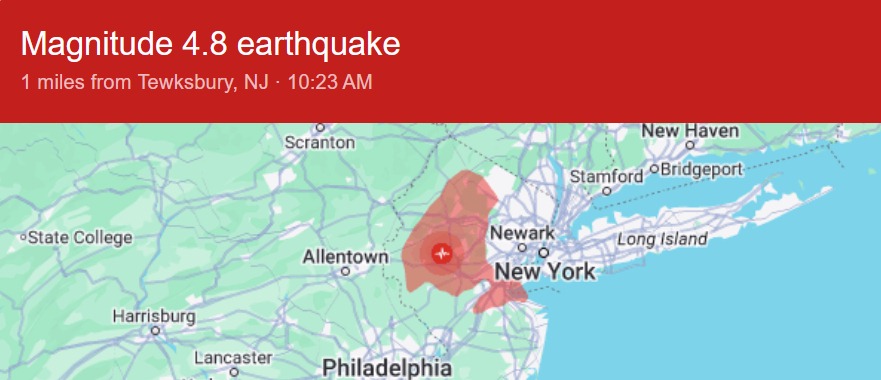
Between April 1 and 4, 2024, Southeastern Pennsylvania experienced another severe weather event attributed to atmospheric rivers and strong winds. Rainfall accumulation exceeded 3 inches, accompanied by wind gusts ranging from 35 to 45 mph. Tragically, two individuals lost their lives in unrelated incidents, one in Montgomery County and the other in Delaware County, when trees collapsed onto their vehicles. Today (Friday April 5) Pennsylvania, New Jersey, and New York experienced a 4.8 magnitude earthquake. Monday is a total eclipse.

This song, “Biblical Baggage,” delves into the tumultuous and uncertain nature of our times, drawing parallels to events of biblical proportions.

[Verse 1] sets the scene with a sense of urgency, describing a day when natural forces wreak havoc, breaking banks and setting new records.

The [Chorus] captures the chaos and devastation unfolding, likening it to a dam breaking, floods flowing, and the Earth shaking, all while humanity remains oblivious to the impending catastrophe.

[Verse 2] portrays the collective uncertainty and vulnerability in the face of such calamities. The imagery of swaying suggests a lack of stability and the looming threat of being swept away by the relentless tide.

The [Bridge] reflects on the toll exacted by nature’s fury, questioning whether humanity will heed the lessons it presents or face dire consequences.

[Verse 3] paints a picture of the magnitude of the events, labeling them quasi-biblical and highlighting the historical significance of our current state of decay.

The [Outro] brings a sense of foreboding, as the sun is eclipsed by the moon, symbolizing an impending darkness amidst the ongoing turmoil of floods, mudslides, earthquakes, and more.

Overall, “Biblical Baggage” serves as a reflection on the precariousness of our existence in the face of natural disasters and the urgent need for awareness and action in the midst of escalating environmental crises.

ABOUT THE SCIENCE
Human-induced climate change is a complex element within a dynamic and interconnected chaotic system. When coupled with other natural phenomena such as earthquakes or solar eclipses, the convergence of factors can create overwhelming compounding effects. Climate change is primarily driven by the escalation of thermal energy affecting biogeophysical and socio-economic systems. While biogeophysical factors can be studied using math, physics, and historical records, socio-economic systems pose greater challenges due to the unpredictable consequences of human behavior and inexplicable consumer choices, exacerbating tipping points and feedback loops.

The Age of Loss and Damage is a new way of thinking about economics by combining economics, climate science, statistics, and physics. Until now, economic models have been unfit to capture the full extent of climate damage. Traditionally, “integrated assessment models” (IAMs) were used to forecast “shock” events. IAMs use “quadratic function” to calculate GDP losses by squaring the temperature change, yet ignore other methods (such as the exponential function) that are better suited for rapid change. “Climate change is fundamentally different to other shocks because once it has hit, it doesn’t go away,” said Thierry Philipponnat, author of a report by Finance Watch, a Brussels-based public interest NGO on financial issues. “And if the fundamental assumption is flawed, all the rest makes little sense — if any.”

Industrial Noize Pollution = The Equation

4D Music: Songs About Science

A song about The Human Induced Climate Change Experiment

bookmark_borderRansom Your Wisdom?

LYRICS
And, then…
Some
Or than?
Sum
Ransom your wisdom?
Sounds dumb
To succumb
But, then…
Will is for free
Freewill will.
Will freewill?
Yet still, freewill won’t get the best of me
But still, freewill won’t get the rest of me
Until freewill
Freewill won’t rule my destiny!?!?!
And, then…
Some
Or than?
Sum
When one is one
When one is won

Unplugged Version Chords: B E / A B E / B7 A G E
Instrumentation: Vocals, Takamine Acoustic Guitar
Recorded at Lake Wynonah, Pennsylvania

Industrial Noize Pollution = The Equation

4D Music: Songs About Science

A song about The Human Induced Climate Change Experiment

bookmark_borderHey, Now!

LYRICS
Hey, now!
And, then…
Hey now
Now and then
When then became when
If only?
Didn’t you see
It happened just now
Somehow…
“Be”‘s so slippery
Future ashore
Passed past
Before the last
Before no more
Let’s live to give
And, love to love

Unplugged Version Chords: F# E / E B F# / D C#7 F#
Instrumentation: Vocals, Takamine Acoustic Guitar
Recorded at Lake Wynonah, Pennsylvania

ABOUT THE SONG
Climate Change: How Long Is “Ever”? Brouse (2023)
The Reign of Violent Rain Brouse and Mukherjee (2023-2024)
The Age of Loss and Damage Brouse (2023)

What Can I Do?
There are plenty of things you can do to help save the planet. Stop using fossil fuels. Consume less. Love more. Here is a list of additional actions you can take.

The Beatless Sense Mongers: We’re Here… Were Here

bookmark_borderSub-straight

(Verse 1)
As the sea levels rise, the world starts to change,
Inland we wonder, how far does it range?
Could saltwater creep into our lakes so vast?
The Great Lakes’ fate, uncertain to last.

(Chorus)
Rising tides, changing scenes,
Violent rains, and what they mean.
From coastal plains to hillsides high,
The earth’s new face, under the sky.

(Verse 2)
Laden speaks of coastal zones explored,
As the waves crash harder on familiar shores.
Cape Cod, a dead-peninsula, facing its fate,
Maine’s silent debate.

(Chorus)
Rising tides, changing scenes,
Violent rains, and what they mean.
From coastal plains to hillsides high,
The earth’s new face, under the sky.

(Bridge)
Brouse shares tales of Pennsylvania’s plight,
Sinkholes, derailments in the dead of night.
Local substrates, a crucial role they play,
In shaping our world, come what may.

(Verse 3)
Floodplains transform, under the rain’s relentless beat,
New culverts form, as streets turn into creeks.
The Gulf Coast braces, from both sides it’s hit,
As violent rain’s reign, shows no sign to quit.

(Chorus)
Rising tides, changing scenes,
Violent rains, and what they mean.
From coastal plains to hillsides high,
The earth’s new face, under the sky.

(Outro)
From Maine’s rocky coast to Pennsylvania’s plains,
The world is changing, under nature’s reigns.
As sea meets rain in a dance profound,
Our planet’s story, in every sound.

Chords: A C E A / A C C A A D A E A / E A7 C B7 E
Instrumentation: Vocals, Takamine Acoustic Guitar
Recorded at Lake Wynonah, Pennsylvania

ABOUT THE SCIENCE
As the sea levels rise, how far “inland” might we see salinization of fresh water? Is it possible saltwater could infiltrate the Great Lakes?


  • Lake Superior has an elevation of 600 feet above (current) sea level and a depth of 1,332 feet.
  • Lake Ontario is 243 feet above sea level with a depth of 802 feet.
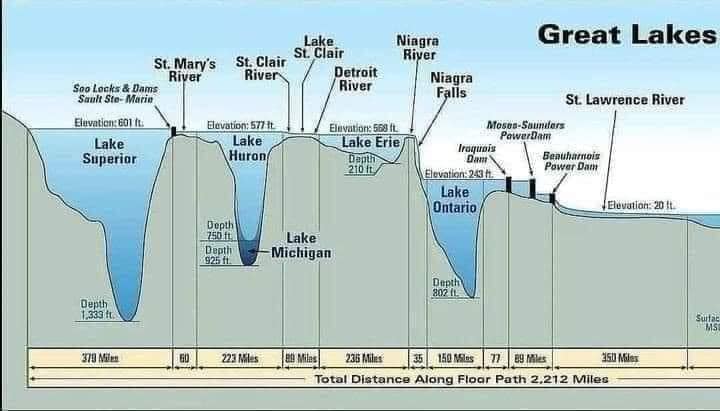
The Great Lakes

Greg Laden (an archaeologist who has worked extensively in coastal zones) replied:
Would not reach the Great lakes, but with a little erosion, the Hudson, Lake Champlain, and the St. Lawrence could become contiguous, so New England becomes an Island.

Daniel Brouse:
I am particularly interested in the Kennebecasis River (a tributary of the Saint John River in southern New Brunswick, Canada.) Do you have any thoughts on this process, in particular, the changing topography caused by extreme rain events? You can kind-of imagine Eastern and Western North America as giant beaches with ever increasing atmospheric waves splashing down on us. The Gulf Coast will be hit from both sides. We to see increasing intensity and/or frequency in a wide variety of violent rain events including: downpours, flooding, hurricanes, cyclones, monsoons, coastal flooding, storm surges, lightning and wildfires, hail, extreme wind, and concurrent extremes. The reign of violent rain has already begun. More hillsides and shorelines are collapsing. Atmospheric rivers are dramatically increasing flash flooding in the Northeastern USA. Worldwide, stormwater systems are becoming overwhelmed. Ironically, the streets of Abu Dhabi and Dubai, UAE, flooded days before the COP28 Climate Conference. Nowhere is safe from violent rain, not even in the desert preparing for a UN meeting on the climate crisis. As a result of increasing violent rain, new drainage culverts are forming. Eventually, the culverts will transform into recurring streams, carving new canyons, creating new landscapes and islands. Increased wildfires and landslides will transform topography. At the same time as the violent rain makes its way to the sea, the sea is rising to meet the violent rain. What do you think will happen to the floodplains in North America?

Greg Laden:
I have many thoughts on this, and this has been part of my research and study for a very long time, having done coastal archaeology in North America, etc. The basic question is what is the substrate? Sea level rise of 1 meter in Maine means the sea goes up to the top line that is currently 1 meter above the sea (we are ignoring tides) and that’s it for thousands of years. That is because Maine is made out of granite. Sea level rise of 1 meter along Cape Cod, which is glacial till, means that the sea will erode horizontally many many meters. In fact, Cape Cod is a dead-peninsula walking, even given pre-AGW sea level rise. It will all wash away eventually, except any rocky bits of bedrock that might be there (but they aren’t there AFIK.) So, given that, yes, storms come in to play. The rate of erosion of Cap Cod, to continue with that example, accelerated in about 1979, due to increased severe coastal storms. What happens to a given floodplain will depend totally on local conditions. Many of our floodplains are not that often flooded, especially in glacial zones where they are filled up, and lower reaches of the giant rivers, and there is a lot of infrastructure in place that will initially control things.

Daniel Brouse:
You might be interested in King of Prussia and Plymouth Meeting, PA. The train derailment in Plymouth Meeting (July 17, 2023) was caused by extreme rainfall and flash flooding that resulted in sinkholes developing in the carbonate rock under the railroad tracks. In July and December of 2023, extreme rainfall resulted in sinkholes being exposed in the carbonate rock under Route 202 in King of Prussia, PA. I guess this is part of the local substrate conditions that vary widely from location to location.
Industrial Noize Pollution = The Equation

4D Music: Songs About Science

A song about The Human Induced Climate Change Experiment

bookmark_borderChallenges

LYRICS
Challenges
We’ll prevail
Challenges
Set sail!
For a virgin see/sea

Emergency

If they’re here to stay
I’m hear to sway
Today’s the day

Chords: B A E / E C B7 E / G A A G E
Instrumentation: Vocals, Takamine Acoustic Guitar
Written and recorded at Lake Wynonah, Pennsylvania