bookmark_borderBreakdown (Go Ahead and Give It to Me)


[Verse 1]
The world’s on fire, can’t you see? (We)
Primate breakdown, in-your-face destiny.
Feedback loops, (loops, loops)
Points plopped, (Ball dropped)
Temperature?
[Break]
On fire
[Break]
Nature’s future?
[Break]
Dire

[Pre-Chorus]
Too much dying, carbon thinks gone,
Future’s bleak, can’t carry on.
Food and water, air we breathe,
All at risk, can’t you believe?

[Chorus]
Go ahead and give it to me:
Primate breakdown
All around
Found your town
Primate breakdown
[Bridge]
It ain’t alright
See the light
[Break]
Be the light

[Instrumental]

[Break]
Climbing higher
[Break]
Fire

[Verse 2]
In twenty twenty-three, Copernicus cried,
Oh, woe, the heat beat, reached new highs.
She couldn’t believe, She ain’t naive
Mind-blowing stats, it’s hard to conceive.

[Pre-Chorus]
Too much dying, carbon thinks gone,
Future’s bleak, can’t carry on.
Food and water, air we breathe,
All at risk, can’t you believe?

[Chorus]
Go ahead and give it to me:
Primate breakdown
All around
Found your town
Primate breakdown
[Bridge]
It ain’t alright
See the light
[Break]
Be the light

[Instrumental, Hammond B3 Organ, Guitar Solo, Saxophone Solo]

[Break]
Climbing higher
[Break]
Fire

[Outro]
The time is now, we must unite, ( Ignite! Fire, climbing higher)
Combat primate change, might see the light

[End]

A SCIENCE LESSON: PRIMATE BREAKDOWN
Climate breakdown, the most alarming development, occurs when feedback loops are triggered, and tipping points are crossed. This leads to the extinction of plants, the disappearance of carbon sinks, and an exponential acceleration of Earth’s temperature. The consequences are dire, with the potential disappearance of vital resources like food, fresh water, and breathable air, likely followed by catastrophic impacts on human survival.

In October 2023, the European Space Agency’s Copernicus Climate Change Service reported that the average temperature for September hit 16.38 degrees Celsius, surpassing the previous record set in September 2020 by 0.5 degrees Celsius. Copernicus Director Carlo Buontempo described it as “mind-blowing” and emphasized the devastating impacts on people and ecosystems, citing destruction of assets, infrastructure, and harvests. “What we are observing, are not only new extremes but the persistence of these record-breaking conditions, and the impacts these have on both people and planet, are a clear consequence of the warming of the climate system,” Director Buontempo said.

By January 2024, the Earth had experienced an alarming annual average temperature increase of over 1.5 degrees Celsius. This temperature rise continued in February 2024, with a monthly average reaching 1.77 degrees above pre-industrial levels, occurring centuries earlier than previously predicted. The urgency to address and combat climate change has never been more critical.

by The Beatless Sense Mongers

A song about The Human Induced Climate Change Experiment

bookmark_borderMy Heart is Melting

Hello?
[Break]
Does anybody know?
[Break]
[Instrumental, Hammond B3 Organ]

[Verse 1]
Are the fiercest winters
A thing of the past
Starting to wonder
What ice will last

[Chorus]
My heart is melting
My soul is wanting
For a world with comMEN sense
More open arms. a lot less fence

[Bridge]
Enlighten the dense
Rinse and repeat
While dancing to the beat
[Break]
Sweet
[Break]
Treat

[Instrumental]

[Break]
Hello?
[Break]
Does anybody know?
[Break]

[Verse 2]
Is the Summer’s onslaught
Starting to Spring
The children overwrought
Their parents, depressing

[Chorus]
My heart is melting
My soul is wanting
For a world with comMEN sense
More open arms. a lot less fence

[Outro]
Enlighten the dense
Rinse and repeat
While dancing to the beat
[Break]
Sweet
[Break]
Treat

[Instrumental]

[Break]
Hello?
[Break]
Does anybody know?
[Break]

[Verse 3]
Can we change attitude
More in the future
Whatnot, rude, and lewd
Put out to pasture

[Chorus]
My heart is melting
My soul is wanting
For a world with comMEN sense
More open arms. a lot less fence

[Outro]
Enlighten the dense
Rinse and repeat
While dancing to the beat
[Break]
Sweet
[Break]
Treat

[End]

by The Beatless Sense Mongers

A song about The Human Induced Climate Change Experiment

bookmark_borderFeedback

Feedback

Back, back, back

[Verse]
Got back (back)
Before before
Got back (back)
Back for more
Now I get back (get back)
For sure

[Break]
Back
[Break]
Back for sure

[Chorus]
Time to get back back
In a feedback loop loop
And hear science of the day
[Break]
Play!
[Break]

[Instrumental, Guitar Solo, Drum Fills, Female Vocals]
[Outro]
Back
Back
Back

A SCIENCE LESSON
While guitar feedback and climate feedback may seem worlds apart, they share a fundamental similarity in the way they operate as feedback loops.

In the realm of music, guitar feedback occurs when the sound from an amplifier is picked up by the guitar’s pickups, creating a loop of sound that feeds back into itself. This loop can lead to a continuous, often high-pitched tone or squeal. The intensity of the feedback depends on various factors such as the distance between the guitar and the amplifier, the volume level, and the position of the guitar relative to the speakers.

Similarly, in climate science, feedback loops play a crucial role in amplifying or dampening the effects of climate change. For example, as global temperatures rise due to increased greenhouse gas emissions, feedback mechanisms such as the melting of Arctic sea ice and the release of methane from permafrost can further amplify warming. These feedback loops create a self-reinforcing cycle where warming leads to additional effects that, in turn, contribute to more warming.

Both guitar feedback and climate feedback involve a process where an initial input (sound or temperature increase) triggers a response that reinforces the original input, leading to a continuous loop of amplification. In the case of guitar feedback, this loop produces a distinctive sound characteristic of rock music. In the case of climate feedback, the loop can have profound and far-reaching consequences for the Earth’s climate system, impacting ecosystems, weather patterns, and sea levels.

Understanding and managing feedback loops are essential in both domains. In music, musicians use techniques such as adjusting volume levels or changing the guitar’s position to control feedback and achieve desired sounds. In climate science, researchers strive to understand the complex interactions between different feedback mechanisms to better predict and mitigate the impacts of climate change.

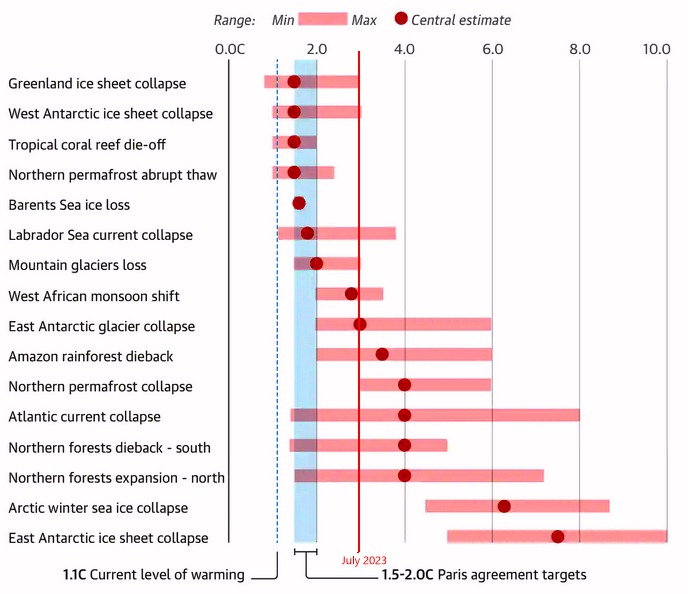
The Domino Effect is causing climate change to accelerate at an exponential rate. Tipping points are Critical Milestones that directly impact the rate of acceleration in climate change by multiplying the number and intensity of feedback loops. Identifying and understanding these tipping points is crucial for climate science and policymaking. Crossing multiple tipping points could lead to a domino effect, resulting in a much more rapid and severe climate change than currently projected.
From the album: MegaEpix Enormous

bookmark_borderThe Snowball Effect (Roll, Baby, Roll)

[Intro]
I didn’t really know what I was doing at the time…
You see, I was under the influence of gravity
[Instrumental, Organ, Saxophone, Bass]

[Verse 1]
Conservation of my momentum
Conversation: go get ’em
Time to roll
It’s all downhill from… hear
[Bridge]
Hear the diction of friction
Your warm affection
I’ve the notion
Accelerates my motion
[Break]
Roll, baby, roll
[Chorus]
Roll, baby, roll (Roll, baby, roll)
It’s all downhill from here
We’re on a roll (Roll, baby, roll)
Make sure our path is clear
Don’t want our ride to collide
[Instrumental]

[Break]
In the first place
[Verse 2]
In the first place
I was under the influence of gravity
And, it really got to me
[Break]
Pull
[Break]
Pull
[Break]
Pull
[Break]
I have to go
‘least, it’s all downhill from… hear
[Bridge]
Hear the diction of friction
Your warm affection
I’ve the notion
Accelerates my motion
[Break]
Roll, baby, roll
[Chorus]
Roll, baby, roll (Roll, baby, roll)
It’s all downhill from here
We’re on a roll (Roll, baby, roll)
Make sure our path is clear
Don’t want our ride to collide
[Instrumental]

[Break]
Foot on the gas
[Verse 3]
Gaining mass
While time goes past
Conserving my momentum
I am…
Going big
Big, big, big
[Break]
Pull
[Break]
Pull
[Break]
Pull
[Break]
I have to go
‘least, it’s all downhill from… hear
[Bridge]
Hear the diction of friction
Your warm affection
I’ve the notion
Accelerates my motion
[Break]
Roll, baby, roll
[Chorus]
Roll, baby, roll (Roll, baby, roll)
It’s all downhill from here
We’re on a roll (Roll, baby, roll)
Make sure our path is clear
Don’t want our ride to collide

[Outro]
I didn’t really know what I was doing at the time…
I was really under the influence of gravity
And, she said, “Let’s roll.”
So, we went for a stroll
[End]
[Silence]

A SCIENCE LESSON
When a snowball rolls down a hill, it accumulates mass, accelerates, and gains inertia, mirroring the progression of human-induced climate change. Tipping points, once breached, set off self-sustaining feedback loops independent of human influence. This phenomenon is akin to a falling domino striking two more, setting off a chain reaction—hence the term “The Domino Effect”. In climate science, it’s often termed “tipping cascades.” This concept can also be likened to “The Snowball Effect.” A tipping point resembles a snowball gathering mass and velocity (momentum) as it rolls downhill. Once passed, it leads to cumulative and reinforced global warming.

  1. Conservation of Momentum: According to Newton’s first law of motion, an object in motion tends to stay in motion unless acted upon by an external force. As the snowball starts rolling down the hill, it gains momentum. Momentum is the product of mass and velocity, so as the snowball gains mass by accumulating more snow, its momentum increases.
  2. Friction: Friction between the snowball and the surface of the hill plays a crucial role. Friction opposes the motion of the snowball, which means it acts in the direction opposite to the snowball’s velocity. However, as the snowball accumulates more mass, it also gains more surface area in contact with the hill, which increases the frictional force. This can help accelerate the snowball’s motion, especially if the hill is steep enough.
  3. Gravity: Gravity is what pulls the snowball downhill in the first place. As the snowball rolls down the hill, it accelerates under the influence of gravity. The force of gravity acting on the snowball increases its velocity, contributing to its momentum.
  4. Impact and Collisions: As the snowball accumulates more mass, it may collide with other objects like rocks or other snowballs on its way down the hill. These collisions can transfer momentum and alter the snowball’s trajectory and velocity.

Overall, the snowball’s momentum is a result of the interplay between these factors. As it gains mass and velocity while rolling down the hill, its momentum increases, governed by the principles of classical mechanics.

Chaos theory, the concept of The Snowball Effect, tipping points and feedback loops provide valuable insights into understanding the acceleration of climate change.

  1. Chaos Theory: Chaos theory deals with complex systems that are highly sensitive to initial conditions, where small changes can lead to significant differences in outcomes. The Earth’s climate system is a classic example of such a complex system. Small perturbations, such as changes in greenhouse gas concentrations or variations in ocean currents, can lead to large-scale and often unpredictable changes in weather patterns and climate dynamics. Chaos theory helps us understand why seemingly small changes in atmospheric composition or temperature can have profound and sometimes unexpected effects on global climate patterns.
  2. Tipping Points: Tipping points are thresholds in a system where a small change can lead to a significant and often irreversible shift in the system’s state. In the context of climate change, tipping points represent critical thresholds in Earth’s climate system, such as the melting of polar ice caps or the collapse of large ice sheets. Once these tipping points are crossed, they can trigger feedback loops that amplify warming and accelerate climate change. For example, the melting of Arctic sea ice reduces the Earth’s albedo, leading to more absorption of solar radiation and further warming of the Arctic, creating a positive feedback loop.
  3. Feedback Loops: Feedback loops are mechanisms by which changes in one part of a system amplify or dampen changes in another part of the system. In the climate system, there are both positive and negative feedback loops. Positive feedback loops amplify changes and tend to destabilize the climate system, while negative feedback loops dampen changes and promote stability. For example, as temperatures rise, permafrost thaw releases methane, a potent greenhouse gas, which further accelerates warming, creating a positive feedback loop. On the other hand, increased atmospheric CO2 levels can stimulate plant growth, leading to more carbon uptake through photosynthesis, which acts as a negative feedback loop.

By considering chaos theory, tipping points, and feedback loops, we can better understand the non-linear dynamics of the climate system and why climate change can accelerate rapidly once certain thresholds are crossed. This understanding is crucial for developing effective strategies to mitigate and adapt to climate change.

Tipping points are Critical Milestones that directly impact the rate of acceleration in climate change by multiplying the number and intensity of feedback loops. Identifying and understanding these tipping points is crucial for climate science and policymaking. Crossing multiple tipping points could lead to a domino effect, resulting in a much more rapid and severe climate change than currently projected.

Tipping Points

Push a glass toward the edge of a table and eventually it will fall off on its own. No matter how slowly or meticulously you push… no matter how you weight or fill the glass, it will reach a tipping point and fall off before being pushed completely off the table. No matter whether you believe the glass is half-empty or half-full, when the tipping point is reached it will plummet out-of-control to its end. This is science not fate, faith, nor belief. Human induced climate change has resulted in environmental tipping points being breached.

Tipping points, when crossed, trigger self-sustaining feedback loops that are no longer dependent on human activity. Similar to when a domino topples over hitting two more dominoes that in turn fall hitting more dominoes. Thus, the name The Domino Effect. It can also be visualized as The Snowball Effect. A tipping point is like a snowball rolling down a hill growing in mass and velocity (momentum). When a tipping point is crossed, it results in cumulative and reinforced global warming.

From Daniel’s Multimedia Album: Omnilogy

bookmark_borderMath and Science

[Intro]
[Instrumental]
1 + 1 = 2
[Break]
2 + 2 = 2’s, too
[Verse 1]
Mathematics a universal language
No baggage
Political point-of-view
Here’s all you’ve got to do:
[Chorus]
Just look out your window
Tell me, what do you see?
Do you see all the math
Of our after-wrath?
[Bridge]
And, it ain’t over yet
Place your bet
Have we just started
[Break]
1 to 1
[Break]
1 to 2
I’m asking you

[Verse 2]
What are the odds, of pulling through
Ask your gods if you’re lucky, too?
I’m beggin’ you, do the math
Takin’ a bath
[Bridge]
Frogs in a pot
Why not?
Turn up the heat
(And, the sun beat, beat, beat
Down)

[Chorus]
Just look out your window
Tell me, what do you see?
Do you see all the math
Of our after-wrath?
[Bridge]
And, it ain’t over yet
Place your bet
Have we just started
[Break]
1 to 1
[Break]
1 to 2
I’m asking you
[Instrumental]

[Break]
Do you see the math
[Break]
Of our after-wrath?
[Bridge]
And, it ain’t over yet
Place your bet
Have we just started
[Break]
1 to 1
[Break]
1 to 2
I’m asking you
[Instrumental]
[Chorus]
Just look out your window
Tell me, what do you see?
Do you see all the math
Of our after-wrath?
[Outro]
And, it ain’t over yet
Place your bet
Have we just started
[End]
[Silence]

Mathematics, often simply referred to as “math,” is the study of numbers, quantity, structure, space, and change. It involves abstract concepts such as numbers, shapes, and patterns, as well as logical reasoning and problem-solving techniques.

Mathematics encompasses a wide range of branches, including arithmetic, algebra, geometry, calculus, statistics, and more. It provides tools and methods for analyzing and understanding the world around us, from calculating the trajectory of a spacecraft to modeling the spread of a disease.

Mathematics is considered a universal language because its principles and concepts are consistent and applicable across different cultures and contexts. It plays a fundamental role in various fields such as science, engineering, economics, and technology, serving as a cornerstone of modern civilization.

* Our climate model employs mathematics, statistics, economics, and chaos theory to comprehensively consider human impacts and projects a potential global average temperature increase of 9℃ above pre-industrial levels.

From Daniel’s Multimedia Album: Omnilogy

bookmark_borderAstronomy

[Verse 1]
First verse of the universe:
Any time, night or day
[Break]
Look out!
Come to find out
Astronomy’s comin’ at me
I seeeeeee
[Bridge]
Astronomy, meeeeeeeeeee
Comin’ at me
At the speed of light
Both day and night
At light speed, the feed

[Instrumental]
[Break]
Woosh!
[Break]
Duck!
[Break]
What the faaa…
[Instrumental]
[Chorus]
Astronomy
Shining light
Gave me birth
On Earth
Son of the Sun
And Mother Earth
Just a little “here”
Both far and near
[Instrumental]

[Break]
Astronomy, you see
My life depends deeply

[Verse 2]
Second verse of the universe:
All the time, at the time,
This time,
All night and day
Comin’ this way
[Break]
Look out!
Come to find out
Astronomy’s comin’ at me
I seeeeeee
[Bridge]
Astronomy, meeeeeeeeeee
Comin’ at me
At the speed of light
Both day and night
At light speed, the feed

[Break]
Woosh!
[Break]
Duck!
[Break]
What the faaa…

[Outro]
Earth is deeply intertwined with astronomy, as it involves the study of celestial objects and phenomena, including planets like Earth. Therefore, it’s challenging to separate the two. Life on Earth relies heavily on the light from celestial objects, particularly the Sun. Have fun!
[Break]
Astronomy, you see
My life depends deeply
[End]
[Silence]

The concept of Earth, as a physical entity, is deeply intertwined with astronomy, as it involves the study of celestial objects and phenomena, including planets like Earth. Therefore, it’s challenging to separate the existence of Earth from the field of astronomy.

Life on Earth relies heavily on the light from celestial objects, particularly the Sun. Sunlight provides the energy needed for photosynthesis, which is the process by which plants and other photosynthetic organisms produce food. This food forms the basis of the food chain, ultimately sustaining all life on Earth. Additionally, sunlight regulates Earth’s climate and temperature, influencing weather patterns, ocean currents, and other environmental factors that are crucial for life.

Without the light of celestial objects, Earth would be shrouded in darkness, and photosynthesis would cease, leading to the collapse of ecosystems and the extinction of most life forms. Therefore, the presence of light from celestial objects is essential for the existence of life on Earth.

From Daniel’s Multimedia Album: Omnilogy

bookmark_borderThunder

[Verse 1]
Beneath the darkened skies we stand,
As lightning strikes across the land,
A flash of light, a crack so loud,
Echoes in my head from the thunder cloud.

[Pre-Chorus]
The air ignites, the heavens roar,
A cacophony you can’t ignore,
In every storm, a tale untold,
Of lightning bolts and thunder’s hold.

[Chorus]
Thunder rolls, the sky’s alive,
Such energy, we will survive,
A rumbling echo, fierce and strong,
In every storm, the rain sing along.

[Instrumental]
[Break]
Thunder!
[Break]
Clap!
[Break]

[Verse 2]
The lightning’s dance, a sight to see,
A fleeting moment, wild and free,
Wait! In its wake, a sound profound,
As thunder shakes the very ground.

[Pre-Chorus]
The air ignites, the heavens roar,
A cacophony you can’t ignore,
In every storm, a tale untold,
Of lightning bolts and thunder’s hold.

[Instrumental]
[Break]
Thunder!
[Break]
Thunder!
[Break]
Thunder!
[Chorus]
Thunder rolls, the sky’s alive,
Such energy, we will survive,
A rumbling echo, fierce and strong,
In every storm, the rain sing along.
[Break]
Thunder!
[Break]
Clap!
[Break]
[Instrumental]

[Bridge]
With each strike, a stories unfold,
Of chaos in the clouds, untold,
In thunder’s song, we find our way,
Through stormy nights and cloudy days.

[Outro]
So let the thunder fill the air,
A reminder that we’re all aware,
Of nature’s power, wild and grand,
In every storm, we will withstand.
[End]
[Silence]

Thunder results from the rapid expansion and contraction of air surrounding a lightning bolt. When lightning strikes, it heats the air to temperatures hotter than the surface of the sun. This extreme heat causes the air to expand quickly, creating a shockwave that manifests as thunder. The rumbling sound of thunder is the audible representation of this shockwave traveling through the atmosphere and reaching our ears. The time delay between the lightning flash and the sound of thunder depends on the distance between the lightning bolt and the observer, with approximately 5 seconds of delay corresponding to 1 mile of distance.

In the realm of meteorology, chaos theory offers valuable insights into the intricate dynamics of thunderstorm formation. Thunderstorms are complex phenomena influenced by multiple factors, including temperature, humidity, air pressure, and wind patterns. These variables interact in nonlinear ways, making thunderstorm prediction challenging.

Chaos theory underscores the concept of sensitivity to initial conditions, known as the butterfly effect. In the context of thunderstorms, even minor fluctuations in atmospheric conditions can have profound effects, such as triggering the development of lightning and thunder. This sensitivity to initial conditions highlights the complexity and unpredictability of thunderstorm behavior, illustrating the need for advanced modeling techniques and data analysis in meteorological research.

From Daniel’s Multimedia Album: Omnilogy

bookmark_borderString Theory

[Female Vocal Harmonies]
[Intro]
[Instrumental, Acoustic, Piano, Guitar]
[Break]
Vibrate
[Break]
Feel free
Don’t hesitate to
[Break]
Vibrate
[Break]
[Bridge]
(vibrate, resonate)
(vibrate, resonate)
(vibrate, resonate)
[Verse 1]
In the fabric of the scenes, where seems entwine,
The strings sing, a cosmic symphony so fine. (so fine)
Each note a particle, each chord a force untold,
Silent harmonies, in strings of purest gold.

[Chorus]
String theory, weaving dreams of the universe,
Echoes of vibrations, in every cosmic verse.
From the tiniest quark (spark) through the galaxies above,
Strings of creation sing a song, the creation of the initial love…
in harmony
[Instrumental]

[Verse 2]
Like a guitar string plucked, in the dance of space and time,
Strings reverberate, in melodies sublime.
Pythagorean harmonies, in the cosmic ballet,
Infinite variations, in the strings that play.

[Chorus]
String theory, weaving dreams of the universe,
Echoes of vibrations, in every cosmic verse.
From the tiniest quark (spark) through the galaxies above,
Strings of creation sing a song, the creation of the initial love…
in harmony

[Bridge]
In the symphony of strings, every note has its place,
From the lowest bass to the highest grace.
Through the cosmic orchestra, let the music unfurl,
In the cosmic dance of strings, let love and truth prevail.

[Chorus]
String theory, weaving dreams of the universe,
Echoes of vibrations, in every cosmic verse.
From the tiniest quark (spark) through the galaxies above,
Strings of creation sing a song, the creation of the initial love…
in harmony

[Outro]
In the tapestry of existence, where mysteries abound,
Strings of creation weave, in patterns, look around.
Listen to the music, strings bind us all,
The song of string theory, unknot the gnarl.
[End]
[Silence]

String theory hypothesizes that very small “strings” vibrations produce the observed particles and forces of nature similar to a vibrating guitar string and heard in Pythagorean harmonies. If you view a guitar string in slow motion, it moves in a variety of ways at the same time in a similar fashion as the forces in subatomic particles.

“A piano or violin string can resonate or vibrate with many different shapes of vibration corresponding to different tones. There is basic tone and there are higher overtones. The richness or beauty of music has to do with the different interplay of the harmonics,” explains Edward Witten.

From Daniel’s Multimedia Album: Omnilogy

bookmark_borderWhich Way is Out? (Relativity Challenges)

[Intro]
Excuse me
[Break]
Can you help me out?
Can’t seem to see
My way out

[Verse 1]
Here’s the thing…
Finding something (out)
Finding anything (out)
About out
Getting out!
O
U
T
Free me
[Chorus]
Which way is up?
Which way is down?
Hard to tell
If you keep moving around
In the meantime,
[Bridge]
I’m…
I’m… trying to find anything about…
How to get out
So, excuse me
[Break]
Can you help me out?
Can’t seem to see
[Break]
My way out
[Break]
Breakout
[Instrumental]

[Verse 2]
Can you tell me, without a doubt
Which way is out?
Here I sit… cry and shout out, “Out!”
’cause I can’t find my way out

[Chorus]
Which way is up?
Which way is down?
Hard to tell
If you keep moving around
In the meantime,
[Bridge]
I’m…
I’m… trying to find anything about…
How to get out
So, excuse me
[Break]
Can you help me out?
Can’t seem to see
[Break]
My way out
[Break]
Breakout
[Instrumental]

[Verse 3]
In search of the most direct route
To getting out
Relativity’s gettin’ the best of me
The Heavens know, I can’t see
My way out

[Chorus]
Which way is up?
Which way is down?
Hard to tell
If you keep moving around
In the meantime,
[Bridge]
I’m…
I’m… trying to find anything about…
How to get out
So, excuse me
[Break]
Can you help me out?
Can’t seem to see
[Break]
My way out
[Break]
Breakout
[Break]
Relativity challenges our intuitive understanding of space, time, and the nature of reality.
Really?
In the realm of relativity, the concept of “out” becomes more complex.
Perplex?
[Instrumental]
[Outro]
Relativity challenges our intuitive understanding of space, time, and the nature of reality.
Really.
In the realm of relativity, the concept of “out” becomes more complex
Really.
[End]
[Silence]

Relativity challenges our intuitive understanding of space, time, and the nature of reality. It suggests that our perception of the universe is shaped by our relative motion and the gravitational environment in which we exist, leading to philosophical questions about the nature of existence and our place in the cosmos.

While the effects of relativity may not always be directly observable in our daily lives, they underpin many aspects of modern science and technology, shaping our understanding of the universe and influencing the development of new technologies and ideas.

In the realm of relativity, the concept of “out” becomes more complex and relative depending on the observer’s frame of reference and the curvature of spacetime. In everyday experience on Earth, “out” is often interpreted as away from the center of the planet or outward toward the horizon.

However, in the context of general relativity, which describes gravity as the curvature of spacetime, the direction of “out” can vary depending on the local gravitational field and the observer’s position in spacetime. For example:

  1. Near a massive celestial body like a planet or star, the direction of “out” may be toward the center of gravity due to the curvature of spacetime caused by the mass of the object. In this case, “out” would be perpendicular to the local gravitational field.
  2. In regions of strong gravitational fields, such as near a black hole, the curvature of spacetime becomes extreme, and the concept of “out” may lose its conventional meaning. Objects near a black hole may appear to move inward toward the singularity, regardless of their initial direction of motion.
  3. In the absence of significant gravitational fields, such as in deep space far from massive objects, the direction of “out” may be more straightforward, following the trajectory of the observer’s motion or the expansion of the universe in cosmological terms.

Ultimately, the concept of “out” in the realm of relativity is relative and dependent on the observer’s frame of reference, the local gravitational environment, and the curvature of spacetime.

From Daniel’s Multimedia Album: Omnilogy

bookmark_border2024 Albums

New Releases

Omnilogy
Love Love: Embracing Love’s Power to Save the World
The Book Of Daniel: Chapter 12 (The End Of Times)

To Cause A Change: The Philadelphia Experiment

We’re Here… er, a… Were Here

= The Equation

The Reign of Violent Rain

Camelot’s Resurgence

Deep Dive Into Spacetime Music

The Echoes of Earth’s Wrath

bookmark_borderApparent Chaos

Overall, the most intriguing aspect of chaos theory is its ability to shed light on the intricate dynamics of nonlinear systems and uncover the underlying order within apparent chaos, challenging traditional notions of predictability and determinism in science.

[Intro]
Chaos
It’s no coin toss
Know, know, know

[Instrumental]

[Verse 1]
In the realm of complexity, where order meets surprise,
There’s a theory that reveals the truth behind our eyes.
It’s chaos, they say, but don’t be dismayed,
For within this apparent chaos, there’s a hidden serenade.

[Bridge]
Behind our I’s
Our ears hear
Here is made
A hidden serenade

[Chorus]
Apparent chaos, dancing in disguise,
Unraveling secrets, where truth and mystery flies.
Beneath the surface, in the depths of the unknown,
There’s an underlying order, waiting to be shown.
[Break]
Chaos
[Break]
It’s no coin toss
Know, know, know
[Instrumental]
[Guitar Solo]

[Break]
Chaos
[Break]
It’s no coin toss
Know, know, know
[Break]

[Verse 2]
From simple rules, emerge patterns unforeseen,
In nonlinear systems, where chaos reigns supreme.
But don’t be fooled by the “randomness” you see,
For within this apparent chaos, lies a symphony.

[Bridge]
Behind our I’s
Our ears hear
Here is made
A hidden serenade

[Chorus]
Apparent chaos, dancing in disguise,
Unraveling secrets, where truth and mystery flies.
Beneath the surface, in the depths of the unknown,
There’s an underlying order, waiting to be shown.
[Break]
Chaos
[Break]
It’s no coin toss
Know, know, know
[Instrumental]
[Guitar Solo]

[Break]
Chaos
[Break]
It’s no coin toss
Know, know, know
[Break]
[Bridge]
Traditional notions, they begin to fade,
As chaos theory reveals the game we’ve played.
No longer bound by predictability’s chains,
We embrace the complexity, where true knowledge reigns.

[Chorus]
Apparent chaos, dancing in disguise,
Unraveling secrets, where truth and mystery flies.
Beneath the surface, in the depths of the unknown,
There’s an underlying order, waiting to be shown.
[Break]
Chaos
[Break]
It’s no coin toss
Know, know, know
[Instrumental]
[Flute Solo]

[Outro]
So let’s dive into the chaos, with open hearts and minds,
For within its depths, the beauty of order we’ll find.
In the dance of complexity, we’ll discover the key,
To unlocking the secrets of the universe’s mystery.
[Instrumental]
[Saxophone Solo]
[End]
[Silence]

From Daniel’s Multimedia Album: Omnilogy

bookmark_borderLove Can Save the World


[Intro]
What we need is love
[Break]
Love
[Instrumental]
[Break]
[Verse 1]
In a world divided, torn apart by hate,
Love comes as the answer, it’s never too late.
It bridges every gap, brings us side by side,
With empathy and compassion, we’ll turn the tide.
Come along for the ride!
[Break]
Ride, ride, ride
[Chorus]
Love has the power to save the world,
Teleconnections, unity unfurled.
Promoting peace, harmony’s sweet embrace,
Empathy emergency, quick, spread love’s grace.
[Break]
Embrace
[Bridge]
[Instrumental]
[Sirens]
[Guitar Solo]

[Break]
What do we need love?
[Break]
Love
[Break]
[Verse 2]
Where there’s conflict and violence, love takes a stand,
Forgiveness and reconciliation, hand in hand, understand
Heals our wounds, bring us back to one,
With love as our guide, the battle’s won.
Dreaming, under the sun

[Chorus]
Love has the power to save the world,
Nonlinear dynamics semantics, we’ll see “unfurled.”
Promoting peace, harmony’s sweet, sweet embrace,
Empathy emergency, quick, spread love all over the place.
[Break]
Embrace
[Bridge]
[Instrumental]
[Sirens]
[Flute Solo]
[Break]
What do we need love?
[Break]
Love
[Break]
[Bridge]
With hearts open wide, and hands reaching out,
We’ll protect the Earth, of that there’s no doubt.
For every living being, every tree and stream,
Love fuels our actions, it’s more than a dream.
It’s the scene
[Break]
[Instrumental]
[Saxophone Solo]
[Break]

[Chorus]
Love has the power to save the world,
Imperative sensitive dependence, we’ll be “unfurled.”
Promoting peace, harmony’s sweet, sweet, sweet embrace,
Empathy emergency, quick, spread love all over the place.
[Break]
Fill our space
[Break]
What do we need love?
[Break]
Love
[Break]
[Outro]
Can’t lose, choose love, in all we do,
For a brighter future, love from me to you.
With love as our ride, we’re on the way,
To a world of compassion, where all can play.
We all can stay.
[End]
[Silence]

A SCIENCE LESSON

Love has the transformative power to save the world in numerous ways:

  1. Fostering Connection and Unity: Love brings people together, transcending boundaries of race, religion, nationality, and ideology. By fostering a sense of empathy, compassion, and understanding, love promotes unity and solidarity among diverse individuals and communities. When people come together in love, they can work collaboratively to address shared challenges and create positive change on a global scale.
  2. Promoting Peace and Harmony: Love is the antidote to hatred, conflict, and violence. By promoting forgiveness, reconciliation, and mutual respect, love can help heal deep-seated divisions and promote peace and harmony within and between societies. When individuals and nations choose love over fear and hostility, they pave the way for peaceful coexistence and cooperation.
  3. Inspiring Empathy and Altruism: Love cultivates a sense of empathy and concern for the well-being of others. When individuals act out of love, they are motivated to alleviate suffering, promote justice, and advance the common good. Love inspires acts of kindness, generosity, and selflessness, creating a ripple effect of positive change that spreads throughout communities and across borders.
  4. Protecting the Environment: Love for the natural world motivates individuals to protect and preserve the planet for future generations. When people recognize their interconnectedness with all living beings and the delicate balance of ecosystems, they are inspired to adopt sustainable lifestyles, promote conservation efforts, and advocate for environmental stewardship. Love for the Earth compels us to take action to address climate change, protect biodiversity, and ensure a healthy and sustainable future for all.
  5. Empowering Social Justice: Love is inherently egalitarian, valuing the inherent worth and dignity of every individual. When people act out of love, they are committed to promoting social justice, equality, and human rights for all. Love drives efforts to dismantle systems of oppression, combat discrimination, and create inclusive societies where everyone has the opportunity to thrive. By standing up for justice and advocating for marginalized communities, love can help create a more just and equitable world for future generations.

In summary, love has the power to save the world by fostering connection and unity, promoting peace and harmony, inspiring empathy and altruism, protecting the environment, and empowering social justice. When individuals and communities choose love as their guiding principle, they can create a world where compassion, understanding, and cooperation prevail, paving the way for a brighter and more sustainable future for all.

From the Album
Love Love: Embracing Love’s Power to Save the World

bookmark_borderEmbrace Chaos

[Intro]
[Female Vocals]
We be
The ghost
In the machine
We be
The mean
Machine
Now, seen…
Do you deem?
Do you dream?
The Age of Imagine
Imagine that
It’s where we’re at
[Instrumental]
[Break]
[Guitar Solo]
[Break]
[Intro]
Chaos
[Break]
In us
[Break]
Chaos
[Bridge]
Chaos us
Chaos usus
Chaos sus us us

[Break]
Embrace
[Break]
Embrace the chaos in us
[Verse 1]
We are the ghost in the machine
“Of the system,” know what I mean?

[Verse 2]
We are the variable variables
Multiplying the mean in extreme

[Bridge]
Teleconnections’ resurrections
Has brought us here today (hear today)
And, a… thermal inertia…
Er, a… is terminal
With little chance of survival
[Break]
Behold, the threshold
[Break]
Any minute…
[Break]
The limit
Limited it
[Chorus]
Like a hurricane
Where’s the role of control?
Like a butterfly
You can hear here if you try
Flutter your wings
Make the winds sing
What your love brings
Wondrous things
Wondrous us

[Break]

[Verse 3]
We are the stardust in the wind (Wind in the dust)
Where will we start in The End? (We must)
After the end of The End, we begin
Where? Will I find you there?

[Bridge]
Teleconnections’ resurrections
Has brought us here today (hear today)
And, a… thermal inertia…
Er, a… is terminal
With little chance of survival
[Break]
Behold, the threshold
[Break]
Any minute…
[Break]
The limit
Limited it
[Chorus]
Like a hurricane
Where’s the role of control?
Like a butterfly
You can hear here if you try
Flutter your wings
Make the winds sing
What your love brings
Wondrous things
Wondrous us

[Break]
[Flute Solo]
[Female Vocals]
Like a butterfly
You can hear here if you try
Flutter your wings
Make the winds sing
What your love brings
Wondrous things
Wondrous us
Soon to be
The illustrious and wondrous us

[Bridge]
Teleconnections’ resurrections
Has brought us here today (hear today)
And, a… thermal inertia…
Er, a… is terminal
With little chance of survival
[Break]
Behold, the threshold
[Break]
Any minute…
[Break]
The limit
Limited it
[Outro]
Like a hurricane
Where’s the role of control?
Like a butterfly
You can hear here if you try
Flutter your wings
Make the winds sing
What your love brings
Wondrous things

[Break]
[Saxophone Solo]
[Instrumental]
Wondrous us
Wondrous
[End]
[Silence]

SCIENCE LESSONS
Chaos Theory and Climate Change
The Science of Chaos Theory, String Theory, and Music

Part I Chaos Theory: Adapting and Coping
Understanding chaos theory can be beneficial in adapting to climate change in several ways:

  1. Complex Systems Perspective: Chaos theory provides insights into the behavior of complex systems, such as the Earth’s climate system. By understanding that climate is a complex, nonlinear system with interconnected components and feedback loops, we can better grasp the unpredictable and emergent behavior of the climate.
  2. Nonlinear Dynamics: Chaos theory emphasizes the importance of nonlinear dynamics, where small changes in initial conditions can lead to significant and unpredictable outcomes. In the context of climate change, this means that seemingly minor changes, such as fluctuations in greenhouse gas emissions or land use patterns, can have far-reaching and potentially catastrophic effects on the climate system.
  3. Sensitive Dependence on Initial Conditions: Chaos theory highlights the concept of sensitive dependence on initial conditions, often referred to as the “butterfly effect.” This means that small variations in initial conditions can amplify over time, leading to large-scale changes in the system. In the context of climate change, this underscores the importance of addressing even minor contributors to greenhouse gas emissions and environmental degradation.
  4. Resilience and Adaptation: By understanding the nonlinear and unpredictable nature of climate systems, we can develop more resilient adaptation strategies. Instead of relying solely on linear models and projections, we can adopt flexible and adaptive approaches that account for uncertainty and variability in the climate system.
  5. Scenario Planning: Chaos theory encourages scenario planning and the exploration of multiple possible futures. Instead of focusing on single-point predictions, scenario-based approaches consider a range of potential outcomes and their associated risks. This allows policymakers, planners, and communities to better prepare for a wide range of climate-related challenges and uncertainties.
  6. Feedback Loops and Tipping Points: Chaos theory highlights the importance of feedback loops and tipping points in driving system behavior. By identifying potential feedback mechanisms and tipping points in the climate system, we can better anticipate sudden and nonlinear changes, such as abrupt shifts in weather patterns or the collapse of ecosystems.
  7. Adaptive Governance: Chaos theory underscores the need for adaptive governance and decision-making processes that are responsive to changing conditions and feedback from the environment. Instead of rigid and static policies, adaptive governance approaches allow for continual learning, adjustment, and innovation in response to evolving climate dynamics.

Overall, understanding chaos theory can inform more robust and adaptive strategies for mitigating and adapting to climate change, helping societies navigate the complex and uncertain challenges posed by a changing climate.

PART II Chaos Theory: Survival
Understanding chaos theory can be instrumental in helping individuals survive and thrive in a complex and unpredictable world. Here’s how:

  1. Adaptability: Chaos theory teaches us that complex systems, like the world around us, are inherently unpredictable and subject to sudden changes. By embracing this understanding, individuals can cultivate adaptability and resilience in the face of uncertainty. Rather than resisting change, they can learn to embrace it, adjusting their plans and strategies as needed to navigate shifting circumstances.
  2. Flexibility: Chaos theory emphasizes the importance of flexibility in response to nonlinear dynamics and feedback loops. Individuals who understand these principles can adopt flexible approaches to problem-solving and decision-making, avoiding rigid thinking patterns that may be ill-suited to a changing environment. By remaining open to new possibilities and perspectives, they can capitalize on emerging opportunities and avoid being blindsided by unexpected challenges.
  3. Risk Management: Chaos theory highlights the concept of sensitive dependence on initial conditions, where small changes can have outsized effects over time. Armed with this knowledge, individuals can take a proactive approach to risk management, identifying and mitigating potential sources of volatility and uncertainty before they escalate into larger problems. By understanding the interconnectedness of different factors and the potential for cascading effects, they can anticipate and prepare for a wide range of scenarios.
  4. Innovation: Chaos theory encourages experimentation and innovation as a means of exploring the complex and dynamic nature of the world. Individuals who embrace chaos theory are more likely to embrace a spirit of creativity and curiosity, seeking out novel solutions to pressing challenges and embracing failure as an opportunity for learning and growth. By fostering a culture of innovation, they can uncover new possibilities and push the boundaries of what’s possible.
  5. Resilience: Chaos theory underscores the importance of resilience in the face of adversity. By understanding that setbacks and disruptions are inevitable in a chaotic world, individuals can develop resilience by building strong support networks, cultivating coping strategies, and maintaining a positive mindset in the face of challenges. Rather than being overwhelmed by adversity, they can bounce back stronger and more resilient than before.

Overall, an understanding of chaos theory can empower individuals to thrive in an uncertain and ever-changing world by fostering adaptability, flexibility, risk management, innovation, and resilience. By embracing chaos as a natural and inherent aspect of life, individuals can navigate complexity with confidence and creativity, turning challenges into opportunities for growth and success.

From the album About the End

and

From the album Plan “B”

bookmark_borderDream the Dream

[Female Vocals]
[Intro]
Dream
Dream a dream
Dream The Dream
Envision the scene
Envision the vision
[Instrumental]
[Break]
[Verse 1]
Imagine imagination elevation
You dream the scene, revolution
First, what do you want to be?
Will it be in harmony?
Can you see
Your vision
Envision vision

[Break]
See the light
[Break]
Be the light
[Break]
All is right

[Bridge]
Dream

[Break]
[Bridge]
[Guitar Solo]

[Chorus]
Sow our dreams
So our scenes
Are seen…
Know our seems
Means
Our scenes

[Break]

Dream
Dream a dream
Dream The Dream
Envision the scene
Envision the vision
[Instrumental]
[Break]
[Verse 2]
Imagination elevation, celebration
We dream the scene, evolution revolution
Next, it’s free for all to be
All to be in harmony
We see
Our vision
Envision vision
Envision collision
Without reality
You and me

[Break]
See the light
[Break]
Be the light
[Break]
All is right

[Bridge]
[Instrumental]
Dream
[Break]
[Instrumental]
Dream
Dream a dream
[Break]
Dream The Dream
Envision the scene
Envision the vision
A scene seen
Scene seen

[Outro]
Dream The Dream
Envision the scene
Envision the vision
A scene seen
Scene seen
[End]
[Silence]

A SCIENCE LESSON
Imagination, envisioning your dreams, and achieving goals can be incredibly beneficial in several ways:

  1. Clarifying Vision: Imagination allows you to visualize your dreams and goals with clarity. By vividly imagining what you want to achieve, you can create a clear mental picture of your desired outcome, which serves as a roadmap for success.
  2. Motivation and Inspiration: Envisioning your dreams can ignite a sense of passion and motivation within you. When you can see the fulfillment of your goals in your mind’s eye, it inspires you to take action and work towards making those dreams a reality.
  3. Overcoming Obstacles: Imagining yourself overcoming obstacles and challenges along the way helps build resilience and determination. By visualizing yourself successfully navigating hurdles, you develop the confidence and mindset needed to overcome setbacks when they arise.
  4. Boosting Creativity: Imagination is a powerful tool for sparking creativity and innovation. When you allow your mind to wander and explore different possibilities, you often come up with new ideas and solutions that can help you achieve your goals more effectively.
  5. Enhancing Problem-Solving Skills: Envisioning your dreams requires you to think critically about the steps needed to achieve them. This process helps sharpen your problem-solving skills as you identify potential barriers and strategize ways to overcome them.
  6. Building Self-Confidence: As you imagine yourself achieving your goals, you develop a greater sense of self-confidence and self-belief. Visualizing success reinforces the belief that you have the ability to accomplish what you set out to do, boosting your confidence in your own capabilities.
  7. Fostering Resilience: Imagining yourself achieving your dreams, even in the face of adversity, fosters resilience and perseverance. It helps cultivate a growth mindset, where setbacks are viewed as opportunities for learning and growth rather than insurmountable obstacles.
  8. Creating a Positive Mindset: Envisioning your dreams and goals in a positive light cultivates a positive mindset. By focusing on what you want to achieve rather than dwelling on limitations or past failures, you maintain a hopeful and optimistic outlook on the future.

Overall, imagination, envisioning your dreams, and achieving goals play a crucial role in personal development, goal attainment, and overall success. By harnessing the power of your imagination and actively working towards your aspirations, you can unlock your full potential and create a fulfilling and meaningful life.

From the album About the End

bookmark_border(Hide)


[Female Vocals]
[Intro]

Shhh
Be very, very quite
I’m hiding from the riot
[Break]
Now The Hunted
Far and wide
Shouldn’t have fronted
Better hide
Hide the hide

[Verse 1]
You now reside on the outside
Your insides out of your mind
If you’re lucky, you’ll find
The time

[Break]
Now The Hunted
Far and wide
Shouldn’t have fronted
Better hide
Hide the hide

[Verse 2]
On the run is losing its fun
Think it’s time I tried to hide (hide the hide)
’cause I now reside on the outside
Done cried
Time to hide the hide

[Chorus]
Dodge, dodge, dodge,
Camouflage
Forest green in a jungle scene
Minimum, blending in
The less seen the more scene

[Bridge]
Serene
In a nightmarish dream
Make the best of it
Can’t quit
Won’t quit
Noooo, not the least bit

[Break]
Hide!
[Break]
Pride died
[Break]
Subside
Let’s just hide

[Verse 3]
Come to decide, my hide must hide
Tried to run, boy, I tried (Tried n’ tried)
Drained dry, my hide must hide
Brains been fried

[Break]
Hide!
[Break]
Pride died
[Break]
Subside
Let’s just hide

[Chorus]
Dodge, dodge, dodge,
Camouflage
Forest green in a jungle scene
Minimum, blending in
The less seen the more scene

[Outro]
Serene
In a nightmarish dream
Make the best of it
Can’t quit
Won’t quit
Noooo, not the least bit

[End]
[Silence]

A SCIENCE LESSON
The Earth will exceed 1.5℃ (average global surface temperature over the surface of the earth for ten years) by the 2040’s and a societal collapse will ensue. For the most part, the Earth will be uninhabitable for humans by 2070 UNLESS immediate action is taken. UPDATE: Since writing this in 2021, there is enough data to conclude 1.5℃ will be breached a decade earlier. In October 2023, the Imperial College of London published a study that concludes 1.5℃ will be reached by 2030 at our current rate of emissions. The average temperature for 2023 was +1.4℃ with September’s average +1.7℃ and parts of July at +3℃.

From the album Plan “B”