bookmark_borderFrom on High

From on high
Look around
What goes up
Must come down
Started, now can’t stop
Crumbling mountaintop

Can’t deny
Look around
What goes up
Must come down
Started, in motion
Ice into ocean

My, Oh, my
Look around
What goes up
Soon falls down
Started, domino
You know… there they go….

Unplugged Version Chords: E F F# F# F E / D C E
Instrumentation: Vocals (TC-Helicon VOICELIVE and MiniNova Vocorder), Ibanez Acoustic Guitar (AW54CE)

ABOUT THE SONG
Climate breakdown, the most alarming development, occurs when feedback loops are triggered, and tipping points are crossed. This leads to the extinction of plants, the disappearance of carbon sinks, and an exponential acceleration of Earth’s temperature. The consequences are dire, with the potential disappearance of vital resources like food, fresh water, and breathable air, likely followed by catastrophic impacts on human survival. Identifying and understanding these tipping points is crucial for climate science and policymaking. Crossing multiple tipping points could lead to a domino effect, resulting in a much more rapid and severe climate change than currently projected.

The Beatless Sense Mongers: We’re Here… Were Here

4D Music: Songs About Science

A song about The Human Induced Climate Change Experiment

bookmark_borderEquation of Change

LYRICS
Hard rock song about the equation to solve the climate change formula .

Climate Change: The Equation Brouse and Mukherjee (2023)

[Verse]
The world is turning, spinning round and round
Temperature rising, the ice is meltin’ down (down)
We gotta find a solution, before it’s too late
The equation of change, we must calculate (calculate)

[Verse 2]
Carbon emissions, polluting the air
We gotta find a way, to show we care (care)
The clock is ticking, time is running out
We gotta solve this problem, there’s no room for doubt (doubt)

[Chorus]
(x^2 – 4xy + 3y^2) – (2x^2 – 6xy + 4y^2)
Equals the power of change, to save our Earth
We’ll take action and fight, for a better tomorrow
Together we’ll make a difference, and heal the sorrow

bookmark_borderBiblical Baggage

LYRICS
[Verse 1]
Today is the day
While the banks are breached
The earth was at fault
A new record reached

(Chorus)
The damn is breaking
The flood is flowing
The Earth is shaking
No one is knowing

[Verse 2]
Today we all sway
To, fro, friend and foe
Some will wash away
Will you stay or go?
(chorus)
[Bridge]
Water and land roll
Nature’s exact toll
Will Man yearn to learn
Or crash and burn?

[Verse 3]
Today they do say
Quasi-biblical
Our rate of decay
Is historical
(chorus)

[Outro]
Soon… the sun is eclipsed by the moon
Flood, mud, earthquake, shake and bake
Soon… the sun is eclipsed by the

Chords: F Bb Ab F / F Bb Db F / Db F Db C7 F / F Ab Bb F; Part II @ 104 Beats Per Minute
Instrumentation: Vocals (TC-Helicon VOICELIVE and MiniNova Vocorder), Ibanez Acoustic Guitar (AW54CE), Ibanez Electric RG-270 (Vox ToneLab and Boss Digital Delay), Fender Jazz Bass (Boss Digital Delay), Keyboards (Korg PS60, Casio WK-3500, Yamaha PSR-740, MiniNova, MicroKorg)

ABOUT THE SONG
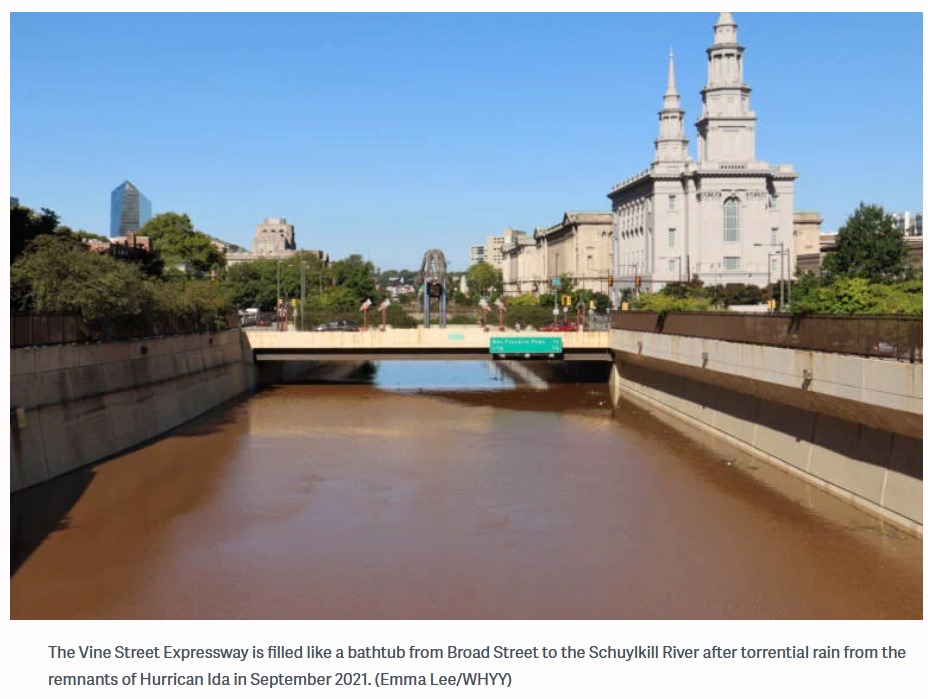
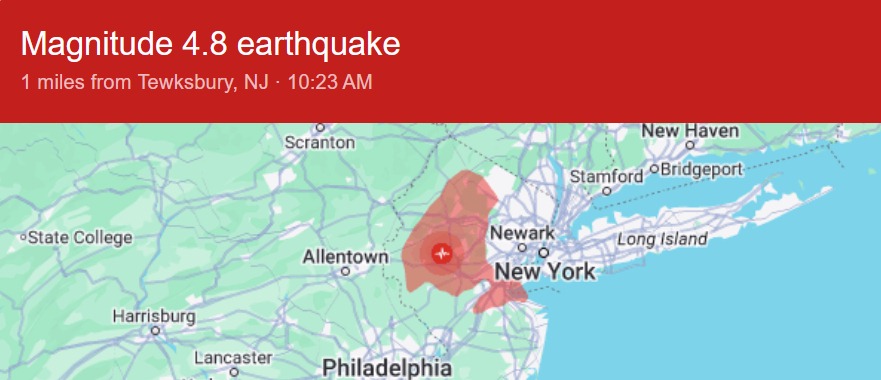
Between April 1 and 4, 2024, Southeastern Pennsylvania experienced another severe weather event attributed to atmospheric rivers and strong winds. Rainfall accumulation exceeded 3 inches, accompanied by wind gusts ranging from 35 to 45 mph. Tragically, two individuals lost their lives in unrelated incidents, one in Montgomery County and the other in Delaware County, when trees collapsed onto their vehicles. Today (Friday April 5) Pennsylvania, New Jersey, and New York experienced a 4.8 magnitude earthquake. Monday is a total eclipse.

This song, “Biblical Baggage,” delves into the tumultuous and uncertain nature of our times, drawing parallels to events of biblical proportions.

[Verse 1] sets the scene with a sense of urgency, describing a day when natural forces wreak havoc, breaking banks and setting new records.

The [Chorus] captures the chaos and devastation unfolding, likening it to a dam breaking, floods flowing, and the Earth shaking, all while humanity remains oblivious to the impending catastrophe.

[Verse 2] portrays the collective uncertainty and vulnerability in the face of such calamities. The imagery of swaying suggests a lack of stability and the looming threat of being swept away by the relentless tide.

The [Bridge] reflects on the toll exacted by nature’s fury, questioning whether humanity will heed the lessons it presents or face dire consequences.

[Verse 3] paints a picture of the magnitude of the events, labeling them quasi-biblical and highlighting the historical significance of our current state of decay.

The [Outro] brings a sense of foreboding, as the sun is eclipsed by the moon, symbolizing an impending darkness amidst the ongoing turmoil of floods, mudslides, earthquakes, and more.

Overall, “Biblical Baggage” serves as a reflection on the precariousness of our existence in the face of natural disasters and the urgent need for awareness and action in the midst of escalating environmental crises.

ABOUT THE SCIENCE
Human-induced climate change is a complex element within a dynamic and interconnected chaotic system. When coupled with other natural phenomena such as earthquakes or solar eclipses, the convergence of factors can create overwhelming compounding effects. Climate change is primarily driven by the escalation of thermal energy affecting biogeophysical and socio-economic systems. While biogeophysical factors can be studied using math, physics, and historical records, socio-economic systems pose greater challenges due to the unpredictable consequences of human behavior and inexplicable consumer choices, exacerbating tipping points and feedback loops.

The Age of Loss and Damage is a new way of thinking about economics by combining economics, climate science, statistics, and physics. Until now, economic models have been unfit to capture the full extent of climate damage. Traditionally, “integrated assessment models” (IAMs) were used to forecast “shock” events. IAMs use “quadratic function” to calculate GDP losses by squaring the temperature change, yet ignore other methods (such as the exponential function) that are better suited for rapid change. “Climate change is fundamentally different to other shocks because once it has hit, it doesn’t go away,” said Thierry Philipponnat, author of a report by Finance Watch, a Brussels-based public interest NGO on financial issues. “And if the fundamental assumption is flawed, all the rest makes little sense — if any.”

Industrial Noize Pollution = The Equation

4D Music: Songs About Science

A song about The Human Induced Climate Change Experiment

bookmark_borderThe Reign of Violent Rain

An Industrial Noize Pollution album made by machine and man.

SIDE I

SIDE II

Drip, Drip, Destroy

Hard rock song about a leaking roof. The Momentum of Rain is p = mv (p = momentum, m = mass, v = velocity.)

[Verse]
Roof is leaking, water’s seeping through the cracks
Drip, drip, drip, it’s falling down my back
I can’t escape this constant reminder of the rain
Gotta fix it now, before it drives me insane

[Verse 2]
Every drop hits the floor like a pounding drum
Drip, drip, drip, it’s a battle I can’t outrun
I’m soaked, I’m drenched, can’t you see my plight?
Gonna tear it down, gonna fight this fight

[Chorus]
Drip, drip, destroy, it’s tearing me apart
This leaking roof is breaking my heart
Gonna scream, gonna shout, gonna make it right
Drip, drip, destroy, gonna win this fight

The moisture
Starts taking shape
For sure
Shape of a cloud
We think
Out loud
Out loud
So proud
(How loud? Hubris us proud)
Is cumulonimbus a reflection on us
Inability to sustain
Brings on violent rain
As silent remain
Under violent rain
Under violent reign
(No fun dancing in the violent rain)

Climate of Chaos

An aggressive hard rock song about: Human-induced climate change is a dynamic component of an intricate and unordered system, as per chaos theory. Global warming is accelerating exponentially. Our climate model uses chaos theory in an attempt to adequately account for humans and forecasts a global average temperature increase of 9 degrees Celsius above pre-industrial levels. Everybody has the responsibility not to pollute. There are plenty of things you can do to help save the planet. Stop using fossil fuels. Consume less. Love more. Here is a list of additional actions you can take.

[Verse]
In a world of chaos, where systems intertwine
A symphony of disorder, a dance of time
Human-induced changes, a web of destruction
Global warming accelerating, no time for reflection (oh-yeah)

[Verse 2]
The ice caps are melting, the oceans are rising
Species are dying, can’t you see it’s terrifying?
We’re playing with fire, but the flames keep getting higher
We need to wake up, before it’s too late to retire (yeah!)

[Chorus]
Can’t you see the chaos unfolding? (oh-oh)
Global warming, the world is exploding
We’re facing a crisis, it’s time to take action (take action)
Climate of chaos, it’s a chain reaction

Violent Rain

An intense hard rock song about: Sidd said, Now I am thinking the violent rain will be a bigger problem before we die. Flow velocities go up due to climate change, Force and damage = square of the velocities.
— from The Reign of Violent Rain / Brouse and Mukherjee (2023)

[Verse]
Sidd said, “Now I’m thinking, the violent rain will be a bigger problem”
Before we die, we’re caught in the eye of the storm
Flow velocities go up, all because of climate change
Force and damage, it’s the square of the velocities

[Verse 2]
Dark clouds roll in, thunder cracks in the sky
We’re running from the storm, but there’s nowhere to hide
Drenched in fear, we feel the chaos closing in
The violence of the rain, it’s a battle we can’t win

[Chorus]
Violent rain, it’s pouring down on us (pouring down on us)
Tearing through, leaving destruction in its wake (in its wake)
We try to escape, but it’s too late (but it’s too late)
The power of the storm, it’s a force we can’t break

Quantum Leap

A heavy, hard rock song: chaos theory The Butterfly Effect a small change can result in a quantum leap. Be a butterfly and affect the world. The Butterfly Effect illustrates that a small change in one area can lead to significant alterations in conditions anywhere on the globe. Hence, the frequently heard statement that a fluttering butterfly in China can cause a hurricane in the Atlantic.

[Verse]
In the realm of chaos, a butterfly takes flight
With every flutter, causing ripples in the night (night)
No one knows the power, waiting to ignite
A small change can lead to a world of might

[Verse 2]
From the ashes rise the giants, the fire starts to burn
A quantum leap in motion, the world begins to turn
With the power of a whisper, they’ll feel the heat
A revolution rising, defeat is not a retreat

[Chorus]
Be the butterfly, spread your wings and fly (fly, fly, fly)
A small change can cause a storm, reach for the sky (yeah, yeah, yeah)
In the chaos lies the power, waiting to be unfurled (unfurled)
The butterfly effect, watch as it changes the world (the world, the world)

Acceleration

Hard rock song: Tipping points and feedback loops impact the rate of climate change acceleration. Crossing multiple tipping points results in the Domino Effect.

[Verse]
Drowning in the silence, screaming in dismay
As the world spins faster, spiraling away (away)
Tipping points and feedback loops, the danger now revealed
Crossing the line of no return, the climate’s fate is sealed

[Verse 2]
Domino effect, the earth in disarray
Turbulent skies of chaos, never-ending fray (fray)
Like a runaway train, the acceleration’s strong
As we witness the destruction, we know we did it wrong

[Chorus]
Accelerate, accelerate, the world’s on fire
Tipping points and feedback loops, the flames grow higher
The domino effect, crashing one by one
In this race against time, will we come undone?

Tempest of Change

Hard rock song: Extreme Weather when energy is added to a system, fluctuations increase. What we are saying is weather conditions will become more volatile due to the impact of humans.
— from The Human Induced Climate Change Experiment

[Verse]
Thunder rolling, lightning strikes the sky
The winds are howling, chaos fills the air (yeah)
Energy surging, nature’s fury unleashed
The tempest of change, a force we can’t repair (whoa-ooh)

[Verse 2]
Raging storms, tornadoes spinning wild
Heatwaves scorching, oceans rising high (oh-yeah)
Humans disrupt the delicate balance
Fluctuations surge, weather intensified (woah-oh)

[Chorus]
Extreme weather, a cry of nature’s rage (yeah, yeah)
Unleashing power that humans can’t contain (ooh-yeah)
Impact of our actions, consequences clear (clear, yeah)
Weather’s volatility, a warning we should hear

Unordered Chaos

Hard rock song: The Age of Loss and Damage humans experience greater loss and damage to life. Anthropogenic climate change is an exponential component of an unordered system (chaos theory).

[Verse]
In the age of loss and damage, we’re drowning in despair
Anthropogenic climate change, the chaos that we bear
Exponential destruction, our world in disarray
Searching for a solution, will we find a way?

[Verse 2]
The Earth is screaming out, its cries fall on deaf ears
As temperatures rise, we fuel our own fears
The storms intensify, the fires rage on
We’re living in a nightmare, with no place to belong

[Chorus]
Unordered chaos, the price we pay
The consequence of our actions, won’t go away (no way)
Can we break this cycle, can we make a change?
Or will we be consumed by the chaos we arrange?

What is the peril
With all of this?
Risk to life
Risk to limb
Bringing strife
To who I am
Taking life
From who I am

Vector-borne disease
Under a scorching breeze
Dying of thirst
As hopes are coerced

Loss of the trees
No more gentle breeze
Extremes abound
Dreams shattered, ground

Loss of home
Forever to roam
Refugee’s fate
A self-imposed state

Intensified rain
Reigning severity’s pain
Water refuses to drain
Sustaining sanity becomes a strain

Hazard, threat, jeopardy
High-risk probability
Time hangs on the line
Under constant alarms of harm
Susceptible to vulnerability
In debt, regretting the threat

Ignite the World

Hard rock anthem: Climate change: — each person bears the responsibility to minimize pollution, discontinue the use of fossil fuels, reduce consumption, and foster a culture of love and care. Climate change is primarily driven by the escalation of thermal energy affecting biogeophysical and socio-economic systems. While biogeophysical factors can be studied using math, physics, and historical records, socio-economic systems pose greater challenges due to the unpredictable consequences of human behavior and inexplicable consumer choices, exacerbating tipping points and feedback loops.

[Verse]
In a world of fire, burning so bright
We gotta rise up, we gotta make it right
The earth is calling, can’t you feel the pain?
It’s time to stand up, we won’t be the same

[Chorus]
Ignite the world, let’s make a change (make a change)
Together we can rearrange (rearrange)
In our hearts, we hold the key (hold the key)
To a future that’s clean and free

[Verse 2]
No more pollution, no more wasting time
We gotta act now, leave the past behind
With renewable energy, we’ll pave the way
For a world where love and care will always stay

Earthquake of the Ages

Hard rock song about the rate of climate change, so much change so rapidly, volatile, extreme, mind-blowing, gobsmackingly bananas.

Dr. Caroline Holmes of the British Antarctic Survey (an expert on Antarctic sea-ice) said, “What we’re seeing right now is so far outside what we’ve observed previously. We expected change but I don’t think we expected so much change so rapidly.”

Some areas of the world are now warming so fast, it is becoming more difficult to measure the change from “normal” or average. Jeff Boyne, National Weather Service meteorologist and climatologist, said, “There are climate normals that are updated every 10 to 15 years, because the planet is warming so fast. The ENSO (El Nino-Southern Oscillation) regions are warming so fast that those normals are being updated every 5 years.”

“It’s so far outside anything we’ve seen, it’s almost mind-blowing,” says Walter Meier, who monitors sea-ice with the National Snow and Ice Data Center. “September was, in my professional opinion as a climate scientist, absolutely gobsmackingly bananas,” said Zeke Hausfather, at the Berkeley Earth climate data project.”

[Verse]
Fire and ice, the Earth collides
Mountains crumble, the ocean tides
Nature’s fury, it’s hard to believe
The planet’s screaming, won’t you perceive?

[Verse 2]
Volcanic eruptions, the land ablaze
Melting glaciers, a haunting chase
Hurricanes swirling, tempestuous force
Climate’s shifting, off its course

[Chorus]
Mind-blowing, gobsmackingly bananas
The rate of change, it’s causing trauma
Volatile and extreme, this Earthquake of the Ages
Can we find a way to turn the pages?

Solid Ground

Hard rock song about the erosion and the hardness of rock under our feet, granite, glacial till, limestone bedrock, karst terrain, or carbonate rock. Violent Rain and the Substrate: The basic question is what is the substrate? Sea level rise of 1 meter in Maine means the sea goes up to the top line that is currently 1 meter above the sea (we are ignoring tides) and that’s it for thousands of years. That is because Maine is made out of granite. Sea level rise of 1 meter along Cape Cod, which is glacial till, means that the sea will erode horizontally many many meters. In fact, Cape Cod is a dead-peninsula walking, even given pre-AGW sea level rise. It will all wash away eventually, except any rocky bits of bedrock that might be there (but they aren’t there AFIK.) So, given that, yes, storms come in to play. The rate of erosion of Cap Cod, to continue with that example, accelerated in about 1979, due to increased severe coastal storms. What happens to a given floodplain will depend totally on local conditions.

[Verse]
In this cold world, I search for something real
But all I find are facades, just surface appeal (appeal)
I’m walkin’ on rocks that have weathered the test
Their silent strength, a testament to what is best (yeah)

[Verse 2]
Behind the cracks, there lies a story untold
The scars they bear, each one a battle unfold (unfold)
Granite veins run deep beneath the ground
Unyielding and unbreakable, forever profound (oh-yeah)

[Chorus]
Solid ground beneath my feet (yeah)
Eroding, eroding but never retreat (ooh-yeah)
Through glacial till and limestone bedrock, I stand tall
On karst terrain, this world can’t make me fall (fall)

Barren Lands

Hard rock song: Soil degradation, through erosion, loss of organic matter, and reduced water retention, cause desertification. The earth’s climate is nonlinear and teleconnected. Global warming is caused by an increase in thermal energy in the climate system. The Earth is a climate system. Many subsystems make up our climate. Chaos theory emphasizes the complexity and nonlinearity of dynamic systems, and this complexity is inherent in the interactions between soil, atmosphere, and oceans in the Earth’s climate system.

[Verse]
The soil is dying, the earth is crying
Erosion takes its toll, as the winds are flying
Lost in the desert, a landscape unforgiving
Barren lands surround, no hope for the living

[Verse 2]
Organic matter, once rich and thriving
Reduced to ashes, in the desert it’s striving
Water retention, a thing of the past
The dry lands expand, the future is cast

[Chorus]
A world in decay, it’s slipping away (slipping away)
Desertification, the price we must pay (we must pay)
The climate is nonlinear, teleconnected we stand
Barren lands, the mark of man’s hand (yeah!)
Industrial Noize Pollution

4D Music: Songs About Science

A song about The Human Induced Climate Change Experiment


bookmark_borderSub-straight

(Verse 1)
As the sea levels rise, the world starts to change,
Inland we wonder, how far does it range?
Could saltwater creep into our lakes so vast?
The Great Lakes’ fate, uncertain to last.

(Chorus)
Rising tides, changing scenes,
Violent rains, and what they mean.
From coastal plains to hillsides high,
The earth’s new face, under the sky.

(Verse 2)
Laden speaks of coastal zones explored,
As the waves crash harder on familiar shores.
Cape Cod, a dead-peninsula, facing its fate,
Maine’s silent debate.

(Chorus)
Rising tides, changing scenes,
Violent rains, and what they mean.
From coastal plains to hillsides high,
The earth’s new face, under the sky.

(Bridge)
Brouse shares tales of Pennsylvania’s plight,
Sinkholes, derailments in the dead of night.
Local substrates, a crucial role they play,
In shaping our world, come what may.

(Verse 3)
Floodplains transform, under the rain’s relentless beat,
New culverts form, as streets turn into creeks.
The Gulf Coast braces, from both sides it’s hit,
As violent rain’s reign, shows no sign to quit.

(Chorus)
Rising tides, changing scenes,
Violent rains, and what they mean.
From coastal plains to hillsides high,
The earth’s new face, under the sky.

(Outro)
From Maine’s rocky coast to Pennsylvania’s plains,
The world is changing, under nature’s reigns.
As sea meets rain in a dance profound,
Our planet’s story, in every sound.

Chords: A C E A / A C C A A D A E A / E A7 C B7 E
Instrumentation: Vocals, Takamine Acoustic Guitar
Recorded at Lake Wynonah, Pennsylvania

ABOUT THE SCIENCE
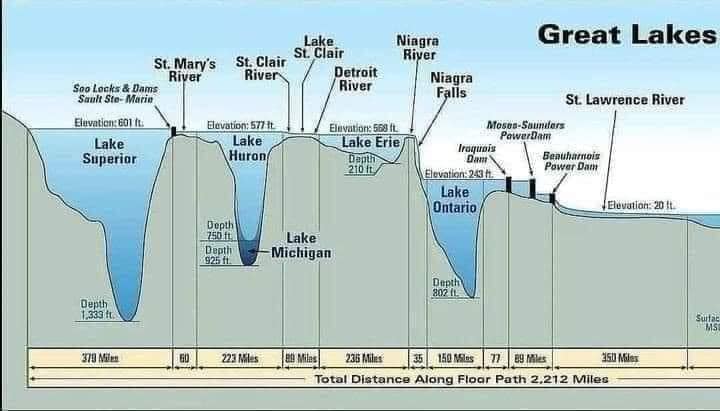
As the sea levels rise, how far “inland” might we see salinization of fresh water? Is it possible saltwater could infiltrate the Great Lakes?


  • Lake Superior has an elevation of 600 feet above (current) sea level and a depth of 1,332 feet.
  • Lake Ontario is 243 feet above sea level with a depth of 802 feet.

The Great Lakes

Greg Laden (an archaeologist who has worked extensively in coastal zones) replied:
Would not reach the Great lakes, but with a little erosion, the Hudson, Lake Champlain, and the St. Lawrence could become contiguous, so New England becomes an Island.

Daniel Brouse:
I am particularly interested in the Kennebecasis River (a tributary of the Saint John River in southern New Brunswick, Canada.) Do you have any thoughts on this process, in particular, the changing topography caused by extreme rain events? You can kind-of imagine Eastern and Western North America as giant beaches with ever increasing atmospheric waves splashing down on us. The Gulf Coast will be hit from both sides. We to see increasing intensity and/or frequency in a wide variety of violent rain events including: downpours, flooding, hurricanes, cyclones, monsoons, coastal flooding, storm surges, lightning and wildfires, hail, extreme wind, and concurrent extremes. The reign of violent rain has already begun. More hillsides and shorelines are collapsing. Atmospheric rivers are dramatically increasing flash flooding in the Northeastern USA. Worldwide, stormwater systems are becoming overwhelmed. Ironically, the streets of Abu Dhabi and Dubai, UAE, flooded days before the COP28 Climate Conference. Nowhere is safe from violent rain, not even in the desert preparing for a UN meeting on the climate crisis. As a result of increasing violent rain, new drainage culverts are forming. Eventually, the culverts will transform into recurring streams, carving new canyons, creating new landscapes and islands. Increased wildfires and landslides will transform topography. At the same time as the violent rain makes its way to the sea, the sea is rising to meet the violent rain. What do you think will happen to the floodplains in North America?

Greg Laden:
I have many thoughts on this, and this has been part of my research and study for a very long time, having done coastal archaeology in North America, etc. The basic question is what is the substrate? Sea level rise of 1 meter in Maine means the sea goes up to the top line that is currently 1 meter above the sea (we are ignoring tides) and that’s it for thousands of years. That is because Maine is made out of granite. Sea level rise of 1 meter along Cape Cod, which is glacial till, means that the sea will erode horizontally many many meters. In fact, Cape Cod is a dead-peninsula walking, even given pre-AGW sea level rise. It will all wash away eventually, except any rocky bits of bedrock that might be there (but they aren’t there AFIK.) So, given that, yes, storms come in to play. The rate of erosion of Cap Cod, to continue with that example, accelerated in about 1979, due to increased severe coastal storms. What happens to a given floodplain will depend totally on local conditions. Many of our floodplains are not that often flooded, especially in glacial zones where they are filled up, and lower reaches of the giant rivers, and there is a lot of infrastructure in place that will initially control things.

Daniel Brouse:
You might be interested in King of Prussia and Plymouth Meeting, PA. The train derailment in Plymouth Meeting (July 17, 2023) was caused by extreme rainfall and flash flooding that resulted in sinkholes developing in the carbonate rock under the railroad tracks. In July and December of 2023, extreme rainfall resulted in sinkholes being exposed in the carbonate rock under Route 202 in King of Prussia, PA. I guess this is part of the local substrate conditions that vary widely from location to location.

Industrial Noize Pollution = The Equation

4D Music: Songs About Science

A song about The Human Induced Climate Change Experiment

bookmark_borderThe Equation: Part III

(Verse 1)
Turbulence, it’s chaos unfurled,
The hardest problem, in this vast world.
The Professor speaks, of skies in turmoil,
As climate shifts, it doubles the coil.

(Chorus)
Turbulence, it’s on the rise,
In wind and water, where chaos lies.
From Lahaina’s flames to Norway’s floods,
Turbulence, it shakes our blood.

(Verse 2)
Maui’s wildfire, a scene of despair,
Fanned by winds, hurricane’s flare.
Streets ablaze, with scorching heat,
As Lahaina’s heart, faced defeat.

(Chorus)
Turbulence, it’s on the rise,
In wind and water, where chaos lies.
From Lahaina’s flames to Norway’s floods,
Turbulence, it shakes our blood.

(Bridge)
Flashpoints ignite, with a fiery blast,
As people flee, into the ocean vast.
But water, too, joins in the fray,
With waves that tear, and claim their way.

(Verse 3)
Norway’s floods, a tale of woe,
As dams burst open, the waters flow.
Homes washed away, in torrents wild,
As nature’s fury, leaves hearts beguiled.

(Chorus)
Turbulence, it’s on the rise,
In wind and water, where chaos lies.
From Lahaina’s flames to Norway’s floods,
Turbulence, it shakes our blood.

(Outro)
In the dance of chaos, we find our plight,
Turbulence grows, with all its might.
But in the face of turmoil, we’ll stand tall,
For together, we’ll weather, through it all.

Chords: A Bb A G F# E / E A C G A / D C A / C E A
Instrumentation: Vocals, Takamine Acoustic Guitar
Recorded at Lake Wynonah, Pennsylvania

ABOUT THE SCIENCE
Turbulence
Professor Paul D. Williams of the University of Reading, UK, said, “They are chaotic. Turbulence is known famously as the hardest problem in physics.” In their study Evidence for Large Increases in Clear-Air Turbulence Over the Past Four Decades, Prof. Williams and his team found “Climate change has caused turbulence to double in the last 40 years” and is expected to double or triple again in the next decades.

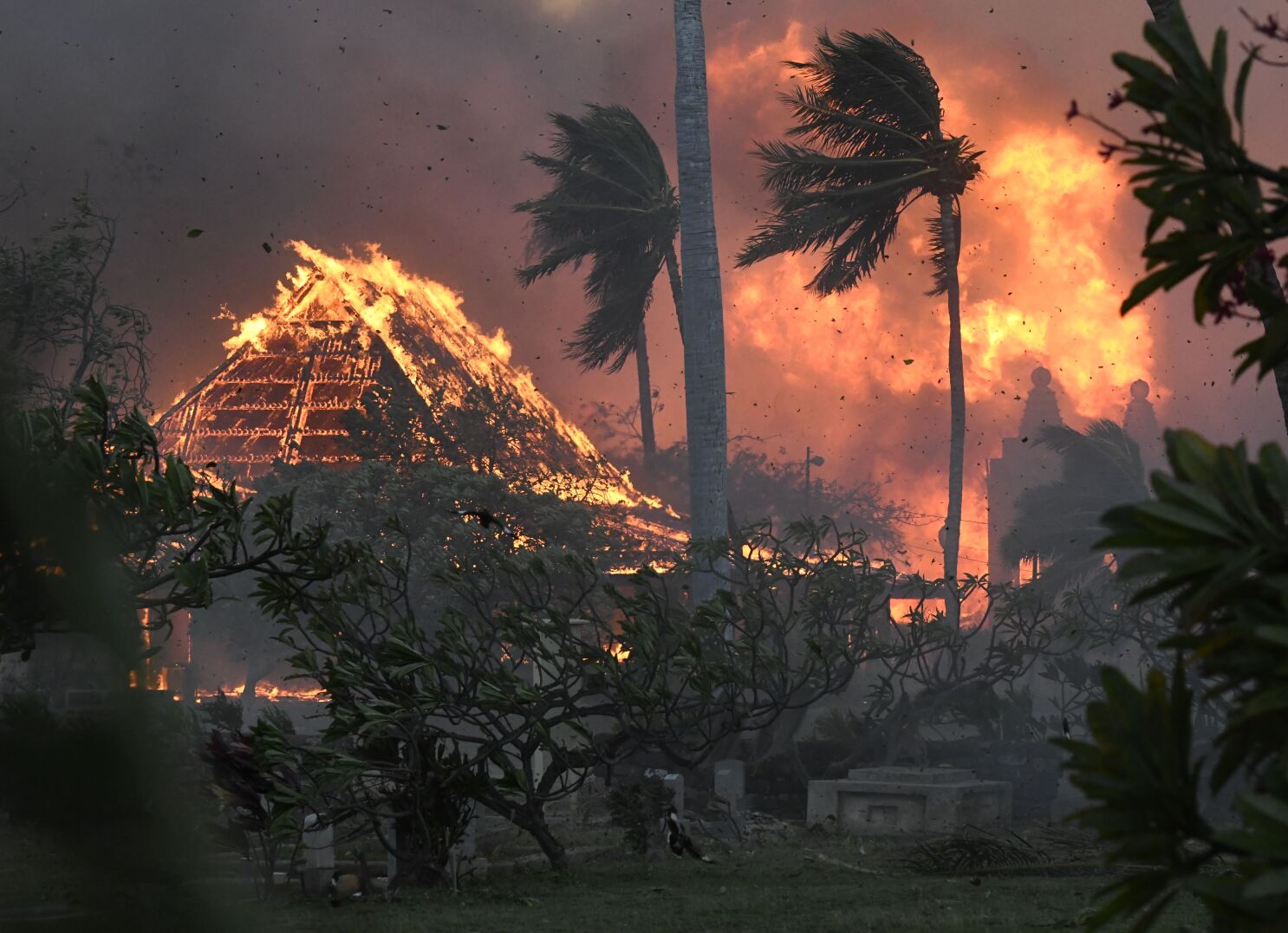
The hall of historic Waiola Church in Lahaina and nearby Lahaina Hongwanji Mission are engulfed in flames along Wainee Street on Tuesday, Aug. 8, 2023, in Lahaina, Hawaii. (Matthew Thayer/The Maui News via AP)

Update — Climate change’s influence on wind and water flow forces caused more severe damage and deaths. The Maui wildfire of August 2023 is an example. What would have been a fairly routine wildfire was fanned out-of-control by hurricane force winds. One headline read, “Maui fires: Hawaii blazes fanned by Hurricane Dora”. Another headline read, “Hawaii wildfires kill as ‘apocalypse’ hits Maui island”. The New York Times reported, “Gov. Josh Green of Hawaii said on Thursday that the devastating wildfires that swept through western Maui and killed at least 55 people, and possibly many more, were ‘likely the largest natural disaster in Hawaii state history.'”

Both wind and water flow forces contributed to the devastation. Hurricane Dora was at least 500 miles from Hawaii yet the wind forces impacted the fire in Maui. The winds were so strong that before the fire reached Lahaina extremely hot air blew over the town. The streets were so hot they burnt people’s feet trying to flee. The surface of everything became hot. Even after people jumped into the ocean, they said the debris in the water was too hot to float on. Almost all the boats in the harbor burned.

The blast of hot air over Lahaina created the conditions for a flashpoint. A flashpoint is the temperature at which a particular organic compound gives off sufficient vapor to ignite in air. The entire town ignited so quickly that warning sirens could not be activated and people did not have time to escape.

In an unexpected twist, water flow forces also contributed to the chaos. How could water flow add to the fire emergency conditions? When people fled the heat and fire, they jumped into the sea. ABC news reported: Shawn Dougherty, of Lahaina, was among the hundreds of residents forced to flee the resort city when the wildfire began engulfing their homes.

Like others, Dougherty said his only means of survival was to jump into the ocean with his girlfriend, but while some found safety in nearby jetties, the rocks and coral tore up Dougherty’s body.

“At one point, it seemed like I might drown,” he told ABC News. “I’m a good swimmer, but the water was just really rough because of the wind and the turbulence.”

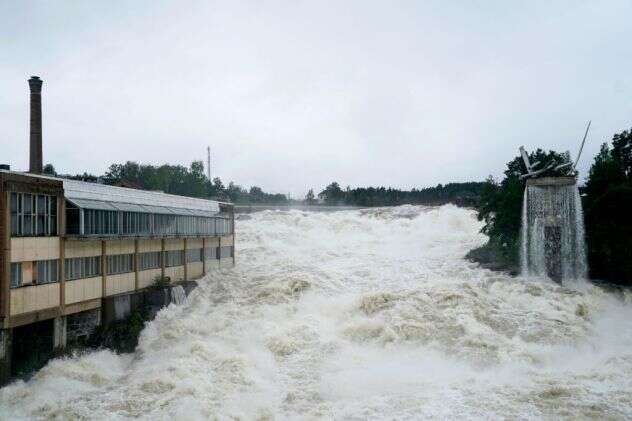
Norway Floods 2023

Also in August of 2023, climate change’s influence on water flow forces caused more severe damage and deaths. AccuWeather reported, “Dam bursts open as deadly flooding washes away homes in Norway. Torrents of water gushed through multiple towns across Norway and landslides cascaded down mountainsides after a deluge drenched Norway.”

4D Music: Songs About Science

A song about The Human Induced Climate Change Experiment

bookmark_borderThe Equation: Part II

(Verse 1)
In the whirlwind of change, we find our fate,
Force proportional, contemplate.
Density times velocity, squared in air,
The drag equation, tells us what’s there.

(Chorus)
Velocity squared, a powerful force,
In the wind water’s relentless course.
As climate shifts, and speeds increase,
The damage grows, without release.

(Verse 2)
A ten-mile breeze, seems gentle and mild,
But square that velocity, see it compiled.
Twenty miles an hour, brings four times the might,
And as it doubles, the force takes flight.

(Chorus)
Velocity squared, a powerful force,
In the wind and water’s relentless course.
As climate shifts, and speeds increase,
The damage grows, without release.

(Bridge)
Water denser than air, eight hundredfold,
The force of its flow, a story untold.
As rivers rage and oceans churn,
The drag equation, we must discern.

(Verse 3)
Floods and storms, they testify,
To the power of force, as they amplify.
Sewage systems crumble, hillsides succumb,
As velocity rises, the damage becomes numb…
Damn-age becomes numb

(Chorus)
Velocity squared, a powerful force,
In the wind and water’s relentless course.
As climate shifts, and speeds increase,
The damage grows, without release.

(Outro)
So heed the lesson, the drag equation’s call,
In the face of change, we must stand tall.
For as velocities rise, and forces collide,
The future’s in our hands, where hope resides.

Chords: F# E E D F# / F# D E F# / outro F# D C#7 F#
Instrumentation: Vocals, Takamine Acoustic Guitar, Percussion
Written and recorded at Lake Wynonah, Pennsylvania

ABOUT THE SCIENCE
ChatGBT co-authored the lyrics utilizing this part of a research paper:
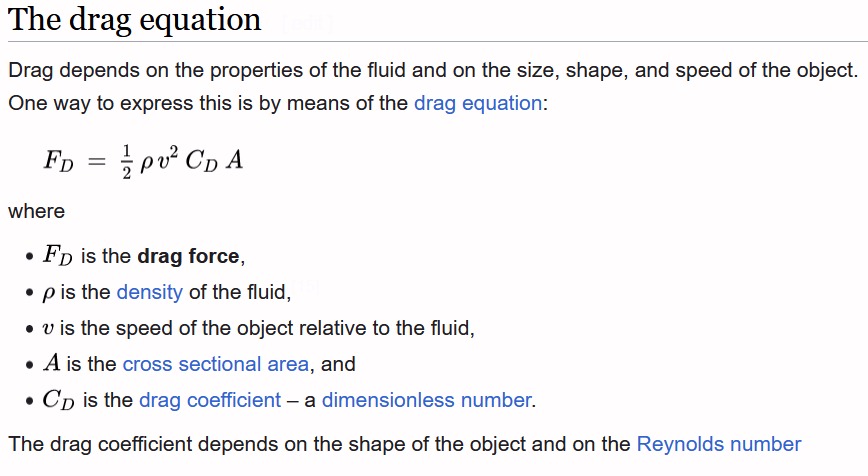
You will see that force is proportional to density times square of velocity (v^2)

The Drag Equation
So a twenty mile an hour wind exerts four times as much force as a ten mile an hour wind. And a forty mile an hour wind exerts sixteen times as much force as a ten mile an hour wind. A wind of fifty miles an hour exerts twenty five times and a wind of sixty miles an hour exerts thirty six times as much force as one of ten miles an hour. Then you have the density term. Water is about eight hundred times denser than air, So the force exerted by a ten mile an hour flow of water is eight hundred times that of a ten mile an hour wind. So as flow velocities go up due to climate change, force and damage scale as square of the velocities. What is not clear is how much these velocities increase with climate change. But in a sense we are seeing this already as, for example, flood and sewage systems succumb and hillsides fall down, and so on.

4D Music: Songs About Science

A song about The Human Induced Climate Change Experiment

bookmark_borderThe Equation: Part I

(Verse 1)
For decades now, I’ve been pondering,
The global warming formula, inside my mind wandering.
Human-induced change, an exponential part,
In an unordered system, chaos rules the chart.

(Chorus)
Acceleration, tipping points, feedback loops abound,
In this chaotic dance, our fate is found.
From the domino to the snowball’s roll,
In this whirlwind of change, we find our role.
In rock n’ roll
Find our role
Knock and know all

(Verse 2)
Complex equations, too vast to write,
But I’ll jot down a part, in the dimming light.
Tipping points and feedback loops, they steer the course,
Determining the rate, of climate’s force.
Of course,
Climate’s force
(Chorus)
Acceleration, tipping points, feedback loops abound,
In this chaotic dance, our fate is found.
From the domino to the snowball’s roll,
In this whirlwind of change, we find our role…

(Bridge)
Earth spins in a vortex, a cosmic whirl,
As we accelerate, our destiny unfurl.
The motion of time, in a turbulent sea,
Momentum’s impact, on you and me…
To be
Or not to be?
To be

(Verse 3)
Violent weather events, wreaking havoc’s might,
As momentum grows, in the dark of night.
Floods, storms, and hurricanes, they rage and spin,
As the planet’s pulse quickens, under chaos’ din.

(Chorus)
Acceleration, tipping points, feedback loops abound,
In this chaotic dance, our fate is found.
From the domino to the snowball’s roll,
In this whirlwind of change, we find our role.

(Outro)
So let’s ponder the equations, the theories, the fray,
In this spiral of change, let’s find a new way.
To slow down the momentum, without haste or fear,
For in this dance of chaos, our path becomes clear.

Chords: D C G D / C Em Am / D / D Db D / D Am / C Em Am / D / D C Am
Instrumentation: Vocals, Takamine Acoustic Guitar
Recorded at Lake Wynonah, Pennsylvania

THE SCIENCE
ChatGBT co-authored the lyrics utilizing this part of a research paper:

I’ve been thinking about the giant global warming formula that has been formulating in my head for the last few decades.

Human induced climate change is an exponential component of an unordered system (chaos theory). Our climate model uses chaos theory in an attempt to adequately account for humans and forecasts a global average temperature increase of 9 degrees Celsius above pre-industrial levels.

Though the equation is complex… too complicated to write down….
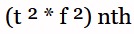
I’ve lately begun considering trying to write down a small part of it: Tipping points and feedback loops are parts of an equation that determine the rate of acceleration in climate change.

What do you think about this?
t = tipping point
f = feedback loop
(t ² * f ²) nth

or

the domino effect * the snowball effect:
(h cos α−(s+d)sin θi+1) * a(1 + r) x

Acceleration, tipping points etc. I know that no simple formula exists for any of these. The reason you can’t write a formula is because they are chaotic systems. Chaos theory is the study of unordered systems; however, trying to write it down helps me quantify what I see in my mind’s eye.

These formulas have similarities to acceleration formulas we imagined in 1995:

Abstract
Earth is in a space-time continuum similar to the vortex of a flushing toilet.

if acceleration = velocity/time
and v = speed of light = 2.9979*10^8 m/s
and for the sake of argument we are accelerating at pi (rounded to 15 decimal places) m/s^2
then time = 95426120.77903860 seconds (rounded to 16 significant digits)
= 1104.468990498130 days
= 3.025942439720910 years = roughly 3 years + 9.5 days as relative to the rotation and revolution of the planet earth.

Important note: this is motion at constant speed in a circle. So the speed of light isn’t changing but the direction of motion is, so there is acceleration (= change in velocity, not speed is the acceleration. Velocity has a direction as well as a magnitude, it is a vector, not a scalar like speed.)

a couple other fundamental physical constants to contemplate:
permitivity of free space = 8.854*10^(-12) C^2/(N*m)
permeability of free space = 4(pi)*10^(-7) Wb/(A*m)

SIDD: The tricky part is… you cannot maintain a constant acceleration like pi m/s^2 on a massive body.

In 2023 Sidd added:
On another note, regarding the permeability mu and permittivity epsilon
… those are deeply related to the speed of light thru maxwell’s equations
c=1/sqrt(mu*epsilon)

As for deep contemplation, let me see, in terms of formal schooling
I deeply contemplated those for two years in undergraduate
and about a year and a half in grad school … made my head very pointy.

Conclusion:

Human induced climate change is an exponential component of an unordered system (chaos theory). That means global warming is accelerating at a rapid rate in a complex way — a climate crisis.

Additional Notes

I ask Sidd:
… and what does the answer mean?
” 3.025942439720910 years = roughly 3 years + 9.5 days as relative to the rotation and revolution of the planet earth”

Is it the Earth’s rotation in the flow of the vortex?

Sidd replied:
The answer doesn’t mean very much… for example the speed we chose is c,
but nothing except light moves at speed c, and we know that neither earth nor
any material object can move or does move at speed c … so that answer
isn’t too useful

I think we just intended to show a calculation and people can plug in their own, hopefully more realistic numbers

Then, I recalled:
At the time we were working on a couple of concepts. One had to do with the momentum of humankind. The other had to do with the perception of time as environmental conditions deteriorate. (As 500 year floods become 100 year floods, then 100 year floods become 10 year floods, how will we perceive time? Will it be similar to a mass moving toward the center of a vortex?)

So yes… what you did was get me thinking about the rate of acceleration in global warming…
it’s kind-a like we are spiraling out-of-control faster and faster.. as if in a vortex… and…
how climate change is a vector (not a scalar like speed.)

… which got me thinking a lot more about the energy in the whole system moving around… not just as heat.

As an example, in the first 6 months of 2023 there were 15 confirmed weather/climate disaster events with losses exceeding $1 billion each to affect United States. These events included 1 flooding event, 13 severe storm events, and 1 winter storm event.

None of these events were directly related to heat. Almost all of the events were caused by violent weather. Momentum caused the most damage. (Also see: A Hard Rain Is Falling)

Which reminded me of what started us on this study… what we were working on at the time and still are…
*How to change the momentum of the human race and climate change without going any faster.*
…like a big ship heading for a waterfall…
and all the crew and engine working at full steam could not go any faster to reverse direction
So we created one of the first www games… this was/is the final anti-IQ pop quiz question:

“What are at least two (2) ways that you can increase your momentum, without increasing your speed?”
Hint: Momentum is equal to mass x velocity (p=mv).

Technically Speaking, It’s Not the Momentum That Kills You

It’s not the fall that kills you; it’s the sudden stop at the end.

Technically speaking it is the impact from the momentum that causes damage and deaths. Global warming causes an increase in mass and/or velocity (momentum) of things that are mass flow driven by heat, like wind and flood.

The burning of fossil fuels and other human released emissions have impacted momentum’s impact. A warmer atmosphere can hold more moisture. Warmer air allows for the creation of more massive raindrops. Warmer ocean temperatures create stronger hurricanes. Hail and tornadoes form in strong thunderstorm clouds with intense updrafts, high liquid-water content, and large water droplets.

Sidd added: It’s worse than that. Wind and water flow forces scale as the square of velocity, so as flow speeds increase (say due to more intense heating or heavier rain) the damage scales as the square of the velocity.

About “square of the velocity”, I asked Sidd: is this Bernoulli’s Equation?

4D Music: Songs About Science

A song about The Human Induced Climate Change Experiment

bookmark_borderA Tale of Intensification

LYRICS
In the East, where rivers flow in the sky,
Violent rains, historic floods pass by.
Canada’s hurricanes break records, so they say,
While Florida, Carolina, and South’s bill to pay.

(Chorus)
Atmospheric rivers, they twist and they bend,
From West to East, they shape our end,
Gaze as they dance, a meteorological blend,
Change our world, from beginning to end.

(Verse 2)
Traditionally, they whispered on the West’s breeze,
But now, the East feels their force with ease.
Meteorologists puzzled, but now they see the light,
As ARs carve their path, day and night.
(Chorus)
(Bridge)
NOAA nods, recognizing the trend,
PNA patterns, a message they send.
ARs in the East, not just a myth,
Their frequency rising, a climatic shift.

(Verse 3)
A tale of intensification, ARs amplify,
Affecting the northeast, where the sea meets the sky.
From Washington to Maine, the risks do grow,
As coastal lows brew, and nor’easters blow.
(Chorus)

(Outro)
Climate change, an urgent call,
ARs gaining strength, the sea levels tall.
We’re witnessing changes, too fast to comprehend,
As atmospheric rivers reshape, our world’s bend.

Chords: G# G F# / B D F# / F# B D / B E B / B F# D# F# B; Part II Rock Shuffle / Shuffle Rock @ 126 Beats Per Minute
Instrumentation: Vocals (TC-Helicon VOICELIVE and MiniNova Vocorder), Ibanez Acoustic Guitar (AW54CE), IKeyboards (Korg PS60, Casio WK-3500, Yamaha PSR-740, MiniNova, MicroKorg)

ABOUT THE SCIENCE & SONG
ChatGBT co-authored the lyrics using this section of our research paper:

The Eastern US is already seeing violent rain events as far inland as Kentucky with historic flooding in both 2022 and 2023. Eastern Canada has experienced its worst hurricanes on record. Florida, South Carolina, and North Carolina have suffered billions of dollars in storm damage. Homeowners insurance is becoming increasing difficult to obtain in Florida.

Traditionally, atmospheric rivers (AR) in the United States have been linked to the West Coast. However, there is now growing recognition of AR activity on the East Coast. “In reality, their frequency hasn’t necessarily increased. Meteorologists have been using the term for decades; it’s simply gained popularity in the media, much like the polar vortex,” explained Jeff Boyne, meteorologist and climatologist at the National Weather Service. Indeed, according to Jason Cordeira, associate professor of meteorology at Plymouth State University, “Atmospheric rivers are more common on the East Coast than on the West Coast, although they tend to be less impactful and produce lower rainfall amounts.”

In March 2024, NOAA and the National Weather Service finally recognized the heightened frequency of East Coast Atmospheric Rivers occurrences, attributing them primarily to the recent shifts in the Pacific/North America (PNA) teleconnection pattern. This shift is accompanied by a northward movement of the midlatitude jet stream. ARs in the Eastern US have received relatively little attention despite their frequent occurrence and significant impact on heavy precipitation and severe weather events. The authors conducted a comprehensive study on wintertime AR frequency over the Eastern US spanning four decades, utilizing multiple observations and a state-of-the-art high-resolution climate model (AM4) developed at GFDL. Their findings reveal a notable rise in AR frequency over the Eastern US during this timeframe. NOAA’s report reaffirmed these findings, emphasizing the confirmed linkages with the PNA pattern across diverse scenarios, highlighting the crucial role of the PNA pattern in influencing AR variability.

There is increasing research into the types and intensification of East Coast AR events. The US Fourth National Climate Assessment highlights a substantial increase in heavy precipitation events in the Northeast, particularly between 1958 and 2012, with ongoing projections indicating further rises in precipitation, notably during winter and spring and in northern areas of the region.

Many types of East Coast ARs are intensifying, likely as a result of climate change. A study titled “Identifying Eastern US Atmospheric River Types and Evaluating Historical Trends” notes, “The increased moisture transport could have significant implications across the northeast corridor from Washington D.C. to Coastal Maine, heightening the risk of extreme precipitation from landfalling ARs. The study reveals that most ARs in the region are induced by extratropical cyclones, with lee side low pressure systems and coastal lows along the Atlantic Coast (e.g., nor’easters) being responsible for generating the strongest ARs.”

Climate change is anticipated to bring complex and potentially substantial impacts to both the Atlantic Meridional Overturning Circulation (AMOC) and atmospheric rivers along the East Coast of the USA. The AMOC interacts with atmospheric circulation patterns, including the positioning of the jet stream. Changes in the AMOC can influence the behavior of the jet stream, which, in turn, affects the formation and path of atmospheric rivers. The jet stream plays a crucial role in steering weather systems and atmospheric rivers.

How Fast Are Atmospheric Rivers Gaining Frequency and Intensity?
While the rate of change in the intensity, duration, and likelihood of climate disasters varies depending on the type of extreme weather, insights from events like the Canada wildfires of 2023 offer valuable perspective. According to the World Weather Attribution Organization, “Climate change amplified the cumulative severity of Quebec’s 2023 fire season up to the end of July by approximately 50%, and seasons of this severity are now at least seven times more likely to occur.” Similar trends may be observed in other catastrophic events such as hurricanes, heatwaves, droughts, floods, tornadoes, sea level rise, and atmospheric rivers.

According to a NASA-led analysis, global average sea level rose by approximately 0.3 inches (0.76 centimeters) from 2022 to 2023. When our paper, “Climate Change: Rate of Acceleration,“ was authored in 2023, the swift acceleration of this trend was unforeseen. Initially projected to double over 100 years, the rate of sea level rise dramatically escalated, shortening the doubling period to just 10 years by 2020. Recent observations suggest a further compression of this doubling period to a mere 2 years, raising significant concerns. It is imperative to acknowledge and address this alarming trend, hoping it is not indicative of a new norm but rather an anomaly.

Some areas of the world are now warming so fast, it is becoming more difficult to measure the change from “normal” or average. Jeff Boyne of the NWS said, “There are climate normals that are updated every 10 to 15 years, because the planet is warming so fast. The ENSO (El Nino-Southern Oscillation) regions are warming so fast that those normals are being updated every 5 years.” “It’s so far outside anything we’ve seen, it’s almost mind-blowing,” says Walter Meier, who monitors sea-ice with the National Snow and Ice Data Center. “September was, in my professional opinion as a climate scientist, absolutely gobsmackingly bananas,” said Zeke Hausfather, at the Berkeley Earth climate data project.”

4D Music: Songs About Science

A song about The Human Induced Climate Change Experiment

bookmark_borderForest Green

LYRICS
(Verse 1)
As forest green fades from the scene,
Is it from the soil, beginning to spoil?
The naked eye can’t perceive,
The microbial community, retreating as we grieve.

(Chorus)
Desertification, soil degradation,
An explosion of erosion, washing hopes away.
Oh, the sheer severity, loss of biodiversity,
More vulnerability, from the primate climate.
Change, change
So strange
Climate change
So strange

(Verse 2)
In the breakdown, receding in feeding,
The breakdown’s breakdown, silently bleeding.
Each grain of soil tells a story untold,
Of ecosystems lost, and futures foretold.

(Chorus)
Desertification, soil degradation,
An explosion of erosion, washing hopes away.
Oh, the sheer severity, loss of biodiversity,
More vulnerability, from the primate climate.

(Bridge)
The earth beneath our feet, crumbling away,
As we pave the path, for our own dismay.
The cycle disrupted, nature’s song in discord,
Leaving us vulnerable, to the climate’s sword.
Oh, Lord!
Heard the word?
Absurd

(Verse 3)
With each loss, a ripple in time,
Echoes of the past, a warning sign.
Yet in the chaos, there’s still a chance,
To mend the soil, with our hands.

(Chorus)
Desertification, soil degradation,
An explosion of erosion, washing hopes away.
Oh, the sheer severity, loss of biodiversity,
More vulnerability, from the primate climate.

(Outro)
Let’s heed the call, before it’s too late,
Restore the soil, and alter our fate.
For in the earth’s embrace, lies the key,
To a future where life thrives, abundantly free.

Chords: Am FD C Am / Am Em AM / C B7 Em / Em G Em / Am G Em / Em C B7 Em / Am; Part II Hard Rock / Heavy Metal @ 122 Beats Per Minute
Instrumentation: Vocals (TC-Helicon VOICELIVE and MiniNova Vocorder), Ibanez Acoustic Guitar (AW54CE), Keyboards (Korg PS60, Casio WK-3500, Yamaha PSR-740, MiniNova, MicroKorg)

ABOUT THE SONG
This song serves as a poignant commentary on the devastating impact of climate change on soil health and biodiversity, urging listeners to recognize the urgent need for action and restoration.

(Verse 1)
The imagery of “forest green fades from the scene” captures the loss of lush ecosystems due to soil degradation, hinting at the root cause lying within the soil itself. The mention of the “microbial community” highlights the intricate web of life within the soil, now threatened and receding, leading to a sense of grief and loss.

(Chorus)
“Desertification, soil degradation” and “an explosion of erosion” paint a grim picture of the consequences of neglect and exploitation of the soil. The severity of these impacts is underscored by the “loss of biodiversity” and increased vulnerability stemming from the changing climate, emphasizing the interconnectedness of soil health and ecosystem resilience.

(Verse 2)
The metaphor of “the breakdown’s breakdown, silently bleeding” conveys the gradual but pervasive nature of soil degradation, with each component of the soil ecosystem suffering in turn. The “story untold” within each grain of soil symbolizes the rich history and potential future of ecosystems lost to degradation and neglect.

(Bridge)
The bridge serves as a sobering reflection on the consequences of human actions, as the earth beneath our feet crumbles away under the weight of exploitation and disregard. The disruption of the natural cycle and discord in “nature’s song” emphasize the urgent need for stewardship and restoration efforts.

(Verse 3)
Despite the bleakness of the situation, the song offers a glimmer of hope, highlighting the opportunity for redemption and renewal. Each loss serves as a reminder of the fragility of ecosystems and the importance of proactive measures to mend and restore the soil for future generations.

(Outro)
The outro carries a message of urgency and responsibility, urging listeners to heed the call to action before it’s too late. The key to a thriving future lies in restoring and nurturing the soil, paving the way for a world where life can flourish abundantly once again.

ABOUT THE SCIENCE
Soil plays a crucial role in climate change mitigation and adaptation, and soil degradation can contribute to the process of desertification. Here’s why soil is integral to climate change and how soil degradation can lead to desertification:

Importance of Soil in Climate Change:

  1. Carbon Sequestration:
    • Healthy soils act as a significant carbon sink, storing large amounts of carbon in the form of organic matter. This process, known as carbon sequestration, helps mitigate climate change by reducing the concentration of greenhouse gases, particularly carbon dioxide (CO2), in the atmosphere.
  2. Water Regulation:
    • Soil influences water availability and regulates the water cycle. Healthy soils absorb and store water, reducing the risk of floods and contributing to moisture availability during dry periods. This capacity for water regulation is crucial for climate resilience.
  3. Biodiversity Support:
    • Healthy soils provide habitat and support for a diverse range of organisms, including bacteria, fungi, insects, and plant roots. Biodiversity in the soil contributes to ecosystem stability, resilience, and adaptation to changing environmental conditions.
  4. Nutrient Cycling:
    • Soil is essential for nutrient cycling, as it hosts microbial communities that break down organic matter and make nutrients available to plants. This nutrient cycling supports plant growth and contributes to overall ecosystem health.

Soil Degradation and Desertification:

  1. Erosion:
    • Soil degradation, often caused by factors like deforestation, overgrazing, and unsustainable agricultural practices, can lead to increased soil erosion. Erosion removes the topsoil layer, which is rich in organic matter and nutrients, reducing the soil’s fertility and water retention capacity.
  2. Loss of Soil Structure:
    • Poor land management practices, such as excessive plowing, deforestation, and improper irrigation, can lead to the loss of soil structure. This makes the soil more susceptible to erosion, reduces water infiltration, and hinders the growth of vegetation.
  3. Decreased Carbon Sequestration:
    • Soil degradation results in the loss of organic matter, reducing the soil’s ability to sequester carbon. This can contribute to increased atmospheric CO2 levels, exacerbating the greenhouse effect and climate change.
  4. Loss of Biodiversity:
    • Degraded soils often experience a decline in microbial and plant diversity. This loss of biodiversity weakens the soil’s resilience to environmental stresses and reduces its capacity to support healthy ecosystems.
  5. Increased Vulnerability to Climate Change:
    • Degraded soils are more vulnerable to the impacts of climate change, such as extreme weather events, droughts, and temperature variations. This vulnerability can create a feedback loop, where climate change further exacerbates soil degradation.
  6. Desertification:
    • Desertification is the process by which fertile land becomes increasingly arid and unproductive, eventually turning into desert-like conditions. Soil degradation, through erosion, loss of organic matter, and reduced water retention, is a key driver of desertification.
  7. Impact on Livelihoods:
    • Desertification poses a threat to agricultural productivity, water resources, and local livelihoods. It can lead to the displacement of communities and exacerbate social and economic challenges, contributing to a cycle of poverty and environmental degradation.

Addressing soil degradation is crucial for sustainable land management, climate change mitigation, and the prevention of desertification. Implementing conservation practices, agroforestry, reforestation, and sustainable agriculture techniques can help restore and protect soils, contributing to climate resilience and biodiversity conservation.

Create a sustainable and climate-resilient environment in and around your home and prevent soil degradation.
Protect Your Home: Violent Rain and Stormwater Runoff
Flood Insurance
Climate Change: What Can I Do?

Tree Extinction Due to Human Induced Environmental Stress

Chaos Theory and Climate Systems

Climate Change: Rate of Acceleration

The Human Induced Climate Change Experiment

bookmark_borderNine Dominoes (Know No-No’s)

LYRICS
(Verse 1)
Under the guise of needy thirst
We lined them up, unaware of the worst
Greenland’s ice sheet, once mighty and tall
Collapsed under pressure, the first to fall

(Chorus)
Nine dominoes, each one a plight
As they topple down, into the night
From polar ice to forest green
The Domino Effect, a sight unseen
Dominoes know no-no’s
Dominoes

(Verse 2)
West Antarctica, with a deafening sound
Followed suit, as the ice crumbled down
Labrador-Irminger in demise
Convection collapsed, under warming skies

(Chorus)
Nine dominoes, each one a plight
As they topple down, into the night
From polar ice to forest green
The Domino Effect, a sight unseen
Dominoes know no-no’s
Dominoes

(Bridge)
East Antarctic Subglacial Basins, hidden deep below
Their collapse adds to the relentless flow
Arctic winter sea ice, once thick and vast
Now collapses lapses, lost to the past

(Verse 3)
East Antarctic Ice Sheet, once thought secure
Now joins the ranks of those no longer pure
Amazon Rainforest, lungs of the Earth
Dies back in silence, its value of worth

(Chorus)
Nine dominoes, each one a plight
As they topple down, into the night
From polar ice to forest green
The Domino Effect, a sight unseen
Dominoes know no-no’s
Dominoes

(Outro)
Boreal permafrost, locked in icy embrace
Now melts away, leaving barren space
Atlantic Meridional Overturning Circulation
The final blow, you know domino
As it collapses, the Domino Effect, we know

(Chorus)
Nine dominoes, each one a plight
As they topple down, into the night
From polar ice to forest green
The Domino Effect, a sight unseen.
Dominoes know no-no’s
Dominoes

Chords: F Bb / F / Ab Eb Bb / Ab Eb Bb F / Db F / Db C7 / F
Instrumentation: Vocals, Takamine Acoustic Guitar, Kurzweil Electric Piano, Percussion
Written and recorded at Lake Wynonah, Pennsylvania

ABOUT THE SCIENCE
Tipping points are Critical Milestones that directly impact the rate of acceleration in climate change by multiplying the number and intensity of feedback loops. Identifying and understanding these tipping points is crucial for climate science and policymaking. Crossing multiple tipping points could lead to a domino effect, resulting in a much more rapid and severe climate change than currently projected.

A look at nine (9) of the multiple tipping points that are in play during 2024. The first dominoes have fallen and will continue to knock down more tiles with each escalating step. The crossing of these nine climate tipping points represents a critical threshold in the Earth’s climate system, with potentially irreversible consequences for global ecosystems and human societies:

  1. Greenland Ice Sheet Collapse: The melting of the Greenland Ice Sheet has accelerated in recent years, leading to increased rates of ice loss and sea level rise. As glaciers retreat and ice shelves collapse, vast quantities of freshwater enter the ocean, disrupting marine ecosystems and contributing to global sea level rise.
  2. West Antarctic Ice Sheet Collapse: Similar to Greenland, the West Antarctic Ice Sheet is experiencing rapid melting and destabilization. The collapse of this ice sheet has the potential to raise sea levels by several meters, inundating coastal areas and triggering widespread impacts on infrastructure, agriculture, and human populations.
  3. Labrador-Irminger Seas/SPG Convection Collapse: The collapse of convection in the Labrador-Irminger Seas, part of the North Atlantic Ocean, could disrupt the Atlantic Meridional Overturning Circulation (AMOC). This circulation pattern plays a crucial role in regulating global climate and ocean circulation, influencing weather patterns and heat distribution worldwide.
  4. East Antarctic Subglacial Basins Collapse: The East Antarctic Ice Sheet contains vast quantities of ice, much of which is grounded below sea level. The collapse of subglacial basins in East Antarctica could lead to rapid ice loss and contribute to sea level rise, with potentially far-reaching consequences for coastal regions and global climate stability.
  5. Arctic Winter Sea Ice Collapse: Arctic sea ice has been declining rapidly in extent and thickness due to rising temperatures. The loss of winter sea ice in the Arctic not only accelerates regional warming but also affects global weather patterns, ocean circulation, and biodiversity in the Arctic ecosystem.
  6. East Antarctic Ice Sheet Collapse: While traditionally considered more stable than its western counterpart, the East Antarctic Ice Sheet is also vulnerable to collapse under continued warming. The disintegration of ice shelves and glaciers in East Antarctica could significantly contribute to sea level rise and alter ocean circulation patterns.
  7. Amazon Rainforest Dieback: Deforestation, drought, and climate change threaten the resilience of the Amazon Rainforest, the world’s largest tropical rainforest. The dieback of the Amazon could result in decreased rainfall, increased carbon emissions, and loss of biodiversity, impacting regional and global climate systems.
  8. Boreal Permafrost Collapse: Permafrost in the northern regions of the globe contains vast stores of carbon in the form of frozen organic matter. As permafrost thaws due to rising temperatures, it releases greenhouse gases such as methane and carbon dioxide, further exacerbating climate change and creating a feedback loop of increased warming.
  9. Atlantic Meridional Overturning Circulation Collapse: The collapse of the AMOC, driven by changes in ocean temperature and salinity, could have profound consequences for global climate stability. Disruption of this circulation pattern could lead to abrupt shifts in weather patterns, including changes in temperature, precipitation, and ocean currents, with far-reaching impacts on ecosystems and human societies.

The crossing of these tipping points underscores the urgent need for decisive action to mitigate climate change and adapt to its impacts. Without concerted efforts to reduce greenhouse gas emissions and protect vulnerable ecosystems, the consequences of these tipping points could pose significant challenges to the well-being of present and future generations.

4D Music: Songs About Science

A song about The Human Induced Climate Change Experiment

bookmark_borderUntil the Dawn

LYRICS
(Verse 1)
Autumn whispers of a world unbound,
Where ice sheets crumble, no solace found.
Greenland’s tears, West Antarctica’s cries,
As melting shores meet relentless skies.

(Chorus)
What will become of our habitat’s plight?
As boiling tides rise, eclipsing the night.
Violent rain pounds, carving new streams,
As Earth’s fever rises, in feverish dreams.

(Verse 2)
Copernicus speaks of mind-bending heat,
As nations tremble, beneath nature’s beat.
Assets crumble, harvests fade away,
In the relentless heat of a changing day.
(Chorus)
(Bridge)
A 1.5-degree leap, a world ablaze,
Urgency screams, in a desperate haze. (World ablaze)
As violent rain reigns, across the land, (Understand?)
The future’s cast by an unforgiving hand. (ComprehEND?)

(Verse 3)
Hillsides crumble, shorelines drown in dread,
As violent rain reigns, upon our heads.
Deserts flood, in defiance of sky,
As the world grapples with a climactic goodbye.
(Chorus)
(Outro)
In the wake of chaos, and uncertainty’s stare,
We must unite, in a world laid bare.
As the seas rise, and the storms rage on,
We’ll face the challenges, until the dawn.

Chords: Em Am / Em Am C B7 Em / C D Em / D Em Em/9; Part II Heavy Metal / Rock Ballad @ 116 Beats Per Minute
Instrumentation: Vocals (TC-Helicon VOICELIVE and MiniNova Vocorder), Ibanez Acoustic Guitar (AW54CE), Ibanez Electric RG-270 (Vox ToneLab and Boss Digital Delay), Fender Jazz Bass (Boss Digital Delay), Keyboards (Korg PS60, Casio WK-3500, Yamaha PSR-740, MiniNova, MicroKorg)

ABOUT THE SONG
The above lyrics are a collaboration with ChatGBT. The song was composed using the information under “ABOUT THE SCIENCE” that was written by Daniel Brouse and Sidd Mukherjee.

ABOUT THE SCIENCE
By the Autumn of 2023, it had become evident the West Antarctic and Greenland ice sheets will completely melt. The process is irreversible and inevitable. What can Earthlings expect to happen to their habitat?

The most rapid sea level rise.

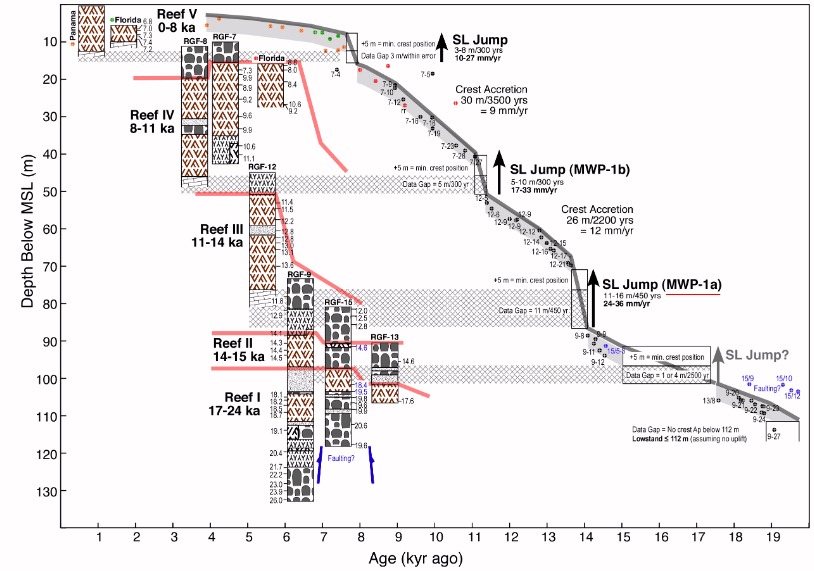
In The Reign of Violent Rain, Sidd said, “Now I am thinking the violent rain will be a bigger problem before we die… still thinking it through. In the long run, yes, sea level rise will hit big. If you look at the history, it is episodic, and in the fast bits it can go up 3 feet every twenty years for five hundred years (See MWP-1A in fig. 3, supplement). But, the rain intensity is increasing faster today, and drainage cannot cope, whether in the city or out, culverts and such put in over the last hundred years cannot handle. So, I am paying a lot of attention to terrain and drainage far inland from the seacoast (like Ohio.)

In the paper, Sea level and global ice volumes from the Last Glacial Maximum to the Holocene, Kurt Lambeck states, “The major cause of sea-level change during ice ages is the exchange of water between ice and ocean and the planet’s dynamic response to the changing surface load.”

On November 20, 2023, the UN’s Emission Gap Report found even if countries carried out their current emissions-reduction pledges, the world would likely continuously exceed +3C degrees of warming this century. Later that day, the International Cryosphere Climate Initiative released State of the Cryosphere Report 2023 saying, “Two degrees is too high. Our message — the message of the Cryosphere — is that this insanity cannot and must not continue. The melting point of ice pays no attention to rhetoric, only to our actions.”

What does this mean about our current human induced climate change?
1) We should expect to see rising sea levels.
2) Approximately half of the current sea level rise is due to thermal expansion. As water gets warmer, it expands. NASA says, “About half of the measured global sea level rise on Earth is from warming waters and thermal expansion.”
3) There is a very complex set of climate systems impacted by sea level rise. The shape of the Earth is changing and speeding up as ice from the poles melts and is drawn toward the equator through centrifugal and gravitational forces, as well as, glacial isostatic adjustment. A study published in Geophysical Research Letters of the American Geophysical Union suggests that global warming has led to significant melting of glaciers due to which our planet’s axis of rotation has been moving faster since the 1990s.

All of this has a great impact on our weather. The rain intensity is increasing faster today than ever known. The cool water from the melting ice at the poles is being drawn toward the center of the Earth and getting warmed to record high temperatures. The warm, moist air is circulating and moving over land. These changes in climate systems will cause other areas to experience unprecedented drought. The Amazon River and the Panama Canal recorded their lowest water levels on record during 2023.

What do we expect to happen?
The Long Run
Long run sea level rise New Jersey Coast

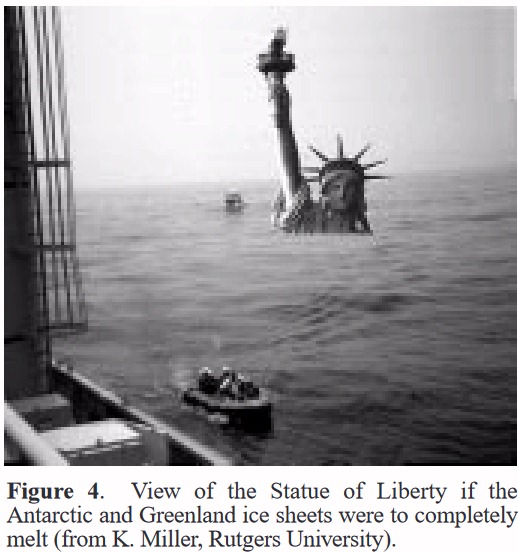
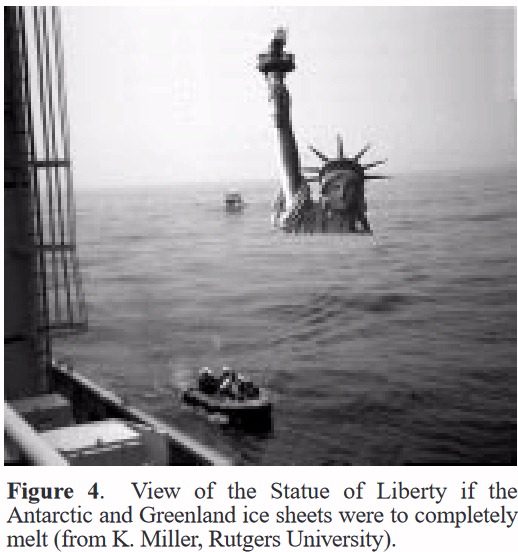
We expect sea level rise will total about 270 feet over the next several millennia. In 1998, the State of New Jersey published Sea Level Rise in New Jersey with a depiction of the Statue of Liberty with 270 feet in sea level rise.

In the last melting of the glacial maximum, the first 500 years saw a “pulse” of high rate sea level rise of about 500 years duration resulting in about a 66 foot rise in sea levels.

A high rate of sea-level rise starting at ∼14.5 ka BP of ∼500 y duration. The onset occurs at the start of the Bølling−Allerød warm period. Its duration could be <500 y because of uncertainties in chronology, and the globally averaged rise in sea level of ∼20 m occurs at a rate of ∼40 mm⋅y−1 or greater. This pulse, MWP-1A, has been identified separately in the records of Barbados, Sunda , and Tahiti. Spatial variation in its amplitude can be expected because of the planet’s elastic and gravitational response to rapid unloading of ice in either or both of the two hemispheres with, based on the ice−earth models used here, model-predicted values ranging from ∼14 m for Barbados to ∼20 m for Tahiti. This compares with observational values of ∼15–20 m for Barbados and 12–22 m for Tahiti. Observational uncertainties remain large, including differences in the timing of this event as recorded at the different localities, and it is not possible from this evidence to ascertain the relative importance of the contribution of the two hemispheres to MWP-1A.

We expect to see a similar pattern in the long run.

Our estimate of 270 feet is based on “the safe” elevation to live — high-tides, waves, coastal flooding, storm surge, grade of shoreline, etc. would make the lowest elevations for living space to be at least 270 feet above pre-industrial sea levels. This would be the minimum elevation. Personally, I would not want to live that low. As the water submerges sewage treatment plants, landfills, chickens, cows, and all sorts of other bio-hazards, the waters will become toxic. In addition, much of the land will experience salinization making it unfit for plant life. Another concern for elevations under 800 feet is living on an island. Many locations at lower elevations will become isolated. Living on an island has many problems including fresh water, food, shelter, and healthcare. Security from pirates pilfering, raping, and plundering will likely be the overriding concern. Of course, I don’t expect that to happen for millennia, but I hope government planners do plan for it now. If you look at Florida as an example, parts of the coastline have seen sea levels rise over 14-20 feet in the last decade. Although the storm surge was only for hours, you wouldn’t want to live there during those hours. Not to mention, the frequency of these extreme weather events will rise exponentially. Thus, our recommendation to evacuate Florida now (i.e. Managed Retreat). The billions of dollars spent to rebuild after Hurricane Ida will all be for naught. Allowing building there will needlessly endanger property and lives. Parts of the world have already seen storm surges of 40 feet. I expect most North American coastlines will see sea levels rise, if only temporarily, by 20-40 feet this century. As far as long run sea level rise, much will depend on location, gravity, isostatic adjustment, and thermal expansion. If the ocean temperatures get warm enough (thermal expansion), parts of the world may see sea levels rise to 270 feet for long periods of times. Other parts of the world, like Greenland, may actually see sea levels decline. In any event, the Earth crossed tipping points this decade which make extreme sea level rise inevitable and irreversible in our lifetimes. Planners should plan on it.

Sidd reiterated, “That 270 feet will take a long time. I would be more careful about the violent rain than the ice melt.”

INTERPRETATION OF SCIENCE AND SONG
This song paints a vivid picture of the devastating effects of climate change, using powerful imagery and emotive language to convey the urgency of the crisis.

In the opening verse, the imagery of autumn whispers and crumbling ice sheets sets the tone for a world in turmoil. The tears of Greenland and West Antarctica symbolize the profound grief of the natural world as it faces destruction at the hands of humanity.

The chorus poses a haunting question about the fate of our habitat, as boiling tides rise and violent rain carves new streams. The repetition of “Earth’s fever rises” emphasizes the escalating nature of the crisis and the urgent need for action.

Verse 2 introduces the scientific perspective, with references to Copernicus and the mind-bending heat felt around the world. The imagery of crumbling assets and fading harvests highlights the real-world consequences of climate change on communities and economies.

The bridge amplifies the sense of urgency, describing a world ablaze with a 1.5-degree leap in temperature. The imagery of violent rain reigning across the land underscores the destructive power of extreme weather events driven by climate change.

Verse 3 continues the theme of destruction, with hillsides crumbling and shorelines drowning under the onslaught of violent rain. The defiance of deserts flooding speaks to the unpredictability and chaos unleashed by climate change.

The outro leaves listeners with a sense of determination in the face of uncertainty, urging unity in the face of the challenges ahead. The imagery of rising seas and raging storms underscores the magnitude of the crisis, while also hinting at the resilience of humanity in the face of adversity.

Overall, this song serves as a powerful reminder of the urgent need for action on climate change, drawing on both scientific knowledge and emotive storytelling to convey the gravity of the situation.

4D Music: Songs About Science

A song about The Human Induced Climate Change Experiment

bookmark_borderRaindrops on the Window

LYRICS
Verse 1
Raindrops on the window
Make me wonder
Will Mother be a widow
As men rape and plunder

Chorus:
Teardrops from the sky
Asking why
Watching her children cry
Cry, Mother, cry

Verse 2
Rain upon the windowpane
Reflecting on the pain
Mother’s distress, can’t contain
Life’s value, what’s to gain?
(Chorus)

Bridge:
Raindrops on the window
Prompt me to ponder
From extreme wet to extreme dry
Will we sink, will we fry?
Cry, Mother, cry

Verse 3
Rain on the rooftop’s beat
Growing in repeat
Mother, halt this endless feat
Intensifying with each heartbeat
(Chorus)
Outro:
Raindrops on the window
Lead me to reflect
Will we come to comprehend
Tipping points’ effect?
… or… Cry, Mother, cry?

Chords: C D G / G F#m Em / Em F#m G / C Em / C B7 Em; Part II Ambient / Rock Ballad @ 66 Beats Per Minute
Instrumentation: Vocals (TC-Helicon VOICELIVE and MiniNova Vocorder), Ibanez Acoustic Guitar (AW54CE), Keyboards (Korg PS60, Casio WK-3500, Yamaha PSR-740, MiniNova, MicroKorg)

ABOUT THE SONG
This song serves as a poignant commentary on the devastating impact of climate change, portraying the Earth as a grieving mother witnessing the destruction wrought by humanity’s actions.

In the opening verse, raindrops on the window symbolize the tears of Mother Earth as she contemplates the uncertain fate of her inhabitants. The imagery of Mother potentially becoming a widow highlights the threat posed by human exploitation and disregard for the environment.

The chorus reinforces the theme of sorrow and despair, as the Earth’s tears fall from the sky and her children suffer. It evokes a sense of helplessness in the face of escalating climate crisis.

Verse 2 delves deeper into the emotional turmoil experienced by Mother Earth, as she reflects on the pain caused by human greed and exploitation. The questioning of life’s value underscores the destructive consequences of prioritizing profit over the well-being of the planet.

The bridge prompts introspection and contemplation, as raindrops on the window lead the narrator to ponder the extremes of climate change and the potential catastrophic outcomes for humanity.

Verse 3 continues the metaphor of rain as a reflection of Mother Earth’s distress, emphasizing the intensifying impact of climate change with each passing moment. The urgent plea for Mother to halt this destruction highlights the need for immediate action to mitigate the effects of climate change.

The outro leaves listeners with a sense of introspection and uncertainty, as raindrops on the window prompt reflection on humanity’s role in exacerbating the climate crisis and the need to comprehend the tipping points that could lead to irreversible damage.

Overall, this song serves as a powerful call to action, urging listeners to acknowledge the profound impact of climate change and take responsibility for preserving the planet for future generations.

ABOUT THE SCIENCE
Human induced climate change is an exponential component of an unordered system (chaos theory). That means global warming is accelerating at a rapid rate in a complex way.

“We are not saying that the Earth’s temperature is just going to rise. In general, as energy is added to a system, the fluctuations in the system increase. So, we expect more storms, more droughts, more wildfires, more floods, more fluctuations of all kinds. What we are saying is that weather conditions will become more volatile due to the impact of humans,” said Mukherjee and Brouse. (2004)

Climate change is primarily driven by the escalation of thermal energy affecting biogeophysical and socio-economic systems. While biogeophysical factors can be studied using math, physics, and historical records, socio-economic systems pose greater challenges due to the unpredictable consequences of human behavior and inexplicable consumer choices, exacerbating tipping points and feedback loops.

The Age of Loss and Damage is a new way of thinking about economics by combining economics, climate science, statistics, and physics. Until now, economic models have been unfit to capture the full extent of climate damage. Traditionally, “integrated assessment models” (IAMs) were used to forecast “shock” events. IAMs use “quadratic function” to calculate GDP losses by squaring the temperature change, yet ignore other methods (such as the exponential function) that are better suited for rapid change. “Climate change is fundamentally different to other shocks because once it has hit, it doesn’t go away,” said Thierry Philipponnat, author of a report by Finance Watch, a Brussels-based public interest NGO on financial issues. “And if the fundamental assumption is flawed, all the rest makes little sense — if any.”

Unfortunately, even scientists are failing to see, let alone forecast, the rapid acceleration in climate change. Due to their complexity, the impacts of the Domino Effect are being underestimated. The Domino Effect is also known as “tipping cascades” in climate science. Cascading impacts in relation to tipping points include cascading impacts across biogeophysical and social systems. Until recently, scientist have been drastically underestimating the social-ecological systems. The University of Exeter reports, “There is a notable lack of topic clusters dedicated to how humans will be impacted by climate-related tipping cascades.” 2023 was a wake-up call to social-ecological scientists. The record breaking physical and economical impacts could be felt worldwide. The record warming year was seventeen times greater than any other record increase in history. Typically, record-breaking temperatures are measured in 100th degrees. There were also 200 consecutive days of record-breaking temperatures. Usually, there are one or two record breaking days in a row. The increase in intensity and frequency of record-breaking heat requires forecasting models to be recast.

As flow velocities go up due to climate change, force and damage scale as square of the velocities.

How Do Pollution and Climate Change Kill People?

Pollution and climate change can have severe health impacts, leading to the loss of lives through various direct and indirect mechanisms. An overview of how pollution and climate change contribute to adverse health outcomes:

Pollution:

  1. Air Pollution:
    • Respiratory Issues: Inhalation of air pollutants, such as particulate matter (PM), nitrogen dioxide (NO2), sulfur dioxide (SO2), and ozone (O3), can cause or exacerbate respiratory conditions like asthma, bronchitis, and chronic obstructive pulmonary disease (COPD).
    • Cardiovascular Effects: Air pollution is linked to cardiovascular diseases, including heart attacks and strokes. Fine particulate matter can enter the bloodstream, affecting the cardiovascular system.
  2. Water Pollution:
    • Waterborne Diseases: Contaminated water sources can harbor pathogens, leading to waterborne diseases like cholera, dysentery, and gastrointestinal infections.
    • Chemical Exposure: Industrial pollutants, agricultural runoff, and untreated sewage can introduce harmful chemicals into water supplies, posing long-term health risks.
  3. Soil Pollution:
    • Food Contamination: Polluted soil can lead to the contamination of crops with heavy metals, pesticides, and other harmful substances. Consuming contaminated food can result in health issues, including neurological problems and cancer.
  4. Noise Pollution:
    • Stress and Mental Health: Chronic exposure to high levels of noise can contribute to stress, anxiety, and sleep disturbances. Long-term stress can impact mental health and, indirectly, physical well-being.

Climate Change:

  1. Extreme Heat:
    • Heat-Related Illnesses: Increasing temperatures, especially during heatwaves, can cause heat-related illnesses such as heat exhaustion and heatstroke, leading to organ failure and death.
  2. Extreme Weather Events:
    • Injuries and Fatalities: Hurricanes, floods, wildfires, and other extreme weather events associated with climate change can cause injuries and fatalities directly. These events may also displace populations, leading to increased vulnerability.
  3. Vector-Borne and Infectious Diseases:
    • Changing Disease Patterns: Climate change can alter the distribution and prevalence of vector-borne diseases like malaria, dengue, and Lyme disease. These diseases can lead to severe health complications and death. Climate change can influence the geographic range and seasonality of infectious diseases, potentially leading to the emergence of new health threats. “The magnitude of the vulnerability when you think about one or two diseases — okay, sure, we can deal with that,” professor Camilo Mora said. “But when you’re talking about 58% of the diseases, and 58% of those diseases can be affected or triggered in 1,000 different ways. So that, to me, was also revealing of the fact that we’re not going to be able to adapt to climate change.”
  4. Air Quality Impacts:
    • Worsening Respiratory Conditions: Changes in climate patterns can affect air quality, contributing to increased respiratory issues and exacerbating existing health conditions.
  5. Food and Water Scarcity:
    • Malnutrition and Dehydration: Climate change can impact agricultural productivity and water availability. This may lead to food and water scarcity, causing malnutrition, dehydration, and related health problems.
  6. Mental Health Impact:
    • Psychological Stress: The environmental changes and uncertainties associated with climate change can contribute to mental health issues, including anxiety, depression, and post-traumatic stress disorder (PTSD). Almost all survivors of climate-related disasters suffer from mental distress experiencing PTSD. Of those who have not experienced climate disasters, over two-thirds of U.S. adults (68%) report having climate change anxiety.

It’s important to note that vulnerable populations, such as the elderly, children, and those with pre-existing health conditions, are often disproportionately affected by the health impacts of pollution and climate change. Additionally, global efforts to mitigate these impacts and transition to more sustainable practices are crucial for protecting human health and well-being.

* Our climate model employs chaos theory to comprehensively consider human impacts and projects a potential global average temperature increase of 9℃ above pre-industrial levels.

What Can I Do?
There are numerous actions you can take to contribute to saving the planet. Each person bears the responsibility to minimize pollution, discontinue the use of fossil fuels, reduce consumption, and foster a culture of love and care. Be a butterfly and affect the world. The Butterfly Effect illustrates that a small change in one area can lead to significant alterations in conditions anywhere on the globe. Hence, the frequently heard statement that a butterfly in China can cause a hurricane in the Atlantic.
Here is a list of additional actions you can take.

4D Music: Songs About Science

A song about The Human Induced Climate Change Experiment

bookmark_borderUrgency Screams!

LYRICS
(Verse 1)
The era of warming ends, boiling tides arise,
The UN’s warning, spoken with sighs.
Global temperatures soaring, records fall,
As climate change’s grip tightens, on us all.

(Chorus)
What will the “End of Times” look like?
As feedback loops spin, tipping points strike.
Plants fade, carbon sinks vanish from sight,
As Earth’s fever rises, into the night.

(Verse 2)
Copernicus speaks of mind-blowing heat,
September’s record shattered, under our feet.
Assets crumble, harvests wither away,
As we face the truth of our reckless play.
(Chorus)
(Bridge)
A 1.5-degree leap, in Earth’s embrace,
Urgency screams, in every race.
Violent rain pounds, carving new streams,
As landscapes shift, in chaotic dreams.

(Verse 3)
Hillsides crumble, shorelines disappear,
As the reign of violent rain draws near.
Deserts flood, as if to defy,
Even there, climate’s relentless cry.
(Chorus)
(Outro)
In this world of chaos, and despair,
Survival’s grip, hangs in the air.
As we face a future, uncertain and dire,
We must unite, before the fire.
Aspire higher!
What will the “End of Times” look like?
Aspire higher!

Chords: Em G D Em / Em C B7 Em / Em/7/7(11) jam / Em G C Em; Part II Hard Rock / Digi-Rock @ 120 Beats Per Minute
Instrumentation: Vocals (TC-Helicon VOICELIVE and MiniNova Vocorder), Ibanez Acoustic Guitar (AW54CE), Ibanez Electric RG-270 (Vox ToneLab and Boss Digital Delay), Fender Jazz Bass (Boss Digital Delay), Keyboards (Korg PS60, Casio WK-3500, Yamaha PSR-740, MiniNova, MicroKorg)

ABOUT THE SONG
The above lyrics are a collaboration with ChatGBT. The song was composed using the information under “ABOUT THE SCIENCE” that was written by Daniel Brouse and Sidd Mukherjee.

ABOUT THE SCIENCE

What will the “End of Times” look like?

“The era of global warming has ended and the era of ‘global boiling’ has arrived. Climate change is here. It is terrifying. And it is just the beginning”, UN secretary general, António Guterres, said after scientists confirmed July 2023 was on track to be the world’s hottest month on record.

Climate breakdown, the most alarming development, occurs when feedback loops are triggered, and tipping points are crossed. This leads to the extinction of plants, the disappearance of carbon sinks, and an exponential acceleration of Earth’s temperature. The consequences are dire, with the potential disappearance of vital resources like food, fresh water, and breathable air, likely followed by catastrophic impacts on human survival.

In October 2023, the European Space Agency’s Copernicus Climate Change Service reported that the average temperature for September hit 16.38 degrees Celsius, surpassing the previous record set in September 2020 by 0.5 degrees Celsius. Copernicus Director Carlo Buontempo described it as “mind-blowing” and emphasized the devastating impacts on people and ecosystems, citing destruction of assets, infrastructure, and harvests. “What we are observing, are not only new extremes but the persistence of these record-breaking conditions, and the impacts these have on both people and planet, are a clear consequence of the warming of the climate system,” Director Buontempo said.

By January 2024, the Earth had experienced an alarming annual average temperature increase of over 1.5 degrees Celsius. This temperature rise continued in February 2024, with a monthly average reaching 1.77 degrees above pre-industrial levels, occurring centuries earlier than previously predicted. The urgency to address and combat climate change has never been more critical.

Sidd reiterated, “That 270 feet will take a long time. I would be more careful about the violent rain than the ice melt.” Expect to see increasing intensity and/or frequency in a wide variety of violent rain events including: downpours, flooding, hurricanes, cyclones, monsoons, coastal flooding, storm surges, lightning and wildfires, hail, extreme wind, and concurrent extremes. The reign of violent rain has already begun. More hillsides and shorelines are collapsing. Atmospheric rivers are dramatically increasing flash flooding in the Northeastern USA. Worldwide, stormwater systems are becoming overwhelmed. Ironically, the streets of Abu Dhabi and Dubai, UAE, flooded days before the COP28 Climate Conference. Nowhere is safe from violent rain, not even in the desert preparing for a UN meeting on the climate crisis. As a result of increasing violent rain, new drainage culverts are forming. Eventually, the culverts will transform into recurring streams, carving new canyons, creating new landscapes and islands. In addition, extreme weather events are increasing the frequency of lightning storms and wildfires. After wildfires, rain deluges cause massive landslides transforming the topography. At the same time as the violent rain makes its way to the sea, the sea is rising to meet the violent rain.

In the article “Violent Rain and the Substrate,” Greg Laden, coastal archaeologist, said, “With a little erosion, the Hudson, Lake Champlain, and the St. Lawrence could become contiguous, so New England becomes an Island.”

For any remaining humans, fresh air, water, food, and sunlight will all be problematic; however, your most severe concern will likely be security. Those with supplies will be at high risk of being raped and looted. Good luck!

* Our climate model employs chaos theory to comprehensively consider human impacts and projects a potential global average temperature increase of 9℃ above pre-industrial levels.

What Can I Do?
There are numerous actions you can take to contribute to saving the planet. Each person bears the responsibility to minimize pollution, discontinue the use of fossil fuels, reduce consumption, and foster a culture of love and care. Be a butterfly and affect the world. The Butterfly Effect illustrates that a small change in one area can lead to significant alterations in conditions anywhere on the globe. Hence, the frequently heard statement that a butterfly in China can cause a hurricane in the Atlantic.

LYRIC AND SCIENCE INTERPRETATION
ChatGBT’s interpretation of “our” lyrics:
This song vividly portrays the escalating crisis of climate change, evoking a sense of urgency and impending catastrophe.

The opening verse sets the scene with imagery of boiling tides and soaring temperatures, emphasizing the gravity of the situation as the Earth’s climate reaches a tipping point. The UN’s warning underscores the seriousness of the issue, as global records are shattered and the effects of climate change tighten their grip on humanity.

The chorus poses a haunting question about the “End of Times,” highlighting the devastating consequences of unchecked climate change. It paints a grim picture of disappearing ecosystems and escalating temperatures, as Earth’s fever continues to rise.

The second verse brings attention to the scientific evidence behind climate change, referencing reports from organizations like Copernicus and the dire impact on agriculture and infrastructure. It emphasizes the recklessness of human actions and the need to confront the truth of our collective responsibility.

The bridge intensifies the urgency of the message, emphasizing the rapid acceleration of climate change and the destructive power of extreme weather events. It paints a picture of landscapes transforming in the face of chaotic environmental shifts.

The third verse delves into the immediate impacts of climate change, with imagery of crumbling hillsides and disappearing shorelines. It highlights the global reach of the crisis, even affecting traditionally arid regions like deserts.

The chorus repeats, driving home the message of impending catastrophe and the urgent need for action.

The outro leaves listeners with a sense of uncertainty and desperation, emphasizing the need for unity in the face of existential threats posed by climate change. It urges collective action before it’s too late, leaving an echo of hope amidst the chaos.

What you can do today. How to save the planet.

4D Music: Songs About Science

A song about The Human Induced Climate Change Experiment

bookmark_borderTo Reach the End

LYRICS
(Verse 1)
Pushing and shoving, we race to the end,
But what message do we hope to send?
In our pursuit of more, we’ve lost our way,
Me, my, mine, dominating the fray.
(Chorus)
Neglecting reason, rejecting rhyme,
We’re running out of space, running out of time.
The Earth cries out, her voice a plea,
To halt our madness and set her free.
(Verse 2)
Consuming voraciously, without a thought,
The consequences of our actions, often forgot.
Nature’s rhythms disrupted by our greed,
As we sow the seeds of our own misdeed.
(Chorus)
(Bridge)
But amidst the chaos, a glimmer of light,
A chance to change our course, to make it right.
Let’s pause, let’s listen, let’s realign,
And weave a future where all can shine.
(Verse 3)
Together we stand, against the tide,
To protect the Earth, our precious guide.
For in unity lies our greatest strength,
To heal the planet, no matter the length.
(Chorus)
(Outro)
So let’s rewrite the story, let’s change the trend,
And journey together, towards a brighter End.
With compassion and care, let’s mend the line,
And embrace a world with harmonies fine.

Chords: F# E / B D F# B / B F# F# B / D E F# / F# C# B F#; Part Reggae Trip-Hop II @ 90 Beats Per Minute
Instrumentation: Vocals (TC-Helicon VOICELIVE and MiniNova Vocorder), Ibanez Acoustic Guitar (AW54CE), Keyboards (Korg PS60, Casio WK-3500, Yamaha PSR-740, MiniNova, MicroKorg)

ABOUT THE SONG
This song serves as a poignant commentary on humanity’s destructive impact on the environment and the urgent need for collective action to address climate change.

The opening verse paints a picture of a society driven by relentless pursuit of material gain, where individualism reigns supreme and the consequences of our actions are disregarded in favor of short-term gratification.

The chorus highlights the dire situation we find ourselves in, as we neglect reason and continue to exploit the Earth’s resources at an unsustainable rate. The Earth is personified as a sentient being crying out for relief from the damage we have inflicted upon her.

The second verse delves deeper into the destructive nature of human consumption and the disregard for the interconnectedness of all life on Earth. Our greed and disregard for the natural world have disrupted delicate ecosystems and set us on a path of self-destruction.

The bridge offers a glimmer of hope amidst the despair, emphasizing the potential for positive change if we can muster the courage to realign our priorities and work towards a sustainable future where all beings can thrive.

The third verse calls for unity in the face of adversity, recognizing that only by coming together can we hope to protect the planet and heal the damage that has been done. It emphasizes the strength that lies in collective action and the importance of standing up against the forces of destruction.

The outro serves as a rallying cry for action, urging listeners to rewrite the story of our relationship with the planet and embark on a journey towards a brighter future. It emphasizes the need for compassion and care in our interactions with the natural world and calls for a renewed commitment to living in harmony with the Earth.

Overall, this song serves as a powerful reminder of the urgent need for action to address climate change and the importance of collective responsibility in safeguarding the planet for future generations.

ABOUT THE SCIENCE

What will the “End of Times” look like?

“The era of global warming has ended and the era of ‘global boiling’ has arrived. Climate change is here. It is terrifying. And it is just the beginning”, UN secretary general, António Guterres, said after scientists confirmed July 2023 was on track to be the world’s hottest month on record.

In the 1990’s, we wrote a paper on the worst-case scenario entitled, “The Impact of Governance & Globalization on Forecasting (The Tunnel Under Thesis).” The theory predicted that forecasting would become increasingly difficult. “The result — a figurative, as well as, literal tunneling underground.”

Since that time, forecasting has become increasing more difficult. “In general, as energy is added to a system, the fluctuations in the system increase. So, we expect more storms, more droughts, more wildfires, more floods, more fluctuations of all kinds. What we are saying is that weather conditions will become more volatile due to the impact of humans,” said Mukherjee and Brouse. (2004)

In a report published in Nature entitled Over half of known human pathogenic diseases can be aggravated by climate change, data analyst and associate professor in the Department of Geography and Environment at the University of Hawaii Manoa, Camilo Mora, said climate hazards aggravated 58% of all known human pathogens. That is over half of infectious diseases discovered since the end of the Roman Empire. 58% of an authoritative list of infectious diseases documented to have impacted humanity have already been shown to be aggravated by climatic hazards — a finding the researchers found “shocking,” Mora said.

Movement of people and animals caused by climate is one factor. Warming at higher latitudes allowed vectors and pathogens to survive winter is another factor. The report goes on to say, “The human pathogenic diseases and transmission pathways aggravated by climatic hazards are too numerous for comprehensive societal adaptations, highlighting the urgent need to work at the source of the problem: reducing GHG (Greenhouse Gas) emissions.”

This research reveals more evidence that humans will have difficulty adapting to climate change, especially those in developing countries, Mora said. “The magnitude of the vulnerability when you think about one or two diseases — okay, sure, we can deal with that,” he said. “But when you’re talking about 58% of the diseases, and 58% of those diseases can be affected or triggered in 1,000 different ways. So that, to me, was also revealing of the fact that we’re not going to be able to adapt to climate change.”

In 2023, we wrote about having crossed tipping points in the paper, “Climate Change: How Long Is ‘Ever’?“. When we wrote the Tunnel Under Thesis in 1995, we forecast crossing these tipping points would not happen for centuries. We underestimated Man’s ignorance and arrogance. Fossil fuel consumption and greenhouse gas emissions have continued to set record highs. Humans have caused chain-reactions resulting in toppled tipping points, feedback loops, and The Domino Effect.

Events we thought would not happen in our lifetimes are happening now. My last resort emergency plan was to escape to Canada. (I am a dual citizen.) This summer that plan literally went up in smoke. “Beginning in March 2023, and with increased intensity starting in June, Canada has been affected by an ongoing, record-setting series of wildfires.” — Wikipedia

All of my life I have located my office and bedrooms in the uppermost southern exposure (preferably in the tree canopy.) I love sunlight, elevation, trees, fresh air, and wildlife. It is becoming ever more obvious my dreamlife is coming to an end, and I will be forced to tunnel under. For those forward thinkers, think about your poop. Pumping sewage above ground level will be a major problem at all times. In addition, the inability to pump flood water will become deadly during extreme weather events. In July of 2020 NPR reported, “The remnants of Hurricane Ida dropped unprecedented rainfall on several eastern states, killing dozens of people. Eleven of them were Queens residents who died when their basement apartments flooded.” In August of 2022 CNN reported, “Seoul has vowed to move some of the city’s poorest families out of underground and semi-subterranean homes after 13 people were killed in flooding caused by record rainfall this week, sparking public horror and calls for government accountability.” Drowning in your own poop may result for those unprepared.

There will be enough ice melt to raise sea levels 220 feet. We estimate 270 feet to be “the minimum safe” elevation to live. High-tides, waves, coastal flooding, storm surge, grade of shoreline, etc. would make the lowest elevations for living space to be at least 270 feet above pre-industrial sea levels. This would be the minimum elevation. Personally, I would not want to live that low. As the water submerges sewage treatment plants, landfills, chickens, cows, and all sorts of other bio-hazards, the waters will become toxic. In addition, much of the land will experience salinization making it unfit for plant life. Another concern for elevations under 800 feet is living on an island. Many locations at lower elevations will become isolated. Living on an island has many problems including fresh water, food, shelter, and healthcare. Security from pirates pilfering, raping, and plundering will likely be the overriding concern. Of course, I don’t expect that to happen for millennia, but I hope government planners do plan for it now. If you look at Florida as an example, parts of the coastline have seen sea levels rise over 14-20 feet in the last decade. Although the storm surge was only for hours, you wouldn’t want to live there during those hours. Not to mention, the frequency of these extreme weather events will rise exponentially. Thus, our recommendation to evacuate Florida now (i.e. Managed Retreat). The billions of dollars spent to rebuild after Hurricane Ida will all be for naught. Allowing building there will needlessly endanger property and lives. Parts of the world have already seen storm surges of 40 feet. I expect most North American coastlines will see sea levels rise, if only temporarily, by 20-40 feet this century. As far as long run sea level rise, much will depend on location, gravity, isostatic adjustment, and thermal expansion. If the ocean temperatures get warm enough (thermal expansion), parts of the world may see sea levels rise to 270 feet for long periods of times. Other parts of the world, like Greenland, may actually see sea levels decline. In any event, the Earth crossed tipping points this decade which make extreme sea level rise inevitable and irreversible in our lifetimes. Planners should plan on it.

Sidd reiterated, “That 270 feet will take a long time. I would be more careful about the violent rain than the ice melt.” Expect to see increasing intensity and/or frequency in a wide variety of violent rain events including: downpours, flooding, hurricanes, cyclones, monsoons, coastal flooding, storm surges, lightning and wildfires, hail, extreme wind, and concurrent extremes. The reign of violent rain has already begun. More hillsides and shorelines are collapsing. Atmospheric rivers are dramatically increasing flash flooding in the Northeastern USA. Worldwide, stormwater systems are becoming overwhelmed. Ironically, the streets of Abu Dhabi and Dubai, UAE, flooded days before the COP28 Climate Conference. Nowhere is safe from violent rain, not even in the desert preparing for a UN meeting on the climate crisis. As a result of increasing violent rain, new drainage culverts are forming. Eventually, the culverts will transform into recurring streams, carving new canyons, creating new landscapes and islands. In addition, extreme weather events are increasing the frequency of lightning storms and wildfires. After wildfires, rain deluges cause massive landslides transforming the topography. At the same time as the violent rain makes its way to the sea, the sea is rising to meet the violent rain.

In the article “Violent Rain and the Substrate,” Greg Laden, coastal archaeologist, said, “With a little erosion, the Hudson, Lake Champlain, and the St. Lawrence could become contiguous, so New England becomes an Island.”

For any remaining humans, fresh air, water, food, and sunlight will all be problematic; however, your most severe concern will likely be security. Those with supplies will be at high risk of being raped and looted. Good luck!

* Our climate model employs chaos theory to comprehensively consider human impacts and projects a potential global average temperature increase of 9℃ above pre-industrial levels.

What Can I Do?
There are numerous actions you can take to contribute to saving the planet. Each person bears the responsibility to minimize pollution, discontinue the use of fossil fuels, reduce consumption, and foster a culture of love and care. Be a butterfly and affect the world. The Butterfly Effect illustrates that a small change in one area can lead to significant alterations in conditions anywhere on the globe. Hence, the frequently heard statement that a butterfly in China can cause a hurricane in the Atlantic.

Here is a list of additional actions you can take.

4D Music: Songs About Science

A song about The Human Induced Climate Change Experiment