bookmark_borderSlowing the Spin

[Intro]
Once again
(We’re slowing the spin)
Faster and faster
(Can’t slow disaster)

[Verse 1]
Which way to go
(We don’t know)
What a (Shhh) it show
(A fatal blow)

[Bridge]
Drip by drip
(Drop by drop]
We’re fillin’ ‘er up

[Chorus]
Once again
(We’re slowing the spin)
Faster and faster
(Can’t slow disaster)

[Verse 2]
The future is now
(Can’t stop it… know how)
Oh, didn’t you hear
(We’re bringing it here)

[Bridge]
Drip by drip
(Drop by drop]
We’re fillin’ ‘er up

[Chorus]
Once again
(We’re slowing the spin)
Faster and faster
(Can’t slow disaster)

[Outro]
Drip by drip
(Drop by drop]
We’re fillin’ ‘er up

ABOUT THE SONG
If the Earth were to spin faster, time would pass more slowly relative to an outside observer, according to Einstein’s theory of relativity. For people on Earth, however, time would feel completely normal. What would change is the length of the day: faster rotation would shorten days and could even require “negative leap seconds” to keep atomic clocks aligned with Earth’s rotation. At Earth’s current rotational speed, these relativistic effects are extremely small, but they are very real. GPS satellites, for example, experience measurable time shifts due to both their high orbital speed and weaker gravity, and must correct for relativity to function accurately.

Climate change, by contrast, is causing the Earth to spin slightly more slowly, lengthening days by tiny but measurable amounts. As polar ice melts, water is redistributed toward the equator, moving mass farther from Earth’s axis of rotation. Like a spinning skater extending their arms, this increases Earth’s moment of inertia and slows its spin. This effect adds to other long-term influences, such as tidal friction from the Moon, which has been gradually slowing Earth’s rotation for billions of years.

Conclusion:
Relativity and climate change affect time and Earth’s rotation in very different ways, but both are observable, measurable, and governed by well-understood physics. While relativistic time dilation reminds us that time itself is not absolute, climate-driven changes in Earth’s spin show that human activity is now influencing even the planet’s most fundamental motions. The changes are small, but their significance lies in what they reveal: Earth is a dynamic system, and human actions are increasingly part of that system.

From the album “The Future

Also found on the album “Reggae Getaway

bookmark_borderAmple

[Intro]
How much time do we have
(Is it ample)
If you don’t mind…
(Could you give us a sample)

[Bridge]
[Chorus]
The sands of time
(They don’t know)
They just flow
(Flow, flow, flow)

[Verse]
How much time is on the clock
(Is there enough… is it ample)
Or, has our ship… already left the dock
(Rendering my plea… a bad example)

[Bridge]
tick-tock
(tick-tock)

[Chorus]
The sands of time
(They don’t know)
They just flow
(Flow, flow, flow)

[Verse]
How much time does remain
(Enough to keep this soul alive)
Or, has the world gone insane
(Now, to beg to survive)

[Bridge]
tick-tock
(tick-tock)

[Chorus]
The sands of time
(They don’t know)
They just flow
(Flow, flow, flow)

[Outro]
As for me
(Swimming against the tide)
Can’t you see
(That ain’t my ride)

From the album “The Future

Also found on the album “Reggae Getaway

bookmark_borderEasier Said

Easier-Said.mp3
Easier-Said.mp4
Easier-Said-Reggae.mp3
Easier-Said-Reggae.mp4
Easier-Said-intro.mp3

[Intro]
How come…
It’s easier said
(Than done)

[Verse 1]
If it were easy
(Everybody would be doing it)
Watch out for the sleazy
(As they’re really ruin it)

[Bridge]
How come…
It’s easier said
(Than done)

[Chorus]
Because discipline
(Has been wearing thin)
The thrill of skill
(Lost and tossed)

[Verse 2]
If it were simple
(Even a monkey could do it)
But human skills dwindle
(As we say “forget it”)

[Bridge]
How come…
It’s easier said
(Than done)

[Chorus]
Because discipline
(Has been wearing thin)
The thrill of skill
(Lost and tossed)

[Outro]
I’m putting my nose
To the grindstone
(… and shoulder to the wheel)
I’m putting my knows
In the mind bone
(For the real deal feel)

From the album “Hold On

Also found on the album “Reggae Getaway

bookmark_borderTropical

Tropical.mp3
Tropical.mp4
Tropical-Reggae.mp3
Tropical-Reggae.mp4
Tropical-intro.mp3

[Intro]
Not getting off topic
(It’s tropic… all)

[Verse 1]
I headed North
But it felt South
Hear my mouth
(Too much warmth)

[Bridge]
Check the total
Not getting off topic
(It’s tropic… all)

[Chorus]
No room on my island
(For man nor beast)
Time for man to understand
(At the very least)

[Verse 2]
The Great White North
Is lookin’ quite black
Smoldering warmth
(Wildfires attack)

[Bridge]
Check the total
Not getting off topic
(It’s tropic… all)

[Chorus]
No room on my island
(For man nor beast)
Time for man to understand
(At the very least)

[Outro]
Check the total
(Sum of the feast)
Can we still
(Pay the bill)
And to be nice
(Add a bucket of ice)
Not getting off topic
(It’s tropic… all)
Here in The Fall
Tropical

ABOUT THE SONG AND THE SCIENCE

The Arctic as a Harbinger

The Arctic is warming far faster than the global average — ~2-3°C already, about 3-4 times faster than the planet as a whole. Projections vary:

  • Low emissions (~1.5-2°C global): Arctic warms 3-5°C by 2100.
  • High emissions (~3-4°C global): Arctic warms 7-10°C by 2100, with even higher local spikes.
  • Worst-case runaway: With reinforcing tipping points (permafrost, albedo collapse, ocean disruption), Arctic warming could exceed 12°C this century.

Consequences include seasonal ice-free summers by mid-century, permafrost fires releasing CO2 and methane, and destabilization of AMOC, accelerating sea-level rise and global weather extremes.

Humanity’s Chosen Fate

The question is not whether Earth will warm — it is how fast, how far, and how violently feedbacks will accelerate the process. A 9°C rise this century may or may not occur, but even “consensus” outcomes (~3°C) would be catastrophic.

The decisive factor is human action: whether we allow runaway feedbacks to trigger an irreversible “Hothouse Earth,” or whether we cut emissions, restore ecosystems, and adapt quickly enough to keep habitable zones intact.

We are not just modeling the future — we are choosing it.

* Our probabilistic, ensemble-based climate model — which incorporates complex socio-economic and ecological feedback loops within a dynamic, nonlinear system — projects that global temperatures are becoming unsustainable this century. This far exceeds earlier estimates of a 4°C rise over the next thousand years, highlighting a dramatic acceleration in global warming. We are now entering a phase of compound, cascading collapse, where climate, ecological, and societal systems destabilize through interlinked, self-reinforcing feedback loops.

We examine how human activities — such as deforestation, fossil fuel combustion, mass consumption, industrial agriculture, and land development — interact with ecological processes like thermal energy redistribution, carbon cycling, hydrological flow, biodiversity loss, and the spread of disease vectors. These interactions do not follow linear cause-and-effect patterns. Instead, they form complex, self-reinforcing feedback loops that can trigger rapid, system-wide transformations — often abruptly and without warning. Grasping these dynamics is crucial for accurately assessing global risks and developing effective strategies for long-term survival.

Tipping points and feedback loops drive the acceleration of climate change. When one tipping point is breached and triggers others, the cascading collapse is known as the Domino Effect.

The Climate Crisis: Violent Rain | Deadly Humid Heat | Health Collapse | Extreme Weather Events | Insurance | Trees and Deforestation | Rising Sea Level | Food and Water

The Human Induced Climate Change Experiment

From the album “Arctic

Also found on the album “Reggae Getaway

bookmark_borderExtreme Energy Events

Extreme-Energy-Events-Best-Of.mp3
Extreme-Energy-Events-Best-Of.mp4
Extreme-Energy-Events.mp3
Extreme-Energy-Events.mp4
Extreme-Energy-Events-Pt-2.mp3
Extreme-Energy-Events-Pt-2.mp4
Extreme-Energy-Events-Reggae.mp3
Extreme-Energy-Events-Reggae.mp4

Extreme-Energy-Events-Animation-1.mp4
Extreme-Energy-Events-Animation-2.mp4
Extreme-Energy-Events-Animation-3.mp4
Extreme-Energy-Events-Animation-4.mp4
Extreme-Energy-Events-intro.mp3

[Intro]
Hail from hell
(Violent precipitation)
Whipped whiplash
(Involuntary participation)

[Verse 1]
Small increases
(Destabilizing changes)
Increases… never ceases
(Habitat rearranges)

[Chorus]
Hail from hell
(Violent precipitation)
Whipped whiplash
(Involuntary participation)

[Bridge]
In any event,
I mean (extreme)
Energy event

[Verse 2]
Testified:
Transformed
(Transferred)
(And amplified)

[Chorus]
Hail from hell
(Violent precipitation)
Whipped whiplash
(Involuntary participation)

[Bridge]
In any event,
I mean (extreme)
Energy event

[Outro]
Energy
(You moved me)
Energy
(Our legacy)
We store more
(We whored hoard)

ABOUT THE SONG AND THE SCIENCE
The phrase global warming is widely misunderstood. While it accurately describes a rise in Earth’s average temperature, it fails to capture the true source of risk: a rapid increase in total energy within the Earth system. Heat is only the entry point. Once added, that energy is transformed, transferred, and amplified through atmospheric, oceanic, and terrestrial processes.

In 2025, global mean temperatures exceeded the long-recognized 1.5°C threshold. To a lay observer, this may sound insignificant. It is not. Earth’s climate is a nonlinear system. Small average increases translate into large, destabilizing changes in circulation, moisture, pressure, and momentum–producing what are better described as extreme energy events.

What Are Extreme Energy Events?

Terms like heat waves or extreme weather describe symptoms, not mechanisms. The real driver is energy–thermal, kinetic, latent, and gravitational–moving through a destabilized system.

Extreme energy events include:

  • Violent precipitation and flash flooding
  • Extreme winds and pressure-gradient-driven storms
  • Rapid thermal and moisture swings (“climate whiplash”)
  • Coastal storm surge and marine heatwaves
  • Convective, solid, and chemical energy releases (hail, microbursts, wildfire)

These events are becoming more frequent and more destructive because energy scales nonlinearly.

Alignment With Tipping Points and Cascading Collapse

This framework of extreme energy events directly aligns with–and physically underpins–tipping-point theory and cascading-collapse dynamics.

Extreme Energy as the Mechanism of Tipping Points

Tipping points are not abstract thresholds; they are energy thresholds. A system appears stable while excess energy is absorbed internally–through ocean heat uptake, cryosphere melt, soil moisture loss, or atmospheric moisture loading. Once buffering capacity is exhausted, the system reorganizes abruptly.

Examples include:

  • Jet stream destabilization once polar amplification erodes the equator-to-pole temperature gradient
  • AMOC weakening as freshwater input disrupts density-driven circulation
  • Cryosphere collapse when latent heat thresholds are exceeded and albedo feedbacks flip sign

Extreme energy events are therefore the observable phase transition–the moment when stored energy is released into motion, flow, and force.

Cascading Collapse: When One Failure Accelerates the Next

Earth’s climate is a tightly coupled system. When one component crosses a tipping point, it injects energy or removes stability from adjacent systems, accelerating their failure.

For example:

  • Arctic amplification weakens the jet stream → stalled Rossby waves → prolonged heat domes and floods → soil moisture loss → wildfire → atmospheric aerosol loading → further circulation disruption.
  • Ocean heat uptake delays surface warming → stratification increases → circulation slows → marine heatwaves intensify → ecosystem collapse → reduced carbon uptake → accelerated atmospheric warming.

Each collapse feeds energy forward, amplifying stress on the next subsystem. This is why observed change is no longer sequential–it is simultaneous.

Nonlinearity: Why Change Appears Sudden

In nonlinear systems, stress accumulates invisibly. The release is abrupt.

Extreme energy events mark the transition from:

  • Energy accumulationenergy expression
  • Bufferingbreakdown
  • Variabilityinstability

This explains why multiple “once-in-1,000-year” events are now occurring within the same season, across unrelated regions, and through different physical mechanisms.

From Climate Risk to Systems Failure

Our tipping-point and cascading-collapse work emphasizes a critical insight: the danger is not the magnitude of warming alone, but the synchronization of failures.

Extreme energy events are the connective tissue between:

  • Climate physics
  • Infrastructure collapse
  • Economic destabilization
  • Ecological failure
  • Human habitability limits

They are how abstract thresholds become lived reality.

The Core Reality

Climate change is not simply warming the planet–it is pushing multiple Earth systems past energetic thresholds simultaneously.

Once tipping points are crossed, the system no longer returns to its prior state. Energy flows reconfigure permanently, cascades accelerate, and collapse becomes self-reinforcing.

We are no longer approaching this phase.

We are inside it.


* Our probabilistic, ensemble-based climate model — which incorporates complex socio-economic and ecological feedback loops within a dynamic, nonlinear system — projects that global temperatures are becoming unsustainable this century. This far exceeds earlier estimates of a 4°C rise over the next thousand years, highlighting a dramatic acceleration in global warming. We are now entering a phase of compound, cascading collapse, where climate, ecological, and societal systems destabilize through interlinked, self-reinforcing feedback loops.

We examine how human activities — such as deforestation, fossil fuel combustion, mass consumption, industrial agriculture, and land development — interact with ecological processes like thermal energy redistribution, carbon cycling, hydrological flow, biodiversity loss, and the spread of disease vectors. These interactions do not follow linear cause-and-effect patterns. Instead, they form complex, self-reinforcing feedback loops that can trigger rapid, system-wide transformations — often abruptly and without warning. Grasping these dynamics is crucial for accurately assessing global risks and developing effective strategies for long-term survival.

What Can I Do?
The single most important action you can take to help address the climate crisis is simple:
stop burning fossil fuels. There are numerous actions you can take to contribute to saving the planet. Each person bears the responsibility to minimize pollution, discontinue the use of fossil fuels, reduce consumption, and foster a culture of love and care. The Butterfly Effect illustrates that a small change in one area can lead to significant alterations in conditions anywhere on the globe. Hence, the frequently heard statement that a fluttering butterfly in China can cause a hurricane in the Atlantic. Be a butterfly and affect the world.

Tipping points and feedback loops drive the acceleration of climate change. When one tipping point is breached and triggers others, the cascading collapse is known as the Domino Effect.

The Climate Crisis: Violent Rain | Deadly Humid Heat | Health Collapse | Extreme Weather Events | Insurance Collapse | Forest Collapse | Soil Collapse | Rising Sea Level | Food and Water Collapse | Updates

The Human Induced Climate Change Experiment

From the album “Sudden
Also found on the album “Reggae Getaway

bookmark_borderWe Came to a….

We-Came-to-a-___.mp3
We-Came-to-a-___.mp4
We-Came-to-a-___-Reggae.mp3
We-Came-to-a-___-Reggae.mp4
We-Came-to-a-___-intro.mp3

[Intro]
We came to a….
Stop!
(A sudden stop)
[Break]
No it wasn’t the fall
(… wasn’t that at all)
It was the sudden stop

[Refrain]
Make no mistake
(No but… abrupt)
What’vr it’ll take
(Default to halt)

[Bridge]
We came to a….
Stop!
(A sudden stop)
[Break]
No it wasn’t the fall
(… wasn’t that at all)
It was the sudden stop

[Refrain]
Make no mistake
(No but… abrupt)
What’vr it’ll take
(Default to halt)

[Bridge]
We came to a….
Stop!
(A sudden stop)
[Break]
No it wasn’t the fall
(… wasn’t that at all)
It was the sudden stop

[Outro]
Make no mistake
(There where no)
Ifs ands or…
(But, but, but)
Abrupt!
So whatever it takes
(To make)
… default to halt

From the album “Sudden
Also found on the album “Reggae Getaway

bookmark_borderRogue Waves

Rogue-Waves.mp3
Rogue-Waves.mp4
Rogue-Waves-Reggae.mp3
Rogue-Waves-Reggae.mp4
Rogue-Waves-Animation-1.mp4
Rogue-Waves-Animation-2.mp4
Rogue-Waves-intro.mp3

[Intro]
A nonlinear phenomenon
(Is going on)
On and on

[Verse 1]
Ubiquitous
(It’s all around us)
Unpredictable behavior
(That’s for sure)

[Bridge]
A nonlinear phenomenon
(Is going on)
On and on

[Chorus]
Strange way to behave
(Rogue wave)
Guess we’re gonna see
(Under the sea)

[Verse 2]
Highly complex
(Sure to perplex)
Watch this input
(Mismatch the output)

[Bridge]
A nonlinear phenomenon
(Is going on)
On and on

[Chorus]
Strange way to behave
(Rogue wave)
Guess we’re gonna see
(Under the sea)

[Outro]
It never fails
(Your ship sails)
Out with the tide
(Missed your ride)
Might I suggest
(It’s for the best)
A nonlinear phenomenon
(Is going on)
On and on
(Rogue) wave bye-bye
(Bye-bye)

ABOUT THE SONG AND THE SCIENCE
Nonlinear phenomena are ubiquitous in nature, appearing in systems where the output is not directly proportional to the input, leading to complex and often unpredictable behavior.

In Physical Systems
* Fluid Dynamics and Turbulence: The flow of fluids often becomes turbulent, a highly complex and nonlinear phenomenon. The formation and behavior of ocean rogue waves, which are massive, unexpected waves, are a result of nonlinear wave interactions.

From the album “Nonlinear

Also found on the album “Reggae Getaway

bookmark_borderMorphogenesis

Morphogenesis.mp3
Morphogenesis.mp4
Morphogenesis-Reggae..>
Morphogenesis-intro.mp3

[Intro]
This is:
(Morphogenesis)
More, more, morph!
(Oh, genesis)

[Verse 1]
The development
(Is what is meant)
Shape and structure
(What’s your future)

[Bridge]
This is:
(Morphogenesis)

[Chorus]
Zebra’s stripes
(Different types)
Leopard’s spots
(Formation plots)

[Bridge]
(Morphogenesis)
More, more, morph!
(Oh, genesis)

[Verse 2]
Nonlinear pattern
(Easy to discern)
Looks like chaos
(When among us)

[Bridge]
This is:
(Morphogenesis)

[Chorus]
Zebra’s stripes
(Different types)
Leopard’s spots
(Formation plots)

[Outro]
This is:
(Morphogenesis)
In organisms
(There’s no skepticism)
It’s plain as day to see
(This is no conspiracy)
Chaos
(Is the science in front of us)
Face to face
(With the human race)
(Morphogenesis)
More, more, morph!
(Oh, genesis)

ABOUT THE SONG AND THE SCIENCE
Nonlinear phenomena are ubiquitous in nature, appearing in systems where the output is not directly proportional to the input, leading to complex and often unpredictable behavior.

Here are some of the most common nonlinear observations in nature:

In Physical Systems
* Weather and Climate Systems: Weather patterns are a classic example of a complex, nonlinear system that exhibits deterministic chaos (the “butterfly effect”). Small initial changes can lead to vastly different long-term outcomes, making long-term precise forecasting impossible. Climate change itself involves complex, nonlinear interactions and critical thresholds, such as the rapid melting of Arctic ice.
* Fluid Dynamics and Turbulence: The flow of fluids often becomes turbulent, a highly complex and nonlinear phenomenon. The formation and behavior of ocean rogue waves, which are massive, unexpected waves, are a result of nonlinear wave interactions.
* Natural Disasters: Phenomena like earthquakes (which can show sudden, non-linear releases of energy) and the formation of volcanic lightning or ball lightning are often driven by nonlinear dynamics.
* Chemical Reactions: Some chemical reactions, such as the Belousov-Zhabotinsky reaction, display nonlinear oscillatory behavior and pattern formation due to internal feedback loops.

In Biological and Ecological Systems
* Population Dynamics: The interactions between predator and prey populations often follow nonlinear models (like the Lotka-Volterra equations), leading to cyclical fluctuations rather than stable equilibrium. Insect, mammal, and fish population trends have been found to be highly nonlinear.
* Ecosystem Regime Shifts: Ecosystems can tolerate gradual pressure (e.g., pollution, climate change) for a long time until a sudden, catastrophic “regime shift” or tipping point is crossed, such as a clear lake rapidly becoming a murky, algae-dominated system.

Biological Rhythms and Pattern Formation:
* Circadian rhythms (sleep/wake cycles) and heart rhythms are self-sustained oscillations modeled by nonlinear dynamics.
* Morphogenesis (the development of shape and structure in organisms) involves nonlinear pattern formation, resulting in things like the stripes on a zebra or spots on a leopard.
* Neuronal Networks: The brain and nervous system operate through complex, nonlinear interactions between neurons, exhibiting behaviors like synchronized firing and even chaotic dynamics.
* Disease Spread: The spread of infectious diseases typically follows an exponential, or non-linear, growth curve with time, rather than a simple linear progression.

From the album “Nonlinear

Also found on the album “Reggae Getaway

bookmark_borderEverything but the Kitchen Brink

Everything-but-the-Kitchen-Brink.mp3
Everything-but-the-Kitchen-Brink.mp4
Everything-but-the-Kitchen-Brink-Reggae.mp3
Everything-but-the-Kitchen-Brink-Reggae.mp4
Everything-but-the-Kitchen-Brink-intro.mp3

[Intro]
Shout!
(Throwin’ out)
What do you think
(Everything but the kitchen brink)

[Verse 1]
Sit around the breakfast table
(Wonderin’ if we’ll be able)
To figure out peace (and harmony)
Or at least… (some humanity)

[Break]
Shout!
(Throwin’ out)
What do you think
(Everything but the kitchen brink)

[Chorus]
Bail faster
(Don’t wanna sink)
To avoid disaster
(Bail faster)
Or drink…
(Drink, drink, drink)

[Bridge]
Swim!
(’cause we’re fallin’ in)

[Verse 2]
Through out the baby
(With the bath water)
No, it’s not a “maybe”
(Your son… or our daughter)

[Break]
Shout!
(Throwin’ out)
What do you think
(Everything but the kitchen brink)

[Chorus]
Bail faster
(Don’t wanna sink)
To avoid disaster
(Bail faster)
Or drink…
(Drink, drink, drink)

[Outro]
Swim!
(’cause we’re fallin’ in)

ABOUT THE SONG

Health feedback loops, violent rain, and deadly humid heat are fueling an exponential rise in climate-related deaths. This lethal triad — disease, extreme heat, and intense rainfall — demonstrates that climate change is not a distant threat but a rapidly accelerating public health emergency. These stressors interact and amplify one another, creating a cascade of compounding impacts that demand urgent intervention.

All 50 U.S. states — including Alaska — are already experiencing deadly humid heat advisories. Large regions of the country are becoming uninhabitable for weeks or even months each year due to extreme heat. Wet-bulb temperatures are approaching 31°C (87.8°F) in multiple states — a physiological threshold beyond which sustained outdoor survival is impossible, even with water and shade. Meanwhile, violent rain events are killing hundreds and causing billions in annual damage. Climate-driven health feedback loops have become the leading cause of mortality in the United States — fueled by systemic interactions between temperature extremes, air quality degradation, disease vectors, and infrastructure collapse. Addressing climate change is no longer just an environmental imperative — it is a public health necessity.

* Our probabilistic, ensemble-based climate model — which incorporates complex socio-economic and ecological feedback loops within a dynamic, nonlinear system — projects that global temperatures are becoming unsustainable this century. This far exceeds earlier estimates of a 4°C rise over the next thousand years, highlighting a dramatic acceleration in global warming. We are now entering a phase of compound, cascading collapse, where climate, ecological, and societal systems destabilize through interlinked, self-reinforcing feedback loops.

We examine how human activities — such as deforestation, fossil fuel combustion, mass consumption, industrial agriculture, and land development — interact with ecological processes like thermal energy redistribution, carbon cycling, hydrological flow, biodiversity loss, and the spread of disease vectors. These interactions do not follow linear cause-and-effect patterns. Instead, they form complex, self-reinforcing feedback loops that can trigger rapid, system-wide transformations — often abruptly and without warning. Grasping these dynamics is crucial for accurately assessing global risks and developing effective strategies for long-term survival.

What Can I Do?Solutions to the Fossil Fuel Economy and the Myths Accelerating Climate and Economic Collapse.

There are numerous actions you can take to contribute to saving the planet. Each person bears the responsibility to minimize pollution, discontinue the use of fossil fuels, reduce consumption, and foster a culture of love and care. The Butterfly Effect illustrates that a small change in one area can lead to significant alterations in conditions anywhere on the globe. Hence, the frequently heard statement that a fluttering butterfly in China can cause a hurricane in the Atlantic. Be a butterfly and affect the world.

What you can do today. How to save the planet.

From the album “Brink

Also found on the album “Reggae Getaway

bookmark_borderDefault

Default.mp3
Default.mp4
Default-Reggae.mp3
Default-Reggae.mp4
Default-intro.mp3

[Intro]
You bet
(Reset)
To default
(Alt, alt, alt)

[Refrain]
Can you push the button
(Swipe and or click)
Have we reached rock bottom
(All snipe and snip)

[Bridge]
Gone rotten
Regret
(Is it too late to halt?)
You bet
(Reset)
To default
(Alt, alt, alt)

[Refrain]
Can you push the button
(Swipe and or click)
Have we reached rock bottom
(Either ass or dick)

[Bridge]
Gone rotten
Regret
(Is it too late to halt?)
You bet
(Reset)
To default
(Alt, alt, alt)

[Refrain]
Can you push the button
(Swipe and or click)
Have we reached rock bottom
(All bait and switch)

[Outro]
Have you forgotten
(It’s gone rotten)
Best forget (regret)
It’s too late to cry
(Don’t even ask why)
It’s too late to halt
(Hit default)
You bet
(Reset)
Default
(Alt, alt, alt)

From the album “Brink

Also found on the album “Reggae Getaway

bookmark_borderWith a Grain of Salt

With-a-Grain-of-Salt.mp3
With-a-Grain-of-Salt.mp4
With-a-Grain-of-Salt-Reggae.mp3
With-a-Grain-of-Salt-Reggae.mp4
ith-a-Grain-of-Salt-Unplugged-Underground-XXVIII.mp3

With-a-Grain-of-Salt-intro.mp3

[Intro]
Halt!
(What?)
You’ve gotta take that …
(With a grain of salt)

[Verse 1]
Intrusion
(Into your mind)
Intrusion
(Time to remind)

[Chorus]
Halt!
(What?)
You’ve gotta take that …
(With a grain of salt)

[Bridge]
’cause whether you like it or not
(That’s what you wrought)
That’s what you brought
(That’s what we’ve got)
[Instrumental, Saxophone Solo]

[Verse 2]
Are you thinking
(The land is sinking)
Meanwhile, the rising tide…
(Can we ride)

[Chorus]
Halt!
(What?)
You’ve gotta take that …
(With a grain of salt)

[Bridge]
’cause whether you like it or not
(That’s what you wrought)
That’s what you brought
(That’s what we’ve got)
It’s a saline situation
(Burst a sublime time)
It’s a humane violation
(Crime of all time)

[Outro]
What?
(Exalt)
You’ve gotta take that …
(With a grain of salt)
A salty attitude
(Lack of gratitude)

ABOUT THE SCIENCE: Florida: Freshwater on the Brink
Rising seas are pushing saltwater into South Florida’s drinking-water aquifers, including the Biscayne Aquifer. Less rainfall, reduced river flow, and heavy groundwater pumping all accelerate the intrusion.

Tampa just had to start buying 10 million gallons of water per day — something officials call “very rare,” especially this early in the year. Saltwater intrusion and declining flows are forcing emergency water measures far earlier than in past decades.

* Our probabilistic, ensemble-based climate model — which incorporates complex socio-economic and ecological feedback loops within a dynamic, nonlinear system — projects that global temperatures are becoming unsustainable this century. This far exceeds earlier estimates of a 4°C rise over the next thousand years, highlighting a dramatic acceleration in global warming. We are now entering a phase of compound, cascading collapse, where climate, ecological, and societal systems destabilize through interlinked, self-reinforcing feedback loops.

What Can I Do?
The single most important action you can take to help address the climate crisis is simple: stop burning fossil fuels. There are numerous actions you can take to contribute to saving the planet. Each person bears the responsibility to minimize pollution, discontinue the use of fossil fuels, reduce consumption, and foster a culture of love and care.

The Climate Crisis: Violent Rain | Deadly Humid Heat | Health Collapse | Extreme Weather Events | Insurance | Trees and Deforestation | Soil | Rising Sea Level | Food and Water | Updates

Tipping points and feedback loops drive the acceleration of climate change. When one tipping point is breached and triggers others, the cascading collapse is known as the Domino Effect.

The Human Induced Climate Change Experiment

From the album “Porous

Also found on the album “Reggae Getaway

bookmark_borderHoley Rock

Holey-Rock.mp3
Holey-Rock.mp4
Holey-Rock-Reggae.mp3
Holey-Rock-Reggae.mp4
Holey-Rock-intro.mp3

[Intro]
Can I hear you say “amen”
(Amen!)
Say it again
(Amen!)
Stone, stone, stone
(Rock!)

[Verse 1]
Primarily
(Sedimentary)
Specifically
(Porosity)

[Bridge]
Stone, stone, stone
(Rock!)

[Chorus]
Roll away the sandstone
(Holey rock)
Roll away the limestone
(Holey rock)
… and roll
(Amen!)

[Bridge]
Ya can’t get blood
… from a stone
Stone, stone, stone
(Rock!)

[Verse 2]
Solid as a rock
(Yet floats your boat)
A mental block
(Learned from rote)

[Bridge]
Preferably
(Permeability)
Stone, stone, stone
(Rock!)

[Chorus]
Roll away the sandstone
(Holey rock)
Roll away the limestone
(Holey rock)
… and roll
(Amen!)

[Outro]
Ya can’t get blood
(… from a stone)
Take my word
(Pull the sword)
From the… (Rock!)
Roll away the stone
(Holey rock)
Roll away the stone
(Holey rock)
… and roll away
(Say:)
Amen!

ABOUT THE SCIENCE
The most porous rocks are typically sedimentary rocks, with sandstone and limestone being prime examples. Some volcanic rocks, like pumice, are also extremely porous due to trapped gas bubbles during formation.

Sedimentary rocks
* Sandstone: Often highly porous, allowing it to absorb liquids. The porosity can range from 11–32%.
* Limestone: Also very porous and can readily absorb liquids, though its porosity is often less than sandstone.
* Shale: Can be porous (8–29%) but often lacks permeability, meaning the pores are not interconnected.

Volcanic rocks
* Pumice: This is a very lightweight, porous volcanic rock that is created when gas-rich lava cools rapidly. It’s used in many products because of its absorbent nature.

From the album “Porous
Also found on the album “Reggae Getaway

bookmark_borderHippo-Autonomous

Hippo-Autonomous.mp3
Hippo-Autonomous.mp4
Hippo-Autonomous-Pt-2.mp3
Hippo-Autonomous-Pt-2.mp4
Hippo-Autonomous-Reggae-1.mp3
Hippo-Autonomous-Reggae-1.mp4
Hippo-Autonomous-Reggae-2.mp3
Hippo-Autonomous-Reggae-2.mp4
Hippo-Autonomous-intro.mp3

[Intro]
Here we go
(Hop on the bus)
Hippo-autonomous
(Whoa, whoa, whoa)

[Verse 1]
Come with us
(But this bus…)
Has no driver
(No survivor)

[Bridge]
(Whoa, whoa, whoa)
Here we go
(Hop on the bus)

[Chorus]
Hippo-autonomous
(They said:)
It’s the biggest thing
(Since sliced bread)

[Verse 2]
Hop onboard
(That’s absurd)
There’s no driver
(No survivor)

[Bridge]
(Whoa, whoa, whoa)
Here we go
(Hop on the bus)

[Chorus]
Hippo-autonomous
(They said:)
It’s the biggest thing
(Since sliced bread)

[Outro]
… just ask the dead
(Put their destiny)
On autopilot
(Now they see)
They lost a lot
(Humanity)
Tragedy

From the album “Porous
Also found on the album “Reggae at Play” and “Reggae Getaway

bookmark_borderUpside-Down Pyramid

Upside-Down-Pyramid-Best-Of.mp3
Upside-Down-Pyramid-Best-Of.mp4
Upside-Down-Pyramid.mp3
Upside-Down-Pyramid.mp4
Upside-Down-Pyramid-Reggae.mp3
Upside-Down-Pyramid-Reggae.mp4
Upside-Down-Pyramid-Unplugged-Underground-XXVIII.mp3
Upside-Down-Pyramid-Unplugged-Underground-XXVIII.mp4
Upside-Down-Pyramid-intro.mp3″

[Intro]
Upside-down pyramid
(To the point:)
Accumulate till you break

[Verse 1]
Compound a triangle
In a cubical way
Wrangle it on its head
Piling higher ever day

[Bridge]
Upside-down pyramid
(To the point:)

[Chorus]
Accumulate till you break
(Keep piling on and on)
How much can her back take
(Piling on and on and on)
… for how long?

[Verse 2]
If you take away the base
(Leaving barely a trace)
Piling on to the peak
(Till you cause her to freak)

[Bridge]
Upside-down pyramid
(To the point:)

[Chorus]
Accumulate till you break
(Keep piling on and on)
How much can her back take
(Piling on and on and on)
… for how long?

[Outro]
Upside-down pyramid
(To the point:)
Man did what man did
(Self-anoint)
A pyramid scheme
(Or so it would seem)
Man built an upside-down pyramid
(He did)
… and called it progress.
(But physics calls it collapse.)

Physics & Math Behind the Lyrics

Your song uses geometry, load distribution, instability, and accumulation to represent how human activities are stressing the Earth’s climate system past its natural limits. The central metaphor — an upside-down pyramid — is a perfect model of structural instability under increasing load.


VERSE 1

“Compound a triangle / In a cubical way”

A triangle is the simplest stable structure in physics and engineering because it distributes force evenly across all sides.
A cube distributes load vertically and horizontally, but it requires more support.

Combining these ideas symbolically:

  • Earth’s climate is built on simple, stable foundational cycles (carbon cycle, hydrologic cycle, Hadley circulation).

  • Humans have over-engineered that simplicity by adding massive layers of emissions, energy imbalance, land-use change, and feedback loops, turning stable geometry into overloaded complexity.


“Wrangle it on its head / Piling higher every day”

Here, the triangle (a stable base) is inverted.
In physics, an inverted pyramid is metastable — it can stand temporarily, but every additional load increases the torque and probability of collapse.

Math:
If a structure has a narrow base and wide top, the center of mass rises, which increases instability:

τ=F⋅d

  • F = added load (global emissions, heat, moisture content, deforestation, pollution)

  • d = distance from the pivot point (the “base” of Earth’s climate stability)

As both F and d increase, torque increases, driving collapse.

This mirrors how each year:

  • atmospheric CO₂ rises ~2–3 ppm

  • northern rainfall extremes rise 7–10% per °C

  • ocean heat content hits record highs

  • ice sheets destabilize

  • energy imbalance increases

We keep piling on, raising the center of mass of the entire climate system.


BRIDGE: “Upside-down pyramid (To the point)”

This is the purest physics image in the lyrics.
An upside-down pyramid has:

  • maximum load at the top

  • minimum support at the bottom

In climate terms:

  • The “top” = human demands, emissions, consumption, growth, extraction

  • The “base” = planetary boundaries (carbon sinks, ice albedo, stable jet stream, ocean buffering)

Human activity has turned the climate into a structure that cannot support the load placed upon it.

This is equivalent to a pyramid scheme, where early loads remain hidden until collapse becomes sudden and nonlinear.


CHORUS

“Accumulate till you break / Keep piling on and on”

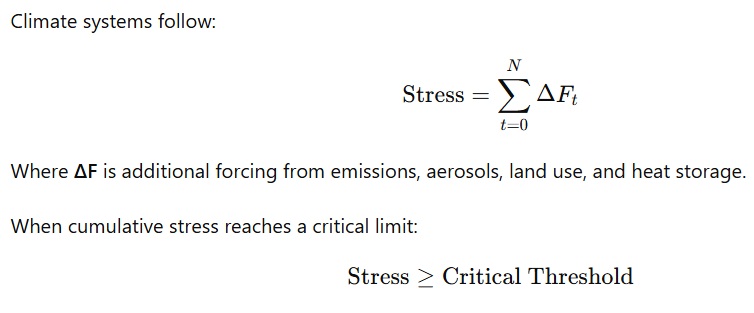
This is the mathematics of thresholds, tipping points, and nonlinear accumulation.

Climate systems follow:


the climate stress formula

then phase changes occur:

  • ice sheets shift from melting to irreversible retreat

  • AMOC slows toward breakdown

  • permafrost flips from sink to source

  • forests shift from carbon absorption to release

  • storm systems intensify nonlinearly

The lyrics capture that point of no return — the “break.”


“How much can her back take… for how long?”

Earth’s “back” = the planetary boundary framework which includes limits on:

  • atmospheric CO₂

  • ocean acidity

  • land system change

  • freshwater use

  • biosphere integrity

  • aerosol loading

  • chemical pollution

We have already transgressed 6 of the 9 known boundaries.
The chord in the chorus mirrors the tension of a structure near collapse.


VERSE 2

“If you take away the base / Leaving barely a trace”

In engineering:
Remove the foundation → structure collapses.

In climate physics:
Removing the “base” = destroying Earth’s stabilizing feedbacks:

  • melting sea ice removes albedo

  • deforestation removes carbon sinks

  • warming oceans weaken heat absorption

  • jet stream weakening removes atmospheric stability

  • soil carbon loss weakens ground-level buffering

This is the destruction of the base of the pyramid.


“Piling on to the peak / Till you cause her to freak”

This is textbook load exceeding threshold.

Real climate example:
The hydrologic cycle now holds ~10–15% more water in many regions due to warming.
This “pile” of excess moisture explosively intensifies storms, floods, and violent rain.

Same physics as too much mass at the top of an inverted pyramid → sudden breakdown.


OUTRO

“Upside-down pyramid / Man did what man did / A pyramid scheme”

The song resolves with a perfect metaphor:

A pyramid scheme relies on exponential extraction until collapse is inevitable.

Human civilization is currently:

  • extracting more resources than Earth can replenish

  • burning more carbon than sinks can absorb

  • adding more heat than oceans can buffer

  • demanding more stability than the climate can provide

This is mathematically equivalent to the growth curve of a pyramid scheme:

Growth∝ekt 

 — where e is Euler’s number, k is the growth constant, and t is time.

Natural systems cannot sustain exponential human demand.

Thus:
Man built an upside-down pyramid — and called it progress.

But physics calls it collapse.

* Our probabilistic, ensemble-based climate model — which incorporates complex socio-economic and ecological feedback loops within a dynamic, nonlinear system — projects that global temperatures are becoming unsustainable this century. This far exceeds earlier estimates of a 4°C rise over the next thousand years, highlighting a dramatic acceleration in global warming. We are now entering a phase of compound, cascading collapse, where climate, ecological, and societal systems destabilize through interlinked, self-reinforcing feedback loops.

What Can I Do?
The single most important action you can take to help address the climate crisis is simple: stop burning fossil fuels.

Tipping points and feedback loops drive the acceleration of climate change. When one tipping point is breached and triggers others, the cascading collapse is known as the Domino Effect.

The Climate Crisis: Violent Rain | Deadly Humid Heat | Health Collapse | Extreme Weather Events | Insurance | Trees and Deforestation | Soil | Rising Sea Level | Food and Water | Updates

The Human Induced Climate Change Experiment

From the album “Amplification
Also found on the album “Reggae at Play

bookmark_borderDense Woulds

Dense-Woulds.mp3
Dense-Woulds.mp4
Dense Woulds-Reggae.mp3
Dense Woulds-Reggae.mp4
Dense-Woulds-intro.mp3

[Intro]
How do you suggest…
(We navigate the forest)

[Verse 1]
Take a look around
(What are you going to do)
Cut ’em all down….

[Bridge]
Dense woulds
(Coulds and shoulds)

[Chorus]
Can’t see the forest
(Through the trees)
Been put to the test
(So help us, please)

[Bridge]
How do you suggest…
(We navigate the forest)

[Verse 2]
Take a look around
(Are you going to saw in awe)
Cut ’em all down….

[Bridge]

[Chorus]

[Outro]
How do you suggest…
(We navigate the forest)
Best not tire
(And set ‘er on fire)
Since our habitat
(Is where we’re at)
We know we could
(We know we should)
Cut our would

ABOUT THE SCIENCE: Tree Extinction Due to Human Induced Environmental Stress

I. Overview

Long-term field observations, remote-sensing data, and new climate-biosphere models now converge on a disturbing conclusion: Earth’s forests are undergoing rapid, nonlinear decline driven by a cascading series of human-induced stressors. The interacting effects of pollution, drought, extreme weather, pest outbreaks, wildfire acceleration, and climate feedback loops have pushed multiple forest biomes into sink-to-source transitions, where forests emit more carbon than they absorb.

What began in 2001 as a study of visible canopy loss has evolved into documentation of a global systemic collapse. Satellite evidence confirms that large forest regions–including the African tropical moist broadleaf biome–have already shifted from net carbon sinks to net sources in a period of only seven years (Mensah et al. 2025). Similar transitions are now observed in boreal forests, peatlands, and other major carbon reservoirs.

These processes are not isolated. They are coupled, mutually reinforcing feedback loops capable of accelerating tree mortality on timescales far faster than traditional models predicted.

II. Sampling of Contributing Variables

A. Pollution

Pollution remains the most significant driver of global tree decline–and the most underestimated. Because pollution affects air, water, soil chemistry, and atmospheric chemistry simultaneously, its effects manifest through multiple pathways.

At the center of the problem is tropospheric ozone, a toxic oxidant produced by combustion byproducts (NO2, VOCs, methane). Ground-level ozone:

  • damages foliage and suppresses photosynthesis
  • reduces stomatal conductance and growth
  • diminishes drought and heat tolerance
  • increases vulnerability to pests, pathogens, and wildfire

Field and global datasets show that ozone pollution is responsible for a substantial portion of current forest mortality. A 2024 tropical forest analysis found that human-derived ozone has reduced net primary productivity (NPP) by ~17% since 2000, significantly weakening the tropical carbon sink.

Further reading:

  • The Dangers of Tropospheric Ozone
  • Tropospheric Ozone = Bad Ozone
  • The Ozone Know Zone
  • Gasoline Plus Ethanol Equals Bad Ozone

Ozone interacts with other pollutants–including nitrogen deposition, particulate matter, and acidifying compounds–to accelerate canopy loss and soil nutrient depletion. Thermal pollution (heat from combustion and urban surfaces) additionally increases ozone formation rates.

B. Water Stress

1. Drought

Recent decades have experienced unprecedented drought frequency and severity. Lower water tables, heat waves, and multi-year moisture deficits weaken root systems and diminish trees’ ability to withstand pests and disease.

2. Excess Rain / Acid Rain

Conversely, excessive rainfall–often more acidic and chemically reactive–damages leaves, alters soil pH, and dissolves essential micronutrients. Acid fog and cloudwater have been documented causing widespread leaf necrosis.

Both extremes–too little and too much water–are now more common due to climate change’s amplification of the hydrological cycle.

Further reading:
Will Tree Species Survive Climate Change?

C. Pests

1. Insects and Worms

Tree mortality from insects such as gypsy moths and borers has long been understood, but recent collapses in insect biodiversity (~80% declines) and changes in soil invertebrates are novel phenomena linked to warming and acidification.
Bee population losses create critical pollination failures. Worm colonization in previously worm-free northern forests has transformed soil structure and nutrient cycling, contributing to tree decline.

2. Invasive Species

A proliferation of invasive insects and plants–including ailanthus, Asian longhorn beetle, emerald ash borer, and persistent non-native earthworms–has destabilized forest ecosystems.

3. Short, Warm Winters

Warmer winters dramatically reduce larval mortality. USDA data:

  • At -17.8 °C: only 5% of emerald ash borer larvae die
  • At -34 °C: 98% mortality

These lethal cold thresholds are now rarely reached in many northern regions.

4. Deadwood Decomposition Feedback

A Nature study shows that insects contribute to ~29% of global deadwood carbon emissions, releasing ~10.9 Gt of carbon annually, comparable to or exceeding fossil-fuel emissions.

Examples:

  • Emerald Ash Borer
  • Whitebark Pine Beetle
  • Worm Invasion
  • Beetlemania
  • Utah Beetles

D. Climate Change Feedback Loops

Pollution, drought, heat, and pests each contribute to mortality–but it is the feedback between them that drives runaway decline.

Key climate feedback loops affecting trees:

  1. Warming → drought + heat waves → tree death → reduced carbon sink → more warming
  2. Ozone formation → reduced NPP → increased atmospheric COâ‚‚ → enhanced warming
  3. Wildfires → massive GHG release + ozone production → more warming → more fires
  4. Permafrost thaw → COâ‚‚ and CHâ‚„ release → accelerated warming → boreal forest die-off

The Tree Extinctions scientific warning states that one-third of global tree species are now threatened with extinction, risking ecosystem collapse.

Wildfires as Accelerating Forces

Warming has intensified wildfire seasons globally. Highlights:

  • Australia (2019-2020): 24 million hectares burned; ecosystems that had not burned for 35,000 years were consumed
  • Northwestern U.S. & Canada (2021): record wildfire extent
  • Three of the last five U.S. years: >10 million acres burned
  • Canada 2023-2024: largest fires in modern history, releasing massive permafrost carbon

Hotter temperatures → more fires → fewer forests → more carbon emissions → hotter temperatures.

By 2070, ~2 billion people may live in Saharan-like heat zones (PNAS).

III. Conclusion

Human activities–pollution, fossil combustion, land use, and climate alteration–are driving an accelerating cycle of tree mortality. Tropospheric ozone, previously underestimated in its global effect, now appears to be one of the dominant controls on forest health and productivity. When combined with drought, pests, invasive species, and wildfires, the result is a self-reinforcing, exponential decline in global forest stability.

Tree mortality accelerates global warming; warming accelerates further tree mortality.
This is no longer a linear problem–it is a cascading climate-biosphere emergency.

Immediate mitigation of fossil-fuel emissions, ozone precursors, and land-use drivers is essential if Earth’s forests–and the ecosystems and climate stability they support–are to survive the 21st century.

* Our probabilistic, ensemble-based climate model — which incorporates complex socio-economic and ecological feedback loops within a dynamic, nonlinear system — projects that global temperatures are becoming unsustainable this century. This far exceeds earlier estimates of a 4°C rise over the next thousand years, highlighting a dramatic acceleration in global warming. We are now entering a phase of compound, cascading collapse, where climate, ecological, and societal systems destabilize through interlinked, self-reinforcing feedback loops.

\What Can I Do?
The single most important action you can take to help address the climate crisis is simple: stop burning fossil fuels.

Tipping points and feedback loops drive the acceleration of climate change. When one tipping point is breached and triggers others, the cascading collapse is known as the Domino Effect.

The Climate Crisis: Violent Rain | Deadly Humid Heat | Health Collapse | Extreme Weather Events | Insurance | Trees and Deforestation | Soil | Rising Sea Level | Food and Water | Updates

The Human Induced Climate Change Experiment


From the album “Dense
Also found on the album “Reggae at Play