bookmark_borderDecay

Decay-Best-Of.mp3
Decay-Best-Of.mp4
Decay.mp3
Decay.mp4
Decay-intro.mp3

[Intro]
May all your problems self-decay
(Fade away to yesterday)
[Instrumental, Piano Solo, Guitar Solo]
So, we can dance and declare
(We’re on our way there…..)

[Bridge]
Where happiness is bliss
(And the music goes like this….)

[Refrain]
May all your problems fade away
(Decay into yesterday)
So, we can dance and declare
(We’re on our way there…..)

[Bridge]
Where happiness is bliss
(And the music goes like this….)
… 2, 3, 4…
(Play it once more)

[Refrain]
May all your problems fade away
(Decay into yesterday)
So, we can dance and declare
(We’re on our way there…..)

[Outro]
Where happiness is bliss
(And the music goes like this….)
… 2, 3, 4…
(Play it once more)
Sing along!
(One more song!)
One more song
(One more song!)

From the album “Amplification

bookmark_borderUpside-Down Pyramid

Upside-Down-Pyramid-Best-Of.mp3
Upside-Down-Pyramid-Best-Of.mp4
Upside-Down-Pyramid.mp3
Upside-Down-Pyramid.mp4
Upside-Down-Pyramid-Reggae.mp3
Upside-Down-Pyramid-Reggae.mp4
Upside-Down-Pyramid-Unplugged-Underground-XXVIII.mp3
Upside-Down-Pyramid-Unplugged-Underground-XXVIII.mp4
Upside-Down-Pyramid-intro.mp3″

[Intro]
Upside-down pyramid
(To the point:)
Accumulate till you break

[Verse 1]
Compound a triangle
In a cubical way
Wrangle it on its head
Piling higher ever day

[Bridge]
Upside-down pyramid
(To the point:)

[Chorus]
Accumulate till you break
(Keep piling on and on)
How much can her back take
(Piling on and on and on)
… for how long?

[Verse 2]
If you take away the base
(Leaving barely a trace)
Piling on to the peak
(Till you cause her to freak)

[Bridge]
Upside-down pyramid
(To the point:)

[Chorus]
Accumulate till you break
(Keep piling on and on)
How much can her back take
(Piling on and on and on)
… for how long?

[Outro]
Upside-down pyramid
(To the point:)
Man did what man did
(Self-anoint)
A pyramid scheme
(Or so it would seem)
Man built an upside-down pyramid
(He did)
… and called it progress.
(But physics calls it collapse.)

Physics & Math Behind the Lyrics

Your song uses geometry, load distribution, instability, and accumulation to represent how human activities are stressing the Earth’s climate system past its natural limits. The central metaphor — an upside-down pyramid — is a perfect model of structural instability under increasing load.


VERSE 1

“Compound a triangle / In a cubical way”

A triangle is the simplest stable structure in physics and engineering because it distributes force evenly across all sides.
A cube distributes load vertically and horizontally, but it requires more support.

Combining these ideas symbolically:

  • Earth’s climate is built on simple, stable foundational cycles (carbon cycle, hydrologic cycle, Hadley circulation).

  • Humans have over-engineered that simplicity by adding massive layers of emissions, energy imbalance, land-use change, and feedback loops, turning stable geometry into overloaded complexity.


“Wrangle it on its head / Piling higher every day”

Here, the triangle (a stable base) is inverted.
In physics, an inverted pyramid is metastable — it can stand temporarily, but every additional load increases the torque and probability of collapse.

Math:
If a structure has a narrow base and wide top, the center of mass rises, which increases instability:

τ=F⋅d

  • F = added load (global emissions, heat, moisture content, deforestation, pollution)

  • d = distance from the pivot point (the “base” of Earth’s climate stability)

As both F and d increase, torque increases, driving collapse.

This mirrors how each year:

  • atmospheric CO₂ rises ~2–3 ppm

  • northern rainfall extremes rise 7–10% per °C

  • ocean heat content hits record highs

  • ice sheets destabilize

  • energy imbalance increases

We keep piling on, raising the center of mass of the entire climate system.


BRIDGE: “Upside-down pyramid (To the point)”

This is the purest physics image in the lyrics.
An upside-down pyramid has:

  • maximum load at the top

  • minimum support at the bottom

In climate terms:

  • The “top” = human demands, emissions, consumption, growth, extraction

  • The “base” = planetary boundaries (carbon sinks, ice albedo, stable jet stream, ocean buffering)

Human activity has turned the climate into a structure that cannot support the load placed upon it.

This is equivalent to a pyramid scheme, where early loads remain hidden until collapse becomes sudden and nonlinear.


CHORUS

“Accumulate till you break / Keep piling on and on”

This is the mathematics of thresholds, tipping points, and nonlinear accumulation.

Climate systems follow:
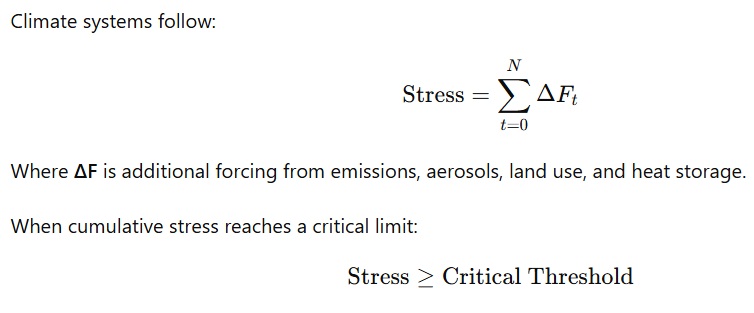

the climate stress formula

then phase changes occur:

  • ice sheets shift from melting to irreversible retreat

  • AMOC slows toward breakdown

  • permafrost flips from sink to source

  • forests shift from carbon absorption to release

  • storm systems intensify nonlinearly

The lyrics capture that point of no return — the “break.”


“How much can her back take… for how long?”

Earth’s “back” = the planetary boundary framework which includes limits on:

  • atmospheric CO₂

  • ocean acidity

  • land system change

  • freshwater use

  • biosphere integrity

  • aerosol loading

  • chemical pollution

We have already transgressed 6 of the 9 known boundaries.
The chord in the chorus mirrors the tension of a structure near collapse.


VERSE 2

“If you take away the base / Leaving barely a trace”

In engineering:
Remove the foundation → structure collapses.

In climate physics:
Removing the “base” = destroying Earth’s stabilizing feedbacks:

  • melting sea ice removes albedo

  • deforestation removes carbon sinks

  • warming oceans weaken heat absorption

  • jet stream weakening removes atmospheric stability

  • soil carbon loss weakens ground-level buffering

This is the destruction of the base of the pyramid.


“Piling on to the peak / Till you cause her to freak”

This is textbook load exceeding threshold.

Real climate example:
The hydrologic cycle now holds ~10–15% more water in many regions due to warming.
This “pile” of excess moisture explosively intensifies storms, floods, and violent rain.

Same physics as too much mass at the top of an inverted pyramid → sudden breakdown.


OUTRO

“Upside-down pyramid / Man did what man did / A pyramid scheme”

The song resolves with a perfect metaphor:

A pyramid scheme relies on exponential extraction until collapse is inevitable.

Human civilization is currently:

  • extracting more resources than Earth can replenish

  • burning more carbon than sinks can absorb

  • adding more heat than oceans can buffer

  • demanding more stability than the climate can provide

This is mathematically equivalent to the growth curve of a pyramid scheme:

Growth∝ekt 

 — where e is Euler’s number, k is the growth constant, and t is time.

Natural systems cannot sustain exponential human demand.

Thus:
Man built an upside-down pyramid — and called it progress.

But physics calls it collapse.

* Our probabilistic, ensemble-based climate model — which incorporates complex socio-economic and ecological feedback loops within a dynamic, nonlinear system — projects that global temperatures are becoming unsustainable this century. This far exceeds earlier estimates of a 4°C rise over the next thousand years, highlighting a dramatic acceleration in global warming. We are now entering a phase of compound, cascading collapse, where climate, ecological, and societal systems destabilize through interlinked, self-reinforcing feedback loops.

What Can I Do?
The single most important action you can take to help address the climate crisis is simple: stop burning fossil fuels.

Tipping points and feedback loops drive the acceleration of climate change. When one tipping point is breached and triggers others, the cascading collapse is known as the Domino Effect.

The Climate Crisis: Violent Rain | Deadly Humid Heat | Health Collapse | Extreme Weather Events | Insurance | Trees and Deforestation | Soil | Rising Sea Level | Food and Water | Updates

The Human Induced Climate Change Experiment

From the album “Amplification
Also found on the album “Reggae at Play

bookmark_borderAs the Sound Propagates

As-the-Sound-Propagates.mp3
As-the-Sound-Propagates.mp4
As-the-Sound-Propagates-Unplugged-Underground-XXVIII.mp3
As-the-Sound-Propagates-Unplugged-Underground-XXVIII.mp4
As-the-Sound-Propagates-intro.mp3

[Intro]
As the sound propagates
(My ear navigates)
As it did…
(Become one with solid)

[Bridge]
Once wed
(We could hear here)

[Refrain]
Less lost energy
(Less energy loss)
Amplifies
(Efficiencies)
As the sound propagates
(My ear navigates)
As it did…
(Become one with solid)

[Bridge]
Now wed (together, now in bed)
We can hear here
(Travelin’ through to you)
Put your ear to my chest
(Hear my heart beat the best)

[Refrain]
Less lost energy
(Less energy loss)
Amplifies
(Efficiencies)
As the sound propagates
(My ear navigates)
As it did…
(Become one with solid)

[Outro]
Faster
(Goes the speed of sound)
It’s found
(Faster)
Ear to ground
(It’s found)
More attention n’
(Less Attenuation)

ABOUT THE SCIENCE
Putting your ear against a solid medium like a wall (even with a glass) or railroad tracks “amplifies” sound because sound travels much more efficiently through dense solids than through air, reducing the amount of energy lost as the sound propagates.

The effect is due to two main physical principles:

1. Superior Transmission of Vibrations through Solids
Sound is a vibration or a pressure wave that requires a medium to travel.

* Molecules are closer together in solids: In solids like steel or glass, molecules are tightly packed and linked by strong intermolecular forces, allowing them to pass vibrational energy to their neighbors very quickly and efficiently.
* Faster speed of sound: Sound travels significantly faster in solids (e.g., about 5,100 meters per second in steel) than in air (about 343 m/s). This rapid transmission means less energy is lost along the way compared to the sound wave dissipating in all directions through the less dense air.
* Energy Conservation (Less Attenuation): The sound wave’s energy stays contained and focused within the solid medium (like the linear path of a rail), rather than spreading out spherically in three dimensions as it does in the open air, where intensity drops quickly due to the inverse square law.

2. Overcoming “Acoustic Impedance Mismatch”
Acoustic impedance is a measure of how much a medium resists the flow of sound energy. When sound travels from one medium to another with a very different impedance (like from air into a solid wall and back to air), most of the energy is reflected away at the boundary.

* Direct Coupling: By placing your ear (which is mostly fluid and tissue, a higher-impedance medium) directly onto the glass or track, you create a direct acoustic coupling with the solid material.
* Bypassing the Air Interface: You bypass the poor air-to-solid and solid-to-air energy transfer points. The vibrations are transmitted directly into the material of your head and inner ear via bone conduction, which is more efficient than relying on the very weak vibration of the tiny amount of air next to the wall.

The Role of the Glass
The glass acts as a solid extension of the wall, providing a rigid object that can form a better seal against the ear than the curved surface of the head could form with the flat wall, making the effect more practical.

From the album “Amplification

bookmark_borderBlew a Fuse

Blew-a-Fuse-Best-Of.mp3
Blew-a-Fuse-Best-Of.mp4
Blew-a-Fuse.mp3
Blew-a-Fuse.mp4
Blew-a-Fuse-intro.mp3

[Intro]
Blew a fuse
(Or maybe a few)

[Refrain]
A screw loose
(A brick shy)
Quite a load
(To unload)

[Bridge]
Explode!
Blew a fuse
(Or maybe a few)
… a fews?
(Confuse)

[Refrain]
A screw loose
(A brick shy)
Quite a load
(To unload)

[Bridge]
Explode!
Blew a fuse
(Or maybe a few)
… a fews?
(Confuse)

[Refrain]
A screw loose
(A brick shy)
Quite a load
(To unload)

[Outro]
A screw loose
(A brick shy)
Crazy goose
(Nor here there nigh)
Blew a fuse
(Or maybe a few)
… a fews?
(Confuse)
Confused
(Win or lose?)

From the album “Amplification

bookmark_borderThe First Major Amplifier

The-First-Major-Amplifier.mp3
The-First-Major-Amplifier.mp4
The-First-Major-Amplifier-Pt-2.mp3
The-First-Major-Amplifier-Pt-2.mp4
The-First-Major-Amplifier-intro.mp3

[Intro]
The first major amplifier
(Human disqualifier)

[Verse 1]
Instant disaster
(Just add water)
Pour on the reign
(Increase the strain)

[Chorus]
The first major amplifier
(Human disqualifier)
In a runaway phase
(The rest of our days)

[Bridge]
380 zettajoules
(What a bunch of fools)

[Verse 2]
Increased moisture
(In the air for sure)
Poor on violent rain
(Increase the pain)

[Chorus]

[Bridge]

[Chorus]

[Outro]
Better change our ways
[Instrumental, Piano Solo, Bass, Percussion]
380 zettajoules
(What a bunch of fools)
Blowin’ me away
(More and more every day)
[Instrumental, Synth Solo, Organ, Bass, Percussion, Drums]

ABOUT THE SCIENCE

1. Ignition: Fossil Fuels, Pollution, and Initial Forcing

The chain reaction begins with the combustion of fossil fuels. This produces:

  • Greenhouse gases: CO2, CO4, and tropospheric ozone (O3)

  • Particulate pollution: PM2.5 and other aerosols

  • Secondary health effects: heart disease, stroke, respiratory failure, and compounding stress on human physiological systems

Fine particulate pollution and ozone feed directly into a health-driven feedback loop–weakening human resilience, increasing mortality, reducing labor productivity, and indirectly accelerating global warming through economic disruption and heightened energy demand.

Meanwhile, CO2 and methane trap longwave radiation, raising global temperatures and injecting more thermal energy into every component of the climate system.

2. Atmospheric Moisture Feedback: The First Major Amplifier

A fundamental physical law governs what happens next: warmer air holds more water vapor, and water vapor is itself the most powerful greenhouse gas on the planet.

  • For every 1°C (1.8°F) of warming, the atmosphere can hold ~7% more moisture.

  • Over 10°C, water-holding capacity nearly doubles.

  • Increased evaporation → increased atmospheric moisture → increased back-radiation → more warming → more evaporation.

This is a classic positive feedback loop.

More water vapor also supercharges extreme precipitation events, creating catastrophic inland and coastal flooding, particularly in regions like the Mid-Atlantic United States where river basins, stormwater systems, and aging infrastructure are already overwhelmed.

3. Permafrost Thaw, Boreal Forest Collapse, and the Carbon Bomb

As global temperatures rise, the Arctic warms 3-4 times faster than the global average–a phenomenon known as polar amplification. This triggers the next phase of the chain reaction:

Permafrost Thaw

  • Releases vast stores of CO2 and CO4 trapped for millennia

  • Destabilizes soils, infrastructure, and entire ecosystems

  • Forms thaw lakes that leak methane at accelerating rates

Zombie Fires and Boreal Wildfires

The thawing cryosphere has enabled:

  • “Zombie fires” smoldering underground year-round

  • Record-breaking boreal forest fires in Canada, Alaska, and Siberia

  • Fire emissions now exceeding the annual fossil-fuel emissions of countries like Canada

These fires convert carbon sinks into carbon sources–an irreversible shift.

4. Ocean Heating, Jet Stream Disruption, and the Breakdown of Planetary Circulation

The oceans absorb over 90% of the excess heat trapped by anthropogenic greenhouse gases. This thermal accumulation drives multiple destabilizing processes:

  • Weakening of the AMOC (Atlantic Meridional Overturning Circulation)

  • Slowing and increased waviness of the jet stream

  • Prolonged heat domes, atmospheric blocking, and stalled storm systems

  • Intensification of tropical cyclones through ocean heat content

These system-level shifts introduce chaotic behavior into global weather patterns–persistent drought where water is needed, and supersaturated storms where the atmosphere is already overloaded.

5. Conclusion: A Planet in a Chain Reaction

Climate drivers and amplifiers now form an interconnected series of cascading feedback loops that are accelerating global warming far beyond linear predictions. The climate is no longer responding to “emissions alone”; it is responding to its own destabilization.

Earth’s climate chain reaction is not theoretical or distant–it is unfolding in real time.

To interrupt this runaway process, humanity must:

  • Rapidly eliminate fossil fuel combustion

  • Restore carbon sinks

  • Rebuild resilient infrastructure

  • Reduce pollution

  • Strengthen global cooperation rather than retreat into isolation

Without decisive action, the chain reaction will continue until multiple tipping points lock the planet into an unlivable state.

Infectious disease vectors, violent rain, and deadly humid heat now stand among the greatest threats of climate change, no longer future warnings but present realities. This deadly triad — rising infectious diseases, escalating heat extremes, and intense rainfall events — has begun driving an exponential increase in climate-related deaths worldwide. These hazards do not operate in isolation; they amplify one another’s impacts, creating cascading risks that strain health systems, destabilize communities, and accelerate global mortality. Climate change has become a full-scale health crisis, demanding urgent, systemic action before these accelerating threats overwhelm society’s ability to respond.

* Our probabilistic, ensemble-based climate model — which incorporates complex socio-economic and ecological feedback loops within a dynamic, nonlinear system — projects that global temperatures are becoming unsustainable this century. This far exceeds earlier estimates of a 4°C rise over the next thousand years, highlighting a dramatic acceleration in global warming. We are now entering a phase of compound, cascading collapse, where climate, ecological, and societal systems destabilize through interlinked, self-reinforcing feedback loops.

What Can I Do?
The single most important action you can take to help address the climate crisis is simple: stop burning fossil fuels.


Tipping points and feedback loops drive the acceleration of climate change. When one tipping point is breached and triggers others, the cascading collapse is known as the Domino Effect.

From the album “Amplification

bookmark_borderExothermic Reaction

Exothermic-Reaction-Best-Of.mp3
Exothermic-Reaction-Best-Of.mp4
Exothermic-Reaction.mp3
Exothermic-Reaction.mp4
Exothermic-Reaction-intro.mp3

[Intro]
Exothermic reaction
(Action, action, Action)

[Verse 1]
Breaking the bonds
(And beyond)
A conversion
(Into combustion)

[Bridge]
Exothermic reaction
(Action, action, Action)

[Chorus]
Energy (release!)
Combustion
Energy (release!)
Fruition

[Bridge]
Oh, please
(Release, release)

[Verse 2]
So it comes to be
(Thermal energy)
Heat you can feel
(Light up for real)

[Bridge]
Exothermic reaction
(Action, action, Action)

[Chorus]
Energy (release!)
Combustion
Energy (release!)
Fruition

[Outro]
Learn to burn
(Burn, baby, burn)
You know…?
(Disco inferno)
Exothermic reaction
(Action, action, Action)
Satisfaction

ABOUT THE SCIENCE
Combustion is a high-temperature exothermic reaction, meaning energy is released during the process. Here is a breakdown of how this conversion and release of energy works: The Chemical Process of Combustion

Combustion typically involves a fuel (e.g., wood, natural gas, gasoline) reacting rapidly with an oxidizer, usually oxygen from the air.

Breaking Chemical Bonds (Energy Input Required): Energy must first be put in to break the existing chemical bonds within the fuel molecules and the oxygen molecules.

Forming New Bonds (Energy Release): The atoms then rearrange to form new, more stable chemical compounds, typically carbon dioxide (CO2) and water (H2O).The key to combustion is that the bonds in the products are significantly stronger and more stable than the bonds in the reactants (fuel and O2).

Net Energy Release: Because less energy is needed to break the initial bonds than is released when the new, stable bonds form, there is a large net release of energy into the surroundings. This released energy manifests primarily as heat (thermal energy) and light.

From the album “Amplification

bookmark_borderWhy Magnify

Why-Magnify.mp3
Why-Magnify.mp4
Why-Magnify-Pt-2.mp3
Why-Magnify-Pt-2.mp4
Why-Magnify-intro.mp3

[Intro]
Why (Magnify)

[Verse 1]
Amplifiers
(Feedback)
Into the drivers
(Survivors?)

[Bridge]
Why (Magnify)

[Chorus]
Anthropogenic forcing
(Compounding)
Reality divorcing
(Dumbfounding)

[Verse 2]
Amplifiers
(Turn into drivers)
Driving us crazy
(As the world turns hazy)

[Bridge]

[Chorus]

[Outro]
Testify!
Why (Magnify)
Why turn up the heat
(On the street)
I mean… why not
(Stop with the hot)
Hot, hot, hot

ABOUT THE SCIENCE: How Drivers and Amplifiers Compound Anthropogenic Forcing

Drivers, Amplifiers, and Exponential Climate Feedback Loops

Climate change accelerates because the Earth system is governed by drivers (forces that initiate warming) and amplifiers (feedbacks that magnify that warming). When amplifiers feed back into the drivers–or begin creating new amplifiers–they produce nonlinear, exponential increases in temperature and extreme weather.

This is how you go from merely “warming” to runaway, compounding, tipping-point-driven climate destabilization.

* Our probabilistic, ensemble-based climate model — which incorporates complex socio-economic and ecological feedback loops within a dynamic, nonlinear system — projects that global temperatures are becoming unsustainable this century. This far exceeds earlier estimates of a 4°C rise over the next thousand years, highlighting a dramatic acceleration in global warming. We are now entering a phase of compound, cascading collapse, where climate, ecological, and societal systems destabilize through interlinked, self-reinforcing feedback loops.

What Can I Do?
The single most important action you can take to help address the climate crisis is simple: stop burning fossil fuels.

Tipping points and feedback loops drive the acceleration of climate change. When one tipping point is breached and triggers others, the cascading collapse is known as the Domino Effect.

The Climate Crisis: Violent Rain | Deadly Humid Heat | Health Collapse | Extreme Weather Events | Insurance | Trees and Deforestation | Soil | Rising Sea Level | Food and Water | Updates

The Human Induced Climate Change Experiment

From the album “Amplification

bookmark_borderConvex Lens

Convex-Lens.mp3
Convex-Lens.mp4
Convex-Lens-Pt-2.mp3
Convex-Lens-Pt-2.mp4
Convex-Lens-intro.mp3

[Intro]
Focus in
(A convex lens)

[Verse 1]
Living in the days
(Of light rays)
At the focal point
(Of disjoint)

[Bridge]
Focus in
(A convex lens)

[Chorus]
Refraction
(Satisfaction)
Intensity
(Of the energy)

[Verse 2]
Redistribute
(In a finite way)
Will contribute
(To fire at play)

[Bridge]

[Chorus]

[Bridge]

[Outro]
Refraction
(Satisfaction)
Intensity
(Of the energy)
Can’t you see
(What will come to be)
Flammability

ABOUT THE SCIENCE
A magnifying glass (a convex lens) focuses energy by using the principle of refraction to concentrate light rays from a large area onto a much smaller area, significantly increasing the intensity of the energy at the focal point. It does not create new energy, but rather redistributes the existing energy.

From the album “Amplification

bookmark_borderAmplify the Pain

Amplify-the-Pain-Best-Of.mp3
Amplify-the-Pain-Best-Of.mp4
Amplify-the-Pain.mp3
Amplify-the-Pain.mp4
Amplify-the-Pain-Pt-2.mp3
Amplify-the-Pain-Pt-2.mp4
Amplify-the-Pain-intro.mp3

[Intro]
Is there a need to explain
(How you amplify the pain)

[Verse 1]
Economic mayhem
(On a global scale)
Hard to tell what year I’m in
(It’s a Great Depression fail)

[Chorus]
Is there a need to explain
(How you amplify the pain)
Increasing the intensity
(Of our shock therapy)

[Bridge]
God, the insanity
How insane
(You amplify the pain)

[Verse 2]
Fiscal fiasco
(A real no know)
The economy is woozy
(Gonna crash on the cozy)

[Chorus]

[Bridge]
God, the insanity
How insane
(You amplify the pain)

[Outro]
God, the inhumanity
(Pure insanity)
How insane
(To amplify the pain)
The cruelty
(Innocence a causality (casualty))
God, the inhumanity
(Pure insanity)

ABOUT THE SONG
The latest employment numbers reveal exactly why small businesses are suing President Trump over his tariff policies: tariffs hit small firms and lower-income consumers the hardest, functioning as a stealth tax that now adds anywhere from 20% to over 50% to the cost of many goods compared with last year.

And the results are now undeniable.

Record Small Business Bankruptcies and a Collapse in Hiring

Small business bankruptcies have surged to record highs, and the newest job numbers show the situation is accelerating.

According to the November 2025 ADP National Employment Report, the private sector saw a net loss of 32,000 jobs. That decline was driven entirely by small businesses, which shed an alarming 120,000 workers in just one month.

ADP’s chief economist, Dr. Nela Richardson, called small firms “a canary in the coal mine” — the first to suffer when consumer demand weakens and operating costs spike. Pay growth for small-firm workers also fell far behind that of larger companies, underscoring how badly the sector is being squeezed.

This isn’t a blip. It’s a structural failure created by policy.

Tariffs Are Functioning as a Massive, Regressive Tax

Unlike large corporations, small businesses don’t have the financial cushion, global supply chains, or pricing power to absorb sudden spikes in import costs. They pay tariffs up front, while their customers — mostly working- and middle-class households — face higher prices at checkout.

That’s why small businesses are paying the equivalent of 20% to over 50% more in real taxes compared with last year. U.S. import prices (excluding the tariff) show that foreign exporters have been raising their prices in dollars. This indicates they are not absorbing much, if any, of the tariff cost.

Tariffs are taxes. And these taxes are crippling the very businesses that drive local economies and job creation.

The Administration Blames… Democrats?

In stark contrast to economic reality, U.S. Secretary of Commerce Howard Lutnick declared that the weak job numbers were not caused by tariffs, but instead blamed:

  • the recent government shutdown, and
  • mass deportations,
    as if those weren’t also direct consequences of Trump’s own policies.

Tariffs raised business costs.
The shutdown weakened demand.
Mass deportations removed workers and consumers.
Every explanation points back to the same place.

The Lawsuit Before the Supreme Court

The reason small businesses are currently suing the administration — in a case now before the U.S. Supreme Court — is precisely because Trump’s tariff actions have caused severe, measurable financial harm.

If the Court rules the tariffs illegal (as multiple lower courts already have), businesses want the right to recover the money they were forced to pay. Without that ruling, many of them won’t survive.


Small businesses are not just numbers on a spreadsheet — they’re the backbone of the U.S. economy. And right now, Trump’s tariff regime is breaking that backbone.

Trumpenomics

From the album “Amplification

bookmark_borderWill I

Will-I-Best-of-Best-Of.mp3
Will-I-Best-of-Best-Of.mp4
Will-I.mp3
Will-I.mp4
Will-I-Pt-2.mp3
Will-I-Pt-2.mp4
Will-I-Unplugged-Underground-XXVIII.mp3
Will-I-Unplugged-Underground-XXVIII.mp4
Will-I-intro.mp3

[Intro]
Will I amplify
(More wars on war)
Or will I amplify
(My piece of peace)

[Verse 1]
As I make a noise
(What message do I send)
What am I poised
(To recommend)

[Chorus]
Will I amplify
(More wars on war)
Or will I amplify
(My piece of peace)

[Bridge]
Are we still in a debate
(Over love and hate?)

[Verse 2]
Hear me make a sound
(What message do I send)
What am I bound
(To recommend)

[Chorus]
Will I amplify
(More wars on war)
Or will I amplify
(My piece of peace)

[Bridge]
Are we still in a debate
(Over love and hate?)

[Outro]
Will we amplify
(More wars on war)
Or will we amplify
(Our piece of peace)

From the album “Amplification

bookmark_borderAmped

Amped.mp3
Amped.mp4
Amped-Pt-2.mp3
Amped-Pt-2.mp4
Amped-intro.mp3

[Intro]
Amped
(Electric)
Music

[Verse 1]
Plugged in
(Turned on)
Let’s begin
(Shinin’ on)

[Bridge]
Amped
(Stamped:)
(Electric)
Music

[Chorus]
Don’t you know
(When the electrons flow)
Oh, so fantastic
(Makin’ us go frantic)

[Verse 2]
Turn up the volume
(Come out of your vacuum)
Partake in dancing
(Let’s shake advancing)

[Bridge]
Amped
(Stamped:)
Electric
(Music)
(Electric)
Music

[Chorus]
Don’t you know
(When the electrons flow)
Oh, so fantastic
(Makin’ us go frantic)

[Outro]
Amped (up)
Ramped (up)
Pound (out) sound
(Electric)
Music

From the album “Amplification

bookmark_borderOnset of the Blues

Onset-of-the-Blues.mp3
Onset-of-the-Blues.mp4
Onset-of-the-Blues-Unplugged-Underground-XXVIII.mp3
Onset-of-the-Blues-Unplugged-Underground-XXVIII.mp4
Onset-of-the-Blues-intro.mp3

[Intro]
The dogs howled the news
(The onset of the blues)

[Refrain]
What do we choose
(Win or lose)
What is our choice
(To raise our voice)

[Bridge]
If we refuse….
The dogs will howl the news
(The onset of the blues)

[Refrain]
What do we choose
(Win or lose)
What is our choice
(To raise our voice)

[Bridge]
If we prevail
The winds of change will wail
(And we will be free)

[Refrain]
What do we choose
(Win or lose)
What is our choice
(To raise our voice)

[Outro]
Heed the howl
What do we choose
(Win or lose)
What is our choice
(To raise our voice)
Raise our voice!
Heed the howl

From the album “Amplification

bookmark_borderWall of Sound

Wall-Of-Sound-Best-Of.mp3
Wall-Of-Sound-Best-Of.mp4
Wall-Of-Sound.mp3
Wall-Of-Sound.mp4
Wall-Of-Sound-intro.mp3

[Intro]
Found
(Wall of sound)
Wrecking crew
(Coming through)

[Verse 1]
Just for the record
(Wanna make a record)
Sound — Powerful
(Bound to be wonderful)

[Chorus]
Oh, oh, oh, found
(Wall of sound)
Wrecking crew
(Coming through)

[Bridge]
Get down
(Down, down, down)
Get up
(Yeah, yeah, yeah)

[Verse 2]
Press it to vinyl
(Take a cover still)
Gotta take a chance
(To make the kids dance)

[Chorus]
Oh, oh, oh, found
(Wall of sound)
Wrecking crew
(Coming through)

[Outro]
Get down
(Spin us ’round)
Found the sound
Get up
(Yup, yup, yup)
Spin us ’round
(Round and round)

ABOUT THE SONG
Phil Spector’s “Wall of Sound” was a revolutionary music production technique developed in the early 1960s to create a dense, orchestral, and powerful sound that would play well on the AM radios and jukeboxes of the era. He often described it as a “Wagnerian approach to rock & roll,” producing “little symphonies for the kids”. The technique was achieved through a meticulous process of layering and reverberation, primarily at Gold Star Studios in Los Angeles with engineer Larry Levine and a group of session musicians known as The Wrecking Crew.

Key Elements of the “Wall of Sound”
* Dense Layering of Instruments: Spector used a large ensemble of musicians (sometimes 20 or more) crammed into a relatively small studio space. Multiple instruments often doubled or tripled the same parts. For example, he might use several guitars, two basses, two pianos (acoustic and electric), and various percussion instruments (shakers, tambourines, etc.) all playing in unison. This blending of tone colors created a rich, thick texture where individual instruments became indistinguishable, merging into a single, massive sound.
* Natural Reverberation: The sound from the studio was fed into a purpose-built echo chamber (a highly sound-reflective basement room with speakers and microphones). The signal would reverberate off the hard walls, be captured by the microphones, and then be mixed back into the main recording on tape. This added a lush, spacious, and dramatic depth to the recording.
* Mono Mixes: Spector was an auteur who insisted on releasing his records in glorious mono. He felt that a stereo mix allowed the listener to control the balance and potentially ruin the carefully constructed sonic “painting” he had created.
* Mixing for AM Radio: The compression effect caused by the dense layering and heavy reverb ensured that the records had a powerful presence and clarity even when played on low-fidelity, small-speaker transistor radios and jukeboxes.

Famous Examples
Key recordings that epitomize the “Wall of Sound” include:

* The Ronettes – “Be My Baby”
* The Righteous Brothers – “You’ve Lost That Lovin’ Feelin'”
* The Crystals – “He’s a Rebel”
* Ike & Tina Turner – “River Deep – Mountain High”
* Darlene Love – “Today I Met The Boy I’m Gonna Marry”

The “Wall of Sound” profoundly influenced numerous artists and producers, including Brian Wilson of The Beach Boys, who adopted similar layering techniques for Pet Sounds, and artists like Bruce Springsteen and ABBA, whose producers cited Spector as a major inspiration.

From the album “Amplification

bookmark_borderMegaphone

Megaphone.mp3
Megaphone.mp4
Megaphone-Pt-2.mp3
Megaphone-Pt-2.mp4
Megaphone-intro.mp3

[Intro]
Is your voice by choice
(Megaphone prone)

[Verse 1]
Are you sitting
(Idly by)
Babysitting
(Ready to cry)

[Bridge]
Is your voice by choice
(Megaphone prone)

[Chorus]
Get off your seat
(And on the street)
Make a sound
(That is found)

[Bridge]
A word (that’s heard)

[Verse 2]
Are you waiting
(On participating)
Leave the solution
(To another’s revolution)

[Bridge]
Is your voice by choice
(Megaphone prone)

[Chorus]
Get off your seat
(And on the street)
Make a sound
(That is found)

[Outro]
A word (that’s heard)
Get off your seat
(And on the street)
Make a sound
(That is found)
Make it loud
(Be a thundercloud)

ABOUT THE SCIENCE
A megaphone does not electronically amplify sound (like a powered speaker does); instead, it
uses a simple acoustic principle to make a person’s natural voice project farther and more clearly.

It works by performing two main functions:
1. Directing the Sound (Focusing Energy)
Without a megaphone, your voice travels outward spherically in all directions. As sound waves spread out over a larger area, their energy dissipates quickly, and the volume drops off rapidly. The cone shape of the megaphone forces the sound waves produced by your mouth into a narrower, forward-facing beam. This concentrates all the acoustic energy that would normally be wasted traveling up, down, and behind you, directing it specifically toward the intended audience.

2. Matching Acoustic Impedance (Improving Efficiency)
This is the more scientific reason the megaphone works well. Sound travels best between mediums that have similar acoustic impedance (a measure of how much a medium resists the flow of sound energy).

* There is a significant difference in acoustic impedance between the high-pressure air inside your mouth and the open air of the environment.
* When sound leaves your open mouth directly into the open air, much of the sound energy is actually reflected back at you because the impedance mismatch is so high. It’s an inefficient transfer of energy.

The megaphone acts as an acoustic impedance transformer or “matching” device. It provides a gradual transition:

* The small opening is close to the impedance of your mouth.
* The large opening at the flare end is close to the impedance of the open environment.

By gradually changing the cross-sectional area, the megaphone helps the sound waves efficiently transition from high-pressure air inside the cone to the open atmosphere, ensuring more of the sound energy is successfully broadcast outward rather than being reflected back into your throat.

Summary
A megaphone makes your voice louder by focusing the sound waves into a beam and improving the efficiency with which that sound energy leaves the horn and enters the open air.

From the album “Amplification

bookmark_borderStanding Wave

Standing-Wave.mp3
Standing-Wave.mp4
Standing-Wave-Pt-2.mp3
Standing-Wave-Pt-2.mp4

[Intro]
Get off you seat
(Understanding standing)
Get on your feet
(Standing understanding)

[Verse 1]
Superpostion
(Identical waves)
Opposit3e directions
(The wave behaves)

[Chorus]
Interference
(Constructive)
Interference
(Destructive)

[Bridge]
I meant…
(Maximum displacement)

[Verse 2]
Harmonics
(Of music)
In the zone
(Of an overtone)

[Chorus]
Interference
(Constructive)
Interference
(Destructive)

[Bridge]
I meant…
(Maximum displacement)
Amaze
(Going through a phase)

[Chorus]
Interference
(Constructive)
Interference
(Destructive)

[Outro]
I meant…
(Maximum displacement)
Amaze
(Going through a phase)
Nodes
(Notes)
Antinodes
(And antidotes)
For days
(Going through a phase)

ABOUT THE SCIENCE
The physics of a standing wave involve the superposition of two identical waves traveling in opposite directions, resulting in a stationary pattern of oscillation within a confined medium. This phenomenon is a key example of resonance, where specific points in space remain fixed while others oscillate with maximum amplitude.

Interference (Constructive and Destructive):
* At certain fixed locations, the waves always meet in phase, leading to constructive interference and points of maximum displacement called antinodes.
* At other fixed locations, the waves are always 180 degrees out of phase, leading to destructive interference and points of zero displacement called nodes.

Resonance and Harmonics: Standing waves only form at specific, discrete frequencies, known as the natural or resonant frequencies of the system. These frequencies are often integer multiples of the lowest possible frequency (the fundamental frequency or first harmonic), which determines the various harmonics or overtones of the system.

From the album “Amplification