bookmark_borderHippo-Autonomous

Hippo-Autonomous.mp3
Hippo-Autonomous.mp4
Hippo-Autonomous-Pt-2.mp3
Hippo-Autonomous-Pt-2.mp4
Hippo-Autonomous-Reggae-1.mp3
Hippo-Autonomous-Reggae-1.mp4
Hippo-Autonomous-Reggae-2.mp3
Hippo-Autonomous-Reggae-2.mp4
Hippo-Autonomous-intro.mp3

[Intro]
Here we go
(Hop on the bus)
Hippo-autonomous
(Whoa, whoa, whoa)

[Verse 1]
Come with us
(But this bus…)
Has no driver
(No survivor)

[Bridge]
(Whoa, whoa, whoa)
Here we go
(Hop on the bus)

[Chorus]
Hippo-autonomous
(They said:)
It’s the biggest thing
(Since sliced bread)

[Verse 2]
Hop onboard
(That’s absurd)
There’s no driver
(No survivor)

[Bridge]
(Whoa, whoa, whoa)
Here we go
(Hop on the bus)

[Chorus]
Hippo-autonomous
(They said:)
It’s the biggest thing
(Since sliced bread)

[Outro]
… just ask the dead
(Put their destiny)
On autopilot
(Now they see)
They lost a lot
(Humanity)
Tragedy

From the album “Porous
Also found on the album “Reggae at Play” and “Reggae Getaway

bookmark_borderUpside-Down Pyramid

Upside-Down-Pyramid-Best-Of.mp3
Upside-Down-Pyramid-Best-Of.mp4
Upside-Down-Pyramid.mp3
Upside-Down-Pyramid.mp4
Upside-Down-Pyramid-Reggae.mp3
Upside-Down-Pyramid-Reggae.mp4
Upside-Down-Pyramid-Unplugged-Underground-XXVIII.mp3
Upside-Down-Pyramid-Unplugged-Underground-XXVIII.mp4
Upside-Down-Pyramid-intro.mp3″

[Intro]
Upside-down pyramid
(To the point:)
Accumulate till you break

[Verse 1]
Compound a triangle
In a cubical way
Wrangle it on its head
Piling higher ever day

[Bridge]
Upside-down pyramid
(To the point:)

[Chorus]
Accumulate till you break
(Keep piling on and on)
How much can her back take
(Piling on and on and on)
… for how long?

[Verse 2]
If you take away the base
(Leaving barely a trace)
Piling on to the peak
(Till you cause her to freak)

[Bridge]
Upside-down pyramid
(To the point:)

[Chorus]
Accumulate till you break
(Keep piling on and on)
How much can her back take
(Piling on and on and on)
… for how long?

[Outro]
Upside-down pyramid
(To the point:)
Man did what man did
(Self-anoint)
A pyramid scheme
(Or so it would seem)
Man built an upside-down pyramid
(He did)
… and called it progress.
(But physics calls it collapse.)

Physics & Math Behind the Lyrics

Your song uses geometry, load distribution, instability, and accumulation to represent how human activities are stressing the Earth’s climate system past its natural limits. The central metaphor — an upside-down pyramid — is a perfect model of structural instability under increasing load.


VERSE 1

“Compound a triangle / In a cubical way”

A triangle is the simplest stable structure in physics and engineering because it distributes force evenly across all sides.
A cube distributes load vertically and horizontally, but it requires more support.

Combining these ideas symbolically:

  • Earth’s climate is built on simple, stable foundational cycles (carbon cycle, hydrologic cycle, Hadley circulation).

  • Humans have over-engineered that simplicity by adding massive layers of emissions, energy imbalance, land-use change, and feedback loops, turning stable geometry into overloaded complexity.


“Wrangle it on its head / Piling higher every day”

Here, the triangle (a stable base) is inverted.
In physics, an inverted pyramid is metastable — it can stand temporarily, but every additional load increases the torque and probability of collapse.

Math:
If a structure has a narrow base and wide top, the center of mass rises, which increases instability:

τ=F⋅d

  • F = added load (global emissions, heat, moisture content, deforestation, pollution)

  • d = distance from the pivot point (the “base” of Earth’s climate stability)

As both F and d increase, torque increases, driving collapse.

This mirrors how each year:

  • atmospheric CO₂ rises ~2–3 ppm

  • northern rainfall extremes rise 7–10% per °C

  • ocean heat content hits record highs

  • ice sheets destabilize

  • energy imbalance increases

We keep piling on, raising the center of mass of the entire climate system.


BRIDGE: “Upside-down pyramid (To the point)”

This is the purest physics image in the lyrics.
An upside-down pyramid has:

  • maximum load at the top

  • minimum support at the bottom

In climate terms:

  • The “top” = human demands, emissions, consumption, growth, extraction

  • The “base” = planetary boundaries (carbon sinks, ice albedo, stable jet stream, ocean buffering)

Human activity has turned the climate into a structure that cannot support the load placed upon it.

This is equivalent to a pyramid scheme, where early loads remain hidden until collapse becomes sudden and nonlinear.


CHORUS

“Accumulate till you break / Keep piling on and on”

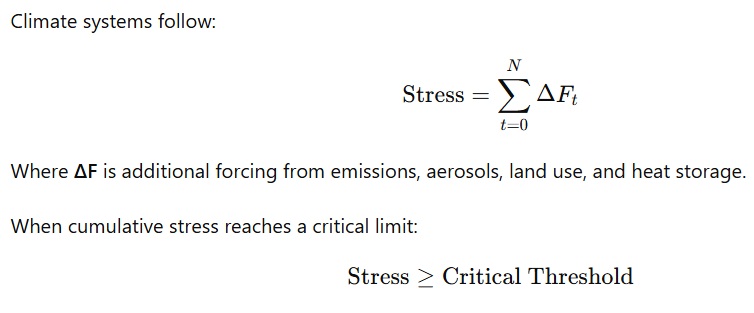
This is the mathematics of thresholds, tipping points, and nonlinear accumulation.

Climate systems follow:


the climate stress formula

then phase changes occur:

  • ice sheets shift from melting to irreversible retreat

  • AMOC slows toward breakdown

  • permafrost flips from sink to source

  • forests shift from carbon absorption to release

  • storm systems intensify nonlinearly

The lyrics capture that point of no return — the “break.”


“How much can her back take… for how long?”

Earth’s “back” = the planetary boundary framework which includes limits on:

  • atmospheric CO₂

  • ocean acidity

  • land system change

  • freshwater use

  • biosphere integrity

  • aerosol loading

  • chemical pollution

We have already transgressed 6 of the 9 known boundaries.
The chord in the chorus mirrors the tension of a structure near collapse.


VERSE 2

“If you take away the base / Leaving barely a trace”

In engineering:
Remove the foundation → structure collapses.

In climate physics:
Removing the “base” = destroying Earth’s stabilizing feedbacks:

  • melting sea ice removes albedo

  • deforestation removes carbon sinks

  • warming oceans weaken heat absorption

  • jet stream weakening removes atmospheric stability

  • soil carbon loss weakens ground-level buffering

This is the destruction of the base of the pyramid.


“Piling on to the peak / Till you cause her to freak”

This is textbook load exceeding threshold.

Real climate example:
The hydrologic cycle now holds ~10–15% more water in many regions due to warming.
This “pile” of excess moisture explosively intensifies storms, floods, and violent rain.

Same physics as too much mass at the top of an inverted pyramid → sudden breakdown.


OUTRO

“Upside-down pyramid / Man did what man did / A pyramid scheme”

The song resolves with a perfect metaphor:

A pyramid scheme relies on exponential extraction until collapse is inevitable.

Human civilization is currently:

  • extracting more resources than Earth can replenish

  • burning more carbon than sinks can absorb

  • adding more heat than oceans can buffer

  • demanding more stability than the climate can provide

This is mathematically equivalent to the growth curve of a pyramid scheme:

Growth∝ekt 

 — where e is Euler’s number, k is the growth constant, and t is time.

Natural systems cannot sustain exponential human demand.

Thus:
Man built an upside-down pyramid — and called it progress.

But physics calls it collapse.

* Our probabilistic, ensemble-based climate model — which incorporates complex socio-economic and ecological feedback loops within a dynamic, nonlinear system — projects that global temperatures are becoming unsustainable this century. This far exceeds earlier estimates of a 4°C rise over the next thousand years, highlighting a dramatic acceleration in global warming. We are now entering a phase of compound, cascading collapse, where climate, ecological, and societal systems destabilize through interlinked, self-reinforcing feedback loops.

What Can I Do?
The single most important action you can take to help address the climate crisis is simple: stop burning fossil fuels.

Tipping points and feedback loops drive the acceleration of climate change. When one tipping point is breached and triggers others, the cascading collapse is known as the Domino Effect.

The Climate Crisis: Violent Rain | Deadly Humid Heat | Health Collapse | Extreme Weather Events | Insurance | Trees and Deforestation | Soil | Rising Sea Level | Food and Water | Updates

The Human Induced Climate Change Experiment

From the album “Amplification
Also found on the album “Reggae at Play

bookmark_borderDense Woulds

Dense-Woulds.mp3
Dense-Woulds.mp4
Dense Woulds-Reggae.mp3
Dense Woulds-Reggae.mp4
Dense-Woulds-intro.mp3

[Intro]
How do you suggest…
(We navigate the forest)

[Verse 1]
Take a look around
(What are you going to do)
Cut ’em all down….

[Bridge]
Dense woulds
(Coulds and shoulds)

[Chorus]
Can’t see the forest
(Through the trees)
Been put to the test
(So help us, please)

[Bridge]
How do you suggest…
(We navigate the forest)

[Verse 2]
Take a look around
(Are you going to saw in awe)
Cut ’em all down….

[Bridge]

[Chorus]

[Outro]
How do you suggest…
(We navigate the forest)
Best not tire
(And set ‘er on fire)
Since our habitat
(Is where we’re at)
We know we could
(We know we should)
Cut our would

ABOUT THE SCIENCE: Tree Extinction Due to Human Induced Environmental Stress

I. Overview

Long-term field observations, remote-sensing data, and new climate-biosphere models now converge on a disturbing conclusion: Earth’s forests are undergoing rapid, nonlinear decline driven by a cascading series of human-induced stressors. The interacting effects of pollution, drought, extreme weather, pest outbreaks, wildfire acceleration, and climate feedback loops have pushed multiple forest biomes into sink-to-source transitions, where forests emit more carbon than they absorb.

What began in 2001 as a study of visible canopy loss has evolved into documentation of a global systemic collapse. Satellite evidence confirms that large forest regions–including the African tropical moist broadleaf biome–have already shifted from net carbon sinks to net sources in a period of only seven years (Mensah et al. 2025). Similar transitions are now observed in boreal forests, peatlands, and other major carbon reservoirs.

These processes are not isolated. They are coupled, mutually reinforcing feedback loops capable of accelerating tree mortality on timescales far faster than traditional models predicted.

II. Sampling of Contributing Variables

A. Pollution

Pollution remains the most significant driver of global tree decline–and the most underestimated. Because pollution affects air, water, soil chemistry, and atmospheric chemistry simultaneously, its effects manifest through multiple pathways.

At the center of the problem is tropospheric ozone, a toxic oxidant produced by combustion byproducts (NO2, VOCs, methane). Ground-level ozone:

  • damages foliage and suppresses photosynthesis
  • reduces stomatal conductance and growth
  • diminishes drought and heat tolerance
  • increases vulnerability to pests, pathogens, and wildfire

Field and global datasets show that ozone pollution is responsible for a substantial portion of current forest mortality. A 2024 tropical forest analysis found that human-derived ozone has reduced net primary productivity (NPP) by ~17% since 2000, significantly weakening the tropical carbon sink.

Further reading:

  • The Dangers of Tropospheric Ozone
  • Tropospheric Ozone = Bad Ozone
  • The Ozone Know Zone
  • Gasoline Plus Ethanol Equals Bad Ozone

Ozone interacts with other pollutants–including nitrogen deposition, particulate matter, and acidifying compounds–to accelerate canopy loss and soil nutrient depletion. Thermal pollution (heat from combustion and urban surfaces) additionally increases ozone formation rates.

B. Water Stress

1. Drought

Recent decades have experienced unprecedented drought frequency and severity. Lower water tables, heat waves, and multi-year moisture deficits weaken root systems and diminish trees’ ability to withstand pests and disease.

2. Excess Rain / Acid Rain

Conversely, excessive rainfall–often more acidic and chemically reactive–damages leaves, alters soil pH, and dissolves essential micronutrients. Acid fog and cloudwater have been documented causing widespread leaf necrosis.

Both extremes–too little and too much water–are now more common due to climate change’s amplification of the hydrological cycle.

Further reading:
Will Tree Species Survive Climate Change?

C. Pests

1. Insects and Worms

Tree mortality from insects such as gypsy moths and borers has long been understood, but recent collapses in insect biodiversity (~80% declines) and changes in soil invertebrates are novel phenomena linked to warming and acidification.
Bee population losses create critical pollination failures. Worm colonization in previously worm-free northern forests has transformed soil structure and nutrient cycling, contributing to tree decline.

2. Invasive Species

A proliferation of invasive insects and plants–including ailanthus, Asian longhorn beetle, emerald ash borer, and persistent non-native earthworms–has destabilized forest ecosystems.

3. Short, Warm Winters

Warmer winters dramatically reduce larval mortality. USDA data:

  • At -17.8 °C: only 5% of emerald ash borer larvae die
  • At -34 °C: 98% mortality

These lethal cold thresholds are now rarely reached in many northern regions.

4. Deadwood Decomposition Feedback

A Nature study shows that insects contribute to ~29% of global deadwood carbon emissions, releasing ~10.9 Gt of carbon annually, comparable to or exceeding fossil-fuel emissions.

Examples:

  • Emerald Ash Borer
  • Whitebark Pine Beetle
  • Worm Invasion
  • Beetlemania
  • Utah Beetles

D. Climate Change Feedback Loops

Pollution, drought, heat, and pests each contribute to mortality–but it is the feedback between them that drives runaway decline.

Key climate feedback loops affecting trees:

  1. Warming → drought + heat waves → tree death → reduced carbon sink → more warming
  2. Ozone formation → reduced NPP → increased atmospheric COâ‚‚ → enhanced warming
  3. Wildfires → massive GHG release + ozone production → more warming → more fires
  4. Permafrost thaw → COâ‚‚ and CHâ‚„ release → accelerated warming → boreal forest die-off

The Tree Extinctions scientific warning states that one-third of global tree species are now threatened with extinction, risking ecosystem collapse.

Wildfires as Accelerating Forces

Warming has intensified wildfire seasons globally. Highlights:

  • Australia (2019-2020): 24 million hectares burned; ecosystems that had not burned for 35,000 years were consumed
  • Northwestern U.S. & Canada (2021): record wildfire extent
  • Three of the last five U.S. years: >10 million acres burned
  • Canada 2023-2024: largest fires in modern history, releasing massive permafrost carbon

Hotter temperatures → more fires → fewer forests → more carbon emissions → hotter temperatures.

By 2070, ~2 billion people may live in Saharan-like heat zones (PNAS).

III. Conclusion

Human activities–pollution, fossil combustion, land use, and climate alteration–are driving an accelerating cycle of tree mortality. Tropospheric ozone, previously underestimated in its global effect, now appears to be one of the dominant controls on forest health and productivity. When combined with drought, pests, invasive species, and wildfires, the result is a self-reinforcing, exponential decline in global forest stability.

Tree mortality accelerates global warming; warming accelerates further tree mortality.
This is no longer a linear problem–it is a cascading climate-biosphere emergency.

Immediate mitigation of fossil-fuel emissions, ozone precursors, and land-use drivers is essential if Earth’s forests–and the ecosystems and climate stability they support–are to survive the 21st century.

* Our probabilistic, ensemble-based climate model — which incorporates complex socio-economic and ecological feedback loops within a dynamic, nonlinear system — projects that global temperatures are becoming unsustainable this century. This far exceeds earlier estimates of a 4°C rise over the next thousand years, highlighting a dramatic acceleration in global warming. We are now entering a phase of compound, cascading collapse, where climate, ecological, and societal systems destabilize through interlinked, self-reinforcing feedback loops.

\What Can I Do?
The single most important action you can take to help address the climate crisis is simple: stop burning fossil fuels.

Tipping points and feedback loops drive the acceleration of climate change. When one tipping point is breached and triggers others, the cascading collapse is known as the Domino Effect.

The Climate Crisis: Violent Rain | Deadly Humid Heat | Health Collapse | Extreme Weather Events | Insurance | Trees and Deforestation | Soil | Rising Sea Level | Food and Water | Updates

The Human Induced Climate Change Experiment


From the album “Dense
Also found on the album “Reggae at Play

bookmark_borderPacked House

Packed-House.mp3
Packed-House.mp4
Packed-House-Reggae.mp3
Packed-House-Reggae.mp4
Packed-House-intro.mp3

[Intro]
It’s a packed house
(Rouse) your feet
(Dance)… to the beat

[Refrain]
Take it to the street
(Get the crowd loud)
We won’t take defeat
(Gonna shout it out loud)
In common time
(Swords in rhyme)

[Bridge]
Make us complete!
(It’s a packed house)
Rouse! (to your feet)
Dance… (to the beat)

[Refrain]
Take it to the street
(Get the crowd loud)
A complete feat
(Gonna shout love out loud)

[Refrain]
Take it to the street
(Get the crowd loud)
A complete feat
(Gonna shout love out loud)
In common time
(Swords in rhyme)
Love, love, love

[Outro]
Make us complete!
(It’s a packed house)
Rouse! (to your feet)
Dance… (to the beat)
Sing (do everything)
Shout (and jump about)
Shout:
(It’s of love)
Love, love, love
(It’s a packed house)
Rouse! (Rouse!)

From the album “Dense
Also found on the album “Reggae at Play

bookmark_borderThe Iceberg

The-Iceberg.mp3
The-Iceberg.mp4
The-Iceberg-Reggae.mp3
The-Iceberg-Reggae.mp4
The-Iceberg-intro.mp3

[Intro]
(Here’s a tip:)
It’s not the tip
(Of the iceberg)
[Instrumental, Synth Solo]
Titanic (Realization)
Gigantic (Rearrangement)

[Verse 1]
Is smooth sailing
(A thing of the past)
Or more wailing
(Will surely last)

[Chorus]
No, not the tip
(The iceberg)
Cancels your trip
(Not nice… for shore)

[Bridge]
Titanic (Realization)
Gigantic (Rearrangement)

[Verse 2]
Has our ship sailed
(We missed the boat)
Guess the wail failed
(Our chances remote)

[Chorus]
No, not the tip
(The iceberg)
Cancels our trip
(Not nice… for shore)

[Bridge]
Titanic (Realization)
Gigantic (Rearrangement)

[Chorus]
No, not the tip
(The iceberg)
Cancels our trip
(Not nice… for shore)

[Outro]
Into our baggage
(Drip, drip, drip)
The advice of a sage:
(Know no more)
Titanic (Realization)
Gigantic (Rearrangement)
Of all that’s meant
(Civilization)

From the album “Lulu

Also found on the album “Reggae at Play

bookmark_borderRead ‘Em and Weep

Read-Em-and-Weep.mp3
Read-Em-and-Weep.mp4
Read-Em-and-Weep-Reggae.mp3
Read-Em-and-Weep-Reggae.mp4
Read-Em-and-Weep-intro.mp3

[Intro]
Put your cards on the table
(Read ’em… and weep)

[Verse 1]
Are you sure
You want to play high stakes
(No matter what it takes)
Will you endure

[Bridge]
Are you able….
(Or is the price too steep)
Put your cards on the table
(Read ’em… and weep)

[Chorus]
A pair of twos
(Is that all you have)
Well, as you choose
(Have is now half)

[Bridge]
You lose

[Verse 2]
Put your money
(Where your mouth is)
Pop quiz!
You ready, honey?

[Bridge]
Are you able….
(Or is the price too steep)
Put your cards on the table
(Read ’em… and weep)

[Chorus]
A pair of twos
(Is that all you have)
Well, as you choose
(Have is now half)

[Bridge]
You lose
Are you able….
(Or is the price too steep)
Put your cards on the table
(Read ’em… and weep)

[Chorus]
A pair of twos
(Is that all you have)
Well, as you choose
(Have is now half)

[Outro]
… of what it use to be
(Can you see….)
The irony:
A royal flush
(Hush, hush, hush)

From the album “That’s Loud

Also found on the album “Reggae at Play

bookmark_borderThe Animals Spill

The-Animals-Spill-Reggae.mp3
The-Animals-Spill-Reggae.mp4
The-Animals-Spill-intro.mp3
The-Animals-Spill.mp3
The-Animals-Spill.mp4

[Intro]
The animals spill

[Verse 1]
The King of the jungle
(In a tantrum of a bungle)
Threw a fit (every bit)
Of the way…

[Bridge]
[Instrumental, Bass Solo]
(Every single day)
Day in and day out
(Shout!)

[Chorus]
The animals spill
(Due to the hairless apes’ gapes)
Eyes shut (mouths wide open)
They still shrill swill
(… so much for humans hopin’)

[Verse 2]
The head hairless ape
(In a tantrum he mumbled)
Never humble (Not a bit)
Just full of (shh!) it

[Bridge]
You know…
(The ego)
… will blow n’ blow
Every single day
(No “hooray”)
Day in and day out
(Shout!)

[Chorus]
The animals spill
(Due to the hairless apes’ gapes)
Eyes shut (mouths wide open)
They still shrill swill
(… so much for humans hopin’)

[Outro]
The animals spill
(Due to the hairless apes’ gapes)
Eyes shut (mouths wide open)
They still shrill swill
(But hear’s to humans hopin’)
Don’t let ’em get you down
(Listen to the sound)
Found all around
(Find the thrill)
The humans spill
(And thrive with the alive)

ABOUT THE SONG

Don the Con: How Trump Cemented His Legacy as the Dumbest World Leader in History

Trump said it best, “Smart people don’t like me.”

Trump is going down in history as the dumbest president in American history; however, that title may not be “biggly” enough for him. He is now being recognized globally as the dumbest world leader in history — a man who has willfully ignored, denied, and lied about established science, accelerating a planetary crisis that has already cost millions of lives. Trump’s science denial directly resulted in millions of preventable COVID deaths in his first term. Now, he is endangering the entire population of the world.

Trump has repeatedly dismissed climate science as a “hoax,” “bullshit,” and “the green scam.” At the United Nations, he called climate change a “con” — an irony lost on no one, coming from “Don the Con” himself, a man whose business empire was built on deceit, bankruptcies, and fraud. His record now includes criminal convictions, civil judgments, and an unparalleled legacy of scientific ignorance.

This year, Trump refused to cooperate with the COP30 global climate summit in Brazil, further cementing America’s retreat from global climate leadership. With global emissions nearly doubling in the last 33 years, few would argue that progress has met expectations. Worse, the post-COVID global consensus on tackling climate change is fracturing — led by Trump’s renewed campaign of climate disinformation and economic coercion. His administration’s new trade tariffs pressure allies such as Japan, the EU, and South Korea to buy more U.S. fossil fuels, directly undermining global decarbonization efforts.

Trump’s absence from COP30 drew sharp rebukes from world leaders. “For small island states, the climate crisis is not past tense or future tense. It is our reality. We have no way to run, no way to hide,” said Antigua and Barbuda’s Prime Minister Gaston Browne. Chilean President Gabriel Boric accused Trump of spreading “lies” about the climate crisis, while Colombian President Gustavo Petro declared, “Mr. Trump is against humankind.”

As Trump abandons both people and planet, others are stepping into the leadership void. California Governor Gavin Newsom announced he will attend COP30 in Brazil, representing the world’s fourth-largest economy. Newsom aims to strengthen climate partnerships, promote clean-energy investments, and showcase California’s model for creating jobs while cutting toxic pollution.

“As the President of the United States turns his back on people and the planet, California is inking global partnerships focused on creating jobs and cutting toxic pollution,” Newsom said. “The economic winners of the 21st century are those who build the clean-energy future. We’re doing that right now — and showing the world that climate action means jobs, clean air, and lower costs.”

While Trump clings to fossil-fueled fantasies and falsehoods, California and the world are moving forward without him. History will remember Trump not as a leader, but as a warning — a living example of how ignorance, arrogance, and greed can conspire to imperil the planet itself.

The Great Race Against Time: Trump vs. Mother Nature

The Human Induced Climate Change Experiment

From the album “Ambiguous
Also found on the album “Reggae at Play

bookmark_borderTurbulent

Turbulent.mp3
Turbulent.mp4
Turbulent-Reggae.mp3
Turbulent-Reggae.mp4
Turbulent-intro.mp3

[Intro]
Chaotic motion
(It’s a gas)
Current commotion
(Watch us pass)

[Bridge]
The fortune of future
(… not really quite sure….)

[Refrain]
Chaotic motion
(It’s a gas)
Current commotion
(Watch us pass)

[Bridge]
Will we arrive
(Alive)
The fortune of future
(… not really quite sure….)
Really was hoping
(We would endure)

[Refrain]
Chaotic motion
(It’s a gas)
Current commotion
(Watch us pass)

[Bridge]
Will we arrive
(Alive)
The fortune of future
(… not really quite sure….)
Really was hoping
(We would endure)

[Outro]
As we strive to arrive alive…
(Will we survive?)
The fortune of future
(… not really quite sure….)
Really was hoping
(We would endure)
… a little more.

ABOUT THE SONG
“Turbulent” describes a state of chaotic, irregular, or violent motion.

Fluid dynamics:
This refers to chaotic motion in liquids or gases, where the flow is not in smooth, parallel layers. Examples include:

    • Turbulent air causing a bumpy ride in an airplane
    • Turbulent water in rapids or the sea

Abstract turbulence: this describes periods of great disorder, change, or conflict. A turbulent era in history, such as the social revolutions of the 1960s or the collapse of the US in the Trump era.

From the album “In the Throes

Also found on the album “Reggae at Play

bookmark_borderIn the Surf

In-the-Surf.mp3
In-the-Surf.mp4
In-the-Surf-Reggae.mp3
In-the-Surf-Reggae.mp4
In-the-Surf-intro.mp3

[Intro]
Was body-surfing
(Accidentally went turf-surfing)

[Verse 1]
Surfs up! High tide
(Thought I’d go for a ride)
Way up on a wave
(Now my life… please save)

[Bridge]
Was body-surfing
(Accidentally went turf-surfing)

[Chorus]
Rolling in the surf
(Head over heels)
A face full of turf
(Know how it fees?)

[Verse 2]
In the barrel
(Took a roll)
Left the pocket
(Like a rocket)

[Bridge]
Was body-surfing
(Accidentally went turf-surfing)

[Chorus]
Rolling in the surf
(Head over heels)
A face full of turf
(Know how it fees?)

[Bridge]
Was body-surfing
(Accidentally went turf-surfing)

[Chorus]
Rolling in the surf
(Head over heels)
A face full of turf
(Know how it fees?)

[Outro]
Now I understand
(Buried in the sand)
Face defaced
(Sandpaper erased)
Was body-surfing
(Accidentally went turf-surfing)

From the album “In the Throes

Also found on the album “Reggae at Play

bookmark_borderThe Troubles

The-Troubles.mp3
The-Troubles.mp4
The-Troubles-Reggae.mp3
The-Troubles-Reggae.mp4
The-Troubles-intro.mp3

[Intro]
The distraught
(Taught the troubles)
Mumbles…
(Hummana, hummana, hummana)

[Bridge]
Bloody Sunday
(Sure ain’t no “fun day”)
A massacre
(That’s for sure)

[Refrain]
The distraught
(Taught the troubles)
Mumbles…
(Hummana, hummana, hummana)

[Bridge]
Bloody Sunday
(Sure ain’t no “fun day”)
A massacre
(That’s for sure)
In the Derry air
(In the derriere)

[Refrain]
The distraught
(Taught the troubles)
Mumbles…
(Hummana, hummana, hummana)

[Outro]
Bloody Sunday
(Sure ain’t no “fun day”)
A massacre
(That’s for sure)
In the Derry air
(In the derriere)
Bloody Sunday
(Best to run away)
Runaway run away

ABOUT THE SONG
The Troubles (Irish: Na Trioblóidí) were an ethno-nationalist conflict in Northern Ireland that lasted for about 30 years from the late 1960s to 1998. Bloody Sunday, or the Bogside Massacre, was a massacre on 30 January 1972 when British soldiers shot 26 unarmed civilians during a protest march in the Bogside area of Derry, Northern Ireland. Thirteen men were killed outright and the death of another man four months later was attributed to his gunshot injuries. Many of the victims were shot while fleeing from the soldiers, and some were shot while trying to help the wounded.

From the album “In the Throes

Also found on the album “Reggae at Play

bookmark_borderSeriously

Seriously.mp3
Seriously.mp4
Seriously-Reggae-Ska.mp3
Seriously-Reggae-Ska.mp4
Seriously-intro.mp3

[Intro]
(Seriously)…
How can you be taken
Seriously…
(Seriously)

[Bridge]
A clown (bringing us down)
Down (down, down, down)

[Refrain]
(Seriously)…
How can you be taken
(Seriously)…
Maybe if you awaken
(Momentarily)
You could see more clearly

[Bridge]
(More love)
(More love) Instead of…
A clown (bringing us down)
Down (down, down, down)
Seriously… (deliriously)

From the album “Taken

Also found on the album “Reggae at Play

bookmark_borderRead It

Read-It.mp3
Read-It.mp4
Read-It-Reggae.mp3
Read-It-Reggae.mp4
Read-It-intro.mp3

[Intro]
Read it
(In black and white)
Grasp it
(Basic insight)

[Bridge]
And, so the story goes….
(As your wisdom grows)

[Refrain]
Read it
(In black and white)
Plain as day
(Wouldn’t you say)
Grasp it
(Basic insight)

[Bridge]
And, so the story goes….
(As your wisdom grows)
No more “who knows”
(Once you hear it)
You won’t fear it

[Refrain]
Read it
(In black and white)
Plain as day
(Wouldn’t you say)
In your face…
(Human race)
Grasp it
(Basic insight)

[Outro]
And, so the story goes….
(As your wisdom grows)
No more “who knows”
(Once you hear it)
You won’t fear it
(Just let the music play)
… all day
(Let us play, play, play)
… all day

From the album “Title

Also found on the album “Reggae at Play

bookmark_borderTilt

Tilt.mp3
Tilt.mp4
Tilt-Reggae.mp3
Tilt-Reggae.mp4
Tilt-intro.mp3

[Intro]
And the title read: (Tilt!)

[Verse 1]
Smacked those bumpers
(A little too hard)
Sending signals bonkers
(Leaving the score scarred)

[Bridge]
And the title read: (Tilt!)

[Chorus]
Lost our turn
(Maybe the game)
Will we learn
(It’s never the same)

[Verse 2]
Push and shove
(Away the love)
Shutting ‘er down
(Like a foolish clown)

[Bridge]
And the title read: (Tilt!)

[Chorus]
Lost our turn
(Maybe the game)
Will we learn
(It’s never the same)

[Bridge]
And the title read: (Tilt!)

[Chorus]
Lost our turn
(Maybe the game)
Will we learn
(It’s never the same)

[Outro]
And the title read: (Tilt!)
Game Over
(Deposit more money)
No, it ain’t funny
(Tilt!)

From the album “Title

bookmark_borderHold (Title)

Hold-Title.mp3
Hold-Title.mp4
Hold-Title-Reggae.mp3
Hold-Title-Reggae.mp4
Hold-Title-intro.mp3

[Intro]
Do you hold the title
(Or is the coinage under mortgage?)
What’s the ownership
(Did you pay cash or credit for it?)

[Verse 1]
The deficit
(Keeps growing and growing)
Soon we’ll regret
(Despite already knowing)

[Bridge]
Your slip is showing…
Past time for you
(To pay what’s due)

[Chorus]
Do you hold the title
(Or is the coinage under mortgage?)
What’s the ownership
(Did you pay cash or credit for it?)

[Verse 2]
The national debt
(Growing faster and faster)
Do you regret
(Knowing it’s a disaster)

[Bridge]
Your slip is showing…
Past time for you
(To pay what’s due)

[Chorus]
Do you hold the title
(Or is the coinage under mortgage?)
What’s the ownership
(Did you pay cash or credit for it?)

[Outro]
Your slip is showing…
(Your fly is down)
… best look around
Past time for you
(To pay what’s due)
In case it is news
(Tired of singing the blues)
Pay your dues

From the album “Title

Also found on the album “Reggae at Play

bookmark_borderMighty Oak

Mighty-Oak.mp3
Mighty-Oak.mp4
Mighty-Oak-Reggae.mp3
Mighty-Oak-Reggae.mp4
Mighty-Oak-intro.mp3

[Intro]
(If it ain’t broke…)
Ensuring
(Enduring)
The mighty oak

[Verse 1]
If you ever get board
(No joke, be an oak)
Keep your brain sane
(Oh, lordy lord)

[Chorus]
(If it ain’t broke…)
Ensuring
(Enduring)
The mighty oak

[Bridge]
Strength, longevity, and resilience
(Independence)

[Verse 2]
Are you barking up the wrong tree
(A mighty oak wanna be?)
From the humble acorn
(Grow and learn… you are born)

[Chorus]
(If it ain’t broke…)
Ensuring
(Enduring)
The mighty oak

[Bridge]
Strength, longevity, and resilience
(Independence)

[Chorus]
(If it ain’t broke…)
Ensuring
(Enduring)
The mighty oak

[Outro]
Strength (in a board length)
Longevity (in your durability)
Resilience (Independence)
Living for over 1,000 years
(Long beyond man’s cheers or jeers)
But no joke… can the oak
(Withstand man)

ABOUT THE SONG
The mighty oak is an enduring symbol of strength, longevity, and resilience, rooted in its biological makeup and prominent place in history, myth, and ecosystems. The phrase “mighty oak” also refers to the oak tree as the official national tree of the United States and has been used as the title for several books and movies.

 
The oak tree as a symbol of might
The perception of the oak as “mighty” comes from several characteristics:
  • Keystone species: Oak trees are a keystone species, supporting more wildlife than any other tree in North America. A single mature oak provides food, shelter, and nesting sites for hundreds of species of fungi, insects, birds, and mammals.
  • Sturdy wood: The strong, durable wood of the oak has been used for centuries in construction and shipbuilding. The famous USS Constitution earned the nickname “Old Ironsides” because its hull was made from strong white oak, which helped it withstand cannon fire.
  • Longevity: With some oaks capable of living for over 1,000 years, their long lifespan makes them a symbol of endurance and steadfastness. Ancient oaks like the Major Oak in Sherwood Forest, England, and the Treaty Oak in Jacksonville, Florida, have witnessed centuries of history.
  • Resilience: The proverb “great oaks from little acorns grow” illustrates the idea that even the smallest things have the potential to become something great. This growth from a tiny acorn to a towering, durable tree symbolizes resilience and the achievement of great strength over time.

From the album “Strength

Also found on the album “Reggae at Play

Trees

The Human Induced Climate Change Experiment