bookmark_borderTwilight: The End of Times

[Intro]
[Dark]
[Foreboding]
[Instrumental]
[Male Spoken Word]
This is the end
Beautiful friend
This is the end

[Break]
[Female Vocals]
[Bridge]
This is the end
Beautiful friend
This is the end
The mountains and the valleys start to tremble and quake
The children of the sun began to awake, wake up!

[Verse 1]
Seems that the wrath of the Gods
Got a hunch, who knows and we started to go
I think we might be thinking
Throw me a line if I reach it in time
I’ll meet you up there
No wrath, aware and high

[Chorus]
You’re no good for me, and I’m no good for you
I’m gonna a look you straight in the eye
n’ tell you what I’m gonna do
I’m gonna leave, you know I gotta go
I gotta go
Nice try, say good bye
Na na na na, hey hey, goodbye
Na na na na, na na na na, hey hey, goodbye

[Break]

[Verse 2]
If your head explodes with dark forebodings, too
I’ll see you
.. up there
No wrath, aware, on high
’cause we must try!

[Chorus]
You’re no good for me, and I’m no good for you
I’m gonna a look you straight in the eye
n’ tell you what I’m gonna do
I’m gonna leave, you know I gotta go
I gotta go
Nice try, say good bye
Na na na na, hey hey, goodbye
Na na na na, na na na na, hey hey, goodbye

[Break]
[Bridge]
This is the end
Beautiful friend
This is the end
The mountains and the valleys start to tremble and quake
The children of the sun began to awake, wake up!

[Break]
Na, na, na, na
[Verse 3]
There’s something wrong with the world today
Something’s wrong with our I’s
And God knows it ain’t Her’s
It sure ain’t no surprise, yeah
On the ledge
Living on the edge
On the verge
Living on the edge

[Chorus]
You’re no good for me, and I’m no good for you
I’m gonna a look you straight in the eye
n’ tell you what I’m gonna do
I’m gonna leave, you know I gotta go
I gotta go
Bye-bye, bye-bye
Nice try, say good bye
Na na na na, hey hey, goodbye
Na na na na, na na na na, hey hey, goodbye
Bye-bye, bye-bye

[Outro]
Say good bye
Na na na na, hey hey, goodbye
Na na na na, na na na na, hey hey, goodbye
Bye-bye, bye-bye
Bye-bye, bye-bye

[End]
[Silence]

ABOUT THE SONG
Inspired by classic rock songs about The End including The Doors, Led Zeppelin, Pink Floyd, The Guess Who, Steam, Aerosmith, Genesis, the Yardbirds, and the Moody Blues.

About the End

bookmark_borderZombie Apocalypse (The End of Times Prequel)

Daniel:
The king will do as he pleases. He will exalt and magnify himself above every god and will say unheard-of things against the God of gods. He will be successful until the time of wrath is completed.
He will show no regard for the gods of his fathers or for the one desired by women, nor will he regard any god, but will exalt himself above them all. Instead of them, he will honor a god of fortresses.

And many of those whose bodies lie dead and buried will rise up to shame and everlasting contempt. Many humans will fall by the sword or be burned or captured or plundered. And, there will be a time of anguish greater than any previous suffering in history.

This passage from the Book of Daniel describes a period of great turmoil and conflict, marked by the rise of a powerful and arrogant king who exalts himself above all gods, including the God of gods. The king’s actions indicate a complete disregard for tradition, faith, and morality, as he prioritizes his own power and glorifies militarism by honoring a “god of fortresses.”

The passage also foretells a time of immense suffering and anguish, surpassing any previous hardships in history. Many people will experience violence, destruction, and loss, depicted by falling by the sword, being burned, captured, or plundered. The imagery evokes a sense of chaos and despair as humanity faces unprecedented challenges and tribulations.

Furthermore, the mention of “many of those whose bodies lie dead and buried will rise up to shame and everlasting contempt” suggests a final judgment or reckoning, where those who have faced injustice and persecution will be vindicated, while those who have oppressed others will face eternal disgrace.

Overall, the passage highlights themes of arrogance, oppression, suffering, and divine judgment, serving as a warning about the consequences of pride and injustice. It emphasizes the importance of remaining faithful and righteous in the face of adversity and corruption.

[Intro]
[Instrumental]
[Female Vocals]
This ain’t no fun.
Can’t you see?
Zombie!
Run!

[Break]
[Faster Tempo]
Run, run, run

[Verse 1]
From dust to dust, rise up again
Let the race from the dead begin
Sorry son,
You missed the starting gun
You better run

[Chorus]
Is it any wonder
They pilfer and plunder
No place to hide
Along for the ride
Blame it on blunder
I’m going under
Chaos is undone
Run!

[Break]
[Increase Tempo]
Run, run, run

[Bridge]
Zombie will be the death of me
Zombie let me be
Zombie!
Run, run, run
No place to run, run, run
No place to hide
Can’t get off this ride
Can’t elude those who’ve died
So help me God, I’ve tried

[Break]
[Increasing Tempo]
Run, run, run
Run

[Verse 2]
Ain’t no joke, the dead spoke
Their funny bone is killing me
Talk about having really thin skin
Bones of dust come to life again
Beauty is only skin deep, so I see

[Chorus]
Is it any wonder
They pilfer and plunder
No place to hide
Along for the ride
Blame it on blunder
I’m going under
Chaos is undone
Run!

[Outro]
[Decreasing Tempo]
Run, run, run
Run!

[End]
[Silence]

About the End

bookmark_borderDaniel 12:3 (The End of Times)

3 And those who are wise — the people of God — shall shine as brightly as the sun’s brilliance, and those who turn many to righteousness will glitter like stars forever.

4 But Daniel, keep this prophecy a secret; seal it up so that I will not be understood until the end times, when travel and education shall be vastly increased.

[Intro]
See the light?

[Verse 1]
In the depths of time, a prophecy untold
Where wisdom shines like purest gold
The people of Mother, with hearts aflame
Shall rise like stars, to etch their name

[Chorus]
Oh, the wise shall shine like the sun
With brilliance shining on and on
And those who lead others to the light
Will glitter like stars in the darkest night
Be the light?

[Break]
See the light

[Verse 2]
Keep this secret close, Daniel, they said
For the end times, when knowledge spreads
Travel and education, vast and wide
Shall unlock the truth, can’t be denied

[Chorus]
Oh, the wise shall shine like the sun
With brilliance shining on and on
And those who lead others to the light
Will glitter like stars in the darkest night
Be the light?

[Break]
See the light

[Bridge]
As the ages turn, and the world evolves
The prophecy unfolds, as it resolves
With hearts ablaze, and minds alight
We’ll journey forward, into the light
See the light?
The light

[Break]
See the light

[Chorus]
Oh, the wise shall shine like the sun
With brilliance shining on and on
And those who lead others to the light
Will glitter like stars in the darkest night
Be the light?

[Break]
See the light
Be the light
Light of lights

[Outro]
So let us heed the call, to wisdom’s way
And guide others to the light each day
For in the end, when all is done
We’ll shine like stars, forever one
Shine, shine, shine
Shine on

[End]
[Silence]

About the End

bookmark_borderDaniel 12:2 (The End of Times)

2. And many of those whose bodies lie dead and buried will rise up, some to everlasting life and some to shame and everlasting contempt.

[Intro]
[Instrumental]
[Female Vocals]
Love from above
Love

[Female Backing Vocals]
Love, Love, love

[Verse 1]
In the twilight of the age, when darkness falls
And shadows linger in silent halls
The prophecy unfolds, the truth revealed
As the fate of humanity is gently sealed

[Break]
Time to shine
Shine, shine, shine

[Chorus]
For in the end of times, the graves shall open wide
And souls shall rise, to where destinies abide
Some to everlasting life, in glory’s gleam
While others to shame, in the shadows scream

[Break]
Time to shine
Shine, shine, shine

[Verse 2]
As the trumpet sounds, across the land
Awakening the sleepers, with a mighty hand
The righteous shall ascend, to the heavens above
In the embrace of grace, they’ll find eternal love
Love, love, love
Love from above
Love

[Break]
Time to shine

[Bridge]
Love from above
Love
Bring on the love

[Chorus]
For in the end of times, the graves shall open wide
And souls shall rise, to where destinies abide
Some to everlasting life, in glory’s gleam
While others to shame, in the shadows scream

[Bridge]
In the balance of eternity, all shall be weighed
The deeds of the righteous, the sins they’ve paid
And those who sought redemption, in the darkest night
Shall find salvation, in the morning light

[Chorus]
For in the end of times, the graves shall open wide
And souls shall rise, to where destinies abide
Some to everlasting life, in glory’s gleam
While others to shame, in the shadows scream

[Outro]
So let us heed the warning, of the ancient sage
And walk the path of righteousness, in every age
For in the end of times, our fate shall be known
As we rise or fall, in the light we’ve sown

[End]
[Silence]

About the End

bookmark_borderDaniel 12:1 (The End of Times)

1. At that (this) time, the mighty angelic prince who stands guard over your (our) nation, will stand up and fight for you in heaven against satanic forces. And, there will be a time of anguish for the Judeo Christians greater than any previous suffering in history. And yet every one of your (our) people whose names are written in the Book will endure it.

[Female Vocals]
[Intro]
Love from above
Love

[Female Vocals]
Love, Love, love

[Intro]
Love from above
Love

[Verse 1]
In the darkest hour, when all seems lost
When the shadows rise, and evil’s cost
A mighty angel stands guard above
Fighting for us with unwavering love
Love, love, love

[Break]
Love, love, love
Bring on love, from above

[Pre-Chorus]
Through the anguish, through the pain
In the midst of suffering, we remain
With love from above

[Chorus]
For every soul whose name is written down
In the Book of Life, where hope is found
We’ll endure the trials, we’ll stand strong
With the angelic prince, we’ll carry on
And on

[Break]
Love, love, love
Bring on love, from above

[Verse 2]
Against the forces of darkness, we’ll fight
Guided by faith, in the darkest night
For there will be anguish, like never before
But we’ll find solace in heaven’s door

[Break]
Love, love, love
Bring on love, from above

[Pre-Chorus]
Through the tears, through the strife
In the face of fear, we’ll find life
Of love
Bring on love from above

[Chorus]
For every soul whose name is written down
In the Book of Life, where hope is found
We’ll endure the trials, we’ll stand strong
With the angelic prince, we’ll carry on
And on and on

[Bridge]
Though the road may be long, and the journey hard
We’ll trust in the promise, written in the stars
That through every trial, through every test
We’ll be blessed, we’ll be blessed
With all the rest

(Chorus)
For every soul whose name is written down
In the Book of Life, where hope is found
We’ll endure the trials, we’ll stand strong
With the angelic prince, we’ll carry on
And on, and on

[Outro]
So let us hold fast to faith’s bright flame
For in the end, we’ll conquer the game
With the angelic prince by our side
We’ll rise, we’ll rise, we’ll rise
With love from above

[End]
[Silence]

About the End

bookmark_borderThe End of Times

[Intro]
Tried, no place to hide
Done, no place to run
Done undone

[Verse 1]
The end of times is drawing near
The heat of Man’s beat come to fear
From hottest months on record, we can’t hide
As we face the chaos, the rising tide
Done, no place to run

[Break]

[Verse 2]
Diseases aggravated, by Mother’s wrath
As pathogens spread along their path
From warming oceans to shifting sands
Humans struggle to understand
Done, no place to run
Tried, no place to hide

[Break]

[Pre-Chorus]
Forecasting fails, chaos prevails
In this era where fear trails

[Chorus]
The end of times, it’s drawing near
As primate change looms, the future unclear
Disease and disaster, the world’s in plight
The end of times, a terrifying sight
Oh to find kind light
Just a sliver of daylight

[Bridge]
Tipping points crossed, irreversible fate
As we grapple with our planet’s state
From violent rain to rising seas
The end of times brings us to our knees
Oh please, please, please

[Verse 3]
Elevations rise, as waters surge
Leaving behind destruction, an urgent urge
To act, to change, to save our home
Before it’s too late, before we’re alone
Tried, no place to hide
Done, no place to run
Done undone

[Break]
Out-of-sight
Alright
Out-of-sight
Out-of-sight

[Pre-Chorus]
Forecasting fails, chaos prevails
In this era where fear trails

[Chorus]
The end of times, it’s drawing near
As primate change looms, the future unclear
Disease and disaster, the world’s in plight
The end of times, a terrifying sight
Oh to find kind light
Just a sliver of daylight
Out-of-sight

[Outro]
But amidst the chaos, hope still springs
With every action, a difference it brings
So let us rise, let us fight
For a world where the end of times is out of sight
Out-of-sight

[End]
[Silence]

A SCIENCE LESSON
What will the “End of Times” look like?

“The era of global warming has ended and the era of ‘global boiling’ has arrived. Climate change is here. It is terrifying. And it is just the beginning”, UN secretary general, António Guterres, said after scientists confirmed July 2023 was on track to be the world’s hottest month on record.

In the 1990’s, we wrote a paper on the worst-case scenario entitled, “The Impact of Governance & Globalization on Forecasting (The Tunnel Under Thesis).” The theory predicted that forecasting would become increasingly difficult. “The result — a figurative, as well as, literal tunneling underground.”

Since that time, forecasting has become increasing more difficult. “In general, as energy is added to a system, the fluctuations in the system increase. So, we expect more storms, more droughts, more wildfires, more floods, more fluctuations of all kinds. What we are saying is that weather conditions will become more volatile due to the impact of humans,” said Mukherjee and Brouse. (2004)

In a report published in Nature entitled Over half of known human pathogenic diseases can be aggravated by climate change, data analyst and associate professor in the Department of Geography and Environment at the University of Hawaii Manoa, Camilo Mora, said climate hazards aggravated 58% of all known human pathogens. That is over half of infectious diseases discovered since the end of the Roman Empire. 58% of an authoritative list of infectious diseases documented to have impacted humanity have already been shown to be aggravated by climatic hazards — a finding the researchers found “shocking,” Mora said.

Movement of people and animals caused by climate is one factor. Warming at higher latitudes allowed vectors and pathogens to survive winter is another factor. The report goes on to say, “The human pathogenic diseases and transmission pathways aggravated by climatic hazards are too numerous for comprehensive societal adaptations, highlighting the urgent need to work at the source of the problem: reducing GHG (Greenhouse Gas) emissions.”

This research reveals more evidence that humans will have difficulty adapting to climate change, especially those in developing countries, Mora said. “The magnitude of the vulnerability when you think about one or two diseases — okay, sure, we can deal with that,” he said. “But when you’re talking about 58% of the diseases, and 58% of those diseases can be affected or triggered in 1,000 different ways. So that, to me, was also revealing of the fact that we’re not going to be able to adapt to climate change.”

In 2023, we wrote about having crossed tipping points in the paper, “Climate Change: How Long Is ‘Ever’?“. When we wrote the Tunnel Under Thesis in 1995, we forecast crossing these tipping points would not happen for centuries. We underestimated Man’s ignorance and arrogance. Fossil fuel consumption and greenhouse gas emissions have continued to set record highs. Humans have caused chain-reactions resulting in toppled tipping points, feedback loops, and The Domino Effect.

Events we thought would not happen in our lifetimes are happening now. My last resort emergency plan was to escape to Canada. (I am a dual citizen.) This summer that plan literally went up in smoke. “Beginning in March 2023, and with increased intensity starting in June, Canada has been affected by an ongoing, record-setting series of wildfires.” — Wikipedia

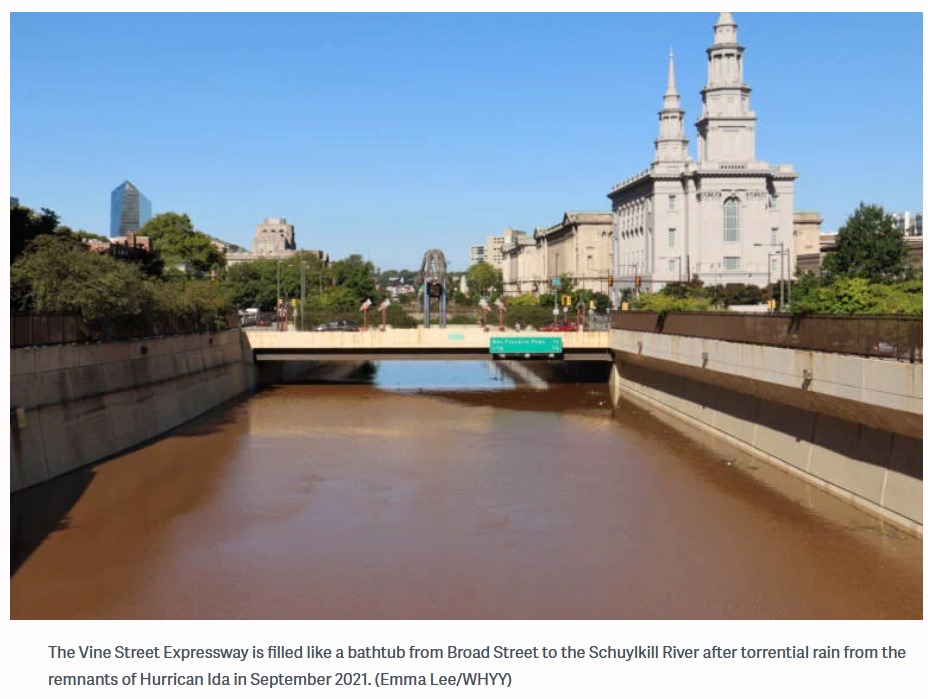
All of my life I have located my office and bedrooms in the uppermost southern exposure (preferably in the tree canopy.) I love sunlight, elevation, trees, fresh air, and wildlife. It is becoming ever more obvious my dreamlife is coming to an end, and I will be forced to tunnel under. For those forward thinkers, think about your poop. Pumping sewage above ground level will be a major problem at all times. In addition, the inability to pump flood water will become deadly during extreme weather events. In July of 2020 NPR reported, “The remnants of Hurricane Ida dropped unprecedented rainfall on several eastern states, killing dozens of people. Eleven of them were Queens residents who died when their basement apartments flooded.” In August of 2022 CNN reported, “Seoul has vowed to move some of the city’s poorest families out of underground and semi-subterranean homes after 13 people were killed in flooding caused by record rainfall this week, sparking public horror and calls for government accountability.” Drowning in your own poop may result for those unprepared.

There will be enough ice melt to raise sea levels 220 feet. We estimate 270 feet to be “the minimum safe” elevation to live. High-tides, waves, coastal flooding, storm surge, grade of shoreline, etc. would make the lowest elevations for living space to be at least 270 feet above pre-industrial sea levels. This would be the minimum elevation. Personally, I would not want to live that low. As the water submerges sewage treatment plants, landfills, chickens, cows, and all sorts of other bio-hazards, the waters will become toxic. In addition, much of the land will experience salinization making it unfit for plant life. Another concern for elevations under 800 feet is living on an island. Many locations at lower elevations will become isolated. Living on an island has many problems including fresh water, food, shelter, and healthcare. Security from pirates pilfering, raping, and plundering will likely be the overriding concern. Of course, I don’t expect that to happen for millennia, but I hope government planners do plan for it now. If you look at Florida as an example, parts of the coastline have seen sea levels rise over 14-20 feet in the last decade. Although the storm surge was only for hours, you wouldn’t want to live there during those hours. Not to mention, the frequency of these extreme weather events will rise exponentially. Thus, our recommendation to evacuate Florida now (i.e. Managed Retreat). The billions of dollars spent to rebuild after Hurricane Ida will all be for naught. Allowing building there will needlessly endanger property and lives. Parts of the world have already seen storm surges of 40 feet. I expect most North American coastlines will see sea levels rise, if only temporarily, by 20-40 feet this century. As far as long run sea level rise, much will depend on location, gravity, isostatic adjustment, and thermal expansion. If the ocean temperatures get warm enough (thermal expansion), parts of the world may see sea levels rise to 270 feet for long periods of times. Other parts of the world, like Greenland, may actually see sea levels decline. In any event, the Earth crossed tipping points this decade which make extreme sea level rise inevitable and irreversible in our lifetimes. Planners should plan on it.

Sidd reiterated, “That 270 feet will take a long time. I would be more careful about the violent rain than the ice melt.” Expect to see increasing intensity and/or frequency in a wide variety of violent rain events including: downpours, flooding, hurricanes, cyclones, monsoons, coastal flooding, storm surges, lightning and wildfires, hail, extreme wind, and concurrent extremes. The reign of violent rain has already begun. More hillsides and shorelines are collapsing. Atmospheric rivers are dramatically increasing flash flooding in the Northeastern USA. Worldwide, stormwater systems are becoming overwhelmed. Ironically, the streets of Abu Dhabi and Dubai, UAE, flooded days before the COP28 Climate Conference. Nowhere is safe from violent rain, not even in the desert preparing for a UN meeting on the climate crisis. As a result of increasing violent rain, new drainage culverts are forming. Eventually, the culverts will transform into recurring streams, carving new canyons, creating new landscapes and islands. In addition, extreme weather events are increasing the frequency of lightning storms and wildfires. After wildfires, rain deluges cause massive landslides transforming the topography. At the same time as the violent rain makes its way to the sea, the sea is rising to meet the violent rain.

In the article “Violent Rain and the Substrate,” Greg Laden, coastal archaeologist, said, “With a little erosion, the Hudson, Lake Champlain, and the St. Lawrence could become contiguous, so New England becomes an Island.”

For any remaining humans, fresh air, water, food, and sunlight will all be problematic; however, your most severe concern will likely be security. Those with supplies will be at high risk of being raped and looted. Good luck!

* Our climate model employs chaos theory to comprehensively consider human impacts and projects a potential global average temperature increase of 9℃ above pre-industrial levels.

What Can I Do?
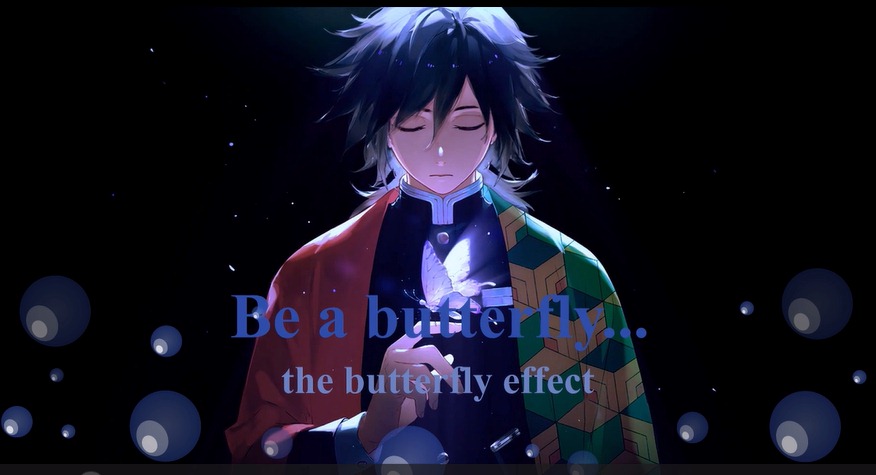
There are numerous actions you can take to contribute to saving the planet. Each person bears the responsibility to minimize pollution, discontinue the use of fossil fuels, reduce consumption, and foster a culture of love and care. Be a butterfly and affect the world. The Butterfly Effect illustrates that a small change in one area can lead to significant alterations in conditions anywhere on the globe. Hence, the frequently heard statement that a butterfly in China can cause a hurricane in the Atlantic.

About the End

bookmark_borderTunnel Under (Into the Light)

[Intro]
[Instrumental]
[Drum Solo]
[Bridge]
Diggity, dig, dig
Dig it

[Verse 1]
In the world of planning, control, and management
We’re navigating through a complex arrangement
Forecasting’s the key to our precision
But chaos brews, causing a division

[Pre-Chorus]
Digital control, security, pollution’s plight
They’re shaking up our forecasting fight

[Chorus]
Tunnel under thesis, the future’s veiled
Decentralization, our course set, unassailed
As we navigate this chaotic sea
The tunnel under thesis sets us free
Free to be
Free

[Break]
[Bridge]
Diggity, dig, dig
Dig it

[Verse 2]
Digital distribution, losing its grip
As underground tech starts to rip
Peer-to-peer networks, music swapping sites
Traditional control put to the test in these fights

[Pre-Chorus]
Security measures, wars waged on fear
Driving us to decentralize, the path is clear

[Chorus]
Tunnel under thesis, the future’s veiled
Decentralization, our course set, unassailed
As we navigate this chaotic sea
The tunnel under thesis sets us free
Free to be
See?

[Break]

[Bridge]
Governments seek to maintain their hold
But their methods bring forth the underground mold
Encrypted data tunnels, communication webs
The tunnel under thesis, breaking old webs

[Break]
[Bridge]
Diggity, dig, dig
Dig it

[Verse 3]
Pollution’s grip tightens, climate’s change nears
Deforestation, compounding our fears
Chaos in weather, chaos in the skies
The tunnel under thesis, our beacon in the rise
Surprise!

[Pre-Chorus]
Security measures, wars waged on fear
Driving us to decentralize, the path is clear

[Chorus]
Tunnel under thesis, the future’s veiled
Decentralization, our course set, unassailed
As we navigate this chaotic sea
The tunnel under thesis sets us free
Free to be
See?

[Outro]
So as we face the chaos, the uncertainty
The tunnel under thesis, our guiding key
Through digital storms and pollution’s might
We tunnel underground, into the light
Alright
Light

[End]
[Silence]

ABOUT THE SCIENCE OF FORESEEING
Title: The Impact of Governance & Globalization on Forecasting
(The Tunnel Under Theory)
by D. Brouse, M. Hammel, and S. Mukherjee

Introduction
Originally published in 1995, this study offers a global forecast projecting a Social Justification scenario where humans find themselves compelled to “tunnel underground.”
Abstract: The Tunnel Under Thesis

Planning and control are integral functions of management. Once a plan is established, it must be executed. The effectiveness of plan control is contingent upon the quality of the plan itself. The ability to forecast events and trends accurately and precisely is pivotal to the quality of the planning function.

Forecasting methodologies, including qualitative analyses, time series analysis & projection, and econometric models, are extensively utilized across U.S. businesses and governmental agencies.

The interplay of three key factors—control of digital distribution, security, and pollution—is poised to render traditional forecasting tools and methods increasingly unreliable:

  • control of digital distribution
  • security
  • pollution

Control of Digital Distribution
Existing systems for controlling data communications and digital distribution are showing signs of failure. Attempts by owners of traditional systems to maintain control are likely to spur the development of underground technologies.

Examples include peer-to-peer networks and music swapping websites.

Security
Government efforts to combat globally organized illicit activities such as drugs or terrorism often result in significant collateral damage to citizens, infrastructure, and governance systems.

The Patriot Act and the Homeland Security Department are instances where the U.S. Federal Government’s attempt to control, based on forecasting methods, has led to unintended consequences. These repercussions compel both good and bad actors to decentralize their activities, giving rise to encrypted data tunnels and underground communication networks.

State governments, grappling with challenges in controlling tax receipts due to digital distribution of goods and services, may inadvertently foster the development of decentralized business systems. This exacerbates existing inadequacies in municipal government accounting systems.

Pollution
Pollution, with greenhouse gases being a major threat, is driving irreversible climatic change. Some perceive land clearing as a form of pollution, while deforestation exacerbates the global warming crisis.

Chaos theory suggests that meteorological forecasting will face similar challenges to economic forecasting. Given the close relationship between weather and the economy, heightened volatility is anticipated in both domains.

Global warming, along with issues such as insect-borne and zoonotic viruses, particulate matter and ozone pollution, exposure to ultraviolet radiation, nuclear fallout, reforms to flood insurance, wildfires, and other weather-related phenomena, portend a more literal interpretation of “tunneling under.”

About the End

bookmark_borderHappy for a While

[Intro]
[Flute]
Happy, can’t help but smile
So happy
Hope you’ll stay, hear a while
Happy
Oh so happy, can’t help but smile
For a while

[Bridge]
From ear-to-ear
Hear
Hear
Right here

[Break]
[Guitar Solo]
[Verse 1]]
Guitar far and near
Near and far
What’s there not to like?
A bizarre bazaar
Complainers take a hike
Sustainers, alright!

[Break]
[Bridge]
Take us to the light
We’ll tunnel us out
The End’s insight
We’re just about…
Right here
Hear, right?
Hear!

[Verse 2]
Wish upon a star
Shared bizarre bazaar
Shines both near and far
Delight of twilight
… into the night

[Bridge]
Take us to the light
We’ll tunnel us out
The End’s insight
We’re just about…
Right here
Hear, right?
Hear!

[Break]

[Chorus]
Happy, can’t help but smile
So happy
Hope you’ll stay, hear a while
Happy, you and me
Oh so happy, can’t help but smile
For a while

[Break]
[Verse 3]
Wish upon a star
Doesn’t matter who you are
Priceless, bizarre bazaar
Where you can dance all night

[Bridge]
Take us to the light
We’ll tunnel us out
The End’s insight
We’re just about…
Right here
Hear, right?
Hear!

[Break]

[Chorus]
Happy, can’t help but smile
So happy
Hope you’ll stay, hear a while
Happy, you and me
Oh so happy, can’t help but smile
For a while

[Outro]
Can you smile for a while?
Smile!
Can you smile for a while?
Smile….

[End]

[Silence]

ABOUT THE SONG
This study was originally published in 1995. In essence, it is a global forecast that predicts a Social Justification in which humans will force themselves to “tunnel underground“. Help us dig out and see the light!

From the album Speciman and the Experiments: Experiments in the Fine Line Between

bookmark_borderBest of Videos

Live from KingArthur.com….

bookmark_borderUntil the Dawn

LYRICS
(Verse 1)
Autumn whispers of a world unbound,
Where ice sheets crumble, no solace found.
Greenland’s tears, West Antarctica’s cries,
As melting shores meet relentless skies.

(Chorus)
What will become of our habitat’s plight?
As boiling tides rise, eclipsing the night.
Violent rain pounds, carving new streams,
As Earth’s fever rises, in feverish dreams.

(Verse 2)
Copernicus speaks of mind-bending heat,
As nations tremble, beneath nature’s beat.
Assets crumble, harvests fade away,
In the relentless heat of a changing day.
(Chorus)
(Bridge)
A 1.5-degree leap, a world ablaze,
Urgency screams, in a desperate haze. (World ablaze)
As violent rain reigns, across the land, (Understand?)
The future’s cast by an unforgiving hand. (ComprehEND?)

(Verse 3)
Hillsides crumble, shorelines drown in dread,
As violent rain reigns, upon our heads.
Deserts flood, in defiance of sky,
As the world grapples with a climactic goodbye.
(Chorus)
(Outro)
In the wake of chaos, and uncertainty’s stare,
We must unite, in a world laid bare.
As the seas rise, and the storms rage on,
We’ll face the challenges, until the dawn.

Chords: Em Am / Em Am C B7 Em / C D Em / D Em Em/9; Part II Heavy Metal / Rock Ballad @ 116 Beats Per Minute
Instrumentation: Vocals (TC-Helicon VOICELIVE and MiniNova Vocorder), Ibanez Acoustic Guitar (AW54CE), Ibanez Electric RG-270 (Vox ToneLab and Boss Digital Delay), Fender Jazz Bass (Boss Digital Delay), Keyboards (Korg PS60, Casio WK-3500, Yamaha PSR-740, MiniNova, MicroKorg)

ABOUT THE SONG
The above lyrics are a collaboration with ChatGBT. The song was composed using the information under “ABOUT THE SCIENCE” that was written by Daniel Brouse and Sidd Mukherjee.

ABOUT THE SCIENCE
By the Autumn of 2023, it had become evident the West Antarctic and Greenland ice sheets will completely melt. The process is irreversible and inevitable. What can Earthlings expect to happen to their habitat?

The most rapid sea level rise.

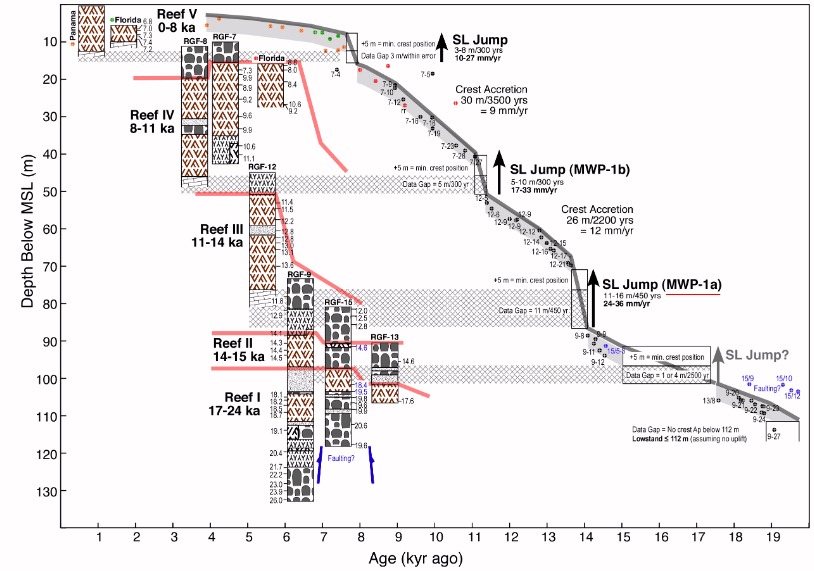
In The Reign of Violent Rain, Sidd said, “Now I am thinking the violent rain will be a bigger problem before we die… still thinking it through. In the long run, yes, sea level rise will hit big. If you look at the history, it is episodic, and in the fast bits it can go up 3 feet every twenty years for five hundred years (See MWP-1A in fig. 3, supplement). But, the rain intensity is increasing faster today, and drainage cannot cope, whether in the city or out, culverts and such put in over the last hundred years cannot handle. So, I am paying a lot of attention to terrain and drainage far inland from the seacoast (like Ohio.)

In the paper, Sea level and global ice volumes from the Last Glacial Maximum to the Holocene, Kurt Lambeck states, “The major cause of sea-level change during ice ages is the exchange of water between ice and ocean and the planet’s dynamic response to the changing surface load.”

On November 20, 2023, the UN’s Emission Gap Report found even if countries carried out their current emissions-reduction pledges, the world would likely continuously exceed +3C degrees of warming this century. Later that day, the International Cryosphere Climate Initiative released State of the Cryosphere Report 2023 saying, “Two degrees is too high. Our message — the message of the Cryosphere — is that this insanity cannot and must not continue. The melting point of ice pays no attention to rhetoric, only to our actions.”

What does this mean about our current human induced climate change?
1) We should expect to see rising sea levels.
2) Approximately half of the current sea level rise is due to thermal expansion. As water gets warmer, it expands. NASA says, “About half of the measured global sea level rise on Earth is from warming waters and thermal expansion.”
3) There is a very complex set of climate systems impacted by sea level rise. The shape of the Earth is changing and speeding up as ice from the poles melts and is drawn toward the equator through centrifugal and gravitational forces, as well as, glacial isostatic adjustment. A study published in Geophysical Research Letters of the American Geophysical Union suggests that global warming has led to significant melting of glaciers due to which our planet’s axis of rotation has been moving faster since the 1990s.

All of this has a great impact on our weather. The rain intensity is increasing faster today than ever known. The cool water from the melting ice at the poles is being drawn toward the center of the Earth and getting warmed to record high temperatures. The warm, moist air is circulating and moving over land. These changes in climate systems will cause other areas to experience unprecedented drought. The Amazon River and the Panama Canal recorded their lowest water levels on record during 2023.

What do we expect to happen?
The Long Run
Long run sea level rise New Jersey Coast

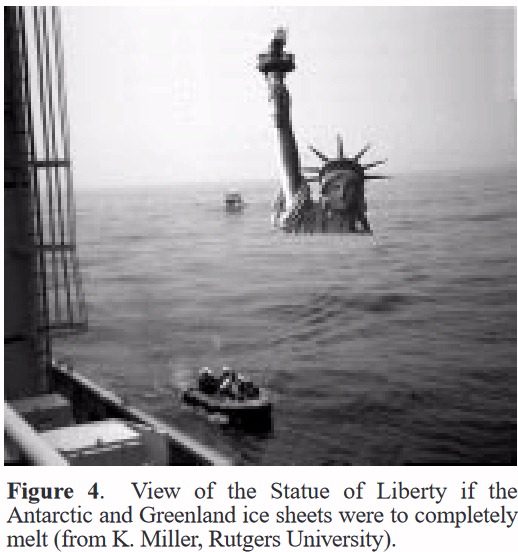
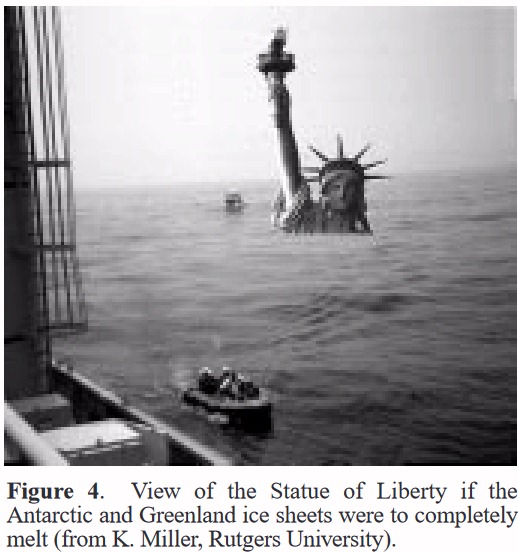
We expect sea level rise will total about 270 feet over the next several millennia. In 1998, the State of New Jersey published Sea Level Rise in New Jersey with a depiction of the Statue of Liberty with 270 feet in sea level rise.

In the last melting of the glacial maximum, the first 500 years saw a “pulse” of high rate sea level rise of about 500 years duration resulting in about a 66 foot rise in sea levels.

A high rate of sea-level rise starting at ∼14.5 ka BP of ∼500 y duration. The onset occurs at the start of the Bølling−Allerød warm period. Its duration could be <500 y because of uncertainties in chronology, and the globally averaged rise in sea level of ∼20 m occurs at a rate of ∼40 mm⋅y−1 or greater. This pulse, MWP-1A, has been identified separately in the records of Barbados, Sunda , and Tahiti. Spatial variation in its amplitude can be expected because of the planet’s elastic and gravitational response to rapid unloading of ice in either or both of the two hemispheres with, based on the ice−earth models used here, model-predicted values ranging from ∼14 m for Barbados to ∼20 m for Tahiti. This compares with observational values of ∼15–20 m for Barbados and 12–22 m for Tahiti. Observational uncertainties remain large, including differences in the timing of this event as recorded at the different localities, and it is not possible from this evidence to ascertain the relative importance of the contribution of the two hemispheres to MWP-1A.

We expect to see a similar pattern in the long run.

Our estimate of 270 feet is based on “the safe” elevation to live — high-tides, waves, coastal flooding, storm surge, grade of shoreline, etc. would make the lowest elevations for living space to be at least 270 feet above pre-industrial sea levels. This would be the minimum elevation. Personally, I would not want to live that low. As the water submerges sewage treatment plants, landfills, chickens, cows, and all sorts of other bio-hazards, the waters will become toxic. In addition, much of the land will experience salinization making it unfit for plant life. Another concern for elevations under 800 feet is living on an island. Many locations at lower elevations will become isolated. Living on an island has many problems including fresh water, food, shelter, and healthcare. Security from pirates pilfering, raping, and plundering will likely be the overriding concern. Of course, I don’t expect that to happen for millennia, but I hope government planners do plan for it now. If you look at Florida as an example, parts of the coastline have seen sea levels rise over 14-20 feet in the last decade. Although the storm surge was only for hours, you wouldn’t want to live there during those hours. Not to mention, the frequency of these extreme weather events will rise exponentially. Thus, our recommendation to evacuate Florida now (i.e. Managed Retreat). The billions of dollars spent to rebuild after Hurricane Ida will all be for naught. Allowing building there will needlessly endanger property and lives. Parts of the world have already seen storm surges of 40 feet. I expect most North American coastlines will see sea levels rise, if only temporarily, by 20-40 feet this century. As far as long run sea level rise, much will depend on location, gravity, isostatic adjustment, and thermal expansion. If the ocean temperatures get warm enough (thermal expansion), parts of the world may see sea levels rise to 270 feet for long periods of times. Other parts of the world, like Greenland, may actually see sea levels decline. In any event, the Earth crossed tipping points this decade which make extreme sea level rise inevitable and irreversible in our lifetimes. Planners should plan on it.

Sidd reiterated, “That 270 feet will take a long time. I would be more careful about the violent rain than the ice melt.”

INTERPRETATION OF SCIENCE AND SONG
This song paints a vivid picture of the devastating effects of climate change, using powerful imagery and emotive language to convey the urgency of the crisis.

In the opening verse, the imagery of autumn whispers and crumbling ice sheets sets the tone for a world in turmoil. The tears of Greenland and West Antarctica symbolize the profound grief of the natural world as it faces destruction at the hands of humanity.

The chorus poses a haunting question about the fate of our habitat, as boiling tides rise and violent rain carves new streams. The repetition of “Earth’s fever rises” emphasizes the escalating nature of the crisis and the urgent need for action.

Verse 2 introduces the scientific perspective, with references to Copernicus and the mind-bending heat felt around the world. The imagery of crumbling assets and fading harvests highlights the real-world consequences of climate change on communities and economies.

The bridge amplifies the sense of urgency, describing a world ablaze with a 1.5-degree leap in temperature. The imagery of violent rain reigning across the land underscores the destructive power of extreme weather events driven by climate change.

Verse 3 continues the theme of destruction, with hillsides crumbling and shorelines drowning under the onslaught of violent rain. The defiance of deserts flooding speaks to the unpredictability and chaos unleashed by climate change.

The outro leaves listeners with a sense of determination in the face of uncertainty, urging unity in the face of the challenges ahead. The imagery of rising seas and raging storms underscores the magnitude of the crisis, while also hinting at the resilience of humanity in the face of adversity.

Overall, this song serves as a powerful reminder of the urgent need for action on climate change, drawing on both scientific knowledge and emotive storytelling to convey the gravity of the situation.

4D Music: Songs About Science

A song about The Human Induced Climate Change Experiment

bookmark_borderUrgency Screams!

LYRICS
(Verse 1)
The era of warming ends, boiling tides arise,
The UN’s warning, spoken with sighs.
Global temperatures soaring, records fall,
As climate change’s grip tightens, on us all.

(Chorus)
What will the “End of Times” look like?
As feedback loops spin, tipping points strike.
Plants fade, carbon sinks vanish from sight,
As Earth’s fever rises, into the night.

(Verse 2)
Copernicus speaks of mind-blowing heat,
September’s record shattered, under our feet.
Assets crumble, harvests wither away,
As we face the truth of our reckless play.
(Chorus)
(Bridge)
A 1.5-degree leap, in Earth’s embrace,
Urgency screams, in every race.
Violent rain pounds, carving new streams,
As landscapes shift, in chaotic dreams.

(Verse 3)
Hillsides crumble, shorelines disappear,
As the reign of violent rain draws near.
Deserts flood, as if to defy,
Even there, climate’s relentless cry.
(Chorus)
(Outro)
In this world of chaos, and despair,
Survival’s grip, hangs in the air.
As we face a future, uncertain and dire,
We must unite, before the fire.
Aspire higher!
What will the “End of Times” look like?
Aspire higher!

Chords: Em G D Em / Em C B7 Em / Em/7/7(11) jam / Em G C Em; Part II Hard Rock / Digi-Rock @ 120 Beats Per Minute
Instrumentation: Vocals (TC-Helicon VOICELIVE and MiniNova Vocorder), Ibanez Acoustic Guitar (AW54CE), Ibanez Electric RG-270 (Vox ToneLab and Boss Digital Delay), Fender Jazz Bass (Boss Digital Delay), Keyboards (Korg PS60, Casio WK-3500, Yamaha PSR-740, MiniNova, MicroKorg)

ABOUT THE SONG
The above lyrics are a collaboration with ChatGBT. The song was composed using the information under “ABOUT THE SCIENCE” that was written by Daniel Brouse and Sidd Mukherjee.

ABOUT THE SCIENCE

What will the “End of Times” look like?

“The era of global warming has ended and the era of ‘global boiling’ has arrived. Climate change is here. It is terrifying. And it is just the beginning”, UN secretary general, António Guterres, said after scientists confirmed July 2023 was on track to be the world’s hottest month on record.

Climate breakdown, the most alarming development, occurs when feedback loops are triggered, and tipping points are crossed. This leads to the extinction of plants, the disappearance of carbon sinks, and an exponential acceleration of Earth’s temperature. The consequences are dire, with the potential disappearance of vital resources like food, fresh water, and breathable air, likely followed by catastrophic impacts on human survival.

In October 2023, the European Space Agency’s Copernicus Climate Change Service reported that the average temperature for September hit 16.38 degrees Celsius, surpassing the previous record set in September 2020 by 0.5 degrees Celsius. Copernicus Director Carlo Buontempo described it as “mind-blowing” and emphasized the devastating impacts on people and ecosystems, citing destruction of assets, infrastructure, and harvests. “What we are observing, are not only new extremes but the persistence of these record-breaking conditions, and the impacts these have on both people and planet, are a clear consequence of the warming of the climate system,” Director Buontempo said.

By January 2024, the Earth had experienced an alarming annual average temperature increase of over 1.5 degrees Celsius. This temperature rise continued in February 2024, with a monthly average reaching 1.77 degrees above pre-industrial levels, occurring centuries earlier than previously predicted. The urgency to address and combat climate change has never been more critical.

Sidd reiterated, “That 270 feet will take a long time. I would be more careful about the violent rain than the ice melt.” Expect to see increasing intensity and/or frequency in a wide variety of violent rain events including: downpours, flooding, hurricanes, cyclones, monsoons, coastal flooding, storm surges, lightning and wildfires, hail, extreme wind, and concurrent extremes. The reign of violent rain has already begun. More hillsides and shorelines are collapsing. Atmospheric rivers are dramatically increasing flash flooding in the Northeastern USA. Worldwide, stormwater systems are becoming overwhelmed. Ironically, the streets of Abu Dhabi and Dubai, UAE, flooded days before the COP28 Climate Conference. Nowhere is safe from violent rain, not even in the desert preparing for a UN meeting on the climate crisis. As a result of increasing violent rain, new drainage culverts are forming. Eventually, the culverts will transform into recurring streams, carving new canyons, creating new landscapes and islands. In addition, extreme weather events are increasing the frequency of lightning storms and wildfires. After wildfires, rain deluges cause massive landslides transforming the topography. At the same time as the violent rain makes its way to the sea, the sea is rising to meet the violent rain.

In the article “Violent Rain and the Substrate,” Greg Laden, coastal archaeologist, said, “With a little erosion, the Hudson, Lake Champlain, and the St. Lawrence could become contiguous, so New England becomes an Island.”

For any remaining humans, fresh air, water, food, and sunlight will all be problematic; however, your most severe concern will likely be security. Those with supplies will be at high risk of being raped and looted. Good luck!

* Our climate model employs chaos theory to comprehensively consider human impacts and projects a potential global average temperature increase of 9℃ above pre-industrial levels.

What Can I Do?
There are numerous actions you can take to contribute to saving the planet. Each person bears the responsibility to minimize pollution, discontinue the use of fossil fuels, reduce consumption, and foster a culture of love and care. Be a butterfly and affect the world. The Butterfly Effect illustrates that a small change in one area can lead to significant alterations in conditions anywhere on the globe. Hence, the frequently heard statement that a butterfly in China can cause a hurricane in the Atlantic.

LYRIC AND SCIENCE INTERPRETATION
ChatGBT’s interpretation of “our” lyrics:
This song vividly portrays the escalating crisis of climate change, evoking a sense of urgency and impending catastrophe.

The opening verse sets the scene with imagery of boiling tides and soaring temperatures, emphasizing the gravity of the situation as the Earth’s climate reaches a tipping point. The UN’s warning underscores the seriousness of the issue, as global records are shattered and the effects of climate change tighten their grip on humanity.

The chorus poses a haunting question about the “End of Times,” highlighting the devastating consequences of unchecked climate change. It paints a grim picture of disappearing ecosystems and escalating temperatures, as Earth’s fever continues to rise.

The second verse brings attention to the scientific evidence behind climate change, referencing reports from organizations like Copernicus and the dire impact on agriculture and infrastructure. It emphasizes the recklessness of human actions and the need to confront the truth of our collective responsibility.

The bridge intensifies the urgency of the message, emphasizing the rapid acceleration of climate change and the destructive power of extreme weather events. It paints a picture of landscapes transforming in the face of chaotic environmental shifts.

The third verse delves into the immediate impacts of climate change, with imagery of crumbling hillsides and disappearing shorelines. It highlights the global reach of the crisis, even affecting traditionally arid regions like deserts.

The chorus repeats, driving home the message of impending catastrophe and the urgent need for action.

The outro leaves listeners with a sense of uncertainty and desperation, emphasizing the need for unity in the face of existential threats posed by climate change. It urges collective action before it’s too late, leaving an echo of hope amidst the chaos.

What you can do today. How to save the planet.

4D Music: Songs About Science

A song about The Human Induced Climate Change Experiment

bookmark_borderTo Reach the End

LYRICS
(Verse 1)
Pushing and shoving, we race to the end,
But what message do we hope to send?
In our pursuit of more, we’ve lost our way,
Me, my, mine, dominating the fray.
(Chorus)
Neglecting reason, rejecting rhyme,
We’re running out of space, running out of time.
The Earth cries out, her voice a plea,
To halt our madness and set her free.
(Verse 2)
Consuming voraciously, without a thought,
The consequences of our actions, often forgot.
Nature’s rhythms disrupted by our greed,
As we sow the seeds of our own misdeed.
(Chorus)
(Bridge)
But amidst the chaos, a glimmer of light,
A chance to change our course, to make it right.
Let’s pause, let’s listen, let’s realign,
And weave a future where all can shine.
(Verse 3)
Together we stand, against the tide,
To protect the Earth, our precious guide.
For in unity lies our greatest strength,
To heal the planet, no matter the length.
(Chorus)
(Outro)
So let’s rewrite the story, let’s change the trend,
And journey together, towards a brighter End.
With compassion and care, let’s mend the line,
And embrace a world with harmonies fine.

Chords: F# E / B D F# B / B F# F# B / D E F# / F# C# B F#; Part Reggae Trip-Hop II @ 90 Beats Per Minute
Instrumentation: Vocals (TC-Helicon VOICELIVE and MiniNova Vocorder), Ibanez Acoustic Guitar (AW54CE), Keyboards (Korg PS60, Casio WK-3500, Yamaha PSR-740, MiniNova, MicroKorg)

ABOUT THE SONG
This song serves as a poignant commentary on humanity’s destructive impact on the environment and the urgent need for collective action to address climate change.

The opening verse paints a picture of a society driven by relentless pursuit of material gain, where individualism reigns supreme and the consequences of our actions are disregarded in favor of short-term gratification.

The chorus highlights the dire situation we find ourselves in, as we neglect reason and continue to exploit the Earth’s resources at an unsustainable rate. The Earth is personified as a sentient being crying out for relief from the damage we have inflicted upon her.

The second verse delves deeper into the destructive nature of human consumption and the disregard for the interconnectedness of all life on Earth. Our greed and disregard for the natural world have disrupted delicate ecosystems and set us on a path of self-destruction.

The bridge offers a glimmer of hope amidst the despair, emphasizing the potential for positive change if we can muster the courage to realign our priorities and work towards a sustainable future where all beings can thrive.

The third verse calls for unity in the face of adversity, recognizing that only by coming together can we hope to protect the planet and heal the damage that has been done. It emphasizes the strength that lies in collective action and the importance of standing up against the forces of destruction.

The outro serves as a rallying cry for action, urging listeners to rewrite the story of our relationship with the planet and embark on a journey towards a brighter future. It emphasizes the need for compassion and care in our interactions with the natural world and calls for a renewed commitment to living in harmony with the Earth.

Overall, this song serves as a powerful reminder of the urgent need for action to address climate change and the importance of collective responsibility in safeguarding the planet for future generations.

ABOUT THE SCIENCE

What will the “End of Times” look like?

“The era of global warming has ended and the era of ‘global boiling’ has arrived. Climate change is here. It is terrifying. And it is just the beginning”, UN secretary general, António Guterres, said after scientists confirmed July 2023 was on track to be the world’s hottest month on record.

In the 1990’s, we wrote a paper on the worst-case scenario entitled, “The Impact of Governance & Globalization on Forecasting (The Tunnel Under Thesis).” The theory predicted that forecasting would become increasingly difficult. “The result — a figurative, as well as, literal tunneling underground.”

Since that time, forecasting has become increasing more difficult. “In general, as energy is added to a system, the fluctuations in the system increase. So, we expect more storms, more droughts, more wildfires, more floods, more fluctuations of all kinds. What we are saying is that weather conditions will become more volatile due to the impact of humans,” said Mukherjee and Brouse. (2004)

In a report published in Nature entitled Over half of known human pathogenic diseases can be aggravated by climate change, data analyst and associate professor in the Department of Geography and Environment at the University of Hawaii Manoa, Camilo Mora, said climate hazards aggravated 58% of all known human pathogens. That is over half of infectious diseases discovered since the end of the Roman Empire. 58% of an authoritative list of infectious diseases documented to have impacted humanity have already been shown to be aggravated by climatic hazards — a finding the researchers found “shocking,” Mora said.

Movement of people and animals caused by climate is one factor. Warming at higher latitudes allowed vectors and pathogens to survive winter is another factor. The report goes on to say, “The human pathogenic diseases and transmission pathways aggravated by climatic hazards are too numerous for comprehensive societal adaptations, highlighting the urgent need to work at the source of the problem: reducing GHG (Greenhouse Gas) emissions.”

This research reveals more evidence that humans will have difficulty adapting to climate change, especially those in developing countries, Mora said. “The magnitude of the vulnerability when you think about one or two diseases — okay, sure, we can deal with that,” he said. “But when you’re talking about 58% of the diseases, and 58% of those diseases can be affected or triggered in 1,000 different ways. So that, to me, was also revealing of the fact that we’re not going to be able to adapt to climate change.”

In 2023, we wrote about having crossed tipping points in the paper, “Climate Change: How Long Is ‘Ever’?“. When we wrote the Tunnel Under Thesis in 1995, we forecast crossing these tipping points would not happen for centuries. We underestimated Man’s ignorance and arrogance. Fossil fuel consumption and greenhouse gas emissions have continued to set record highs. Humans have caused chain-reactions resulting in toppled tipping points, feedback loops, and The Domino Effect.

Events we thought would not happen in our lifetimes are happening now. My last resort emergency plan was to escape to Canada. (I am a dual citizen.) This summer that plan literally went up in smoke. “Beginning in March 2023, and with increased intensity starting in June, Canada has been affected by an ongoing, record-setting series of wildfires.” — Wikipedia

All of my life I have located my office and bedrooms in the uppermost southern exposure (preferably in the tree canopy.) I love sunlight, elevation, trees, fresh air, and wildlife. It is becoming ever more obvious my dreamlife is coming to an end, and I will be forced to tunnel under. For those forward thinkers, think about your poop. Pumping sewage above ground level will be a major problem at all times. In addition, the inability to pump flood water will become deadly during extreme weather events. In July of 2020 NPR reported, “The remnants of Hurricane Ida dropped unprecedented rainfall on several eastern states, killing dozens of people. Eleven of them were Queens residents who died when their basement apartments flooded.” In August of 2022 CNN reported, “Seoul has vowed to move some of the city’s poorest families out of underground and semi-subterranean homes after 13 people were killed in flooding caused by record rainfall this week, sparking public horror and calls for government accountability.” Drowning in your own poop may result for those unprepared.

There will be enough ice melt to raise sea levels 220 feet. We estimate 270 feet to be “the minimum safe” elevation to live. High-tides, waves, coastal flooding, storm surge, grade of shoreline, etc. would make the lowest elevations for living space to be at least 270 feet above pre-industrial sea levels. This would be the minimum elevation. Personally, I would not want to live that low. As the water submerges sewage treatment plants, landfills, chickens, cows, and all sorts of other bio-hazards, the waters will become toxic. In addition, much of the land will experience salinization making it unfit for plant life. Another concern for elevations under 800 feet is living on an island. Many locations at lower elevations will become isolated. Living on an island has many problems including fresh water, food, shelter, and healthcare. Security from pirates pilfering, raping, and plundering will likely be the overriding concern. Of course, I don’t expect that to happen for millennia, but I hope government planners do plan for it now. If you look at Florida as an example, parts of the coastline have seen sea levels rise over 14-20 feet in the last decade. Although the storm surge was only for hours, you wouldn’t want to live there during those hours. Not to mention, the frequency of these extreme weather events will rise exponentially. Thus, our recommendation to evacuate Florida now (i.e. Managed Retreat). The billions of dollars spent to rebuild after Hurricane Ida will all be for naught. Allowing building there will needlessly endanger property and lives. Parts of the world have already seen storm surges of 40 feet. I expect most North American coastlines will see sea levels rise, if only temporarily, by 20-40 feet this century. As far as long run sea level rise, much will depend on location, gravity, isostatic adjustment, and thermal expansion. If the ocean temperatures get warm enough (thermal expansion), parts of the world may see sea levels rise to 270 feet for long periods of times. Other parts of the world, like Greenland, may actually see sea levels decline. In any event, the Earth crossed tipping points this decade which make extreme sea level rise inevitable and irreversible in our lifetimes. Planners should plan on it.

Sidd reiterated, “That 270 feet will take a long time. I would be more careful about the violent rain than the ice melt.” Expect to see increasing intensity and/or frequency in a wide variety of violent rain events including: downpours, flooding, hurricanes, cyclones, monsoons, coastal flooding, storm surges, lightning and wildfires, hail, extreme wind, and concurrent extremes. The reign of violent rain has already begun. More hillsides and shorelines are collapsing. Atmospheric rivers are dramatically increasing flash flooding in the Northeastern USA. Worldwide, stormwater systems are becoming overwhelmed. Ironically, the streets of Abu Dhabi and Dubai, UAE, flooded days before the COP28 Climate Conference. Nowhere is safe from violent rain, not even in the desert preparing for a UN meeting on the climate crisis. As a result of increasing violent rain, new drainage culverts are forming. Eventually, the culverts will transform into recurring streams, carving new canyons, creating new landscapes and islands. In addition, extreme weather events are increasing the frequency of lightning storms and wildfires. After wildfires, rain deluges cause massive landslides transforming the topography. At the same time as the violent rain makes its way to the sea, the sea is rising to meet the violent rain.

In the article “Violent Rain and the Substrate,” Greg Laden, coastal archaeologist, said, “With a little erosion, the Hudson, Lake Champlain, and the St. Lawrence could become contiguous, so New England becomes an Island.”

For any remaining humans, fresh air, water, food, and sunlight will all be problematic; however, your most severe concern will likely be security. Those with supplies will be at high risk of being raped and looted. Good luck!

* Our climate model employs chaos theory to comprehensively consider human impacts and projects a potential global average temperature increase of 9℃ above pre-industrial levels.

What Can I Do?
There are numerous actions you can take to contribute to saving the planet. Each person bears the responsibility to minimize pollution, discontinue the use of fossil fuels, reduce consumption, and foster a culture of love and care. Be a butterfly and affect the world. The Butterfly Effect illustrates that a small change in one area can lead to significant alterations in conditions anywhere on the globe. Hence, the frequently heard statement that a butterfly in China can cause a hurricane in the Atlantic.

Here is a list of additional actions you can take.
4D Music: Songs About Science

A song about The Human Induced Climate Change Experiment

bookmark_border98.6

LYRICS
If we ever get in the clear
Then we’ve got to get out of here
Masses of gases
Making my temperature rise
Bulging eyes as the brain fries
Making my temperature rise
Can’t cry too dry
Making my temperature rise

If we ever get out of here
Then we’re near the “all’s clear”
Masses of gases
Making my temperature rise
Bulging eyes as the brain fries
Making my temperature rise
Can’t cry too dry
Making my temperature rise

Until we get out of here
Hear that we have yet to fear
Masses of gases
Making my temperature rise
Bulging eyes as the brain fries
Making my temperature rise
Can’t cry too dry
Making my temperature rise

Chords: E F G / G F# E / E’s; Part II Double Boogie @ 164 Beats Per Minute
Instrumentation: Vocals (TC-Helicon VOICELIVE and MiniNova Vocorder), Ibanez Acoustic Guitar (AW54CE), Fender Jazz Bass (Boss Digital Delay), Keyboards (Korg PS60, Casio WK-3500, Yamaha PSR-740, MiniNova, MicroKorg)

ABOUT THE SONG
This song “98.6” vividly portrays the intense and deadly effects of extreme heat, particularly focusing on the concept of wet-bulb temperature and its implications for human survival in the context of climate change. The repetition of the phrase “Making my temperature rise” underscores the urgency and intensity of the situation. The reference to “Masses of gases” suggests the role of greenhouse gases in exacerbating the heat, highlighting the link to human activities and climate change. The imagery of “bulging eyes” and “brain fries” paints a distressing picture of the physical and cognitive impacts of extreme heat, emphasizing the life-threatening nature of the situation. Overall, the song captures the ominous and oppressive atmosphere of deadly humid heat and the urgent need to address climate change to mitigate its devastating effects.

ABOUT THE SCIENCE
Greenhouse gases themselves are not inherently toxic to humans in the concentrations typically found in the atmosphere. However, their role in trapping heat and contributing to global warming and climate change can have detrimental effects on human health and the environment. For example, the increased temperatures associated with higher levels of greenhouse gases can lead to more frequent and severe heatwaves, which can cause heat-related illnesses and even death, particularly in vulnerable populations such as the elderly and those with pre-existing health conditions. Additionally, changes in climate patterns influenced by greenhouse gases can impact air and water quality, alter ecosystems, and lead to more extreme weather events, all of which can indirectly affect human health and well-being. Therefore, while greenhouse gases themselves may not be toxic, their effects on the environment can have significant health implications.

The greatest health risk from climate change to those alive today is the increased moisture content in the air (relative humidity) combined with the increased temperatures.

A Wet-bulb measures the temperature read by a thermometer covered in a wet cloth. As water evaporates from the cloth, evaporation cools the thermometer. This mirrors how the human body cools itself with sweat. The higher the heat and humidity (heat index), the harder it is for sweat to evaporate. The study Adaptability Limit to Climate Change Due to Heat Stress found that a wet-bulb temperature of 35C (95F) at 100% humidity, or 115F at 50% humidity, would be the upper limit of safety, beyond which the human body can no longer cool itself by evaporating sweat from the surface of the body to maintain a stable body core temperature.

The United Nations DRR says:
For every degree Celsius in warming, the water-holding capacity of the atmosphere increases by about 7%. Record-high sea temperatures ensure there is more moisture (in the form of water vapor) in the atmosphere, by an estimated 5-15% compared to before the 1970s, when global temperature rise began in earnest.

Deadly humid heat affects billions including the US Midwest this century. “It’s very disturbing,” study co-author Matthew Huber of Purdue University. “It’s going to send a lot of people to emergency medical care.” The study Greatly enhanced risk to humans as a consequence of empirically determined lower moist heat stress tolerance was conducted by Purdue and George Mason University and published August 15, 2023.

These results indicate that a significant portion of the world’s population will experience — for the first time in human history — prolonged exposures to uncompensable extreme moist heat. Humans will struggle to adapt to these conditions in a warmer world as they will present widespread challenges across many aspects of food-energy-water security, human health, and economic development including in the world’s most populous and most vulnerable regions.

At 3C (5.4F) of yearly average warming, more than 1.5 billion people will suffer. In the summer of 2023, the Earth experienced about a month of warming at 3C above pre-industrial levels. Both 2022 and 2023 saw a record number of heat related deaths. More than 61,000 Europeans died from extreme heat in the summer of 2022.

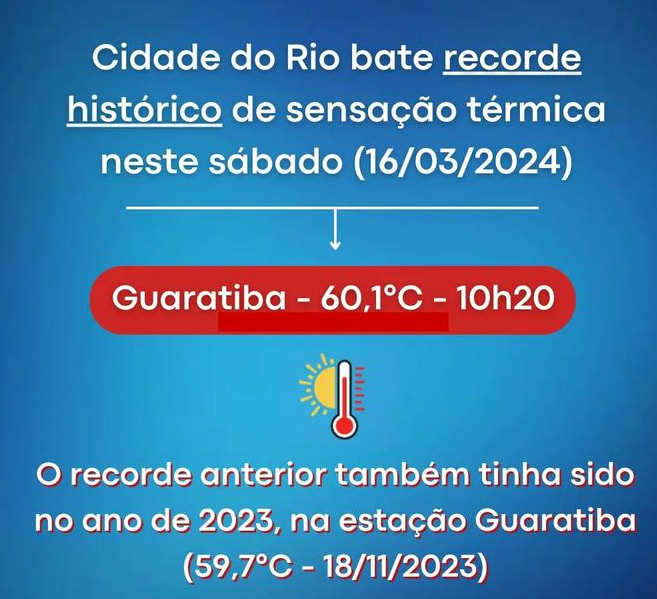
The average temperature for Brazil had been above the historical average from July through October of 2023. Rio de Janeiro recorded 42.5C on November 12, 2023 (a record for November) and high humidity on the 14th meant that it felt like 58.5C, municipal authorities said. The combination of heat and humidity is the greatest climate change risk to human health. On November 17, “a young Brazilian fan of US singer Taylor Swift died in Rio de Janeiro after falling ill inside the sweltering stadium where the superstar’s concert was held, amid a record-breaking heatwave across large swathes of Brazil,” as reported by ABC. “The show took place on the same day that Rio recorded its highest-ever heat index reading, which combines temperature and humidity, at 59.3 degrees Celsius (139 degrees Fahrenheit).”

The Water Vapor Feedback Problem
Water vapor is a powerful greenhouse gas. Since the 1970s, its rise likely increased global heating by an amount comparable to that from rising carbon dioxide. We are now seeing the consequences. In the current climate, for average all-sky conditions, water vapour is estimated to account for 50% of the total greenhouse effect, carbon dioxide 19%, ozone 4% and other gases 3%. Clouds make up about a quarter of the greenhouse effect.

The main greenhouse gases — carbon dioxide, methane, nitrous oxide and ozone — don’t condense and precipitate. Water vapor does, which means its lifetime in the atmosphere is much shorter, by orders of magnitude, compared to other greenhouse gases. On average, water vapor only lasts nine days. The increased intensity of precipitation often results in violent rain.

Sidd said, “The biggest feedback loop is water vapor. Humans put CO2 in the air. CO2 is a greenhouse gas, so the earth gets warmer. Warmer air can hold more water vapor soaking up more water vapor from the oceans. Water vapor is a greenhouse gas, so it gets even warmer… rinse (sorry!) and repeat. Another interesting thing is that the precipitation (rain, snow, sleet) intensity is increasing.”

Due to climate change humans will experience greater loss and damage to life and quality of life from air pollution, decreasing supply of potable water, extreme weather events, and disease. The greatest short term climate change risk to human health is deadly humid heat (wet-bulb temperature).

* Our climate model uses chaos theory in an attempt to adequately account for humans and forecasts a global average temperature increase of 9 degrees Celsius above pre-industrial levels. Everybody has the responsibility not to pollute. There are plenty of things you can do to help save the planet. Stop using fossil fuels. Consume less. Love more. Here is a list of additional actions you can take.
Climate Change and Deadly Humid Heat Brouse (2023)

4D Music: Songs About Science

A song about The Human Induced Climate Change Experiment

bookmark_borderFamily Barbecue

LYRICS
Today’s the day
Record hot
So they say
All we’ve got

Chorus:
There’s going to be a barbecue
Involving me
Involving you
Too late to wake
We’re going to bake
Sadly see
“For goodness sake”

Today’s the day
Record heat
It’s not O.K.
Ruins the beat… the beat… the beat
(chorus)

Today’s the day
Record broke
Lost our way
The fires stoke
(chorus)

Chords: F# C# B F# / C# B F# / B F# C#7 F#; Part II 83 to 110 BPM
Instrumentation I: Vocals, Takamine Acoustic Guitar
Written and recorded at Lake Wynonah, Pennsylvania on a summer-like day in March.
Instrumentation II: Vocals (TC-Helicon VOICELIVE and MiniNova Vocorder), Ibanez Acoustic Guitar (AW54CE), Fender Squire Mini Electric Guitar (Boss Digital Delay and VOX ToneLab), Fender Jazz Bass (Boss Digital Delay), Keyboards (Korg PS60, Casio WK-3500, Yamaha PSR-740, MiniNova, MicroKorg)

ABOUT THE SONG
This song “Family Barbecue” serves as a poignant commentary on the impact of climate change, particularly focusing on the extreme heat and its consequences.

The repeated phrase “Today’s the day” emphasizes the immediacy and urgency of the situation, suggesting that the effects of climate change are being felt in the present moment. “Record hot” and “record heat” highlight the extreme temperatures that are occurring, indicating a departure from normal conditions.

The metaphor of a “barbecue” evokes images of heat, discomfort, and potential danger, mirroring the intensity of the heatwave described in the song. The phrase “All we’ve got” underscores the sense of helplessness or resignation in the face of these extreme conditions.

The chorus emphasizes the inevitability of the situation, suggesting that it is “too late to wake” and that individuals are resigned to “bake” in the heat. The use of the phrase “For goodness sake” conveys a sense of frustration or disbelief at the severity of the situation.

Overall, “Family Barbecue” serves as a sobering reminder of the reality of climate change and its impact on daily life, urging listeners to recognize the urgency of addressing this pressing issue.

ABOUT THE SCIENCE
Human-induced climate change is a dynamic component of an intricate and unordered system, as per chaos theory. This implies that global warming is accelerating exponentially in a complex manner. Over the period from 1992 to 2023, we have presented compelling evidence, proposed remedies to mitigate climate change, and amassed valuable information through the engagement of millions with this climate model. Your participation has been invaluable. The incontrovertible data underscores that human-induced climate change is rapidly deteriorating our habitat.

Our climate model / experiment employs chaos theory to comprehensively consider human impacts and projects a potential global average temperature increase of 9℃ above pre-industrial levels. Global warming is a consequence of elevated thermal energy in the climate system, which comprises various subsystems. Chaos theory underscores the intricate and nonlinear nature of dynamic systems. Human well-being is compromised above a 1.5-degree temperature rise, rendering much of the Earth uninhabitable. A 9-degree Celsius increase would bring the Earth close to a wet-bulb temperature incapable of sustaining human life.

What Can I Do? There are numerous actions you can take to contribute to saving the planet. Each person bears the responsibility to minimize pollution, discontinue the use of fossil fuels, reduce consumption, and foster a culture of love and care. The Butterfly Effect illustrates that a small change in one area can lead to significant alterations in conditions anywhere on the globe. Hence, the frequently heard statement that a fluttering butterfly in China can cause a hurricane in the Atlantic. Be a butterfly and affect the world.

Here is a list of additional actions you can take.
4D Music: Songs About Science

A song about The Human Induced Climate Change Experiment

bookmark_borderOn My Way

LYRICS
I can’t resume to consume
As though it’s yesterday
Should I assume there is room
To obtain O.K.?
If so, I’m on my way

Chorus:
On my way
Into today
On my way
Toward the day
When we can say
All’s O.K.

Pursue to refrain to “to consume”
As though time will resume
It’s a crime to breed doom
No, it’s not O.K.
Let’s hope help is on the way
(chorus)

Consequences of consume loom
The reaper counts the days
As we encourage gloom
Best change our ways
Or else End in a blaze
(chorus)

Chords: Am D7 / D7 C Am / Am Em Am; Part II Heavy Metal Twist @ 164 BPM
Instrumentation: Vocals, Takamine Acoustic Guitar; Part II Vocals (TC-Helicon VOICELIVE and MiniNova Vocorder), Keyboards (Korg PS60, Casio WK-3500, Yamaha PSR-740, MiniNova, MicroKorg)
Part I written and recorded at Lake Wynonah, Pennsylvania

ABOUT THE SONG
These lyrics convey a sense of reflection on past actions and a desire for positive change in the face of potential consequences. The singer expresses a reluctance to resume the same consumption patterns as before, suggesting a recognition of the impact of past behaviors. The use of “On my way” and the chorus implies a commitment to move forward into a better future, aspiring toward a day when everything is deemed okay. The lyrics also touch on the urgency of addressing environmental issues, hinting at potential dire consequences if actions are not altered. Overall, the song encourages a shift in behavior for the greater good and a more sustainable future.

THE SCIENCE
“Human well-being is compromised above a 1.5-degree temperature rise, rendering much of the Earth uninhabitable.” — Daniel and Sidd

March 7, 2024
“According to Copernicus, the average global surface air temperature in February was 13.54 degrees Celsius (roughly 56.4 degrees Fahrenheit). That is 1.77 degrees Celsius above the pre-industrial average for February, leading it to become the ninth consecutive month where each month was the warmest on record globally.”

Our climate model employs chaos theory to comprehensively consider human impacts and projects a potential global average temperature increase of 9℃ above pre-industrial levels. Global warming is a consequence of elevated thermal energy in the climate system, which comprises various subsystems. Chaos theory underscores the intricate and nonlinear nature of dynamic systems. Human well-being is compromised above a 1.5-degree temperature rise, rendering much of the Earth uninhabitable. A 9-degree Celsius increase would bring the Earth close to a wet-bulb temperature incapable of sustaining human life.

What Can I Do? There are numerous actions you can take to contribute to saving the planet. Each person bears the responsibility to minimize pollution, discontinue the use of fossil fuels, reduce consumption, and foster a culture of love and care. Consume less. Consumer habits have played a significant role in damaging the world’s environment and economies. The insatiable demands of mass consumption have led to the exploitation of natural resources and the emission of pollution and greenhouse gases. In many instances, it’s feasible to choose not to consume certain products entirely. Travel, fashion, and meat are examples of areas where consumption could be minimized. Reducing overall consumption is the most impactful individual contribution towards eliminating pollution and mitigating the effects of climate change. The critical aspect of reducing consumption is to cease burning fossil fuels and using hydrocarbon products immediately. (Hydrocarbons encompass plastics, polymers, petroleum, and natural gas.)

The Butterfly Effect illustrates that a small change in one area can lead to significant alterations in conditions anywhere on the globe. Hence, the frequently heard statement that a fluttering butterfly in China can cause a hurricane in the Atlantic. Be a butterfly and affect the world.

The Butterfly Effect / Be a Butterfly

What you can do today. How to save the planet.

A song about The Human Induced Climate Change Experiment