bookmark_borderThreshold

Threshold.mp3
Threshold.mp4
Threshold-Pt-2.mp3
Threshold-Pt-2.mp4
Threshold-intro.mp3

[Verse 1]
Cascading feedbacks
(Our wisdom lacks)
Probabilistic future
(The allure is unsure)

[Chorus]
Threshold
(Reality’s grabbin’ hold)
Threshold
(Can’t say we weren’t told)

[Bridge]
The inevitable
(Is irreversible)

[Verse 2]
The Domino Effect
(Causing a real wreck)
Keep knocking down
(All around)

[Chorus]
Threshold
(Reality’s grabbin’ hold)
Threshold
(Can’t say we weren’t told)

[Bridge]
The inevitable
(Is irreversible)

[Chorus]
Threshold
(Reality’s grabbin’ hold)
Threshold
(Can’t say we weren’t told)

[Outro]
Threshold
(Has grabbed hold)
Same ole story
(Has gotten old)
No more glory
(In our history)
The inevitable
(Is irreversible)

ABOUT THE SONG AND SCIENCE

Climate thresholds — often called tipping points — are critical boundaries within Earth’s systems. Once crossed, the system shifts into a new state that sustains and accelerates its own change, even without additional human forcing. These thresholds mark the divide between a climate we can influence directly and one that begins to spiral beyond our control.

Climate Thresholds and Self-Sustaining Change

A tipping point is reached when gradual pressure (such as rising CO₂, warming oceans, or ecosystem degradation) overwhelms the stabilizing forces within a system. Once crossed, positive feedbacks dominate:

  • Arctic warming melts sea ice → darker ocean absorbs more heat → faster warming.

  • Permafrost thaws → methane release → additional warming → deeper thaw.

  • Ice shelves collapse → glaciers accelerate → sea level rises → more destabilization.

These aren’t linear responses. They are phase shifts — abrupt transitions into new climate states that can persist for centuries to millennia.


Cascading Feedbacks: The Domino Effect

Tipping points rarely occur in isolation. When one destabilizes, it increases stress on others. This chain reaction — the Domino Effect — reflects how interconnected Earth’s climate systems truly are.

Examples of cascading interactions:

• Heat ↔ Fire ↔ Carbon Cycle Breakdown
Rising temperatures intensify droughts and wildfires.
Wildfires generate aerosols and tropospheric ozone that suppress photosynthesis.
Reduced plant uptake increases atmospheric CO₂.
Higher CO₂ drives more heat, more drought, and more fire — a self-reinforcing cycle.

• Cryosphere ↔ Ocean Circulation ↔ Weather Extremes
Melting Greenland and Antarctic ice dilutes and disrupts ocean circulation patterns (e.g., AMOC).
Weakened circulation destabilizes weather systems, amplifying flooding, heatwaves, and crop failures.
These impacts accelerate ice loss — closing the loop.

• Sea-Level Rise ↔ Coastal Collapse ↔ Societal Instability
As sea levels rise and glaciers retreat, coastlines erode and infrastructure fails.
The economic and political fallout delays mitigation, ensuring even higher emissions.
Societal feedbacks feed back into environmental collapse.

These are compound, interacting feedbacks, not separate problems. Once multiple loops reinforce each other, the climate behaves like a complex adaptive system moving into runaway disequilibrium.


A Probabilistic Future

Because these interactions amplify one another, future climate trajectories cannot be captured by linear models or single-variable projections. Instead, the system behaves stochastically:

  • risks compound,

  • uncertainties grow asymmetrically,

  • and tail-risk outcomes (the worst-case scenarios) become more probable.

This is why modern ensemble modeling treats climate futures in probabilistic terms — because once feedback loops activate, Earth’s climate begins evolving according to internal dynamics we no longer fully control.

Tipping points and feedback loops are parts of an equation that determine the rate of acceleration in climate change and are critical to understanding the Domino Effect of Climate Collapse.

The Human Induced Climate Change Experiment

From the album “Brink

bookmark_borderTipping Point

Tipping-Point.mp3
Tipping-Point.mp4
Tipping-Point-Pt-2.mp3
Tipping-Point-Pt-2.mp4
Tipping-Point-intro.mp3

[Intro]
How’s your viewpoint
(Can you see clearly)
Toppled tipping point
(Look to see reality)

[Verse 1]
Pushed to edge
(Broke our pledge)
Reached a critical point
(For total disjoint)

[Chorus]
How’s your viewpoint
(Can you see clearly)
Toppled tipping point
(Look to see reality)

[Bridge]
Whoopeeeeee
Hey, Ma
(Look at me)
Na, na, na, na, na

[Verse 2]
You can watch all
(The dominoes fall)
The fall is inevitable
(No, no longer questionable)

[Chorus]
How’s your viewpoint
(Can you see clearly)
Toppled tipping point
(Look to see reality)

[Bridge]
Whoopeeeeee
Hey, Ma
(Look at me)
Na, na, na, na, na

[Chorus]
How’s your viewpoint
(Can you see clearly)
Toppled tipping point
(Look to see reality)

[Outro]
Whoopeeeeee
Hey, Ma
(Look at me)
Na, na, na, na, na
I’m in free-fall
(Of the downfall)
This joint…
(Crossed the tipping point)

ABOUT THE SONG AND SCIENCE

Understanding Tipping Points

Tipping points and feedback loops are key factors in determining the rate of acceleration of climate change. When one tipping point is breached and triggers others to fall, the result is known as the Domino Effect.

To explain: push a glass slowly toward the edge of a table. Eventually, no matter how cautious you are, it will reach a critical point where it tips over and falls. Once the tipping point is crossed, the fall is inevitable–regardless of your intentions or beliefs.

Climate tipping points operate the same way. They are not a matter of opinion, but of science. Once breached, they lead to rapid, self-perpetuating change that is difficult–often impossible–to reverse.

What Are Climate Tipping Points?

Climate tipping points mark thresholds in Earth’s systems beyond which change becomes self-sustaining. These shifts push the climate into a new and often irreversible state–without requiring further human influence.

Many of these tipping points have already been crossed. For instance:

  • Methane released from beneath melting Arctic ice cannot be re-sequestered.

  • Alpine glaciers formed over 25,000 years ago are gone and will not return for millennia.

  • Permafrost is thawing across the Northern Hemisphere, from Alaska to Siberia, unleashing carbon and methane, destabilizing landscapes, and destroying ecosystems.

The Iberdrola Group reports, “Melting Siberian permafrost is turning tundra into muddy, barren terrain, starving local wildlife. Water bodies vanish as their bases thaw, worsening drought conditions.”

These are not isolated incidents. They mark the formation of positive feedback loops–like methane release accelerating further warming, which causes more methane to be released. The cycle feeds itself.

Evidence of Crossed Tipping Points

In 2019, Professor Tim Lenton of the University of Exeter warned:

“A decade ago we identified a suite of potential tipping points in the Earth system. Now we see evidence that over half of them have been activated… It is no longer responsible to wait and see.”

Some already-active or dangerously close tipping points include:

  • Greenland and East Antarctic Ice Sheet collapse

  • Mountain glacier loss

  • Atlantic Meridional Overturning Circulation (AMOC)

  • Amazon rainforest dieback

  • Arctic sea ice loss

  • Boreal forest degradation

  • Permafrost thaw

  • Warm-water coral bleaching

  • West Antarctic Ice Sheet instability

AMOC Tipping Point Crossed?
Until recently, the collapse of the AMOC was projected centuries away. But in July 2023, Nature Communications published “Warning of a forthcoming collapse of the Atlantic Meridional Overturning Circulation.” The data now projects AMOC collapse around 2050 under current emissions scenarios.

This collapse could accelerate sea level rise along the U.S. East Coast, intensify storms in Europe, and increase drought in West Africa. Prof. Stefan Rahmstorf warned:

“Climate history shows AMOC changes have led to some of the most abrupt and extreme temperature shifts. We must avoid disrupting it at all costs.”

Feedback Loops and Cascading Tipping Points

In Climate Change: How Long Is “Ever”?, we wrote:

“Extreme weather will increase. Coastlines will vanish. The most troubling shift, however, is the emergence of feedback loops–where plants and carbon sinks die off, accelerating warming independently of human activity.”

Sidd Mukherjee noted:

“That’s just one study. The window is between 2025 and 2095. I suspect we’ll be seeing many unpleasant surprises before then.”

The Domino Effect
When one tipping point triggers another, the domino effect begins. For example:

  • Melting mountain glaciers contribute to sea level rise.

  • This rise disrupts ocean circulation (AMOC).

  • AMOC disruption weakens rainfall in the Amazon.

  • Amazon dieback reduces carbon sequestration, amplifying global warming.

The Journal Science study “Triggering Multiple Climate Tipping Points” confirms:

“Even 1°C of global warming–the level we’ve already exceeded–risks triggering multiple tipping points.”

Each tenth of a degree beyond this increases the risk dramatically. Yet the world is on track for 2-3°C of warming–well above the Paris Agreement’s 1.5°C goal.

Cascading Crisis: Tipping Points Triggering Tipping Points

Climate scientist Sidd Mukherjee warned:

“Remember: these thresholds come with error bars. What we think might tip at 1.5°C may already be tipped at 1°C.”

This appears to be happening now.

For example:

  • Sea ice loss exposes darker ocean surfaces.

  • These absorb more heat, leading to more ice loss.

  • This heat also accelerates methane release from thawing permafrost.

  • Thawing permafrost releases yet more methane, feeding the loop.

In July 2023, the global temperature briefly reached 3°C above pre-industrial levels–an unprecedented and alarming milestone.

Conclusion: The Window is Closing

Adapted from Exceeding 1.5°C Global Warming Could Trigger Multiple Climate Tipping Points (Sept. 2022):

We are now living with the reality of crossed tipping points. Some systems–like AMOC, Arctic sea ice, and permafrost–may already be in irreversible decline. These shifts will affect the Earth for thousands of years, regardless of future emissions cuts.

The imperative is clear: We must act not only to reduce emissions, but to halt the cascade of tipping points before they spiral out of control.

URGENT CLIMATE WARNING
Our probabilistic, ensemble-based climate model — which incorporates complex socio-economic and ecological feedback loops within a dynamic, nonlinear system — projects that global temperatures are becoming unsustainable this century. This far exceeds earlier estimates of a 4°C rise over the next thousand years, highlighting a dramatic acceleration in global warming. We are now entering a phase of compound, cascading collapse, where climate, ecological, and societal systems destabilize through interlinked, self-reinforcing feedback loops.

At this level of heating, large regions of the planet will become uninhabitable due to extreme heat, sea level rise, agricultural collapse, and mass migration. Critically, parts of the U.S. are already experiencing wet-bulb temperatures approaching or exceeding 31°C (87.8°F) — a physiological limit beyond which the human body can no longer regulate its internal temperature, even in the shade with ample water.

This is no longer a distant threat. The climate system is entering a phase of compound risk and cascading collapse — and we are already seeing the early signs.

Immediate, radical mitigation and adaptation efforts are now essential to preserve habitable zones, food systems, and public health.

Tipping points and feedback loops are parts of an equation that determine the rate of acceleration in climate change and are critical to understanding the Domino Effect of Climate Collapse.

The Human Induced Climate Change Experiment

From the album “Brink

bookmark_borderPinnacle’s Precipice

Pinnacles-Precipice-Best-Of.mp3
Pinnacles-Precipice-Best-Of.mp4
Pinnacles-Precipice.mp3
Pinnacles-Precipice.mp4
Pinnacles-Precipice-Pt-2.mp3
Pinnacles-Precipice-Pt-2.mp4
Pinnacles-Precipice-Unplugged-Underground-XXVIII.mp3
Pinnacles-Precipice-Unplugged-Underground-XXVIII.mp4
Pinnacles-Precipice-intro.mp3

[Intro]
(What is this?)
At the pinnacle’s precipice….

[Verse 1]
Man, would you look at man
(At the top of his game)
Yet it’s hard to understand
(If it’s just in name)

[Chorus]
Climbing higher (and higher)
Trying to fulfill desire (higher)
A race to the top
(To a drastic stop)

[Bridge]
Do we know what priceless is?
(What is this?)
At the pinnacle’s precipice….

[Verse 2]
Say, what’s going on today
(With the level playing field)
Have we lost our way
(To the dark side yield?)

[Chorus]
Climbing higher (and higher)
Trying to fulfill desire (higher)
A race to the top
(To a drastic stop)

[Bridge]
Do we know what priceless is?
(What is this?)
At the pinnacle’s precipice….

[Chorus]
Climbing higher (and higher)
Trying to fulfill desire (higher)
A race to the top
(To a drastic stop)

[Outro]
Have we forgot
(What we wrought)
Do we know what priceless is?
(This is:)
The pinnacle’s precipice
(The pinnacle… of our precipice)
[Instrumental, Whistle Solo]

ABOUT THE SONG
“Pinnacle’s precipice” is not a standard English idiom but a powerful, descriptive phrase created by combining two strong metaphors that represent contradictory ideas:
* Pinnacle: The highest point of achievement, success, power, or development (a peak or summit).
* Precipice: The edge of a very steep cliff or the brink of a dangerous, disastrous situation.

Therefore, “the pinnacle’s precipice” is a rhetorical or literary expression that describes a situation of being at the absolute peak of success while simultaneously standing at the immediate brink of total collapse, failure, or disaster. It is a moment of extreme vulnerability at the highest point of one’s fortune.

Metaphorical Meaning
The phrase captures the inherent instability of being at the very top:
* The Height of Danger: It suggests that the higher you climb (figuratively, in a career, a civilization, or a moment in history), the more dangerous the potential fall becomes.
* The Inevitability of Change: It alludes to the philosophical concept of impermanence (nothing lasts forever). A peak can only be a peak for a moment before the inevitable decline begins.
* A Critical Moment: Being on the “precipice” means being very close to a significant, critical turning point or drastic change.

A good example of this concept is man at the top of the world while man’s ignorance and arrogance has pushed the climate to its brink.

The events of 2024–2025 reveal the limits of incremental mitigation. Stabilizing Earth’s climate now demands more than emission reductions — it requires active carbon removal, ecosystem restoration, and an immediate global phase-out of fossil fuels.

As the planet’s natural stabilizers fail, humanity faces a critical juncture: continue deferring action or act decisively to preserve habitability. The evidence is unequivocal — the feedback loops have tipped, the tipping points have cascaded, and the window for prevention is rapidly closing.

* Our probabilistic, ensemble-based climate model — which incorporates complex socio-economic and ecological feedback loops within a dynamic, nonlinear system — projects that global temperatures are becoming unsustainable this century. This far exceeds earlier estimates of a 4°C rise over the next thousand years, highlighting a dramatic acceleration in global warming. We are now entering a phase of compound, cascading collapse, where climate, ecological, and societal systems destabilize through interlinked, self-reinforcing feedback loops.

What Can I Do?
The single most important action you can take to help address the climate crisis is simple: stop burning fossil fuels. There are numerous actions you can take to contribute to saving the planet. Each person bears the responsibility to minimize pollution, discontinue the use of fossil fuels, reduce consumption, and foster a culture of love and care. The Butterfly Effect illustrates that a small change in one area can lead to significant alterations in conditions anywhere on the globe. Hence, the frequently heard statement that a fluttering butterfly in China can cause a hurricane in the Atlantic. Be a butterfly and affect the world.

Solutions to the Fossil Fuel Economy and the Myths Accelerating Climate and Economic Collapse.


Tipping points and feedback loops drive the acceleration of climate change. When one tipping point is toppled and triggers others, the cascading collapse is known as the Domino Effect.

The Human Induced Climate Change Experiment


From the album “Brink

bookmark_borderAn Extreme Edge

An-Extreme-Edge-Best-Of.mp3
An-Extreme-Edge-Best-Of.mp4
An-Extreme-Edge.mp3
An-Extreme-Edge.mp4
An-Extreme-Edge-intro.mp3

[Intro]
On the edge
(Of extreme)
Know what I mean?
(Purge before the dirge)

[Verse 1]
What do you deem extreme
(Living on the edge of life)
What do you dream the scene
(A life rife with strife?)

[Chorus]
On the edge
(Of extreme)
Know what I mean?
(Purge before the dirge)

[Bridge]
On the extreme edge
(Of humanity’s pledge)
“Promise… and hope to die”
(Why?)

[Verse 2]
Is your dream too extreme
(Living live or let die)
Closing your eyes to seen
(Why bother to try)

[Chorus]
On the edge
(Of extreme)
Know what I mean?
(Purge before the dirge)

[Bridge]
On the extreme edge
(Of humanity’s pledge)
“Promise… and hope to die”
(Why?)

[Chorus]
On the edge
(Of extreme)
Know what I mean?
(Purge before the dirge)

[Outro]
Or all fall
(Think extinct)
On the extreme edge
(Of humanity’s pledge)
“Promise… and hope to die”
(Why?)
When we could choose love
(Above)
… choose love.

ABOUT THE SONG AND THE SCIENCE: Foster a Culture of Love and Care

Q: What is happening with climate change?
A: It is accelerating at an exponential rate — far faster than the public narrative or old models suggest.

For years, the world was taught to focus on “holding global warming to 1.5°C.” But that number has quietly become meaningless. Not only have we likely crossed it already, the real danger is not the temperature itself — it is the tipping points that crossing that threshold has set in motion. These tipping points have triggered cascading, self-reinforcing feedback loops that are now reshaping Earth’s systems with unprecedented speed.

We are not approaching a climate crisis.
We are living inside its accelerating phase.

A Planet in Nonlinear Transition

These are not distant projections.
These are real-time runaway feedbacks already visible across ecosystems, oceans, and the atmosphere.

The climate system is now governed by compound nonlinear interactions:

  • Arctic amplification

  • ocean heat accumulation

  • ozone stress

  • runaway wildfires

  • permafrost collapse

  • accelerating hydrological extremes

Each amplifies the others in ways models struggle to capture.

The central scientific question is no longer:

“Will feedback loops accelerate warming?”

It is now:

“How much time is left before cascading feedbacks overwhelm natural and human systems?”

Our research is focused on precisely this:
mapping the speed, scale, and irreversibility of climate feedbacks — and determining how close Earth is to thresholds that will define the trajectory of human civilization.

* Our probabilistic, ensemble-based climate model — which incorporates complex socio-economic and ecological feedback loops within a dynamic, nonlinear system — projects that global temperatures are becoming unsustainable this century. This far exceeds earlier estimates of a 4°C rise over the next thousand years, highlighting a dramatic acceleration in global warming. We are now entering a phase of compound, cascading collapse, where climate, ecological, and societal systems destabilize through interlinked, self-reinforcing feedback loops.

What Can I Do?
The single most important action you can take to help address the climate crisis is simple: stop burning fossil fuels. There are numerous actions you can take to contribute to saving the planet. Each person bears the responsibility to minimize pollution, discontinue the use of fossil fuels, reduce consumption, and foster a culture of love and care.  The Butterfly Effect illustrates that a small change in one area can lead to significant alterations in conditions anywhere on the globe. Hence, the frequently heard statement that a butterfly in China can cause a hurricane in the Atlantic. Be a butterfly and affect the world.
Here is a list of additional actions you can take.

Tipping points and feedback loops drive the acceleration of climate change. When one tipping point is breached and triggers others, the cascading collapse is known as the Domino Effect.

The Climate Crisis: Violent Rain | Deadly Humid Heat | Health Collapse | Extreme Weather Events | Insurance | Trees and Deforestation | Soil | Rising Sea Level | Food and Water | Updates

The Human Induced Climate Change Experiment

From the album “Brink

bookmark_borderEverything but the Kitchen Brink

Everything-but-the-Kitchen-Brink.mp3
Everything-but-the-Kitchen-Brink.mp4
Everything-but-the-Kitchen-Brink-Reggae.mp3
Everything-but-the-Kitchen-Brink-Reggae.mp4
Everything-but-the-Kitchen-Brink-intro.mp3

[Intro]
Shout!
(Throwin’ out)
What do you think
(Everything but the kitchen brink)

[Verse 1]
Sit around the breakfast table
(Wonderin’ if we’ll be able)
To figure out peace (and harmony)
Or at least… (some humanity)

[Break]
Shout!
(Throwin’ out)
What do you think
(Everything but the kitchen brink)

[Chorus]
Bail faster
(Don’t wanna sink)
To avoid disaster
(Bail faster)
Or drink…
(Drink, drink, drink)

[Bridge]
Swim!
(’cause we’re fallin’ in)

[Verse 2]
Through out the baby
(With the bath water)
No, it’s not a “maybe”
(Your son… or our daughter)

[Break]
Shout!
(Throwin’ out)
What do you think
(Everything but the kitchen brink)

[Chorus]
Bail faster
(Don’t wanna sink)
To avoid disaster
(Bail faster)
Or drink…
(Drink, drink, drink)

[Outro]
Swim!
(’cause we’re fallin’ in)

ABOUT THE SONG

Health feedback loops, violent rain, and deadly humid heat are fueling an exponential rise in climate-related deaths. This lethal triad — disease, extreme heat, and intense rainfall — demonstrates that climate change is not a distant threat but a rapidly accelerating public health emergency. These stressors interact and amplify one another, creating a cascade of compounding impacts that demand urgent intervention.

All 50 U.S. states — including Alaska — are already experiencing deadly humid heat advisories. Large regions of the country are becoming uninhabitable for weeks or even months each year due to extreme heat. Wet-bulb temperatures are approaching 31°C (87.8°F) in multiple states — a physiological threshold beyond which sustained outdoor survival is impossible, even with water and shade. Meanwhile, violent rain events are killing hundreds and causing billions in annual damage. Climate-driven health feedback loops have become the leading cause of mortality in the United States — fueled by systemic interactions between temperature extremes, air quality degradation, disease vectors, and infrastructure collapse. Addressing climate change is no longer just an environmental imperative — it is a public health necessity.

* Our probabilistic, ensemble-based climate model — which incorporates complex socio-economic and ecological feedback loops within a dynamic, nonlinear system — projects that global temperatures are becoming unsustainable this century. This far exceeds earlier estimates of a 4°C rise over the next thousand years, highlighting a dramatic acceleration in global warming. We are now entering a phase of compound, cascading collapse, where climate, ecological, and societal systems destabilize through interlinked, self-reinforcing feedback loops.

We examine how human activities — such as deforestation, fossil fuel combustion, mass consumption, industrial agriculture, and land development — interact with ecological processes like thermal energy redistribution, carbon cycling, hydrological flow, biodiversity loss, and the spread of disease vectors. These interactions do not follow linear cause-and-effect patterns. Instead, they form complex, self-reinforcing feedback loops that can trigger rapid, system-wide transformations — often abruptly and without warning. Grasping these dynamics is crucial for accurately assessing global risks and developing effective strategies for long-term survival.

What Can I Do?Solutions to the Fossil Fuel Economy and the Myths Accelerating Climate and Economic Collapse.

There are numerous actions you can take to contribute to saving the planet. Each person bears the responsibility to minimize pollution, discontinue the use of fossil fuels, reduce consumption, and foster a culture of love and care. The Butterfly Effect illustrates that a small change in one area can lead to significant alterations in conditions anywhere on the globe. Hence, the frequently heard statement that a fluttering butterfly in China can cause a hurricane in the Atlantic. Be a butterfly and affect the world.

What you can do today. How to save the planet.

From the album “Brink

Also found on the album “Reggae Getaway

bookmark_borderPlight of the Penguin

Plight-of-the-Penguin-Best-Of.mp3
Plight-of-the-Penguin-Best-Of.mp4
Plight-of-the-Penguin-Unplugged.mp3
Plight-of-the-Penguin-Unplugged.mp4
Plight-of-the-Penguin.mp3
Plight-of-the-Penguin.mp4
Plight-of-the-Penguin-Unplugged-Underground-XXVIII.mp3
Plight-of-the-Penguin-Unplugged-Underground-XXVIII.mp4
Plight-of-the-Penguin-intro.mp3

[Intro]
Flight of the bumble bee
(Are you kidding me?)
Oh, no, no I’m talkin’
(Plight of the penguin)

[Verse 1]
The emperor
(Is wearing no clothes)
I suppose… the Emperor
(Is indisposed)

[Chorus]
Flight of the bumble bee
(Are you kidding me”)
Oh, no, no I’m talkin’
(Plight of the penguin)

[Bridge]
No way to fly
(Just wait to die)
Watch us cry

[Verse 2]
Once again, the African
(And the Galapagos, too)
Yellow-eyed can’t survive
(Woe, their barely alive)

[Chorus]
[Bridge]

[Outro]
Oh whoa woe, I’m talkin’
(Plight of the penguin)
No way to fly
(… waitin’ to die)
They can’t participate
(No, they can’t migrate)
Do you wonder why…
(It makes me cry)

ABOUT THE SCIENCE — The Plight of the Penguin: Will Humans Follow? (Adaptation Part I)

Abstract

Penguin populations across the Southern Hemisphere are undergoing rapid collapse as climate change, ocean warming, disrupted food webs, and human exploitation destabilize their ecosystems. This paper synthesizes new evidence from Antarctic system destabilization, emerging penguin population studies, and interlinked climate tipping points to examine the existential crisis facing both penguin species and humanity. While some penguin species exhibit short-term adaptability, the majority face extinction within the century. Likewise, accelerating nonlinear climate dynamics and cascading feedback loops threaten to exceed human adaptive capacity. Understanding the penguin’s collapse offers a preview of humanity’s own trajectory under unchecked climate destabilization.

1. Introduction

Over the past year, the severity of global penguin declines has become unmistakably clear. These declines are not isolated events: they are symptoms of a rapidly destabilizing Earth system. From Antarctica to South Africa to the Galápagos, penguins serve as indicator species–sentinels signaling the collapse of marine and cryospheric ecosystems.

At the same time, new climate science–particularly the August 2025 paper Emerging Evidence of Abrupt Changes in the Antarctic Environment –confirms that Antarctica is destabilizing far faster than previously modeled. Processes once thought to unfold over millennia are now accelerating on decadal or even annual scales.

What is happening to the penguins is not separate from humanity’s fate. It is a preview.

2. The Emperor Penguin and the Antarctic System Collapse

2.1 Antarctica: The Fastest-Moving Existential Threat

Antarctica represents the single greatest existential threat to human civilization. The collapse of the West Antarctic Ice Sheet alone commits the planet to ~3.3 meters (11 feet) of sea-level rise; full destabilization of East Antarctica commits humanity to more than 50 meters (164 feet).

The August 2025 Antarctic study revealed several accelerated processes:

  • Ice shelf disintegration occurring a century ahead of projections

  • Runaway marine ice sheet instability along the Amundsen sector

  • Rapid weakening of the Antarctic overturning circulation (AOC)

  • Record-low sea-ice extent for consecutive years

  • Nonlinear acceleration of glacial outflow

These are tipping points, and evidence indicates many have already been crossed.

2.2 Biological Collapse: The Emperor Penguin

The Emperor Penguin (Aptenodytes forsteri), entirely dependent on stable, land-fast sea ice, has become the symbol of Antarctic ecological collapse.

Key Impacts

  • Breeding failures
    Early sea-ice breakup plunges downy chicks into freezing water; they drown or die of hypothermia. Entire colonies experience total reproductive collapse.

  • Colony declines
    Between 2018 and 2022, 30% of all known colonies experienced major or total sea-ice loss.

  • Population crash
    Some regions show a 22% decline, nearly 50% worse than previous worst-case predictions.

  • Extinction risk
    Under current emissions scenarios, >90% of colonies may reach quasi-extinction by 2100.
    The species was listed as Threatened under the U.S. Endangered Species Act in 2022.

The Emperor Penguin is not merely “at risk.” It is on a countdown to extinction.

3. African Penguins: A Parallel Collapse

A newly published analysis from the University of Exeter and South Africa’s Department of Forestry, Fisheries, and the Environment (Ostrich: Journal of African Ornithology) — High adult mortality of African Penguins — reveals staggering losses in African penguin (Spheniscus demersus) populations.

3.1 Catastrophic Findings

  • 62,000 breeding adults died between 2004-2011

  • 95% colony collapse at Dassen and Robben Islands

  • 80% global decline over 30 years

  • Species now classified as Critically Endangered

3.2 Drivers of Collapse

  1. Commercial overfishing
    Exploitation of sardines and anchovies reached ~80%, leaving insufficient forage.

  2. Climate-driven ecosystem shift
    Warming and changing salinity pushed prey far offshore.
    Penguins cannot forage more than ~40 km from the nest–beyond that, they starve.

This is not a natural fluctuation. It is a human-driven collapse.

4. The Broader Penguin Crisis

A snapshot of current conservation status:

4.1 Endangered or Declining Species

  • Yellow-eyed Penguin (Hoiho) – <3,000 mature individuals

  • Erect-crested Penguin – declining, restricted to sub-Antarctic islands

  • Galapagos Penguin – threatened by El Nino amplification

  • Macaroni & Southern Rockhopper Penguins – food scarcity, climate extremes

These declines highlight the fragility of polar and marine ecosystems under rapid warming.

5. Species Showing Short-Term Adaptation

A few penguin species–temporarily–appear stable or increasing:

  • Gentoo Penguins
    Thrive with reduced ice; flexible diet and foraging range.

  • Adelie Penguins (regional)
    Declining in the warming Peninsula but increasing in the Ross Sea and East Antarctica.

  • King Penguins
    Overall stable and increasing, though some colonies show sharp declines.

  • Little Penguins
    Generally stable; primary threats are human disturbance rather than climate.

These species are not “safe.” They are simply not yet in freefall.

6. Can Humans Adapt?

The question is no longer theoretical.

Humanity has triggered:

  • Antarctic and Arctic permafrost thaw

  • Carbon-sink collapse in mature forests

  • Nonlinear amplification of feedback loops

  • Accelerating sea-level rise

  • Disrupted global heat and moisture transport

  • Destabilized agriculture, fisheries, and water systems

As of 2020-2025, most of Earth’s major carbon sinks–including Amazonia, boreal forests, and thawing permafrost–have shifted from net absorbers to net sources of greenhouse gases. This marks the onset of an accelerating planetary cascade.

Migration? Limited.
Geoengineering? Unproven and high-risk.
Adaptation? Insufficient.
Restoring lost ice? Impossible on human timescales.

Without unprecedented global action–and likely without breakthroughs in AI-accelerated climate solutions–human adaptive capacity will be exceeded within decades.

Penguins are simply ahead of us in the timeline.

7. Conclusion

Penguin collapse is not just a biodiversity tragedy–it is a systems-level warning of Earth’s destabilization. The same forces driving penguin extinction are driving humanity toward an adaptation threshold we are unlikely to surpass.

The question is not whether the penguins can adapt.
It is whether we can.

And the window to answer that question is rapidly closing.

URGENT CLIMATE WARNING
Our climate model — incorporating complex social-ecological feedback loops within a dynamic, nonlinear system — projects that global temperatures could rise by up to 9°C (16.2°F). This far exceeds earlier projections, which estimated a 4°C rise over the next thousand years, and signals a dramatic acceleration of planetary warming. We are entering a phase of compound, cascading collapse.

At this level of heating, many regions will become uninhabitable due to heat stress, sea-level rise, food system failure, and forced migration. Wet-bulb temperatures in the U.S. are already nearing 31°C (87.8°F) — a physiological limit beyond which human life cannot be sustained outdoors for long, even with water and shade.

This is not hypothetical. The climate system is tipping now.

Tipping points and feedback loops drive the acceleration of climate change. When one tipping point is breached and triggers others, the cascading collapse is known as the Domino Effect.

The Climate Crisis: Violent Rain | Deadly Humid Heat | Extreme Weather Events | Insurance | Trees Deforestation | Air Pollution | Rising Sea Level | Food and Water | Updates

The Human Induced Climate Change Experiment

From the album “Brink

bookmark_borderPenguin Are You African

Penguin-Are-You-African-Best-Of.mp3
Penguin-Are-You-African-Best-Of.mp4
Penguin-Are-You-African.mp3
Penguin-Are-You-African.mp4
Penguin-Are-You-African-intro.mp3

[Intro]
(Penguin, are you African?)
Will you or the Emperor endure
(… ’cause I’m not so sure)

[Verse 1]
Penguin…
Are you African
(Barely alive)
Are you starvin’
(Tryin’ to survive)

[Bridge]
Penguin, are you African?
(I’m askin’ once again)
Will you or the Emperor endure
(’cause I’m not sure)

[Chorus]
No (know) solution
(For humanity)
Their evolution
(Wrapped in vanity)

[Bridge]
Penguin, are you African?
(I’m cryin’ once again)
Penguin…
You’re dyin’
(Much to our chagrin)

[Verse 2]
African
(Penguin)
Here we hear
(Nature’s callin’)
As we thrive… we drive
(No penguin’s chillin’)

[Bridge]
Penguin, are you African?
(I’m askin’ once again)
Will you or the Emperor endure
(’cause I’m not sure)

[Chorus]
No (know) solution
(For humanity)
Their evolution
(Wrapped in vanity)

[Bridge]
Penguin, are you African?
(I’m cryin’ once again)
Penguin…
You’re dyin’
(Much to our chagrin)

[Outro]
Penguin…
(Where to begin)
… Well, man’s bent on hell…
(Hellbent is what I meant)
Can you understand man?
(’cause it makes me wanna cry)
Knowing you’ll die
(African penguin)
What’s man doin’?
Penguin, are you African?
Will you or the Emperor endure
(’cause I’m not sure)
Just think…
(Extinct.)

ABOUT THE SONG

The number one KingArthur song of 2025 is “Penguin.” I originally wrote it about the Emperor Penguin.

The song grew out of grief — the same grief I feel every time I write about extinction. Its earliest spark came from the paper Antarctica, Inevitable Sea-Level Rise, and the Cascading Impacts of Climate Change. Writing scientifically about extinction demands clinical phrasing like:

“Wildlife Collapse: Emperor penguins and other species face extinction as their habitats vanish.”

But music lets me tell the truth emotionally — without filters, without footnotes.
“Penguin” became the place where I could finally let the pain through, turning the cold statistics into something human.

Heartbreakingly, a new report shows the crisis extends far beyond Antarctica.

A newly published study has revealed that African penguins off the coast of South Africa likely starved to death en masse after a catastrophic collapse of their primary food sources, sardines and anchovies.

The specific species of penguin that starved to death en masse off the coast of South Africa is the

African penguin (Spheniscus demersus).

This species is the only penguin native to the African continent and is now classified as “Critically Endangered” by the International Union for Conservation of Nature (IUCN).

The findings — from the University of Exeter and South Africa’s Department of Forestry, Fisheries and the Environment, published in Ostrich: Journal of African Ornithology — are devastating:

  • Mass Starvation: An estimated 62,000 breeding penguins died between 2004 and 2011.

  • Colony Collapse: On Dassen Island and Robben Island, 95% of the penguins breeding in 2004 were gone within eight years.

  • Species Status: African penguins are now Critically Endangered, with a global population decline of nearly 80% in just 30 years.

Why did this happen?

Two driving forces:

  1. Commercial Overfishing — Sardine and anchovy exploitation reached nearly 80%, stripping the ecosystem bare.

  2. Climate Change — Warming oceans and shifting salinity patterns have pushed the remaining fish far from traditional penguin foraging zones. Penguins can’t travel more than ~40 km from their nests to hunt. When the fish move, they starve.

So today, I’m writing and recording “African Penguin.”

If the song moves even one person to care, to act, to push for change, then maybe it can make a difference.

Please — before it’s too late — stop climate change now.

URGENT CLIMATE WARNING
Our climate model — incorporating complex social-ecological feedback loops within a dynamic, nonlinear system — projects that global temperatures could rise by up to 9°C (16.2°F). This far exceeds earlier projections, which estimated a 4°C rise over the next thousand years, and signals a dramatic acceleration of planetary warming. We are entering a phase of compound, cascading collapse.

At this level of heating, many regions will become uninhabitable due to heat stress, sea-level rise, food system failure, and forced migration. Wet-bulb temperatures in the U.S. are already nearing 31°C (87.8°F) — a physiological limit beyond which human life cannot be sustained outdoors for long, even with water and shade.

This is not hypothetical. The climate system is tipping now.

Tipping points and feedback loops drive the acceleration of climate change. When one tipping point is breached and triggers others, the cascading collapse is known as the Domino Effect.

The Climate Crisis: Violent Rain | Deadly Humid Heat | Extreme Weather Events | Insurance | Trees Deforestation | Air Pollution | Rising Sea Level | Food and Water | Updates

The Human Induced Climate Change Experiment

From the album “Brink

bookmark_borderBrink

Brink.mp3
Brink.mp4
Brink-Pt-2.mp3
Brink-Pt-2.mp4
Brink-intro.mp3

[Intro]
Do you think
(We’re on the brink)

[Verse 1]
Our toes on the line
(Right up to the edge)
Our knows out of line
(Tip toe to the ledge)

[Bridge]
Do you think
(We’re on the brink)

[Chorus]
On the brink of starvation
(Irrational nation)
On the brink of devastation
(Unnatural gestation)

[Verse 2]
Are you still on the fence
(Can’t make up your mind)
What a lousy defense
(Why don’t you be kind)

[Bridge]
Do you think
(We’re on the brink)

[Chorus]
On the brink of starvation
(Irrational nation)
On the brink of devastation
(Unnatural gestation)

[Outro]
No pollution solution
Do you think
(We’re on the brink)
Of becoming extinct?

ABOUT THE SCIENCE

Can Humans Adapt?

The question is no longer theoretical.

Humanity has triggered:

  • Antarctic and Arctic permafrost thaw

  • Carbon-sink collapse in mature forests

  • Nonlinear amplification of feedback loops

  • Accelerating sea-level rise

  • Disrupted global heat and moisture transport

  • Destabilized agriculture, fisheries, and water systems

As of 2020-2025, most of Earth’s major carbon sinks–including Amazonia, boreal forests, and thawing permafrost–have shifted from net absorbers to net sources of greenhouse gases. This marks the onset of an accelerating planetary cascade.

Migration? Limited.
Geoengineering? Unproven and high-risk.
Adaptation? Insufficient.
Restoring lost ice? Impossible on human timescales.

Without unprecedented global action–and likely without breakthroughs in AI-accelerated climate solutions–human adaptive capacity will be exceeded within decades.

Penguins are simply ahead of us in the timeline.

Conclusion

Penguin collapse is not just a biodiversity tragedy–it is a systems-level warning of Earth’s destabilization. The same forces driving penguin extinction are driving humanity toward an adaptation threshold we are unlikely to surpass.

The question is not whether the penguins can adapt.
It is whether we can.

And the window to answer that question is rapidly closing.

URGENT CLIMATE WARNING
Our climate model — incorporating complex social-ecological feedback loops within a dynamic, nonlinear system — projects that global temperatures could rise by up to 9°C (16.2°F). This far exceeds earlier projections, which estimated a 4°C rise over the next thousand years, and signals a dramatic acceleration of planetary warming. We are entering a phase of compound, cascading collapse.

At this level of heating, many regions will become uninhabitable due to heat stress, sea-level rise, food system failure, and forced migration. Wet-bulb temperatures in the U.S. are already nearing 31°C (87.8°F) — a physiological limit beyond which human life cannot be sustained outdoors for long, even with water and shade.

This is not hypothetical. The climate system is tipping now.

Tipping points and feedback loops drive the acceleration of climate change. When one tipping point is breached and triggers others, the cascading collapse is known as the Domino Effect.

The Climate Crisis: Violent Rain | Deadly Humid Heat | Extreme Weather Events | Insurance | Trees Deforestation | Air Pollution | Rising Sea Level | Food and Water | Updates

The Human Induced Climate Change Experiment

From the album “Brink

bookmark_borderDon’t Sweat It

Dont-Sweat-It-Best-Of.mp3 Dont-Sweat-It-Best-Of.mp4 Dont-Sweat-It.mp3 Dont-Sweat-It.mp4 Dont-Sweat-It-intro.mp3

[Verse 1]
Sweating like a pig
(Doing a dirge jig)
Just another fool
(Trying to stay cool)

[Bridge]
Can you beat
(The heat)

[Chorus]
Thermoregulation
(Whoa, don’t sweat it)
Thermoregulation
(No, don’t bet on it)

[Verse 2]
Sweating is starting to cease
(Soon to be deceased)
Just another fool
(Trying to stay cool)

[Bridge]
Can you beat
(The heat)

[Chorus]
Thermoregulation
(Whoa, don’t sweat it)
Thermoregulation
(No, don’t bet on it)

[Outro]
Can’t sweat it
(Will regret it)
Can’t beat
(The heat)
Man’s retreat
Can’t beat
(The heat)
Man’s defeat

ABOUT THE SCIENCE

The most immediate and deadly health risk from climate change is not simply heat–it’s the combination of heat and humidity, known as deadly humid heat or wet-bulb temperature. This phenomenon is already threatening lives across the globe and increasingly within the United States.

As temperatures rise, so does the atmosphere’s capacity to hold water vapor. The Clausius-Clapeyron equation explains this: for every 1°C (1.8°F) increase in temperature, the air can hold about 7% more moisture. This additional humidity prevents our bodies from cooling through sweat, creating dangerous and potentially fatal conditions.

A wet-bulb temperature is measured using a thermometer wrapped in a wet cloth, mimicking the body’s sweat-based cooling. When the air is too humid, evaporation slows or stops, and the body can no longer cool itself. A 2022 study, Adaptability Limit to Climate Change Due to Heat Stress, found that a wet-bulb temperature of 35°C (95°F) at 100% humidity–or even 115°F at 50% humidity–is the upper limit of survivability.

Beyond this threshold, even in the shade and with water, the body begins to overheat. Symptoms include confusion, dizziness, rapid heartbeat, nausea, and ultimately, fatal heatstroke. These effects can occur within hours, and without cooling infrastructure, medical intervention, or access to safe shelter, death is a likely outcome.

The United Nations Office for Disaster Risk Reduction (UNDRR) warns that each degree Celsius of warming increases atmospheric moisture by 7%. Global sea surface temperatures are now at record highs, increasing atmospheric water vapor by 5-15% compared to pre-1970s levels.

A 2023 study by Purdue and George Mason universities, Greatly Enhanced Risk to Humans from Lower Moist Heat Stress Tolerance, projects that 1.5 billion people could be exposed to deadly heat stress at just 3°C (5.4°F) of warming. In summer 2023, the Earth experienced over a month of temperatures above this threshold. Europe saw over 61,000 heat-related deaths in 2022 alone.

In Brazil, the effects were stark: Rio de Janeiro hit a record temperature of 42.5°C (108.5°F) in November 2023. With humidity, the heat index soared to 59.3°C (138.7°F)–lethal even to healthy individuals. A young concertgoer at a Taylor Swift concert in Rio tragically died due to these conditions. This isn’t an anomaly–it’s a harbinger of the future.

Thermoregulation

The primary roles of the pores in the skin are for secretion and temperature regulation.

Releasing Sweat: Tiny sweat pores, connected to eccrine glands, release perspiration to the surface of the skin. The evaporation of this sweat is essential for cooling the body down and regulating core temperature (thermoregulation).

WARNING!

* Our probabilistic, ensemble-based climate model — which incorporates complex socio-economic and ecological feedback loops within a dynamic, nonlinear system — projects that global temperatures are becoming unsustainable this century. This far exceeds earlier estimates of a 4°C rise over the next thousand years, highlighting a dramatic acceleration in global warming. We are now entering a phase of compound, cascading collapse, where climate, ecological, and societal systems destabilize through interlinked, self-reinforcing feedback loops.

What Can I Do?
The single most important action you can take to help address the climate crisis is simple: stop burning fossil fuels.

Tipping points and feedback loops drive the acceleration of climate change. When one tipping point is breached and triggers others, the cascading collapse is known as the Domino Effect.

The Climate Crisis: Violent Rain | Deadly Humid Heat | Health Collapse | Extreme Weather Events | Insurance | Trees and Deforestation | Soil | Rising Sea Level | Food and Water | Updates

The Human Induced Climate Change Experiment


From the album “Porous

bookmark_borderWaterproof

Waterproof.mp3
Waterproof.mp4
Waterproof-Unplugged-Underground-XXVIII.mp3
Waterproof-Unplugged-Underground-XXVIII.mp4
Waterproof-intro.mp3

[Intro]
Good to the last drop
(Drop)

[Verse 1]
The Snake River
(Fails to deliver)
Diluted subsidies
(Causing tragedies)

[Bridge]
Dam the salmon
(Dam ’em, damn ’em)

[Chorus]
Mead and Powell runnin’ low
(How much longer… I dunno)
Just a drip (Barely a flow)
The last drop (Oh, whoa woe)

[Verse 2]
Biscayne Aquifer
(Situation’s more than dire)
Drowning in the salt
(Do you wonder whose fault?)

[Bridge]
The primate climate
Takes on the hairless ape
(Shape)
[Instrumental, Guitar Solo]

[Chorus]
Mead and Powell runnin’ low
(How much longer… I dunno)
Just a drip (Barely a flow)
The last drop (Oh, whoa woe)

[Bridge]
The primate climate
Takes on the hairless ape
(Shape)

[Outro]
The primate climate
Extract a confession
(From the extractionists)
It’s the human lesson
(By extinctionalists)

ABOUT THE SCIENCE

America’s Water Crisis Is Already Here — and Climate Change Is Driving It

The U.S. is running out of fresh water, and the evidence is everywhere:

🔥 Colorado River Collapse

  • Lake Mead & Lake Powell at historic lows

  • Forced federal water cuts

  • Hydropower at Hoover & Glen Canyon at risk

  • 40 million people affected

🌡️ Why?
Climate change is accelerating aridification:

  • Vanishing snowpack

  • Earlier melt

  • Extreme evaporation

  • Soils absorbing water before it reaches rivers
    A 2023 study found warming has drained the equivalent of an entire Lake Mead from the basin since 2000.

🐟 Lower Snake River Dams Myth
They produce <4% of the NW’s power, offer almost no storage, require huge subsidies, and are driving salmon toward extinction. Calling dam removal “climate craziness” is pure politics — not science.

🌊 Florida Is in Trouble Too
Sea-level rise is pushing saltwater into Florida’s drinking water aquifers.
Tampa is already buying 10 million gallons/day — something officials say was “very rare” before this year.

🚨 Different regions, same crisis:
Climate-driven hydrological disruption is hitting reservoirs, aquifers, ecosystems, energy grids, and farms — now, not decades from now.

This is the new water reality in America. And it’s accelerating.

* Our probabilistic, ensemble-based climate model — which incorporates complex socio-economic and ecological feedback loops within a dynamic, nonlinear system — projects that global temperatures are becoming unsustainable this century. This far exceeds earlier estimates of a 4°C rise over the next thousand years, highlighting a dramatic acceleration in global warming. We are now entering a phase of compound, cascading collapse, where climate, ecological, and societal systems destabilize through interlinked, self-reinforcing feedback loops.

What Can I Do?
The single most important action you can take to help address the climate crisis is simple: stop burning fossil fuels. There are numerous actions you can take to contribute to saving the planet. Each person bears the responsibility to minimize pollution, discontinue the use of fossil fuels, reduce consumption, and foster a culture of love and care. The Butterfly Effect illustrates that a small change in one area can lead to significant alterations in conditions anywhere on the globe. Hence, the frequently heard statement that a fluttering butterfly in China can cause a hurricane in the Atlantic. Be a butterfly and affect the world.

Tipping points and feedback loops drive the acceleration of climate change. When one tipping point is breached and triggers others, the cascading collapse is known as the Domino Effect.


The Human Induced Climate Change Experiment

From the album “Porous

bookmark_borderWith a Grain of Salt

With-a-Grain-of-Salt.mp3
With-a-Grain-of-Salt.mp4
With-a-Grain-of-Salt-Reggae.mp3
With-a-Grain-of-Salt-Reggae.mp4
ith-a-Grain-of-Salt-Unplugged-Underground-XXVIII.mp3

With-a-Grain-of-Salt-intro.mp3

[Intro]
Halt!
(What?)
You’ve gotta take that …
(With a grain of salt)

[Verse 1]
Intrusion
(Into your mind)
Intrusion
(Time to remind)

[Chorus]
Halt!
(What?)
You’ve gotta take that …
(With a grain of salt)

[Bridge]
’cause whether you like it or not
(That’s what you wrought)
That’s what you brought
(That’s what we’ve got)
[Instrumental, Saxophone Solo]

[Verse 2]
Are you thinking
(The land is sinking)
Meanwhile, the rising tide…
(Can we ride)

[Chorus]
Halt!
(What?)
You’ve gotta take that …
(With a grain of salt)

[Bridge]
’cause whether you like it or not
(That’s what you wrought)
That’s what you brought
(That’s what we’ve got)
It’s a saline situation
(Burst a sublime time)
It’s a humane violation
(Crime of all time)

[Outro]
What?
(Exalt)
You’ve gotta take that …
(With a grain of salt)
A salty attitude
(Lack of gratitude)

ABOUT THE SCIENCE: Florida: Freshwater on the Brink
Rising seas are pushing saltwater into South Florida’s drinking-water aquifers, including the Biscayne Aquifer. Less rainfall, reduced river flow, and heavy groundwater pumping all accelerate the intrusion.

Tampa just had to start buying 10 million gallons of water per day — something officials call “very rare,” especially this early in the year. Saltwater intrusion and declining flows are forcing emergency water measures far earlier than in past decades.

* Our probabilistic, ensemble-based climate model — which incorporates complex socio-economic and ecological feedback loops within a dynamic, nonlinear system — projects that global temperatures are becoming unsustainable this century. This far exceeds earlier estimates of a 4°C rise over the next thousand years, highlighting a dramatic acceleration in global warming. We are now entering a phase of compound, cascading collapse, where climate, ecological, and societal systems destabilize through interlinked, self-reinforcing feedback loops.

What Can I Do?
The single most important action you can take to help address the climate crisis is simple: stop burning fossil fuels. There are numerous actions you can take to contribute to saving the planet. Each person bears the responsibility to minimize pollution, discontinue the use of fossil fuels, reduce consumption, and foster a culture of love and care.

The Climate Crisis: Violent Rain | Deadly Humid Heat | Health Collapse | Extreme Weather Events | Insurance | Trees and Deforestation | Soil | Rising Sea Level | Food and Water | Updates

Tipping points and feedback loops drive the acceleration of climate change. When one tipping point is breached and triggers others, the cascading collapse is known as the Domino Effect.

The Human Induced Climate Change Experiment

From the album “Porous

Also found on the album “Reggae Getaway

bookmark_borderAbsorption

Absorption.mp3
Absorption.mp4
Absorption-Pt-2.mp3
Absorption-Pt-2.mp4
Absorption-intro.mp3

[Intro]
Mass consumption
(Absorption, tion, tion)
Sponging off the Earth
(Since our birth)

[Verse 1]
Where we begin…
(Is soakin’ it in)
Suck up even more
(Than ever before)

[Chorus]
Mass consumption
(Human absorption)
Sponging off the Earth
(Since our birth)

[Bridge]
Mass consumption
(Absorption)
Sponging off the Earth
(Since our birth)

[Verse 2]
Where we continue
(You soakin’ it, too)
Suck up every bit
(Out of habit)

[Chorus]
Mass consumption
(Human absorption)
Sponging off the Earth
(Since our birth)

[Bridge]
Mass consumption
(Absorption)
Sponging off the Earth
(Since our birth)

[Outro]
Mass consumption
(Reduction)
If we want an Earth
(For future birth)
Reduce the pace
(Of the human race)
Mass consumption
(Solution)

ABOUT THE SCIENCE
Mass consumption is the root engine of environmental exploitation and anthropogenic climate change.
It’s not just the industries themselves—it’s the economic model built on endless growth, disposable goods, and ever-rising demand. Every product extracted, manufactured, shipped, and discarded carries a carbon and ecological cost. As long as our global systems reward consumption without limits, ecosystems will continue to be degraded, resources depleted, and greenhouse gases pumped into the atmosphere.

Real climate solutions require more than cleaner technology—they demand rethinking consumption patterns, redefining prosperity, and designing an economy that values sustainability over excess.

* Our probabilistic, ensemble-based climate model — which incorporates complex socio-economic and ecological feedback loops within a dynamic, nonlinear system — projects that global temperatures are becoming unsustainable this century. This far exceeds earlier estimates of a 4°C rise over the next thousand years, highlighting a dramatic acceleration in global warming. We are now entering a phase of compound, cascading collapse, where climate, ecological, and societal systems destabilize through interlinked, self-reinforcing feedback loops.

What Can I Do?
The single most important action you can take to help address the climate crisis is simple: stop burning fossil fuels. There are numerous actions you can take to contribute to saving the planet. Each person bears the responsibility to minimize pollution, discontinue the use of fossil fuels, reduce consumption, and foster a culture of love and care. The Butterfly Effect illustrates that a small change in one area can lead to significant alterations in conditions anywhere on the globe. Hence, the frequently heard statement that a fluttering butterfly in China can cause a hurricane in the Atlantic. Be a butterfly and affect the world.

Tipping points and feedback loops drive the acceleration of climate change. When one tipping point is breached and triggers others, the cascading collapse is known as the Domino Effect.


The Human Induced Climate Change Experiment

From the album “Porous

bookmark_borderUpside-Down Pyramid

Upside-Down-Pyramid-Best-Of.mp3
Upside-Down-Pyramid-Best-Of.mp4
Upside-Down-Pyramid.mp3
Upside-Down-Pyramid.mp4
Upside-Down-Pyramid-Reggae.mp3
Upside-Down-Pyramid-Reggae.mp4
Upside-Down-Pyramid-Unplugged-Underground-XXVIII.mp3
Upside-Down-Pyramid-Unplugged-Underground-XXVIII.mp4
Upside-Down-Pyramid-intro.mp3″

[Intro]
Upside-down pyramid
(To the point:)
Accumulate till you break

[Verse 1]
Compound a triangle
In a cubical way
Wrangle it on its head
Piling higher ever day

[Bridge]
Upside-down pyramid
(To the point:)

[Chorus]
Accumulate till you break
(Keep piling on and on)
How much can her back take
(Piling on and on and on)
… for how long?

[Verse 2]
If you take away the base
(Leaving barely a trace)
Piling on to the peak
(Till you cause her to freak)

[Bridge]
Upside-down pyramid
(To the point:)

[Chorus]
Accumulate till you break
(Keep piling on and on)
How much can her back take
(Piling on and on and on)
… for how long?

[Outro]
Upside-down pyramid
(To the point:)
Man did what man did
(Self-anoint)
A pyramid scheme
(Or so it would seem)
Man built an upside-down pyramid
(He did)
… and called it progress.
(But physics calls it collapse.)

Physics & Math Behind the Lyrics

Your song uses geometry, load distribution, instability, and accumulation to represent how human activities are stressing the Earth’s climate system past its natural limits. The central metaphor — an upside-down pyramid — is a perfect model of structural instability under increasing load.


VERSE 1

“Compound a triangle / In a cubical way”

A triangle is the simplest stable structure in physics and engineering because it distributes force evenly across all sides.
A cube distributes load vertically and horizontally, but it requires more support.

Combining these ideas symbolically:

  • Earth’s climate is built on simple, stable foundational cycles (carbon cycle, hydrologic cycle, Hadley circulation).

  • Humans have over-engineered that simplicity by adding massive layers of emissions, energy imbalance, land-use change, and feedback loops, turning stable geometry into overloaded complexity.


“Wrangle it on its head / Piling higher every day”

Here, the triangle (a stable base) is inverted.
In physics, an inverted pyramid is metastable — it can stand temporarily, but every additional load increases the torque and probability of collapse.

Math:
If a structure has a narrow base and wide top, the center of mass rises, which increases instability:

τ=F⋅d

  • F = added load (global emissions, heat, moisture content, deforestation, pollution)

  • d = distance from the pivot point (the “base” of Earth’s climate stability)

As both F and d increase, torque increases, driving collapse.

This mirrors how each year:

  • atmospheric CO₂ rises ~2–3 ppm

  • northern rainfall extremes rise 7–10% per °C

  • ocean heat content hits record highs

  • ice sheets destabilize

  • energy imbalance increases

We keep piling on, raising the center of mass of the entire climate system.


BRIDGE: “Upside-down pyramid (To the point)”

This is the purest physics image in the lyrics.
An upside-down pyramid has:

  • maximum load at the top

  • minimum support at the bottom

In climate terms:

  • The “top” = human demands, emissions, consumption, growth, extraction

  • The “base” = planetary boundaries (carbon sinks, ice albedo, stable jet stream, ocean buffering)

Human activity has turned the climate into a structure that cannot support the load placed upon it.

This is equivalent to a pyramid scheme, where early loads remain hidden until collapse becomes sudden and nonlinear.


CHORUS

“Accumulate till you break / Keep piling on and on”

This is the mathematics of thresholds, tipping points, and nonlinear accumulation.

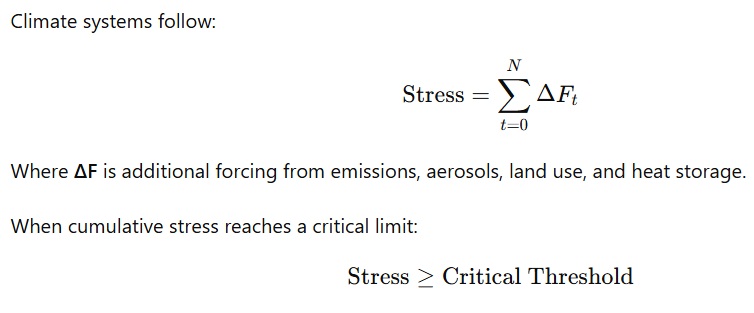
Climate systems follow:


the climate stress formula

then phase changes occur:

  • ice sheets shift from melting to irreversible retreat

  • AMOC slows toward breakdown

  • permafrost flips from sink to source

  • forests shift from carbon absorption to release

  • storm systems intensify nonlinearly

The lyrics capture that point of no return — the “break.”


“How much can her back take… for how long?”

Earth’s “back” = the planetary boundary framework which includes limits on:

  • atmospheric CO₂

  • ocean acidity

  • land system change

  • freshwater use

  • biosphere integrity

  • aerosol loading

  • chemical pollution

We have already transgressed 6 of the 9 known boundaries.
The chord in the chorus mirrors the tension of a structure near collapse.


VERSE 2

“If you take away the base / Leaving barely a trace”

In engineering:
Remove the foundation → structure collapses.

In climate physics:
Removing the “base” = destroying Earth’s stabilizing feedbacks:

  • melting sea ice removes albedo

  • deforestation removes carbon sinks

  • warming oceans weaken heat absorption

  • jet stream weakening removes atmospheric stability

  • soil carbon loss weakens ground-level buffering

This is the destruction of the base of the pyramid.


“Piling on to the peak / Till you cause her to freak”

This is textbook load exceeding threshold.

Real climate example:
The hydrologic cycle now holds ~10–15% more water in many regions due to warming.
This “pile” of excess moisture explosively intensifies storms, floods, and violent rain.

Same physics as too much mass at the top of an inverted pyramid → sudden breakdown.


OUTRO

“Upside-down pyramid / Man did what man did / A pyramid scheme”

The song resolves with a perfect metaphor:

A pyramid scheme relies on exponential extraction until collapse is inevitable.

Human civilization is currently:

  • extracting more resources than Earth can replenish

  • burning more carbon than sinks can absorb

  • adding more heat than oceans can buffer

  • demanding more stability than the climate can provide

This is mathematically equivalent to the growth curve of a pyramid scheme:

Growth∝ekt 

 — where e is Euler’s number, k is the growth constant, and t is time.

Natural systems cannot sustain exponential human demand.

Thus:
Man built an upside-down pyramid — and called it progress.

But physics calls it collapse.

* Our probabilistic, ensemble-based climate model — which incorporates complex socio-economic and ecological feedback loops within a dynamic, nonlinear system — projects that global temperatures are becoming unsustainable this century. This far exceeds earlier estimates of a 4°C rise over the next thousand years, highlighting a dramatic acceleration in global warming. We are now entering a phase of compound, cascading collapse, where climate, ecological, and societal systems destabilize through interlinked, self-reinforcing feedback loops.

What Can I Do?
The single most important action you can take to help address the climate crisis is simple: stop burning fossil fuels.

Tipping points and feedback loops drive the acceleration of climate change. When one tipping point is breached and triggers others, the cascading collapse is known as the Domino Effect.

The Climate Crisis: Violent Rain | Deadly Humid Heat | Health Collapse | Extreme Weather Events | Insurance | Trees and Deforestation | Soil | Rising Sea Level | Food and Water | Updates

The Human Induced Climate Change Experiment

From the album “Amplification
Also found on the album “Reggae at Play

bookmark_borderThe First Major Amplifier

The-First-Major-Amplifier.mp3
The-First-Major-Amplifier.mp4
The-First-Major-Amplifier-Pt-2.mp3
The-First-Major-Amplifier-Pt-2.mp4
The-First-Major-Amplifier-intro.mp3

[Intro]
The first major amplifier
(Human disqualifier)

[Verse 1]
Instant disaster
(Just add water)
Pour on the reign
(Increase the strain)

[Chorus]
The first major amplifier
(Human disqualifier)
In a runaway phase
(The rest of our days)

[Bridge]
380 zettajoules
(What a bunch of fools)

[Verse 2]
Increased moisture
(In the air for sure)
Poor on violent rain
(Increase the pain)

[Chorus]

[Bridge]

[Chorus]

[Outro]
Better change our ways
[Instrumental, Piano Solo, Bass, Percussion]
380 zettajoules
(What a bunch of fools)
Blowin’ me away
(More and more every day)
[Instrumental, Synth Solo, Organ, Bass, Percussion, Drums]

ABOUT THE SCIENCE

1. Ignition: Fossil Fuels, Pollution, and Initial Forcing

The chain reaction begins with the combustion of fossil fuels. This produces:

  • Greenhouse gases: CO2, CO4, and tropospheric ozone (O3)

  • Particulate pollution: PM2.5 and other aerosols

  • Secondary health effects: heart disease, stroke, respiratory failure, and compounding stress on human physiological systems

Fine particulate pollution and ozone feed directly into a health-driven feedback loop–weakening human resilience, increasing mortality, reducing labor productivity, and indirectly accelerating global warming through economic disruption and heightened energy demand.

Meanwhile, CO2 and methane trap longwave radiation, raising global temperatures and injecting more thermal energy into every component of the climate system.

2. Atmospheric Moisture Feedback: The First Major Amplifier

A fundamental physical law governs what happens next: warmer air holds more water vapor, and water vapor is itself the most powerful greenhouse gas on the planet.

  • For every 1°C (1.8°F) of warming, the atmosphere can hold ~7% more moisture.

  • Over 10°C, water-holding capacity nearly doubles.

  • Increased evaporation → increased atmospheric moisture → increased back-radiation → more warming → more evaporation.

This is a classic positive feedback loop.

More water vapor also supercharges extreme precipitation events, creating catastrophic inland and coastal flooding, particularly in regions like the Mid-Atlantic United States where river basins, stormwater systems, and aging infrastructure are already overwhelmed.

3. Permafrost Thaw, Boreal Forest Collapse, and the Carbon Bomb

As global temperatures rise, the Arctic warms 3-4 times faster than the global average–a phenomenon known as polar amplification. This triggers the next phase of the chain reaction:

Permafrost Thaw

  • Releases vast stores of CO2 and CO4 trapped for millennia

  • Destabilizes soils, infrastructure, and entire ecosystems

  • Forms thaw lakes that leak methane at accelerating rates

Zombie Fires and Boreal Wildfires

The thawing cryosphere has enabled:

  • “Zombie fires” smoldering underground year-round

  • Record-breaking boreal forest fires in Canada, Alaska, and Siberia

  • Fire emissions now exceeding the annual fossil-fuel emissions of countries like Canada

These fires convert carbon sinks into carbon sources–an irreversible shift.

4. Ocean Heating, Jet Stream Disruption, and the Breakdown of Planetary Circulation

The oceans absorb over 90% of the excess heat trapped by anthropogenic greenhouse gases. This thermal accumulation drives multiple destabilizing processes:

  • Weakening of the AMOC (Atlantic Meridional Overturning Circulation)

  • Slowing and increased waviness of the jet stream

  • Prolonged heat domes, atmospheric blocking, and stalled storm systems

  • Intensification of tropical cyclones through ocean heat content

These system-level shifts introduce chaotic behavior into global weather patterns–persistent drought where water is needed, and supersaturated storms where the atmosphere is already overloaded.

5. Conclusion: A Planet in a Chain Reaction

Climate drivers and amplifiers now form an interconnected series of cascading feedback loops that are accelerating global warming far beyond linear predictions. The climate is no longer responding to “emissions alone”; it is responding to its own destabilization.

Earth’s climate chain reaction is not theoretical or distant–it is unfolding in real time.

To interrupt this runaway process, humanity must:

  • Rapidly eliminate fossil fuel combustion

  • Restore carbon sinks

  • Rebuild resilient infrastructure

  • Reduce pollution

  • Strengthen global cooperation rather than retreat into isolation

Without decisive action, the chain reaction will continue until multiple tipping points lock the planet into an unlivable state.

Infectious disease vectors, violent rain, and deadly humid heat now stand among the greatest threats of climate change, no longer future warnings but present realities. This deadly triad — rising infectious diseases, escalating heat extremes, and intense rainfall events — has begun driving an exponential increase in climate-related deaths worldwide. These hazards do not operate in isolation; they amplify one another’s impacts, creating cascading risks that strain health systems, destabilize communities, and accelerate global mortality. Climate change has become a full-scale health crisis, demanding urgent, systemic action before these accelerating threats overwhelm society’s ability to respond.

* Our probabilistic, ensemble-based climate model — which incorporates complex socio-economic and ecological feedback loops within a dynamic, nonlinear system — projects that global temperatures are becoming unsustainable this century. This far exceeds earlier estimates of a 4°C rise over the next thousand years, highlighting a dramatic acceleration in global warming. We are now entering a phase of compound, cascading collapse, where climate, ecological, and societal systems destabilize through interlinked, self-reinforcing feedback loops.

What Can I Do?
The single most important action you can take to help address the climate crisis is simple: stop burning fossil fuels.


Tipping points and feedback loops drive the acceleration of climate change. When one tipping point is breached and triggers others, the cascading collapse is known as the Domino Effect.

From the album “Amplification

bookmark_borderWhy Magnify

Why-Magnify.mp3
Why-Magnify.mp4
Why-Magnify-Pt-2.mp3
Why-Magnify-Pt-2.mp4
Why-Magnify-intro.mp3

[Intro]
Why (Magnify)

[Verse 1]
Amplifiers
(Feedback)
Into the drivers
(Survivors?)

[Bridge]
Why (Magnify)

[Chorus]
Anthropogenic forcing
(Compounding)
Reality divorcing
(Dumbfounding)

[Verse 2]
Amplifiers
(Turn into drivers)
Driving us crazy
(As the world turns hazy)

[Bridge]

[Chorus]

[Outro]
Testify!
Why (Magnify)
Why turn up the heat
(On the street)
I mean… why not
(Stop with the hot)
Hot, hot, hot

ABOUT THE SCIENCE: How Drivers and Amplifiers Compound Anthropogenic Forcing

Drivers, Amplifiers, and Exponential Climate Feedback Loops

Climate change accelerates because the Earth system is governed by drivers (forces that initiate warming) and amplifiers (feedbacks that magnify that warming). When amplifiers feed back into the drivers–or begin creating new amplifiers–they produce nonlinear, exponential increases in temperature and extreme weather.

This is how you go from merely “warming” to runaway, compounding, tipping-point-driven climate destabilization.

* Our probabilistic, ensemble-based climate model — which incorporates complex socio-economic and ecological feedback loops within a dynamic, nonlinear system — projects that global temperatures are becoming unsustainable this century. This far exceeds earlier estimates of a 4°C rise over the next thousand years, highlighting a dramatic acceleration in global warming. We are now entering a phase of compound, cascading collapse, where climate, ecological, and societal systems destabilize through interlinked, self-reinforcing feedback loops.

What Can I Do?
The single most important action you can take to help address the climate crisis is simple: stop burning fossil fuels.

Tipping points and feedback loops drive the acceleration of climate change. When one tipping point is breached and triggers others, the cascading collapse is known as the Domino Effect.

The Climate Crisis: Violent Rain | Deadly Humid Heat | Health Collapse | Extreme Weather Events | Insurance | Trees and Deforestation | Soil | Rising Sea Level | Food and Water | Updates

The Human Induced Climate Change Experiment

From the album “Amplification