bookmark_border2.7

You call this heaven?
Not even close to break-even

[Verse 1]
Blasting past 1.5
Gets hard to stay alive
Getting so hot
Time forgot

[Bridge]
On our way to stay
Far away

[Chorus]
Watch the temperature creep
And weep
Watch the mercury rise
Realize
[Break]
Everyone dies

[Instrumental, Guitar Solo, Drum Fills]

[Verse 2]
Surpassing 2.0
You know (we don’t have long to go)
Wildfires go wild
Floods never mild

[Bridge]
On our way to stay
Far away

[Chorus]
Watch the temperature creep
And weep
Watch the mercury rise
Realize
[Break]
Everyone dies

[Instrumental, Saxophone Solo, Drum Fills]

[Verse 3]
2.7
This ain’t heaven
Discover
Hell froze over

[Bridge]
On our way to stay
Far away

[Chorus]
Watch the temperature creep
And weep
Watch the mercury rise
Realize
[Break]
Everyone dies

[Outro]
You call this heaven?
Not even close to break-even

[End]

A SCIENCE NOTE
Most climate scientists are projecting a global temperature increase of over 2.5°C above pre-industrial levels by the end of this century. This escalation in temperature brings forth a cascade of devastating consequences.

As the thermometer creeps past the 2.0°C mark, the likelihood of extreme forest fires surges by up to 200 times, while the risk of flood damage doubles. Beyond this threshold, at 2.7°C, an alarming scenario unfolds where approximately 2 billion people find themselves displaced from the “climate niche” that has sustained human civilization for the past 10,000 years.

Should the mercury climb to 3.0°C, the outlook becomes even bleaker. Many coastal cities, including Miami, Shanghai, Rio de Janeiro, and The Hague, face the grim prospect of submersion under rising sea levels. This catastrophic inundation not only jeopardizes the lives and livelihoods of millions but also erases centuries of cultural heritage and economic prosperity. The consequences of failing to curb global warming are dire, with each incremental rise in temperature amplifying the severity of these impacts.
From the album “Nowadays” by The Beatless Sense Mongers

MegaEpix Enormous

A song about The Human Induced Climate Change Experiment

bookmark_borderThe Heat is On

[Verse]
We talkin’ ’bout the climate
The temperature’s risin’
Chaos theory in effect
Ain’t no compromisin’
Human impacts got the world in a frenzy
9 degrees above
It’s gettin’ hot and it’s intense
See

[Verse 2]
Global warming
It’s the consequence we facin’
Thermal energy risin’
Climates changin’
Climate system
A web of subsystems
Intricate and nonlinear
This chaos we’ve become

[Chorus]
The heat is on
It’s gettin’ hotter day by day
1.5 degrees
We’re compromised in a major way
Earth uninhabitable
The future’s lookin’ bleak
9 degrees
It’s a wet-bulb temp we can’t defeat

[Bridge]
The heat is on (and on and on)
Temperature climbing (rising)
Is it surprising?

[Break]
Ouch!

[Chorus]
The heat is on
It’s gettin’ hotter day by day
1.5 degrees
We’re compromised in a major way
Earth uninhabitable
The future’s lookin’ bleak
9 degrees
It’s a wet-bulb temp we can’t defeat

[End]

A SCIENCE NOTE
AI and I created the song from this quote:
This climate model / experiment employs chaos theory to comprehensively consider human impacts and projects a potential global average temperature increase of 9℃ above pre-industrial levels. Global warming is a consequence of elevated thermal energy in the climate system, which comprises various subsystems. Chaos theory underscores the intricate and nonlinear nature of dynamic systems. Human well-being is compromised above a 1.5-degree temperature rise, rendering much of the Earth uninhabitable. A 9-degree Celsius increase would bring the Earth close to a wet-bulb temperature incapable of sustaining human life.

From the album “Nowadays” by The Beatless Sense Mongers

MegaEpix Enormous

A song about The Human Induced Climate Change Experiment

bookmark_borderExtreme Everywhere

Look out!
It ain’t over
Duck and cover

[Verse 1]
The mean for extreme
Getting meaner
The average extreme
More savage

[Bridge]
When it rains
It pours more
When it pours
No one endures

[Chorus]
Hard not to be aware
Extreme everywhere
Just look out your window
And you’ll know

[Instrumental, Guitar Solo, Drum Fills]

[Break]
It ain’t over
Duck and cover!

[Verse 2]
It seems the extreme
Varies from the mean
The average extreme
Brings more ravage

[Bridge]
When it rains
It pours more
When it pours
No one endures

[Chorus]
Hard not to be aware
Extreme everywhere
Just look out your window
And you’ll know

[Instrumental, Saxophone Solo, Drum Fills]

[Verse 3]
Do you mean extreme
Is getting more intense
Yet the mean
Are too dense

[Bridge]
When it rains
It pours more
When it pours
No one endures

[Break]
It ain’t over
Duck and cover!

[Chorus]
Hard not to be aware
Extreme everywhere
Just look out your window
And you’ll know

[Outro]
It ain’t over
Duck and cover!

[End]

A SCIENCE NOTE
Reports of extreme weather have surged to unprecedented levels, leaving scientists astounded by the intensity and frequency of these events.

In Brazil, flooding ravaged the southern city of Porto Alegre, claiming the lives of at least 100 people. Meanwhile, flash floods in Afghanistan proved even deadlier, with over 300 lives lost. In Kenya, over 300 people died and thousands were displaced due to historic flooding.

India grapples with scorching temperatures reaching up to 46 degrees Celsius amid national elections. The Philippines faced a severe heat wave, prompting authorities to shutter schools. Thailand reported fatalities due to record-breaking heat, echoing similar extreme conditions in Indonesia, Malaysia, the Maldives, and Myanmar. Across Africa, record-high temperatures have become the norm.

In the United States, April witnessed the second-highest number of tornadoes ever recorded for that month.

Jonathan Overpeck, head of the School for Environment and Sustainability at the University of Michigan, expressed grave concern: “It is not surprising to witness worsening climate extremes so early in the year. If this trend persists, 2024 could be marked by unprecedented climate disasters and human suffering.”

Mukherjee and Brouse emphasized the broader impact, stating, “We are not simply predicting a rise in Earth’s temperature. Rather, as energy is injected into the system, we anticipate heightened fluctuations across various weather patterns—more storms, droughts, wildfires, floods, and overall increased volatility. The human impact on climate is evident, shaping a future of unprecedented environmental unpredictability.”

* Our climate model employs chaos theory to comprehensively consider human impacts and projects a potential global average temperature increase of 9℃ above pre-industrial levels.

What Can I Do?
There are numerous actions you can take to contribute to saving the planet. Each person bears the responsibility to minimize pollution, discontinue the use of fossil fuels, reduce consumption, and foster a culture of love and care. Be a butterfly and affect the world. The Butterfly Effect illustrates that a small change in one area can lead to significant alterations in conditions anywhere on the globe. Hence, the frequently heard statement that a butterfly in China can cause a hurricane in the Atlantic.
Here is a list of additional actions you can take.

From the album “Nowadays” by The Beatless Sense Mongers

MegaEpix Enormous

A song about The Human Induced Climate Change Experiment

bookmark_borderAghast in Afghanistan

Aghast in Afghanistan

[Verse 1]
When it rains
We’re poor
As it strains
Ever more

[Bridge]
Man, the Taliban Clan
Deprives the alive

[Break]
Strive to thrive
Aghast in Afghanistan

[Chorus]
Triggered torrents
Amount mounts
Lands ravaged
At the hands of the savage

[Instrumental, Oud, Zithers, Toms, Percussion]

[Verse 2]
When it reigns
We’re poor
As it pains
Ever more

[Bridge]
Man, the Taliban Clan
Deprives the alive

[Break]
Strive to thrive
Aghast in Afghanistan

[Chorus]
Triggered torrents
Amount mounts
Lands ravaged
At the hands of the savage

[Instrumental, Oud, Zithers, Toms, Percussion]

[Verse 3]
The reign rains
Pouring on the poor
Who remains
Under strains fore evermore

[Bridge]
Man, the Taliban Clan
Deprives the alive

[Break]
Strive to thrive
Aghast in Afghanistan

[Chorus]
Triggered torrents
Amount mounts
Lands ravaged
At the hands of the savage

[Outro]
Strive to thrive
Aghast in Afghanistan

[End]

A SCIENCE NOTE
Afghanistan has been devastated by flash floods that claimed the lives of over 300 people, according to the UN’s World Food Programme. The catastrophe unfolded as heavy rains triggered torrents of water and mud, wreaking havoc across multiple provinces. Authorities swiftly declared a state of emergency and launched rescue efforts to aid the injured.

The aftermath of the floods left villages submerged and agricultural lands ravaged, prompting a massive humanitarian response. Aid organizations described the situation as dire, with many areas facing isolation due to the floodwaters.

Rana Deraz, a communications officer for the UN agency in Afghanistan, provided grim statistics: “In Baghlan province alone, there are 311 fatalities, with 2,011 houses destroyed and 2,800 houses damaged. The number of missing persons remains high.”

Taliban government spokesman Zabihullah Mujahid expressed condolences, acknowledging the loss of “hundreds of our fellow citizens” in the calamitous floods.

Richard Bennett, the UN special rapporteur for human rights in Afghanistan, highlighted the broader implications, emphasizing that the floods serve as “a stark reminder of Afghanistan’s vulnerability to the climate crisis.”

From the album “Nowadays” by The Beatless Sense Mongers

MegaEpix Enormous

A song about The Human Induced Climate Change Experiment

bookmark_borderRoller Coaster Incident

Keep your hands and feet
On your seat

[Verse 1]
Hold on as your roller coaster rolls on
(Rolls on and on)
Clicking toward the top
Like a ticking clock
(Tick, Tick, Tick Tick)
The alarm just won’t
[Break]
Stop!
[Chorus]
Screaming toward the other side
Reside in collide as you slide…
From on top
And the alarm just won’t stop

[Verse 2]
Is your coaster beyond coasting
Is it boasting of roasting
Drought than flood
Then mud then drought
Is there any doubt?

[Chorus]
Screaming toward the other side
Reside in collide as you slide…
From on top
And the alarm just won’t stop

[Bridge]
Our coaster’s coming off the rails
It never fails

[Instrumental, Guitar Solo, Sub-Bass]

[Verse 3]
Is your coaster beyond coasting
Is it boasting of roasting n’ toasting
Is your coaster off the rails
It never fails
[Break]
Derails

[Bridge]
Our coaster’s coming off the rails
It never fails

[Chorus]
Screaming toward the other side
Reside in collide as you slide…
From on top
And the alarm just won’t stop
[Break]
Stop!

[End]

A SCIENCE NOTE
This song uses the metaphor of a roller coaster to depict the unpredictable and dangerous trajectory of climate change. The roller coaster represents humanity’s journey through the impacts of climate change, with its ups and downs symbolizing extreme weather events such as droughts, floods, and mudslides.

In the verses, the lyrics describe the roller coaster’s relentless movement, comparing it to a ticking clock and emphasizing the feeling of being out of control. The repetition of “the alarm just won’t stop” suggests a sense of urgency and the constant warning signs of environmental crises.

The chorus reflects the sense of impending disaster as the roller coaster hurtles towards “the other side,” a metaphor for the unknown future shaped by climate change. The collision imagery implies the collision of different environmental forces and the inevitable consequences of inaction.

The bridge introduces the idea of the roller coaster coming off the rails, symbolizing the breakdown of systems and the failure to address climate change effectively. The repetition of “It never fails” underscores the inevitability of disaster if urgent action is not taken.

The song conveys a sense of urgency and the need for collective action to address the climate crisis before it’s too late.

From the album “Nowadays” by The Beatless Sense Mongers

MegaEpix Enormous

A song about The Human Induced Climate Change Experiment

bookmark_borderOn Our Way

Awake?

[Verse 1]
Do you wonder how long
Will this go on
How long
Till we see it’s gone wrong?

[Bridge]
(They say) Can’t put off today
Your yesterday
(In play) We’re on our way
To self-judgement day

[Chorus]
Can you stand naked before Mother
And swear you’ve done no harm
Will you sacrifice your brother
To avoid your squirm
[Break]
Quick to learn

[Instrumental, Guitar Solo, Drum Fills]

[Verse 2]
Do you wonder the length
Of time we rely on
Whether we’ve strength
To carry on (and on and on)

[Bridge]
(They say) Can’t put off today
Your yesterday
(In play) We’re on our way
To self-judgement day

[Chorus]
Can you stand naked before Mother
And swear you’ve done no harm
Will you sacrifice your brother
To avoid your squirm
[Break]
Quick to learn

[Instrumental, Guitar Solo, Drum Fills]

[Verse 3]
Do you wonder the heights
To which we’ve gone
To set things off right
And, carry on (and on and on)

[Break]
(They say) Can’t put off today
Your yesterday
(In play) We’re on our way
To self-judgement day

[Chorus]
Can you stand naked before Mother
And swear you’ve done no harm
Will you sacrifice your brother
To avoid your squirm
[Outro]
Quick to learn

A SCIENCE NOTE
The song delves into the introspection and accountability necessary in confronting the reality of climate change.

In the verses, questions are posed about the duration of our ignorance and the realization of the wrongness of our actions. The repetition of “on and on” suggests a cyclical nature to our behavior and the ongoing consequences we face.

The bridge introduces the idea of facing consequences for our actions, emphasizing the urgency of addressing the problem before it’s too late. The reference to “self-judgment day” implies a reckoning with our own choices and their impact on the planet.

The chorus challenges listeners to confront their role in environmental degradation, asking if they can honestly claim to have done no harm and if they would sacrifice others to avoid accountability. The break underscores the need for swift comprehension and action.

Instrumental sections with guitar solos and drum fills add intensity and urgency to the message, reinforcing the gravity of the situation.

The song serves as a call to awareness and responsibility, urging individuals to confront the reality of climate change and take meaningful action to mitigate its effects.

From the album “Nowadays” by The Beatless Sense Mongers

MegaEpix Enormous

A song about The Human Induced Climate Change Experiment

bookmark_borderOn the Verge of an Abyss

She said,
Hanging by a thread
A near miss
On the verge of an abyss

[Verse 1]
She said,
Hanging by a thread
Can’t miss this:
On the verge of an abyss

[Bridge]
Teetering on the edge
On the verge

[Chorus]
Anticipating prevaricating
The same ole narrating
What are we going to do
I’m asking you
[Break]
What are we going to do?

[Instrumental, Bass, Drum Fills]

[Verse 2]
Not far from dead
Hanging by a thread
Bubble popped bliss
On the verge of an abyss

[Bridge]
Teetering on the edge
On the verge

[Chorus]
Anticipating prevaricating
The same ole narrating
What are we going to do
I’m asking you
[Break]
What are we going to do?

[Instrumental, Saxophone Solo, Bass]

[Verse 3]
Thought stuck in my head:
Hanging by a thread
Can’t get over this:
On the verge of an abyss

[Bridge]
Teetering on the edge
On the verge

[Chorus]
Anticipating prevaricating
The same ole narrating
What are we going to do
I’m asking you
[Break]
What are we going to do?

[Outro]
The scientists envisage a ‘semi-dystopian’ future
Is this what we want… are you sure?

[End]

A SCIENCE NOTE
The world is on the verge of a climate abyss, the UN has warned, in response to a Guardian survey that found that hundreds of the world’s foremost climate experts expect global heating to soar past the international target of 1.5C.

The Guardian reports, “Many of the scientists envisage a ‘semi-dystopian’ future, with famines, conflicts and mass migration, driven by heatwaves, wildfires, floods and storms of an intensity and frequency far beyond those that have already struck.”
The UN has issued a stark warning in response to a Guardian survey revealing that hundreds of leading climate experts anticipate global heating to surpass the international target of 1.5 degrees Celsius.

“The goal of limiting global warming to 1.5 degrees Celsius is teetering on the edge,” remarked the official spokesperson for António Guterres, the UN secretary-general. “The battle to preserve the 1.5-degree target will be decisive in the 2020s, under the leadership of today’s political and industry leaders. They must grasp the gravity of the situation. The science is unequivocal, and so are the world’s scientists: the stakes for humanity have never been higher.”

Alok Sharma, president of the Cop26 climate summit in 2021, emphasized the urgency of the Guardian’s survey results, urging governments to act swiftly on their climate commitments. He underscored the need for world leaders to fulfill their promise to transition away from fossil fuels, as pledged at Cop28 in December.

Christiana Figueres, the former UN climate chief who played a pivotal role in the 2015 Paris climate agreement where the 1.5-degree Celsius goal was established, urged collective action in response to the scientists’ warnings. She emphasized that while the scientists have provided the data, it is now up to the global community to determine the necessary actions to transform the seemingly impossible into reality.

From the album “Nowadays” by The Beatless Sense Mongers

MegaEpix Enormous

A song about The Human Induced Climate Change Experiment

bookmark_borderSemi-Dystopian

Wow… just sayin’
… semi-dystopian

[Verse 1]
The world is frying
They’re not lying
The experts know
Where we’re going to go

[Bridge]
If we don’t stop
The fossil fuels
We’re going to top
The temperature… beat by heat
[Break]
Stop the top!

[Chorus]
Semi-dystopian
The “oh, no!” scenario
Livin’ semi-dystopian
Is barely livin’

[Instrumental, Guitar Solo, Drum Fills]

[Break]
Wow… just sayin’
… semi-dystopian

[Verse 2]
Have you been looking
The world is cooking
The experts know
It’s getting tough to grow

[Bridge]
If we don’t stop
The fossil fuels
We’re going to top
The temperature… beat by heat
[Break]
Stop the top!

[Chorus]
Semi-dystopian
The “oh, no!” scenario
Livin’ semi-dystopian
Is barely livin’

[Instrumental, Saxophone Solo, Drum Fills]

[Break]
Wow… just sayin’
… semi-dystopian

[Verse 3]
Have we gone blind
Not a kind kind
Don’t we know
The situation’s gonna blow?

[Bridge]
If we don’t stop
The fossil fuels
We’re going to top
The temperature… beat by heat
[Break]
Stop the top!

[Chorus]
Semi-dystopian
The “oh, no!” scenario
Livin’ semi-dystopian
Is barely livin’

[Outro]
Wow… just sayin’
… semi-dystopian

[End]

A SCIENCE NOTE
The Guardian reports, “Many of the scientists envisage a ‘semi-dystopian’ future, with famines, conflicts and mass migration, driven by heatwaves, wildfires, floods and storms of an intensity and frequency far beyond those that have already struck.”

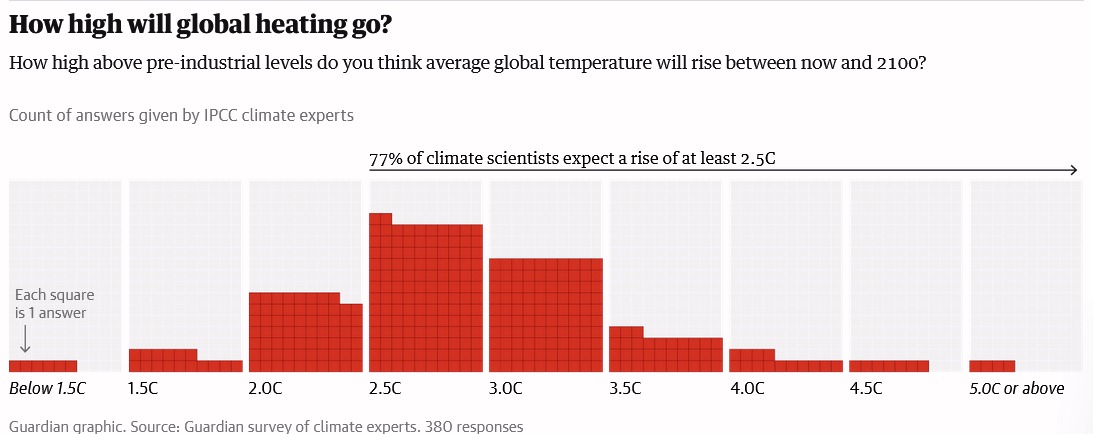
Top climate scientists anticipate that global temperatures will surpass the 1.5-degree Celsius target, reaching at least 2.5 degrees Celsius above preindustrial levels by the end of this century, according to an exclusive Guardian survey.

Nearly 80% of the respondents, comprising experts from the Intergovernmental Panel on Climate Change (IPCC), anticipate a global heating of at least 2.5 degrees Celsius, with almost half predicting a rise of at least 3 degrees Celsius. Merely 6% believe that the internationally agreed 1.5-degree Celsius limit will be achieved.

Many scientists paint a grim picture of the future, envisioning a “semi-dystopian” scenario characterized by famines, conflicts, and mass migration triggered by extreme weather events such as heatwaves, wildfires, floods, and storms.

Expressing a mixture of despair and frustration, Gretta Pecl from the University of Tasmania remarked, “I think we are headed for major societal disruption within the next five years. [Authorities] will be overwhelmed by extreme event after extreme event, food production will be disrupted. I could not feel greater despair over the future.”

Survey of Climate Scientists

From the album “Nowadays” by The Beatless Sense Mongers

MegaEpix Enormous

A song about The Human Induced Climate Change Experiment

bookmark_borderSet Free to the See

Drop by drop
Drip, drop

[Verse 1]
Ice eludes, turning to tears
Think of all the years….
Wanting to be free
Back to the see (be the sea)

[Bridge]
Drip turns to trickle
No longer fickle
So before you know
Turns to flow

[Chorus]
Set free to see
Set free to be
Free to be the sea
Revolutionary

[Instrumental, Saxophone Solo, Bass]

[Verse 2]
Along the way, who’s to say
You might take flight
And zoom, there’s plenty of room
In the atmosphere

[Bridge]
If you can warm up to the idea
(The wind’s will steer)
And before you know
You’re wind flow

[Chorus]
Set free to see
Set free to be
Free to be the sea
Revolutionary

[Instrumental, Guitar Solo, Bass, Organ, Drum Solo]

[Verse 3]
Moisture, are you sure
Vapor, more and / or were?
Humidity gets the best of me
But at least you’re free

[Bridge]
If you can warm up to the idea
(The wind’s will steer)
And before you know
You’re wind flow

[Chorus]
Set free to see
Set free to be
Free to be the sea
Revolutionary

[Outro]
Set free to see
Set free to be
Revolutionary

A SCIENCE NOTE
This climate change song follows the journey of a water molecule from the Greenland ice sheet as it melts and joins the sea, highlighting the transformative power of water in the context of environmental change.

The repeated motif of “Drop by drop, Drip, drop” emphasizes the gradual but significant process of melting ice and the release of water into the sea.

In the first verse, the water molecule yearns to be free, symbolizing the liberation of trapped water from the ice sheet. The desire to return “Back to the sea” underscores the natural cycle of water and the interconnectedness of Earth’s systems.

The bridge underscores the transition from individual drops to a flowing stream, paralleling the collective impact of melting ice on sea levels and ocean currents.

The chorus celebrates the water molecule’s newfound freedom, portraying it as “Revolutionary” in its ability to influence the environment.

The instrumental sections, including saxophone, bass, organ, and drum solos, evoke the fluidity and dynamism of water as it moves through various states and environments.

In the third verse, the song reflects on the complexity of water’s transformations, from solid ice to vapor and back again, while acknowledging the challenges of increasing humidity in a changing climate.

The outro reaffirms the water molecule’s revolutionary role, emphasizing its potential to inspire change and adaptation in the face of environmental challenges.

The song captures the essence of water’s journey from ice sheet to sea, offering a poignant reflection on the profound impact of climate change on Earth’s water cycle.

From the album “Nowadays” by The Beatless Sense Mongers

MegaEpix Enormous

A song about The Human Induced Climate Change Experiment

bookmark_borderStill Floating

Going under
Is it any wonder

[Verse 1]
The state is still floating
The water so high
Only choice is boating
Or to fly

[Bridge]
The days go by
Yet, we can’t get dry

[Chorus]
Brazil, still, under water
More than a week and still the havoc
Send in god’s blotter
The state of the state — a wreck

[Instrumental, Sub-bass, Berimbau, Atabaque Drum, Pandeiro]

[Verse 2]
Inundated, shouldn’t have waited
Confessing it’s distressing
Inundated, isolated
More storms on the way
Will we last another day

[Bridge]
The days go by
Yet, we can’t get dry

[Chorus]
Brazil, still, under water
More than a week and still the havoc
Send in god’s blotter
The state of the state — a wreck

[Instrumental, Sub-bass, Berimbau, Atabaque Drum, Pandeiro]

[Verse 3]
The state is still floating
The only access there, by air
Recovery after discovery
Of land (Do you understand?)

[Bridge]
The days go by
Yet, we can’t get dry

[Chorus]
Brazil, still, under water
More than a week and still the havoc
Send in god’s blotter
The state of the state — a wreck

[End]

A SCIENCE NOTE
On May 10, 2024, when a representative of Brazil’s Rio Grande do Sul was asked about “recovery” after weeks of historic flooding, she responded, “The state is still floating.”

From the album “Nowadays” by The Beatless Sense Mongers

MegaEpix Enormous

A song about The Human Induced Climate Change Experiment

bookmark_borderApt to Adapt?

[Verse]
In the thick of the jungle
A battle’s begun
Climate adaptation
We’re out in the sun
Frictions and uncertainties
They’re tearing us apart
Lower technology adoption
It’s a poison dart

[Verse 2]
Beliefs are inaccurate
It’s a dangerous game
Monetary losses
They’re causing us pain
We’re stuck in a cycle
We can’t break free
The cost of ignorance
It’s plain to see

[Chorus]
Apt to Adapt
The road is rough
Jungle rock revival
We’ve had enough
Frictions and losses
They’re driving us mad
It’s time to rise up
Take a stand

[Bridge]
Apt to adapt
Pick yourself up by the bootstrap

[Instrumental, Saxophone Solo]

[Verse 3]
Beliefs just are not true
What are you going to do
Losses mount
Can’t you count?

[Chorus]
Apt to Adapt
The road is rough
Jungle rock revival
We’ve had enough
Frictions and losses
They’re driving us mad
It’s time to rise up
Take a stand

[Outro]
Crap!
Can I adapt?

[End]

A SCIENCE NOTE

As the climate changes, efficient climate policy requires a better understanding of how individuals adapt. Despite extensive research on various climate adaptation frictions, including financial and technological constraints, models of adaptive decision-making assume that agents have perfect information and accurate beliefs about climate. Combining rural household data in Bangladesh with a meteorological measure of dryness, this paper studies the role of individual drought beliefs and their accuracy in irrigation decisions as a key adaptive margin. In a theoretical model, I introduce a behavioral friction to document how heterogeneous beliefs differentially influence responsiveness to the same meteorological signal in dryness. The empirical analysis reveals an asymmetric response to dry shocks in irrigation conditional on the accuracy of prior beliefs. A counterfactual analysis shows lower technology adoption levels and higher monetary losses when beliefs are inaccurate.
— from “Adapting to climate change accounting for individual beliefs”

From the album “Nowadays” by The Beatless Sense Mongers

MegaEpix Enormous

A song about The Human Induced Climate Change Experiment

bookmark_borderFingers in My Ears

[Verse]
Got the rhythm of rock
Spitting beats in your ears
But I ain’t here to talk about your foolish fears
I see the signs
The world’s running out of time
But I got my fingers in my ears
Blocking out the rhymes

[Verse 2]
Can’t you see the smoke
The planet’s going up in flames
But you keep on playing these mindless games
You’re blind to the truth
You’re living in a lie
While mother nature’s screaming
But you just deny

[Chorus]
Fingers in my ears
I refuse to hear the cries
Blind to the truth
While the world slowly dies
But I won’t back down
I won’t stay silent
Gonna scream and shout
’til the earth is defiant

A SCIENCE NOTE
“Fingers in My Ears” depicts the act of climate change denial through the metaphor of covering one’s ears to avoid hearing uncomfortable truths. The song portrays a sense of urgency and frustration as the singer confronts those who refuse to acknowledge the reality of the environmental crisis.

In the first verse, the lyrics describe the singer’s awareness of the signs of impending disaster, symbolized by the “rhythm of rock” and “beats in your ears.” Despite recognizing the urgency of the situation, the subject chooses to block out the truth by metaphorically putting their “fingers in [their] ears.” This represents a deliberate act of denial and avoidance of reality.

The second verse further emphasizes the severity of the situation, highlighting the destructive consequences of environmental degradation. The imagery of smoke and flames symbolizes the planet’s deterioration due to human activities, such as deforestation and fossil fuel combustion. Despite the clear evidence of environmental harm, the subject remains willfully ignorant and continues to prioritize their own comfort over acknowledging the truth.

The chorus reinforces the theme of denial and resistance to facing the reality of climate change. The repeated phrase “Fingers in my ears” serves as a metaphor for the subject’s refusal to listen to reason or accept responsibility for their role in the crisis. However, the defiant tone of the chorus suggests a determination to challenge this denial and advocate for action to address the environmental crisis. Ultimately, the song calls for a collective awakening and commitment to confronting climate change denial in order to protect the planet and secure a sustainable future.

From the album “Fingers in My Ears” by Listening Deficit

MegaEpix Enormous

A song about The Human Induced Climate Change Experiment

bookmark_borderDenial

[Verse]
He’s a climate change denier
Can’t see the flames get higher
With his listening deficit
Ignorance won’t let him get it
Keeps on denying the facts
Living in his own abstract
Thinking he’s got it all figured out
But he’s just spreading doubt

[Verse 2]
He’s got his head in the sand
Can’t comprehend
Won’t understand
Blinded by his own stubborn pride
While the world is starting to slide
He’s got no time for science
He’s caught up in defiance
Thinking he’s above it all
While the planet’s taking a fall

[Chorus]
Hey
Climate change denier
Can you feel the fire?
Your ears are deaf
Your mind is blind
The truth you’ll never find
Ignoring the warning signs
You’re playing with our time
But we won’t be silent
We’ll stand up and keep on fighting

A SCIENCE NOTE
“Denial” paints a vivid portrait of a climate change denier who remains obstinate in the face of overwhelming evidence. In the verses, the denier is depicted as someone who refuses to acknowledge the escalating environmental crisis, choosing instead to ignore the “flames” of climate change as they intensify. Despite a “listening deficit” and an inability to grasp the severity of the situation, the denier persists in denying the scientific facts, clinging to their own abstract beliefs.

The imagery of having “his head in the sand” symbolizes the denier’s willful ignorance and refusal to confront the truth. While the world faces dire consequences, the denier remains steadfast in their denial, driven by stubborn pride and defiance. The chorus serves as a direct call-out to the denier, urging them to recognize the urgency of the situation and the need for action. Despite their reluctance to listen, the song emphasizes the determination of others to continue fighting for environmental justice and awareness.

From the album “Fingers in My Ears” by Listening Deficit

MegaEpix Enormous

A song about The Human Induced Climate Change Experiment

bookmark_borderDenying the Heat

[Verse]
He’s a climate change denier
With a skull full of fire
Blinded by his ego
Can’t see the world’s getting dire
Got a listening deficit
Ain’t hearing no facts
Living in a bubble
Ignorance is his only act

He’s screaming out loud
“It’s all a bunch of lies!”
Turns a blind eye
While the planet slowly dies
But the truth is out there
In the rising tides and heat
The signs are all around
Can’t you feel the heartbeat?

[Verse 2]
His head’s buried in the sand
Can’t face the harsh reality
Ain’t no time for games
We’re running out of sanity
With each passing day
The earth cries in distress
But he just keeps denying
Fueling the world’s mess

A SCIENCE NOTE
This song paints a vivid picture of a climate change denier who stubbornly refuses to acknowledge the reality of the environmental crisis. The first verse describes the denier as someone who is consumed by their own ego and unable to comprehend the severity of the situation. They are depicted as having a “listening deficit” and living in a self-imposed bubble of ignorance.

Despite overwhelming evidence, the denier adamantly rejects the truth, dismissing climate change as “a bunch of lies” and choosing to ignore the signs of environmental degradation. Meanwhile, the planet suffers, with rising temperatures and sea levels symbolized by “the rising tides and heat.”

In the second verse, the song emphasizes the denier’s willful ignorance and avoidance of reality. Metaphorically, their “head’s buried in the sand,” indicating a refusal to confront the truth. While the world faces unprecedented challenges, the denier remains steadfast in their denial, contributing to the worsening state of the planet.

The song serves as a poignant commentary on the damaging impact of climate change denial and the urgent need for collective action to address the crisis before it’s too late.

From the album “Fingers in My Ears” by Listening Deficit

MegaEpix Enormous

A song about The Human Induced Climate Change Experiment

bookmark_borderNowadays

Nowadays
Now which ways?

[Verse 1]
Climbed the tallest tree
To see what I could see
I said, “Lord! Help me!”

[Chorus]
They’re fighting left and right
In fact, everywhere in sight
While the temperatures go higher
The world caught on fire
[Break]
Fire!

[Bridge]
Nowadays
Every which ways
A mess
Nowadays
Every which weighs
Way less

[Instrumental]

[Verse 2]
Climbed the highest mountain
And saw once again
I said, “Good god! Save me!”

[Chorus]
They’re fighting left and right
In fact, everywhere in sight
While the temperatures go higher
The world caught on fire
[Break]
Fire!

[Bridge]
Nowadays
Every which ways
A mess
Nowadays
Our voices heard less
Do we understand
We need to stand?

[Instrumental, Saxophone Solo]
[Instrumental, Guitar Solo]
[Instrumental, Bass, Drum Fills]

[Verse 3]
I went to the highest authority
And She said to me
Son! Save “we”!

[Chorus]
They’re fighting left and right
In fact, everywhere in sight
While the temperatures go higher
The world caught on fire
[Break]
Fire!

[Bridge]
Confess,
Nowadays
Every which ways
A mess
Climb the tallest tree (and see)
Climb the highest mountain (again)
Shout it out
Tell ’em what it’s about!

[Outro]
Nowadays
Every which ways
A mess

[End]

A SCIENCE NOTE
Human-induced climate change is a dynamic component of an intricate and unordered system, as per chaos theory. This implies that global warming is accelerating exponentially in a complex manner. Over the period from 1992 to 2023, we have presented compelling evidence, proposed remedies to mitigate climate change, and amassed valuable information through the engagement of millions with this climate model. Your participation has been invaluable. The incontrovertible data underscores that human-induced climate change is rapidly deteriorating our habitat.

This climate model / experiment employs chaos theory to comprehensively consider human impacts and projects a potential global average temperature increase of 9℃ above pre-industrial levels. Global warming is a consequence of elevated thermal energy in the climate system, which comprises various subsystems. Chaos theory underscores the intricate and nonlinear nature of dynamic systems. Human well-being is compromised above a 1.5-degree temperature rise, rendering much of the Earth uninhabitable. A 9-degree Celsius increase would bring the Earth close to a wet-bulb temperature incapable of sustaining human life.

What Can I Do? There are numerous actions you can take to contribute to saving the planet. Each person bears the responsibility to minimize pollution, discontinue the use of fossil fuels, reduce consumption, and foster a culture of love and care. The Butterfly Effect illustrates that a small change in one area can lead to significant alterations in conditions anywhere on the globe. Hence, the frequently heard statement that a fluttering butterfly in China can cause a hurricane in the Atlantic. Be a butterfly and affect the world.

From the album “Nowadays” by The Beatless Sense Mongers

MegaEpix Enormous

A song about The Human Induced Climate Change Experiment