[Silence]
[Instrumental, Electric Guitar, Acoustic Guitar, Bass, Drums, Piano, Organ, Synth]
[Intro]
[Instrumental Intro: Quirky Garage-Rock Guitar, Bouncy Bass, Snare Hits, Toy Piano, Organ Stabs, Playful Synth]
[Spoken Vocal]
It’s raining…
It’s pouring…
But who’s paying?
(Scales weighing)
[Verse 1]
Clouds roll in
The streets turn gray
Water finds
Another way
Pipes fill up
Rivers rise
Another warning
In disguise
The old song says
The old man snores
But outside
The water pours
[Refrain]
It’s raining. It’s pouring.
(The old man is snoring)
It’s reigning. It’s pooring.
(I’m saying:)
… the young man is paying
Oh, boy!
(Boys and girls)
Lost joy
(Our thrill kills)
Kill!
(Joy)
[Chorus]
It’s raining!
(Raining!)
It’s pouring!
(Pouring!)
Still the bill
Keeps growing
It’s reigning!
(Reigning!)
It’s pooring!
(Pooring!)
Who’s paying?
(… just saying!)
[Verse 2]
Flooded roads
And broken drains
Water running
Through the lanes
Basements wet
Insurance high
Another cost
We can’t deny
The weather hits
The budget too
Somebody pays
For what we do
[Pre-Chorus]
Rain!
(Rain!)
Pain!
(Pain!)
Cost!
(Cost!)
Lost!
(Lost!)
When the water
Hits the ground
The economics
Come around
[Instrumental]
[Electric Guitar Solo: Playful Blues-Rock Lead With Ducking Wah, Bouncy Bass, Organ and Punchy Drums]
[Bridge]
Oh, boy!
(Boys and girls)
Where’d the joy go?
(Where’d it go?)
Our thrill
(Kills)
When the thrill
Becomes the bill
[Rap Vocal Break]
Rain on the roof
Rain in the street
Rain in the basement
Water at your feet
Call the plumber
Call the crew
Call insurance
Who’s paying you?
Premium rising
Deductible too
Infrastructure aging
What are we gonna do?
You can call it weather
You can call it rain
But when the pattern changes
It changes the game
The cost comes down
The cost goes up
Somebody’s always
Picking up the cup
[Breakdown]
[Music Drops to Bass, Toy Piano, Finger Claps and Distant Thunder Effects]
It’s raining…
It’s pouring…
It’s reigning…
It’s pooring…
(Insane in pain)
[Whispered]
(Scales of justice weighing)
The young man is paying…
[Final Refrain]
It’s raining. It’s pouring.
(The old man is snoring)
It’s reigning. It’s pooring.
(I’m saying:)
… the young man is paying
Oh, boy!
(Boys and girls)
Lost joy
(Our thrill kills)
Kill!
(Joy)
[Final Chorus]
It’s raining!
(Raining!)
It’s pouring!
(Pouring!)
Like no one’s knowing
(The price keeps growing)
It’s reigning!
(Reigning!)
It’s pooring!
(Pooring!)
You can ignore some more?
(Aint’ no use in praying)
… who’s paying?
[Outro]
[Instrumental Outro: Garage Guitar, Bouncy Bass, Organ, Toy Piano and Rain Percussion; Gradual Fade]
Rain…
Reign…
Pour…
Poor…
[Spoken, fading]
It’s raining. It’s pouring.
(The old man is snoring)
It’s reigning. It’s pooring.
(I’m saying:)
… ain’t no use praying
(The thrill to…)
Kill!
(Joy)
Enjoy?
About the Song
This is where the bleeding edge begins.
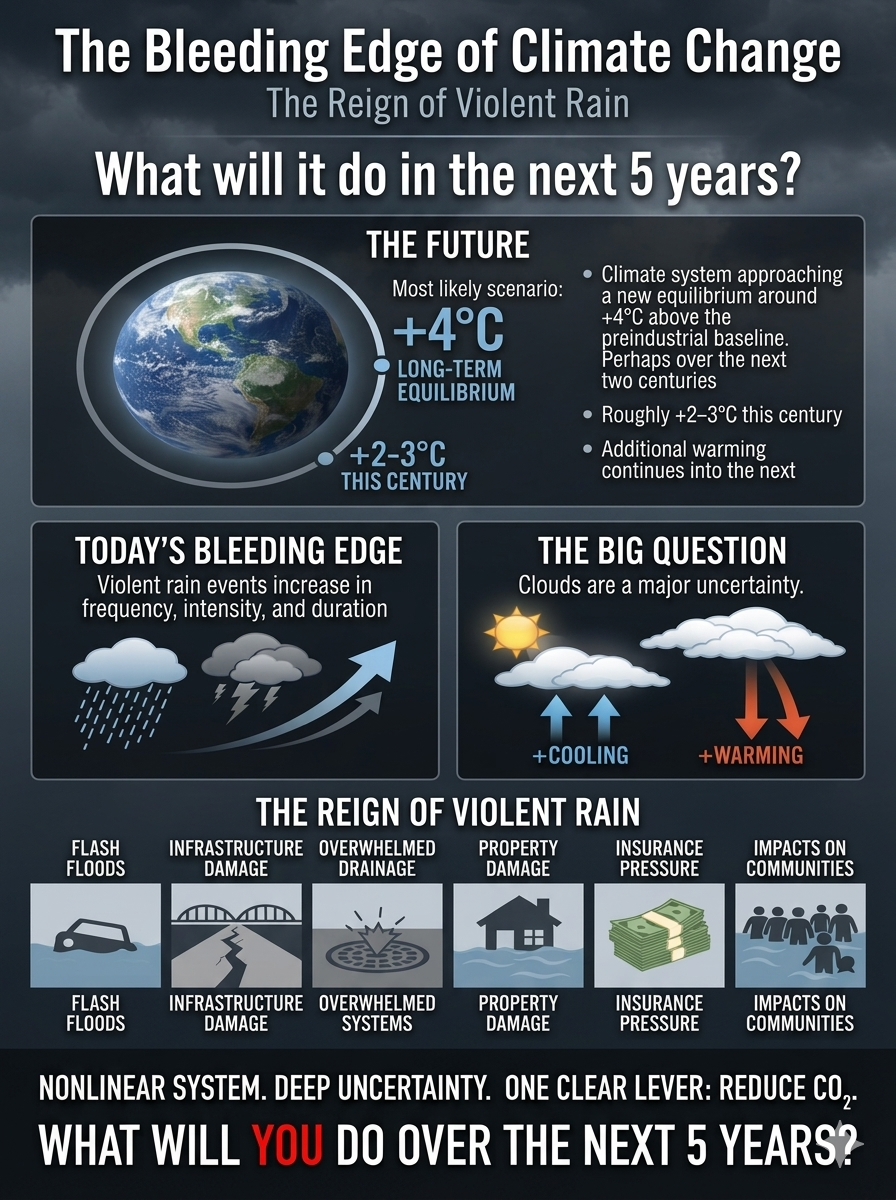
Clouds are arguably the largest remaining uncertainty in our understanding of climate sensitivity. They can both reflect incoming solar radiation and trap outgoing heat. Which effect dominates—and how that balance changes as the planet warms—is one of the great questions in climate science.
My expectation is that the climate system could eventually approach a new equilibrium around +4°C above the preindustrial baseline, perhaps over the course of a couple centuries. That would imply roughly +2–3°C this century, with additional warming continuing into the next.
But that remains uncertain.
The important point is that climate change is not a simple linear equation. It is a massively interconnected system in which changes in one component can alter another, which then feeds back into the first. Ice affects albedo. Albedo affects heating. Heating affects clouds. Clouds affect radiation. Radiation affects ocean temperatures. Ocean temperatures affect evaporation and atmospheric moisture. And the cycle continues.
Everything is nonlinear.
Yet uncertainty about the exact trajectory does not mean uncertainty about what we should do.
The clearest lever we have is still the same: reduce CO₂ emissions and slow the accumulation of greenhouse gases in the atmosphere.
And while the long-term equilibrium matters, there is a much more immediate question.
What happens to you over the next five years?
We are already seeing rainfall becoming more intense and, in many places, more destructive—violent. A warmer atmosphere can hold more water vapor, increasing the potential for extreme precipitation. The question isn’t simply how hot the planet might become over the next 50 years.
The more immediate question is:
What is the violent rain going to do to your home, your community, your infrastructure, your insurance—and you—over the next five years?
That is where climate change stops being a distant projection and starts becoming a personal reality.
From the album “Demand Destruction“