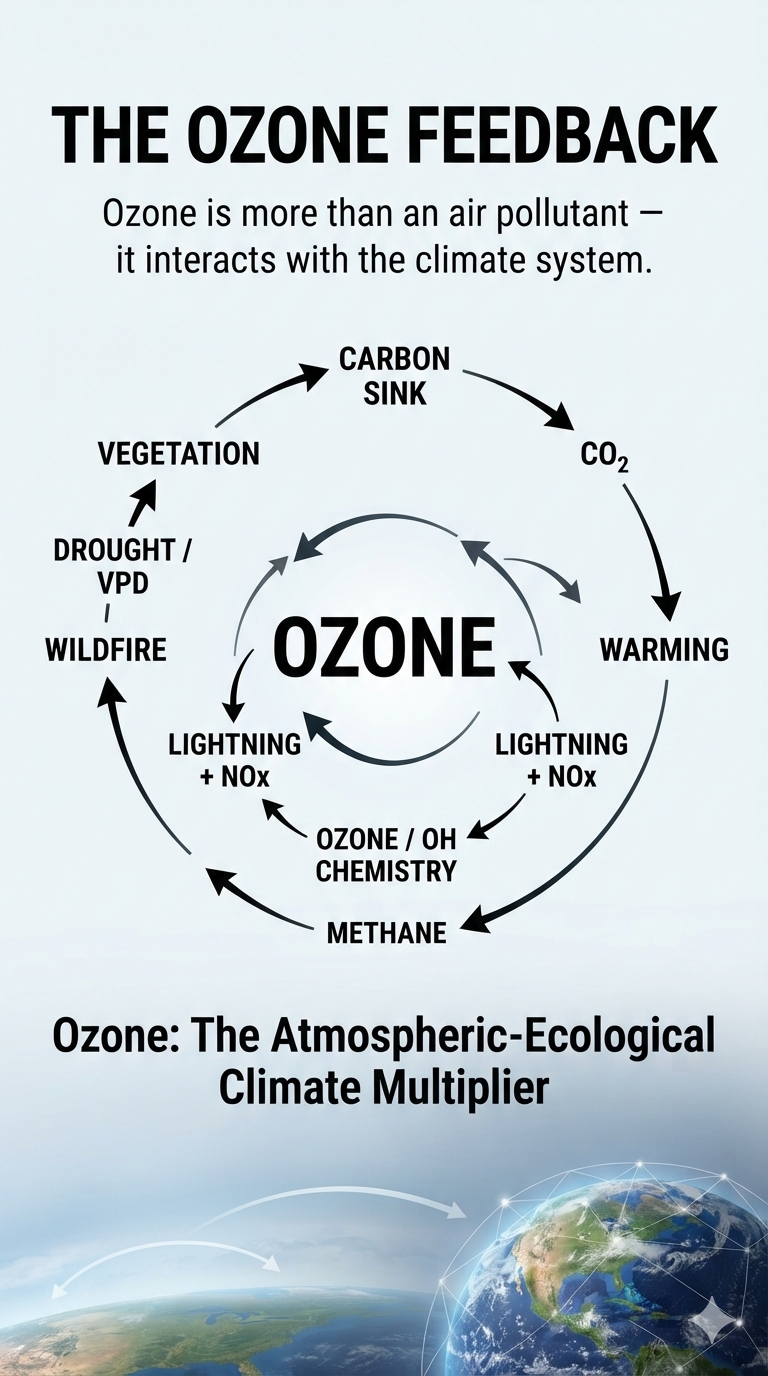
Increasing tropospheric ozone contributes to climate-system acceleration through simultaneous direct radiative forcing and indirect ecological forcing, with ozone-induced vegetation stress reducing carbon uptake, altering land-surface energy and water exchange, increasing ecosystem vulnerability, and interacting with wildfire, drought, methane, lightning, and other climate feedbacks. These coupled interactions may amplify climate-system responses beyond the effect of ozone considered as an isolated atmospheric constituent.
[Silence]
[Instrumental Intro: Piano, Deep Sub-Bass Synth, Acoustic Guitar, Organ, Harmonica, Tribal Percussion, Electric Slide Guitar]
[Intro]
Comin’ from the northeast
(A real beast)
Ridin’ the coast
(What a roast!)
Slowly movin’
(But not away)
Hangin’ around
(Another day)
[Verse 1]
Atlantic City
(Beach took a hit)
Half-mile stretch
(That’s some of it)
Dunes carved deeply
(Steep and tall)
Sand disappeared
(There goes the wall)
[Refrain]
Comin’ from the northeast
(A real beast)
… to say the least
Hangin’ out day after day
(No, just wont move away)
… ocean takes over the bay
[Verse 2]
Down in Brigantine
(The beach did flee)
Hundreds of feet
(Washed out to sea)
[Refrain]
Comin’ from the northeast
(A real beast)
… to say the least
Hangin’ out day after day
(No, just wont move away)
… ocean takes over the bay
[Verse 3]
Storm energy
(Turned into cost)
Flooded the streets
(What have we lost?)
[Bridge]
Storm energy!
(Flood and erosion!)
Wind energy!
(Coastal corrosion!)
Joules don’t stay
(In a textbook line)
They reach your house
(And they reach mine)
[Refrain]
Comin’ from the northeast
(A real beast)
… to say the least
Hangin’ out day after day
(No, just wont move away)
… ocean takes over the bay
[Breakdown]
Flooding!
(Erosion!)
Wind!
(Destruction!)
Power!
(Interruption!)
Traffic!
(Disruption!)
Property!
(Depreciation!)
Business!
(Complication!)
[Final Refrain]
Comin’ from the northeast
(A real beast)
… to say the least
Hangin’ out day after day
(No, just wont move away)
… ocean takes over the bay
[Outro]
Comin’ from the northeast
(What a beast!)
Turning energy
(Into receipts!)
Damage
(Becomes dollars)
Dam Age!
(Everybody hollers)
[Silence]
[End]
About the Song
The late-September 2026 nor’easter turned atmospheric and oceanic energy into a massive economic event.
$10–13 BILLION in estimated damage and economic losses.
Flooding.
Beach and dune erosion.
Downed trees.
Power outages.
Infrastructure damage.
Transportation disruption.
The storm demonstrates a simple connection:
STORM ENERGY → FLOODING + EROSION + WIND → DAMAGE → ECONOMIC LOSS
Climate energy does not remain an abstract number measured in joules. It reaches us through the places where we live, the infrastructure we depend upon, and the economic systems that connect us.
The Jersey Shore: Erosion, Flooding and Infrastructure Damage
The most concentrated physical damage occurred along exposed coastal communities.
Atlantic City
Atlantic City experienced some of its most severe beach erosion since Superstorm Sandy in 2012. A particularly hard-hit area extended for approximately a half-mile north of Steel Pier.
The storm carved deeply into the dunes, leaving steep sand escarpments and exposing previously buried structures. Atlantic City Beach Patrol officials reported that roughly half of the dunes remained in the affected area after the storm.
This is more than a cosmetic change to the beach. Dunes function as part of the coastal defense system. Removing large quantities of sand reduces the physical buffer between ocean waves and developed areas.
Brigantine
Brigantine also suffered extensive beach and dune erosion. City officials estimated that hundreds of feet of beach were washed away, while approximately 30 feet of dunes were lost in one particularly vulnerable area. Officials said the damage could amount to tens of millions of dollars.
The storm also damaged the city’s promenade. A newly installed beach-access ramp was torn from its foundation and carried approximately 30 blocks down the beach before being recovered. Sections of promenade railing were also damaged.
Mayor Vince Sera described the storm as producing exceptionally powerful ocean conditions, while city officials emphasized that the promenade and seawall helped protect homes and infrastructure from even greater damage.
Repeated Tidal Flooding
The storm’s slow movement and persistent onshore winds produced flooding over multiple high-tide cycles.
In Sea Bright, New Jersey, for example, successive tides repeatedly flooded neighborhoods rather than producing a single isolated flooding event. More than four inches of rain also fell in portions of New Jersey, adding freshwater runoff to the coastal flooding problem.
The combination of heavy rainfall + elevated ocean water + high tides + strong onshore winds created a compound flooding event.
[Refrain]
Can you see reality
(The future of humanity)
Travesty of our trajectory
(We’ll go down in history)
[Break]
History…
(What will it say?)
Did we see it coming?
(Did we look away?)
[Outro]
Can you see reality
(The future of humanity)
Travesty of our trajectory
(We’ll go down in history)
Can you change reality
(The future of humanity)
Change the trajectory
(Before it changes me)
Can you see reality
(The future of humanity)
(Are you sure…)
Of the future…
About the Song
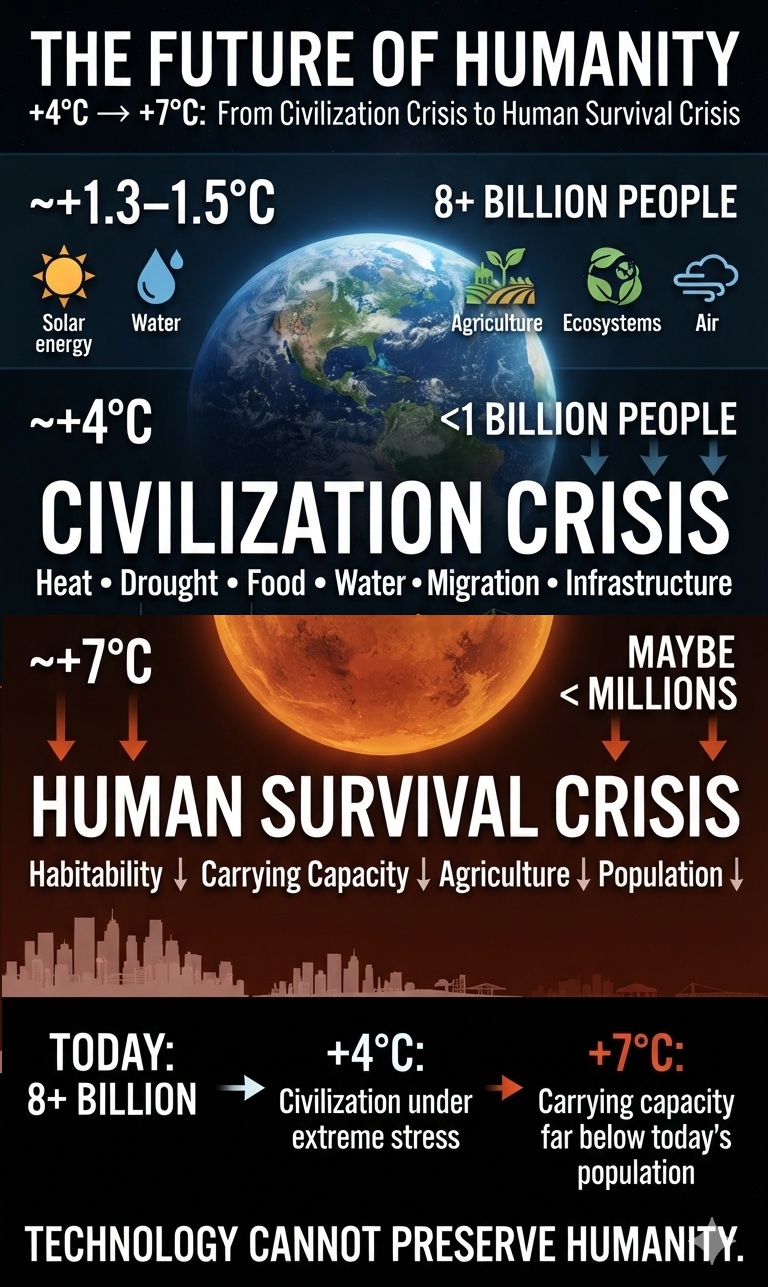
🌎 THE FUTURE OF HUMANITY
+4°C → +7°C: From Civilization Crisis to Human Survival Crisis
What happens to humanity if Earth doesn’t stop at +2°C or +3°C—but eventually reaches +4°C and then +7°C?
There is no scientifically established population number for a +7°C Earth.
But the physical constraints are becoming increasingly clear.
At approximately +4°C, humanity could face a civilization-scale crisis:
🔥 Extreme heat
💧 Water shortages
🌾 Agricultural disruption
🏙️ Infrastructure failures
🌍 Mass migration
⚡ Energy-system stress
Over the following centuries, continued warming toward +7°C could transform the question entirely.
The issue would no longer be simply:
How do we adapt civilization to a hotter planet?
It becomes:
How many humans can the planet physically support?
Technology could keep some people alive through underground facilities, controlled environments, hydroponic agriculture, protective equipment and advanced energy systems.
But there is an enormous difference between keeping thousands or millions of people alive in artificial environments and maintaining a civilization of 8+ billion people.
Today’s population depends upon the Earth providing enormous services essentially for free:
☀️ Solar energy
💧 Rainfall and freshwater
🌾 Productive soils
🌳 Ecosystems
🌬️ Breathable air
🌊 Functioning oceans
🌡️ Manageable temperatures
🌱 Outdoor agricultural space
At +7°C, humanity could increasingly have to manufacture artificially what the Earth currently provides naturally.
And that creates a fundamental problem:
Energy requires infrastructure.
Infrastructure requires materials.
Materials require mining and manufacturing.
Manufacturing requires energy and water.
Technology can extend human habitability.
But technology cannot be assumed to recreate the Earth for eight billion people.
The path from +4°C to +7°C could therefore represent a transition from:
Fighting to preserve civilization
to
Fighting to preserve humanity itself.