Ride that tide
(See ya on the flipside)
Feedin’ back
(Way back, back, back)
[Fade out]
Feedin’ back
(Way back, back, back)
Ride that tide…
(See ya on the flipside)
[Surf Guitar Fade]
[Silence]
[End]
About the Song: Why Hasn’t There Been a Hurricane?
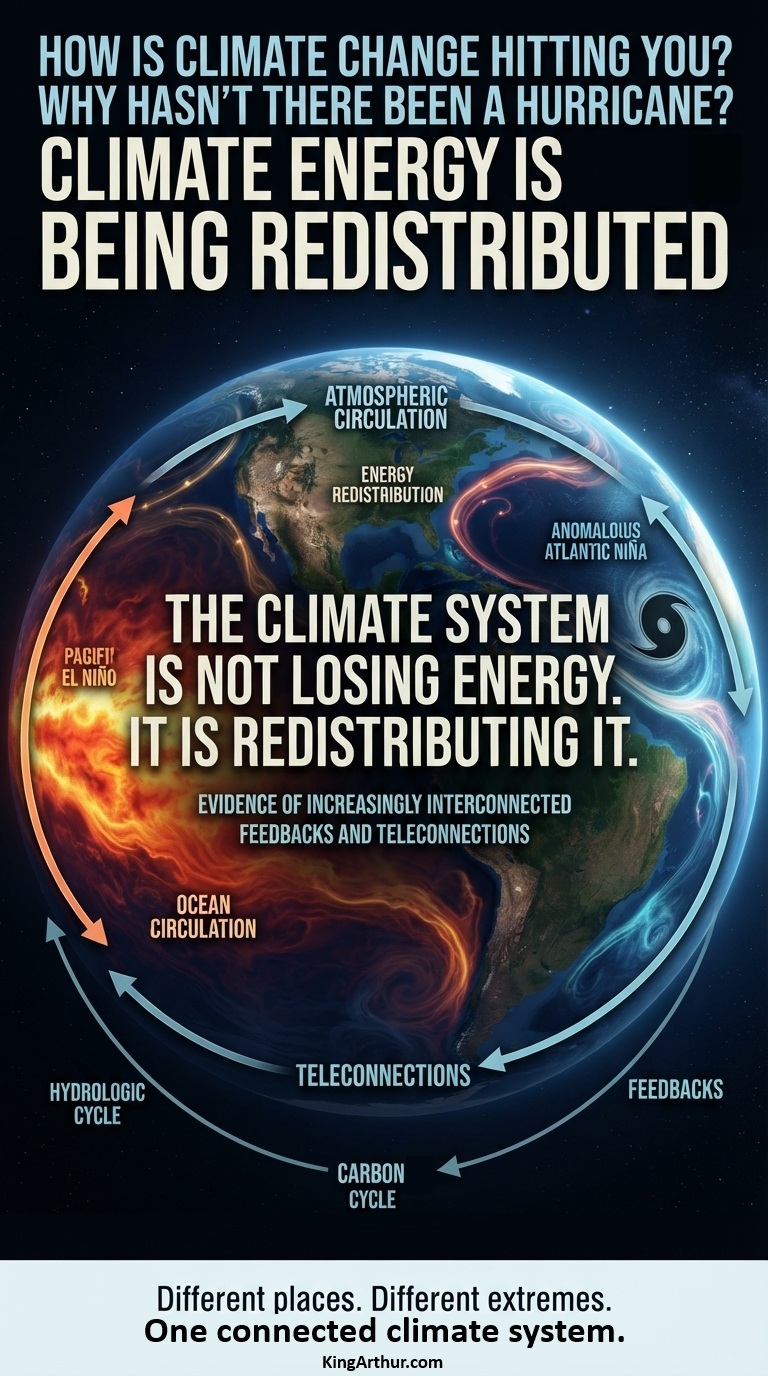
Climate Energy Is Being Redistributed
The absence of hurricanes isn’t evidence that the climate system is becoming less energetic. It is the opposite: climate energy is being redistributed in ways that produce very different outcomes in different parts of the planet.
As of September 23, the Atlantic has produced six named storms but still has produced zero hurricanes—an exceptionally delayed first hurricane. NOAA’s current summary shows Atlantic ACE about 92% below the 1991–2020 average at this point in the season.
The alarming part isn’t simply the lack of hurricanes. It’s the apparent coupling of climate patterns that historically operated more independently. I first warned about this Pacific El Niño–Atlantic Niña coupling back in May. Now, as we progress this far into the season, the observations are providing an unusually clear real-world example of how teleconnections can link distant parts of the climate system.
The simultaneous occurrence of an extreme Pacific El Niño and an anomalous Atlantic Niña represents a significant disruption of the historical baseline. NOAA reports that the El Niño is strengthening, with eastern equatorial Pacific sea-surface temperatures already more than 3°C above average.
An Atlantic Niña can suppress Atlantic hurricane development through increased atmospheric stability and wind shear. So there is a relatively straightforward physical explanation for the quiet Atlantic. But I think the deeper question is why these large-scale ocean–atmosphere patterns are coupling so strongly in the first place.
That’s where climate-acceleration research comes in. I see this as evidence worth watching for increasingly interconnected feedbacks and teleconnections—changes in ocean circulation, atmospheric circulation, energy redistribution, and the hydrologic and carbon cycles that can influence one another across ocean basins.
In other words, the absence of hurricanes isn’t evidence that the climate system is becoming less energetic. It is the opposite: climate energy is being redistributed in ways that produce very different outcomes in different parts of the planet.
It may manifest as a powerful, rare September nor’easter hitting the Jersey Shore.
[Verse 1]
Here we are
(And here we go)
Another song
(Another show)
Just in time
(To sing a rhyme)
Pick-up a beat
(To move your feet)
[Refrain]
This song…
(Is not so long)
No, not so long
(Not goodbye)
Not see you later
(Why not try)
A lover… not a hater
(And sing along:)
This song…
(Is not so long)
[Verse 2]
So long
(So wrong!)
Don’t make it sad
(It ain’t that bad)
A wave goodbye
(Can still be high)
A smile can say
(Come back someday)
[Pre-Chorus]
Don’t close the door
(We want some more)
Don’t turn away
(Just press replay)
[Refrain]
This song…
(Is not so long)
No, not so long
(Not goodbye)
Not see you later
(Why not try)
A lover… not a hater
(And sing along:)
This song…
(Is not so long)
[Bridge]
So…
(Long?)
So long!
(How long?)
Not very long!
(How long?)
Long enough
(To sing this song!)
[Break]
Not goodbye!
(No!)
Not farewell!
(Still dwell)
Not see you later!
(We here to cater)
We’re doing well!
So long!
(So long!)
So long!
(Not too long!)
So long!
(Along!)
Sing along!
[Final Refrain]
This song…
(Is not so long)
No, not so long
(Not goodbye)
Not see you later
(Why not try)
A lover… not a hater
(And sing along:)
This song…
(Is not so long)
[Silence]
[Instrumental Intro: Deep Sub-Bass, Swampy Electric Guitar, Low Piano, Organ, Drums, Percussion, Saxophone]
[Intro]
Crude…
(Screwed!)
Costs…
(Loss!)
How much?
Well…
(Bloody hell!)
[Verse 1]
Down at the dock
(What’s that shock?)
Tanker in the water
(Sinking like a rock?)
[Pre-Chorus]
The tank didn’t sink
(The price did rise)
Look at that number
(Before your eyes!)
Surprise
(Surprise)
[Refrain]
Ya woulda thought
(The tank sank)
You’d be at loss…
(Crude costs)
[Verse 2]
Time-charter earnings
(That’s the score)
One point two million
(Dollars a day or more!)
[Refrain]
Ya woulda thought
(The tank sank)
You’d be at loss…
(Crude costs)
[Bridge]
Did the ship sink?
(What do you think?)
It’s just the cost
(That’s lost)
[Break]
[Drums Drop to Half-Time]
Sixteen…
Thousand…
[Pause]
One-point-two…
Million!
[Band Hit]
A DAY!
(In pay)
[Instrumental]
[Extended Swampy Guitar Solo Over Deep Bass, Organ and Driving Piano — Saxophone Answers With Short Bursts]
[Final Refrain]
Ya woulda thought
(The tank sank)
You’d be at loss…
(Crude costs)
Noo…
It was the cost
(That was lost)
[Outro]
Ya woulda thought
(The tank sank)
You’d be at loss…
(Crude costs)
Noo…
It was the cost
(That was lost)
[Deep Bass Hit]
Crude costs!
[Bass Hit]
[Silence]
[End]
About the Song
Oil Shipping Costs Explode: From ~$16,000 to More Than $1.2 Million a Day
The cost of transporting crude oil by the world’s largest oil tankers has reached extraordinary levels.
On the benchmark TD3C route — a 270,000-metric-ton Very Large Crude Carrier (VLCC) traveling from the Middle East Gulf to China — daily time-charter-equivalent (TCE) earnings have surged from roughly $16,000/day in 2020 to more than $1.2 million/day in September 2026.
That is not simply a large increase. It represents an extraordinary transformation in the economics of moving oil by sea.