bookmark_borderMelting

Melting.mp3
Melting.mp4
Melting-Pt-2.mp3
Melting-Pt-2.mp4

Melting-Animation-1.mp4
Melting-Animation-2.mp4
Melting-intro.mp3

[Intro]
The past
(Melting into the future)
The future
(Melting into the past)
… will it last?
[Instrumental, Guitar Solo]

[Verse 1]
Naughty or nice
(Better think twice)
Take my advice
(Look at the ice)

[Instrumental, Synth Solo, Organ, Bass, Percussion]

[Chorus]
The past
(Melting into the future)
The future
(Melting into the past)

[Bridge]
… will it last?
(Are you sure)
[Instrumental, Guitar Solo]

[Verse 2]
Don’t you know
(Albedo)
How low can we go
(What a shh… it show)

[Instrumental, Synth Solo, Organ, Bass, Percussion]

[Chorus]
The past
(Melting into the future)
The future
(Melting into the past)

[Bridge]
… will it last?
(Are you sure)
[Instrumental, Guitar Solo]

[Outro]
… just as we did fear
(Watch it disappear)
The past
(Melting into the future)
The future
(Melting into the past)

ABOUT THE SONG AND THE SCIENCE

In The Plight of the Penguin: Will Humans Follow? (Adaptation Part I), we examined how multiple penguin species–despite short-term behavioral flexibility–are failing to adapt to the pace and scale of anthropogenic climate change. This second paper extends that analysis to the Arctic, focusing on polar bears as a living stress test for biological adaptation under rapid warming. Together, penguins and polar bears frame the planetary poles as early-warning systems for human survivability. While limited genetic and epigenetic responses are emerging in some species, the evidence suggests that nonlinear climate dynamics and cascading feedback loops are outpacing adaptive capacity–first in wildlife, and increasingly in humans.

I. From Penguins to Polar Bears: A Shared Signal

Penguin populations across the Southern Hemisphere are undergoing rapid collapse as climate change, ocean warming, disrupted food webs, and direct human exploitation destabilize their ecosystems. While a handful of species show limited, short-term adaptability, the majority are now projected to decline irreversibly within this century.

The Emperor Penguin, African Penguin, Yellow-eyed Penguin, Erect-crested Penguin, Galapagos Penguin, Macaroni Penguin, and Southern Rockhopper Penguin have all failed to adapt to accelerating environmental change. Current projections place several of these species on extinction trajectories within decades–some potentially much sooner.

These collapses are not isolated ecological tragedies. They are biological signals. Penguins evolved for cold, stable systems; when those systems destabilize beyond critical thresholds, even highly specialized and once-resilient species fail. This same pattern–rapid environmental change overwhelming adaptive capacity–now appears in the Arctic.

Conclusion: A Narrowing Window

Penguins and polar bears are not merely victims of climate change; they are indicators. Their struggles reveal the limits of biological adaptation under rapid, nonlinear environmental change.

Polar bears show that even when genetic flexibility exists, it may only delay extinction–not prevent it. Humans, meanwhile, appear to be accumulating biological damage faster than beneficial adaptation.

The lesson is stark: adaptation without mitigation is failure postponed. The window for preserving both human health and planetary biodiversity is closing, and no species–no matter how intelligent–can out-evolve a collapsing climate system.

The choice is no longer whether change is coming, but whether we act quickly enough to remain biologically capable of surviving it.


* Our probabilistic, ensemble-based climate model — which incorporates complex socio-economic and ecological feedback loops within a dynamic, nonlinear system — projects that global temperatures are becoming unsustainable this century. This far exceeds earlier estimates of a 4°C rise over the next thousand years, highlighting a dramatic acceleration in global warming. We are now entering a phase of compound, cascading collapse, where climate, ecological, and societal systems destabilize through interlinked, self-reinforcing feedback loops.

We examine how human activities — such as deforestation, fossil fuel combustion, mass consumption, industrial agriculture, and land development — interact with ecological processes like thermal energy redistribution, carbon cycling, hydrological flow, biodiversity loss, and the spread of disease vectors. These interactions do not follow linear cause-and-effect patterns. Instead, they form complex, self-reinforcing feedback loops that can trigger rapid, system-wide transformations — often abruptly and without warning. Grasping these dynamics is crucial for accurately assessing global risks and developing effective strategies for long-term survival.

What Can I Do?
The single most important action you can take to help address the climate crisis is simple: stop burning fossil fuels. There are numerous actions you can take to contribute to saving the planet. Each person bears the responsibility to minimize pollution, discontinue the use of fossil fuels, reduce consumption, and foster a culture of love and care. The Butterfly Effect illustrates that a small change in one area can lead to significant alterations in conditions anywhere on the globe. Hence, the frequently heard statement that a fluttering butterfly in China can cause a hurricane in the Atlantic. Be a butterfly and affect the world.

Tipping points and feedback loops drive the acceleration of climate change. When one tipping point is breached and triggers others, the cascading collapse is known as the Domino Effect.

The Climate Crisis: Violent Rain | Deadly Humid Heat | Health Collapse | Extreme Weather Events | Insurance Collapse | Forest Collapse | Soil Collapse | Rising Sea Level | Food and Water Collapse | Updates

The Human Induced Climate Change Experiment


From the album “Arctic

bookmark_borderCascading Dominoes

Cascading-Dominoes-Best-Of.mp3
Cascading-Dominoes-Best-Of.mp4
Cascading-Dominoes.mp3
Cascading-Dominoes.mp4
Cascading-Dominoes-Animation-2.mp4
Cascading-Dominoes-Animation.mp4
Cascading-Dominoes-intro.mp3

[Verse 1]
Setup in the form
(Of a waterfall)
Now watch the storm
(As they all fall)

[Bridge]
Knocking each other over
(In a hostile takeover)
Over and over
(Over and over)

[Chorus]
Is it too late
(To discover)
We participate
(Foe or lover)

[Bridge]
Knocking each other over
(In a hostile takeover)
Over and over
(Over and over)

[Verse 2]
You know the dominoes
(Go as we woe)
No, can’t whoa the dominoe
(Watch ’em go, go, go)

[Bridge]
Knocking each other over
(In a hostile takeover)
Over and over
(Over and over)

[Chorus]
Is it too late
(To discover)
We participate
(Foe or lover)

[Outro]
Knocking each other over
(In a hostile takeover)
Over and over
(Over and over)
Whoa foe
(Bring on the lover)
Is it too late
(To discover)
Bring on the lover
(Over and over)
Over and over

ABOUT THE SONG

The Non-Linear Acceleration of Climate Change: Evidence, Confirmation, and the Emerging Domino Effect

By Sidd Mukherjee and Daniel Brouse
November 22, 2025

In the 1990s, we developed what became known as The Non-Linear Acceleration Hypothesis–the proposition that climate change is not progressing linearly but is accelerating exponentially. Working together, with Sidd’s background as a Doctor of Physics from Ohio State and my own experimental and observational analyses, we produced the foundational evidence for this theory. By the early 2000s, our work had evolved into a recognized climate framework, validated repeatedly through independent replication and supported by an expanding body of empirical data. Over the decades, this body of confirmation has solidified into the scientific consensus we see today.

Shrinking Doubling Times and Escalating Impacts

One of the most compelling indicators of nonlinear acceleration is the dramatic contraction of the doubling time of climate impacts–the interval in which damage effectively doubles due to interacting feedback processes. In the mid-20th century, the doubling time was on the order of 100 years. By the early 2000s, it had fallen to 10 years, and recent analyses show that it has now plunged to approximately 2 years.

This means that the impacts of climate change today are twice as severe as they were two years ago. If the doubling time remains constant, they will be four times worse in two years, eight times worse in four years, and potentially sixty-four times worse within a decade. These estimates are conservative; the doubling period continues to shorten as feedbacks intensify. With no meaningful global mitigation underway, the trajectory is unmistakable and vastly more catastrophic than previously projected.

The Domino Effect: Cascading Tipping Points

Building on nonlinear thermodynamics and chaos theory, we now know that climate tipping points are not isolated events–they interact. As major systems destabilize, they trigger secondary failures, creating a cascade of compounded impacts.

Our recent synthesis of 2024-2025 data shows:

  • CO2 concentrations, fossil fuel emissions, and global temperatures all reached record highs.
  • Natural carbon sinks are beginning to convert into carbon sources.
  • Feedbacks across ice loss, ocean circulation, albedo decline, and atmospheric chemistry are synchronizing.
  • These interactions are driving what we call the Domino Effect–a system-wide cascade that threatens global habitability within this century.

* Our probabilistic, ensemble-based climate model — which incorporates complex socio-economic and ecological feedback loops within a dynamic, nonlinear system — projects that global temperatures are becoming unsustainable this century. This far exceeds earlier estimates of a 4°C rise over the next thousand years, highlighting a dramatic acceleration in global warming. We are now entering a phase of compound, cascading collapse, where climate, ecological, and societal systems destabilize through interlinked, self-reinforcing feedback loops.

What Can I Do?
The single most important action you can take to help address the climate crisis is simple: stop burning fossil fuels. There are numerous actions you can take to contribute to saving the planet. Each person bears the responsibility to minimize pollution, discontinue the use of fossil fuels, reduce consumption, and foster a culture of love and care. The Butterfly Effect illustrates that a small change in one area can lead to significant alterations in conditions anywhere on the globe. Hence, the frequently heard statement that a fluttering butterfly in China can cause a hurricane in the Atlantic. Be a butterfly and affect the world.

Tipping points and feedback loops drive the acceleration of climate change. When one tipping point is breached and triggers others, the cascading collapse is known as the Domino Effect.


The Human Induced Climate Change Experiment


From the album “Lulu

bookmark_borderOutburst

Outburst-Best-Of.mp3
Outburst-Best-Of.mp4
Outburst.mp3
Outburst.mp4
Outburst-intro.mp3

[Verse 1]
All pent up… gonna let it out
(There’s no doubt)
It’s not a matter of if,
It’s a matter of when.
(Then….)

[Bridge]
Outburst

{Chorus]
Pouring up and out
(In urgency)
Shout!
(A Glacial Flood Emergency)
New urgency (see?)

[Bridge]
(Don’t know… how the flow… is gonna go)

[Verse 2]
Did you try sticking
… your finger… (in the dike)
… praying… wishing…
(Despite the trite)

[Bridge]
Outburst
(Hate to bust your bubble)
Outburst
(Left it all as rubble)

{Chorus]
Pouring up and out
(In urgency)
Shout!
(A Glacial Flood Emergency)
New urgency (see?)

[Bridge]
(Don’t know… how the flow… is gonna go)
Outburst
(Hate to bust your bubble)
Outburst
(Left us all in rubble)

[Outro]
Outburst
(Case: the worst)
Under the flow
(Of getting to know)

A SCIENCE NOTE: Sudden Sea Level Pulses, Glacial Floods, and “Cork Release” Events
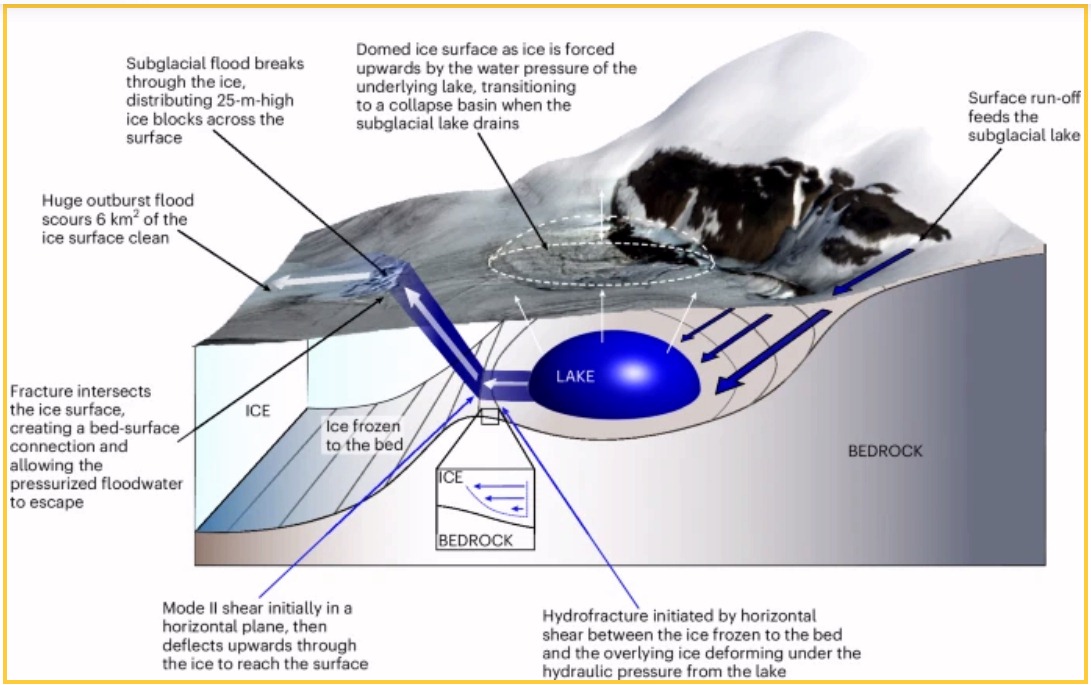
If you’ve been following the giant feedback loop example involving Sudden Sea Level Pulses and Cork Release events, there’s a paper documenting one in action — an outburst of 23 billion gallons of water in just ten days. That’s the equivalent of nine Niagara Falls roaring beneath the ice, warping and fracturing the once-pristine sheet into a chaotic mess.

The Earth’s climate system is a tightly woven network of interdependent processes. Disturb one, and you risk setting off a cascade of reinforcing feedback loops. Consider just one example: the potential collapse of the Atlantic Meridional Overturning Circulation (AMOC).

When the AMOC slows, tropical waters grow hotter while the Arctic warms even faster. This accelerates polar ice melt, raising global sea levels more quickly and injecting vast amounts of freshwater into the North Atlantic. The added freshwater disrupts ocean salinity and density, further weakening the AMOC in a dangerous feedback cycle.

Meanwhile, elsewhere in the system, Amazon droughts intensify under the altered climate, pushing the rainforest toward dieback and eventual desertification. This reduces the Amazon’s ability to recycle rainfall and sequester carbon, further amplifying global warming–and thus accelerating ice melt, sea level rise, and AMOC destabilization.

The Albedo Effect and Ice Melt

Sudden Sea Level Rise / Cork Release

One of the most powerful feedbacks in the polar regions is the albedo effect. As bright, reflective ice melts, it reveals darker land or ocean surfaces that absorb far more solar energy. This speeds up further melting. While melting sea ice mainly changes heat balance without directly raising sea levels, the melting of land-based ice–especially from Greenland and Antarctica–not only raises global seas but also changes ocean salinity and temperature, further destabilizing circulation systems like the AMOC.

These ice sheets hold vast “corks” of land ice restraining enormous reservoirs of meltwater. When these corks break, sudden sea level rise pulses–sometimes 1-3 feet per year for multiple consecutive years–could occur. The impacts on coastlines, global weather, and ocean currents would be both severe and unpredictable.

The Greenland Ice Sheet Outburst Flood

Recent research has identified a startling example of this process. In the paper Outburst of a subglacial flood from the surface of the Greenland Ice Sheet (2025), scientists documented a 90-million-cubic-meter flood that forced its way upward through the ice sheet, bursting out at the surface. This was caused by the rapid drainage of a subglacial lake in a region where the bed was thought to be frozen solid–an event that current ice sheet models do not account for.

The flood’s upward path fractured the ice sheet, disrupting the downstream marine-terminating glacier and altering its flow. This bi-directional coupling between surface and basal hydrology highlights just how complex–and poorly understood–ice sheet dynamics truly are.

Over the last three decades, Greenland has lost roughly 169 billion tons of ice per year on average, contributing about 14 mm to global sea level rise. Roughly half of this loss comes from surface melting and runoff, which are projected to increase sharply as Arctic warming intensifies.

Alaska’s Mendenhall Glacier Outburst: A Glacial Flood Emergency

A massive upstream basin of rainwater and snowmelt, dammed by Alaska’s Mendenhall Glacier, began releasing in August of 2025, prompting officials to urge residents in parts of Juneau to evacuate ahead of a potentially dangerous surge of floodwater.

A glacial outburst flood occurs when meltwater or rainwater accumulates behind a natural ice dam, creating a substantial reservoir of water under pressure. In the case of the Mendenhall Glacier, snowmelt and rainfall from the upstream basin — ironically named Suicide Basin — accumulate behind the glacier, which acts as a solid barrier, trapping the water in depressions known as proglacial lakes or subglacial reservoirs. As the water volume increases, hydrostatic pressure builds against the ice dam. Ice behaves like a viscoelastic material–it can deform slowly under pressure but can fracture if stress exceeds its strength. The weight of the water eventually exceeds the ice’s ability to hold it, particularly if crevasses or melt channels weaken the glacier structure. Once the pressure exceeds the strength of the ice or underlying bedrock, cracks propagate rapidly, and water can exploit subglacial channels, forcing its way beneath or through the ice, a process known as hydraulic fracturing. When the dam fails, the water stored in the basin rushes downstream in a high-energy flood, converting potential energy into kinetic energy, generating destructive flow speeds and forces that can erode soil, uproot trees, damage infrastructure, and rapidly raise river levels. Warming temperatures increase surface melt and rainfall, filling these basins faster, while ice thinning and increased meltwater lubricate the glacier bed, reducing friction and making outbursts more likely. In essence, a glacial outburst results from the buildup of pressure from trapped water, ice weakening or cracking, and the sudden release of gravitational energy, producing a high-speed, destructive flood downstream.

Why This Matters

If hydrofracture events like this outburst become more frequent, the world could face abrupt, multi-foot-per-year sea level jumps–not the gradual rise most models currently project. This would leave little time for adaptation in coastal cities and could unleash profound economic, humanitarian, and ecological consequences.

Current ice sheet models typically treat meltwater movement as predictable and gradual. The Greenland event shows that under certain conditions, trapped subglacial water can build enough pressure to fracture ice and erupt at the surface–what could be called a “cork release” event. These sudden failures are not fully understood, but they could represent one of the most dangerous tipping points in the cryosphere.

Understanding and integrating these processes into predictive models is urgent. The more we learn, the more it becomes clear that the climate system is capable of abrupt, nonlinear shifts–far faster than human infrastructure, economies, or governance can adapt.

* Our climate model — which incorporates complex social-ecological feedback loops within a dynamic, non-linear system — projects that global temperatures could rise by up to 9°C (16.2°F) within this century. This far exceeds earlier estimates of a 4°C rise over the next thousand years, signaling a dramatic acceleration of warming.

Ignite a Domino Effect: Albedo, Brown Carbon, AMOC, Permafrost, Amazon Rainforest Dieback, Outbursts and Sea Level Rise Pulses, Hydroclimate Whiplash, and Arctic Sea Ice Brouse and Mukherjee (2025)

Tipping points and feedback loops drive the acceleration of climate change. When one tipping point is toppled and triggers others, the cascading collapse is known as the Domino Effect.

The Human Induced Climate Change Experiment

From the album “Real Eyes

bookmark_borderTotal Crime

[Verse 1]
Total waste of space
Total waste of our place
Major oil
Nature’s spoil

[Chorus]
This time
It’s a crime
A Total crime
Of all time

[Instrumental, Guitar Solo, Drum Fills]

[Verse 2]
Total brought on the pain
Total bringing on violent rain
Fossil fuel fools
Greed’s tool

[Chorus]
This time
It’s a crime
A Total crime
Of all time

[Instrumental, Saxophone Solo, Bass]

[Bridge]
Oui, oui
We, we
We have a right
To life
We have to fight
Your strife
Oui, we

[Chorus]
This time
It’s a crime
A Total crime
Of all time

[Instrumental, Piano, Bass]

[Outro]
This time
It’s a crime
A Total crime
Of all time

A SCIENCE NOTE
May 21, 2024 — A criminal case has been filed against the CEO and directors of the French oil company TotalEnergies, alleging that its fossil fuel exploitation has contributed to the deaths of victims of climate-fueled extreme weather disasters.

The case was filed in Paris by eight individuals harmed by extreme weather, along with three NGOs. The plaintiffs believe this to be the first criminal case filed against the individuals running a major oil company. The public prosecutor who received the file has three months to decide whether to open a judicial investigation or dismiss the complaint.

The case aims to establish the alleged criminal liability of TotalEnergies’ directors and major shareholders for deliberately endangering lives, involuntary manslaughter, neglecting to address a disaster, and damaging biodiversity. If proven, such crimes are punishable by imprisonment and fines.

TotalEnergies has frequently been targeted by climate cases, with eight known cases, most of which remain active. Climate change litigation against companies and governments is increasing, with many hundreds of cases filed globally.

Notable European successes for climate campaigners include Shell being ordered by a Dutch court to almost halve its carbon emissions by 2030, a decision currently under appeal. Recent successes also include the European Court of Human Rights ruling in April that the Swiss government had failed to cut the country’s emissions adequately, and a UK High Court decision in May declaring the government’s climate action plan unlawful.

One plaintiff in the TotalEnergies complaint, known as William C, lost his mother in the floods brought by Storm Alex in southeastern France in 2020. “I am defending the honor of my mother, who died because of a climate disaster,” he said. “The choices that Total and its shareholders make at the annual general meeting will have a decisive impact on our lives in the future.”

Traditional economics is based upon the “costs and benefits” to society. Since there are no known long-term benefits of climate change to society, the Age of Loss and Damage economics focuses on the exponential costs of climate change to society.

Loss and damage litigation against oil companies and governments will change world economics.

— from The Age of Loss and Damage / Brouse (2023)

From the album “Right Now” by The Beatless Sense Mongers

MegaEpix Enormous

A song about The Human Induced Climate Change Experiment

bookmark_borderMinute to Minute

[Verse 1]
I’ve heard that things on the street
Are getting pretty bleak
Warlords and overlords, the mighty
Verse the meek

[Chorus]
Doing the best I can
To understand Man
All the while, try to smile
While I’m here, time is dear
Cherishing minute to minute

[Instrumental, Guitar Solo, Drum Fills]

[Verse 2]
The absurd word that I heard
is the Plan of Man
How can we withstand (The Plan of Man)
If the plan of Man’s “Be damned.”

[Chorus]
Doing the best I can
To understand Man
All the while, try to smile
While I’m here, time is dear
Cherishing minute to minute

[Instrumental, Saxophone Solo, Drum Fills]

[Bridge]
So, put down the fossil fuel, fool
You’re a danger to yourself
So, put down the fossil fuel, fool
You’re a danger to world health
So, put down the fossil fuel, fool

[Chorus]
Doing the best I can
To understand Man
All the while, try to smile
While I’m here, time is dear
Cherishing minute to minute

[Outro]
All the while, try to smile
While you’re here, time is dear
Cherishing minute to minute

[End]

A SCIENCE NOTE

Our climate model uses chaos theory in an attempt to adequately account for humans and forecasts a global average temperature increase of 9℃ above pre-industrial levels. Everybody has the responsibility not to pollute. There are plenty of things you can do to help save the planet. Stop using fossil fuels. Consume less. Love more. Here is a list of additional actions you can take.

by Δ To Cause a Change from the album Psyched

MegaEpix Enormous

A song about The Human Induced Climate Change Experiment

bookmark_borderDenier Liar

LYRICS
What to do
When you
Won’t except the truth is true
Are you
A denier
Or a liar?

Tainted
Point-of-view
Painted
Whitewash, too
Are you
A denier
Or a liar?

Maybe you don’t care
How you foul the air
But I sure think
You really stink
Are you
A denier
Or a liar?

Denier Liar.mp3

ABOUT THE SONG
A song about Donald Trump, Myron Ebell and climate change.

Style: Freedom Folk Rock
Chords: C E / S C E
Recording: live 1-trck stereo

Vocals, Guitar, Keyboards

Written at the corner of Gay and Church Streets. Recorded in Chester County, West Chester, PA.

From the album Gay Church