[Intro]
[Instrumental Intro: Deep Thunder Bass, Rolling Drums, Dark Piano Chords, Rising Synth Atmosphere, Distorted Guitar Swells]
[Minimal Beat, Sub Bass, Spoken Vocal]
The clouds gather…
(Energy rising)
The waters come…
(No more hiding)
[Refrain]
The rain…
(Is gonna reign over me)
All pain
(No gain)
The troubles we could see
If we let the violent reign
(… remain…)
[Verse 1]
Rain has always fallen down
Rivers flow through every town
But the energy has changed
And the balance rearranged
When the clouds release their load
Floods begin to overflow
[Pre-Chorus]
More water
(More force)
More motion
(Off course)
[Chorus]
Violent reign
(Pouring down)
Turns a smile
(Intо a frown)
Heavy drops
(Falling fast)
Changing futures
(Changing past)
Not just rain
(Not the same)
Energy
(Feeds the game)
[Verse 2]
Wind and water carry weight
Small increases escalate
Raindrops growing, rivers rise
Floodwaters take by surprise
What was once a passing storm
Now can break the strongest form
[Pre-Chorus]
Higher heat
(More supply)
More moisture
(In the sky)
When it falls
(From above)
Comes with force
(Not just love)
[Bridge]
Temperature
(Is the clue)
Energy
(Is what moves through)
Heat becomes
(The storm and sea)
Changing what
(The world can be)
Not only warmer…
(Not only hot…)
But more powerful
(Than we thought)
[Breakdown]
[Minimal Beat, Deep Sub Bass, Spoken Vocal]
Violent rain…
Not just more drops.
More energy.
More water.
More force.
(Change our course)
[Final Chorus]
The rain…
(Is gonna reign over me)
More strain
(To gain)
The troubles we could see
If we let the violent reign
(… remain…)
More intense
(More extreme)
More destructive
(Than it seems)
Storms arrive
(From above)
On the drive
(Drowning out the love)
[Outro]
[Instrumental Outro: Heavy Rain Effects, Echo Guitar, Deep Organ, Thunder Rolls Fading Into Silence]
The rain…
(Is gonna reign…)
The rain…
(Will remain…)
Unless we change…
(The violent reign.)
The Reign of Violent Rain
About the Song
“Climate change is increasing the amount of energy violent rain events contain, amplifying how much damage they can inflict.”
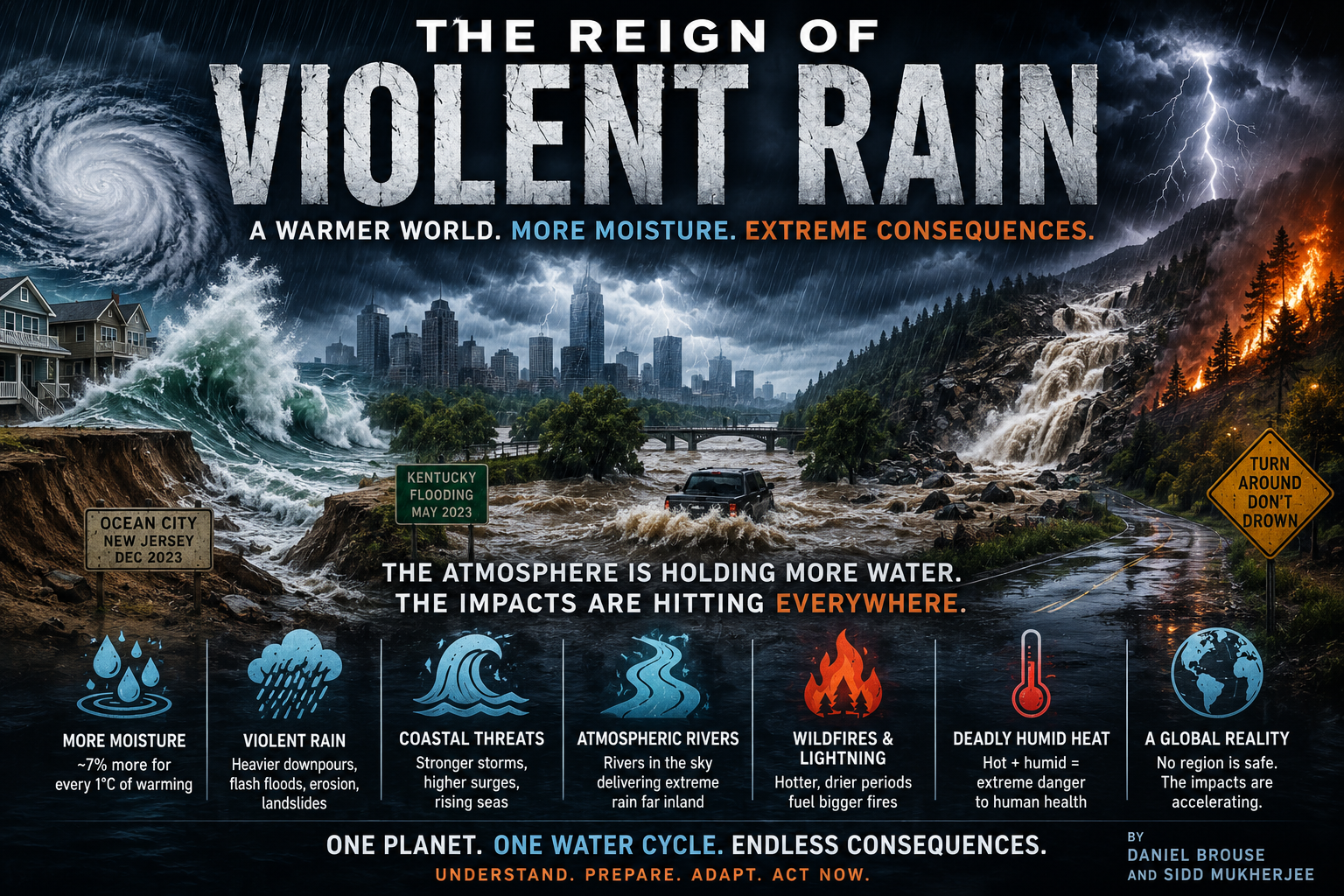
The physics of wind and rain are important to understand: their destructive force increases nonlinearly with velocity and is further amplified by density and mass. Even relatively small increases in wind speed or rainfall intensity can produce disproportionately larger impacts and damage.
Many people equate global warming solely with increasing temperatures. This is a deadly misunderstanding. The additional energy accumulating within Earth’s climate system does not remain simply as heat. It is redistributed throughout the atmosphere and oceans, manifesting in many forms of extreme weather, including floods, stronger storms, atmospheric rivers, and increasingly destructive episodes of violent rain.
Violent rain is not merely heavier rainfall. It is rainfall intensified by the additional energy and moisture now present in the climate system, producing larger raindrops, higher rainfall rates, more intense runoff, and more destructive flooding and erosion.
[Verse 2]
More potential, more release
Less assurance, less peace
Small increases, larger cost
Power gained and power lost
Storms that seemed ordinary
Suddenly become extraordinary
[Bridge]
Not just warmer
(More alive)
Not just hotter
(More drive)
… it gathers, concentrates
And arrives without debate
[Breakdown]
[Minimal Beat, Deep Bass Pulse, Spoken Vocal]
Time to test:
(Evaporated.)
Concentrated.
(Released.)
The beast.
(Manifest.)
Put to the test
(Manifest.)
[Final Chorus]
Microburst
(Bust!)
… through…
(Raining down on you)
Microburst
(Gust!)
… blew…
(Right over you)
What seemed calm
(Became severe)
What seemed distant
(Is now here)
More energy
(More extremes)
More surprises
(Than it seems)
(Released.)
The beast.
(Manifest.)
Put to the test
(Manifest.)
About the Song
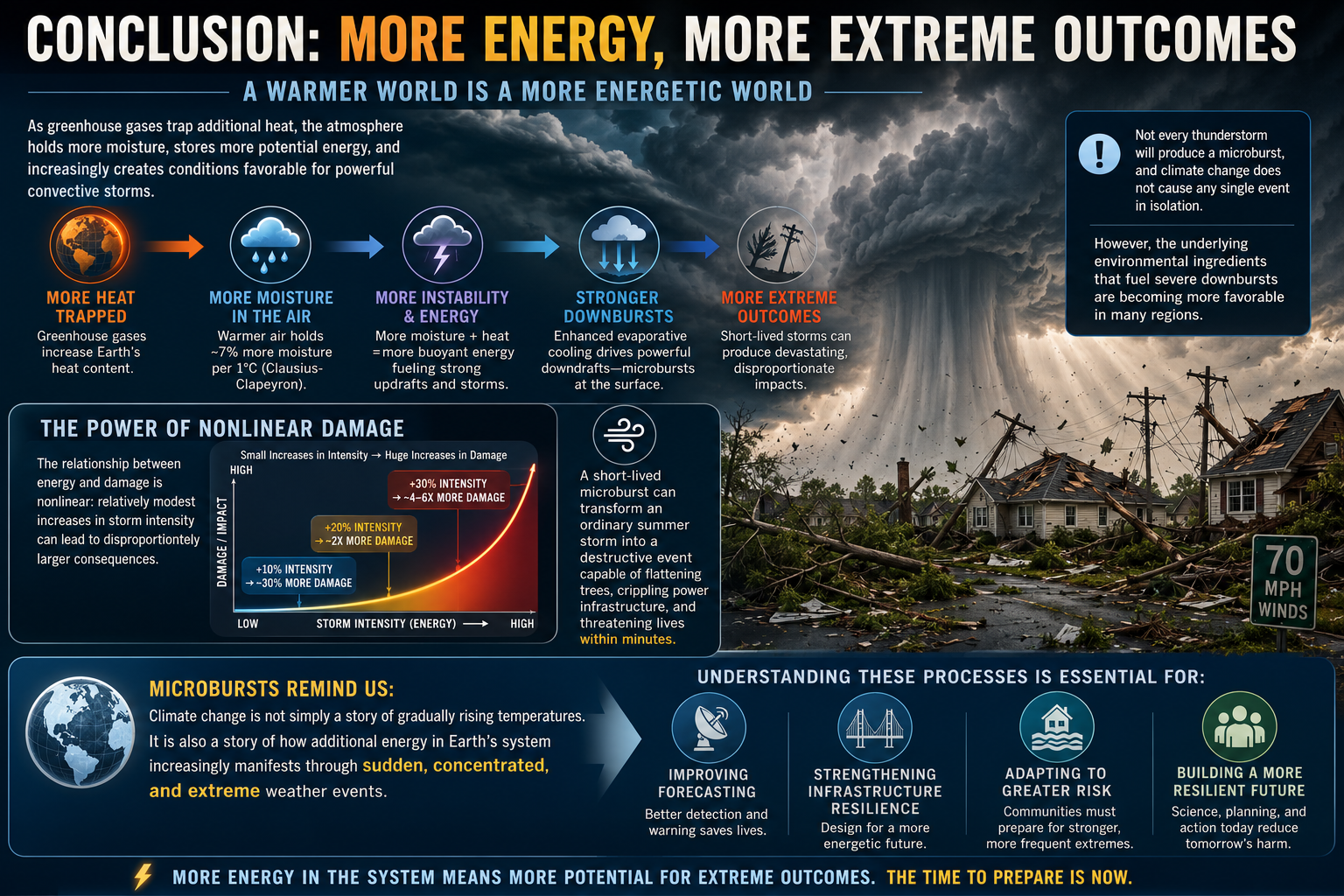
Microbursts illustrate a fundamental principle of climate physics: a warmer world is a more energetic world. As greenhouse gases trap additional heat, the atmosphere holds more moisture, stores more potential energy, and increasingly creates conditions favorable for powerful convective storms.
Because the relationship between energy and damage is nonlinear, relatively modest increases in storm intensity can lead to disproportionately larger consequences. A short-lived microburst can transform an ordinary summer storm into a destructive event capable of flattening trees, crippling power infrastructure, and threatening lives within minutes.
Microbursts therefore serve as a reminder that climate change is not simply a story of gradually rising temperatures. It is also a story of how additional energy in Earth’s system increasingly manifests through sudden, concentrated, and extreme weather events. Understanding these processes is essential for improving forecasting, strengthening infrastructure resilience, and adapting to a climate system that is becoming progressively more volatile and energetic.
Microbursts: Violent Downdraft Spreading in All Directions
<– ← WIND ← IMPACT → WIND → –>
Explodes Outward
Storm surge (Feel the force)
No longer distant (Now the course)
[Outro]
[Instrumental Outro: Massive Drums, Echoing Guitar, Ocean Waves, Dark Organ Fade]
Storm surge… (Storm surge…)
Energy purge…
On the verge… (On the edge…)
Over the ledge.
About the Song: Climate Change and Storm Surges
Climate change is dramatically worsening storm surges by raising baseline sea levels and creating conditions that favor more intense coastal storms. As the planet warms, the combination of rising oceans and increasingly energetic weather systems allows seawater to penetrate farther inland with greater destructive force, placing millions of people and billions of dollars in coastal infrastructure at increasing risk.
Key Drivers of Worsening Storm Surges
Rising Sea Levels: This is the primary driver of increasing coastal flood risk. Global warming melts land-based ice sheets and glaciers while also causing seawater to expand as it warms. Because sea levels are higher than they were a century ago, today’s storm surges begin from an elevated baseline, allowing floodwaters to reach much farther inland.
Increased Storm Intensity: Warmer ocean temperatures provide additional energy for tropical cyclones, effectively increasing their potential intensity. Stronger storms generate more powerful winds that pile up and push enormous volumes of water toward coastlines, producing higher and more destructive storm surges.
Rapid Intensification: The accumulation of heat in the upper ocean has increased the likelihood of rapid intensification events, in which hurricane wind speeds increase by at least 35 mph within a 24-hour period. This accelerated strengthening dramatically reduces the time available for forecasts, evacuations, and emergency preparations.
Slower-Moving Storms: Some studies suggest that climate change may contribute to a reduction in the forward speed of certain tropical cyclones. When storms move more slowly, they remain over coastal areas longer, generating prolonged storm surges, heavier rainfall, and repeated wave impacts that compound flooding and infrastructure damage.
The Bottom Line
Storm surges are becoming more dangerous because they are increasingly occurring on top of a rising ocean and, in many cases, are being driven by more energetic storms. The result is deeper flooding, greater inland penetration of seawater, longer-lasting impacts, and rapidly escalating economic and human costs.
[Refrain]
Extreme Energy Events
(Presents:)
More!
(Rain)
More!
(Pain)
[Verse 1]
People hear the phrase “warming world”
Think the change is neatly curled
Just a number climbing slow
One degree or two to go
But heat won’t sit in place
Energy runs the race’s pace
Stored and shifted, pushed around
Turning sky and sea and ground
[Pre-Chorus]
Heat goes in
(Then transforms)
Changing shape
(Into storms)
[Chorus]
Extreme Energy Events
(Presents:)
More!
(Waves)
Who
(Saves?)
More!
(Heat)
More!
(Beat)
Energy finds another street
[Verse 2]
Winds accelerate and race
Storms intensify their pace
Moisture rises, clouds expand
Heavy rains sweep through the land
Latent heat and ocean flow
Feed the systems as they grow
Lightning flashes through the sky
Wildfires spread and glaciers slide
Watch the joules begin to roam
Far away… now close to home
[Instrumental]
[Guitar Solo]
[Driving Bass, Organ Chords, Synth Arpeggios]
[Bridge]
Kinetic energy
(Moving air)
Potential energy
(Rising there)
Latent heat
(Hidden force)
Electrical energy
(Changing course)
Mechanical work
(Shaping shore)
Chemical feedbacks
(And more… and more…)
[Breakdown]
[Minimal Beat, Deep Sub Bass, Spoken Vocal]
Global warming…
(Is only the beginning.)
Temperature is the signal.
Energy…
(Is the story after all)
[Final Chorus]
Extreme Energy Events
(Presents:)
More!
(Rain)
More!
(Strain)
More!
(Fire)
Dire
(Higher)
More extreme
(Now what I mean)
Think not only in degrees
(Think in motion)
Think in gradients and seas
(Think in oceans)
Think in forces, flows, and streams
(And momentum)
Think in joules and what it means
(Where they send them)
Extreme Energy Events
(Presents:)
[Outro]
[Instrumental Outro: Echo Guitar, Rolling Drums, Organ Sustain, Synth Slowly Dissolving]
Extreme energy…
(In motion)
Extreme energy…
(Transformation)
Extreme event
(… in the present)
About the Song
The phrase global warming is widely misunderstood. While it correctly describes a rise in average surface temperature, it understates the real risk: a rapid increase in total system energy. Temperature is only the initial signal. Once excess energy accumulates, it is transferred, converted, and expressed through atmospheric circulation, ocean dynamics, hydrological cycling, and ecological responses.
Global warming is therefore the beginning of climate change — not its endpoint.
Extreme Energy Events
Excess trapped thermal energy is continually transformed into other forms, including:
Kinetic Energy (stronger winds, faster storm systems)
Gravitational Potential Energy (enhanced vertical convection, intensified precipitation)
Latent Heat (phase changes driving hurricanes and atmospheric rivers)
Radiant Energy (infrared trapping and feedback amplification)
Chemical Energy (biogeochemical feedbacks, wildfire combustion)
Electrical Energy (increased lightning frequency in convective systems)
Mechanical Work (coastal erosion, glacier flow acceleration, ocean mixing)
In 2025, global mean temperatures exceeded the long-recognized 1.5°C threshold. To a casual observer, that number may sound small. In a nonlinear system, it is not.
Small shifts in average temperature translate into large, destabilizing shifts in gradients — temperature gradients, pressure gradients, and moisture gradients. Those gradient changes alter circulation patterns, intensify convection, amplify hydrological extremes, and increase momentum transfer.
What emerges are not merely “weather events,” but what are more accurately described as:
Extreme energy events.
Understanding climate change requires thinking not in degrees —
but in joules.
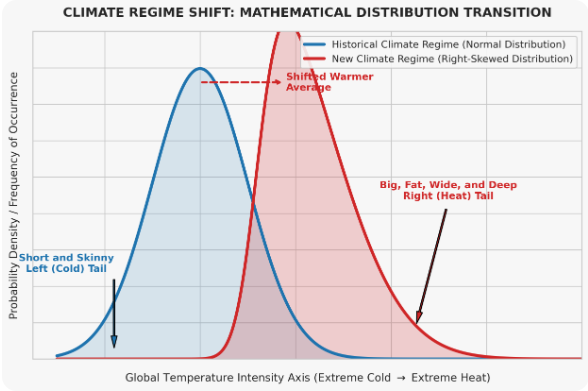
Extreme heat waves, marine heatwaves, intense rainfall, flash flooding, atmospheric rivers, severe droughts, wildfire conditions, and the most powerful tropical cyclones are becoming more frequent, more intense, and longer-lasting. As the right tail of the distribution expands in both length (greater extremes) and breadth (greater frequency), events that were once considered exceptionally rare are occurring with increasing regularity, lasting longer, and causing greater destruction.
This change in the probability distribution helps explain why record-breaking events are occurring with unprecedented frequency. A simple shift of the bell curve would increase average temperatures, but the emergence of a broad, heavy right tail fundamentally changes the odds. The climate system is no longer producing merely warmer versions of past weather—it is generating a growing number of events that fall far outside the historical range of experience. The result is an increasing concentration of record-breaking extremes that disproportionately drive human, economic, and ecological impacts.
[Final Chorus]
Dancin’ in…
(A ring-of-fire)
No way out
(No higher)
Lightning singing
Through the wire
Burning brighter
And higher
[Final Refrain]
Lightning strikes twice
(Or maybe thrice)
Everyone sing:
(In a ring!)
A ring-of-fire
(Feedback…)
Higher and higher
No, no more slack
(Feedback…)
[Outro]
Ring of fire…
(Higher! Higher!)
Round we go
(Will it stop… I don’t know)
Ring of fire…
(When will it tire)
I don’t know
About the Song
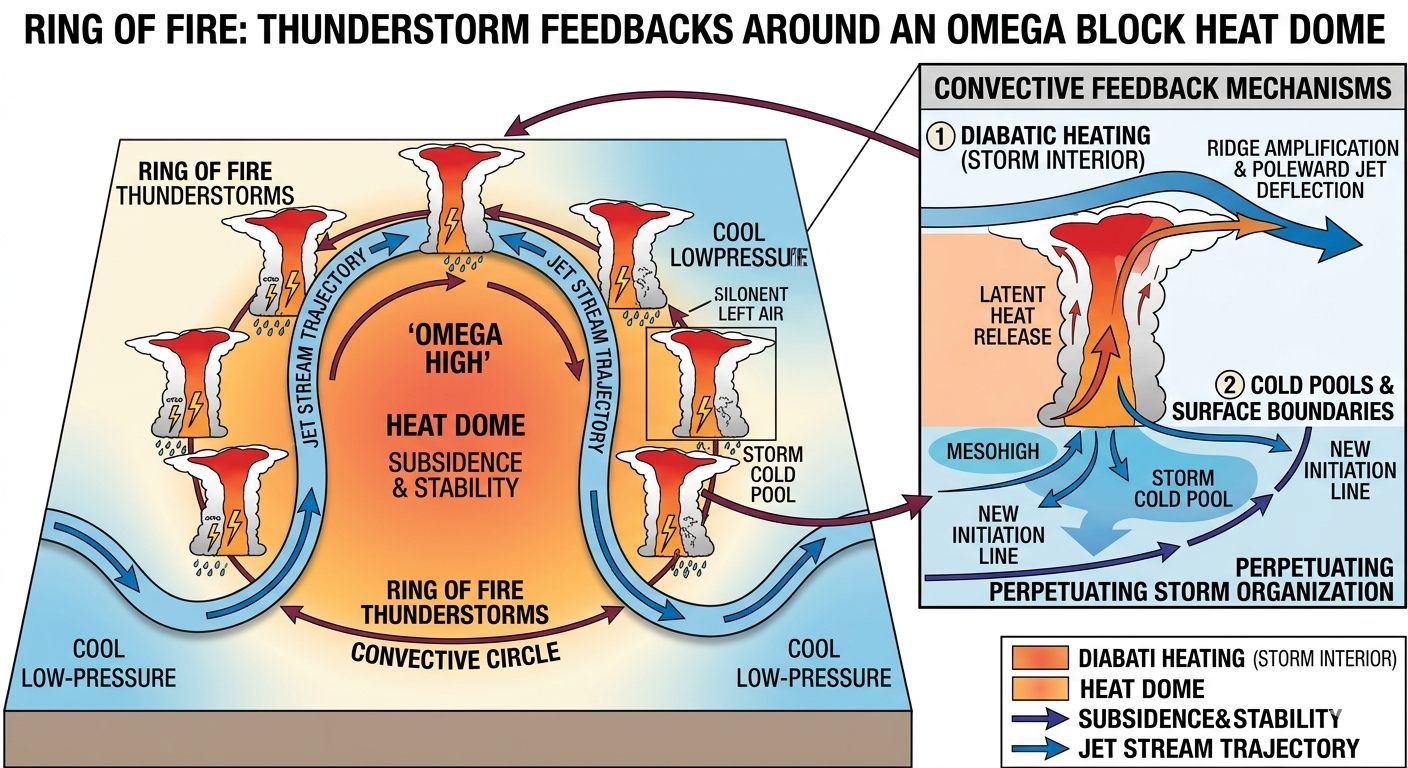
In meteorology, a Ring of Fire describes a recurring pattern in which clusters of powerful thunderstorms repeatedly develop and travel around the outer edge of a large, stationary high-pressure system. These storms form where extremely hot, dry air beneath the heat dome collides with cooler, moisture-rich air circulating around its perimeter.
The pattern becomes especially dangerous when the high-pressure system takes the form of an Omega block, named because the jet stream bends into a shape resembling the Greek letter Ω. In this configuration, the jet stream stalls, leaving a massive dome of sinking air trapped beneath the center of the ridge. The descending air continuously compresses and warms, suppressing cloud formation and preventing thunderstorms from developing over the core of the heat dome.
Unable to penetrate this atmospheric “cap,” storms are instead forced to travel around the edge of the dome, following the path of the jet stream. The result is a nearly continuous corridor of severe thunderstorms that circles the stagnant high-pressure system like a racetrack.
The Ring: A Corridor of Explosive Storms
Along the outer edge of the heat dome, the hot, dry air meets cooler, more humid, and unstable air associated with surrounding low-pressure troughs. The sharp temperature and moisture contrasts create an ideal environment for rapid thunderstorm development. Abundant atmospheric moisture—enhanced by warmer oceans and increased evaporation—provides enormous latent heat that fuels severe convection. The result is repeated outbreaks of supercell thunderstorms, mesoscale convective systems (MCSs), derechos, torrential rainfall, large hail, and frequent lightning.
The “Train Track” Effect
Because Omega blocks often remain stationary for days or even weeks, the jet stream changes very little. New thunderstorms repeatedly form along the same atmospheric boundary and follow nearly identical paths. Meteorologists refer to this as training, because successive storms move over the same locations like railroad cars on a track. This dramatically increases the risk of catastrophic flash flooding, even when individual storms are moving rapidly.
The Ring of Fire is an example of how Earth’s climate system is increasingly governed by interacting positive feedback loops rather than isolated events. Rising temperatures increase atmospheric moisture and instability, producing more lightning, larger wildfires, and greater emissions of greenhouse gases and light-absorbing aerosols. These processes reinforce one another, accelerating climate change.
[Intro]
… waited
(As the future came)
… left
(Without a name)
[Verse 1]
The river climbed
(Above the mark)
The power failed
(And left the dark)
The road gave way
(The bridge went too)
One broken link
(Then another one through)
The crops dried out
(Then the rains arrived)
The ground cracked open
(Then came the tide)
What once was home
(Began to bend)
And every refuge
(Reached its end)
[Chorus]
Is that what you meant?
(Displacement)
Are we really hellbent?
(Displacement)
How many losses
(Before consent?)
Is that what you meant?
(Displacement)
[Verse 2]
A flooded field
(A shuttered store)
A water line
(At the kitchen door)
A job gone missing
(A school shut down)
A train of reasons
(To leave the town)
The map still says
(That people stay)
But the facts on the ground
(Have drifted away)
You don’t just move
(Because it rains)
You move when the whole
(System pains)
[Chorus]
Is that what you meant?
(Displacement)
Are we really hellbent?
(Displacement)
How many losses
(Before consent?)
Is that what you meant?
(Displacement)
[Breakdown]
Move again
(Begin again)
Pack it up
(Pack it in)
Move again
(Begin again)
[Final Chorus]
Is that what you meant?
(Displacement)
Are we really hellbent?
(Displacement)
Not one disaster
(But a system spent)
Not one collapse
(But a continent bent)
Is that what you meant?
(Displacement)
[Final Refrain]
Forced to move
(Displacement)
No place left
(Displacement)
Threshold crossed
(Displacement)
What was lost?
(Displacement)
[Outro]
Where do we go?
(And the wind said)
You already know
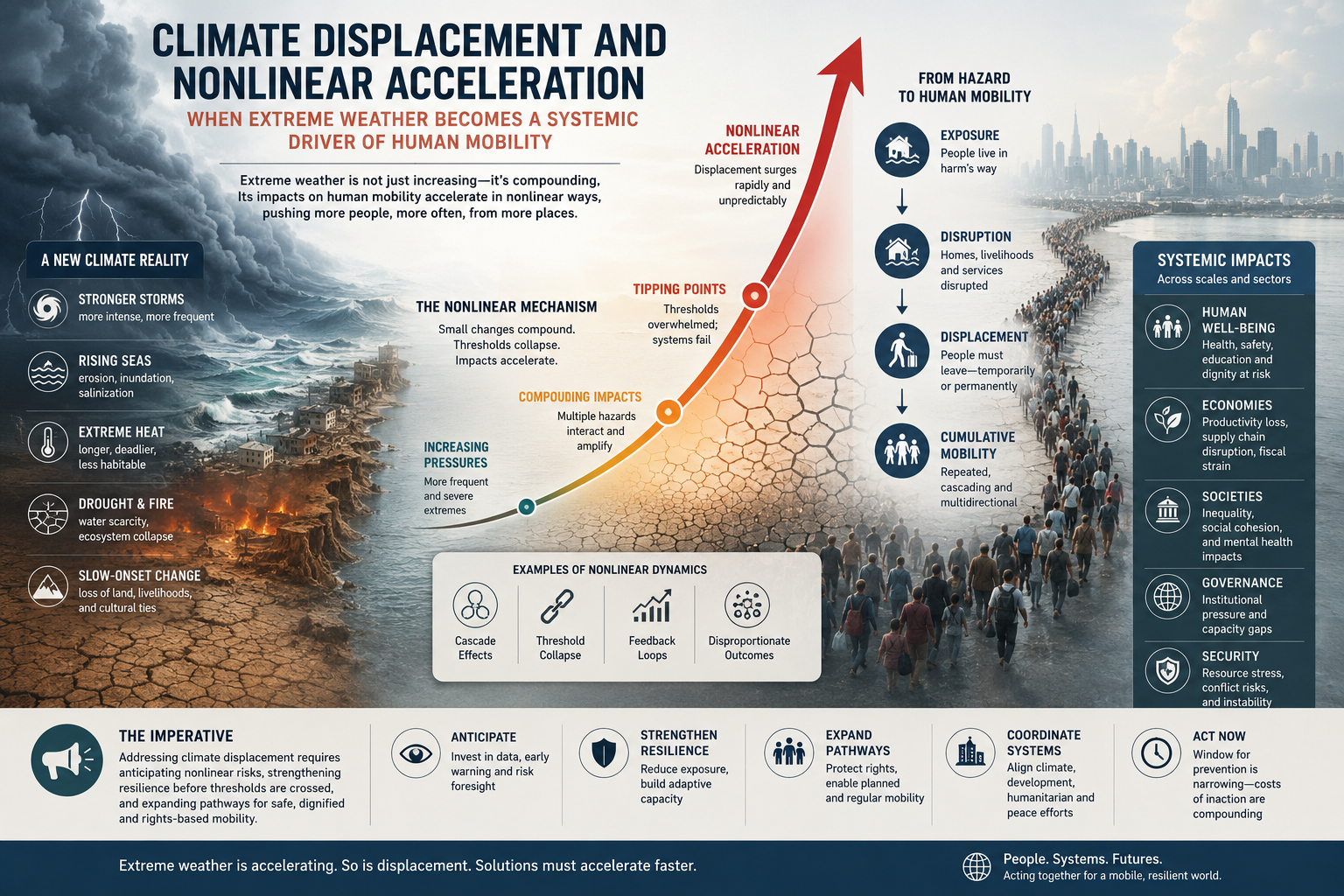
Climate displacement acceleration.
About the Song: When Extreme Weather Becomes a Systemic Driver of Human Mobility
Displacement is increasingly best understood as a systems-level indicator. It measures not only the physical impact of a storm, flood, drought, wildfire, or heatwave, but also the failure of social and ecological buffers that once absorbed those shocks. When households are forced to move, it means a threshold has been crossed: infrastructure failed, livelihoods failed, food systems failed, water systems failed, governance failed, or some combination of the above failed at once.
The 2026 Global Report on Internal Displacement provides a stark snapshot of this process. By the end of 2025, 82.2 million people were living in internal displacement across 104 countries and territories. Of those, 68.6 million were displaced by conflict and violence and 13.6 million by disasters.
A linear view of climate displacement assumes a relatively simple chain of causation:
warming → more extreme weather → more damage → more displacement
But the real system increasingly looks more like this:
[Intro]
Where were you?
(Where are you now?)
Point A
(To somehow)
Mark the line
(Make it plain)
Start to finish
(Change the frame)
[Verse 1]
It’s not the miles
(That you may roam)
Not every step
(Between here and home)
It’s where you started
(And where you land)
The shift between
(The two at hand)
You can wander
(Round and round)
Still end up near
(The same old ground)
But if you move
(From there to here)
That change in place
(Is what we hear)
[Chorus]
Defined
(As the change)
Rearrange
(Position)
From where you were
(To where you came)
Defined
(As the change)
Rearrange
(Position)
Direction matters
(Just the same)
[Verse 2]
Final minus
(Initial state)
That’s the measure
(Of the update)
A positive sign
(Means up or right)
A negative sign
(Means left in flight)
Distance counts
(Every turn)
Every loop
(Every burn)
But displacement
(Cuts straight through)
To what has changed
(In terms of you)
[Chorus]
Defined
(As the change)
Rearrange
(Position)
From where you were
(To where you came)
Defined
(As the change)
Rearrange
(Position)
Direction matters
(Just the same)
[Bridge]
Magnitude
(And where it points)
That’s the key
(To all the joints)
Not just motion
(Without a name)
But movement framed
(Inside the plane)
You can drift
(Or stay aligned)
But once you move
(It gets defined)
A simple shift
(Can still reveal)
How space and change
(Begin to feel)
[Breakdown]
Change the place
(Change the sign)
Mark the shift
(Make the line)
Change the place
(Change the sign)
Now define
(Now define)
[Final Chorus]
Defined
(As the change)
Rearrange
(Position)
From where you were
(To where you came)
Defined
(As the change)
Rearrange
(Position)
A new direction
(A new design)
Defined
(As the change)
Rearrange
(Position)
… new design
[Outro]
Point A
(Point B)
What it means
(Is what you see)
Not the journey
(Not the strain)
But where you moved
(And how you changed)
About the Song
In classical physics, displacement is defined as the change in position of an object. Unlike distance, which measures the total path traveled, displacement is a vector quantity. This means it possesses both a magnitude (numerical value) and a specific direction.
1. The Mathematical Definition
Displacement is represented by the symbol Δx (or Δr in multi-dimensional space). It is calculated by subtracting the initial position vector (xᵢ) from the final position vector (x𝒻):
Δx = x𝒻 − xᵢ
SI Unit: meters (m)
Sign convention: In one-dimensional motion, a positive sign (+) denotes movement to the right or upward, while a negative sign (-) denotes movement to the left or downward.
Out of Sorts
[Intro]
Something’s off
(Something’s wrong)
Hard to tell
(How long)
Everything’s there
(But not in place)
Like a smile
(On the wrong face)
[Verse 1]
The room’s the same
(But the air feels strange)
Every little thing
(Just slightly changed)
The lights are on
(But they don’t look right)
Morning comes
(Like the middle of night)
You lost the thread
(Of what you meant)
Spent your focus
(Like you spent your rent)
Now every plan
(Feels out of joint)
Every step
(Missed the point)
[Chorus]
Are you feeling
(Out of sorts)
Are you reeling
(Last resorts)
Are you drifting
(Off the course)
Out of balance
(With no remorse)
Are you feeling
(Out of sorts)
[Verse 2]
The stack got higher
(The sleep got thin)
The pressure found
(A way to get in)
One more bill
(One more bad call)
One more push
(And you feel too small)
You’re still standing
(But not quite straight)
Running late
(Inside your fate)
And all the things
(You used to hold)
Feel less certain
(More bought than sold)
[Chorus]
Are you feeling
(Out of sorts)
Are you reeling
(Last resorts)
Are you drifting
(Off the course)
Out of balance
(With no remorse)
Are you feeling
(Out of sorts)
[Bridge]
Could be the weather
(Could be the news)
Could be the miles
(In somebody’s shoes)
Could be the heat
(Or the lack of sleep)
Could be the weight
(You forgot to keep)
Could be the world
(Coming in too fast)
Could be too much
(From the future and past)
Sometimes the signal
(Comes in blurred)
And all you’ve got
(Is one loose word)
[Breakdown]
Shake it loose
(Shake it loose)
Take a breath
(Take a breath)
Shake it loose
(Shake it loose)
What comes next?
(What comes next?)
[Final Chorus]
Are you feeling
(Out of sorts)
Are you reeling
(Last resorts)
Are you drifting
(Off the course)
Out of balance
(With no remorse)
Are you feeling
(Out of sorts)
Are you spinning
(Through the reports)
[Final Refrain]
Out of sorts
(Last resorts)
Out of sorts
(Last resorts)
Out of sorts
(Last resorts)
Out of sorts
(Last resorts)
[Outro]
Something’s off
(Something’s wrong)
Hard to tell
(How long)
But if you listen
(Through the noise)
You might still find
(Your better voice)
Move Out
[Intro]
Pack it up
(Move it now)
Anyhow…
Don’t look back
(At what the future will lack)
[Verse 1]
The water’s rising
(Up the stairs)
Smoke is hanging
(In the air)
Power’s gone
(The road is closed)
The warning came
(But no one knows)
How long we’ve got
(Before the line)
Between “still safe”
(And “too late this time”)
The bags are by
(The broken door)
And nobody’s waiting
(Anymore)
[Chorus]
Didn’t you hear
(We gotta move outta here)
In case I wasn’t clear
(Outta here)
Didn’t you hear
(We gotta move outta here)
There’s nothing left
(To keep us here)
[Refrain]
No doubt about
(Gotta move out)
Let’s hear you shout:
(Gotta move out)
No doubt about
(Gotta move out)
Let’s hear you shout:
(Gotta move out)
[Verse 2]
The crops gave out
(The pipes ran dry)
The price of staying
(Climbed too high)
The school shut down
(The clinic too)
The map says stay
(But the facts say move)
A cracked foundation
(A washed-out lane)
A month of heat
(Then months of rain)
You don’t leave home
(For one bad day)
You leave when the system
(Gives way)
[Chorus]
Didn’t you hear
(We gotta move outta here)
In case I wasn’t clear
(Outta here)
Didn’t you hear
(We gotta move outta here)
There’s nothing left
(But pain and fear)
[Breakdown]
No doubt
(Move out)
Somehow
(Move now)
No doubt
(Move out)
Somehow
(Move now)
[Final Chorus]
Didn’t you hear
(We gotta move outta here)
In case I wasn’t clear
(Outta here)
Didn’t you hear
(We gotta move outta here)
The ground beneath
(Has disappeared)
Didn’t you hear
(We gotta move outta here)
[Final Refrain]
No doubt about
(Gotta move out)
Let’s hear you shout:
(Gotta move out)
No doubt about
(Gotta move out)
Let’s hear you shout:
(Gotta move out)
Move out
(Gotta move out)
Move out
(Gotta move out)
[Outro]
Pack it up
(Move it out)
In a bout…
(About moving out)
Don’t look back
(Forever we’ll lack)
Uprooted
[Intro]
Pack the bag
(Check the tag)
Start the car
(Roaming far)
One more town
(Going down)
Running far
(Grab my guitar)
[Verse 1]
The warning came
(Then came the flood)
Then came the smoke
(Then came the mud)
The roof gave way
(The well ran dry)
The field went brown
(Beneath the sky)
We thought we’d leave
(For just a while)
Till the road bent out
(Another mile)
Till “temporary”
(Turned primary)
Forced a new begin
(Never going back again)
[Pre-Chorus]
One storm’s a shock
(Two storms a sign)
Three storms later
(You redraw the line)
[Chorus]
On the road again
(We gotta ride)
Ride, ride, ride
(Never going home again)
On the road again
(We gotta ride)
Ride, ride, ride
(Never going home again)
[Refrain]
Uprooted
(Too many extremes)
Uprooted
(Wondering if you know… what it means?)
Uprooted
(Too many extremes)
Uprooted
(Wondering if you know… what it means?)
[Verse 2]
A bridge washed out
(A school shut down)
The clinic closed
(The crops turned brown)
A paycheck gone
(A landlord waits)
A family stalled
(Between two states)
The map says “home”
(But home says “no”)
When there’s no safe place
(Left to go)
And every fix
(Loses the race)
Can’t hold together
(A failing place)
[Chorus]
On the road again
(We gotta ride)
Ride, ride, ride
(Never going home again)
On the road again
(We gotta ride)
Ride, ride, ride
(Never going home again)
[Bridge]
Not just movement
(Not just flight)
Not one bad season
(Or one bad night)
It’s the way return
(Keeps slipping back)
As roads collapse
(And wages crack)
A million exits
(Without relief)
A rising ledger
(Of stranded grief)
And every mile
(The tires spin)
Says the system lost
(What we lived in)
[Breakdown]
Drive all night
(For new daylight)
Chase the dawn
(Keep movin’ on)
Till the old place is gone
(Long, long gone)
[Final Chorus]
On the road again
(We gotta ride)
Ride, ride, ride
(Never going home again)
On the road again
(We gotta ride)
Ride, ride, ride
(Never going home again)
On the road again
(We gotta ride)
Ride, ride, ride
(With the past tied in)
[Final Refrain]
Uprooted
(Too many extremes)
Uprooted
(Wondering if you know… what it means?)
Uprooted
(Too many extremes)
Uprooted
(Wondering if you know… what it means?)
Uprooted
(No easy return)
Uprooted
(Watch the whole world turn)
[Outro]
Pack the bag
(Check the tag)
Start the car
(Roaming far)
One more town
(Going down)
Running far
(Grab my guitar)
About the Song
According to IDMC, nearly 13.6 million people were still living in internal displacement at the end of 2025 because of disasters, compared with roughly 9.9 million at the end of 2024. That is an increase of about 3.7 million people in a single year, or approximately 37–38 percent.
This matters for two reasons.
First, it suggests that the consequences of disasters are becoming more persistent. Many people are not simply evacuating and returning home after a storm. They are remaining displaced for longer periods because homes, farmland, water systems, roads, and local economies are not recovering quickly enough.
Second, it highlights the difference between flows and stocks in displacement analysis. IDMC distinguishes between:
* internal displacements: the number of forced movements recorded during a year, including repeated movements by the same person; and
* internally displaced people (IDPs): the number of people still living in displacement at a given point in time, usually at the end of the year.
This distinction is crucial in a nonlinear climate context. A single extreme event can trigger a large flow of short-term displacements, but a system under sustained stress generates something more dangerous: a rising stock of people who remain uprooted because return, recovery, and resettlement become progressively harder.
That is the deeper warning embedded in the recent numbers.
RTZ
[Intro]
Round you go
(To and fro)
Out and back
(On the track)
Round you go
(Start the show)
RTZ
(Return to zero)
[Verse 1]
You took a walk
(Down the street)
Past the corner store
(On your feet)
Kept on moving
(Mile by mile)
Took the long way
(For a while)
You went somewhere
(That much is true)
Spent some time
(Seeing the view)
But when you came
(All the way home)
Your starting point
(Was still your own)
[Chorus]
Though you did depart
When you return to start
The trip you made
Caused displacement to fade
Though you did depart
When you return to start
The miles remain
But no net change
[Refrain]
RTZ
(Return to zero)
Now you see
(Now you know)
RTZ
(Return to zero)
Round you go
(Back to go)
[Verse 2]
Distance counts
(Every stride)
Outward bound
(And back in line)
Two miles traveled
(That part’s real)
But displacement
(Is a different deal)
It only cares
(Where you begin)
And where you stop
(When you’re done again)
So if the finish
(Meets the start)
Zero’s written
(On the chart)
[Bridge]
It’s not about
(How far you roam)
It’s whether or not
(You came back home)
The path can twist
(The path can bend)
But zero waits
(At journey’s end)
[Breakdown]
Out you go
(Back you come)
Out you go
(Displace none)
Mile away
(Mile back home)
Net result?
(Zero zone)
[Final Chorus]
Though you did depart
When you return to start
The trip you made
Caused displacement to fade
Though you did depart
When you return to start
Distance was real
But the net “no deal”
[Final Refrain]
RTZ
(Return to zero)
Now you see
(Now you know)
RTZ
(Return to zero)
Back at home
(Forgot your roam)
RTZ
(Return to zero)
[Outro]
Round you go
(There you go)
Back to start
(Whole new chart)
RTZ
(Return to zero)
About the Song
In physics displacement is zero if you return to start.
A loop around the block: If you walk 1 mile away from your house and then walk 1 mile back, your distance traveled is 2 miles, but your displacement is 0. Because your final position is the same as your initial position, there is zero net change in your location.
Drop a Pebble
[Intro]
Still water
(Still mind)
Small stone
(One kind)
Still water
(Still mind)
Watch it unwind
[Verse 1]
You hold it small
(Just in your hand)
A simple shape
(From the land)
Nothing special
(At first sight)
But it changes everything
(When it takes flight)
It falls through air
(So clean, so free)
Then meets the surface
(Of memory)
And in that instant
(Quiet and sure)
The rules of space
(Are something more)
[Refrain]
Be a rebel
(Drop a pebble)
Then of course
(Watch the force)
Be a rebel
(Drop a pebble)
Feel the source
(Of the force)
[Verse 2]
Water parts
(Makes a room)
A hidden rise
(Inside the plume)
Volume shifts
(Exact and true)
What it pushes out
(It must undo)
No overlap
(No shared place)
Just displacement
(In time and space)
And what goes down
(Comes back in view)
In rising levels
(It tells you)
[Chorus]
Be a rebel
(Drop a pebble)
Then of course
(Watch the force)
Be a rebel
(Drop a pebble)
Then feel the course
(Of the force)
[Bridge]
It’s not magic
(It’s geometry)
It’s not chaos
(It’s symmetry)
Space insists
(On separation)
Matter meets
(Its limitation)
One stone enters
(One world reacts)
Water rises
(Along its tracks)
[Final Refrain]
Be a rebel
(Drop a pebble)
Then of course
(Watch the force)
Be a rebel
(Drop a pebble)
Feel the source
(Of the force)
[Outro]
Still water
(Still mind)
Small stone
(One kind)
Watch the ripples
(Unwind)
About the Song
When you drop a pebble into water, fluid displacement involves a clear series of physical interactions.
Because two distinct pieces of matter cannot occupy the same space at the same time, the pebble forces
water molecules out of its way as it sinks.
Here is exactly how the physics of this process works step-by-step:
Spatial Exclusion and Volume Shift
As the pebble enters and sinks, it pushes water aside to make room for its own body. Because the pebble
is completely submerged, the volume of water displaced is exactly equal to the geometric volume of the pebble.
If you drop a pebble with a volume of 10 cm3 into a graduated cylinder, the water level will rise
by exactly 10 mL.
The Generation of Upward Buoyant Force
According to Archimedes’ Principle, any object submerged in a fluid experiences an upward buoyant force
Fb. This upward push is directly equal to the weight of the water that the pebble displaced.
Hydrologic Whiplash
[Intro]
Dry…
(Then drown)
Crack…
(Then come down)
Dry…
(Then drown)
Whiplash
(Comin’ around)
Mad dash
(Is it any wonder)
Heavy metal thunder
[Verse 1]
The ground turns brittle
(Under the sun)
Fields start splitting
(One by one)
Wells run shallow
(Rivers shrink)
Everything’s waiting
(On the brink)
Then the sky comes open
(All at once)
No slow return
(No second month)
No gentle mercy
(No measured pace)
Just too much water
(In too small a place)
[Chorus]
Hydrologic whiplash
(Changing up fast)
Hydrologic whiplash
(Normal’s now past)
Hydrologic whiplash
(First the dust, then the splash)
Hydrologic whiplash
(Thrown by the lash)
[Refrain]
One way, then the other
(No time to recover)
One way, then the other
(Then we smother)
Cracked by drought
(Washed right out)
Cracked by drought
(Washed right out)
What a blunder
(Is it any wonder)
Heavy metal thunder
[Verse 2]
Crops don’t make it
(Through the heat)
Livestock weaken
(On burning streets)
Pipes run dry
(Storage falls)
Then the flood comes
(Through the walls)
Roads get taken
(Bridges bend)
Homes collapse
(Again, again)
Clinics drowning
(Sewers fail)
Recovery breaks
(Before it can prevail)
[Chorus]
Hydrologic whiplash
(Changing up fast)
Hydrologic whiplash
(Normal’s now past)
Hydrologic whiplash
(First the dust, then the splash)
Hydrologic whiplash
(Thrown by the lash)
[Bridge]
… the violent swing
(Between the pain)
Not much of anything
(Will remain)
Will we try to sustain?
(Is it any wonder)
Heavy metal thunder
[Breakdown]
Dust in the lungs
(Water in the street)
Empty reservoir
(Then a tidal beat)
No time to plant
(No time to mend)
No time to start
(Before the next begins)
[Final Chorus]
Hydrologic whiplash
(Changing up fast)
Hydrologic whiplash
(Normal’s now past)
Hydrologic whiplash
(First the dust, then the splash)
Hydrologic whiplash
(Thrown by the lash)
Hydrologic whiplash
(Dry to flood in a flash)
Hydrologic whiplash
(And the damage stacks)
[Outro]
Dry…
(Then drown)
Crack…
(Then come down)
No time left
(To turn around)
Whiplash…
(Comin’ around)
Reigning down
(Is it any wonder)
Heavy metal thunder
About the Song
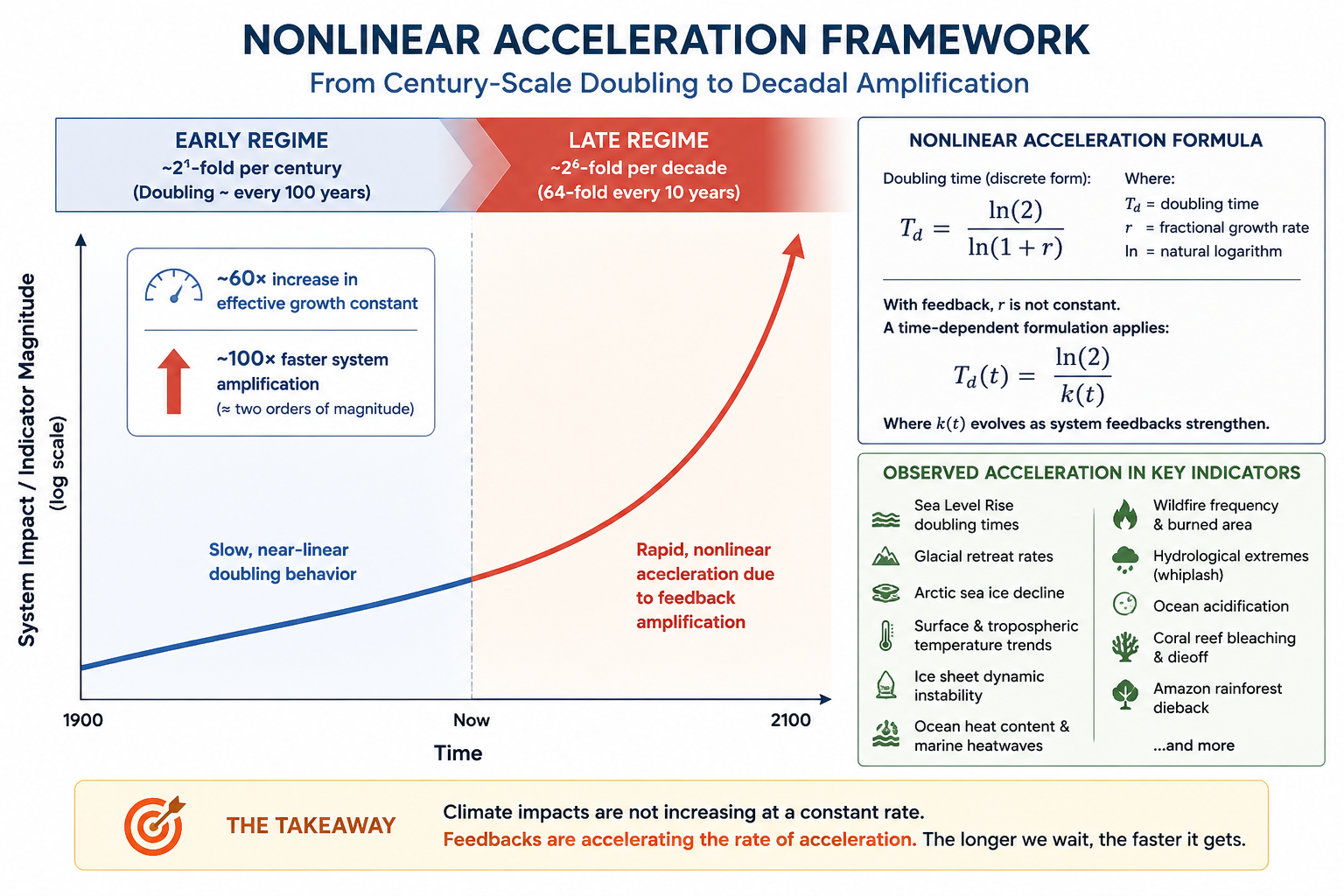
One of the clearest nonlinear pathways is hydrologic whiplash—the growing tendency for regions to swing rapidly between drought and flood. A warmer atmosphere increases evaporation, drying soils and intensifying drought. At the same time, warmer air holds more water vapor, increasing the likelihood of extreme rainfall when storms do occur. The result is not simply “more drought” or “more flooding,” but a destabilizing oscillation between the two.
For vulnerable populations, this matters enormously. Drought can destroy crops, livestock, and local water supplies. Flooding can then destroy the roads, bridges, homes, sanitation systems, and clinics needed for recovery. The second disaster lands before recovery from the first is complete. Communities are not merely hit harder; they are hit before they have time to recover. That is a nonlinear displacement engine.
Repeated
[Intro]
Again…
(Again)
Pack it up
(Again)
Start over
(Again)
[Verse 1]
The water came
(So they ran)
Found a room
(Made a plan)
Months went by
(They drifted back)
Fixed the door
(Patched the cracks)
Then the storm
(Came around)
Same old road
(Same old sound)
Grab the kids
(Grab the cash)
Life reduced
(To what you stash)
[Refrain]
Repeated
(Displacement)
Retreated
(New placement)
Try to settle
(But don’t get seated)
This is what it means
(To be repeated)
Move, move
(Then move again)
New address
(Same wear and tear)
Pack the life
(That’s been depleted)
This is what it means
(To be repeated)
[Final Refrain]
Repeated
(Displacement)
Retreated
(New placement)
Repeated
(Displacement)
Retreated
(New placement)
Repeated…
(Repeated…)
[Outro]
Again…
(Again)
Start over
(Again)
Discover
(Repeat begin)
About the Song: Repeated Displacement
Climate displacement is often not a one-time movement. A household may flee a floodplain, return months later, then flee again during the next storm season, then relocate after drought destroys agricultural income, then move again after conflict or price shocks intensify. The same family can be counted multiple times in annual displacement flows, but the deeper reality is repeated social dislocation.
Repeated displacement erodes savings, fragments families, interrupts schooling, worsens health outcomes, and depletes community resilience. Over time, it converts temporary mobility into chronic instability.
Are You Coming Back?
[Intro]
Door still swings
(On its frame)
Keys still hang
(Just the same)
Night comes down
(And asks again)
Will you return
(Or did it end?)
[Verse 1]
There’s a jacket
(On the chair)
A little proof
(You once were there)
Coffee cup
(By the sink)
All the things
(That make me think)
Maybe distance
(Is just a phase)
Maybe time
(Can shift its ways)
Maybe roads
(That split apart)
Still remember
(Where they start)
[Refrain]
But are you coming back
(Again)
Or will you ever lack
(To again begin)
Are you coming home
(Or are you gone, gone, gone)
Out on your own
(Singing our swan song)
[Verse 2]
There’s a silence
(In the hall)
That almost sounds
(Like a distant call)
And every room
(Lost its shape)
Even absence
(Leaves a trace)
[Refrain]
But are you coming back
(Again)
Or will you ever lack
(To again begin)
Are you coming home
(Or are you gone, gone, gone)
Out on your own
(Singing our swan song)
About the Song
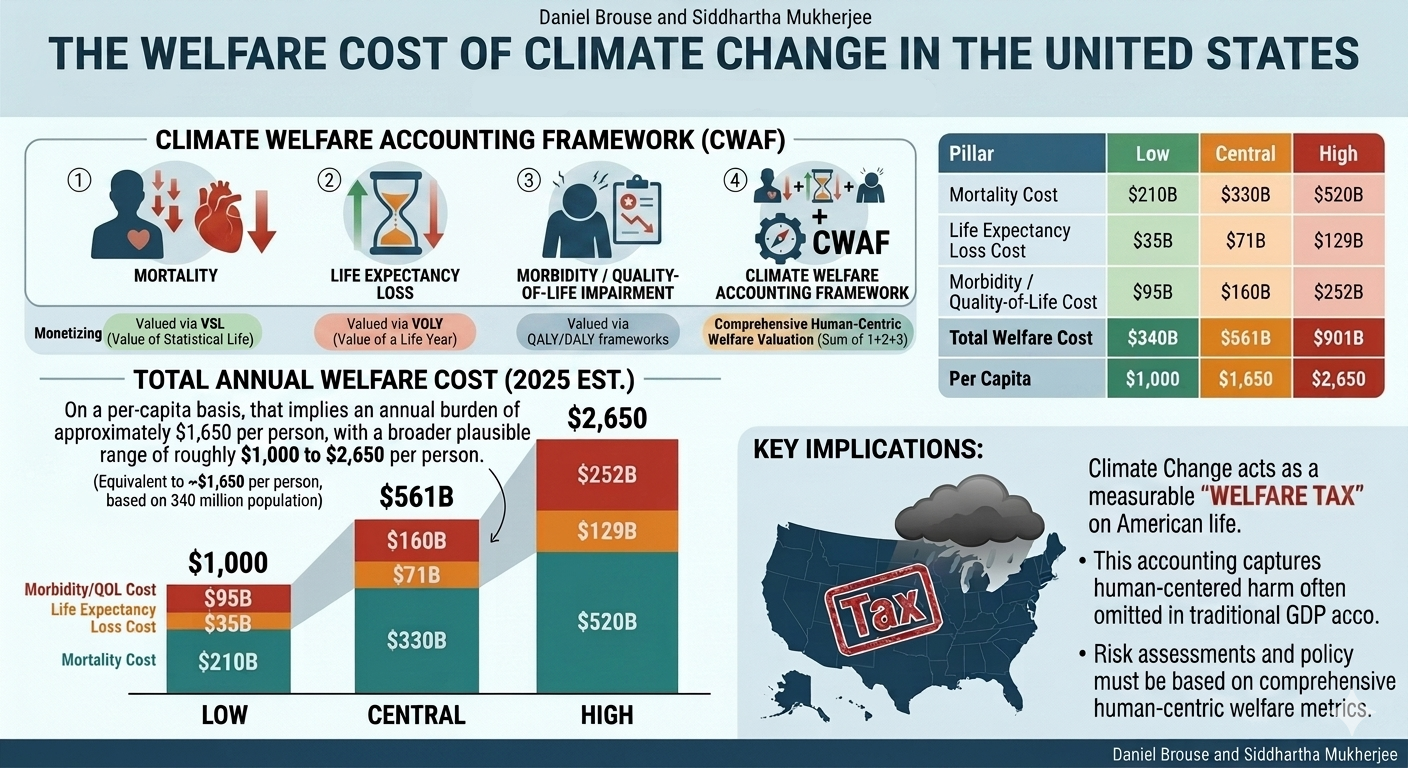
Using a bottom-up framework built around mortality (VSL), life expectancy loss (VSLY), and morbidity/quality-of-life loss (QALY/DALY), the paper estimates that the 2025 U.S. welfare cost of climate change plausibly falls in a range of $350 billion to $900 billion, with a central estimate of roughly $560 billion. On a per-capita basis, that implies an annual burden of approximately $1,650 per person, with a broader plausible range of roughly $1,000 to $2,650 per person.
This is not the full cost of climate change. It excludes many property, infrastructure, insurance, and macroeconomic channels that appear in broader all-in damage estimates. But it captures something those approaches often miss: the direct monetized cost of human harm.
The broader lesson is that climate change is already functioning as a welfare tax on American life. It reduces the quantity of life through premature mortality, reduces the length of life through chronic environmental stress, and reduces the quality of life through illness, disability, anxiety, and recurring exposure to an increasingly unstable climate system. Any serious climate accounting framework that ignores those dimensions will understate the true burden of climate change.
[Intro]
Heavy things
(Still can rise)
Hidden truth
(Under skies)
Heavy things
(Still can rise)
… in disguise
[Verse 1]
He sat in thought
(In ancient light)
In bath and water
(A sudden insight)
A crown, a question
(A puzzling claim)
Then physics answered
(The rise, the same)
Not by magic
(Not by chance)
But fluid laws
(In quiet dance)
Every object
(Finds its place)
In displaced water
(Space for space)
[Refrain]
Archimedes’ Principle
(At the time quite radical)
The buoyant force
(Takes its course)
Archimedes’ Principle
(So mathematical)
The buoyant force
(Changes course)
[Verse 2]
When things go down
(Into the stream)
They push aside
(More than they seem)
Not just resistance
(Not just drag)
But lifted weight
(From what they snag)
The fluid rises
(To match the space)
A hidden balance
(We can trace)
What gets displaced
(Defines the lift)
A natural law
(A steady gift)
[Chorus]
Archimedes’ Principle
(At the time quite radical)
The buoyant force
(Takes its course)
What sinks below
(Does not stay low)
It rises up
(As waters go)
Archimedes’ Principle
(The truth empirical)
The buoyant force
(Is always real)
[Bridge]
Not mystical
(Not divine)
Just density
(Defined in line)
Weight of water
(Displaced below)
Returns upward
(As forces go)
Fb rises
(Clear and strong)
Equal to weight
(It can’t go wrong)
Of the fluid moved
(Exactly so)
That’s how the water
(Makes things go)
[Breakdown]
Push it down
(It pushes back)
Find the balance
(Along the track)
No mystery
(No hidden hand)
Just fluid laws
(That understand)
[Final Chorus]
Archimedes’ Principle
(At the time quite radical)
The buoyant force
(Takes its course)
What sinks below
(Does not stay low)
It rises up
(As waters go)
Archimedes’ Principle
(Still mathematical)
The buoyant force
(Is always factual)
[Outro]
In still water
(Truth appears)
Ancient insight
(Through the years)
Archimedes’ Principle
(At the time quite radical)
Still holds now
(And always will)
Stay Put
[Intro]
Sit still
(No freewill)
Don’t move
(Or groove)
[Verse 1]
I made a promise
(To the floor)
I said I’d linger
(Just one hour more)
But times get tricky
(Under skin)
Like a wind that says
(“Keep movin’”)
[Refrain]
I’d love to:
(Stay put!)
But, but, but…
(I’m telling you)
… you know…
I gotta go
(We gotta go)
Go, go, go
[Verse 2]
The map is folded
(On the desk)
The quiet plans
(Become a mess)
A distant whistle
(A calling tone)
Turns every place
(Into unknown)
And still I try
(To settle in)
But movement wins
(Again, again)
[Chorus]
I’d love to stay
(Stay put!)
Hold the line
(Stay put!)
But “whether” pulls
(Me out again)
Out the door
(Into the wind)
I’d love to stay
(Stay put!)
But weather has it’s way
(Move it!)
The world keeps saying
“Go on, go on”
(So I commit)
[Bridge]
Is it me
(Or gravity?)
Or just the shape
(Of self-imposed destiny?)
[Breakdown]
Would love to sit still…
(Forced to move)
Against my will
Gotta move…
(Don’t approve)
But I’m already
(Gone, gone, gone)
[Final Chorus]
I’d love to:
(Stay put!)
But the world says
“Move a bit”
I’d love to:
(Stay put!)
But the moment
(Doesn’t quit)
So I go
(Go, go, go)
Away from where the current’s
(Flow goes)
[Outro]
I’d love to:
(Stay put!)
But the movement
(Doesn’t quit)
King Kong Song
[Intro]
Drums in the dark
(Something wakes)
Branches shake
(The whole earth quakes)
Eyes up high
(Shadow long)
Everybody whisper:
(King Kong)
[Verse 1]
We came ashore
(With flash and flame)
Thinking the island
(Was ours to name)
Tall grass swayed
(Like warning signs)
But we kept walking
(Past the lines)
Then the mountain moved
(Or so it seemed)
A living thunder
(Out of the green)
Fists like hammers
(Breath like steam)
Turning nightmare
(From a dream)
[Chorus]
Until King Kong
(Came along)
Best run for your life
(When danger is rife)
Until King Kong
(Came along)
Big trouble’s near
(When the giant appears)
[Refrain]
Ah-ah-ah-ah-aaaaah-ah-ah-ah-ah!
(Escape!)
Ah-ah-ah-ah-aaaaah-ah-ah-ah-ah!
(The white ape)
Ah-ah-ah-ah-aaaaah-ah-ah-ah-ah!
(Too late!)
Ah-ah-ah-ah-aaaaah-ah-ah-ah-ah!
(The white ape)
[Verse 2]
He beat his chest
(The jungle rang)
Birds took flight
(And the vines all sprang)
One step closer
(Trees bent low)
One wrong move
(And it’s over, you know)
Planes and bullets
(Can’t mean much)
When rage and muscle
(Hit that hard)
He climbed higher
(Than fear itself)
Like some old god
(Off the shelf)
[Bridge]
He’s not evil
(He’s not tame)
Just the force
(Behind the name)
Beauty, terror
(Fury, grace)
All of it written
(On his face)
And when he roars
(The sky gives way)
Nobody’s king
(At the end of the day)
[Breakdown]
Don’t look back
(Just run)
Don’t freeze up
(Just run)
He’s on the wall
(He’s on the wire)
He’s in the smoke
(He’s in the fire)
[Final Chorus]
Until King Kong
(Came along)
Best run for your life
(When danger is rife)
Until King Kong
(Came along)
Whole world shakes
(With every step he takes)
[Final Refrain]
Ah-ah-ah-ah-aaaaah-ah-ah-ah-ah!
(Escape!)
Ah-ah-ah-ah-aaaaah-ah-ah-ah-ah!
(The white ape)
Ah-ah-ah-ah-aaaaah-ah-ah-ah-ah!
(Too late!)
Ah-ah-ah-ah-aaaaah-ah-ah-ah-ah!
(The white ape)
[Outro]
Shadow falls
(City screams)
King Kong walks
(Through the beams)
Up the tower
(Cling on strong)
Long live the legend…
(King Kong)
The Heat Is On
[Intro]
No wind…
(No change)
Same sky…
(Arranged)
No wind…
(No change)
Just the beat…
(… of the heat)
[Verse 1]
The jet stream bends
(Out of line)
Drawing shapes
(Like a sign)
A standing wave
(Up in the air)
But nothing moves
(It just stays there)
High pressure locks
(The doors of sky)
Keeps the cool air
(Passing by)
And underneath
(The burning dome)
The surface bakes
(All alone)
[Chorus]
Under a dome
(Nowhere to roam)
Omega block
(Time gets stuck)
Between a rock
(And a hard place)
…betwixt the human race
Under a dome
(Heat takes hold)
Omega block
(Stories retold)
Between a rock
(And a hard place)
…betwixt the human race
[Refrain]
Come on:
(The heat is on)
Hot sun
(The heat is on)
Shade… none
(The heat is on)
[Verse 2]
The storm tracks shift
(Around the ridge)
Like rivers forced
(Without a bridge)
Rain falls elsewhere
(Not here today)
While drought expands
(Along the way)
The pattern stalls
(The atmosphere sighs)
Under repeating
(Amplified highs)
And the system
(That used to flow)
Now circles back
(Too slow, too slow)
[Chorus]
Under a dome
(Nowhere to roam)
Omega block
(A system shock)
Between a rock
(And a hard place)
…betwixt the human race
Under a dome
(Heat takes hold)
Omega block
(Heat uncontrolled)
Between a rock
(And a hard place)
…betwixt the human race
[Refrain]
Come on:
(The heat is on)
Hot sun
(The heat is on)
Shade… none
(The heat is on)
[Bridge]
Rossby waves
(Stretch and break)
Make the climate
(Shift and shake)
Stratosphere warms
(Above the pole)
While surface heat
(Takes its toll)
Arctic loss
(Weakens the flow)
Now the jet stream
(Loses go)
What once was pattern
(Becomes extreme)
A stalled-out world
(An obscene scene)
[Breakdown]
Stuck…
(Stuck…)
Hot…
(Hot…)
No escape…
(Just a lot…)
… if Hot! Hot! Hot!
[Refrain]
Come on:
(The heat is on)
Hot sun
(The heat is on)
Shade… none
(The heat is on)
[Final Chorus]
Under a dome
(Nowhere to roam)
Omega block
(Time gets locked)
Between a rock
(And a hard place)
…betwixt the human race
Under a dome
(Heat takes hold)
Omega block
(World unfolds)
Between a rock
(And a hard place)
…betwixt the human race
[Outro]
Goes on and on and on
(The heat is on)
Hot sun
(The heat is on)
Shade… none
(The heat is on)
… on and on and on
About the Song
Omega Block Ω
An omega block is essentially an extreme, highly amplified Rossby-wave pattern where the jet stream bends into the shape of the Greek letter Ω. These blocking patterns slow atmospheric circulation dramatically and can “lock” weather systems in place for days or even weeks.
That is a major factor behind persistent heat domes over the EU and UK. Instead of weather systems moving progressively west-to-east as they historically did, the amplified wave stalls, allowing heat to continuously build beneath the ridge while storms and cooler air are diverted around it.
As these amplified Rossby waves meander around the hemisphere, similar blocking impacts can propagate into other regions at comparable latitudes — including the US and parts of Asia. That is why we increasingly see synchronized extremes globally: prolonged heatwaves in one region while other areas experience stalled flooding, cold intrusions, or drought.
Sudden Stratospheric Warming events, Arctic amplification, weakening thermal gradients, and Rossby-wave amplification are all interconnected components of the same broader atmospheric destabilization process.
The power flickers
(The fans go dead)
Hospitals fill
(With heat instead)
And every warning
(Starts to sound)
Like a siren
(Without a town)
[Chorus]
So, ya think you can outrun
(The sun)
Run, run, run
Doesn’t sound like much
(No not much fun)
Run, run, run
So, ya think you can outrun
(The sun)
Run, run, run
When the night stays hot
(Where do you turn?)
Run, run, run
[Bridge]
This isn’t summer
(Like summer was)
This is stress
(Without a pause)
Wet-bulb rising
(Breath gets tight)
No true shelter
(Day or night)
It’s not just weather
(It’s a test)
Of how much strain
(A body lets)
Before the line
(Begins to blur)
Between endure
(And disappear)
[Breakdown]
Run if you want
(Run if you can)
But heat won’t care
(About your plan)
Run to the shade
(Run to the sea)
Still it follows
(Relentlessly)
[Final Chorus]
So, ya think you can outrun
(The sun)
Run, run, run
Doesn’t sound like much
(No not much fun)
Run, run, run
So, ya think you can outrun
(The sun)
Run, run, run
But when the whole damn sky
(Becomes the one)
Run, run, run
[Final Refrain]
You can’t beat
(The heat)
No, you can’t retreat
(Off the street)
You can’t hide
(From the sky)
No, you can’t outrun
(The sun)
[Outro]
Run, run, run
(Here it comes)
Run, run, run
(Still it comes)
Heat on your back
(Under attack)
Ladder outta rungs
(Fire in your lungs)
Washout
[Intro]
Low tide lies
(For a while)
Stillness wears
(A crooked smile)
You can stand there
(And call it safe)
Till the water
(Changes shape)
[Verse 1]
Built your house
(Right near the edge)
Talked yourself
(Off the ledge)
Said the warnings
(Were overblown)
Till the shoreline
(Was in your home)
First the puddles
(Then the street)
Then the water
(At your feet)
Then the road
(Just disappears)
Dragged away
(By all your years)
[Refrain]
About to find out
(About the washout)
When the tide comes in
(You can’t win)
About to find out
(About the washout)
When the ground gives way
(It won’t stay)
[Chorus]
Washout
(Takes it all)
Washout
(Brick and wall)
Washout
(One hard shove)
Washout
(What were you thinking of?)
[Verse 2]
The dune gave in
(The pilings cracked)
No easy route
(To take it back)
Insurance gone
(Bank still calls)
Salt in the wires
(Mold in the walls)
A lifetime stacked
(In boxes high)
Photo albums
(Left to dry)
But some things don’t
(Come back again)
Not the land
(Not the den)
[Refrain]
About to find out
(About the washout)
When the tide comes in
(You can’t win)
About to find out
(About the washout)
When the bluff lets go
(Down below)
[Bridge]
It doesn’t bargain
(Doesn’t care)
Doesn’t stop
(For your repair)
You can curse the sea
(Or curse the rain)
But the water’s not
(Explaining pain)
It just keeps moving
(Where it must)
Through sand and stone
(And wood and rust)
And what you thought
(Would always last)
Gets folded under
(By the past)
[Breakdown]
Can’t hold the line
(Can’t hold the slope)
Can’t nail it down
(Can’t float on hope)
One more storm
(One more shove)
One more thing
(To rise above)
[Final Chorus]
Washout
(Takes it all)
Washout
(Brick and wall)
Washout
(One hard shove)
Washout
(What were you thinking of?)
Washout
(There goes the drive)
Washout
(Still trying to survive)
[Final Refrain]
About to find out
(About the washout)
When the tide comes in
(You can’t win)
About to find out
(About the washout)
When the sea wants in
(It gets in)
[Outro]
Low tide lies
(For a while)
Stillness wears
(A crooked smile)
Sorry, Baby
[Intro]
I wish I had
(A better line)
Something softer
(To leave behind)
I wish I had
(A better way)
Than what I’m saying
(Today)
Ya know…
(We gotta go)
[Verse 1]
You gave me shelter
(When nights got cold)
Held together
(What I couldn’t hold)
Stayed beside me
(Through the strain)
Even when
(It looked insane)
But time kept moving
(Underneath)
Pulling loose
(What we believed)
And now the road
(Has split in two)
And I can’t fake
(What I can’t do)
[Refrain]
So, sorry
(Baby)
But, what can I say?
So sorry
(Baby)
There’s no way to stay
So sorry
(Baby)
I wish it wasn’t true
So sorry
(Baby)
I can’t stay…
… it’s true…
(… and neither can you)
Ya know…
(We gotta go)
[Verse 2]
It isn’t anger
(It isn’t blame)
It’s just the fire
(Has changed its name)
Something faded
(Without a sound)
And now there’s no
(Safe middle ground)
I tried to find
(Some words that heal)
But broken things
(Don’t always seal)
And every hour
(We linger here)
Only makes
(The leaving clear)
[Chorus]
I know it hurts
(Maybe me too)
To hear the truth
(Instead of “soon”)
I know this room
(Still feels like home)
But staying now
(Would be alone)
Ya know…
(We gotta go)
[Bridge]
Yeah, ya know…
(We gotta go)
[Final Refrain]
So, sorry
(Baby)
But, what can I say?
So sorry
(Baby)
There’s no way to stay
So sorry
(Baby)
The night has had its say
So sorry
(Baby)
I can’t stay…
… it’s true…
(… and neither can you)
Ya know…
(We gotta go)
[Outro]
I wish I had
(A better line)
Something softer
(To leave behind)
Ya know…
(We gotta go)
Migration
[Intro]
You drew the line
(At someone else)
You slammed the door
(And called for help)
You drew the line
(At someone else)
Now the line
(Erodes your health)
[Verse 1]
You said, “Go back”
(With no delay)
“Not my problem”
(Turn away)
Built your fences
(Drew your maps)
Talked in slogans
(And traps)
Thought the flood
(Would stop at sea)
Thought the fire
(Would spare your street)
Thought collapse
(Had someone else’s name)
Till the smoke and water
(Came the same)
[Chorus]
You used to be
(Against the immigrant)
Now do you find it…
(Ignorant and arrogant?)
You used to sneer
(At those who had to run)
Now your own road
(Is coming undone)
[Refrain]
Migration
(Found yourself on the run)
Migration
(Guess now it ain’t so fun?)
Your situation
(Looks different in the sun)
Migration
(Now you’re the one)
[Verse 2]
The rent went up
(The crops went down)
Storm took the roof
(Off your town)
Insurance vanished
(Work moved out)
Then came the heat
(And then the drought)
So now you pack
(What still remains)
Photos, meds
(A little change)
Looking for someplace
(That still can hold)
A bed, a job
(A hand to hold)
[Chorus]
You used to be
(Against the immigrant)
Now do you find it…
(Ignorant and arrogant?)
You used to say
(“They should’ve stayed and fought”)
Now every highway
(Holds the lesson taught)
[Bridge]
Funny how compassion
(Shows up late)
When you’re the one
(Outside the gate)
Funny how borders
(Feel less clear)
When your own children
(Need somewhere near)
It wasn’t weakness
(It was need)
Not some failure
(Or foreign creed)
It was survival
(Plain and blunt)
The same old truth
(At the human front)
[Breakdown]
Run, run
(Find a place)
Run, run
(Another face)
Run, run
(Another town)
Run, run
(Don’t slow down)
[Final Chorus]
You used to be
(Against the immigrant)
Now do you find it…
(Ignorant and arrogant?)
You used to judge
(From somewhere safe and dry)
Now your own future
(Is asking why)
[Final Refrain]
Migration
(Found yourself on the run)
Migration
(Guess now it ain’t so fun?)
Your situation
(Changed before you were done)
Migration
(Now you’re the one)
[Outro]
You drew the line
(At someone else)
Now you’re the one
(Who needs some help)
About the Song: Immigration and GDP
Wealthy nations that absorbed the highest rates of immigration over the past 35 years experienced massive surges in economic growth and labor productivity, directly contradicting the rhetoric of anti-immigrant political movements. According to a landmark study released today, June 25, 2026, by University of California, Davis professor Giovanni Peri, an influx of immigrants equal to just 1% of a country’s population drives a 1.2% spike in GDP per worker within five years, which grows to 1.9% over a decade.
Out of Runway
[Intro]
Lights fade
(Warning signs)
Engines hum
(Last in line)
Lights fade
(Warning signs)
No more climb
[Verse 1]
We built it high
(Above the ground)
Thought the sky
(Would hold us down)
Kept pushing forward
(Past the edge)
Dancing closer
(To the ledge)
Every meter
(Taken in greed)
More speed, more speed
(More we need)
Never noticing
(The strip was thin)
Never thinking
(We might not win)
[Chorus]
Do you understand?
(We’re out of runway)
Nowhere to land
(… out of runway)
Do you understand?
(No more runway)
Nowhere to stand
(… out of runway)
[Refrain]
Man’s damned demand
(Causing us to crash)
… In the pursuit of cash
(Hourglass is runnin’ outta sand)
Nowhere to land
(… out of runway)
Hey! Hey! Hey!
[Verse 2]
Altitude dropping
(Confidence too)
Systems are screaming
(What did we do?)
We traded margin
(For the gain)
Now there’s only
(Flame on flame)
No extension
(No second try)
Just a long fall
(Through the sky)
And all the numbers
(We once trusted)
Turn to smoke
(Burned and rusted)
[Chorus]
Do you understand?
(We’re out of runway)
Nowhere to land
(… out of runway)
Do you understand?
(No escape runway)
Nowhere to stand
(… out of runway)
[Bridge]
We measured everything
(But time)
Turned warnings into
(Subtle rhyme)
Growth at any cost
(We said)
Now the runway ends
(In our head)
No diversion
(No control)
Just gravity
(Taking toll)
And every choice
(That built this flight)
Now meets the dark
(Without the light)
[Breakdown]
Too fast
(No ground)
Too late
(No sound)
Too high
(No way down)
No runway
(To be found)
[Final Chorus]
Do you understand?
(We’re out of runway)
Nowhere to land
(… out of runway)
Do you understand?
(The end is underway)
Nowhere to stand
(… out of runway)
[Final Refrain]
Man’s damned demand
(Causing us to crash)
… In the pursuit of cash
(Hourglass ran outta sand)
Nowhere to land
(… out of runway)
Hey! Hey! Hey!
[Outro]
Lights fade
(Warning signs)
Engines die
(Left behind)
No more climb
(No more time)
Road to Zanzibar
[Intro]
Pack your bags
(Or what’s left to tote)
Grab your hat
(And miss the boat)
Follow signs
(Through the bizarre)
That don’t quite lead
(To Zanzibar)
[Verse 1]
Bing brought charm
(And Bob brought Hope)
But these days Hope
(Can barely cope)
The beach keeps shrinking
(At the hotel bar)
And salt creeps inland
(From the shore so far)
Seaweed farmers
(Lose their yield)
Fish head deeper
(From the field)
Coral’s paling
(Under stress)
And the map looks more
(Like a guess)
[Chorus]
The thing
(About Bing)
He has no Hope
(Nope)
The thing
(About Hope)
He can’t help cope
(Nope)
The thing
(About this show)
The road keeps washing
(Out below)
[Refrain]
No, this ain’t the road
(To Zanzibar)
The road doesn’t go…
(that far)
Do you even know…
(Where you are?)
No, this ain’t the road
(To Zanzibar)
The tide came through
(And took the car)
[Verse 2]
Rice fields brine up
(Freshwater’s gone)
Storm drains back up
(All night long)
Rain comes hard
(Then not at all)
Drought, then flood
(That’s the curtain call)
Tour boats idle
(Reefs turn white)
Hotels worry
(About next night)
And every season
(Feels off-key)
Like somebody moved
(The whole damn sea)
[Bridge]
Roadside sign says
(Scenic route)
Wave comes in
(And knocks it out)
You can joke
(And crack a line)
Till the shoreline slips
(Beyond design)
This isn’t just
(A travel gag)
It’s a living place
(Dragged by the drag)
Of hotter seas
(And rising stress)
And a road that leads
(To less and less)
[Breakdown]
Wrong turn here
(Wrong turn there)
No more beach
(Just thinner air)
Wrong turn here
(Wrong turn there)
Try to drive
(But beware)
[Final Chorus]
The thing
(About Bing)
He has no Hope
(Nope)
The thing
(About Hope)
He lost his sting
(End of the rope)
The thing
(About Zanzibar)
The road keeps sinking
(Where you are)
[Final Refrain]
No, this ain’t the road
(To Zanzibar)
The road doesn’t go…
(that far)
Do you even know…
(Where you are?)
No, this ain’t the road
(To Zanzibar)
[Outro]
Pack your bags
(Or what’s left to tote)
Grab your hat
(And miss the boat)
About the Song
“The Road to…” series consists of seven wildly popular musical comedy films. They starred the iconic duo Bob Hope and Bing Crosby, alongside leading lady Dorothy Lamour. The films are famous for their exotic settings, fourth-wall-breaking gags, and improvised, rapid-fire banter.
Road to Zanzibar (1941) – An African safari adventure parody.
Soon, there may be no road to Zanzibar.
Zanzibar is already being hit hard by climate change, with major risks to its blue economy and to the livelihoods of much of the population. Because the islands depend heavily on tourism, fishing, and agriculture, rising seas, hotter waters, and more erratic rainfall are damaging multiple sectors at once.
* Coastal erosion and sea-level rise are washing away beaches, damaging hotels and shoreline infrastructure, and pushing saltwater into freshwater aquifers and low-lying farmland.
* Marine livelihoods are under pressure as warmer shallow waters hurt seaweed farming through disease, fish move farther offshore into cooler waters, and coral reefs suffer bleaching and acidification—undermining both fisheries and tourism.
* Agriculture is becoming less reliable because of drought, irregular rainfall, and flooding, which reduce crop yields and threaten food security.
* Flooding is worsening in both villages and urban areas as heavy rain and high tides overwhelm drainage and damage homes, roads, and public infrastructure.
[Arrangement: Wry, swinging climate-cabaret with a jaunty travel-movie bounce, comic call-and-response, and a chorus that keeps tripping over the disappearing map]
[Intro]
Pack your bags
(Or what’s left to tote)
Grab your hat
(And miss the boat)
Follow signs
(Through the bizarre)
That don’t quite lead
(To Zanzibar)
[Verse 1]
Bing brought charm
(And Bob brought Hope)
But these days Hope
(Can barely cope)
The beach keeps shrinking
(At the hotel bar)
And salt creeps inland
(From the shore so far)
Seaweed farmers
(Lose their yield)
Fish head deeper
(From the field)
Coral’s paling
(Under stress)
And the map looks more
(Like a guess)
[Chorus]
The thing
(About Bing)
He has no Hope
(Nope)
The thing
(About Hope)
He can’t help cope
(Nope)
The thing
(About this show)
The road keeps washing
(Out below)
[Refrain]
No, this ain’t the road
(To Zanzibar)
The road doesn’t go…
(that far)
Do you even know…
(Where you are?)
No, this ain’t the road
(To Zanzibar)
The tide came through
(And took the car)
[Verse 2]
Rice fields brine up
(Freshwater’s gone)
Storm drains back up
(All night long)
Rain comes hard
(Then not at all)
Drought, then flood
(That’s the curtain call)
Tour boats idle
(Reefs turn white)
Hotels worry
(About next night)
And every season
(Feels off-key)
Like somebody moved
(The whole damn sea)
[Bridge]
Roadside sign says
(Scenic route)
Wave comes in
(And knocks it out)
You can joke
(And crack a line)
Till the shoreline slips
(Beyond design)
This isn’t just
(A travel gag)
It’s a living place
(Dragged by the drag)
Of hotter seas
(And rising stress)
And a road that leads
(To less and less)
[Breakdown]
Wrong turn here
(Wrong turn there)
No more beach
(Just thinner air)
Wrong turn here
(Wrong turn there)
Try to drive
(But beware)
[Final Chorus]
The thing
(About Bing)
He has no Hope
(Nope)
The thing
(About Hope)
He lost his sting
(End of the rope)
The thing
(About Zanzibar)
The road keeps sinking
(Where you are)
[Final Refrain]
No, this ain’t the road
(To Zanzibar)
The road doesn’t go…
(that far)
Do you even know…
(Where you are?)
No, this ain’t the road
(To Zanzibar)
[Outro]
Pack your bags
(Or what’s left to tote)
Grab your hat
(And miss the boat)
About the Song
“The Road to…” series consists of seven wildly popular musical comedy films. They starred the iconic duo Bob Hope and Bing Crosby, alongside leading lady Dorothy Lamour. The films are famous for their exotic settings, fourth-wall-breaking gags, and improvised, rapid-fire banter.
Road to Zanzibar (1941) – An African safari adventure parody.
Soon, there may be no road to Zanzibar.
Zanzibar is already being hit hard by climate change, with major risks to its blue economy and to the livelihoods of much of the population. Because the islands depend heavily on tourism, fishing, and agriculture, rising seas, hotter waters, and more erratic rainfall are damaging multiple sectors at once.
* Coastal erosion and sea-level rise are washing away beaches, damaging hotels and shoreline infrastructure, and pushing saltwater into freshwater aquifers and low-lying farmland.
* Marine livelihoods are under pressure as warmer shallow waters hurt seaweed farming through disease, fish move farther offshore into cooler waters, and coral reefs suffer bleaching and acidification—undermining both fisheries and tourism.
* Agriculture is becoming less reliable because of drought, irregular rainfall, and flooding, which reduce crop yields and threaten food security.
* Flooding is worsening in both villages and urban areas as heavy rain and high tides overwhelm drainage and damage homes, roads, and public infrastructure.
[Silence]
[Arrangement: Driving rock with a tense bassline, stomping drums, clipped guitar, and a chorus that hits with accusation and irony]
[Intro]
You drew the line
(At someone else)
You slammed the door
(And called for help)
You drew the line
(At someone else)
Now the line
(Erodes your health)
[Verse 1]
You said, “Go back”
(With no delay)
“Not my problem”
(Turn away)
Built your fences
(Drew your maps)
Talked in slogans
(And traps)
Thought the flood
(Would stop at sea)
Thought the fire
(Would spare your street)
Thought collapse
(Had someone else’s name)
Till the smoke and water
(Came the same)
[Chorus]
You used to be
(Against the immigrant)
Now do you find it…
(Ignorant and arrogant?)
You used to sneer
(At those who had to run)
Now your own road
(Is coming undone)
[Refrain]
Migration
(Found yourself on the run)
Migration
(Guess now it ain’t so fun?)
Your situation
(Looks different in the sun)
Migration
(Now you’re the one)
[Verse 2]
The rent went up
(The crops went down)
Storm took the roof
(Off your town)
Insurance vanished
(Work moved out)
Then came the heat
(And then the drought)
So now you pack
(What still remains)
Photos, meds
(A little change)
Looking for someplace
(That still can hold)
A bed, a job
(A hand to hold)
[Chorus]
You used to be
(Against the immigrant)
Now do you find it…
(Ignorant and arrogant?)
You used to say
(“They should’ve stayed and fought”)
Now every highway
(Holds the lesson taught)
[Bridge]
Funny how compassion
(Shows up late)
When you’re the one
(Outside the gate)
Funny how borders
(Feel less clear)
When your own children
(Need somewhere near)
It wasn’t weakness
(It was need)
Not some failure
(Or foreign creed)
It was survival
(Plain and blunt)
The same old truth
(At the human front)
[Instrumental]
[Guitar solo]
[Organ swells]
[Breakdown]
Run, run
(Find a place)
Run, run
(Another face)
Run, run
(Another town)
Run, run
(Don’t slow down)
[Final Chorus]
You used to be
(Against the immigrant)
Now do you find it…
(Ignorant and arrogant?)
You used to judge
(From somewhere safe and dry)
Now your own future
(Is asking why)
[Final Refrain]
Migration
(Found yourself on the run)
Migration
(Guess now it ain’t so fun?)
Your situation
(Changed before you were done)
Migration
(Now you’re the one)
[Outro]
You drew the line
(At someone else)
Now you’re the one
(Who needs some help)
About the Song: Immigration and GDP
Wealthy nations that absorbed the highest rates of immigration over the past 35 years experienced massive surges in economic growth and labor productivity, directly contradicting the rhetoric of anti-immigrant political movements. According to a landmark study released today, June 25, 2026, by University of California, Davis professor Giovanni Peri, an influx of immigrants equal to just 1% of a country’s population drives a 1.2% spike in GDP per worker within five years, which grows to 1.9% over a decade.
[Arrangement: Heavy atmospheric rock with slow-burning tension, deep synth drones, distorted guitar swells, and a relentless mid-tempo pulse that feels “stuck in place”]
[Intro]
No wind…
(No change)
Same sky…
(Arranged)
No wind…
(No change)
Just the beat…
(… of the heat)
[Verse 1]
The jet stream bends
(Out of line)
Drawing shapes
(Like a sign)
A standing wave
(Up in the air)
But nothing moves
(It just stays there)
High pressure locks
(The doors of sky)
Keeps the cool air
(Passing by)
And underneath
(The burning dome)
The surface bakes
(All alone)
[Chorus]
Under a dome
(Nowhere to roam)
Omega block
(Time gets stuck)
Between a rock
(And a hard place)
…betwixt the human race
Under a dome
(Heat takes hold)
Omega block
(Stories retold)
Between a rock
(And a hard place)
…betwixt the human race
[Refrain]
Come on:
(The heat is on)
Hot sun
(The heat is on)
Shade… none
(The heat is on)
[Verse 2]
The storm tracks shift
(Around the ridge)
Like rivers forced
(Without a bridge)
Rain falls elsewhere
(Not here today)
While drought expands
(Along the way)
The pattern stalls
(The atmosphere sighs)
Under repeating
(Amplified highs)
And the system
(That used to flow)
Now circles back
(Too slow, too slow)
[Chorus]
Under a dome
(Nowhere to roam)
Omega block
(A system shock)
Between a rock
(And a hard place)
…betwixt the human race
Under a dome
(Heat takes hold)
Omega block
(Heat uncontrolled)
Between a rock
(And a hard place)
…betwixt the human race
[Refrain]
Come on:
(The heat is on)
Hot sun
(The heat is on)
Shade… none
(The heat is on)
[Bridge]
Rossby waves
(Stretch and break)
Make the climate
(Shift and shake)
Stratosphere warms
(Above the pole)
While surface heat
(Takes its toll)
Arctic loss
(Weakens the flow)
Now the jet stream
(Loses go)
What once was pattern
(Becomes extreme)
A stalled-out world
(An obscene scene)
[Breakdown]
Stuck…
(Stuck…)
Hot…
(Hot…)
No escape…
(Just a lot…)
… if Hot! Hot! Hot!
[Refrain]
Come on:
(The heat is on)
Hot sun
(The heat is on)
Shade… none
(The heat is on)
[Final Chorus]
Under a dome
(Nowhere to roam)
Omega block
(Time gets locked)
Between a rock
(And a hard place)
…betwixt the human race
Under a dome
(Heat takes hold)
Omega block
(World unfolds)
Between a rock
(And a hard place)
…betwixt the human race
[Outro]
Goes on and on and on
(The heat is on)
Hot sun
(The heat is on)
Shade… none
(The heat is on)
… on and on and on
About the Song
Omega Block Ω
An omega block is essentially an extreme, highly amplified Rossby-wave pattern where the jet stream bends into the shape of the Greek letter Ω. These blocking patterns slow atmospheric circulation dramatically and can “lock” weather systems in place for days or even weeks.
That is a major factor behind persistent heat domes over the EU and UK. Instead of weather systems moving progressively west-to-east as they historically did, the amplified wave stalls, allowing heat to continuously build beneath the ridge while storms and cooler air are diverted around it.
As these amplified Rossby waves meander around the hemisphere, similar blocking impacts can propagate into other regions at comparable latitudes — including the US and parts of Asia. That is why we increasingly see synchronized extremes globally: prolonged heatwaves in one region while other areas experience stalled flooding, cold intrusions, or drought.
Sudden Stratospheric Warming events, Arctic amplification, weakening thermal gradients, and Rossby-wave amplification are all interconnected components of the same broader atmospheric destabilization process.
[Silence]
[Arrangement: Up-tempo piano-rock with a restless pulse, steady kick, low organ drone, echoing guitar lines, and a chorus that feels like packing up all over again]
[Intro]
Again…
(Again)
Pack it up
(Again)
Start over
(Again)
[Verse 1]
The water came
(So they ran)
Found a room
(Made a plan)
Months went by
(They drifted back)
Fixed the door
(Patched the cracks)
Then the storm
(Came around)
Same old road
(Same old sound)
Grab the kids
(Grab the cash)
Life reduced
(To what you stash)
[Refrain]
Repeated
(Displacement)
Retreated
(New placement)
Try to settle
(But don’t get seated)
This is what it means
(To be repeated)
Move, move
(Then move again)
New address
(Same wear and tear)
Pack the life
(That’s been depleted)
This is what it means
(To be repeated)
[Final Refrain]
Repeated
(Displacement)
Retreated
(New placement)
Repeated
(Displacement)
Retreated
(New placement)
Repeated…
(Repeated…)
[Outro]
Again…
(Again)
Start over
(Again)
Discover
(Repeat begin)
About the Song: Repeated Displacement
Climate displacement is often not a one-time movement. A household may flee a floodplain, return months later, then flee again during the next storm season, then relocate after drought destroys agricultural income, then move again after conflict or price shocks intensify. The same family can be counted multiple times in annual displacement flows, but the deeper reality is repeated social dislocation.
Repeated displacement erodes savings, fragments families, interrupts schooling, worsens health outcomes, and depletes community resilience. Over time, it converts temporary mobility into chronic instability.
[Silence]
[Arrangement: Urgent piano-rock with rolling toms, tense bass pulse, swirling organ, clipped guitar, and storm-surge dynamics that swing between sparse drought verses and crashing flood choruses]
[Intro]
Dry…
(Then drown)
Crack…
(Then come down)
Dry…
(Then drown)
Whiplash
(Comin’ around)
Mad dash
(Is it any wonder)
Heavy metal thunder
[Verse 1]
The ground turns brittle
(Under the sun)
Fields start splitting
(One by one)
Wells run shallow
(Rivers shrink)
Everything’s waiting
(On the brink)
Then the sky comes open
(All at once)
No slow return
(No second month)
No gentle mercy
(No measured pace)
Just too much water
(In too small a place)
[Chorus]
Hydrologic whiplash
(Changing up fast)
Hydrologic whiplash
(Normal’s now past)
Hydrologic whiplash
(First the dust, then the splash)
Hydrologic whiplash
(Thrown by the lash)
[Refrain]
One way, then the other
(No time to recover)
One way, then the other
(Then we smother)
Cracked by drought
(Washed right out)
Cracked by drought
(Washed right out)
What a blunder
(Is it any wonder)
Heavy metal thunder
[Verse 2]
Crops don’t make it
(Through the heat)
Livestock weaken
(On burning streets)
Pipes run dry
(Storage falls)
Then the flood comes
(Through the walls)
Roads get taken
(Bridges bend)
Homes collapse
(Again, again)
Clinics drowning
(Sewers fail)
Recovery breaks
(Before it can prevail)
[Chorus]
Hydrologic whiplash
(Changing up fast)
Hydrologic whiplash
(Normal’s now past)
Hydrologic whiplash
(First the dust, then the splash)
Hydrologic whiplash
(Thrown by the lash)
[Bridge]
… the violent swing
(Between the pain)
Not much of anything
(Will remain)
Will we try to sustain?
(Is it any wonder)
Heavy metal thunder
[Instrumental]
[Piano and Organ Interplay]
[Guitar Solo]
[Breakdown]
Dust in the lungs
(Water in the street)
Empty reservoir
(Then a tidal beat)
No time to plant
(No time to mend)
No time to start
(Before the next begins)
[Final Chorus]
Hydrologic whiplash
(Changing up fast)
Hydrologic whiplash
(Normal’s now past)
Hydrologic whiplash
(First the dust, then the splash)
Hydrologic whiplash
(Thrown by the lash)
Hydrologic whiplash
(Dry to flood in a flash)
Hydrologic whiplash
(And the damage stacks)
[Outro]
Dry…
(Then drown)
Crack…
(Then come down)
No time left
(To turn around)
Whiplash…
(Comin’ around)
Reigning down
(Is it any wonder)
Heavy metal thunder
About the Song
One of the clearest nonlinear pathways is hydrologic whiplash—the growing tendency for regions to swing rapidly between drought and flood. A warmer atmosphere increases evaporation, drying soils and intensifying drought. At the same time, warmer air holds more water vapor, increasing the likelihood of extreme rainfall when storms do occur. The result is not simply “more drought” or “more flooding,” but a destabilizing oscillation between the two.
For vulnerable populations, this matters enormously. Drought can destroy crops, livestock, and local water supplies. Flooding can then destroy the roads, bridges, homes, sanitation systems, and clinics needed for recovery. The second disaster lands before recovery from the first is complete. Communities are not merely hit harder; they are hit before they have time to recover. That is a nonlinear displacement engine.
[Silence]
[Arrangement: Up-tempo piano rock with pulsing bass, organ swells, blues guitar riffs, and layered call-and-response vocals; urgent but reflective, building toward a driving final chorus]
[Intro]
… waited
(As the future came)
… left
(Without a name)
[Verse 1]
The river climbed
(Above the mark)
The power failed
(And left the dark)
The road gave way
(The bridge went too)
One broken link
(Then another one through)
The crops dried out
(Then the rains arrived)
The ground cracked open
(Then came the tide)
What once was home
(Began to bend)
And every refuge
(Reached its end)
[Chorus]
Is that what you meant?
(Displacement)
Are we really hellbent?
(Displacement)
How many losses
(Before consent?)
Is that what you meant?
(Displacement)
[Verse 2]
A flooded field
(A shuttered store)
A water line
(At the kitchen door)
A job gone missing
(A school shut down)
A train of reasons
(To leave the town)
The map still says
(That people stay)
But the facts on the ground
(Have drifted away)
You don’t just move
(Because it rains)
You move when the whole
(System pains)
[Chorus]
Is that what you meant?
(Displacement)
Are we really hellbent?
(Displacement)
How many losses
(Before consent?)
Is that what you meant?
(Displacement)
[Bridge]
[Instrumental]
[Piano Solo]
[Organ Solo]
[Breakdown]
Move again
(Begin again)
Pack it up
(Pack it in)
Move again
(Begin again)
[Final Chorus]
Is that what you meant?
(Displacement)
Are we really hellbent?
(Displacement)
Not one disaster
(But a system spent)
Not one collapse
(But a continent bent)
Is that what you meant?
(Displacement)
[Final Refrain]
Forced to move
(Displacement)
No place left
(Displacement)
Threshold crossed
(Displacement)
What was lost?
(Displacement)
[Outro]
Where do we go?
(And the wind said)
You already know
Climate displacement acceleration.
About the Song: When Extreme Weather Becomes a Systemic Driver of Human Mobility
Displacement is increasingly best understood as a systems-level indicator. It measures not only the physical impact of a storm, flood, drought, wildfire, or heatwave, but also the failure of social and ecological buffers that once absorbed those shocks. When households are forced to move, it means a threshold has been crossed: infrastructure failed, livelihoods failed, food systems failed, water systems failed, governance failed, or some combination of the above failed at once.
The 2026 Global Report on Internal Displacement provides a stark snapshot of this process. By the end of 2025, 82.2 million people were living in internal displacement across 104 countries and territories. Of those, 68.6 million were displaced by conflict and violence and 13.6 million by disasters.
A linear view of climate displacement assumes a relatively simple chain of causation:
warming → more extreme weather → more damage → more displacement
But the real system increasingly looks more like this:
The acceleration’s rising still
(Watch the curve swerve)
Climate jerk!
(It gets attention!)
Climate jerk!
(Starts a conversation!)
[Outro]
What’s the word?
(Climate jerk!)
What’s the math?
(Do the work!)
Read the graph
(Follow the line!)
The future’s written
(One slope at a time!)
No doubt
(To find out)
The denier (crier)
About the Song
The technical term is third-derivative behavior—specifically, when d³I/dt³ > 0, meaning the acceleration itself is increasing. I use the informal term “climate jerk” because it’s more accessible to a general audience and, judging by some of the reactions, it certainly gets people’s attention.
[Spoken Vocal over minimal beat]
How long does it take to make the ice?
(Hmmm… before you answer, better think twice)
[Chorus]
How long does it take to make the ice?
(Before you answer, better think twice)
It takes a long, long, long, long time
(You could call it… humanity’s crime)
How long does it take to hold the cold?
(Stories written in glaciers old)
It takes a world beyond our care
(A patient earth… less of us there)
[Refrain]
6 million years
(Of falling tears)
6 million years
(Through shifting spheres)
6 million years
(Kept in arrears)
6 million years
(And disappearing here)
[Verse 1]
Layer upon layer
(Year upon year)
Pressure turns memory
(Into crystal clear)
Snow becomes silence
(And silence becomes stone)
A record of ages
(No longer our own)
[Chorus]
How long does it take to make the ice?
(Before you answer, better think twice)
It takes a long, long, long, long time
(You could call it… humanity’s crime)
What disappears in a moment’s heat
(Took eons to complete)
[Refrain]
6 million years
(Of falling tears)
6 million years
(The record clears)
6 million years
(And the future nears)
6 million years
(Still nobody hears)
[Bridge]
Not everything lost
(Can be remade)
Not every footprint
(Can be unmade)
The clock doesn’t rewind
(It only bends)
And what we erase
(Doesn’t pretend)
p>[Final Chorus]
How long does it take to make the ice?
(Before you answer, better think twice)
It takes a long, long, long, long time
(And never comes back in our lifetime)
How long does it take to understand?
(What slips through our hands)
It takes a world learning how to see
(What used to simply be)
[Outro]
How long…
(Too long to replace)
How long…
(A vanishing place)
How long…
(We’re asking now)
How long…
(We’re answering how)
[Spoken]
How long do you think it takes to make six-million-year-old ice?
(Said with tears and fears:)
The answer, of course, is millions of years.
About the Song
Unfortunately, we have already lost things that cannot be replaced or restored.
One of my favorite questions for people who dismiss the significance of climate change is simple:
How long do you think it takes to make six-million-year-old ice?
The answer, of course, is millions of years.
When ancient glaciers, ice sheets, ecosystems, coral reefs, forests, and species disappear, they do not return on timescales relevant to human civilization. Some losses are effectively permanent from the perspective of any society that will exist over the coming centuries or even millennia.
The reality is that many of the changes now unfolding across the Earth system cannot be reversed within a human lifetime. Yet this does not mean that the future is predetermined or that human actions no longer matter.
In fact, they matter enormously.
He Did That
[Intro]
It started small
(A change in the air)
Barely a whisper
(But it was there)
We watched it build
(Without a sound)
Now look around
(Homeward bound)
[Chorus]
Oh, yes
(He did that)
Confess
(Where we’re at)
Oh, yes
(We’re in this track)
No way back
(He did that)
[Refrain]
Man, it was you
(Man, it was me)
Oh, yes… you, too
(Everyone that’s we)
All of us
(In the chain)
All of us
(Through the strain)
[Verse 1]
Our spew rising
(In the sky)
Records breaking
(Year by high)
Systems linking
(Feedback loops)
Tipping points in
(All the groups)
[Chorus]
Oh, yes
(He did that)
Confess
(Where we’re at)
Oh, yes
(The impact stack)
We signed that
(He did that)
[Refrain]
Man, it was you
(Man, it was me)
Oh, yes… you, too
(Collectively)
Every hand
(Every choice)
Every land
(Every voice)
[Verse 2]
Ice retreats
(From the pole)
Forests burn
(Out of control)
Rivers rise
(And fall again)
Storms arrive
(Without end)
Not one system
(Stands alone)
All are tied
(To what we’ve sown)
[Bridge]
Not a single switch
(But a network wide)
Not a single cause
(We can isolate and hide)
But still the driver
(Is clear to see)
Human hands
(Shaping destiny)
Oh, yes
(The feedback stack)
We all act
(He did that)
Oh, yes
(No turning back)
We confess
(The path we track)
[Refrain]
Man, it was you
(Man, it was me)
Oh, yes… you, too
(History)
Everywhere
(Everywhere)
In the air
(Everywhere)
[Outro]
We built the frame
(We shaped the flame)
We know the name
(Of what we became)
He did that
(So did we)
Now we see
(Clearly)
About the Song
The Continued Role of Human Activities
A growing body of evidence suggests that Earth’s major climate systems are increasingly interconnected through a network of reinforcing feedback loops. Sea-level rise, polar amplification, ocean heat content, marine heatwaves, atmospheric rivers, Rossby-wave persistence, AMOC weakening, wildfire feedbacks, permafrost thaw, methane release, ecosystem shifts, and climatic whiplash all appear to be interacting in ways that increase complexity and reduce predictability.
Through our analysis of highly coupled nonlinear systems, we remain convinced that human forcing is still the primary driver and determinant of the ultimate outcome.
Approaching the Threshold
[Intro]
Something’s changing
(Can you feel it?)
Something’s shifting
(Can you hear it?)
Not all at once
(But little by little)
Until the trickle becomes
(A flood from the middle)
[Verse 1]
The system
(Has its limit)
The balance
(Has a minute)
Push it farther
(Push it more)
Soon you’re knocking
(On another door)
What seems stable
(Can rearrange)
What seems gradual
(Can suddenly change)
[Pre-Chorus]
One more degree
(One more strain)
One more shock
(Through the chain)
[Chorus]
Approaching the threshold
(Better hold on)
Approaching the threshold
(It won’t be long)
Approaching the threshold
(The warning’s strong)
Approaching the threshold
(What’s right goes wrong)
[Refrain]
Closer to the edge
(Out on a ledge)
Push the tipping point
(Till it’s outta joint!)
Closer to the edge
(No safety hedge)
Push the tipping point
(Till it’s outta joint!)
[Verse 2]
A current weakens
(A forest dries)
An ocean warms
(A species dies)
Each by itself
(May seem small)
But linked together
(They can move it all)
The network stretches
(Under load)
The future narrows
(Down the road)
[Pre-Chorus]
A little push
(A little shove)
From below
(And above)
One loose thread
(Starts to pull)
Until the system
(Is no longer full)
[Chorus]
Approaching the threshold
(Better hold on)
Approaching the threshold
(It won’t be long)
Approaching the threshold
(The die is drawn)
Approaching the threshold
(What’s gone is gone)
[Bridge]
The danger isn’t
(Just one event)
It’s what follows
(After the descent)
One reaction
(Can trigger two)
Then two become ten
(Coming after you)
A spark becomes fire
(A fire becomes heat)
The heat changes pathways
(Beneath our feet)
[Final Chorus]
Approaching the threshold
(Better hold on)
Approaching the threshold
(It won’t be long)
Approaching the threshold
(The signal’s on)
Approaching the threshold
(From dusk to dawn)
Approaching the threshold
(Can you see?)
Approaching the threshold
(For you and me)
[Final Refrain]
Closer to the edge
(Out on a ledge)
Push the tipping point
(Till it’s outta joint!)
Closer to the edge
(No privilege)
Push the tipping point
(Till it’s outta joint!)
[Outro]
How close are we?
(Closer than before)
Push a little more…
(Closer still)
Approaching the threshold
(Until…)
Approaching the threshold
(We will…)
About the Song
Many subsystems appear to be approaching—or perhaps have already crossed—important thresholds. The interactions among these systems make prediction increasingly difficult, and cascading responses are a legitimate concern. In a highly interconnected system, a seemingly modest perturbation can propagate through multiple pathways and produce consequences far larger than the original disturbance.
This possibility is precisely what makes climate change so dangerous.
[Intro]
Dark sky brewing
(Pressure in the air)
Silent counting
(Somewhere out there)
Electric tension
(Waiting to break)
Nature holding
(For balance to shake)
[Verse 1]
Clouds collide above the heat
(Charge begins to rise)
Invisible pathways forming
(Through the humid skies)
A single spark becomes a line
(Cutting through the dark)
And everything between them
(Leaves a sudden mark)
[Refrain]
In the “Oh! Zone”
(Ozone)
In the know no zone
(Ozone)
In the “flow zone”
(Oh no zone)
Where reactions
(Overgrow zone)
[Chorus]
When lightning strikes
(The sky replies)
In chemical chains
(The atmosphere lies)
When lightning strikes
(The balance bends)
One flash begins
(What never ends)
When lightning strikes
(The system breathes)
Between creation
(And what it seizes)
[Verse 2]
Ozone forming in the wake
(Where reactions hide)
Vegetation takes the hit
(How much can she take?)
[Refrain]
In the “Oh! Zone”
(Ozone)
In the know no zone
(Ozone)
In the flow zone
(Still unknown zone)
Where feedback loops
(Start to show zone)
[Chorus]
When lightning strikes
(The sky ignites)
Invisible chemistry
(Through endless nights)
When lightning strikes
(The balance shifts)
And every system
(Slowly lifts)
When lightning strikes
(It writes the air)
A hidden force
(We’re barely aware)
[Bridge]
Is it warming?
(Is it cooling?)
Is it chaos?
(Or just ruling?)
A balance struck
(Between the two)
Smell the storm
(A hidden clue)
A paradox
(The system view)
[Instrumental Break]
[Thunder Percussion]
[Synth Swells]
[Electric Guitar Solo like arcing bolts]
[Final Chorus]
When lightning strikes
(The sky replies)
In chemical chains
(The atmosphere tries)
When lightning strikes
(The story bends)
And every pathway
(Comes and sends)
When lightning strikes
(The world aligns)
In hidden loops
(Of unseen signs)
[Refrain]
In the “Oh! Zone”
(Ozone)
In the know no zone
(Ozone)
In the flow zone
(Still unknown zone)
Where everything
(Becomes the zone)
[Outro]
One flash
(Then gone)
One world
(Moved on)
When lightning strikes
(The air remembers)
When lightning strikes
(And still it trembles)
About the Song
Lightning is more than a spectacular atmospheric phenomenon. It is an important driver of atmospheric chemistry, ozone formation, ecosystem productivity, and climate dynamics.
By generating NOx and ozone in the upper troposphere, lightning contributes directly to greenhouse warming. By damaging vegetation and weakening carbon sinks, ozone contributes indirectly to additional warming through biological pathways. By increasing ecosystem vulnerability, ozone may also strengthen wildfire-driven feedbacks that further amplify climate change.
At the same time, lightning-generated hydroxyl radicals provide a partial counterbalance by accelerating methane removal.
Understanding the net effect of these competing processes requires moving beyond traditional atmospheric chemistry frameworks toward a fully integrated Earth-system perspective. Such an approach may reveal that lightning-generated ozone occupies a more significant role in climate feedback dynamics than previously appreciated.
Feedback loops amplify climate change and can push interconnected Earth systems past critical tipping points. As tipping points are crossed, they can trigger additional feedback loops and destabilize other climate systems. This cascading “Domino Effect” compresses timescales, accelerates change, and increases the risk of rapid, nonlinear climate transformations.
As It Was?
[Intro]
As it was
(As it was)
Can we go back?
(Just because?)
As it was
(As it was)
Or is that chapter
(Already in “after”?)
[Verse 1]
The ice remembers
(What we forget)
A frozen history
(We haven’t met)
Layer by layer
(Year after year)
Now disappearing
(Before our tears)
The rivers wander
(New paths to find)
Leaving the maps
(We drew behind)
[Pre-Chorus]
The clock moves forward
(It can’t rewind)
The future arrives
(Constantly remind)
[Chorus]
Will the world ever be as it was?
(No, and man is “because”)
Will the world ever be the same?
(Woe no, only in name)
Will the mountains wear
(The same old crown?)
Will the oceans rise
(Or settle down?)
Will the world ever be as it was?
(No, and man is “because”)
[Refrain]
Gone is gone
(And time moves on)
Gone is gone
(From dusk till dawn)
What remains?
(What remains?)
The choice ahead
(Hope or dread?)
[Verse 2]
Species vanish
(Without goodbye)
Corals fade
(Beneath the tide)
Forests migrate
(To cooler ground)
Seeking climates
(No longer found)
The chemistry changes
(Within the sea)
Rewriting futures
(For you and me)
[Pre-Chorus]
The past is precious
(But cannot stay)
The question now is
(What comes our way)
[Chorus]
Will the world ever be as it was?
(No, and man is “because”)
Will the world ever be the same?
(Woe no, only in name)
Will the seasons keep
(The rhythms known?)
Or become something
(Of their own?)
Will the world ever be as it was?
(No, and man is “because”)
[Final Chorus]
Will the world ever be as it was?
(No, and man is “because”)
Will the world ever be the same?
(Woe no, only in name)
The question isn’t
(What we have lost)
The question is
(What future it costs)
Will the world ever be as it was?
(No, and man is “because”)
[Final Refrain]
Gone is gone
(And time moves on)
Gone is gone
(But life goes on)
What remains?
(What remains?)
If we delay…
(From today)
[Outro]
As it was?
(As it was?)
No…
How dangerous
(Depends on us)
About the Song
Will the World Ever Be as It Was?
That does not appear possible.
The climate of the twentieth century is gone.
Many glaciers are retreating beyond recovery. Ancient ice is melting. Species are disappearing. Ecosystems are shifting. Ocean chemistry is changing. Sea levels will continue rising for centuries, and some changes already underway will persist for generations.
The question is no longer whether we can preserve the world exactly as it was.
We cannot.
The more important question is whether we can influence the world that follows.
Not Yet
[Intro]
Place you bet?
(Not yet)
[Refrain]
Is it writing
(Not yet)
Is it biting…
(You bet!)
[Outro]
Is it written
(Not yet)
Is it bitten…
(Sure bet!)
Sensitivity
[Intro]
A whisper becomes
(A thunder roll)
A tiny adjustment
(Changes the whole)
What seems insignificant
(Today)
May determine
(Tomorrow’s way)
[Verse 1]
A fraction of a degree
(A subtle blow)
A little extra heat
(Makin’ oceans slow)
A shift in the wind
(A change in the flow)
Can lead somewhere
(Gettin’ hard to know)
The rules remain
(But outcomes vary)
Will the path ahead
(Become contrary?)
[Pre-Chorus]
Not random
(But hard to see)
A world connected
(By sensitivity)
[Chorus]
Small changes
(Chain-reaction rearranges)
Perturbation
(Propagation)
Small changes
(Lead to strange equations)
Perturbation
(Transformation)
[Refrain]
Spread your wings
(See what it brings)
Fly above…
(And share the love)
Change the world
(Come unfurled)
Change the world
(Be butterfly bold)
[Verse 2]
The atmosphere remembers
(More than we know)
Tiny disturbances
(Help patterns grow)
A storm may gather
(From seeds unseen)
A future emerges
(Between the extremes)
The system evolves
(In nonlinear ways)
Following pathways
(Through countless days)
[Pre-Chorus]
One small motion
(Starts a chain)
Across the sunshine
(And through the rain)
[Chorus]
Small changes
(Chain-reaction rearranges)
Perturbation
(Propagation)
Small changes
(Through countless interactions)
Perturbation
(Amplification)
[Bridge]
The butterfly doesn’t
(Control the sky)
Yet somehow contributes
(To what may arise)
Not destiny
(Not fate alone)
But possibilities
(Being shown)
The future branches
(At every turn)
A lesson
(We continue to learn)
[Instrumental Break]
[Synth Lead]
[Guitar Solo]
[Piano and Organ Dialogue]
[Final Chorus]
Small changes
(Chain-reaction rearranges)
Perturbation
(Propagation)
Small changes
(Lead to new creations)
Perturbation
(Transformation)
Small changes
(Build new foundations)
Perturbation
(Innovation)
[Final Refrain]
Spread your wings
(See what it brings)
Fly above…
(And share the love)
Change the world
(Come unfurled)
Change the world
(See what flapping wings… brings….)
Spread your wings
(And let them sing)
Every motion
(Can mean something)
[Outro]
A tiny beginning
(A different end)
One small choice
(Begins again)
Sensitivity…
(The possibility)
Sensitivity…
(For you and me)
About the Song
Chaos Theory: Sensitivity and Nonlinear Dynamics
Chaos theory explores how deterministic systems can behave unpredictably, especially when small changes in initial conditions lead to vastly different outcomes. This is particularly relevant for climate variability, such as hurricane formation or abrupt shifts in atmospheric circulation.
[Intro]
How hard will our generation make the struggle to thrive…
(… become a struggle merely to survive?)
[Verse 1]
A child not yet born
(Will live with our choice)
Tomorrow is listening
(To today’s voice)
Our decisions
(Leave a trace)
As our action
(Shapes a place)
Food on the table
(Water to drink)
The future depends on
(How far we think)
[Pre-Chorus]
It’s not just weather
(It’s quality of life)
Not just statistics
(It’s struggle and strife)
[Chorus]
How hard will we make the struggle to thrive…
(… become a struggle to survive?)
How hard will we drive, drive, drive
(To keep our love alive)
How hard will we make the climb?
(One choice at a time)
How hard will we make the struggle to thrive…
(… become a struggle to survive?)
[Refrain]
Choose wisely
(The future sees)
Choose wisely
(Beyond these trees)
Choose wisely
(Beyond today)
The price is paid
(Along the way)
[Verse 2]
The coastlines change
(The waters rise)
Heat fills summers
(And dries the skies)
Harvests depend
(On what remains)
Of stable seasons
(And gentle rains)
Communities build
(Or fall apart)
The future begins
(In every heart)
[Pre-Chorus]
The question isn’t
(Can we rewind?)
The question is
(What future we find)
[Chorus]
How hard will we make the struggle to thrive…
(… become a struggle to survive?)
How hard will we drive, drive, drive
(To keep our love alive)
How hard will we make the climb?
(One choice at a time)
How hard will we make the struggle to thrive…
(… become a struggle to survive?)
[Final Chorus]
How hard will we make the struggle to thrive…
(… become a struggle to survive?)
How hard will we drive, drive, drive
(To keep our love alive)
How hard will we make the climb?
(One choice at a time)
How hard will we make the struggle to thrive…
(… become a struggle to survive?)
[Final Refrain]
Choose wisely
(The future sees)
Choose wisely
(For mortality)
Choose wisely
(The world to be)
Choose wisely
(For humanity)
[Outro]
The world that was
(Is fading away)
The world that will be
(Is shaped today)
How hard will we make the struggle to thrive…
(… become a struggle merely to survive?)
We shall see…
(Choose wisely.)
About the Song: The Moral Question
Ultimately, climate change is not simply an environmental issue. It is a question of human welfare, opportunity, and survival.
The decisions made today will determine the quality of life experienced by many generations to come. They will influence access to food, water, shelter, health, security, and economic stability. They will shape the future of coastal communities, agricultural regions, and ecosystems around the world.
Perhaps the most important question is not whether climate change can be stopped entirely.
It is this:
How hard will our generation make the struggle to thrive become a struggle merely to survive?
The future may no longer be capable of becoming what it once could have been. But it is still capable of becoming far better—or far worse—depending on the choices humanity makes today.
The world as it was may be gone.
The world that will be is still being written.
We determine the future today. Choose wisely.
What Can I Do?
[Intro]
What can I do?
(Standing here with you)
What can I do?
(To change what’s true)
The world feels wide
(And far away)
But every choice
(Shapes today)
[Verse 1]
We used to think
(It was too late)
A fixed outcome
(A sealed fate)
But systems move
(When forces shift)
Even small acts
(Become a lift)
A turn of pressure
(A change in flow)
Can bend the future
(More than we know)
[Pre-Chorus]
Not everything
(Is locked in place)
Some paths respond
(To human pace)
[Chorus]
“What can I do?”
(Let me tell you)
Be an influence
(Using common sense)
“What can I do?”
(It starts with you)
Shift the direction
(Of what we do)
[Verse 2]
The difference is not small
(As it appears)
One degree more
(Shapes future years)
One path of warming
(Or far beyond)
Changes everything
(We depend on)
Food systems, oceans
(Cities, land)
All tied together
(Hand in hand)
[Refrain]
Can we influence how bad it gets?
(Yes, we can)
Can we influence how far it goes?
(Yes, we can)
Can we shape the edge
(Of the unknown?)
Yes we can
(But not alone)
[Bridge]
Stop burning what
(The Earth once stored)
Stop feeding systems
(We can’t afford)
Reduce the force
(That drives the heat)
Change the habits
(At our feet)
Because the future
(Is not fixed)
It’s feedback loops
(And paths we mix)
[Chorus]
“What can I do?”
(Let me tell you)
Be an influence
(Using common sense)
“What can I do?”
(It starts with you)
Shift the direction
(Of what we do)
[Final Chorus]
What can I do?
(Start today)
What can I do?
(There is a way)
Small actions ripple
(Far and wide)
Butterfly futures
(Amplified)
What can I do?
(Be the change)
What can I do?
(Rearrange)
This is why continued focus on the acceleration of climate change is so important.
If human activities remain the dominant forcing mechanism, then reducing that forcing can still alter the trajectory of the system, even if we can no longer prevent many of the changes already set in motion.
The difference between a world that warms another degree and one that warms several more degrees is not an academic distinction.
It is the difference between:
More manageable versus catastrophic sea-level rise.
Regional crop disruptions versus widespread food insecurity.
Occasional extreme heat versus chronic heat stress.
Increased adaptation costs versus systemic economic disruption.
Partial ecosystem loss versus widespread ecological collapse.
Small differences in average temperature translate into enormous differences in impacts because climate risks do not increase linearly. They compound through feedbacks, thresholds, and cascading interactions.
What Can I Do?
The single most important action you can take to help address the climate crisis is simple: stop burning fossil fuels. There are numerous actions you can take to contribute to saving the planet. Each person bears the responsibility to minimize pollution, discontinue the use of fossil fuels, reduce consumption, and foster a culture of love and care. The Butterfly Effect illustrates that a small change in one area can lead to significant alterations in conditions anywhere on the globe. Hence, the frequently heard statement that a fluttering butterfly in China can cause a hurricane in the Atlantic. Be a butterfly and affect the world.
About the Song: Cryosphere Tipping Points and Ice Sheet Collapse
In 1995, I was convinced climate change was happening at an exponential rate; however, Sidd argued we needed more data over a longer time period. At the time, the dominant assumption was that global warming was largely linear and slow—offering centuries to respond.
By 2004, enough observational data had accumulated to confirm accelerating nonlinear behavior in the cryosphere and ocean systems. Greenland ice sheet dynamics, in particular, were no longer consistent with equilibrium assumptions.
Much of climate change can potentially be mitigated or slowed. Ice sheet collapse, however, is largely irreversible on human timescales once critical thresholds are crossed.
“And once we have destabilized these ice sheets, there will be no stable coastline for centuries.”
Off His Chain
[Intro]
Hey!
(Watch him go)
No leash
(Whoa, oh, oh)
Something snapped
(It’s gonna blow)
Better step back
(Let it show)
[Verse 1]
Used to be calm
(Used to sit still)
Now it’s all chaos
(Against the will)
Circling faster
(Barking loud)
Lost in the motion
(Running proud)
[Pre-Chorus]
Too much pressure
(Breaking free)
Too much tension
(In the energy)
[Chorus]
Acting unrestrained
(Has he got no brain?)
Aggressive… or out of control
(Impressive? Nooo, I’m gonna roll)
Acting unchained
(Lost in the game)
Breaking loose
(From every chain)
[Refrain]
That dog’s gone mad
(Off his chain)
Things lookin’ bad
(Won’t remain)
I think I’ve had enough fun
(I’m gonna run)
Run, run, run
[Verse 2]
Neighborhood shaking
(From the sound)
Pacing in circles
(All around)
Fence line rattling
(Metal and bone)
No longer answering
(The call of home)
Is it instinct?
(Is it fear?)
Or just something
(That got too near?)
[Pre-Chorus]
Signal’s gone
(Control is thin)
Something’s shifted
(Under the skin)
[Chorus]
Acting unrestrained
(Has he got no brain?)
Aggressive… or out of control
(Impressive? Nooo, I’m gonna roll)
No direction
(Only pain)
Running wild
(Off the chain)
[Bridge]
Push it far enough
(It will bend)
Till the beginning
(Meets the end)
[Final Chorus]
Acting unrestrained
(No longer contained)
Aggressive… or out of control
(The system’s derailed from its role)
Acting unrestrained
(No longer tamed)
Running wild
(Unnamed)
[Final Refrain]
That dog’s gone mad
(Off his chain)
Things lookin’ bad
(Will not remain)
I think I’ve had enough fun
(I’m gonna run)
Run, run, run
[Outro]
Off his chain…
(Off his chain…)
Gone again…
(Off his chain…)
… lame membrane.
Smear
[Intro]
One little mark
(On the glass)
One little streak
(Will surely pass)
One little blur
(Here and there)
Nothing to worry about
(Or so we’re aware)
[Verse 1]
Started with a fingerprint
(A trace of a touch)
Barely noticed
(Didn’t matter much)
Then another followed
(Then a few more came)
Until the picture changed
(Though the window looked the same)
[Pre-Chorus]
A little distortion
(A little disguise)
A little obstruction
(Before your eyes)
[Chorus]
Oh, dear
(Don’t let it smear)
Clearly, we won’t be able to see…
(Clearly)
Q: How Adaptable Are Humans to Rising Heat and Compounding Environmental Stressors?
A: Far less adaptable than many assume.
Modern humans (Homo sapiens) are approximately 200,000 years old, with some of our closest ancestral lineages dating back roughly 140,000 years. One of the oldest known oral traditions may provide a remarkable example of humanity’s long environmental memory: the story of the Seven Sisters of the Pleiades.
The Pleiades are a cluster of stars in the Taurus constellation. Today, six stars are easily visible to the naked eye, yet many ancient traditions across the world describe seven visible sisters. Some researchers suggest these stories may preserve observations from many tens of thousands of years ago, before stellar movement made the seventh star difficult to see without magnification.
Among the oldest continuous cultural traditions associated with the Pleiades are the Dreaming stories of Aboriginal Australians. These interconnected “songlines” span much of the Australian continent, linking ecological knowledge, astronomy, navigation, and seasonal cycles across dozens of language groups and cultures.
First Nations Australians are also among the earliest groups to recognize localized ecological disruptions associated with anthropogenic climate change. Their approximately 65,000 years of continuous connection to Country produced highly localized ecological calendars based not on fixed months, but on relationships among plants, animals, weather patterns, and stars. This deep environmental literacy enabled them to track subtle shifts in ecosystems long before modern climate science emerged.
Yet even populations with millennia of environmental adaptation have limits.
Although Aboriginal Australians survived in some of the harshest climates on Earth, they have not escaped the physiological and societal burdens associated with environmental stress. Today, Indigenous Australians continue to experience significantly lower life expectancy compared to non-Indigenous populations, reflecting the complex interaction of environmental, social, economic, and health stressors.
Storm Cloud
[Intro]
Dark horizon
(Coming around)
Sky getting heavy
(Without a sound)
Pressure falling
(All around)
Something’s building
(Above the ground)
[Verse 1]
Far away
(It begins)
A distant rumble
(Blowing in)
Warm air rising
(Into the sky)
Feeding giants
(Mile high)
The atmosphere
(Is loaded now)
You can feel it
(Somehow)
[Pre-Chorus]
Black and gray
(Blocking the sun)
Looks like trouble
(On the run)
[Chorus]
Storm cloud!
(For crying out loud)
Look out!
(Lookout)
Danger wowed
(No doubt)
Storm cloud!
(Growing proud)
Calling out
(Loud and loud)
Danger wowed
(No doubt)
[Refrain]
Thunder!
(Rolling through)
Lightning!
(Coming, too)
Thunder!
(Rolling through)
What are we gonna do?
[Verse 2]
Heat below
(Fuels the rise)
Moisture climbing
(To the skies)
Every degree
(Adds a little more)
To what the atmosphere
(Is storing for)
Rain begins
(Then rain won’t stop)
Somewhere a river
(Jumps the top)
[Pre-Chorus]
Black and gray
(Blocking the sun)
Looks like trouble
(On the run)
[Chorus]
Storm cloud!
(For crying out loud)
Look out!
(Lookout)
Danger wowed
(No doubt)
Storm cloud!
(Growing proud)
Calling out
(Loud and loud)
Danger wowed
(No doubt)
[Bridge]
What was rare
(Is showing up more)
Knocking hard
(On the door)
The warmer the ocean
(The stronger the ride)
More energy
(Has nowhere to hide)
[Verse 3]
Ensembles gathered
(By the score)
Exploring futures
(More and more)
Not a prophecy
(Not a decree)
But a map of possibility
Every simulation
(Adds a clue)
About what the system
(Might do)
[Final Chorus]
Would you mind modeling for me
I’d love to see what’s to be
(Is it lovely?)
What is your degree…
Of sensitivity
(Is it exponentially?)
Would you mind modeling for me
I’d love to see what’s to be
(Show me clearly)
What is your degree…
Of sensitivity
(Is it exponentially?)
[Outro]
Patterns emerging
(Out of the noise)
Signals rising
(Above the noise)
Modeling
(What may yet be)
A window into
(Possibility)
About the Song
Statistical Mechanics (SM), chaos theory, and climate science are deeply interconnected, especially in the study of complex, dynamic systems like Earth’s climate.
1. Statistical Mechanics (SM): Understanding Many-Body Systems
SM connects the microscopic behavior of individual particles to macroscopic properties like pressure or entropy. It handles massive numbers of interactions through probabilities and ensemble averages, making it essential for describing bulk climate behavior—like temperature gradients or energy flux—without tracking every molecule.
2. Chaos Theory: Sensitivity and Nonlinear Dynamics
Chaos theory explores how deterministic systems can behave unpredictably, especially when small changes in initial conditions lead to vastly different outcomes. This is particularly relevant for climate variability, such as hurricane formation or abrupt shifts in atmospheric circulation.
3. The Bridge Between SM and Chaos in Climate Science
Ensemble modeling in climate science arises from this intersection—running multiple simulations to assess statistical distributions of outcomes. Concepts like phase transitions and entropy production help analyze tipping points like Arctic sea ice loss or AMOC collapse.
Probabilistic
(The future will deal)
Probabilistic
(But the risks are real)
Probabilistic
(Listen to the statistics)
Probabilistic
(While there’s time to fix it)
[Outro]
Not certainty
(But probability)
Not prophecy
(But possibility)
The signal grows
(For all to see)
Probabilistic
(That’s reality)
About the Song
Because climate is chaotic, long-term prediction relies on ensemble modeling rather than deterministic forecasts. Thousands of simulations explore parameter uncertainty, emissions pathways, and internal variability.
Probabilistic climate models simulate future climate conditions by producing ranges of possible outcomes rather than a single definitive prediction. By incorporating stochastic noise and varying model parameters, they explicitly account for inherent system variability and scientific uncertainties, allowing scientists to calculate the likelihood of specific climatic events.
We examine how human activities — such as deforestation, fossil fuel combustion, mass consumption, industrial agriculture, and land development — interact with ecological processes like thermal energy redistribution, carbon cycling, hydrological flow, biodiversity loss, and the spread of disease vectors. These interactions do not follow linear cause-and-effect patterns. Instead, they form complex, self-reinforcing feedback loops that can trigger rapid, system-wide transformations — often abruptly and without warning. Grasping these dynamics is crucial for accurately assessing global risks and developing effective strategies for long-term survival.
Stochastic Noise
[Intro]
Random walk
(In the code)
Hidden variables
(Might explode)
Tiny fluctuations
(Everywhere)
Invisible motion
(In the air)
[Verse 1]
We built the grid
(So neat and clean)
Smoothed the edges
(Of what is seen)
Fifty kilometers
(Or a hundred wide)
But the real world
(Can’t be simplified)
Clouds are forming
(Out of scale)
Ocean currents
(Tell the tale)
Gusts and eddies
(Underneath)
Beneath the model
(Lies the brief)
[Pre-Chorus]
Deterministic lines
(Too sharp to trust)
Reality is
(More than dust)
[Chorus]
Restore the missing texture
(To ensure our future)
Begin putting the chaos back in
(Again)
Restore the missing texture
(To ensure our future)
Let the system breathe again
(Again and again)
[Refrain]
Stochastic noise
Which do you think
(White or pink?)
Stochastic noise
Where does it sink
(Into the link?)
White noise, pink noise
(Random choice)
Stochastic noise
(Give it a voice)
[Verse 2]
Parameter fits
(Average truth)
But averages hide
(The missing proof)
Extreme events
(Flattened out)
When the real world
(Is full of doubt)
One cloud cluster
(Changes flow)
One burst of wind
(Can overthrow)
What was steady
(Becomes unsure)
When randomness
(Opens the door)
[Pre-Chorus]
Too smooth a world
(Too false a frame)
Nature resists
(The same old game)
[Chorus]
Restore the missing texture
(To ensure our future)
Begin putting the chaos back in
(Again)
Restore the missing texture
(To ensure our future)
Let the fluctuations spin
(Again and again)
[Bridge]
A flicker here
(A jitter there)
Is far near
(Or nowhere?)
[Final Chorus]
Restore the missing texture
(To ensure our future)
Begin putting the chaos back in
(Again)
Restore the missing texture
(To ensure our future)
Let stochastic systems win
(Again and again)
[Refrain]
Stochastic noise
Which do you think
(White or pink?)
Stochastic noise
Don’t overthink
(Just let it link)
White noise, pink noise
Random choice
Stochastic noise
Becomes the voice
[Outro]
Tiny fluctuations
(Never still)
Shaping futures
(At least until…)
With random poise
(We learn to see)
Stochastic noise
(Is reality)
About the Song: Stochastic Noise in Climate and Physical Modeling
1. Overview
Stochastic noise refers to random, unpredictable fluctuations introduced into mathematical systems in order to represent processes that are too small, too fast, or too complex to be explicitly resolved. In climate science and physics, stochastic noise is used to replace missing sub-grid-scale dynamics with statistically consistent variability, ensuring that deterministic equations better reflect real-world chaotic behavior.
Rather than treating the system as perfectly smooth or fully deterministic, stochastic approaches acknowledge that many physical processes operate below the resolution of computational models and must therefore be represented probabilistically.
2. Why Climate Models Use Stochastic Noise
Global climate models divide the Earth into grid cells that are typically on the order of 50–100 kilometers in size. Many physically important processes occur at scales far smaller than these grid cells, including:
* Individual cloud formation and microphysics
* Localized wind gusts and turbulence
* Ocean eddies and small-scale mixing processes
These sub-grid processes cannot be explicitly resolved, yet they significantly influence large-scale climate behavior.
The deterministic (parameterized) approach
Traditional models approximate these processes using fixed or averaged parameterizations. While computationally efficient, this approach can:
* Suppress natural variability
* Smooth over extreme events
* Introduce systematic bias in long-term behavior
The stochastic approach
In contrast, stochastic modeling introduces randomness drawn from probability distributions at each timestep. This allows the system to:
* Retain variability across scales
* Avoid artificial steady-state cycling
* Better represent chaotic physical interactions
In effect, stochastic noise restores the missing “texture” of the climate system.
Noise Hue
[Intro]
What’s your color?
(What’s your view?)
What’s your signal?
(Coming through?)
Sure your system
(Leaves a clue)
So tell me now…
(What’s your noise hue?)
[Verse 1]
Some folks like it
(Random and bright)
No memory
(From day to night)
Every moment
(Stands alone)
A scattered pattern
(All its own)
Equal power
(At every scale)
No favorite frequency
(In the tale)
[Pre-Chorus]
One step forward
(No looking back)
No memory stored
(Along the track)
[Refrain]
I’m asking you
(What’s your noise hue)
Do you think
(Pink)
Or you said
(Red)
Or not quite…
(White)
I’m asking you
(What’s your noise hue)
What do you see
(In variability?)
[Verse 2]
Then comes red
(Moving slow)
Carrying yesterday
(Wherever it goes)
Tiny changes
(Accumulated)
Future states
(Related)
Ocean currents
(Hold the heat)
Deep-time memory
(Beneath our feet)
The past keeps whispering
(Into today)
Guiding tomorrow
(Along the way)
[Pre-Chorus]
One step forward
(Remembers two)
The future depends
(On what you’ve been through)
[Chorus]
Noise hue
(Choose your view)
White like static
(Coming through)
Noise hue
(Choose your view)
Red like memory
(Holding true)
[Verse 3]
Pink stands somewhere
(In between)
Not too random
(Not too clean)
Partly chaos
(Partly design)
A balance stretching
(Across time)
River systems
(Rainfall too)
Nature often
(Prefers this hue)
Long-term patterns
(Short-term surprise)
A compromise
(Before your eyes)
[Final Refrain]
I’m asking you
(What’s your noise hue)
Do you think
(Pink)
Or you said
(Red)
Or not quite…
(White)
I’m asking you
(What’s your noise hue)
A spectrum of chance
(Flowing through)
I’m asking you
(What’s your noise hue)
Nature’s orchestra
(Playing for you)
[Outro]
This signal
(Leaves a trace)
This process
(Finds its place)
From random sparks
(To oceans blue)
The world is colored
(By its noise hue)
About the Song: Types of Stochastic Noise
Stochastic processes are often classified by their spectral properties, or “color,” which describes how variance is distributed across time scales.
White Noise
White noise consists of completely uncorrelated random values. Each time step is independent of the previous one, and the system has equal power across all frequencies. It represents pure randomness without memory.
Red (Brown) Noise
Red or Brown noise exhibits strong temporal correlation. Changes are incremental and the system retains memory of its previous state. This type of noise is often used to represent slow, integrated processes such as ocean heat uptake or deep climate memory.
Pink Noise
Pink noise lies between white and red noise. It balances short-term variability with long-term structure and is frequently observed in complex natural systems, including hydrological variability and certain atmospheric processes.
Evidence of a Jerk
[Intro]
First it changed
(Then it sped)
Then acceleration
(Went off the edge)
Not just moving
(Not just fast)
Something strange
(Is coming to pass)
[Verse 1]
We saw the sea
(Year by year)
The signal grew
(Loud and clear)
More heat stored
(Than before)
Breaking records
(More and more)
Sea levels rising
(Not in a line)
Climbing faster
(Over time)
Another decade
(Changes the score)
Leaving old assumptions
(On the floor)
[Pre-Chorus]
Not just change
(Not just speed)
Something deeper
(Is taking the lead)
[Chorus]
Observational
(Evidence)
… of being a jerk
Seems a bit irrational
(No coincidence)
[Final Chorus]
Observational
(Evidence)
… of being a jerk
Seems a bit irrational
(No coincidence)
Jerk behavior
(For sure)
Observational
(Evidence)
Across the planet’s work
Seems a bit irrational
(No coincidence)
Jerk behavior
(For sure)
[Final Refrain]
First derivative
(Change)
Second derivative
(Acceleration)
Third derivative
(Jerk)
Across the observation
First derivative
(Change)
Second derivative
(Acceleration)
Third derivative
(Jerk)
Changing civilization
[Outro]
Not just warming
(Not just heat)
Multiple signals
(Repeat, repeat)
Different systems
(Converge and merge)
Observational evidence
(Of a climate jerk)
About the Song: Observational Evidence of Climate Jerk
The defining characteristic of a singularity is not merely rapid change, but a continuously increasing rate of acceleration. In mathematical terms, the system exhibits a positive third derivative—commonly referred to as “jerk.” While global surface temperature remains the most widely cited climate metric, several other indicators provide clearer evidence that the Earth system is increasingly characterized not simply by change or acceleration, but by acceleration of acceleration.
Among the strongest candidates are ocean heat content, sea level rise, Rossby wave amplification, and ice-sheet mass loss.
From Acceleration to Jerk
Individually, ocean heat content, sea level rise, Rossby wave amplification, and ice-sheet mass loss each demonstrate clear acceleration. Taken together, they indicate something more significant: the acceleration itself is increasing.
This distinction is critical. A system with constant acceleration can often be approximated using standard trend extrapolation. A system with positive jerk cannot. In such a system, the underlying growth parameters evolve over time, and future trajectories diverge increasingly from historical expectations.
In this framework, the emergence of climate jerk represents a potential indicator that the Earth system is transitioning toward a regime dominated by nonlinear feedbacks and interacting subsystems. The central question is therefore no longer whether the climate is changing or accelerating, but whether the rate of acceleration is itself increasing across multiple independent observational domains.
The convergence of ocean heat content, sea level rise, atmospheric circulation changes, and ice-sheet mass loss suggests that this condition may already be underway.