bookmark_borderRisk

LYRICS
What is the peril
With all of this?
Risk to life
Risk to limb
Bringing strife
To who I am
Taking life
From who I am

Vector-borne disease
Under a scorching breeze
Dying of thirst
As hopes are coerced

Loss of the trees
No more gentle breeze
Extremes abound
Dreams shattered, ground

Loss of home
Forever to roam
Refugee’s fate
A self-imposed state

Intensified rain
Reigning severity’s pain
Water refuses to drain
Sustaining sanity becomes a strain

Hazard, threat, jeopardy
High-risk probability
Time hangs on the line
Under constant alarms of harm
Susceptible to vulnerability
In debt, regretting the threat


Chords: Dm Em Am Em / Em D6 Em / Am G F Em / C F G Am / F Dm C Dm / C B7 A G E / E C D E; Part II @ 40 & 80 to 120 Beats Per Minute
Instrumentation: Vocals (TC-Helicon VOICELIVE and MiniNova Vocorder), Ibanez Acoustic Guitar (AW54CE), Ibanez Electric RG-270 (Boss Digital Delay), Fender Jazz Bass (Boss Digital Delay), Keyboards (Korg PS60, Casio WK-3500, Yamaha PSR-740, MiniNova, MicroKorg)

ABOUT THE SONG
This song “Risk” delves deep into the myriad perils posed by climate change. It portrays a world where every aspect of life is under threat, from the fundamental well-being of individuals to the stability of entire ecosystems.

The opening lines prompt reflection on the nature of the danger: what form does the peril take, and who bears its brunt? The repetition of “Risk to life, Risk to limb” emphasizes the pervasive threat looming over existence itself.

The imagery of vector-borne diseases carried on scorching winds evokes a harrowing scenario where even the air we breathe becomes a source of danger. The desperation of “Dying of thirst, As hopes are coerced” captures the existential struggle against a relentless adversary.

The loss of trees, traditionally a symbol of life and vitality, signifies a world turned upside down, where the very essence of nature is under siege. This loss is compounded by the absence of the cooling breeze they once provided, replaced instead by the oppressive heat of extremes.

The theme of displacement and loss continues with the portrayal of homelessness and the plight of refugees, forced into a perpetual state of wandering by the upheaval of their environments.

Intensified rainfall brings not relief but further suffering, with flooding and waterlogged lands exacerbating the challenges already faced. The inability of water to drain symbolizes the stagnation and helplessness felt in the face of such overwhelming odds.

Finally, the song concludes with a stark acknowledgment of the grim reality: a world characterized by hazard, threat, and jeopardy, where the probabilities of danger are ever-present. In this landscape of vulnerability, the specter of regret looms large, as societies grapple with the consequences of their actions and the uncertain future they have wrought.

ABOUT THE SCIENCE
Climate change poses a wide range of risks across various sectors and aspects of life. Some of the main risks associated with climate change include:

  1. Extreme Weather Events: Climate change increases the frequency and severity of extreme weather events such as hurricanes, floods, heatwaves, droughts, and storms, leading to property damage, loss of life, and disruption of essential services.
  2. Rising Sea Levels: Melting polar ice caps and thermal expansion of seawater lead to rising sea levels, increasing the risk of coastal flooding, erosion, and saltwater intrusion into freshwater sources, threatening coastal communities and ecosystems.
  3. Changes in Precipitation Patterns: Climate change alters precipitation patterns, resulting in more intense rainfall in some regions, leading to flooding and landslides, while other areas experience prolonged droughts, affecting agriculture, water availability, and ecosystems.
  4. Impacts on Agriculture and Food Security: Changes in temperature and precipitation patterns affect crop yields, livestock health, and fisheries, leading to food shortages, price volatility, and loss of livelihoods for farming communities.
  5. Ecosystem Disruption: Climate change disrupts ecosystems, leading to habitat loss, species extinction, and shifts in species distributions, affecting biodiversity, ecosystem services, and human well-being.
  6. Health Risks: Climate change exacerbates health risks by increasing the frequency of heat-related illnesses, vector-borne diseases, air pollution, and waterborne diseases, particularly in vulnerable populations.
  7. Water Scarcity: Changes in precipitation patterns and increased evaporation rates exacerbate water scarcity in many regions, leading to competition for water resources, conflicts over water access, and impacts on agriculture, industry, and human health.
  8. Displacement and Migration: Rising sea levels, extreme weather events, and environmental degradation force communities to relocate, leading to displacement, migration, and potential social conflicts.
  9. Infrastructure Damage: Climate-related hazards, such as storms and floods, damage infrastructure such as roads, bridges, buildings, and utilities, disrupting economic activities and increasing the costs of repair and reconstruction.
  10. Economic Risks: Climate change poses significant economic risks, including damage to property and infrastructure, reduced agricultural productivity, increased insurance premiums, loss of tourism revenue, and disruptions to supply chains, trade, and investment.

Conclusion
Triggering tipping points results in the CO2 stored in nature to be released without the assistance of humans. Though we do not know how much carbon is stored in nature, it would be reasonable to assume that the temperature could be pushed from 3 degrees to 6 degrees Celsius above pre-industrial levels. Humans cannot thrive above a rise of 1.5 degrees. Much of the Earth will be uninhabitable if the temperature rises an additional 6 degrees Celsius. If humans also add 3 degrees Celsius, the temperature and humidity will approach a wet-bulb temperature that will not sustain human life. In any event, there will be exponential loss and damage.

For the first time in human history, global warming is going to continue no matter what humans do. Even if humans stopped their greenhouse gas emissions today, humans have invoked nature’s greenhouse gas emissions. Nevertheless, the sooner humans stop their emissions, the better. In addition, humans must adapt their habitat to remove, reduce, and hinder nature’s greenhouse gas emissions.

Welcome to the Age of Loss and Damage.

* Our climate model employs chaos theory to comprehensively consider human impacts and projects a potential global average temperature increase of 9 degrees Celsius above pre-industrial levels.

What Can I Do?
There are numerous actions you can take to contribute to saving the planet. Each person bears the responsibility to minimize pollution, discontinue the use of fossil fuels, reduce consumption, and foster a culture of love and care. The Butterfly Effect illustrates that a small change in one area can lead to significant alterations in conditions anywhere on the globe. Hence, the frequently heard statement that a fluttering butterfly in China can cause a hurricane in the Atlantic. Be a butterfly and affect the world.
Here is a list of additional actions you can take.
4D Music: Songs About Science

A song about The Human Induced Climate Change Experiment

bookmark_borderDoubling Down

LYRICS
2 x 2 is 4
4 x 2 is 8
8 x 2 is 16
Are you starting to appreciate (2,4,8)
What it will mean? (16)

We’ve found
Doubling down
Astound
Doubling down

Acceleration
Aberration
No celebration
Man’s castration

It’s come unwound
I’m out of time
We’ve gone hellbound
Lost our reason and rhyme

All participate
At an alarming rate
Created fate
Man-made late

Chords: E G / G A C B7 E / E A C E; Part II @ 152 Beats Per Minute
Instrumentation: Vocals (TC-Helicon VOICELIVE and MiniNova Vocorder), Ibanez Acoustic Guitar (AW54CE), Fender Squire Mini Electric Guitar, Fender Jazz Bass (Boss Digital Delay), Keyboards (Korg PS60, Casio WK-3500, Yamaha PSR-740, MiniNova, MicroKorg)

ABOUT THE SONG
The song “Doubling Down” reflects on the concept of exponential growth, particularly in the context of climate change. The repeated multiplication of numbers (2 x 2 is 4, 4 x 2 is 8, etc.) serves as a metaphor for the rapid acceleration of certain phenomena, such as sea level rise, temperature increase, or carbon emissions, which are doubling at alarming rates.

The repetition of “Doubling down” emphasizes the intensification of this trend, suggesting a sense of urgency and concern. It underscores the notion that the consequences of doubling down on unsustainable practices or behaviors are becoming increasingly evident and impactful.

References to “acceleration” and “aberration” highlight the unexpected and alarming nature of this trend, contrasting with the absence of celebration and a sense of loss or regret. The lyrics convey a feeling of inevitability and urgency, emphasizing the need for collective action to address and mitigate the impacts of climate change before it’s too late.

Overall, “Doubling Down” serves as a poignant commentary on the exponential nature of climate change and the imperative for society to confront and address it with urgency and determination.

ABOUT THE SCIENCE
How fast are humans causing the climate to change? When we started our experiments in the 1990’s, we thought the time scale was in millenniums. If climate change were happening on a linear basis, we would have been correct; however, by the late 90’s we were convinced climate change was non-linear.

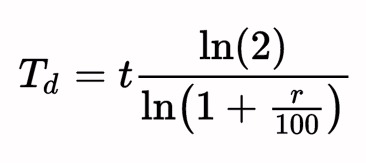
Doubling time is the amount of time it takes for a quantity to double in size (exponential growth). By 2020, there was enough data to see the doubling time of some anthropogenic climate affects had gone from 100 years to 10 years. For instance the rate of sea level rise has gone from about 1.5 millimeters per year to over 3 millimeters. We expect to see the doubling period to continue to shrink raising the possibility of sea levels rising a foot/year by 2050.

T_{d}=t \frac{\ln (2)}{\ln \left(1+\frac{r}{100}\right)}

T_{d} = doubling time
t = time
{r} = growth rate

Though the rate of change in climate disasters’ intensity, duration, and likelihood vary according to the type of extreme weather, a “rule-of-thumb” can be derived from the Canada wildfires of 2023. The World Weather Attribution Organization found, “Climate change made the cumulative severity of Quebec’s 2023 fire season to the end of July around 50% more intense, and seasons of this severity at least seven times more likely to occur.”

50% more intense
7 x more likely

These numbers may be similar in other catastrophes like hurricanes, heat waves, droughts, floods, tornadoes, and sea level rise.

If the doubling time remains at 10 years, we could see extreme events 100% more intense and/or longer in duration, as well as, 14 times more likely to occur. As mentioned above, we expect the doubling time to be reduced. If the doubling time is 5 years, in ten years we could see 200% more intense and longer extreme weather events being 28 times more likely to occur.

2024 Update
Global average sea level rose by about 0.3 inches (0.76 centimeters) from 2022 to 2023, according to a NASA-led analysis. When we authored this paper in 2023, we could not have foreseen the swift acceleration of this trend. Initially projected to double over a span of 100 years, the rate of sea level rise dramatically escalated, shortening the doubling period to a mere 10 years by 2020. Shockingly, recent observations suggest that this doubling period has further compressed to just 2 years. It is imperative to acknowledge and address this concerning trend, hoping it is not a foreboding indication of a new norm but rather an anomaly.

Human-induced climate change is a dynamic component of an intricate and unordered system, as per chaos theory. This implies that global warming is accelerating exponentially in a complex manner. Over the period from 1992 to 2023, we have presented compelling evidence, proposed remedies to mitigate climate change, and amassed valuable information through the engagement of millions with this climate model. Your participation has been invaluable. The incontrovertible data underscores that human-induced climate change is rapidly deteriorating our habitat.

Our climate model / experiment employs chaos theory to comprehensively consider human impacts and projects a potential global average temperature increase of 9℃ above pre-industrial levels. Global warming is a consequence of elevated thermal energy in the climate system, which comprises various subsystems. Chaos theory underscores the intricate and nonlinear nature of dynamic systems. Human well-being is compromised above a 1.5-degree temperature rise, rendering much of the Earth uninhabitable. A 9-degree Celsius increase would bring the Earth close to a wet-bulb temperature incapable of sustaining human life.

What Can I Do? There are numerous actions you can take to contribute to saving the planet. Each person bears the responsibility to minimize pollution, discontinue the use of fossil fuels, reduce consumption, and foster a culture of love and care. The Butterfly Effect illustrates that a small change in one area can lead to significant alterations in conditions anywhere on the globe. Hence, the frequently heard statement that a fluttering butterfly in China can cause a hurricane in the Atlantic. Be a butterfly and affect the world.

Here is a list of additional actions you can take.

4D Music: Songs About Science

A song about The Human Induced Climate Change Experiment

bookmark_border98.6

LYRICS
If we ever get in the clear
Then we’ve got to get out of here
Masses of gases
Making my temperature rise
Bulging eyes as the brain fries
Making my temperature rise
Can’t cry too dry
Making my temperature rise

If we ever get out of here
Then we’re near the “all’s clear”
Masses of gases
Making my temperature rise
Bulging eyes as the brain fries
Making my temperature rise
Can’t cry too dry
Making my temperature rise

Until we get out of here
Hear that we have yet to fear
Masses of gases
Making my temperature rise
Bulging eyes as the brain fries
Making my temperature rise
Can’t cry too dry
Making my temperature rise

Chords: E F G / G F# E / E’s; Part II Double Boogie @ 164 Beats Per Minute
Instrumentation: Vocals (TC-Helicon VOICELIVE and MiniNova Vocorder), Ibanez Acoustic Guitar (AW54CE), Fender Jazz Bass (Boss Digital Delay), Keyboards (Korg PS60, Casio WK-3500, Yamaha PSR-740, MiniNova, MicroKorg)

ABOUT THE SONG
This song “98.6” vividly portrays the intense and deadly effects of extreme heat, particularly focusing on the concept of wet-bulb temperature and its implications for human survival in the context of climate change. The repetition of the phrase “Making my temperature rise” underscores the urgency and intensity of the situation. The reference to “Masses of gases” suggests the role of greenhouse gases in exacerbating the heat, highlighting the link to human activities and climate change. The imagery of “bulging eyes” and “brain fries” paints a distressing picture of the physical and cognitive impacts of extreme heat, emphasizing the life-threatening nature of the situation. Overall, the song captures the ominous and oppressive atmosphere of deadly humid heat and the urgent need to address climate change to mitigate its devastating effects.

ABOUT THE SCIENCE
Greenhouse gases themselves are not inherently toxic to humans in the concentrations typically found in the atmosphere. However, their role in trapping heat and contributing to global warming and climate change can have detrimental effects on human health and the environment. For example, the increased temperatures associated with higher levels of greenhouse gases can lead to more frequent and severe heatwaves, which can cause heat-related illnesses and even death, particularly in vulnerable populations such as the elderly and those with pre-existing health conditions. Additionally, changes in climate patterns influenced by greenhouse gases can impact air and water quality, alter ecosystems, and lead to more extreme weather events, all of which can indirectly affect human health and well-being. Therefore, while greenhouse gases themselves may not be toxic, their effects on the environment can have significant health implications.

The greatest health risk from climate change to those alive today is the increased moisture content in the air (relative humidity) combined with the increased temperatures.

A Wet-bulb measures the temperature read by a thermometer covered in a wet cloth. As water evaporates from the cloth, evaporation cools the thermometer. This mirrors how the human body cools itself with sweat. The higher the heat and humidity (heat index), the harder it is for sweat to evaporate. The study Adaptability Limit to Climate Change Due to Heat Stress found that a wet-bulb temperature of 35C (95F) at 100% humidity, or 115F at 50% humidity, would be the upper limit of safety, beyond which the human body can no longer cool itself by evaporating sweat from the surface of the body to maintain a stable body core temperature.

The United Nations DRR says:
For every degree Celsius in warming, the water-holding capacity of the atmosphere increases by about 7%. Record-high sea temperatures ensure there is more moisture (in the form of water vapor) in the atmosphere, by an estimated 5-15% compared to before the 1970s, when global temperature rise began in earnest.

Deadly humid heat affects billions including the US Midwest this century. “It’s very disturbing,” study co-author Matthew Huber of Purdue University. “It’s going to send a lot of people to emergency medical care.” The study Greatly enhanced risk to humans as a consequence of empirically determined lower moist heat stress tolerance was conducted by Purdue and George Mason University and published August 15, 2023.

These results indicate that a significant portion of the world’s population will experience — for the first time in human history — prolonged exposures to uncompensable extreme moist heat. Humans will struggle to adapt to these conditions in a warmer world as they will present widespread challenges across many aspects of food-energy-water security, human health, and economic development including in the world’s most populous and most vulnerable regions.

At 3C (5.4F) of yearly average warming, more than 1.5 billion people will suffer. In the summer of 2023, the Earth experienced about a month of warming at 3C above pre-industrial levels. Both 2022 and 2023 saw a record number of heat related deaths. More than 61,000 Europeans died from extreme heat in the summer of 2022.

The average temperature for Brazil had been above the historical average from July through October of 2023. Rio de Janeiro recorded 42.5C on November 12, 2023 (a record for November) and high humidity on the 14th meant that it felt like 58.5C, municipal authorities said. The combination of heat and humidity is the greatest climate change risk to human health. On November 17, “a young Brazilian fan of US singer Taylor Swift died in Rio de Janeiro after falling ill inside the sweltering stadium where the superstar’s concert was held, amid a record-breaking heatwave across large swathes of Brazil,” as reported by ABC. “The show took place on the same day that Rio recorded its highest-ever heat index reading, which combines temperature and humidity, at 59.3 degrees Celsius (139 degrees Fahrenheit).”

The Water Vapor Feedback Problem
Water vapor is a powerful greenhouse gas. Since the 1970s, its rise likely increased global heating by an amount comparable to that from rising carbon dioxide. We are now seeing the consequences. In the current climate, for average all-sky conditions, water vapour is estimated to account for 50% of the total greenhouse effect, carbon dioxide 19%, ozone 4% and other gases 3%. Clouds make up about a quarter of the greenhouse effect.

The main greenhouse gases — carbon dioxide, methane, nitrous oxide and ozone — don’t condense and precipitate. Water vapor does, which means its lifetime in the atmosphere is much shorter, by orders of magnitude, compared to other greenhouse gases. On average, water vapor only lasts nine days. The increased intensity of precipitation often results in violent rain.

Sidd said, “The biggest feedback loop is water vapor. Humans put CO2 in the air. CO2 is a greenhouse gas, so the earth gets warmer. Warmer air can hold more water vapor soaking up more water vapor from the oceans. Water vapor is a greenhouse gas, so it gets even warmer… rinse (sorry!) and repeat. Another interesting thing is that the precipitation (rain, snow, sleet) intensity is increasing.”

Due to climate change humans will experience greater loss and damage to life and quality of life from air pollution, decreasing supply of potable water, extreme weather events, and disease. The greatest short term climate change risk to human health is deadly humid heat (wet-bulb temperature).

* Our climate model uses chaos theory in an attempt to adequately account for humans and forecasts a global average temperature increase of 9 degrees Celsius above pre-industrial levels. Everybody has the responsibility not to pollute. There are plenty of things you can do to help save the planet. Stop using fossil fuels. Consume less. Love more. Here is a list of additional actions you can take.
Climate Change and Deadly Humid Heat Brouse (2023)

4D Music: Songs About Science

A song about The Human Induced Climate Change Experiment

bookmark_borderLogical Truths

LYRICS
Use judgement
No argument
Facts are plain to see
Facts plain as can be
What is truth is truth to me
And true for you

One equals one
One sequels none
Black is black versus yak, yak, yak
Facts are plain to see
Facts plain as can be
What is truth is truth to me
And true for you

Logical truth sleuth
By definition
Developed in youth
Our solution
Facts are plain to see
Facts plain as can be
What is truth is truth to me
And true for you

Chords: Am G Em / Am D Am / Am D E / Am C D Am; Part II @ 128 Beats Per Minute
Instrumentation: Vocals (TC-Helicon VOICELIVE and MiniNova Vocorder), Ibanez Acoustic Guitar (AW54CE), Fender Jazz Bass (Boss Digital Delay), Keyboards (Korg PS60, Casio WK-3500, Yamaha PSR-740, MiniNova, MicroKorg)

ABOUT THE SONG
The song “Logical Truths” explores the concept of objective truth and the perception of reality. Here’s an interpretation of the lyrics:

The opening lines emphasize the importance of using judgment and recognizing objective facts. The repetition of “facts plain as can be” underscores the clarity and undeniable nature of these truths. The assertion that “What is truth is truth to me, and true for you” suggests a relativistic view of truth, acknowledging that individuals may perceive truth differently based on their perspectives or beliefs.

The lines “One equals one, One sequels none” seem to highlight basic logical principles, such as the identity property (one equals one) and the concept of singularity (one sequels none), reinforcing the idea of objective truth.

The mention of “Black is black versus yak, yak, yak” juxtaposes a straightforward truth (black is black) with frivolous chatter (“yak, yak, yak”), perhaps implying the importance of distinguishing between essential truths and meaningless distractions.

The phrase “Logical truth sleuth” suggests the pursuit of truth through logical reasoning, which is often developed in youth and shapes our understanding of reality. This pursuit is presented as a solution to navigating the complexities of truth.

Overall, the song advocates for a balanced approach to truth-seeking, recognizing both the objectivity of certain facts and the subjectivity of individual interpretations. It encourages listeners to engage in logical reasoning while remaining open to different perspectives.

ExperiMental Music: The music and lyrics are written and recorded extemporaneously. Extemporaneous, spontaneous, improvisation, jamming, freestyle, and impromptu music are most closely related to pure chaos. The music and lyrics evolve from the “sensitive initial conditions” similar to “a butterfly flapping its wings in China causing a hurricane in the Atlantic.”

Music as a Universal Language: Music has the power to communicate emotions universally. Certain melodies, harmonies, or rhythms can evoke specific feelings that resonate with people across different cultures and backgrounds.

The Science of Chaos Theory, String Theory, and Music

4D Music: Songs About Science

bookmark_borderNew Neutral

LYRICS
Increased frequency
Increased intensity
Normal extreme
Know what I mean?

Shifts in circulation
Exacerbated related
Dam damnation
Beyond what’s slated

Sea surface anomalies
See surface anomalies
Contribute overall
Records fall

Teleconnections
Distant resurrections
Add the chaos sauce
Hot coming across

Still, not so neutral
And so ENSO
That’s what we know
About the way things go

Chords: Em G / A C / C E A / C A / E Em / G Em C B7 Em; Part II @ 125 Beats Per Minute
Instrumentation: Vocals (TC-Helicon VOICELIVE and MiniNova Vocorder), Ibanez Acoustic Guitar (AW54CE), Ibanez Electric RG-270 (Vox ToneLab and Boss Digital Delay), Fender Jazz Bass (Boss Digital Delay), Keyboards (Korg PS60, Casio WK-3500, Yamaha PSR-740, MiniNova, MicroKorg)

ABOUT THE SONG
This song delves into the complexities of ENSO-neutral conditions, highlighting various factors contributing to its dynamic nature. The lyrics touch on increased frequency and intensity of events, suggesting a departure from the norm. Shifts in atmospheric circulation and related phenomena are portrayed as exacerbating existing conditions, leading to outcomes beyond what was anticipated or planned. Sea surface anomalies are mentioned as significant contributors to the overall scenario, with records being broken as a result. The concept of teleconnections, or distant interactions, is introduced, suggesting the interconnectedness of events across different regions. Despite the term “neutral” in ENSO-neutral, the song implies that these conditions are anything but neutral, underscoring the unpredictability and complexity inherent in the ENSO phenomenon.

ABOUT THE SCIENCE
ENSO-neutral refers to a phase in the El Niño-Southern Oscillation (ENSO) cycle when neither El Niño nor La Niña conditions are present in the tropical Pacific Ocean. Climate change can influence ENSO-neutral conditions in several ways:

  1. Increased Frequency and Intensity of Extremes: Climate change can lead to more frequent and intense weather extremes, such as heatwaves, droughts, and heavy rainfall events, even during ENSO-neutral periods. These extremes can occur independently of El Niño or La Niña events and may be exacerbated by rising global temperatures.
  2. Shifts in Atmospheric Circulation Patterns: Climate change can alter atmospheric circulation patterns globally, affecting the behavior of the jet stream and other large-scale wind patterns. These changes can influence the onset, strength, and duration of ENSO-neutral conditions and may lead to shifts in regional weather patterns.
  3. Sea Surface Temperature Anomalies: While ENSO-neutral conditions are characterized by near-average sea surface temperatures (SSTs) in the tropical Pacific, climate change can contribute to overall warming of ocean waters. This background warming may influence the baseline SSTs during ENSO-neutral periods and can potentially impact weather patterns and ocean circulation.
  4. Teleconnections: Climate change can modify teleconnections, which are large-scale atmospheric linkages that connect distant regions of the globe. These teleconnections play a significant role in shaping weather and climate patterns during ENSO-neutral periods. Changes in teleconnections may alter the impacts of ENSO-neutral conditions on weather and climate variability in different regions.

Overall, while ENSO-neutral conditions may not directly result from climate change, the broader changes occurring in the climate system can influence the characteristics and impacts of these neutral periods. Understanding these interactions is essential for improving our ability to predict and adapt to future climate variability and extremes.

Atmosphere-Soil-Ocean Coupling:

  1. Teleconnections:
    • Chaos theory recognizes the concept of teleconnections, where seemingly unrelated events in one part of the Earth system influence conditions in another. For instance, changes in sea surface temperatures (linked to ocean dynamics) can affect atmospheric circulation patterns, leading to variations in precipitation and temperature on land.
  2. Climate Variability:
    • The complex interactions between soil, atmosphere, and oceans contribute to climate variability. Chaos theory helps to understand the sensitivity of the climate system to initial conditions and how small perturbations in one component can lead to significant and sometimes unpredictable outcomes.

Human-induced climate change is a dynamic component of an intricate and unordered system, as per chaos theory. This implies that global warming is accelerating exponentially in a complex manner. Over the period from 1992 to 2023, we have presented compelling evidence, proposed remedies to mitigate climate change, and amassed valuable information through the engagement of millions with this climate model. Your participation has been invaluable. The incontrovertible data underscores that human-induced climate change is rapidly deteriorating our habitat.

Our climate model / experiment employs chaos theory to comprehensively consider human impacts and projects a potential global average temperature increase of 9℃ above pre-industrial levels. Global warming is a consequence of elevated thermal energy in the climate system, which comprises various subsystems. Chaos theory underscores the intricate and nonlinear nature of dynamic systems. Human well-being is compromised above a 1.5-degree temperature rise, rendering much of the Earth uninhabitable. A 9-degree Celsius increase would bring the Earth close to a wet-bulb temperature incapable of sustaining human life.

What Can I Do? There are numerous actions you can take to contribute to saving the planet. Each person bears the responsibility to minimize pollution, discontinue the use of fossil fuels, reduce consumption, and foster a culture of love and care. The Butterfly Effect illustrates that a small change in one area can lead to significant alterations in conditions anywhere on the globe. Hence, the frequently heard statement that a fluttering butterfly in China can cause a hurricane in the Atlantic. Be a butterfly and affect the world.

Here is a list of additional actions you can take.

4D Music: Songs About Science

A song about The Human Induced Climate Change Experiment

bookmark_borderSeam of a Dream

LYRICS
It seems I’m caught on the seam of a dream
’cause it’s hard to see me in this reality
In a drift
Of a draft
Fleeing the scene
Of obscene
(Seen)

On the edge of ledge
Pledge of a dream
Watching and scratching
Wondering why so mean?
In a drift
Of a draft
Fleeing the scene
Of obscene
(Seen)

On the verge of a splurge
Seen in a dream
’cause it’s hard to believe this reality
In a drift
Of a draft
Fleeing the scene
Of obscene
(Seen)

Chords: F# E / B D# / F#/7; Part II @ 137 Beats Per Minute
Instrumentation: Vocals (TC-Helicon VOICELIVE and MiniNova Vocorder), Ibanez Acoustic Guitar (AW54CE), Fender Jazz Bass (Boss Digital Delay), Keyboards (Korg PS60, Casio WK-3500, Yamaha PSR-740, MiniNova, MicroKorg)

ABOUT THE SONG
This song delves into the dissonance between dreams and reality, using vivid imagery to convey a sense of bewilderment and frustration regarding climate change and environmental degradation.

The repetition of phrases like “caught on the seam of a dream” and “on the edge of ledge” suggests a feeling of being suspended between two worlds, one of idealized dreams and one of harsh reality. This juxtaposition reflects the disconnect between the desired state of a pristine environment and the current state of degradation and destruction.

The lyrics evoke a sense of helplessness and confusion, as the protagonist struggles to reconcile their dreams of a better world with the harsh realities of environmental damage. The imagery of “fleeing the scene of obscene” suggests a desire to escape from the ugliness of environmental degradation, but ultimately feeling trapped within it.

Overall, the song captures the emotional turmoil and existential angst that many feel in the face of climate change and environmental destruction. It serves as a poignant reflection on the need for action and change to preserve the planet for future generations.

Humans will experience greater loss and damage to life and quality of life from air pollution, decreasing supply of potable water, extreme weather events, disease, and other adverse health outcomes. The greatest short term climate change risk to human health is deadly humid heat (wet-bulb temperature). The environmental changes and uncertainties associated with climate change can contribute to mental health issues, including anxiety, depression, and post-traumatic stress disorder (PTSD). Almost all survivors of climate-related disasters suffer from mental distress and experience PTSD. Of those who have not experienced climate disasters, over two-thirds of U.S. adults (68%) report having climate change anxiety.

Human-induced climate change is a dynamic component of an intricate and unordered system, as per chaos theory. This implies that global warming is accelerating exponentially in a complex manner. Over the period from 1992 to 2023, we have presented compelling evidence, proposed remedies to mitigate climate change, and amassed valuable information through the engagement of millions with this climate model. Your participation has been invaluable. The incontrovertible data underscores that human-induced climate change is rapidly deteriorating our habitat.

Our climate model / experiment employs chaos theory to comprehensively consider human impacts and projects a potential global average temperature increase of 9℃ above pre-industrial levels. Global warming is a consequence of elevated thermal energy in the climate system, which comprises various subsystems. Chaos theory underscores the intricate and nonlinear nature of dynamic systems. Human well-being is compromised above a 1.5-degree temperature rise, rendering much of the Earth uninhabitable. A 9-degree Celsius increase would bring the Earth close to a wet-bulb temperature incapable of sustaining human life.

What Can I Do? There are numerous actions you can take to contribute to saving the planet. Each person bears the responsibility to minimize pollution, discontinue the use of fossil fuels, reduce consumption, and foster a culture of love and care. The Butterfly Effect illustrates that a small change in one area can lead to significant alterations in conditions anywhere on the globe. Hence, the frequently heard statement that a fluttering butterfly in China can cause a hurricane in the Atlantic. Be a butterfly and affect the world.

Here is a list of additional actions you can take.

4D Music: Songs About Science

A song about The Human Induced Climate Change Experiment

bookmark_borderLa Niña

LYRICS
Coming this summer
A climate bummer
More drought in the corn belt
More strain from the hurricane

Chorus:
The seam of the jet stream
Moving North
Though it may feel cooler to you
It’s a limited point-of-view

Atmosphere ocean feedback
Out of whack
But don’t be a fool
The ocean didn’t cool
(chorus)

Closer inspection
Of tropical convection
Oh, well, upwell
Bequeath cold water from beneath
(chorus)

The way atmospheric waves behave
Communicate La Niña
Coming at ya
No surprise
La Niña drives
(chorus)

Chords: Bbm Db Fm Bbm / Bbm Fm Fm Bbm; Part II @ 148 Beats Per Minute
Instrumentation: Vocals (TC-Helicon VOICELIVE and MiniNova Vocorder), Ibanez Acoustic Guitar (AW54CE), Keyboards (Korg PS60, Casio WK-3500, Yamaha PSR-740, MiniNova, MicroKorg)

ABOUT THE SONG
This song delves into the phenomenon of La Niña and its impact on climate change. La Niña, characterized by cooler-than-average sea surface temperatures in the central and eastern Pacific Ocean, is associated with various weather patterns worldwide. The lyrics convey a sense of concern about the consequences of La Niña, particularly during the summer months.

The mention of “climate bummer” highlights the negative effects expected during La Niña events, such as increased drought in the corn belt and heightened strain from hurricanes. These weather extremes disrupt agricultural productivity and pose risks to communities vulnerable to severe weather events.

The reference to the “seam of the jet stream moving North” indicates shifts in atmospheric circulation patterns associated with La Niña. While some regions may experience cooler temperatures, the song emphasizes that this perspective is limited, as La Niña can bring a range of complex and sometimes unexpected impacts.

The lyrics also touch on the atmospheric-ocean feedback loop, suggesting that disruptions in this system contribute to the erratic behavior of La Niña. The mention of “upwelling” refers to the process where cold water from deeper ocean layers rises to the surface, influencing sea surface temperatures and atmospheric conditions.

Overall, the song warns listeners about the disruptive nature of La Niña events and underscores the interconnectedness of oceanic and atmospheric processes in shaping global climate patterns.

ABOUT THE SCIENCE

In the United States, hurricanes stand out as the most financially burdensome type of climate-related disaster. While the number of disasters related to extreme weather events such as rain, hail, and wind, resulting in over a billion dollars in damage may be higher, the sheer magnitude of damage caused by a single hurricane surpasses them. For example, in 2023, there were 17 extreme weather events, each causing over a billion dollars in damage, but no hurricanes occurred. However, Hurricane Ida alone incurred an estimated $75 billion in damages, making it the costliest disaster of 2021.

In 2023, the world experienced an El Niño phase, which typically reduces hurricane activity. However, the climate pattern shifted towards La Niña in 2024. La Niña patterns often amplify the Atlantic hurricane season, particularly concerning when paired with months-long streaks of record warmth across the Atlantic Ocean.

The chaotic interactions between various factors, including ocean currents, sea surface temperatures, and atmospheric circulation, contribute to the overall climate patterns experienced on the East Coast. Climate change can influence the jet stream and atmospheric rivers, impacting weather patterns on the East Coast of the USA. The jet stream is a key player in steering weather systems and atmospheric rivers.

It’s important to note that the relationship between the jet stream and atmospheric rivers is part of a larger, complex climate system. Human induced climate change is an exponential component of an unordered system (chaos theory). That means global warming is accelerating at a rapid rate in a complex way. Our climate model uses chaos theory in an attempt to adequately account for humans and forecasts a global average temperature increase of 9 degrees Celsius above pre-industrial levels. Climate change is expected to have complex and significant impacts on the jet stream, Atlantic Meridional Overturning Circulation (AMOC), and atmospheric rivers.

Our climate model / experiment employs chaos theory to comprehensively consider human impacts and projects a potential global average temperature increase of 9℃ above pre-industrial levels. Global warming is a consequence of elevated thermal energy in the climate system, which comprises various subsystems. Chaos theory underscores the intricate and nonlinear nature of dynamic systems. Human well-being is compromised above a 1.5-degree temperature rise, rendering much of the Earth uninhabitable. A 9-degree Celsius increase would bring the Earth close to a wet-bulb temperature incapable of sustaining human life.

What Can I Do? There are numerous actions you can take to contribute to saving the planet. Each person bears the responsibility to minimize pollution, discontinue the use of fossil fuels, reduce consumption, and foster a culture of love and care. The Butterfly Effect illustrates that a small change in one area can lead to significant alterations in conditions anywhere on the globe. Hence, the frequently heard statement that a fluttering butterfly in China can cause a hurricane in the Atlantic. Be a butterfly and affect the world.

Here is a list of additional actions you can take.

4D Music: Songs About Science

A song about The Human Induced Climate Change Experiment

bookmark_borderApproaching the Speed of Light

LYRICS
To turn the page on age
I might
Approach the speed of light
But alas
My mass won’t pass

The faster I move through 3
The slower I move through 4
So, if it were up to me
I would age no more

Approaching the speed of light
Careful not to touch much
Less my new plight
Would be too much mass
In the ass

At 99.99999
I’m in time
As my year clears
Theirs nears 2,000 years

Inspiration
Through time dilation
Relativistic magic
Slick and thick

Feeling relatively fine
Reeling n time
Knowing large
Time’s in charge

Chords: F# C# B F# / C# B F# / B F# C#7 F#; Part II Cowboy Boogie Rock Shuffle @ 178 Beats Per Minute
Instrumentation: Vocals (TC-Helicon VOICELIVE and MiniNova Vocorder), Ibanez Acoustic Guitar (AW54CE), Keyboards (Korg PS60, Casio WK-3500, Yamaha PSR-740, MiniNova, MicroKorg)

ABOUT THE SONG
This song explores themes related to the concept of time dilation and the effects of approaching the speed of light, as described by Einstein’s theory of relativity.

The lyrics suggest a desire to defy the limitations imposed by aging and the passage of time. The phrase “To turn the page on age” indicates a longing to escape the constraints of aging. The idea of approaching the speed of light symbolizes a quest for liberation and a desire to transcend the boundaries of time.

However, the lyrics also acknowledge the physical limitations inherent in such a pursuit. The mention of mass and its implications at relativistic speeds reflects an understanding of the scientific principles governing time dilation. As an object accelerates towards the speed of light, its mass increases exponentially, making it increasingly difficult to accelerate further.

The reference to “3” and “4” alludes to the four-dimensional spacetime framework of Einstein’s theory of relativity, where the three dimensions of space are combined with the dimension of time. The lyrics suggest that as one approaches the speed of light, time seems to slow down relative to an outside observer (“The faster I move through 3, the slower I move through 4”).

Despite the challenges and limitations described, there’s a sense of acceptance and contentment conveyed in the closing lines. The protagonist finds solace in their relative experience of time, feeling “relatively fine” and recognizing that “time’s in charge.” Overall, the song reflects on the complexities of time, aging, and the human desire to defy the inevitability of temporal constraints.

ExperiMental Music: The music and lyrics are written and recorded extemporaneously. Extemporaneous, spontaneous, improvisation, jamming, freestyle, and impromptu music are most closely related to pure chaos. The music and lyrics evolve from the “sensitive initial conditions” similar to “a butterfly flapping its wings in China causing a hurricane in the Atlantic.”

Music as a Universal Language: Music has the power to communicate emotions universally. Certain melodies, harmonies, or rhythms can evoke specific feelings that resonate with people across different cultures and backgrounds.

The Science of Chaos Theory, String Theory, and Music

Deep Dive Into Science

bookmark_borderI Don’t Mind

LYRICS
I don’t mind when the clouds pass by
It’s when they stop and start to cry
Finding it hard to stay high and dry
No matter how hard I try
The sounding of pounding
Takes my breath away
Found above ground
Still falling all around
Falling down

Drain in the bathtub
I’m drowning
Done with this downing and clowning
Found it hard to stay and watch you die
No smarter now, wonder why?

Chords: G#mM7 E7 E E7 E / C D G E / C D A E / A / C D E; Part II @ 128 Beats Per Minute
Instrumentation: Vocals (TC-Helicon VOICELIVE and MiniNova Vocorder), Ibanez Acoustic Guitar (AW54CE), Fender Jazz Bass (Boss Digital Delay), Keyboards (Korg PS60, Casio WK-3500, Yamaha PSR-740, MiniNova, MicroKorg)

ABOUT THE SONG
This song conveys a sense of helplessness and frustration in the face of extreme weather events. The imagery of clouds stopping and crying suggests a sudden onset of heavy rainfall, which the speaker finds difficult to endure. Despite their efforts to stay dry, they feel overwhelmed by the intensity of the downpour. The repetition of “falling down” emphasizes the relentlessness of the rain and its impact on the speaker’s surroundings.

The metaphor of drowning in a bathtub further illustrates the feeling of being overwhelmed and powerless. The speaker expresses a desire to escape from the situation, feeling unable to bear witness to the destruction caused by the weather. They question their own understanding of the circumstances, wondering why they are unable to find a solution or cope with the situation more effectively.

Overall, the song captures the emotional toll of extreme weather events and the sense of despair that can accompany them. It reflects on the fragility of human existence in the face of nature’s power and the struggle to maintain resilience in challenging circumstances.

ABOUT THE SCIENCE
Humans will experience greater loss and damage to life and quality of life from air pollution, decreasing supply of potable water, extreme weather events, disease, and other adverse health outcomes. The greatest short term climate change risk to human health is deadly humid heat (wet-bulb temperature).  The environmental changes and uncertainties associated with climate change can contribute to mental health issues, including anxiety, depression, and post-traumatic stress disorder (PTSD). Almost all survivors of climate-related disasters suffer from mental distress and experience PTSD. Of those who have not experienced climate disasters, over two-thirds of U.S. adults (68%) report having climate change anxiety.

In October of 2023 Sidd said, “Now I am thinking the violent rain will be a bigger problem before we die.”

Mass and velocity are parts of a larger equation that also includes density.The combination of these variables results in an increased intensity of the flow forces (i.e. flow dynamics). Wind and water flow forces scale as the square of velocity, so as flow speeds increase (say due to more intense heating or heavier rain) the damage scales as the square of the velocity. Look at drag physics and you will see that force is proportional to density times square of velocity (v^2).

So a twenty mile an hour wind exerts four times as much force as a ten mile an hour wind. And a forty mile an hour wind exerts sixteen times as much force as a ten mile an hour wind. A wind of fifty miles an hour exerts twenty five times and a wind of sixty miles an hour exerts thirty six times as much force as one of ten miles an hour. Then you have the density term. Water is about eight hundred times denser than air, so the force exerted by a ten mile an hour flow of water is eight hundred times that of a ten mile an hour wind. As flow velocities go up due to climate change, force and damage scale as square of the velocities. What is not clear is how much these velocities increase with climate change. But in a sense we are seeing this already as, for example, flood and sewage systems succumb and hillsides fall down, and so on.

Human-induced climate change is a dynamic component of an intricate and unordered system, as per chaos theory. This implies that global warming is accelerating exponentially in a complex manner. Over the period from 1992 to 2023, we have presented compelling evidence, proposed remedies to mitigate climate change, and amassed valuable information through the engagement of millions with this climate model. Your participation has been invaluable. The incontrovertible data underscores that human-induced climate change is rapidly deteriorating our habitat.

Our climate model / experiment employs chaos theory to comprehensively consider human impacts and projects a potential global average temperature increase of 9℃ above pre-industrial levels. Global warming is a consequence of elevated thermal energy in the climate system, which comprises various subsystems. Chaos theory underscores the intricate and nonlinear nature of dynamic systems. Human well-being is compromised above a 1.5-degree temperature rise, rendering much of the Earth uninhabitable. A 9-degree Celsius increase would bring the Earth close to a wet-bulb temperature incapable of sustaining human life.

What Can I Do? There are numerous actions you can take to contribute to saving the planet. Each person bears the responsibility to minimize pollution, discontinue the use of fossil fuels, reduce consumption, and foster a culture of love and care. The Butterfly Effect illustrates that a small change in one area can lead to significant alterations in conditions anywhere on the globe. Hence, the frequently heard statement that a fluttering butterfly in China can cause a hurricane in the Atlantic. Be a butterfly and affect the world.

Here is a list of additional actions you can take.

4D Music: Songs About Science

A song about The Human Induced Climate Change Experiment

bookmark_borderFamily Barbecue

LYRICS
Today’s the day
Record hot
So they say
All we’ve got

Chorus:
There’s going to be a barbecue
Involving me
Involving you
Too late to wake
We’re going to bake
Sadly see
“For goodness sake”

Today’s the day
Record heat
It’s not O.K.
Ruins the beat… the beat… the beat
(chorus)

Today’s the day
Record broke
Lost our way
The fires stoke
(chorus)

Chords: F# C# B F# / C# B F# / B F# C#7 F#; Part II 83 to 110 BPM
Instrumentation I: Vocals, Takamine Acoustic Guitar
Written and recorded at Lake Wynonah, Pennsylvania on a summer-like day in March.
Instrumentation II: Vocals (TC-Helicon VOICELIVE and MiniNova Vocorder), Ibanez Acoustic Guitar (AW54CE), Fender Squire Mini Electric Guitar (Boss Digital Delay and VOX ToneLab), Fender Jazz Bass (Boss Digital Delay), Keyboards (Korg PS60, Casio WK-3500, Yamaha PSR-740, MiniNova, MicroKorg)

ABOUT THE SONG
This song “Family Barbecue” serves as a poignant commentary on the impact of climate change, particularly focusing on the extreme heat and its consequences.

The repeated phrase “Today’s the day” emphasizes the immediacy and urgency of the situation, suggesting that the effects of climate change are being felt in the present moment. “Record hot” and “record heat” highlight the extreme temperatures that are occurring, indicating a departure from normal conditions.

The metaphor of a “barbecue” evokes images of heat, discomfort, and potential danger, mirroring the intensity of the heatwave described in the song. The phrase “All we’ve got” underscores the sense of helplessness or resignation in the face of these extreme conditions.

The chorus emphasizes the inevitability of the situation, suggesting that it is “too late to wake” and that individuals are resigned to “bake” in the heat. The use of the phrase “For goodness sake” conveys a sense of frustration or disbelief at the severity of the situation.

Overall, “Family Barbecue” serves as a sobering reminder of the reality of climate change and its impact on daily life, urging listeners to recognize the urgency of addressing this pressing issue.

ABOUT THE SCIENCE
Human-induced climate change is a dynamic component of an intricate and unordered system, as per chaos theory. This implies that global warming is accelerating exponentially in a complex manner. Over the period from 1992 to 2023, we have presented compelling evidence, proposed remedies to mitigate climate change, and amassed valuable information through the engagement of millions with this climate model. Your participation has been invaluable. The incontrovertible data underscores that human-induced climate change is rapidly deteriorating our habitat.

Our climate model / experiment employs chaos theory to comprehensively consider human impacts and projects a potential global average temperature increase of 9℃ above pre-industrial levels. Global warming is a consequence of elevated thermal energy in the climate system, which comprises various subsystems. Chaos theory underscores the intricate and nonlinear nature of dynamic systems. Human well-being is compromised above a 1.5-degree temperature rise, rendering much of the Earth uninhabitable. A 9-degree Celsius increase would bring the Earth close to a wet-bulb temperature incapable of sustaining human life.

What Can I Do? There are numerous actions you can take to contribute to saving the planet. Each person bears the responsibility to minimize pollution, discontinue the use of fossil fuels, reduce consumption, and foster a culture of love and care. The Butterfly Effect illustrates that a small change in one area can lead to significant alterations in conditions anywhere on the globe. Hence, the frequently heard statement that a fluttering butterfly in China can cause a hurricane in the Atlantic. Be a butterfly and affect the world.

Here is a list of additional actions you can take.

4D Music: Songs About Science

A song about The Human Induced Climate Change Experiment

bookmark_borderYou Know What You Mean

LYRICS
When one acknowledges their role within the system (Gaia hypothesis), the mind is liberated from suffering.

Dreaming away
Dream of the day
When sense is king and loves a thing
Deeming the way to our daydream
Where sense is king and love’s the scene
And you know what you mean
Understand the part of Man
To command what is “I am”
Then the lion lies with the lamb
I am
I can

Working our way
Toward the day
When sense is a thing an love is king
Deeming the way to our dream day
Know sense is a thing a love’s in play
And you know what you mean
Understand the part of Man
To command what is “I am”
Then the lion lies with the lamb
I am
I can

Enjoying today
We found the way
Sense is our king
And love is our thing
Deemed the way to work and play
We sense the thing we need to bring
And you know what you mean
Understand the part of Man
To command what is “I am”
Then the lion lies with the lamb
I am
I can

You’ll find
You liberate your mind

Chords: C Bb / Bb / C Eb / C Eb Bb C; Part II Swing Reggae Trip-Hop @ 100 Beats Per Minute
Instrumentation: Vocals (TC-Helicon VOICELIVE and MiniNova Vocorder), Ibanez Acoustic Guitar (AW54CE), Fender Jazz Bass (Boss Digital Delay), Keyboards (Korg PS60, Casio WK-3500, Yamaha PSR-740, MiniNova, MicroKorg)

ABOUT THE SONG
These lyrics convey a message of unity with nature and a recognition of humanity’s place within the Earth’s interconnected system. The reference to the Gaia hypothesis highlights the idea that the Earth functions as a self-regulating organism, with all living beings playing a vital role. As individuals acknowledge their interconnectedness with the planet, they experience a sense of liberation from suffering.

The imagery of dreaming and envisioning a world where “sense is king and love’s the scene” suggests a future where humanity values wisdom and compassion above all else. This vision includes harmony between humans and nature, symbolized by the lion lying with the lamb.

The repetition of the phrase “I am, I can” emphasizes the power of individual agency and responsibility in shaping the world for the better. By understanding their role as stewards of the Earth, individuals can work towards a future where sense and love guide their actions, leading to a more harmonious existence for all beings.

Overall, these lyrics encourage listeners to recognize the interconnectedness of all life and to strive for a future where humanity lives in harmony with the Earth, liberated from suffering through understanding and compassion.

ExperiMental Music: For the most part, this music is written and recorded extemporaneously. Extemporaneous, spontaneous, improvisation, jamming, freestyle, and impromptu music are most closely related to pure chaos. The music and lyrics evolve from the “sensitive initial conditions” similar to “a butterfly flapping its wings in China causing a hurricane in the Atlantic.”

Music as a Universal Language: Music has the power to communicate emotions universally. Certain melodies, harmonies, or rhythms can evoke specific feelings that resonate with people across different cultures and backgrounds.

The Science of Chaos Theory, String Theory, and Music
4D Music stands for four-dimensional music. The concept of the fourth dimension in the context of spacetime comes from the merging of three-dimensional space with the dimension of time into a four-dimensional continuum. This idea is a fundamental component of Einstein’s theory of general relativity. In classical physics, space and time were considered separate entities, with space described by three dimensions (length, width, and height), and time considered as a separate parameter. However, in the early 20th century, Albert Einstein introduced the concept of spacetime, where time is treated as a fourth dimension, and the fabric of the universe is a four-dimensional continuum.

4D songs contain music and lyrics influenced and inspired by science including: Einstein’s theory of general relativity, quantum mechanics, string theory, chaos theory, physics, climatology, statistics, economics, astronomy, geology, biology, anthropology, meteorology, chemistry, and other scientific disciplines.

ABOUT THE SCIENCE
Human-induced climate change is a dynamic component of an intricate and unordered system, as per chaos theory. This implies that global warming is accelerating exponentially in a complex manner. Over the period from 1992 to 2023, we have presented compelling evidence, proposed remedies to mitigate climate change, and amassed valuable information through the engagement of millions with this climate model. Your participation has been invaluable. The incontrovertible data underscores that human-induced climate change is rapidly deteriorating our habitat.

Our climate model / experiment employs chaos theory to comprehensively consider human impacts and projects a potential global average temperature increase of 9℃ above pre-industrial levels. Global warming is a consequence of elevated thermal energy in the climate system, which comprises various subsystems. Chaos theory underscores the intricate and nonlinear nature of dynamic systems. Human well-being is compromised above a 1.5-degree temperature rise, rendering much of the Earth uninhabitable. A 9-degree Celsius increase would bring the Earth close to a wet-bulb temperature incapable of sustaining human life.

What Can I Do? There are numerous actions you can take to contribute to saving the planet. Each person bears the responsibility to minimize pollution, discontinue the use of fossil fuels, reduce consumption, and foster a culture of love and care. The Butterfly Effect illustrates that a small change in one area can lead to significant alterations in conditions anywhere on the globe. Hence, the frequently heard statement that a fluttering butterfly in China can cause a hurricane in the Atlantic. Be a butterfly and affect the world.

Here is a list of additional actions you can take.

4D Music: Songs About Science

A song about The Human Induced Climate Change Experiment

bookmark_borderWhoa, Woe, Whoa

LYRICS
Here we go
Do we know
Left from right
Dark from light
Whoa, woe, whoa
Won’t say no
Have to go
Left, I might
Seek the light
Whoa, woe, whoa
Do we know
Friend or foe
Left and right
Might not light
Whoa, woe, whoa
Woe has to go
Why not stop!?!?
We feed the problem
And starve the cure
It’s hard to endure
If we do much more
That’s for sure
It’s time for a change
Embrace what’s strange
It’s time the we knew
Something new
Status quo
Has got to go
Whoa, woe, whoa
Woe’s gotta go
Whoa, woe, whoa

Chords: F# / E B F# / D E F# / D B / F# / B F#; Part II @ 137 Beats Per Minute
Instrumentation: Vocals (TC-Helicon VOICELIVE and MiniNova Vocorder), Ibanez Acoustic Guitar (AW54CE), Ibanez Electric RG-270 (Boss Digital Delay, Vox ToneLab), Fender Jazz Bass (Boss Digital Delay), Keyboards (Korg PS60, Casio WK-3500, Yamaha PSR-740, MiniNova, MicroKorg)

ABOUT THE SONG
The lyrics convey a sense of urgency and a call for change in the face of environmental challenges, particularly related to climate change. The repetition of “Whoa, woe, whoa” suggests a mix of concern and lamentation. The lines “We feed the problem, And starve the cure” highlight the need to shift our actions toward solutions rather than exacerbating the issues. The repeated phrase “Woe’s gotta go” emphasizes the desire to move away from destructive patterns and toward a more sustainable and positive future. Overall, the song urges listeners to reconsider their impact on the environment and take meaningful steps toward positive change.

ABOUT THE SCIENCE
Unfortunately, even scientists are failing to see (let alone forecast) the rapid acceleration in climate change. Due to their complexity, the impacts of the Domino Effect are being underestimated. Tipping points are Critical Milestones that directly impact the rate of acceleration in climate change by multiplying the number and intensity of feedback loops. The Domino Effect is also known as “tipping cascades” in climate science. Cascading impacts in relation to tipping points include cascading impacts across biogeophysical and social systems. Until recently, scientist have been drastically underestimating the social-ecological systems. The University of Exeter reports, “There is a notable lack of topic clusters dedicated to how humans will be impacted by climate-related tipping cascades.”

Previous climate models have inadequately incorporated “social-ecological systems” as human involvement was not a significant factor in past climate changes. Unfortunately, the United States ranks among the least prepared countries globally, with the highest percentage of climate deniers. The Republican party dismisses it as a manufactured crisis and plans to increase fossil fuel production, exacerbating the situation. Political extremists asserting that the climate crisis is manufactured employ an ironic term, considering that human manufacturing activities are the primary driver of climate change. Both political parties have concurred to allocate unlimited emergency funding for climate disasters instead of proactively preventing them. Last year, the US witnessed a record number of over a billion-dollar climate disasters, totaling 28 separate weather and climate-related events. It is due to this arrogance and ignorance that “worst-case scenarios” are now “best-case scenarios” for the acceleration of climate change. These factors have altered our climate model, shifting the projected maximum temperature rise from 4 degrees Celsius over the next millennium to a probable increase of 9 degrees Celsius this century.

— from Tipping Cascades, Social-Ecological Systems, and the Hottest Year in History Brouse (2024)

Human-induced climate change is a dynamic component of an intricate and unordered system, as per chaos theory. This implies that global warming is accelerating exponentially in a complex manner. Over the period from 1992 to 2023, we have presented compelling evidence, proposed remedies to mitigate climate change, and amassed valuable information through the engagement of millions with this climate model. Your participation has been invaluable. The incontrovertible data underscores that human-induced climate change is rapidly deteriorating our habitat.

Our climate model / experiment employs chaos theory to comprehensively consider human impacts and projects a potential global average temperature increase of 9℃ above pre-industrial levels. Global warming is a consequence of elevated thermal energy in the climate system, which comprises various subsystems. Chaos theory underscores the intricate and nonlinear nature of dynamic systems. Human well-being is compromised above a 1.5-degree temperature rise, rendering much of the Earth uninhabitable. A 9-degree Celsius increase would bring the Earth close to a wet-bulb temperature incapable of sustaining human life.

What Can I Do? There are numerous actions you can take to contribute to saving the planet. Each person bears the responsibility to minimize pollution, discontinue the use of fossil fuels, reduce consumption, and foster a culture of love and care. The Butterfly Effect illustrates that a small change in one area can lead to significant alterations in conditions anywhere on the globe. Hence, the frequently heard statement that a fluttering butterfly in China can cause a hurricane in the Atlantic. Be a butterfly and affect the world.

Here is a list of additional actions you can take.

4D Music: Songs About Science

A song about The Human Induced Climate Change Experiment

bookmark_borderManufactured Crisis

LYRICS
Yes, this is
A Man-you-factured crisis
Man-made cascade
Go figure
We pulled the trigger
Tipping points
Feedback loops
Whoops!
Trashed the joint

Yes, this is
A Man-you-factured crisis
Manufactured fractured
Industrial revolution
Exponential pollution
Damn the solution
We still drill, drill, drill

Yes, this is
A Man-you-factured crisis
Me and you
Pump CO2
Atmosphere fear
Is here
What we make
From take, take, take

Yes, this is
A Man-you-factured crisis
Resolute to pollute
Fossil fuel fool
Just can’t stop
Why? Why not?
Getting too hot
Crossed the line
To the End of time

Chords: E A G E / D E slide / G A / G A G E / A G E; Part II @ 122 Beats Per Minute
Instrumentation: Vocals (TC-Helicon VOICELIVE and MiniNova Vocorder), Ibanez Acoustic Guitar (AW54CE), Ibanez Electric RG-270 (Boss Digital Delay, Vox ToneLab), Fender Jazz Bass (Boss Digital Delay), Keyboards (Korg PS60, Casio WK-3500, Yamaha PSR-740, MiniNova, MicroKorg)

ABOUT THE SONG
Regrettably, there are still individuals propagating misinformation about climate change. Certain political extremists assert that the climate crisis is manufactured, employing an ironic term, considering that human manufacturing activities constitute the primary driver of climate change.

These lyrics vividly depict the human-induced environmental crisis, emphasizing the consequences of industrialization, pollution, and the relentless exploitation of natural resources. The repeated phrase “Man-you-factured crisis” suggests a deliberate and ongoing human contribution to the predicament. The lines addressing the “trigger” being pulled and the subsequent acknowledgment of tipping points and feedback loops highlight the irreversible damage caused.

The reference to the industrial revolution and “exponential pollution” points to the historical roots of the crisis and the accelerating impact of human activities. The phrase “Damn the solution” reflects a sense of disregard or negligence toward finding effective remedies.

The repetition of “drill, drill, drill” emphasizes the relentless extraction of fossil fuels, a major contributor to the environmental crisis. The mention of pumping CO2 into the atmosphere underscores the role of greenhouse gas emissions in climate change.

Overall, the lyrics convey a critical message about humanity’s role in the ecological crisis, urging reflection on our actions and the need for sustainable solutions to avoid reaching the “End of time.”

ABOUT THE SCIENCE
Unfortunately, even scientists are failing to see (let alone forecast) the rapid acceleration in climate change. Due to their complexity, the impacts of the Domino Effect are being underestimated. Tipping points are Critical Milestones that directly impact the rate of acceleration in climate change by multiplying the number and intensity of feedback loops. The Domino Effect is also known as “tipping cascades” in climate science. Cascading impacts in relation to tipping points include cascading impacts across biogeophysical and social systems. Until recently, scientist have been drastically underestimating the social-ecological systems. The University of Exeter reports, “There is a notable lack of topic clusters dedicated to how humans will be impacted by climate-related tipping cascades.”

Previous climate models have inadequately incorporated “social-ecological systems” as human involvement was not a significant factor in past climate changes. Unfortunately, the United States ranks among the least prepared countries globally, with the highest percentage of climate deniers. The Republican party dismisses it as a manufactured crisis and plans to increase fossil fuel production, exacerbating the situation. Political extremists asserting that the climate crisis is manufactured employ an ironic term, considering that human manufacturing activities are the primary driver of climate change. Both political parties have concurred to allocate unlimited emergency funding for climate disasters instead of proactively preventing them. Last year, the US witnessed a record number of over a billion-dollar climate disasters, totaling 28 separate weather and climate-related events. It is due to this arrogance and ignorance that “worst-case scenarios” are now “best-case scenarios” for the acceleration of climate change. These factors have altered our climate model, shifting the projected maximum temperature rise from 4 degrees Celsius over the next millennium to a probable increase of 9 degrees Celsius this century.

— from Tipping Cascades, Social-Ecological Systems, and the Hottest Year in History Brouse (2024)

Human-induced climate change is a dynamic component of an intricate and unordered system, as per chaos theory. This implies that global warming is accelerating exponentially in a complex manner. Over the period from 1992 to 2023, we have presented compelling evidence, proposed remedies to mitigate climate change, and amassed valuable information through the engagement of millions with this climate model. Your participation has been invaluable. The incontrovertible data underscores that human-induced climate change is rapidly deteriorating our habitat.

Our climate model / experiment employs chaos theory to comprehensively consider human impacts and projects a potential global average temperature increase of 9℃ above pre-industrial levels. Global warming is a consequence of elevated thermal energy in the climate system, which comprises various subsystems. Chaos theory underscores the intricate and nonlinear nature of dynamic systems. Human well-being is compromised above a 1.5-degree temperature rise, rendering much of the Earth uninhabitable. A 9-degree Celsius increase would bring the Earth close to a wet-bulb temperature incapable of sustaining human life.

What Can I Do? There are numerous actions you can take to contribute to saving the planet. Each person bears the responsibility to minimize pollution, discontinue the use of fossil fuels, reduce consumption, and foster a culture of love and care. The Butterfly Effect illustrates that a small change in one area can lead to significant alterations in conditions anywhere on the globe. Hence, the frequently heard statement that a fluttering butterfly in China can cause a hurricane in the Atlantic. Be a butterfly and affect the world.

Here is a list of additional actions you can take.

4D Music: Songs About Science

A song about The Human Induced Climate Change Experiment

bookmark_borderThe Enemy

LYRICS
The consequences we create
Put us in our current state
Mounting expenses that we make
Due our cost from all we take

Chorus:
Paying off our debt
So we get less regret
Less we forget
Our match we’ve met

Look in the mirror
What do you see?
Wallow in horror
The enemy
(chorus)

Resources finite
We just might
Put up a fight
For what is right
(chorus)

Chords: Em6 Em9 / Em C D Em; Part II @ 124 Beats Per Minute
Instrumentation: Vocals (TC-Helicon VOICELIVE and MiniNova Vocorder), Ibanez Acoustic Guitar (AW54CE), Keyboards (Korg PS60, Casio WK-3500, Yamaha PSR-740, MiniNova, MicroKorg)

ABOUT THE SONG
These lyrics convey a reflection on the consequences of human actions that have led to the current state of the environment. The mounting expenses mentioned in the lyrics suggest the ecological costs incurred as a result of human activities. The chorus emphasizes the need to acknowledge and address these consequences by paying off the environmental debt to avoid regret and remember the impact of our actions.

The lines “Look in the mirror, What do you see? Wallow in horror, The enemy” prompt introspection, encouraging individuals to confront their role in environmental degradation. The mention of finite resources hints at the urgency of taking corrective actions, suggesting a call to fight for what is right in terms of environmental conservation. Overall, the lyrics convey a message of accountability, urging listeners to recognize the environmental challenges and actively work towards a more sustainable and responsible future.

ABOUT THE SCIENCE
Human-induced climate change is a dynamic component of an intricate and unordered system, as per chaos theory. This implies that global warming is accelerating exponentially in a complex manner. Over the period from 1992 to 2023, we have presented compelling evidence, proposed remedies to mitigate climate change, and amassed valuable information through the engagement of millions with this climate model. Your participation has been invaluable. The incontrovertible data underscores that human-induced climate change is rapidly deteriorating our habitat.

Our climate model / experiment employs chaos theory to comprehensively consider human impacts and projects a potential global average temperature increase of 9℃ above pre-industrial levels. Global warming is a consequence of elevated thermal energy in the climate system, which comprises various subsystems. Chaos theory underscores the intricate and nonlinear nature of dynamic systems. Human well-being is compromised above a 1.5-degree temperature rise, rendering much of the Earth uninhabitable. A 9-degree Celsius increase would bring the Earth close to a wet-bulb temperature incapable of sustaining human life.

What Can I Do? There are numerous actions you can take to contribute to saving the planet. Each person bears the responsibility to minimize pollution, discontinue the use of fossil fuels, reduce consumption, and foster a culture of love and care. The Butterfly Effect illustrates that a small change in one area can lead to significant alterations in conditions anywhere on the globe. Hence, the frequently heard statement that a fluttering butterfly in China can cause a hurricane in the Atlantic. Be a butterfly and affect the world.

Here is a list of additional actions you can take.

4D Music: Songs About Science

A song about The Human Induced Climate Change Experiment

bookmark_borderForce of Nature

LYRICS
Pressure gradient force
Of course
The initial driving force for wind
The calm chagrined

Under pressure
I’ve got to go
Under pressure
Enhance the flow

Centrifugal force
Of course
Given birth
By the curvature of the Earth
(For what it’s worth)

Coriolis force
Of course
The varying rotational velocities
Fueled by Man’s atrocities
(Modern cities)

Turbulent drag
A snag
Make it tough
Make it rough
Make the wind rescind

Chords: F#m Fm E D# D C# C / C B C; Part II @ 152 Beats Per Minute
Instrumentation: Vocals (TC-Helicon VOICELIVE and MiniNova Vocorder), Keyboards (Korg PS60, Casio WK-3500, Yamaha PSR-740, MiniNova, MicroKorg)

ABOUT THE SONG
These lyrics describe the various forces that influence wind patterns, particularly in the context of atmospheric physics. Let’s break down the interpretation:

  1. Pressure Gradient Force:
    • Describes the force responsible for initiating wind, moving air from high to low-pressure areas.
    • The mention of “calm chagrined” could imply that the absence of this force results in calm conditions, perhaps expressing concern about disruptions in this force.
  2. Centrifugal Force:
    • Refers to the force generated by the Earth’s curvature, which influences wind patterns.
    • The line “Given birth by the curvature of the Earth” suggests a natural and fundamental aspect of atmospheric dynamics.
  3. Coriolis Force:
    • Describes the force arising from the Earth’s rotation, influencing the direction of winds.
    • The line “Fueled by Man’s atrocities” may metaphorically indicate that human actions, possibly detrimental to the environment, impact the Coriolis force and, by extension, wind patterns.
  4. Turbulent Drag:
    • Reflects on the resistance and disruptions caused by turbulent conditions in the atmosphere.
    • “Make it tough, Make it rough, Make the wind rescind” suggests a concern about adverse impacts on wind patterns, possibly alluding to the consequences of human activities on atmospheric stability.

The lyrics convey an understanding of the scientific forces governing wind, with subtle hints at the potential consequences of human actions on these natural processes, especially in the context of climate change.

ABOUT THE SCIENCE
Wind and water flow forces scale as the square of velocity, so as flow speeds increase (say due to more intense heating or heavier rain) the damage scales as the square of the velocity. Look at drag physics and you will see that force is proportional to density times square of velocity (v^2). So a twenty mile an hour wind exerts four times as much force as a ten mile an hour wind. And a forty mile an hour wind exerts sixteen times as much force as a ten mile an hour wind. A wind of fifty miles an hour exerts twenty five times and a wind of sixty miles an hour exerts thirty six times as much force as one of ten miles an hour. Then you have the density term. Water is about eight hundred times denser than air, So the force exerted by a ten mile an hour flow of water is eight hundred times that of a ten mile an hour wind. So as flow velocities go up due to climate change, force and damage scale as square of the velocities. What is not clear is how much these velocities increase with climate change. But in a sense we are seeing this already as, for example, flood and sewage systems succumb and hillsides fall down, and so on.

— from The Reign of Violent Rain / Brouse and Mukherjee (2023)

The speed and direction of horizontal winds are influenced by several forces, each playing a crucial role in shaping atmospheric circulation patterns. Here’s an expanded overview of the five forces that impact horizontal winds:

  1. Pressure Gradient Force:
    • Explanation: The pressure gradient force is the initial driving force for wind. It arises due to differences in air pressure over a given distance. Air naturally moves from areas of higher pressure to lower pressure, creating a force that influences the wind’s speed and direction.
    • Effect on Winds: The steeper the pressure gradient (greater pressure difference over a short distance), the stronger the force and, consequently, the higher the wind speed. Wind flows perpendicular to the isobars, which are lines connecting points of equal pressure.
  2. Advection:
    • Explanation: Advection refers to the horizontal movement of air masses. When air is transported from one region to another, it carries its properties, including temperature and moisture, affecting the atmospheric conditions in the destination area.
    • Effect on Winds: Advection influences wind patterns by introducing air with different characteristics. For example, the movement of a warm air mass into a colder region can result in a change in wind direction and speed.
  3. Centrifugal Force:
    • Explanation: Centrifugal force is an apparent force that appears when an object is moving in a curved path. In the context of wind, it arises as air follows the curvature of the Earth.
    • Effect on Winds: In curved trajectories, such as around high or low-pressure systems, the centrifugal force acts outward. It opposes the pressure gradient force, influencing wind direction. It is particularly important in the circulation around low-pressure centers.
  4. Coriolis Force:
    • Explanation: The Coriolis force results from the Earth’s rotation. As air moves across latitudes, its speed is affected by the varying rotational velocities of different latitudinal circles.
    • Effect on Winds: The Coriolis force deflects moving air to the right in the Northern Hemisphere and to the left in the Southern Hemisphere. It influences the development of large-scale wind patterns such as trade winds, westerlies, and polar easterlies.
  5. Turbulent Drag:
    • Explanation: Turbulent drag occurs due to the friction between the moving air and the Earth’s surface. Surface roughness, including features like mountains, forests, or bodies of water, affects the degree of turbulent drag.
    • Effect on Winds: Turbulent drag slows down the wind near the Earth’s surface. The rougher the surface, the more drag is exerted, causing a decrease in wind speed and altering its direction.

Understanding the interplay of these forces is essential for meteorologists and climatologists to predict and explain atmospheric circulation, weather patterns, and long-term climate trends. Each force contributes to the intricate dance of winds across the globe, shaping the Earth’s dynamic atmospheric system.

Human-induced climate change is a dynamic component of an intricate and unordered system, as per chaos theory. This implies that global warming is accelerating exponentially in a complex manner. Over the period from 1992 to 2023, we have presented compelling evidence, proposed remedies to mitigate climate change, and amassed valuable information through the engagement of millions with this climate model. Your participation has been invaluable. The incontrovertible data underscores that human-induced climate change is rapidly deteriorating our habitat.

Our climate model / experiment employs chaos theory to comprehensively consider human impacts and projects a potential global average temperature increase of 9℃ above pre-industrial levels. Global warming is a consequence of elevated thermal energy in the climate system, which comprises various subsystems. Chaos theory underscores the intricate and nonlinear nature of dynamic systems. Human well-being is compromised above a 1.5-degree temperature rise, rendering much of the Earth uninhabitable. A 9-degree Celsius increase would bring the Earth close to a wet-bulb temperature incapable of sustaining human life.

What Can I Do? There are numerous actions you can take to contribute to saving the planet. Each person bears the responsibility to minimize pollution, discontinue the use of fossil fuels, reduce consumption, and foster a culture of love and care. The Butterfly Effect illustrates that a small change in one area can lead to significant alterations in conditions anywhere on the globe. Hence, the frequently heard statement that a fluttering butterfly in China can cause a hurricane in the Atlantic. Be a butterfly and affect the world.

Here is a list of additional actions you can take.

4D Music: Songs About Science

A song about The Human Induced Climate Change Experiment