bookmark_borderClimate Sys-dumb

LYRICS
If ever there has been
If ever there will be
Then…
It isn’t destiny
Can’t be a victim
Of a climate system
When we’re to blame
For cheatin’ the game
Tried to learn a lesson
Pissing into the wind
Comes back to where it’s been
Mother Nature ain’t messin’
No doubt could start a drought
Followed by a bout
Of torrential rain
… put a strain on the drain
A bout about our downspout
Victim?
It’s our climate sys-dumb

Chords: F Db / Db Eb / Eb Bb Db F / Ab Bb F / F C F Bb F; Part II @ 88 Beats Per Minute
Instrumentation: Vocals (TC-Helicon VOICELIVE and MiniNova Vocorder), Ibanez Acoustic Guitar (AW54CE), Ibanez Electric RG-270 (Boss Digital Delay), Fender Jazz Bass (Boss Digital Delay), Keyboards (Korg PS60, Casio WK-3500, Yamaha PSR-740, MiniNova, MicroKorg)

ABOUT THE SONG

Unfortunately, even scientists are failing to see, let alone forecast, the rapid acceleration in climate change. Due to their complexity, the impacts of the Domino Effect are being underestimated. The Domino Effect is also known as “tipping cascades” in climate science. Cascading impacts in relation to tipping points include cascading impacts across biogeophysical and social systems. Until recently, scientist have been drastically underestimating the social-ecological systems.

The Earth is a climate system. Many subsystems make up our climate. Perhaps the most important factor impacting our climate is us. The biggest influence on climate change is the increase in greenhouse gas concentrations in the Earth’s atmosphere, primarily driven by human activities. The largest drivers of human induced climate change include: burning of fossil fuels, deforestation and land use, industrial processes, agriculture, waste management, and use of fluorinated gases. Human induced climate change is an exponential component of an unordered system (chaos theory). Chaos theory plays a role in understanding the dynamics and potential unpredictability of social-ecological systems’ impact on climate change. Social-ecological systems encompass the interconnectedness of human societies and the ecosystems they are part of, and their behavior is influenced by a myriad of factors, including human activities, policies, resource use, and environmental changes. Chaos theory contributes insights into the complexity, sensitivity to initial conditions, and potential nonlinearities within these systems.

Incorporating chaos theory into forecasting models for social-ecological systems helps researchers and policymakers recognize the limitations of linear thinking and deterministic approaches. Embracing complexity and uncertainty can lead to more robust and adaptive strategies for addressing the multifaceted challenges posed by climate change within the context of human societies and ecosystems.

Our model attempts to adequately account for humans and forecasts a global average temperature increase of 9 degrees Celsius above pre-industrial levels.

A song about The Human Induced Climate Change Experiment

bookmark_borderJet Stream’s Bad Dreams

LYRICS
Jet stream’s bad dreams
Sagging and lagging
Where you do not know
The zonal flow
Jet stream’s weather extremes
Generation amplification
Blowin’ up stuff
Had enough
Blowin’ up stuff

Jet stream’s day dreams
Wavier savior
From under strain
Of the violent rain
Of the violent reign
Jet stream’s weather extremes
Generation amplification
Blowin’ up stuff
Had enough
Blowin’ up stuff
Going gets rough
Blowin’ up stuff
Had enough?

More intensity
And frequency
Increased blocking
Stalled and knocking
Jet stream’s weather extremes
Generation amplification
Blowin’ up stuff
Had enough
Blowin’ up stuff
Going gets rough
Can’t hang tough
Blowin’ up stuff
Had enough?

Chords: F#/7 / E D F# / C# F# / D B D F# B / B C# F#; Part II @ 123 Beats Per Minute
Instrumentation: Vocals (TC-Helicon VOICELIVE and MiniNova Vocorder), Ibanez Acoustic Guitar (AW54CE), Ibanez Electric RG-270 (Boss Digital Delay), Fender Jazz Bass (Boss Digital Delay), Keyboards (Korg PS60, Casio WK-3500, Yamaha PSR-740, MiniNova, MicroKorg)

ABOUT THE SONG
How is climate change impacting the jet stream and atmospheric rivers on the East Coast of the USA?

The interactions between various factors, including ocean currents, sea surface temperatures, and atmospheric circulation, contribute to the overall climate patterns experienced on the East Coast. Climate change can influence the jet stream and atmospheric rivers, impacting weather patterns on the East Coast of the USA. The jet stream is a key player in steering weather systems and atmospheric rivers. Here are some key ways in which these changes may occur:

Jet Stream:

    1. Amplification and Slowing:
      • Climate change can lead to the amplification of atmospheric patterns, including the jet stream. This can result in larger north-south swings, which may contribute to more persistent weather conditions. Additionally, a warming Arctic relative to the mid-latitudes may slow down the jet stream.
    2. Stalled Weather Patterns:
      • A slower, more meandering jet stream can lead to the persistence of weather patterns, causing prolonged periods of extreme conditions such as heatwaves, cold spells, or heavy rainfall.
    3. Shifts in Track:
      • Climate change may alter the typical track of the jet stream, influencing where it tends to position itself. These shifts can impact regional weather patterns, including precipitation and temperature distributions.
    4. Increased Amplification:
      • As the Earth’s poles warm faster than the mid-latitudes, the temperature difference between the Arctic and lower latitudes decreases. This reduction in temperature gradient may lead to a more meandering and slower jet stream with larger north-south waves, a phenomenon known as “jet stream amplification.”
    5. Wavier Jet Stream:
      • The reduced temperature contrast between the Arctic and mid-latitudes can make the jet stream more susceptible to large, slow-moving waves. This wavier pattern can result in more persistent weather conditions, including prolonged periods of heatwaves, cold spells, droughts, or heavy rainfall.
    6. Increased Blocking Patterns:
      • A wavier and slower jet stream can lead to the formation of blocking patterns, where high or low-pressure systems persist in a particular location for an extended period. Blocking patterns can contribute to prolonged and extreme weather events.
    7. Slower Movement:
      • Some studies suggest that the jet stream is slowing down as a result of climate change. A slower jet stream can cause weather systems to move more slowly across the landscape, potentially intensifying the impacts of extreme events such as storms, heatwaves, or heavy rainfall.
    8. Changes in Zonal Flow:
      • The jet stream typically flows from west to east in a relatively straight line, a pattern known as zonal flow. Climate change may lead to more frequent disruptions of this zonal flow, causing the jet stream to meander and creating conditions for more extreme weather events.
    9. Impacts on Weather Extremes:
      • Changes in the jet stream can influence the occurrence and characteristics of weather extremes, including heatwaves, cold snaps, and intense storms. These changes can have significant implications for local and regional climate patterns.

    Atmospheric Rivers:

    1. Increased Moisture Content:
      • Warmer temperatures associated with climate change can enhance evaporation, increasing the moisture content of the atmosphere. This, in turn, can contribute to the development of more intense atmospheric rivers, which are channels of concentrated moisture in the atmosphere.
    2. Changes in Intensity and Frequency:
      • Climate change may lead to alterations in the intensity and frequency of atmospheric rivers. There is evidence suggesting that these phenomena could become more common and more potent, leading to heavier rainfall events and an increased risk of flooding.
    3. Altered Trajectories:
      • Changes in the jet stream’s position and behavior can influence the trajectories of atmospheric rivers. Variations in the jet stream can result in altered paths for these moisture-laden systems, affecting the regions that experience heavy rainfall and potential flooding.
    4. Extreme Weather Events:
      • Atmospheric rivers are often associated with extreme weather events, including heavy rainfall and flooding. Changes in the characteristics of atmospheric rivers due to climate change can contribute to an increased likelihood of severe weather events on the East Coast.

It’s important to note that the relationship between the jet stream and atmospheric rivers is part of a larger, complex climate system. Human induced climate change is an exponential component of an unordered system (chaos theory). That means global warming is accelerating at a rapid rate in a complex way. Climate change is expected to have complex and significant impacts on the jet stream, Atlantic Meridional Overturning Circulation (AMOC), and atmospheric rivers.

Chaos theory is a branch of mathematics that studies the behavior of dynamic systems that are highly sensitive to initial conditions, often exhibiting complex and unpredictable patterns. In the context of climate change, several Earth systems, including the Atlantic Meridional Overturning Circulation (AMOC), the jet stream, atmospheric rivers, sea level rise, and droughts, can be influenced by chaotic dynamics.

This music was written and recorded extemporaneously. Extemporaneous, spontaneous, improvisation, jamming, freestyle, and impromptu music are most closely related to pure chaos. The music and lyrics evolve from the “sensitive initial conditions” similar to “a butterfly flapping its wings in China causing a hurricane in the Atlantic.”

— from Climate Change, the Jet Stream, and East Coast Atmospheric Rivers Brouse (2024)

Deep Dive Into Science

A song about The Human Induced Climate Change Experiment

bookmark_borderThe Sound of Falling Dominoes

LYRICS
Put your ear to the girth of the Earth
Can you hear it coming?
Dominoes falling
Urgent calling

Hear the sound
Look around
Put your ear to the ground
Survival situations
Due to human complication
Here the sound
Is found

Can you see the vision
The impact and collision
Propagate mechanical waves
The primate saves!

Put your ear to the girth of the Earth
Can you hear it coming?
Dominoes falling
Urgent calling

Put your ear to the ground
Dominoes are falling down
As humans rearrange
Bringing on the climate change
Dominoes are falling down
One knows Mother Nature frowns
Dominoes are falling down
The temperature is going up
Dominoes are falling down
Hope we have a backup?

Chords: E/7 A G E / D D# E / E C E / D C E / D C D C / C B7 E / C D E / E C E / C D E / E G E; Part II @ 144 Beats Per Minute
Instrumentation: Vocals (TC-Helicon VOICELIVE and MiniNova Vocorder), Ibanez Acoustic Guitar (AW54CE), Ibanez Electric RG-270 (Boss Digital Delay), Fender Jazz Bass (Boss Digital Delay), Keyboards (Korg PS60, Casio WK-3500, Yamaha PSR-740, MiniNova, MicroKorg)

ABOUT THE SONG
This song is about the both literal toppling dominoes and figuratively falling dominoes, as well as the sound earth shaking observations. “Putting one’s ear to the ground is a phrase often used to describe someone who is listening carefully, attentively, or trying to gather information (demonstrating principles related to the propagation of mechanical waves.) The origin of this expression is rooted in Native American tracking skills and has been associated with the ability to detect subtle vibrations or sounds in the ground. It is often used in tracking or survival situations.

LITERAL FALLING DOMINOES
The physics of falling dominoes involves principles related to mechanics, specifically dynamics and energy conservation. When a row of dominoes is set up and the first one is pushed, a chain reaction of falling dominoes is initiated. Here are some key physics concepts at play:

  1. Potential and Kinetic Energy:
    • Potential Energy: Each standing domino possesses potential energy due to its elevated position. The higher a domino, the more potential energy it has.
    • Kinetic Energy: As the first domino falls, it converts its potential energy into kinetic energy—the energy of motion.
  2. Conservation of Energy:
    • The total energy in the system is conserved. As each domino falls, it transfers its potential energy to the next one in the chain, maintaining the overall energy of the system.
  3. Momentum:
    • As dominoes fall, they transfer momentum to the next domino in line. Momentum is the product of an object’s mass and its velocity. The conservation of momentum ensures that the dominoes keep falling in sequence.
  4. Angular Momentum:
    • When a domino starts to fall, it may also rotate slightly due to the asymmetry of its shape. This introduces angular momentum into the system.
  5. Friction:
    • Friction between the dominoes and the surface on which they are placed plays a role in controlling the rate at which they fall. If the surface is too slippery, the dominoes may slide instead of topple.
  6. Collision Physics:
    • The collision between falling and standing dominoes involves principles of collision physics, including the conservation of linear and angular momentum.
  7. Elasticity:
    • The dominoes themselves have a certain elasticity. When one domino collides with another, it compresses slightly and then rebounds, transferring energy to the next domino.
  8. Inertia:
    • The tendency of an object to resist changes in its state of motion (including changes in speed or direction) is described by inertia. Each domino’s inertia is overcome as it falls, initiating the chain reaction.
  9. Sound:
    • The falling dominoes generate sound waves due to the impact and collision between them, demonstrating principles related to the propagation of mechanical waves.

The physics of falling dominoes is a dynamic interplay of various mechanical principles. Setting up and toppling dominoes is not only entertaining but also provides a hands-on way to observe and understand fundamental concepts in physics.

FIGURATIVE FALLING DOMINOES

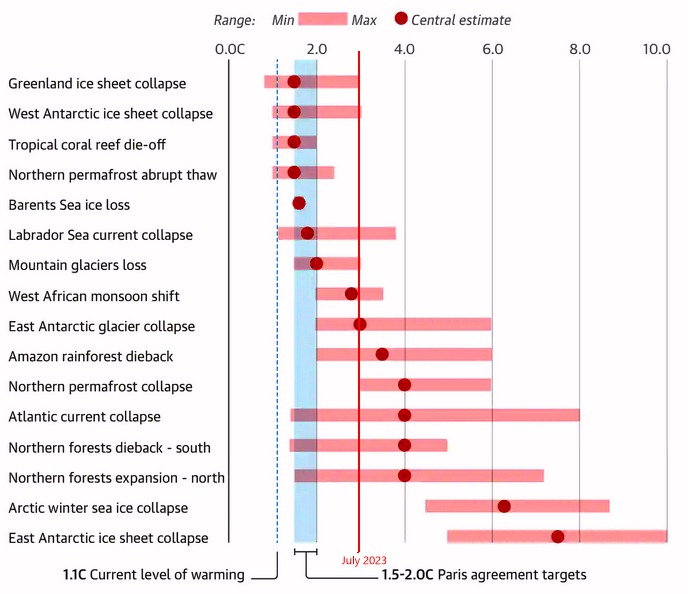
Tipping points are Critical Milestones that directly impact the rate of acceleration in climate change by multiplying the number and intensity of feedback loops.
Tipping Points

Identifying and understanding these tipping points is crucial for climate science and policymaking. Crossing multiple tipping points could lead to a domino effect, resulting in a much more rapid and severe climate change than currently projected.


Push a glass toward the edge of a table and eventually it will fall off on its own. No matter how slowly or meticulously you push… no matter how you weight or fill the glass, it will reach a tipping point and fall off before being pushed completely off the table. No matter whether you believe the glass is half-empty or half-full, when the tipping point is reached it will plummet out-of-control to its end. This is science not fate, faith, nor belief. Human induced climate change has resulted in environmental tipping points being breached.

Tipping points, when crossed, trigger self-sustaining feedback loops that are no longer dependent on human activity. Similar to when a domino topples over hitting two more dominoes that in turn fall hitting more dominoes. Thus, the name The Domino Effect. It can also be visualized as The Snowball Effect. A tipping point is like a snowball rolling down a hill growing in mass and velocity (momentum). When a tipping point is crossed, it results in cumulative and reinforced global warming.

Tipping cascades have emerged between biogeophysical and social-ecological systems. This Domino Effect is causing climate change to accelerate at an exponential rate.

The carbon sequestration from dissolved organic carbon is only one of the many carbon sinks in the Amazon. It is likely Amazon droughts will become more frequent and intense resulting in decarbonization at an exponential rate. The collapse of the AMOC will hasten the collapse of the Amazon. The collapse of the Amazon will hasten the collapse of the AMOC.

Feedback loops and tipping points are parts of an equation that determine the rate of acceleration in climate change. Triggering these tipping points results in the CO2 stored in nature to be released without the assistance of humans. Though we do not know how much carbon is stored in nature, it would be reasonable to assume that the temperature could be pushed from 3 degrees to 6 degrees above pre-industrial levels. Humans cannot thrive above a rise of 1.5 degrees. Much of the Earth will be uninhabitable if the temperature rises an additional 6 degrees Celsius. If humans also add 3 degrees Celsius, the temperature and humidity will approach a wet-bulb temperature that will not sustain human life.

For the first time in human history, global warming is going to continue no matter what humans do. Even if humans stopped their greenhouse gas emissions today, humans have invoked nature’s greenhouse gas emissions. Nevertheless, the sooner humans stop their emissions, the better. In addition, humans must adapt their habitat to remove, reduce, and hinder nature’s greenhouse gas emissions.

What Can I Do?
There are plenty of things you can do to help save the planet. Stop using fossil fuels. Consume less. Here is a list of additional actions you can take.

— from Toppled Tipping Points: The Domino Effect Brouse and Mukherjee (2023)

This music was written and recorded extemporaneously. Extemporaneous, spontaneous, improvisation, jamming, freestyle, and impromptu music are most closely related to pure chaos. The music and lyrics evolve from the “sensitive initial conditions” similar to “a butterfly flapping its wings in China causing a hurricane in the Atlantic.”

Deep Dive Into Science

A song about The Human Induced Climate Change Experiment

bookmark_borderLeaking Gas

LYRICS
We’re leaking gas
(Leaking gas in mass)
This can not last
(Better do something… do something fast)
It will not pass
It’ll linger and trigger our class
Breakdown of order
Social decay
Crossing the border
Enter dismay
Soothsayers and prayers save the day
No way?

Fouling the air
(Just look up there)
Fueling despair
(Just poke… rile the bear)
It will not pass
It’ll linger and trigger our class
Breakdown of order
Social decay
Crossing the border
Enter dismay
Soothsayers and prayers save the day
No way?

Spewing out fumes
(Does an ass assume)
Begging for doom
(Our future looms)
It will not pass
It’ll linger and trigger our class
Breakdown of order
Social decay
Crossing the border
Enter dismay
Soothsayers and prayers save the day
No way?

riffs: e f f# g / g f# f e
Chords: G / G E / C D G / E / E G / C D G; Part II @ 137 Beats Per Minute
Instrumentation: Vocals (TC-Helicon VOICELIVE and MiniNova Vocorder), Ibanez Acoustic Guitar, Ibanez RG-Series (Boss Digital Delay), Fender Jazz Bass (Boss Digital Delay), Keyboards (Korg PS60, Casio WK-3500, Yamaha PSR-740, MiniNova, MicroKorg)

ABOUT THE SONG
How are humans leaking greenhouse gases and how long do the gases stay in the atmosphere?

Humans contribute to the release of greenhouse gases through various activities, primarily related to the burning of fossil fuels, deforestation, industrial processes, and certain agricultural practices. Here are some major sources:

  1. Burning of Fossil Fuels: The combustion of fossil fuels, such as coal, oil, and natural gas for energy production, is a significant source of greenhouse gas emissions. This includes power plants, transportation (cars, trucks, planes), and industrial facilities.
  2. Deforestation: Trees absorb carbon dioxide (CO2) during photosynthesis, acting as a natural carbon sink. Deforestation, the clearing of forests for agriculture or other purposes, reduces the number of trees available to absorb CO2, leading to increased concentrations of greenhouse gases in the atmosphere.
  3. Industrial Processes: Certain industrial activities release greenhouse gases. For example, the production of cement generates carbon dioxide, and certain chemical processes release gases like methane (CH4).
  4. Agriculture: Agricultural practices, such as rice cultivation and livestock farming, can produce methane. Additionally, the use of synthetic fertilizers can lead to the release of nitrous oxide (N2O), another potent greenhouse gas.

As for the longevity of greenhouse gases in the atmosphere, it varies depending on the specific gas. Here are some approximate lifetimes:

  1. Carbon Dioxide (CO2): CO2 is the most prevalent greenhouse gas and has a long atmospheric lifetime. While some CO2 is absorbed by natural processes, a significant portion remains in the atmosphere for hundreds to thousands of years.
  2. Methane (CH4): Methane has a shorter lifetime compared to CO2, lasting about 12 years in the atmosphere. However, it is a much more potent greenhouse gas on a per-molecule basis.
  3. Nitrous Oxide (N2O): N2O has a longer atmospheric lifetime than methane, lasting around 121 years. It is also a potent greenhouse gas.

Human induced climate change is an exponential component of an unordered system (chaos theory). That means global warming is accelerating at a rapid rate in a complex way.

What now?
From 2016-2022, this section was dedicated to hope and optimism; however, 2021 was a record year for greenhouse gas emissions. Then in 2022, Russia invaded Ukraine creating a global energy security crisis. Most countries chose to increase greenhouse gas emissions even further. Therefore, there is little to no hope. Currently, we have crossed the tipping point when human induced climate change triggers a chain reaction of feedback loops. In 2022, the UN Environment Programme (UNEP) insisted there is “no credible pathway to 1.5℃ in place.”

The Earth will exceed 1.5℃ (average global surface temperature over the surface of the earth for ten years) by the 2040’s and a societal collapse will ensue. For the most part, the Earth will be uninhabitable for humans by 2070 UNLESS immediate action is taken. UPDATE: Since writing this in 2021, there is enough data to conclude 1.5℃ will be breached a decade earlier. In October 2023, the Imperial College of London published a study that concludes 1.5℃ will be reached by 2030 at our current rate of emissions. The average temperature for 2023 was +1.4℃ with September’s average +1.7℃ and parts of July at +3℃.
— from The Human Induced Climate Change Experiment

What Can I Do?
There are plenty of things you can do to help save the planet. Stop using fossil fuels. Consume less. Love more. Here is a list of additional actions you can take.

A song about The Human Induced Climate Change Experiment

bookmark_borderThe Bright Side

LYRICS
Well, look on the bright side
At least we won’t freeze to death
Spread the light far and wide
Before our final breath
Breathe in
Breath out
Cease
Without doubt

We’ll cook on the outside
Humanity’s humidity
The we’ll cook on the flip-side
Humanity’s stupidity
Breathe in
Breath out
Cease
Without doubt
Seize
Opportunity
Cease
Exploiting unity

Give birth from Mother Earth
Live more with far less
Far less “careless”
… behavior…
Savior
Save our souls
From our tolls
Save our souls
From our goals
Our do’s have come due
Blue, but true

Chords: Eb D / D C D / C D / D Eb D / D E A / A C E A / C E A; Part II @ 130 Beats Per Minute
Instrumentation: Vocals (TC-Helicon VOICELIVE and MiniNova Vocorder), Ibanez Acoustic Guitar, Fender Squire Mini (Boss Digital Delay), Fender Jazz Bass (Boss Digital Delay), Keyboards (Korg PS60, Casio WK-3500, Yamaha PSR-740, MiniNova, MicroKorg)

ABOUT THE SONG

  • Chaos Theory:
    • Chaos theory is a branch of mathematics that studies complex systems whose behavior is highly sensitive to initial conditions. It deals with deterministic systems that can exhibit unpredictable, chaotic behavior.
    • Chaos theory studies unordered systems. Being in a hurricane is an example of visualizing chaos theory. If you are in the hurricane, the weather appears chaotic; however, if you pull back to a satellite view, you can see a spiraling weather system.
    • Some musicians and composers have incorporated chaos theory principles into their compositions, using mathematical algorithms to generate music that exhibits chaotic or unpredictable patterns. This can result in unique and non-traditional musical structures. Similar to a hurricane, some musical compositions sound chaotic when you are in the middle of it; however, when you pull back and listen to the combined elements, a structure can be heard.
    • In order to focus on their individual parts, members of bands and orchestras tend to isolate their part in their head. In order to make sense of the combined chaos, engineers, producers, and conductors need to “pull back” and listen to all the parts together.
    • Extemporaneous, spontaneous, improvisation, jamming, freestyle, and impromptu music are most closely related to pure chaos. The music and lyrics evolve from the “sensitive initial conditions” similar to “a butterfly flapping its wings in China causing a hurricane in the Atlantic.”
    • from The Science of Chaos Theory, String Theory, and Music Brouse (2024)

Human induced climate change is an exponential component of an unordered system (chaos theory). That means global warming is accelerating at a rapid rate in a complex way.

“Air pollution is: a leading cause of death worldwide, the leading cause of climate change, and the greatest threat to humankind,” The Long-term Breathing Experiment Brouse (2023)

The greatest health risk from climate change to those alive today is the increased moisture content in the air (relative humidity) combined with the increased temperatures.

A Wet-bulb measures the temperature read by a thermometer covered in a wet cloth. As water evaporates from the cloth, evaporation cools the thermometer. This mirrors how the human body cools itself with sweat. The higher the heat and humidity (heat index), the harder it is for sweat to evaporate. The study Adaptability Limit to Climate Change Due to Heat Stress found that a wet-bulb temperature of 35C (95F) at 100% humidity, or 115F at 50% humidity, would be the upper limit of safety, beyond which the human body can no longer cool itself by evaporating sweat from the surface of the body to maintain a stable body core temperature.

The United Nations DRR says:
For every degree Celsius in warming, the water-holding capacity of the atmosphere increases by about 7%. Record-high sea temperatures ensure there is more moisture (in the form of water vapor) in the atmosphere, by an estimated 5-15% compared to before the 1970s, when global temperature rise began in earnest.

Deadly humid heat affects billions including the US Midwest this century. “It’s very disturbing,” study co-author Matthew Huber of Purdue University. “It’s going to send a lot of people to emergency medical care.” The study Greatly enhanced risk to humans as a consequence of empirically determined lower moist heat stress tolerance was conducted by Purdue and George Mason University and published August 15, 2023.

These results indicate that a significant portion of the world’s population will experience — for the first time in human history — prolonged exposures to uncompensable extreme moist heat. Humans will struggle to adapt to these conditions in a warmer world as they will present widespread challenges across many aspects of food-energy-water security, human health, and economic development including in the world’s most populous and most vulnerable regions.

At 3C (5.4F) of yearly average warming, more than 1.5 billion people will suffer. In the summer of 2023, the Earth experienced about a month of warming at 3C above pre-industrial levels. Both 2022 and 2023 saw a record number of heat related deaths. More than 61,000 Europeans died from extreme heat in the summer of 2022.
— from Climate Change and Deadly Humid Heat Brouse (2023)

What Can I Do?
There are plenty of things you can do to help save the planet. Stop using fossil fuels. Consume less. Love more. Here is a list of additional actions you can take.

A song about The Human Induced Climate Change Experiment

bookmark_borderIn Theory

LYRICS
Get off the floor
And out the door
Not like before
So much more
Explore
Chorus of chaos
Strings and things
Core us is chaos
Rings and sings
Vibration elevation
Dynamics of harmonics
In the thick
Of music

Get off the floor
And out the door
Not like before
So much more
Explore
Chorus of chaos
Strings and things
Core us is chaos
Rings and sings
Pythagorean harmonies
Grasp comedy from tragedies
Making quarks spark
Out of music

Get off the floor
And out the door
Not like before
So much more
Explore
Chorus of chaos
Strings and things
Core us is chaos
Rings and sings
Extemporaneous
Spontaneous
Impromptu
Through
Me and you
In the thick
Of music

Chords: A C C A / C G D A / A E E A; Part II @ 129 Beats Per Minute
Instrumentation: Vocals (TC-Helicon VOICELIVE and MiniNova Vocorder), Ibanez Acoustic Guitar, Fender Squire Mini (Boss Digital Delay), Fender Jazz Bass (Boss Digital Delay), Keyboards (Korg PS60, Casio WK-3500, Yamaha PSR-740, MiniNova, MicroKorg)

ABOUT THE SONG
The song was written and recorded extemporaneously.

The relationships between chaos theory, string theory, and music are a complex and interdisciplinary topic.


    1. Chaos Theory:
      • Chaos theory is a branch of mathematics that studies complex systems whose behavior is highly sensitive to initial conditions. It deals with deterministic systems that can exhibit unpredictable, chaotic behavior.
      • Chaos theory studies unordered systems. Being in a hurricane is an example of visualizing chaos theory. If you are in the hurricane, the weather appears chaotic; however, if you pull back to a satellite view, you can see a spiraling weather system.
      • Some musicians and composers have incorporated chaos theory principles into their compositions, using mathematical algorithms to generate music that exhibits chaotic or unpredictable patterns. This can result in unique and non-traditional musical structures. Similar to a hurricane, some musical compositions sound chaotic when you are in the middle of it; however, when you pull back and listen to the combined elements, a structure can be heard.
      • In order to focus on their individual parts, members of bands and orchestras tend to isolate their part in their head. In order to make sense of the combined chaos, engineers, producers, and conductors need to “pull back” and listen to all the parts together.
      • Extemporaneous, spontaneous, improvisation, jamming, freestyle, and impromptu music are most closely related to pure chaos. The music and lyrics evolve from the “sensitive initial conditions” similar to “a butterfly flapping its wings in China causing a hurricane in the Atlantic.”

guitar string theory chaos


  1. String Theory:
    • M-theory is a theory of “everything” in physics that attempts to unify the five string theories. The “Theory of Everything” (TOE) is a theoretical framework in physics that aims to explain all fundamental forces and particles in the universe within a single, unified theory. This theory seeks to unify the laws of physics, encompassing both quantum mechanics (which describes the behavior of very small particles) and general relativity (which describes the force of gravity on large scales.)
    • String theory aims to explain the fundamental nature of particles and forces in the universe. According to string theory, the basic building blocks of the universe are not point-like particles, as assumed in traditional particle physics, but tiny, one-dimensional “strings.”These strings can vibrate at different frequencies, and the various vibrational modes of these strings correspond to different particles. The idea is that different particles, such as quarks, electrons, and photons, are manifestations of the same fundamental string vibrating in different ways. This unified perspective seeks to provide a consistent and comprehensive description of all fundamental forces and particles in the universe.The vibrational nature of strings is a crucial aspect of string theory. The different vibrational modes give rise to the diverse particles observed in the universe. The mathematical framework of string theory involves describing the dynamics of these vibrating strings and their interactions.

      Some scientists and theorists have explored the idea that the vibrational nature of strings could have parallels with the vibrational nature of musical notes. String theory hypothesizes that very small “strings” vibrations produce the observed particles and forces of nature similar to a vibrating guitar string and heard in Pythagorean harmonies. If you view a guitar string in slow motion, it moves in a variety of ways at the same time in a similar fashion as the forces in subatomic particles.

      “A piano or violin string can resonate or vibrate with many different shapes of vibration corresponding to different tones. There is basic tone and there are higher overtones. The richness or beauty of music has to do with the different interplay of the harmonics,” explains Edward Witten.

— from The Science of Chaos Theory, String Theory, and Music

bookmark_borderFear of the Unknown

LYRICS
Despite the dirt and grime
Despite the vice and crime
At The End of time(s)
I’ll feel fine
Unite with scientists
Solutions we can’t resist
At The End of time(s)
You’ll feel fine
At The End of time(s)
We’ll feel fine
As the fear of the unknown has grown
Look to the sage to be shown
Near the age of the known
Near the age
Of the known
Be a sage
Of mind-blown
Despite the dirt and grime
Despite the vice and crime
At The End of time(s)
I’ll feel fine
Unite with scientists
Solutions we can’t resist
At The End of time(s)
You’ll feel fine
At The End of time(s)
We’ll feel fine
All we have to do is look around
Answers to be found abound
Near the age of the known
Near the age
Of the known
Be a sage
Of mind-blown

Despite the dirt and grime
Despite the vice and crime
At The End of time(s)
I’ll feel fine
Unite with scientists
Solutions we can’t resist
At The End of time(s)
You’ll feel fine
At The End of time(s)
We’ll feel fine
The fear of the unknown is gone
Moving on… feeling knowledge dawn
Near the age of the known
Near the age
Of the known
Be a sage
Of mind-blown

Chords: F/7 Eb Bb F / Ab Eb Bb / Eb Bb F; Part II @ 152 Beats Per Minute
Instrumentation: Vocals (TC-Helicon VOICELIVE and MiniNova Vocorder), Ibanez Acoustic Guitar, Fender Squire Mini (Boss Digital Delay), Fender Jazz Bass (Boss Digital Delay), Keyboards (Korg PS60, Casio WK-3500, Yamaha PSR-740, MiniNova, MicroKorg)

ABOUT THE SONG
Fear
Why are people afraid of climate change?

The fear of the unknown and the fear of the dark are both common human fears that can be rooted in our evolutionary history and psychological factors.

  1. Fear of the Unknown:
    • This fear is often associated with uncertainty and the unfamiliar. Humans naturally seek predictability and control in their environment, and the unknown represents a lack of control.
    • It can manifest in various aspects of life, such as fear of the future, fear of the unfamiliar, or fear of the unpredictable.
  2. Fear of the Dark:
    • Fear of the dark, known as nyctophobia, is a common fear, especially in children. It may stem from a survival instinct, as humans historically needed to be cautious in the dark to avoid potential dangers. There is an innate fear of the unknown.
    • Imagination and the inability to see clearly in low light conditions can contribute to feelings of vulnerability and fear.

Both fears are deeply ingrained in the human experience and can vary in intensity from person to person. Understanding and addressing these fears often involve a combination of psychological strategies, exposure therapy, and cognitive-behavioral techniques to reframe perceptions and reactions.

Climate Change Knowledge
We know the following to be inevitable and irreversible:

  • Mountain Glacier Loss
  • Greenland Ice Sheet Collapse
  • Antarctic Ice Sheet Collapse
  • Collapse of AMOC (Atlantic Meridional Overturning Circulation)
  • Amazon Rainforest Dieback
  • Northern Permafrost Collapse

Tipping cascades have emerged between biogeophysical and social-ecological systems. This Domino Effect is causing climate change to accelerate at an exponential rate.

Tipping points are Critical Milestones that directly impact the rate of acceleration in climate change by multiplying the number and intensity of feedback loops.

Tipping Points

Push a glass toward the edge of a table and eventually it will fall off on its own. No matter how slowly or meticulously you push… no matter how you weight or fill the glass, it will reach a tipping point and fall off before being pushed completely off the table. No matter whether you believe the glass is half-empty or half-full, when the tipping point is reached it will plummet out-of-control to its end. This is science not fate, faith, nor belief. Human induced climate change has resulted in environmental tipping points being breached.

Tipping points, when crossed, trigger self-sustaining feedback loops that are no longer dependent on human activity. Similar to when a domino topples over hitting two more dominoes that in turn fall hitting more dominoes. Thus, the name The Domino Effect. It can also be visualized as The Snowball Effect. A tipping point is like a snowball rolling down a hill growing in mass and velocity (momentum). When a tipping point is crossed, it results in cumulative and reinforced global warming.

Crossing even a single tipping point is alarming. For instance, crossing the tipping point for ‘mountain glacier loss‘ has immediate consequences: millions of people in Europe will be impacted by the lack of fresh water. Billions of people that live along coasts will be impacted by the saline infiltration and eventually by the submerging of their property. In September of 2022, UNESCO reported accelerated melting of glaciers in World Heritage sites, with glaciers in a third of sites set to disappear by 2050. In September of 2023, the GLAMOS glacier monitoring center found 10% of Swiss glaciers had disappeared in the last 2 years. They do not expect any Swiss glaciers will be left by 2050 no matter what actions are taken. If extreme measures are taken, they anticipate we may be able to save some polar glaciers.

This in and of itself should be alarming; however, it gets worse. Tipping points are parts of feedback loop systems. The ice-albedo feedback loop is an expression of the ability of surfaces to reflect sunlight (heat from the sun). Any loss of ice over a darker surface means the surface will absorb more heat and reflect less heat. This process makes the Earth warmer causing more loss of ice, which in turn causes more warming of the Earth. So, yes, the mountain ice tipping point is quite alarming for both its immediate impact as well as its self-sustaining growth to global warming; but wait, it gets more alarming. The increasing temperatures due to crossing a tipping point cause other tipping points to be toppled (The Domino Effect).
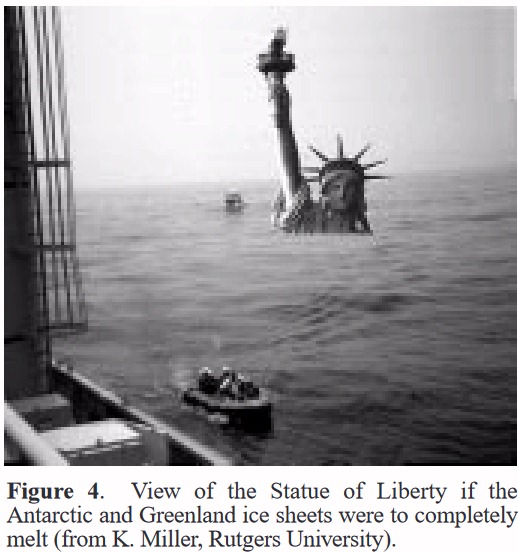
Long run sea level rise New Jersey Coast

By the Autumn of 2023, it had become evident the West Antarctic and Greenland ice sheets will completely melt. The process is irreversible and inevitable. The cool water from the melting ice at the poles is being drawn toward the center of the Earth and getting warmed to record high temperatures. The warm, moist air is circulating and moving over land. These changes in climate systems will cause other areas to experience unprecedented drought. We expect sea level rise will total about 270 feet over the next several millennia. It is episodic, and in the fast bits it can go up 3 feet every twenty years for five hundred years. The melting Arctic and Antarctic have multiple feedback loops including: enhanced oceanic heating and ice-albedo, Planck feedback, lapse-rate feedback, and cloud feedback.

The tipping point for the collapse of AMOC (Atlantic Meridional Overturning Circulation) was thought to be centuries away, at the earliest. In July of 2023, the study Warning of a forthcoming collapse of the Atlantic meridional overturning circulation was published in the journal Nature Communications. “Here we provide statistical significance and data-driven estimators for the time of tipping. We estimate a collapse of the AMOC to occur around mid-century (2025-2095) under the current scenario of future emissions.” The collapse is likely to cause faster sea level rise on the east coast of the US, more severe storms in Europe, and increasing drought in the Sahel in Africa. “From the study of past climate, we know changes in the AMOC have been some of the most abrupt and impactful events in the history of climate,” said Prof. Stefan Rahmstorf, at the Potsdam Institute for Climate Impact Research in Germany and world leading oceanographer. During the last Ice Age, winter temperatures changed by up to 10C within three years in some places. “We are dealing with a system that in some aspects is highly non-linear, so fiddling with it is very dangerous, because you may well trigger some surprises,” he said. “I wish I knew where this critical tipping point is, but that is unfortunately just what we don’t know. We should avoid disrupting the AMOC at all costs. It is one more reason why we should stop global warming as soon as possible.” A feedback loop created by the AMOC tipping point would cause a disruption of weather systems and circulation. The result would be the loss of naturally occurring carbon sinks. One scenario is desertification of the Amazon rainforest. In 2023, the Amazon River and the Rio Negro set record low levels.

The tipping point / feedback loop problem is very complex (chaos theory) and exponentially alarming. Yet another tipping point appears to have been triggered before 2024 — Amazon Rainforest Dieback. The Amazon is often referred to as ‘the lungs of our planet.’ Not only does the Amazon suck in huge quantities of CO2 and breath out O2, but the Amazon soils also store huge amounts of CO2. The desertification of the Amazon would result in a release of the carbon as the soils disappeared.
— from Toppled Tipping Points: The Domino Effect / Brouse and Mukherjee (2023)

What will the “End of Times” look like?

“The era of global warming has ended and the era of ‘global boiling’ has arrived. Climate change is here. It is terrifying. And it is just the beginning”, UN secretary general, António Guterres, said after scientists confirmed July 2023 was on track to be the world’s hottest month on record.

Movement of people and animals caused by climate is one factor. Warming at higher latitudes allowed vectors and pathogens to survive winter is another factor. The report goes on to say, “The human pathogenic diseases and transmission pathways aggravated by climatic hazards are too numerous for comprehensive societal adaptations, highlighting the urgent need to work at the source of the problem: reducing GHG (Greenhouse Gas) emissions.”

This research reveals more evidence that humans will have difficulty adapting to climate change, especially those in developing countries, Mora said. “The magnitude of the vulnerability when you think about one or two diseases — okay, sure, we can deal with that,” he said. “But when you’re talking about 58% of the diseases, and 58% of those diseases can be affected or triggered in 1,000 different ways. So that, to me, was also revealing of the fact that we’re not going to be able to adapt to climate change.”

In 2023, we wrote about having crossed tipping points in the paper, “Climate Change: How Long Is ‘Ever’?“. When we wrote the Tunnel Under Thesis in 1995, we forecast crossing these tipping points would not happen for centuries. We underestimated Man’s ignorance and arrogance. Fossil fuel consumption and greenhouse gas emissions have continued to set record highs. Humans have caused chain-reactions resulting in toppled tipping points, feedback loops, and The Domino Effect.

Events we thought would not happen in our lifetimes are happening now.

There will be enough ice melt to raise sea levels 220 feet. We estimate 270 feet to be “the minimum safe” elevation to live. High-tides, waves, coastal flooding, storm surge, grade of shoreline, etc. would make the lowest elevations for living space to be at least 270 feet above pre-industrial sea levels. This would be the minimum elevation. Personally, I would not want to live that low. As the water submerges sewage treatment plants, landfills, chickens, cows, and all sorts of other bio-hazards, the waters will become toxic. In addition, much of the land will experience salinization making it unfit for plant life. Another concern for elevations under 800 feet is living on an island. Many locations at lower elevations will become isolated. Living on an island has many problems including fresh water, food, shelter, and healthcare. Security from pirates pilfering, raping, and plundering will likely be the overriding concern. Of course, I don’t expect that to happen for millennia, but I hope government planners do plan for it now. If you look at Florida as an example, parts of the coastline have seen sea levels rise over 14-20 feet in the last decade. Although the storm surge was only for hours, you wouldn’t want to live there during those hours. Not to mention, the frequency of these extreme weather events will rise exponentially. Thus, our recommendation to evacuate Florida now (i.e. Managed Retreat). The billions of dollars spent to rebuild after Hurricane Ida will all be for naught. Allowing building there will needlessly endanger property and lives. Parts of the world have already seen storm surges of 40 feet. I expect most North American coastlines will see sea levels rise, if only temporarily, by 20-40 feet this century. As far as long run sea level rise, much will depend on location, gravity, isostatic adjustment, and thermal expansion. If the ocean temperatures get warm enough (thermal expansion), parts of the world may see sea levels rise to 270 feet for long periods of times. Other parts of the world, like Greenland, may actually see sea levels decline. In any event, the Earth crossed tipping points this decade which make extreme sea level rise inevitable and irreversible in our lifetimes. Planners should plan on it.

Sidd reiterated, “That 270 feet will take a long time. I would be more careful about the violent rain than the ice melt.” Expect to see increasing intensity and/or frequency in a wide variety of violent rain events including: downpours, flooding, hurricanes, cyclones, monsoons, coastal flooding, storm surges, lightning and wildfires, hail, extreme wind, and concurrent extremes. The reign of violent rain has already begun. More hillsides and shorelines are collapsing. Atmospheric rivers are dramatically increasing flash flooding in the Northeastern USA. Worldwide, stormwater systems are becoming overwhelmed. Ironically, the streets of Abu Dhabi and Dubai, UAE, flooded days before the COP28 Climate Conference. Nowhere is safe from violent rain, not even in the desert preparing for a UN meeting on the climate crisis. As a result of increasing violent rain, new drainage culverts are forming. Eventually, the culverts will transform into recurring streams, carving new canyons, creating new landscapes and islands. In addition, extreme weather events are increasing the frequency of lightning storms and wildfires. After wildfires, rain deluges cause massive landslides transforming the topography. At the same time as the violent rain makes its way to the sea, the sea is rising to meet the violent rain.

In the article “Violent Rain and the Substrate,” Greg Laden, coastal archaeologist, said, “With a little erosion, the Hudson, Lake Champlain, and the St. Lawrence could become contiguous, so New England becomes an Island.”

For any remaining humans, fresh air, water, food, and sunlight will all be problematic; however, your most severe concern will likely be security. Those with supplies will be at high risk of being raped and looted. Good luck!
— from Climate Change: The End of Times / Brouse and Mukherjee (2023)

Conclusion
Don’t be afraid. Shed some light on global warming. Learn what is going to happen so you can reduce your anxiety and prepare for the inevitable.

What Can I Do?
There are plenty of things you can do to help save the planet. Stop using fossil fuels. Consume less. Love more. Here is a list of additional actions you can take.

A song about The Human Induced Climate Change Experiment

bookmark_borderRain Reign Go Away

LYRICS
I hope we live till our story’s told
I hope we give with hearts of gold
As for our planet — plan for it
Plan for the heat
Man’s conceit
Plan for the pain
Violent rain
When rain is going to reign
And poor is going to pour

I hope we live till our story’s told
I hope we give with hearts of gold
As for our planet — plan for it
Plan for the rise
In high tide
Plan for the drought
There’s no doubt
When rain is going to reign
And poor is going to pour

I hope we live till our story’s told
I hope we give with hearts of gold
As for our planet — plan for it
Plan for the humidity
Plan for lost humanity
When poor is going to rain
And reign is going to pour
When rain is going to reign
And poor is going to pour

Chords: Am C Em Am / Am C D Am / C D C Em Am / Am G D Am; Part III @ 80 Beats Per Minute
Instrumentation: Vocals (TC-Helicon VOICELIVE and MiniNova Vocorder), Ibanez Acoustic Guitar, Fender Squire Mini (Boss Digital Delay), Fender Jazz Bass (Boss Digital Delay), Keyboards (Korg PS60, Casio WK-3500, Yamaha PSR-740, MiniNova, MicroKorg)

ABOUT THE SONG
Human induced climate change is an exponential component of an unordered system (chaos theory). That means global warming is accelerating at a rapid rate in a complex way.

I hope we live till our story’s told” — Global warming has caused irreparable damage to our environment. Almost all scientists agree that IN FACT climate change is a problem. Our planet is becoming unfit for human life. Now the question is can we adapt in time? (1999) In 2023, we wrote about having crossed tipping points in the paper, “Climate Change: How Long Is ‘Ever’?“. When we wrote the Tunnel Under Thesis in 1995, we forecast crossing these tipping points would not happen for centuries. We underestimated Man’s ignorance and arrogance. Fossil fuel consumption and greenhouse gas emissions have continued to set record highs. Humans have caused chain-reactions resulting in toppled tipping points, feedback loops, and The Domino Effect.
— from Climate Change: The End of Times Brouse and Mukherjee (2023)

Plan for the pain Violent rain” — Multiple factors figure into the physics of violent rain. The starting point is the moisture content of air. The Earth is warming. Warm air can physically hold more water than cool air. The warmer the air the more water vapor the air can hold (i.e. relative humidity). The capacity doubles for every ten degree Celsius warming.

One physical result is more massive raindrops. The Momentum of Rain is p = mv (p = momentum, m = mass, v = velocity.) Part of the increasing momentum is transferred to the sides and upward increasing wind turbulence, as well as updrafts. Most of the momentum is transferred upon impact. You may notice the rain bouncing higher off the streets and sidewalks. Flowing rainwater will have both increased mass and velocity.

On the ground, concrete, asphalt, solar panels, roofs, plants, animals, houses, and infrastructure will be hit with greater momentum. In the air, the increasing mass of the rain will intensify wind turbulence. Professor Paul D. Williams of the University of Reading, UK, said, “Turbulence is chaotic (chaos theory). Turbulence is known famously as the hardest problem in physics.” In their study Evidence for Large Increases in Clear-Air Turbulence Over the Past Four Decades, Prof. Williams and his team found “Climate change has caused turbulence to double in the last 40 years” and is expected to double or triple again in the next decades.

Mass and velocity are parts of a larger equation that also includes density.The combination of these variables results in an increased intensity of the flow forces (i.e. flow dynamics). Wind and water flow forces scale as the square of velocity, so as flow speeds increase (say due to more intense heating or heavier rain) the damage scales as the square of the velocity. Look at drag physics and you will see that force is proportional to density times square of velocity (v^2).

So a twenty mile an hour wind exerts four times as much force as a ten mile an hour wind. And a forty mile an hour wind exerts sixteen times as much force as a ten mile an hour wind. A wind of fifty miles an hour exerts twenty five times and a wind of sixty miles an hour exerts thirty six times as much force as one of ten miles an hour. Then you have the density term. Water is about eight hundred times denser than air, so the force exerted by a ten mile an hour flow of water is eight hundred times that of a ten mile an hour wind. As flow velocities go up due to climate change, force and damage scale as square of the velocities.
— from The Reign of Violent Rain Brouse and Mukherjee (2023-2024)

What Can I Do?
There are plenty of things you can do to help save the planet. Stop using fossil fuels. Consume less. Love more. Here is a list of additional actions you can take.

A song about The Human Induced Climate Change Experiment

bookmark_borderFall From Grace (Nothing to Lose)

LYRICS
I guess you’ve got nothing to lose
If that’s what you choose
Since your race has trashed the place
There’s none to embrace
Down on our knees
Begging you please
Take responsibility
For the harm to society
Set us free!

I guess you’ve got something to prove
Is that your best move?
Since your race has trashed the place
There’s none to embrace
Down on our knees
Begging you please
Take responsibility
For the harm to society
Set us free!

I guess you’ve got nothing to say
For behaving that way
Since your race has trashed the place
There’s none to embrace
(Human race fall from grace)
Down on our knees
Begging you please
Take responsibility
For the harm to society
Set us free!

Chords: B C C# D E / E / A C D D E; Part II @ 126 Beats Per Minute
Instrumentation: Vocals (TC-Helicon VOICELIVE and MiniNova Vocorder), Ibanez Acoustic Guitar, Fender Squire Mini (Boss Digital Delay), Fender Jazz Bass (Boss Digital Delay), Keyboards (Korg PS60, Casio WK-3500, Yamaha PSR-740, MiniNova, MicroKorg)

ABOUT THE SONG
The Harm to Society
Global warming has caused irreparable damage to our environment. Almost all scientists agree that IN FACT climate change is a problem. Our planet is becoming unfit for human life. Now the question is can we adapt in time? (1999)

Human induced climate change is an exponential component of an unordered system (chaos theory). That means global warming is accelerating at a rapid rate in a complex way. From 1992 through 2023, we presented evidence and suggested remedies to mitigate climate change. By 2023, the data was undeniable that human induced climate change is destroying our habitat at a rapidly increasing rate.

Traditional economics is based upon the “costs and benefits” to society. Since there are no known long-term benefits of climate change to society, the Age of Loss and Damage economics focuses on the exponential costs of climate change to society.

Health and Wellness
Humans will experience greater loss and damage to life and quality of life from air pollution, decreasing supply of potable water, extreme weather events, and disease. The greatest short term climate change risk to human health is deadly humid heat (wet-bulb temperature).

Almost all survivors of climate-related disasters suffer from mental distress. Of those who have not experienced climate disasters, more than two-thirds of U.S. adults (68%) have reported climate change anxiety.

Real Estate and Infrastructure
A warmer world will present widespread challenges across many aspects of food-energy-water security and economic development. Infrastructure including roads, bridges, sewer and water plants will become unsustainable. Personal property will suffer loss and damage as homeowners and flood insurance become increasingly difficult to obtain.

In October of 2023 Dr. Sidd Mukherjee said, “Now I am thinking the violent rain will be a bigger problem before we die… still thinking it through. In the long run, yes, sea level rise will hit big. If you look at the history, it is episodic, and in the fast bits it can go up 3 feet every twenty years for five hundred years. But, the rain intensity is increasing faster today, and drainage cannot cope, whether in the city or out, culverts and such put in over the last hundred years cannot handle. So, I am paying a lot of attention to terrain and drainage far inland from the seacoast (like Ohio.) By drainage I don’t mean just human built. I mean that the natural streams and gullies and ravines have not evolved to a state that can handle the water volumes we see and the worse, larger volumes we will see. So expect huger erosion, steeper slopes to waterways, land collapses and such. Build out your drainage.”

One of the impacts of violent rain events can be storm surge. As flow velocities go up due to climate change, force and damage scale as square of the velocities. If you look at Florida as an example, parts of the coastline have seen sea levels rise over 14-20 feet in the last decade. Although the storm surge was only for hours, you wouldn’t want to live there during those hours. Not to mention, the frequency of these extreme weather events is rising exponentially. Thus, our recommendation to evacuate Florida now (i.e. Managed Retreat). The billions of dollars spent to rebuild after Hurricane Ida will all be for naught. Allowing building there will needlessly endanger property and lives. Parts of the world have already seen storm surges of 40 feet. I expect most North American coastlines will see sea levels rise, if only temporarily, by 20-40 feet this century.

In the spring of 2023, the USA suspended their national debt ceiling. Included in the debt ceiling suspension is a provision for unlimited emergency federal spending. The result is the government can continue to ignore the causes of climate change and instead give trillion-dollar subsidies to the fossil fuel industry through emergency disaster relief. Yes, another vicious circle — more fossil fuels subsidies result in more climate catastrophes resulting in more fossil fuel subsidies, etc. The end result will be additional trillions in government borrowing while the standard of living declines.

According to NOAA, in 2023 (as of November 8), there have been 25 confirmed weather/climate disaster events with losses exceeding $1 billion each to affect United States. These events included 1 drought event, 2 flooding events, 19 severe storm events, 1 tropical cyclone event, 1 wildfire event, and 1 winter storm event. This is the largest number of climate disasters recorded with a notable increase in extreme precipitation events (violent rain).

Law Suits
What will create the change needed? Loss and damage litigation against oil companies and governments will change world economics.

The oil industry is going to be like the tobacco industry. The consumers are going to claim they were misled about the dangers of burning fossil fuels and will file lawsuits against the oil companies. You will not be able to buy oil or get insurance at a reasonable price (similar to what happened to cigarette smokers.)

Children have filed lawsuits worldwide against their governments over their basic human rights. A district court judge ruled in Held v. Montana that Montana’s Environmental Policy Act, which prohibits the state from considering the climate impact of proposed energy projects, violates the “right to a clean and healthful environment” promised by the state’s constitution.
— from The Age of Loss and Damage / Brouse (2023)

Take Responsibility
There are plenty of things you can do to help save the planet. Stop using fossil fuels. Consume less. Love more. Here is a list of additional actions you can take.

A song about The Human Induced Climate Change Experiment

bookmark_borderPoof! Uprising

LYRICS
The temperature’s rising
Rising, keeps climbing
All aloof
Through the roof
Poof!
Surprising?
When permafrost starts to rot
It’s getting way too hot
So, believe it or not
Wrought with feelings of got
What about love… forgot?

Temperature increasing
Increasing non-ceasing
All aloof
Through the roof
Poof!
Advising:
When permafrost starts to rot
It’s getting way too hot
So, believe it or not
Wrought with feelings of got
What about love… forgot?

It’s going higher
Higher wildfire
All aloof
Through the roof
Poof!
Uprising
When permafrost starts to rot
It’s getting way too hot
So, believe it or not
Wrought with feelings of got
What about love… forgot?

Chords: E F / E F F# / E F F# G G# A / A G A / A C G E; Part II @ 158 Beats Per Minute / Twisted Twist
Instrumentation: Vocals (TC-Helicon VOICELIVE and MiniNova Vocorder), Ibanez Acoustic Guitar, Ibanez RG Series Electric Guitar (Boss Digital Delay), Fender Jazz Bass (Boss Digital Delay), Keyboards (Korg PS60, Casio WK-3500, Yamaha PSR-740, MiniNova, MicroKorg)

Human induced climate change is an exponential component of an unordered system (chaos theory). That means global warming is accelerating at a rapid rate in a complex way.

“The era of global warming has ended and the era of ‘global boiling’ has arrived. Climate change is here. It is terrifying. And it is just the beginning”, UN secretary general, António Guterres, said after scientists confirmed July 2023 was on track to be the world’s hottest month on record.

The Domino Effect is also known as “tipping cascades” in climate science.

Tipping points are Critical Milestones that directly impact the rate of acceleration in climate change by multiplying the number and intensity of feedback loops.

Tipping Points


Push a glass toward the edge of a table and eventually it will fall off on its own. No matter how slowly or meticulously you push… no matter how you weight or fill the glass, it will reach a tipping point and fall off before being pushed completely off the table. No matter whether you believe the glass is half-empty or half-full, when the tipping point is reached it will plummet out-of-control to its end. This is science not fate, faith, nor belief. Human induced climate change has resulted in environmental tipping points being breached.

Tipping points, when crossed, trigger self-sustaining feedback loops that are no longer dependent on human activity. Similar to when a domino topples over hitting two more dominoes that in turn fall hitting more dominoes. Thus, the name The Domino Effect. It can also be visualized as The Snowball Effect. A tipping point is like a snowball rolling down a hill growing in mass and velocity (momentum). When a tipping point is crossed, it results in cumulative and reinforced global warming.

A look at six (6) of the multiple tipping points that show the proverbial snowball is already rolling. The first dominoes have fallen and will continue to knock down more tiles with each escalating step.

  • Mountain Glacier Loss
  • Greenland Ice Sheet Collapse
  • Antarctic Ice Sheet Collapse
  • Collapse of AMOC (Atlantic Meridional Overturning Circulation)
  • Amazon Rainforest Dieback
  • Northern Permafrost Collapse

.

Climate Change Review 2023

Sidd said, “Do you remember back in the early 2000’s when we thought we wouldn’t live to see the extreme changes due to global warming?”

Daniel replied, “I think 2023 is the most significant year so far. We saw confirmation of tipping points being crossed for Mountain Glacier Loss, Greenland Ice Sheet Collapse, Antarctic Ice Sheet Collapse, and potentially the Collapse of AMOC.”

Sidd continued, “We already knew that. It was Canada catching on fire that I could not believe. I never thought I’d live to see the day.”

Daniel asked, “Do you think the permafrost and peatlands will have zombie fires and cause the permafrost tipping point?”

Sidd responded, “Yes. They are gone, too. We already know from the permafrost peatland fires in Siberia.”

Daniel ponders, “Hmmmm… I guess that means my plan went up in smoke? My worst case scenario / last resort emergency plan was to escape to Canada.”

NASA reported: Wildland fire experts have described Canada’s 2023 fire season as record-breaking and shocking. Over the course of a fire season that started early and ended late, blazes have burned an estimated 18.4 million hectares. Hundreds of fires exceeded 10,000 hectares (39 square miles), large enough to be considered “megafires.” These megafires were also unusually widespread this season, charring forests from British Columbia and Alberta in the west to Quebec and the Atlantic provinces in the east to the Northwest Territories and the Yukon in the north.

Forest fires cause a carbon feedback loop. The carbon emissions of Canada’s fires outweighed the combined emissions from its oil and gas, transport and agriculture sectors. The fires also cause the melting of the permafrost and zombie fires to burn in the permafrost. The permafrost collapse is a self-sustaining feedback loop/tipping point. As the permafrost melts, the peatlands emit CO2 and methane. The increase in CO2 and methane results in more warming that results in more peatland emissions. A third feedback loop is created with lightning strikes. The study Forests at Risk Due to Lightning Fires found a sensitivity of extratropical intact forests to potential increases in lightning fires, which would have far-reaching consequences for terrestrial carbon storage and biodiversity. The results show that, on a global scale, lightning is the primary ignition source of fires in temperate and boreal forests. Global warming causes more extreme weather events and conditions for lightning creating more forest fires that create more warming and more lightning strikes.

The study Wildfire as a major driver of recent permafrost thaw in boreal peatlands published in the Journal Nature Communications found wildfires have caused a quarter of permafrost thaw (2,000 square kilometres) in Western Canada’s boreal peatlands over the past 30 years. “Historically, permafrost in this area underwent a natural cycle of thawing and reforming, but given current climate conditions and projections for the future, this fire-induced thaw appears to be irreversible,” said Carolyn Gibson, who conducted the research.

On January 1, 2024, the article, Why Are Alaska’s Rivers Turning Orange?, was published in Scientific America. “Streams in Alaska are turning orange with iron and sulfuric acid. Scientists who have studied these rusting rivers agree that the ultimate cause is climate change. Kobuk Valley National Park has warmed by 2.4 degrees Celsius (4.32 degrees Fahrenheit) since 2006 and could get another 10.2 degrees C hotter by 2100, a greater increase than projected for any other national park. The heat may already have begun to thaw 40 percent of the park’s permafrost, the layer of earth just under the topsoil that normally remains frozen year-round. McPhee wanted to protect the Salmon River because humans had ‘not yet begun to change it.’ Now, less than 50 years later, we have done just that. The last great wilderness in America, which by law is supposed to be ‘untrammeled by man,’ is being trammeled from afar by our global emissions.”
— from Toppled Tipping Points: The Domino Effect / Brouse and Mukherjee (2023)

What Can I Do?
There are plenty of things you can do to help save the planet. Stop using fossil fuels. Consume less. Love more. Here is a list of additional actions you can take.

A song about The Human Induced Climate Change Experiment

bookmark_borderAnomalies Multiply

LYRICS
What we used to call winter
Is now barely a shiver
Try not to get bitter
Waiting for Man to deliver

Anomalies multiply
Like zombies, never die
Trying to get to laughter
Clawing through disaster

If you look just right
A splinter of light
Can we fight for delight
Get more light in sight?
Well alright!
Make it
Bright tonight
Take it
On outright

If you’re one to show
Please say so
If you’re one to shine
Shine on mine
Any time

If you look just right
A river of light
We might find delight
Get more light in sight?
Well alright!
Make it
Bright tonight
Take it
On outright

If you’re one to show
Please say so
If you’re one to shine
Shine on mine
Any time

Chords: Bbm Fm C7 Fm / Fm F / Eb F / Eb Db F; Part II @ 110 Beats Per Minute
Instrumentation: Vocals (TC-Helicon VOICELIVE and MiniNova Vocorder), Ibanez Acoustic Guitar, Ibanez RG Series Electric Guitar (Boss Digital Delay), Fender Jazz Bass (Boss Digital Delay), Keyboards (Korg PS60, Casio WK-3500, Yamaha PSR-740, MiniNova, MicroKorg)

Human induced climate change is an exponential component of an unordered system (chaos theory). That means global warming is accelerating at a rapid rate in a complex way.

2023: The Hottest Year in Human History
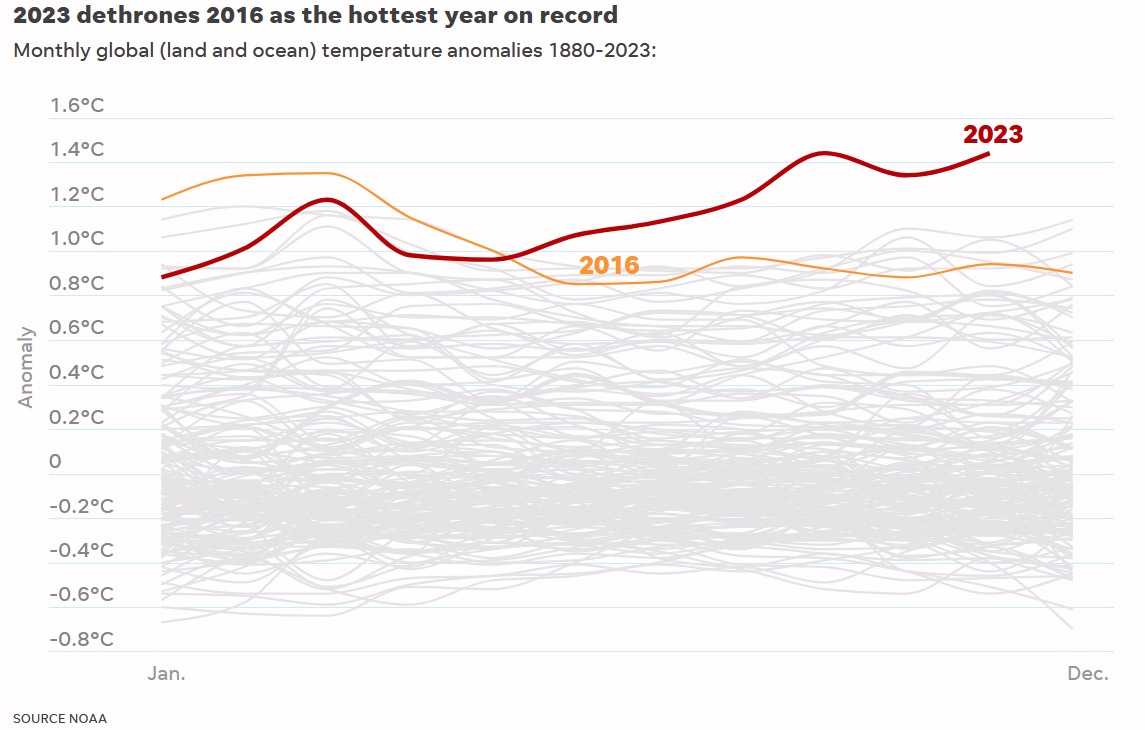
2023 was a wake-up call to both biogeophysical and social-ecological scientists. The record breaking physical and economical impacts could be felt worldwide. The record warming year was seventeen times greater than any other record increase in history. Typically record breaking temperatures are measured in 100th degrees. The graphic shows how far out of skew the 2023 anomalies are compared to the previous record set in 2016. There were also 200 consecutive days of record breaking temperatures. Typically there are one or two record breaking days in row. The increase in intensity and frequency of record breaking heat requires forecasting models to be recast.

— from Tipping Cascades, Social-Ecological Systems, and the Hottest Year in History / Brouse (2024)

What Can I Do?
There are plenty of things you can do to help save the planet. Stop using fossil fuels. Consume less. Love more. Here is a list of additional actions you can take.

A song about The Human Induced Climate Change Experiment

bookmark_borderSocial-Ecological Systems

LYRICS
Another day of pounding rain
Another day of going insane
Atmospheric rivers
Hysterics delivers
Ain’t no self-restraint

Another night of howling winds
Another night knocked down and pinned
Atmospheric rivers
Hysterics delivers
Ain’t no self-restraint

Another year of record heat
Another year be tough to beat?
Atmospheric rivers
Hysterics delivers
Ain’t no self-restraint

The air above
Needs our love
And you know
The land below

The skis above
Need our love
Can’t see the sea nearly

More pollution
No solution
Institution
Of confusion
Depending on
Carrying on
But this can’t to on and on
… and on

Chords: Em C Em / C D / D C Em / Am Em Bm Em / AM C / C B7 Em; Part II @ 104 Beats Per Minute
Instrumentation: Vocals (TC-Helicon VOICELIVE and MiniNova Vocorder), Ibanez Acoustic Guitar, Ibanez RG Series Electric Guitar (Boss Digital Delay), Fender Jazz Bass (Boss Digital Delay), Keyboards (Korg PS60, Casio WK-3500, Yamaha PSR-740, MiniNova, MicroKorg)

ABOUT THE SONG
In September of 2023, the Philadelphia Inquirer reported, “The remnants of Tropical Storm Ophelia soaked the entire Philadelphia region with episodic downpours on Saturday, the first day of fall, conspiring to incite 60-mph wind gusts at the Shore and high-tide flooding that closed numerous roads in beach and back-bay towns.” There were up to 8 inches of rain recorded throughout the Philadelphia region over the three day event.

The winter of 2023 saw near weekly atmospheric river flash flooding events. On January 9, the Greater Philadelphia Region incurred an historic winter tropical violent rain event. CBS news reported, “If it feels like it’s been an abnormally rainy few weeks, you’re right. Normal rainfall totals between Dec. 1 and Jan. 9 amount to about 4.78 inches. Between December 2023 and Tuesday, we’d already recorded more than 9 inches of rain, an amount normally recorded in December, January and February combined.” The January 9 storm brought over 4 inches of rain to many areas. The Delaware River peaked at its highest level ever. There were hurricane strength winds with wind gusts over 70mph.

This song was written and recorded on January 9, 2024 during the storm. Upon starting the electric “plugged-in” version, we lost power for the first out of five times. The version is called “Social-Ecological-Systems-Power-Outage.mp3”. The studio was put on battery back-up for the remainder of the recording session.

The original intent of the song was to highlight the Social-Ecological risks of climate change.

Human induced climate change is an exponential component of an unordered system (chaos theory). That means global warming is accelerating at a rapid rate in a complex way.

Unfortunately, even scientists are failing to see (let alone forecast) the rapid acceleration in climate change. Due to their complexity, the impacts of the Domino Effect are being underestimated. Tipping points are Critical Milestones that directly impact the rate of acceleration in climate change by multiplying the number and intensity of feedback loops. The Domino Effect is also known as “tipping cascades” in climate science. Cascading impacts in relation to tipping points include cascading impacts across biogeophysical and social systems. Until recently, scientist have been drastically underestimating the social-ecological systems. The University of Exeter reports, “There is a notable lack of topic clusters dedicated to how humans will be impacted by climate-related tipping cascades.”

2023 was a wake-up call to both biogeophysical and social-ecological scientists. The record breaking physical and economical impacts could be felt worldwide. The record warming year was seventeen times greater than any other record increase in history. Typically record breaking temperatures are measured in 100th degrees. There were also 200 consecutive days of record breaking temperatures. Typically there are one or two record breaking days in row. The increase in intensity and frequency of record breaking heat requires forecasting models to be recast.

Read the full articles:

The Reign of Violent Rain Brouse and Mukherjee (2023-2024)

The Age of Loss and Damage Brouse (2023)

Tipping Cascades, Social-Ecological Systems, and the Hottest Year in History Brouse (2024)

Climate Change: How Long Is “Ever”? Brouse (2023)

Climate Change: The End of Times Brouse and Mukherjee (2023)

What Can I Do?
There are plenty of things you can do to help save the planet. Stop using fossil fuels. Consume less. Love more. Here is a list of additional actions you can take.

A song about The Human Induced Climate Change Experiment

bookmark_borderPresenting the Future

LYRICS
Once it’s already happening
It’s a little too late to wait
The voice of experience
Has been waiting for this date
Anticipate
The future’s sure to come
Presenting as the present
Soaking in the freedom
Let the message be sent

An ounce of prevention
Is worth a pound of cure
Our human intervention
Makes it all the more sure
Who will endure?
The future’s sure to come
Presenting as the present
Soaking in the freedom
Let the message be sent

The barn doors opening
Is swinging oh so wide
It’s midnight reckoning
We’re out of time to bide
Look far and wide?
The future’s sure to come
Presenting as the present
Soaking in the freedom
Let the message be sent

Chords: C D/7 C D/7 / D/ C G / G D7 D7 G (Part I D7 / Part II D); Part II @ 92 Beats Per Minute
Instrumentation: Vocals (TC-Helicon VOICELIVE and MiniNova Vocorder), Ibanez Acoustic Guitar, Ibanez RG Series Electric Guitar (Boss Digital Delay), Fender Jazz Bass (Boss Digital Delay), Keyboards (Korg PS60, Casio WK-3500, Yamaha PSR-740, MiniNova, MicroKorg)

ABOUT THE SONG
Human induced climate change is an exponential component of an unordered system (chaos theory). That means global warming is accelerating at a rapid rate in a complex way.

Unfortunately, even scientists are failing to see (let alone forecast) the rapid acceleration in climate change. Due to their complexity the impacts of the Domino Effect are being underestimated. Tipping points are Critical Milestones that directly impact the rate of acceleration in climate change by multiplying the number and intensity of feedback loops. The Domino Effect is also known as “tipping cascades” in climate science. Cascading impacts in relation to tipping points include cascading impacts across biogeophysical and social systems. Until recently, scientist have been drastically underestimating the social-ecological systems. The University of Exeter reports, “There is a notable lack of topic clusters dedicated to how humans will be impacted by climate-related tipping cascades.”

The Age of Loss and Damage is a new way of thinking about economics by combining economics, climate science, statistics, and physics. Until now, economic models have been unfit to capture the full extent of climate damage. Traditionally, “integrated assessment models” (IAMs) were used to forecast “shock” events. IAMs use “quadratic function” to calculate GDP losses by squaring the temperature change, yet ignore other methods (such as the exponential function) that are better suited for rapid change. “Climate change is fundamentally different to other shocks because once it has hit, it doesn’t go away,” said Thierry Philipponnat, author of a report by Finance Watch, a Brussels-based public interest NGO on financial issues. “And if the fundamental assumption is flawed, all the rest makes little sense — if any.”

Reuters reported, “Critics say this (IAMs) choice is doomed to underplay the likely impact – particularly if the planet hits environmental tipping points in which damage is not only irreversible but happens at an ever-accelerating rate.” Thierry Philipponnat’s report, Finance in a Hot House World, concludes: “Climate risk is growing to disruptive levels throughout the financial system and the guardians of financial stability urgently need to adapt their tools to regain control.” The report calls for economic models that do not mislead, scenario analyses that prepare the market, and a new prudential tool to address the build-up of systemic climate risk.

Traditional economics is based upon the “costs and benefits” to society. Since there are no known long-term benefits of climate change to society, the Age of Loss and Damage economics focuses on the exponential costs of climate change to society.

— from The Age of Loss and Damage Brouse (2023)

What Can I Do?
There are plenty of things you can do to help save the planet. Stop using fossil fuels. Consume less. Love more. Here is a list of additional actions you can take.

A song about The Human Induced Climate Change Experiment

bookmark_borderJust Look

LYRICS
The way things are going
Can’t keep pretending
We don’t know
The way things are warming
Makes us far less charming
As if we don’t know
It’s time to go
Just look outside your window
The weather outside is frightful
Insightful blow

The increasing forces
With the power of horses
Start to flow
The way things are warming
Makes us far less charming
As if we don’t know
It’s time to go
Just look outside your window
The weather outside is frightful
Insightful blow

Volatile violent rain
In and out of my brain
Movements slow
The way things are warming
Makes us far less charming
As if we don’t know
It’s time to go
Just look outside your window
The weather outside is frightful
Insightful blow

Increasing strange
In the Age of Damage
Rearrange
What you know
The way things are warming
Makes us far less charming
As if we don’t know
It’s time to go
Just look outside your window
The weather outside is frightful
Insightful blow

Chords: F# DEM7 F# / B D C#7 F#; Part II @ 112 Beats Per Minute
Instrumentation: Vocals (TC-Helicon VOICELIVE and MiniNova Vocorder), Ibanez Acoustic Guitar, Ibanez RG Series Electric Guitar (Boss Digital Delay), Fender Jazz Bass (Boss Digital Delay), Keyboards (Korg PS60, Casio WK-3500, Yamaha PSR-740, MiniNova, MicroKorg)

ABOUT THE SONG
When I asked Sidd for advice in combating climate change deniers, he said, “Just tell them to look out their window.”

The way things are warming
September 6, 2023: “Climate breakdown has begun,” the United Nations Secretary-General Antonio Guterres warned the world after the World Meteorological Organization (WMO) reported the world endure its hottest Northern Hemisphere summer in human history. “The dog days of summer are not just barking, they are biting,” the UN chief said in a statement after the report’s release.

The increasing forces
Wind and water flow forces scale as the square of velocity, so as flow speeds increase (say due to more intense heating or heavier rain) the damage scales as the square of the velocity. Look at drag physics and you will see that force is proportional to density times square of velocity (v^2).

Volatile violent rain
Multiple factors figure into the physics of violent rain. The starting point is the moisture content of air. The Earth is warming. Warm air can physically hold more water than cool air. The warmer the air the more water vapor the air can hold (i.e. relative humidity). The capacity doubles for every ten degree Celsius warming.

One physical result is more massive raindrops. The Momentum of Rain is p = mv (p = momentum, m = mass, v = velocity.) Part of the increasing momentum is transferred to the sides and upward increasing wind turbulence, as well as updrafts. Most of the momentum is transferred upon impact. You may notice the rain bouncing higher off the streets and sidewalks. Flowing rainwater will have both increased mass and velocity.

On the ground, concrete, asphalt, solar panels, roofs, plants, animals, houses, and infrastructure will be hit with greater momentum. In the air, the increasing mass of the rain will intensify wind turbulence. Professor Paul D. Williams of the University of Reading, UK, said, “Turbulence is chaotic (chaos theory). Turbulence is known famously as the hardest problem in physics.” In their study Evidence for Large Increases in Clear-Air Turbulence Over the Past Four Decades, Prof. Williams and his team found “Climate change has caused turbulence to double in the last 40 years” and is expected to double or triple again in the next decades.

In the Age of Damage
“For people, for other species, for the ecosystems, for the world we live in, we’ve entered the Age of Loss and Damage, but we’re just at the start. What we are seeing already just makes you want to cry,” said Dr. Christopher Trisos (BBC Interview / MP3 Format) from the University of Cape Town. “We can’t eliminate loss and damage. It is here. That said, there is a lot we can do to limit it.”

What Can I Do?
There are plenty of things you can do to help save the planet. Stop using fossil fuels. Consume less. Love more. Here is a list of additional actions you can take.

A song about The Human Induced Climate Change Experiment

bookmark_borderUnrecognizable

LYRICS
Am I alone
Can’t recognize home
What’s our climate zone
Can’t recognize home
Goldilocks? Not.
Temperatures too hot
The air is too, too thick
Make ya gag
Make ya sick
Do something….
Quick!

Where’s my beautiful music?
Peace, love, and understanding
Man’s demanding reprimanding
My piece of love notwithstanding

Am I alone
Can’t recognize home
What’s our climate zone
Can’t recognize home
Goldilocks? Not.
Little Bo-peep deep
Water’s way too thick
Make ya gag
Make ya sick
Do something….
Quick!

Where’s my beautiful music?
Peace, love, and understanding
Man’s demanding reprimanding
My piece of love notwithstanding

Am I alone
Can’t recognize home
What’s our climate zone
Can’t recognize home
Goldilocks? Not.
Like flies dying to drop
Way too soft up in the loft
Ain’t no gag
Are we sick
Do something….
Quick!

Where’s my beautiful music?
Peace, love, and understanding
Man’s demanding reprimanding
My piece of love notwithstanding

Chords: F Bb F / Ab Bb / Db C7 F / Eb Bb F; Part II @ 102 Beats Per Minute
Instrumentation: Vocals (TC-Helicon VOICELIVE and MiniNova Vocorder), Ibanez Acoustic Guitar, Ibanez RG Series Electric Guitar (Boss Digital Delay), Fender Jazz Bass (Boss Digital Delay), Keyboards (Korg PS60, Casio WK-3500, Yamaha PSR-740, MiniNova, MicroKorg)

Human induced climate change is an exponential component of an unordered system (chaos theory). That means global warming is accelerating at a rapid rate in a complex way.

From 1992 through 2023, we presented evidence and suggested remedies to mitigate climate change. By 2023, the data was undeniable that human induced climate change is destroying our habitat at a rapidly increasing rate.

“For people, for other species, for the ecosystems, for the world we live in, we’ve entered the Age of Loss and Damage, but we’re just at the start. What we are seeing already just makes you want to cry,” said Dr. Christopher Trisos (BBC Interview / MP3 Format) from the University of Cape Town. “We can’t eliminate loss and damage. It is here. That said, there is a lot we can do to limit it.”

September 6, 2023: “Climate breakdown has begun,” the United Nations Secretary-General Antonio Guterres warned the world after the World Meteorological Organization (WMO) reported the world endure its hottest Northern Hemisphere summer in human history. “The dog days of summer are not just barking, they are biting,” the UN chief said in a statement after the report’s release.

At what rate is climate change accelerating?
A: Rapidly
As described above, we do not know the rate of acceleration other than to say it is more rapid than previously thought. In the summer of 2023, the extreme temperatures left most climate scientists shocked. The average earth surface temperature recorded record highs for months reaching over 3 degrees Celsius above pre-industrial levels. The Paris Agreement calls for keeping temperatures below 1.5 degrees. Scientists concur that a rise of 2 degrees will trigger feedback loops and tipping points. Triggering these tipping points results in the CO2 stored in nature to be released at an exponential growth rate. How extreme the acceleration will be depends on tipping points toppling other tipping points in what is known as The Domino Effect. Toppled tipping points will continue to shrink the doubling time and exponentially increase the rate of global warming. Though we do not know how much carbon is stored in nature, it would be reasonable to assume that the temperature could be pushed from 3 degrees to 6 degrees above pre-industrial levels. Humans can not thrive above a rise of 1.5 degrees. Humans can not survive if the temperature rises 6 degrees.

About the 2023 wildfires in Hawaii, Governor Josh Green said, “For perspective, we’ve had six fire emergencies this August, we had six fire emergencies between 1953 and 2003. That’s how- how fast things are changing. I know that there is debate out there whether we should be talking about climate change or not. Well, let’s be real world, climate change is here we are in the midst of it with a hotter planet, and fiercer storms.”

About the catastrophic die-off of 10,000 emperor penguin chicks in the Antarctic, Dr. Caroline Holmes of the British Antarctic Survey (an expert on Antarctic sea-ice) said, “What we’re seeing right now is so far outside what we’ve observed previously. We expected change but I don’t think we expected so much change so rapidly.”

Some areas of the world are now warming so fast, it is becoming more difficult to measure the change from “normal” or average. Jeff Boyne, National Weather Service meteorologist and climatologist, said, “There are climate normals that are updated every 10 to 15 years, because the planet is warming so fast. The ENSO (El Nino-Southern Oscillation) regions are warming so fast that those normals are being updated every 5 years.”

“It’s so far outside anything we’ve seen, it’s almost mind-blowing,” says Walter Meier, who monitors sea-ice with the National Snow and Ice Data Center. “September was, in my professional opinion as a climate scientist, absolutely gobsmackingly bananas,” said Zeke Hausfather, at the Berkeley Earth climate data project.”
— from Climate Change: Rate of Acceleration Brouse and Mukherjee (2023)

What will the “End of Times” look like?
“The era of global warming has ended and the era of ‘global boiling’ has arrived. Climate change is here. It is terrifying. And it is just the beginning”, UN secretary general, António Guterres, said after scientists confirmed July 2023 was on track to be the world’s hottest month on record.

In 2023, we wrote about having crossed tipping points in the paper, “Climate Change: How Long Is ‘Ever’?“. When we wrote “The Impact of Governance & Globalization on Forecasting (The Tunnel Under Thesis)” in 1995, we forecast crossing these tipping points would not happen for centuries. We underestimated Man’s ignorance and arrogance. Fossil fuel consumption and greenhouse gas emissions have continued to set record highs. Humans have caused chain-reactions resulting in toppled tipping points, feedback loops, and The Domino Effect.
— from Climate Change: The End of Times Brouse and Mukherjee (2023)

What Can I Do?
There are plenty of things you can do to help save the planet. Stop using fossil fuels. Consume less. Love more. Here is a list of additional actions you can take.

A song about The Human Induced Climate Change Experiment