In February of 2016, NASA published interplanetary travel posters to help foster imagination about exploration.
LYRICS
Am I in a planetarium
Do I need an interplanetary travel plan
Make my exit to an exoplanet
Aye-aye, I can see me on Pagasi (see sigh)
Or maybe… I dunno… a rogue abode on PSO
A wayward son without a sun
Quit the orbit habit
Perhaps I should see how it feels to get heavy
On super-earth gravity
HD 40307g
There’s the possibility of… oh, I dunno… “My shadow and me”
My shadow and me have company
Then, I could come down to Earth
But I’d rather get down
Saying, “Wonder when we’ll get to go to heaven again?”
Interplanetary Travel.mp4
Interplanetary Travel.mp3
NASA’s Travel Guide
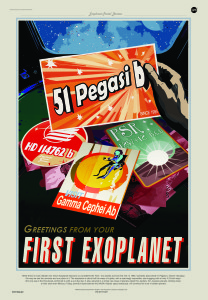
Greetings from your First Exoplanet
While there is much debate over which exoplanet discovery is considered the “first,” one stands out from the rest. In 1995, scientists discovered 51 Pegasi b, forever changing the way we see the universe and our place in it. The exoplanet is about half the mass of Jupiter, with a seemingly impossible, star-hugging orbit of only 4.2 Earth days. Not only was it the first planet confirmed to orbit a sun-like star, it also ushered in a whole new class of planets called Hot Jupiters: hot, massive planets orbiting closer to their stars than Mercury. Today, powerful observatories like NASA’s Kepler space telescope will continue the hunt of distant planets.
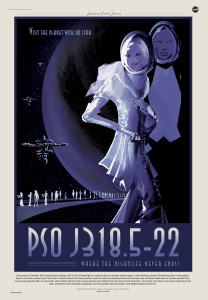
PSO J318.5-22 – Where the Nightlife Never Ends
Discovered in October 2013 using direct imaging, PSO J318.5-22 belongs to a special class of planets called rogue, or free-floating, planets. Wandering alone in the galaxy, they do not orbit a parent star. Not much is known about how these planets come to exist, but scientists theorize that they may be either failed stars or planets ejected from very young systems after an encounter with another planet. These rogue planets glow faintly from the heat of their formation. Once they cool down, they will be dancing in the dark.
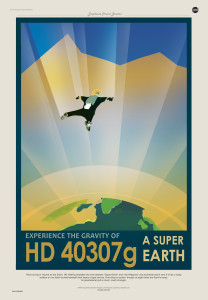
Experience the Gravity of a Super Earth
Twice as big in volume as the Earth, HD 40307g straddles the line between “Super-Earth” and “mini-Neptune” and scientists aren’t sure if it has a rocky surface or one that’s buried beneath thick layers of gas and ice. One thing is certain though: at eight time the Earth’s mass, its gravitational pull is much, much stronger.
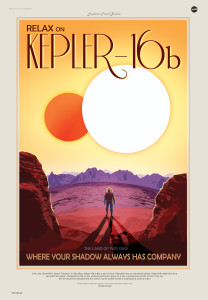
Relax on Kepler-16b – Where your shadow always has company
Like Luke Skywalker’s planet “Tatooine” in Star Wars, Kepler-16b orbits a pair of stars. Depicted here as a terrestrial planet, Kepler-16b might also be a gas giant like Saturn. Prospects for life on this unusual world aren’t good, as it has a temperature similar to that of dry ice. But the discovery indicates that the movie’s iconic double-sunset is anything but science fiction.
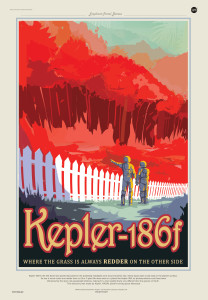
Kepler-186 f – Where the Grass is Always Redder
Kepler-186f is the first Earth-size planet discovered in the potentially ‘habitable zone’ around another star, where liquid water could exist on the planet’s surface. Its star is much cooler and redder than our Sun. If plant life does exist on a planet like Kepler-186f, its photosynthesis could have been influenced by the star’s red-wavelength photons, making for a color palette that’s very different than the greens on Earth. This discovery was made by Kepler, NASA’s planet hunting telescope.
ABOUT THE SONG
Style: ExperiMental Music
Chords: Open D tuning guitar / D F# F E D keys
Recording: digital 1-track stereo recorded live
Vocals, Guitar, Keyboards and Synthesizers (microKorg, Korg N364, Yamaha PSR-740, Casio WK-3500, miniNova, Boss Loop Station, Boss BR-600, DigiTech RP3)
Part of the 4D Music Experiment
by Daniel Brouse and Friends