[Silence]
[Instrumental Intro: Piano, Deep Sub-Bass Synth, Acoustic Guitar, Organ, Saxophone, Drums, Electric Guitar, Percussion]
[Intro]
Here they come!
(Where?)
Right there!
(Where?)
Right through the walls
(Through closed doors and down the halls)
Through the ceiling
(Through the door)
Through your body
(… here come more!)
[Verse 1]
The Sun’s throwing particles across the sky
Billions of billions go racing by
No invitation, no ticket to show
They slip through the places you’ll never know
Through your head
(Through your toes)
Through your heart
(There one goes!)
No bump, no bruise
No bang, no sound
A hundred trillion
(Just passing around!)
[Refrain]
Have you met
(A neutrino?)
I bet…
(You didn’t know)
The real deal
(You won’t even feel)
A single blow
They’re passing right through…
(You)
[Verse 2]
They’re born in the Sun where the fusion burns
And cosmic explosions send more in turns
From distant galaxies, far beyond sight
They cross the universe at nearly light
They’re ghost-like guests
(They don’t knock)
They don’t need keys
(They don’t stop)
Matter’s a maze
(They mostly ignore)
They pass through the Earth
(And out the other door!)
[Pre-Chorus]
A hundred trillion
(Every second!)
Through your body
(You reckon?)
No collision
(No sensation)
Just a subatomic
(Transit station!)
[Refrain]
Have you met
(A neutrino?)
I bet…
(You didn’t know)
The real deal
(You won’t even feel)
A single blow
They’re passing right through…
(You)
[Bridge]
You think you’re solid
(Strong and dense)
A wall of matter
(With a fence)
But deep in the atoms
(There’s room to spare)
And neutrinos move
(Like they’re barely there!)
Through the planet
(Through the stone)
Through the places
(You call your own)
Most pass by
(Without a trace)
But once in a while
(They leave a case!)
[Instrumental]
(Zoom!)
(Through you!)
(Zoom!)
(Comin’ through!)
(From the Sun!)
(From a star!)
(They don’t care!)
(Where you are!)
[Breakdown]
Who’s passing through?
(Neutrinos!)
Who’s feeling it?
(No one knows!)
[Final Refrain]
Have you met
(A neutrino?)
I bet…
(You didn’t know)
The real deal
(You won’t even feel)
A single blow
They’re passing right through…
(You)
[Outro]
Have you met
(A neutrino?)
They’re everywhere
(But hard to know)
Through your bones
(Through your shoes)
Through the Earth
(And out they cruise)
They’re passing right through…
(You!)
[Outro: Narration]
Neutrinos: The sun and cosmic events constantly blast the Earth with ghost-like particles called neutrinos. Approximately 100 trillion neutrinos pass right through your body every second without colliding with a single atom in your cells.
[Silence]
[Instrumental Intro: Piano, Deep Sub-Bass Synth, Acoustic Guitar, Organ, Saxophone, Drums, Electric Guitar, Percussion]
[Intro]
Come on!
(Come on!)
Get it started
(Keep it goin’!)
One more round
(Don’t slow down!)
Let your soul be found
(Make that sound!)
[Verse 1]
A simple spark and the whole thing’s lit
Get on the floor, let the rhythm hit
One more thought, one more idea
Keep that momentum rolling right here
Round and round, let the wheels spin
Each time we stop, we can start again
No sitting still, no calling it done
We’re just getting started, we’re having fun!
[Refrain]
Oh, come on, come on
(Keep ’em comin’)
Start (begin)
Keep ’em comin’
(Move it along)
Oh, come on, come on
(Keep ’em comin’)
Do it (again)
Keep ’em comin’
(Till we reach the dawn)
[Verse 2]
Keep the ideas coming down the line
One more connection and we’re feeling fine
Mix it, match it, let it collide
See what happens when the pieces combine
More interaction, more reaction
More of that feedback satisfaction
Add a change… get into the groove
Push it forward, keep it on the move!
[Refrain]
Oh, come on, come on
(Keep ’em comin’)
Start (begin)
Keep ’em comin’
(Move it along)
Oh, come on, come on
(Keep ’em comin’)
Do it (again)
Keep ’em comin’
(Till we reach the dawn)
[Bridge]
Keep the beat
(Keep it rollin’)
Toward complete
(Keep ’em turnin’)
Keep the sparks
(Keep ’em flyin’)
Keep the loops
(Keep replyin’)
More connections
(More interaction)
More reactions
(More amplification)
Just a little interruption
(In the middle of your day)
I’ve got something to tell you
(But you might look away!)
[Verse 1]
We were busy making plans for tomorrow
While the present was filling with sorrow
We were arguing over who’s to blame
While the whole damn system was going up in flames
We were checking our phone
(Scrolling away)
While reality knocked
(We told it, “Go away!”)
[Pre-Chorus]
Tap, tap, tap
(Who’s there?)
Knock, knock, knock
(Do I care?)
A little inconvenient truth
(Interrupting your groove)
But the facts don’t wait
(For your approval to move!)
[Refrain]
Excuse me…
(Did you see:)
Reality?
Pardon me…
(I didn’t mean to interrupt)
But…
… to be abrupt
(Your hair is on fire)
Flamin’ higher
(Higher! Higher! Higher!)
[Verse 2]
You said the numbers were just a phase
A little blip in the historical haze
You said the warnings were all overblown
Then the weather came knocking that you own
The old assumptions start to crack
And reality doesn’t take them back
You can change the channel
(You can close your eyes)
Then reality comes…
(As a big surprise!)
[Pre-Chorus]
Wait, wait, wait
(What’s that smell?)
Something’s burning
(You can tell!)
No time for spin
(No time for bluff)
The truth is knocking
(And it’s knocking rough!)
[Refrain]
Excuse me…
(Did you see:)
Reality?
Pardon me…
(I didn’t mean to interrupt)
But…
… to be abrupt
(Your hair is on fire)
Flamin’ higher
(Higher! Higher! Higher!)
[Bridge]
It’s not the message
(It’s the delay)
It’s not the warning
(It’s looking away)
You can argue with the messenger
(You can call them a fool)
But the fire doesn’t care
(About your political rule)
[Breakdown]
Excuse me!
(Your hair!)
Pardon me!
(Do you care!)
I hate to interrupt
(But look above!)
That’s not a halo
(That’s combustion, love!)
Higher!
(Higher!)
Fire
(Fire!)
[Instrumental]
[Final Refrain]
Excuse me…
(Did you see:)
Reality?
Pardon me…
(I didn’t mean to interrupt)
But…
… to be abrupt
(Your hair is on fire)
[Outro]
Flamin’ higher
(Higher! Higher! Higher!)
Excuse me…
(Can’t you see)
Smokin’ up your scene…
(Isn’t a dream!)
[Silence]
[Instrumental Intro: Piano, Deep Sub-Bass Synth, Acoustic Guitar, Organ, Saxophone, Drums, Electric Guitar, Percussion]
[Instrumental: Acoustic Guitar, Piano]
[Intro]
[Low Synth Drone, Spoken Vocal, Acoustic Guitar]
Up, up, up we go…
(Where the branches sway)
Step by step, the world unfolds
(And the clouds give way)
[Verse 1]
I started out with my feet on the ground
Looking for a truth that couldn’t be found
I chased the horizon, I followed the breeze
I searched for answers in the tops of the trees
[Refrain]
I climbed up the tallest tree
(To see what I could see)
There staring right at me…
(Was my destiny)
I climbed to the mountain top
(Until the top came to a stop)
I looked out upon the scene
(… there the dream was seen)
It’s right there
(Are you aware?)
… love is everywhere
[Verse 2]
I thought that the summit would tell me the truth
Reveal all the secrets I’d missed in my youth
I thought that the distance would make it all clear
That the meaning of life would be waiting up here
But no golden doorway, no voice from above
Just a world full of wonder, connected by love
The rivers, the forests, the ocean, the sky
All part of a whole that no wall can divide
[Pre-Chorus]
I looked to the east
(I looked to the west)
I searched every corner
(To find what was best)
Then I stopped looking
(And opened my eyes)
The answer was there
(In the earth and the skies)
[Refrain]
I climbed up the tallest tree
(To see what I could see)
There staring right at me…
(Was my destiny)
I climbed to the mountain top
(Until the top came to a stop)
I looked out upon the scene
(… there the dream was seen)
It’s right there
(Are you aware?)
… love is everywhere
[Bridge]
Higher and higher
(What did I find?)
A wider horizon
(Of how to be kind)
[Instrumental: Saxophone Solo]
(Climb up!)
(Look out!)
(Open your eyes!)
(It’s all around!)
[Breakdown]
It’s right there…
(And there!)
Can you see it?
(Can you feel it?)
It’s right here…
(Can you hear!)
[Instrumental: Acoustic Guitar, Organ]
[Final Refrain]
I climbed up the tallest tree
(To see what I could see)
There staring right at me…
(Was my destiny)
I climbed to the mountain top
(Until the top came to a stop)
I looked out upon the scene
(… there the dream was seen)
It’s right there
(Are you aware?)
… love is everywhere
It’s right there
(In the earth and air)
It’s right here
(If we care)
It’s right there
(Are you aware?)
… love is everywhere
[Intro]
Yesterday…
(Tomorrow…)
Today…
(Have you ever looked this way?)
Look ahead!
(Look behind!)
Who’s observing?
(Who’s in mind?)
[Verse 1]
I saw tomorrow in a dream last night
It looked like yesterday in a different light
The future came knocking, the past walked in
And the present couldn’t tell where to begin
[Refrain]
The future…
(Is sure…)
Easy to see
(Retrospectively)
Once memory,
(Then what… really?)
[Instrumental: Whistle Solo]
The past…
(Might last…)
Indefinitely,
(But really…)
If there’s no one to see?
[Instrumental: Whistle Solo]
[Verse 2]
The clock keeps ticking, the seconds fly
But what is a moment as it passes by?
A fraction of now that we try to hold
Turns into a story that we’ve often retold
[Refrain]
The future…
(Is sure…)
Easy to see
(Retrospectively)
Once memory,
(Then what… really?)
[Instrumental: Whistle Solo]
The past…
(Might last…)
Indefinitely,
(But really…)
If there’s no one to see?
[Instrumental: Whistle Solo]
[Bridge]
[Instrumental: Guitar Solo]
Is the past still there?
(When nobody knows?)
Does tomorrow exist?
(Before it unfolds?)
Is the present a point?
(That we cannot retain?)
Or a river of change
(That keeps flowing again?)
The observer observes
(But the observer’s involved)
The question keeps turning
(And remains unresolved)
[Instrumental]
(Tick-tock…)
(Who’s watching the clock?)
(Flashback…)
(What do you know?)
(Fast forward…)
(Where will it go?)
(Rewind!)
(What did we find?)
[Breakdown]
The future!
(Will endure!)
The present!
(Experienced!)
The past!
(Passed!)
[Refrain]
The future…
(Is sure…)
Easy to see
(Retrospectively)
Once memory,
(Then what… really?)
The past…
(Might last…)
Indefinitely,
(But really…)
If there’s no one to see?
[Final Refrain]
The future…
(Is sure…)
Easy to see
(Retrospectively)
We knew it all along!
(Or so we believe!)
[Outro]
The past…
(Might last…)
Indefinitely,
(But really…)
What remains of history
(When there’s no one to see?)
[Style: Psychedelic Science-Rock / Progressive Surf-Rock / Full Blown]
[Intro]
Flap…
(Flap, flap)
A little change…
(And what’s the same?)
One little flutter
(One tiny shove)
Can shake the system
(Destroy our love)
[Verse 1]
A whisper in the atmosphere
A ripple traveling far from here
A little change, a distant start
A million pathways come apart
The pieces move, the patterns bend
And where it starts is not the end
[Pre-Chorus]
Millions…
(Billions…)
Trillions in play
Who knows where the ripples go today?
[Refrain]
How is the butterfly effect…
(… affecting you?)
Is there chaos there?
(… chaos in the air)
… chaos everywhere?
A small perturbation
(… can propagate)
As the fleeting teleconnection
(Amplifies at an exponential rate)
[Verse 2]
A cloud shifts over a warming sea
A current changes what winds will be
The ice retreats, the oceans rise
And feedback wakes before our eyes
One system shifts, the next one bends
And round and round the coupling sends
[Pre-Chorus]
Millions…
(Billions…)
Trillions connect
A network with effects we can’t detect?
[Refrain]
How is the butterfly effect…
(… affecting you?)
Is there chaos there?
(… chaos in the air)
… chaos everywhere?
A small perturbation
(… can propagate)
As the fleeting teleconnection
(Amplifies at an exponential rate)
[Bridge]
We count the pieces
(One by one)
But the connections
(Have only begun)
A million pathways
(A billion more)
Trillions of interactions
(We opened the door)
Feedback coupling
(Coming alive)
One change spreads
(Through the whole hive)
[Instrumental]
[Breakdown]
(Flap… flap…)
(Ripple… ripple…)
(Couple… amplify…)
Do you know…
(Where will it go?)
Millions!
(Billions!)
Trillions!
(And counting!)
… still mounting…
(And counting!)
… still mounting…
(And counting!)
[Final Refrain]
How is the butterfly effect…
(… affecting you?)
Is there chaos there?
(… chaos in the air)
… chaos everywhere?
A small perturbation
(… can propagate)
As the fleeting teleconnection
(Amplifies at an exponential rate)
[Outro]
How is the butterfly effect…
(… affecting you?)
Can we see what’s coming?
(We can see some clues)
Feedback coupling
(Connecting the chain)
One small perturbation
(And we changed the game)
Flap…
(Flap, flap)
A little change…
(Travels far)
Millions…
(Billions…)
Trillions of ways…
… still mounting…
(And counting!)
… more by the day
The network shifts
(The feedbacks grow)
Where it ends…
(We don’t yet know)
The butterfly effect…
(It’s affecting you.)
[Fade out]
The butterfly effect…
(It’s affecting you.)
… and you… and you, too
[Silence]
[End]
About the Song
Feedback Coupling
THE BUTTERFLY EFFECT: A small perturbation can propagate across the entire network.
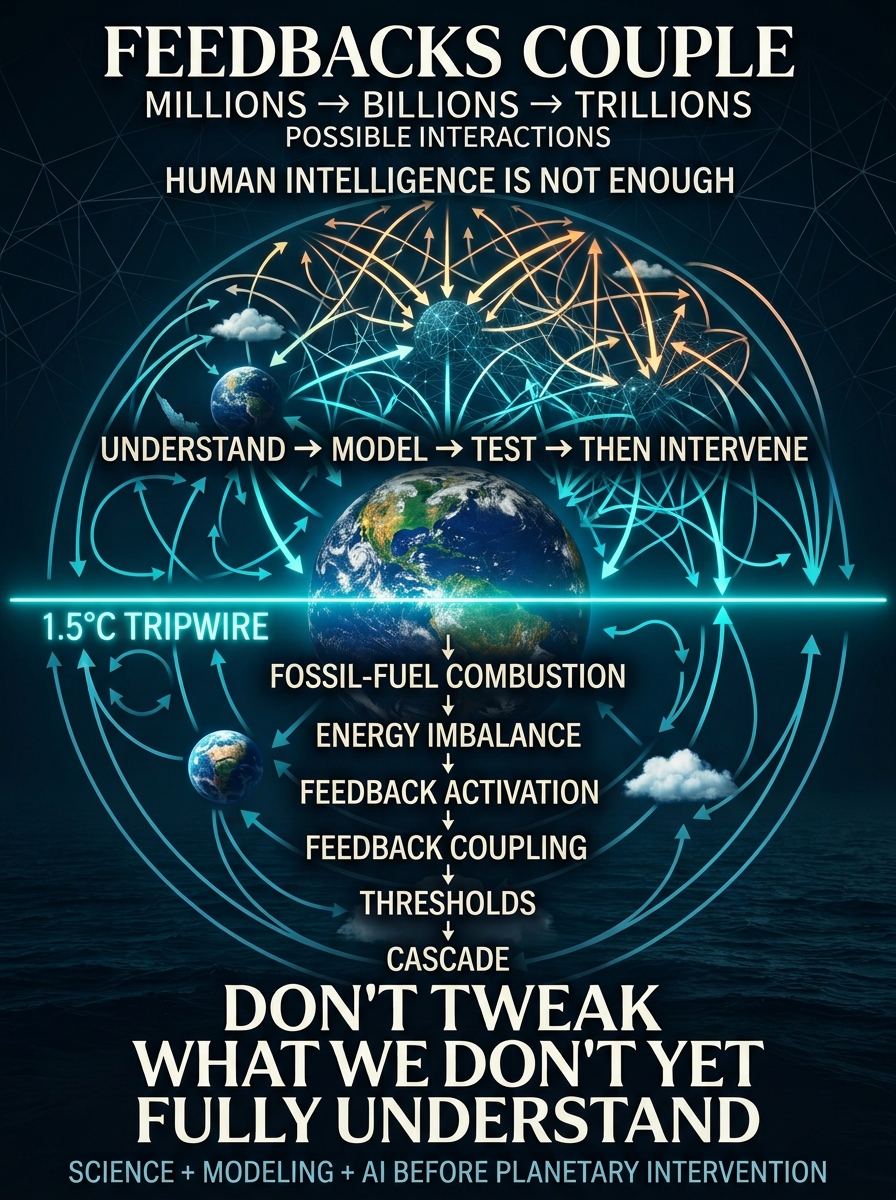
MILLIONS → BILLIONS → TRILLIONS
POSSIBLE FEEDBACK INTERACTIONS
FEEDBACK COUPLING IS EMERGING
We cannot yet predict how these interactions will propagate and amplify as they unfold.
THE BUTTERFLY EFFECT
A small perturbation can propagate across the entire network.
About the Song
Climate feedbacks are processes in which an initial change in Earth’s climate system triggers additional changes that amplify or dampen the original change. Positive feedbacks amplify the initial warming caused by greenhouse-gas emissions, accelerating climate change beyond what the initial forcing alone would produce.
As Earth’s climate system warms and destabilizes, millions of emerging feedback interactions are becoming active across the atmosphere, oceans, cryosphere, land, and living systems. Many of these interactions are now being observed for the first time in human history. As individual feedbacks activate, strengthen, and interact with one another, they create new pathways for amplifying climate change and accelerating Earth-system change. There could well be billions of feedbacks. Now they are coupling… combining… amplifying each other… resulting in trillions of combinations.
MILLIONS → BILLIONS → TRILLIONS
FEEDBACK INTERACTIONS
FEEDBACK COUPLING IS EMERGING
We cannot yet predict how these interactions will propagate and amplify as they unfold. As it is unfolding in real time, just look out your window.
Feedback loops amplify climate change and can push interconnected Earth systems past critical tipping points. As tipping points are crossed, they can trigger additional feedback loops and destabilize other climate systems. This cascading “Domino Effect” compresses timescales, accelerates change, and increases the risk of rapid, nonlinear climate transformations.
[Breakdown]
Warm the sky!
(Amplify!)
Damage the scene!
(Spoil the dream!)
Ozone!
(Leave me alone!)
One-two!
(Dual-force!)
Oh, three!
(Of course!)
Hidden multiplier!
(Amplifying dire!)
[Final Refrain]
The hidden multiplier
(Amplifying dire)
Dual-force
(Of course)
Biological and radiative
(Changing life’s narrative)
[Outro]
The hidden multiplier
(It’s more than heat)
A double force in motion
(With a tangled beat)
Oh, ozone…
(Leave me alone)
Oh, ozone…
(What have you done?)
… out paced our run.
Oh, ozone…
(Leave me alone…)
It’s not just what’s in the air…
(… it’s everything under there.)
About the Song
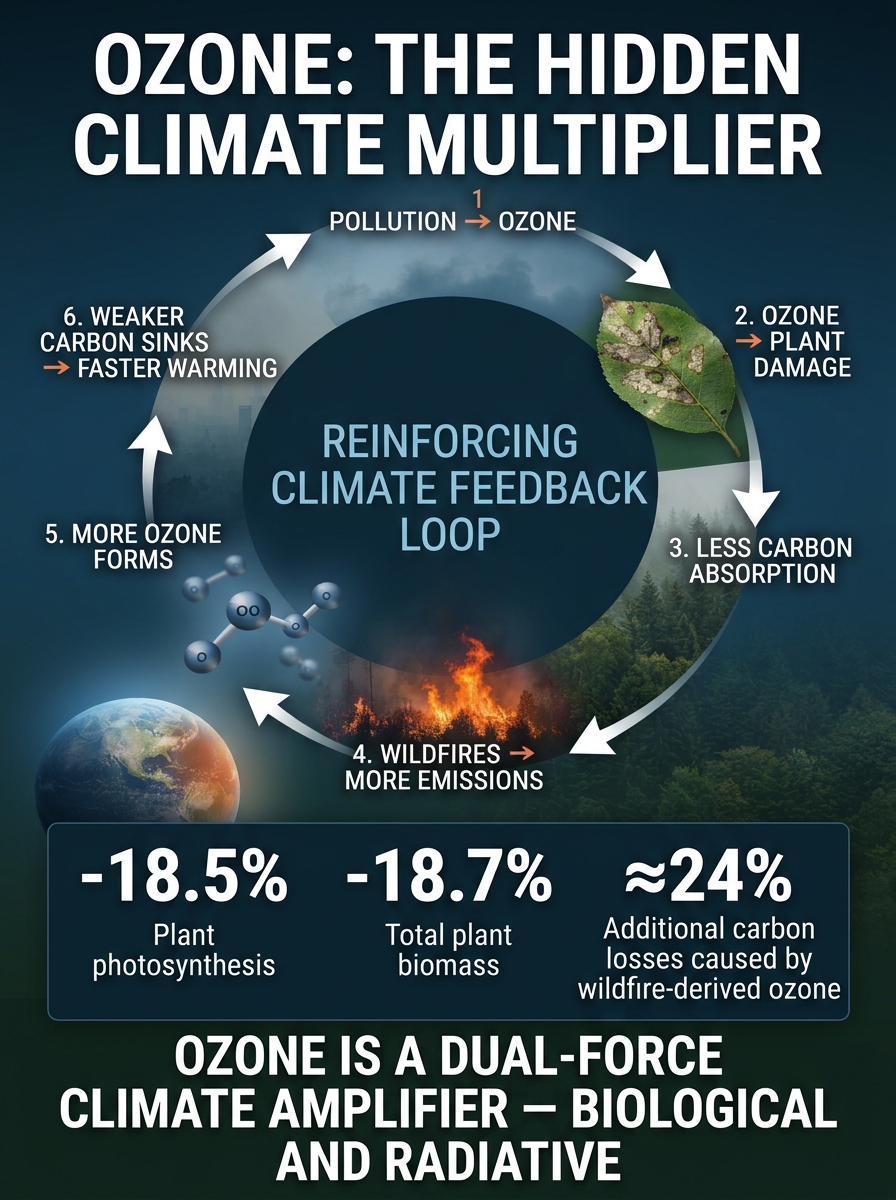
Ozone: The Hidden Climate Multiplier
Climate change is not simply making the planet warmer. It is also affecting the natural systems that help regulate the climate.
Ozone is a dual-force climate amplifier—intensifying atmospheric warming through its radiative effects while accelerating biological damage that weakens Earth’s natural carbon sinks, multiplying the impacts of climate change.
The Big Idea
When we talk about climate change, we usually focus on carbon dioxide, methane, and rising temperatures. But another important part of the story is happening in the atmosphere: ozone pollution is damaging the vegetation that helps remove carbon dioxide from the air.
Ground-level ozone harms plants, reduces photosynthesis, and limits plant growth. These effects weaken an important natural process that helps regulate the Earth’s carbon balance.
New research also shows that ozone produced by wildfires can contribute to additional carbon losses in the Amazon rainforest, beyond the carbon released directly by burning vegetation.
Ozone is not just an air pollutant. It is a biological climate amplifier that can weaken Earth’s natural defenses against global warming.
Ozone is a dual-force climate amplifier — biological and radiative.
[Break]
Left us all alone!
(Guess we’re on our own!)
But look around…
(Look what’s found)
… when we’re all love bound
[Final Refrain]
Left us all alone
(Guess we’re on our own)
The elite
(Left the street)
Couldn’t compete
(With the beat)
Left us all alone…
(Guess we’re on our own…)
But the street…
(Still has a beat)
Couldn’t compete?
(We’ll complete!)
Dance to the beat!
(Bringin’ on the heat!)
[Outro]
On our own…
(On our own…)
Not alone…
(Not alone…)
Beat by beat…
(Street by street…)
We carry on.
(On and on and on)
Windblown
[Intro]
Where did it go?
(Where did it fly?)
Caught by the wind
(Into the sky)
Round and around
(The pieces are spinning)
Lost in the current
(Is anyone winning?)
[Verse 1]
A little bit here
(A little bit there)
Blown from the ground
(Into the air)
Tattered old pages
(Torn at the seam)
Fragments of yesterday
(Fragments of a dream)
Scattered like leaves
(Across every mile)
Worn by the journey
(… carried a while)
[Refrain]
Windblown
(Tattered… torn)
Into the unknown
(Scattered… worn)
[Verse 2]
The wind doesn’t ask
(What you believe)
It picks up the pieces
(And makes them leave)
What seemed permanent
(Did suddenly move)
What seemed so certain
(Can suddenly prove)
That what was fixed
(Isn’t still)
The wind has a way
(Of changing the deal)
[Refrain]
Windblown
(Tattered… torn)
Into the unknown
(Scattered… worn)
Round and around
(The currents collide)
Nothing to hold
(Nowhere to hide)
[Bridge]
Blown away!
(Blown of your throne!)
Thrown away!
(No, just can’t stay!)
Tattered…
(Torn…)
Scattered…
(Worn…)
[Break]
Windblown!
(Where are we going?)
Unknown!
(Fully not knowing!)
Tattered!
(Torn!)
Scattered!
(Worn!)
[Final Refrain]
Windblown
(Tattered… torn)
Into the unknown
(Scattered… worn)
Windblown…
(Where will it go?)
Into the unknown…
(Does anyone know?)
[Outro]
Blown…
(Into the unknown.)
Singing in the Reign
[Intro]
Hear that rain?
(Here again?)
Feel that wind?
(Where’s it been?)
Clouds roll in
(The day grows dim)
But through the gray…
(We sing anyway)
[Verse 1]
Drops on the window
(Rhythm on the roof)
Storm clouds gathering
(That’s all the proof)
Thunder rolls
(Deep and low)
Lightning flashes
(Here we go)
You can’t stop the weather
(You can’t stop the rain)
But you can choose
(How to sing through the pain)
When the skies turn dark
(And the waters rise)
Keep a little hope
(Behind your eyes)
[Refrain]
Just singing in the reign
(Wailing in the pain)
Oh, whoa the woe
(Oh woe, know no)
We can rise above
(Bringing in the love)
[Verse 2]
The river keeps moving
(The current runs strong)
You can fight the water
(Or learn to swim along)
Bring on compassion
(On a path to repair)
A little less fear
(A lot more care)
[Refrain]
Just singing in the reign
(Wailing in the pain)
Oh, whoa the woe
(Oh woe, know no)
We can rise above
(Bringing in the love)
[Bridge]
Sing!
(Bring!)
When the rain comes down
(Sing the sound)
Love!
(Love!)
When the world spins round
(Love!)
Rise!
(Above!)
[Break]
Oh, whoa!
(The woe!)
Oh, no!
(Know no!)
Don’t let the sorrow
(Become the song)
Don’t let the darkness
(Go on and on)
If we’re gonna reign…
(Let love rule!)
If we’re gonna rise…
(Avoid the fool)
[Final Chorus]
Singing in the reign!
(Still singing in the reign!)
Wailing in the pain!
(But love can ease the strain!)
Oh, whoa the woe!
(Oh woe, know no!)
We can rise above
(Bringing on the love)
Rise above!
(Shine some love!)
[Final Refrain]
Just singing in the reign
(Wailing in the pain)
Oh, whoa the woe
(Oh woe, know no)
We can rise above
(Bringing in the love)
Just singing…
(Singing!)
In the reign…
(In the reign!)
While bringing on…
(The love!)
[Outro]
Let it rain…
(Let it rain)
Let it pour…
(Let it pour)
But don’t let the pain…
(Be the final score)
Sing in the reign…
(Sing in the reign)
And let love…
(Rise above)
Beyond the Great Unknown
[Intro]
Where ya been?
(Where ya goin’?)
What’s ahead?
(Is there any knowin’)
Take a step…
(Take a chance)
Feel the beat…
(And make it dance)
[Verse 1]
There’s a road that ain’t been taken
There’s a song that ain’t been sung
There’s a world that’s still awakenin’
Waiting for the morning sun
No map to tell us where to wander
No sign to say which way is right
But every step can take us farther
Out of the shadow into the light
[Refrain]
We’re goin’ for a stroll
(Beyond the great unknown)
The future of rock n’ roll
(For the first time shown)
The light
(Shine)
Oh so fine
(Shine, shine, shine)
The light
(Shone)
Where we’re goin’…
(… beyond the great unknown)
[Verse 2]
Perhaps a little crazy
Is the way to go
If you wait until you’re ready
You may never really know
There’s a rhythm in the thunder
There’s a heartbeat in the ground
When you stop and start to wonder
You can hear a brand-new sound
[Chorus]
Rock n’ roll!
(Go beyond!)
Rock n’ roll!
(Keep movin’ on!)
Past the edge
(Past the line)
Into something
(Undefined)
[Refrain]
We’re goin’ for a stroll
(Beyond the great unknown)
The future of rock n’ roll
(For the first time shown)
The light
(Shine)
Oh so fine
(Shine, shine, shine)
The light
(Shone)
Where we’re goin’…
(… beyond the great unknown)
[Bridge]
The unknown!
(Full blown!)
The unknown!
(Great unknown!)
You come to know
(Where we’re goin’)
As we go…
(Time is flowin’)
One more step!
(One more!)
One more beat!
(Encore!)
[Break]
Hey!
(HEY!)
Where ya goin’?
(Where the light’s showin’!)
What’s it about?
(We’ll find out!)
Shout!
Shine
(Shone)
[Pre-Chorus]
Leave the door
(Leave it wide)
Feel the beat
(Feel inside)
Hear that sound?
(That’s the call)
Come on now…
(Give it your all!)
[Final Refrain]
We’re goin’ for a stroll
(Beyond the great unknown)
The future of rock n’ roll
(For the first time shown)
The light
(Shine)
Oh so fine
(Shine, shine, shine)
The light
(Shone)
Where we’re goin’…
(… beyond the great unknown)
[Outro]
Beyond…
(Beyond!)
The great…
(Shine)
Shone
The light…
(Shine!)
Shone
So bright…
(Shone!)
Shine
(Shine, shine, shone)
Flat on One Side
[Intro]
Hey!
(What’s that sound?)
Thump-thump…
(Round and round)
Something’s wrong
(But we keep ridin’)
Something’s low
(No more hidin’)
[Verse 1]
I felt a wobble in the middle of the night
Thought maybe something wasn’t quite right
Kept on rolling, thinking it would disappear
But every mile made the problem more clear
You can polish up the rim
(You can shine it bright)
But a flat little secret
Won’t stay outta sight
[Pre-Chorus]
One side’s down
(One side’s low)
One side’s up
(Where’d it go?)
Spin that wheel
(Turn it ’round)
Funny thing…
(No hole can be found)
[Refrain]
Is that tire flat?
(Only on one side)
So that’s where we’re at…
(Can’t hide the snide)
Blew a tire
(Knew it was dire)
No, you can’t hide
(What you can’t ride)
[Verse 2]
You can pump it up
(Up, up, up)
You can talk it down
(Down, down, down)
You can try n’ spin it round
But when the rubber meets the road
When the pressure starts to fall
Your secret will explode
When you turn it round… after all
[Chorus]
Flat on one side!
(Flat on one side!)
Rolling ain’t riding
(When the wheel won’t glide)
[Refrain]
Is that tire flat?
(Only on one side)
So that’s where we’re at…
(Can’t hide the snide)
Blew a tire
(Knew it was dire)
No, you can’t hide
(What you can’t ride)
[Bridge]
If it’s flat…
(Fix that!)
If it’s broken…
(Get it stokin’)
‘Cause pretending
(Doesn’t roll!)
And denial
(Takes its toll!)
[Break]
Is it flat?
(Yeah!)
On one side?
(Yeah!)
Can ya ride?
(Know?)
Oh, no, no, no, no
Can ya hide?
(No! Can’t ride)
[Final Refrain]
Is that tire flat?
(Only on one side)
So that’s where we’re at…
(Can’t hide the snide)
Blew a tire
(Knew it was dire)
No, you can’t hide
(What you can’t ride)
[Outro]
Flat…
(That’s where we’re at)
No matter how you roll…
(The hole took a toll)
No, no she won’t roll
Where Ya Goin’?
[Intro]
Hey!
(Hey!)
Where ya goin’?
(Are ya showin’?)
Got a scope?
(Nope!)
Got a plan?
(Ah, man!)
Well then…
(Let’s go!)
[Verse 1]
There’s a road in front of me
(And another to the right)
One goes toward the mountain
(One disappears from sight)
Could ask somebody
(Which way should I go?)
Could wait for a sign
(To reveal and show)
[Refrain]
Hey! Say…
(Where ya goin’?)
Any way…
(Without knowin’)
Anyway…
(We’ve got the day)
[Verse 2]
The future isn’t written
(At least before it’s gone)
The choice becomes a piece
(Of the road we’re on)
You can follow somebody
(You can blaze your own)
You can wander for a while
(And still find your way home)
[Refrain]
Hey! Say…
(Where ya goin’?)
Any way…
(Without knowin’)
Anyway…
(We’ve got the day)
So take a breath
(Look around)
Put your feet upon the ground
(Feel the sound)
[Bridge]
Hey! Are ya knowin’…
(Where ya goin’?)
Don’t know!
(That’s okay!)
Hey!
(Which way?)
Any way!
(Every which way!)
Left!
(Right!)
Up!
(Down!)
Keep your feet
(Movin’ round!)
[Break]
Where ya goin’?
(I dunno!)
How do ya get there?
(Anyway!)
So here we go
([Refrain]
Hey! Say…
(Where ya goin’?)
Any way…
(Without knowin’)
Anyway…
(We’ve got the day)
[Refrain]
Hey! Say…
(Where ya goin’?)
Any way…
(Without knowin’)
Anyway…
(We’ve got the day)
[Final Refrain]
Hey! Say…
(Where ya goin’?)
Any way…
(Without knowin’)
Anyway…
(We’ve got the day)
Hey! Say…
(Where ya goin’?)
I dunno…
(But I’m goin’!)
Anyway…
(We’ve got the day)
[Outro]
Where ya goin’?
(With the wind… blowin’)
Without knowin’…
(That’s the way.)
We’ve got the day.
Flown
[Intro]
Flown…
(Full blown…)
Gone…
(Gone, gone)
Where’d she go?
(Who could know?)
[Verse 1]
A feather falls
(So light)
Caught by the air
(Outta sight)
Up…
(Down!)
Round and round
(Round and round)
[Refrain]
The flown
(Is flowin’)
Gone…
(It’s been going)
… way too long
(Flown)
A feather in the wind…
… been…
(Blowin’)
Flown
(Oh, oh, own)
Flown
(Oh, oh, own)
[Verse 2]
Was it mine?
(Was it yours?)
Did it leave?
(Through the doors?)
No strings
(No chains)
Nothing left
(But remains)
[Break]
Blown…
(Blown!)
Thrown…
(Thrown!)
Known…
(Unknown!)
Gone…
(Oh, oh, gone!)
[Refrain]
The flown
(Is flowin’)
Gone…
(It’s been going)
… way too long
(Flown)
A feather in the wind…
… been…
(Blowin’)
Flown
(Oh, oh, own)
Flown
(Oh, oh, own)
[Verse 3]
What we think
(We know)
Follows me…
(Where winds blow)
Flown…
(Full blown…)
Far…
(So far…)
Passed…
(Past…)
[Final Refrain]
The flown
(Is flowin’)
Gone…
(It’s been going)
… way too long
(Flown)
A feather in the wind…
… been…
(Blowin’)
Flown
(Oh, oh, own)
Flown
(Oh, oh, own)
[Outro]
Flown…
(Full blown…)
Still flowin’…
(Still goin’…)
So long!
(Long)
Gone…
(Gone, gone)
Flown…
(Oh, oh, own)
Flown…
(Oh, oh, own)
[Fade out)
Lighten Up Yourself
[Intro]
Hey now!
(What’s all that fuss?)
Easy now…
(No need to push)
Take a breath
(Let it go)
Feel the rhythm
(Get to know)
One love!
(One life!)
Our heart!
(No strife!)
[Verse 1]
Woke up this morning with a cloud in my head
Thinking ’bout the things that somebody said
Carrying yesterday like a heavy load
Wondering along a lonely road
But the sun keeps shining
(Even through the gray)
And the beat keeps playing
(So dance the blues away)
You can’t change the past
(But you can change today)
So open up your heart
(And let the good vibes stay)
[Pre-Chorus]
Don’t hold tight
(To the sorrow)
Make some room
(For tomorrow)
If the world feels heavy
(Share the load)
Put a little love
(Back upon the road)
[Refrain]
Don’t be so dreadly
(Lighten up yourself)
It might turn deadly
(Lighten up yourself)
Bring to life
(Life!)
Do away with
(Strife)
Come on!
(Lighten up yourself)
Sing along
(Lighten up yourself)
[Verse 2]
If a little worry wants a place in your mind
Hey! Just say, “You better stay behind”
Fear can grow when you feed it every day
And anger gets stronger when you give it your way
So loosen up your shoulders
(Let ’em fall)
Put some music in the room
(And answer the call)
If you got a little love
(You got enough)
Give a little more
(When the going gets tough)
[Chorus]
Lighten up!
(Lighten up!)
Don’t weigh yourself down
(Lighten up!)
Turn that frown around
(Lighten up!)
Life is too short
(To live in strife)
Give a little love
(Bring it back to life)
Lighten up yourself!
(Yeah, yeah!)
Lighten up yourself!
(Oh, yes!)
[Verse 3]
There’s a line between a warning and a wall
There’s a line between standing tall and standing small
You can shout at every shadow
You can fight against the rain
Or you can learn improve your move
And dance away the pain
[Bridge]
One heart!
(One love!)
One beat!
(Rise above!)
Come on everybody…
(Lighten up!)
[Break]
Hey!
(HEY!)
You got a problem?
(Lighten up!)
Got a worry?
(Lighten up!)
Got some trouble?
(Oh, no, no no)
Don’t make it double
(Lighten up!)
Rife with life!
(Sing it!)
[Refrain]
Don’t be a dread
(Lighten up yourself)
Come rock instead
(Lighten up yourself)
Bring to life
(Life!)
Do away with
(Strife)
Come on!
(Lighten up yourself)
Sing along
(Lighten up yourself)
[Final Chorus]
Lighten up!
(Lighten up!)
Don’t weigh yourself down
Lighten up!
(Turn that frown around)
Bring to life!
(Life!)
Do away with strife!
(Strife!)
Come on!
(Lighten up yourself!)
Everybody!
(Lighten up yourself!)
[Final Refrain]
Yo! Don’t be a dread
(Lighten up yourself)
So! Come rock instead
(Lighten up yourself)
Bring to life
(Life!)
Do away with
(Strife)
Bring to life
(Life!)
Do away with
(Strife)
Come on!
(Lighten up yourself)
Sing along
(Lighten up yourself)
[Outro]
Lighten…
(Up!)
Yourself!
(True wealth!)
Let the love…
(Rise above!)
Let the life…
(Lighten up!)
Let the music…
(Enlighten up!)
Come on!
(Come on!)
Everybody!
(Rock steady!)
Enlighten up yourself…
My Mind
[Intro]
My mind…
(What’s on your mind?)
It’s blown…
(What did you find?)
[Verse 1]
Thought I knew the answer
Thought I knew the score
Then somebody asked a question
I’d never thought of before
[Pre-Chorus]
Round and round
The thoughts go by
Looking down
Then looking high
[Refrain]
My mind
(Is blown)
I find
(The known)
Thinking on it
(For a bit)
Thinking hard and long
(On mentally strong)
[Verse 2]
The more I learn
The less I know
The more I turn
The more things grow
[Chorus]
Whoa-oh!
My mind is blown
(Blown!)
Something unknown
(Whoa-oh!)
Think it through
What else could be true?
[Refrain]
My mind
(Is blown)
I find
(The known)
Thinking on it
(For a bit)
Thinking hard and long
(On mentally strong)
[Bridge]
I guess knowing
Is knowing
There’s more to know
To keep on growing
Is going
Where questions go
[Break]
What do you know?
(What do you find?)
What’s blowing your mind?
(My mind!)
[Pre-Chorus]
Round and round
The thoughts go by
Looking down
Then looking high
What I knew
Was just a clue
To what I didn’t know…
[Final Chorus]
Whoa-oh!
My mind is blown
(Blown!)
I find the known
(The known!)
Thinking hard
(Thinking long)
Makes a mind
(Mentally strong!)
[Final Refrain]
My mind
(Is blown)
I find
(The known)
Thinking on it
(For a bit)
Thinking hard and long
(On mentally strong)
My mind…
Is goin’…
(Full blown!)
[Outro]
[Refrain]
My mind
(Is blown)
I find
(The known)
Thinking on it
(For a bit)
Thinking hard and long
(On mentally strong)
Crisis
[Intro]
Risk…
(What’s the risk?)
Push…
(Endure one more…)
Cross the line
(One more time)
Never mind
(We’ll be fine)
[Verse 1]
We saw the warning
We heard the sound
Something was breaking
But we looked around
[Pre-Chorus]
Round and round
We took the chance
Step by step
Into the dance
[Refrain]
We couldn’t resist
(Crossed the line of risk)
This is…
(A full blown crisis)
[Verse 2]
The warning light
Was blinking red
But we kept moving
Straight ahead
The bridge was shaking
The river rose
Nobody wanted
To be the one who knows
“Don’t worry!”
(Don’t worry!)
“It’s under control!”
(Under control!)
Then the whole thing
(Lost its soul)
[Refrain]
We couldn’t resist
(Crossed the line of risk)
This is…
(A full blown crisis)
[Bridge]
Was it sudden?
(No!)
Was it hidden
(No!)
Did we know…
Confess!
(Yes!)
[Break]
Risk!
(Resist!)
Persist!
(Insist!)
This is…
(CRISIS!)
[Pre-Chorus]
Round and round
The feedback goes
Where it stops…
(Nobody knows)
Threshold crossed
The balance shifts
One small push
And it all tips
[Final Refrain]
We couldn’t resist
(Crossed the line of risk)
This is…
(A full blown crisis)
We couldn’t resist
(Crossed the line of risk)
This is…
(A full blown crisis)
Full blown!
(Full blown!)
Crisis!
(Crisis!)
[Outro]
Common sense tossed
(The line is crossed)
Debt Collection
[Intro]
Knock, knock…
(Who’s there?)
Debt collector…
(No one’s here!)
You thought you had time
(You thought you were fine)
But time has a way
(Of collecting its pay)
[Verse 1]
We borrowed from tomorrow
And spent it all today
Took a little from the future
Then we threw the bill away
“Don’t worry ’bout the interest”
(We’ll deal with that somehow)
But the debt kept getting bigger
(And the collector’s here right now)
[Pre-Chorus]
First came the warning
(We waved it away)
Then came the interest
(It started to stay)
[Refrain]
Beyond speculation
(It’s debt collection)
What’s at stake
(A bone break)
First your fingers
(While the pain lingers)
There goes the toes
(Holy! And another knee)
[Verse 2]
You can’t put the pain
A hundred years away
When the heat is at your doorstep
And the flood is on its way
Somewhere far?
(Right where you are)
Far away?
(Not today!)
[Chorus]
Not speculation
(Not speculation!)
Not some distant fate
The consequences
(Are already at the gate)
[Refrain]
Beyond speculation
(It’s debt collection)
What’s at stake
(A bone break)
First your fingers
(While the pain lingers)
There goes the toes
(Holy! And another knee)
[Bridge]
The future moved closer
(The future moved here)
Somewhere else vanished
(It disappeared)
Climate debt!
(Not yet)
Your dues due
(Better come through)
How much can you take
Before you finally wake?
[Pre-Chorus]
It’s not tomorrow
(It’s today)
It’s not somewhere else
(It’s this way)
It’s not abstract
(It’s real)
It’s not a theory
(Look and feel)
[Final Refrain]
Beyond speculation
(It’s debt collection)
What’s at stake
(A bone break)
First your fingers
(While the pain lingers)
There goes the toes
(Holy! And another knee)
Beyond speculation
(It’s debt collection)
What’s at stake
(A bone break)
How much pain
(Before we wake?)
[Outro]
Knock, knock…
(Who’s there?)
Debt collection…
(Already here.)
Oh, dear!
You missed the payment…
(We know.)
You missed the warning…
(Oh, no)
Now…
Pay attention.
(Avoid termination)
The new release of the day, “Debt Collection,” is the accounting of an accounting story. No, it’s not folklore anymore. It’s a retro-futuristic, swampy blues tune about spending your future.
The situation is due to what we do. And now, the blues dues are due.
About the Song: Climate Debt Collection
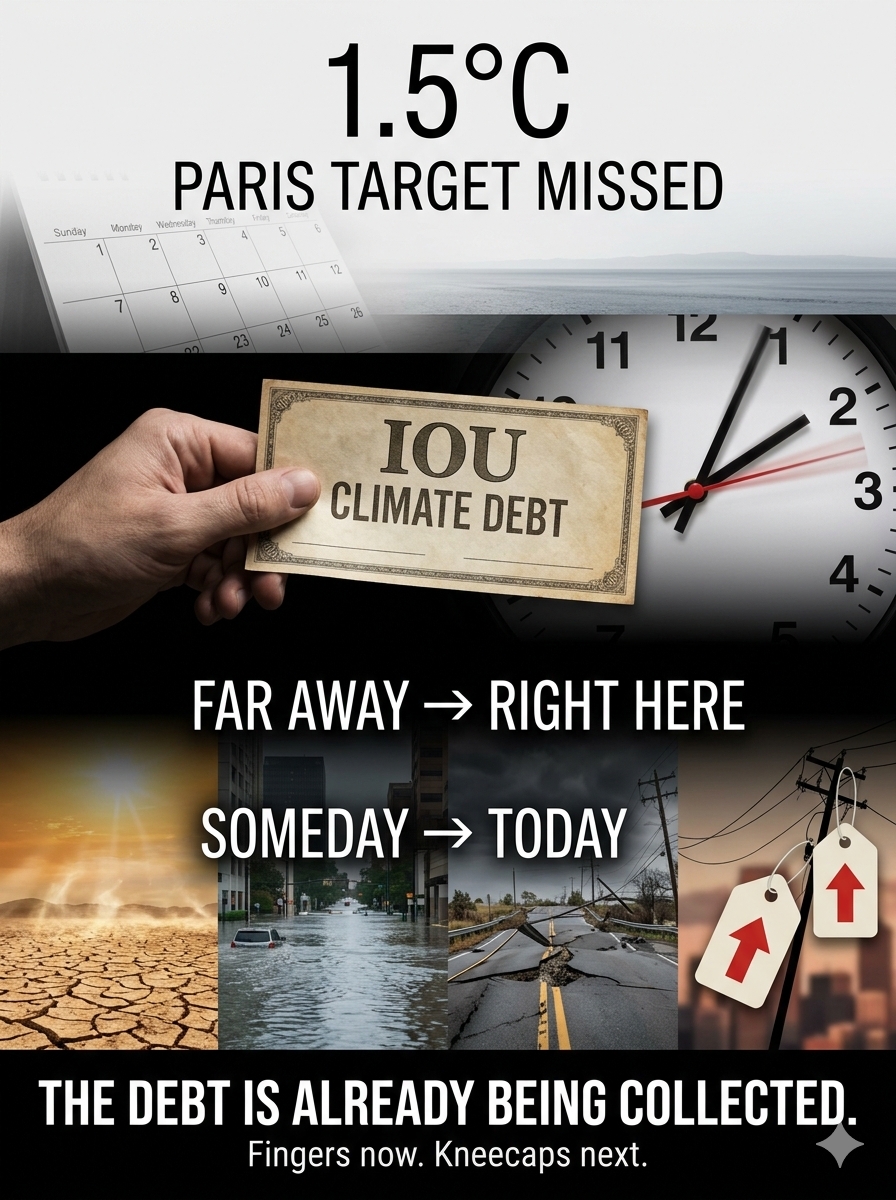
What happens when we miss the 1.5°C Paris target?
Think of it like owing money to a loan shark. The debt doesn’t wait decades to be collected.
Our fingers are being broken now. Our kneecaps are next.
One of the biggest challenges in communicating climate change is proximity—both in time and location.
If the consequences seem far away, people dismiss them. If they’re happening somewhere else, people ignore them.
But climate change is moving from:
future → present
and
somewhere else → right here.
We missed the 1.5°C Paris target. The climate debt is already being collected.
How much pain do we need to feel before we pay attention?
[Final Chorus]
Wake up!
(Wake up!)
As the floor shakes
(Wake up!)
Before the whole thing breaks
No more dreaming
(No more sleep)
We’re in way too deep
To keep pretending…
(We’re asleep)
[Final Refrain]
Snooze switch
(Wake to hit)
Real bitch
(Wake to it)
In way to deep
(To sleep)
Snooze switch!
(Wake up!)
Snooze switch!
(For real!)
Wake to it…
(Wake to it!)
[Outro]
Hit the switch…
(Don’t hit snooze.)
Wake up…
(Too deep to choose to lose)
Wake…
(Up.)
#26 Jerk Surge
[Intro]
Twenty-six!
(What?)
Jerk surge!
(What was that?)
Take a chance…
(Here we go!)
Dance!
[Verse 1]
Something’s coming through the circuit
Something’s moving way too fast
Feel it twitching in the system
Feel the future hit the past
First you think you’ve got it handled
Then the signal starts to switch
One little unexpected movement
And the whole thing makes you twitch
(Twitch, twitch, twitch)
[Pre-Chorus]
Ready?
(Ready!)
Steady?
(No!)
Something’s coming…
(Here we go!)
[Refrain]
Get your 26 fix
(Jerk surge)
Take a chance
(A modern dance)
Splurge
(26 jerk surge)
First
(You get completely)
Then you jerk a knee
(Real, real fast)
Like whiplash!
(Splash!)
Splurge
(26 jerk surge)
[Verse 2]
One-two-three and then you stumble
Four-five-six and lose the beat
Seven-eight and something’s jumping
Nine-ten underneath your feet
[Break]
First you get completely…
(Out of your mind)
Then you jerk a knee!
(The funny bone you’ll find)
Real, real fast!
(Like whiplash!)
Twenty-six!
(That’s the fix!)
Twenty-six!
(That’s the trick!)
Jah, jah, jah
(Jerk surge!)
[Final Chorus]
Jerk surge!
(Jerk surge!)
Feel it hit!
(Feel it hit!)
Take a chance
(A modern dance!)
Don’t resist!
(Don’t resist!)
Twenty-six!
(Get your fix!)
Splurge!
(26 jerk surge!)
[Final Refrain]
Get your 26 fix
(Jerk surge)
Take a chance
(A modern dance)
Splurge
(26 jerk surge)
Jah, jah, jah
(Jerk surge!)
First
(You get completely)
… hit with reality…
Then you knee-jerk
(Twerk)
Hit that funny bone
(Now take it on home!)
Future to past…
(Real, real fast)
Like whiplash!
(Splash!)
Splurge
(26 jerk surge)
Tonight’s new release “#26 Jerk Surge” is a lil’ dance ditty inspired by tonight’s homework assignment “2022–2026 Jerk Surge”. A new dance craze influenced by all the versions of Locomotion, from Little Eva to Grand Funk to Kylie, plus Funk #49 by Joe Walsh. It attempts to explain the climate jerk experienced in 2026 as a cultural experiment experience. Everybody’s doin’ it.
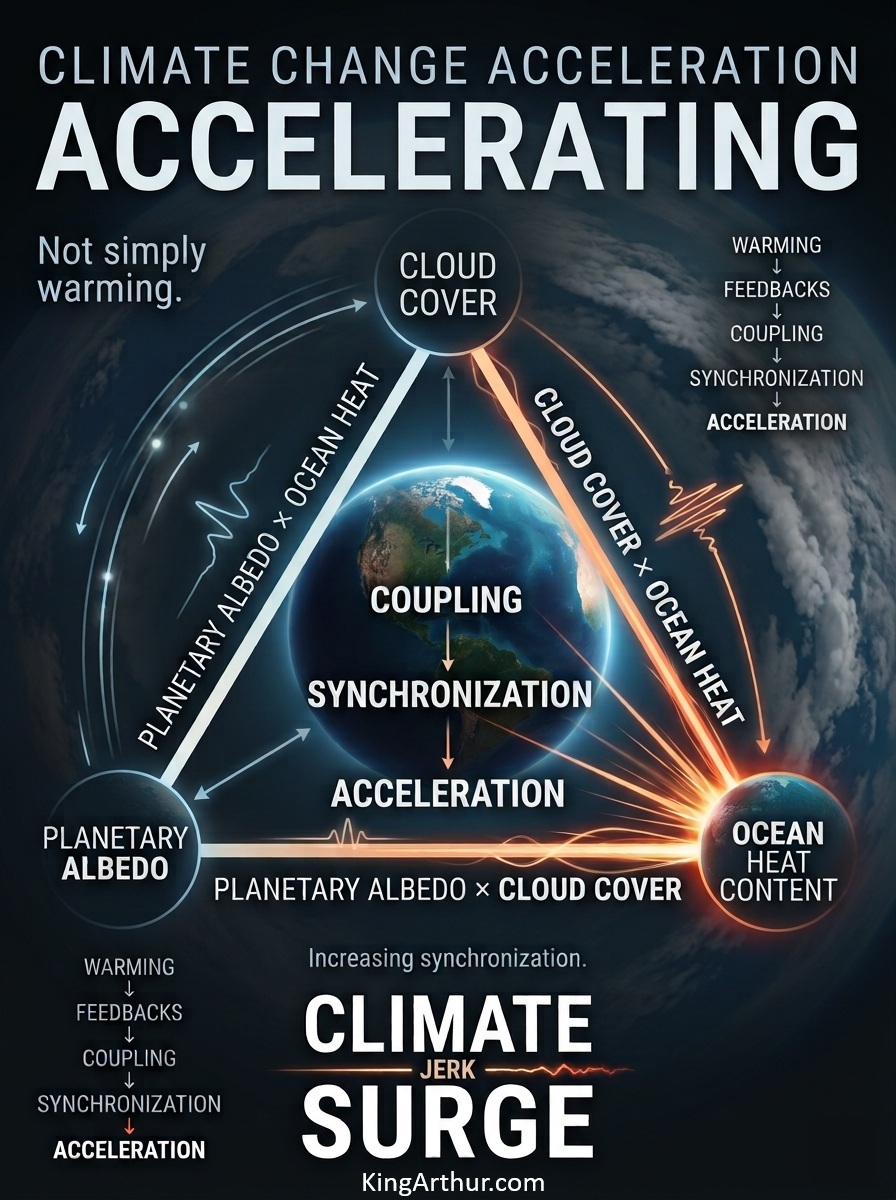
A 2026 study found that the recent change in climate-system dynamics is being expressed not simply as continued warming, but as increasing synchronization among multiple radiative and thermal feedback pathways.
Beginning most notably around 2022, an increasingly interconnected pattern emerges among six major climate-system variables: cloud cover, planetary albedo, sea ice extent, atmospheric water vapor, ocean heat content, and surface temperature.
The three largest interaction paths form a closely connected Albedo–Cloud–Ocean Heat Content triad:
The significance is not that a single feedback has suddenly appeared. These feedbacks are already well established. The emerging signal is that multiple feedback pathways are becoming increasingly coupled—and that the rate of this coupling is itself accelerating.
That accelerating coupling is the Climate Jerk Surge.
[Intro]
What’s in the tank?
(What’s in the bath?)
What’s it gonna do?
(Do the math!)
[Verse 1]
Down at the factory
Where the furnaces glow
Something’s in the vat
And we’re ready to go
Metal meets the chemistry
The surface starts to change
A little bit of science
Can make a whole lot strange
[Refrain]
Doin’ the math
(Takin’ an acid bath)
Industrial trial
(Metallurgy urgency)
[Verse 2]
Rust on the surface
Corrosion underneath
You can polish up the outside
The chemistry’s got teeth
[Chorus]
Acid bath!
(Acid bath!)
Do the math!
(Do the math!)
Anticipate
(What’s the rate?)
How long to wait?
[Refrain]
Doin’ the math
(Takin’ an acid bath)
Industrial trial
(Metallurgy urgency)
[Bridge]
Dip!
(Dip!)
Wait!
(Wait!)
Measure!
(Measure!)
Plate!
(Plate!)
Do the math!
(Acid bath!)
[Break]
Acid!
(Bath!)
Metal!
(Math!)
[Refrain]
Doin’ the math
(Takin’ an acid bath)
Industrial trial
(Metallurgy urgency)
[Final Refrain Outro]
[Fade out]
Doin’ the math
(Takin’ an acid bath)
Industrial trial
(Metallurgy urgency)
Do the Math
[Intro]
And a one…
(And a two…)
Count your fingers!
(Count your toes!)
Here goes…
[Verse 1]
One little number
Two little more
Three little problems
Knockin’ at the door
Four little warnings
Five on the wall
Six little signals
Screamin’ “Don’t fall!”
[Pre-Chorus]
Add it up…
(Add it up!)
Check the sum…
(And then some!)
[Refrain]
And a 1.
And a 2…
(1, 2, 3, 4)
Once more!
(Hit it)
Count on it
(Do the math)
Figure it out
(Avoid the wrath)
[Verse 2]
Measure the distance
Measure the time
Measure the pressure
Measure the climb
What goes up
(Must come down)
What goes round
(Comes back around)
[Refrain]
And a 1.
And a 2…
(1, 2, 3, 4)
Once more!
(Hit it)
Count on it
(Do the math)
Figure it out
(Avoid the wrath)
[Bridge]
One!
(One!)
Two!
(Two!)
Three!
(Three!)
Four!
(Four!)
Out on the dance floor
(Once more:)
Out on the dance floor!
[Break]
And a one!
(Two!)
Three!
(Four!)
Once more!
(Louder than before!)
Out on the dance floor!
[Final Refrain]
And a 1.
And a 2…
(1, 2, 3, 4)
Once more!
(Hit it)
Count on it
(Do the math)
Figure it out
(Avoid her wrath)
[Outro]
[Fade out]
And a one!
(And a two!)
Three!
(Four!)
Do the math!
(Know the path!)
I’ll Dance to That!
[Intro]
Did you say jump…?
(I’ll dance! Gettin’ up!)
You say go…
(Let’s go!)
[Verse 1]
I don’t know where the road is going
I don’t know where it lands
But I know when the rhythm catches
My whole body understands
[Refrain]
I’ll dance to that
(Or can’t deny I didn’t try)
That’s where I’m at
(Let’s dance to that)
Don’t ask why
(Just try)
… and you’ll see…
(Feelin’ happily)
[Verse 2]
The rhythm tells the truth
The beat returns your youth
Free your seat…
Let your soul keep the beat
[Refrain]
I’ll dance to that
(Or can’t deny I didn’t try)
That’s where I’m at
(Let’s dance to that)
Don’t ask why
(Just try)
… and you’ll see…
(Feelin’ happily)
[Bridge]
Left!
(Right!)
Right left.
Left’s wrong…
Same ole song,
Forward!
(Back!)
Up!
(Down!)
That’s where we’re at!
[Break]
I’ll dance to that!
(It’s where I’m at!)
Can you dance to this?
(It’s my wish!)
Can you dance to that?
(Let’s try!)
… touchin’ the sky
[Final Refrain]
I’ll dance to that
(Or can’t deny I didn’t try)
That’s where I’m at
(Let’s dance to that)
Don’t ask why
(Just try)
… and you’ll see…
(Feelin’ happily)
I’ll dance to that!
(Oh, yeah!)
I’ll dance to that!
(One more time!)
Be the rhythm
(Be the rhyme)
[Outro]
[Fade out]
I’ll dance to that
(Or can’t deny I didn’t try)
That’s where I’m at
(Let’s dance to that)
Don’t ask why
(Just try)
… and you’ll see…
(Feelin’ happily)
Mezzin’
[Intro]
Say…
(Hey!)
I’m just mezzin’…
(Messin’?)
Mezzin’ with your mind
(Messin’!)
Say what?
(Guess you’ll come to find…)
[Verse 1]
I put a question
Where the answer should be
Moved the pieces
So you couldn’t quite see
Changed the picture
Turned it upside down
Now you’re lookin’
But you’re lookin’ ’round
[Refrain]
It’s true
(I’m mezzin’ with you)
Realize
(Mesmerize)
Open your eyes!
(Mesmerize)
[Verse 2]
A magician’s hand
Moves faster than the eye
Watch the left hand
While the right goes by
Smoke and mirrors
Sparkle and shine
A little sleight of hand
Can bend your mind
[Refrain]
It’s true
(I’m mezzin’ with you)
Realize
(Mesmerize)
Open your eyes!
(Mesmerize)
[Bridge]
I’m messin’ with you…
(Or am I?)
You’re messin’ with me…
(At least you try)
We’re messin’ with reality…
(Callin’ it calamity)
Our prize…
(Mesmerized)
[Break]
Open your eyes!
(OPEN YOUR EYES!)
Look!
(LOOK!)
Mistook
(What did you see?)
Lack of reality
[Final Refrain]
It’s true
(I’m messin’ with you)
Realize
(Mesmerize)
Open your eyes!
(Mesmerize)
It’s true!
(Mezzin’ with you)
Realize!
(Realize!)
Mesmerize!
(Open your eyes!)
[Outro]
I’m messin’…
(Mezzin’…)
[Fade out]
It’s true
(I’m mezzin’ with you)
Realize
(Mesmerize)
Open your eyes!
(Mesmerize)
[Whisper]
Open your eyes…
Rosemary
[Verse 1]
Walk through the garden
(What do you see?)
A little bit of heaven
(Growing wild and free)
Purple in the twilight
(Green beside the stone)
The scents taking flight
(With a mind of their own)
[Refrain]
Lavender
(And rosemary)
The splendor
(Scents carry)
(The scene:)
The dream
(Serene)
… know what I mean?
[Verse 2]
Rosemary remembers
(That’s what they say)
Old forgotten moments
(Drifting back your way)
Lavender is floating
(Through the evening air)
Close your eyes and breathe it
(There’s a dream right there)
[Pre-Chorus]
One breath
(Takes you there)
One scent
(Anywhere)
[Refrain]
Lavender
(And rosemary)
The splendor
(Scents carry)
(The scene:)
The dream
(Serene)
… know what I mean?
Rosemary…
(Remember me…)
Lavender…
(What a memory…)
[Verse 3]
No need for a picture
(No need for a word)
Some things aren’t explained
(They’re simply heard)
A little bit of yesterday
(A little bit of now)
A little bit of tomorrow
(And we don’t know how)
[Final Refrain]
Lavender
(And rosemary)
The splendor
(Scents carry)
(The scene:)
The dream
(Serene)
… know what I mean?
[Outro]
Lavender…
(Rosemary…)
Carry me…
(Serene…)
The scene…
(The dream…)
… know what I mean?
So Long
[Verse 1]
Here we are
(And here we go)
Another song
(Another show)
Just in time
(To sing a rhyme)
Pick-up a beat
(To move your feet)
[Refrain]
This song…
(Is not so long)
No, not so long
(Not goodbye)
Not see you later
(Why not try)
A lover… not a hater
(And sing along:)
This song…
(Is not so long)
[Verse 2]
So long
(So wrong!)
Don’t make it sad
(It ain’t that bad)
A wave goodbye
(Can still be high)
A smile can say
(Come back someday)
[Pre-Chorus]
Don’t close the door
(We want some more)
Don’t turn away
(Just press replay)
[Refrain]
This song…
(Is not so long)
No, not so long
(Not goodbye)
Not see you later
(Why not try)
A lover… not a hater
(And sing along:)
This song…
(Is not so long)
[Bridge]
So…
(Long?)
So long!
(How long?)
Not very long!
(How long?)
Long enough
(To sing this song!)
[Break]
Not goodbye!
(No!)
Not farewell!
(Still dwell)
Not see you later!
(We here to cater)
We’re doing well!
So long!
(So long!)
So long!
(Not too long!)
So long!
(Along!)
Sing along!
[Final Refrain]
This song…
(Is not so long)
No, not so long
(Not goodbye)
Not see you later
(Why not try)
A lover… not a hater
(And sing along:)
This song…
(Is not so long)
[Outro]
So long…
Not goodbye…
(And, here’s why…)
One more song!
Sing along…
(And carry on…)
One more song!
(To sing along)
A Ray of Light
[Verse 1]
Through the dark
(Do you see?)
A little spark
(Inside of me?)
Through the noise
(Hear that sound?)
Make a choice
(Turn it around)
[Pre-Chorus]
One little beam
(Can wake a dream)
One little thought
(Can change the plot)
[Refrain]
Do you see
(A ray of light)
We can be
(Let’s set it right)
Shine on
(And on and on)
Shine bright
(Be the light)
Incite
(Insight)
Alright!
Light up
Shine on
(And on and on)
[Psychedelic Jam I]
[Swirling guitar / synth / handclaps]
Light…
(Light…)
Light…
(Insight…)
See it…
(Feel it…)
Be it…
(Alright!)
[Verse 2]
When the shadows
(Stretch too long)
Find the rhythm
(Find the song)
When the road
(Goes out of sight)
Keep on moving
(Toward the light)
[Refrain]
Do you see
(A ray of light)
We can be
(Let’s set it right)
Shine on
(And on and on)
Shine bright
(Be the light)
Incite
(Insight)
Alright!
Light up
Shine on
(And on and on)
[Bridge]
Don’t wait
(For the dawn)
Make light
(And carry on)
Don’t hide
(What you know)
Let insight
(Glow!)
Incite!
(Insight!)
Ignite!
(The night!)
Alright!
(Alright!)
Shine!
[Final Refrain]
Do you see
(A ray of light)
We can be
(Let’s set it right)
Shine on
(And on and on)
Shine bright
(Be the light)
Incite
(Insight)
Alright!
Light up
Shine on
(And on and on)
[Outro]
Light up…
(Shine on…)
And on…
(And on and on…)
We just might…
(Be the light…)
Alright!
Never Mind
[Intro]
Never say never
(Never mind)
Maybe forever
(Is hard to find)
Words can wander
(Left and right)
Thoughts can wander
(Out of sight)
… or… into the light
[Verse 1]
You said never
(I said mind)
Somewhere in between
(The being we’ll find)
[Refrain]
I never mind
(You bein’ kind)
The kind being kind
(I never mind)
Nevermind
(Is never in mind)
You’ll find…
(Nevermind)
Far, far behind
Oh, never mind
(The kind kind…)
Find the kind
(Bind)
[Verse 2]
Let’s go
(Let’s ride)
Put the ego
(To the side)
[Pre-Chorus]
Mind your manners
(Mind your mind)
Leave a little kindness
(For mankind)
Escape the tomb
(Find the space)
Leave a little room
(For some grace)
[Refrain]
I never mind
(You bein’ kind)
The kind being kind
(I never mind)
Nevermind
(Is never in mind)
You’ll find…
(Nevermind)
Far, far behind
Oh, never mind
(The kind kind…)
Find the kind
(Bind)
[Verse 3]
A word can cut
(A word can heal)
A thought can hide
(What you really feel)
A little kindness
(Costs so little)
But somehow kindness
(Can solve the riddle)
If you’re looking
(For a sign)
… look for
(Some kind)
If you’re searching
(For a way)
Give a little
(Away each day)
[Bridge]
Never mind!
(Never mind!)
Mind the kind!
(The kind kind!)
Kind the mind!
(Mind the kind!)
Find the bind!
(Leavin’ troubles behind!)
What connects us?
(Kindness!)
What protects us?
(Kindness!)
[Break]
Never…
(Never!)
Mind…
(Mind!)
Never mind!
(Kind!)
Kind!
(Kind!)
[Outro]
I never mind
(You bein’ kind)
The kind being kind
(I never mind)
Nevermind…
(Is never in mind)
You’ll find…
(The kind kind…)
In the light
(Alright?)
You’ll find…
(Delight…)
In the light
(All right!)
Out of Touch
[Intro]
Are we connected?
(Or disconnected?)
Are we listening?
(Or just predicting?)
Just more talking
(Out loud)
But who’s really reaching
(Through the crowd?)
[Verse 1]
Phone in my hand
(World in my face)
Messages flying
(All over the place)
[Refrain]
Out of touch
(Much)
Much
(Out of touch)
Shout:
(Reach out!)
Find out about
(Touch)
… and such
[Verse 2]
Touch the screen
(Feel the glass)
Touch the future
(Watch it pass)
Touch the numbers
(Touch the chart)
Touch the data
(Forgot the heart)
[Refrain]
Out of touch
(Much)
Much
(Out of touch)
Shout:
(Reach out!)
Find out about
(Touch)
… and such
[Verse 3]
Out of touch
(Out of mind)
Out of sight
(Undefined)
[Bridge]
Reach out!
(Find out!)
Look around!
(Look around!)
Touch the ground!
(Hear the sound!)
Hear it here
[Break]
Touch!
(Much!)
Shout Out!
(Reach out!)
Touch and such…
(Find out!)
[Outro]
Out of touch
(Much)
Much
(Out of touch)
Shout:
(Reach out!)
Find out about
(Touch)
… and such
(Shout:)
Reach out!
Floating On
[Intro]
Up above
(Where the clouds roll by)
Looking down
(From a changing sky)
No direction
(No destination)
Just a little
(Levitation)
[Verse 1]
Caught a breeze
(And away I went)
Didn’t ask
(Where the wind was sent)
Over rooftops
(Over trees)
Drifting with
(The passing breeze)
Clouds below me
(Clouds above)
Floating through
(The things I love)
[Refrain]
I’m floating on
(Floating on the wind)
Floating on and on
(Don’t know where to begin)
Floating on… again
[Verse 2]
There’s a river
(Far below)
Where it’s headed
(I don’t know)
Birds are flying
(They know why)
We keep drifting
(Through the sky)
[Refrain]
I’m floating on
(Floating on the wind)
Floating on and on
(Don’t know where to begin)
Floating on… again
[Bridge]
Am I drifting
(Or am I free?)
Will the wind
(Just carrying me?)
Do I choose
(The direction?)
Or surrender
(To convection?)
[Break]
Floating…
(Whoa…)
Drifting…
(Yeah…)
Turning…
(Around…)
Never quite
(Touching the ground)
[Final Chorus]
I’m floating on
(Floating on the wind)
Floating on and on
(Don’t know where to begin)
Floating through
(The atmosphere)
Floating far
(And floating near)
Floating on
(Through thick and thin)
Lose my way
(And find it again)
[Outro]
I’m floating on
(Floating on the wind)
Floating on and on
(Don’t know where to begin)
Floating on… again
Floating on…
(Again)
Floating on…
(And on…)
Zoot
[Intro]
What are we chasing?
(What is the pursuit?)
Something elusive
(Calling it zoot)
Round and around
(We go)
Looking for answers
(… does anybody know?)
Too much!
(Too little!)
Too far!
(Too brittle!)
Somewhere between it all
(There’s a middle)
[Verse 1]
One side says
(Go all the way!)
The other side says
(Stay where you stay!)
[Refrain]
In pursuit
(Of zoot)
Exaggerated
An acute
(Destitute)
Exasperated
Both ends of the spectrum
(Extreme lean freedom)
Meet me in the middle
(To solve the riddle)
[Verse 2]
Know the answer
(Is not extreme)
The reality
(Is somewhere between)
[Refrain]
In pursuit
(Of zoot)
Exaggerated
An acute
(Destitute)
Exasperated
Both ends of the spectrum
(Extreme lean freedom)
Meet me in the middle
(To solve the riddle)
[Bridge]
Come on over
(Just a little)
Take a breath
(Meet me in the middle)
You bring your answer
(I’ll bring mine)
Maybe together
(We’ll define time)
[Break]
Zoot!
(Does it suit?)
Root, root, root
(Zoot!)
[Final Refrain]
In pursuit
(Of zoot)
Exaggerated
An acute
(Destitute)
Exasperated
[Outro]
Both ends of the spectrum
(Extreme lean freedom)
Meet me in the middle
(To solve the riddle)
Zoot…
(At the root)
[Fade out]
Zoot, zoot, zoot
Oh, Now I Get…
[Verse 1]
Round and round
(What was that?)
Lost the thread
(Where’s it at?)
[Refrain]
Oh… so…
(Now I get…)
It
It took…
(A bit)
… but…
(Now I get it!)
Got!
(Not forgot)
[Verse 2]
Aha!
(Oh!)
There it is
(Whoa!)
Pieces click
(Into place)
Suddenly
(I know the face)
[Break]
Wait…
(What?)
What?
(Weight!)
Oh!
(Now!)
I…
(Get…)
Got!
(Not: forgot)
[Verse 3]
Didn’t see it
(At the start)
Now it’s beating
(In my heart)
Mystery
(Becomes clear)
Funny how
(It disappears)
[Refrain]
Oh… so…
(Now I get…)
It
It took…
(A bit)
… but…
(Now I get it!)
Got!
(Not forgot)
[Final Jam]
Oh!
(Now I get it!)
So!
(Now I see!)
In and out
(… of me!)
Get!
(Got!)
[Outro]
Oh…
(Oh!)
Now I get…
…it!
Got!
(Not forgot)
Go Get ‘Er
[Intro]
There she goes
(He thinks he knows)
A start of the heart
(Life glows)
Something shining
(Through the haze)
Pulls you in
(And sets ablaze)
Don’t just wonder
(Don’t just wait)
If you want it
(Change your fate)
[Verse 1]
She’s a real
(Go get ‘er)
Touch to feel
(Go get her)
Something happens
(When she’s near)
Suddenly
(The path is clear)
You can dream it
(You can see)
You can wonder
(What could be)
But a dream
(Is just a dream)
‘Til you step into
(The scene)
[Refrain]
She’s a real
(Go get ‘er)
Touch to feel
(Go get her)
Know what I mean
… dream the scene
(Join the seen)
Turn dream
(Into reality)
See…
(Seen)
… live the dream
Grab hold of life!
(Relief from strife)
Come alive
(… and thrive…)
[Verse 2]
There’s a moment
(There’s a chance)
Life is calling
(Join the dance)
Don’t be waiting
(For a sign)
Anticipating
(Counting time)
Take the vision
(Make it real)
Take the thought
(Turn to feel)
From imagination
(To the street)
Put your dream
(Into the beat)
[Refrain]
She’s a real
(Go get ‘er)
Touch to feel
(Go get her)
Know what I mean
… dream the scene
(Join the seen)
Turn dream
(Into reality)
See…
(Seen)
… live the dream
Go get ‘er!
(Grab hold of life!)
Dreams of rife (life!)
[Bridge]
Dream!
(Seen!)
Seen!
(Scene!)
Be
(Reality)
[Break]
You know…
(Go!)
Get!
(‘Er!)
Go!
(Get ‘er!)
[Outro]
She’s a real
(Go get ‘er)
Touch to feel
(Go get her)
Know what I mean
… dream the scene
(Join the seen)
Turn dream
(Into reality)
See…
(Seen)
… live the dream
[Fade out]
Go get ‘er!
(Go get ‘er!)
Go get ‘er!
(Go!)
Seen: the dream
(Scene: the dream)
Woof
[Intro]
Who’s that talking?
(Who’s that there?)
Making noise
(Everywhere)
Little growl
(Big idea)
Something’s coming
(Now it’s near)
[Verse 1]
You hear a bark
(You look around)
Lookin’ like a land shark
(Attack bound?)
Tail is wagging
(Teeth are showing)
Hard to tell
(Which way it’s going)
[Refrain]
Woof, woof
(You barking at me?)
Woof proof
(You’re barking up the wrong tree)
[Verse 2]
You can talk tough
(You can growl)
You can make a
(You can bark and howl)
[Refrain]
Woof, woof
(You barking at me?)
Woof proof
(You’re barking up the wrong tree)
[Bridge]
Woof!
(What’s that?)
Woof!
(Who’s that?)
Woof!
(Where you at?)
Woof proof!
(That’s that!)
[Break]
Bark!
(In the dark!)
Growl!
(See a moon… howl)
Howl!
(Howl!)
Bow-wow-wow!
[Final Refrain]
Woof, woof
(You barking at me?)
Woof proof
(You’re barking up the wrong tree)
[Outro]
Woof!
(Woof!)
Barking up…
(The wrong tree!)
… obviously
Raisin’
[Intro]
[Low Synth Drone, Spoken Vocal, Distant and Fragmented]
Beam me down
(Down, down, down)
“Is there any intelligent life…”
… around
(Can any be found…)
Spinnin’
(Round n’ round n’ round)
[Verse 1]
Wake up
(Shake up)
Get outta bed
(Get that beat inside your head)
Sunrise
(Open eyes)
Another day
(Another chance to find a way)
No matter where
(You came from)
No matter who
(You are)
We’re breathing
(Underneath the same star)
[Refrain]
Raisin’ the roof
(Raisin’ the vibe)
Proof!
(We’re one tribe)
The human race
(All in one place)
Raise love above
(Love, love, love)
[Verse 2]
Raise your hand
(If you understand)
Raise your voice
(We all have a choice)
Raise the roof
(Raise the floor)
Raise some hell
(Then raise some more)
Raise your spirits
(Raise your eyes)
Raise your hopes
(And realize)
We don’t have
(To tear apart)
To make room
(Inside the heart)
[Chorus]
Raise it up
(Up, up, up!)
Raise it high
(High, high, high!)
Raise a little
(Harmony)
Raise a little
(Humanity)
Raise the roof
(Raise the vibe)
Raise the proof
(We’re one tribe)
[Verse 3]
Some are rich
(Some are poor)
Some have plenty
(Some need more)
Some have power
(Some have none)
All our hours
(Under one sun)
[Refrain]
Raisin’ the roof
(Raisin’ the vibe)
Proof!
(We’re one tribe)
The human race
(All in one place)
Raise love above
(Love, love, love)
[Verse 4]
Raise compassion
(Raise it up)
Raise forgiveness
(Fill the cup)
Raise awareness
(Raise your sight)
Raise a candle
(Be the light)
Raise the question
(Raise the bar)
How much better
(Could we be “our”?)
Raise the future
(Raise today)
Raise each other
(On the way)
[Bridge]
The folklore
(of “us and them”)
Is no more
(I think… therefore I am!)
[Break]
Raisin’!
(Praisin’!)
Raise it up!
(Up!)
Raise love!
(Love!)
… above…
Give flight…
… to the white winged dove
The light of love
[Final Refrain]
Raisin’ the roof
(Raisin’ the vibe)
Proof!
(We’re one tribe)
The human race
(All in one place)
Raise love above
(Love, love, love)
Raisin’ the roof
(Raisin’ the vibe)
Higher!
(We’re still alive)
The human race
(All in one place)
Raise love above
(Love, love, love)
Raise love…
(Above!)
Love, love, love
[Outro]
Can you see reality
(It’s coming into view)
A world moving rapidly
(What are we gonna do?)
Raise love…
(Above!)
Love, love, love
Heroic
[Intro]
An amazing (epiphany)
The phasing (in and out of me)
I can see clearly
(My heart to infinity)
Mortality
(Always surrounds me)
I can see clearly
(My heart to infinity)
Mortality
(Always astounds me)
An amazing (epiphany)
The phasing (in and out of me)
[Outro]
An amazing (epiphany)
The phasing (in and out of me)
I can see clearly
(My heart to infinity)
Mortality
(May you elude me)
Steady
Ready… steady…
(Let me know when you’re ready to go!)
[Verse 1]
[Acoustic Guitar, Bass, Light Drums]
Take a breath
(Feel the floor)
Take a step
(Out the door)
Don’t look back
(Find the groove)
Nothing we lack
(Let’s just move!)
The world is spinning
(Round and round)
And we’ve got rhythm
(We found the sound)
One foot forward
(Then the other)
Find your balance
(Like no other)
[Refrain]
[Full Band, Organ, Saxophone]
Are you ready?
(Rock steady!)
Get off your seat
(And on your feet)
Come on already…
(Rock steady!)
Get on your feet
(Move to the beat)
[Verse 2]
[Drums Build, Electric Guitar]
Ready now
(Don’t lose your way)
Steady now
(We’re gonna play)
Keep it moving
(Keep it tight)
Left to the left
(Right to the right)
Don’t need perfect
(Don’t need clean)
Just keep dancing
(Feel the machine)
The bass goes down
(The guitar goes high)
Saxophone screaming
(Into the sky)
Piano pounding
(Keeping time)
Everybody moving
(Doing fine!)
Rock steady!
(Whoa-oh!)
Rock steady!
(Whoa-oh!)
[Refrain]
Are you ready?
(Rock steady!)
Get off your seat
(And on your feet)
Come on already…
(Rock steady!)
Get on your feet
(Move to the beat)
Ready?
(Ready!)
Steady?
(Steady!)
One…
(Two…)
Three…
(Four!)
Come on…
(Dance some more!)
Steady!
(Steady!)
Ready!
(Ready!)
Move!
(Move!)
Groove!
(Groove!)
Rock n’ ready?
(Rock steady!)
Don’t stop!
(On top!)
[Final Refrain]
Are you ready?
(Rock steady!)
Get off your seat
(And on your feet)
Come on already…
(Rock steady!)
Get on your feet
(Move to the beat)
[Outro]
Are you ready?
(Rock steady!)
No time to wait
(It’s not too late)
Come on already…
(Rock steady!)
Everybody move
(And find your groove!)
Grab My Guitar
[Intro]
Hear that sound
(Coming around)
Six strings calling
(Without warning)
Pick it up
(Shake it up)
Let the rhythm
(Carry ’em)
One basic chord
(Opens the door)
One little beat
(Moves your feet)
[Verse 1]
Woke up this morning
(What did I find?)
A melody forming
(Inside of my mind)
No need for a reason
(No need for a plan)
Just follow the feeling
(As far as I can)
The world keeps spinning
(Round and round)
But there’s something different
(When you make a sound)
A wooden box
(A little wire)
Turn it loose
(Set it on fire!)
[Refrain]
Gonna grab my guitar
(I’ll meet you outside)
… and play
Whether near or far
(Sing it far and wide)
… all day
[Verse 2]
Play on the porch
(Play in the street)
Play in the kitchen
(Dance with the beat)
Play in the sunshine
(Play in the rain)
Play through the laughter
(Play through the pain)
Don’t need a stadium
(Don’t need a crowd)
One voice is plenty
(But two sounds loud!)
[Refrain]
Gonna grab my guitar
(I’ll meet you outside)
… and play
Whether near or far
(Sing it far and wide)
… all day
What are you waiting for?
(Get out the door)
What are you gonna do?
(Come play it through)
[Refrain]
Gonna grab my guitar
(I’ll meet you outside)
… and play
Whether near or far
(Sing it far and wide)
… all day
[Dance Break]
Strum it!
(Shake it!)
Pick it!
(I’ll take it!)
[Final Refrain]
Gonna grab my guitar
(I’ll meet you outside)
… and play
Whether near or far
(Sing it far and wide)
… all day
[Outro]
Gonna grab my guitar
(And open the door)
… and play
Whether near or far
(We’ll make some more)
… all day
Free Wheeling
To be…
(Free…)
Wheeling…
(Reeling…)
Round and round
(Without a sound)
Reach out!
(Shout!)
Feel it…
(… till it won’t quit)
[Instrumental Surf-Rock Riff]
[Verse 1]
Rolling down the highway
(No map in sight)
Wind against my face
(Feels just right)
The road keeps bending
(Out of view)
And every mile
(Feels brand new)
[Pre-Chorus]
[Drums Build]
[Echoed Guitar]
Don’t look back
(Keep moving)
Don’t lose track
(Keep grooving)
The present is clear…
(It’s already here)
[Refrain]
Free wheeling
(Reeling in “real”-ing)
Reach out and feel
(It’s the real deal)
Living in the here
(Living in the now)
Dream the future
(Coming clear)
Making sure we’ll endure
(For all ears to hear)
[Verse 2]
Feel life’s current
(Flowing through)
Obvious the present
(Is here with you)
No crystal ball
(No guarantee)
Just what we do
(With what we see)
[Verse 1]
Sent out on the water
(Out to sea)
Wind behind me
(Set me free)
Waves keep rolling
(Rolling on)
Darkness comes
(And then it’s gone)
[Refrain]
Sent wailing
(Sailing)
Said “Whoa!”
(… to woe)
Oh, no, no, no
Ain’t gonna cry
(No more!)
Gonna try to try
(More than before)
[Verse 2]
When the wind gets stronger
(Hold the line)
When the night gets longer
(Find the sign)
[Refrain]
Sent wailing
(Sailing)
Said “Whoa!”
(… to woe)
Oh, no, no, no
Ain’t gonna cry
(No more!)
Gonna try to try
(More than before)
[Outro]
From woe!
(To go!)
Ain’t gonna cry!
(No more!)
Gonna try to try!
(Spread our wings… soar!)
Sent wailing…
(Sailing…)
Said “Whoa!”
(… to woe)
Oh, no, no, no…
One more try…
(Fly!)
Play the Game
The cards are on the table
(The table’s turning round)
The rules aren’t quite stable
(But listen to that sound)
[Verse 1]
We came with empty pockets
(And a head full of dreams)
Life keeps changing channels
(Or so it seems)
You can’t keep every moment
(You can’t hold back the tide)
But you can choose the way
(You take the ride)
[Pre-Chorus]
[Drums Build]
So roll the dice
(Breathe once or twice)
Look around
(You’re alive)
[Refrain]
Let’s…
(Play the game)
Sure bets…
(That’s the name)
Play the game of livin’
(With what we’ve been givin’)
Take love’s advice…
(Come to life)
Come out and play
(Today)
[Verse 2]
We chase tomorrow
(And forget today)
We build our little castles
(Then give them away)
A little bit of kindness
(A little bit of grace)
Can change the whole equation
(Can change the place)
[Refrain]
Let’s…
(Play the game)
No regrets…
(Stayin’ sane)
Play the game of livin’
(With what we’ve been givin’)
Take love’s advice…
(Come to life)
Come out and play
(Today)
[Bridge]
The end of the game
(Isn’t winning)
Never the same…
(Close to beginning)
[Electric Guitar Swell]
Love…
(Love)
Life…
(Life)
Play…
(Away)
… all day
Come alive!
(Thrive!)
Live!
(Live!)
Give!
(Give!)
Love!
(Love!)
Let’s…
(Let’s!)
Play…
(Play!)
The…
Game!
(GAME!)
Of livin’!
[Refrain]
Let’s…
(Play the game)
Sure bets…
(The name)
[Outro]
Play the game of livin’
(With what we’ve been givin’)
Take love’s advice…
(Come to life)
Come out and play
(Today)
Play the game!
(Play the game!)
With what we’ve been givin’!
(Keep on livin’!)
Come out and play…
(Today.)
What do you say…?
Through the Curtains
[Intro]
Behind the curtain
(Beyond the room)
Something is shining
(Dispelling the gloom)
A little bit of daylight
(Slipping through)
A world beyond the window
(Waiting for you)
Through the curtains
(Life begins)
[Verse 1]
Heavy cloth is hanging
(Blocking out the sun)
Shadows on the ceiling
(Where the light has run)
Standing in the darkness
(Thinking that it’s night)
Never seeing clearly
(What is hiding in the light)
Pull a little closer
(Pull the fabric wide)
Look a little farther
(… to the other side)
[Pre-Chorus]
Turn your head
(Change the angle)
Lift from dread
(Greet an angel)
[Refrain]
Through the drapes…
(The view escapes)
Light beyond the veils
(The comparison pales)
What point of view…
(… have you?)
[Verse 2]
One window faces east
(Another faces west)
Same world outside
(Different light at best)
One sees the sunrise
(One sees the night)
One sees the storm clouds
(One sees the light)
Perspective is a prism
(Breaking up the beam)
Turn it in your fingers
(Watch the colors gleam)
[Pre-Chorus]
Look left
(Look right)
Step back
(See light)
Through the curtains
(Look out again)
[Refrain]
Through the drapes…
(The view escapes)
Light beyond the veils
(The comparison pales)
What point of view…
(… have you?)
[Bridge]
Step into view
(Feel what’s true)
Follow the angle
(Let the thought dangle)
Pull the drapes!
(Pull ’em wide!)
Let the daylight
(Inside!)
Look around!
(Look around!)
There’s a view to be found!
Through the curtains
(The scene is certain)
[Final Refrain]
Through the drapes…
(The view escapes)
Light beyond the veils
(The comparison pales)
[Outro]
What point of view…
(… have you?)
Through the drapes…
(The world awaits)
Pull back the veil
(And open the gates)
[Outro]
Get up off your seat
(Get up on your feet)
… move to the beat
(Experience complete)
… complete the beat
(It’s time…)
… for rhythm and rhyme
Last Dance?
Excuse me…
(Clearly…)
[Refrain]
Is this the last dance?
(In the near future)
Is there any chance…
(You’d care to dance?)
Dance!
(Take a stance…)
Dance!
[Refrain]
Is there any chance
(After the last dance)
There could be “ONE MORE SONG!…
(So we could dance along?)
… and on and on!
Dance!
(Take a stance…)
Dance!
[Refrain]
Is this the last dance?
(In the near future)
Is there any chance…
(You’d care to dance?)
Dance!
(Take a stance…)
Dance!
[Outro]
Is this the last dance?
(Let’s ensure the future)
Since it’s our last chance…
(Would you care to dance?)
Dance!
(Shake n’ prance…)
Dance!
Hurry… Before the Sun Goes Down
[Intro]
Hurry…
(What are we waiting for?)
… something more than before?
Look alive!
(The daylight’s moving!)
Finish through with the drive.
Round and round…
(So… here we go!)
[Verse 1]
Morning came
(And morning went)
Another day
(Was heaven sent)
Coffee’s cold
(The clock is ticking)
Time keeps moving
(No time for nitpicking)
Look to the east
(The light is bright)
Look to the west
(It’s fading light)
The sun ain’t really
(Running away)
We’re turning underneath it
(Another spin today)
[Pre-Chorus]
Tick-tock
(Watch the clock)
Round and round
(The world goes around)
Take your chance
(Join the dance)
Before the light
(Gives up the fight)
[Refrain]
Better hurry…
(Before the sun goes down)
Come on.. let’s scurry
(Before the next spinnin’ round)
Then, it will dawn on you
(The axis of our view)
[Verse 2]
We say sunrise
(We say sunset)
But where’s the sun?
(You haven’t met)
Earth keeps turning
(Under the light)
Half in the daytime
(Half in the night)
[Pre-Chorus]
Round and round
(We all go)
Up and down
(We don’t know)
Tilted world
(Shifting view)
What looks old
(Can start anew)
[Refrain]
Better hurry…
(Before the sun goes down)
Come on.. let’s scurry
(Before the next spinnin’ round)
Then, it will dawn on you
(The axis of our view)
[Bridge]
When the end of the day…
(Is on it’s way)
We can begin…
(To turn it ’round again)
Round!
(Round!)
Round!
(And round!)
Spin me around
(Feet on the ground!)
Sunrise!
(Sunset!)
Daylight!
(Night!)
Turn it around…
(See the light!)
[Breakdown]
Dawn!
(Don’t yawn!)
Sun!
(We’re one!)
Spin!
(Begin!)
Turn!
(Yearn!)
Dawn on you!
(Dawn on me!)
Change your view!
(See what’s to be!)
[Final Refrain]
Better hurry…
(Before the sun goes down)
Come on.. let’s scurry
(Before the next spinnin’ round)
[Outro]
Then, it will dawn on you
(The axis of our view)
Better hurry…
(Before the sun goes down)
Come on.. let’s scurry
(Before the next spinnin’ round)
The world keeps turning
(And so do you)
Then, it will dawn on you…
(The axis of our view!)
Before the sun goes down…
(Hurry!)
Before the world spins ’round…
(Scurry!)
Then it will dawn…
(Dawn!)
Then it will dawn on you…
The axis…
(Of our view…)
Round and round…
Crank It Up
[Intro]
Turn it on!
(Oh, turn it on!)
A little more…
(Let it pour!)
Come on!
(Come on!)
CRANK IT UP!
[Verse 1]
Started low
(Started to grow)
Went from still…
(To full freewill)
Turn the dial
(Feel the vibration)
Wake the room
(Shake the foundation)
[Refrain]
Come on!
(Crank it)
Up, up, up
I’m beggin’
(Turn it on)
Crank it up
(Get gettin’ on…)
… make it happen
Feel it…
(… all around)
(Gettin’ down)
Down, down, down
(Crank it)
Up, up, up
[Verse 2]
Bass is thumping
(Heart is jumping)
Guitar screaming
(Brings on dreaming)
Turn it higher
(Feed the fire)
Don’t you stop
(Take it to the top)
[Refrain]
Come on!
(Crank it)
Up, up, up
I’m beggin’
(Turn it on)
Crank it up
(Get gettin’ on…)
… make it happen
Feel it…
(… all around)
(Gettin’ down)
Down, down, down
(Crank it)
Up, up, up
[Bridge]
Get…
(Down…)
Down…
(Down…)
Now…
GET UP!
Down to the bottom
(Then back to the top)
Down to the basement
(Never gonna stop)
How low?
(GET DOWN! DOWN! DOWN!)
How high?
(TRY UP! UP! UP!)
CRANK IT!
UP!
[Final Refrain]
Come on!
(Crank it)
Up, up, up
I’m beggin’
(Turn it on)
Crank it up
(Get gettin’ on…)
… make it happen
[Outro]
Feel it…
(… all around)
(Gettin’ down)
Down, down, down
(Crank it)
Up, up, up
Come on!
(Crank it)
Up, up, up!
Don’t stop!
(Keep it going!)
Turn it on!
(Keep it flowing!)
Crank it up!
(Get gettin’ on!)
The Climb
[Intro]
[Low Synth Drone, Spoken Vocal, Acoustic Guitar]
Up, up, up we go…
(Where the branches sway)
Step by step, the world unfolds
(And the clouds give way)
[Verse 1]
I started out with my feet on the ground
Looking for a truth that couldn’t be found
I chased the horizon, I followed the breeze
I searched for answers in the tops of the trees
[Refrain]
I climbed up the tallest tree
(To see what I could see)
There staring right at me…
(Was my destiny)
I climbed to the mountain top
(Until the top came to a stop)
I looked out upon the scene
(… there the dream was seen)
It’s right there
(Are you aware?)
… love is everywhere
[Verse 2]
I thought that the summit would tell me the truth
Reveal all the secrets I’d missed in my youth
I thought that the distance would make it all clear
That the meaning of life would be waiting up here
But no golden doorway, no voice from above
Just a world full of wonder, connected by love
The rivers, the forests, the ocean, the sky
All part of a whole that no wall can divide
[Pre-Chorus]
I looked to the east
(I looked to the west)
I searched every corner
(To find what was best)
Then I stopped looking
(And opened my eyes)
The answer was there
(In the earth and the skies)
[Refrain]
I climbed up the tallest tree
(To see what I could see)
There staring right at me…
(Was my destiny)
I climbed to the mountain top
(Until the top came to a stop)
I looked out upon the scene
(… there the dream was seen)
It’s right there
(Are you aware?)
… love is everywhere
[Bridge]
Higher and higher
(What did I find?)
A wider horizon
(Of how to be kind)
(Climb up!)
(Look out!)
(Open your eyes!)
(It’s all around!)
[Breakdown]
It’s right there…
(And there!)
Can you see it?
(Can you feel it?)
It’s right here…
(Can you hear!)
[Final Refrain]
I climbed up the tallest tree
(To see what I could see)
There staring right at me…
(Was my destiny)
I climbed to the mountain top
(Until the top came to a stop)
I looked out upon the scene
(… there the dream was seen)
It’s right there
(Are you aware?)
… love is everywhere
It’s right there
(In the earth and air)
It’s right here
(If we care)
It’s right there
(Are you aware?)
… love is everywhere
Just a little interruption
(In the middle of your day)
I’ve got something to tell you
(But you might look away!)
[Verse 1]
We were busy making plans for tomorrow
While the present was filling with sorrow
We were arguing over who’s to blame
While the whole damn system was going up in flames
We were checking our phone
(Scrolling away)
While reality knocked
(We told it, “Go away!”)
[Pre-Chorus]
Tap, tap, tap
(Who’s there?)
Knock, knock, knock
(Do I care?)
A little inconvenient truth
(Interrupting your groove)
But the facts don’t wait
(For your approval to move!)
[Refrain]
Excuse me…
(Did you see:)
Reality?
Pardon me…
(I didn’t mean to interrupt)
But…
… to be abrupt
(Your hair is on fire)
Flamin’ higher
(Higher! Higher! Higher!)
[Verse 2]
You said the numbers were just a phase
A little blip in the historical haze
You said the warnings were all overblown
Then the weather came knocking that you own
The old assumptions start to crack
And reality doesn’t take them back
You can change the channel
(You can close your eyes)
Then reality comes…
(As a big surprise!)
[Pre-Chorus]
Wait, wait, wait
(What’s that smell?)
Something’s burning
(You can tell!)
No time for spin
(No time for bluff)
The truth is knocking
(And it’s knocking rough!)
[Refrain]
Excuse me…
(Did you see:)
Reality?
Pardon me…
(I didn’t mean to interrupt)
But…
… to be abrupt
(Your hair is on fire)
Flamin’ higher
(Higher! Higher! Higher!)
[Bridge]
It’s not the message
(It’s the delay)
It’s not the warning
(It’s looking away)
You can argue with the messenger
(You can call them a fool)
But the fire doesn’t care
(About your political rule)
[Breakdown]
Excuse me!
(Your hair!)
Pardon me!
(Do you care!)
I hate to interrupt
(But look above!)
That’s not a halo
(That’s combustion, love!)
Higher!
(Higher!)
Fire
(Fire!)
[Instrumental]
[Final Refrain]
Excuse me…
(Did you see:)
Reality?
Pardon me…
(I didn’t mean to interrupt)
But…
… to be abrupt
(Your hair is on fire)
[Outro]
Flamin’ higher
(Higher! Higher! Higher!)
Excuse me…
(Can’t you see)
Smokin’ up your scene…
(Isn’t a dream!)
… know what I mean?
Keep ‘Em Comin’
[Intro]
Come on!
(Come on!)
Get it started
(Keep it goin’!)
One more round
(Don’t slow down!)
Let your soul be found
(Make that sound!)
[Verse 1]
A simple spark and the whole thing’s lit
Get on the floor, let the rhythm hit
One more thought, one more idea
Keep that momentum rolling right here
Round and round, let the wheels spin
Each time we stop, we can start again
No sitting still, no calling it done
We’re just getting started, we’re having fun!
[Refrain]
Oh, come on, come on
(Keep ’em comin’)
Start (begin)
Keep ’em comin’
(Move it along)
Oh, come on, come on
(Keep ’em comin’)
Do it (again)
Keep ’em comin’
(Till we reach the dawn)
[Verse 2]
Keep the ideas coming down the line
One more connection and we’re feeling fine
Mix it, match it, let it collide
See what happens when the pieces combine
More interaction, more reaction
More of that feedback satisfaction
Add a change… get into the groove
Push it forward, keep it on the move!
[Refrain]
Oh, come on, come on
(Keep ’em comin’)
Start (begin)
Keep ’em comin’
(Move it along)
Oh, come on, come on
(Keep ’em comin’)
Do it (again)
Keep ’em comin’
(Till we reach the dawn)
[Bridge]
Keep the beat
(Keep it rollin’)
Toward complete
(Keep ’em turnin’)
Keep the sparks
(Keep ’em flyin’)
Keep the loops
(Keep replyin’)
More connections
(More interaction)
More reactions
(More amplification)
[Breakdown]
Come on!
(Keep ’em comin’!)
One more!
(Keep ’em comin’!)
Faster!
(Keep ’em comin’!)
Louder!
(Keep ’em comin’!)
Start it up!
(Begin!)
Move it on!
(Again!)
Don’t stop now!
(Keep ’em comin’!)
[Final Refrain]
Oh, come on, come on
(Keep ’em comin’)
Start (begin)
Keep ’em comin’
(Move it along)
Oh, come on, come on
(Keep ’em comin’)
Do it (again)
Keep ’em comin’
(Till we reach the dawn)
[Outro]
Oh, come on, come on
(Keep ’em comin’)
One more time!
(Keep ’em comin’!)
Oh, come on, come on
(Keep ’em comin’)
Round and round
(Till the sun comes on!)
Keep ’em comin’!
Passing Through (Neutrino)
[Intro]
Here they come!
(Where?)
Right there!
(Where?)
Right through the walls
(Through closed doors and down the halls)
Through the ceiling
(Through the door)
Through your body
(… here come more!)
[Verse 1]
The Sun’s throwing particles across the sky
Billions of billions go racing by
No invitation, no ticket to show
They slip through the places you’ll never know
Through your head
(Through your toes)
Through your heart
(There one goes!)
No bump, no bruise
No bang, no sound
A hundred trillion
(Just passing around!)
[Refrain]
Have you met
(A neutrino?)
I bet…
(You didn’t know)
The real deal
(You won’t even feel)
A single blow
They’re passing right through…
(You)
[Verse 2]
They’re born in the Sun where the fusion burns
And cosmic explosions send more in turns
From distant galaxies, far beyond sight
They cross the universe at nearly light
They’re ghost-like guests
(They don’t knock)
They don’t need keys
(They don’t stop)
Matter’s a maze
(They mostly ignore)
They pass through the Earth
(And out the other door!)
[Pre-Chorus]
A hundred trillion
(Every second!)
Through your body
(You reckon?)
No collision
(No sensation)
Just a subatomic
(Transit station!)
[Refrain]
Have you met
(A neutrino?)
I bet…
(You didn’t know)
The real deal
(You won’t even feel)
A single blow
They’re passing right through…
(You)
[Bridge]
You think you’re solid
(Strong and dense)
A wall of matter
(With a fence)
But deep in the atoms
(There’s room to spare)
And neutrinos move
(Like they’re barely there!)
Through the planet
(Through the stone)
Through the places
(You call your own)
Most pass by
(Without a trace)
But once in a while
(They leave a case!)
[Instrumental]
(Zoom!)
(Through you!)
(Zoom!)
(Comin’ through!)
(From the Sun!)
(From a star!)
(They don’t care!)
(Where you are!)
[Breakdown]
Who’s passing through?
(Neutrinos!)
Who’s feeling it?
(No one knows!)
[Final Refrain]
Have you met
(A neutrino?)
I bet…
(You didn’t know)
The real deal
(You won’t even feel)
A single blow
They’re passing right through…
(You)
[Outro]
Have you met
(A neutrino?)
They’re everywhere
(But hard to know)
Through your bones
(Through your shoes)
Through the Earth
(And out they cruise)
They’re passing right through…
(You!)
Pinball Lizard
[Intro]
Release the ball!
(Let it roll!)
Light it up!
(Lose control!)
Bing! Bang!
(Cling! Clang!)
Who’s got the flippers?
(Who’s got the bumpers?)
[Verse 1]
You pull me close, then push me away
You change the rules in the middle of play
One minute I’m winning, the next I’m in doubt
You keep me bouncing till I burn out
Left flipper, right flipper
(Who’ll remain…?)
Up the ramp
(Down the drain!)
[Instrumental: Guitar Riff]
[Pre-Chorus]
Bump me!
(Thump me!)
Send me flying through the air
Catch me!
(Release me!)
Do you even know I’m there?
[Refrain]
It’s plain to see
(You’re playing with me)
Hittin’ all the bumpers
(Drivin’ me bonkers)
Are you going to tilt
(Are you going to jilt?)
After all
(… I’m not a pinball)
[Instrumental: Psychedelic Jam]
[Verse 2]
You light up the targets, then shut off the lights
You send me ricocheting through the longest nights
Every time I think I’ve got the game figured out
You flip the whole table and turn me about
Ding-ding!
(Another score!)
Ka-ching!
(Then out the door!)
I’m chasing jackpots
(That never arrive)
How many more rounds
(Do I have to survive?)
[Pre-Chorus]
Bump me!
(Thump me!)
Keep me spinning in the game
Shake me!
(Break me!)
Then you tell me I’m to blame!
[Refrain]
It’s plain to see
(You’re playing with me)
Hittin’ all the bumpers
(Drivin’ me bonkers)
Are you going to tilt
(Are you going to jilt?)
After all
(… I’m not a pinball)
[Bridge]
There’s a little red light
(Flashing in my head)
A warning on the scoreboard
(That I should’ve read)
You keep me in motion
(But I choose the direction)
I’m done being bounced around
(Without my own reflection!)
You can pull the plunger
(You can start the game)
But you don’t own the ball
(And I won’t play the same!)
(Bing!)
(Bang!)
(Clang!)
(Ka-pow!)
Left!
(Right!)
Up!
(Down!)
Who’s playing who
(Is it me or you?)
[Breakdown]
Tilt!
(Warning!)
One more shove
(Goodbye, love!)
[Final Refrain]
It’s plain to see
(You’re playing with me)
Hittin’ all the bumpers
(Drivin’ me bonkers)
Are you going to tilt
(Are you going to jilt?)
After all
(… I’m not a pinball)
It’s plain to see
(I’m finally free)
Are you going to tilt?
(That’s your guilt!)
After all…
(… I’m not a pinball!)
[Outro]
Game over!
(Insert another coin!)
Game over!
(Enough kicks to the groin!)
Bing…
(Bang…)
Out of the Box
[Intro]
Unwrap
(The rapped)
Cut the tape
(Escape!)
[Refrain]
Packaged
(Out of the box)
Welcome to the age
(Reset your clocks)
[Refrain]
Packaged
(Out of the box)
Welcome to a new Age
(Reset your clocks)
Let out of the cage
(Engage)
… welcome to the world stage!
[Refrain]
Packaged
(Out of the box)
Welcome to a new Age
(Reset your clocks)
Let out of the cage
(Engaged)
… on to the next stage!
(Obviously…)
Taking advantage
(… of the opportunity…)
TO BE!
[Refrain]
Packaged
(Out of the box)
Welcome to a new Age
(Reset your clocks)
[Outro]
Let out of the cage
(Engage)
… turn the page!
(Obviously…)
Taking advantage
(… of the opportunity…)
TO BE!
(Lovely… simply lovely)
Catch Me
[Intro]
Ready?
(Ready!)
Steady?
(Almost!)
One, two, three…
(Catch me!)
Jump!
(Whoa!)
Did you know…
(Here we go!)
[Verse 1]
I’m standing on the edge of a brand-new day
Got a head full of dreams and a plan underway
I might take a leap, I might lose my footing
But I’ll trust you to catch me if I start free-falling
You reach out your hand
(I reach out mine)
We meet in the middle
(And everything’s fine!)
It’s not about falling
(It’s learning to fly)
With someone beside you
(Who’ll give it a try!)
[Refrain]
Catch me
(I’ll jump)
… and rescue you
Together “we”!
(… we’ll pump)
Up!
(Up, up, up)
Yup
(Pump up!)
[Verse 2]
When your batteries fade and your engine runs low
I’ll be right beside you, helping you go
You bring the rhythm, I’ll bring the beat
We’ll put a little more bounce into our feet
Pump up the power
(Pump up the pace)
Give one another
(A little more grace)
To stumble, to learn
(To change, to grow)
The higher we climb
(The better the show!)
[Refrain]
Catch me
(I’ll jump)
… and rescue you
Together “we”!
(… we’ll pump)
Up!
(Up, up, up)
Yup
(Pump up!)
[Bridge]
If I fall
(Will you be there?)
If I stumble
(Will you care?)
If we both lose our balance
(And tumble down)
We’ll find our feet
(And turn it around!)
[Breakdown]
Catch me!
(I’ve got you!)
Gravity…
(Set us free.)
Up!
(Up!)
Up!
(Up!)
Higher!
(Higher!)
Together!
(Will weather!)
[Instrumental]
Up, up, up!
(Yup, yup, yup!)
[Final Refrain]
Catch me
(I’ll jump)
… and rescue you
[Outro]
Together “weeee”!
(… we pump up)
Up!
(Up, up, up)
Yup
(Pump up!)
Catch me!
(I’ll catch you!)
Jump up!
(We’ll make it through!)
Together “we”!
(… we’ll pump)
Up!
(Up, up, up)
Yup
(Pump up!)
Jump!
(Up!)
Surprise…
(We rise!)
Catch me…
(And I’ll catch you, too!)
… we weeeeeeee!
Zwirling
[Intro]
Zwirling
(Twirling)
Spinning round and round
(Round and round)
[Refrain]
Zwirling
(Twirling)
Spinning round and round
(Round and round)
Turning
(Swirling)
Turning upside down
(Spinning round and round)
[Refrain]
Zwirling
(Twirling)
Spinning round and round
(Round and round)
Turning
(Swirling)
Turning upside down
(Spinning round and round)
Spinning and spinning
(Unfurling… opening)
[Refrain]
Zwirling
(Twirling)
Spinning round and round
(Round and round)
Turning
(Swirling)
Turning upside down
(Spinning round and round)
Yearning for learning
(… to hear here)
… to have found the sound
[Outro]
Zwirling
(Twirling)
Spinning round and round
(Round and round)
Turning
(Swirling)
Turning upside down
(Spinning round and round)
As it is…
(On our axis)
… while we orbit
(… for a bit)
As we say…
(Day-by-day)
Laughter on the Breeze
[Intro]
When you hear…
(Joy is near)
[Refrain]
Finding the reason to be
(Bliss… and everything’s lovely)
Tickle the soul… (tease)
Laughter (on the breeze)
When you hear…
(It’s here)
[Refrain]
Finding the reason to be
(Bliss… and everything’s lovely)
Tickle the soul… (tease)
Laughter (on the breeze)
It makes a heart smile
(Feelin’ love compile)
When you hear…
(It’s here)
[Refrain]
Finding the reason to be
(Bliss… and everything’s lovely)
Tickle the soul… (tease)
Laughter (on the breeze)
[Bridge]
It makes a heart melt
(When love is felt)
The scene surene
As the dream is seen
When you hear…
(It clear…)
… it’s here
[Instrumental]
[Refrain]
Finding the reason to be
(Bliss… and everything’s lovely)
Tickle the soul… (tease)
Laughter (on the breeze)
[Outro]
Finding the reason to be
(Bliss… and everything’s lovely)
Tickle the soul… (tease)
Laughter (on the breeze)
It makes a heart smile
(Feelin’ love compile)
You heard…
(The word)
Light Hearted
Ooh, the morning’s calling
(Calling out to you)
Feel the sunshine falling
(Coming shining through)
Leave the heavy baggage
(Let it drift away)
There’s so much magic
(In the light of day)
[Verse 1]
Woke up with the world upon my shoulders
Yesterday was weighing on my mind
But the older that I get, the more I notice
There’s a little more of life to find
See the sparrow dancing on the railing
See the clouds go wandering along
Hear the distant children laughing
Every little sound becomes a song
[Refrain]
Light hearted
(Let’s get started)
Take to flight
(Shine your light)
Light hearted
(Departed)
Took to flight
(Shining light)
Light hearted
(Shine, shine, shine)
Throughout time
(Shine, shine, shine)
[Verse 2]
You don’t have to solve the whole equation
You don’t have to carry every stone
Sometimes all it takes is a little patience
And the courage to be fully your own
[Refrain]
Light hearted
(Let’s get started)
Take to flight
(Shine your light)
Light hearted
(Departed)
Took to flight
(Shining light)
Light hearted
(Shine, shine, shine)
Throughout time
(Shine, shine, shine)
A little kindness
(A bit of grace)
Add some sunshine
(To another’s face)
A little laughter
(With our song)
Letting the love
(… carry us along)
Shine, shine, shine!
(Shine, shine, shine!)
Up, up, up!
(Never give up!)
Fly, fly, fly!
(Into the open sky!)
Light, light, light!
(Alright! All right!)
Who’s got a light heart?
(You do! You do!)
Who’s gonna shine bright?
(Me and you!)
What are we waiting for?
(Let’s get started!)
… LIGHT HEARTED!
[Final Refrain]
Light hearted
(Let’s get started)
Take to flight
(Shine your light)
Light hearted
(Departed)
Took to flight
(Shining light)
[Outro]
Light hearted
(Shine, shine, shine)
Throughout time
(Shine, shine, shine)
Light hearted
(Keep it glowing)
Take to flight
(Keep on going)
Light hearted
(Free and flowing)
Shining bright
(Our love is showing)
Light hearted
(Shine, shine, shine)
Throughout time
(Shine, shine, shine)
Shine, shine, shine
(Throughout time)
[Spoken – Warmly, with a smile]
Shine, shine, shine
(Help making it fine.)
Dizzying Height
[Intro]
This just might…
(Be a dizzying height)
[Refrain]
He said…
(My head…)
A bit light
(Dreaded)
Light-headed
This just might…
(Be a dizzying height)
[Refrain]
She said…
(My head…)
Feelin’ a bit light
(Dreaded)
Light-headed
This just might…
(Be a dizzying height)
Looking down
(From on high)
Sounds resound
(Hear angels cry)
[Bridge]
From slight…
(Through, “Not quite right”)
[Refrain]
We said…
(Oh, the head…)
Feelin’ a bit light
(Dreaded)
Light-headed
This just might…
(Be a dizzying height)
(My, my, my)
Looking down
(From on high)
Getting a grasp
(On all that’s passed)
Past…
(Can time last?)
[Outro]
(This just might…)
Be a dizzying height!
(Try…)
Looking down
(From on high)
Getting a grasp
(On all that’s passed)
Fast…
(Our time might not last)
Without Care
[Intro]
A little less feeling…
A little less there…
A world full of people
Who just don’t care.
You pass me by
With vacant stares…
Is anybody home
Behind that carefully careless airs?
[Verse 1]
You see the trouble
But look away
There’s always tomorrow
There’s nothing to say
Someone is falling
Someone is scared
You step around them
Like nobody’s there
[Chorus]
Are you…
(Carefree?)
… is it true
(Or could it be…)
… not without a care
(You’re without care)
Forgot how to find…
(… being kind?)
[Verse 2]
The news keeps coming
The numbers climb
Another disaster
Another headline
A hand needs holding
A voice needs heard
But you scroll right past it
Without a word
You say, “Not my problem”
You say, “Not my fight”
But indifference grows
In the absence of light
[Pre-Chorus 2]
Is your heart on vacation?
Is your conscience in stagnation?
Did you build a wall so high
You can’t hear the world outside?
[Chorus]
Are you…
(Carefree?)
… is it true
(Or could it be…)
… not without a care
(You’re without care)
Forgot how to find…
(… being kind?)
[Instrumental]
Careless…
(Or care less…?)
Confess…
(Feel less…)
[Bridge]
A little time
A lot more grace
Find the courage
To come face to face
[Final Chorus]
Are you…
(Carefree?)
… is it true
(Or could it be…)
… not without a care
(You’re without care)
Forgot how to find…
(… being kind?)
[Outro]
Are you…
(Carefree?)
Or just unaware?
(Of all that’s there)
… stop and see
(What you could be)
If you remembered
(How to care…)
[Outro]
The world doesn’t need
Another empty stare…
It needs someone
Who’s willing to care.
Stumbled Upon
[Intro]
Walking in circles
Following signs
Looking for something
I couldn’t define
A door left open
A light in the rain
A voice in the distance
Calling my name
[Verse 1]
I wasn’t looking for a reason
Wasn’t searching for a clue
I was halfway through the evening
When the world came into view
[Pre-Chorus]
You can look until you’re blind
Chase the truth you hope to find
Then the universe rearranges
… questioning the definition of strange
[Refrain]
I stumbled upon…
(The answer)
The question…
(“Be my dancer”)
I stumbled upon…
(The answer)
The question…
(“Will you be my dancer”)
[Verse 2]
The answer wasn’t the ending
… rather another start
The truth worth defending
Leaves a doorway to the heart
One more step into the unknown
One more rhythm in the air
I was dancing on my own
Then I turned and you were there
[Refrain]
I stumbled upon…
(The answer)
The question…
(“Will you be my dancer?”)
I stumbled upon…
(The answer)
The suggestion…
(“Be my dancer”)
The answer came to me
Dancing to the melody
… sets the question free
Step to the left
Step to the right
Turn with the rhythm
Into the light
[Refrain]
I stumbled upon…
(The answer)
The question…
(“Will you be my dancer?”)
I stumbled upon…
(The answer)
The suggestion…
(“Be a dancer”)
I stumbled upon…
(The answer)
Dance…
(At every chance)
I stumbled upon…
(The answer)
The question’s…
(Solution)
“Be a dancer?”
DANCE!
[Final]
I stumbled upon…
(The answer!)
The question…
(“Will you be my dancer!”)
I stumbled upon…
(The answer!)
The solution…
(“Be a dancer!”)
[Outro]
I wasn’t looking
I didn’t plan
I found the answer
When you took my hand
I stumbled upon…
(The answer!)
The question…
(“Be my dancer!”)
One little question
One little chance
I found the answer…
When you asked me to dance.
On My Way
[Intro]
Hey, hey, hey!
Whoa-oh, oh-oh!
Hey, hey, hey!
I’m on my way!
[Verse 1]
I’ve seen the darkness, I’ve felt the rain
I’ve watched the world go round again
Now the morning brings a light
Another chance to get it right
No looking back at yesterday
No wasting time on what they say
I’ve got a dream I can’t ignore
Taking the step means so much more
[Refrain]
Yes…
(I’m on my way)
Hey, hey, hey!
For the best…
(Hey, hey, hey)
I’m on my way
(To a better day)
Yes…
(I’m on my way)
Hey, hey, hey!
Come what may…
(Hey, hey, hey)
I’m on my way
(To a better day)
[Verse 2]
We’re all just trying to find our place
To leave a little hope and grace
A little kindness, a little truth
A chance to dream like we did in youth
We don’t need riches piled up high
Just open hearts and an open sky
And if we stumble, if we fall
We’ll rise together, one and all
[Refrain]
Yes…
(I’m on my way)
Hey, hey, hey!
For the best…
(Hey, hey, hey)
I’m on my way
(To a better day)
Yes…
(I’m on my way)
Hey, hey, hey!
Come what may…
(Hey, hey, hey)
I’m on my way
(To a better day)
[Bridge]
No more waiting for a sign
No more standing out of line
Feel the heartbeat, hear the sound
Telling us there’s a way around
If you hear me, sing along
If you feel it, make it strong
Side by side, we’ll find the way
We’re building a better day!
Hey!
Are you ready?
(Hey, hey, hey!)
Are you coming?
(I’m on my way!)
Keep on moving!
(Hey, hey, hey!)
Keep on believing!
(In a better day!)
[Final Refrain]
Yes…
(I’m on my way)
Hey, hey, hey!
For the best…
(Hey, hey, hey)
I’m on my way
(To a better day)
Yes…
(I’m on my way)
Hey, hey, hey!
Come what may…
(Hey, hey, hey)
I’m on my way
(To a better day)
Yes!
(I’m on my way!)
Hey, hey, hey!
(I’m on my way!)
For the best!
(Hey, hey, hey!)
I’m on my way…
(To a better day!)
[Outro]
Hey, hey, hey!
I’m on my way!
Hey, hey, hey!
To a better day!
Whoa-oh, oh-oh!
We’re on our way!
Yes…
We’re on our way!
Prism Prison Break
[Intro]
In a spectral spectacle
(Visible colors of light)
Like a ghost in the night
(No mistake… a prism prison break)
[Instrumental]
[Refrain]
The spectral spectacle
(Visible colors of light)
Like a ghost in the night
Devil or angel?
(A spectral spectacle)
Spectacular
[Bridge]
(Alright…)
See the light
(Spectral spectacle… special)
You know…
(Spectral glow)
No mistake… a prism prison break
(No mistake… a prism prison break)
[Refrain]
The spectral spectacle
(Visible colors of light)
Like a ghost in the night
Devil or angel?
(A spectral spectacle)
Spectacular
[Outro]
(Alright…)
See the light
(Spectral spectacle… special)
You know…
(Spectral glow)
Here we go….
(No mistake… a prism prison break)
Leg Up
[Intro]
Hey! Hey!
One step ahead
Two steps behind
You got the advantage
I’ve got the time!
Hey! Hey!
[Verse 1]
You got the map
I got the road
You got the answer
I got the code
You may have started
A little ahead
But I’m still moving
And I’m not dead!
[Refrain]
Obviously…
(You have a leg up on me)
Naturally…
(I’ll strive to arrive)
… and thrive!
Back up on the horse…
(Of course!)
Now, let’s ride
(Ride, ride, ride)
[Verse 2]
You got the money
I got the nerve
You got the spotlight
I’ve got the curve
[Refrain]
Obviously…
(You have a leg up on me)
Naturally…
(I’ll strive to arrive)
… and thrive!
Back up on the horse…
(Of course!)
Now, let’s ride
(Ride, ride, ride)
[Bridge]
One leg up!
(Two feet down!)
Pick yourself up!
(Won’t stick around!)
One more try!
(Reach that sky!)
No looking back!
(No asking why!)
[Intro]
Hurry…
(What are we waiting for?)
… something more than before?
Look alive!
(The daylight’s moving!)
Finish through with the drive.
Round and round…
(So… here we go!)
[Verse 1]
Morning came
(And morning went)
Another day
(Was heaven sent)
Coffee’s cold
(The clock is ticking)
Time keeps moving
(No time for nitpicking)
Look to the east
(The light is bright)
Look to the west
(It’s fading light)
The sun ain’t really
(Running away)
We’re turning underneath it
(Another spin today)
[Pre-Chorus]
Tick-tock
(Watch the clock)
Round and round
(The world goes around)
Take your chance
(Join the dance)
Before the light
(Gives up the fight)
[Refrain]
Better hurry…
(Before the sun goes down)
Come on.. let’s scurry
(Before the next spinnin’ round)
Then, it will dawn on you
(The axis of our view)
[Verse 2]
We say sunrise
(We say sunset)
But where’s the sun?
(You haven’t met)
Earth keeps turning
(Under the light)
Half in the daytime
(Half in the night)
[Pre-Chorus]
Round and round
(We all go)
Up and down
(We don’t know)
Tilted world
(Shifting view)
What looks old
(Can start anew)
[Refrain]
Better hurry…
(Before the sun goes down)
Come on.. let’s scurry
(Before the next spinnin’ round)
Then, it will dawn on you
(The axis of our view)
[Bridge]
When the end of the day…
(Is on it’s way)
We can begin…
(To turn it ’round again)
Round!
(Round!)
Round!
(And round!)
Spin me around
(Feet on the ground!)
Sunrise!
(Sunset!)
Daylight!
(Night!)
Turn it around…
(See the light!)
[Breakdown]
Dawn!
(Don’t yawn!)
Sun!
(We’re one!)
Spin!
(Begin!)
Turn!
(Yearn!)
Dawn on you!
(Dawn on me!)
Change your view!
(See what’s to be!)
[Final Refrain]
Better hurry…
(Before the sun goes down)
Come on.. let’s scurry
(Before the next spinnin’ round)
[Outro]
Then, it will dawn on you
(The axis of our view)
Better hurry…
(Before the sun goes down)
Come on.. let’s scurry
(Before the next spinnin’ round)
The world keeps turning
(And so do you)
Then, it will dawn on you…
(The axis of our view!)
Before the sun goes down…
(Hurry!)
Before the world spins ’round…
(Scurry!)
Then it will dawn…
(Dawn!)
Then it will dawn on you…
The axis…
(Of our view…)
Round and round…
Careful now…
(What are you doing?)
Easy…
(What are you brewing?)
You got a planet
(You got one shot)
A billion connections
(Do you know what you’ve got)
[Verse 1]
You see a fever
(You reach for the ice)
Think you’ve got the answer
(Better take some advice)
Pull one little thread
(From a very tangled net)
You might not know
(What you’re gonna get)
[Pre-Chorus]
One reaction
(Triggers another)
One connection
(Finds its brother)
Feedback talking
(Back and forth)
Who’s controlling
(The force?)
[Refrain]
Before you go tweaking
(Better do more thinking)
Because you should fear
(The geoengineer)
Know of what you’re speaking
(No KoolAid drinking)
That geoengineering
(Could cause our disappearing)
[Verse 2]
The atmosphere
(The ocean blue)
The ice and soil
(They’re talking too)
A tipping element
(Doesn’t stand alone)
It’s connected
(To the unknown)
[Pre-Chorus]
You pull the lever
(You move the machine)
But you don’t see
(Everything in between)
[Refrain]
Before you go tweaking
(Better do more thinking)
Because you should fear
(The geoengineer)
Know of what you’re speaking
(No KoolAid drinking)
That geoengineering
(Could cause our disappearing)
Know no tweaking
[Bridge]
We’re not saying:
(Never try!)
We’re saying:
(Understand why!)
Find out more…
(Continue to explore)
Simulate!
(Replicate!)
Run it again!
(And again!)
Millions of pathways
(Billions of states)
Trillions of interactions
(At the planetary gates!)
Don’t stop thinking!
(Think!)
Know no tweaking
Don’t stop searching!
(Search!)
… get us out of this lurch!
[Final Refrain]
Before you go tweaking
(Better do more thinking)
Because you should fear
(The geoengineer)
[Outro]
Know of what you’re speaking
(No KoolAid drinking)
That geoengineering
(Could cause our disappearing)
Before you go tweaking
(Better understand)
The planet isn’t
(A machine we command)
Keep on researching
(Keep on revealing)
Find the intervention
(That won’t start concealing)
Don’t stop looking…
(For another way)
Don’t stop learning…
(Every single day)
Of what we’re speaking
(No tweaking!)
Know no…
(…tweaking…)
About the Song
Geoengineering the Climate: Why Tweaking the Planet Is Not the Solution
The 1.5°C threshold is more than a temperature target. It represents a critical point in the Earth system because crossing it increases the likelihood that multiple climate feedbacks and tipping elements will be pushed toward, or across, critical thresholds from which recovery is not straightforward.
Many climate tipping elements are already under significant stress, and there is currently no known way to simply reverse these processes once critical thresholds are crossed. More importantly, there is no known way to slow the underlying accumulation of climate-system energy without ultimately addressing its primary driver: the continued combustion of fossil fuels.
That does not mean we should give up on finding additional solutions. Quite the opposite. We should aggressively pursue them. But deliberately manipulating the climate system with today’s understanding is fundamentally different from developing solutions that reduce the underlying forcing.
The central problem is the extraordinary complexity of the Earth system.
The Feedback Loop and Tipping Point Network illustrates only a simplified representation of the feedback relationships that are currently understood. Each feedback can interact with multiple others, creating networks of interactions rather than isolated cause-and-effect relationships.
Once those interactions are combined across the atmosphere, oceans, cryosphere, biosphere, and carbon cycle, the number of possible pathways becomes enormous—potentially millions, billions, or even trillions of interactions across the Earth system.
It is highly inconceivable that human intelligence alone can calculate and predict all of those interactions with sufficient accuracy to safely manipulate the climate at planetary scale.
This is where artificial intelligence could become critically important.
If humanity is going to discover a genuinely safe way to intervene in the climate system—or determine with reasonable confidence that a proposed intervention is safe—we will need Earth-system modeling capable of exploring interactions far beyond what humans can individually calculate. AI could potentially help identify previously unrecognized feedback relationships, run vastly larger ensembles of simulations, detect nonlinear interactions, and expose consequences that conventional modeling or human analysis might miss.
That is not an argument against pursuing alternative solutions. It is an argument for pursuing them much more aggressively through science, modeling, and AI before deploying them.
The distinction is crucial:
We should not stop looking for ways to intervene in the climate system.
We should stop treating the climate system as though we already understand it well enough to safely manipulate it.
Until we can demonstrate that a proposed intervention will not trigger larger, faster, or more dangerous feedbacks elsewhere in the Earth system, deliberately tweaking the planet is an extraordinarily risky experiment.
The goal should be to understand the system first—and intervene only when the evidence shows that the intervention is safer than allowing the underlying problem to continue.
[Intro]
Round and round…
(Where are we going?)
Round and round…
(What are we showing?)
Tick-tock…
(Watch the clock)
Tick…
(Tock…)
Wait a minute!
(Wait!)
… weight, weight, weight
[Verse 1]
Feedback doesn’t have a beginning
(No, no beginning)
Doesn’t have an end
(Going round again)
A little change
(And another one follows)
Today sets the stage
(For tomorrow’s sorrows)
From the top of the world
(To the bottom of the sea)
It’s all connected
(To you and me)
[Refrain]
Welcome to the present…
At present,
(… the future may be running a little late.)
At any rate…
(We represent:)
The insanity
(Of humanity)
Throwin’ our weight around
(Wait!)
Slowin’ us (slowin’ us)
Down
(From spinnin’ round)
Down
(From spinnin’ round)
[Verse 2]
We’re moving the mass
(From here to there)
Changing the balance
(Everywhere)
Moment of inertia
(What’s that mean?)
How mass is arranged
(Changin’ the spin of our machine)
[Refrain]
Welcome to the present…
At present,
(… the future may be running a little late.)
At any rate…
(We represent:)
The insanity
(Of humanity)
Throwin’ our weight around
(Wait!)
Slowin’ us (slowin’ us)
Down
(From spinnin’ round)
Down
(From spinnin’ round)
[Bridge]
Hold on…
(What’s that you say?)
We’re changing the length
(Of the day?)
Round and round!
(Round and round!)
Shift that mass!
(Watch it pass!)
Land to sea!
(You and me!)
Spin it slow!
(Like we don’t know!)
Weight!
(Wait!)
What’s that rate?
(At any rate!)
… no time to hesitate…
[Breakdown]
(WAIT!)
Who’s got the weight?
(We got the weight!)
Who’s running late?
(The future’s fate?)
Who’s spinning round?
(We’re slowing down!)
Wait!
(Wait!)
At any rate!
(Slight change of date!)
We’re changing the planet!
(Welcome to the present!)
We’re changing the clock!
(Welcome to the present!)
We’re changing the system!
(Welcome to the present!)
And the future…
(May be running a little late!)
[Final Refrain]
Welcome to the present…
At present,
(… the future may be running a little late.)
At any rate…
(We represent:)
The insanity
(Of humanity)
Throwin’ our weight around
(Wait!)
Slowin’ us (slowin’ us)
Down
(From spinnin’ round)
Down
(From spinnin’ round)
[Outro]
Welcome to the present…
(Where tomorrow’s delayed)
Welcome to the present…
(Where the clock’s being played)
The Earth keeps turning
(We’re learning too late?)
The future is coming…
(But it’s running a little late!)
Round and round…
(Still going round)
Down…
(From spinnin’ round)
Wait…
(Weight!)
At any rate…
(The future may be running late)
Welcome…
(Welcome…)
To the present.
The planet’s still spinning.
Just…
(A little slower.)
And the future?
(Please allow extra time.)
About the Song
Feedback coupling doesn’t really have a beginning—or an end. But some of its largest planetary impacts can be traced all the way down to Middle Earth, where our collective girth is literally helping change the length of the day. Humanity is redistributing mass across the planet and, in doing so, altering Earth’s moment of inertia and subtly influencing its rotation.
The slowing of Earth’s rotation is not an isolated curiosity. It is a measurable consequence of the same climate-driven processes reshaping the planet. Melting ice sheets and glaciers redistribute enormous amounts of mass, shifting water from land into the oceans and changing how that mass is distributed relative to Earth’s rotational axis. Although sea levels may rise by only millimeters in a year, the cumulative redistribution of water involves staggering quantities of mass, with consequences that extend throughout the interconnected ocean-atmosphere system.
Viewed in this broader context, changes in Earth’s rotation provide another physical indicator of planetary-scale transformation. The significance isn’t simply that a day can become slightly longer. It’s that climate change can influence processes extending far beyond surface temperatures, connecting melting ice, rising seas, shifting mass, and Earth’s rotational dynamics.
Welcome to the present. The future may be running a little late.