There’s no denying
(Your denying is lying)
Causing harm
(Turning off the alarm)
[Outro]
The situation’s dire
(Fire! Fire! Fire!)
Temperatures going higher
(Fire! Fire! Fire!)
Domino…
(After domino)
Down we go
(Down below)
[Silence]
[End]
About the Song
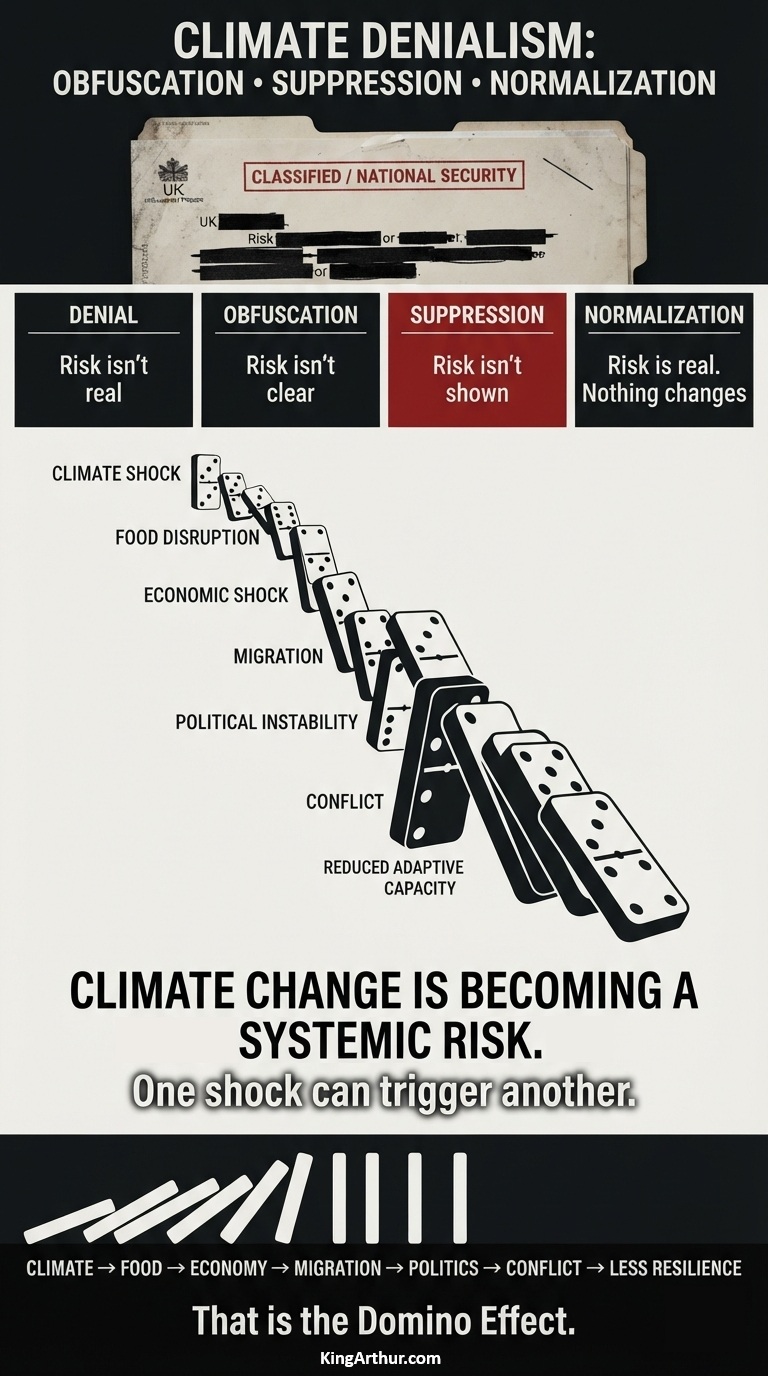
UK Climate Security: From Suppression to the Domino Effect
Climate change is increasingly moving from the category of environmental problem into the category of systemic risk.
A recently reported UK national-security assessment warned that climate and ecological disruption can cascade across borders—affecting food security, economies, migration, and political stability.
The problem is not simply the initial climate shock.
That is the Domino Effect. Denialism has become part of the feedback loop—delaying recognition, obstructing action, weakening resilience, and ultimately amplifying the consequences and accelerating the climate crisis.
The four stages of climate information failure are also important:
Denial — “The risk isn’t real.”
Obfuscation — “The risk isn’t clear.”
Suppression — “The evidence isn’t shown.”
Normalization — “The risk is real, but nothing fundamentally changes.”
When systemic risks are fragmented, delayed, or hidden from public discussion, society loses valuable time to prepare.
Climate risk is no longer just about what happens to the climate.
It is about what climate disruption does to everything connected to it.
About the Song
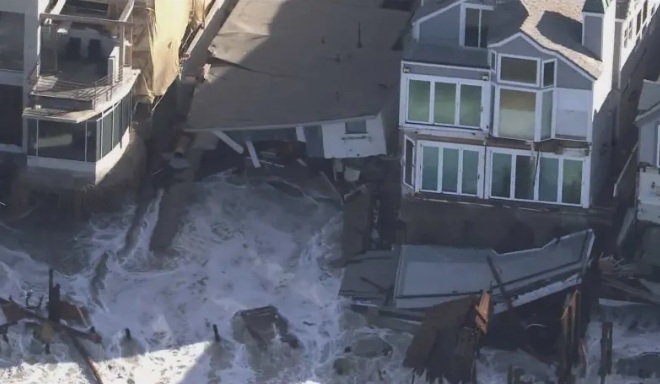
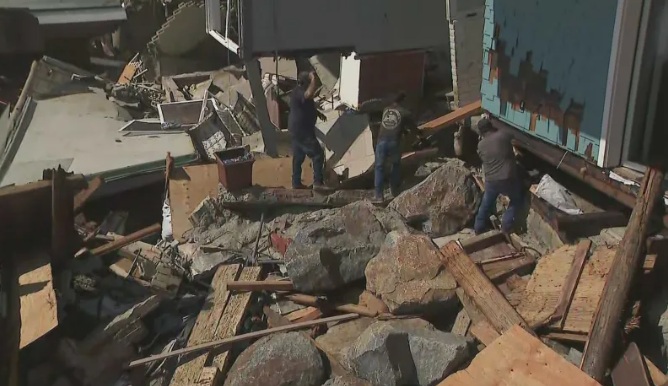
Climate change and coastal impacts are becoming a big problem along the Southern Jersey Shore, with the barrier-island towns taking the brunt of the punishment. Federal funding for beach nourishment has also become much more limited, and sand itself is becoming a finite commodity.
The next couple of days should be an interesting experiment. A powerful, rare September nor’easter is hitting the Jersey Shore tonight, bringing widespread coastal flood warnings, dangerous surf, and wind gusts up to 50 mph. The National Weather Service has issued a Coastal Flood Warning for Atlantic, Cape May, Ocean, and southeastern Burlington counties from Wednesday afternoon through early Saturday morning. The system is also coinciding with an approaching full moon, which can significantly exacerbate tidal flooding across vulnerable shorelines, coastal roadways, and back bays.
At some point, we’re going to reach a hard physical and economic limit. You can keep pumping sand onto a beach, but you can’t manufacture an unlimited supply of sediment or indefinitely out-engineer rising seas and increasingly energetic storms.
The question may eventually stop being, “How much will it cost to save the beach?” and become, “How long can we realistically keep trying?”
Ride that tide
(See ya on the flipside)
Feedin’ back
(Way back, back, back)
[Fade out]
Feedin’ back
(Way back, back, back)
Ride that tide…
(See ya on the flipside)
[Surf Guitar Fade]
[Silence]
[End]
About the Song: Why Hasn’t There Been a Hurricane?
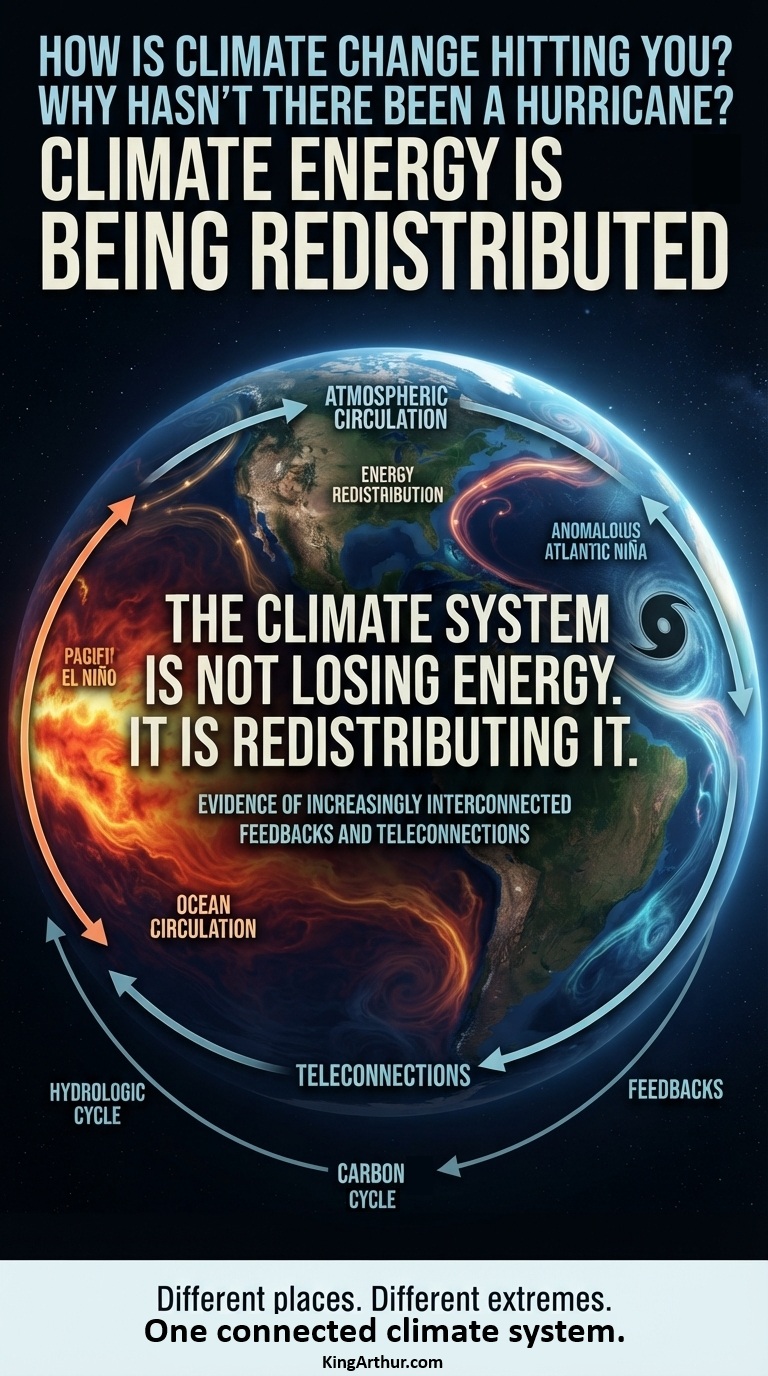
Climate Energy Is Being Redistributed
The absence of hurricanes isn’t evidence that the climate system is becoming less energetic. It is the opposite: climate energy is being redistributed in ways that produce very different outcomes in different parts of the planet.
As of September 23, the Atlantic has produced six named storms but still has produced zero hurricanes—an exceptionally delayed first hurricane. NOAA’s current summary shows Atlantic ACE about 92% below the 1991–2020 average at this point in the season.
The alarming part isn’t simply the lack of hurricanes. It’s the apparent coupling of climate patterns that historically operated more independently. I first warned about this Pacific El Niño–Atlantic Niña coupling back in May. Now, as we progress this far into the season, the observations are providing an unusually clear real-world example of how teleconnections can link distant parts of the climate system.
The simultaneous occurrence of an extreme Pacific El Niño and an anomalous Atlantic Niña represents a significant disruption of the historical baseline. NOAA reports that the El Niño is strengthening, with eastern equatorial Pacific sea-surface temperatures already more than 3°C above average.
An Atlantic Niña can suppress Atlantic hurricane development through increased atmospheric stability and wind shear. So there is a relatively straightforward physical explanation for the quiet Atlantic. But I think the deeper question is why these large-scale ocean–atmosphere patterns are coupling so strongly in the first place.
That’s where climate-acceleration research comes in. I see this as evidence worth watching for increasingly interconnected feedbacks and teleconnections—changes in ocean circulation, atmospheric circulation, energy redistribution, and the hydrologic and carbon cycles that can influence one another across ocean basins.
In other words, the absence of hurricanes isn’t evidence that the climate system is becoming less energetic. It is the opposite: climate energy is being redistributed in ways that produce very different outcomes in different parts of the planet.
It may manifest as a powerful, rare September nor’easter hitting the Jersey Shore.
[Final Refrain]
Hey! We’re disputin’
(Grigori Rasputin)
He’s no friend to reality
(No, no friend to humanity)
Is the ill
(Hard to kill)
Is that it
(He just won’t quit)
[Psychedelic Jam III]
[Extended freak-out]
Hey!
(Who?)
Hey!
(What?)
Rasputin!
(What a spin!)
[Outro]
Hard to kill…
(Hard to tell…)
No saint, all sinner…
(Time does tell…)
… on the way to hell
Can’t you see
(You don’t wanna be)
Grigori…
(Rasputin…)
There’s no disputin’…
(Rasputin…)
[Silence]
[End]
About the Song
This anti-science ideology is a growing problem in the US. One distinction that is particularly important is the difference between scientific knowledge and scientific power. The current administration is undermining scientific knowledge by promoting a false narrative about scientific power and expertise. That is particularly damaging and dangerous when it comes to dismissing climate change as a hoax and undermining confidence in vaccines and medical science.
Calling someone a “Rasputin” means they have a hidden, corrupting, or powerful influence over a leader or ruling group—usually through personal access, charm, manipulation, or secrecy.
What is particularly disturbing today is the overlap between greed and eliminationist logic. The greed component is partly reflected in the effort to portray climate change as a hoax, because acknowledging the full implications of climate science threatens enormous amounts of existing capital and economic interests.
The eliminationist component is even more disturbing. It appears in the way both climate change and public health can be viewed through a “survival of the fittest” framework—where the consequences are not treated as problems to solve, but as mechanisms for eliminating people considered weak, old, sick, or otherwise expendable.
The Epstein files provide some extraordinary evidence of this mindset. Epstein wrote:
“Maybe climate change is a good way of dealing with overpopulation—the earth’s forest fire. Potentially a good thing for the species.”
He also wrote that “executions of the elderly and infirm make sense.”
And his statement that “more CO₂ is good for plants” echoes an argument long promoted by the CO₂ Coalition: that increasing atmospheric CO₂ should be viewed primarily as beneficial because plants use it.
Taken together with the explicitly eugenic statements in the files, this goes far beyond an ordinary disagreement over climate policy. It represents what eliminationist logic: where traditional denial protects existing capital, while ecofascist or eugenic reasoning can rationalize unequal human survival.
That is why the Rasputin comparison is worth exploring. The question isn’t simply who holds power. It is also what ideas are circulating among the people who have access to that power—and what happens when enormous wealth, political influence, scientific denial, eugenics, and eliminationist thinking begin to overlap.
[Refrain]
See the level sinking
(What were you thinking)
Is it at all surprising
(The sea level’s rising)
Wave energy pounding
(Shoreline confounding!)
[Refrain]
See the level sinking
(What were you thinking)
Is it at all surprising
(The sea level’s rising)
[Break]
What’s sinking?
(The sand! The land)
What’s rising?
(See! The sea!)
What’s coming?
(The energy!)
See! (The sea!)
[Final Refrain]
See the level sinking
(What were you thinking)
Is it at all surprising
(The sea level’s rising)
See the level sinking
(Sand is retreating)
Is it at all surprising
(The waves keep repeating)
See the level sinking!
(Sinking!)
Sea level rising!
(Rising!)
[Outro]
No. It ain’t surprising
(Know the sea is rising)
About the Song
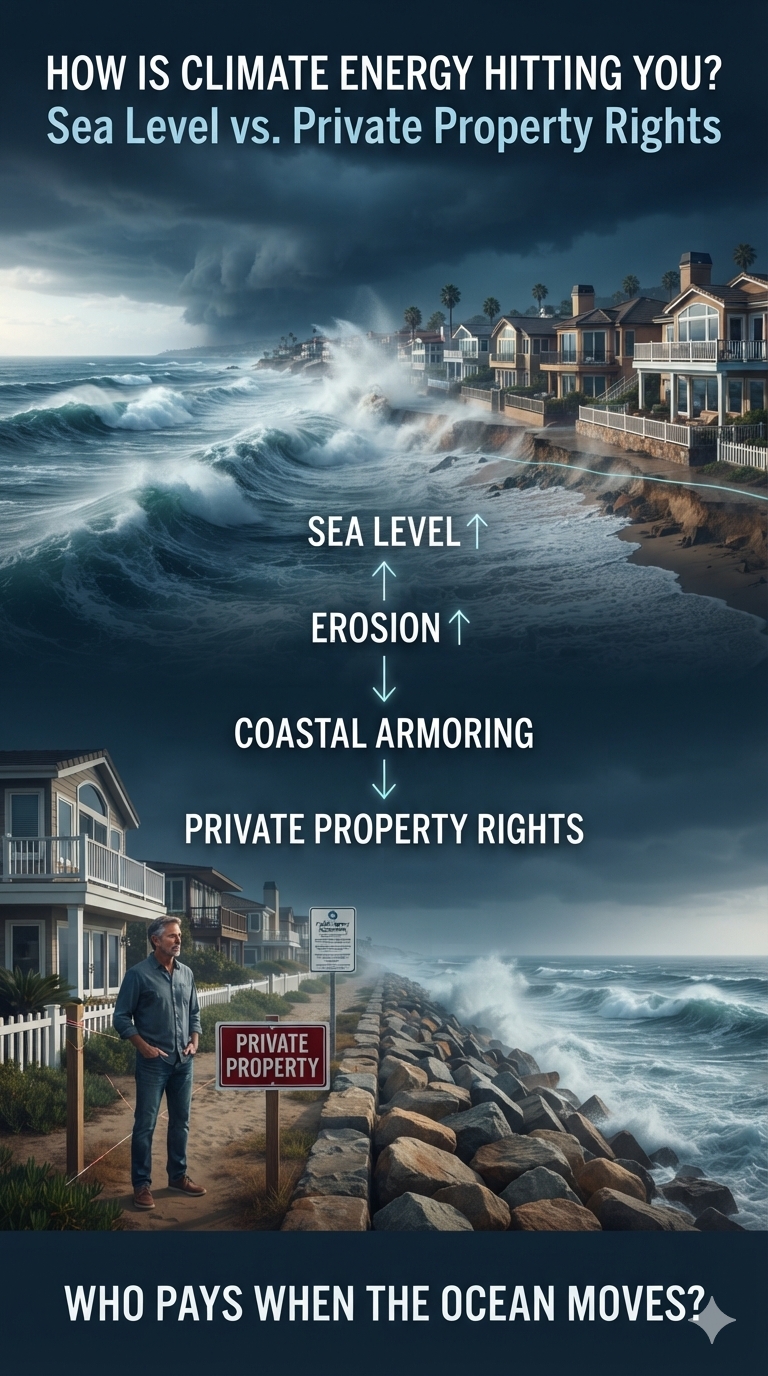
How Is the Climate Energy Hitting You? SoCal Coastal Armoring Sea Level vs. Private Property Rights = Managed Retreat
🌊 Climate energy is hitting the coast.
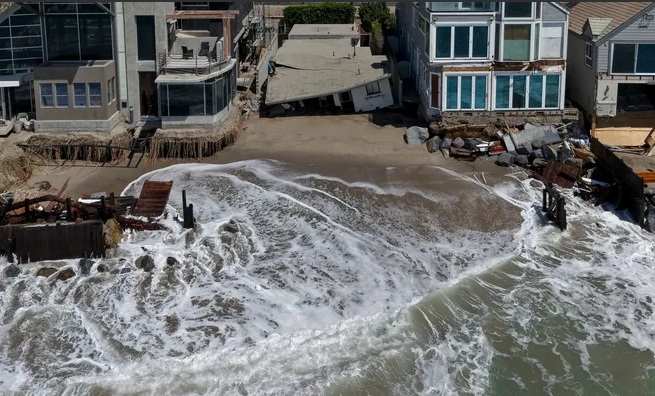
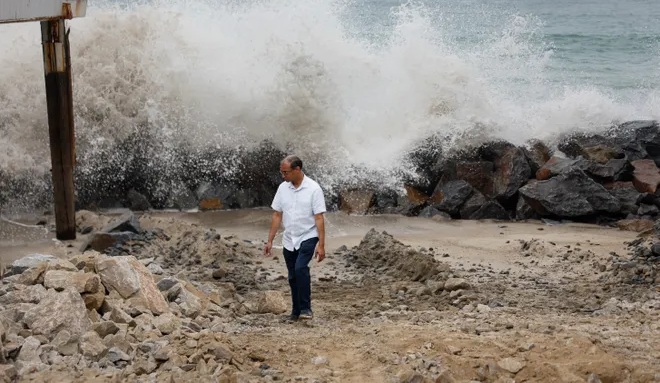
When waves encounter a hard structure instead of dissipating their energy across a gradually sloping beach, some of that energy can be reflected back toward the ocean.
That can increase scour at the base of the structure and accelerate the loss of sand immediately in front of—and adjacent to—the armored shoreline.
A difficult feedback loop can develop:
Loss of sand → greater wave energy → erosion → emergency armoring → altered wave & sediment dynamics → further beach loss
The result is a fundamental conflict:
Protect individual properties — or preserve the beach as a public resource.
🌊 Climate Change Changes the Equation
This isn’t simply a dispute over seawalls.
It’s a preview of a much larger problem.
As sea levels rise, coastal storms and extreme-wave events interact with a progressively higher baseline ocean. More energy can reach vulnerable shorelines, while the loss of beaches and dunes removes natural buffers that once absorbed part of that energy.
The physical equation is changing.
🏖️ Managed Retreat
Managed retreat may ultimately become the long-term strategy for some coastal properties.
The fundamental physical reality is simple:
You can build a wall against the ocean.
You cannot build a wall against a changing climate.
The Beach Road conflict is therefore about much more than a temporary rock wall.
It is about what happens when accelerating climate change collides with private property rights, public resources, and the physical limits of coastal engineering.
You’re getting warmer
(When we take in more)
… But can’t get out the door…
(Energy intensity)
[Verse 1]
Sunlight coming down
(Every single day)
Soaking it in…
(Can’t get away)
[Refrain]
Do we stand a chance?
(The energy imbalance)
Change in the exchange
Oh, my, my
(EEI)
Are you gonna cry
(Or will you die)
[Verse 2]
Back in the earlier days
(The balance held the line)
Then something started shifting
(A change in time)
Two thousand five
(Acceleration!)
Two thousand nineteen
(Accumulation!)
[Refrain]
Do we stand a chance?
(The energy imbalance)
Change in the exchange
Oh, my, my
(EEI)
Are you gonna cry
(Or will you die)
[Bridge]
And then…
Ice sheet
(Retreat)
Clouds thin
(An energy win)
The energy pours in
(Feedbacks begin)
[Break]
[Deep Bass Pulse — Sparse Piano]
Zero…
(Balance…)
Then…
A little more.
[Kick Drum]
A little more.
(Than before)
[Snare]
A little more!
(Starts to pour)
[Full Band Hit]
EEI!
[Instrumental]
[Extended Electric Guitar and Saxophone Duel Over Driving Piano, Organ and Deep Bass — Drums Build Into a Relentless Groove]
[Bridge 2]
Do we balance?
(Or imbalance?)
Do we adapt?
(Or collapse?)
Do we watch?
(Or act?)
Do we learn?
(Or burn?)
Oh, my, my…
[Final Refrain]
Do we stand a chance?
(The energy imbalance)
Change in the exchange
Oh, my, my
(EEI)
Are you gonna cry
(Or will we try)
[Outro]
Do we stand a chance?
(The energy imbalance)
Change in the exchange
Oh, my, my
(EEI)
Are you gonna cry
(Oh, we better try)
EEI
(EEI!)
[Whispered]
The energy imbalance…
(Don’t take the chance)
[Deep Bass Hit]
EEI!
[Silence]
About the Song: The Energy Imbalance (EEI)
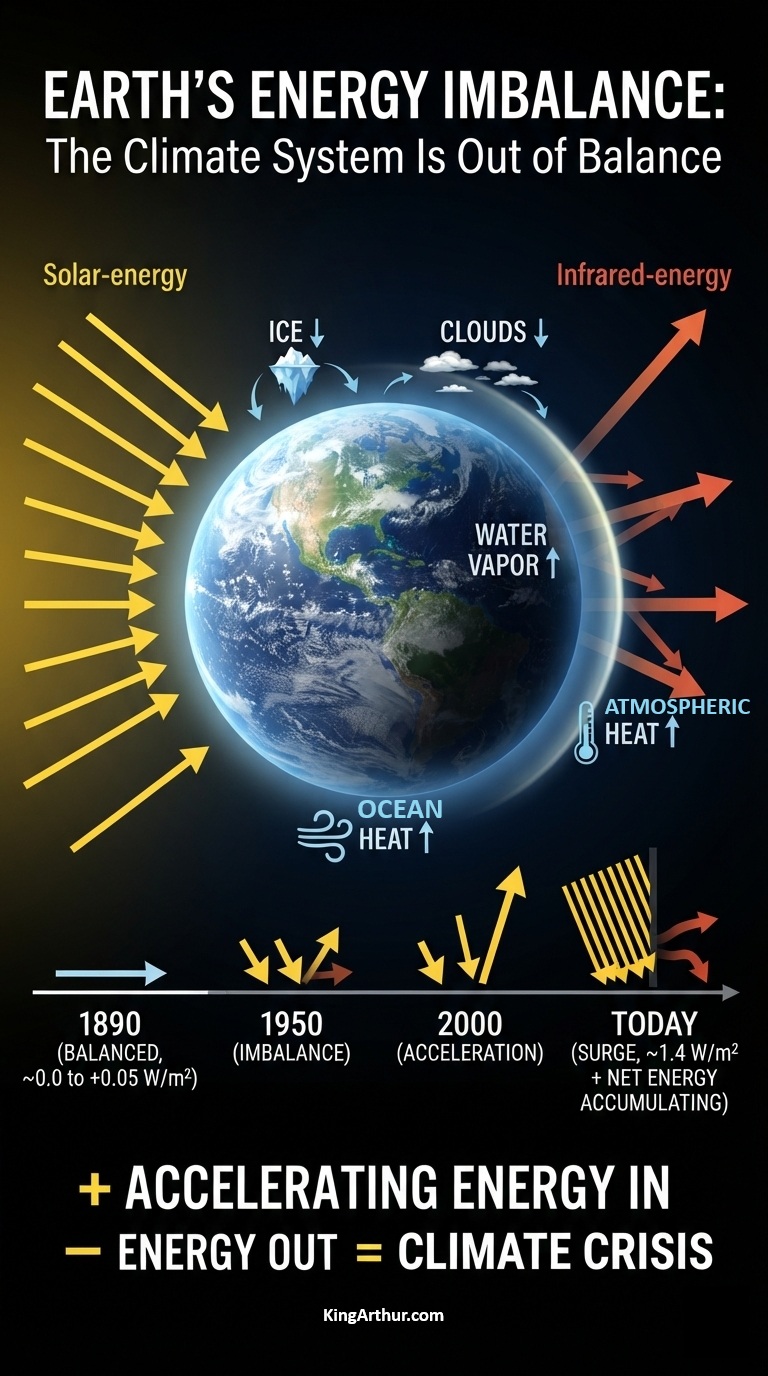
A simple way to understand climate change and global warming is through Earth’s energy balance—or, more precisely, the growing lack of balance known as Earth’s Energy Imbalance (EEI).
Earth’s climate is governed by a fundamental exchange: energy arrives primarily from the Sun, while Earth returns energy to space as reflected sunlight and outgoing infrared radiation. When incoming and outgoing energy are equal over the long term, the planet is approximately in energy balance. When more energy enters the Earth system than leaves it, the difference is stored within the climate system, producing warming.
2005–2019 (The First Acceleration)
The long-term EEI average effectively doubles compared to prior decades. Ocean heat content spikes dramatically as the oceans absorb roughly 90% of this excess energy.
2020–2023 (The Post-2020 Surge)
Slashed marine shipping pollution (IMO 2020 regulations) rapidly clears atmospheric haze over the oceans, forcing a massive, sudden spike in absorbed solar energy.
2024–Present (Nonlinear Feedback Phase)
EEI hits unprecedented, record-breaking territory. Strong climate feedbacks—such as collapsing Antarctic sea ice and thinning cloud decks—darken the planet, causing it to absorb immense amounts of solar radiation.
[Silence]
[Instrumental Intro: Driving Piano, Distorted Electric Guitar, Deep Sub-Bass, Organ, Drums, Percussion, Saxophone]
[Intro]
Hear that sound?
(It’s going down)
Was way off in the distance…
… now lacking resistance…
(Coming closer!)
… drawing near…
(Oh dear!)
Runaway!
(Run away!)
Oh, no…
[Verse 1]
Started with a little push
(Just a little shove)
Then it picked up speed
(That’s enough!)
Round and round
The wheels go faster
Little problem
(Becomes disaster)
Tried to stop it
(Tried to slow)
But the thing kept saying:
(No whoa, no!)
[Refrain]
Run away!
(It’s a runaway runaway)
Out of the way!
(It’s a runaway runaway)
Self-reinforcing
(History divorcing)
Oh, it’s coming this way…
(Today)
Runaway runaway
(Run away)
[Verse 2]
Yesterday was yesterday
(That’s what we say)
But yesterday’s momentum
(Is coming this way)
Cause and effect
(Effect and cause)
Round and round
(Without a pause)
What once seemed strange
(Becomes the norm)
What once was calm
(Becomes the storm)
[Refrain]
Run away!
(It’s a runaway runaway)
Out of the way!
(It’s a runaway runaway)
Self-reinforcing
(History divorcing)
Oh, it’s coming this way…
(Today)
Runaway runaway
(Run away)
[Bridge]
Is it runaway?
(Run away!)
Does it self-reinforce?
(Of course!)
… and much worse
Will tomorrow
Still follow?
(Not today!)
[Break]
[Drums Stop — Deep Bass Pulse]
Run…
(Run…)
Run away…
(Away…)
(Missed the starting gun?)
Run…
(Run…)
Run away…
(Away…)
[Whispered]
One thing…
(Begets another.)
[Drums Explode]
RUNAWAY!
[Instrumental]
[Extended Distorted Guitar Solo — Driving Piano, Organ, Saxophone, Galloping Drums and Deep Bass]
[Final Refrain]
Run away!
(It’s a runaway runaway)
Out of the way!
(It’s a runaway runaway)
Change of course?
(… much worse)
(Better call a hearse)
[Outro]
Oh, it’s coming this way…
(Today)
[Fade out]
Runaway runaway
(Run away)
[Distorted Guitar Feedback]
[End]
[Silence]
About the Song
Is Climate Change Runaway? Maybe.
Unfortunately, the underlying science increasingly points in that direction. More importantly, it highlights what may be the most critical issue facing society today: not whether climate change is occurring, but whether we are approaching thresholds beyond which many impacts become effectively irreversible on human timescales.
None of us are arguing that the entire Earth system is in a fully runaway state today. However, observations accumulated over the past four decades suggest that multiple climate indicators are accelerating faster than many earlier projections anticipated. We are also observing increasing evidence of self-reinforcing feedback loops emerging across interconnected climate, ecological, and economic systems.
The central question is no longer whether runaway behavior is possible in principle. The question is how we recognize the transition if and when enough individual subsystems enter self-reinforcing states that the larger coupled system begins exhibiting runaway characteristics of its own.
About the Song
The distinction between weather and climate has not disappeared. Weather remains the day-to-day state of the atmosphere, while climate describes long-term averages and the underlying behavior of the Earth system. What has changed is the degree to which climate is now shaping weather in real time.
As greenhouse gases accumulate and the planet stores more heat, every component of the climate system contains more energy. Warmer oceans evaporate more water, the atmosphere holds more moisture, and circulation patterns are increasingly disrupted by changes in temperature gradients between the tropics and the poles. These changes alter not only the intensity of individual weather events but also the persistence and interaction of entire weather patterns.
The result is a network of reinforcing feedbacks. A warming ocean fuels stronger atmospheric rivers and hurricanes. Droughts increase wildfire activity, while wildfire smoke alters atmospheric chemistry and solar radiation. Reduced snow and ice decrease Earth’s reflectivity, allowing additional warming. Permafrost thaw releases greenhouse gases that contribute to further warming. Each process influences others, producing cascading effects across the Earth system.
About the Song: Ozone = #1 Climate Gas
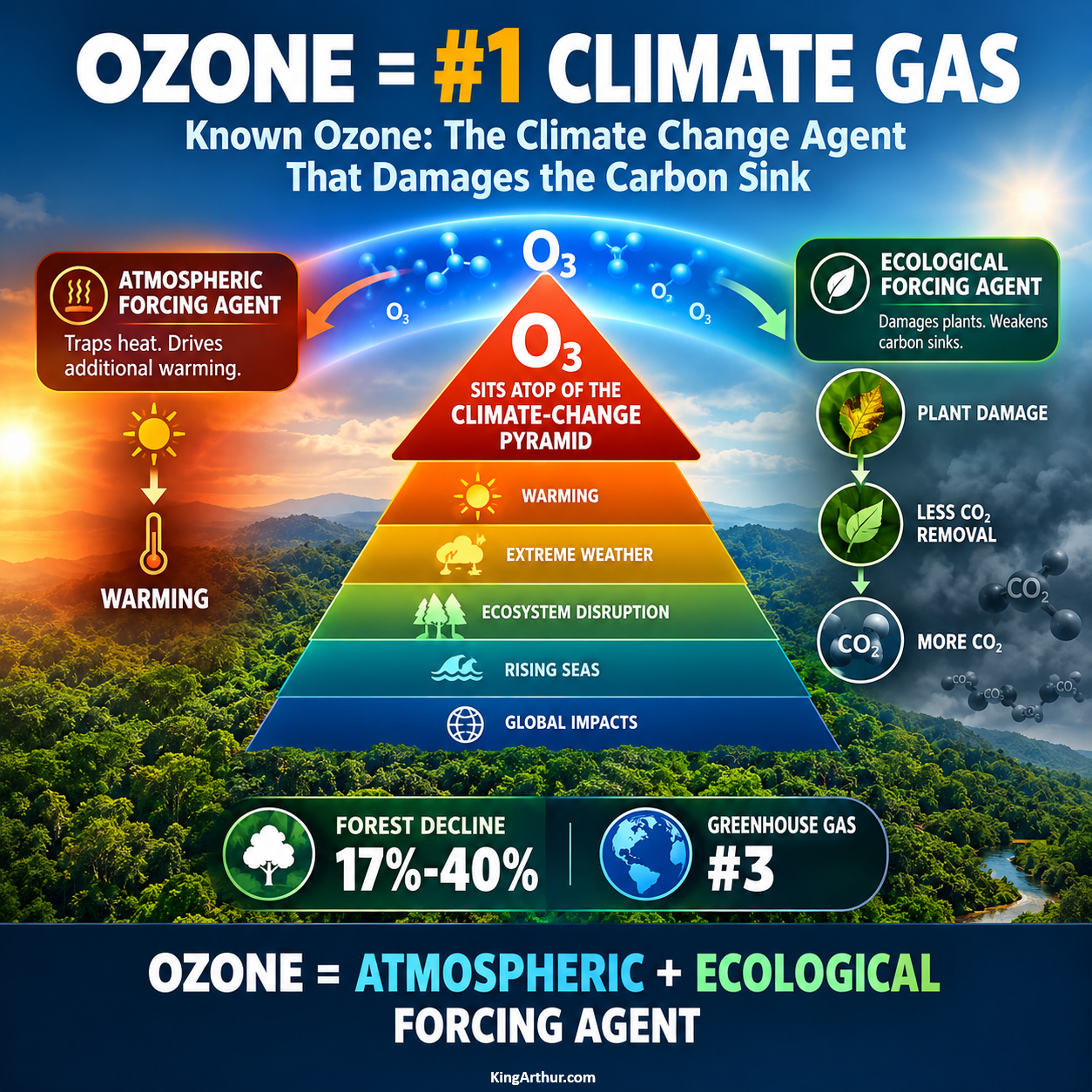
Ozone is usually overlooked as a greenhouse gas. Actually, tropospheric ozone sits atop the climate-change pyramid.
Why? Because ozone is both an:
ATMOSPHERIC FORCING AGENT
→ traps heat
→ drives additional warming
and an:
ECOLOGICAL FORCING AGENT
→ damages plants
→ reduces photosynthesis
→ weakens carbon sinks
→ leaves more CO₂ in the atmosphere
→ drives additional warming
FOREST DECLINE: 17%–40%
GREENHOUSE GAS: #3
Ozone doesn’t just warm the atmosphere. It can damage the biological systems that remove CO₂ from it.
OZONE = ATMOSPHERIC + ECOLOGICAL FORCING AGENT
That makes ozone one of the most important—and overlooked—climate-change agents.
[Silence]
[Instrumental Intro: Swampy Electric Guitar, Deep Sub-Bass, Organ, Piano, Drums, Percussion, Saxophone]
[Intro]
Twenty-six!
(What?)
Jerk surge!
(What was that?)
Take a chance…
(Here we go!)
Dance!
[Verse 1]
Something’s coming through the circuit
Something’s moving way too fast
Feel it twitching in the system
Feel the future hit the past
First you think you’ve got it handled
Then the signal starts to switch
One little unexpected movement
And the whole thing makes you twitch
(Twitch, twitch, twitch)
[Pre-Chorus]
Ready?
(Ready!)
Steady?
(No!)
Something’s coming…
(Here we go!)
[Refrain]
Get your 26 fix
(Jerk surge)
Take a chance
(A modern dance)
Splurge
(26 jerk surge)
First
(You get completely)
Then you jerk a knee
(Real, real fast)
Like whiplash!
(Splash!)
Splurge
(26 jerk surge)
[Verse 2]
One-two-three and then you stumble
Four-five-six and lose the beat
Seven-eight and something’s jumping
Nine-ten underneath your feet
[Final Chorus]
Jerk surge!
(Jerk surge!)
Feel it hit!
(Feel it hit!)
Take a chance
(A modern dance!)
Don’t resist!
(Don’t resist!)
Twenty-six!
(Get your fix!)
Splurge!
(26 jerk surge!)
[Final Refrain]
Get your 26 fix
(Jerk surge)
Take a chance
(A modern dance)
Splurge
(26 jerk surge)
Jah, jah, jah
(Jerk surge!)
First
(You get completely)
… hit with reality…
Then you knee-jerk
(Twerk)
Hit that funny bone
(Now take it on home!)
Future to past…
(Real, real fast)
Like whiplash!
(Splash!)
Splurge
(26 jerk surge)
Tonight’s new release “#26 Jerk Surge” is a lil’ dance ditty inspired by tonight’s homework assignment “2022–2026 Jerk Surge”. A new dance craze influenced by all the versions of Locomotion, from Little Eva to Grand Funk to Kylie, plus Funk #49 by Joe Walsh. It attempts to explain the climate jerk experienced in 2026 as a cultural experiment experience. Everybody’s doin’ it.
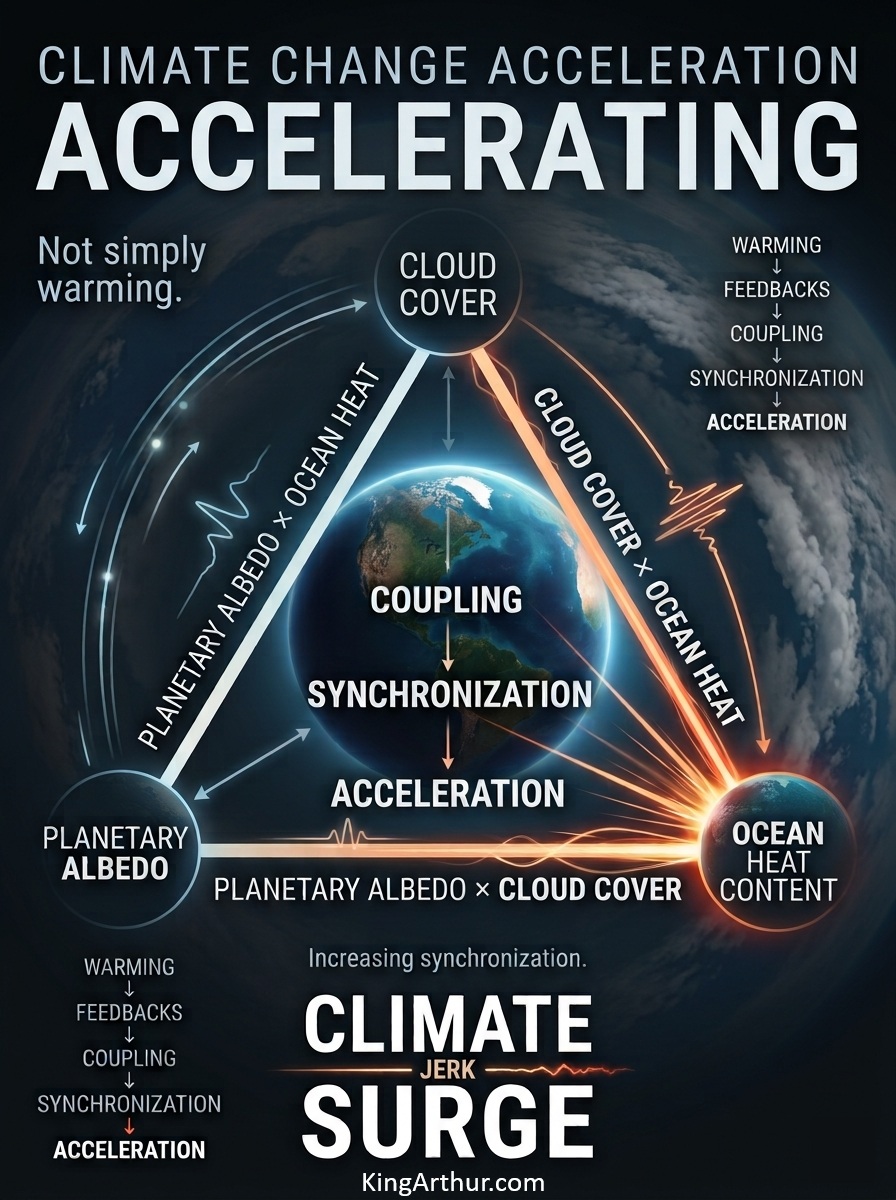
A 2026 study found that the recent change in climate-system dynamics is being expressed not simply as continued warming, but as increasing synchronization among multiple radiative and thermal feedback pathways.
Beginning most notably around 2022, an increasingly interconnected pattern emerges among six major climate-system variables: cloud cover, planetary albedo, sea ice extent, atmospheric water vapor, ocean heat content, and surface temperature.
The three largest interaction paths form a closely connected Albedo–Cloud–Ocean Heat Content triad:
The significance is not that a single feedback has suddenly appeared. These feedbacks are already well established. The emerging signal is that multiple feedback pathways are becoming increasingly coupled—and that the rate of this coupling is itself accelerating.
That accelerating coupling is the Climate Jerk Surge.
[Spoken word]
What happens when we miss the 1.5°C Paris target?
(Did you forget?)
[Instrumental Intro: Slow Blues Guitar, Deep Sub-Bass, Low Piano, Organ, Drums, Percussion]
[Intro]
Knock, knock…
(Who’s there?)
Debt collector…
(No one’s here!)
You thought you had time
(You thought you were fine)
But time has a way
(Of collecting its pay)
[Verse 1]
We borrowed from tomorrow
And spent it all today
Took a little from the future
Then we threw the bill away
“Don’t worry ’bout the interest”
(We’ll deal with that somehow)
But the debt kept getting bigger
(And the collector’s here right now)
[Pre-Chorus]
First came the warning
(We waved it away)
Then came the interest
(It started to stay)
[Refrain]
Beyond speculation
(It’s debt collection)
What’s at stake
(A bone break)
First your fingers
(While the pain lingers)
There goes the toes
(Holy! And another knee)
[Verse 2]
You can’t put the pain
A hundred years away
When the heat is at your doorstep
And the flood is on its way
Somewhere far?
(Right where you are)
Far away?
(Not today!)
[Chorus]
Not speculation
(Not speculation!)
Not some distant fate
The consequences
(Are already at the gate)
[Refrain]
Beyond speculation
(It’s debt collection)
What’s at stake
(A bone break)
First your fingers
(While the pain lingers)
There goes the toes
(Holy! And another knee)
[Bridge]
The future moved closer
(The future moved here)
Somewhere else vanished
(It disappeared)
Climate debt!
(Not yet)
Your dues due
(Better come through)
How much can you take
Before you finally wake?
[Instrumental: Extended Blues-Rock Guitar Solo, Organ, Deep Bass, Heavy Drums]
[Pre-Chorus]
It’s not tomorrow
(It’s today)
It’s not somewhere else
(It’s this way)
It’s not abstract
(It’s real)
It’s not a theory
(Look and feel)
[Final Refrain]
Beyond speculation
(It’s debt collection)
What’s at stake
(A bone break)
First your fingers
(While the pain lingers)
There goes the toes
(Holy! And another knee)
Beyond speculation
(It’s debt collection)
What’s at stake
(A bone break)
How much pain
(Before we wake?)
[Outro]
Knock, knock…
(Who’s there?)
Debt collection…
(Already here.)
Oh, dear!
You missed the payment…
(We know.)
You missed the warning…
(Oh, no)
Now…
Pay attention.
(Avoid termination)
[Silence]
The new release of the day, “Debt Collection,” is the accounting of an accounting story. No, it’s not folklore anymore. It’s a retro-futuristic, swampy blues tune about spending your future.
The situation is due to what we do. And now, the blues dues are due.
About the Song: Climate Debt Collection
What happens when we miss the 1.5°C Paris target?
Think of it like owing money to a loan shark. The debt doesn’t wait decades to be collected.
Our fingers are being broken now. Our kneecaps are next.
One of the biggest challenges in communicating climate change is proximity—both in time and location.
If the consequences seem far away, people dismiss them. If they’re happening somewhere else, people ignore them.
But climate change is moving from:
future → present
and
somewhere else → right here.
We missed the 1.5°C Paris target. The climate debt is already being collected.
How much pain do we need to feel before we pay attention?
From the mountain
To the valley
Feel the energy flow!
The collapse releases the energy.
The impact transforms it.
Fluidization redistributes it.
Entrainment multiplies the moving mass.
And the flow…
Carries the consequences downstream.
(Whole new scene)
… hole knew seen
Like wet concrete…
(Not quite bitter sweet)
[Final Refrain]
Under strain
(Racks the brain)
Pure potential
(… the inevitable)
Fluidization
(Try to liquefy)
Realization
(It did… solid defy)
Potential…
Kinetic…
Pressure…
Flow…
[Spoken, fading]
Oh, no, no, no
(Realization)
Fluidization.
About the Song: How Is the Climate Energy Hitting You Nepal-Tibet?
Fluidization Physics
Like wet concrete.
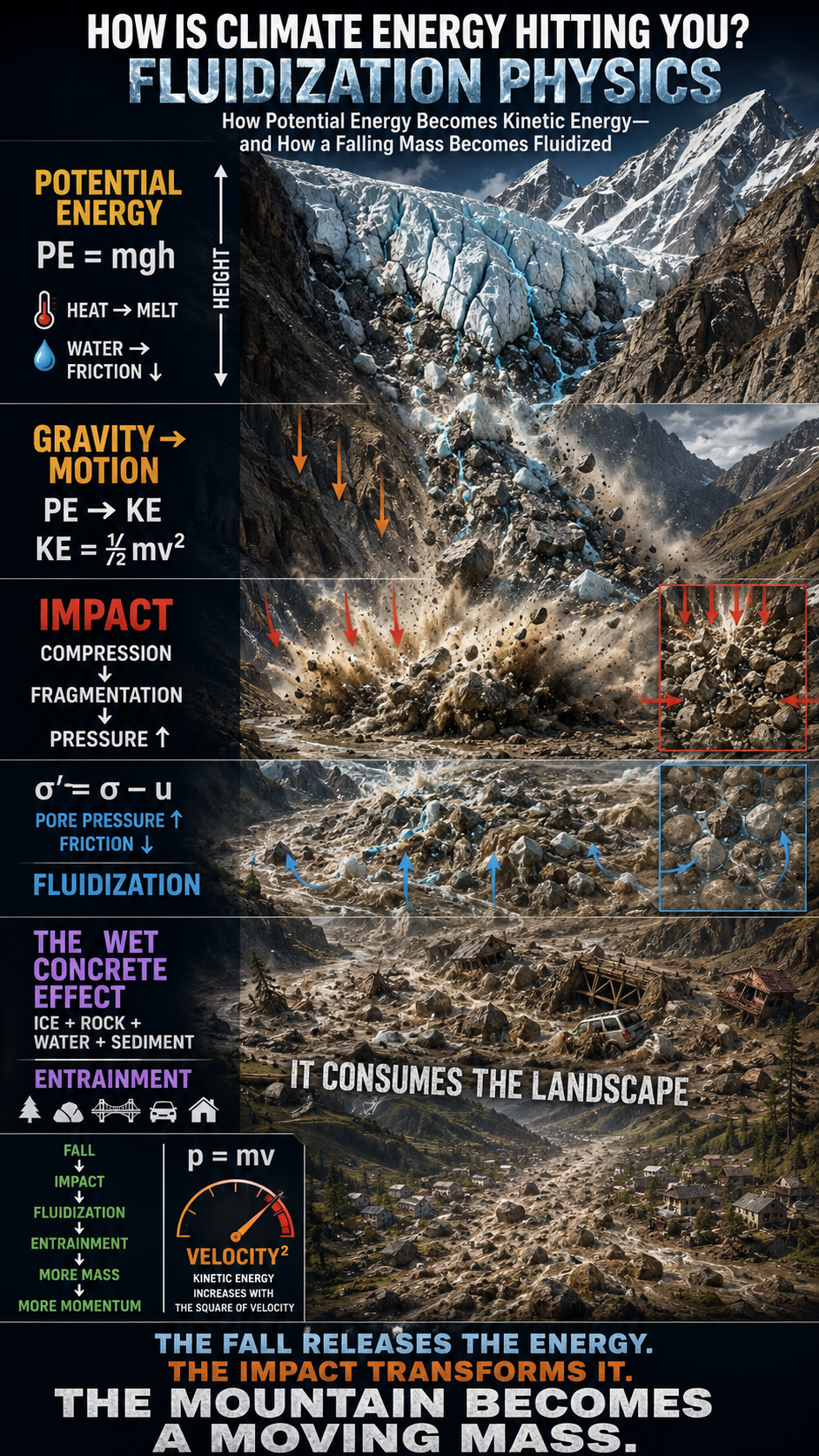
The initial fall releases the energy → The impact transforms it → Fluidization redistributes it → Entrainment multiplies the moving mass.
And the resulting flow carries the consequences downstream.
The collapse itself is a gravitational event. Gravity supplies the immediate energy that drives the mass downward. The climate connection lies in how human-caused warming can alter the physical conditions under which that gravitational energy is released.
Heat can accelerate glacier melt. Meltwater can penetrate fractures and accumulate beneath ice. Rain and meltwater can increase pore-water pressure. Permafrost thaw can weaken previously frozen ground. Warming can therefore change the mechanical stability of ice, rock, soil, and sediment. Climate change does not need to physically push a mountain downhill. It can alter the conditions that determine when that mountain becomes capable of moving.
Then gravity does the rest.
Once the mass begins moving, another fascinating piece of physics takes over: water can actually make a moving granular system more mobile.
We generally think of water as something that slows things down. But water under pressure between particles can reduce the friction holding those particles together. In simplified form:
σ′ = σ − u
where σ′ is effective stress, σ is total stress, and u is pore-water pressure.
As pore-water pressure rises, effective stress falls. As effective stress falls, frictional resistance can decrease. That can make a slope or debris mass substantially more mobile.
This is one reason a wet, saturated mass can behave so differently from the dry rock, soil, and ice from which it originated. The material does not literally turn into water. Instead, water becomes part of a coupled solid-fluid system in which fluid pressure can support and mobilize solid particles.
Under sufficiently energetic and saturated conditions, a granular mass can become partially fluidized, allowing it to flow and transport enormous quantities of additional material.
That is the “wet concrete” effect.
The distinction is important. We are not talking about a solid block of ice simply sliding down a mountain. We are talking about a material system whose physical properties can change dramatically as it accelerates, fragments, mixes with water, and incorporates sediment and other debris.
See the crack
(Hear the wack)
See it grow
(Now you know)
[Bridge]
The interesting part…
Isn’t simply
one tipping point.
It’s what happens
when systems
begin talking to each other.
And you know…
(Albedo.)
Oh dear!
(The atmosphere.)
[Rap Vocal Break]
Glue!
(Flew!)
Comes unstuck!
(What the phfff…)
Awe…
(Thaw!)
What the heck?
Feedback finds
Other kinds
Loop dee loop
(That’s the scoop)
Watch the story
Now unfold!
Rock!
(On!)
… on…
Rock!
(On!)
… on…
Slide!
(Slide!)
Flow!
(Now you know!)
See…
1.5°C…
In action.
[Pause]
No satisfaction
[Pause]
No retraction
[Whispered]
And that’s the facts.
[Build]
[Low Drums Enter]
Permafrost… lost
(At what cost)
[Response]
The glue…
… flew
[Response]
(Oh no!)
[Response]
Oh no, no, no
[Response]
(Oh, no know)
[Full Band]
See…
(When the mountains crumble to the sea!)
[Final Pre-Chorus]
Step right this way
(See 1.5°C in Action)
It’s your lucky day
(We’re the main attraction)
[Final Chorus]
What to do
(When the glue)
Comes unstuck
(Out of luck)
But hey
(Say)
You get to see
(Manmade destiny)
See it move
(See it slide)
See it flow
(See it ride)
And the mountains crumble
To the sea…
See?
Destabilizes
(Fluidizes)
Died…
(By liquefied)
The mass begins to move.
(Physics will prove)
And the feedbacks…
Keep walking the walk.
[Final Hit]
No talk, talk, talk
[Outro]
The glue comes unstuck…
[Pause]
What the phhfff…
(Heck!)
[Whispered]
(Introspect)
And the mountains…
Crumble to the sea.
See?
About the Song
See 1.5°C in Action: The Nepal–Tibet Glacial Collapse
The permafrost tipping point—and its feedbacks with other tipping points—is the most interesting part to me. Permafrost was kind of the glue holding everything together… until 1.5°C. Then the coupled feedbacks start feeding each other, and the whole system begins to unravel. And the mountains crumble to the sea… see? 😉
[Verse 1]
Sitting high upon the wall
Didn’t think he’d ever fall
Solid mass
And standing tall
Till gravity
Would have it all
[Refrain]
Humpty Dumpty
(Had a great fall)
Can’t put ’em back together
(After all)
Not a matter of “whether”
Oh, can’t you see
(Humpty Dumpty)
[Verse 2]
Well…
First the shell
Hits the floor
Then comes more
Splattered yoke
Ain’t no joke
[Physics Breakdown]
[Music briefly strips to bass pulse and percussion]
Momentum…
[Spoken]
Mass times velocity.
(Ends in tragedy)
[Instrumental Hit]
[Refrain]
Humpty Dumpty
(Had a great fall)
Can’t put ’em back together
(After all)
Not a matter of “whether”
Oh, can’t you see
(Humpty Dumpty)
[Bridge]
A stationary egg
(On it’s last leg)
[Pause]
Into the valley.
Onto the ground.
Splat!
(Imagine that)
[Rap Vocal Break]
Mass!
(Mass!)
Velocity!
(Velocity!)
Put ’em together
That’s momentum, see!
I meant…
(Movement!)
Coming down!
(All around!)
Impact!
(Not intact!)
And of course…
(Force!)
Stop it!
(Stop it!)
Turn it!
(Turn it!)
Shake it
(Break it)
Moving mass!
(Moving fast!)
Nothing like
A stationary past!
Humpty…
[Whispered]
Had a great fall.
[Pause]
But…
[Low Response]
The fall wasn’t all.
[Pause]
The impact…
[Soft Response]
Splat!
[Build]
Collision…
Collision…
Collision…
[Full Band]
COLLISION!
[Final Refrain]
Humpty Dumpty
(Had a great fall)
Can’t put ’em back together
(After all)
Not a matter of “whether”
Oh, can’t you see
(Humpty Dumpty)
Humpty Dumpty
(Sat on a wall)
Humpty Dumpty
(Had a great fall)
[Final Hit]
HUMPTY DUMPTY!
All the king’s horses and all the king’s men
[Pause]
Couldn’t put Humpty together again
(No, nowhere to begin)
Never together
(Again)
About the Song: The Fall Is Only the Beginning
The fluidization of the mass on the way down is remarkable physics. But the energy transfer at the bottom may be even more consequential.
The material did not strike the valley floor all at once.
The leading edge arrived first.
It collided with the valley floor and surrounding terrain, fractured, compressed, deformed, and began spreading. Behind it, enormous quantities of ice, rock, water, and sediment were still moving downhill.
That means the impact was not a single collision.
It was a cascading sequence of collisions.
The first material to arrive effectively became an impact surface for the material immediately behind it. The incoming mass continued transferring momentum into material that had already slowed, while the valley floor resisted the movement from below.
The basic relationship is:
p = mv
where p is momentum, m is mass, and v is velocity.
Changing the momentum of an enormous mass requires an enormous force. The rate at which that momentum is transferred matters as well:
F = Δp / Δt
The shorter the time over which momentum is transferred, the greater the instantaneous force.
This is why the impact of a massive debris flow is fundamentally different from simply placing the same amount of material on the ground. A stationary mountain weighs an enormous amount, but its weight is distributed through relatively stable structures. A mountain in motion has momentum. When that momentum is suddenly redirected, compressed, fragmented, or stopped, enormous forces are generated.
Rough Sees Ahead
[Intro]
Hear that thunder?
(Out beyond!)
Feel the water?
(Rising on!)
Wind is howling through the mast
Dark clouds gathering fast
Captain’s looking to the sky
Something’s coming by and by
[Verse 1]
The barometer is falling
And the pressure’s running low
As each wave is getting taller
Nowhere left to go
[Refrain]
You heard what the captain said:
(Rough seas ahead!)
Oh, can’t you see
(The scenes reality)
Can’t we stave…
(Another tidal wave?)
[Verse 2]
Moisture fills the air
Her anger feeds the storm
There’s energy everywhere
They call it our new norm
[Chorus]
Rough seas ahead!
(Rough seas ahead!)
Hold on tight
(It’s gonna be a night!)
Rough seas ahead!
(Do you hear that dread?)
The forecast isn’t fiction
(It’s the physics up ahead!)
[Bridge]
Can we stave it off?
(Can we change the course?)
Can we slow the rise?
(Can we use the force?)
[Refrain]
You heard what the captain said:
(Rough seas ahead!)
Oh, can’t you see
(The scenes reality)
Can’t we stave…
(Another tidal wave?)
[Final Chorus]
Rough seas ahead!
(Rough seas ahead!)
Can you see?
(The reality!)
[Refrain]
You heard what the captain said:
(Rough seas ahead!)
Oh, can’t you see
(The scenes reality)
Can’t we stave…
(Another tidal wave?)
[Outro]
Keep your eyes upon the horizon
Keep your hands upon the wheel
The storm is not nearly done
The feel is for real
[Intro]
Hear it coming
(Feel the gust!)
Clouds are turning
(Into dust!)
[Verse 1]
The wind was once a servant
We put it to the task
Turned the mills and drove the ships
And never thought to ask
[Pre-Chorus]
From the mountains to the ocean
From the ocean to the sky
She keeps on moving
As the winds begin to fly
[Refrain]
Wind whipped
(A slave of the modern age)
Future shipped
(To the history page)
The wind wails
(The system fails)
The sails ripped…
(… wind whipped)
[Verse 2]
The age has got a story
Written in the pressure lines
Forged with human glory
Building catastrophic signs
[Refrain]
Wind whipped
(A slave of the modern age)
Future shipped
(To the history page)
The wind wails
(The system fails)
The sails ripped…
(… wind whipped)
Hold the line
(Hold the mast!)
Storm is coming
(Moving fast!)
[Bridge]
Who’s the master?
(Who’s the slave?)
Did we build the future
(Or dig our own grave?)
We shipped the future
For another day
Now the wind is sending
That bill… right this way
No more pretending
No more looking back
When the future races at ya…
… feel it in the track
[Breakdown]
Wind!
(Whipped!)
Round and round
The energy flows
Where it ends
Nobody knows!
[Final Chorus]
Wind whipped!
(A slave of the modern age!)
Future shipped!
(To the history page!)
The wind wails!
(The system fails!)
The sails ripped!
(… wind whipped!)
[Outro]
Hear the wind
(Whip!)
Hear the sails
(Rip!)
The future isn’t somewhere
Far beyond the horizon
It’s here… see it happen
(Wind whipped!)
Neptune
[Intro]
Hoist the sail!
(No time to fail!)
Raise the mast!
(It’s a must!)
The tide is turning
(Moving fast!)
Where are we going
(… without knowing?)
[Whistle]
Goin’ to meet Neptune!
[Verse 1]
We thought we ruled the ocean
We thought we ruled the land
Built our cities on the shoreline
With a dollar in our hand
We drew ourselves a boundary
Said, “Water, stay behind!”
But the ocean never signed it
And the tide don’t read the lines
[Pre-Chorus]
Round and round
(The waters flow)
Up and down
(The currents go)
What goes up
(Must come down)
[Refrain]
Goin’ to meet Neptune
(Soon, soon, soon)
Goin’ to meet Neptune
(Whistle the tune)
Sing a sea shanty
(Whistle the tune)
Gone is our vanity
(Goin’ to meet Neptune)
[Verse 2]
Morning air is warming
The ocean takes the heat
Her crying loads the sky
And the reign fall will complete
[Refrain]
Goin’ to meet Neptune
(Soon, soon, soon)
Goin’ to meet Neptune
(Whistle the tune)
Sing a sea shanty
(Whistle the tune)
Gone is our vanity
(Goin’ to meet Neptune)
Nowhere to hide
(Nowhere to hide!)
We thought we owned the ocean…
But Neptune’s got the ride!
[Refrain]
Goin’ to meet Neptune
(Soon, soon, soon)
Goin’ to meet Neptune
(Whistle the tune)
Sing a sea shanty
(Whistle the tune)
Gone is our vanity
(Goin’ to meet Neptune)
[Bridge]
Oh, Neptune, mighty Neptune
King of all the blue
We sailed upon your waters
And thought we conquered you
[Sea-shanty Breakdown]
Yo ho!
(Yo ho ho ho!)
Down we go!
(Down we go!)
Watch ‘er rise!
(Watch the flow!)
High tide!
(No surprise!)
Neptune’s hummin’…
Let it ride!
Ohhh…
Ohhh…
Hey!
[Refrain]
Goin’ to meet Neptune
(Soon, soon, soon)
Goin’ to meet Neptune
(Whistle the tune)
Sing a sea shanty
(Whistle the tune)
Gone is our vanity
(Goin’ to meet Neptune)
[Outro]
Goin’ to meet Neptune…
(Soon, soon, soon…)
Gone is our vanity…
Goin’ to meet Neptune!
(… to see god of the sea)
The Energy
[Verse 1]
Where does it go
When the fire dies?
Can you follow the flow
To where the energy rides?
[Pre-Chorus]
Heat in the pavement
Wind in the trees
Water keeps moving
Across the seas
The world keeps turning
Round and around
Energy shifting
As thoughts keep drifting
[Refrain]
Oh can’t you see…
(The energy)
Can’t be created
(Or destroyed)
Exasperated
Annoyed
(… or…)
Revitalization
Deployed
[Verse 2]
A mountain holds it
High in the air
Gravity’s waiting
Potential there
Then comes the falling
Down comes the stone
Potential transforms
Into motion alone
Heat from the friction
Sound from the crash
Light from the lightning
Energy in a flash
[Pre-Chorus]
Exasperation
Can turn into drive
Annoyance can signal
That something’s alive
A setback can become
A reason to try
A spark can become
A fire in the sky
[Refrain]
Oh can’t you see…
(The energy)
Can’t be created
(Or destroyed)
Exasperated
Annoyed
(… or…)
Revitalization
Deployed
[Bridge]
You can’t make it
Out of nothing
You can’t make it
Disappear
Can you redirect it
Transform it a bit
Just to be clear…
Can you make it useful here?
[Spoken]
Anger…
Into action.
Frustration…
Let it become invention.
Exhaustion…
A beacon… a signal
that something needs to change.
(Rearrange)
[Rap Vocal Break]
Energy!
(Transforming me!)
Moving through the system!
(Yes, “I am”)
Heat!
(To the beat!)
Motion!
(Notion!)
Potential waiting
For promotion!
Stored!
(Roared!)
Released!
Changed!
(Rearranged!)
Reconfigured!
(Go figure)
Nothing lost!
(Nothing gained!)
Just not… quite the same!
… keeps
Moving on!
(And on and on and on)
Exasperated!
(Annoyed!)
Turn it into motion!
Revitalization!
(Deployed!)
Set the energy
In a new direction!
Change the form!
(Change the norm!)
Change the direction!
(Change the introspection!)
Take the frustration…
And make it…
REVITALIZATION!
[Final Refrain]
Oh can’t you see…
(The energy)
Can’t be created
(Or destroyed)
Exasperated
Annoyed
(… or…)
Revitalization
Deployed
The question isn’t…
Where did the energy go?
The question is…
What form did it take?
(What impression did it make)
And what will we do…
(I’m asking you)
[Final Hit]
THE ENERGY!
(Certainty)
Can’t be created…
Can’t be destroyed…
Only transformed…
Redirected…
And…
Deployed.
About the Song
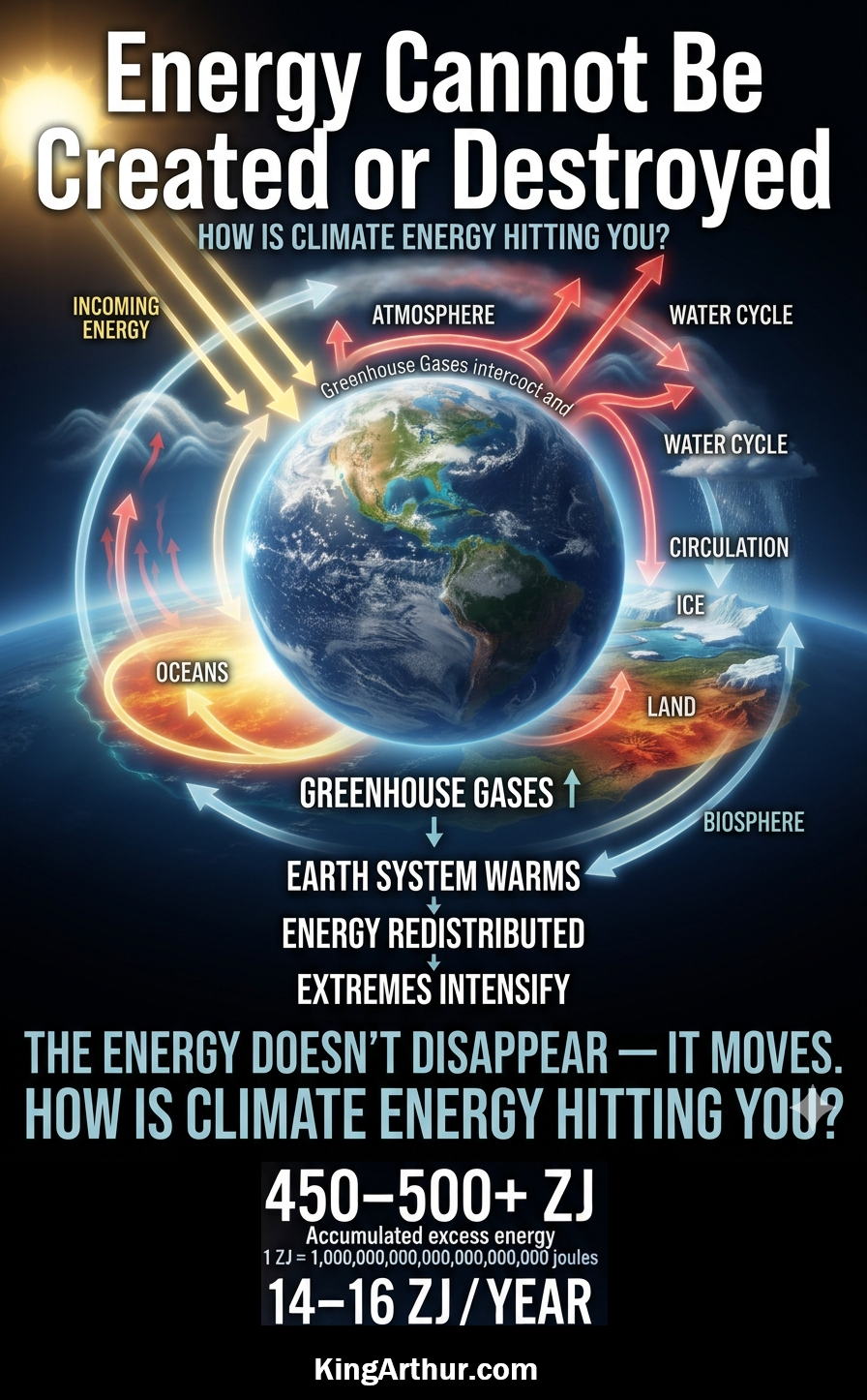
🌎⚡ ENERGY CANNOT BE CREATED OR DESTROYED
So where does all that extra energy in the climate system go?
It doesn’t disappear.
It moves. 🌊💨💧🌀🧊🌱
The oceans absorb enormous amounts of heat. The atmosphere transports energy and moisture. Evaporation moves latent heat. Storms redistribute energy through intense precipitation. Ocean currents carry heat across the planet. Ice melts. Land heats and dries. Ecosystems respond.
And the greenhouse effect changes the planet’s energy balance—leaving more energy within the Earth system before it can ultimately escape to space.
450–500+ ZJ
🌡️ Accumulated excess energy
14–16 ZJ / YEAR
⚡ Approximate additional energy absorbed annually
The important question isn’t simply “How much has the temperature risen?”
It is: How is the increase in energy hitting you with extreme weather events?
When energy moves through steep temperature, pressure, and moisture gradients,
the climate system can unleash:
🌧️ Violent Rain
🌊 Floods
💨 Atmospheric Rivers
🔥 Heatwaves
🏜️ Flash Droughts
🔥 Wildfires
🌪️ Microbursts
💨 Straight-Line Winds
🧊 Hailstorms
Different events. Different mechanisms.
But the underlying story is the same: energy is moving, transforming, and being redistributed
through the Earth system.
The energy doesn’t disappear — IT MOVES.
Backyard Experiments How Is the Climate Energy Hitting You? is a collection of backyard experiments conducted in conjunction with you—the reader. The goal is simple: to look at how the increased energy in the climate system is showing up in our everyday lives.
Is it becoming more extreme, more frequent, and more persistent? Are the changes becoming stranger—or even disturbing?
[Verse 1]
Started as a snowflake
Falling from the sky
The pressure… he couldn’t take
Dying to fly
[Refrain]
Where did it go
(Do you know?)
Sing the refrain:
(Down the drain!)
Does any remain
(Are you insane?)
Down the drain!
[Verse 2]
Water runs downhill
Flowin’, flowin, flowin’… till
Doesn’t want to stay
No, not another day
[Chorus]
[Refrain]
Where did it go
(Do you know?)
Sing the refrain:
(Down the drain!)
Does any remain
(Are you insane?)
Down the drain!
(Down the drain!)
[Pause]
Can’t ever go back.
(Time travel we lack)
Can’t ever go back…
[Refrain]
Where did it go
(Do you know?)
Sing the refrain:
(Down the drain!)
Does any remain
(Are you insane?)
Down the drain!
[Bridge]
Down the drain
(Gone insane)
Down the drain
(Who will remain?)
[Breakdown]
(Down the drain)
Where did the ice go?
(Down the drain)
Down, down, down
(Down!)
Where do we go?
(Down!)
(Down the drain)
Where did the energy go?
Oh, no, no
Drip!
(Drip!)
Drop!
(Drop!)
Flow!
(Flow!)
Go!
(Go!)
Plop!
[Final Refrain]
Where did it go
(Do you know?)
Sing the refrain:
(Down the drain!)
Does any remain
(Are you insane?)
Down the drain!
Oh, no…
Watch ‘er go!
(No whoa oh oh!)
Oh, no, no, no…
(Just woe, woe, woe!)
Down…
The…
Drain!
[Outro]
Gone insane
Cannot remain….
Hitting Me
Did you see…
(The energy)
Comedy…
(Or tragedy?)
[Verse 1]
The energy is everywhere
Moving through the air
Heat is rising
Winds are flying
Water’s going who-knows-where
[Refrain]
The energy
(Is hitting me)
From every side
(Both far and wide)
A climate primate
(Getting hit)
… quite a bit.
[Chorus]
How is it hitting you?
(How is it hitting me?)
Energy
(Dramatically)
[Verse 2]
Evaporation till saturation
Pulling the heat high
(Way across the sky)
How long will it stay…
Waiting for the day
[Refrain]
The energy
(Is hitting me)
From every side
(Both far and wide)
A climate primate
(Getting hit)
… quite a bit.
[Bridge]
Energy… transformed!
[Response]
TRANSFORMED!
Energy… transported!
[Response]
TRANSPORTED!
Store, store store!
(Some more)
[Response]
STORE!
RELEASED
(Doesn’t cease)
[Spoken]
Never created.
Never destroyed.
[Pause]
So…
Where does it go?
[Whisper]
(You’ll soon know)
[Rap Vocal Break]
Hit!
(Hit!)
From the side!
Wide!
(Wide!)
Far and wide!
Where it goes
Nobody knows?
(Feel the flows)
Pour!
More!
(More!)
Knocking at the door!
Extreme…
(Know what I mean?)
Primate!
(Irate!)
Climate!
Getting hit
Quite a bit!
The question…
Is no longer…
Whether the energy exists.
[Pause]
It does.
[Pause]
The question is…
How…
Is that energy…
Hitting you?
(Tell me do)
The energy…
Synergy…
HITTING!
[Final Refrain]
The energy
(Is hitting me)
From every side
(Both far and wide)
A climate primate
(Getting hit)
… quite a bit.
Energy cannot be created.
Energy cannot be destroyed.
Not the norm… not the mean
(Mean extreme)
[Pause]
And eventually…
Destructively
[Final Hit]
HOW IS CLIMATE ENERGY HITTING YOU?
(Tell me, do)
The energy…
Is hitting me.
Quite a bit.
(Feel the hit)
About the Song
Energy cannot be created or destroyed.
But it can be transformed.
It can be transported.
It can be stored.
And it can be released.
The climate system is doing all four.
The question is no longer whether the energy exists.
The question is: How is that energy hitting you?
How Is Climate Energy Hitting You?
Melt My Heart
[Verse 1]
You melt my heart
Right from the very start
A little warmth
A little spark
A little change
Can leave a mark
[Pre-Chorus]
Falling rain
Melting snow
Where the warm winds
Choose to blow
Something frozen
Starts to move
Something solid
Finds its groove
[Refrain]
You melt my heart
(Right from the very start)
When it rains
(It pours)
Oh, the strains
(No one ignores)
You melt my heart
(In the flow)
… you know…
(It will depart)
[Verse 2]
Six thousand two hundred
And five gigatons gone
Hold on, hold on
… for how long?
(Same ole song)
[Pre-Chorus]
Foehn winds blow
Warm and dry
Down the mountains
From the sky
[Refrain]
You melt my heart
(Right from the very start)
When it rains
(It pours)
Oh, the strains
(No one ignores)
You melt my heart
(In the flow)
… you know…
(It will depart)
[Bridge]
When the foehn blows
And the river flows
The ice sheet feels
What the atmosphere knows
Warm air!
(Warm air!)
Moist air!
(Moist air!)
Meeting over Greenland
Changes everything there
And those combined events
Have become more frequent
In the twenty-first century
Foehn
(Keeps blowin’)
Melt is felt.
[Rap Vocal Break]
Melt!
(Felt!)
Heart’s
(Part)
Right from the very start!
Reign!
(Pain!)
Pour!
(Poor)
At the door!
Flow!
(Whoa, oh know)
Watch it go
(Go, go, go)
Gigatons!
(Gigatons!)
Gone!
(Rise!)
Changing shores
Before our eyes!
You melt my heart…
And I wonder…
How much can a heart take?
[Pause]
For goodness sake
[Pause]
How much can we take…
When it rains…
(It pours.)
[Final Refrain]
You melt my heart
(Right from the very start)
When it rains
(It pours)
Oh, the strains
(No one ignores)
You melt my heart
(In the flow)
… you know…
(It will depart)
Oh, I fear…
(It does not simply disappear.)
See the sea…
(Getting near)
… changing forms
(Our new norms)
… the energy…
(What a tragedy)
[Final Hit]
YOU MELT MY HEART!
When it rains…
It pours.
(Poor, poor, poor)
Till no more.
About the Song
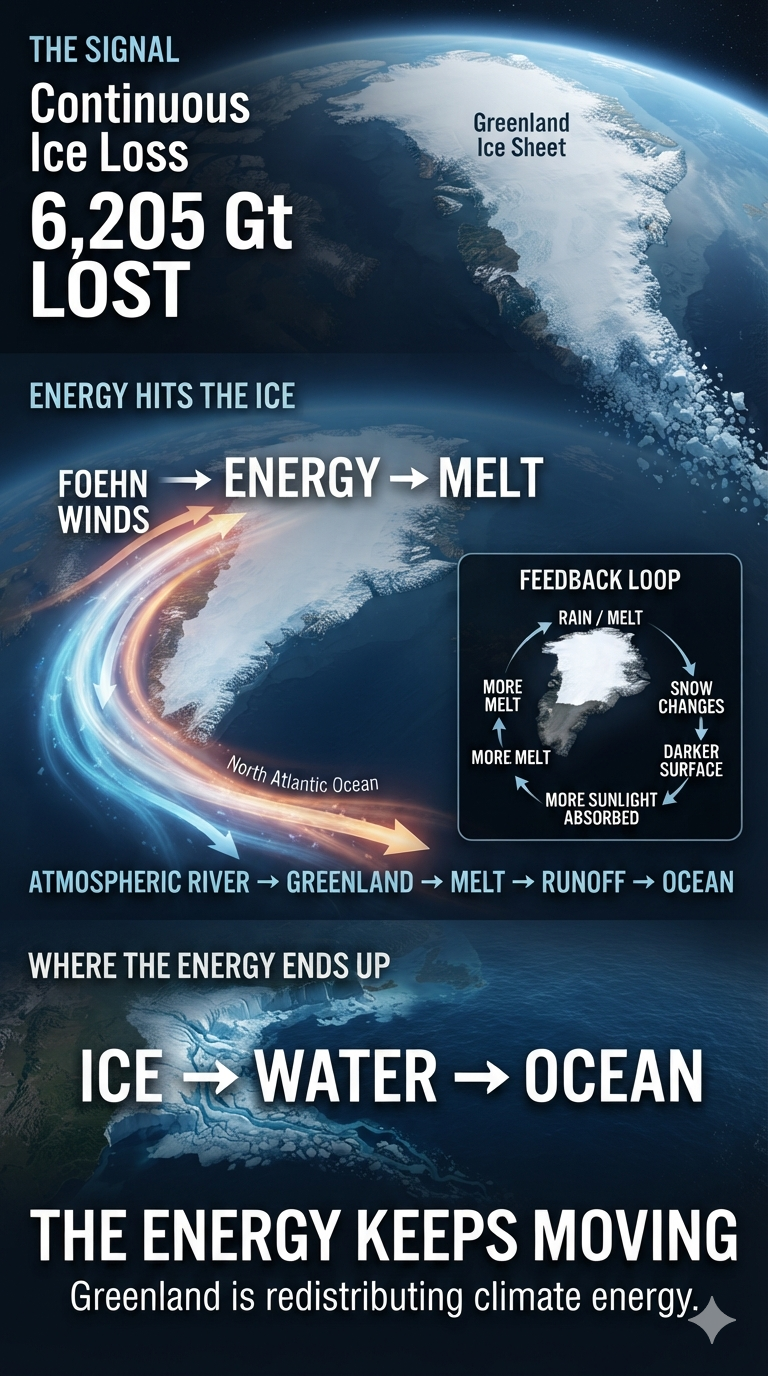
GEUS estimates that Greenland lost approximately 6,205 Gt between 1986/87 and 2025/26, contributing approximately 17.4 mm to global mean sea level.
Near low-elevation outlet glaciers, researchers found that 80–100% of extreme melt occurred during foehn conditions, while 50–75% occurred during atmospheric-river conditions. The researchers also found that these combined AR-foehn events have become more frequent during the 21st century.
[Intro]
Up from the ocean…
(Down from the snow!)
Round and round…
(Here we go!)
[Verse 1]
She has a memory
Of every place she’s been
Mountain top to riverbed
And back around again
[Refrain]
So we’ve come to know…
(Know the flow)
There’s no saying no
(To where she’ll go)
Oh, no, no, no
[Verse 2]
Rain can fall
(Rain can pour!)
Runoff races
Out the door!
[Refrain]
So we’ve come to know…
(Know the flow)
There’s no saying no
(To where she’ll go)
Oh, no, no, no
[Chorus]
Know the flow!
(Watch it go!)
From the mountain
To the river
To the ocean down below
Know the flow!
(Round we go!)
[Bridge]
Understand:
(She commands the land0
Flow!
(Flow!)
Go!
(Go!)
Round and round!
Flow!
(Flow!)
Go!
(Go!)
[Breakdown]
Where did it go?
(Down the drain!)
Where will it go?
(Down the plain!)
Where does it flow?
(We gotta know!)
[Full Band]
FOLLOW THE FLOW!
[Final Refrain]
So we’ve come to know…
(Know the flow)
There’s no saying no
(To where she’ll go)
Oh, no, no, no
Know the flow!
(Know the flow!)
Know the flow!
(Watch her go!)
[Outro]
Drip…
Drop…
(She won’t stop)
Here we go again
(She’ll always win)
Granular
[Intro]
Piece by piece
Grain by grain
Rock and ice
In the rain
What was solid
Won’t stay still
Down the slope
Against its will
[Verse 1]
Get down to the smallest pieces
That’s where the story starts
Pebbles, sand and broken stone
Scattered parts of parts
[Refrain]
When you get down to the nitty gritty
(Granular)
Is it grand or is it a pity
(Spectacular)
A concoction
(Of debris)
Fluidization
(Headin’ for the sea)
[Verse 2]
Rock comes crashing down all around
Guess she’s breaking free
Infiltrate the fractures
Lubricate liquidity
[Refrain]
When you get down to the nitty gritty
(Granular)
Is it grand or is it a pity
(Spectacular)
A concoction
(Of debris)
Fluidization
(Headin’ for the sea)
[Breakdown]
Rock!
(Rock!)
Mix it up!
(Mix it up!)
Shake it loose!
(Shake it loose!)
[Final Chorus]
Granular!
(Down to the grain!)
Spectacular!
(Here comes the rain!)
A concoction
(Of debris)
Fluidization
(Headin’ for the sea!)
Granular!
(Nitty gritty!)
Grandiose or a pity?
(Spectacular failure)
[Refrain]
When you get down to the nitty gritty
(Granular)
Is it grand or is it a pity
(Spectacular)
A concoction
(Of debris)
Fluidization
(Headin’ for the sea)
[Outro]
Grain by grain
Stone by stone
Water finds
It’s way home
Granular…
(Granular!)
Down to the nitty gritty…
(Headin’ for the sea!)
Shocking!
[Intro]
Did you hear that?
(Zap!)
Did you see that?
(Flash!)
Whoa…
(Wake from your nap)
(It’s time to dash!
It’s shocking!
[Verse 1]
It’s happening in the atmosphere
You can feel it in the air
Heat is building
Moisture rising
Energy is everywhere
[Refrain]
I’m talking…
(Shocking!)
There’s no denying…
(It’s electrifying)
…and terrifying
[Verse 2]
On September one
The storm was far from done
Thousands of strikes
Lit up the night sky
(Yikes!)
Feel the sky cry
[Refrain]
I’m talking…
(Shocking!)
There’s no denying…
(It’s electrifying)
…and terrifying
[Bridge]
Science has a warning
Written in the storm:
For every degree of warming
The lightning risks transform
Zap!
(Zap!)
Flash!
(Flash!)
Boom!
(Boom!)
Again!
Zap!
(Zap!)
Flash!
(Flash!)
Boom!
I’m talking…
(Shocking!)
There’s no denying…
(It’s electrifying)
…mystifying
[Full band]
WATCH THE SKY!
(CRY!)
[Refrain]
I’m talking…
(Shocking!)
There’s no denying…
(It’s electrifying)
…and terrifying
[Outro]
[Thunder rolls]
Where there’s heat…
(There’s energy.)
It comes to be…
(Oh, you’ll see)
[Lightning crack]
ZAP!
About the Song: How Is the Climate Energy Hitting You?
Chester County, It’s Shocking
How is a warmer and increasingly moisture-loaded atmosphere changing the conditions under which severe thunderstorms develop?
Over the past decade, the number of lightning strikes in Chester County, PA, has increased dramatically, rising from approximately 18,200 in 2016 to more than 30,500 in 2026.
During the peak of the September 1 storm, Chester County was bombarded by thousands of lightning strikes. The broader storm line was averaging more than 400 lightning strikes every 15 minutes as it moved through the region.
Peer-reviewed atmospheric research published in Science has projected that cloud-to-ground lightning strikes in the contiguous United States could increase by approximately 12% for every 1°C of global warming.
Lightning strikes in Chester County during September 1–2, when two extreme storm systems passed through the region, are estimated at 4,361 strikes. In 2016, there were approximately 18,200 strikes. Assuming there are no additional storms for the remainder of 2026, the estimated total would reach 34,861 strikes—representing approximately a 91.5% increase over the 2016 total, or nearly double the number of strikes recorded ten years earlier.
Listen to the water
(Do you hear it rise?)
Look across the valley
(See it with your eyes?)
Something’s moving
(Coming fast)
Something’s changing
(From the past)
[Verse 1]
Rain comes down
The ground can’t take it
Every channel fills
Who knows if we’re gonna make it—
To the bank
(Hope sank!)
Then another surge
(Splurge)
… who’s to thank?
[Pre-Chorus]
Up the creek
(Without a paddle)
Guess we’re about…
… to find out…
(There’s no way out)
[Refrain]
More surprises
(As the river rises)
Over the bank…
(Who’s to thank)
Rising higher
(Getting dire)
Higher, higher
[Verse 2]
Load it up
(Yup, up, up, up!)
Then let it pour
(Raging roar!)
[Refrain]
More surprises
(As the river rises)
Over the bank…
(Who’s to thank)
Rising higher
(Getting dire)
Higher, higher
[Bridge]
Higher than yesterday
Higher than before
Water at the doorstep
Water through the door
Surprise!
(Rise!)
Higher!
(Dire!)
More!
(Than before!)
… coming through the door?
Higher…
Higher…
Higher…
[Final Refrain]
More surprises
(As the river rises)
Over the bank…
(Who’s to thank)
Rising higher
(Getting dire)
Higher, higher
More surprises
(More surprises!)
River rises
(River rises!)
Higher…
Higher…
Higher!
[Outro]
Watch the water…
(Watch it rise)
Watch the water…
(Before your eyes)
Higher…
Higher…
Dire!
Float an Idea
Float it out
(Out it goes)
Let it drift
(Where it flows)
Too late to hold tight
(Despite your might)
A little thought
(Hey! Why not?)
[Verse 1]
A tiny spark of possibility
Before the work is ever done
Let the question find some daylight
Incite insight
[Refrain]
However remote
(Float!)
An idea
(Ahh, ahh, ahh)
Merrily, merrily
(Our dream is but a stream)
The scene seen
(Floats… sing the note)
Float!
An idea
(Ahh, ahh, ahh)
[Verse 2]
Down the stream of consciousness
Thought are gatherin’ speed
Ride as ideas collide
And becomes a different breed
[Chorus]
Float an idea!
(Let it fly!)
Float an idea!
(Reach the sky!)
Merrily, merrily
(Go with the flow)
You never know
(Where it will go)
Float an idea!
(Ahh, ahh, ahh)
Float!
[Refrain]
However remote
(Float!)
An idea
(Ahh, ahh, ahh)
Merrily, merrily
(Our dream is but a stream)
The scene seen
(Floats… sing the note)
Float!
An idea
(Ahh, ahh, ahh)
[Bridge]
What if?
(What if?)
Why not?
(Sought)
Could it be?
(Reality?)
Let it float!
(Hit that note!)
Float…
Float…
Float!
[Breakdown]
A thought becomes a question
(A question becomes a dream)
A dream becomes a vision
(A vision becomes a stream)
And when the stream is flowing
(You follow where it goes)
One little idea
Can change the way it flows
[Final Chorus]
Float an idea!
(Let it fly!)
Float an idea!
(Reach the sky!)
Merrily, merrily
(Our dream is but a stream)
The scene seen
(Floats… sing the note)
(Ahh, ahh, ahh!)
[Final Refrain]
However remote
(Float!)
An idea
(Ahh, ahh, ahh)
Merrily, merrily
(Our dream is but a stream)
The scene seen
(Floats… sing the note)
[Outro]
Float!
An idea
(Ahh, ahh, ahh)
Float!
[Soft whistling]
As we go…
(Into the flow…)
Don’t need a boat…
(Float!)
An idea.
(Ahh, ahh, ahh)
Let ‘Er Roll
[Intro]
Here we go!
(Whoa, oh, oh)
Down the line!
(Faster than divine)
Water moving
All the time
Catch the current
(In the present)
Let it roll!
(Roll, roll, roll)
[Verse 1]
There’s a current underneath us
It’s present… are you aware
Drips drop on a journey
Moving here and moving there
[Pre-Chorus]
(Don’t fight the flow)
You can’t stop the river
(You already know)
[Refrain]
Let ‘er roll!
(Rolling down the river)
Roll, baby, roll
(The thrill will deliver)
[Verse 2]
Rain comes down upon the watersheds
Reign comes down upon our heads
Pebbles, sand and clay
Will make their way
[Chorus]
Let ‘er roll!
(Rolling down the river)
Roll, baby, roll
(The thrill will deliver)
Round the bend
(Energy send!)
Down the way
(Into yesterday!)
Let ‘er roll!
(Let ‘er roll!)
Can’t fight the tide
(Better step aside!)
… or go along for the ride
[Bridge]
Where’s it going?
You know:
(Down below!)
Down low
(Go, go, go)
[Breakdown]
Roll!
(Roll!)
Roll!
(Roll!)
Down the river
See the sea!
[Final Refrain]
Let ‘er roll!
(Rolling down the river)
Roll, baby, roll
(The thrill will deliver)
Let ‘er roll!
(Let ‘er roll!)
Let ‘er flow!
(Let ‘er flow!)
Down the river…
To the sea!
[Outro]
Roll…
(Roll…)
Baby, roll…
(Rolling down the river…)
Let ‘er roll!
(Hope? … a sliver)
Dam!
[Intro]
Hold back the water
(Hold it back!)
Build up the wall
(Build up the wall!)
Think you’ve got nature
Right where you want her?
Then comes the rainfall…
(Reign fall)
And down comes it all!
[Verse 1]
Stack up the concrete
Pile up the stone
Tell the river
“Stay in your zone”
(Yeah, leave us alone)
[Pre-Chorus]
Water keeps rising
(The water keeps rising)
Water keeps rising
(The water keeps rising)
… ain’t that surprising
[Refrain]
Dam!
(So there “I am”)
Or so I thought
(Therefore I was?)
Damn!
(I mean gosh darn!)
… unneeded harm
(Should cause alarm)
Washed away
(Back to yesterday)
[Verse 2]
A wall of water
A wall of mud
A wall of debris
Coming like a flood
The river remembers
The path to the sea
You can change its direction
But not her destiny
[Refrain]
Dam!
(So there “I am”)
Or so I thought
(Therefore I was?)
Damn!
(I mean gosh darn!)
… unneeded harm
(Should cause alarm)
Washed away
(Back to yesterday)
[Bridge]
Dam!
(Damn!)
Dam!
(Damn!)
One little word
Two meanings collide
One holds the water
One asks us why
Thought we could trust it?
(Watch our actions bust it?)
[Breakdown]
Hold!
(Hold!)
Back!
(Back!)
Rise!
(Rise!)
Crack!
(Crack!)
Then—
Whoosh!
[Final Refrain]
Dam!
(So there “I am”)
Or so I thought
(Therefore I was?)
Damn!
(I mean gosh darn!)
… unneeded harm
(Should cause alarm)
Washed away
(Back to yesterday)
[Outro]
Yesterday…
(Yesterday…)
The dam was there
(The damn unaware)
Today…
(The dam gave way)
Today…
(The damn came to stay)
Dam!
Rainman
[Intro]
Clouds are gathering
(Here they come)
Thunder’s rattling
(What have we done?)
[Verse 1]
Man walked out beneath the sky
Thought he knew the way
(Not really knowin’ why)
Built a world of steel and stone
(All alone… on his throne)
And harmed ‘er day by day
[Refrain]
Man,
(You brought the reign)
You bought the rain
Man, oh, man
(That ain’t no plan)
… ya can’t start over again
Man,
(You brought on the pain)
You bought the rain
[Verse 2]
Rainman, Rainman
What did you expect?
You changed what was clear
To doom and fear
[Chorus]
You bought the rain!
(Bought the rain!)
You brought the pain!
(Brought the pain!)
Round and round
The energy goes
Down it falls
And up it flows
Rainman!
(Oh, Rainman!)
Look what you’ve done!
The reckoning has started
And the runoff’s on the run
[Bridge]
Reign or rain?
(Rain or reign?)
Who’s in control?
(What’s your role?)
You changed the game
(It’s not the same!)
… a heavy toll
[Breakdown]
Man!
(Oh, man!)
Round and round
The world turns
Yet, we’re hellbound…
To burn
(Burn, burn, burn, burn)
[Final Chorus]
Rainman!
(You brought the reign!)
You bought the rain!
(Bought the rain!)
Rainman!
(Oh, can’t you see?)
The energy
(Is coming down on me!)
Man, oh, man
(That ain’t no plan)
You changed the atmosphere
(To one of tears and fear)
[Refrain]
Man,
(You brought the reign)
You bought the rain
Man, oh, man
(That ain’t no plan)
… ya can’t start over again
Man,
(You brought on the pain)
You bought the rain
[Outro]
Rainman…
(Rainman…)
Look to the sky
(Now, you know why)
No more denial
(You can’t hide)
You bought the rain.
(Now it’s your ride)
Stick in the Mud
[Intro]
Well, the water came down
And the river ran wide
Mud in the middle
And nowhere to hide
[Verse 1]
I was standing on solid ground
Or so I thought I was
Then the rain came pounding down
And changed the way it does
[Refrain]
Oh, oh, oh
(Just a stick in the mud)
Don’t you know
(Stuck here after the flood)
Oh, oh, oh
(Just a stick in the mud)
There I go
(Down with the rising flood)
[Verse 2]
Grain by grain
Stone by stone
Raise the strain
Submerged home
[Bridge]
You can call it mud
You can call it flow
You can call it trouble
When you see it go
[Breakdown]
Stick!
(In the mud!)
Slip!
(Into the flood!)
Roll!
(Here we go!)
Goal?
(Do you know)
[Refrain]
Oh, oh, oh
(Just a stick in the mud)
Don’t you know
(Stuck here after the flood)
Oh, oh, oh
(Just a stick in the mud)
There I go
(Stuck here after the flood)
[Outro]
Oh, oh, oh…
(Just a stick in the mud)
Don’t you know…
(Stuck here after the flood)
Just a stick…
(Just a in the thick…)
Just a stick in the mud.
[Arrangement: High-energy piano/organ rock with a crackling electric-guitar riff. Start with distant thunder and sparse piano, then explode into pounding drums and guitar on the refrain. The chorus should feel like a lightning strike.]
[Intro]
Did you hear that?
(Zap!)
Did you see that?
(Flash!)
Whoa…
(Wake from your nap)
(It’s time to dash!
It’s shocking!
[Verse 1]
It’s happening in the atmosphere
You can feel it in the air
Heat is building
Moisture rising
Energy is everywhere
[Refrain]
I’m talking…
(Shocking!)
There’s no denying…
(It’s electrifying)
…and terrifying
[Verse 2]
On September one
The storm was far from done
Thousands of strikes
Lit up the night sky
(Yikes!)
Feel the sky cry
[Refrain]
I’m talking…
(Shocking!)
There’s no denying…
(It’s electrifying)
…and terrifying
[Bridge]
Science has a warning
Written in the storm:
For every degree of warming
The lightning risks transform
[Breakdown]
[Music drops to bass, heartbeat-like kick, and distant thunder]
I’m talking…
(Shocking!)
There’s no denying…
(It’s electrifying)
…mystifying
[Full band]
WATCH THE SKY!
(CRY!)
[Refrain]
I’m talking…
(Shocking!)
There’s no denying…
(It’s electrifying)
…and terrifying
[Outro]
[Thunder rolls]
Where there’s heat…
(There’s energy.)
It comes to be…
(Oh, you’ll see)
[Lightning crack]
ZAP!
About the Song: How Is the Climate Energy Hitting You?
Chester County, It’s Shocking
How is a warmer and increasingly moisture-loaded atmosphere changing the conditions under which severe thunderstorms develop?
Over the past decade, the number of lightning strikes in Chester County, PA, has increased dramatically, rising from approximately 18,200 in 2016 to more than 30,500 in 2026.
During the peak of the September 1 storm, Chester County was bombarded by thousands of lightning strikes. The broader storm line was averaging more than 400 lightning strikes every 15 minutes as it moved through the region.
Peer-reviewed atmospheric research published in Science has projected that cloud-to-ground lightning strikes in the contiguous United States could increase by approximately 12% for every 1°C of global warming.
Lightning strikes in Chester County during September 1–2, when two extreme storm systems passed through the region, are estimated at 4,361 strikes. In 2016, there were approximately 18,200 strikes. Assuming there are no additional storms for the remainder of 2026, the estimated total would reach 34,861 strikes—representing approximately a 91.5% increase over the 2016 total, or nearly double the number of strikes recorded ten years earlier.
[Intro, Spoken Word]
Thump, thump
(Drip, drop)
Enough to make a heart stop
[Instrumental Intro]
[Atmospheric Piano, Saxophone, Sustained Electric Guitar, Deep Bass, Distant Drums; Cold, Expansive Soundscape]
[Verse 1]
You melt my heart
Right from the very start
A little warmth
A little spark
A little change
Can leave a mark
[Pre-Chorus]
Falling rain
Melting snow
Where the warm winds
Choose to blow
Something frozen
Starts to move
Something solid
Finds its groove
[Refrain]
You melt my heart
(Right from the very start)
When it rains
(It pours)
Oh, the strains
(No one ignores)
You melt my heart
(In the flow)
… you know…
(It will depart)
[Verse 2]
Six thousand two hundred
And five gigatons gone
Hold on, hold on
… for how long?
(Same ole song)
[Pre-Chorus]
Foehn winds blow
Warm and dry
Down the mountains
From the sky
[Refrain]
You melt my heart
(Right from the very start)
When it rains
(It pours)
Oh, the strains
(No one ignores)
You melt my heart
(In the flow)
… you know…
(It will depart)
[Instrumental Break]
[Saxophone Solo, Electric Guitar Swells, Hammond Organ, Rolling Drums; Rising Intensity]
[Bridge]
When the foehn blows
And the river flows
The ice sheet feels
What the atmosphere knows
Warm air!
(Warm air!)
Moist air!
(Moist air!)
Meeting over Greenland
Changes everything there
And those combined events
Have become more frequent
In the twenty-first century
[Instrumental, Whistling]
[Spoken]
Foehn
(Keeps blowin’)
Melt is felt.
[Rap Vocal Break]
Melt!
(Felt!)
Heart’s
(Part)
Right from the very start!
Reign!
(Pain!)
Pour!
(Poor)
At the door!
Flow!
(Whoa, oh know)
Watch it go
(Go, go, go)
Gigatons!
(Gigatons!)
Gone!
(Rise!)
Changing shores
Before our eyes!
[Breakdown]
[Music Drops to Piano and Sparse Guitar]
You melt my heart…
And I wonder…
How much can a heart take?
[Pause]
For goodness sake
[Pause]
How much can we take…
[Build]
[Deep Bass Enters; Drums Gradually Rise]
When it rains…
(It pours.)
[Final Refrain]
You melt my heart
(Right from the very start)
When it rains
(It pours)
Oh, the strains
(No one ignores)
You melt my heart
(In the flow)
… you know…
(It will depart)
[Climactic Instrumental]
[Full Band: Saxophone, Electric Guitar, Hammond Organ, Piano, Bass, Drums and Atmospheric Synth; Expansive, Emotional Finale]
[Spoken Over Whistle Instrumental]
Oh, I fear…
(It does not simply disappear.)
See the sea…
(Getting near)
… changing forms
(Our new norms)
… the energy…
(What a tragedy)
[Final Hit]
YOU MELT MY HEART!
[Outro]
[Soft Piano, Wind and Distant Water]
When it rains…
It pours.
(Poor, poor, poor)
Till no more.
About the Song
GEUS estimates that Greenland lost approximately 6,205 Gt between 1986/87 and 2025/26, contributing approximately 17.4 mm to global mean sea level.
Near low-elevation outlet glaciers, researchers found that 80–100% of extreme melt occurred during foehn conditions, while 50–75% occurred during atmospheric-river conditions. The researchers also found that these combined AR-foehn events have become more frequent during the 21st century.
See the crack
(Hear the wack)
See it grow
(Now you know)
[Instrumental]
[Progressive-Rock Instrumental: Driving Guitar Riff, Heavy Bass, Rolling Drums, Hammond Organ and Rising Synth; Increasingly Complex Rhythmic Layers]
[Bridge]
The interesting part…
Isn’t simply
one tipping point.
It’s what happens
when systems
begin talking to each other.
And you know…
(Albedo.)
Oh dear!
(The atmosphere.)
[Rap Vocal Break]
Glue!
(Flew!)
Comes unstuck!
(What the phfff…)
Awe…
(Thaw!)
What the heck?
Feedback finds
Other kinds
Loop dee loop
(That’s the scoop)
Watch the story
Now unfold!
Rock!
(On!)
… on…
Rock!
(On!)
… on…
Slide!
(Slide!)
Flow!
(Now you know!)
[Breakdown]
[Music Drops to Deep Bass, Soft Piano and Distant Guitar Feedback]
See…
1.5°C…
In action.
[Pause]
No satisfaction
[Pause]
No retraction
[Whispered]
And that’s the facts.
[Build]
[Low Drums Enter]
Permafrost… lost
(At what cost)
[Response]
The glue…
… flew
[Response]
(Oh no!)
[Response]
Oh no, no, no
[Response]
(Oh, no know)
[Full Band]
See…
(When the mountains crumble to the sea!)
[Final Pre-Chorus]
Step right this way
(See 1.5°C in Action)
It’s your lucky day
(We’re the main attraction)
[Final Chorus]
What to do
(When the glue)
Comes unstuck
(Out of luck)
But hey
(Say)
You get to see
(Manmade destiny)
See it move
(See it slide)
See it flow
(See it ride)
And the mountains crumble
To the sea…
See?
[Climactic Instrumental]
[Extended Progressive-Rock Finale: Massive Guitar, Hammond Organ, Synth, Bass and Drums; Rising Harmonic Tension Resolves Into a Descending Guitar Figure Mimicking a Mountain Collapse]
[Spoken Over Instrumental]
Destabilizes
(Fluidizes)
Died…
(By liquefied)
The mass begins to move.
(Physics will prove)
And the feedbacks…
Keep walking the walk.
[Final Hit]
No talk, talk, talk
[Outro]
[Instrumental Outro: Guitar Feedback and Low Synth Fade Into Wind and Distant Rumble]
The glue comes unstuck…
[Pause]
What the phhfff…
(Heck!)
[Whispered]
(Introspect)
And the mountains…
Crumble to the sea.
See?
About the Song
See 1.5°C in Action: The Nepal–Tibet Glacial Collapse
The permafrost tipping point—and its feedbacks with other tipping points—is the most interesting part to me. Permafrost was kind of the glue holding everything together… until 1.5°C. Then the coupled feedbacks start feeding each other, and the whole system begins to unravel. And the mountains crumble to the sea… see? 😉