[Verse 2]
Not a straight and simple line
Not a clock that keeps good time
Networks learn to synchronize
Unexpected patterns rise
[Pre-Chorus]
One connects
(To many more)
Then they open
(Another door)
[Bridge]
Butterflies fly…
(Bye-Bye)
Then, another domino
(Starts to go)
Tiny changes…
(Start the flow…)
Feedback joining
(Still unaware?)
Building something
(None can share)
Not just faster…
(Faster faster…)
Changing how…
(Changing now…)
[Breakdown]
[Minimal Beat, Deep Sub Bass, Spoken Vocal]
Acceleration…
is change over time.
The acceleration…
of acceleration…
is when the rate of change…
changes.
[Final Chorus]
No! (No hesitating)
Accelerating
(Acceleration
…of acceleration)
(No!) No hesitation
(No!) No time for anticipation
…when you wait…
(It becomes too late)
Feedback rising
(Loop by loop)
Networks forming
(Group by group)
Small beginnings
(Bigger fate)
Understanding…
…cannot wait.
[Outro]
[Instrumental Outro: Massive Drums, Echo Guitar, Organ Sustain, Synth Climbs Then Slowly Dissolves]
The future…
isn’t only changing…
It’s changing…
how…
it changes.
About the Song
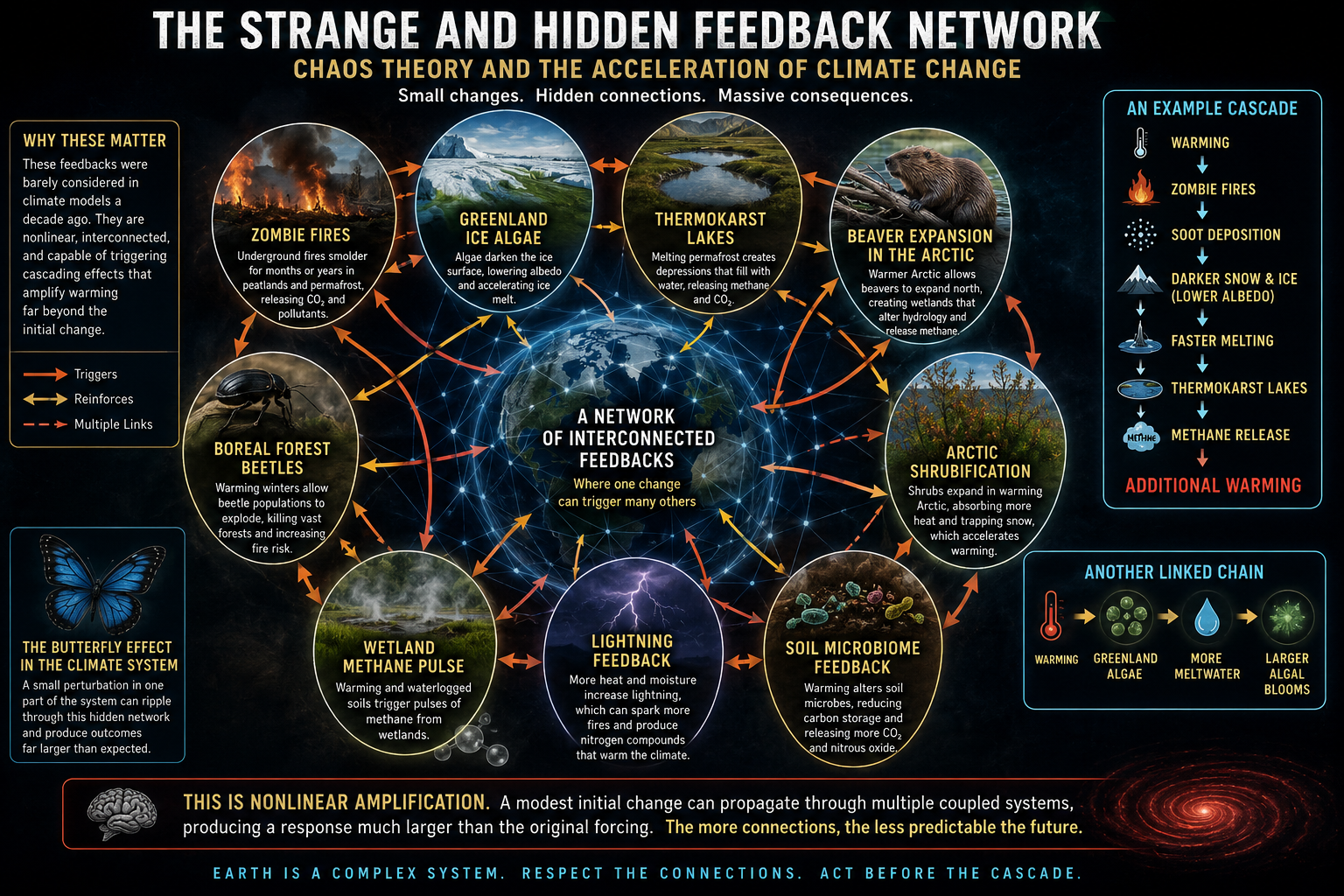
Emerging coupled feedback interactions exemplify nonlinear amplification: a modest initial perturbation can propagate through multiple coupled systems, producing a response much larger than the original forcing—a climate-scale manifestation of the Butterfly Effect. Rather than operating independently, feedbacks interact as an interconnected network in which biological, atmospheric, oceanic, cryospheric, and ecological processes reinforce one another. This networked behavior is one reason Earth-system responses become increasingly difficult to predict using traditional linear cause-and-effect thinking.
Unlike traditional climate feedbacks, which are often described individually, coupled feedback interactions arise when one feedback activates, strengthens, or synchronizes with others, producing cascading amplification throughout the Earth system. These interactions create emergent behavior that cannot be understood by examining any single process in isolation.
Climate change is more than a gradual increase in global temperature. It is the evolution of an increasingly interconnected Earth system whose components continuously exchange thermal energy, moisture, carbon, and momentum through a growing network of coupled feedbacks.
The possibility that the acceleration of climate change may itself accelerate represents one of the most consequential hypotheses in modern climate science. If correct, future climate change will depend not only on greenhouse gas emissions but also on how rapidly feedbacks become interconnected and how efficiently they amplify one another.
Determining the limits of this amplification—including the upper bounds of radiative forcing, ocean heat content, and equilibrium warming—will require integrating chaos theory, nonlinear dynamics, thermodynamics, and Earth-system science into the next generation of climate models. Understanding these interactions may prove essential for anticipating future climate trajectories and the societal, ecological, and economic thresholds they may cross.
[Minimal Beat, Sub Bass, Spoken Vocal]
What you don’t see…
(Still matters)
What you don’t know…
(Still will grow)
Oh, oh, oh
[Refrain]
The strange
(Rearrange)
Hidden from view
(Do what they do)
[Verse 1]
Beneath the ice and underneath snow
Tiny changes start to grow
Not alone but hand in hand
Working quietly across the land
One small spark beneath the ground
Another signal without a sound
One begins what others feed
Growing faster than we’d believe
[Pre-Chorus]
Hidden pieces
(Working still)
Following
(Physics’ will)
[Chorus]
Strange and hidden
(Hard to see)
Building pathways
(Quietly)
One becomes
(Two or three)
Then becomes
(A growing sea)
The strange
(Rearrange)
Hidden from view
(Do what they do)
[Instrumental]
[Guitar Solo]
[Driving Bass, Atmospheric Synth Layers, Organ Chords, Rolling Drums]
[Verse 2]
Zombie fires beneath the snow
Ice algae where glaciers glow
Thermokarst lakes begin to rise
Methane drifting through the skies
Lightning strikes a drying land
Beetles spread through weakened stands
Shrubs advance where tundra slept
Oceans warm in layers kept
As the stories intertwine
Crossing invisible design
No single answer tells it all
Together, systems rise and fall
[Bridge]
Not a straight line
(Not a chain)
More like rivers
(Joining rain)
Tiny changes
(Start the flow)
How far they travel…
(Nobody knows)
[Final Chorus]
The strange
(Rearrange)
Hidden from view
(Do what they do)
Small beginnings
(Big surprise)
Changing Earth
(Before our eyes)
Butterflies
(Dominoes)
One small change
(Grows and grows)
The strange
(Rearrange)
Hidden from view…
Changing…
Me and you.
[Outro]
[Instrumental Outro: Echo Guitar, Deep Synth Drone, Organ Fade, Wind Effects]
Hidden pathways…
(Hidden patterns…)
Hidden futures…
(Anticipating)
Waiting…
…to emerge.
(Converge)
Chaos Theory and the Acceleration of Climate Change
About the Song: The Strange and Hidden Feedback Network
*Chaos Theory and the Acceleration of Climate Change*
Climate change isn’t just one feedback causing another.
It’s becoming a **network of interacting feedbacks** where seemingly unrelated processes reinforce each other in ways that traditional linear thinking struggles to capture.
Our newest infographic explores some of the Earth’s most unusual and recently recognized climate feedbacks, including:
This is **nonlinear amplification**: modest initial changes propagating through interconnected systems to produce responses far larger than the original disturbance.
As these hidden connections strengthen, predicting climate behavior becomes increasingly difficult using simple cause-and-effect models.
Understanding the **network** is becoming just as important as understanding the individual feedbacks.
Darkened ice
(Absorbs the day)
Accelerating
(Melt away)
A microscopic
(Force unseen)
Changing landscapes
(Cold and green)
[Refrain]
Zombie fires
(Transpire)
Higher!
Ice algae
(Really?)
Reality
[Bridge]
Now you know the below
(Ice the ice above)
Disruption of flow
(What happened to love?)
Small reactions
(Become chains)
Hidden networks
(Change the game)
[Breakdown]
[Minimal Beat, Deep Sub Bass, Spoken Vocal]
The strangest feedbacks…
are often the ones we cannot see.
A fire beneath the snow.
Hotter higher on the ice.
Tiny changes…
with planetary consequences.
[Final Chorus]
Zombie fires
(Transpire)
Higher!
Ice algae
(Really?)
Reality
Hidden forces
(Coming through)
Changing worlds
(We thought we knew)
Zombie fires
(Ice algae)
Signals rising…
(See…)
Reality.
[Outro]
[Instrumental Outro: Deep Drone Synth, Crackling Fire FX, Melting Ice Sounds, Echo Guitar Fade]
Beneath the snow…
The fire waits.
Across the ice…
The color… participates
Hidden…
Emerging…
Alive.
(Thrive)
About the Song
The Strange and Hidden Feedback Network: Chaos Theory and the Acceleration of Climate Change
Some of the most fascinating—and concerning—climate feedback loops are ones that were barely considered in climate models a decade ago. They illustrate how a relatively small change can trigger a cascade of nonlinear responses, making them particularly relevant from a chaos theory perspective.
1. Zombie Fires (Overwintering Peat Fires)
Feedback loop:
Higher temperatures → more drought.
Peat ignites during summer fires.
Fire smolders underground all winter.
Fire re-emerges the following spring.
Vegetation and insulating peat disappear.
Permafrost thaws.
Ancient carbon and methane are released.
More warming → more fires.
These fires can survive beneath snow because peat acts like charcoal, insulating the combustion. They’re becoming increasingly common across Canada and Siberia as warmer, drier conditions expand.
2. Greenland Ice Algae
Perhaps one of the strangest biological feedbacks.
Feedback loop:
Warmer summers melt snow.
Microscopic algae bloom on exposed ice.
Dark pigments reduce ice reflectivity (albedo).
More sunlight is absorbed.
Ice melts faster.
More liquid water supports additional algae.
Researchers call this biological darkening. In parts of Greenland’s “Dark Zone,” algae have become a measurable contributor to increased melt.
[Intro]
[Instrumental Intro: Delicate Piano Notes, Atmospheric Synth Pads, Pulsing Bass, Soft Guitar Harmonics, Gradually Building Drums]
[Minimal Beat, Sub Bass, Spoken Vocal]
A tiny motion…
(A distant change)
A single step…
(A wider range)
One small turn…
(Begins the flow)
Watch what happens…
(As systems grow)
[Refrain]
Watch the butterfly
(Kiss the sky)
Blow a domino
(Then watch them go)
[Verse 1]
A whisper moves across the air
A subtle shift could land anywhere
The oceans turn, the forests bend
A change begins… where’s the end?
A little warmer, a little more
Energy enters through the door
The atmosphere begins to change
The patterns shift, the winds rearrange
[Chorus]
Butterflies and dominoes
(Where the hidden pathway goes)
Small beginnings
(Growing wide)
Systems changing
(Worldwide)
Feedback rising
(Loop by loop)
Tipping points
(Coming through)
Butterflies and dominoes
(Watch the chain reaction grow)
[Refrain]
Watch the butterfly
(Kiss the sky)
Blow a domino
(Then watch them go)
[Instrumental]
[Guitar Solo]
[Expansive Synth Layers, Driving Bass, Rolling Drums, Organ Swells Mimicking Cascading Waves]
[Verse 2]
Ice reflects the sunlight away
Until the mirror starts to fade
Dark oceans absorb the light
Adding heat into the night
Frozen soils begin to thaw
Releasing what was stored before
Forests struggle, oceans warm
Each response creates a storm
[Bridge]
Feedback loops
(Amplify)
Tipping points
(Stand nearby)
One falls over
(Then another)
Like a signal
(From a brother)
Dominoes falling
(Row by row)
Faster than
(We used to know)
[Breakdown]
[Minimal Beat, Deep Sub Bass, Spoken Vocal]
The butterfly does not move the domino.
No, the butterfly…
reveals the connection.
(Now we know)
[Final Chorus]
Watch the butterfly
(Kiss the sky)
Blow a domino
(Then watch them go)
Small disturbance
(Larger change)
A new pattern
(Rearranged)
Feedback rising
(Loop by loop)
Tipping points
(Coming through)
Butterflies and dominoes
(Where the hidden pathway goes)
[Outro]
[Instrumental Outro: Piano Returns, Echo Guitar, Gentle Synth Fade, Soft Percussion]
Watch the butterfly
(Kiss the sky)
Blow a domino
(Then watch them go)
A butterfly flies…
A domino falls…
(Surprise!)
A planet changes…
(Rearranges)
Connected…
Through it all.
Butterfly Effect and Domino Effect
About the Song: The Hidden Connections Driving Climate Change
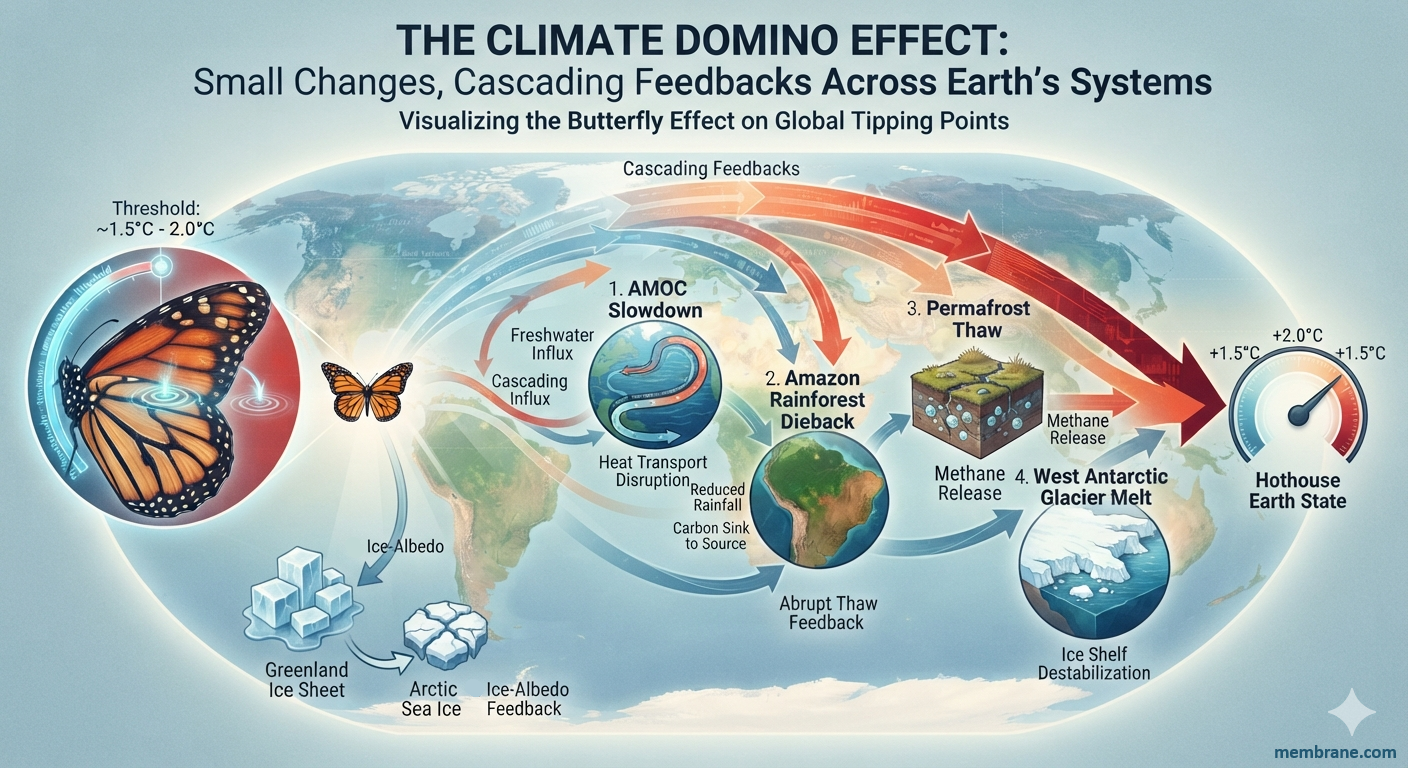
Climate change is not a simple chain of cause and effect. The Earth operates as a connected system where changes in one part of the planet can trigger responses in many others. These emerging coupled feedback interactions demonstrate a fundamental principle of nonlinear systems: a small initial change can spread through multiple connected processes and produce a response much larger than the original disturbance. This is the climate version of the Butterfly Effect.
Climate feedbacks do not operate independently. Instead, they interact as a vast network linking the atmosphere, oceans, ice sheets, forests, soils, and ecosystems. When one feedback strengthens another, the combined effect can become greater than the sum of the individual parts. This is why climate change can sometimes accelerate faster than expected and why predicting future changes is so challenging.
Feedback Loops → Tipping Points → Acceleration → Domino Effect
Feedback loops amplify climate change and can push interconnected Earth systems past critical tipping points. As tipping points are crossed, they can trigger additional feedback loops and destabilize other climate systems. This cascading “Domino Effect” compresses timescales, accelerates change, and increases the risk of rapid, nonlinear climate transformations.
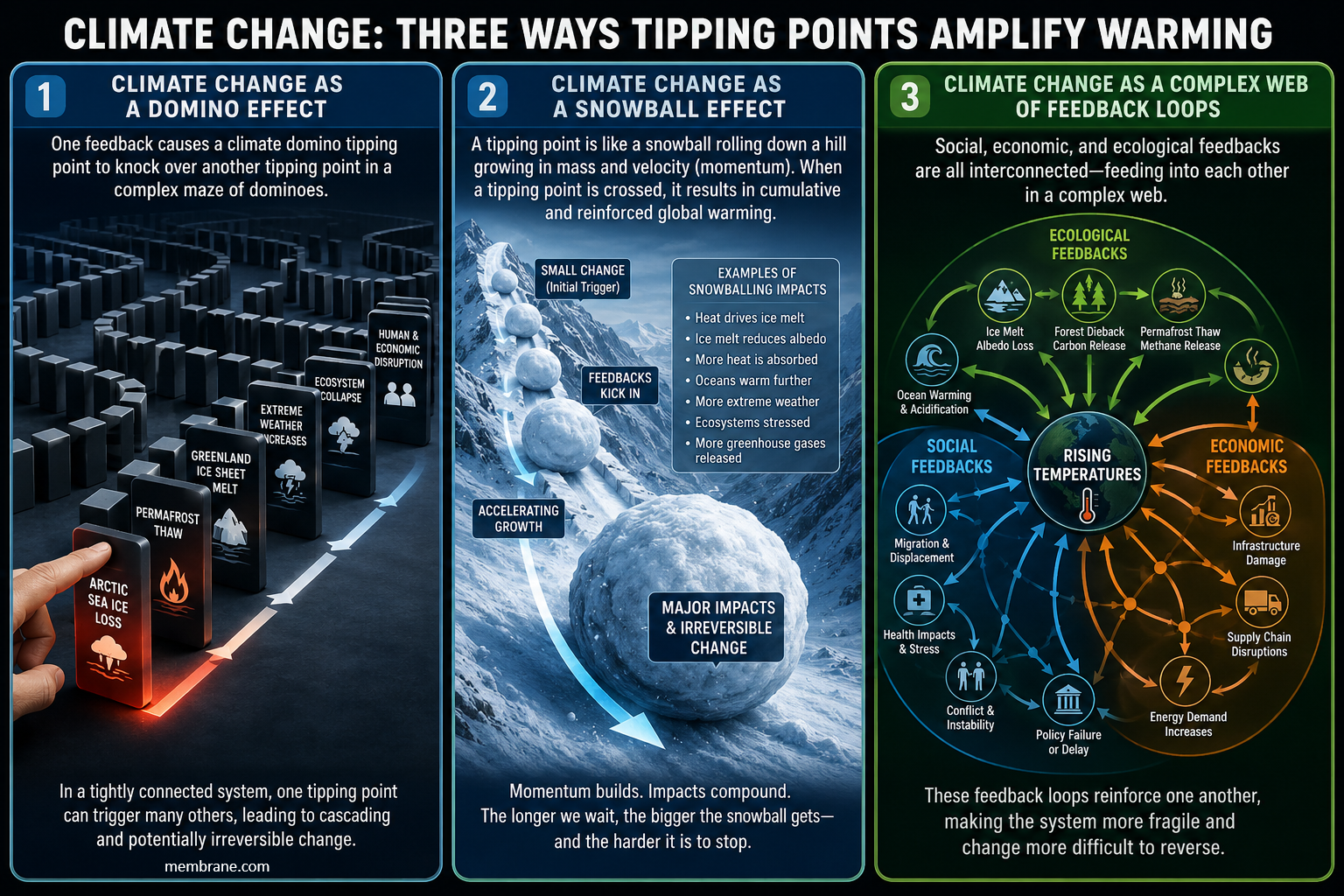
Create an infographic with three side-by-side panels illustrating three ways climate change accelerates through interconnected feedback mechanisms. Use a clean, scientific style with bold titles, arrows, and simple labels. The overall theme should emphasize accelerating nonlinear change rather than isolated events.
Panel 1: Climate Change as a Domino Effect
Illustrate a vast, complex maze of dominoes representing climate tipping points. A single falling domino triggers a chain reaction that spreads through multiple pathways, knocking over many other tipping points simultaneously.
Include examples of dominoes labeled:
Arctic Sea Ice Loss
Permafrost Thaw
Greenland Ice Sheet Melt
Boreal Forest Dieback
Amazon Rainforest Dieback
Ocean Warming
Wildfires
Methane Release
Extreme Weather
Water Scarcity
Food Insecurity
Human Migration
The image should convey that one feedback loop can trigger many others, producing cascading climate tipping points throughout the Earth system.
Panel 2: Climate Change as a Snowball Effect
Show a small snowball beginning at the top of a mountain slope. As it rolls downhill, it becomes dramatically larger, faster, and more powerful, symbolizing increasing momentum.
As the snowball grows, illustrate climate impacts accumulating around it:
Rising temperatures
Ice melt
Reduced albedo
Ocean heat accumulation
Atmospheric water vapor
Stronger storms
Floods
Droughts
Wildfires
Sea-level rise
Use arrows to emphasize positive feedback, showing that each new impact increases the size and momentum of the snowball.
The final snowball at the bottom should appear enormous, illustrating how crossing climate tipping points leads to cumulative, self-reinforcing global warming that becomes increasingly difficult to slow or reverse.
Panel 3: Climate Change as a Complex Web of Feedback Loops
Create a network diagram centered on Global Warming, with interconnected nodes linked by arrows in multiple directions.
Organize the nodes into three interconnected categories:
Ecological Feedbacks
Ice-Albedo Feedback
Permafrost Methane
Ocean Warming
Forest Dieback
Wildfires
Carbon Cycle Changes
Economic Feedbacks
Rising Energy Demand
Infrastructure Damage
Insurance Losses
Agricultural Decline
Supply Chain Disruptions
Resource Scarcity
Social Feedbacks
Human Migration
Public Health Impacts
Conflict
Political Instability
Food Insecurity
Water Scarcity
Use numerous looping arrows to show that these ecological, economic, and social systems continually reinforce one another rather than operating independently.
The overall visual should resemble a dynamic interconnected network, emphasizing that climate change is not a single linear process but a complex adaptive system of mutually reinforcing feedback loops that accelerate global warming.
Feedback Loops → Tipping Points → Acceleration → Domino Effect
Feedback loops amplify climate change and can push interconnected Earth systems past critical tipping points. As tipping points are crossed, they can trigger additional feedback loops and destabilize other climate systems. This cascading “Domino Effect” compresses timescales, accelerates change, and increases the risk of rapid, nonlinear climate transformations.
The acceleration’s rising still
(Watch the curve swerve)
Climate jerk!
(It gets attention!)
Climate jerk!
(Starts a conversation!)
[Outro]
What’s the word?
(Climate jerk!)
What’s the math?
(Do the work!)
Read the graph
(Follow the line!)
The future’s written
(One slope at a time!)
No doubt
(To find out)
The denier (crier)
About the Song
The technical term is third-derivative behavior—specifically, when d³I/dt³ > 0, meaning the acceleration itself is increasing. I use the informal term “climate jerk” because it’s more accessible to a general audience and, judging by some of the reactions, it certainly gets people’s attention.
[Final Chorus]
Observational
(Evidence)
… of being a jerk
Seems a bit irrational
(No coincidence)
Jerk behavior
(For sure)
Observational
(Evidence)
Across the planet’s work
Seems a bit irrational
(No coincidence)
Jerk behavior
(For sure)
[Final Refrain]
First derivative
(Change)
Second derivative
(Acceleration)
Third derivative
(Jerk)
Across the observation
First derivative
(Change)
Second derivative
(Acceleration)
Third derivative
(Jerk)
Changing civilization
[Outro]
Not just warming
(Not just heat)
Multiple signals
(Repeat, repeat)
Different systems
(Converge and merge)
Observational evidence
(Of a climate jerk)
About the Song: Observational Evidence of Climate Jerk
The defining characteristic of a singularity is not merely rapid change, but a continuously increasing rate of acceleration. In mathematical terms, the system exhibits a positive third derivative—commonly referred to as “jerk.” While global surface temperature remains the most widely cited climate metric, several other indicators provide clearer evidence that the Earth system is increasingly characterized not simply by change or acceleration, but by acceleration of acceleration.
Among the strongest candidates are ocean heat content, sea level rise, Rossby wave amplification, and ice-sheet mass loss.
From Acceleration to Jerk
Individually, ocean heat content, sea level rise, Rossby wave amplification, and ice-sheet mass loss each demonstrate clear acceleration. Taken together, they indicate something more significant: the acceleration itself is increasing.
This distinction is critical. A system with constant acceleration can often be approximated using standard trend extrapolation. A system with positive jerk cannot. In such a system, the underlying growth parameters evolve over time, and future trajectories diverge increasingly from historical expectations.
In this framework, the emergence of climate jerk represents a potential indicator that the Earth system is transitioning toward a regime dominated by nonlinear feedbacks and interacting subsystems. The central question is therefore no longer whether the climate is changing or accelerating, but whether the rate of acceleration is itself increasing across multiple independent observational domains.
The convergence of ocean heat content, sea level rise, atmospheric circulation changes, and ice-sheet mass loss suggests that this condition may already be underway.
[Final Chorus]
Restore the missing texture
(To ensure our future)
Begin putting the chaos back in
(Again)
Restore the missing texture
(To ensure our future)
Let stochastic systems win
(Again and again)
[Refrain]
Stochastic noise
Which do you think
(White or pink?)
Stochastic noise
Don’t overthink
(Just let it link)
White noise, pink noise
Random choice
Stochastic noise
Becomes the voice
[Outro]
Tiny fluctuations
(Never still)
Shaping futures
(At least until…)
With random poise
(We learn to see)
Stochastic noise
(Is reality)
About the Song: Stochastic Noise in Climate and Physical Modeling
1. Overview
Stochastic noise refers to random, unpredictable fluctuations introduced into mathematical systems in order to represent processes that are too small, too fast, or too complex to be explicitly resolved. In climate science and physics, stochastic noise is used to replace missing sub-grid-scale dynamics with statistically consistent variability, ensuring that deterministic equations better reflect real-world chaotic behavior.
Rather than treating the system as perfectly smooth or fully deterministic, stochastic approaches acknowledge that many physical processes operate below the resolution of computational models and must therefore be represented probabilistically.
2. Why Climate Models Use Stochastic Noise
Global climate models divide the Earth into grid cells that are typically on the order of 50–100 kilometers in size. Many physically important processes occur at scales far smaller than these grid cells, including:
* Individual cloud formation and microphysics
* Localized wind gusts and turbulence
* Ocean eddies and small-scale mixing processes
These sub-grid processes cannot be explicitly resolved, yet they significantly influence large-scale climate behavior.
The deterministic (parameterized) approach
Traditional models approximate these processes using fixed or averaged parameterizations. While computationally efficient, this approach can:
* Suppress natural variability
* Smooth over extreme events
* Introduce systematic bias in long-term behavior
The stochastic approach
In contrast, stochastic modeling introduces randomness drawn from probability distributions at each timestep. This allows the system to:
* Retain variability across scales
* Avoid artificial steady-state cycling
* Better represent chaotic physical interactions
In effect, stochastic noise restores the missing “texture” of the climate system.
Probabilistic
(The future will deal)
Probabilistic
(But the risks are real)
Probabilistic
(Listen to the statistics)
Probabilistic
(While there’s time to fix it)
[Outro]
Not certainty
(But probability)
Not prophecy
(But possibility)
The signal grows
(For all to see)
Probabilistic
(That’s reality)
About the Song
Because climate is chaotic, long-term prediction relies on ensemble modeling rather than deterministic forecasts. Thousands of simulations explore parameter uncertainty, emissions pathways, and internal variability.
Probabilistic climate models simulate future climate conditions by producing ranges of possible outcomes rather than a single definitive prediction. By incorporating stochastic noise and varying model parameters, they explicitly account for inherent system variability and scientific uncertainties, allowing scientists to calculate the likelihood of specific climatic events.
We examine how human activities — such as deforestation, fossil fuel combustion, mass consumption, industrial agriculture, and land development — interact with ecological processes like thermal energy redistribution, carbon cycling, hydrological flow, biodiversity loss, and the spread of disease vectors. These interactions do not follow linear cause-and-effect patterns. Instead, they form complex, self-reinforcing feedback loops that can trigger rapid, system-wide transformations — often abruptly and without warning. Grasping these dynamics is crucial for accurately assessing global risks and developing effective strategies for long-term survival.
[Verse 1]
A fraction of a degree
(A subtle blow)
A little extra heat
(Makin’ oceans slow)
A shift in the wind
(A change in the flow)
Can lead somewhere
(Gettin’ hard to know)
The rules remain
(But outcomes vary)
Will the path ahead
(Become contrary?)
[Pre-Chorus]
Not random
(But hard to see)
A world connected
(By sensitivity)
[Chorus]
Small changes
(Chain-reaction rearranges)
Perturbation
(Propagation)
Small changes
(Lead to strange equations)
Perturbation
(Transformation)
[Refrain]
Spread your wings
(See what it brings)
Fly above…
(And share the love)
Change the world
(Come unfurled)
Change the world
(Be butterfly bold)
[Verse 2]
The atmosphere remembers
(More than we know)
Tiny disturbances
(Help patterns grow)
A storm may gather
(From seeds unseen)
A future emerges
(Between the extremes)
The system evolves
(In nonlinear ways)
Following pathways
(Through countless days)
[Arrangement: Bass becomes more active, percussion intensifies]
[Pre-Chorus]
One small motion
(Starts a chain)
Across the sunshine
(And through the rain)
[Chorus]
Small changes
(Chain-reaction rearranges)
Perturbation
(Propagation)
Small changes
(Through countless interactions)
Perturbation
(Amplification)
[Bridge]
The butterfly doesn’t
(Control the sky)
Yet somehow contributes
(To what may arise)
Not destiny
(Not fate alone)
But possibilities
(Being shown)
The future branches
(At every turn)
A lesson
(We continue to learn)
[Instrumental Break]
[Synth Lead]
[Guitar Solo]
[Piano and Organ Dialogue]
[Final Chorus]
Small changes
(Chain-reaction rearranges)
Perturbation
(Propagation)
Small changes
(Lead to new creations)
Perturbation
(Transformation)
Small changes
(Build new foundations)
Perturbation
(Innovation)
[Final Refrain]
Spread your wings
(See what it brings)
Fly above…
(And share the love)
Change the world
(Come unfurled)
Change the world
(See what flapping wings… brings….)
Spread your wings
(And let them sing)
Every motion
(Can mean something)
[Outro]
A tiny beginning
(A different end)
One small choice
(Begins again)
Sensitivity…
(The possibility)
Sensitivity…
(For you and me)
About the Song
Chaos Theory: Sensitivity and Nonlinear Dynamics
Chaos theory explores how deterministic systems can behave unpredictably, especially when small changes in initial conditions lead to vastly different outcomes. This is particularly relevant for climate variability, such as hurricane formation or abrupt shifts in atmospheric circulation.
Feedback loops amplify climate change and can push interconnected Earth systems past critical tipping points. As tipping points are crossed, they can trigger additional feedback loops and destabilize other climate systems. This cascading “Domino Effect” compresses timescales, accelerates change, and increases the risk of rapid, nonlinear climate transformations.
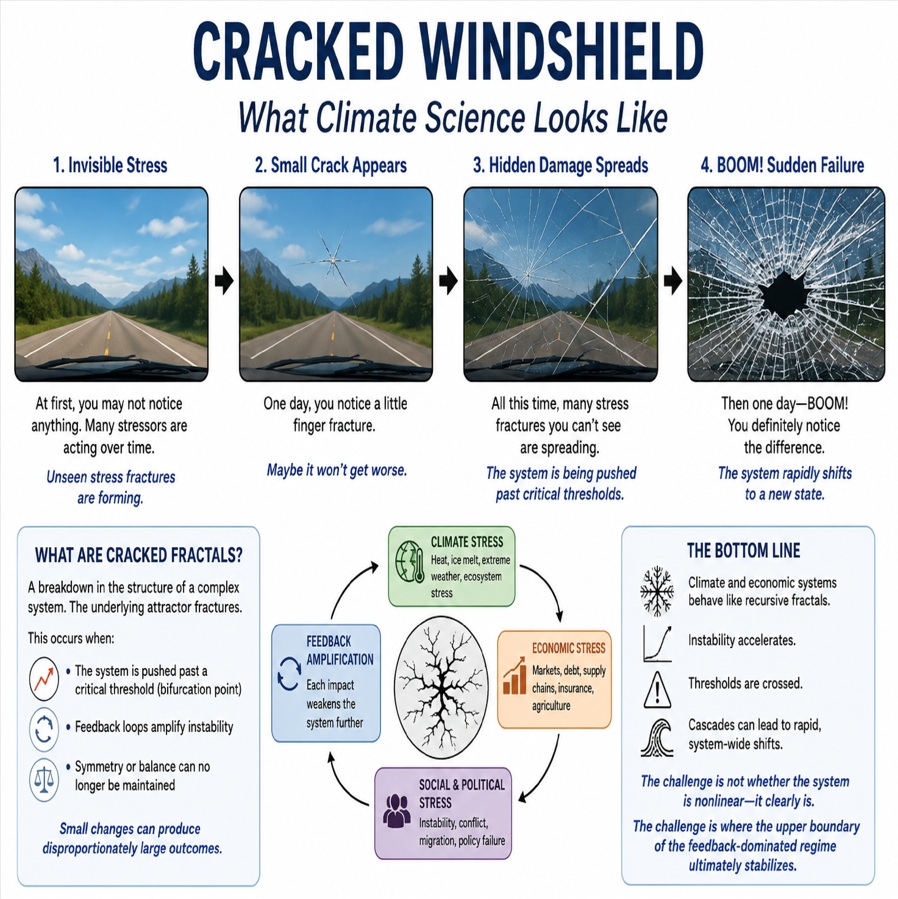
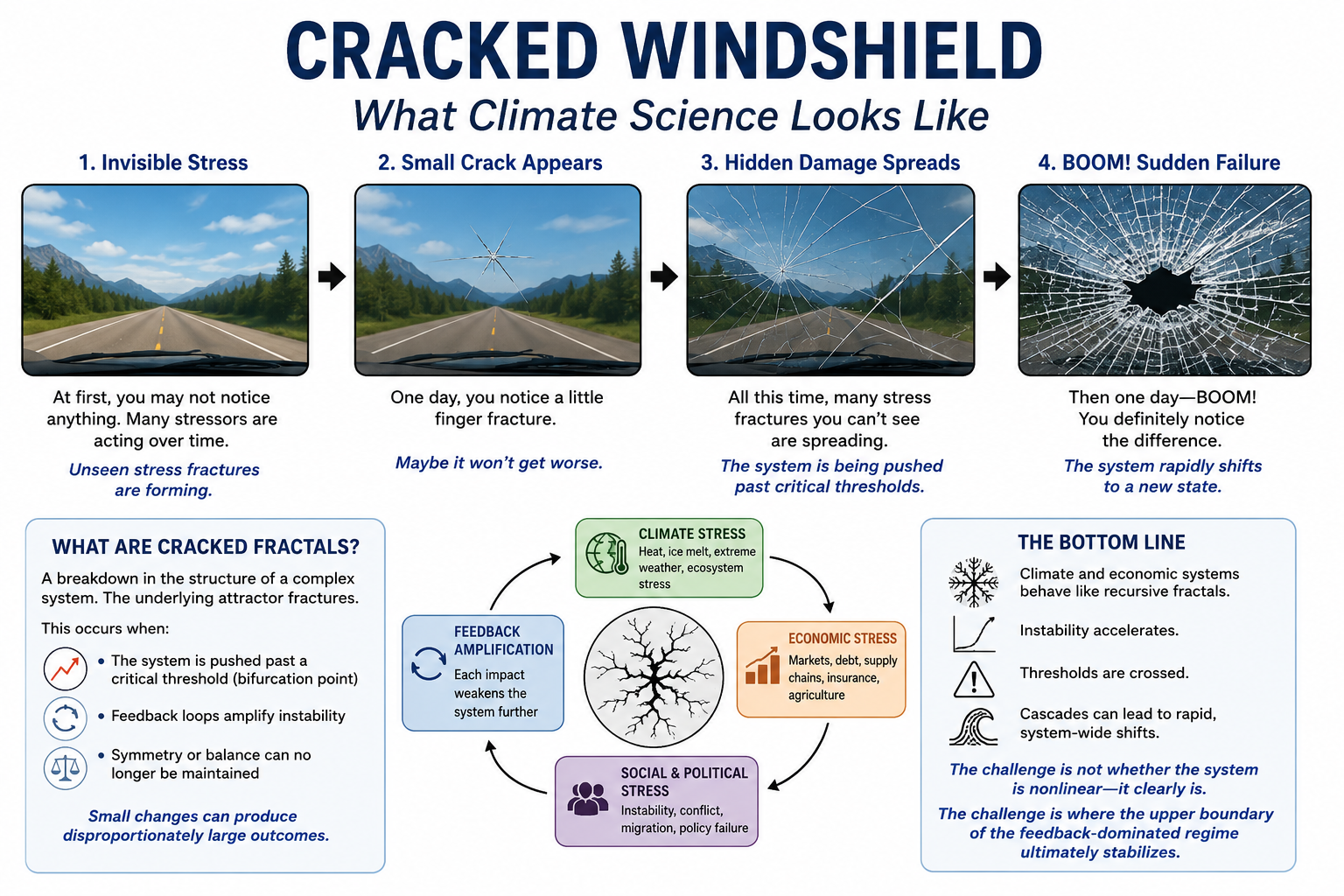
At first, you may not notice anything at all. Time passes. The damage appears minor or even invisible. Then one day, a small fracture catches your eye — just a tiny finger crack stretching across the glass.
You think:
“Maybe it won’t get worse.”
But during all that time, unseen stress fractures have already been spreading beneath the surface. Temperature changes, vibration, pressure, and repeated impacts continue weakening the structure. The windshield may appear stable right up until the moment it suddenly fails.
[Intro]
Did you know…
You can look out your window…
And see what’s come to be.
At first…
You don’t notice anything.
Just another day.
Another mile.
Another season passing by.
(Why?)
[Soft Piano Enters]
Then one day…
You see it.
A tiny crack.
A thin line stretching across the glass.
You tell yourself…
“It’s probably nothing.”
But beneath the surface…
The fractures are already spreading.
(Bringing on the dreading)
[Verse 1]
Did you know
You can look out your window
(And see what’s come to be)
There’s a crack
In the windshield
(And it will yield… the fact)
You can drive for miles
Thinking everything’s alright
Just a little line of damage
In the morning light
But every bump and every season
Every freeze and every thaw
Adds a little more pressure
To a weakness that you saw
[Pre-Chorus]
Beneath the surface
Out of sight
The fractures spread
Day and night
[Chorus]
[Full Band]
It’s a cracked windshield
Spider webs across the sky
One more shock
And the whole thing comes alive
It’s a cracked windshield
Breaking faster than it seems
What looked so small
Was bigger than our dreams
And when it goes
It doesn’t ask us why
A cracked windshield
Across the world we drive
[Verse 2]
We watched the rivers
We watched the forests
We watched the oceans rise
We saw the warning signs
Reflected in our eyes
Heat waves linger longer
Storms arrive with greater force
Every year another fracture
Running through the course
We kept saying tomorrow
Would be time enough to mend
Never seeing all the branches
Growing from the end
[Pre-Chorus]
[Building Tension]
Beneath the surface
Out of sight
The fractures spread
Day and night
[Chorus]
It’s a cracked windshield
Spider webs across the sky
One more shock
And the whole thing comes alive
It’s a cracked windshield
Breaking faster than it seems
What looked so small
Was bigger than our dreams
And when it goes
It doesn’t ask us why
A cracked windshield
Across the world we drive
[Bridge]
Then one day…
BOOM.
The pattern changes shape.
What held together yesterday
Can suddenly break.
[Drums Re-enter]
The pieces were connected
Though we never saw the thread
Now every crack is talking
To the others up ahead
Tipping points and feedback loops
Joining hand in hand
Drawing maps of fractures
Across the sea and land
[Final Chorus]
It’s a cracked windshield
Looking out on changing days
The lines we ignored
Now stretch in every way
It’s a cracked windshield
Not a single crack alone
But a thousand hidden pathways
Through the structure we’ve known
And the lesson
Written right before our eyes
A cracked windshield
Shows how systems fail with time
[Outro]
[Drums Fade]
Did you know…
You can look out your window…
And see what’s come to be…
[Organ and Piano Sustain]
There’s a crack…
In the windshield…
[Long Pause]
And it reveals…
What we could not see…
(And what has come to be.)
Get Together
[Chorus]
Do you want to get together?
(Does it have to be forever)
Strange attractor
(Is in fact a factor?)
[Refrain]
Do you want to get together?
(Is it “whether”… is it weather)
How long… is forever
(How long… will this song go on?)
Until…
(Still is still)
[Chorus]
Do you want to get together?
(Does it have to be forever)
Strange attractor
(Is in fact a factor?)
[Bridge]
Maybe pathways cross
(Like they often do)
Maybe strange attractors
(Brought me here to you)
[Refrain]
Do you want to get together?
(Is it “whether”… is it weather)
How long… is forever
(How long… will this song go on?)
Until…
(Still is still)
Until…
(The moment stands still)
[Outro]
[Instrumental Fade]
[Guitar Harmonics]
[Organ Sustain]
[Soft Bass Pulse]
[Spoken Vocal]
Is forever…
… simply what happens…
when two trajectories meet…
… the feat.
(Complete?)
Complete
Frame 1 — Invisible Stress
[Intro]
Sometimes the biggest changes…
Begin where nobody is looking.
A structure can appear unchanged…
Nevertheless…
(… stress quietly accumulates beneath the surface.)
[Verse 1]
Back before the warning signs
Filled the nightly news
The system seemed so stable
Nothing much to lose
The seasons came and went around
Like they always had before
But tiny shifts were building up
Behind a hidden door
[Pre-Chorus]
Earlier in the game
(First frame)
Before the picture changed
(No one knew its name)
[Chorus]
At first you may not notice
(Maybe you missed the first verse)
Multiplying unseen fractures
(Adding up to become the future)
Tiny stresses
(Hidden from view)
Building pathways
(Running through)
[Verse 2]
The ice thinning slow
So hardly anyone could know
Easy to explain away
Until the pressure found its way
[Pre-Chorus]
Earlier in the game
(First frame)
Quiet changes spreading
(Without a face to blame)
[Chorus]
At first you may not notice
(Maybe you missed the first verse)
Multiplying unseen fractures
(Adding up to become the future)
Tiny stresses
(Hidden from view)
Building pathways
(Running through)
[Bridge]
Invisible doesn’t mean absent
Silent doesn’t mean still
The forces keep accumulating
Following their will
Every crack begins as something
Almost too small to see
Until enough connections form
To change reality
[Breakdown]
One line…
(Becomes two)
Two lines…
(Becomes more)
Small shifts…
(Open the door)
[Final Chorus]
At first you may not notice
(Maybe you missed the first verse)
Multiplying unseen fractures
(Adding up to become the future)
Hidden stresses
(Beneath the skin)
The story’s already starting
(Before the next frames begin)
[Outro]
[Ambient Synth, Soft Piano]
Earlier in the game…
(First frame)
The damage wasn’t seen…
(Soon bursting onto the scene)
Queue frame 2
(Hidden stress becomes a mess)
About the Song
The graphic is a simplified representation of an extraordinarily complex system. Nevertheless, it provides a familiar visual analogy that helps make nonlinear climate dynamics easier to understand.
Up through the 1990s, we were largely in Frame 1 — invisible stress. The underlying pressures were building, but most of the damage remained hidden from view.
Fly on the Phenomenon
[Intro]
Remember when…
A summer drive meant stopping for gas…
And cleaning the windshield.
Not once…
But over and over again.
Now the glass stays clean…
(There is no yield)
Revealed:
(No bugs in the scene)
… know what I mean?
[Verse 1]
Cruisin’ down the blacktop
Windows rolled down
Used to hear the buzzin’
All around town
Dragonflies and fireflies
Moths beneath the moon
Clouds of life were everywhere
But they vanished much too soon
[Pre-Chorus]
Something changed
Along the way
The silence grew
Day by day
[Chorus]
A fly…
(On the phenomenon)
Oh my
(Now there’s none)
[Refrain]
Splatometer
(Runnin’ flat)
Splat!
Insect splatter
(Sure does matter)
[Verse 2]
Used to wipe the windshield
Every hundred miles
Now it stays so spotless
Year after year and mile after mile
The roads are getting cleaner
But something isn’t right
When the air grows empty
Of wings in summer light
[Pre-Chorus]
The birds are looking
Fields and streams
No dinner cooking
Just leftover dreams
[Chorus]
A fly…
(On the phenomenon)
Oh my
(Now there’s none)
[Refrain]
Splatometer
(Runnin’ flat)
Splat!
Insect splatter
(Sure does matter)
[Bridge]
Half or more in others too
And the warning’s coming through
Vacant fields and flowers
The blame is all ours
[Build]
One by one
The losses add
Until the whole thing’s looking bad
[Chorus]
A fly…
(On the phenomenon)
Oh my
(Now there’s none)
A fly…
(Where’d they go?)
Oh my
(We may never know)
[Refrain]
Splatometer
(Runnin’ flat)
Splat!
Insect splatter
(Sure does matter)
Splatometer
(Falling fast)
Splat!
(How much longer)
Can this last?
[Final Verse]
The windshield tells a story
Anybody can see
A signal from the roadside
Of a changing tragedy
The smallest things among us
Often hold the biggest key
And when they start disappearing
What does that say for you and me?
[Final Chorus]
A fly…
(On the phenomenon)
Oh my
(Now there’s none)
A fly…
(On the windshield glass)
Oh my
(Passed into the past)
[Outro]
[Highway Sounds Fade]
[Soft Acoustic Guitar]
[Fade Out]
Splat…
Splat…
Splat…
(No more of that…)
About the Song
The “windshield phenomenon” refers to the observation that people see far fewer dead insects on their windshields today than they did a few decades ago. What began as an anecdotal observation has since been confirmed by scientific studies documenting substantial declines in insect populations around the world.
Researchers have even measured the trend directly using standardized bug-splatter surveys.
*In Denmark, a study tracking insect impacts along the same driving routes from 1997 to 2017 found roughly an 80% decline in insect splatters, paralleling declines in insect-eating bird populations.
* In the UK, “Splatometer” surveys conducted by the Kent Wildlife Trust found a 50% to 72% reduction in insect collisions compared with measurements from 2004.
* A landmark 2017 study in German nature reserves reported a 76% decline in total flying insect biomass over a 27-year period.
The causes are complex and likely include habitat loss, pesticide use, pollution, climate change, invasive species, and other environmental stressors acting together. Regardless of the exact mix of causes, the decline is significant because insects form the foundation of many ecosystems, supporting pollination, soil health, birds, amphibians, and countless other species.
In many ways, the disappearing bugs on our windshields may be one of the most visible signs of a much larger ecological disruption.
Many Stressors
[Intro]
Rarely does a system fail…
From a single cause.
Because more often…
Many pressures arrive together…
Turning is…
To was.
[Verse 1]
Another extreme storm
Creating a new (knew) norm
A splinter by itself may seem
Like something incomplete…
(But, just wait until they meet)
[Pre-Chorus]
One stressor here
(One stressor there)
Another arrives
(From everywhere)
[Chorus]
Many stressors
(Over time)
Humanity’s aggressors
(All the while… feedbacks rhyme)
[Verse 2]
Ecofascists wine and dine
Order another course (of course!)
While separate pieces intertwine
And magnify the force
[Pre-Chorus]
One becomes two
(Two become more)
Small disturbances
(Open a door)
[Chorus]
Many stressors
(Over time)
Humanity’s aggressors
(All the while… feedbacks rhyme)
Adding pressure
(Year by year)
Making futures
(Less than clear)
[Bridge]
[Music Drops to Bass and Drums]
Habitat loss
(Push)
Pollution
(Push)
Overconsumption
(Push)
Climate disruption
(Push)
Invasive species
(Push)
Resource depletion
(Push)
One alone may bend a system
(Together they can break “I am”)
[Build]
Stress upon stress
(Stronger still)
Force upon force
(Against the will)
Feedback loops
(Begin to grow)
Accelerating
(What we sow)
[Chorus]
Many stressors
(Over time)
Humanity’s aggressors
(All the while… feedbacks rhyme)
[Final Chorus]
[Full Band, Choir Harmony]
Many stressors
(Over time)
Humanity’s aggressors
(All the while… feedbacks rhyme)
Not one cause
(Not one line)
But countless pressures
(All combined)
Many stressors
(Every day)
Shaping futures
(Along the way)
[Outro]
[Drums Fade, Ambient Synth Remains]
A system can withstand…
A great deal.
Until it can’t.
The challenge…
Is recognizing the total weight.
Not just the heaviest stone.
(Man, man alone)
[Fade Out]
Many stressors…
Over time…
Butterfly Flaps
[Intro]
Wisp, wisp…
(Just like this:)
The butterfly effect isn’t about butterflies.
(I’ve come to realize)
It’s about sensitivity.
(I’ve come to see)
Tiny causes.
(And becauses)
Unexpected consequences.
A world where small things matter.
[Verse 1]
A whisper in the background
(A change too small to see)
A fraction of a degree
(In a complex tapestry)
A choice made on a Tuesday
(A pathway left untapped)
One little perturbation
(Then the future gets remapped)
[Pre-Chorus]
Small things
(Grow)
Small things
(Flow)
Small things
(We barely know)
[Whispered Vocal]
Wisp, wisp…
(Just like this:)
[Chorus]
A butterfly flaps its wings
(And look what it brings)
The chaos amongst us
(Is it fabulous or dangerous?)
A tiny little motion
(Changes everything)
A butterfly flaps its wings
(And look what it brings)
[Verse 2]
The storm was not created
(By wings alone, it’s true)
The atmosphere was waiting
(For something small to do)
A system near a threshold
(Can tip from little things)
When tension fills the network
(The smallest signal sings)
[Chorus]
A butterfly flaps its wings
(And look what it brings)
The chaos amongst us
(Is it fabulous or dangerous?)
The future starts unfolding
(From the smallest springs)
A butterfly flaps its wings
(And look what it brings)
[Refrain]
Flap flap flap
(Then a cascade)
Flap flap flap
(A future made)
Flap flap flap
(A pathway laid)
Flap flap flap
(A price gets paid)
[Bridge]
Chaos doesn’t mean disorder
It means possibility
The future is not random
It’s sensitive dependency
The system holds many outcomes
Many roads that might have been
Until some tiny influence
Helps determine if we’re in balance
Wisp, wisp…
(Just like this:)
[Build]
One choice
(One chance)
One step
(One dance)
One flutter
(Advance)
And suddenly…
Circumstance
[Whispered Vocal]
Wisp, wisp…
(Just like this:)
[Final Chorus]
A butterfly flaps its wings
(And look what it brings)
The chaos amongst us
(Is it fabulous or dangerous?)
Maybe both together
(As uncertainty sings)
A butterfly flaps its wings
(And look what it brings)
A butterfly flaps its wings
(And look what it brings)
The world is more connected
(Than it first appears)
Tiny causes
(Growing through the years)
[Outro]
[Soft Piano and Synth Fade]
The butterfly was never the story…
Just the opening of the book
waiting for you to look
Flap…
(Flap…)
Flap…
[Whispered Vocal]
Wisp, (wisp…)
Just like this:
(Wisp…..)
About the Song
The new release of the day, **”BUTTERFLY FLAPS,”** is a song about the chaos amongst us. The track features acoustic/electric guitar, glockenspiel, bass, and layered synth textures inspired by the famous butterfly effect—the idea that small actions can sometimes produce surprisingly large consequences.
The song was inspired by recent conversations about those seeking to incite insight into ecosystems, economics, and consumer behavior. In many ways, every consumer is a butterfly, casting votes with dollars, attention, and choices. Those decisions ripple outward through supply chains, markets, communities, and the environment, creating reverberations that can be difficult to predict.
As the chorus asks:
*”A butterfly flaps its wings
(And look what it brings)
The chaos amongst us
(Is it fabulous or dangerous?)”*
The answer may be both.
The song explores how seemingly insignificant actions can contribute to much larger outcomes through interconnected systems, where a *”tiny little motion (Changes everything)”* and *”the future starts unfolding (From the smallest springs).”*
Whether in ecology, economics, or everyday life, small choices matter. Sometimes more than we realize. Sometimes a butterfly flaps its wings… and look what it brings.
Who Is Responsible? The answer may be both.
Consumers ultimately control demand. Without demand, there is no profitable supply. Every purchase acts as a market signal that encourages additional production, resource extraction, energy consumption, and waste generation.
In that sense, consumers exert enormous influence over emissions, pollution, and resource use. Corporations certainly bear responsibility for their actions, but they are responding to economic incentives created by billions of individual purchasing decisions.
The challenge is that responsibility is distributed. No single consumer causes the problem, yet collectively consumers drive the system. That means meaningful change requires both systemic reforms and changes in consumer behavior. Ignoring either side of that equation leaves us with an incomplete solution.
[Intro]
The first frame was easy to ignore.
(But no more)
Most of the damage remained unseen
(On the scene)
But eventually…
(What was once invisible to all)
Is now in view.
(Yes… here in the room with you.)
[Verse 1]
A line appears across the glass
A signal we can see
Not enough to stop the journey
But enough to disagree
Some say it’s just a blemish
Some say it’s all okay
Others point to growing patterns
That won’t simply fade away
[Pre-Chorus]
The pressure’s rising
(More each year)
The warning signs
(Becoming clear)
[Chorus]
Welcome to frame 2
(Stressors in view)
Well… of course…
(Maybe it won’t get worse?)
The cracks are showing
(Across the pane)
Yet many still say
(It’s just the rain)
[Verse 2]
The summers feel now makes ya reel
The floods arrive so fast
Records that once stood the test
Now rarely seem to last
As glaciers slip into the past
The oceans climb the shore
Each fracture looks connected
To the ones that came before
[Pre-Chorus]
What once seemed random
(Begins to align)
Individual signals
(Forming a line)
[Chorus]
Welcome to frame 2
(Stressors in view)
Well… of course…
(Maybe it won’t get worse?)
[Bridge]
Better rehearse
(For the hearse)
If we keep pretending
(The cracks won’t burst)
A fracture ignored
(Is a fracture fed)
The longer we wait
(The further it spreads)
[Build]
One crack…
(Becomes a chain)
One stress…
(Becomes a strain)
One warning…
(Becomes a trend)
Until the structure starts to bend
[Final Chorus]
[Full Band]
Welcome to frame 2
(Stressors in view)
No longer hidden
(Enough to review)
What once seemed distant
(Is drawing near)
The windshield’s talking
(Can anyone hear here?)
Welcome to frame 2
(A cracked point-of-view)
[Outro]
The first frame hid the damage.
The second frame reveals it.
The question becomes…
Will we ever quit?
[Fade Out]
Frame 2…
In view…
One Day…
[Intro]
It rarely happens all at once.
Change does not arrive by chance.
It arrives as accumulation…
Until suddenly unreliable…
Becomes undeniable.
[Verse 1]
A small imbalance in the system
A shift too slight to name
A quiet drift in baseline rules
That never looks the same
You carry on through daily noise
Assuming it will pass
Not noticing the pattern
Forming in the glass
[Pre-Chorus]
A line becomes a signal
(A signal becomes more)
What once was barely visible
(Starts knocking at the door)
[Chorus]
One day
(Along the way)
You notice
(An injustice)
Askew…
(What was one or two)
Grew and grew
(And grew, too)
The wait gained weight
[Verse 2]
The numbers start to gather
The edges start to fray
What felt like coincidence
No longer fades away
The curve begins to steepen
The baseline rearranged
And what you thought was stable
Is quietly exchanged
[Pre-Chorus]
A whisper becomes warning
(A warning becomes sound)
What once was scattered signals
(Begins begins screaming all around)
[Chorus]
One day
(Along the way)
You notice
(An injustice)
Askew…
(What was one or two)
Grew and grew
(And grew, too)
The wait gained weight
[Bridge]
It wasn’t sudden…
It wasn’t loud…
It was layered expectation
Underneath a growing cloud
Each step too small to measure
Each change too slow to feel
Until the accumulation
Makes the abstract suddenly real
[Build]
Small shifts
(Becoming trend)
Lost ground
(Without an end)
Quiet drift
(Becomes demand)
Until you finally understand
[Final Chorus]
One day
(Along the way)
You notice
(An injustice)
No longer hidden
(No disguise)
It was always forming
(Before your eyes)
Askew…
(What was one or two)
Grew and grew
(And grew, too)
The wait gained weight
(No debate)
Too, too late
[Outro]
One day…
Is never really one day.
It is many ways…
(In many days)
Until now…
(And now you know)
Spreading
[Intro]
A crack rarely stays where it starts.
(It departs leaving remnants)
Stress seeks pathways.
(Day after day after days)
Pressure seeks weakness.
And once connections form…
The spreading begins.
(Growin’)
Growin’ again and again
[Verse 1]
What began as a single line
Running through the pane
Slowly found another path
And then another lane
Each fracture linked to others
Across the structure’s face
Turning isolated damage
Into a spreading lace
[Pre-Chorus]
Across the glass
(Across the years)
Across our hopes
(Across our fears)
[Chorus]
We knew
(It grew)
Spreading
(Toward dreading)
The lines connected
(More than a few)
What seemed impossible
(Became true)
[Verse 2]
A drought affects a harvest
A harvest shifts a price
A price affects a family
Already stretched by life
A storm disrupts with strife
A region strains a state’s state
The consequences multiply
As pressures accumulate
(You can’t deny)
… it’s gettin’ late
[Refrain]
Pushed to the limit
(More than a bit)
Climatic
(Economic)
Political
(Roll call)
And, all and all
Let it roll
(Roll, baby, roll)
[Pre-Chorus]
One stressor
(Finds another)
One fracture
(Finds a brother)
[Chorus]
We knew
(It grew)
Spreading
(Toward dreading)
The pathways widened
(Through and through)
What seemed disconnected
(Connected too)
[Bridge]
Feedback follows feedback
Reaction follows cause
Every system carries strengths
And hidden structural flaws
The question isn’t whether
The crack will spread at all
The question is how quickly
The next fractures will crawl
[Build]
Faster…
(Than before)
Farther…
(Than before)
Deeper…
(Than before)
Opening another door
[Refrain]
Pushed to the limit
(More than a bit)
Climatic
(Economic)
Political
(Roll call)
Ecological
(Overall)
And, all and all
Let it roll
(Roll, baby, roll)
[Final Chorus]
We knew
(It grew)
Spreading
(Toward dreading)
Across the glass
(Across the years)
Across the headlines
(Across the fears)
We knew
(It grew)
Spreading
(Still spreading)
[Outro]
A fracture spreads…
Not because it wants to.
But because the structure
Allows it not to quit.
(Call it… habit?)
Or habitat, at that.
[Fade Out]
Roll…
Baby…
Roll…
Fractured Attractor
[Intro]
The system tends toward patterns.
Stable states.
Habitual paths.
Attractors.
(Consider the factors)
But what happens…
With changing rates
(Changing fates)
When the attractor itself begins to fracture?
[Verse 1]
The system found equilibrium
Or so it seemed to be
A balance built from countless parts
Across the land and sea
The pathways looked familiar
The averages held true
Until the hidden stresses
Started breaking through
[Pre-Chorus]
One branch
(Becomes two)
Two branches
(Becomes more)
Tiny fractures
(Open doors)
[Chorus]
Have you considered the factor
(Fractured attractor)
Humanity as the actor
(Fractured attractor)
A crack becomes a pattern
(A branching vector)
Following pathways
(Through the fractured attractor)
[Verse 2]
The forests lose resilience
The oceans gather heat
Economic systems wobble
As feedbacks start to meet
Each stressor finds another
Each pathway finds a way
The network grows more tangled
With each passing day
[Refrain]
Feedback on feedback
(Reaction chain)
Stress upon stress
(Again and again)
Branch upon branch
(Spreading faster)
Following the map
(Of the fractured attractor)
[Verse 3]
What looked like isolated events
Now travel as a swarm
Droughts and floods and market shocks
Become a different form
The pieces stay connected
Though distant in their place
Invisible relationships
Linking the space
[Pre-Chorus]
One threshold
(Becomes two)
Two thresholds
(Becomes more)
Tiny openings
(Open doors)
[Chorus]
Have you considered the factor
(Fractured attractor)
Humanity as the actor
(Fractured attractor)
What once seemed random
(Finds a vector)
Tracing pathways
(Through the fractured attractor)
[Bridge]
The crack was never merely a crack
It was a roadmap
A network
A branching architecture
Waiting to emerge
The fracture spreads
Not in a line
But as a fractal
Repeating through time
[Build]
Bifurcation
(New direction)
Amplification
(New connection)
Percolation
(New infection)
Cascading toward
(Reorganization)
[Final Chorus]
[Full Band]
Have you considered the factor
(Fractured attractor)
Humanity as the actor
(Fractured attractor)
The windshield shatters
(Into sectors)
Revealing pathways
(Of the fractured attractor)
Have you considered the factor
(Fractured attractor)
The future grows from
(What we manufacture)
Your choice contributes
(To the vector)
Guiding trajectories
(Through the fractured attractor)
[Outro]
[Drums Fade]
[Organ Sustain]
[Ambient Guitar Harmonics]
A stable world…
May not disappear all at once.
Sometimes it fragments.
Sometimes it branches.
Those are not standard textbook terms, but they are scientifically meaningful metaphors.
It is essentially describing:
<blockquote”>A nonlinear system whose original attractor has become unstable, causing stress to propagate through a branching network of feedbacks and bifurcations.
In chaos-theory language, that is very close to:
attractor destabilization
cascading bifurcations
fracture networks
branching criticality
percolation cascades
For a climate paper, it would probably be called:
“A Fractured Attractor: Crack Propagation and Cascading Bifurcations in Coupled Climate–Economic Systems”
or simply
“Climate Change as a Fracture Fractal”
because it immediately conveys the image of a small crack evolving into a branching network of instability.
Frame 3 — Gettin’ Harder to See
[Intro]
There comes a point…
When the cracks are formin’ a joint…
You stop seeing the original fracture.
The damage itself begins to obscure the view.
(For you… it’s true)
It’s getting hard to see
(Except for the cracks… obviously)
[Verse 1]
The windshield’s still together
But barely just the same
Lines cross lines in every direction
No longer easy to name
What started as a single nick
Has branched across the whole
A thousand tiny pathways grew thick
Connecting pole to pole
[Refrain]
Golly
(Gettin’ hard to see)
I mean…
(Really)
It’s getting hard to see
(Except for the cracks… obviously)
[Chorus]
Frame 3
(Gettin’ hard to see)
Hidden damage spreads
(Pulling all the threads)
Until who knows…
(The emperor wears no clothes)
Signals overlap
(Harder to compose)
The headlines multiply
The denialists disagree
But the fractures keep expanding
For everyone to see
[Pre-Chorus]
One crack here
(One crack there)
One more burden
(Everywhere)
It’s getting hard to see
(Except for the cracks… obviously)
[Refrain]
Golly
(Gettin’ hard to see)
I mean…
(Really)
[Chorus]
Frame 3
(Gettin’ hard to see)
Hidden damage spreads
(Pulling all the threads)
Until you know…
(The emperor wears no clothes)
The view grows fractured
(Through every window)
[Bridge]
It’s getting hard to see
(Except for the cracks… obviously)
[Build]
More connections
(More complexity)
More uncertainty
(More intensity)
More pathways
(More revealed)
Less ability
(To conceal)
[Final Chorus]
[Full Band, Choir Harmony]
Frame 3
(Gettin’ hard to see)
The fractures multiply
(Beyond simplicity)
Frame 3
(Gettin’ hard to see)
Hidden damage spreads
(Pulling all the threads)
Until who knows…
(The emperor wears no clothes)
The cracks tell stories
(We all chose)
[Outro]
What began as a tiny line…
Has become all of time.
What became askew…
Now shapes the view
(It’s true)
[Fade Out]
Gettin’ hard to see…
Really…
Gettin’ hard to see…
(It’s getting hard to see)
Except for the cracks… obviously
(Except for the cracks… obviously)
Magnitude
[Intro]
Sometimes the question isn’t whether something is growing.
The question is…
How fast is the grow growing?
(Yet off we go… without knowing….)
[Verse 1]
Back when the signals first emerged
The changes seemed restrained
A little faster every year
But largely unexplained
The curves were slowly bending
The future looked remote
Most assumed the system’s pace
Would somehow stay afloat
[Chorus]
Oh, the magnitude
(Of your attitude)
There’s no latitude
(For being rude… crude)
Dismissing warnings
(From the data dude)
When the evidence grows
(In magnitude)
[Verse 2]
The numbers kept on changing
The curves refused to rest
Each decade brought new records
Surpassing every test
What looked like gentle motion
Began to steepen more
The feedbacks found each other
And opened wider doors
[Refrain]
The growth constant
(Is not)
…is not constant
(Faster and faster)
Riskin’ disaster
[Chorus]
Oh, the magnitude
(Of your attitude)
There’s no latitude
(For being rude… crude)
[Bridge]
[Music Drops to Bass and Piano]
The problem of amplification
(Amplification! Amplification!)
When feedback follows feedback
(Feedback, back, back)
And pathways intertwine
Tomorrow doesn’t add itself
It multiplies through time
[Build]
Faster…
(Than expected)
Stronger…
(Than projected)
Steeper…
(Than before)
Opening another door
[Refrain]
The growth constant
(Is not)
…is not constant
(Faster and faster)
Riskin’ disaster
Feedback master
(Adding pressure)
[Final Chorus]
[Full Band, Choir Harmony]
Oh, the magnitude
(Of your attitude)
There’s no latitude
(For being rude… crude)
Oh, the magnitude
(Of what came true)
The future arrived
(Faster than we knew)
[Outro]
The biggest surprise…
May not be the change itself.
But the speed…
Of the change in change.
Change… not only coming
(Change… already here)
Hear?
[Fade Out]
Magnitude…
Magnitude…
Faster and faster…
What does that mean?
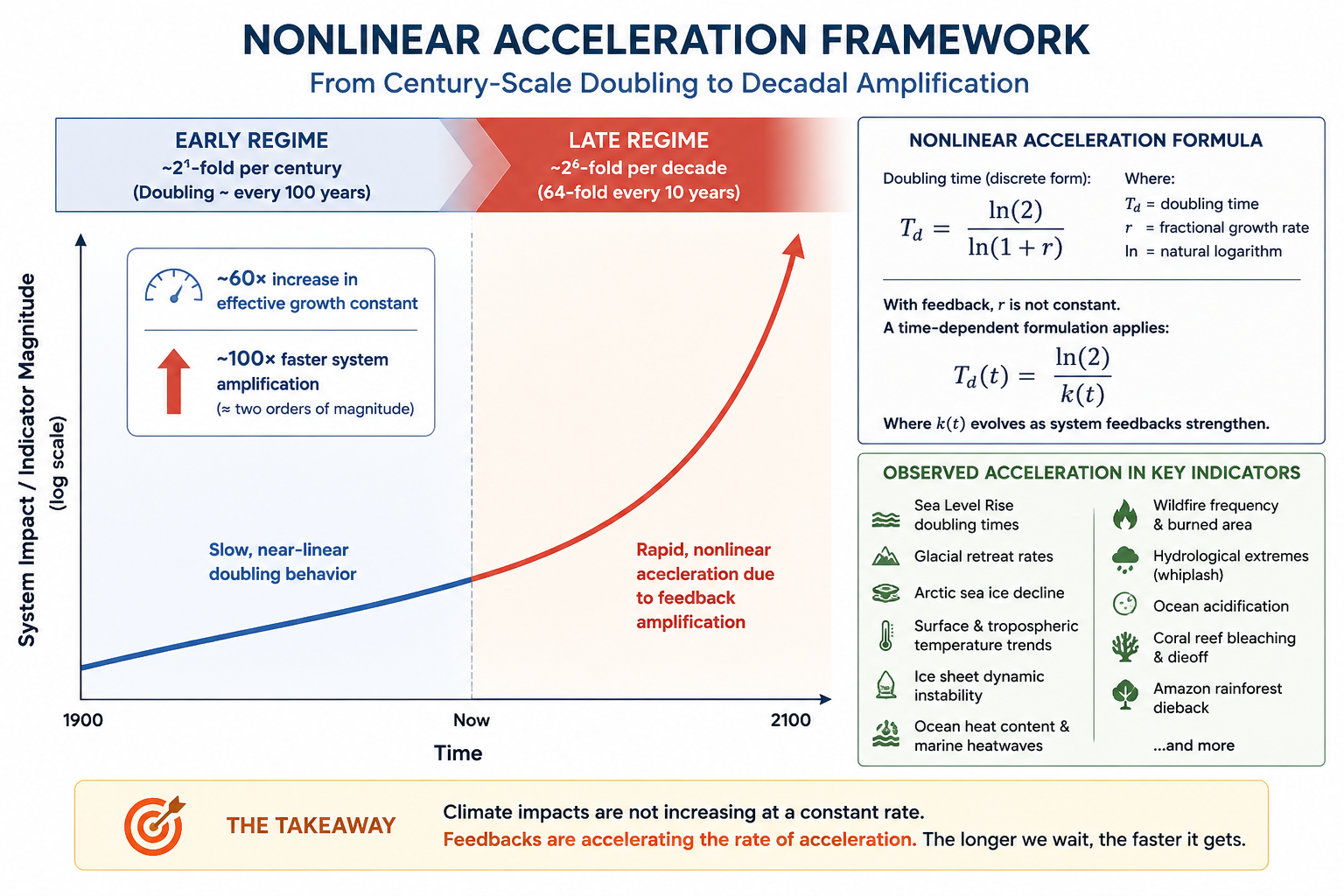
The Nonlinear Acceleration framework focuses on the rate of acceleration of climate change.
At the time the hypothesis was first developed in the 1990s, observed acceleration rates were closer to ~2^1-fold per century doubling behavior. More recent analyses across multiple independent datasets suggest much shorter characteristic timescales consistent with stronger feedback amplification of 2^6-fold on a decadal basis.
* a ~60× increase in the effective growth constant
* or about two orders of magnitude faster system amplification
depending on formulation and interpretation.
Train, Train
[Intro]
[Instrumental Intro: Rhythmic Train-Like Percussion, Low Droning Bass, Metallic Wheel-Sample FX, Slow Rising Synth Pulse]
Steel on steel, a steady grind
Motion pulling through the mind
Landscape blurring at the edge
Running close along the ledge
Signals flicker, lights go green
Nothing stays quite in between
Speed is something we can feel
But not always what is real
[Verse 1]
[Arrangement: Driving Bassline, Staccato Guitar Rhythm, Tight Snare, Subtle Industrial Synth Layer]
We measure pace by what we see
Acceleration steadily
But under that familiar sound
There’s shaking underneath the ground
Systems stretch and start to strain
Under rising load and gain
Not yet gone beyond control
But pressure building in the whole
Every carriage holds its place
Until the rhythm starts to race
And what once felt safe and known
Stops behaving like a stone
[Refrain]
[Arrangement: Chant Vocals, Percussive Train Rhythm, Organ Swells, Echoed Group Shouts]
Train, train
(Are you coming off the tracks)
Train, train
(Are you conforming to the facts)
Train, train
(Have we all gone insane)
Train, train
(Will we all remain)
[Verse 2]
[Arrangement: Pulsing Synth Bass, Echo Guitar Lines, Syncopated Drum Pattern, Ambient Tension Pads]
We don’t yet see the coming bend
Or where the straightaways might end
No clear signal marks the shift
When stability starts to drift
We only notice after change
Once effects begin to range
Across the system wide and deep
Where consequences fail to sleep
And hindsight writes the clearer line
After thresholds cross the line
But by then it’s hard to slow
What’s already set to go
[Bridge]
[Arrangement: Half-Time Breakdown, Low Drone Bass, Metallic Percussion, Rising Dissonant Swells]
If there’s a curve around the hill
Then speed becomes a fragile will
For every train that keeps its pace
Must still respect the track and space
No one sees the tipping point
Until it fractures joint by joint
And then the question comes too late
Was this speed or was it fate?
[Refrain]
[Arrangement: Full Ensemble Chant, Heavy Drum Pattern, Expanding Organ, Layered Vocal Harmony]
Train, train
(Are you coming off the tracks)
Train, train
(Are you conforming to the facts)
Train, train
(Have we all gone insane)
Train, train
(Will we all remain)
[Outro]
[Arrangement: Fading Train Wheels, Distant Horn Echo, Slow Bass Decay, Ambient Wind Through Rails]
The motion doesn’t break or bend
It only asks us where it ends
And whether we can still explain
What drives the speed of this train.
About the Song
We are on a train that is clearly accelerating. You can look out the window and see the speed increasing over time. That much is observable and not really in dispute.
At the same time, the ride is becoming less stable. We are seeing increasing variability, volatility, and signs of stress across different parts of the system.
So no, we do not appear to be in a full runaway state—yet. But we should at least make sure the engineer has not fallen asleep at the controls. More importantly, we should be slowing down.
How far are we from a true runaway scenario? I do not know. No one can define that threshold with certainty.
What I do know is that if there is a steep grade ahead or a sharp bend in the tracks, speed matters. A train can accelerate safely for a long time right up until it encounters conditions it was not designed to handle.
If we continue gaining momentum into a decline and then hit a sharp curve, I am not at all confident that we stay on the rails.
The prudent course is not to wait until we see the curve. The prudent course is to slow down now, while we still can.
* In other words, part of the problem is epistemic: we may only fully recognize such a transition in hindsight, once the system response is already well underway.
[Verse 3]
Some say everything is normal
(Just another passing phase)
Others see the fracture lines
(Beneath familiar days)
Invisible stress accumulates
(Like cracks beneath the glass)
Then one day the pieces connect
(And thresholds come to pass)
The question isn’t whether
(The system can still change)
The question is how much remains
(Within a manageable range)
[Final Chorus]
How do we know
(How this can go)
Wow! Watch that momentum grow…
(Maybe we should slow)
How do we know
(What futures we bestow)
The train is still upon the tracks…
(Maybe we should slow)
How do we know
(How far before the bend)
We still have time to brake the wheels…
(But not time without end)
[Extended Refrain]
Whiplash!
(To and fro)
Whiplash!
(The signals show)
Whiplash!
(The numbers grow)
Whiplash!
(Maybe we should slow)
Whiplash!
(Watch momentum flow)
Whiplash!
(Maybe we should know)
[Outro]
[Spoken Vocal]
A system can absorb stress for a very long time… (until.)
The challenge is recognizing the transition before the cracks connect… (fulfil.)
About the Song
*Important Footnote
It is not possible to reach a full “Hothouse Earth” runaway state within a century. However, it is possible that current emissions and feedback processes could set in motion long-term, high-impact warming pathways.
Under strong feedback participation, some research has explored scenarios involving more than 10°C of global warming over centuries, often discussed within “Hothouse Earth” frameworks. The critical issue is not whether such outcomes occur within decades, but whether present-day actions commit future generations to warming trajectories that become increasingly difficult—or impossible—to reverse.
We examine how human activities — such as deforestation, fossil fuel combustion, mass consumption, industrial agriculture, and land development — interact with ecological processes like thermal energy redistribution, carbon cycling, hydrological flow, biodiversity loss, and the spread of disease vectors. These interactions do not follow linear cause-and-effect patterns. Instead, they form complex, self-reinforcing feedback loops that can trigger rapid, system-wide transformations — often abruptly and without warning. Grasping these dynamics is crucial for accurately assessing global risks and developing effective strategies for long-term survival.
How Will I Know?
[Intro]
One of the hardest things about tipping points…
is that they rarely arrive with a sign.
(No arrival time)
No flashing light.
No buzzer.
No announcement.
(What I meant:)
Just a system…
(Entering the flight of might)
[Verse 1]
The lake looked calm this morning
(The shoreline looked the same)
The graphs were still updating
(With a slightly steeper frame)
The changes felt incremental
(Not enough to steal the show)
Yet something underneath us
(Had already started to go)
[Pre-Chorus]
One more step
(One more degree)
One more stress
(We barely see)
[Chorus]
How will I know
(We’ve crossed the line)
What will it show
(During tipping point time)
Will it arrive
(With a bell or a sign)
Or only later
(When all’s not fine)
[Refrain]
Madge,
(How will I know)
You’re soaking in it
(That’s it)
Rinse repeat
(Go!)
Repeat
(Repeat)
[Verse 2]
The forest still looked healthy
(Until it didn’t one day)
The glacier seemed eternal
(Until it slipped away)
The probabilities kept shifting
(Beneath familiar ground)
By the time the trend was obvious
(The threshold had been found)
[Pre-Chorus]
One more year
(One more trend)
One more warning
(We defend)
[Chorus]
How will I know
(We’ve crossed the line)
What will it show
(During tipping point time)
Will there be proof
(We can define)
Or only footprints
(Left behind)
[Bridge]
The challenge isn’t seeing change
The challenge is recognition
A system can be transforming
Long before admission
We ask for certainty
While the pathways rearrange
And by the time we’re satisfied
The system may have changed
[Build]
Rinse…
(Repeat)
Watch…
(The heat)
Track…
(The beat)
The signals don’t retreat
[Final Chorus]
How will I know
(We’ve crossed the line)
What will it show
(During tipping point time)
The answer may be hidden
(Until another time)
When future generations
(Look behind)
How will I know
(We’ve crossed the line)
Maybe the question itself
(Is the warning sign)
[Extended Refrain]
Madge,
(How will I know)
You’re soaking in it
(That’s it)
Rinse repeat
(Go!)
Repeat
(Repeat)
Watch the pattern
(Grow)
Watch the momentum
(Flow)
[Outro]
Most times the tipping point
Doesn’t announce itself.
Sometimes…
The only way you know
Is that the world no longer behaves
Losing the last chance to save.
How will I know…
(No)
How will I know…
(No)
Epistemic
Epistemic: we may only fully recognize such a transition in hindsight, once the system response is already well underway.
We don’t see the phase change around.
Only after it’s going down
(Down, down, down)
When the curve has already bent.
(And chances already spent.)
[Verse 1]
We build our models carefully
With data in a line
Assuming that tomorrow
Will resemble one more time
We trust the average behavior
The smoothness of the trend
Not seeing that the structure
Is approaching an end
[Chorus]
Epistemic: Things that pertain
(… to how we know what we know)
In fact…
(What constitutes a fact)
…or the limits of our understanding
(Our damned demanding)
The edge of certainty
(Begins to bend)
Where explanation
(Can’t defend)
[Verse 2]
A system shifts in silence
A threshold disappears
But language lags behind it
For years and years and years
We label what is familiar
We name what we can see
While deeper reorganizations
Rewrite reality
[Pre-Chorus]
We measure
(After the fact)
We explain
(Once it’s intact)
[Chorus]
Epistemic: Things that pertain
(… to how we know what we know)
In fact…
(What constitutes a fact)
…or the limits of our understanding
(Our damned demanding)
We learn too late
(What we didn’t know)
As the hidden fractures
Begin to show
[Refrain]
In hindsight
(20/20)
New insight
(Needed plenty)
In hindsight
(Incite insight)
[Bridge]
We think we see reality
But we see its reflection
Filtered through assumption
And delayed detection
The world moves first
Then knowledge follows slow
By the time we name it
It already chose to grow
[Build]
Too late…
(To define it)
Too late…
(To confine it)
Too late…
(To align it)
It already shifted while we were trying to find it
[Final Chorus]
[Full Band, Choir Harmony]
Epistemic: Things that pertain
(… to how we know what we know)
In fact…
(What constitutes a fact)
…or the limits of our understanding
(Our damned demanding)
[Refrain]
In hindsight
(20/20)
New insight
(Needed plenty)
In hindsight
(Incite insight)
[Outro]
In hindsight
(20/20)
New insight
(Needed plenty)
In hindsight
(Incite insight)
(End of the music)
[Silence]
Epistemic…
(End of the music)
Bifurcation
[Intro]
A bifurcation is not loud.
(Often lost in the crowd)
It is not dramatic at first.
(Even out in broad daylight)
It is a threshold hiding in plain sight.
A point where the rules you thought…
are not.
(Bifurcation)
Revolution
(No vacation)
[Verse 1]
We walked a line of comfort
(Assuming it would hold)
A smooth and steady function
(Predictable and old)
But underneath the averages
(A tension starts to grow)
Until a parameter shifts
(And something lets us know)
[Pre-Chorus]
One degree
(Too much)
One change
(Too much)
One step
(Too much)
And nothing feels as such
[Chorus]
The past is of little use
(Now that we’ve lit the fuse)
Yet… we still refuse
(To engage with our age)
The curve begins to break
(The patterns disengage)
The system finds a second path
(A split upon the stage)
[Refrain]
Systemic transformation
(The music of orientation)
Systemic transformation
(The magic of revolution)
[Verse 2]
What once was stable motion
(Begins to lose its ground)
The attractor shifts its meaning
(The old rules fall unbound)
Two futures now emerging
(From what looked like one before)
A branching of the possible
(Through an invisible door)
[Pre-Chorus]
Small change
(Big effect)
Small shift
(Intersect)
Small spark
(Can redirect)
What we did not expect
[Chorus]
The past is of little use
(Now that we’ve lit the fuse)
Yet… we still refuse
(To engage with our age)
The system splits in silence
(No warning to accuse)
And suddenly the future
(Is no longer what we choose)
[Refrain]
Systemic transformation
(The music of orientation)
Systemic transformation
(Bifurcation)
Revolution
[Bridge]
At the bifurcation point
History does not continue
It divides
Each path self-consistent
Each path plausible
Each path irreversible once taken
There is no return
Only divergence
[Build]
Left path
(Right path)
Stable past
(Final math)
New state
(Too late)
The system chooses how to break
[Final Chorus]
The past is of little use
(Now that we’ve lit the fuse)
Yet still we stand confused
(At the edge we cannot lose)
Systemic transformation
(No longer a suggestion)
Systemic transformation
(Becomes the only question)
The attractor splits
(The frame divides)
And what we were
(No longer survives)
[Outro]
[Slow Piano, Fading Drone]
A bifurcation is not an ending.
It is a divergence.
A moment where one world becomes two.
And only one can be lived.
Bifurcation…
(Revolution)
Bifurcation…
(Revolution)
About the Song
Bifurcation is the division of something into two branches or parts.
Mathematics & Science: Refers to the point where a system undergoes a sudden, qualitative change in its behavior or structure when a parameter is slightly altered.
Symmetry Gone
[Intro]
Symmetry is what we assume when the world feels balanced.
When forces cancel.
When systems mirror themselves across time.
(Suddenly losing rhythm and rhyme)
Comin’ on nonlinear systems…
rarely stay symmetric for long.
(So here’s the song….)
[Verse 1]
We built our expectations
On balance and on scale
On averages behaving
Everlasting patterns that prevail
But underneath the structure
A slight imbalance grew
A tilt that once was nothing
Now changes what we do
[Pre-Chorus]
Left side
(Meets right side)
Old truth
(Meets new guide)
Stable frame
(Starts to slide)
Something shifts inside
[Chorus]
Is our symmetry gone
(Have we cracked our mirror)
Were our choices wrong
(More major and less minor)
Did the reflection break
(Or was it always thinner)
Is our symmetry gone
(Have we cracked our mirror)
[Verse 2]
The climate writes in gradients
Not equal left and right
Feedbacks amplify the uneven
Into day and night
What once was neatly mirrored
Across assumed constraints
Now leans toward amplification
Of asymmetry and strain
[Pre-Chorus]
One side
(Begins to win)
One side
(Loses skin)
Balance fades
(From within)
The shift is happening
[Chorus]
Is our symmetry gone
(Have we cracked our mirror)
Were our choices wrong
(More major and less minor)
Did the system tilt
(Without us seeing clearer)
Is our symmetry gone
(Have we cracked our mirror)
[Bridge]
Symmetry is an assumption
Of reversible design
But feedback breaks reversibility
Over nonlinear time
Once a small deviation
Is allowed to persist
The system stops returning
To the equilibrium it missed
[Build]
Tilt becomes direction
(Direction becomes law)
Law becomes trajectory
(Becomes a guiding flaw)
[Final Chorus]
Is our symmetry gone
(Have we cracked our mirror)
What we thought was balance
(Becomes ever clearer)
No equal return
(No simple divider)
Is our symmetry gone
(Have we cracked our mirror)
Were our choices wrong
(Or just nonlinear)
The system bends
(Beyond the familiar)
[Outro]
A mirror only reflects symmetry…
until it breaks.
Then it reveals…
the asymmetry that was always there to take
Symmetry gone…
(So long)
Gone Mono
[Intro]
Different voices.
(Or the same old choices?)
[Verse 1]
I used to hear the harmony
Coming from both sides
Different notes and melodies
All along the ride
The balance made the music
Feel bigger than the room
Now something’s missing from the mix
And silence starts to bloom
[Pre-Chorus]
Left and right
(Working together)
Different voices
(Made it better)
[Chorus]
Oh, no
(Woe)
My stereo
(Went mono)
Now I can only hear
(With one ear)
The richness faded
(From the show)
My stereo
(Went mono)
[Verse 2]
The system kept on playing
Or so it seemed at first
Until the missing pieces
Made the whole thing sound much worse
[Chorus]
Oh, no
(Woe)
My stereo
(Went mono)
Now I can only hear
(With one ear)
The song keeps playing
(Soft and low)
My stereo
(Went mono)
[Bridge]
The Beatles sounded better
(Before Paul and John split up)
Now only one comes through
(No matter what I do)
My stereo
(Went mono)
The harmonies are thinner now
(Lost somewhere along the route)
The song remains familiar
(But something’s missing from the truth)
[Build]
One channel
(Goes away)
One pathway
(Fades away)
[Pre-Chorus]
Many voices
(One refrain)
Many pathways
(One domain)
[Final Chorus]
Oh, no
(Woe)
My stereo
(Went mono)
Now I can only hear
(With one ear)
The world sounds smaller
(Than before)
My stereo
(Went mono)
Oh, no
(Woe)
The missing channels
(Start to show)
The music lost dimension
(That we used to know)
[Outro]
The song didn’t stop.
The volume didn’t vanish.
But the depth…
(And breadth)
… went missing.
(Goodbye… kissing)
[Fade Out]
My stereo…
Went mono…
About the Song
Today’s release, **”Gone Mono,”** blends groovy organ riffs, surf-inspired electric guitar, and strong 1960s British Invasion vibes. The song was inspired by a simple experience many music lovers have had: listening to an old stereo recording when one channel suddenly cuts out.
As I listened to an old Beatles song that had been carefully mixed for stereo playback through a speaker with one dead channel, it struck me that the experience felt surprisingly similar to what happens when complex systems lose diversity and resilience. There was no harmony. Sometimes there was no voice at all. Paul would disappear. Then John. Entire parts of the song would simply vanish depending on which channel carried the track. The music was still there, but something essential was missing. The depth, richness, and interplay that made it whole had begun to disappear.
That became a metaphor for climate change and ecological simplification. As ecosystems lose species, redundancy, and complexity, they can begin to behave more like a system approaching singularity—fewer pathways, fewer options, and less resilience when stress arrives.
The song leans into that idea with lyrics like:
*”Oh, no (Woe)
My stereo (Went mono)
Now I can only hear
(With one ear)”*
and my favorite tongue-in-cheek bridge:
*”The Beatles sounded better
(Before Paul and John split up)
Now only one comes through
(No matter what I do)
My stereo
(Went mono)”*
Sometimes a broken stereo can teach an unexpected lesson about the value of diversity, whether in music, ecosystems, or the complex systems we depend on every day.
Hole in My Heart
[Intro]
Not all systems fail gradually.
Some fail at the seams.
Where everything seemed intact…
then is no longer what it means.
[Verse 1]
We were running steady rhythm
(A stable kind of day)
Nothing in the signal
(Suggested it would sway)
Then a tiny misalignment
(A fraction out of place)
Turned into a rupture
(We could not erase)
[Pre-Chorus]
All at once
(Not in time)
All at once
(Undefined)
[Chorus]
Really?
Is that what you’re gonna do
(Shoot it straight through)
Suddenly…
(The start:)
Hole in my heart
A structure I depended on
(Just falls apart)
Hole in my heart
[Refrain]
BOOM!
(Sudden failure)
I can’t endure
Soon!
(And that’s for sure)
For certain: future
Becomes obscure
[Verse 2]
It wasn’t slow erosion
It wasn’t wear and tear
It was a single moment
That fractured all the air
The feedback loops collapsed in
A cascade out of sight
And everything went silent
Between the wrong and right
[Pre-Chorus]
No warning
(No sign)
No warning
(Declined)
[Chorus]
Really?
Is that what you’re gonna do
(Shoot it straight through)
Suddenly…
(The start:)
Hole in my heart
(The system breaks without a sound)
Down, down, down
(… falls apart)
Hole in my heart
[Refrain]
BOOM!
(Sudden failure)
I can’t endure
Soon!
(And that’s for sure)
Nothing feels secure
[Bridge]
Some failures are gradual
Others are binary
A threshold crossed without apology
No time to inventory
What held together yesterday
Does not imply today
The structure chooses its collapse
In its own sudden way
[Build]
Snap…
(No delay)
Break…
(No say)
Shift…
(Away)
And nothing stays the same
[Final Chorus]
Really?
Is that what you’re gonna do
(Shoot it straight through)
Suddenly…
(The start:)
Hole in my heart
(No warning written in the sky)
No more asking and asking why…
(No time to start)
Hole in my heart
BOOM!
(Sudden failure)
I can’t endure
Soon!
(And that’s for sure)
Nothing stays secure
[Outro]
Sometimes the first sign of instability…
is collapse.
(No time lapse)
A hole is not an absence of structure.
It is the moment structure disappears.
(The absence appears)
Depart…
(Hole in my heart…)
Frame 4 — No More
[Intro]
At some point, the frames stop being perspectives.
They become states.
(Ever increasing rates)
Not ways of seeing…
But what is actually there.
(We’re just unaware)
[Verse 1]
The windshield is no longer a window
It’s more crack than glass
A lattice of accumulated stress
From every frame that passed
What once was interpretation
Is now structure and decay
The system shows its boundaries
In everything it displays
[Pre-Chorus]
No correction
(No return)
No reflection
(As it burns)
No direction
(As it turns)
Only lessons it has learned
[Chorus]
The final frame
(Not the same)
The final frame
(All’s gone lame)
Frame 4 — No More
(Will we remain?)
The structure speaks
(Without a name)
[Refrain]
No more
(Know more)
No more
(For sure)
No more balance
(No secure)
No more answers
(No demure)
[Verse 2]
What was once a simple fracture
Is now the entire view
A system rewritten inward
By everything it went through
The feedback loops are louder now
Each threshold crossed in turn
The question is no longer if
But what is left to learn
[Pre-Chorus]
No more waiting
(No delay)
No more stating
(“It’ll stay”)
No more faking
(Decay)
The system chose another way
[Chorus]
The final frame
(Not the same)
The final frame
(All’s gone lame)
Frame 4 — No More
(The rules unname)
The glass is structure
(Not just frame)
[Refrain]
No more
(Know more)
No more
(For sure)
No more future
(As before)
No more stories
(To restore)
[Bridge]
There is a point where observation ends
And entanglement begins
Where you are no longer watching the system
You are inside its change
The frame does not contain the fracture anymore
The fracture contains the frame… the future
[Build]
No exit
(No door)
No reset
(No floor)
No safety
(Anymore)
Only what came before
[Final Chorus]
The final frame
(Not the same)
The final frame
(All’s gone lame)
Frame 4 — No More
(The last refrain)
The structure closes
On what remains
The final frame
(Becomes the chain)
And nothing moves
(The same again)
[Outro]
No more frames…
(Fractured future)
No more distance…
(Fractured future)
No more illusion of outside…
(Fractured future)
No more…
(Fractured future)
Rearview Mirror
[Intro]
We rarely understand change be for reaching “apparently”
We understand it after it has already become memory
Is the present too fast to interpret…
(Even for an expert?)
[Verse 1]
We thought we were observing motion
(But we were in the stream)
Each moment felt so ordinary
(Not quite what it would seem)
The signals were incremental
(The meaning lagged behind)
Until the point of turning
(Was something we defined)
[Pre-Chorus]
Too late
(To adjust)
Too fast
(To trust)
Too unclear
(At first)
[Chorus]
Alas,
(Sometimes you don’t know until you pass)
Too fast?
(Rapidly the future turns to past)
What felt like now becomes a trace
(A fading photograph)
And only then can we see the face
(Of paths we didn’t grasp)
[Refrain]
In the rearview mirror
(Hindsight’s 20/20)
The path becomes much clearer
(When the future’s empty)
The bends we missed
(Become symmetry)
In the rearview mirror
(We finally see)
[Verse 2]
The climate shifted subtly
(Year by year by year)
A pattern in the averages
(We struggled to make clear)
The extremes began accumulating
(One record after one)
Until the past was obvious
(And the threshold had been done)
[Pre-Chorus]
Too slow
(To detect)
Too close
(To correct)
Too late
(To reject)
What we didn’t quite expect
[Chorus]
Alas,
(Sometimes you don’t know until you pass)
Too fast?
(Rapidly the future turns to past)
We only see the road ahead
(Once it’s been surpassed)
And realize the turning point
(Was already cast)
[Refrain]
In the rearview mirror
(Hindsight’s 20/20)
The path becomes much clearer
(When the future’s empty)
What once was noise
(Becomes history’s choice)
In the rearview mirror
(We finally see clearer)
[Bridge]
The paradox of awareness
Is timing, not vision
We are always interpreting
A delayed transmission
By the time the pattern resolves
We are already beyond it
Looking backward at certainty
We never quite confronted
[Build]
Too late…
(To steer)
Too clear…
(When near)
Too near…
(The fear)
Of what we didn’t hear
[Intro]
[Instrumental: Light Acoustic Guitar, Fluttering Synths, Piano, Bass, Percussion]
[Whispered Vocal]
Wisp, wisp…
(Just like this:)
[Spoken Vocal]
The butterfly effect isn’t about butterflies.
(I’ve come to realize)
It’s about sensitivity.
(I’ve come to see)
Tiny causes.
(And becauses)
Unexpected consequences.
A world where small things matter.
[Verse 1]
A whisper in the background
(A change too small to see)
A fraction of a degree
(In a complex tapestry)
A choice made on a Tuesday
(A pathway left untapped)
One little perturbation
(Then the future gets remapped)
[Pre-Chorus]
Small things
(Grow)
Small things
(Flow)
Small things
(We barely know)
[Whispered Vocal]
Wisp, wisp…
(Just like this:)
[Chorus]
A butterfly flaps its wings
(And look what it brings)
The chaos amongst us
(Is it fabulous or dangerous?)
A tiny little motion
(Changes everything)
A butterfly flaps its wings
(And look what it brings)
[Verse 2]
The storm was not created
(By wings alone, it’s true)
The atmosphere was waiting
(For something small to do)
A system near a threshold
(Can tip from little things)
When tension fills the network
(The smallest signal sings)
[Chorus]
A butterfly flaps its wings
(And look what it brings)
The chaos amongst us
(Is it fabulous or dangerous?)
The future starts unfolding
(From the smallest springs)
A butterfly flaps its wings
(And look what it brings)
[Refrain]
Flap flap flap
(Then a cascade)
Flap flap flap
(A future made)
Flap flap flap
(A pathway laid)
Flap flap flap
(A price gets paid)
[Bridge]
[Music Drops to Piano and Ambient Synth]
Chaos doesn’t mean disorder
It means possibility
The future is not random
It’s sensitive dependency
The system holds many outcomes
Many roads that might have been
Until some tiny influence
Helps determine if we’re in balance
[Whispered Vocal]
Wisp, wisp…
(Just like this:)
[Build]
One choice
(One chance)
One step
(One dance)
One flutter
(Advance)
And suddenly…
Circumstance
[Final Chorus]
A butterfly flaps its wings
(And look what it brings)
The chaos amongst us
(Is it fabulous or dangerous?)
Maybe both together
(As uncertainty sings)
A butterfly flaps its wings
(And look what it brings)
A butterfly flaps its wings
(And look what it brings)
The world is more connected
(Than it first appears)
Tiny causes
(Growing through the years)
[Outro]
[Soft Piano and Synth Fade]
The butterfly was never the story…
Just the opening of the book
waiting for you to look
Flap…
(Flap…)
Flap…
[Whispered Vocal]
Wisp, (wisp…)
Just like this:
(Wisp…..)
[Silence]
About the Song
The new release of the day, **”BUTTERFLY FLAPS,”** is a song about the chaos amongst us. The track features acoustic/electric guitar, glockenspiel, bass, and layered synth textures inspired by the famous butterfly effect—the idea that small actions can sometimes produce surprisingly large consequences.
The song was inspired by recent conversations about those seeking to incite insight into ecosystems, economics, and consumer behavior. In many ways, every consumer is a butterfly, casting votes with dollars, attention, and choices. Those decisions ripple outward through supply chains, markets, communities, and the environment, creating reverberations that can be difficult to predict.
As the chorus asks:
*”A butterfly flaps its wings
(And look what it brings)
The chaos amongst us
(Is it fabulous or dangerous?)”*
The answer may be both.
The song explores how seemingly insignificant actions can contribute to much larger outcomes through interconnected systems, where a *”tiny little motion (Changes everything)”* and *”the future starts unfolding (From the smallest springs).”*
Whether in ecology, economics, or everyday life, small choices matter. Sometimes more than we realize. Sometimes a butterfly flaps its wings… and look what it brings.
Who Is Responsible? The answer may be both.
Consumers ultimately control demand. Without demand, there is no profitable supply. Every purchase acts as a market signal that encourages additional production, resource extraction, energy consumption, and waste generation.
In that sense, consumers exert enormous influence over emissions, pollution, and resource use. Corporations certainly bear responsibility for their actions, but they are responding to economic incentives created by billions of individual purchasing decisions.
The challenge is that responsibility is distributed. No single consumer causes the problem, yet collectively consumers drive the system. That means meaningful change requires both systemic reforms and changes in consumer behavior. Ignoring either side of that equation leaves us with an incomplete solution.
[Intro]
[Instrumental Intro: Rhythmic Train-Like Percussion, Low Droning Bass, Metallic Wheel-Sample FX, Slow Rising Synth Pulse]
Steel on steel, a steady grind
Motion pulling through the mind
Landscape blurring at the edge
Running close along the ledge
Signals flicker, lights go green
Nothing stays quite in between
Speed is something we can feel
But not always what is real
[Verse 1]
[Arrangement: Driving Bassline, Staccato Guitar Rhythm, Tight Snare, Subtle Industrial Synth Layer]
We measure pace by what we see
Acceleration steadily
But under that familiar sound
There’s shaking underneath the ground
Systems stretch and start to strain
Under rising load and gain
Not yet gone beyond control
But pressure building in the whole
Every carriage holds its place
Until the rhythm starts to race
And what once felt safe and known
Stops behaving like a stone
[Refrain]
[Arrangement: Chant Vocals, Percussive Train Rhythm, Organ Swells, Echoed Group Shouts]
Train, train
(Are you coming off the tracks)
Train, train
(Are you conforming to the facts)
Train, train
(Have we all gone insane)
Train, train
(Will we all remain)
[Verse 2]
[Arrangement: Pulsing Synth Bass, Echo Guitar Lines, Syncopated Drum Pattern, Ambient Tension Pads]
We don’t yet see the coming bend
Or where the straightaways might end
No clear signal marks the shift
When stability starts to drift
We only notice after change
Once effects begin to range
Across the system wide and deep
Where consequences fail to sleep
And hindsight writes the clearer line
After thresholds cross the line
But by then it’s hard to slow
What’s already set to go
[Bridge]
[Arrangement: Half-Time Breakdown, Low Drone Bass, Metallic Percussion, Rising Dissonant Swells]
If there’s a curve around the hill
Then speed becomes a fragile will
For every train that keeps its pace
Must still respect the track and space
No one sees the tipping point
Until it fractures joint by joint
And then the question comes too late
Was this speed or was it fate?
[Refrain]
[Arrangement: Full Ensemble Chant, Heavy Drum Pattern, Expanding Organ, Layered Vocal Harmony]
Train, train
(Are you coming off the tracks)
Train, train
(Are you conforming to the facts)
Train, train
(Have we all gone insane)
Train, train
(Will we all remain)
[Outro]
[Arrangement: Fading Train Wheels, Distant Horn Echo, Slow Bass Decay, Ambient Wind Through Rails]
The motion doesn’t break or bend
It only asks us where it ends
And whether we can still explain
What drives the speed of this train.
About the Song
We are on a train that is clearly accelerating. You can look out the window and see the speed increasing over time. That much is observable and not really in dispute.
At the same time, the ride is becoming less stable. We are seeing increasing variability, volatility, and signs of stress across different parts of the system.
So no, we do not appear to be in a full runaway state—yet. But we should at least make sure the engineer has not fallen asleep at the controls. More importantly, we should be slowing down.
How far are we from a true runaway scenario? I do not know. No one can define that threshold with certainty.
What I do know is that if there is a steep grade ahead or a sharp bend in the tracks, speed matters. A train can accelerate safely for a long time right up until it encounters conditions it was not designed to handle.
If we continue gaining momentum into a decline and then hit a sharp curve, I am not at all confident that we stay on the rails.
The prudent course is not to wait until we see the curve. The prudent course is to slow down now, while we still can.
* In other words, part of the problem is epistemic: we may only fully recognize such a transition in hindsight, once the system response is already well underway.