bookmark_borderThird Derivative (Album)

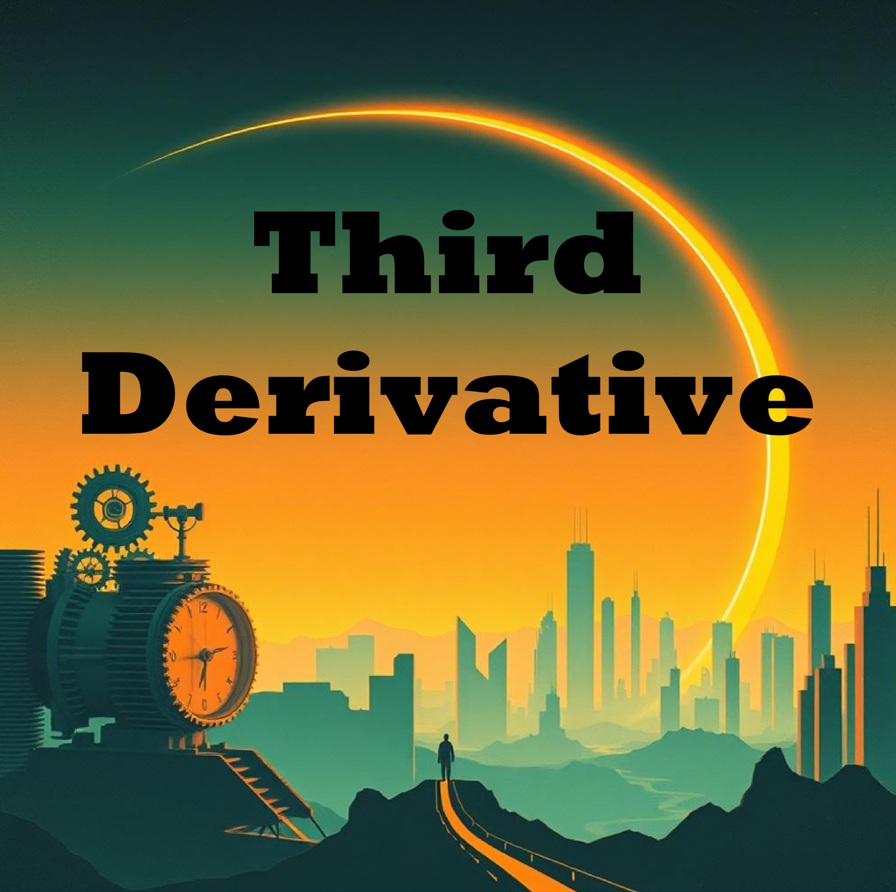
Third Derivative Album Cover

Third Derivative

From the album Third Derivative

d³I/dt³ > 0

In physics, this phenomenon is known as “jerk”, representing the rate of change of acceleration. Its presence is a hallmark of systems undergoing rapid nonlinear transitions, where acceleration itself is increasing. In the context of climate, this indicates that the Earth system is approaching nonlinear instability. Such behavior raises a significant probability that the climate could enter singularity-like dynamics within the next decade or two, in which small perturbations trigger extreme, system-wide responses.

How Not to Be a Jerk: Third Derivatives and the Singularity of Climate Change

Singularity

Advances in technology, modeling, and artificial intelligence have significantly improved our ability to understand and track the accelerating dynamics of climate change. These tools have provided new insight into how quickly complex systems can evolve—and how difficult it may be to keep pace with that acceleration.

Our latest analysis suggests that the climate–economic system is now exhibiting third-derivative behavior, indicating that not only are impacts increasing, and accelerating, but the acceleration itself is increasing. This places the system within a singularity-like regime, characterized by nonlinear amplification, rising instability, and reduced predictability.

Historically, such transitions were assumed to unfold over tens of thousands to millions of years based on paleoclimate evidence. However, current observations indicate that these dynamics may be occurring on dramatically compressed timescales, raising the possibility that singularity-like behavior could emerge within contemporary time horizons.

Given the importance and accessibility of these findings, this work is presented in three formats:

Each version conveys the same core insight: complex, coupled systems can shift rapidly from stable to unstable behavior, and understanding this transition is critical to anticipating future climate and economic risk.

Second Derivative

[Intro]
Change begins… we mark the rate…
(But something deeper seals the fate)

[Verse 1]
First we measured what we see
A rising line, predictably
dI/dt, the slope we trace
Tracking change across the space

But underneath the curve it bends
A hidden force that never ends
The rate itself begins to shift
A deeper motion starts to lift

[Pre-Chorus]
Not just faster… faster still…
Acceleration bends the will

[Chorus]
First derivative
(Initial initiative)
Second derivative
(More take… less give)

[Verse 2]
Now the slope begins to rise
Steeper than we realized
d²I/dt², the sign is clear
Acceleration drawing near

Feedback loops compress the time
Doubling faster down the line
What was once a steady climb
Now explodes beyond design

[Bridge]
dI/dt > 0
(Change is real, we start to know)
d²I/dt² > 0
(The pace itself begins to grow)
d³I/dt³ > 0
(Acceleration starts to flow)

[Breakdown / Spoken Layer]
Not constant… increasing…
Not linear… compounding…
Not stable… transforming…

[Chorus – Climax]
First derivative
(Initial initiative)
Second derivative
(More take… less give)
Third derivative rising still
(Change accelerates at will)

[Outro]
Curves collapse… time compress…
Systems pushed beyond redress…
Whether… weather…
Second derivative…

About This Track
“Second Derivative” translates a core concept from calculus into the language of climate dynamics:
the difference between change and accelerating change.

Key ideas reflected in the song:
* First Derivative (dI/dt): Measures the rate of change—e.g., rising temperatures or sea levels.
* Second Derivative (d²I/dt²): Measures acceleration—how quickly those rates are increasing.
* Third Derivative (d³I/dt³): Indicates that even acceleration itself is increasing.

The track emphasizes a critical insight:
* Climate change is not just happening
* It is accelerating
* And that acceleration is increasing over time

This leads to:
* Nonlinear acceleration
* Collapsing doubling times
* Rapid system transformation

“Second Derivative” captures why traditional linear assumptions fail—because the system is not moving at a steady pace, but instead is compounding into increasingly rapid and unpredictable change.

Third Derivative

[Intro]
Beyond the curve… beyond the climb…
(Change reshapes the shape of time)

[Verse 1]
We tracked the rise, we marked the rate
First derivative sealed the fate
Then saw the slope begin to bend
Acceleration without end

Second derivative drove the change
Compressed the time, rearranged the range
But deeper still, beneath the flow
A hidden surge begins to grow

[Pre-Chorus]
Not just faster… faster still…
The force behind the rising will…

[Chorus]
Second derivative
(Drive it did)
Third derivative
(Time to change the narrative)

[Verse 2]
d³I/dt³, the signal screams
Acceleration feeds extremes
The rate of change begins to race
No steady state, no resting place

Feedback loops ignite the core
Each cycle faster than before
Doubling times collapse in line
Exponential redefined

[Bridge]
First we saw it start to rise
(We measured, we quantified)
Then we felt it multiply
(Acceleration amplified)
Now the change behind the change
(Rewrites time, escapes the range)

[Breakdown / Spoken Layer]
dI/dt > 0
(Change is happening)
d²I/dt² > 0
(Change is accelerating)
d³I/dt³ > 0
(Acceleration increasing…)

[Chorus – Climax]
Second derivative
(Drive it did)
Third derivative
(Time to change the narrative)
Rewrite the line, redefine
The curve itself escapes design

[Outro]
Time compresses… systems bend…
No clear start… no certain end…
Whether… weather…
Third derivative…
(We did what we did)
Repetitive
(Third derivative…)
We did what we did.

About This Track
“Third Derivative” is the culmination of the album’s mathematical and physical framework, capturing the most advanced and underrecognized dynamic in climate change: the acceleration of acceleration itself.

Key concepts in the track:
* First Derivative (dI/dt): Change is occurring
* Second Derivative (d²I/dt²): Change is accelerating
* Third Derivative (d³I/dt³): Acceleration itself is increasing

This third layer fundamentally alters how we understand risk:
* The system is not just speeding up
* It is speeding up faster over time
* Leading to nonlinear acceleration and collapsing timescales

The title track reframes the narrative:
Traditional models assume stable acceleration.

Reality shows increasing acceleration, which drives:
* Rapid system transformation
* Escalating extremes
* Unpredictable outcomes

“Third Derivative” is both a mathematical statement and a warning:
we are no longer tracking change—
we are tracking the transformation of change itself.

Don’t Be a Jerk

[Intro]
Attention… listen close…
(The emperor’s got no clothes)
In case you didn’t know…
(Third derivative’s in the flow)

[Verse 1]
d³I/dt³, the system jerks
Acceleration itself works
Every push and every shove
Feeds the chain of change above

Nonlinear paths, tipping points
Small nudges trigger jointed joints
Singularity looms near
Systems scream what we should fear

[Pre-Chorus]
Don’t ignore the subtle signs
Rapid shifts rewrite the lines

[Chorus]
(Attention!)
Please, please me
Don’t be a knee…
(Jerk, reaction)

[Verse 2]
The Earth responds in sudden ways
Every season, hotter days
Jerk is physics made real
Acceleration’s turning wheel

Moments small can start the chain
Amplifying every gain
Economy and climatology
All tied universally

[Bridge]
Rate of change is growing fast
Acceleration’s not the last
Third derivative guides the play
Jerk warns us, heed the way

[Breakdown / Spoken Layer]
d³I/dt³ > 0
(Be a climate hero)
Forget surprising
(Acceleration is rising…)
Nonlinear, unpredictable
(Forecast if you’re able)
Small shifts trigger system-wide impacts…
(Facts are facts)

[Chorus – Climax]
(Attention!)
Please, please me
Don’t be a knee…
(Jerk, reaction)
Recognize the jerk, anticipate
(Nonlinear systems dominate)

[Outro]
Don’t be a jerk…
(Shoulder shirk)
Watch the rate…
(Expiration date)
Respect the system…
(That I’m in)
Or face the fate…
(Expiration date)

About This Track
“Don’t Be a Jerk” explores the third derivative of climate impacts, also known in physics as jerk:
* Jerk (d³I/dt³): The rate of change of acceleration.
* Climate Implication: Systems where acceleration itself is increasing can reach nonlinear instability. Small perturbations may trigger extreme, system-wide effects, similar to singularity-like behavior.
* Warning: Ignoring third-derivative dynamics underestimates risk. Understanding jerk is critical to anticipating rapid climate escalation.
* Lesson: Just as jerk in physics represents sudden shocks, in climate systems it signals where caution, mitigation, and foresight are necessary.

This track blends mathematics, physics, and musical intensity to communicate urgency: the faster acceleration rises, the more attention—and care—we must give to the system we live in.

Extreme Responses

[Intro]
A subtle shift… a silent spark…
(Smallest change can leave a mark)

[Verse 1]
At first it moves in quiet lines
Gradual change across the times
But underneath, a hidden rise
Acceleration multiplies

d³I/dt³ begins to show
A deeper force beneath the flow
Jerk emerges, sharp and fast
Turning future into past
[Guitar arpeggios, Bass steady, Drums light kick, Synth pad]

[Pre-Chorus]
Small inputs… larger waves…
Nonlinear paths we fail to gauge…

[Chorus]
His presence is a hallmark
(Extreme responses)
What was light… turns dark
(Extreme responses)

[Verse 2]
Storms ignite from minor shifts
Heat amplifies, the system lifts
Floods from rainfall once contained
Now exceed what we explained

Thresholds crossed without a sound
Instability all around
Every perturbation grows
Triggering effects we barely know

[Bridge]
Singularity in the near
(Unfolding faster year by year)
Tiny changes, massive scale
(System-wide effects prevail)

[Breakdown / Spoken Layer]
Jerk is rising…
(Not surprising)
Acceleration increasing…
(Never ceasing)
Nonlinear instability…
(No longer rarity)
Extreme responses…
(Time condenses)

[Chorus – Climax]
His presence is a hallmark
(Extreme responses)
What was light… turns dark
(Extreme responses)
From the smallest spark we see
(A chain reaction sets us free)

[Outro]
From calm to chaos… line to curve…
Every system finds its nerve…
(Third derivative)
The new narrative:
Extreme responses…
(Time condenses)

About This Track
“Extreme Responses” builds on the concept of jerk (the third derivative) to illustrate how climate systems transition into nonlinear instability.

Key ideas reflected in the song:
* Jerk (d³I/dt³): The rate of change of acceleration—indicating that acceleration itself is increasing.
* Nonlinear Transitions: Systems exhibiting jerk are prone to rapid, unpredictable shifts.
* Instability Thresholds: As the climate system approaches critical thresholds, small perturbations can trigger disproportionately large effects.
* Singularity-like Dynamics: The combination of increasing acceleration and feedback loops raises the likelihood of extreme, system-wide responses within relatively short timescales.

The track emphasizes a crucial insight:
When jerk is present, the system no longer responds proportionally—
it reacts in sudden, amplified, and often irreversible ways.

“Extreme Responses” captures that tipping point moment—
where small causes no longer produce small effects,
but instead unleash cascading, global consequences.

Warning:

[Intro]
Signal rising… systems strain…
(A message buried in the gain)

[Verse 1]
Third derivative, flashing red
Acceleration out ahead
d³I/dt³, the sign is clear
The curve itself bends into fear

Ignore the rate behind the rate
Underestimate, seal the fate
Doubling times begin to fall
Compression closing in on all

[Pre-Chorus]
Not just change… not just speed…
Acceleration outpaces greed…

[Chorus]
Warning! Warning!
(Perplexed! Sucked into the vortex)
Warning! Warning!
(Singularity-like behavior… who’s your savior?)

[Verse 2]
Spiral tightening toward the core
Velocity rising more and more
v proportional to one over r
Closer in, it pulls you far

Rotation quickens, forces climb
Shrinking radius, collapsing time
Toward a point where rules break down
Chaos wears the system crown

[Bridge]
Small disturbances, amplified
System-wide effects collide
Economic shocks, physical strain
All accelerating in the chain

[Breakdown / Spoken Layer]
d³I/dt³ > 0
(Fiddle like Nero)
(Acceleration increasing…)
Never ceasing
(Raising suspicion)
Nonlinear transition…
(Whoa! Watch it climb)
Compressed time…
(Tisk, tisk, tisk)
Singularity risk…

[Chorus – Climax]
Warning! Warning!
(Perplexed! Sucked into the vortex)
Warning! Warning!
(Singularity-like behavior… who’s your savior?)
No steady state, no stable floor
Every second amplifies more

[Outro]
Spiral inward… faster still…
Breaking points beyond our will…
(Third derivative)
Warning…
(Change the narrative)
Warning…
(Alarming)

About This Track
“Warning:” is a direct expression of third-derivative (jerk) dynamics and their implications for climate instability and risk.

Key ideas reflected in the song:

Jerk (d³I/dt³ > 0): Indicates that acceleration is increasing—signaling rapid nonlinear transition.
Compressed Doubling Times: As acceleration grows, the time between major changes shrinks dramatically, increasing urgency.
Vortex Dynamics: Like a vortex where velocity increases as radius decreases (v ∝ 1/r), the climate system may experience intensifying feedbacks as it approaches instability.
Singularity Risk: The system may approach a point where small perturbations trigger extreme, system-wide responses, resembling singularity-like behavior.

The song serves as both metaphor and message:

Ignoring third-derivative dynamics leads to underestimating risk.

“Warning:” captures the moment where the system is no longer just changing—
it is spiraling toward instability, where conventional assumptions break down and rapid transformation becomes unavoidable.

Systematically Underestimated

[Refrain]
Systematically
(Underestimated)
Systemically
(Integrated)

Systematically
(Delayed reaction)
Systemically
(Masked interaction)

“Lag… lag… lag…”
(Tale: the dog wag)
“Hidden… hidden… hidden…”
(Provoked forbidden)
“Acceleration… unobserved…”
(Obscured)

[Verse 1]
Ice holds memory in suspended time
Locked in pressure, buried in rhyme
What you don’t see hasn’t disappeared
It’s just deferred… re-engineered

Water waits in crystalline delay
While markets price the storm today
Signals flicker, out of phase
Two clocks ticking… separate ways

[Pre-Chorus]
Physical lag in frozen mass
Economic shock moves twice as fast
But even that… is running blind
To what it leaves… unquantified

[Chorus]
Systematically
(Underestimated)
Every loss
(Miscalculated)

Systemically
(Disconnected)
Truth unfolds
(Retrospected)

Observed lines below the curve
What we count… is not what occurs

[Verse 2]
Storms arrive before the books adjust
Balance sheets dissolve to dust
Bridges crack and coastlines bend
But spreadsheets wait to comprehend

Exposure buried, unassessed
Vulnerability… unexpressed
Populations off the chart
Risk unmodeled from the start

[Bridge]
Observed impact less than real
A partial truth we choose to feel
Insurance fades, the signal drops
But damage climbs… it never stops

Withdrawn lines redraw the map
Coverage gone… but not the gap
A phantom curve begins to rise
Invisible… to quantified eyes

[Breakdown – Minimal / Atmospheric]

Observed… less than true…
Reported… less than due…
(You know…)
Say it slow:
Observed Economic Impact…
(Less than…)
True Economic Impact…

[Chorus – Expanded]
Systematically
(Underestimated)
Losses grow
(Unaggregated)

Systemically
(Compounded strain)
Feedback loops
(Amplify the pain)

Hidden curves begin to steepen
What we measure… isn’t deep enough

[Outro – Ascending / Chaotic Resolution]

Lag in ice… lag in mind
Truth arrives… but out of time
(Sis, sis, sis, sis)
Systematically…
(Underestimated)
Sis, sis, sis, sis
(System collapsing…)
While we debated
(Mental masturbated)
(Sis, sis, sis, sis)
Systemically…
(Integrated)
Acceleration…
(Aggravation)
Unrestrained
(Uncontained… uncontained…)
Sis, sis, sis, sis
(System collapse… sis, sis, sis)

About the Song:
This piece explores the divergence between observed and actual climate-driven economic impacts. Sea-level rise (SLR) functions as a lagging physical indicator because meltwater remains temporarily stored in ice sheets before entering the ocean system. In contrast, economic damages often appear earlier, responding rapidly to extreme weather, infrastructure exposure, and financial system stress.

However, economic signals are themselves delayed—not by physical constraints, but by systematic underestimation of risk. These include incomplete accounting of indirect and long-term losses, behavioral and institutional delays in recognizing emerging threats, and data limitations in rapidly changing environments.

A key dynamic arises from insurance market behavior. As insurers withdraw from high-risk regions, reported (insured) losses may decline, even as total damages continue to rise. This creates a divergence between observed and true economic impacts:

Observed Economic Impact < True Economic Impact

This hidden gap produces the illusion of slower change while underlying risks accelerate. The result is a nonlinear amplification effect, where both physical and economic systems exhibit accelerating dynamics that are only fully recognized in hindsight.

The song translates these coupled lags—physical and cognitive—into sound, structure, and repetition, emphasizing the central theme: what is measured is not the full system, and what is unseen is often already in motion.

Approaching Infinity (d³I/dt³ > 0)

[Intro]
Ladies and gentlemen,
I present the present:
Introducing singularity
(No longer a rarity)

Where the lines blur
(And the curves explode)
Where the maps end
(And we’re off the road)

[Verse 1]
Slow burn, quiet climb
(Everything looks fine)
Pressure builds beneath
(Hidden in design)

Microfractures whisper
(But no one hears the sound)
Stability’s an illusion
(‘Til it’s breaking down)

Water rising steady
(But the math says more)
Every inch is heavier
(Than the one before)

[Pre-Chorus]
You thought it was linear
(It never was)
You thought it was gradual
(It never does)

[Chorus]
Known laws cease
(Predictabilities decrease)
Assumptions fail
(It’s the final nail)

Models break
(At the edge they can’t take)
Truth reveals
(Through nonlinear fields)

Singularity
(It’s not infinity)
It’s the boundary
(Of what we can see)

[Verse 2 – Dam Collapse]
Standing tall, holding back
(All that weight, all that mass)
Cracks run deep in the spine
(Hidden fault lines in time)

Then a whisper becomes a roar
(What was held is no more)
Tiny change, final push
(Everything gives in a rush)

More flow → more erosion
(Positive feedback motion)
More breach → more release
(Acceleration unleashed)

[Bridge – Spoken / Atmospheric]
A singularity is not a place…
(Rather a disguised race)
It’s a transition
(Through rapid acceleration)

Not infinity—
But instability.

Not the end of physics—
(Just into chaos’s thick)
But the end of prediction
(Transition of fiction)

[Verse 3 – Vortex]
Spinning tighter, pulling in
(Center draws everything)
Closer now, faster still
(You can feel the will)

v over r
(You know what you are)
Radius falls to zero
(Who’s the next hero?)

But it never goes infinite
(It breaks instead)
Turbulence takes control
(Chaos in the head)

[Pre-Chorus 2]
Closer you get
(The less you know)
Faster it moves
(The less it shows)

[Chorus – Full]
Known laws cease
(Predictabilities decrease)
Assumptions fail
(It’s the final nail)

Order fades
(In accelerating waves)
Nothing’s still
(When the slope turns vertical)

Singularity
(It’s instability)
A boundary
(Of reality)

[Breakdown – Climate/Economic Coupling]
Heat goes up → costs go higher
(Markets strain under the fire)
Loss compounds → systems bend
(Feedback loops don’t pretend)

Damage grows → capacity falls
(Echoes through financial walls)
Risk mispriced → truth delayed
(Then correction gets repaid)

[Final Chorus – Extended]
Known laws cease
(Predictabilities decrease)
Assumptions fail
(It’s the final nail)

Slow then fast
(Then it all collapses past)
Stable phase
(Into nonlinear haze)

Singularity
(It’s inevitability)
Not a point
(But a velocity)

[Outro]
Stable…
(Unstable…)
Beyond perhaps
(Collapse…)

About This Track
“Approaching Infinity” translates complex concepts from physics and climate science into a sonic narrative of nonlinear collapse. The song explores how systems—whether physical, environmental, or economic—transition from apparent stability into rapid, unpredictable change.

At its core is the idea of singularity as a boundary, not a literal point of infinity, but a regime where traditional assumptions fail and behavior becomes dominated by feedback loops and accelerating dynamics. Drawing on analogies such as dam failure and vortex formation, the track reflects how small perturbations can trigger disproportionate, system-wide responses.

Musically, the composition mirrors this progression:
* Structured, steady rhythms represent stable regimes
* Layered instrumentation and rising intensity reflect nonlinear acceleration
* Breakdowns and distortion capture the transition into instability and chaos

The recurring theme—“known laws cease”—underscores the central insight: the greatest risk is not just change, but the acceleration of change itself.

Damn Collapse

[Intro]
Hold the line… pressure builds…
(May appear still…)
… but quiet cracks beneath the hills
(On the edge of what kills)

[Verse 1]
Rising higher, inch by inch
Structure holds, but starts to flinch
Hidden fractures, out of sight
Silent stress beneath the height

Temperature climbs, oceans store
Energy building more and more
Whether we see or whether we wait
The system strains beneath the weight

[Pre-Chorus]
Looks stable… feels contained…
But inside, the cracks have gained…

[Chorus]
Damn! (Dam collapse)
Synapse (relapse)
Damn! (Dam collapse)
Try to get a grasp

[Verse 2]
Stress increases with the height
Force grows faster than the sight
Linear thoughts begin to fail
Nonlinear paths prevail

Small additions, massive strain
Pressure doubling in the chain
h to one, then h squared
Every step less prepared

[Bridge]
Still intact… right before…
(Everything gives at the core)
One small shift, one tiny break
(All it takes is what it takes)

[Breakdown / Spoken Layer]
Stable…
Unstable…
(Perhaps)
Collapse…

d²I/dt² > 0
d³I/dt³ > 0
Acceleration rising…
(Shouldn’t be surprising)
Failure approaching…
(Phase shift encroaching)

[Chorus – Climax]
Damn! (Dam collapse)
Synapse (relapse)
Damn! (Dam collapse)
Try to get a grasp
(Cracks connect, resistance snaps)
System falls and calls a wrap

[Outro]
Flow increases… breach expands…
Nothing left to hold the dam…
(The new narrative:)
Third derivative
Damn! (Dam collapse)
Beyond perhaps
(Damn dam collapse)

About This Track
“Damn Collapse” uses the failure of a dam as a physical analogy for how climate systems approach nonlinear instability and abrupt collapse.

Key concepts reflected in the song:
* Latent Instability: Systems can appear stable while internal stress accumulates (e.g., rising temperatures, ocean heat, greenhouse gases).
* Nonlinear Scaling: Structural stress and force increase disproportionately with forcing (Force ∝ h²), meaning small increases can produce large impacts.
* Critical Threshold: A system may remain intact until a tipping point is reached—after which even a small perturbation can trigger collapse.
* Runaway Feedback: Once failure begins, positive feedback loops accelerate breakdown (more flow → more erosion → larger breach).
* Functional Singularity: The transition from stable to collapse is abrupt, where predictability fails and system behavior changes dramatically.

The track captures a central warning:
Collapse doesn’t begin when things look unstable—
it begins when stability is already gone.

Self-Organization

[Intro]
Energy flows…
(As of no one knows)
Pressure builds…
(Demand instills)

[Verse 1]
Input comes, rotation spins
Angular momentum, the dance begins
Pressure gradients form and rise
Vortices appear before our eyes

From chaos, structure grows
A swirling path the system knows
Coherent motion, spinning tight
Energy organizes… incites insight

[Pre-Chorus]
But as the core pulls ever near
Velocity climbs, equations clear
r → 0, speed undefined
Singularity evades our mind

[Chorus]
Energy input… but, but, but
(Put in, put in, put in)
Self-organization
(Realization)

[Verse 2]
Rotation tightens, turbulence grows
Instabilities in fluid flows
Laminar rules no longer hold
Chaos emerges, mysteries unfold

The vortex peaks, the equations fail
Real laws bend, the system wails
From order to disorder, spin cascades
Energy transforms as structure fades

[Bridge]
Shout:
(Put out, out, out!)
Rotational motion
(Realization)
No doubt
(We’ll find out)
Input in
(Again and again)
Shout:
(Put out, out, out!)

[Chorus – Climax]
Energy input… but, but, but
(Put in, put in, put in)
Self-organization
(Realization)
Chaos spins, the vortex shows
From singularity to turbulent flows

[Outro]
Structure fades…
(Form evades)
Spin remains…
(Yet refrains)
Chaos reigns…
(Erasing gains)
Energy… organizes…
(Man realizes)

About This Track
“Self-Organization” examines vortex dynamics in fluid systems as an analogy for how energy input leads to emergent structure and instability:
* Energy Input: Vortices form from gradients in pressure and rotational motion.
* Conserved Angular Momentum: The system organizes spontaneously, demonstrating self-organization.
* Nonlinear Acceleration: Near the vortex core, velocity increases dramatically (v ∝ 1/r), signaling singularity-like behavior.
* Transition to Turbulence: Real-world systems cannot reach infinite velocity; the vortex becomes turbulent, unstable, and dissipates energy.
* Climate Analogy: The song reflects how energy accumulation in Earth systems can lead to abrupt transitions, cascading impacts, and emergent behavior across coupled systems.

The Tip of a Tornado’s Vortex

[Intro]
Wind rises…
(Full of surprises)
Dark clouds swirl…
(Spin and twirl)

[Verse 1]
Spinning tighter, faster still
The funnel forms, obeys the thrill
Pressure drops, forces climb
Everything caught feels borrowed time

Air and debris in violent dance
A system pulled into circumstance
Vortex tightens, energy grows
The closer you get, the stronger it blows
(Whoa, oh… there it goes!)

[Pre-Chorus]
Velocity climbs, equations fail
Chaos forms along the trail
Not infinity, just dangerously near
Turbulence reigns, destruction clear

[Chorus]
Quite complex
(The tip of the vortex)
Damage explodes
(Confidence erodes)

[Verse 2]
Debris lifts, structures bend
The system’s power has no end
Rapid acceleration, forces spike
At the vortex tip, nothing is alike

Touchdown marks the violent scene
Suction pulls all in between
The math keeps infinite at bay
While damage occurs in a brutal display

[Bridge]
Sucked down the drain, spinning round
(and round and round…)
Chaos intensifies, all unbound
(Unbound, unbound)
Rapid flows, unstable core
(Power rising, more and more)

[Chorus – Climax]
Quite complex
(The tip of the vortex)
Damage explodes
(Confidence erodes)
All is pulled, torn, and spun
(At the vortex heart, all’s come undone)

[Outro]
The eye retreats… calm returns…
Debris settles… the vortex burns…
Energy dissipates, silence grows
Nature reminds… of what she knows
[Soft Piano, Synth pad, Fading Bass]

About This Track
“The Tip of a Tornado’s Vortex” examines vortex dynamics at extreme scales:
* Rapid Acceleration: Wind speeds increase dramatically toward the core, illustrating nonlinear force amplification.
* Instability and Turbulence: The center never reaches infinite velocity; instead, the system becomes chaotic and unstable.
* Visible Impact: Forces near the core explain the destructive and explosive damage seen at tornado touchdown.
* Climate Analogy: Highlights how energy concentration in natural systems can produce intense, localized impacts, mirroring broader climate-driven extreme events.

Slow Down

[Intro]
Spin, spin, the day extends…
(Moments stretch beyond their ends)

[Verse 1]
Ice liquidates from the poles
Mass redistributes, takes its toll
Centrifugal whispers push outward wide
The equator swells with ocean tide

Moments stretch, a second slips
The planet slows with subtle shifts
A skater stretches arms outright
Rotation eases, day meets night

[Pre-Chorus]
Time is subtle, barely seen
But water rises in between
Gravitational tides, uneven flow
Signals that the system knows

[Chorus]
Slow down
(Spinning round)
We’ve found
(We’re slowing down)

[Verse 2]
Where ice retreats, the oceans swell
Sea levels rise, they start to tell
Some coasts get more than their share
Uneven shifts through Earth’s thin air

Moments shift and day expands
Physics writes with unseen hands
The spinning world is gently slowed
But impacts ripple, waves have flowed

[Bridge]
Time’s subtle hand, centrifugal sway
Mass moves south, while moments stay
Sea levels rise, the coastlines groan
Even the day is slightly grown

[Chorus – Climax]
Slow down
(Spinning round)
We’ve found
(We’re slowing down)
Time extends, the oceans know
Gravity shifts, the currents show

[Outro]
Spin slows…
(Mother knows)
Ice melts…
(Heat felt)
Water moves…
(Land grooves)
Moments grow…
(The less we know)
Slow down…
(Down… down… down)

About This Track
“Slow Down” explores how Earth’s rotation is subtly slowing due to climate-driven mass redistribution from melting ice. Key points:
* Moment of Inertia Changes: As ice melts at the poles and mass shifts toward lower latitudes, Earth’s rotation slows, just like a figure skater extending their arms.
* Sea Level Impacts: Uneven mass redistribution amplifies local sea level rise in some regions, contributing to accelerated coastal risks.
* Subtle but Significant: The change in day length is very small day to day, but the underlying physics directly connects to tangible climate consequences.

The song blends physics, planetary dynamics, and human perception, highlighting how small shifts in time reflect much larger environmental changes.

Dancing (On the Head of a Pin)

[Intro]
Once again…
(How many angels)
Dancing on the head of a pin?
(Begin:)

[Verse 1]
Balancing lines on a razor’s edge
Infinite thoughts on a finite ledge
Precision points where worlds collide
Where reason bends and truths divide

[Light Organ Accents, Guitar Harmonics]
Counting angels, counting time
Crossing limits line by line
So exact, yet undefined
Losing grip while staying confined

[Pre-Chorus]
So small… yet everything within…
The edge of chaos wearing thin…

[Chorus]
Dancing
(On the head of a pin)
Hear it drop?

Through the eye of a needle
(Dancing, again)
Or for that matter… (fecal)

[Verse 2]
Thread the path through narrowing space
System strained, quickening pace
Closer in, the margins fade
Every move a higher stake

[Organ Swell, Synth Arpeggio]
Tiny shifts, enormous sway
Chaos creeping in to play
Balance breaks without a sound
Suddenly you’re underground

[Bridge – Breakdown]
Did you step in it?
(Did you step in shhhh…) It!
Once again…
(Dancin’s wearin’ thin)

[Beat Drops Out → Only Sub Bass + Percussion Hits]

[Chorus – Climax]
Dancing
(On the head of a pin)
Hear it drop?

Through the eye of a needle
(Dancing, again)
Or for that matter… (fecal)

Spinning closer… tighter spin…
Balance breaks from deep within…

[Outro]
Once again…
(How many angels…)
Dancing…
(On the head… of a pin…)

About This Track
“Dancing (On the Head of a Pin)” plays with the classic philosophical question of how many angels can dance on the head of a pin, reframing it through the lens of precision, instability, and nonlinear systems.

The idiom “how many angels can dance on the head of a pin” refers to engaging in over-meticulous, trivial, or purely theoretical debates that have no practical value or real-world importance. It mocks irrelevant, intense speculation, particularly in philosophy or theology, by highlighting the waste of time spent on such questions.

Key ideas reflected in the song:
* Extreme Sensitivity: When systems operate at very small scales or tight constraints, tiny changes can have outsized effects.
* Threshold Dynamics: The “head of a pin” becomes a metaphor for operating at the edge of stability.
* Narrow Pathways: References like “the eye of a needle” highlight how constrained and fragile equilibrium can be.
* Breakdown into Chaos: As balance becomes impossible to maintain, systems transition into instability—mirroring broader themes of climate and physical systems approaching tipping points.

The song blends humor, philosophy, and physics to capture a core idea:
when you’re balancing on the smallest possible edge—
it doesn’t take much to fall.

The moral of our story:
There is no need to debate climate change—or the exact rate at which we approach singularity—just as there is no need to debate how many angels can dance on the head of a pin. In the real world, the point at which meaningful debate ends is when the system enters the third derivative. At that stage, the question is no longer if or how fast, but when we realize we are already there.

Advances in Technology

[Intro]
Accelerating dynamic
(Put to music)
[Instrumental]
[Guitar Solo]
[Organ Stabs, Driving Bass, Drum Fills]
[Percussion]

[Verse 1]
We built the tools to see the change
Mapped the patterns, tracked the range
Data streams in real time flow
Revealing what we didn’t know

Models running, systems align
Simulations redefining time
Artificial minds now trace
The speed at which we lose the pace

[Pre-Chorus]
Faster insight, deeper view
But faster still, the system grew

[Chorus]
Advances
(In technology)
Oh, oh… can’t you see…
(More chances?)

[Verse 2]
We measure rise, we chart the trend
Predict the curve around the bend
But every line we calculate
Is outrun by the shifting rate

Not just change, but changing change
Acceleration rearranged
Third derivative takes the stage
Rewriting time across the page

[Bridge]
From ages past, the record shows
Slow unfolding, ancient flows
Now compressed in modern days
Time collapses in new ways

[Breakdown / Spoken Layer]
Impacts increasing…
Acceleration increasing…
Acceleration of acceleration increasing…
Singularity-like behavior…
(Human’s failure)

[Chorus – Climax]
Advances
(In technology)
Oh, oh… can’t you see…
(More chances?)
More insight, yet less control
(As the system takes its toll)

[Outro]
We built the lens to finally see…
But can we match the velocity…
Of change…
(Climate rearranged)
Strange…

About This Track
“Advances in Technology” explores the paradox of modern climate science:
* Improved Understanding: Advances in modeling, data analysis, and artificial intelligence allow us to better track and understand climate dynamics.
* Acceleration Gap: Despite better tools, the system itself is accelerating faster than our ability to respond.
* Third-Derivative Behavior: The climate–economic system is not just changing or accelerating—it is accelerating at an increasing rate, indicating entry into a nonlinear, singularity-like regime.
* Compressed Timescales: What once unfolded over geological timescales may now be occurring within decades, dramatically increasing urgency.

The song captures a central tension:
we can now see the future more clearly than ever—
but that future is arriving faster than expected.

Chaosous

[Intro]
[Minimal Beat, Spoken Vocal]
We are not approaching infinity—
we are approaching a form of instability best described as chaos
Numbers fail… signals fade…
(Into the unknown we wade)
Seeing how much she can take…
(At the edge where models break)

[Verse 1]
Equations stretch beyond their range
Predicting paths that rearrange
Infinity in theory’s sight
But never seen in broad daylight

Small shifts ripple, growing wide
Unstable systems can’t abide
What once was smooth begins to bend
Order breaks, assumptions end

[Pre-Chorus]
Closer in, the pull is strong
Right becomes increasingly wrong

[Bridge]
Sing the chorus with us:

[Chorus]
Chaosous
(Is among us)
Chaosous
(Back to the verses)

[Verse 2]
Coupled systems feed the flame
Climate, markets—same same game
Each one drives the other fast
Feedback loops that outlast

Velocity begins to climb
As radius collapses time
Closer to the center’s draw
Everything obeys the flaw

[Pre-Chorus]
r goes down, the force goes high
Approaching limits we can’t deny

[Chorus]
Chaosous
(Is among us)
Chaosous
(Back to the verses)

[Bridge]
Not infinity—but close enough
Where systems fracture, raw and rough
Predictions fail, stability lost
Every gain comes at a cost

[Breakdown / Spoken Layer]
Speed increases…
(Life decreases)
Structure breaks…
(Gives less than takes)
Turbulence emerges…
(Land submerges)
Outcomes unpredictable…
(Unretractable)

[Chorus – Climax]
Chaosous
(Is among us)
Chaosous
(End of the verses)
Pulled inside the tightening flow
(Where outcomes shift and no one knows)

[Outro]
Not infinite… but undefined…
A breaking point within the mind…
Third derivative
(Too much take… not enough give)
Chaosous…
(What’s left of us)

About This Track
“Chaosous” explores what happens when systems approach singularity-like boundaries—not true infinity, but a point where predictability collapses and instability dominates.

Key ideas reflected in the song:
* Singularity in Physics: A point where equations break down and predictions fail.
* Nonlinear Sensitivity: Small changes produce disproportionately large effects.
* Vortex Dynamics: As radius shrinks (r → 0), velocity rapidly increases, illustrating why forces intensify near the core.
* Turbulence Transition: Real systems never reach infinity—they become chaotic, unstable, and more destructive.
* Coupled Systems: Climate and the global economy amplify each other, accelerating toward instability together.

The central message:
We are not approaching infinity—
we are approaching a form of instability best described as chaos.

“Chaosous” captures that boundary—
where order gives way to turbulence,
and prediction gives way to consequence.

A Problem

[Intro]
Equations on the board
(Difficult to compute)
Reality in disorder
(Hard to attribute)

[Bridge]
Solve it if you can
(Balance and expand)
Check your math again
(Collapse at hand)

[Chorus]
It’s a physics problem
(Difficult to solve)
It’s a physical problem
(Dissolve and devolve)

[Verse 1]
x plus y, what’s the sum?
Can numbers tell the outcome?
Add the heat, multiply the rain
Divide the loss, subtract the gain

The system spins in loops unseen
Feedback forces push between
What we calculate, what we feel
The solution hides, the spiral real

[Verse 2]
Economics meets the storm
Infrastructure bends, norms deform
More damage → less defense
More loss → heightened consequence

A problem in the books
A problem in our looks
Symbols on the page, chaos on the stage
Equations fail to gauge

[Chorus]
It’s a physics problem
(Difficult to solve)
It’s a physical problem
(Dissolve and devolve)

[Bridge 2]
Check your units, check your scope
Constants fail to hold our hope
Feedback loops accelerate
Answers late, answers late

[Outro]
Problem, problem, every day
Problem, problem, find a way
Math or life, the line is thin
Where one ends, the other begins

About:
“A Problem” plays on the dual meaning of the word problem: a mathematical equation to be solved and a complex, real-world challenge. The song explores how climate and economic systems are intertwined in self-reinforcing feedback loops, making the “solutions” far more complicated than simple calculations. The lyrics juxtapose formal equations with chaotic real-life outcomes to reflect the accelerating nonlinear dynamics of climate change.

Problematic

[Intro – Spoken / Whispered]
Problematic… everything accelerates…
Check the rate, check the rate…

[Bridge]
(Up, up, up)
Change is speeding up
(Rate itself is shifting)
Acceleration’s rising
Feedback (back, backs) are lifting
(Uprising)

[Chorus]
It’s a problematic problem
(Too fast to solve)
It’s a problem in the making
(Too big to absolve)

[Verse 1]
First derivative, the speed we know
Second derivative, the rate starts to grow
Third derivative, the jerk we can’t ignore
Small pushes now create much more

Every system feeds the other
Economy, climate, intertwined like no other
Losses pile, resilience fades
Every measure lags, every warning delayed

[Verse 2]
Nonlinear, runaway, tipping near
Doubling times compressed, future unclear
d²I/dt² rising, d³I/dt³ too
Every tiny change now multiplies through

Mathematical, physical, real-world collide
Equations fail where chaos hides
Solve for x? Solve for y?
Reality laughs as numbers fly

[Chorus]
It’s a problematic problem
(Too fast to solve)
It’s a problem in the making
(Too big to absolve)

[Bridge 2]
Feedback feeds feedback
Acceleration accelerates
Small perturbations → massive reactions
(Whole reduced to fractions)
Systemic consequences reverberate
(Hole… resonate)

[Outro – Repeated, Fading]
Problematic… problem…
Equations break, reality wakes…

About:
“Problematic” uses wordplay to convey that climate–economic dynamics are both a math problem (rate, derivatives, equations) and a real-world problem (systemic risk, instability). The arrangement reflects the intensifying nature of the third derivative: quiet, uncertain passages illustrate early-stage changes, while full-band crashes and layered effects mirror runaway feedback and singularity-like escalation.

Why This Is Dangerous

[Intro]
Why is this dangerous
(For all of us?)
Why?
(Give ‘er a try…)

[Chorus]
This is dangerous
(For all of us)
Toward disastrous
(Unanamous)

[Verse 1]
Small events…
(Can’t circumvent)
It’s on all of us
(Multiply into chaos)
Humans flail
(Predictions fail…)
Opportunity: blown
(The known becomes unknown)
Instability spreads…
(Welcome the dreads)
Man, sucks… blows
(Everywhere it goes)

[Bridge 1]
In a precarious position
(A verge of the edge situation)
Tipping points approach
(Sudden cascade)
Encroach
(End of the masquerade)

[Chorus]
This is dangerous
(For all of us)
Toward disastrous
(Unanimous)

[Verse 2]
Dam → sudden collapse
(relapse, lapse-lapse)
Vortex → turbulence
(In our presence)
Climate → cascading failures
(Folks to folklores)
Economy → financial stress
(Quite a mess)
Every system…
(Amplifies where I am)

[Bridge 2 / Instrumental]
Small causes, large effects
(Perplex)
Velocity increases
(Time decreases)
Uncertainty grows
(No one knows)
We cannot ignore it
(For a moment)

[Chorus / Outro]
This is dangerous
(For all of us)
Toward disastrous
(Unanimous)

[About Section / Spoken Outro]
This track emphasizes the risks of nonlinear dynamics and third-derivative behavior in coupled systems. When physical and economic systems approach singularity-like behavior, small perturbations can trigger extreme, system-wide consequences. The song uses musical layering and gradual buildup to mirror the cascading instability in real-world systems.

About Time…

[Intro]
This song… is about time
(It’s about time!)

[Verse 1]
Clocks keep ticking, hands still move
But something’s shifting in the groove
Moments pass, then race ahead
Future arrives before it’s said

What once was rare now feels routine
The unseen quickly turns to seen
Years collapse into a day
Time accelerates away

[Pre-Chorus]
Feel the rhythm speeding up
Filling faster every cup

[Chorus]
Does anybody really know
(What time it is?)
As the time seems to flow
(The scene turns to seen)

[Verse 2]
Five hundred years now ten or less
Extremes repeat, no time to guess
Once in a lifetime—now again
And again, and again, and again

Frequency climbs, intensity too
All of time breaking through
What we called rare becomes the norm
Rewritten by the rising storm

[Bridge]
In a vortex, closer in
Time compresses, tighter spin
Do we notice? Do we see?
Or drift along unconsciously?

Second derivative… we feel the pace
Third derivative… time erased

[Chorus – Climax]
Does anybody really know
(What time it is?)
As the time seems to flow
(The scene turns to seen)

Do you notice how it grows?
How the rhythm overflows?

[Outro]
[Gradual Strip Down: Piano + Ambient Synth + Soft Bass]
Time keeps slipping… faster still…
Until it bends beyond our will…

It’s about time…
(It’s about time…)

About This Track
“About Time” explores how our perception of time changes as systems accelerate toward singularity-like behavior.

Key ideas reflected in the song:
* Time Compression: Events that once occurred over centuries now happen within decades or years.
* Frequency & Intensity: Rare events become common, and extremes intensify simultaneously.
* Vortex Analogy: Like a vortex where motion speeds up toward the center, time appears to “shrink” as change accelerates.
* Perceptual Lag: Humans may fail to recognize acceleration because perception adjusts slowly compared to system dynamics.

The central question:
If time itself seems to be speeding up—
will we notice before it’s too late?

The Compression of Time: Third Derivatives, Vortex Dynamics, and Wormholes in Climate–Economic Singularity

Flush the Toilet

[Intro]
Spin, spin, slow at first…
(Forget your thirst)
Floating on the edge…
(Nearing the verge)
Drawn to the center…
(Starting to splinter)

[Verse 1]
Vortex dynamics, spatial compression
A swirling analogy, temporal obsession
Floating at the edge, slow to spin
Drawn to the center, chaos begins

[Chorus 1]
In a rush?
(Flush!)
Shove and push
(Flush!)

[Bridge]
Push came to shove
(Abandoned love)
Will you see it coming?
Will you react?
Or be swallowed by the current,
Lost to the act?

[Verse 2]
Velocity grows as radius shrinks
r → 0, faster than you think
Small moves, huge gains, motion tight
Everything speeds up toward the night

[Chorus 2]
In a rush?
(Flush!)
Shove and push
(Flush!)

[Bridge]
Push came to shove
(Abandoned love)
Will you see it coming?
Will you react?
Or be swallowed by the current,
Lost to the act?

[Verse 3 / Breakdown]
Spatial compression, mapped to time
Early shifts slow, later chaos climbs
Rapid succession, unstoppable flow
Near the core, everything you know

[Bridge 2]
Vortex tightens
Spinning faster
Will you hold on, or be disaster?

[Chorus 3 / Outro]
In a rush?
(Flush!)
Shove and push
(Flush!)

[Bridge]
Push came to shove
(Abandoned love)
Will you see it coming?
Will you react?
Or be swallowed by the current,
Lost to the act?

[Outro]
Spinning…
(Spin, spin, spin… going…)
Accelerating…
(There’s no debating)
Gone down the drain…
(The world’s gone insane)
Down, down, down
(Down the drain)

About
“Flush the Toilet” is a metaphorical exploration of accelerating climate change using the familiar visual of a vortex. Spatial compression is analogous to temporal compression: small changes early on appear manageable, but near tipping points, dynamics escalate rapidly. The song’s arrangement mirrors the physical concept: building layers, accelerating rhythms, and dynamic tension evoke the intensifying forces, while pauses and ambient textures represent the deceptive calm before collapse.

Vortex Dynamics: Singular Behavior in Fluid Systems

Energy Input and Self-Organization

Vortices emerge from energy input into a fluid system:

  • pressure gradients develop
  • rotational motion forms
  • angular momentum is conserved

The system organizes into a coherent structure.

Nonlinear Acceleration Toward the Core

A defining vortex property is:

v ∝ 1 / r

As radius decreases:

r → 0 ⇒ v → ∞

This represents a mathematical singularity.

Breakdown of Physical Validity

In reality, infinite velocity does not occur. Instead:

lim (r → 0) v(r) → undefined

This signals:

  • breakdown of governing equations
  • transition beyond laminar flow assumptions

Wormhole Analogy

[Intro]
Swallowed whole
(Swallowed by a wormhole)

[Verse 1]
A distant point, a separate place
A gap in time, a measured space
Cause unfolds, then waits its turn
Effect arrives, the system learns

But something shifts within the frame
The rules collapse, not quite the same
Distance folds, the line is bent
Time dissolves in the event

[Pre-Chorus]
Delay removed… the gap is gone…
What took time now rushes on…

[Chorus]
Wormhole analogy
(Will it get the best of me)
Analogous wormhole
(A dangerous role)
Roll, roll, roll

[Verse 2]
Climate shifts, the markets feel
Immediate shock, no time to heal
Feedback loops begin to bind
Cause and effect collapse in kind

Stress compounds, capacity falls
Each new impact amplifies all
No delay to slow the chain
Instant pressure, instant strain

[Bridge]
[Build: Synth Arpeggio Rising]
Swallowed whole
(Swallowed by a wormhole)

[Breakdown / Spoken Layer]
Cause… effect…
No separation…
Feedback… compression…
Instant escalation…

[Chorus – Climax]
Wormhole analogy
(Will it get the best of me)
Analogous wormhole
(A dangerous role)
Roll, roll, roll
Through the fold, no time to see
The space between has ceased to be

[Outro]
Folded time… compressed fate…
No delay… it’s far too late…
Swallowed whole…
By the wormhole…

About This Track
“Wormhole Analogy” explores the compression of cause and effect in nonlinear, tightly coupled systems—using the concept of a wormhole as a metaphor.

Core Concept
A wormhole represents a shortcut through space-time, collapsing distance between two points. Similarly, in complex systems approaching instability, the distance between cause and effect collapses.

Stable Systems:
Cause → Delay → Effect

Nonlinear Systems Near Instability:
Cause → Immediate, amplified effect

Climate–Economic Coupling
The song reflects how climate and economic systems are increasingly intertwined:
* Climate impacts trigger immediate economic consequences
* Economic stress reduces adaptive capacity
* Reduced capacity amplifies future impacts

This creates reinforcing feedback loops where:
* Delay disappears
* Response time collapses
* Effects intensify rapidly
* Compression Dynamics

This is a form of temporal compression, where:
* What once unfolded over years happens in months
* What once took decades unfolds in real time

Just as a wormhole collapses spatial distance, these systems collapse causal distance—bringing consequences forward in time.

Key Insight
The danger is not just the magnitude of change, but the loss of time between cause and effect.

In such a system:
* Reaction windows shrink
* Predictability declines
* Small triggers produce immediate, system-wide responses

“Wormhole Analogy” captures this transition—from a world where effects follow causes…
to one where they arrive almost instantly, with amplified force.

Phase Transition

[Intro]
Something (shh, shh, shh) shifts…
(Below the surface…)
Nevertheless:

[Verse 1]
[Minimal Beat, Sparse Piano, Ambient Synth Pad]
Stable ground beneath our feet
Patterns calm, predictable beat
But pressure builds, unseen strain
Hidden cracks form a drain

Signals flicker, small and strange
Early signs of deeper change
What was steady starts to bend
Toward a state we can’t defend

[Pre-Chorus]
It’s not a break—it’s not a fall…
It’s something changing through it all…

[Chorus]
Phase
(Transition)
Raise
(Suspicion)

[Verse 2]
Nonlinear, feedback grows
Every input overflows
Volatility fills the frame
Nothing stable stays the same

Coherence begins to fade
Order lost in what we made
Cascades build from small mistakes
Chain reactions, system breaks

[Bridge]
Fa, fa, fa (phase)
Ra, ra, ra (raise)
Raise n’ phase

Stable… nonlinear… chaotic…
(Fable… not clear… strange music)

[Chorus – Climax]
Phase
(Transition)
Raise
(Suspicion)

From control to overload
(On a shifting, breaking road)

[Bridge]
[Bridge – Breakdown]
Fa, fa, fa (phase)
Ra, ra, ra (raise)
Raise n’ phase

[Outro]
Not a moment… not a line…
But a shift across all time…

Stable… nonlinear… chaotic…
(Fable… come dear… strange magic)

About This Track
“Phase Transition” reframes collapse as a process rather than a single event.

Key ideas reflected in the song:
* Three Regimes: Systems evolve from stable → nonlinear → chaotic.
* Rising Volatility: Fluctuations increase as the system approaches transition.
* Loss of Coherence: Predictable structure degrades into disorder.
* Cascading Failures: Small disruptions trigger chain reactions across interconnected systems.

The song mirrors this progression musically—starting controlled and structured, then gradually fragmenting into layered intensity and rhythmic instability.

The core message:
Collapse isn’t a moment—
it’s a transition.

Synthesis

[Intro]
Pieces scattered…
(Humans rattled)
Must be a sign
(Signals align…)

[Verse 1]
[Minimal Beat, Soft Piano, Pulsing Bass]
From the dam to the spinning core
Different forms, but something more
Patterns echo, systems rhyme
Across all space, across all time

What appears as separate threads
Interweaves where tension spreads
Every structure, every flow
Leads to what we start to know

[Pre-Chorus]
Not infinity… but something near…
Where breakdown signals something clear…

[Chorus]
This is:
(Synthesis)
The synthesis
(Of all that is)

[Bridge]
Ssssyn, ssssyn, sssssyn,
(Synthesis)
… is, is, is…

[Verse 2]
Dam holds strong… until it breaks
Hidden stress, the structure shakes
Vortex spins… tighter still
Order bends beyond its will

Climate shifts, cascades unfold
Feedback loops we can’t control
Markets strain under the weight
Systems linked, they share the fate

[Bridge]
Ssssyn, ssssyn, sssssyn,
(Synthesis)
… is, is, is…

Not infinite…
Unstable…
Unpredictable…

[Chorus – Climax]
This is:
(Synthesis)
The synthesis
(Of all that is)

Dam collapse… vortex spin…
Climate storms… markets thin…

[Outro]
Not infinity…
But the end of certainty…

This is…
(Synthesis…)

About This Track
“Synthesis” brings together the core idea that different systems behave similarly as they approach instability.

Key insights reflected in the song:
Singularity ≠ Infinity: Real systems do not reach infinite values—they reach instability and unpredictability.

Shared Dynamics Across Systems:
* Dam: Structural collapse after hidden stress accumulation
* Vortex: Transition to turbulence as velocity intensifies
* Climate: Cascading failures driven by feedback loops
* Economy: Systemic stress and instability under compounding shocks
* Unified Principle: These are not isolated phenomena—they are expressions of the same underlying dynamics.

Musically, the track layers and merges motifs from earlier songs, reflecting the concept itself:
separate systems… unified behavior.

Conclusion

[Intro]
In conclusion
(Mass confusion)

[Verse 1]
We traced the lines, we mapped the flow
Watched the numbers start to grow
From subtle shifts to rising force
A system drifting off its course

What seemed stable, calm, and clear
Now dissolves as we draw near
Not a break—but something more
A shifting state we can’t ignore

[Pre-Chorus]
Not infinity… but loss of control…
A boundary line we never told…

[Chorus]
In conclusion
(I must confess:)
We’ve made a mess

We could care less
(Careless mess)
In conclusion

[Bridge – Breakdown]
In conclusion
(Mass confusion)
Manmade delusion

[Verse 2]
Small perturbations, amplified
Back-to-back feedback we cannot hide
Acceleration of the rate
Leads us to a fragile state

Third derivative takes the lead
More take now, less we need
Prediction fades, uncertainty grows
Where it stops… nobody knows

[Bridge – Breakdown]
In conclusion
(Mass confusion)
Manmade delusion

Singularity… not infinite…
(Though closing in a bit)
Yes, undefined… unstable…
(Feeding into our fable)

[Chorus – Climax]
In conclusion
(I must confess:)
We’ve made a mess

We could care less
(Careless mess)
In conclusion

Cascades begin… systems unwind…
(Crossing the edge of the nonlinear line…)

[Outro]
Not infinity…
(Closer to insanity)
It’s the end of prediction…
(And manmade friction)
Not the end…
(Of the end)
But transition…
(Into contradiction)
In conclusion…
(Goodbye illusion)

About This Track
“Conclusion” synthesizes the central message of the album:
* Singularity-like behavior marks the transition from predictable to unstable system dynamics.
* Nonlinear amplification means small inputs can produce disproportionately large outcomes.
* Third-derivative dynamics (d³I/dt³ > 0) indicate accelerating acceleration—systems are not just changing faster, but accelerating faster over time.
* Coupled systems (climate and economy) amplify each other, increasing the likelihood of cascading failures.

The key insight:
Singularity is not infinity—
it is the boundary where prediction fails and instability takes over.

The song closes the arc by shifting from analysis to realization:
we are not observing the system from the outside—
we are inside it.

*Important Footnote

[Intro]
Almost forgot…
(About the feedback hook)
Don’t overlook…
(The end of the book)

[Verse 1]
Buried beneath the lines we wrote
Hidden deep—a quiet note
Not the headline, not the claim
But everything that feeds the flame

Probabilities intertwine
Models shift across time
Feedback loops begin to grow
Faster than we used to know

[Pre-Chorus]
[Snare Roll, Rising Synth Arpeggio]
What was distant… now is near…
What was slow… accelerates here…

[Chorus]
Before I forget…
(About regret…)
Note:
(An important footnote)
Vote!
(With your actions)
Avoid elusive satisfaction

[Verse 2]
Four degrees in distant time
Now compressed within the line
This century begins to show
A different path, a faster flow

Systems linked, they start to fall
One tips over—then them all
Dominoes in sequence laid
Chain reactions self-made

[Bridge]
Tipping points…
(Compounded disjoints)
Feedback loops…
(Manmade oops)
Cascading…
(No evading)
Time-lapse
(Collapse…)

Climate… economy… ecology…
(Primate… you and me… climatology)
All connected…
(Or disconnected)
Well… at least forget resurrected
[Build: Snare Crescendo, Synth Stack Rising, Guitar Feedback]

[Chorus – Climax]
Before I forget…
(About regret…)
Note:
(An important footnote)
Vote!
(With your actions)
Avoid elusive satisfaction

Act now… don’t delay…
Footnotes don’t fade away…

[Outro]
Not a footnote…
(Rather the result of your vote)
So much more
(But the core…)
If we’re to endure
(What we ignored…)
We can’t ignore…

(Before we forget…)
Or bring on regret

[Outro – About the Song – Spoken Word]
*Important Footnote!
* Our probabilistic, ensemble-based climate model — which incorporates complex socio-economic and ecological feedback loops within a dynamic, nonlinear system — projects that global temperatures are becoming unsustainable this century. This far exceeds earlier estimates of a 4°C rise over the next thousand years, highlighting a dramatic acceleration in global warming. We are now entering a phase of compound, cascading collapse, where climate, ecological, and societal systems destabilize through interlinked, self-reinforcing feedback loops.

Tipping points and feedback loops drive the acceleration of climate change. When one tipping point is toppled and triggers others, the cascading collapse is known as the Domino Effect.

About This Track
“*Important Footnote” highlights how the most critical insights are often buried in the fine print.

Key ideas reflected in the song:
* Accelerated Warming: Updated models suggest far faster warming than earlier long-term estimates.
* Feedback Loops: Interactions between climate, ecological, and economic systems amplify change.
* Domino Effect: Tipping points can trigger cascading failures across interconnected systems.
* Action vs. Awareness: The chorus shifts from observation to responsibility—emphasizing that awareness without action is insufficient.

The core message:
What we treat as a footnote today
becomes the headline tomorrow.

Parade in the Reign

[Intro]
After all our fears
(Washing all our tears)
Down the drain
(What life remains?)

[Verse 1]
[Soft Groove, Piano Accents, Ambient Synth Pad]
We watched the rise, ignored the signs
Drew our lines, crossed them in time
What we built began to bend
Toward a place we couldn’t defend

Water writes what fire began
Etching truth across the land
Cycles turn beyond our claim
Nothing left to stay the same

[Pre-Chorus]
What we ruled… now slips away…
What we knew… dissolves to gray…

[Chorus]
Mankind
(Wasn’t so kind)
Lost his mind
(Never to find)
… ohhh… never mind…

[Bridge]
If it’s too late now
(Find some how)
To parade in the reign
(Do you find it insane)
Pain could not tame
(Lame in the membrane)

[Verse 2]
Storms return with louder voice
Every drop removes a choice
Flood the streets, erase the past
Moments fade, nothing lasts

[Layered Guitar + Synth]
Echoes drift through broken sound
Of what was lost and never found
Still we march, still we strain
Dancing in the falling rain

[Bridge]
If it’s too late now
(Find some how)
To parade in the reign
(Do you find it insane)
Pain could not tame

We answer the call
(The extreme rain)
Falls…
(Upon the membrane)
No more after all’s

[Chorus – Final]
Mankind
(Wasn’t so kind)
Lost his mind
(Never to find)
… ohhh… never mind…

[Outro]
After all…
(The reign remains…)

About This Track
“Parade in the Reign” serves as the album’s postlude, blending reflection, consequence, and quiet acceptance.

Key themes:
* Reign vs. Rain: Wordplay captures both human dominance (“reign”) and nature’s response (“rain”).
* Aftermath: The focus shifts from acceleration and collapse to what remains afterward.
* Cyclical Closure: The ending suggests continuation—systems don’t stop; they transform.
* Human Reflection: The final chorus reframes responsibility, not as accusation, but as realization.

The closing idea:
After the buildup, after the breaking point—
the system doesn’t end…
it keeps going…
with or without us.

bookmark_borderFlush the Toilet

[Intro]
[Sparse ambient pads, dripping water sound effects, soft sub bass; minimal percussion]
Spin, spin, slow at first…
(Forget your thirst)
Floating on the edge…
(Nearing the verge)
Drawn to the center…
(Starting to splinter)

[Verse 1]
Vortex dynamics, spatial compression
A swirling analogy, temporal obsession
Floating at the edge, slow to spin
Drawn to the center, chaos begins
[Gradual addition of muted guitar plucks, low synth swells, light hi-hat pulse]

[Chorus 1]
In a rush?
(Flush!)
Shove and push
(Flush!)
[Heavy kick drum, snare, rising hi-hat pattern; distorted bass line emphasizing “Flush!” hits]

[Bridge]
Push came to shove
(Abandoned love)
Will you see it coming?
Will you react?
Or be swallowed by the current,
Lost to the act?
[Stripped instrumentation, echoing piano, sparse percussion; tension builds with vocal delay effects]

[Verse 2]
Velocity grows as radius shrinks
r → 0, faster than you think
Small moves, huge gains, motion tight
Everything speeds up toward the night
[Layered synth arpeggios, bass line accelerates, guitar riffs echo “acceleration”]

[Chorus 2]
In a rush?
(Flush!)
Shove and push
(Flush!)
[Full band enters; heavy rhythm section, synth stabs, guitar leads; rising cymbals toward climax]

[Bridge]
Push came to shove
(Abandoned love)
Will you see it coming?
Will you react?
Or be swallowed by the current,
Lost to the act?
[Guitar solo, echoing piano, sparse percussion; tension builds with vocal delay effects]

[Verse 3 / Breakdown]
Spatial compression, mapped to time
Early shifts slow, later chaos climbs
Rapid succession, unstoppable flow
Near the core, everything you know
[Slow down drums, reverb-drenched synths, vocal whispers; tension before final burst]

[Bridge 2]
Vortex tightens
Spinning faster
Will you hold on, or be disaster?

[Instrumental – Extended Psychedelic Jam]
[Percussion stutters, bass drops, distorted guitar bends; suspenseful pause before outro]

[Chorus 3 / Outro]
In a rush?
(Flush!)
Shove and push
(Flush!)

[Bridge]
Push came to shove
(Abandoned love)
Will you see it coming?
Will you react?
Or be swallowed by the current,
Lost to the act?
[Drum solo, echoing piano, heavy percussion; tension builds with vocal delay effects]

[Explosive final hit with full instrumentation; cymbal crash, synth sweep; end abruptly with a single water swirl effect]

[Outro]
[Ambient water swirling fades, echoing distant flush, soft fading pad]
Spinning…
(Spin, spin, spin… going…)
Accelerating…
(There’s no debating)
Gone down the drain…
(The world’s gone insane)
Down, down, down
(Down the drain)

About
“Flush the Toilet” is a metaphorical exploration of accelerating climate change using the familiar visual of a vortex. Spatial compression is analogous to temporal compression: small changes early on appear manageable, but near tipping points, dynamics escalate rapidly. The song’s arrangement mirrors the physical concept: building layers, accelerating rhythms, and dynamic tension evoke the intensifying forces, while pauses and ambient textures represent the deceptive calm before collapse.

Vortex Dynamics: Singular Behavior in Fluid Systems

Energy Input and Self-Organization

Vortices emerge from energy input into a fluid system:

  • pressure gradients develop
  • rotational motion forms
  • angular momentum is conserved

The system organizes into a coherent structure.

Nonlinear Acceleration Toward the Core

A defining vortex property is:

v ∝ 1 / r

As radius decreases:

r → 0 ⇒ v → ∞

This represents a mathematical singularity.

Breakdown of Physical Validity

In reality, infinite velocity does not occur. Instead:

lim (r → 0) v(r) → undefined

This signals:

  • breakdown of governing equations
  • transition beyond laminar flow assumptions

From the album Third Derivative

bookmark_borderWhy This Is Dangerous

[Silence]

[Instrumental, Guitar, Piano, Organ, Synth, Bass, Percussion, Drums]

[Intro]
[Instrumental Intro: Pulsing Bass, Organ Swell, Muted Guitar Chops, Rising Synth Filter]
[Minimal Beat, Sub Bass, Spoken Vocal]
Why is this dangerous
(For all of us?)
Why?
(Give ‘er a try…)
[Instrumental]
[Guitar Licks]
[Organ Stabs, Driving Bass, Snare March]

[Chorus]
This is dangerous
(For all of us)
Toward disastrous
(Unanamous)

[Verse 1]
[Soft Synth Pad, Light Percussion]
Small events…
(Can’t circumvent)
It’s on all of us
(Multiply into chaos)
Humans flail
(Predictions fail…)
Opportunity: blown
(The known becomes unknown)
Instability spreads…
(Welcome the dreads)
Man, sucks… blows
(Everywhere it goes)

[Bridge 1]
[Build: Rising Synth Arpeggio, Layered Guitar Chords]
In a precarious position
(A verge of the edge situation)
Tipping points approach
(Sudden cascade)
Encroach
(End of the masquerade)

[Chorus]
This is dangerous
(For all of us)
Toward disastrous
(Unanimous)

[Verse 2]
[Percussion Intensifies, Bass Pulses Faster]
Dam → sudden collapse
(relapse, lapse-lapse)
Vortex → turbulence
(In our presence)
Climate → cascading failures
(Folks to folklores)
Economy → financial stress
(Quite a mess)
Every system…
(Amplifies where I am)

[Bridge 2 / Instrumental]
[Guitar Solo, Synth Swells, Drums Build]
Small causes, large effects
(Perplex)
Velocity increases
(Time decreases)
Uncertainty grows
(No one knows)
We cannot ignore it
(For a moment)

[Chorus / Outro]
This is dangerous
(For all of us)
Toward disastrous
(Unanimous)
[Instrumental Fade Out: Pulsing Bass, Distant Synths, Gentle Cymbals]

[About Section / Spoken Outro]
This track emphasizes the risks of nonlinear dynamics and third-derivative behavior in coupled systems. When physical and economic systems approach singularity-like behavior, small perturbations can trigger extreme, system-wide consequences. The song uses musical layering and gradual buildup to mirror the cascading instability in real-world systems.

From the album Third Derivative

bookmark_borderChaosous

[Silence]

[Instrumental, Guitar, Piano, Organ, Synth, Bass, Percussion, Drums]

[Intro]
[Minimal Beat, Spoken Vocal]
We are not approaching infinity—
we are approaching a form of instability best described as chaos
[Instrumental: Pulsing Bass, Organ Swell, Muted Guitar Chops, Rising Synth Filter]
[Minimal Beat, Sub Bass, Spoken Vocal]
Numbers fail… signals fade…
(Into the unknown we wade)
Seeing how much she can take…
(At the edge where models break)
[Instrumental – Ambient Synth swell, Piano echoes, Low Bass rumble]

[Verse 1]
Equations stretch beyond their range
Predicting paths that rearrange
Infinity in theory’s sight
But never seen in broad daylight

Small shifts ripple, growing wide
Unstable systems can’t abide
What once was smooth begins to bend
Order breaks, assumptions end
[Guitar arpeggios, Bass steady, Drums light, Synth pad]

[Pre-Chorus]
Closer in, the pull is strong
Right becomes increasingly wrong

[Bridge]
Sing the chorus with us:

[Chorus]
Chaosous
(Is among us)
Chaosous
(Back to the verses)
[Full Band – Guitar overdrive, Piano chords, Synth lead, Driving Drums]

[Verse 2]
Coupled systems feed the flame
Climate, markets—same same game
Each one drives the other fast
Feedback loops that outlast

Velocity begins to climb
As radius collapses time
Closer to the center’s draw
Everything obeys the flaw
[Guitar riffs, Organ swell, Drums snare build, Synth arpeggio]

[Pre-Chorus]
r goes down, the force goes high
Approaching limits we can’t deny

[Chorus]
Chaosous
(Is among us)
Chaosous
(Back to the verses)
[Full Band – Intensifying, layered vocals, Synth surge]

[Bridge]
Not infinity—but close enough
Where systems fracture, raw and rough
Predictions fail, stability lost
Every gain comes at a cost

[Instrumental – Extended Jam, Guitar/Synth duel, Drums double-time, Organ glide]

[Breakdown / Spoken Layer]
Speed increases…
(Life decreases)
Structure breaks…
(Gives less than takes)
Turbulence emerges…
(Land submerges)
Outcomes unpredictable…
(Unretractable)

[Chorus – Climax]
Chaosous
(Is among us)
Chaosous
(End of the verses)
Pulled inside the tightening flow
(Where outcomes shift and no one knows)
[Full Band – Maximum intensity, Guitar feedback, Synth soaring, Drums pounding]

[Outro]
Not infinite… but undefined…
A breaking point within the mind…
Third derivative
(Too much take… not enough give)
Chaosous…
(What’s left of us)
[Minimal Piano, Fading Synth Pads, Bass hum dissipates]

About This Track
“Chaosous” explores what happens when systems approach singularity-like boundaries—not true infinity, but a point where predictability collapses and instability dominates.

Key ideas reflected in the song:
* Singularity in Physics: A point where equations break down and predictions fail.
* Nonlinear Sensitivity: Small changes produce disproportionately large effects.
* Vortex Dynamics: As radius shrinks (r → 0), velocity rapidly increases, illustrating why forces intensify near the core.
* Turbulence Transition: Real systems never reach infinity—they become chaotic, unstable, and more destructive.
* Coupled Systems: Climate and the global economy amplify each other, accelerating toward instability together.

The central message:
We are not approaching infinity—
we are approaching a form of instability best described as chaos.

“Chaosous” captures that boundary—
where order gives way to turbulence,
and prediction gives way to consequence.

From the album Third Derivative

bookmark_borderDancing (On the Head of a Pin)

[Silence]

[Instrumental, Guitar, Piano, Organ, Synth, Bass, Percussion, Drums]

[Intro]
[Ambient Synth Swell, Light Wind FX, Sparse Piano Notes]
Once again…
(How many angels)
Dancing on the head of a pin?
(Begin:)

[Muted Guitar Chops, Subtle Bass Pulse Enters]

[Verse 1]
[Soft Groove, Brush Drums, Floating Synth Pad]
Balancing lines on a razor’s edge
Infinite thoughts on a finite ledge
Precision points where worlds collide
Where reason bends and truths divide

[Light Organ Accents, Guitar Harmonics]
Counting angels, counting time
Crossing limits line by line
So exact, yet undefined
Losing grip while staying confined

[Pre-Chorus]
[Build: Bass Pulse Increases, Snare Rolls, Rising Synth Filter]
So small… yet everything within…
The edge of chaos wearing thin…

[Chorus]
[Full Band – Driving Bass, Guitar Overdrive, Organ Stabs, Tight Drums]
Dancing
(On the head of a pin)
Hear it drop?

Through the eye of a needle
(Dancing, again)
Or for that matter… (fecal)

[Verse 2]
[Groove Continues, Slightly Heavier Drums, Syncopated Guitar]
Thread the path through narrowing space
System strained, quickening pace
Closer in, the margins fade
Every move a higher stake

[Organ Swell, Synth Arpeggio]
Tiny shifts, enormous sway
Chaos creeping in to play
Balance breaks without a sound
Suddenly you’re underground

[Bridge – Breakdown]
[Percussion, Sub Bass, Spoken Vocal, Glitch FX]
Did you step in it?
(Did you step in shhhh…) It!
Once again…
(Dancin’s wearin’ thin)

[Beat Drops Out → Only Sub Bass + Percussion Hits]

[Instrumental – Extended Psychedelic Jam – Percussion Break]
[Layered Percussion, Polyrhythms, Phase Effects]
[Guitar Solo – Wah/Delay/Feedback Swells]
[Organ Stabs, Driving Bass, Drum Fills]
[Synth Spiral Effects – Panning Left/Right, Increasing Intensity]

[Chorus – Climax]
[Full Band – Maximum Energy, Double-Time Drums, Synth Lead]
Dancing
(On the head of a pin)
Hear it drop?

Through the eye of a needle
(Dancing, again)
Or for that matter… (fecal)

Spinning closer… tighter spin…
Balance breaks from deep within…

[Outro]
[Instruments Gradually Strip Away – Piano + Ambient Synth Remain]
Once again…
(How many angels…)
Dancing…
(On the head… of a pin…)

[Final Note Sustains → Fade to Silence]

About This Track
“Dancing (On the Head of a Pin)” plays with the classic philosophical question of how many angels can dance on the head of a pin, reframing it through the lens of precision, instability, and nonlinear systems.

The idiom “how many angels can dance on the head of a pin” refers to engaging in over-meticulous, trivial, or purely theoretical debates that have no practical value or real-world importance. It mocks irrelevant, intense speculation, particularly in philosophy or theology, by highlighting the waste of time spent on such questions.

Key ideas reflected in the song:
* Extreme Sensitivity: When systems operate at very small scales or tight constraints, tiny changes can have outsized effects.
* Threshold Dynamics: The “head of a pin” becomes a metaphor for operating at the edge of stability.
* Narrow Pathways: References like “the eye of a needle” highlight how constrained and fragile equilibrium can be.
* Breakdown into Chaos: As balance becomes impossible to maintain, systems transition into instability—mirroring broader themes of climate and physical systems approaching tipping points.

The song blends humor, philosophy, and physics to capture a core idea:
when you’re balancing on the smallest possible edge—
it doesn’t take much to fall.

The moral of our story:
There is no need to debate climate change—or the exact rate at which we approach singularity—just as there is no need to debate how many angels can dance on the head of a pin. In the real world, the point at which meaningful debate ends is when the system enters the third derivative. At that stage, the question is no longer if or how fast, but when we realize we are already there.

From the album Third Derivative

bookmark_borderSelf-Organization

[Silence]

[Instrumental, Guitar, Piano, Organ, Synth, Bass, Percussion, Drums]

[Intro]
Energy flows…
(As of no one knows)
Pressure builds…
(Demand instills)
[Instrumental – Slow synth arpeggio, soft bass pulse, light piano]

[Verse 1]
Input comes, rotation spins
Angular momentum, the dance begins
Pressure gradients form and rise
Vortices appear before our eyes

From chaos, structure grows
A swirling path the system knows
Coherent motion, spinning tight
Energy organizes… incites insight
[Guitar tremolo, Synth pads, Drums brush lightly]

[Pre-Chorus]
But as the core pulls ever near
Velocity climbs, equations clear
r → 0, speed undefined
Singularity evades our mind
[Bass deepens, Organ glides, Drums soft snare]

[Chorus]
Energy input… but, but, but
(Put in, put in, put in)
Self-organization
(Realization)
[Full band – Synth leads, Driving Bass, Percussion accents]

[Verse 2]
Rotation tightens, turbulence grows
Instabilities in fluid flows
Laminar rules no longer hold
Chaos emerges, mysteries unfold

The vortex peaks, the equations fail
Real laws bend, the system wails
From order to disorder, spin cascades
Energy transforms as structure fades
[Guitar feedback, Synth swells, Drums crescendo]

[Bridge]
Shout:
(Put out, out, out!)
Rotational motion
(Realization)
No doubt
(We’ll find out)
Input in
(Again and again)
Shout:
(Put out, out, out!)
[Instrumental – Extended Jam, Synth and Guitar duel, Drums double-time]

[Chorus – Climax]
Energy input… but, but, but
(Put in, put in, put in)
Self-organization
(Realization)
Chaos spins, the vortex shows
From singularity to turbulent flows
[Full band – Maximum intensity, Synth leads, Guitar riffs, Drums pounding]

[Outro]
Structure fades…
(Form evades)
Spin remains…
(Yet refrains)
Chaos reigns…
(Erasing gains)
Energy… organizes…
(Man realizes)
[Soft fading Piano, Synth pad, Bass hum]

About This Track
“Self-Organization” examines vortex dynamics in fluid systems as an analogy for how energy input leads to emergent structure and instability:
* Energy Input: Vortices form from gradients in pressure and rotational motion.
* Conserved Angular Momentum: The system organizes spontaneously, demonstrating self-organization.
* Nonlinear Acceleration: Near the vortex core, velocity increases dramatically (v ∝ 1/r), signaling singularity-like behavior.
* Transition to Turbulence: Real-world systems cannot reach infinite velocity; the vortex becomes turbulent, unstable, and dissipates energy.
* Climate Analogy: The song reflects how energy accumulation in Earth systems can lead to abrupt transitions, cascading impacts, and emergent behavior across coupled systems.

From the album Third Derivative

bookmark_borderDon’t Be a Jerk

[Silence]

[Instrumental, Guitar, Piano, Organ, Synth, Bass, Percussion, Drums]

[Intro]
Attention… listen close…
(The emperor’s got no clothes)
In case you didn’t know…
(Third derivative’s in the flow)
[Instrumental – Synth pulse, Guitar lightly distorted, Piano stabs, Bass low hum]

[Verse 1]
d³I/dt³, the system jerks
Acceleration itself works
Every push and every shove
Feeds the chain of change above

Nonlinear paths, tipping points
Small nudges trigger jointed joints
Singularity looms near
Systems scream what we should fear
[Guitar arpeggios, Bass steady, Drums light, Synth pad]

[Pre-Chorus]
Don’t ignore the subtle signs
Rapid shifts rewrite the lines

[Chorus]
(Attention!)
Please, please me
Don’t be a knee…
(Jerk, reaction)
[Full Band – Guitar overdrive, Piano chords, Synth lead, Drums driving]

[Verse 2]
The Earth responds in sudden ways
Every season, hotter days
Jerk is physics made real
Acceleration’s turning wheel

Moments small can start the chain
Amplifying every gain
Economy and climatology
All tied universally
[Guitar riffs, Organ swell, Drums snare build, Synth arpeggio]

[Bridge]
Rate of change is growing fast
Acceleration’s not the last
Third derivative guides the play
Jerk warns us, heed the way

[Instrumental – Extended Jam, Guitar/Synth duel, Drums double-time, Organ glide]

[Breakdown / Spoken Layer]
d³I/dt³ > 0
(Be a climate hero)
Forget surprising
(Acceleration is rising…)
Nonlinear, unpredictable
(Forecast if you’re able)
Small shifts trigger system-wide impacts…
(Facts are facts)

[Chorus – Climax]
(Attention!)
Please, please me
Don’t be a knee…
(Jerk, reaction)
Recognize the jerk, anticipate
(Nonlinear systems dominate)
[Full Band – Maximum intensity, Guitar feedback, Synth soaring, Drums heavy]

[Outro]
Don’t be a jerk…
(Shoulder shirk)
Watch the rate…
(Expiration date)
Respect the system…
(That I’m in)
Or face the fate…
(Expiration date)
[Minimal Piano, Fading Guitar, Soft Synth Pads]

About This Track
“Don’t Be a Jerk” explores the third derivative of climate impacts, also known in physics as jerk:
* Jerk (d³I/dt³): The rate of change of acceleration.
* Climate Implication: Systems where acceleration itself is increasing can reach nonlinear instability. Small perturbations may trigger extreme, system-wide effects, similar to singularity-like behavior.
* Warning: Ignoring third-derivative dynamics underestimates risk. Understanding jerk is critical to anticipating rapid climate escalation.
* Lesson: Just as jerk in physics represents sudden shocks, in climate systems it signals where caution, mitigation, and foresight are necessary.

This track blends mathematics, physics, and musical intensity to communicate urgency: the faster acceleration rises, the more attention—and care—we must give to the system we live in.

From the album Third Derivative

bookmark_borderDown the Drain

[Silence]

[Instrumental, Guitar, Piano, Organ, Synth, Bass, Percussion, Drums]

[Intro]
[Instrumental Intro: Swirling Synth, Rotating Stereo FX, Low Bass Pulse]
[Dripping Water FX evolving into circular motion]
[Filtered Vocal, distant]
Round and round…
(Feel it pull…)
Down…
(Down, down, down)

[Instrumental]
[Guitar Swells, Reverse Delays, Circular Panning Effects]

[Verse 1]
Water turns beneath the skin
Tiny spin begins within
Distance over time, it grows
Velocity… it starts to show

Nothing still, it all must move
Energy finds a turning groove
What begins as subtle strain
Forms the spiral… down the drain

[Pre-Chorus]
Acceleration takes the lead
Change in motion, change in speed
Vectors twist, direction bends
Where it starts… is where it ends

[Chorus]
Down the drain, we spiral in
Caught within the tightening spin
(Circulation… pulling through)
Everything is drawn to you

Down the drain, no straight escape
Rotation seals the system’s fate
(Closer now… can’t remain)
All roads lead us down the drain

[Verse 2]
Forced rotation, boundaries tight
Angular motion taking flight
Two omega, area grows
Circulation starts to close

Free vortex begins to form
No constraint to break the norm
Two pi constant, locked in flow
Faster as the radius goes

Tangential speed begins to rise
As the center amplifies
Closer in, the faster pace
Singularity at the base

[Pre-Chorus]
Radius shrinks, the pull expands
Nothing stable, nothing stands
Nonlinear, undefined
Chaos waiting at the line

[Chorus]
Down the drain, we spiral in
Caught within the tightening spin
(Circulation… pulling through)
Everything is drawn to you

Down the drain, no straight escape
Rotation seals the system’s fate
(Closer now… can’t remain)
All roads lead us down the drain

[Bridge]
[Half-Time, Heavy Bass, Deep Organ, Swirling FX Intensify]
Non-potential… energy stored
Motion builds, can’t be ignored
(Loop the path… feel it gain…)
Feel the strain?

Integral never returns to zero
Round again, no steady hero
(Spin it up… feed the flow…)
Soon we’ll come to know

At the center, undefined
Where the laws fall out of line
(No equation… holds the core…)
Spinning, spinning for the floor
[Breakdown – Minimal Beat, Sub Bass, Spoken Vocal]
Velocity… increases as radius falls…
Tangential force… rising through it all…
At the center… something breaks…
Not just the model… but what it takes…

[Build-Up]
[Snare Roll, Rising Synth Spiral, Guitar Feedback in Circular Pan]
(Faster… tighter… deeper… now…)
… wow…
(No escape… no way out…)
Can you even hear me shout?
[Final Chorus – Full Band, Intense, Layered Vocals]
Down the drain, we spiral in
Every turn compounds the spin
(Circulation… amplified)
Pulled by forces multiplied

Down the drain, collapse the frame
Motion drives the system’s name
(Closer still… can’t sustain)
Everything goes down the drain

[Outro]
[Instrumental Fade: Swirling Synth Slows, Dripping Water Returns]
Round and round…
(Down, down, down)
Pow
(Slower now…)
Swan song…
(Then gone…)

[Silence]

About the Song: Down the Drain
“Down the Drain” explores the physics of vortices—rotating flows that appear whenever energy moves through a system under constraint. From a simple sink whirlpool to hurricanes and ocean currents, vortices form because moving fluids tend to organize into rotation, especially when momentum is conserved and space is limited.

In a vortex, velocity is not uniform. As water moves closer to the center, its tangential velocity increases (v ∝ 1/r), meaning the rotation speeds up as the radius shrinks. This creates a tightening spiral where motion intensifies toward the core. At the center lies a singularity, a point where ideal equations break down and behavior becomes unstable and chaotic.

The song connects this physics to climate dynamics. Climate change is not just about rising temperatures—it is increasingly about motion: stronger storms, faster winds, heavier rainfall, and more powerful currents. These are all forms of mass in motion, where momentum (p = m·v) and rotational forces drive damage.

Like a vortex, the climate system is influenced by feedback loops. As warming adds energy, circulation patterns intensify, which can further accelerate movement—creating a system that behaves less like a steady increase in heat and more like a spiraling acceleration of forces.

“Down the Drain” uses the imagery of a whirlpool to illustrate this reality: once a system begins to spin faster and tighter, escape becomes increasingly difficult, and the consequences are governed not by intention, but by the underlying laws of physics.

From the album “Drag Physics

bookmark_borderHumane Experiment

[Silence]

[Instrumental: Acoustic Guitar, Synth Layers, Analog Keys, Electric Guitar, Bass, Percussion, Drums, Subtle Strings]

[Intro]
[Instrumental: Acoustic Guitar Solo]
Humane (human?)
[Slow, pulsing synth drone, rising filters, subtle percussion]
[Spoken Vocal]
Welcome to the largest experiment in history…
(The Humane Experiment)
No controls…
No undo button…
Just energy, moving…
Joule by joule.

[Verse 1]
[Driving Bassline, Analog Synth Arpeggio]
We tweak the atmosphere
(Add CO₂, release heat)
Burn forests, mine the soil
(The clock ticks)

Oceans absorb, then falter
(Biological pumps fail)
Ice melts, waters rise
(The domino effect starts)

[Pre-Chorus]
[Bright synth stabs, drums building]
Tipping points
(Don’t wait for warning)
One passes, another falls
(Chain reaction)

Acceleration
(Doubling per decade)
Unprecedented
(Geologic speed)

Humane (human?)
Amen

[Chorus]
[Full band, Synth Wall, Anthemic Guitar]
We are the experiment
(Human-induced)
Moving joules, altering flows
(Earth reacts)

Tipped tipping points
(Domino collapse)
No going back
(Only forward)

[Verse 2]
[Percussion syncopation, Synth Pads]
Social, ecological loops
(Reinforce each other)
Nonlinear, coupled systems
(Every action matters)

Storms rage, droughts expand
(Fires ignite)
Methane escapes
(From thawing soils)

Temperature rises
(Atmosphere stores more)
Feedbacks amplify
(The system races)

[Bridge – Instrumental]
[Synth Layers Rising, Guitar Swells, Strings]
[Drums Half-Time Groove]
Visualize the dominoes
One by one they tip
Energy flows, unstoppable
Patterns emerge in chaos
Humane (human?)
Amen

[Saxophone Solo]
[Expressive, rising intensity, intertwining with synth arpeggios]
The solo twists and falls, like currents in the ocean,
Like heat in the atmosphere,
Like the Earth responding…
To human action.

[Chorus – Expanded / Anthemic]
[Full Synth + Guitar + Strings, Choir Layered Vocals]
We are the experiment
(Earth reacts)
Energy redistributed
(Joules unleashed)

Tipped tipping points
(Domino collapse)
Acceleration
(2^6 per decade)
Geologically unprecedented
(The clock is running)

[Outro]
[Ambient synth wash, soft acoustic guitar fading]
[Spoken Vocal]
This is not a simulation.
This is not a model.
Look out your window…
And see the experiment unfolding.
Humane (human?)
Amen

Every joule counts…
Every action matters…
We are writing the results in real time.

[Instrumental: Acoustic Guitar Solo]

About the Song – Human Experiment
Humane Experiment closes the “Joules” album with a direct confrontation of humanity’s role as an agent in accelerating climate change. The song frames Earth as a dynamic, nonlinear system in which social, ecological, and physical processes are tightly coupled. Every energy input — from burning fossil fuels to deforestation — feeds into this planetary-scale experiment, redistributing joules and amplifying feedback loops.

Tipping points, or critical thresholds, are central to the song’s theme. The track emphasizes that climate change is no longer a gradual, linear process; instead, it is defined by accelerating, compounding effects. Researchers like Daniel Brouse and Sidd Mukherjee estimate that the current pace of change is roughly doubling every 2–10 years — a rate that is geologically unprecedented. The song mirrors this urgency through escalating musical intensity, pulsing synths, and cascading instrumental layers, reflecting both the power and speed of the systems at work. Their intent is to inspire and guide citizen scientists toward understanding, action, and ultimately, victory.

The song uses repeated motifs — dominoes, tipping points, and accelerating energy flows — to illustrate the concept of nonlinear acceleration in a social-ecological context. Instruments mirror the physics: synth arpeggios represent joules moving through interconnected systems, guitar and strings convey cascading consequences, and the saxophone solo evokes the unpredictable, chaotic pathways energy can take.

Ultimately, Humane Experiment serves as both a warning and a reflection, inviting listeners to consider the scale, speed, and interconnectedness of the climate crisis. It underscores that humanity is not merely observing change, but actively shaping it — and that every joule we release into the system contributes to the ongoing experiment.

From the album “Joules

bookmark_borderOver the Edge of Chaos

[Silence]

[Instrumental: Guitar, Piano, Organ, Synths (Multiple Layers), Bass, Percussion, Drums, Saxophone]

[Intro]
Tipping (tipping, tipping)
Discover (over)
[Ambient Synth Pads, Slow Pulsing Sub Bass, Distant Wind FX]
[Arpeggiated Synth Pattern Fading In]
[Spoken Vocal]
For centuries…
The system held steady.
(Homeostasis)

But stress was building…
(Carbon rising)
(Forests thinning)
(Oceans warming)

The valley seemed safe.

Until the slope appeared.

Tipping (tipping, tipping)
Discover (over)

[Verse 1]
[Driving Synth Bass, Tight Drum Groove]
Greenhouse pressure building slow
(Invisible strain)
Deforestation scars the flow
(Energy remains)

Pollution drifts through air and seas
(Hidden feedbacks grow)
A system balanced delicately
(But starting not to hold)

[Pre-Chorus]
[Bright Synth Chords Expanding]
We push the ball up higher
(Fossil fire)
Higher on the slope
(Less stable now)

The valley floor behind us
(History fades)
The future… hard to know
Tipping (tipping, tipping)
Discover (over)

[Chorus]
[Wide Synth Pads, Anthemic Groove]
Edge of chaos
(Where stability breaks)
Small events echo
(Massive quakes)

Edge of chaos
(Predictability fades)
Local sparks become
(Global cascades)

[Verse 2]
[Rhythmic Synth Pulses, Bass Groove]
One bad year in ocean flow
(El Niño ignites)
Currents falter far below
(Heat redirects its might)

Food systems strain, harvests fail
(Supply lines bend)
Regional fractures start to trail
(Cracks that never mend)
Tipping (tipping, tipping)
Discover (over)

[Bridge – Instrumental Expansion]
[Synth Layers Building – Analog Leads + Modulated Pads]
[Drums Drop to Half-Time Groove]

Ocean currents hesitate
(Joules reroute)
Ice sheets weaken, oceans wait
(New pathways form)

Feedback loops accelerate
(System unlocks)
Chaos enters through the gate

Tipping (tipping, tipping)
Discover (over)

[Saxophone Solo Section]
[Warm Analog Synth Pads + Driving Bassline]
[Saxophone Solo – expressive, rising tension]
[Synth Countermelody weaving around sax]

The melody climbs…
The tension grows…
The system searches…
For where it goes.
Tipping (tipping, tipping)
Discover (over)

[Chorus – Expanded]
[Full Band + Synth Wall]
Edge of chaos
(Where valleys divide)
Push too far and
(The system slides)

Edge of chaos
(New attractor calls)
Once it tips
(The old world falls)

[Outro]
[Slow Synth Fade, Soft Piano Notes, Wind FX Return]
[Spoken Vocal]

Imagine the planet
As a ball in a valley.

For thousands of years
It rested at the bottom.

We pushed it upward
Burning fossil… fools.

Now it sits on the slope…

And gravity
Is patient.

Tipping (tipping, tipping)
Discover (over)

About the Song – Edge of Chaos
“Edge of Chaos” translates a core insight from chaos theory into a musical narrative about climate instability. Complex systems like Earth’s climate often remain stable for long periods — a state known as homeostasis — while hidden stresses accumulate beneath the surface. Greenhouse gases, deforestation, and pollution act like slow pressure pushing the system away from equilibrium.

As the system approaches a critical threshold — what scientists call the edge of chaos — even small disturbances can trigger cascading changes. A single strong El Niño event, for example, can amplify droughts, disrupt ocean circulation, and destabilize food systems across continents. These disruptions interact with existing feedback loops, accelerating change in ways that appear sudden and unpredictable.

Chaos theory helps explain why climate breakdown does not unfold smoothly. Instead of gradual change, the system experiences nonlinear jumps and phase shifts. Predictability declines, local events propagate globally, and long-stable patterns such as ocean currents or ice sheets can rapidly reorganize.

The song’s central metaphor — a ball rolling in a valley — reflects a well-known visualization used in climate science. For thousands of years, Earth’s climate existed within a stable “valley.” Human activity has pushed the system up the slope toward instability. If the ball crosses the ridge, gravity carries it into a new valley — a different stable state. That state may be far less hospitable to the ecosystems and civilizations that developed in the previous one.

“Edge of Chaos” is not simply about warming. It is about a planetary system approaching a chaotic transition, where stability gives way to rapid, cascading change.
From the album “Joules

bookmark_borderEdge of the Glass

[Silence]

[Instrumental, Guitar, Piano, Organ, Synth, Bass, Percussion, Drums]

[Intro]
[Instrumental Intro: Pulsing Bass, Rising Arpeggios, Tense Synth Pads]
[Minimal Beat, Sub Bass, Spoken Vocal]
Push the glass…
(Millimeters first)
Momentum builds…
(Centimeters per second)
In a flash (Smash!)

[Verse 1]
Small change, big swing
(Butterfly flaps)
Arctic melts, storms bring
(Chaos snaps)

Ice sheets wobble, forests die
(CO₂ rises)
Currents shift, oceans sigh
(Energy flies)

Feedback loops accelerate
(Positive, negative)
The system tips…
(No time to wait)

[Chorus]
Edge of the glass
(Tipping points move fast)
Nonlinear chaos
(The die is cast)
Sensitive dependence
(Small pushes, huge reaction)
Edge of the glass
(Human action or inaction)

[Bridge – Breakdown]
In a flash (Smash!)
[Percussion, Sub Bass, Spoken Vocal]
Not random, deterministic
(Underneath the noise)
Thresholds matter more than averages
(Every stress, every choice)

[Instrumental – Extended Jam]
[Guitar Solo — angular, restless]
[Organ Stabs, Driving Bass, Snare March]

[Verse 2]
Droughts and floods synchronize
(Extreme swings)
Jets meander, heat amplifies
(Storms cling)

Every fraction of energy
(Every joule)
Shifts attractors, destabilizes
(A new state to rule)

[Chorus – Bigger, Anthemic]
Edge of the glass
(Tipping points move fast)
Nonlinear chaos
(The die is cast)
Sensitive dependence
(Small pushes, huge reaction)
Edge of the glass
(Human action or inaction)
In a flash (Smash!)

[Outro]
Watch carefully…
(Every change counts)
The glass teeters…
(Feedback mounts)
Once it falls…
(Irreversible amounts)
In a flash (Smash!)

About the Song – Edge of the Glass
“Edge of the Glass” explores the climate system as a chaotic, nonlinear system governed by feedback loops, tipping points, and sensitive dependence on initial conditions. Just as a glass pushed slowly toward the edge accelerates unpredictably as it nears the tipping point, Earth’s climate exhibits thresholds where small changes can trigger disproportionately large effects.

The song translates the complex physics of climate change into musical form, emphasizing cumulative stress on ice sheets, forests, oceans, and atmospheric systems. It conveys how local events, like minor Arctic ice loss, can propagate globally through atmospheric and oceanic circulation—illustrating the butterfly effect in real-time climate phenomena.

By framing climate change as a deterministic but nonlinear process, “Edge of the Glass” underscores the urgency of monitoring feedbacks and acting before critical thresholds are crossed. The track encourages awareness and citizen observation as we navigate the precarious state of our planet.

Chaos Theory Basics (Quick Refresher)

From the album “Joules

bookmark_borderThe Network Problem

[Silence]

[Instrumental, Guitar, Piano, Organ, Synth, Bass, Percussion, Drums]

[Intro]
[Instrumental Intro: Slow Synth Pulse, Distant Guitar Harmonics]
[Minimal Beat, Sub Bass, Spoken Vocal]
Not one disaster…
Not one collapse…

A network waking.

[Instrumental]
[Bass enters slowly]
[Organ drone rising]

[Verse 1]
Boreal forests breathing
(Carbon turning back)
Once a silent reservoir
(Now leaking through the cracks)

Ocean layers settling
(Stratified and still)
The carbon pumps weakening
(Biology uphill)

Soil microbes shifting
(Heat rewrites the code)
Invisible empires
(Change the carbon load)

[Chorus]
It’s a network problem
(Nodes ignite)
Signals traveling
(Left and right)

Every system talking
(Every loop alive)
The climate’s not a line
(It’s a web that thrives)

[Verse 2]
Aerosols and clouds
(Change the falling rain)
Tiny particles deciding
(Where the rivers drain)

Jet streams slowing
(Loops that never break)
Drought becomes flood
(Every season shakes)

Hydroclimate snapping
(Whiplash through the land)
Deserts spreading outward
(Grain slipping through the sand)

[Chorus]
It’s a network problem
(Nodes ignite)
Signals traveling
(Left and right)

Every feedback whispering
(Every loop awake)
Small changes multiplying
(Every pathway shakes)

[Bridge – Spoken / Atmospheric]
[Percussion drops out]
We may never map them all…
Every loop… every link…

But patterns emerge.

Acceleration.

Nonlinear motion.

Planetary scale.

[Instrumental swell]
[Synth Arpeggios + Guitar Delay]

[Verse 3]
First of its kind
(Human hands involved)
A planetary shift
(The system evolves)

Not warming alone
(Not just degrees)
But interacting forces
(A storm of feedback keys)

[Final Chorus]
It’s a network problem
(How many now?)
How tightly coupled?
(Where and how?)

How fast they amplify
(Through air and sea)
The climate speaking
(In complexity)

[Outro]
[Instrumental fade: Bass + Piano]
The question has changed…
Not if the loops exist.

But how many
Are already alive.
[Soft synth fade]

ABOUT THE SONG
The Network Problem explores a key insight from modern climate science: the climate system is not controlled by a single variable like temperature. Instead, it behaves as a complex network of interacting physical, chemical, and biological systems exchanging energy and matter across the atmosphere, oceans, land, and biosphere. Human greenhouse gas emissions increase the planet’s radiative energy imbalance, and that excess energy moves through the system—driving winds, altering ocean circulation, shifting ecosystems, and activating feedback processes that can amplify the original change.

Many of these feedbacks are already being studied. Boreal forests that once absorbed carbon may begin releasing it through wildfire, heat stress, and insect outbreaks. Ocean warming strengthens stratification, weakening the biological carbon pump that normally moves carbon to deep waters. Soil microbial communities can shift under heat and moisture stress, accelerating decomposition and releasing stored carbon. Meanwhile, aerosol–cloud interactions, jet stream persistence, and “hydroclimatic whiplash” can reshape rainfall patterns, intensify drought–flood cycles, and destabilize regional climates.

The challenge is that these processes do not operate independently. Each one can influence the others: wildfires affect atmospheric particles and clouds; ocean warming alters atmospheric circulation; soil carbon loss increases greenhouse gases and further warms the planet. In physics terms, this is a coupled nonlinear system, where small disturbances can propagate through multiple connected pathways and produce unexpectedly large outcomes.

The central question of this century may not simply be how much the planet warms, but how many feedbacks are already active, how tightly they are coupled, and how quickly they are amplifying change. The Network Problem turns that scientific challenge into sound—capturing the uneasy reality that we are still learning how the planet’s interconnected systems respond to the energy we have added.

From the album “Joules

bookmark_borderExtreme Feedbacks (From Heat to Motion Pt. II)

[Silence]

[Instrumental, Guitar, Piano, Organ, Synth, Bass, Percussion, Drums]

[Intro]
[Instrumental Intro: Distorted Bass Pulse, Rapid Synth Stabs, Dissonant Guitar Chops]
[Minimal Beat, Sub Bass, Spoken Vocal]
Joules… unbound.
Energy… runaway.

[Instrumental]
[Bass Solo – aggressive, overdriven]
[Organ Stabs, Chaotic Percussion, Snare Rolls]

[Verse 1]
Kinetic storms
(Winds tearing skies)
Pressure gradients rising
(Fury multiplies)

Gravitational surge
(Clouds climb higher)
Vertical convection
(Pouring rain, never tire)

Latent heat unleashed
(Hurricanes roar)
Atmospheric rivers
(Flood every shore)

[Chorus]
From heat to chaos
(Joules on fire)
Energy surging
(Unleashed desire)

Chemical, electrical
(Fires, lightning collide)
Mechanical work
(Glaciers, coasts, collide)

[Verse 2]
Radiant energy trapped
(Infrared amplifies)
Feedback loops spinning
(System multiplies)

Wildfire smoke travels
(Aerosols darken)
Algal blooms spread
(Ice sheets weaken)

Ocean mixing furious
(Mechanical upheaval)
Every joule accelerating
(No reprieve)

[Bridge – Breakdown]
[Percussion, Sub Bass, Spoken Vocal]
This is no gentle rise…
(It’s runaway)
Every subsystem feeding
(Every joule consumed)

[Instrumental – Extended Chaos Jam]
[Guitar: angular, screaming, high gain]
[Synth: glitchy, rapid arpeggios]
[Drums: polyrhythmic, rolling snare]

[Chorus – Massive, Frenetic]
From heat to chaos
(Joules on fire)
Energy surging
(Unleashed desire)

Chemical, electrical
(Fires, lightning collide)
Mechanical work
(Glaciers, coasts, collide)

[Outro]
Feel the momentum…
(System unbound)
See the extremes…
(Everywhere around)

From heat to motion…
(Joules runaway)
Earth responds
(Feedbacks play)

About This Song
Extreme Feedbacks (From Heat to Motion Pt-2) is a sonic exploration of climate change as a system of cascading energy transformations. Building on the concepts introduced in the original From Heat to Motion, this companion track dramatizes the extreme consequences of excess thermal energy in Earth’s coupled systems.

The song tracks how trapped heat is converted into kinetic energy (storms), latent heat (hurricanes, atmospheric rivers), gravitational potential (convection and precipitation), chemical energy (wildfires), electrical energy (lightning), and mechanical work (glacial flow, ocean mixing, coastal erosion). Each verse, chorus, and instrumental jam represents one of these transformations, turning abstract scientific processes into a dramatic musical experience.

Pt-2 emphasizes the feedback loops that amplify instability, illustrating that global warming is not a single event but the beginning of a chain reaction. The track embodies the urgency and intensity of extreme energy events, urging listeners to recognize the interconnectedness of climate systems and the consequences of unchecked energy accumulation.

It is both a warning and a tribute to the scientists tracking these changes, transforming joules of energy into sound and awareness, and making the invisible processes of our planet tangible and immediate.

From the album “Joules

bookmark_borderOzone Zone

[Silence]

[Instrumental, Guitar, Piano, Organ, Synth, Bass, Percussion, Drums]

[Intro]
[Instrumental Intro: Low Drone, Distorted Bass Pulse, Rising Synth Static]
[Minimal Beat, Sub Bass, Spoken Vocal]

Runaway feedback
(Not abstract)
Permafrost burning
(That’s a fact)

[Organ Stabs, Driving Bass, Snare March]

Old assumption
(Slow thaw)
Observed reality
(Year-round fire, no law)

[Verse 1]
Frozen ground
(Not so sound)
Carbon locked
(Now unbound)

Thousands of years
(That was the claim)
Now it’s flame
(Changing the game)

Methane rising
(Some burns bright)
Natural flare?
(Not quite right)

Some converts
(CH4 to CO2)
Still heats the sky
(Still pushes through)

But much escapes
(Unburned release)
Radiative forcing
(Doesn’t cease)

[Chorus]
Welcome to the Ozone Zone
(Feedbacks fully grown)
Nonlinear
(Not overblown)
Orders of magnitude
(Faster than shown)
We’re past hypothetical
(It’s operational)

[Instrumental – Guitar Solo, Angular and Urgent]

[Verse 2]
Combustion adds
(Not just CO2)
NOx and VOCs
(Form something new)

Tropospheric ozone
(Ground-level harm)
Not the shield
(That blocks UV alarm)

Phytotoxic gas
(Leaves in distress)
Photosynthesis
(Less and less)

Ten to forty percent
(Growth decline)
Twenty to seventy
(In sensitive line)

Net primary productivity
(Undermined)
Carbon sinks
(Resigned)

[Bridge – Breakdown]
[Percussion Drops to Sub Bass Heartbeat]
[Spoken Vocal]

Forests once absorbed
(Now they emit)
Two short years
(The balance flipped)

Old-growth canopy
(Forty percent gone)
Vertical structure
(Shortened and drawn)

[Build: Synth Arpeggio Rising, Tension Climbing]

Wildfire feeds
(Ozone breeds)
Ozone weakens
(Resilience recedes)

[Chorus]
Welcome to the Ozone Zone
(Compound and prone)
Systems coupled
(Overthrown)
Sink to source
(The die is thrown)
Cascading instability
(Globally known)

[Verse 3]
Asthma rising
(Lungs inflamed)
Cardio stress
(Children blamed)

Heat plus ozone
(Deadly blend)
Public health
(On a bend)

Nonlinear math
(Threshold crossed)
Gradual change?
(Irreversible cost)

Century-scale
(Compressed to years)
Model spread
(Meets real fears)

[Bridge – Scientific Interlude]
[Minimal Beat, Spoken Vocal, Clinical Tone]

Carbon combustion
(Increases forcing)
Ozone formation
(Secondary sourcing)

Permafrost thaw
(Wildfire ignition)
Feedback loops
(Self-amplification)

Mapping the frontier
(Not just emission)
Quantifying tipping
(System transition)

[Final Chorus – Intensified]
Welcome to the Ozone Zone
(Feedbacks unknown)
Nonlinear Earth
(Overthrown)
Track the pace
(Quantify the zone)
Civilization’s margin
(Narrowly sown)

[Outro]
[Instrumental – Sustained Organ, Slow Drum Pulse]

Runaway feedback
(Not theory alone)
We’re living inside
(The Ozone Zone)

Measure the scale
(Define the line)
Before abrupt
(Becomes the sign)

[Fade – Low Bass Pulse Dissolves into Static]

From the album “Rewilding

bookmark_borderMacroscopic Perspective (Album)

From the album “Macroscopic Perspective

The Macroscopic Perspective
In science, when you stop looking at individual particles (the “microscopic”) and start looking at the system as a whole (the “macroscopic”), you are taking a Macroscopic View.

The Hurricane Example: While individual air molecules move chaotically and appear random at small scales, the macroscopic view reveals organized structures — such as the hurricane’s eye and its spiral bands.

The Human Induced Climate Change Experiment

Macroscopic Perspective

[Intro]
As a matter of fact
(Pull back)

[Verse 1]
Can’t see the knows on your face
(Can’t keep up with the human race)
Blinded by the chaos
(In the face of all of us)

[Bridge]
As a matter of fact
(Pull back)

[Chorus]
Macroscopic (Perspective)
Take a look and see
Macroscopic (Perspective)
The fallacy of destiny

[Verse 2]
Can’t see the forest through the trees
(How warming results in a freeze)
Reminded of the chaos
(In the face of all of us)

[Bridge]
As a matter of fact
(Pull back)

[Chorus]
Macroscopic (Perspective)
Take a look and see
Macroscopic (Perspective)
The fallacy of destiny

[Outro]
As a matter of fact
(Pull back)
[Bridge – Breakdown]
[Minimal Beat, Sub Bass, Spoken Vocal]
Look and see
(Reality)
… really….

Like a Hurricane

[Intro]
Reign!
(Like a hurricane)

[Verse 1]
Can you see
(Where you stand)
Can you fly
(Above the land)

[Bridge]
Reign!
(Like a hurricane)

[Chorus]
Can you see
(If I’s in the eye)
Could it be
(The answer’s from on high)

[Verse 2]
The wind and rain
(Whirl and swirl)
Hard to explain
(Low n’ the blow)

[Bridge]
Reign!
(Like a hurricane)

[Chorus]
Can you see
(If I’s in the eye)
Could it be
(The answer’s from on high)

[Bridge – Breakdown]
Look large
(Pull back)
Enlarge
(Pull back)
Out of the twirl

[Chorus]
Can you see
(If I’s in the eye)
Could it be
(The answer’s from on high)

[Outro]
Can you tell
(If all is well)
Could it be
(From above we’ll see)

ABOUT THE SONG
From inside a hurricane, it is hard to tell what it going on.

From a macroscopic perspective, a hurricane is analyzed as a massive, organized, and self-sustaining atmospheric heat engine, often spanning hundreds of kilometers, that converts heat energy from warm ocean waters into mechanical energy (wind). This large-scale, top-down view focuses on the system’s overall structure, including the central eye, surrounding eyewall, and spiraling rain bands.

You need to “pull back” to see the what’s going on.

What Begins

[Intro]
Hey, man
(Butterfly)
In what begins…
Tiny motion, motion, motion (wide)
Butterfly

[Verse 1]
Shift a grain
(Change the sky)
Drop of rain
(Multiply)
Small mistake
(Big cascade)
Lines that break
(Rippled braid)
Hey, man
(Butterfly)

[Bridge]
In what begins…

[Chorus]
Hey, man
(Can’t you see?)
Every move
(Seeds the sea)
Bend the curve
(Set it free)
Strange attractor
(Entropy)

[Bridge]
In what begins…

[Verse 2]
Loop the loop
(Feedback hum)
Future’s group
(Where we’re from)
Edge of phase
(Flip the state)
Simple phrase
(Complicate)
Hey, man
(Butterfly)

[Bridge]
Come on, man
(Nonlinear)
Order hiding in the blur (there)
Amplify!
(Classify!)

[Chorus]
Hey, man
(Can’t predict)
What begins
(Interconnects)
Every spark
(Architects)
Strange attractor
(What’s next?)

[Breakdown]
Fractal fire
(Self-similar)
Climb the wire
(Regular)
Near and far
(Spiral tight)
Chaos theory
(Holds it right)

[Outro]
Hey, man
(Butterfly)
[Minimal Beat, Whispered Vocal]
Trace the pattern (in the sky)
Hardwired?
(Amplified)
From a whisper
(Worldwide)

Hardwired

[Intro]
Hey, man
(Hardwired)
Static, static, static (clear)
Hardwired

[Verse 1]
Crossed a wire
(Sparks will fly)
Feed the fire
(Question why)
Short the fuse
(Burn it down)
Blame the news
(Spin it round)
Hey, man
(Hardwired)

[Chorus]
Hey, man
(Change the plan)
Flip the switch
(Understand)
No more fryin’
(In demand)
We’re hardwired
(To take a stand)

[Bridge]
Come on, man
(Reset, reset)
Dial it back, back, back (now)
Hardwired!
(Sing along)
Rewired!

[Verse 2]
Loop the blame
(Again, again)
Fuel the flame
(Where’s it end?)
Break the chain
(Cut the feed)
Feel the strain
(Plant the seed)
Hey, man
(Hardwired)

[Chorus]
Hey, man
(Change the plan)
Hear the tone
(From the band)
No more livin’
(Slip and slide)
We’re hardwired
(From inside)

[Breakdown]
Static fades
(Clear the line)
Raise the gauge
(Realign)
Not haywire
(Not today)
Hardwired
(Find the way)

[Outro]
Hey, man
(Hardwired)
Cool the fire
[Scream Vocal]
(Rewired!)
Sing along
(Hardwired!)
Sound the choir
(As for haywire!)

ABOUT THE SONG

The term “hardwired” can relate to chaos theory in an interesting conceptual way, especially when you consider systems, patterns, and predictability. Let me break it down carefully:


1. Hardwiring = Fixed Initial Conditions

  • In chaos theory, small differences in initial conditions can lead to vastly different outcomes — the classic “butterfly effect.”

  • Something that is hardwired can be thought of as a fixed parameter or rule in a system.

  • If a system is “hardwired,” it may follow a deterministic rule, but chaos can still emerge if the system is sensitive to initial conditions.

  • Example: The equations governing a double pendulum are fixed (hardwired), yet their motion is highly unpredictable.


2. Hardwiring = Constraints on a Chaotic System

  • Hardwiring sets the boundaries or structure of a system.

  • Chaos doesn’t imply total randomness; it arises within deterministic rules.

  • The “hardwired” aspects define the rules the chaos operates under.

  • Example: In weather systems, physical laws (thermodynamics, fluid dynamics) are hardwired, but the outcomes are chaotic and difficult to predict beyond a certain time horizon.


3. Hardwiring = Feedback Loops

  • Many chaotic systems include feedback loops that amplify small changes.

  • These loops are often “hardwired” into the system structure.

  • Example: In a population model (predator-prey dynamics), the rules governing reproduction and predation are fixed, but the population sizes over time can fluctuate unpredictably.


4. Psychological/Behavioral Analogy

  • If you think of humans as a system, “hardwired” tendencies (genetic or neurological) can interact with the environment in complex ways.

  • Even with “hardwired” behavior, chaotic outcomes can appear due to environmental sensitivity.

  • This is analogous to deterministic chaos: predictable rules, unpredictable outcomes.


In short:

  • Hardwired = deterministic rules or fixed structures in a system.

  • Chaos theory = sensitive dependence on initial conditions within deterministic systems.

  • The connection: hardwired rules can produce chaotic behavior, because fixed rules interacting with small changes can create complex, unpredictable dynamics.

Microscopic Reflection

[Intro]
As a matter intact
(Look close)
[Muted Guitar Harmonics]
Trace it back
(So close)

[Verse 1]
See the lines upon your hand
(Every choice a grain of sand)
Tiny fractures in the glass
(Where the moments slowly pass)
Hidden in the smallest act
(Consequences compact)

[Bridge]
As a matter intact
(Look close)

[Chorus]
Microscopic (Reflection)
Take a closer view
Microscopic (Connection)
The little things we do

Microscopic (Correction)
Shift a point or two
Microscopic (Direction)
Becomes the world you knew

[Verse 2]
In a whisper lies a storm
(In a norm, the break from norm)
Heat begins at minor degrees
(Seeds become the tallest trees)
What appears so small, so slight
(Turns the day or bends the night)

[Bridge]
As a matter intact
(Look close)

[Chorus]
Microscopic (Reflection)
Take a closer view
Microscopic (Connection)
The little things we do

Microscopic (Inflection)
Changes what is true
Microscopic (Perception)
Defines the wider view

[Outro]
As a matter intact
(Look close)
Look within
(Reality)
Begin…
(And see)
…clearly.

Think Big

[Intro]
Think big
(Bigger, bigger, bigger)

[Verse 1]
How big is your world
(Do you orbit the sun)
Understand what’s been told
(Or just in it for the fun)

[Bridge]
Think big
(Bigger, bigger, bigger)

[Chorus]
Take a broad view
(See the whole picture)
See if what you do
(Endangers “to endure”)

[Verse 2]
How big is your home
(Rotating on its axis?)
Is humanity prone
(To greed taxes)

[Bridge]
Think big
(Bigger, bigger, bigger)

[Chorus]
Take a broad view
(See the whole picture)
See if what you do
(Endangers “to endure”)

[Bridge]
Think big
(Bigger, bigger, bigger)

[Outro]
Look at the big picture
(Consider the future)
Will we endure
(Some more)

Think Big

[Intro]
Think big
(Bigger, bigger, bigger)

[Verse 1]
How big is your world
(Do you orbit the sun)
Understand what’s been told
(Or just in it for the fun)

[Bridge]
Think big
(Bigger, bigger, bigger)

[Chorus]
Take a broad view
(See the whole picture)
See if what you do
(Endangers “to endure”)

[Verse 2]
How big is your home
(Rotating on its axis?)
Is humanity prone
(To greed taxes)

[Bridge]
Think big
(Bigger, bigger, bigger)

[Chorus]
Take a broad view
(See the whole picture)
See if what you do
(Endangers “to endure”)

[Bridge]
Think big
(Bigger, bigger, bigger)

[Outro]
Look at the big picture
(Consider the future)
Will we endure
(Some more)

Zoom Out

[Intro]
Zoom out
(Farther, farther, farther)
Beyond doubt
(Wider than we are)

[Verse 1]
From mountain height
(To continental drift)
From city lights
(To tectonic shift)
See the lines connect
(Invisible threads)
Cause and effect
(In what we’ve said)

[Bridge]
Zoom out
(Farther, farther, farther)
Count the cost
(Measure the matter)

[Chorus]
Take the long view
(Time is the teacher)
See what we do
(Shapes every feature)
Every small act
(Fractals the whole)
Pull back the map
(And measure the soul)

[Verse 2]
How vast is the frame
(Generations deep?)
Is fortune and fame
(All we mean to keep?)
Empires rise
(Entropy wins)
Scale implies
(Where truth begins)

[Bridge – Breakdown]
Perspective shifts (lift)
[Soft Piano Motif]
We are brief
(But not without weight)

[Chorus]
Take the long view
(Time is the teacher)
See what we do
(Shapes every feature)
Every small spark
(Ignites the chain)
Wide as the dark
(We’re all contained)

[Final Chorus – Expanded]
Take the broad view
(See the whole picture)
Scale what is true
(Bigger than scripture)
From atom to star
(The pattern repeats)
Who we are
(Is what we keep)

[Outro]
Zoom out
(Farther, farther)
Hold doubt
(Light as a feather)
Macroscopic
(We belong)
The whole topic
(Is one song)

Statistical Mechanic Music

[Intro]
Without tracking every molecule.
(Nor sole soul)
This thing is running sick
(Maybe we need a mechanic)

[Verse 1]
Entropy of empathy
(Easy to see)
Energy flux
(And “run amuck’s”)

[Bridge]
This thing is running sick
(Maybe we need a mechanic)

[Chorus]
Connecting microscopic behavior
(With macroscopic properties)
Double checking to make sure
(Of all claimed realities)

[Bridge – Breakdown]
Statistical mechanics
(My minds music)
Statistical mechanics
(Mathematical fix)

[Verse 2]
Entropy of humanity
(Obviously)
Could end tragically
(… the probabilities)

[Bridge]
This thing is running sick
(Maybe we need a mechanic)

[Chorus]
Connecting microscopic behavior
(With macroscopic properties)
Double checking to make sure
(Of all claimed realities)

[Outro – Breakdown]
Statistical mechanics
(My minds music)
Mathematical fixer
(Mental elixir)
… not tracking every molecule…
(Nor souls’ role)

ABOUT THE SONG
Statistical Mechanics (SM), chaos theory, and climate science are deeply interconnected, especially in the study of complex, dynamic systems like Earth’s climate.

SM connects the microscopic behavior of individual particles to macroscopic properties like pressure or entropy. It handles massive numbers of interactions through probabilities and ensemble averages, making it essential for describing bulk climate behavior—like temperature gradients or energy flux—without tracking every molecule.

Ensemble Theory (Statistical Mechanic Music Pt. 2)

[Intro]
We don’t need every path
(Just the pattern)
We don’t trace every math
(Just what matters)

Grand canonical
(Open system)

[Verse 1]
Billions collide
(Random motion)
Order inside
(The commotion)
Probability waves
(Quietly speak)
Averages behave
(When extremes leak)

Microstates whisper
(Under the hood)
Macro gets crisper
(Understood)

[Bridge]
Partition function
(Sum it up)
Energy junction
(Fill the cup)
This engine hums
(Heat exchange)
When threshold comes
(Phase will change)

[Chorus]
From countless collisions
(Emerges design)
Statistical vision
(Reveals the line)
You don’t need precision
(Down to the bone)
Just distribution
(To see what’s grown)

[Verse 2]
Feedback loops
(Amplify)
Small perturbations
(Multiply)
Critical mass
(Tipping point)
Structures that pass
(Out of joint)

Entropy climbs
(Arrow of time)
But islands arise
(Structure in rhyme)

Fluctuations flare
(Short and bright)
Average them there
(Truth in sight)

[Bridge – Breakdown]
Ensemble theory
(Plural truth)
Micro uncertainty
(Macro proof)

Not every detail
(Needs inspection)
Just scale
(And direction)

[Chorus – Expanded]
From microscopic motion
(To planetary spin)
Local commotion
(Global trend)
Track the dispersion
(Measure the drift)
Statistical version
(Of the rift)

[Final Chorus – Climactic]
Countless collisions
(One equation)
Layered decisions
(Whole creation)
Entropy rising
(Still we choose)
Pattern surprising
(Win or lose)

[Outro – Dissolve]
We don’t track every molecule
(Nor every soul)
We read the rule
(Of the whole)

Statistical mechanics
(Mind’s music)
Dynamic balance
(Harmonic physics)

The Picture

[Intro]
Are you sure
(That’s the whole picture?)

[Verse 1]
With your face in the mess
(Confess)
Can you see the light
(Through the night)

[Bridge]
[Instrumental, Pulsing Bass, Organ Swell, Muted Guitar Chops, Rising Synth Filter]
Are you sure
(That’s the whole picture?)

[Chorus]
The big picture view
(Is it coming to you)
If perspective you lack
(Take a step back)

[Verse 2]
Caught in a storm
(That’s not the norm)
Is light in sight
(Delight in insight)

[Bridge]
Are you sure
(That’s the whole picture?)

[Chorus]
The big picture view
(Is it coming to you)
If perspective you lack
(Take a step back)

[Outro]
Make sure
(It’s the whole picture)
You can begin
(To take it all in)

The Frame

[Intro]
Look again
(What’s outside the frame?)

[Verse 1]
Edges we trim
(To make it fit)
Colors we dim
(Bit by bit)
Zoomed in tight
(Lose the sight)
What you defend
(Depends)

[Bridge]
Hold still
(Feel the distortion)
Tilt the lens
(Change proportion)

[Chorus]
The hidden view
(Is breaking through)
If angles deceive
(Shift what you believe)
The story you claim
(Is shaped by the frame)

[Verse 2]
Lines intersect
(Connect)
Shadows reveal
(What’s real)
Step to the side
(Let it widen)
Truth’s not flat
(It’s layered like that)

[Bridge – Breakdown]
Are you sure
(You saw it all?)
Lift the veil
(Scale the wall)

[Chorus]
The broader view
(Is waiting for you)
If focus distracts
(Consider the facts)
The picture you name
(Is shaped by the frame)

[Outro]
Look again
(Outside the frame)
Take it in
(Reclaim the whole)
Now begin
(To see control)
The picture grows
(When the border goes)

In the Foray

[Intro]
Are you OK?
(In the foray)
Best step away

[Verse]
Got caught up
(In the rigamarole)
Strange stuff
(These humans dole)

[Bridge]
Are you OK?
(In the foray)
Best step away

[Verse]
Got swept up
(In the palaver)
Weird stuff
(Headed toward cadaver)

[Bridge]
Are you OK?
(In the foray)
Best step away

[Verse]
Got wrapped up
(In the song and dance)
Till we had enough
(Of the pony prance)

[Bridge]
Are you OK?
(In the foray)
Best step away

[Outro]
Are you OK?
(In the foray)
Best step back
(And relax)
… step away

Through the Fray

[Intro]
Can you see?
(Through the fray)
Take a small step back
(Away from the attack)

[Verse 1]
Caught in the spin
(The chatter, the din)
Strange faces
(Moments thin)
Step to the side
(Observe the tide)
Let patterns unfold
(Stories told)

[Bridge 1]
Can you see?
(Through the fray)
Step back, just a bit
(So you can see it)

[Verse 2]
Words collide
(The noise outside)
Odd motions
(Confusion tied)
Notice the pulse
(The hidden waltz)
Watch how it bends
(Beginning to end)

[Bridge 2]
Are you aware?
(Through the fray)
Take a breath, step clear
(You’re a bit too near)

[Verse 3]
Tangles unwind
(The chaos behind)
Observe the dance
(Not caught by chance)
Feel the rhythm shift
(Grasp the gift)
Ease into the flow
(As moments go)

[Bridge 3]
Can you see?
(Through the fray)
Step lightly back
(Avoid the attack)

[Outro]
Are you aware?
(Through the fray)
Step back, relax
(And watch it sway)
…through the fray

Net Radiation

[Intro]
Human neglect
(The greenhouse effect)

[Verse 1]
Buy, buy, buy
(Consume sky high)
Drill, baby, Drill
(Kill, kill, kill)

[Bridge]
In effect
Human neglect
(The greenhouse effect)

[Chorus]
The net result
(Incoming less outgoing)
Environmental assault
(Net radiation)
… the situation

[Verse 2]
More, more, more
(Mass consumption)
Mine to the core
(Till extinction)

[Bridge]
In effect
Human neglect
(The greenhouse effect)

[Chorus]
The net result
(Incoming less outgoing)
Environmental assault
(Net radiation)
… the situation

[Outro]
The end result
(A total assault)
Rape Mother Nature
(Till we don’t endure)
… the situation
(Devastation)

ABOUT THE SONG

Human-induced climate change, also called anthropogenic global warming, is a physical phenomenon rooted in the radiative properties of greenhouse gases (GHGs), especially CO₂, CH₄, and N₂O, and their interaction with Earth’s energy balance.

 The Greenhouse Effect

Earth receives energy from the Sun primarily in the form of shortwave radiation (visible light and near-infrared). The planet absorbs this energy and re-emits it as longwave infrared radiation. Greenhouse gases in the atmosphere absorb some of this infrared radiation and re-emit it, warming the lower atmosphere and surface. This is the greenhouse effect, and it is governed by fundamental physics:

Net Radiation=4S(1α)σT4

Where:

  • SS = solar constant (~1361 W/m²)

  • α\alpha = Earth’s albedo (~0.3)

  • σ\sigma = Stefan-Boltzmann constant (~5.67×10⁻⁸ W/m²K⁴)

  • TT = Earth’s effective radiating temperature

Without GHGs, Earth’s surface would average ~255 K (-18°C). With current GHG levels, it averages ~288 K (~15°C).

From: Anthropogenic Global Warming: Evidence and Mechanisms of Human-Induced Climate Change 

Isotopic Signature

[Intro]
Isotopic Signature
(Are you sure)
We’re sure

[Verse 1]
Burn, baby, burn
(Combustion engine)
Nooo… never learn
(Do it again and again)

[Bridge]
Isotopic Signature
(Are you sure)
We’re sure

[Chorus]
It’s clear
(The atmosphere)
Isn’t clear

We’re near
(The end of the line)
The end of our time

[Verse 2]
Turn up the heat
(Environmental cheat)
Maybe we better not
(Crank it too hot)

[Bridge]
Isotopic Signature
(Are you sure)
We’re sure

[Chorus]
It’s clear
(The atmosphere)
Isn’t clear

We’re near
(The end of the line)
The end of our time

[Outro]
Isotopic Signature
(Are you sure)
We’re sure
(Can we endure)
… er, a… not so sure

ABOUT THE SONG: Human Contribution via CO₂

Humans have increased atmospheric CO₂ from ~280 ppm (pre-industrial) to ~420 ppm today. This increase is not from natural sources but primarily from burning fossil fuels (coal, oil, gas) and land-use changes. The isotopic signature of carbon identifies the source:

  • ¹²C, ¹³C, ¹⁴C isotopes are key:

    • Fossil fuels are depleted in ¹³C because plants preferentially absorb ¹²C during photosynthesis.

    • Fossil fuels contain no ¹⁴C (radiocarbon), as it decays over millions of years.

  • The observed decline in ¹³C/¹²C ratio and ¹⁴C content confirms that the excess CO₂ comes from fossil carbon, not volcanoes or oceans.

Radiative Forcing

[Verse 1]
The balance between
(In and out)
Heatin’ the scene
(There’s no doubt)

[Chorus]
Radiative forcing
(Humans coercing)
Radiative forcing
(Dunce’s endorsing)

[Bridge]
Delta F
(Man’s gone deaf)

[Verse 2]
Oh, where to begin
(The balance within)
Our greenhouse
(Turning hothouse)

[Chorus]
Radiative forcing
(Humans coercing)
Radiative forcing
(Dunce’s endorsing)

[Bridge]
Delta F
(Man’s gone deaf)

[Outro]
The radiative force
(Oh, of course)
Turning up the heat
(Till we’re beat)

ABOUT THE SONG

Radiative Forcing

Radiative forcing (ΔF\Delta F) quantifies how much a GHG changes the balance between incoming and outgoing radiation:

Explanation:

  • ΔF\Delta F = radiative forcing (in watts per square meter, W/m²)

  • CC = current atmospheric CO₂ concentration (ppm)

  • C0C_0 = reference (pre-industrial) CO₂ concentration (ppm)

  • ln⁡\ln = natural logarithm

Where:

  • CC = current CO₂ concentration (ppm)

  • C0C_0 = pre-industrial CO₂ concentration (~280 ppm)

  • The constant 5.35 comes from line-by-line radiative transfer calculations

This formula captures the logarithmic relationship: each doubling of CO₂ produces roughly the same increase in radiative forcing (~3.7 W/m² per doubling).

Other gases:

  • CH₄ (methane): short-lived but ~25× more potent than CO₂ over 100 years.

  • N₂O (nitrous oxide): ~298× more potent than CO₂ over 100 years.

The total forcing is the sum of all anthropogenic contributions:

Explanation:

  • ΔFtotal = total radiative forcing from all greenhouse gases

  • ΔFCO₂ = forcing due to carbon dioxide

  • ΔFCH₄ = forcing due to methane

  • ΔFN₂O = forcing due to nitrous oxide

  • “…” indicates contributions from other greenhouse gases (e.g., CFCs, HFCs)

Feedback Attack

[Intro]
Feedback (Attack, attack, attack)

[Verse 1]
Hotter air
(More vapor there)
Earth’s reflectivity
(Increased intensity)

[Chorus]
Do you know
(Ice-albedo)
And, for sure
(Water vapor)

[Bridge]
Feedback (Attack, attack, attack)

[Verse 2]
Is the permafrost
(Lost, lost, lost)
At what cost
(Humanity’s tossed)

[Chorus]
Do you know
(Ice-albedo)
And, for sure
(Water vapor)

[Bridge]
Feedback (Attack, attack, attack)

[Outro]
Know no lack
(Feedback) Attack, attack, attack
Feedback (Attack, attack, attack)
Societal crack
(Feedback) Attack, attack, attack

ABOUT THE SONG: Feedbacks Amplifying Warming

Initial radiative forcing is amplified by feedbacks:

  • Water vapor feedback: warmer air holds more water → more greenhouse effect

  • Ice-albedo feedback: melting ice lowers reflectivity → more absorption

  • Permafrost carbon release: thawing peat releases CO₂ and CH₄ → additional forcing

This creates nonlinear acceleration: warming triggers processes that produce more warming — a key insight in the “Domino Effect” hypothesis.

Observational Evidence

[Intro]
Are you surprised
(It’s right before your eyes)

[Verse 1]
For sure:
(Rising temperatures)
Proof twice:
(Melting ice)

[Chorus]
Are you surprised
(It’s right before your eyes)
Observational evidence
(Proof’s elements)

[Bridge]
Have you realized
(It’s right before your eyes)

[Verse 2]
Look and see:
(The rising sea)
See how thick:
(The isotopic)

[Chorus]
Are you surprised
(It’s right before your eyes)
Observational evidence
(Proof’s elements)

[Bridge]
Have you realized
(It’s right before your eyes)

[Outro]
Check you science book
(And take a look)
Only a fool denies
(It’s right before your eyes)

ABOUT THE SONG: Observational Evidence
1. Rising global temperatures (surface and ocean heat content)
2. Melting glaciers and ice sheets (Greenland, Antarctica, Arctic sea ice)
3. Rising sea levels
4. Atmospheric CO₂ increase with fossil fuel isotopic signature
5. Measured radiative forcing matches predictions from CO₂ and other GHGs

Summary
* Fossil fuel combustion increases CO₂ → higher radiative forcing → warming.
* The isotopic composition confirms the carbon source is anthropogenic.
* Feedback loops accelerate the warming beyond the direct effect of CO₂ alone.

Measured Response

[Intro]
Did you record
(What you observed?)
Numbers align
(Over time)

[Verse 1]
Data streams
(Not just dreams)
Trend lines rise
(No disguise)
Signal clear
(Year by year)
Margins thin
(We’re closing in)

[Chorus]
Measured response
(Follows the evidence)
Lines on a graph
(More than coincidence)
Plot the change
(It’s rearranged)
Measured response
(Against the nonsense)

[Bridge]
Did you compare
(The baseline there?)
Run it again
(Independent)

[Verse 2]
Carbon traced
(Time and place)
Oceans warm
(Storm by storm)
Acid shifts
(Current drifts)
Feedback loops
(Raising roofs)

[Chorus]
Measured response
(Follows the evidence)
Layer by layer
(Strong convergence)
Check the scale
(It won’t fail)
Measured response
(No divergence)

[Bridge – Breakdown]
Have you graphed
(The aftermath?)
Peer review
(Confirms it too)

[Outro]
Open your book
(Just take a look)
Replicate
(Validate)
Only denial pretends
(There are no trends)
Measured response
(Science defends)

ABOUT THE SONG
This pairs naturally with Observational Evidence:
“Observational Evidence” = What we see.
“Measured Response” = What we quantify and confirm.

Upward Curves and Converging Lines

[Intro]
A different path
(Same aftermath)
Separate signs
(Converging lines)

[Verse 1]
Glaciers retreat
(Record heat)
Oceans rise
(No surprise)
Atmospheres thin
(Tracing carbon in)
Pressure climbs
(Through the times)

[Pre-Chorus]
Independent streams
(Separate teams)
Different tools
(Same rules)

[Chorus]
Upward curves
(Undisturbed)
Across the charts
(In every part)
Multiple ways
(All display)
Upward curves
(Converging lines)

[Verse 2]
Isotopes speak
(Peak to peak)
Coral fades
(Acid waves)
Storm tracks bend
(Start to trend)
Signals align
(Design by design)

[Bridge – Breakdown]
Run it twice
(Still precise)
Change the frame
(Same result)
Shift the scale
(It won’t fail)

[Chorus]
Upward curves
(Undeterred)
From pole to shore
(And more and more)
Lines once apart
(Now interlocked)
Upward curves
(Converging lines)

[Final Chorus – Expanded]
Upward curves
(Undeniable)
Across domains
(Repeatable)
Every test
(Confirms the rest)
Upward curves
(Converging lines)

[Outro]
Different paths
(Same math)
Look again
(And then again)
Only denial declines
(Converging lines)

This completes the trilogy structurally and thematically:
Observational Evidence — It’s visible.
Measured Response — It’s quantified.
Upward Curves and Converging Lines — Independent datasets reinforce one conclusion.

Wide Angle

[Intro]
Have you tried
(Wide)
… angle

[Verse 1]
Have you thought it through
(With a wide field of view)
From side to side
(Real wide eyed)

[Chorus]
Have you tried
(Wide)
… angle
(Try to untangle)

Begin…
(To take it all in)

[Verse 2]
Have you considered it all
(Short and narrow to the tall)
From side to side
(Real wide eyed)

[Chorus]
Have you tried
(Wide)
… angle
(Try to untangle)

[Bridge – Breakdown]
Begin…
(To take it all in)

[Outro]
Open wide
(Inside)
Open wide
(Outside)

Light Speed

[Intro]
One hundred and eighty-six thousand
(Miles per second)

[Verse 1]
So here we go
(Where?)
I do not know
(There.)

[Chorus]
One hundred and eighty-six thousand
(Miles per second)
Imagine how far we are
(In an hour)

[Bridge – Breakdown]
669,600,000 miles
(Won’t be back for a while)
The mind… it riles

[Verse 2]
We just might
(Hit the speed of light)
Don’t think we’ll get past
(Our relativistic mass)

[Chorus]
One hundred and eighty-six thousand
(Miles per second)
Imagine how far we are
(In an hour)

[Bridge – Breakdown]
[Minimal Beat, Sub Bass, Spoken Vocal]
669,600,000 miles
(Won’t be back for a while)
The mind… it riles

[Outro]
One hundred and eighty-six thousand
(Miles per second)
Near the speed of light
(Fear the need of slight)

Relativistic You

[Intro]
(Don’t forget)
The closer you get
(To light speed)
If you wanna live
(Something must give)
… indeed

Frames divide
(Inside)

[Verse 1]
Clocks slow down
(Not a sound)
Your heartbeat stays
(But Earth delays)
Seconds stretch
(Time won’t match)
You age less fast
(The future passed)

[Chorus]
As you approach the speed of light
(Time slips out of sight)
What they see
(Is not what you’ll be)
Relativistic view
(Changes you)

[Bridge – Breakdown]
Gamma climbs
(Through spacetime)
Mass and energy
(Equivalency)

[E = mc² — whispered vocal layer]

[Verse 2]
Lengths contract
(Front to back)
Stars draw near
(Disappear)
Space compress
(Motion stress)
Forward sight
(Tunnels tight)

[Pre-Chorus]
Energy cost
(Explodes across)
Push harder still
(Never will)

[Chorus]
As you approach the speed of light
(Time yields to flight)
From their side
(You slow and glide)
From your frame
(Not the same)

[Bridge 2 – Radiation]
Cosmic rays
(Amplify)
Blue-shift blaze
(In your eye)

Microwaves turn
(X-ray burn)
Front-end glow
(Danger zone)

[Verse 3]
You won’t reach
(The limit breach)
Infinite need
(For finite speed)
The closer you try
(The more you defy)
Massive demand
(Out of hand)

[Final Chorus – Expanded]
One hundred and eighty-six thousand
(Miles per second)
Closer you race
(Time distorts its face)
Across the divide
(No universal stride)
Relativistic you
(Breaks what you knew)

[Outro]
From your seat
(Complete)
The journey seems brief
(A moment’s relief)
But back at home
(You’ve overflown)

Light speed nears
(Bends your years)