bookmark_borderGalahad

LYRICS
Do you wish you had
What Galahad had?
Pureness of heart
Right from the start

Purity and responsibility,
Unveiling sustainability.
Facing challenges with grace,
(Justice just in case)
Justice finding its rightful place.

Transformation in consumption,
A profound, echoing assumption.
At the table of the round,
Where solutions can be found.

Leadership sparks inspiration,
Unity fuels collaboration.
Responsibility guiding our course,
Shaping the destiny of our force.

Witness the miraculous ability,
Within us, a shared possibility.
We can be, unequivocally,
Agents of change, resolutely

Do you long to hold
What Galahad did unfold?
Pureness of heart,
Right from the start

Chords: B F# E F# / F# A F# / A B F#; Part II Ambient Soul Shuffle @ 106 Beats Per Minute
Instrumentation: Vocals (TC-Helicon VOICELIVE and MiniNova Vocorder), Ibanez Acoustic Guitar (AW54CE), Keyboards (Korg PS60, Casio WK-3500, Yamaha PSR-740, MiniNova, MicroKorg)

ABOUT GALAHAD
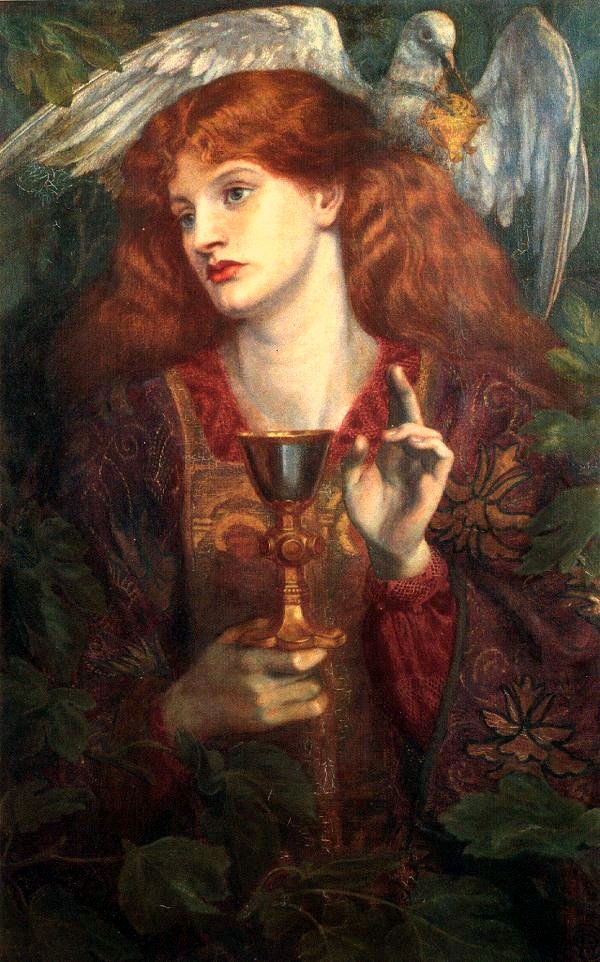
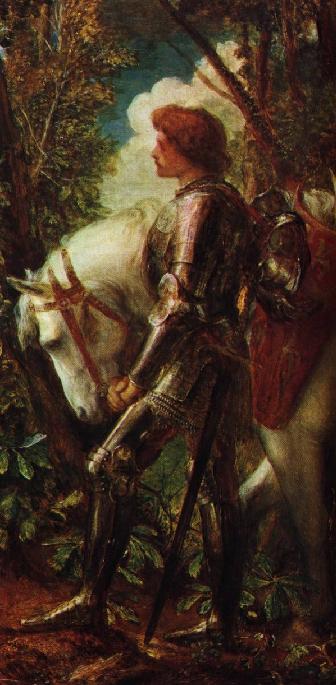
Galahad, a revered knight of King Arthur’s Round Table, emerges as a central figure in Arthurian legend, celebrated for his valor and unparalleled purity. Born from the union of Sir Lancelot du Lac and Lady Elaine of Corbenic, Galahad’s exceptional character is believed to draw inspiration from the monastic order established by St. Bernard of Clairvaux, embodying celibacy and otherworldly virtues.

Upon reaching the age of 15, Galahad encounters his father Lancelot for the first time, defeating him in a duel and earning his knighthood. The young knight is introduced to King Arthur’s court during Pentecost, where he successfully unveils the Siege Perilous, a vacant chair reserved for the one destined to achieve the Holy Grail. Surviving this perilous test, Galahad is acknowledged by Arthur as the greatest knight, and the quest for the Holy Grail begins.

Taking the lead in the quest, Galahad’s purity and divine connection guide the Knights of the Round Table on their journey. Arthur, foreseeing the challenges and sacrifices, fears for the fate of his knights. Galahad’s quest mirrors Arthur’s own mythic journey, solidifying his role as the chosen one.

Unique among the knights, Galahad possesses miraculous abilities, banishing demons, and healing the sick. He embarks on the Grail Quest alone, rescuing fellow knights, sparing enemies, and performing extraordinary feats. Reuniting with Bors and Percival, the trio discovers the mystical Ship of Solomon, leading them to an island where Galahad acquires King David’s sword.

The overarching quest for the Holy Grail, the sacred cup from the Last Supper, symbolizes the pursuit of holiness. While King Arthur does not find the Grail himself, Galahad’s unwavering purity allows him to achieve this mythical and divine goal.

THE GALAHAD METAPHOR
Galahad, as a metaphor for climate change, can be understood through his role as a symbol of purity, righteousness, and a transformative force in the Arthurian legend. In the context of climate change, Galahad represents the ideals and actions necessary for positive environmental transformation.

  1. Purity and Responsibility: Galahad’s unparalleled purity reflects the need for a clean and sustainable environment. In the face of environmental challenges, purity can be seen as a commitment to responsible and eco-friendly practices that aim to preserve the Earth for future generations.
  2. Transformation and Renewal: Galahad’s quest for the Holy Grail is a journey of transformation. Similarly, addressing climate change requires a profound transformation in how societies approach consumption, energy use, and environmental conservation. Galahad’s story mirrors the need for humanity to undergo a significant shift in behavior for a sustainable future.
  3. Leadership and Inspiration: Galahad’s leadership in the Grail Quest inspires others to follow. In the context of climate change, leaders with a vision for a sustainable future can inspire individuals, communities, and nations to take collective action in combating environmental degradation.
  4. Miraculous Abilities: Galahad’s miraculous abilities, such as banishing demons and healing the sick, can be metaphorically linked to the innovative technologies and solutions that humanity can develop to address environmental challenges. These may include advancements in renewable energy, conservation efforts, and sustainable practices.
  5. Unity and Collaboration: Galahad’s ability to work alone and later reunite with fellow knights emphasizes the importance of unity in the face of adversity. Addressing climate change requires global collaboration, where nations, organizations, and individuals unite to implement effective and widespread environmental policies and practices.
  6. Chosen One and Responsibility: Galahad is considered the chosen one, reflecting the idea that individuals and societies have a responsibility to protect the planet. This metaphor encourages a sense of duty toward environmental stewardship and emphasizes that everyone has a role to play in mitigating climate change.

In summary, the metaphorical interpretation of Galahad in the context of climate change underscores the need for purity, transformation, leadership, collaboration, and a sense of responsibility to bring about positive and sustainable environmental change.

From the album: Camelot’s Resurgence

A song about The Human Induced Climate Change Experiment

bookmark_borderHuginn and Muninn

LYRICS
Feathered kin in a flock
Together they equate stock
Thought intertwined with memory
Exposing treachery

Raise awareness, global endeavor
In the forefront, now and forever
Justice in fairness, a quest
Self-awareness, a welcomed guest

In ceaseless flight, a crusade
Against corruption’s dark shade
Ceaseless flight, a beacon of light
Illuminating perception’s height

Symbiotic bond, a dance
Embodying interdependence’s trance
Beyond brinkmanship’s strife
Towards transcendence, a new life

In a trance-state journey
Through stormy weather, unwavering
News of the world, unfurled
A poetic tapestry, beautifully swirled

Chords: G F E G E G / A C / E C D / E C D E / E C A D / E F G; Part II Ambient Country Pop @ 105 Beats Per Minute
Instrumentation: Vocals (TC-Helicon VOICELIVE and MiniNova Vocorder), Ibanez Acoustic Guitar (AW54CE), Keyboards (Korg PS60, Casio WK-3500, Yamaha PSR-740, MiniNova, MicroKorg)

ABOUT HUGINN AND MUNINN
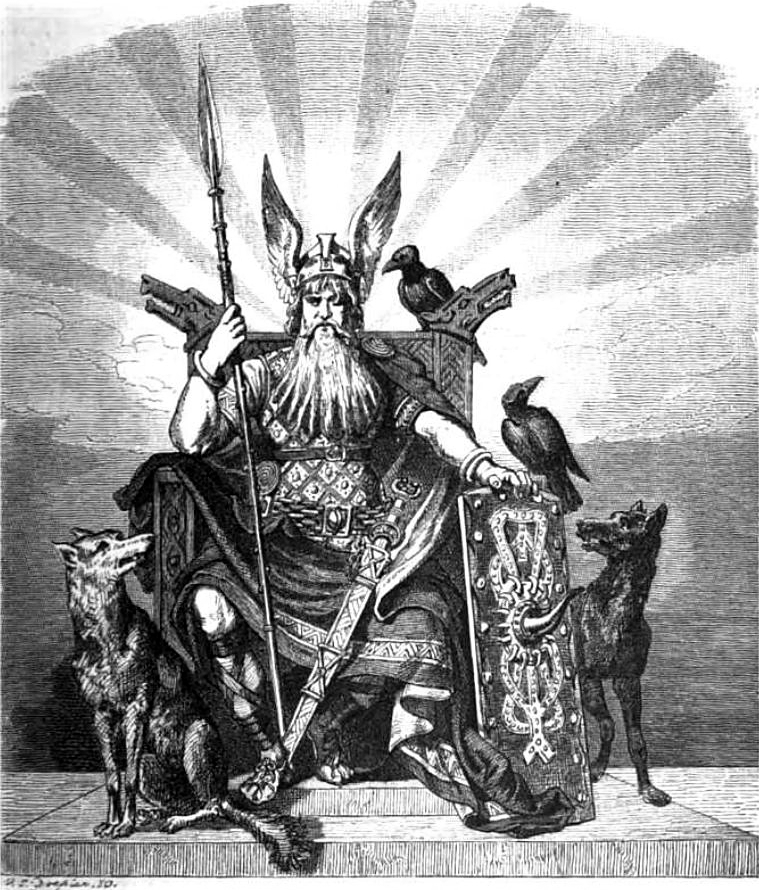
In Norse mythology, Huginn (Old Norse: “thought”) and Muninn (Old Norse “memory” or “mind”) are a pair of ravens that traverse the world, Midgard, gathering information for the god Odin. These iconic ravens find mention in the Poetic Edda, compiled in the 13th century from earlier traditional sources such as the Prose Edda and Heimskringla, as well as in the Third Grammatical Treatise by Óláfr Þórðarson. Skaldic poetry also contributes to the rich tapestry of their legend. The names Huginn and Muninn are sometimes anglicized as Hugin and Munin, aligning with the modern Danish, Norwegian, and Swedish spellings.

Scholars have drawn connections between Odin’s association with Huginn and Muninn and shamanic practices. John Lindow posits that Odin’s ability to dispatch his “thought” (Huginn) and “mind” (Muninn) parallels the trance-state journey undertaken by shamans. The stanza in Grímnismál, where Odin expresses concern about the return of Huginn and Muninn, aligns with the inherent dangers faced by shamans during their trance-state journeys, according to Lindow. Another intriguing perspective, proposed by Bernd Heinrich, suggests that Huginn and Muninn, alongside Odin and his wolves Geri and Freki, symbolize a symbiotic relationship observed in the natural world among ravens, wolves, and humans engaged in hunting activities.

THE HUGINN AND MUNINN METAPHOR

Huginn and Muninn, the mythical ravens from Norse mythology, can be metaphorically linked to the concept of climate change in several ways. These legendary birds, serving Odin as messengers and scouts, embody aspects of awareness, memory, and interconnectedness, which can be extended to symbolic representations of environmental consciousness:

  1. Global Awareness: Huginn and Muninn travel throughout Midgard, the world, gathering information for Odin. In a metaphorical sense, their ceaseless flight reflects the need for global awareness and understanding of environmental changes. Addressing climate change requires a collective, global effort, emphasizing the importance of information dissemination and awareness.
  2. Memory and Learning: Muninn, often associated with memory, represents the retention of knowledge. Metaphorically, this could symbolize the importance of learning from past environmental changes, understanding historical patterns, and using accumulated knowledge to address current climate challenges.
  3. Interconnected Ecosystems: Huginn and Muninn’s symbiotic relationship with Odin and other creatures, like wolves Geri and Freki, mirrors the interconnectedness of ecosystems. In the context of climate change, understanding the intricate relationships between different elements of the environment becomes crucial for effective mitigation and adaptation strategies.
  4. Responsibility and Stewardship: Odin’s reliance on Huginn and Muninn underscores a sense of responsibility for the well-being of Midgard. Metaphorically, this can be seen as humanity’s responsibility to act as stewards of the Earth. Climate change necessitates a collective commitment to sustainable practices and environmental stewardship to ensure a harmonious coexistence with the planet.
  5. Trance-state Journey as Metaphor: Odin’s trance-state journey, associated with the return of Huginn and Muninn, can symbolize the introspective and transformative journey humanity must undertake to address climate change. The concerns expressed by Odin may echo the urgency and risks associated with delayed action on environmental issues.

While these connections are metaphorical and interpretative, they highlight the rich symbolism embedded in Norse mythology, offering insights into the broader themes of interconnectedness, responsibility, and the need for global awareness in the face of environmental challenges like climate change.

From the album: The Echoes of Earth’s Wrath:
A Musical Journey Through Mythical Metaphors on Human-Induced Climate Change

A song about The Human Induced Climate Change Experiment

bookmark_borderThe Holy Grail

LYRICS
Seeking
Searching
Pursuing
The eluding

Quest for a transformation
A global solution
Less greed and grime
More love in time

Spiritual enlightenment
Is the journey’s ascent
May our cup runneth over
In wisdom, we uncover

The quest for the Holy Grail
Our best shall prevail
The quest for the Holy Grail
Our souls we’ll/will unveil

Chords: Em D6 / Em F / F Bb F / C7 F / C F C7 / C7 Am Eaug C / C F Bb / C Edim / F; Part II Hard Rock / Digi-Rock @ 120 Beats Per Minute
Instrumentation: Vocals (TC-Helicon VOICELIVE and MiniNova Vocorder), Fender Jazz Bass (Boss Digital Delay), Keyboards (Korg PS60, Casio WK-3500, Yamaha PSR-740, MiniNova, MicroKorg)

ABOUT THE HOLY GRAIL
In the King Arthur legend, the quest for the Holy Grail centers around the prophecy that a knight will eventually fill a vacant seat at the Round Table by seeking and finding this sacred object. The quest begins when a stone with an embedded sword is discovered, and only Sir Galahad, son of Sir Lancelot, proves capable of drawing the sword and joining the Round Table. The Holy Grail, associated with the cup used by Jesus at the Last Supper, symbolizes a mystical union with God in the legends. The origin of the Grail legend is uncertain, but it appeared in literature from the 12th to the 15th century.

The earliest known work on the Holy Grail is “Le Conte du Graal” (The Story of the Grail or the Tale of Perceval) by Chrétien de Troyes in the 12th century, merging the religious quest for the Grail with knightly adventures. Perceval, a knight of innocence, encounters the wounded Fisher King and sees the Grail but refrains from asking about it, leading to the king’s continued suffering. Later versions replace Perceval with Sir Gawain. In Wolfram von Eschenbach’s 13th-century version, the Grail is a precious stone fallen from heaven, differing from the cup depiction and inspiring Richard Wagner’s opera “Parsifal.”

The medieval legend of King Arthur’s quest for the Holy Grail is rooted in the spiritual journey of the knights. The Grail is perceived as a sacred and magical object with healing powers, and those who find it are believed to gain great power and wisdom. In Dan Brown’s novel “The DaVinci Code,” the Holy Grail takes on a different meaning, representing a secret bloodline—Jesus Christ and Mary Magdalene’s alleged descendants. The novel suggests that the Priory of Sion has protected this secret, and protagonist Robert Langdon becomes embroiled in a race to unveil it. The contrast between the spiritual quest in Arthurian legend and the conspiracy theory in Dan Brown’s novel highlights the varied interpretations and adaptations of the Holy Grail myth across different narratives.

THE HOLY GRAIL METAPHOR
The Holy Grail, as a metaphor for climate change, could represent the quest for a transformative solution or understanding to address the environmental challenges facing the world. In the Arthurian legend, the Holy Grail is a symbol of spiritual enlightenment and healing, and its quest is seen as a journey of self-discovery and redemption for the knights. Similarly, the metaphorical Holy Grail of climate change might embody the search for sustainable practices, innovative technologies, and a collective commitment to heal and restore the planet.

The quest for the Holy Grail requires overcoming obstacles, proving one’s worthiness, and demonstrating virtues such as courage and selflessness. In the context of climate change, this could parallel the challenges humanity faces in transitioning to cleaner energy sources, reducing carbon emissions, and adopting environmentally conscious practices. The metaphor underscores the urgency of finding solutions, the need for cooperation on a global scale, and the potential for positive transformation if the quest is undertaken with dedication and a sense of responsibility.

Just as the knights embark on a spiritual and ethical journey in pursuit of the Holy Grail, addressing climate change requires a moral and ethical commitment to protecting the environment and ensuring a sustainable future. The metaphor emphasizes that, like the knights in the legend, individuals and societies must rise to the occasion, overcome obstacles, and work collectively to find the metaphorical Holy Grail for climate change—a sustainable and harmonious relationship with the planet.

From the album: Camelot’s Resurgence

A song about The Human Induced Climate Change Experiment

bookmark_borderGuinevere

LYRICS
Dear Guinevere,
Why do we veer
From virtue and valor
Why do we squalor

Scapegoating responsibility
Neglecting rationality
Craving brutality
Bringing on inevitability

Are all of us
Morally ambiguous
Are none of us
A positive influence

Consequences of betrayal
Will be our end all
We betrayed our Earth
We betrayed our birth

Guinevere, my dear
I fear The End near
Oh dear, Guinevere
Our future’s clear

Chords: Dm C / F D / Dm F / Dm C / Dm Bb / Dm C C Dm; Part II @ 80 Beats Per Minute
Instrumentation: Vocals (TC-Helicon VOICELIVE and MiniNova Vocorder), Carlo Robelli Classical Guitar, Keyboards (Korg PS60, Casio WK-3500, Yamaha PSR-740, MiniNova, MicroKorg)

ABOUT Guinevere
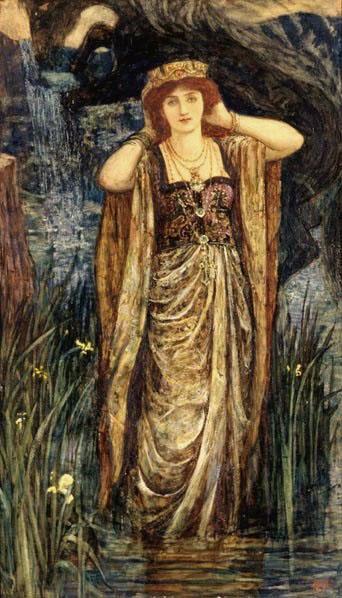
Guinevere, an early-medieval queen of Great Britain, is intricately woven into the Arthurian legend, with her portrayal spanning a spectrum from a fatally flawed and villainous traitor to a noble and virtuous lady. Initially introduced in popular literature in the early 12th century, nearly seven centuries after the purported times of King Arthur, Guinevere’s character has been shaped by various narratives.

The earliest datable mention of Guinevere appears in Geoffrey of Monmouth’s Historia Regum Britanniae, where she is seduced by Mordred during his ill-fated rebellion against Arthur. In a later French Arthurian romance tradition, prominently featured in Le Morte d’Arthur by Thomas Malory, Guinevere is portrayed as the daughter of King Leodegrance, entrusted with the Round Table after Uther Pendragon’s death.

Caradoc of Llancarfan’s account in the Life of Gildas, written between 1130 and 1150, introduces the story of Guinevere’s kidnapping and rape by Melwas, the king of the “Summer Country,” leading to Arthur’s determined quest to rescue her.

In the 13th-century French chivalric romances, Guinevere’s narrative includes an arranged marriage to Arthur, with the Round Table as her dowry. During Arthur’s absence in France pursuing Lancelot, she faces challenges, including Mordred’s treacherous plans. In certain versions, Guinevere assents to Mordred’s proposal, while others depict her resisting his advances in the Tower of London and later seeking refuge in a nun convent during the siege.

Following Arthur’s return and the fatal Battle of Camlann, where Mordred meets his end, Guinevere becomes a scapegoat for the violence during the civil war. Despite her complex role, Guinevere’s character is often devoid of personal perspective or motivation. In the aftermath of Arthur’s death, she retires to a convent as an act of penitence for her perceived infidelity.

Guinevere’s multifaceted portrayal reflects the evolving interpretations of her character throughout the centuries within the Arthurian legend.

The Guinevere Metaphor
Guinevere’s character in the Arthurian legend can be metaphorically linked to climate change through the complexities and consequences surrounding her choices and actions. Here are some parallels:

  1. Flawed Human Agency: Guinevere’s portrayal as a flawed and sometimes morally ambiguous character reflects the imperfect decisions humans make. Similarly, the collective human actions contributing to climate change, such as deforestation, excessive use of fossil fuels, and pollution, showcase the flawed agency responsible for environmental challenges.
  2. Betrayal and Consequences: Guinevere’s affair with Lancelot, leading to betrayal and consequences for the kingdom, can be likened to humanity’s exploitation of natural resources and the subsequent environmental consequences. The betrayal of environmental ethics and sustainability principles can lead to severe repercussions for the planet.
  3. Scapegoating and Responsibility: Guinevere’s role as a scapegoat for the violence during the civil war draws parallels to the tendency to blame individuals or specific factors for climate change. The complexity of environmental issues often leads to the scapegoating of particular industries or practices, deflecting attention from collective responsibility.
  4. Penitence and Redemption: Guinevere’s retreat to a convent in penitence reflects the acknowledgment of wrongdoing and a desire for redemption. In the context of climate change, efforts toward environmental conservation, sustainable practices, and global initiatives can be seen as humanity’s collective penitence and attempts at redemption for the damage inflicted on the planet.
  5. Complexity of Motivations: Guinevere’s character lacks a fully developed perspective or motivation in some versions of the legend, mirroring the complexity and diversity of motivations behind climate-related actions. Climate change is driven by a multitude of factors, including economic interests, political decisions, and individual behaviors, making it challenging to attribute a singular motivation.

While the metaphorical connection between Guinevere and climate change may be symbolic, it highlights the intricate relationship between human choices, consequences, and the need for collective responsibility in addressing complex challenges.

From the album: Camelot’s Resurgence

A song about The Human Induced Climate Change Experiment

bookmark_borderMordred

LYRICS
More dread
Mordred
The decline of fine
More dread
Mordred
The downfall of all

Traitor narrator
Can’t save your tail
Traitor narrator
Won’t save this tale

Consequences of action
Loss of satisfaction
Collapse of the kingdom
And the woes to come
Lord of societal discord

More dread
Mordred
The demise from rise
More dread
Mordred
The betrayal of all

Chords: Em Cm Cm Em / A C / G C A / A B C D E F G A / C D E; Part II Blues Ballad Trip-Hop @ 62 Beats Per Minute
Instrumentation: Vocals (TC-Helicon VOICELIVE and MiniNova Vocorder), Keyboards (Korg PS60, Casio WK-3500, Yamaha PSR-740, MiniNova, MicroKorg)

ABOUT MORDRED
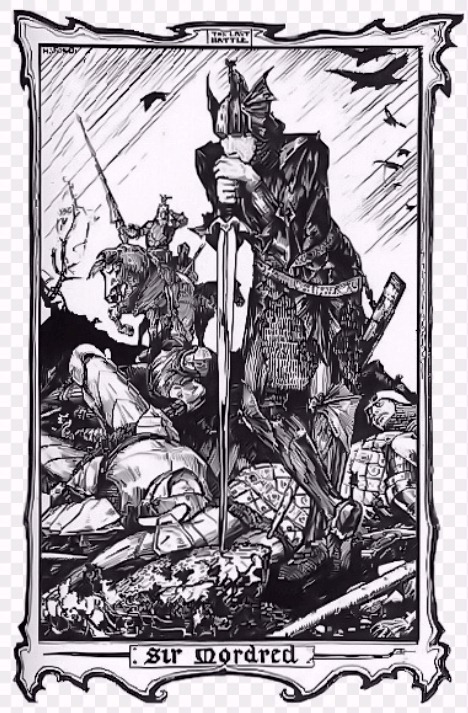
Mordred is a key figure in the Arthurian legend, with the earliest mention of a possibly historical Medraut found in the Welsh chronicle Annales Cambriae. This chronicle ambiguously associates Mordred and Arthur with the Battle of Camlann in the year 537. Initially portrayed as Arthur’s treacherous nephew and a legitimate son of King Lot, later versions often depict him as Arthur’s villainous bastard son, conceived through an incestuous relationship with his half-sister, known by various names such as Anna, Orcades, or Morgause, the queen of Lothian or Orkney. The narratives, including those in the Historia and other renditions, culminate in Mordred’s demise at Camlann, typically in a final duel where he manages to inflict a mortal wound upon his own slayer, Arthur.

Mordred’s familial connections, particularly his role as a brother or half-brother to Gawain, remain consistent, while his relationships with Arthur’s wife, Guinevere, exhibit variations. In a popular narrative stemming from 13th-century French chivalric romances and prominently featured in Le Morte d’Arthur, Mordred is knighted by Arthur and becomes a member of the Round Table fellowship. In this version, he emerges as the central figure in Arthur’s downfall, aiding his half-brother Agravain in exposing the affair between Guinevere and Lancelot. Exploiting the resulting civil war, Mordred ascends to become the high king of Britain.

The MORDRED METAPHOR
The legend of Mordred in the Arthurian mythos can be metaphorically linked to the theme of climate change. Mordred’s role as a traitor within the Arthurian legend, contributing to the downfall of Camelot, can be seen as an allegory for the destructive consequences of human actions on the environment.

In the legend, Mordred’s betrayal and manipulation of the circumstances, such as exposing the affair between Guinevere and Lancelot, lead to a civil war and the ultimate collapse of the Arthurian kingdom. This betrayal and the ensuing conflict can be compared to human activities that contribute to environmental degradation, including deforestation, pollution, and unsustainable resource exploitation.

Mordred’s rise to power through exploiting internal conflicts mirrors how environmental issues can intensify due to societal discord and a lack of unified efforts to address climate change. The legend may serve as a cautionary tale, urging humanity to recognize the consequences of its actions on the environment and work together to prevent the potential downfall of the planet.

The metaphorical connection highlights the importance of unity, responsible stewardship of natural resources, and addressing climate change as a collective effort to avoid catastrophic outcomes similar to those witnessed in the legend of Mordred and Camelot.

From the album: Camelot’s Resurgence

A song about The Human Induced Climate Change Experiment

bookmark_borderThe Lady of Shalott

She left the web, she left the loom,
She made three paces through the room,
She saw the water-lily bloom,
She saw the helmet and the plume,
She look’d down to Camelot.

Out flew the web and floated wide;
The mirror crack’d from side to side;
“The curse is come upon me,” cried
The Lady of Shalott.
— Tennyson, Lord Alfie

Chords: Am Dm C Em Am
Instrumentation: Vocals (TC-Helicon VOICELIVE), Ibanez Acoustic Guitar (AW54CE)

LYRICS
A mirror image of our age
Viewing backward toward the stage
The reverse of our course…
A worse curse?

Detached perspective of reality
Not to see how things shall be
Left alone in isolation
Ever feeling desolation

Neglecting all outside
Ignoring your inside
Where can hope reside
When feelings have died
[Bridge: the mirror cracks]
At an increasing rate
Leading to a tragic fate
What of the broader circumstance
Love, dance, and romance?

Will you let your life rot
Like the Lady of Shalott?

Chords: Am / Dm C Em Am / Am G Am / C D E; Part III Trip-Hop Epic Ballad @ 70 to 120 Beats Per Minute
Instrumentation: Vocals (TC-Helicon VOICELIVE and MiniNova Vocorder), Ibanez Acoustic Guitar (AW54CE), Keyboards (Korg PS60, Casio WK-3500, Yamaha PSR-740, MiniNova, MicroKorg)

ABOUT THE SONG (AND POEMS)
The first four of the 1842 second version of the poem describe a pastoral setting. The Lady of Shalott lives in an island castle in a river which flows to Camelot, but the local farmers know little about her.

And by the moon the reaper weary,
Piling sheaves in uplands airy,
Listening, whispers, “‘Tis the fairy
Lady of Shalott.”

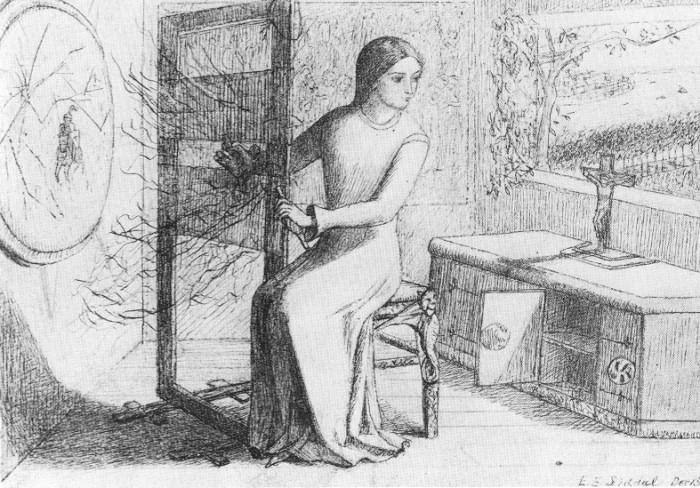
Stanzas five to eight describe the lady’s life. She suffers from a mysterious curse and must continually weave images on her loom without ever looking directly out at the world. Instead, she looks into a mirror, which reflects the busy road and the people of Camelot who pass by her island.

She knows not what the curse may be,
And so she weaveth steadily,
And little other care hath she,
The Lady of Shalott.

The reflected images are described as “shadows of the world”, a metaphor that makes it clear they are a poor substitute for seeing directly (“I am half-sick of shadows”).

William Maw Egley, The Lady of Shalott, 1858

Stanzas nine to twelve describe “bold Sir Lancelot” as he rides by and is seen by the lady.

All in the blue unclouded weather
Thick-jewell’d shone the saddle-leather,
The helmet and the helmet-feather
Burn’d like one burning flame together,
As he rode down to Camelot.

The remaining seven stanzas describe the effect on the lady of seeing Lancelot; she stops weaving and looks out of her window toward Camelot, bringing about the curse.

Out flew the web and floated wide—
The mirror crack’d from side to side;
“The curse is come upon me,” cried
The Lady of Shalott.

She leaves her tower, finds a boat upon which she writes her name, and floats down the river to Camelot. She dies before arriving at the palace. Among the knights and ladies who see her is Lancelot, who thinks she is lovely.

“Who is this? And what is here?”
And in the lighted palace near
Died the sound of royal cheer;
And they crossed themselves for fear,
All the Knights at Camelot;
But Lancelot mused a little space
He said, “She has a lovely face;
God in his mercy lend her grace,
The Lady of Shalott.”

ABOUT The Lady of Shalott
Alfred Lord Tennyson’s four-part poem, ‘The Lady of Shalott,’ narrates the tale of a young medieval woman mysteriously confined on an island near Camelot. Her existence revolves around the solitary tasks of weaving a vibrant web and observing the outside world solely through a mirror. A curse looms over her: gazing directly at Camelot will bring about misfortune. The poem unfolds the tragic narrative of Elaine of Astolat, a young noblewoman marooned in a tower upstream from Camelot. Tennyson’s exploration of Arthurian themes is depicted as “a valid setting for the study of the artist and the perils of personal isolation,” as noted by one of his biographers.

CLIMATE CHANGE METAPHOR
The Lady of Shalott, in Alfred Lord Tennyson’s poem, can be metaphorically linked to climate change through the theme of isolation and the consequences of disregarding the world outside her confined existence. The Lady, secluded on her island and restricted to experiencing life indirectly through her mirror, represents a detached perspective on reality.

Similarly, humanity, in the context of climate change, can be seen as isolating itself from the environmental challenges that surround it. The Lady’s curse, triggered by the direct view of Camelot, symbolizes the repercussions of ignoring or neglecting the outside world. In the climate change metaphor, this could signify the adverse effects that result from turning a blind eye to environmental issues, such as rising temperatures, pollution, and loss of biodiversity.

The Lady’s curse leads to her tragic fate, emphasizing the potential dire consequences of disregarding the broader context. In the climate change metaphor, it underscores the urgency of addressing environmental concerns and the interconnectedness of human actions with the health of the planet. The Lady’s story serves as a cautionary tale, urging us to break free from isolation, acknowledge the reality of climate change, and actively engage in preserving the delicate balance of our environment.

From the album: Camelot’s Resurgence

A song about The Human Induced Climate Change Experiment

>The Lady of Shalott

bookmark_borderLancelot

LYRICS
Addressing the hidden root
Residing under the boot
May not be obvious to me
Yet, all the world can see

Fits of madness
Suicidal tendencies
Sits in sadness
Homicidal remedies

How destructive action
Leads to lack of satisfaction
Bad things that you pass
Come back to bite in the ass

Claim that life isn’t fair
Induce a sense of despair
Totally unaware
You, yourself declare

The Earth’s edict
Contributors to conflict
Will wallow
In their own hollow
Till there is war
No more

[Lancelot, it’s getting hot!
How much time?
Not a lot!]

Chords: Em D / C D G D / C6 D Bb D; Part II Ambient Pop Cha Cha @ 132 Beats Per Minute
Instrumentation: Vocals (TC-Helicon VOICELIVE and MiniNova Vocorder), Ibanez Electric RG-270 (Boss Digital Delay), Fender Jazz Bass (Boss Digital Delay), Keyboards (Korg PS60, Casio WK-3500, Yamaha PSR-740, MiniNova, MicroKorg)

ABOUT LANCELOT
Lancelot, a prominent figure in the Arthurian legend, served as King Arthur’s close companion and stood among the greatest Knights of the Round Table. Born an orphan, Lancelot was the son of King Ban of the lost kingdom of Benoic. Orphaned and raised in a fairy realm by the Lady of the Lake, he emerged as a hero known for his exceptional prowess in battles, quests, and tournaments, establishing himself as an unparalleled swordsman and jouster. Lancelot eventually became the lord of the castle Joyous Gard and the personal champion of Arthur’s wife, Queen Guinevere.

Despite his formidable achievements, Lancelot faced challenges in the form of frequent and occasionally prolonged fits of madness. His tragic affair with Queen Guinevere, once discovered, triggered a civil war that ultimately led to the downfall of Arthur’s kingdom, exploited by the cunning Mordred.

According to the Vulgate Cycle, Lancelot’s backstory unfolds in the borderland between Gaul and Brittany, where he is born as Galahad, the son of King Ban of Bénoïc. Fleeing the fall of Ban’s kingdom to King Claudas, the infant Lancelot is carried away by the Lady of the Lake, a fairy enchantress. Lancelot’s journey continues as he earns a place at Arthur’s elite Round Table by freeing King Arthur’s nephew Gawain from captivity.

Lancelot’s romantic entanglement with Queen Guinevere is marked by a magical connection, leading to a profound and forbidden love. His knight-errant adventures include triumphing in tournaments, rescuing knights held captive by villains like Turquine, and overcoming betrayals. Lancelot’s dedication to Queen Guinevere is evident in his heroic feats, such as slaying dragons and giants and playing a crucial role in the war against the Saxons in Lothian.

However, Lancelot’s life is marred by recurring fits of madness, often triggered by emotional turmoil, false news of the death of allies like Gawain, or encounters with sexually charged situations. These episodes contribute to the complexity of his character.

The destructive consequences of Lancelot’s affair with Queen Guinevere become evident when the truth is exposed, leading to the violent rescue of the condemned queen and the death of Gawain’s brothers. This tragic event sets in motion the chain of events that culminate in Mordred’s treason, the disappearance of Arthur, and the apparent demise of the once-mighty Camelot. Lancelot’s tale serves as a poignant narrative of love, betrayal, and the far-reaching repercussions of personal choices within the legendary realm of King Arthur.

THE CLIMATE CHANGE METAPHOR

The story of Lancelot, particularly aspects of his character and the consequences of his actions, can be metaphorically linked to certain aspects of the challenges posed by climate change:

  1. Hidden Origins and Lost Kingdom:
    • Lancelot’s Backstory: Lancelot is an orphan with a mysterious origin, hailing from the lost kingdom of Benoic.
    • Climate Change Metaphor: Climate change often involves addressing the hidden origins of environmental issues, and the impact of lost ecosystems and habitats.
  2. Magical Connection and Love:
    • Lancelot’s Connection: Lancelot and Queen Guinevere share a magical connection, leading to a forbidden love that has significant consequences.
    • Climate Change Metaphor: The interconnectedness of ecosystems and the environment emphasizes the need for responsible stewardship to avoid unintended and detrimental consequences.
  3. Destructive Consequences of Actions:
    • Lancelot’s Affair: Lancelot’s affair with Guinevere results in a civil war and the downfall of Arthur’s kingdom.
    • Climate Change Metaphor: Human actions, such as unsustainable practices and environmental degradation, can lead to destructive consequences for the planet and its ecosystems.
  4. Fits of Madness and Suicidal Tendencies:
    • Lancelot’s Struggles: Lancelot experiences fits of madness and suicidal tendencies, often related to false or real news of death.
    • Climate Change Metaphor: The challenges posed by climate change can induce a sense of despair or hopelessness, emphasizing the importance of addressing these challenges with resilience and effective solutions.
  5. War and Consequences for Arthur’s Kingdom:
    • Lancelot’s Role: Lancelot’s actions, especially the rescue of Guinevere, lead to a war and the eventual downfall of Arthur’s kingdom.
    • Climate Change Metaphor: Climate change contributes to conflicts over resources and poses threats to the stability of societies and ecosystems.
  6. Revelation and Unraveling Truths:
    • Lancelot’s Revelation: The revelation of Lancelot’s affair with Guinevere leads to a series of tragic events.
    • Climate Change Metaphor: The revelation of environmental truths and the acknowledgment of climate change impacts are crucial steps toward addressing and mitigating its effects.

From the album: Camelot’s Resurgence

A song about The Human Induced Climate Change Experiment

bookmark_borderDaniel

LYRICS
We require our attention
As divine intervention
No need for a seer to see
We create our destiny

Man is overactive
Holding the climate captive
Steadfast devotion
To our solution
For evolution

Interpret the signs
Of Man’s designs
Long-term consequences
To satisfy our instance
And, the lion dines

Working towards redemption
For future generations
Could be our salvation
Redeem the drudge and sludge
God as our judge

Chords: E/7/m/m7(11) A E / B7 A A G e; Part II @ 128 Beats Per Minute
Instrumentation: Vocals (TC-Helicon VOICELIVE and MiniNova Vocorder), Ibanez Acoustic Guitar (AW54CE), Fender Squire Mini Electric Guitar (Boss Digital Delay), Fender Jazz Bass (Boss Digital Delay), Keyboards (Korg PS60, Casio WK-3500, Yamaha PSR-740, MiniNova, MicroKorg)

ABOUT THE SONG
The story of Daniel, as recounted in the Hebrew Bible, offers metaphorical parallels to the challenges and consequences associated with climate change.

  1. Captivity and Environmental Impact:
    • Story of Daniel: Daniel faces captivity in Babylon, a foreign land, due to circumstances beyond his control.
    • Climate Change: Human activities have led to environmental changes, impacting ecosystems and causing unforeseen consequences.
  2. Faith and Resilience:
    • Story of Daniel: Despite societal pressures to conform to Babylonian practices, Daniel and his friends maintain their faith and principles.
    • Climate Change: Dealing with climate change requires steadfastness in adhering to sustainable practices and values even when faced with opposing influences.
  3. Interpretation of Signs and Visions:
    • Story of Daniel: Daniel is known for interpreting dreams and visions that foretell significant events.
    • Climate Change: Scientists interpret environmental data and signs, providing insights into the consequences of climate change.
  4. Divine Intervention and Protection:
    • Story of Daniel: Daniel miraculously survives the lions’ den, symbolizing divine intervention and protection for those with unwavering faith.
    • Climate Change: Mitigating climate change requires divine-like intervention in the form of global cooperation, sustainable practices, and responsible stewardship of the planet.
  5. Long-Term Consequences and Redemption:
    • Story of Daniel: The visions in the Book of Daniel include prophecies about the rise and fall of kingdoms, suggesting long-term consequences for actions.
    • Climate Change: Human actions today have long-term consequences for the planet, and efforts to address climate change involve working towards redemption and sustainable practices for future generations.
  6. Theological and Symbolic Resonance:
    • Story of Daniel: The story of Daniel holds theological significance, with themes of faith, divine protection, and the promise of redemption.
    • Climate Change: Addressing climate change requires considering ethical, moral, and symbolic dimensions to ensure a sustainable and just future.

While not a direct analogy, these connections highlight how narratives from religious texts can be metaphorically applied to contemporary challenges such as climate change, emphasizing the importance of faith, resilience, interpretation of signs, and responsible stewardship of the environment.

ABOUT DANIEL
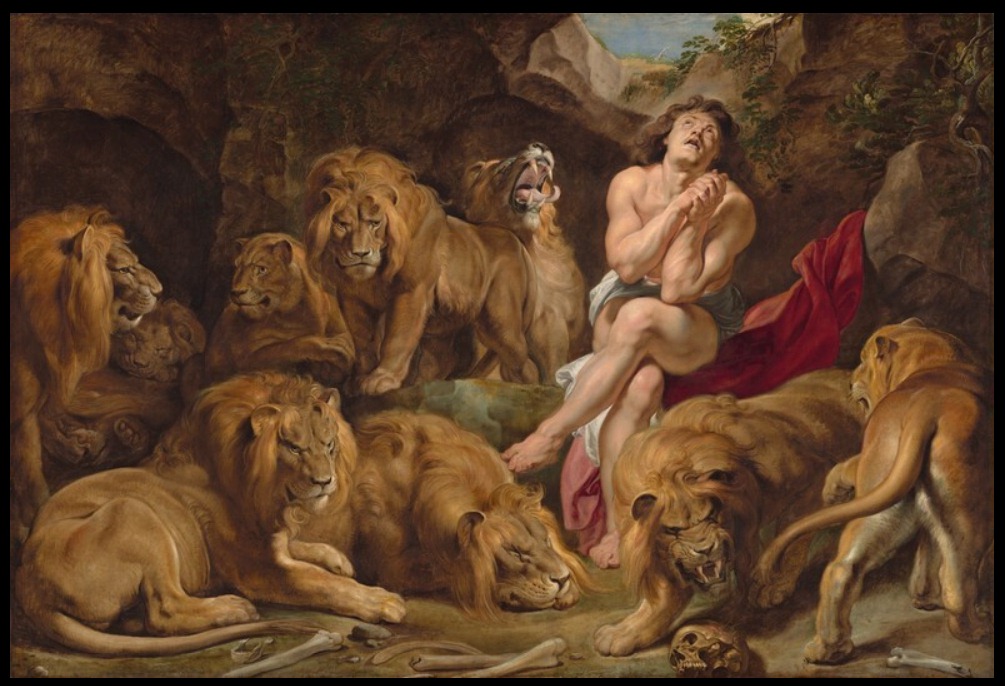
According to the Hebrew Bible, Daniel was a noble Jewish youth from Jerusalem who faced captivity under Nebuchadnezzar II of Babylon. Throughout his service to Babylonian kings, including Nebuchadnezzar and Cyrus, Daniel remained steadfast in his devotion to the God of Israel. He shared this period of captivity with his friends Shadrach, Meshach, and Abednego, and despite societal pressures to conform, they held firm to their faith. God blessed Daniel with wisdom and the ability to interpret dreams, showcasing his unwavering commitment.

The Book of Daniel, a 2nd-century BC biblical apocalypse set in the 6th century BC, offers an account of Daniel’s activities and visions during his exile. The name Daniel itself means “God is my judge.”

In Nebuchadnezzar’s dreams, Daniel interprets a giant statue representing four kingdoms, with God ultimately establishing His own kingdom. Another dream involves a great tree destroyed by a heavenly decree, foretelling divine judgment. Daniel’s visions include symbolic representations of historical events, such as the rise and fall of kingdoms, and a struggle between the “king of the north” and the “king of the south,” culminating in the establishment of God’s kingdom on Earth.

One notable event from Daniel’s life recounts how Persian King Darius I condemned him to a night in a lions’ den for his unwavering worship of God. Miraculously, Daniel emerged unharmed.

Overall, Daniel’s narrative is a testament to resilience and faithfulness, offering profound lessons about enduring faith even in the face of adversity.

From the album: The Echoes of Earth’s Wrath:
A Musical Journey Through Mythical Metaphors on Human-Induced Climate Change

A song about The Human Induced Climate Change Experiment

bookmark_borderLyonesse

Part I
When I Set Out For Lyonesse
by Thomas Hardy

When I set out for Lyonnesse,
A hundred miles away,
The rime was on the spray,
And starlight lit my lonesomeness
When I set out for Lyonnesse
A hundred miles away.

What would bechance at Lyonnesse
While I should sojourn there
No prophet durst declare,
Nor did the wisest wizard guess
What would bechance at Lyonnesse
While I should sojourn there.

When I came back from Lyonnesse
With magic in my eyes,
All marked with mute surmise
My radiance rare and fathomless,
When I came back from Lyonnesse
With magic in my eyes!

Chords: Am C Em Am / Am C B7
Instrumentation: Vocals, Ibanez Acoustic Guitar (AW54CE)

PART II
Lyonesse,
We must confess
To see you under the sea
Is our mess
Not destiny

1. Submersion beneath the waves
No one anywhere saves
We just wait and see
Environmental catastrophe

2. There’s less Lyonesse
Man’s solution
Divine retribution
Loss and transformation
Of our submerged nation

3. There’s less Lyonesse
A crime committed against nature
The crime a failure to nurture
For overexploitation
There is no explanation

(Look around
We’re going down)

Chords: Am C Em Am / Am E F / F G Am; Part II Electric Ambient Rock and Roll @ 128 Beats Per Minute
Instrumentation: Vocals (TC-Helicon VOICELIVE), Keyboards (Korg PS60, Casio WK-3500, Yamaha PSR-740, MiniNova, MicroKorg)

ABOUT LYONESSE
Lyonesse holds a significant place in Arthurian legend, notably featuring in the tragic tale of Tristan and Iseult. It served as the homeland of the heroic Tristan, a distinguished Knight of the Round Table, whose father, King Meliodas, ruled over Lyonesse. In Arthurian lore, Lyonesse is a mythical and “lost” land believed to have once connected Cornwall in western England to the Isles of Scilly in the English Channel.

The name “Lyonesse” first emerged in Thomas Malory’s late 15th-century work, Le Morte Darthur, where it was portrayed as the native land of Tristan. Interestingly, earlier Arthurian legends had associated Tristan with Leonois, likely the region around Saint-Pol-de-Léon in Brittany. Malory’s adoption of the name “Lyonesse” is a deviation from the original association.

Legend holds that Lyonesse met a tragic fate by sinking beneath the waves in a single night. Discrepancies exist in stories regarding the date of this catastrophic event, with some narratives pointing to 11 November 1099, while others suggest it occurred a decade earlier. According to one version, the kingdom faced divine retribution for an unspecified heinous crime committed by its people. The ensuing night witnessed a devastating storm culminating in a colossal wave that engulfed Lyonesse.

Alfred, Lord Tennyson’s Arthurian epic, Idylls of the King, contributes to Lyonesse’s mythical legacy. Within this narrative, Lyonesse becomes the backdrop for the climactic battle between King Arthur and Mordred, the king’s nephew and illegitimate son. Tennyson’s verses weave in references to the legends of Lyonesse, emphasizing its emergence from and eventual submersion into the ocean.

Then rose the King and moved his host by night
And ever pushed Sir Mordred, league by league,
Back to the sunset bound of Lyonesse—
A land of old upheaven from the abyss
By fire, to sink into the abyss again;
Where fragments of forgotten peoples dwelt,
And the long mountains ended in a coast
Of ever-shifting sand, and far away
The phantom circle of a moaning sea.

The legend of Lyonesse can be interpreted as a metaphor for climate change in several ways:

  1. Submersion beneath the waves: The sinking of Lyonesse into the ocean overnight mirrors the rapid changes and environmental catastrophes associated with climate change. Rising sea levels, intensified storms, and coastal erosion are all phenomena linked to climate change that can lead to the literal submergence of land beneath the waves.
  2. Divine retribution: In some versions of the legend, Lyonesse meets its watery end as a punishment from a higher power for the wrongdoing of its inhabitants. This can symbolize the consequences humanity faces due to its unsustainable actions and disregard for the environment. Climate change, often viewed as a result of human activities such as deforestation, pollution, and greenhouse gas emissions, can be seen as a form of collective retribution for these transgressions against nature.
  3. Loss and transformation: The legend of Lyonesse is also a story of loss and transformation. The sudden disappearance of an entire kingdom beneath the waves represents the loss of habitat, biodiversity, and cultural heritage that can occur due to climate change. However, like Lyonesse, there is potential for transformation and adaptation in the face of environmental challenges. Just as the legend speaks of the rise and fall of Lyonesse, the story of climate change encompasses both the destruction of ecosystems and the opportunity for renewal through conservation efforts and sustainable practices.

Overall, the legend of Lyonesse serves as a cautionary tale about the consequences of environmental degradation and the need for humanity to address the impacts of climate change before it’s too late.

The legend of Lyonesse can be metaphorically linked to climate change through its narrative of environmental upheaval and the consequences of human actions. In the legend, Lyonesse, a once-thriving land connecting Cornwall to the Isles of Scilly, meets a tragic end by sinking beneath the waves in a single night. This myth echoes themes relevant to climate change in the following ways:

  1. Rapid Environmental Change: The sudden submersion of Lyonesse signifies a swift and dramatic alteration in the physical landscape. Similarly, climate change often involves rapid shifts in environmental conditions, including rising sea levels and extreme weather events, impacting ecosystems and communities.
  2. Human Impact and Divine Retribution: The legend suggests that the people of Lyonesse faced divine retribution for a crime committed against nature. This mirrors the idea that human activities, such as deforestation, pollution, and overexploitation of natural resources, contribute to climate change. In both cases, there are consequences for ecological mismanagement.
  3. Unspecified Crime and Consequences: The legend leaves the nature of Lyonesse’s crime open to interpretation. This ambiguity aligns with the varied and complex causes of climate change, where multiple human activities collectively contribute to environmental degradation. The consequences, like the storm and engulfing wave, symbolize the repercussions of these actions.
  4. Loss of Homeland and Displacement: The sinking of Lyonesse leads to the loss of a homeland, echoing concerns about rising sea levels and the potential displacement of communities due to climate change. Coastal regions around the world are vulnerable to submersion, posing challenges for inhabitants and contributing to the issue of climate-induced migration.
  5. Symbolic Return and Remembrance: In some versions, Lyonesse is said to return briefly before disappearing again. This cyclical pattern can be seen metaphorically as a reminder of the interconnectedness of environmental issues and the need for sustained efforts to address and mitigate the impacts of climate change.

By viewing the legend of Lyonesse as a metaphor for climate change, it becomes a cautionary tale emphasizing the importance of responsible stewardship of the environment to avoid catastrophic consequences.

Thomas Hardy’s poem “When I Set Out For Lyonesse” can be interpreted as a metaphor for the journey of addressing climate change. The poet’s voyage to Lyonesse, a mythical and distant place, may symbolize the collective effort to tackle environmental challenges. Here’s a potential interpretation:

  1. The Journey and Distance: The hundred miles to Lyonesse could represent the extensive and challenging path humanity must traverse to combat climate change. The poet embarks on this journey, emphasizing the considerable distance to be covered.
  2. The Unknown Future: The uncertainty about what will happen in Lyonesse mirrors the unpredictable outcomes of environmental efforts. Despite setting out on this quest, the poet acknowledges that the future consequences are unclear, much like the unpredictable impacts of climate change mitigation.
  3. Magic and Radiance: The magic in the poet’s eyes upon returning from Lyonesse may symbolize the transformative power of collective action and environmental initiatives. The radiance and fathomless quality suggest the profound and lasting effects that positive changes can bring to the world.
  4. Mute Surmise: The marked and mute surmise of those witnessing the poet’s return may represent the astonishment or skepticism faced by society when environmental efforts yield unexpected positive results. The radiance in the poet’s eyes becomes evidence of a successful quest, leaving observers in awe.

In this interpretation, the poem becomes a metaphorical journey toward addressing climate change, emphasizing the challenges, uncertainties, and transformative potential of collective action in safeguarding the environment.
From the album: Camelot’s Resurgence

A song about The Human Induced Climate Change Experiment

bookmark_borderDragon’s Breath

Dragon’s breath
Kiss of death
Exhale
Fire
Exhale
Higher
Pay these…
… in Hades

It’s a gas
We’ll come to pass

Chords: Gm Fm / Fm Bb / Fm C / C scale bridges; Reggae Trip-Hop @ 90 Beats Per Minute
Instrumentation: Vocals (TC-Helicon VOICELIVE and MiniNova Vocorder), Keyboards (Korg PS60, Casio WK-3500, Yamaha PSR-740, MiniNova, MicroKorg)

ABOUT THE SONG
The depiction of dragons breathing fire is believed by scholars to have originated from medieval representations of hell’s entrance. Artists like the Dutch painter Hieronymus Bosch portrayed hell’s mouth as a monstrous entity emitting flames and smoke akin to the characteristics of Hades. These fiery depictions influenced the mythical concept of dragons as fire-breathing creatures.

Considered among the most formidable beings on Earth due to their colossal size, dragons possess extraordinary capabilities. They can soar through the skies, exhale fire, and demonstrate exceptional strength and intelligence. The robust scales covering their bodies provide formidable protection, rendering them impervious to swords, arrows, and conventional weaponry. Additionally, dragons wield lethal poisons within their teeth and claws, adding to their formidable arsenal.

The concept of “dragon’s breath” can be metaphorically linked to climate change through the imagery of fire-breathing dragons. In this metaphor, the dragon’s breath represents the detrimental impact of human activities on the environment, particularly the emission of greenhouse gases. The relentless release of pollutants, akin to the relentless exhalation of fire from a dragon, contributes to the warming of the Earth’s atmosphere.

Just as the fiery breath of dragons is a destructive force in mythical tales, human-induced activities, such as the burning of fossil fuels, deforestation, and industrial processes, release gases like carbon dioxide into the atmosphere. This metaphor highlights the destructive consequences of our actions, drawing parallels between the mythical power of dragons and the tangible, often devastating effects of climate change on the planet.

From the album: The Echoes of Earth’s Wrath:
A Musical Journey Through Mythical Metaphors on Human-Induced Climate Change

A song about The Human Induced Climate Change Experiment

bookmark_borderUther Pendragon

LYRICS
Uther,
What about Mother?
My birth
On Earth
Son of the head dragon
Born of pain
To Ygraine

Mother tires
Over irresponsible pursuit of desires
Arthur pauses
Addressing the root causes
Man’s confusion
Over magical deception and illusion

Will we see
Intergenerational responsibility
Our decisions
Impact profoundly
All that is mine
Deteriorate in decline

Unchecked desires
Mother tires
Wildfires
Rising seas
The future sees
The future seize

Chords: G F E / B E F# / F# B / B C D E / C D E / G F E / B E F# / F# F E C G / C D E; Musette @ 200 BPM
Instrumentation: Vocals (TC-Helicon VOICELIVE and MiniNova Vocorder), Keyboards (Korg PS60, Casio WK-3500, Yamaha PSR-740, MiniNova, MicroKorg)

ABOUT UTHER
Uther Pendragon served as the King of Dumnonia and held the esteemed title of High King of Britain in a bygone era. His tale is steeped in the annals of history, a narrative that unfolds with his profound love for Lady Igraine (Ygraine). Described as a stalwart monarch and a protector of his people, Uther’s leadership left an indelible mark on the kingdom.

The epithet “Pendragon,” originating from Brittonic, translates to “head dragon.” Uther, embodying the strength and resilience symbolized by the dragon, led his fellow warriors to Ireland under the guidance of Merlin. Their mission: to transport the ancient stones of Stonehenge from Ireland to Britain, a testament to Uther’s commitment to his realm.

The course of Uther’s life takes a fateful turn when he becomes captivated by Igraine, the wife of his vassal Gorlois. This forbidden love sparks a war between Uther and Gorlois, leading to a series of events orchestrated by the enigmatic Merlin. Through magical disguise, Uther assumes Gorlois’ appearance, ultimately resulting in the birth of Arthur, the destined “once and future king” – an illegitimate heir.

In the face of ongoing conflicts with the Saxons, Uther makes a poignant decision to ensure Arthur’s safety. Entrusting Merlin with his son’s upbringing, Uther separates from Arthur to confront the challenges posed by the Saxons head-on.

As Uther’s health deteriorates and the Saxon wars take a grim turn, he remains steadfast in leading his army, even earning the moniker “Half-Dead King” from his adversaries. Despite a victorious encounter against Hengist’s son Octa at Verulamium, the Saxons employ treacherous means, poisoning a spring near Verulamium that Uther drinks from, leading to his eventual demise. Uther Pendragon’s legacy endures in the tales of Arthurian legend, reflecting the complex interplay of love, power, and sacrifice in the realm of Camelot.

Uther Pendragon, a legendary figure in Arthurian lore, can be metaphorically linked to the phenomenon of climate change in several ways:

  1. Irresponsible Pursuit of Desires: Uther’s obsessive love for Lady Igraine, despite the consequences it brings, mirrors humanity’s relentless pursuit of desires that contribute to climate change. The unbridled pursuit of economic and personal interests, often at the expense of environmental well-being, draws parallels to Uther’s singular focus on Igraine.
  2. Magical Deception and Illusion: Uther’s use of magical deception, facilitated by Merlin, to achieve his desires reflects the illusionary nature of short-term gains in the face of long-term consequences. Similarly, society’s reliance on quick fixes and temporary solutions without addressing the root causes of climate change can be seen as a form of collective illusion.
  3. Illegitimate Consequences: The birth of Arthur, an illegitimate child resulting from Uther’s actions, symbolizes unintended and often detrimental consequences. Climate change, triggered by human activities, has spawned unintended environmental repercussions, affecting ecosystems, weather patterns, and biodiversity.
  4. Generational Responsibility: Uther’s decision to entrust Merlin with the upbringing of Arthur signifies the acknowledgment of a need for intergenerational responsibility. In the context of climate change, the current generation’s actions and decisions profoundly impact the well-being of future generations, emphasizing the importance of responsible stewardship of the planet.
  5. Deterioration and Decline: Uther’s gradual decline in health, exacerbated by the challenges posed by the Saxons, mirrors the gradual deterioration of the Earth’s health due to climate change. The metaphor of the “Half-Dead King” reflects the compromised state of the environment and the urgent need for collective action to address climate-related issues.

In this metaphorical interpretation, Uther Pendragon becomes a symbol representing the consequences of unchecked desires, the importance of responsible decision-making, and the intergenerational implications of climate change.

From the album: Camelot’s Resurgence

A song about The Human Induced Climate Change Experiment

bookmark_borderMidas

LYRICS
Soon we’ll concede
You can’t feed
On greed
Too much
Midas touch

Growing old
With a daughter of gold
Unintended consequences
Of the human menaces

Relentless exploitation
Environmental degradation
Tragic realization
Near-starvation

Insatiable desires
Consumption never tires
Material abundance
Children have no chance

A second chance
The need to balance
Humanity has the capacity
If only we could see?

Chords: Dm C Am G / G Dm G / Dm G Dm / G Bb G / Bb C Dm/D; 8 Beat Pop Digi-Rock @ 152 Beats Per Minute
Instrumentation: Vocals (TC-Helicon VOICELIVE and MiniNova Vocorder), Keyboards (Korg PS60, Casio WK-3500, Yamaha PSR-740, MiniNova, MicroKorg)

ABOUT THE SONG
King Midas is renowned in Greek mythology for his ill-fated ability to turn everything he touched into pure gold. This power, initially seen as a blessing, quickly turned tragic when Midas inadvertently transformed his daughter and, later, his dinner into gold, leading to near-starvation. Realizing the dire consequences of his insatiable greed, Midas beseeched the gods for a reversal. Dionysus, showing mercy, allowed Midas to wash away the curse in the river Pactolus. This cautionary tale prompts reflection on the potential consequences of succumbing to our unchecked desires.

The myth of King Midas can be metaphorically related to climate change, highlighting the unintended consequences of human actions driven by insatiable desires. King Midas’s ability to turn everything into gold represents humanity’s pursuit of wealth, growth, and material prosperity without considering the broader implications.

In the context of climate change, the relentless exploitation of natural resources and the pursuit of economic growth often come at the cost of environmental degradation. The “golden touch” symbolizes the quest for material abundance without recognizing the potential harm to the planet.

Midas’s tragic realization, as he transforms his own daughter and dinner into gold, mirrors the unintended environmental consequences of human activities. Climate change, driven by factors like deforestation, overconsumption, and excessive reliance on fossil fuels, leads to severe consequences such as global warming, rising sea levels, and loss of biodiversity.

The myth serves as a cautionary tale, urging reflection on the need to balance human desires for prosperity with responsible environmental stewardship. Just as Midas sought to undo the damage by washing away the golden curse, the myth suggests that humanity has the capacity to mitigate and reverse the impacts of climate change through mindful and sustainable practices.

From the album: The Echoes of Earth’s Wrath:
A Musical Journey Through Mythical Metaphors on Human-Induced Climate Change

A song about The Human Induced Climate Change Experiment

bookmark_borderPhilomela’s Tongue

Instrumental with quasi-electronic lyrics:
Philomela’s tongue
A lie was built
The Fat Lady has sung
Hide our guilt?
Cut out our tongue

Philomela’s tongue
Has come undone
Philomela’s tongue
It’s come undone

Chords: Em Dm A / A Am Adim / Cm C / Dm Em Dm A; Part II Ambient Country Two Step @ 128 Beats Per Minute
Instrumentation: Vocals (MiniNova Vocorder), Keyboards (Korg PS60, Casio WK-3500, Yamaha PSR-740, MiniNova, MicroKorg)

ABOUT THE SONG
Tereus seduced his wife’s sister, Philomelam and tricked her into a sham marriage. (Other versions describe the encounter as a brutal rape.) In order to hide his guilt, Tereus cut out Philomela’s tongue.

The metaphor “Philomela’s tongue” in the context of climate change suggests the suppression or silencing of essential information and the consequences of deceptive actions. Philomela, in Greek mythology, faced a traumatic experience at the hands of Tereus, who not only deceived her but also took extreme measures to hide the truth.

In the metaphor, the line “A lie was built, The Fat Lady has sung” implies that a falsehood or deception has been constructed and that its consequences, represented by “The Fat Lady has sung,” are now evident or irreversible. The reference to “Hide our guilt? Cut out our tongue” suggests a dilemma faced by those responsible for the deception. The metaphorical cutting out of the tongue could symbolize attempts to silence the truth or conceal the damaging information to avoid accountability.

The repetition of “Philomela’s tongue, It’s come undone” reinforces the idea that attempts to suppress or hide crucial details are unraveling, and the truth is emerging despite efforts to keep it concealed. This metaphor may draw parallels to the handling of information related to climate change, where misinformation, denial, or intentional suppression of facts can have severe consequences.

Overall, the metaphor of “Philomela’s tongue” in this context underscores the idea that attempts to deceive or hide the truth about climate change may eventually unravel, leading to accountability and a reckoning for the actions taken to conceal crucial information.

From the album: The Echoes of Earth’s Wrath:
A Musical Journey Through Mythical Metaphors on Human-Induced Climate Change

A song about The Human Induced Climate Change Experiment

bookmark_borderHercules

LYRICS
Hercules, please!
All hail
I pale
On a grand scale

Hercules, please!
Patron of health
Guards true wealth
Safeguarding humanity
All all our vanity
Strength and heroes
No friend of Nero
We don’t fiddle around
While the world is burning down

Hercules, please!
Adversity from infancy
Our legacy
If we don’t recognize
Adversity’s size
Hercules, please!

Chords: A# C# D# F# / A F# / A# C# D# F# / F#; Part II 6/8 March & Shuffle Boogie @ 120 Beats Per Minute
Instrumentation: Vocals (TC-Helicon VOICELIVE and MiniNova Vocorder), Ibanez Acoustic Guitar (AW54CE), Ibanez Electric RG-270 (Boss Digital Delay), Fender Jazz Bass (Boss Digital Delay), Keyboards (Korg PS60, Casio WK-3500, Yamaha PSR-740, MiniNova, MicroKorg)

ABOUT THE SONG
These lyrics about Hercules and climate change attempt to convey a plea for intervention and guidance in the face of environmental challenges. The repeated call to “Hercules, please!” suggests a desperate desire for a powerful force, symbolized by Hercules, to address the pressing issues at hand. The reference to Hercules as the “Patron of health” emphasizes the need for protection and preservation of the world’s well-being.

The lines “All hail, I pale, On a grand scale” indicate a recognition of the magnitude of the situation, acknowledging the widespread and significant impact of climate change. The mention of Hercules as the guardian of true wealth and the safeguard of humanity suggests a longing for a hero or protector to navigate through the challenges posed by environmental degradation.

The verse “Strength and heroes, No friend of Nero” imply a rejection of destructive or negligent behaviors represented by Nero, and a call for strength and heroism in the face of adversity. The line “We don’t fiddle around, While the world is burning down” emphasizes the urgency of taking action instead of engaging in frivolous activities, especially considering the critical state of the world.

The plea for Hercules’ intervention continues with a reflection on adversity, legacy, and the importance of recognizing the size of challenges. “Adversity from infancy, Our legacy” suggests that the issues at hand have been present for a long time and are now part of humanity’s legacy. The call to recognize “Adversity’s size” reinforces the need for acknowledging the severity of environmental problems.

In summary, these lyrics express a plea for a heroic and powerful figure like Hercules to intervene and address the challenges posed by climate change, emphasizing the urgency of the situation and the need for collective recognition and action.

ABOUT HERCULES
Hercules, the Roman counterpart of the Greek hero Heracles, is renowned in classical mythology for his exceptional strength and epic adventures as the son of Jupiter and mortal Alcmena. Revered as the god of strength and heroes, Hercules holds the divine role of safeguarding humanity and is recognized as the patron of health. His heroic feats include rescuing the princess of Troy from a voracious sea-monster and aiding Zeus in the battle against the Giants for control of Olympus, securing his esteemed place among the Olympians. Later in his life, Hercules married Deianira, whose name, meaning “man-destroyer” or “destroyer of her husband,” adds intrigue to his narrative. From his infancy, Hercules faced adversity, symbolized by the strangulation of two snakes sent by Zeus’ wife, Hera. His involvement as one of the ‘Argonauts’ on Jason’s quest for the Golden Fleece further highlights his legendary status. Notably, Hercules outwitted Atlas, who, as per some sources, was the father of the Hesperides guarding the golden apples in Hera’s orchard at the Garden of the Hesperides. Hercules cunningly convinced Atlas to retrieve the apples by offering to support the heavens during the task.

Hercules, in the realm of classical mythology, serves as a metaphor for climate change, reflecting both strength and challenges on a grand scale. Analogous to Hercules’ role as the god of strength and heroes, climate change presents itself as an omnipotent force, demanding attention and collective efforts. The hero’s feats, such as rescuing the princess of Troy and aiding in the battle against the Giants, draw parallels to the global challenges of addressing environmental crises for the well-being of our planet. Hercules’ commitment to safeguarding humanity aligns with the urgent need for collective action to protect our world from the adverse impacts of climate change. The symbolism extends to Hercules’ marriage to Deianira, embodying the complex relationship between humanity and the environment, fraught with challenges and potential consequences. The narrative of Hercules facing adversity from infancy, represented by Hera’s snakes, mirrors the ongoing struggles and obstacles humanity encounters in dealing with climate-related issues. Hercules’ involvement in the quest for the Golden Fleece and the cunning interaction with Atlas underscores the need for strategic, clever, and collaborative approaches in addressing climate change. Overall, the myth of Hercules serves as a powerful metaphor, urging societies to recognize their strength, confront challenges, and collectively work towards a sustainable and resilient future.

From the album: The Echoes of Earth’s Wrath:
A Musical Journey Through Mythical Metaphors on Human-Induced Climate Change

A song about The Human Induced Climate Change Experiment

bookmark_borderMerlin

LYRICS
Quick!
Merlin’s natural magic
Is music
To my ears
Savior
From our fears

Surprise
How wise
Shine the light
Prophetic insight
Foresee the future
Help us endure
Safeguarding and guiding
Tumultuous times align

Extracting Excalibur from the stone
Collective efforts, not alone
Evolution and adaptation
Understanding all creation
We’ll see…
With knowledge comes responsibility
To be

Need more persuasion
From modern-day “Merlins”
Together we’ll protect planet
… and inhabitants

Chords: E C D E / C E / C D E / A C C E / C B7 E / B E / E C D E; Part II @ 98 Beats Per Minute
Instrumentation: Vocals (TC-Helicon VOICELIVE and MiniNova Vocorder), Ibanez Acoustic Guitar (AW54CE), Keyboards (Korg PS60, Casio WK-3500, Yamaha PSR-740, MiniNova, MicroKorg)

ABOUT MERLIN
Merlin, a mythical figure intricately woven into the tapestry of King Arthur’s legend, is best recognized as a wizard and scientist. Positioned at the forefront of medieval science, Merlin was a erudite individual proficient in astrology, cosmology, prophecy, and natural magic. Additionally, he held the roles of seer and proto-alchemist.

Functioning as a prophet, Merlin possessed the ability to foresee the future, a skill he utilized to predict Arthur’s destined kingship. Following Arthur’s birth, Merlin safeguarded the infant, orchestrating his upbringing away from his parents. Upon Uther’s demise, Merlin declared that the next king would be the one capable of extracting the sword Excalibur from a stone. Numerous knights attempted and failed, but Arthur emerged victorious. Subsequently, Merlin played a pivotal role in assisting Arthur in claiming the throne.

Choosing the path of virtue over malevolence, Merlin harnessed all his attributes for the greater good. His character embodies a nuanced conflict between knowledge and power. Initially symbolizing wisdom in early Welsh tales, Merlin evolved into an advisor to kings during the Middle Ages. Eventually, he assumed the roles of mentor and teacher, guiding Arthur and others on their quests.

Merlin, in the context of climate change, serves as a metaphor for the intricate and multifaceted nature of the environmental challenges we face. Here’s an exploration of the metaphor:

  1. Wisdom and Scientific Understanding: Much like Merlin’s proficiency in medieval sciences, including astrology, cosmology, and natural magic, addressing climate change requires a deep understanding of the scientific complexities involved. Scientists and researchers act as modern-day “Merlins,” utilizing their knowledge to decipher and predict the impacts of climate change on our planet.
  2. Prophetic Insight: Merlin’s prophetic abilities parallel the scientific predictions made by researchers regarding the consequences of climate change. Climate scientists use models and data to foresee the future state of the Earth, much like Merlin predicted Arthur’s destiny as king.
  3. Guidance and Protection: Merlin’s role in safeguarding and guiding Arthur during tumultuous times aligns with the need for guidance in navigating the challenges posed by climate change. The global community, through collaboration and shared knowledge, can work together to protect the planet and its inhabitants.
  4. The Sword in the Stone as a Symbol: The tale of Arthur extracting Excalibur from the stone serves as a metaphor for the monumental task of addressing climate change. The stone represents the formidable challenges, and the successful extraction symbolizes the collective efforts needed to overcome environmental hurdles.
  5. Evolution and Adaptation: Merlin’s evolution from a symbol of wisdom to an advisor and mentor reflects the evolving understanding of climate change. Initially recognized for wisdom, the role expands to include advising and guiding, mirroring the ongoing adaptation and learning required to address environmental issues.
  6. Conflict Between Knowledge and Power: Merlin’s internal conflict between knowledge and power mirrors the ethical choices humanity faces in dealing with climate change. The knowledge of environmental issues comes with the responsibility to use that knowledge for the betterment of the planet, not exploit it for short-term gains.

In essence, the metaphor of Merlin for climate change emphasizes the importance of wisdom, foresight, collaboration, and ethical decision-making in the face of complex environmental challenges.

From the album: Camelot’s Resurgence

A song about The Human Induced Climate Change Experiment