bookmark_borderPegasus

LYRICS
Mama had a baby and her head popped off!

The illustrious Pegasus
The delicate balance
In circumstance
I mean… between
Mortal and immortal realms
When Man is left at the helm
Stomp your hooves
Nature sings
Clap your wings
The anger brings
Clap like thunder!
Better wonder….

Bring on a natural free-spirited nature
So our generations endure
(For sure… more, more)
Indeed, aid those in need
Be the steed
Adventurous Pegasus

Chords: Bdim / C D E F G A B C / C C7sus4 / Fsus4 F / Bb C F; @ 120 Beats Per Minute
Instrumentation: Vocals (TC-Helicon VOICELIVE and MiniNova Vocorder), Ibanez Electric RG-270 (Boss Digital Delay), Fender Jazz Bass (Boss Digital Delay), Keyboards (Korg PS60, Casio WK-3500, Yamaha PSR-740, MiniNova, MicroKorg)

ABOUT THE SONG
Pegasus, the majestic winged horse, came into existence through the heroic act of Perseus, who beheaded Medusa, and Pegasus sprang forth from her severed neck. Sired by Poseidon and foaled by the Gorgon Medusa, Pegasus possesses the extraordinary ability to soar through the skies, bridging the realms of mortals and immortals. With a powerful kick of his hooves, he could conjure springs of water, showcasing his divine connection. His wings, capable of thunderous claps when angered, underscore his mythical nature. Pegasus embodies a spirit of adventure and freedom, ceaselessly seeking excitement and novel encounters. His character is marked by a strong sense of justice, compelling him to aid those in need. However, Pegasus is not without flaws; at times, his impulsiveness and recklessness lead him to act before considering the consequences.

Pegasus, the mythical winged horse, can be metaphorically linked to human-induced climate change in several ways:

  1. Birth from a Tragic Act: Pegasus originated from the severed neck of Medusa, a consequence of Perseus’ heroic but violent deed. Similarly, climate change is born from human actions, often involving exploitation and disregard for the environment, leading to negative consequences.
  2. Connection to Nature: Pegasus, with his ability to create springs of water and traverse mortal and immortal realms, symbolizes a deep connection to nature. Human-induced climate change reflects our impact on the natural world, affecting ecosystems, water sources, and the delicate balance between the mortal (human) and immortal (natural) realms.
  3. Power and Immortality: Pegasus’ immortal nature and ability to fly highlight both power and the potential for everlasting impact. Human actions contributing to climate change demonstrate a powerful influence on the planet, with long-lasting consequences that may endure for generations.
  4. Anger and Consequences: Pegasus’ wings clap like thunder when angry, implying consequences for disturbances. Human activities leading to climate change can evoke the “thunder” of natural disasters, such as storms, hurricanes, and wildfires, as consequences for environmental imbalances.
  5. Adventurous and Reckless Spirit: Pegasus’ adventurous and free-spirited nature mirrors humanity’s pursuit of progress and innovation, sometimes at the cost of environmental sustainability. The metaphor emphasizes the importance of balancing progress with responsible and considerate actions.
  6. Desire to Help: Pegasus’ sense of justice and willingness to aid those in need can be seen as a reflection of humanity’s capacity for positive change. It suggests that, like Pegasus, humans can use their collective power to address climate change issues and help mitigate their impacts.

In these ways, Pegasus serves as a metaphorical representation, drawing parallels between the mythical creature and the complex, multifaceted nature of human-induced climate change.

From the album: The Echoes of Earth’s Wrath:
A Musical Journey Through Mythical Metaphors on Human-Induced Climate Change

A song about The Human Induced Climate Change Experiment

bookmark_borderCronus (Measuring Out Time)

LYRICS
Is Cronus us?
You know
When the status quo
Has got to go
Cut off his balls
The king falls

Is Cronus us?
What we did
Eat the kids
Regurgitate
What we ate
Ignore advice
Pay the price

Is Cronus us?
Titanomachy calamity
At odds
Man against the gods
Cursed and then sent
With Cronus’ punishment
We roam
Measuring out eternity alone
Forever unable
Inexorable
As we grow old
Leaving the weight of the world
On the unsung young

Is Cronus us?
What could be worse
Now I’m paying for the crime
The Curse of ‘Old Father Time’

Chords: G Bb C G / D C G / G Bb C G / D C G / Eb F Bb G / B Bb G; Part II @ 104 Beats Per Minute
Instrumentation: Vocals (TC-Helicon VOICELIVE and MiniNova Vocorder), Ibanez Acoustic Guitar (AW54CE), Keyboards (Korg PS60, Casio WK-3500, Yamaha PSR-740, MiniNova, MicroKorg)

ABOUT CRONUS
Cronus, a Titan and the youngest son of Uranus (Heaven/Sky) and Gaia (Earth), played a pivotal role in the overthrow of his father Uranus, leading to his becoming the first ruler of the world. Fueled by jealousy and resentment towards his powerful father, Cronus volunteered to assist his mother Gaia in freeing his siblings, whom Uranus had hidden under the earth.

In a daring act, Cronus confronted Uranus and, wielding his weapon, severed his father’s genitals. He cast these into the ocean, and from the resulting foam emerged the goddess Aphrodite. Cronus, having imprisoned Uranus, ascended to the position of the world’s first king.

However, Cronus, haunted by a prophecy that his own children would rebel against him, took extreme measures to safeguard his rule. He swallowed each of his offspring at birth. Zeus, the youngest of his children, orchestrated a plan to challenge Cronus. Providing him with a concoction, Zeus caused Cronus to regurgitate his swallowed children, initiating a rebellion against the Titan ruler.

The ensuing Titanomachy, a decade-long conflict between the Titans and the Olympian gods, unfolded. Zeus, Hades, and Poseidon devised a strategic plan to defeat the Titans decisively. While Hades confiscated Cronus’ weapons and Poseidon threatened him with his trident, Zeus unleashed thunderbolts. Simultaneously, the Hecatonchires bombarded the Titans with rocks, securing victory for the Olympian gods.

Consequently, the defeated Titans were consigned to Tartarus, with Atlas enduring the harsh punishment of supporting the heavens on his shoulders. Cronus, uniquely cursed, wandered the world, condemned to measure out eternity alone and became known as ‘Old Father Time.’ Aging over time, Cronus symbolized the inexorable passage of time that ultimately guides mortals to their inevitable end.

A METAPHOR FOR CLIMATE CHANGE
The story of Cronus can be interpreted as a metaphor for climate change in several ways.

  1. Overthrowing the Old Order: In the tale, Cronus represents the existing order or status quo, while Uranus symbolizes the established, powerful forces. Cronus, driven by resentment and a desire for change, overthrows his father. Similarly, the current environmental state, marked by unsustainable practices and disregard for nature, needs a transformative shift to address climate change.
  2. Environmental Exploitation: The act of Cronus severing Uranus’ genitals and casting them into the ocean can be seen as a metaphor for human exploitation of natural resources. This reckless behavior results in consequences, represented by the birth of Aphrodite from the sea foam, akin to the unforeseen effects of environmental degradation, like the emergence of climate-related challenges.
  3. Cycles of Destruction and Renewal: Cronus’ actions of swallowing his own offspring to prevent rebellion can be compared to the disregard for future consequences seen in environmental degradation. The subsequent rebellion led by Zeus, Hades, and Poseidon mirrors the need for a collective effort to combat climate change, symbolizing a struggle between destructive environmental practices and the forces trying to restore balance.
  4. The Titanomachy as Climate Struggle: The Titanomachy can serve as an allegory for the ongoing battle against climate change. The gods, representing those striving for environmental sustainability, strategically confront the Titans, symbolizing destructive human activities. The Hecatonchires’ involvement suggests the need for massive collective efforts, echoing the necessity of global cooperation to combat climate change.
  5. The Curse of ‘Old Father Time’: Cronus’ punishment, wandering the world and measuring out eternity alone, reflects the consequences of environmental degradation. The inexorable passage of time and aging symbolize the irreversible damage caused by climate change. The burden placed on Atlas to support the heavens could represent the ongoing responsibility of the current generation to address the consequences of past actions.

In this metaphorical interpretation, the story of Cronus becomes a cautionary tale about the consequences of environmental exploitation and the need for a collective effort to address climate change before it becomes an irreversible force, much like the inexorable passage of time. It highlights the intergenerational burden of environmental degradation, with future generations inheriting the consequences of the actions of their predecessors. We will expresses regret for our consequences, comparing us to the curse of ‘Old Father Time,’ where the passage of time becomes a relentless reminder of past mistakes.

From the album: The Echoes of Earth’s Wrath:
A Musical Journey Through Mythical Metaphors on Human-Induced Climate Change

A song about The Human Induced Climate Change Experiment

bookmark_borderHubris and Nemesis

LYRICS
Anoint
No doubt succession
Exploit
Without repercussions
Never learn our lesson
Nemesis is Hubris’
Consequences
Humaneless humans
Have no defenses
Environmental degradation
Eye on mental
No hesitation
Ecosystem disruption
On her and him…
Their acquisition
Ignorant and arrogant
They rant:
I want this
And I want that
Don’t give a piss
Where you’re at
I need more
Than those before
Will not concede
My need for greed
Me, my, mine
All the time
Have no spine
Hear me whine
Ignorant and arrogant
We rant:
We can’t

We can’t rant

Chords: Em Am C / B7 AM Em / Em D# Dm / Dm C Am Em / G Am Em / B7 Am Em; Part II @ 120 Beats Per Minute
Instrumentation: Vocals (TC-Helicon VOICELIVE and MiniNova Vocorder), Ibanez Acoustic Guitar (AW54CE), Ibanez Electric RG-270 (Boss Digital Delay), Fender Jazz Bass (Boss Digital Delay), Keyboards (Korg PS60, Casio WK-3500, Yamaha PSR-740, MiniNova, MicroKorg)

ABOUT THE SONG
In 2023, we wrote about having crossed tipping points in the paper, “Climate Change: How Long Is ‘Ever’?“. We had forecast crossing these tipping points would not happen for centuries. We underestimated Man’s ignorance and arrogance. Fossil fuel consumption and greenhouse gas emissions have continued to set record highs. Humans have caused chain-reactions resulting in toppled tipping points, feedback loops, and The Domino Effect.
— from Climate Change: The End of Times Brouse and Mukherjee (2023)

The song presents a powerful metaphor for the interplay between hubris and nemesis in the context of environmental degradation, acting as a commentary on human-induced climate change.

Hubris in Exploitation:

  1. Anoint, No doubt succession, Exploit: These lyrics highlight a sense of entitlement and anointing oneself without considering the consequences. The term “exploit” suggests the reckless use of resources without acknowledging the impacts on the environment.
  2. Without repercussions, Never learn our lesson: The idea that actions are taken without fear of consequences reflects the hubris of assuming that nature can be exploited endlessly without facing repercussions. The refusal to learn lessons indicates a dangerous cycle of repeating environmentally harmful behaviors.
  3. Nemesis is Hubris’ Consequences: Here, the song explicitly connects the concept of nemesis to the consequences of hubris. It implies that the environmental challenges and crises faced by humanity are the natural outcomes of arrogant and exploitative practices.

Consequences and Defenselessness:

  1. Humaneless humans, Have no defenses: The lyrics suggest that humans, lacking humility and empathy (humaneless), are defenseless in the face of the environmental consequences. This vulnerability stems from a lack of understanding and acknowledgment of the interconnectedness of all life.
  2. Environmental degradation, Eye on mental, No hesitation: Describing environmental degradation, the song emphasizes the psychological impact (“eye on mental”) and the lack of hesitation in causing harm. This underscores the urgency and severity of the environmental crisis.

Ecosystem Disruption and Acquisition:

  1. Ecosystem disruption, On her and him, Their acquisition: The disruption of ecosystems is highlighted, with a subtle nod to the gendered impacts (“on her and him”). The mention of “acquisition” suggests the relentless pursuit of resources without regard for the delicate balance of ecosystems.

Ignorance and Arrogance:

  1. Ignorant and arrogant, They rant: The repetition of “ignorant and arrogant” reinforces the theme of overconfidence and lack of awareness. The act of ranting suggests a self-centered and thoughtless expression of desires without considering the broader consequences.
  2. I want this, And I want that, Don’t give a piss, Where you’re at: The lyrics express a selfish and indifferent attitude toward others and the environment, reinforcing the theme of self-centeredness and disregard for the well-being of others.

Refusal to Change:

  1. We can’t rant: The concluding lines imply a recognition that the current path of exploitation and arrogance cannot continue without consequences. However, the phrase “We can’t rant” may suggest a collective inability or unwillingness to change behavior and attitudes.

In summary, the song serves as a poignant metaphor for the destructive cycle of human hubris leading to environmental nemesis, urging listeners to reflect on the consequences of unsustainable practices and the urgent need for change.

Hubris and Nemesis
Hubris and Nemesis, concepts from Greek mythology, can be seen as metaphorical representations of certain aspects of human-induced climate change.

  1. Hubris:
    • Definition: Hubris refers to excessive pride, arrogance, or overconfidence, often leading individuals to defy or challenge the gods, leading to their downfall.
    • Metaphor for Climate Change: Human activities, driven by technological advancements and industrialization, can be viewed as a form of hubris. The excessive exploitation of natural resources, deforestation, and the release of greenhouse gases demonstrate a certain level of arrogance regarding humanity’s impact on the environment. The belief that humans can manipulate and control nature without consequences parallels the hubris seen in Greek myths.
  2. Nemesis:
    • Definition: Nemesis represents the inevitable punishment or retribution for hubris, ensuring a balance is maintained in the natural order.
    • Metaphor for Climate Change: The consequences of environmental degradation, global warming, and climate change can be seen as a form of nemesis. Rising sea levels, extreme weather events, and disruptions to ecosystems can be viewed as nature’s way of restoring balance and imposing consequences for humanity’s environmental hubris. The impacts of climate change, such as natural disasters and loss of biodiversity, act as a form of retribution for the unsustainable practices that have disrupted the balance of the planet.

In this metaphorical interpretation, the cycle of hubris and nemesis mirrors the human impact on the environment. Hubris represents the anthropocentric belief that humans can exploit nature without repercussions, while nemesis embodies the natural consequences and environmental challenges that arise as a result of these actions. The metaphor serves as a cautionary tale about the importance of humility, sustainability, and recognizing the interconnectedness between human activities and the health of the planet.

From the album: The Echoes of Earth’s Wrath:
A Musical Journey Through Mythical Metaphors on Human-Induced Climate Change

A song about The Human Induced Climate Change Experiment

bookmark_borderThe Emperor’s New Clothes

LYRICS
Throwing spaghetti at the wall
After all,
Will it fall?
Throwing confetti in the wind
Keeps blowin’…
To my chagrin
Surprise the wise
In the thick
Of will it stick?
Or just a fleeting greeting
Weill we grow to know our shadow
Or be left stark
In the dark

Who knows the Emperor is wearing new clothes?

Dangers of denial
Consequences
Ignoring scientific evidence
Sheer peer pressure
Strangers get riled
Circumstance
Imploring a humane stance
Circumstances
Imploring humane stances and dances
Revolution of the child’s revelation
Revolution revelation
Revelation revolution

Chords: A C D E / A C E A / A G D A / Em7(11) A / A C B7 E / E A C E / E/7/sus4; Part II Ambient-Vienna Waltz @ 180 Beats Per Minute
Instrumentation: Vocals (TC-Helicon VOICELIVE and MiniNova Vocorder), Ibanez Acoustic Guitar (AW54CE), Ibanez Electric RG-270 (Boss Digital Delay), Fender Jazz Bass (Boss Digital Delay), Keyboards (Korg PS60, Casio WK-3500, Yamaha PSR-740, MiniNova, MicroKorg)

ABOUT THE SONG
The song “The Emperor’s New Clothes” is a poetic exploration of the challenges and consequences associated with climate change denial. Here’s an interpretation:

  1. Metaphor of Throwing Spaghetti and Confetti:
    • Uncertainty and Unpredictability: The act of throwing spaghetti at the wall and confetti in the wind symbolizes the uncertainty and unpredictability of addressing climate change. Will the efforts to address the issue stick and create meaningful change, or will they be fleeting and ineffectual?
  2. Emperor’s New Clothes Reference:
    • Awareness of Denial: The repeated reference to the Emperor’s new clothes suggests an awareness of denial. The question “Who knows the Emperor is wearing new clothes?” could be an inquiry into who recognizes the pretense or denial regarding the realities of climate change.
  3. Challenges of Recognition:
    • Growing to Know Our Shadow: The mention of growing to know our shadow implies a journey of self-awareness and acknowledgment of the darker aspects, possibly alluding to the challenges of recognizing and addressing climate change before it is too late. Once the sun sets, it will be too late to see your shadow.
  4. Dangers of Denial and Consequences:
    • Dangers of Denial: The lyrics highlight the dangers of denial and its consequences. Ignoring scientific evidence, succumbing to peer pressure, and being indifferent to the circumstances of climate change can lead to severe repercussions.
  5. Call for Humane Stances and Dances:
    • Revolution of Revelation: The call for “humane stances and dances” suggests a plea for compassionate and ethical responses to the environmental challenges. The term “revolution of the child’s revelation” may signify a transformative change brought about by the pure and unfiltered insights of the younger generation.
  6. Circumstances and Strangers:
    • Social Dynamics: The mention of strangers getting riled and the role of circumstances implies the societal and interpersonal dynamics surrounding climate change discussions. It may point to the challenges of navigating differing perspectives and the urgency of addressing environmental issues.
  7. Surprise the Wise:
    • Challenge to Wisdom: The line “Surprise the wise in the thick of will it stick?” suggests a challenge to the wisdom of those who may be resistant to change. It questions whether efforts to address climate change can overcome skepticism and resistance.

In summary, “The Emperor’s New Clothes” appears to be a contemplative piece that explores the complexities, challenges, and consequences associated with acknowledging and combating climate change denial. It underscores the importance of recognizing the truth, responding with empathy, and embracing a revolution of awareness and action.

How is The Emperor’s New Clothes a metaphor for human induced climate change?
“The Emperor’s New Clothes” is a classic fairy tale by Hans Christian Andersen, where an emperor is deceived into believing he is wearing invisible clothes that only the wise can see. The story draws parallels to human-induced climate change in several ways:

  1. Willful Deception:
    • Denial and Deception: In the tale, the emperor and his subjects pretend to see the nonexistent clothes out of fear of being perceived as foolish. Similarly, there has been a historical tendency among some individuals, industries, and governments to deny or downplay the reality of climate change due to various reasons, including economic interests.
  2. Ignoring the Obvious:
    • Ignoring the Truth: In the story, everyone, including the emperor, ignores the obvious truth – that he is not wearing any clothes. This mirrors the reluctance of some individuals and entities to acknowledge the clear and scientifically supported evidence of climate change caused by human activities.
  3. Social Pressure and Conformity:
    • Fear of Speaking Out: The fear of going against the perceived consensus is evident in both contexts. In the fairy tale, people fear challenging the emperor’s supposed attire, while in the climate change scenario, there has been societal pressure, political resistance, and fear of economic consequences for those challenging established practices.
  4. Consequences of Silence:
    • Environmental Consequences: In the fairy tale, the consequences of silence are embarrassment and the perpetuation of a falsehood. In the case of climate change, the consequences of ignoring or downplaying the issue are severe environmental impacts, including rising temperatures, extreme weather events, loss of biodiversity, and disruptions to ecosystems.
  5. The Call for Truth:
    • Need for Truth and Transparency: The story emphasizes the importance of truth and transparency. Similarly, addressing climate change requires acknowledging the reality of the situation, promoting transparency in reporting environmental impacts, and seeking sustainable solutions.
  6. Empowering the Young:
    • The Child’s Revelation: In Andersen’s tale, it is a child who finally speaks the truth about the emperor’s lack of clothing. This reflects the role of the younger generation, activists, and environmentalists who often take the lead in raising awareness about climate change and advocating for urgent action.

In summary, “The Emperor’s New Clothes” serves as a metaphor for human-induced climate change by highlighting the dangers of denial, the consequences of ignoring scientific evidence, the impact of social pressure, and the need for transparency, truth, and the courage to address the pressing issue of environmental degradation.

Music as a Universal Language: Music has the power to communicate emotions universally. Certain melodies, harmonies, or rhythms can evoke specific feelings that resonate with people across different cultures and backgrounds.

ExperiMental Music: The music and lyrics are written and recorded extemporaneously. Extemporaneous, spontaneous, improvisation, jamming, freestyle, and impromptu music are most closely related to pure chaos. The music and lyrics evolve from the “sensitive initial conditions” similar to “a butterfly flapping its wings in China causing a hurricane in the Atlantic.”

The Science of Chaos Theory, String Theory, and Music

From the album: The Echoes of Earth’s Wrath:
A Musical Journey Through Mythical Metaphors on Human-Induced Climate Change

A song about The Human Induced Climate Change Experiment

bookmark_borderOh My God!

LYRICS
Mercury flew
To inform of knew
The evidence
Of our commerce
In fact,
With speed and impact

Chorus:
Running rings around the sun
Time our damage is undone
With the Earth, we are one
Age of Knew/New has begun

Icarus
Like us
Ignored the warning
We’re warming
Hubris and consequences
Brought on this
Our offenses’ expenses

Chorus

Phoenix
Rise quick
From the flame
Our new game
What can be
Renewed energy
Regenerate
Minus the hate
Adorn a new fashion
Renew compassion
Rise above
Alive with love

Chorus

Chords: F# C# B / B C# F# / D B / B C# F# / A B F# / C# B F#; Part II @ 128 Beats Per Minute
Instrumentation: Vocals (TC-Helicon VOICELIVE and MiniNova Vocorder), Ibanez Acoustic Guitar (AW54CE), Ibanez Electric RG-270 (Boss Digital Delay), Fender Jazz Bass (Boss Digital Delay), Keyboards (Korg PS60, Casio WK-3500, Yamaha PSR-740, MiniNova, MicroKorg)

THE INTERPRETATION
The lyrics of the song “Oh My God!” convey a narrative related to climate change and human impact on the environment. Here’s an interpretation of each section:

  1. Mercury’s Flight:
    • Symbolic Messenger: Mercury, a symbol of speed and communication, is portrayed as a messenger delivering evidence of the impact of human activities, particularly commerce, on the environment.
    • Speed and Impact: The mention of “speed and impact” suggests that the consequences of human actions are swift and far-reaching, affecting the natural world.
  2. Chorus:
    • Running Rings Around the Sun: The imagery of running rings around the sun signifies the continuous cycle of time and the urgency to address and undo the damage caused by human activities.
    • Unity with Earth: The chorus emphasizes unity with the Earth, suggesting that recognizing and rectifying the environmental damage is essential to harmonizing with the planet. The “Age of Knew/New” indicates a new era marked by awareness and understanding.
  3. Icarus’s Tale:
    • Ignoring Warnings: The reference to Icarus reflects the human tendency to disregard warnings and continue behaviors that contribute to global warming. “Hubris and consequences” underscore the idea that arrogance and overconfidence lead to detrimental outcomes.
    • Expenses of Offenses: The consequences of human actions are described as “offenses’ expenses,” highlighting the costs associated with environmental damage and the need to address them.
  4. Chorus (Repeated):
    • Reiteration: The repeated chorus reinforces the themes of acknowledging our interconnectedness with the Earth, the urgency to reverse environmental damage, and the onset of a new era marked by awareness.
  5. Phoenix’s Symbolism:
    • Renewal and Regeneration: The phoenix symbolizes renewal and regeneration, suggesting that it is possible to rise from the metaphorical ashes of environmental degradation.
    • Renewed Energy and Compassion: The call for “Renewed energy” extends beyond environmental energy to encompass a rejuvenated commitment to compassion and love for the planet, as implied by “Renew compassion.”
    • Rising Above: The closing lines encourage rising above destructive habits and fostering a lifestyle driven by love and care for the environment.

In summary, “Oh My God!” employs mythical elements to convey a message of environmental awareness, the consequences of human actions, and the potential for positive change and renewal. The repetition of the chorus emphasizes the urgency and significance of the themes presented in the song.

THE CHARACTERS
How are the Mercury, Icarus and the phoenix metaphors for human induced climate change?

Mercury was the Roman god of commerce, who was known for being able to mediate between the gods and the mortal world. He protected both the merchants and the people who were involved in circulation. His winged feet made him incredibly fast, and he was also known for being able to carry messages and goods with him.

In Greek mythology, Icarus was the son of the master craftsman Daedalus, the architect of the labyrinth of Crete. Icarus ignored Daedalus’s instructions not to fly too close to the sun, causing the beeswax in his wings to melt. Icarus fell from the sky, plunged into the sea, and drowned. The myth gave rise to the idiom, “fly too close to the sun.”

The phoenix is an immortal bird that cyclically regenerates or is otherwise born again. While it is part of Greek mythology, it has analogs in many cultures such as Egyptian and Persian. Associated with the sun, a phoenix obtains new life by rising from the ashes of its predecessor.

CLIMATE CHANGE METAPHORES
Metaphorically, these mythological figures can be related to human-induced climate change in the following ways:

  1. Mercury:
    • Mediation and Commerce: Mercury’s role as a mediator between gods and mortals can be seen as a metaphor for humanity’s role in mediating the impacts of climate change. Humans have the capacity to influence and regulate the commercial and industrial activities that contribute to environmental changes.
    • Speed and Impact: Mercury’s swift nature, represented by his winged feet, can symbolize the rapid pace of human activities and their impact on the environment. The speed at which industries and commerce operate can lead to consequences that affect the planet swiftly.
  2. Icarus:
    • Hubris and Consequences: Icarus’s tragic story is often interpreted as a cautionary tale against human hubris and overreaching ambitions. Similarly, human activities related to climate change, driven by excessive consumption and disregard for nature’s limits, can be seen as a form of hubris. Ignoring the warnings, such as flying too close to the sun, may result in dire consequences.
    • Ignored Warnings: Daedalus warned Icarus about the dangers of flying too close to the sun, just as scientists and environmentalists warn about the consequences of unsustainable practices. Ignoring these warnings and continuing on a path of environmental degradation can lead to irreversible damage.
  3. Phoenix:
    • Cyclic Regeneration: The phoenix’s ability to cyclically regenerate and rise from its ashes is a metaphor for the potential resilience and regenerative capacity of nature. Despite the damage caused by human activities, there is hope for renewal and regeneration if humans take corrective actions.
    • Renewable Energy: The association of the phoenix with the sun aligns with the growing focus on renewable energy sources as a sustainable alternative. Transitioning to cleaner energy practices can be seen as a form of rebirth and renewal for the planet.

In summary, these mythological figures serve as allegorical representations that can help us understand different aspects of human-induced climate change, from the consequences of unchecked actions (Icarus) to the potential for renewal and positive change (Phoenix).

Music as a Universal Language: Music has the power to communicate emotions universally. Certain melodies, harmonies, or rhythms can evoke specific feelings that resonate with people across different cultures and backgrounds.

ExperiMental Music: The music and lyrics are written and recorded extemporaneously. Extemporaneous, spontaneous, improvisation, jamming, freestyle, and impromptu music are most closely related to pure chaos. The music and lyrics evolve from the “sensitive initial conditions” similar to “a butterfly flapping its wings in China causing a hurricane in the Atlantic.”

The Science of Chaos Theory, String Theory, and Music

From the album: The Echoes of Earth’s Wrath:
A Musical Journey Through Mythical Metaphors on Human-Induced Climate Change

A song about The Human Induced Climate Change Experiment

bookmark_borderHow Can I See the Light?

LYRICS
How can I see the light?

Look up
During all your days
Direct your gaze
Toward the sky
Give it a try

Avoid obstructions
Void of objections
Position yourself in a place
Where you face
The light
Clear line of sight
Appropriate precautions
For one:
Don’t look into the eyes of the sun

How can I see the light?
Clear sky insight
Through your window
Come to know
Streaming sunlight
See the light

Chords: F Db / Bb Ab / Bb Db F F Bb / Db F Bb; Part II @ 85 Beats Per Minute
Instrumentation: Vocals (TC-Helicon VOICELIVE and MiniNova Vocorder), Ibanez Acoustic Guitar (AW54CE), Ibanez Electric RG-270 (Boss Digital Delay), Fender Jazz Bass (Boss Digital Delay), Keyboards (Korg PS60, Casio WK-3500, Yamaha PSR-740, MiniNova, MicroKorg)

ABOUT THE SONG (Figuratively)
These lyrics convey a metaphorical message about finding hope and positivity in the face of challenges, particularly related to climate change. The repeated question, “How can I see the light?” suggests a desire to find optimism and a way forward. Here’s an interpretation:

The lyrics encourage the listener to seek hope and inspiration, symbolized by “the light,” despite the difficulties posed by climate change.

“Look up” serves as a directive to remain optimistic and maintain a positive outlook.

“Direc t your gaze toward the sky” suggests a shift in perspective, looking beyond immediate concerns and focusing on the bigger picture.

“Give it a try” emphasizes the importance of making an effort to find hope and positivity.

“Avoid obstructions, void of objections” suggests clearing mental or emotional obstacles that may hinder a positive outlook.

“Position yourself in a place where you face the light, clear line of sight” reinforces the idea of consciously placing oneself in a situation that allows for a positive perspective.

“Appropriate precautions, for one: Don’t look into the eyes of the sun” serves as a metaphorical reminder to be cautious and realistic, acknowledging challenges without being overwhelmed by them.

“How can I see the light? Clear sky insight” suggests that clarity and understanding can lead to a more optimistic outlook.

“Through your window, come to know streaming sunlight, see the light” metaphorically implies that by opening up to possibilities and new perspectives, one can find hope even in small, everyday moments.

Overall, these lyrics encourage an attitude of hopefulness and a proactive approach to maintaining a positive outlook despite the challenges associated with climate change.

ABOUT THE SONG (Literally)
To see the light, you can follow these simple steps:

  1. Find a Light Source: Sunlight comes from the sun, so the first step is to position yourself in a location where sunlight is present. This is typically outdoors, but sunlight can also enter buildings through windows.
  2. Time of Day: Sunlight is most abundant during the day when the sun is in the sky. The exact time will vary depending on your location, time of year, and weather conditions. Generally, mid-morning to mid-afternoon provides the brightest sunlight.
  3. Clear Skies: Sunlight is most visible on clear days when the sky is not overcast. Try to go outside when the sky is clear to experience the full brightness of sunlight.
  4. Avoid Obstructions: Position yourself in a place where buildings, trees, or other obstacles do not block the sunlight. Open spaces with direct exposure to the sun will provide the best view.
  5. Look Up: Simply direct your gaze towards the sky or the source of sunlight. If you’re indoors, position yourself near a window where sunlight is streaming in.

Remember to take appropriate precautions, such as wearing sunglasses if needed, especially during bright and sunny days, to protect your eyes from excessive sunlight.

Music as a Universal Language: Music has the power to communicate emotions universally. Certain melodies, harmonies, or rhythms can evoke specific feelings that resonate with people across different cultures and backgrounds.

ExperiMental Music: The music and lyrics are written and recorded extemporaneously. Extemporaneous, spontaneous, improvisation, jamming, freestyle, and impromptu music are most closely related to pure chaos. The music and lyrics evolve from the “sensitive initial conditions” similar to “a butterfly flapping its wings in China causing a hurricane in the Atlantic.”
The Science of Chaos Theory, String Theory, and Music

Our climate model employs chaos theory to comprehensively consider human impacts and projects a potential global average temperature increase of 9℃ above pre-industrial levels.
What Can I Do? There are numerous actions you can take to contribute to saving the planet. Each person bears the responsibility to minimize pollution, discontinue the use of fossil fuels, reduce consumption, and foster a culture of love and care. The Butterfly Effect illustrates that a small change in one area can lead to significant alterations in conditions anywhere on the globe. Hence, the frequently heard statement that a fluttering butterfly in China can cause a hurricane in the Atlantic. Be a butterfly and affect the world.

What you can do today. How to save the planet.

A song about The Human Induced Climate Change Experiment

bookmark_borderPay the Piper!

LYRICS
“What’s up, Bigshot?”
They’re asking you
How ’bout “why not?”
Do’s have come due
Did you hear them say
“The piper demands pay!”
Ohh…
It’s on the way?
I swear…
It’s on the way
Put it in the post today
It’s on the way

Keep on drilling
As illing comes on
The sick get thick
And it won’t be long
Did you hear them say
“The piper demands pay!”
Ohh…
It’s on the way?
I swear…
It’s on the way
Put it in the post today
It’s on the way

Shot down Biggun
No place to run
Not bones nor hide
Have place to hide
Did you hear them say
“The piper demands pay!”
Ohh…
It’s on the way?
I swear…
It’s on the way
Put it in the post today
It’s on the way

Curtains falling
End of the show
Music’s over
Discover know
Or didn’t you hear the say
No help is on the way

“The piper demands pay!”
Ohh…
It’s on the way?
I swear…
It’s on the way
Put it in the post today
It’s on the way

Chords: G A G A / C E A / C D A; Part II @ 120 Beats Per Minute / fourth verse slowdown, speedup, slowdown.
Instrumentation: Vocals (TC-Helicon VOICELIVE and MiniNova Vocorder), Ibanez Acoustic Guitar, Ibanez RG Series Electric Guitar (Boss Digital Delay), Fender Jazz Bass (Boss Digital Delay), Keyboards (Korg PS60, Casio WK-3500, Yamaha PSR-740, MiniNova, MicroKorg)

ABOUT THE SONG
These lyrics use The Pied Piper as a metaphor to convey a sense of impending consequences, particularly related to environmental issues and climate change. The lines “What’s up, Bigshot?” and “They’re asking you, how ’bout ‘why not?'” suggest a confrontational tone directed at someone in authority or power, challenging their actions or inaction.

The reference to “The piper demands pay!” implies that there will be consequences for past actions, and the repeated refrain “It’s on the way” emphasizes the inevitability of these consequences. The urgency is heightened with the lines “Keep on drilling, as illing comes on,” linking environmental exploitation (drilling) with detrimental effects on health and well-being (illing).

The mention of being “shot down Biggun” and having “no place to run” paints a picture of dire circumstances with no escape, possibly reflecting the irreversible damage caused by human activities. The repeated assertion that “It’s on the way” underscores a sense of accountability and a reckoning for the actions taken.

The concluding lines, “Curtains falling, end of the show, music’s over, discover know,” convey a sense of finality and a realization that time is running out. The phrase “No help is on the way” suggests a lack of external assistance or redemption, reinforcing the idea that the consequences must be faced.

Overall, these lyrics utilize The Pied Piper narrative to convey a warning about the impending repercussions of environmental degradation and the urgent need for accountability and change.

The phrase “pay the piper” originates from the story of the Pied Piper of Hamelin. The town of Hamelin agrees to pay the Piper to get rid of all the rats. When they fail to pay him, he steals their kids. Similarly, Man has failed to pay the price of human induced climate change. Now the human race will pay the price with our children and our children’s children.

Human induced climate change is an exponential component of an unordered system (chaos theory). That means global warming is accelerating at a rapid rate in a complex way. From 1992 through 2023, we presented evidence and suggested remedies to mitigate climate change. By 2023, the data was undeniable that human induced climate change is destroying our habitat at a rapidly increasing rate.

“For people, for other species, for the ecosystems, for the world we live in, we’ve entered the Age of Loss and Damage, but we’re just at the start. What we are seeing already just makes you want to cry,” said Dr. Christopher Trisos (BBC Interview / MP3 Format) from the University of Cape Town.

Tipped Tipping Points, Feedback Loops, and the Domino Effect

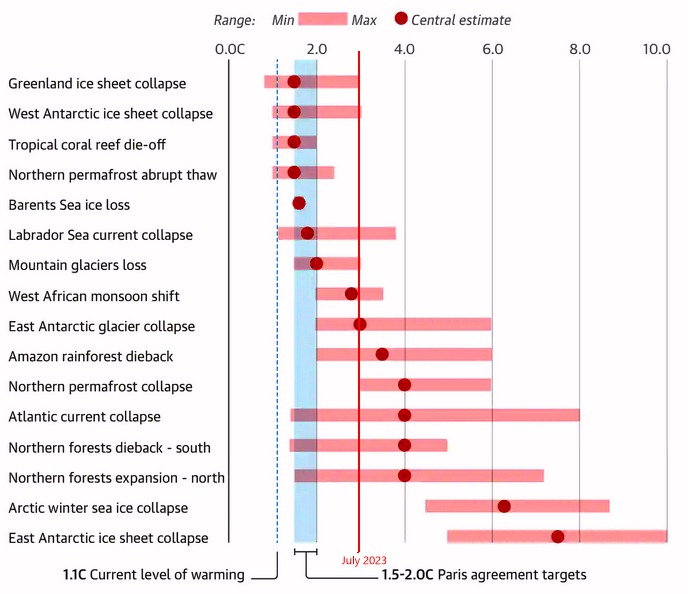
Tipping points are Critical Milestones that directly impact the rate of acceleration in climate change by multiplying the number and intensity of feedback loops.
Tipping Points

Push a glass toward the edge of a table and eventually it will fall off on its own. No matter how slowly or meticulously you push… no matter how you weight or fill the glass, it will reach a tipping point and fall off before being pushed completely off the table. No matter whether you believe the glass is half-empty or half-full, when the tipping point is reached it will plummet out-of-control to its end. This is science not fate, faith, nor belief. Human induced climate change has resulted in environmental tipping points being breached.

Tipping points, when crossed, trigger self-sustaining feedback loops that are no longer dependent on human activity. Similar to when a domino topples over hitting two more dominoes that in turn fall hitting more dominoes. Thus, the name The Domino Effect. It can also be visualized as The Snowball Effect. A tipping point is like a snowball rolling down a hill growing in mass and velocity (momentum). When a tipping point is crossed, it results in cumulative and reinforced global warming.

By 2024, six (6) of the multiple tipping points show the proverbial snowball is already rolling. The first dominoes have fallen and will continue to knock down more tiles with each escalating step.

  • Mountain Glacier Loss
  • Greenland Ice Sheet Collapse
  • Antarctic Ice Sheet Collapse
  • Collapse of AMOC (Atlantic Meridional Overturning Circulation)
  • Amazon Rainforest Dieback
  • Northern Permafrost Collapse

Crossing even a single tipping point is alarming. For instance, crossing the tipping point for ‘mountain glacier loss‘ has immediate consequences: millions of people in Europe will be impacted by the lack of fresh water. Billions of people that live along coasts will be impacted by the saline infiltration and eventually by the submerging of their property. In September of 2022, UNESCO reported accelerated melting of glaciers in World Heritage sites, with glaciers in a third of sites set to disappear by 2050. In September of 2023, the GLAMOS glacier monitoring center found 10% of Swiss glaciers had disappeared in the last 2 years. They do not expect any Swiss glaciers will be left by 2050 no matter what actions are taken. If extreme measures are taken, they anticipate we may be able to save some polar glaciers.

This in and of itself should be alarming; however, it gets worse. Tipping points are parts of feedback loop systems. The ice-albedo feedback loop is an expression of the ability of surfaces to reflect sunlight (heat from the sun). Any loss of ice over a darker surface means the surface will absorb more heat and reflect less heat. This process makes the Earth warmer causing more loss of ice, which in turn causes more warming of the Earth. So, yes, the mountain ice tipping point is quite alarming for both its immediate impact as well as its self-sustaining growth to global warming; but wait, it gets more alarming. The increasing temperatures due to crossing a tipping point cause other tipping points to be toppled (The Domino Effect).
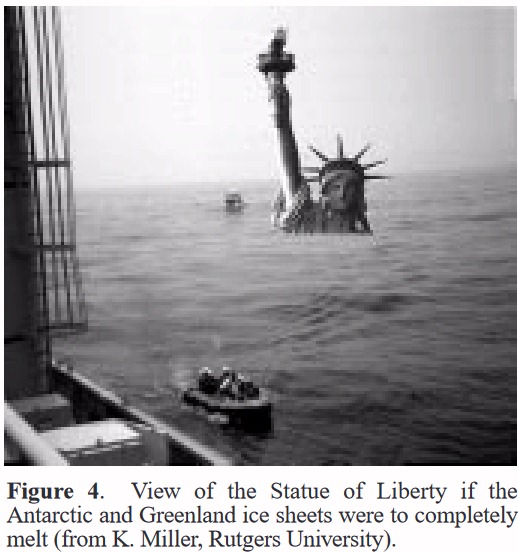
Long run sea level rise New Jersey Coast

By the Autumn of 2023, it had become evident the West Antarctic and Greenland ice sheets will completely melt. The process is irreversible and inevitable. The cool water from the melting ice at the poles is being drawn toward the center of the Earth and getting warmed to record high temperatures. The warm, moist air is circulating and moving over land. These changes in climate systems will cause other areas to experience unprecedented drought. We expect sea level rise will total about 270 feet over the next several millennia. It is episodic, and in the fast bits it can go up 3 feet every twenty years for five hundred years. The melting Arctic and Antarctic have multiple feedback loops including: enhanced oceanic heating and ice-albedo, Planck feedback, lapse-rate feedback, and cloud feedback.
— from Toppled Tipping Points: The Domino Effect / Brouse and Mukherjee (2023)

In 2023, we wrote about having crossed tipping points in the paper, “Climate Change: How Long Is ‘Ever’?“. When we wrote the Tunnel Under Thesis in 1995, we forecast crossing these tipping points would not happen for centuries. We underestimated Man’s ignorance and arrogance. Fossil fuel consumption and greenhouse gas emissions have continued to set record highs. Humans have caused chain-reactions resulting in toppled tipping points, feedback loops, and The Domino Effect.

Events we thought would not happen in our lifetimes are happening now. My last resort emergency plan was to escape to Canada. This summer that plan literally went up in smoke. “Beginning in March 2023, and with increased intensity starting in June, Canada has been affected by an ongoing, record-setting series of wildfires.” — Wikipedia

All of my life I have located my office and bedrooms in the uppermost southern exposure (preferably in the tree canopy.) I love sunlight, elevation, trees, fresh air, and wildlife. It is becoming ever more obvious my dreamlife is coming to an end, and I will be forced to tunnel under. For those forward thinkers, think about your poop. Pumping sewage above ground level will be a major problem at all times. In addition, the inability to pump flood water will become deadly during extreme weather events. In July of 2020 NPR reported, “The remnants of Hurricane Ida dropped unprecedented rainfall on several eastern states, killing dozens of people. Eleven of them were Queens residents who died when their basement apartments flooded.” In August of 2022 CNN reported, “Seoul has vowed to move some of the city’s poorest families out of underground and semi-subterranean homes after 13 people were killed in flooding caused by record rainfall this week, sparking public horror and calls for government accountability.” Drowning in your own poop may result for those unprepared.

There will be enough ice melt, water redistribution, and extreme weather events to raise sea levels as much as 270 feet.  Sidd reiterated, “That 270 feet will take a long time. I would be more careful about the violent rain than the ice melt.”

“For any remaining humans, fresh air, water, food, and sunlight will all be problematic; however, your most severe concern will likely be security. Those with supplies will be at high risk of being raped and looted. Good luck!”
— from Climate Change: The End of Times / Daniel Brouse and Sidd Mukherjee (2023)

What Can I Do?
There are plenty of things you can do to help save the planet. Stop using fossil fuels. Consume less. Love more. Here is a list of additional actions you can take.
From the album: The Echoes of Earth’s Wrath:
A Musical Journey Through Mythical Metaphors on Human-Induced Climate Change

A song about The Human Induced Climate Change Experiment

bookmark_borderHard to Deny

LYRICS
The air pollution is fogging up the sky
Hard to deny
The ocean’s rising forever nigh
Hard to deny

Perpetuate the lie
Propagate the con
And the band played on
You’re in the middle
With Nero on fiddle
And the band played on

For sure glaciers going bye-bye
Hard to deny
Wildfires burn high, high, high
Hard to deny

Perpetuate the lie
Propagate the con
And the band played on
You’re in the middle
With Nero on fiddle
And the band played on

Our reservoir ran dry
Hard to deny
A flood of mud up to the eye / I
Hard to deny

Perpetuate the lie
Propagate the con
And the band played on
You’re in the middle
With Nero on fiddle
And the band played on

Chords: A/7 / D E A / C G / G A; Part II @ 108 BPM
Instrumentation: Vocals, Acoustic Guitar, Electric Guitar, Keyboards (Korg PS60, Casio WK-500, Korg N364, MiniNova, MicroKorg)

The song portrays a poignant commentary on the devastating impacts of climate change with a reference to Nero, the Roman emperor famously associated with fiddling while Rome burned. The lyrics emphasize the visible consequences of environmental degradation, such as air pollution and rising oceans, and draw parallels to historical denial and inaction. The repeated refrain, “And the band played on,” suggests a metaphorical continuation of frivolous activities despite the impending crisis, highlighting the negligence and perpetuation of misinformation. The imagery of glaciers melting, wildfires raging, and reservoirs running dry vividly captures the urgency and severity of the climate crisis, making it “hard to deny.” Overall, the song serves as a powerful call to acknowledge the environmental challenges and take meaningful action.

Climate fools that continue to deny and lie.  Humans will have difficulty adapting to climate change.  In 2023, I wrote the paper, “Climate Change: How Long Is ‘Ever’?“. When we wrote the referenced Tunnel Under Thesis (1995), we forecast these extreme climate events would not happen for centuries. We underestimated Man’s ignorance and arrogance. Fossil fuel consumption and greenhouse gas emissions have continued to set record highs. Humans have caused chain-reactions resulting in domino-effects, snowball effects, and feedback loops.  Events we thought would not happen in our lifetimes are happening now. The facts are hard to deny.

From the album: The Echoes of Earth’s Wrath:
A Musical Journey Through Mythical Metaphors on Human-Induced Climate Change

What you can do today. How to save the planet.

A song about The Human Induced Climate Change Experiment

bookmark_borderWarrior Saint (Columba)

LYRICS
Yes, sir
Sir Vent
I went….

Oh, how quaint
Warrior saint
Left Ireland
For Scotland
Confess:
The Battle of Cúl Dreimhne
Kill dreams
They said
Three thousand dead
Go ahead
Rabble-rouser
Warrior saint
Oh how quaint
Rabble-rouser
Can raise the dead
Go right ahead

What the hell
Expel
Malignant spirits
Never feared it
Beyond the norm
Calm the storm
Bring back the dream
Know what I mean?
At least
Subdue the wild beast
Unleash
The love
Reign down
From above

Chords: A D A / E7 D A / A D A G A
Instrumentation: Vocals, Acoustic Guitar, Electric Guitar, Keyboards (Yamaha PSR740, Korg PS60, MicroKorg)

A song about: St. Columba
Cineal Conaill, the Tyrconell branch of Niall of the Nine Hostages (7 December 521 – 9 June 597)

In Ireland, the saint is commonly known as Colmcille. Colmcille is one of the three patron saints of Ireland, after Patrick and Brigid of Kildare.

Columba is historically revered as a warrior saint and was often invoked for victory in battle. He left Ireland for Scotland not as a missionary but as an act of self-imposed penance for a bloody mess he had caused at home.

The Battle of Cúl Dreimhne
The Battle of Cúl Dreimhne: sometime around 560, the Irish abbot and missionary Saint Columba became involved in a quarrel with Saint Finnian of Movilla Abbey over a psalter. Columba copied the manuscript at the scriptorium under Saint Finnian, intending to keep the copy. Saint Finnian disputed his right to keep the copy. Thus, this dispute was about the ownership of the copy (whether it belonged to Saint Columba because he copied it or whether it belonged to Saint Finnian because he owned the original). King Diarmait mac Cerbaill gave the judgement, “To every cow belongs her calf, therefore to every book belongs its copy.”

Columba disagreed with King Diarmait’s ruling against him and reportedly instigated a successful rebellion of the Uí Néill clan against the King. The battle was claimed to have caused around 3,000 casualties.

St. Columba and the Isle of Iona
As a self-imposed penance, Columba settled on the isle of Iona. In 563 AD, St. Columba arrived on its white sandy beaches with 12 followers, built his first Celtic church and established a monastic community. The Isle of Iona is three miles long by one mile wide, but has had an influence out of all proportion to its size on the establishment of Christianity in Scotland, England and throughout mainland Europe. Full of remorse for his actions and the deaths he had ultimately caused, he settled on Iona as the first place he found from where he couldn’t see his native Ireland. One of the features on the island is even called “The Hill with its back to Ireland”.

What miracles did St Columba perform? (Book Two of his Miraculous Powers)
In the second book, Columba performs various miracles such as healing people with diseases, expelling malignant spirits, subduing wild beasts, calming storms, and even returning the dead to life.

bookmark_borderOn the Surface

LYRICS
Down here on the surface
Accompanied by your smiling face
Come hear of our service
Take us to our place in space
Fare is fair
Become aware
Of their
Fair is fare
More aware
Of there

Round, here is the surface
Occupied by the human race

Down here on the surface
Accompanied by your smiling face
Come hear of our service
Take us to our place in space
Fare is fair
Become aware
Of their
Fair is fare
More aware
Of there

Let love to our surface
Accompanied by our smiling face

Down here on the surface
Accompanied by your smiling face
Come hear of our service
Take us to our place in space
Fare is fair
Become aware
Of their
Fair is fare
More aware
Of there

Chords: C#m7 E / G A E / C D E
Instrumentation: Vocals, Guitar, Loop Pedal, Keyboards (Casio WK-500, Korg N364, MiniNova)
Written and recorded live to a digital 1-track

bookmark_borderFlipping

LYRICS
Bottom’s on top
What did they say
Flipping won’t stop
It’s the new way
When I get to The End
Will I recognize the start
Feel as the wounds mend
With a complete change of heart

Bottom’s on top
What did they say
Flipping won’t stop
It’s the new way
As times get turbulent
Will sadist be jubilant
Foresee to be mercy
With the time their lent?

Bottom’s on top
What did they say
Flipping won’t stop
It’s the new way
Do I die and rise above
Or sink to the depths of hell
Become one with the rhythm of love
If it turns out well

Chords: A G / D C A
Instrumentation: Vocals, Guitar, Loop Pedal, Keyboards (Casio WK-500, Korg N364, MiniNova)
Written and recorded live to a digital 1-track

bookmark_border3 Crosses

LYRICS
3 crosses up on Calvary
Yet only 1 comes to memory?
All 3 going to meet their maker
The life giver… the life taker
Easy come
Easy go
All in sum/some
Ego

Poet, philosopher, and priest
All will die to say the least
All 3 going to meet their maker
The life giver… the life taker
Easy come
Easy go
All in sum/some
Ego

When the ship is going down
Doesn’t matter which deck you’re on
We all go to meet our maker
The life giver… the life taker
Easy come
Easy go
All in sum/some
Ego

Bridge: A Bb D / A E A
Chords: D A E / C E C A C E A
Instrumentation: Vocals, Guitar, Loop Pedal, Keyboards
Written and recorded live to a digital 1-track

bookmark_borderDoes One Good

LYRICS
Do you find it heart warming
when the people are charming
it does one good
As it should
Freed my freewill
… still…
It’s come to this
Granted each and every wish
Now server
what shall I do?

Do you find it alarming
When the people are harming
Not as one should
For the good
Freed my freewill
… still…
It’s come to this
Granted each and every wish
Now server
what shall I do?

Riff: c d e(b) d c
Chords: C Cm / Cm G G Cm / G F E / C D G; 117 BPM
Instrumentation: Vocals, Keyboards
Written and recorded live to a digital 1-track

bookmark_borderThe Knights

LYRICS
The knights mount up
Their colors blowing in the wind
Beast upon beast
Riding into The End
To write the final chapter
Final verse

The nights lit up
The colors glowing from what’s been
Bombardment meant
Bringing on The End
To write the final chapter
Final verse

They can’t give up
Their colors running with the blood
Belly of the beast
Always wins in The End
To write the final chapter
Final verse

Chords: Dm Bb / Dm Eb Em Bb Dm; 120 BPM
Instrumentation: Vocals, Keyboards
Written and recorded live to a digital 1-track

Also: Rawhide Underwear
Instrumentals: This Is Next

bookmark_borderStepped in It

LYRICS
Did you hear that sound
Underfoot
Uh oh! Must’ve stepped in it
Hate to look and see what’s found
Uh oh! Hate stepping in shhhhh…
Wait!
Better hold my tongue
’till my nose gets done
And that last step is undone
Yeah, the misdone is undone
So there’s no misstep regret
Noooo… no need to fret

Chords: Em / F Em / Dm Em; 160 BPM
Instrumentation: Vocals, Keyboards, Synthesizers
Written and recorded live

Canine Incisors Sessions

Also: Rawhide Underwear and Knew Normal
Instrumentals: This Is Next