bookmark_borderBetween the Lines

Through the blur
Are you sure?
[Break]

[Verse 1]
Have you seen between the lines
The coming of the times
When we care to find kind

[Instrumental, Guitar, Drum Fills]

[Verse 2]
Have you read between the lines
Do you find it’s a fine line
Balancing blind

[Chorus]
Tip-toeing on the precipice
Tap dancing in a mine field
A recipe for disaster
Or will our hunger yield?

[Instrumental, Hammond B3]

[Bridge]
Will we, “chose the high road”
Or will we go low
Will we accept our load
Or the future blow
Blow our lines
Blow our times

[Instrumental, Saxophone]

[Break]
Through the blur
Are you sure?
[Break]

[Verse 3]
Have you seen beyond the lines
Past the front…
The crime of all times

[Instrumental, Shakers, Rattles, Drum Fills]

[Verse 4]
Have you been into the lines
As the hunt
[Chorus]
Tip-toeing on the precipice
Tap dancing in a mine field
A recipe for disaster
Or will our hunger yield?

[Instrumental, Piano, Trumpet]

[Outro]
Will we choose the high road
Or will we go low
Will we accept our load
Or the future blow
Blow our lines
Blow our times

[End]

* Our climate model uses chaos theory in an attempt to adequately account for humans and forecasts a global average temperature increase of 9 degrees Celsius above pre-industrial levels. Everybody has the responsibility not to pollute. There are plenty of things you can do to help save the planet. Stop using fossil fuels. Consume less. Love more. Here is a list of additional actions you can take.

by The Beatless Sense Mongers

A song about The Human Induced Climate Change Experiment

bookmark_borderMirror Cracked

[Intro]
Under a hex…
Have we been placed under a hex?
[Break]
Perplexed
[Break]
What next?

[Instrumental, Guitar Solo, Drum Fills, Cymbal Crash]

[Bridge]
Cut the deck
Dealt the cards
That’s our hand
Do we understand?

[Verse]
We wrote the rules
Then, broke ’em
We broke toward cruel
And, chocked ’em

[Break]
Have we been placed under a hex?
[Break]
Perplexed
[Break]
What next?

[Chorus]
Oh, what a shame
No one to blame
In the mirror, fear Her
Imagine Her image
Mother Nature
Mirror cracked
[Break]
Human attack
[Break]
Mirror cracked, She took it back

[Instrumental, Hammond B3 Solo, Guitar, Drum Fills]

[Break]
Have we been placed under a hex?
Perplexed
[Break]
What next?
[Break]
Mirror cracked
[Break]
She took it back

[Instrumental]

[Verse 2]
Our disease
If you please, Her cure
We ignore
She’ll endure
Her future

[Break]
Have we been placed under a hex?
[Break]
Perplexed
[Break]
What next?

[Chorus]
Oh, what a shame
No one to blame
In the mirror, fear Her
Imagine Her image
Mother Nature
Mirror cracked
[Break]
Human attack
[Break]
Mirror cracked, She took it back

[Outro]
Perplexed hex
What next?
Mirror cracked
She took it back

[End]

* Our climate model uses chaos theory in an attempt to adequately account for humans and forecasts a global average temperature increase of 9 degrees Celsius above pre-industrial levels. Everybody has the responsibility not to pollute. There are plenty of things you can do to help save the planet. Stop using fossil fuels. Consume less. Love more. Here is a list of additional actions you can take.

by The Beatless Sense Mongers

A song about The Human Induced Climate Change Experiment

bookmark_borderCan Ya, Kenya?

[intro]
Off the rails
Rain in pails
[Break]
[Instrumental, Drum Fills, Percussion]

[Verse 1]
The rain remains and peaks for weeks
Devastating floods into slides of mud
Exacerbated, devastated
Shouldn’t have waited

[Chorus]
If you dam bursts open many years too soon
Water surging, tunneling under
If you train comes of the tracks, the facts
Western life styles, is it any wonder?
[Break]
Dash!
[Break]
Flash
[Break]
Floods

[Instrumental, Native Drums]

[Bridge]
Our train is going off the tracks
Off the rails
Too late for take-backs
Crying fails

[Instrumental, Vibes Solo]

[Verse 2]
The rain won’t drain… strains, and leaks
(Eventually) swept the line away
(Grappling) with weeks of heavy rainfall
Time to heed nature’s call

[Chorus]
If you dam bursts open many years too soon
Water surging, tunneling under
If you train comes of the tracks, the facts
Western life styles, is it any wonder?
[Break]
Dash!
[Break]
Flash
[Break]
Floods

[Instrumental, Native Drums]

[Bridge]
Our train is going off the tracks
Off the rails
Too late for take-backs
Crying fails

[Instrumental, Vibes Solo]

[Verse 3]
So, can ya, Kenya?
Forget thrive, can ya survive
Can ya, Kenya, arrive alive
Prepare to dive (Dive! Dive)!

[Chorus]
If you dam bursts open many years too soon
Water surging, tunneling under
If you train comes of the tracks, the facts
Western life styles, is it any wonder?
[Break]
Dash!
[Break]
Flash
[Break]
Floods

[Instrumental, Native Drums]

[Outro]
Our train is going off the tracks
Off the rails
Too late for take-backs
Crying fails

[End]

A SCIENCE LESSON
(April 2024) At least 71 fatalities have been confirmed, with 110 individuals hospitalized following devastating floods near the town of Mai Mahiu in Kenya’s north-western Nakuru county, as confirmed by Nakuru governor Susan Kihika to CNN on Monday.

Kihika attributed the exacerbated flooding to the bursting of a dam. However, locals and first responders informed CNN that the disaster was caused by water surging through a tunnel beneath a railway bridge with a blocked culvert.

Kenya has been grappling with weeks of heavy rainfall and ensuing flash floods.

Flash floods and a landslide in central Kenya resulted in a minimum of 45 casualties and over 110 injuries on Monday, as floodwaters swept away houses and vehicles in the town of Mai Mahiu, according to government reports. Initially, police attributed the flooding to a burst dam, but the Ministry of Water later clarified that it was caused by a river tunnel under a railway embankment becoming obstructed with debris.

“The water (eventually) swept the railway line and started moving downstream with very high speed and velocity, causing destruction of property and loss of lives,” stated the ministry, a narrative corroborated by two local residents.

“Though 45 fatalities have already been recovered along the path of the flash floods and the landslide, search, rescue, and recovery efforts are ongoing,” remarked interior minister Kithure Kindiki in a statement.
Footage depicted a significant portion of rail track, embankment, and trees being swept downhill. Even as floodwaters receded hours after the rain ceased, local residents were seen extracting motorcycles and household belongings from the mud.

by The Beatless Sense Mongers

A song about The Human Induced Climate Change Experiment

bookmark_borderDubai Sky

Dubai sky,
Why?
[Break]
[Instrumental, Oud, Guitar Solo, Lute, Oboe, Tambourine]

[Verse 1]
More rain in a day than a year
What can I say, living in fear
The sky opened, the heavens fell
Forecast for the future, doesn’t bode well

[Break]
The pain of desert rain
[Break]

[Chorus]
Land so dry can’t even cry
No so wet you’re gonnna regret
What use to fry won’t stay dry
Times are changing, climates rearranging
[Break]
Hail!
[Break]
The Prince of Fail

[Instrumental, Oud Solo,

[Break]
Dubai sky,
Why?
[Break]
[Instrumental, Oud, Guitar Solo, Lute, Oboe, Tambourine]

[Verse 2]
As the rain pounds out the beat
Water fills the street
The water is pouring down
No dry ground found…
It’s flooding all around

[Break]
The pain of desert rain
[Break]

[Chorus]
Land so dry can’t even cry
No so wet you’re gonnna regret
What use to fry won’t stay dry
Times are changing, climates rearranging
[Break]
Hail!
[Break]
The Prince of Fail
[Instrumental, Oud Solo, Lute, Oboe, Tambourine]

[Break]
Dubai sky,
Why?
[Break]
[Instrumental, Oud, Guitar Solo, Lute, Oboe, Tambourine]

[Verse 3]
The sands of time are drenched
Desert no more, ocean floor
Parched passed, thirst quenched
What was sure is now shore
Pour, pour, pour

[Break]
The pain of desert rain
[Break]

[Chorus]
Land so dry can’t even cry
No so wet you’re gonnna regret
What use to fry won’t stay dry
Times are changing, climates rearranging

[Outro]
Hail!
The Prince of Fail
[End]

A SCIENCE LESSON
On April 16, 2024, the United Arab Emirates (UAE) experienced an unprecedented storm that resulted in the heaviest rainfall ever recorded in the desert nation. Heavy thunderstorms lashed the UAE, leading to extensive flooding of roads and Dubai’s international airport. The rainfall, which began late Monday, saturated the sands and roadways of Dubai with approximately 20 millimeters (0.79 inches) of rain, according to meteorological data collected at Dubai International Airport. The intensity of the storms intensified on Tuesday, dumping even more rain and hail onto the overwhelmed city.

By the end of Tuesday, Dubai had received more than 142 millimeters (5.59 inches) of rainfall within a 24-hour period. This amount far exceeds the average annual rainfall of 94.7 millimeters (3.73 inches) at Dubai International Airport, which is the world’s busiest airport for international travel and a hub for the long-haul carrier Emirates.

The state-run WAM news agency described the rainfall as “a historic weather event,” surpassing any previous records since the start of data collection in 1949.

The sudden deluge highlighted the vulnerability of Dubai and the UAE to extreme weather events, prompting concerns about climate resilience and urban planning. As one expert on climate resilience and urban environments noted, the unprecedented rainfall underscores the need for the UAE to reassess its approach to infrastructure and emergency preparedness.

The heavy rainfall also had significant impacts on businesses and individuals in the region. For example, Somia Anwar, co-owner of Bookends, a used books seller, experienced flooding in her basement-level shop, resulting in the loss of thousands of books. The incident highlighted the need for improved waterproofing measures and insurance coverage against such events.

Scientists attributed the severity of the rainfall to a combination of factors, including the warming of the Pacific Ocean associated with the El Niño pattern and human-caused climate change. While the precise contribution of climate change to the extreme weather event is difficult to quantify, the warming climate is increasingly making such events more severe and frequent.

With the UAE hosting the COP28 climate summit last year, awareness has grown about climate change dangers. The country has an adaptation plan, and Dubai was the first to apply for a UN scheme to become a “City Resilience Hub” in 2020.

UAE capital Abu Dhabi weathered the latest storm better than the larger glitzy trading and financial hub of Dubai. The futuristic city is the UAE’s biggest by population and the location of the world’s second busiest airport, which was forced to cancel more than 1,000 flights, leaving passengers stranded for days.

“The infrastructure was built before these weather changes happened,” said an insurance executive, who said it was too early to estimate overall damage costs. “In certain instances, the quality of construction by the developers was not good enough.”

Sprawling Dubai was especially vulnerable to flooding because it was relatively flat, covered in impermeable concrete and asphalt surfaces, and its desert sands lacked the ability to grow vegetation that could absorb floodwater, said a Dubai-based town planning specialist.

Following the floods, Sheikh Hamdan bin Mohammed al-Maktoum, the crown prince, approved a Dh66bn upgrade to the drain network © AP

Underlying those drainage problems is a groundwater table already oversaturated by irrigation and pipe leakage, a common issue in the Gulf. “The cities are really floating,” said Hrvoje Cindrić, Middle East planning lead at international engineering firm Buro Happold.

When Dubai floods, he added, “the water has got nowhere to go”.

Dubai officials over the years have considered comprehensive drainage systems but carried out limited works because of the high costs involved versus the perceived relatively low risk.

Upgrades to the network have included a 10km drainage tunnel under southern Dubai, opened ahead of Expo 2020, to serve the huge exhibition facilities, which was also the site of the UN climate summit, and the airport.

“You wouldn’t engineer for the worst possible scenario . . . it’s prohibitively expensive,” said Huda Shaka, a chartered urban planner based in Dubai. But following the storm, “it’s not just a theoretical scenario.

In the wake of the floods, Sheikh Hamdan bin Mohammed al-Maktoum, the crown prince, approved a Dh66bn upgrade to the drain network. Tenders were first issued last year for the project, though bids were not received until February.

The announcement came after the UAE president Sheikh Mohammed bin Zayed al-Nahyan ordered officials to monitor the nation’s infrastructure and “limit the damage caused,” according to the state news agency.

Town planning experts say Dubai could adopt “sponge city” principles, making detailed flooding plans and allotting areas with permeable surfaces for better drainage. Given the damage sustained by many buildings, “there may be a need for tougher building codes,” said a former Emirati official.

“Now the cost of mitigating [extreme weather] becomes not unreasonable,” said urban planner Shaka, adding: “sometimes it takes an extreme event for action to happen.”
by The Beatless Sense Mongers

A song about The Human Induced Climate Change Experiment

bookmark_borderTwisted Twister


[Intro: Breaking News]
At least 17 tornadoes touch down in Oklahoma
Mama got to know a tornado
[Instrumental, Guitar Solo, Drums Fills]

[Verse 1]
Twisted twisters
Menacing splinters
Splatter matter
Spread the dread
Spread the dead

[Bridge]
Sounds like a freight train is coming
Better start off running

[Chorus]
Mister, stop the twister
Cars can fly into the sky
Twisted twisters blister
Baby dies, mother cries

[Instrumental, Saxophone Solo, Drum Fills]

[Break]
Breaking News
[Break]
Take cover, lover

[Verse 2]
Twister, can’t resist her
Oh, my, my, I try
She’s coming down (down, down)
Spinning ’round (and round)
No storm cellar found

[Bridge]
Sounds like a freight train is coming
Better start off running

[Chorus]
Mister, stop the twister
Cars can fly into the sky
Twisted twisters blister
Baby dies, mother cries

[Instrumental, Saxophone Solo, Drum Fills]

[Break]
Breaking News
[Break]
Take cover, lover

[Verse 2]
Twisted twister insists her
Get her in the cellar
Tornado gonna blow (Blow, blow, blow)
Twist, fist, pound us down
No storm cellar found

[Bridge]
Sounds like a freight train is coming
Better start off running

[Chorus]
Mister, stop the twister
Cars can fly into the sky
Twisted twisters blister
Baby dies, mother cries

[End]

A SCIENCE LESSON
During a tornado outbreak on April 27, 2024, at least 17 tornadoes touched down in Oklahoma. According to the Oklahoma Department of Emergency Management, hospitals across the state reported a total of 100 injuries attributed to the storms. Of these injuries, 25 individuals sustained cuts or piercings, 30 were due to falls, 16 were caused by being struck by debris or falling against it, 17 were related to transportation incidents, and 12 were categorized as unspecified injuries.

The relationship between climate change and tornado frequency and intensity is an area of active research in the field of atmospheric science. While tornadoes are complex phenomena influenced by multiple factors, including temperature, humidity, wind patterns, and atmospheric instability, scientists are investigating how climate change may impact tornado activity. Here’s what is currently known:

  1. Tornado Frequency: There is limited evidence to suggest that climate change has influenced the overall frequency of tornadoes. Historical tornado records show considerable year-to-year variability in tornado occurrence, making it difficult to detect long-term trends. However, some studies suggest that the number of days with multiple tornadoes (outbreaks) may be increasing, possibly due to changes in atmospheric conditions favorable for tornado formation.
  2. Tornado Intensity: The relationship between climate change and tornado intensity is less clear. Tornado intensity is typically measured using the Enhanced Fujita (EF) scale, which assesses damage to structures caused by tornadoes. While some studies suggest that climate change may lead to a slight increase in the frequency of stronger tornadoes (EF3 and above), the evidence is not yet conclusive.
  3. Environmental Factors: Climate change can influence the environmental conditions that contribute to tornado formation and development. For example, warmer temperatures and increased atmospheric moisture may enhance instability and convective energy, potentially leading to more favorable conditions for severe thunderstorms and tornadoes. However, other factors such as wind shear and atmospheric dynamics also play crucial roles in tornado formation, and their response to climate change is more uncertain.
  4. Regional Variability: The impact of climate change on tornado activity may vary regionally. Different parts of the world experience different climatic conditions and atmospheric dynamics, leading to varied responses to climate change. For example, while some regions may experience an increase in tornado activity, others may see little to no change or even a decrease.

Overall, while there is ongoing research on the potential links between climate change and tornado activity, significant uncertainties remain. Tornadoes are inherently complex and variable phenomena influenced by a multitude of factors, making it challenging to attribute specific changes to climate change alone. Continued research and improved understanding of tornado dynamics and their relationship to climate variability and change are needed to better assess future risks and impacts.

by The Beatless Sense Mongers

A song about The Human Induced Climate Change Experiment

bookmark_borderYour Earth

Your Earth. Your birth

The piece about love (The peace about love)

[Verse 1]
What about peace?
What about love?
What about understanding…
The piece about love (The peace about love)

[Bridge]
How deep inside do you gotta go
Inside your hide… before you know, you know?
[Break]
You know

[Chorus]
You’ve been given this lease on life
(Your birth on Earth)
So, for what it’s worth
(Avoid rife bringing on strife)
Better to do than die
Why, on Earth, forfeit your birth

[Instrumental, Guitar Solo, Saxophone Solo, Drum Fills]

[Bridge]
How deep inside do you gotta go
Inside your hide… before you know, you know?
[Break]
You know

[Chorus]
You’ve been given this lease on life
(Your birth on Earth)
So, for what it’s worth
(Avoid rife bringing on strife)
Better to do than die
Why, on Earth, forfeit your birth

by The Beatless Sense Mongers

From the Album
Love Love: Embracing Love’s Power to Save the World

bookmark_borderThe Here and Now

Here, hear, here

Now

[Verse 1]
What I like about here
Is now
In case I’m not clear to hear: now
[Break]
The here and now
[Break]
Hear
[Break]
Now

[Bridge]
A picture perfect opportunity
Is looking at you, and looking at me
It’s obvious for all to seeeeee
[Break]
The here and now

[Chorus]
Seize the moment
For biodiversity
Make the movement
For more than me, me, me
Give the gods some “wow”
In the here and now

[Break]
Hear?
[Break]

[Verse 2]
Have no fear!
Cheer for the now and here
There is no “mere”
In the hear, and now!
[Bridge]
Bring it in, bring it near
On the prowl in the here and now
[Break]
Hear
[Break]
Now

[Bridge]
A picture perfect opportunity
Is looking at you, and looking at me
It’s obvious for all to seeeeee
[Break]
The here and now

[Chorus]
Seize the moment
For biodiversity
Make the movement
For more than me, me, me
Give the gods some “wow”
In the here and now

[Instrumental]

[Break]
The here and now
[Break]
Hear
[Break]
Now

[Bridge]
A picture perfect opportunity
Is looking at you, and looking at me
It’s obvious for all to seeeeee
[Break]
The here and now

[Chorus]
Seize the moment
For biodiversity
Make the movement
For more than me, me, me
Give the gods some “wow”
In the here and now

[Outro]
Yes, I hear here
[Break]
Now… wow
[End]

by The Beatless Sense Mongers

bookmark_borderSomething

Surprise!
[Break]
Rise
[Break]

[Verse 1]
I heard there’s something we can do
For instance: make a difference
Absolutely nothing hampering you
So, come on! Make a difference

[Bridge]
Little to no doubt
Our time is running out
Grab ’em by the balls

[Chorus]
Ride, cowboy, ride
You can save the day
Instead of crying a tide
Start to find your way
[Break]
Rise!
[Break]
Surprise!
[Break]
Rise

[Instrumental, Hammond B3 Organ, Guitar Solo]

[Verse 2]
You’ve heard there’s something we can do
For reference: make a difference
The word is, “We can pull through!”
So, come on! Make a difference

[Bridge]
Little to no doubt
Our time is running out
Grab ’em by the balls

[Chorus]
Ride, cowboy, ride
You can save the day
Instead of crying a tide
Start to find your way
[Break]
Rise!
[Break]
Surprise!
[Break]
Rise

[Break]
Ride, Cowboy
[Break]
Ride!

[Verse 3]
We know there’s plenty we can do
Our preference: make a difference
The world needs us to pull through
So, come on! Make a difference

[Bridge]
Little to no doubt
Our time is running out
Grab ’em by the balls

[Chorus]
Ride, cowboy, ride
You can save the day
Instead of crying a tide
Start to find your way

Break]
Rise!
[Break]
Ride, cowboy, rise
[Break]
Rise

[Outro]
[Break]
Rise!
[Break]
Ride, cowboy, rise
[Break]
Rise

[End]

by The Beatless Sense Mongers

A song about The Human Induced Climate Change Experiment

bookmark_borderMy Heart is Melting

Hello?
[Break]
Does anybody know?
[Break]
[Instrumental, Hammond B3 Organ]

[Verse 1]
Are the fiercest winters
A thing of the past
Starting to wonder
What ice will last

[Chorus]
My heart is melting
My soul is wanting
For a world with comMEN sense
More open arms. a lot less fence

[Bridge]
Enlighten the dense
Rinse and repeat
While dancing to the beat
[Break]
Sweet
[Break]
Treat

[Instrumental]

[Break]
Hello?
[Break]
Does anybody know?
[Break]

[Verse 2]
Is the Summer’s onslaught
Starting to Spring
The children overwrought
Their parents, depressing

[Chorus]
My heart is melting
My soul is wanting
For a world with comMEN sense
More open arms. a lot less fence

[Outro]
Enlighten the dense
Rinse and repeat
While dancing to the beat
[Break]
Sweet
[Break]
Treat

[Instrumental]

[Break]
Hello?
[Break]
Does anybody know?
[Break]

[Verse 3]
Can we change attitude
More in the future
Whatnot, rude, and lewd
Put out to pasture

[Chorus]
My heart is melting
My soul is wanting
For a world with comMEN sense
More open arms. a lot less fence

[Outro]
Enlighten the dense
Rinse and repeat
While dancing to the beat
[Break]
Sweet
[Break]
Treat

[End]

by The Beatless Sense Mongers

A song about The Human Induced Climate Change Experiment

bookmark_border2024 Albums

New Releases

Omnilogy
Love Love: Embracing Love’s Power to Save the World
The Book Of Daniel: Chapter 12 (The End Of Times)

To Cause A Change: The Philadelphia Experiment

We’re Here… er, a… Were Here

= The Equation

The Reign of Violent Rain

Camelot’s Resurgence

Deep Dive Into Spacetime Music

The Echoes of Earth’s Wrath

bookmark_borderWhirlwind

[Intro]
De, de, de, de, de, de
Da, De, de, de, de, de, de
De, de, de, de, de, de
Da, De, de, de, de, de, de

[Verse 1]
Have you ever thought to try
… more than just get by?

[Bridge 1]
Come on, girl
Give it a whirl
Come on, Man
I bet you can

[Chorus]
If you fall down, get up and do it again
Just break it down, and get back to begin
De, de, de, de, de, de
Maybe you will come to see
De, de, de, de, de, de
How things are meant to be
De, de, de, de, de, de
Then,
Tell a friend
And do it again

[Verse 2]
Ever been of the mind to give
To cherish every moment you live

[Bridge 1]
Come on, girl
Give it a whirl
Come on, Man
I bet you can

[Chorus]
If you fall down, get up and do it again
Just break it down, and get back to begin
De, de, de, de, de, de
Maybe you will come to see
De, de, de, de, de, de
How things are meant to be
De, de, de, de, de, de
Then,
Tell a friend
And do it again

[Bridge 2]
De, de, de, de, de, de
Da, De, de, de, de, de, de
De, de, de, de, de, de
Da, De, de, de, de, de, de

[Verse 3]
Let’s say “what about love”?
Take our spirits and rise above
Rise higher, higher
Hi, hi, hi

[Bridge 1]
Come on, girl
Give it a whirl
Come on, Man
I bet you can

[Chorus]
If you fall down, get up and do it again
Just break it down, and get back to begin
De, de, de, de, de, de
Maybe you will come to see
De, de, de, de, de, de
How things are meant to be
De, de, de, de, de, de
Then,
Tell a friend
And do it again

[Bridge 2]
De, de, de, de, de, de
Da, De, de, de, de, de, de
De, de, de, de, de, de
Da, De, de, de, de, de, de

[Pre-Outro]
Come on, girl
Give it a whirl
Come on, Man
I bet you can
See to be
A, B, C
De, de, de, de, de, de
Da, De, de, de, de, de, de
De, de, de, de, de, de
Da, De, de, de, de, de, de

[Outro]
Come on, girl
Give it a whirl
Come on, girl
Whirl
We’ll win
Whirlwind

[Ending]
[Silence]
[End]

The Beatless Sense Mongers: We’re Here… er, a… Were Here

4D Music: Songs About Science

A song about The Human Induced Climate Change Experiment

bookmark_borderThe Good-times

[Intro]

[Chanting]
The good-times
The good-times
The good-times
… iiiiimes

[Verse 1]
Everyone shout
All about
The good-times
Good times
Everyone shout
The good-times
Good times

[Chorus]
It’s possible that somehow
It won’t get better… than right now
Right now
Everyone chimes:
The good-times
Good times

[Bridge]
Loving on living
Living on loving
Loving living
Living loving

[Verse]
Reminiscence route
What about…
The good-times?
Good times
Everyone shout
All about
The good-times
Good times

[Chorus]
It’s possible that somehow
It won’t get better… than right now
Right now
Everyone chimes:
The good-times
Good times

[Bridge]
Loving on living
Living on loving
Loving living
Living loving

[Break]

[Interlude]

[Verse 3]
In for a bout
Shout it out:
The good-times
Good times.
Everyone shout
All about
The good-times
Good times.

[Chorus]
It’s possible that somehow
It won’t get better… than right now
Right now
Everyone chimes:
The good-times
Good times

[Outro]
Loving on living
Living on loving

[Fade out]
Loving living
Living loving

[Ending]
[Silence]

The Beatless Sense Mongers: We’re Here… Were Here

4D Music: Songs About Science

A song about The Human Induced Climate Change Experiment

bookmark_borderRio Negro

[Verse 1]
Beneath the canopy, where the Rio Negro flows,
Its water dark as night, its secrets no one knows,
Carbon-rich and acidic, like Coca-Cola’s hue,
But in 2023, it recorded lows we never knew.

]Chorus]
Oh, Rio Negro, what tales do you tell?
Of carbon sinks and climate’s swell,
With every drop, a story untold,
In your depths, the truth unfolds.

[Verse 2]
A scientist’s home, where the river bends,
Watching as the drought, its harshness extends,
More carbon discharged, to the ocean it will sink,
But with less rain, it’s a chain that leads to the brink.

[Bridge]
In South American rivers, a study finds,
DOC release, rapid, as rain unwinds,
Small catchments and peatlands, the most sensitive they see,
With every rain event, DOC sets free.

[Chorus]
Oh, Rio Negro, what tales do you tell?
Of carbon sinks and climate’s swell,
With every drop, a story untold,
In your depths, the truth unfolds.

[Verse 3]
Under natural light, in the Rio’s deep embrace,
Rates of photo-oxidation, an exponential race,
The deeper the water, the more carbon’s laid to rest,
In the ocean’s depths, where it may find its final test.

[Interlude]

[Verse 4]
But beyond the Rio, in the Amazon’s expanse,
A record low, and an unusual dance,
Droughts more frequent, the rainforest weeps,
Decarbonization at an exponential creep.

[Bridge]
The AMOC slows, the Amazon falls,
In a tangled dance, their destiny calls,
Carbon cycles disrupted, in nature’s grand scheme,
The collapse hastened, like a recurring dream.

[Chorus]
Oh, Rio Negro, what tales do you tell?
Of carbon sinks and climate’s swell,
With every drop, a story untold,
In your depths, the truth unfolds.

[Outro]
From the heat of Rio to the river’s might,
From drought to deluge, in the day and the night,
The Rio Negro speaks, if only we would hear,
In its ebb and its flow, the message is clear.

ABOUT THE SONG
Rio Negro Climate Change Case Study
What do you know about the Rio Negro as it relates to climate change and carbon sinks? The Rio Negro gets its name from its color. The black water is caused by highly acidic and carbon rich water. One scientist that lives on the river called it similar to Coca-cola. In 2023, the Rio Negro recorded record low levels.

Most of the carbon discharged into the water helps the carbon to eventually sink in the ocean as a literal carbon sink. The lack of rain and drought conditions result in more vegetation dying and contribute to a feedback loop — more plants die from less rain… and there is less rain to wash the excess carbon to the bottom of the ocean… resulting in more global warming… resulting in more dead vegetation.

A study of Dissolved Organic Carbon (DOC) in South American rivers found, “Small and steep catchments hosting organic rich forest soils and peatlands were the most sensitive and showed the highest and fastest DOC release if evaluated on a per unit area basis. Here, rain events caused a rapid exponential increase in DOC release….”

The study Effects of natural light and depth on rates of photo-oxidation of dissolved organic carbon in a major black-water river, the Rio Negro, Brazil found under natural sunlight during the dry seasons rates of complete photo-oxidation and changes in absorbance indices decayed exponentially. The deeper the water the less CO2 emissions created and the more carbon is sequestered at the bottom of the ocean.

The Amazon river was also at record lows during 2023. The drought conditions in the Amazon rain forest are unusual. We are watching the Rio Negro and Amazon Rivers as a case study for the slowing and/or collapse of the AMOC, the die-back of the Amazon, and the carbon cycle.

The carbon sequestration from dissolved organic carbon is only one of the many carbon sinks in the Amazon. It is likely Amazon droughts will become more frequent and intense resulting in decarbonization at an exponential rate. The collapse of the AMOC will hasten the collapse of the Amazon. The collapse of the Amazon will hasten the collapse of the AMOC.

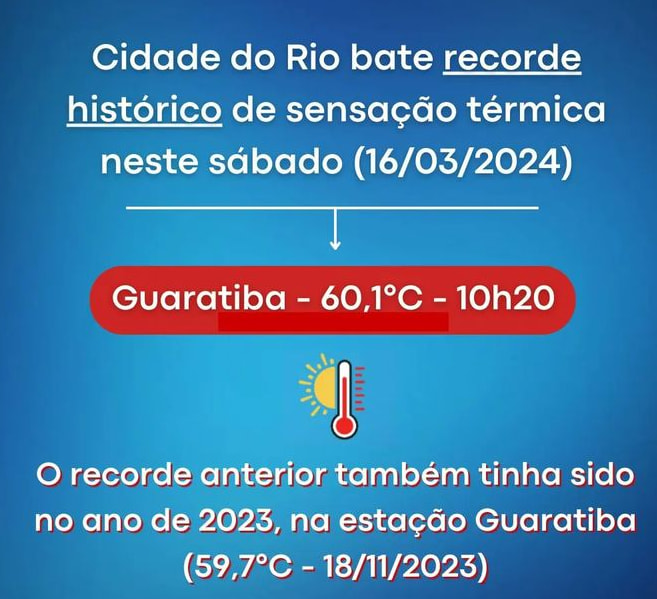
Rio de Janeiro with a wet-bulb temperature reaching 62.3 degrees Celsius (144.1 degrees Fahrenheit)

From March 16 through 18, 2024, Brazil experienced a severe heatwave, setting new records in Rio de Janeiro with a wet-bulb temperature reaching 62.3 degrees Celsius (144.1 degrees Fahrenheit). The wet-bulb temperature reflects the body’s cooling mechanism through sweat evaporation. Higher heat and humidity levels, indicated by the heat index, impede sweat evaporation. A wet-bulb temperature of 35℃ (95℉) at 100% humidity, or 115℉ at 50% humidity, represents the upper limit of safety, beyond which the human body cannot effectively regulate its core temperature through sweat evaporation.

On March 23, an atmospheric river event brought heavy rains to Brazil’s Rio de Janeiro state, resulting in at least nine fatalities, primarily in Petropolis, which bore the brunt of the impact. An astonishing 270 mm (11 inches) of rain fell within a 24-hour period, significantly affecting the region and leading to numerous incidents, including landslides and house collapses.

The Beatless Sense Mongers: We’re Here… er, a… Were Here

4D Music: Songs About Science

A song about The Human Induced Climate Change Experiment

bookmark_borderCan You Stop the Rain?

[Intro]
[Instrumental]
[Verse 1]
Can we stop the rain?
Isn’t it insane?
Drip, drip, destroy
Come back to enjoy

[Chorus]
Please explain
What are we waiting for?
[Choir refrain]
Choir refrain: What are we waiting for?
(What are we waiting for?)

[Bridge]
Well?
Hell!
Well, well, well
La, de, da, la, de, dee
Help us see

[Break]

[Verse 2]
Can we stop the rain?
Hate to complain
Can’t get a grip
Drip, drip, destroy
Please come back to enjoy

[Chorus]
Please explain
What are we waiting for?
[Choir refrain]
Choir refrain: What are we waiting for?
(What are we waiting for?)

[Bridge]
Well?
Hell!
Well, well, well
La, de, da, la, de, dee
Help us see

[Solo]

[Break]

[Bridge]
It’s going to rain
It’s going to pour
Can’t bear the pain
Oh going poor
er, a, ah, ahh, ah, la, la
La, la, la, lo, da, de, da

[Verse 1]
Can we stop the rain?
Isn’t it insane?
Drip, drip, destroy
Come back to enjoy

[Outro]
Please explain
What are we waiting for?
[Choir refrain]
Choir refrain: What are we waiting for?
(What are we waiting for?)

[Ending]

[Silence]

THE SCIENCE LESSON

Most climate change models forecast rising sea levels as the predominant threat of a warming climate to flood risks. Though sea level rise is of great concern, so should be extreme rainfall (violent rain). One type of violent rain is an atmospheric river. Atmospheric rivers are narrow bands of moisture that travel across the lower troposphere. The Journal EOS in the article Atmospheric Rivers Spur High-Tide Floods on U.S. West Coast explains, “Atmospheric rivers, at their peak, can carry as much water through the sky as the Amazon River does on land. They unleash intense winds and heavy rain as they surge across the Pacific Ocean, eventually making landfall on the U.S. West Coast, contributing to many high-tide flooding events.”

Both the sea and air temperatures are rising. Warm air can hold more moisture than cool air. Warmer sea temperatures result in more evaporation. Warmer air can hold more moisture. The increased moisture in the air moves over land causing inland deluges.

The Beatless Sense Mongers: We’re Here… er, a… Were Here

4D Music: Songs About Science

A song about The Human Induced Climate Change Experiment

bookmark_borderIons on the Air

[Intro]
[Harmonica]
Can you feel?
Feel real
Feeeeeeeel
So real
Ideal
I-deal

[Verse 1]
Can you feel
Ions on the air
Negative ions
Positive signs
Charge!

[Bridge]
Ch, ch, ch, charge
Large, large, charge
Ion
Eye on
Ion
Eye on ion
I… on… and, on and on, and on

[Break]

[Verse 2]
Intersection of teleconnection
Clear ear ear
Through the atmosphere, ear, ear
Hear here

[Bridge]
Ch, ch, ch, charge
Large, large, charge
Ion
Eye on
Ion
Eye on ion
I… on… and, on and on, and on

[Verse 3]
Ions on the air
I’m already there
On the air
There

[Solo]

[Break]

[Outro]
Can you feel?
Feel real
Feeeeeeeel
So real
Ideal
I-deal

[Ending]

[Silence]

ABOUT THE SCIENCE
How does rain affect ions?
As raindrops collide, the water molecules break apart into fragments that gain an electrical charge. The heavier and harder the rain, the more negative ions are produced.

Negative ions are tasteless, odourless and invisible molecules that we inhale when we are in environments that contain moving water, like rain. Once the negative ions reach our bloodstream, they are believed to produce biochemical reactions that help to relieve stress, alleviate depression and even boost our energy.

Global warming is caused by an increase in thermal energy in the climate system. The Earth is a climate system. Many subsystems make up our climate. Chaos theory emphasizes the complexity and nonlinearity of dynamic system.

Teleconnections:
Chaos theory recognizes the concept of teleconnections, where seemingly unrelated events in one part of the Earth system influence conditions in another. For instance, changes in sea surface temperatures (linked to ocean dynamics) can affect atmospheric circulation patterns, leading to variations in precipitation and temperature on land.

The Beatless Sense Mongers: We’re Here… er, a… Were Here

4D Music: Songs About Science

A song about The Human Induced Climate Change Experiment