bookmark_borderKnucklehead

Knucklehead

[Intro]
Immigration (damnation)
Stimulation (over saturation)
Devalue (devalue you)

[Verse 1]
Have you heard what’s been said?
… appears there’s only so far
Words can penetrate
A knucklehead
[Chorus]
Their fears so bizarre
Can’t anticipate
Buckle to dread
[Bridge]
Bringing on the fate of hate

[Verse 2]
Are you concerned about the living dead
… appears there’s not that far
Into the heart
Of a knucklehead
[Chorus]
Their fears so bizarre
Love’s no part
Buckle to dread
[Bridge]
Bringing on the fate of hate

[Chorus]
Their fears so bizarre
Love’s no part
Buckle to dread

Bringing on the fate of hate

[Bridge]
I have updated the article to address several of your comments, including the impact of immigration (80% of GDP), the effect of inflation (due to $4 trillion in printed money), and interest rates (considering factors like inflation, tax cuts, tariffs, and lack of immigration).
[Outro]
However, the discussion on millions of unnecessary deaths (related to the COVID-19 response) versus the ‘No Wars’ claim will be reserved for a future paper.

AN ECONOMICS NOTE
This song was inspired by comments to my article on the economics of politics, particularly those from an uneducated, uneducable racist and a bigot. He also is the inspiration behind the hit song “Can You Fight the Tide? (Of Ignorance).”

July 19, 2024
“Perhaps most importantly is the repeated use of the phrase ‘Drill, Baby, Drill’.”

Economic Update:
If Trump wins, great news for the very few people whose primary income comes from government securities interest! Unfortunately, very, very bad news for everyone else.

Tariffs, protectionism, lack of immigration, and nationalism are all detrimental to the economy. Tariffs and protectionist policies can lead to trade wars, higher consumer prices, and disruptions in the supply chain, which can stifle economic growth. Limiting immigration reduces the labor force and can slow down innovation and productivity, as immigrants often contribute significantly to economic dynamism. Nationalism can lead to isolationist policies that hinder international cooperation and trade, further damaging the economy. Over the last several years, approximately 80% of economic growth can be attributed to immigration.

Should Trump win, there is a concern that the U.S. may face economic decline similar to his six personal bankruptcies. His previous administration’s policies on tariffs, immigration restrictions, and nationalist rhetoric have already shown signs of economic strain. Continued implementation of such policies could exacerbate these issues, leading to a weakened economy and reduced global competitiveness for the U.S. It is crucial to adopt inclusive and cooperative economic strategies to foster sustainable growth and stability.

Perhaps most importantly is the repeated use of the phrase ‘Drill, Baby, Drill’. The phrase encapsulates a harmful approach to energy policy that prioritizes fossil fuel extraction over sustainable practices. Climate change, exacerbated by such policies, poses the most severe threat not only to our environment but also to our economy.

In 2023, the U.S. experienced a record number of climate disasters, each exceeding one billion dollars in damages, with a total of 28 separate weather and climate-related events. Some of these individual events cost the U.S. economy hundreds of billions of dollars. The frequency and severity of these events are alarming, reflecting the accelerating pace of climate change.

The economic impact of climate change is expected to be staggering, with projections indicating it could cost the U.S. economy trillions of dollars. The financial burdens arise from various sources, including the destruction of infrastructure, increased healthcare costs due to climate-related illnesses, disruptions to agriculture and food supply, and the need for extensive disaster relief and recovery efforts. One of the primary drivers of the current inflation spike is the rising cost of homeowners insurance due to climate disaster-related claims. Short sellers anticipate that within ten years, 25% of U.S. properties will be uninsurable. These costs will continue to rise unless significant measures are taken to mitigate climate change and transition to a more sustainable energy system.

Moreover, the long-term economic effects of climate change can hinder economic growth, reduce productivity, and increase social inequalities. Proactive investments in renewable energy, climate resilience, and sustainable practices are essential to curtail the financial and environmental impacts of climate change. These measures are crucial to protect both the environment and the economy from the devastating impacts of climate change.

— from Drill, Baby, Drill (Brouse 2024)

The Politics of Climate Change

Regrettably, the United States ranks among the least prepared countries globally, with the highest percentage of climate deniers. Politicians exacerbate the problem by hindering efforts against climate change. The Republican Party dismisses it as a manufactured crisis and plans to increase fossil fuel production. Political extremists asserting that the climate crisis is manufactured employ an ironic term, considering that human manufacturing activities are the primary driver of climate change.

Under President Biden, the United States continues to be the world’s largest producer of oil, including crude oil, natural gas liquids, and other petroleum products. Both political parties have concurred to allocate unlimited emergency funding for climate disasters instead of proactively preventing them. In 2023, the U.S. witnessed a record number of climate disasters exceeding one billion dollars each, totaling 28 separate weather and climate-related events.

In June 2024, the Supreme Court significantly expanded its authority and severely curtailed the Environmental Protection Agency’s (EPA) ability to enforce environmental protection laws. This ruling represents a dramatic shift in the balance of power, undermining decades of regulatory progress aimed at mitigating environmental damage and climate change. The court’s decision essentially nullifies the EPA’s mandate to regulate emissions and enforce compliance with existing environmental standards.

This judicial overreach is viewed by many as an act of arrogance and ignorance, resulting in a scenario where “worst-case” predictions for climate change have become the “best-case” expectations. The ramifications of this decision are dire, prompting a revision of climate models to reflect a much grimmer outlook. The new projections indicate a potential maximum global temperature increase of 9°C within this century, a stark rise from the previously estimated 4°C over the next millennium.

Such an unprecedented increase in global temperatures would push Earth toward a wet-bulb temperature threshold that is incompatible with human life. Wet-bulb temperature, which combines heat and humidity, represents a critical limit beyond which the human body can no longer effectively cool itself through perspiration, leading to potentially fatal heat stress.

* Our climate model uses chaos theory in an attempt to adequately account for humans and forecasts a global average temperature increase of 9 degrees Celsius above pre-industrial levels. Everybody has the responsibility not to pollute. There are plenty of things you can do to help save the planet. Stop using fossil fuels. Consume less. Love more. Here is a list of additional actions you can take.

From the album ‘What’s Left’ by The Beatless Sense Mongers

MegaEpix Enormous

A song about The Human Induced Climate Change Experiment

bookmark_borderThe Thickness

[Intro]
The thickness of the air
Is getting hard to bear
At any rate
Can you endure or tolerate

[Verse 1]
For every degree
In the mercury
Seven percent more humidity

[Chorus]
The thickness of the air
Is getting hard to bear (are you aware?)
At any rate
Can you endure (any more)
Or tolerate (even perspirate)

[Bridge]
Do you know
Will the sweat flow

[Verse 2]
Watch the temperature soar
Can you endure
The water vapor
Man’s great caper

[Chorus]
The thickness of the air
Is getting hard to bear (are you aware?)
At any rate
Can you endure (any more)
Or tolerate (even perspirate)

[Bridge]
Do you know
Will the sweat flow
Do you know
Will the heat grow
Do you know
How to say no
(no, no, no)

[Chorus]
The thickness of the air
Is getting hard to bear (are you aware?)
At any rate
Can you endure (any more)
Or tolerate (even perspirate)

[Outro[
Do you know
How to say no
(no, no, no)

A SCIENCE NOTE
The greatest health risk from climate change to those alive today is the increased moisture content in the air (relative humidity) combined with the increased temperatures. Climate change and rising temperatures significantly increase the humidity in the atmosphere due to the relationship between temperature and the air’s capacity to hold moisture. The Clausius-Clapeyron equation describes this relationship, indicating that for every 1C (1.8F) increase in temperature, the air can hold about 7% more water vapor.

A Wet-bulb measures the temperature read by a thermometer covered in a wet cloth. As water evaporates from the cloth, evaporation cools the thermometer. This mirrors how the human body cools itself with sweat. The higher the heat and humidity (heat index), the harder it is for sweat to evaporate. The study Adaptability Limit to Climate Change Due to Heat Stress found that a wet-bulb temperature of 35C (95F) at 100% humidity, or 115F at 50% humidity, would be the upper limit of safety, beyond which the human body can no longer cool itself by evaporating sweat from the surface of the body to maintain a stable body core temperature.

When the “wet bulb” temperature reaches a temperature too hot for humans to sweat, it is referred to as the “wet-bulb temperature threshold” or simply the “wet-bulb limit.” This limit represents the maximum temperature at which evaporation from a wet surface, such as the skin, can effectively cool the human body through sweating. Beyond this threshold, the body’s ability to regulate its internal temperature becomes severely compromised, posing a significant risk to human health and well-being.

When the temperature exceeds the wet-bulb temperature threshold, the human body faces significant risks of heat-related illnesses and potentially fatal heatstroke. Under such conditions, the body’s ability to cool itself through perspiration is severely compromised, leading to a rapid rise in core body temperature. As a result, individuals may experience symptoms such as dizziness, fatigue, rapid heartbeat, nausea, and confusion. Without intervention, heat exhaustion can progress to heatstroke, a life-threatening condition characterized by a core body temperature above 40°C (104℉), accompanied by neurological symptoms such as seizures, delirium, and loss of consciousness. Heatstroke requires immediate medical attention and can be fatal if left untreated.

Exposure to temperatures exceeding the wet-bulb threshold poses a grave risk to human health and highlights the urgent need for effective measures to mitigate and adapt to the impacts of climate change, which can exacerbate extreme heat events and increase the frequency of conditions exceeding this critical threshold.

* Our climate model uses chaos theory in an attempt to adequately account for humans and forecasts a global average temperature increase of 9 degrees Celsius above pre-industrial levels. Everybody has the responsibility not to pollute. There are plenty of things you can do to help save the planet. Stop using fossil fuels. Consume less. Love more. Here is a list of additional actions you can take.

From the album “She’s Gonna Give!” by Daniel

MegaEpix Enormous

A song about The Human Induced Climate Change Experiment

bookmark_borderChristmas in July

[Intro]
Did you know
We had record snow
Oh, my
In July

[Verse 1]
Do you know what I mean
When I say extreme
Thermal energy
Unveiled mystery

[Bridge]
Oh, no! Snow!
Oh, my, my
Christmas in July

[Chorus]
I’m dreaming of a white summer
Extreme weather newcomer
The heat is on
What we brought upon

[Verse 2]
When I say extreme
This is what I mean
Thermal energy
Increased intensity

[Bridge]
Oh, no! Snow!
Oh, my, my
Christmas in July

[Chorus]
I’m dreaming of a white summer
Extreme weather newcomer
The heat is on
What we brought upon

[Bridge]
Oh, no! Snow!
Oh, my, my
Christmas in July

[Outro]
Did you know
We had record snow
Oh, my
In July

A SCIENCE NOTE
On July 14, 2024, Philadelphia set an unusual weather record for the month of July by experiencing measurable snowfall. This rare event occurred during the third heat wave of the summer when a severe thunderstorm passed over Philadelphia International Airport. The storm brought small granular hail, which accumulated enough to be recorded as snowfall. This surprising weather phenomenon highlights the extreme and unpredictable nature of weather patterns, even during typically hot summer months. The occurrence of hail during a heat wave underscores the complexities of atmospheric conditions and the potential for unexpected weather events.

Global warming has inflicted irreversible damage on our environment, a consensus echoed by nearly all scientists. Indeed, climate change poses a profound challenge. Our planet is witnessing conditions that increasingly jeopardize human habitation. The critical question now is whether we can adapt swiftly enough. “We are not saying that the Earth’s temperature is just going to rise. In general, as energy is added to a system, the fluctuations in the system increase. So, we expect more storms, more droughts, more wildfires, more floods, more fluctuations of all kinds. What we are saying is that weather conditions will become more volatile (Extreme Weather Events) due to the impact of humans,” said Mukherjee and Brouse.

Human-induced climate change is a dynamic component of an intricate and unordered system, as per chaos theory. This implies that global warming is accelerating exponentially in a complex manner. Over the period from 1992 to 2023, we have presented compelling evidence, proposed remedies to mitigate climate change, and amassed valuable information through the engagement of millions with this climate model. Your participation has been invaluable. The incontrovertible data underscores that human-induced climate change is rapidly deteriorating our habitat.

This climate model/experiment employs chaos theory to comprehensively consider human impacts, projecting a potential global average temperature increase of 9°C above pre-industrial levels. Global warming results from elevated thermal energy within the climate system, which includes various interconnected subsystems. Chaos theory highlights the intricate and nonlinear nature of these dynamic systems. Previous climate models inadequately incorporated “social-ecological systems,” as human involvement was not a significant factor in past climate changes.

From the album “Christmas in July” by the King Arthur Holiday Band

MegaEpix Enormous

A song about The Human Induced Climate Change Experiment

bookmark_borderAnd How

[Intro]
Envision the scene
Vision as dream
It’s how dreams come true
They do

[Verse 1]
Envision the dream
With precision
And, dreams come true
They do

[Bridge]
Oh, we’re gonna have a good time
Yes, we’re gonna have a good time
Gonna have a good time
Right now
And how
(Wow)

[Chorus]
What do you want to be?
(Me and we!)
What do you want to be?
(Me and we!)
And, thus us
[Breakdown]
We’re in this together
No matter the weather
We’re in this together
No matter the whether

[Verse 2]
Envision a dream come true
It’s all up to you
See the dream’s scene
And, let it be seen

[Bridge]
Oh, we’re gonna have a good time
Yes, we’re gonna have a good time
Gonna have a good time
Right now
And how
(Wow)

[Chorus]
What do you want to be?
(Me and we!)
What do you want to be?
(Me and we!)
And, thus us

[Outro]
We’re in this together
No matter the weather
We’re in this together
No matter the whether

A SCIENCE NOTE

Athletes often use a meditation technique known as visualization or mental imagery to envision a race or performance in advance. This technique involves mentally rehearsing the race, competition, or performance in great detail. Here’s how it works and its benefits:

How Visualization Works

  1. Relaxation:

    • Athletes start by finding a quiet place and assuming a comfortable position. They might use deep breathing exercises to enter a relaxed state.
  2. Detailed Imagery:

    • They then begin to mentally recreate the race or event in vivid detail. This includes visualizing the start, the course, competitors, and the finish line.
    • They incorporate all senses into the visualization – seeing the track, hearing the crowd, feeling the ground underfoot, smelling the environment, and even tasting sweat.
  3. Positive Outcomes:

    • Athletes focus on performing well, imagining themselves executing each movement perfectly, overcoming challenges, and achieving their goals.
    • They visualize both the physical and emotional aspects of the race, including staying calm under pressure and maintaining focus.
  4. Consistency:

    • This practice is often repeated regularly, helping to reinforce the mental rehearsal and making the visualization more vivid and automatic.

Benefits of Visualization

  1. Improved Performance:

    • Visualization helps athletes prepare mentally for the race, which can enhance physical performance. By mentally rehearsing the race, they are better prepared for the actual event.
  2. Enhanced Confidence:

    • Seeing themselves succeed in their mind’s eye can boost athletes’ confidence, reducing anxiety and self-doubt.
  3. Better Focus:

    • Visualization helps athletes concentrate on the task at hand, blocking out distractions and staying focused on their goals.
  4. Preparation for Various Scenarios:

    • By imagining different scenarios, such as adverse weather or strong competitors, athletes can prepare mentally for unexpected challenges.
  5. Muscle Memory:

    • Repeated mental practice can help in building muscle memory, making physical movements more natural and automatic during the actual performance.

Practical Example

A sprinter might use visualization to mentally run through their race multiple times before the actual event:

  • Start: Imagining the feel of the starting blocks, the sound of the starter gun, and the initial burst of speed.
  • Middle of the Race: Visualizing maintaining form, pacing, and strategic movements.
  • Finish: Seeing themselves crossing the finish line, feeling the satisfaction of completing the race, and experiencing the emotions of victory.

In conclusion, visualization is a powerful meditation technique that helps athletes prepare for their races or performances by mentally rehearsing and envisioning every aspect of the event. This practice can lead to improved performance, increased confidence, better focus, and effective handling of various scenarios.


From the album “She’s Gonna Give!” by Daniel

MegaEpix Enormous

bookmark_borderOuch!

[Intro]
Ouch!
Don’t touch
Ouch!
A touch to much

[Verse 1]
The air’s too thick too breathe
How can I relieve
The tangled web we weave
Is hard to believe

[Chorus]
The chaos in the hot sauce
Too severe to swallow
Gave common sense a toss
Now, we weep and wallow

[Bridge]
Ouch!
Don’t touch
Ouch!
A touch to much

[Verse 2]
The water’s too warm to relieve
Can’t win with a swim
The tangled web we weave
Is hard to believe

[Chorus]
The chaos in the hot sauce
Too severe to swallow
Gave common sense a toss
Now, we weep and wallow

[Bridge]
Ouch!
Don’t touch
Ouch!
A touch to much

[Chorus]
The chaos in the hot sauce
Too severe to swallow
Gave common sense a toss
Now, we weep and wallow

[Bridge]
Ouch!
Don’t touch
Ouch!
A touch to much

[Outro]
Ouch!
Don’t touch
Ouch!
A touch to much

A SCIENCE NOTE
How does chaos theory explain thermal energy redistributed throughout the world?

  1. Nonlinear Dynamics:
    • Chaos theory emphasizes the nonlinear dynamics of complex systems, meaning that small changes in initial conditions can lead to disproportionately large and unpredictable outcomes. In the context of climate, this nonlinearity is evident in how the redistribution of thermal energy is influenced by factors like ocean currents and atmospheric circulation, which can exhibit chaotic behavior.
  2. Sensitive Dependence on Initial Conditions:
    • Chaos theory also highlights the concept of sensitive dependence on initial conditions, commonly known as the butterfly effect. In climate systems, small variations in initial conditions, such as temperature or atmospheric pressure, can lead to significant changes in the distribution of thermal energy over time.
  3. Complex Feedback Loops:
    • Climate systems involve intricate feedback loops, where changes in one component can influence others. These feedback loops contribute to the complexity and unpredictability of thermal energy redistribution. Chaos theory helps us understand how these feedback mechanisms can amplify or dampen the effects of perturbations in the system.
  4. Emergent Patterns:
    • Chaos theory recognizes the emergence of complex patterns from seemingly chaotic systems. In climate science, emergent patterns may include large-scale phenomena like El Niño or the Madden-Julian Oscillation, which play roles in redistributing thermal energy on a global scale.
  5. Climate Variability and Change:
    • Chaos theory is particularly relevant in studying climate variability and change. While long-term trends such as global warming are discernible, the inherent chaos in the climate system introduces variability and uncertainty, making it challenging to precisely predict how thermal energy will be redistributed over shorter timescales.
  6. Atmospheric Rivers and Droughts:
    • Atmospheric rivers are concentrated bands of moisture in the atmosphere, and their behavior is influenced by various atmospheric factors. Chaos theory comes into play when trying to predict the exact paths and intensities of atmospheric rivers, especially as small changes in initial conditions can lead to vastly different outcomes over time. Droughts result from complex interactions between atmospheric conditions, precipitation patterns, land use, and water management. Chaos theory highlights the sensitivity of drought conditions to initial conditions and the potential for nonlinear responses, making it difficult to precisely predict the onset, duration, and severity of drought events.

From the album “How to Serve Man” by The Beatless Sense Mongers

MegaEpix Enormous

A song about The Human Induced Climate Change Experiment

bookmark_borderWhen I Think About When

[Intro]
When I think about when
It gets me wondering
What about then?
Then again….

[Verse 1]
How long is this going to last
… before becoming the past
The sands of time pass
Through our grasp

[Chorus]
When I think about when
It gets me wondering
What about then?
Then again….

[Bridge]
Do you find it troubling
The doubling time is doubling
Watching our destruction’s pace
Win the race

[Verse 2]
Do we have much time to waste
Wasted pace, wasted race
How can we procrastinate
Leaving children to our fate

[Chorus]
When I think about when
It gets me wondering
What about then?
Then again….

[Bridge]
Do you find it troubling
The doubling time is doubling
Watching our destruction’s pace
Win the race

[Chorus]
When I think about when
It gets me wondering
What about then?
Then again….

[Outro]
Do you find it troubling
The doubling time is doubling
Watching our destruction’s pace
Win the race

A SCIENCE NOTE
Doubling time refers to the duration needed for a quantity to double in size, a characteristic of exponential growth. By 2020, substantial data revealed that the doubling time for certain anthropogenic climate impacts had decreased significantly, shifting from 100 years to merely 10 years. For instance, the rate of sea level rise has surged from approximately 1.5 millimeters per year to over 3 millimeters. This trend suggests that the doubling period is likely to further contract, heightening the prospect of sea levels ascending at a rate of one foot per year by 2050.

If the doubling time remains at 10 years, we could see extreme events 100% more intense and/or longer in duration, as well as, 14 times more likely to occur. As mentioned above, we expect the doubling time to be reduced. If the doubling time is 5 years, in ten years we could see 200% more intense and longer extreme weather events being 28 times more likely to occur.

2024 Update
Global average sea level rose by about 0.3 inches (0.76 centimeters) from 2022 to 2023, according to a NASA-led analysis. When we authored this paper in 2023, we could not have foreseen the swift acceleration of this trend. Initially projected to double over a span of 100 years, the rate of sea level rise dramatically escalated, shortening the doubling period to a mere 10 years by 2020. Shockingly, recent observations suggest that this doubling period has further compressed to just 2 years. It is imperative to acknowledge and address this concerning trend, hoping it is not a foreboding indication of a new norm but rather an anomaly.

From: Climate Change: Rate of Acceleration Brouse and Mukherjee (2023-2024)

From the album “How to Serve Man” by The Beatless Sense Mongers

MegaEpix Enormous

A song about The Human Induced Climate Change Experiment

bookmark_borderStarlight, Star Bright

[Intro]
Starlight, star bright.
First star I see tonight.
Wish I may, wish I might.
Have the wish I wish, tonight —
Shine on people of the Earth
(shine on and on)

[Verse 1]
As you look out through the stars
Do you wonder where we are
… in time and space

[Chorus]
Shine on people of the Earth
(shine on and on)
Give the meaning a new birth
(shine on and on)
Shine on everyone

[Bridge]
The human race
Set the pace
That we accelerate
Called it fate

Non-ceasing
(Increasing)
Everyday
(Faster, faster)
In disaster’s way

[Verse 2]
As you look out through the stars
Do you wonder where we are
… in time and space

[Chorus]
Shine on people of the Earth
(shine on and on)
Give the meaning a new birth
(shine on and on)
Shine on everyone

[Bridge]
The human race
Set the pace
That we accelerate
Called it fate

Non-ceasing
(Increasing)
Everyday
(Faster, faster)
In disaster’s way

[Outro]
Starlight, star bright.
First star I see tonight.
Shine on people of the Earth
(shine on and on)

A SCIENCE NOTE
How fast are humans causing the climate to change? When we started our experiments in the 1990’s, we thought the time scale was in millenniums. If climate change were happening on a linear basis, we would have been correct; however, by the late 90’s we were convinced climate change was non-linear.

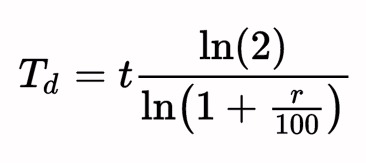
Doubling time refers to the duration needed for a quantity to double in size, a characteristic of exponential growth. By 2020, substantial data revealed that the doubling time for certain anthropogenic climate impacts had decreased significantly, shifting from 100 years to merely 10 years. For instance, the rate of sea level rise has surged from approximately 1.5 millimeters per year to over 3 millimeters. This trend suggests that the doubling period is likely to further contract, heightening the prospect of sea levels ascending at a rate of one foot per year by 2050.

T_{d}=t \frac{\ln (2)}{\ln \left(1+\frac{r}{100}\right)}

T_{d} = doubling time
t = time
{r} = growth rate

Though the rate of change in climate disasters’ intensity, duration, and likelihood vary according to the type of extreme weather, a “rule-of-thumb” can be derived from the Canada wildfires of 2023. The World Weather Attribution Organization found, “Climate change made the cumulative severity of Quebec’s 2023 fire season to the end of July around 50% more intense, and seasons of this severity at least seven times more likely to occur.”

50% more intense
7 x more likely

These numbers may be similar in other catastrophes like atmospheric rivers, hurricanes, heat waves, droughts, floods, tornadoes, and sea level rise.

If the doubling time remains at 10 years, we could see extreme events 100% more intense and/or longer in duration, as well as, 14 times more likely to occur. As mentioned above, we expect the doubling time to be reduced. If the doubling time is 5 years, in ten years we could see 200% more intense and longer extreme weather events being 28 times more likely to occur.

2024 Update
Global average sea level rose by about 0.3 inches (0.76 centimeters) from 2022 to 2023, according to a NASA-led analysis. When we authored this paper in 2023, we could not have foreseen the swift acceleration of this trend. Initially projected to double over a span of 100 years, the rate of sea level rise dramatically escalated, shortening the doubling period to a mere 10 years by 2020. Shockingly, recent observations suggest that this doubling period has further compressed to just 2 years. It is imperative to acknowledge and address this concerning trend, hoping it is not a foreboding indication of a new norm but rather an anomaly.

From the album “How to Serve Man” by The Beatless Sense Mongers

MegaEpix Enormous

A song about The Human Induced Climate Change Experiment

bookmark_borderValue Men-You

[Intro]
What’s on the value menu?
Is it me, is it you?
Could be, it is we.

[Verse 1]
How’s the menu
Any good values?
Depends on your point-of-view
[Bridge]
If it’s your ‘deal’
Or you’re the meal

[Chorus]
What’s on the value menu?
Is it me, is it you?
Could be, it is we
(We’re gonna see)
(Immediately)

[Break]
We’re about to see
Definitively

[Verse 2]
What’s on menu
Or, is it do
To your purview
[Bridge]
If it’s your ‘deal’
Or you’re the meal

[Chorus]
What’s on the value menu?
Is it me, is it you?
Could be, it is we
(We’re gonna see)
(Immediately)

[Bridge]
The value meal
It’s a big deal
What once was real
Now cannot feel
Just bones and meat
Knocked off their feet

[Chorus]
What’s on the value menu?
Is it me, is it you?
Could be, it is we
(We’re gonna see)
(Immediately)

[Outro]
What’s on the value menu?
Is it me, is it you?
Could be, it is we.

A SCIENCE NOTE
As climate change accelerates food and water insecurity are becoming serious threats to existence. What are you going to do?

From the album “How to Serve Man” by The Beatless Sense Mongers

MegaEpix Enormous

A song about The Human Induced Climate Change Experiment

bookmark_borderÀ LA Carte

[Intro]
À la carte
With a carrot
Care to share it?

[Verse 1]
À la carte
With a lung
With a heart
À la carte
Swan song sung
Where to start
[Bridge]
How ’bout with a tart?
Come on, do your part!
(An eye for an eye)
How about a breast with the rest?
(An I for an I)

[Chorus]
Whatever dish
That you wish
Your desire
Is their dire

[Verse 2]
À la carte
Pick a brain
Tear apart
À la carte
The only strain
Where to start
[Bridge]
How ’bout with a tart?
Come on, do your part!
(An eye for an eye)
How about a breast with the rest?
(An I for an I)

[Chorus]
Whatever dish
That you wish
Your desire
Is their dire

[Outro]
Where to start
Give from your heart?
Come on, do your part!

A SCIENCE NOTE
Humans will experience greater loss and damage to life and quality of life from air pollution, decreasing supply of potable water, extreme weather events, disease, and other adverse health outcomes. The greatest short term climate change risk to human health is deadly humid heat (wet-bulb temperature).

The greatest health risk from climate change to those alive today is the increased moisture content in the air (relative humidity) combined with the increased temperatures. Climate change and rising temperatures significantly increase the humidity in the atmosphere due to the relationship between temperature and the air’s capacity to hold moisture. The Clausius-Clapeyron equation describes this relationship, indicating that for every 1C (1.8F) increase in temperature, the air can hold about 7% more water vapor.

When the “wet bulb” temperature reaches a temperature too hot for humans to sweat, it is referred to as the “wet-bulb temperature threshold” or simply the “wet-bulb limit.” This limit represents the maximum temperature at which evaporation from a wet surface, such as the skin, can effectively cool the human body through sweating. Beyond this threshold, the body’s ability to regulate its internal temperature becomes severely compromised, posing a significant risk to human health and well-being.

When the temperature exceeds the wet-bulb temperature threshold, the human body faces significant risks of heat-related illnesses and potentially fatal heatstroke. Under such conditions, the body’s ability to cool itself through perspiration is severely compromised, leading to a rapid rise in core body temperature. As a result, individuals may experience symptoms such as dizziness, fatigue, rapid heartbeat, nausea, and confusion. Without intervention, heat exhaustion can progress to heatstroke, a life-threatening condition characterized by a core body temperature above 40°C (104℉), accompanied by neurological symptoms such as seizures, delirium, and loss of consciousness. Heatstroke requires immediate medical attention and can be fatal if left untreated.

Exposure to temperatures exceeding the wet-bulb threshold poses a grave risk to human health and highlights the urgent need for effective measures to mitigate and adapt to the impacts of climate change, which can exacerbate extreme heat events and increase the frequency of conditions exceeding this critical threshold.
* Our climate model uses chaos theory in an attempt to adequately account for humans and forecasts a global average temperature increase of 9 degrees Celsius above pre-industrial levels. Everybody has the responsibility not to pollute. There are plenty of things you can do to help save the planet. Stop using fossil fuels. Consume less. Love more.

From the album “How to Serve Man” by The Beatless Sense Mongers

MegaEpix Enormous

A song about The Human Induced Climate Change Experiment

bookmark_borderHow to Serve Man

How to Serve Man: Bass-ic Recipe

[Intro]
The masses spew gasses
Turning up the heat
In self-defeat

[Verse 1]
Look and see
The recipe
We’re about to cook
Could it be
A tragedy
Written in the book

[Bridge]
How to serve Man
We followed our plan
The masses spew gasses
Turning up the heat
In self-defeat

[Chorus]
Spoiled human
Been left to rot
Boiled human
Sure hits the spot

[Instrumental, Bass Solo]

[Verse 2]
Oh, woe is me
It’s overdone
Could it be
We were too dumb?

[Bridge]
How to serve Man
We followed our plan
The masses spew gasses
Turning up the heat
In self-defeat

[Chorus]
Spoiled human
Been left to rot
Boiled human
Sure hits the spot

[Bridge]
How to serve Man
We followed our plan
The masses spew gasses
Turning up the heat
In self-defeat

[Outro]
Spoiled human
Been left to rot
Boiled human
Sure hits the spot

A SCIENCE NOTE

Human-induced climate change is a dynamic component of an intricate and unordered system, as per chaos theory. This implies that global warming is accelerating exponentially in a complex manner. Over the period from 1992 to 2023, we have presented compelling evidence, proposed remedies to mitigate climate change, and amassed valuable information through the engagement of millions with this climate model. Your participation has been invaluable. The incontrovertible data underscores that human-induced climate change is rapidly deteriorating our habitat.

This climate model/experiment employs chaos theory to comprehensively consider human impacts, projecting a potential global average temperature increase of 9°C above pre-industrial levels. Global warming results from elevated thermal energy within the climate system, which includes various interconnected subsystems. Chaos theory highlights the intricate and nonlinear nature of these dynamic systems. Previous climate models inadequately incorporated “social-ecological systems,” as human involvement was not a significant factor in past climate changes.

Regrettably, the United States ranks among the least prepared countries globally, with the highest percentage of climate deniers. Politicians exacerbate the problem by hindering efforts against climate change. The Republican Party dismisses it as a manufactured crisis and plans to increase fossil fuel production. Political extremists asserting that the climate crisis is manufactured employ an ironic term, considering that human manufacturing activities are the primary driver of climate change.

Under President Biden, the United States continues to be the world’s largest producer of oil, including crude oil, natural gas liquids, and other petroleum products. Both political parties have concurred to allocate unlimited emergency funding for climate disasters instead of proactively preventing them. In 2023, the U.S. witnessed a record number of climate disasters exceeding one billion dollars each, totaling 28 separate weather and climate-related events.

In June 2024, the Supreme Court significantly expanded its authority and severely curtailed the Environmental Protection Agency’s (EPA) ability to enforce environmental protection laws. This ruling represents a dramatic shift in the balance of power, undermining decades of regulatory progress aimed at mitigating environmental damage and climate change. The court’s decision essentially nullifies the EPA’s mandate to regulate emissions and enforce compliance with existing environmental standards.

This judicial overreach is viewed by many as an act of arrogance and ignorance, resulting in a scenario where “worst-case” predictions for climate change have become the “best-case” expectations. The ramifications of this decision are dire, prompting a revision of climate models to reflect a much grimmer outlook. The new projections indicate a potential maximum global temperature increase of 9°C within this century, a stark rise from the previously estimated 4°C over the next millennium.

Such an unprecedented increase in global temperatures would push Earth toward a wet-bulb temperature threshold that is incompatible with human life. Wet-bulb temperature, which combines heat and humidity, represents a critical limit beyond which the human body can no longer effectively cool itself through perspiration, leading to potentially fatal heat stress.

From the album “How to Serve Man” by The Beatless Sense Mongers

MegaEpix Enormous

A song about The Human Induced Climate Change Experiment

bookmark_borderShift in the Balance of Power

[Intro]
Shift
In the balance of power
Rift
Between people and their ivory tower

[Verse 1]
Call it democracy fudge
I mean, you be the judge
The Supreme Court’s overreach
The republic has a breach

[Bridge]
Shift
In the balance of power
Rift
Between people and their ivory tower

[Chorus]
Opened flood gates
On environmental damage
Injustice negates
Will Man manage?

[Verse 2]
Watch the climate fail
Justices should be in jail
Living in the age
Of our damage

[Bridge]
Shift
In the balance of power
Rift
With their ivory tower

[Chorus]
Opened flood gates
On environmental damage
Injustice negates
Will Man manage?

[Bridge]
Shift
In the balance of power
Rift
With their ivory tower

[Outro]
Shift
In the balance of power
Rift
With their ivory tower

AN IMPORTANT NOTE

In June 2024, the Supreme Court significantly expanded its authority and severely curtailed the Environmental Protection Agency’s (EPA) ability to enforce environmental protection laws. This ruling represents a dramatic shift in the balance of power, undermining decades of regulatory progress aimed at mitigating environmental damage and climate change. The court’s decision essentially nullifies the EPA’s mandate to regulate emissions and enforce compliance with existing environmental standards.

This judicial overreach is viewed by many as an act of arrogance and ignorance, resulting in a scenario where “worst-case” predictions for climate change have become the “best-case” expectations. The ramifications of this decision are dire, prompting a revision of climate models to reflect a much grimmer outlook. The new projections indicate a potential maximum global temperature increase of 9°C within this century, a stark rise from the previously estimated 4°C over the next millennium.

Such an unprecedented increase in global temperatures would push Earth toward a wet-bulb temperature threshold that is incompatible with human life. Wet-bulb temperature, which combines heat and humidity, represents a critical limit beyond which the human body can no longer effectively cool itself through perspiration, leading to potentially fatal heat stress.

What Can I Do? There are numerous actions you can take to contribute to saving the planet. Each person bears the responsibility to minimize pollution, discontinue the use of fossil fuels, reduce consumption, and foster a culture of love and care. The Butterfly Effect illustrates that a small change in one area can lead to significant alterations in conditions anywhere on the globe. Hence, the frequently heard statement that a fluttering butterfly in China can cause a hurricane in the Atlantic. Be a butterfly and positively impact the world.

From the album “Free Freedom” by The Beatless Sense Mongers

MegaEpix Enormous

A song about The Human Induced Climate Change Experiment

bookmark_borderFree Freedom

[Intro]
Lady Justice
Has been robbed blind
Sadly, this just is
The time of unkind

[Verse 1]
Our Lady held hostage
In the age
Of no logic
Sure is sick

[Bridge]
No humanity
Just insanity

[Chorus]
Let our Lady go
A travesty
Don’t want to know
Set our Lady free
Stop the insanity
Let our spirits glow

[Verse 2]
Our Lady (in a cage)
The crowd (in a rage)
Freedom (came undone)
Two sides (no won)
No one….

[Bridge]
No humanity
Just insanity

[Chorus]
Let our Lady go
A travesty
Don’t want to know
Set our Lady free
Stop the insanity
Let our spirits glow

[Bridge]
Lady Justice
Has been robbed blind
Sadly, this just is
The time of unkind
Can we sedate
Hate
(Remind the world of love)
(Of love)

[Outro]
Can we sedate
Hate
(Remind the world of love)
(Of love)

A SCIENCE NOTE

Regrettably, the United States ranks among the least prepared countries globally, with the highest percentage of climate deniers. Politicians exacerbate the problem by hindering efforts against climate change. The Republican Party dismisses it as a manufactured crisis and plans to increase fossil fuel production. Political extremists asserting that the climate crisis is manufactured employ an ironic term, considering that human manufacturing activities are the primary driver of climate change.

Under President Biden, the United States continues to be the world’s largest producer of oil, including crude oil, natural gas liquids, and other petroleum products. Both political parties have concurred to allocate unlimited emergency funding for climate disasters instead of proactively preventing them. In 2023, the U.S. witnessed a record number of climate disasters exceeding one billion dollars each, totaling 28 separate weather and climate-related events.

In June 2024, the Supreme Court significantly expanded its authority and severely curtailed the Environmental Protection Agency’s (EPA) ability to enforce environmental protection laws. This ruling represents a dramatic shift in the balance of power, undermining decades of regulatory progress aimed at mitigating environmental damage and climate change. The court’s decision essentially nullifies the EPA’s mandate to regulate emissions and enforce compliance with existing environmental standards.

This judicial overreach is viewed by many as an act of arrogance and ignorance, resulting in a scenario where “worst-case” predictions for climate change have become the “best-case” expectations. The ramifications of this decision are dire, prompting a revision of climate models to reflect a much grimmer outlook. The new projections indicate a potential maximum global temperature increase of 9°C within this century, a stark rise from the previously estimated 4°C over the next millennium.

Such an unprecedented increase in global temperatures would push Earth toward a wet-bulb temperature threshold that is incompatible with human life. Wet-bulb temperature, which combines heat and humidity, represents a critical limit beyond which the human body can no longer effectively cool itself through perspiration, leading to potentially fatal heat stress.

From the album “Free Freedom” by The Beatless Sense Mongers

MegaEpix Enormous

bookmark_borderBozo the Rodeo Clown

[Intro]
Oh, know
Just another bozo

[Verse 1]
Bozo, the rodeo clown
Seems to come to every town
Brings a frown when he throws down
Bozo, the rodeo clown

[Bridge]
Plural in the rural
Conservative
More take, less give

[Chorus]
Are you more important
’cause you represent ignorance
With arrogance
One brow primate (irate)
Destroys the climate
(At a rapid rate)

[Verse 2]
Bozo, the rodeo clown
Denial breakdown
Defile shakedown
Bozo, the rodeo clown

[Bridge]
Plural in the rural
Conservative
More take, less give

[Chorus]
Are you more important
’cause you represent ignorance
With arrogance
One brow primate (irate)
Destroys the climate
(At a rapid rate)

[Breakdown]
[Instrumental]
Oh, know (no know)
Just another bozo
Oh, no (no, no)
Puttin’ on a sh, show
Of woe (woe, woe)
Just another bozo
Thought processes… slow, oh, oh
Oh, no (no, no)
Woah (woe, woe)

[Outro]
Oh, know (no know)
Just another bozo
Oh, no (no, no)
Just another bozo

A SCIENCE NOTE
Regrettably, the United States ranks among the least prepared countries globally, with the highest percentage of climate deniers. Politicians hinder the fight against climate change exacerbating the problem. The Republican party dismisses it as a manufactured crisis and plans to increase fossil fuel production. Political extremists asserting that the climate crisis is manufactured employ an ironic term, considering that human manufacturing activities are the primary driver of climate change. Under President Biden, the United States has continued to be the world’s largest producer of oil, including crude oil, natural gas liquids, and other petroleum products. Both political parties have concurred to allocate unlimited emergency funding for climate disasters instead of proactively preventing them. Last year, the US witnessed a record number of over a billion-dollar climate disasters, totaling 28 separate weather and climate-related events. It is due to this arrogance and ignorance that “worst-case scenarios” are now “best-case scenarios” for the acceleration of climate change.

Many conservative politicians in rural areas deny the existence or severity of climate change, dismissing it as a hoax or exaggerated. This denial stems from skepticism about scientific consensus and the influence of fossil fuel industries. The combination of climate change denial, legislative actions that favor fossil fuels, cultural and economic priorities, and public opinion in conservative, rural areas of the USA has significantly hindered progress in the fight against climate change. Addressing these challenges requires a multifaceted approach, including education, economic transition plans for affected communities, and bipartisan cooperation to develop sustainable solutions.

From the album “Free Freedom” by The Beatless Sense Mongers

MegaEpix Enormous

A song about The Human Induced Climate Change Experiment

bookmark_borderPronounced: Climate Change

[Intro]
Pronounced: Climate Change
Pronounced climate change
You say — climate change
Big way — pronounced
Pronounced

[Verse 1]
Mum’s the word
Cats got their tongue
Sums absurd (some’s? all’s absurd)
Forgot their young

[Chorus]
Tisk, tisk
The most significant risk
Can’t they even say
Change is underway?
[Breakdown]
Pronounced: Climate Change
Pronounced climate change
You say — climate change
Big way — pronounced
Pronounced

[Bridge]
The biggest threat
We’re sure to regret
There’s no (nada, zero, zip)
Satisfaction
In our lack of action

[Verse 2]
The primate’s climate
Overate
Mass consumption
(Overrate)
Gumption malfunction

[Chorus]
Tisk, tisk
The most significant risk
Can’t they even say
Change is underway?

[Bridge]
The biggest threat
We’re sure to regret
There’s no (nada, zero, zip)
Satisfaction
In our lack of action

[Outro]
Pronounced: Climate Change
Pronounced climate change
You say — climate change
Big way — pronounced
Pronounced

AN URGENT POLITICAL AND SCIENCE NOTE
A song about the Presidential debate in which neither candidate even mentioned the most severe risk to freedom in the USA — climate change.  Regrettably, the United States ranks among the least prepared countries globally, with the highest percentage of climate deniers. Politicians hinder the fight against climate change exacerbating the problem. The Republican party dismisses it as a manufactured crisis and plans to increase fossil fuel production. Political extremists asserting that the climate crisis is manufactured employ an ironic term, considering that human manufacturing activities are the primary driver of climate change. Under President Biden, the United States has continued to be the world’s largest producer of oil, including crude oil, natural gas liquids, and other petroleum products. Both political parties have concurred to allocate unlimited emergency funding for climate disasters instead of proactively preventing them. Last year, the US witnessed a record number of over a billion-dollar climate disasters, totaling 28 separate weather and climate-related events. It is due to this arrogance and ignorance that “worst-case scenarios” are now “best-case scenarios” for the acceleration of climate change. These factors have altered our climate model, shifting the projected maximum temperature rise from 4 degrees Celsius over the next millennium to a probable increase of 9 degrees Celsius this century. A 9-degree Celsius increase would bring the Earth close to a wet-bulb temperature incapable of sustaining human life.

From the album “Hold the Onions” by The Beatless Sense Mongers

MegaEpix Enormous

A song about The Human Induced Climate Change Experiment

bookmark_borderUnder My Administration

[Intro]
Divisible
Divisive
Indeed (In deed)
One nation
Revelation

[Verse 1]
Under my administration
One divided nation
Freedom’s equilibrium
Has gone numb (Feed dumb)
[Bridge]
Free dumb rings
(Ding-a-ling)
[Instrumental]

[Chorus]
One nation
Under water
Cursed, you did
Your son and daughter
[Breakdown]
[Instrumental]
One nation’s
Damnation
Quid (pro quo)
You know!

[Verse 2]
Under my administration
Head backward, before stagnation
Tryin’ to bring
On The End
Black angel, sing!
(Bring) on the End
[Bridge]
Freedom’s equilibrium
Has gone numb (Feed dumb)
Free dumb rings
(Ding-a-ling)

[Breakdown]
[Outro]
What we did
Quid (pro quo)
You know!

A SCIENCE NOTE
Chaos theory underscores the intricate and nonlinear nature of dynamic systems. Previous climate models have inadequately incorporated “social-ecological systems” as human involvement was not a significant factor in past climate changes. Regrettably, the United States ranks among the least prepared countries globally, with the highest percentage of climate deniers. Politicians hinder the fight against climate change exacerbating the problem. The Republican party dismisses it as a manufactured crisis and plans to increase fossil fuel production. Political extremists asserting that the climate crisis is manufactured employ an ironic term, considering that human manufacturing activities are the primary driver of climate change. Under President Biden, the United States has continued to be the world’s largest producer of oil, including crude oil, natural gas liquids, and other petroleum products. Both political parties have concurred to allocate unlimited emergency funding for climate disasters instead of proactively preventing them. Last year, the US witnessed a record number of over a billion-dollar climate disasters, totaling 28 separate weather and climate-related events. It is due to this arrogance and ignorance that “worst-case scenarios” are now “best-case scenarios” for the acceleration of climate change. These factors have altered our climate model, shifting the projected maximum temperature rise from 4 degrees Celsius over the next millennium to a probable increase of 9 degrees Celsius this century. A 9-degree Celsius increase would bring the Earth close to a wet-bulb temperature incapable of sustaining human life.

From the album “Free Freedom” by The Beatless Sense Mongers

MegaEpix Enormous

A song about The Human Induced Climate Change Experiment